Understanding Farm Households’ Tolerance Toward Asian Elephants in China: Evidence from 873 Households in Yunnan Province



Simple Summary
Abstract
1. Introduction
2. Materials and Methods
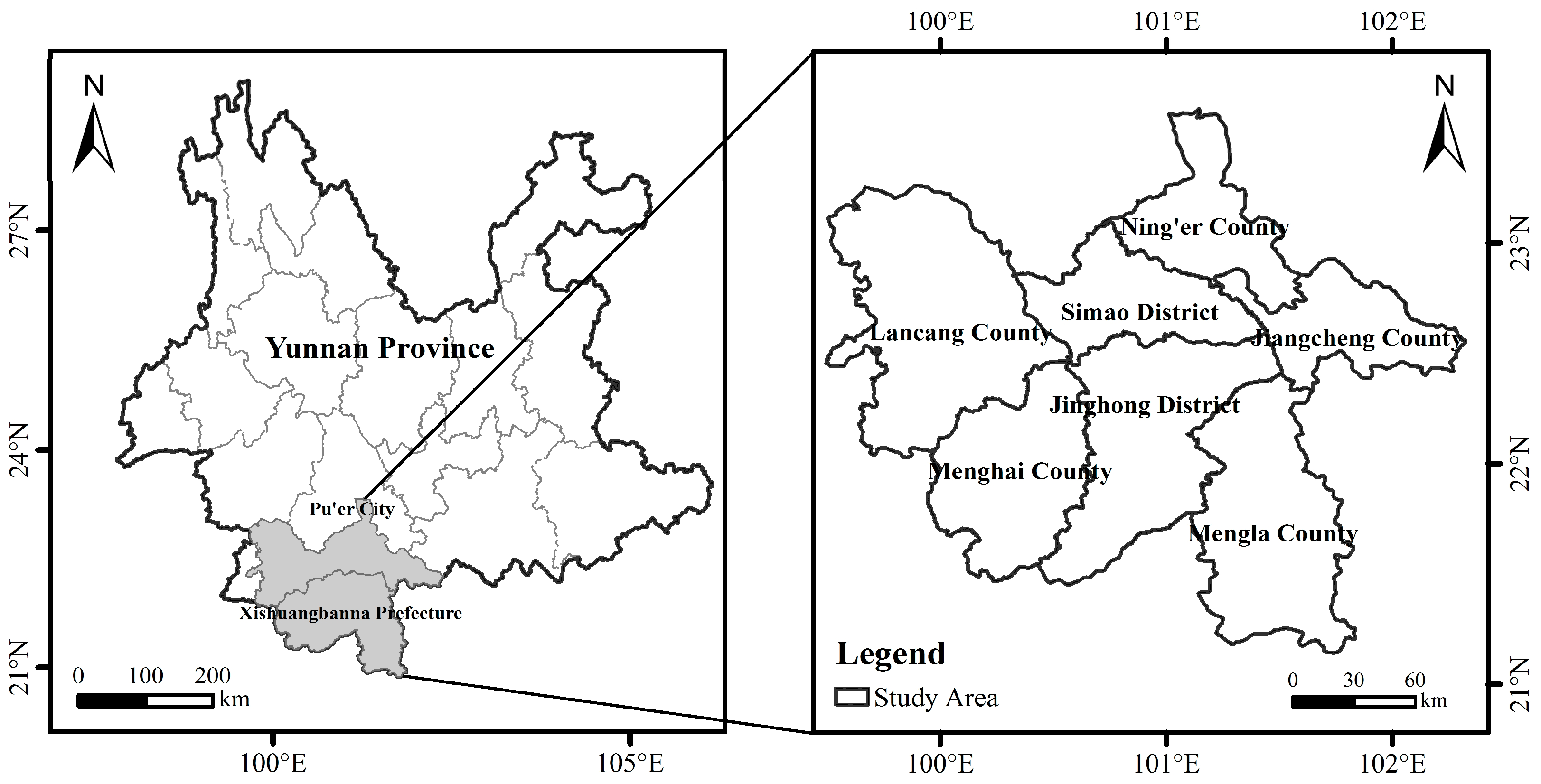
2.1. Study Area
2.2. Data Collection
2.3. Variable Selection
2.4. Research Methods
3. Results
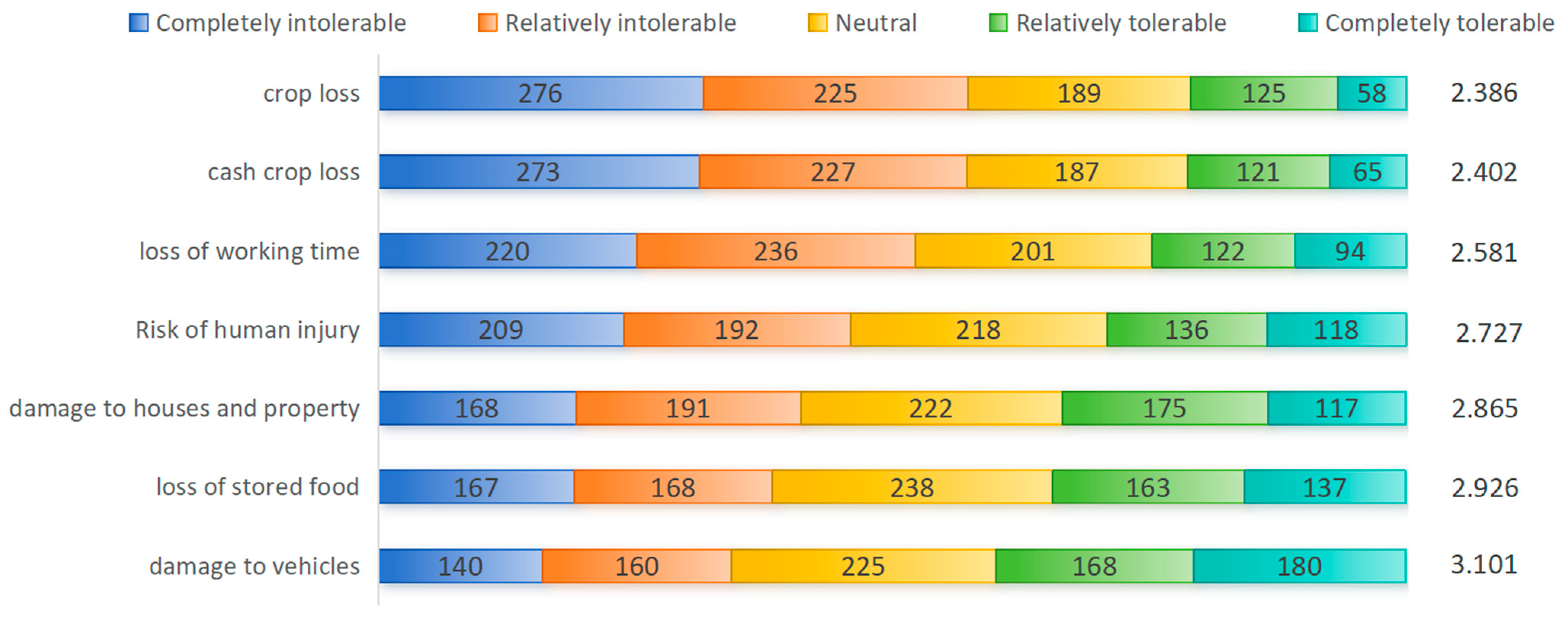
3.1. Tolerance Toward Different Types of Elephant-Related Damage
3.2. Farm Households’ Tolerance Across Other Dimensions
3.3. One-Way ANOVA of Tolerance Based on Individual and Household Characteristics
3.3.1. Gender Differences
3.3.2. Age Differences
3.3.3. Education Level Differences
3.3.4. Ethnic Differences
3.3.5. Occupational Differences
3.3.6. Regional Differences
3.3.7. Differences by Cultivated Land Area
3.3.8. Differences by Household Income
3.3.9. Differences by Agricultural Dependence
3.4. ANCOVA of Tolerance Based on Individual and Household Characteristics
4. Discussion
4.1. Tolerance Gradient Across Types of Elephant-Related Damage and Its Livelihood Relevance
4.2. Key Dimensions of Tolerance in Human–Elephant Coexistence
4.3. Differences in Tolerance Across Socio-Demographic and Household Characteristics
4.4. Research Limitations
5. Conclusions
Author Contributions
Funding
Institutional Review Board Statement
Data Availability Statement
Acknowledgments
Conflicts of Interest
Appendix A

| Variables | Reference Group | Coefficient | Standard Error | p Value |
|---|---|---|---|---|
| Han | Other ethnic minorities | −0.253 | 0.090 | 0.005 |
| Dai | 0.849 | 0.083 | 0.000 | |
| Hani | 0.153 | 0.083 | 0.065 | |
| Lahu | 0.297 | 0.109 | 0.007 | |
| Female | Male | −0.289 | 0.062 | 0.000 |
| Primary school or below | College or above | −0.168 | 0.156 | 0.280 |
| Junior high school | −0.193 | 0.155 | 0.211 | |
| Senior high school | −0.190 | 0.181 | 0.297 | |
| Other occupations | Wildlife protection-related occupations | −0.521 | 0.083 | 0.000 |
| Pu’er City | Xishuangbanna Prefecture | 0.431 | 0.055 | 0.000 |
| Age | −0.024 | 0.028 | 0.390 | |
| Cultivated Land Area | −0.060 | 0.020 | 0.003 | |
| Agricultural Dependence | −0.066 | 0.020 | 0.001 | |
| Household Income | 0.045 | 0.022 | 0.040 |
| Comparison Group | Comparison Group | Mean Difference | Standard Error | p Value | Sig. |
|---|---|---|---|---|---|
| Han | Dai | −1.103 | 0.082 | 0.000 | Yes |
| Hani | −0.407 | 0.082 | 0.000 | Yes | |
| Lahu | −0.550 | 0.107 | 0.000 | Yes | |
| Other ethnic minorities | −0.253 | 0.090 | 0.048 | Yes | |
| Dai | Hani | 0.696 | 0.075 | 0.000 | Yes |
| Lahu | 0.553 | 0.103 | 0.000 | Yes | |
| Other ethnic minorities | 0.849 | 0.083 | 0.000 | Yes | |
| Hani | Lahu | −0.143 | 0.103 | 1.000 | No |
| Other ethnic minorities | 0.153 | 0.083 | 0.651 | No | |
| Lahu | Other ethnic minorities | 0.297 | 0.109 | 0.068 | No |
References
- Campos-Arceiz, A.; Blake, S. Megagardeners of the Forest—The Role of Elephants in Seed Dispersal. Acta Oecologica 2011, 37, 542–553. [Google Scholar] [CrossRef]
- Fernando, P.; De Silva, M.K.C.R.; Jayasinghe, L.K.A.; Janaka, H.K.; Pastorini, J. First Country-Wide Survey of the Endangered Asian Elephant: Towards Better Conservation and Management in Sri Lanka. Oryx 2021, 55, 46–55. [Google Scholar] [CrossRef]
- Thant, Z.M.; Leimgruber, P.; Williams, A.C.; Oo, Z.M.; Roskaft, E.; May, R. Factors Influencing the Habitat Suitability of Wild Asian Elephants and Their Implications for Human-Elephant Conflict in Myanmar. Glob. Ecol. Conserv. 2023, 43, e02468. [Google Scholar] [CrossRef]
- Wan, X.; Jiang, G.; Yan, C.; He, F.; Wen, R.; Gu, J.; Li, X.; Ma, J.; Stenseth, N.C.; Zhang, Z. Historical Records Reveal the Distinctive Associations of Human Disturbance and Extreme Climate Change with Local Extinction of Mammals. Proc. Natl. Acad. Sci. USA 2019, 116, 19001–19008. [Google Scholar] [CrossRef]
- Bowers, M.J.; Corde, S.C.; Von Hagen, L.; Kasaine, S.; Amakobe, B.; Githiru, M.; Wambugu, G.M.; Mutwiwa, U.N.; Schulte, B.A. Climate-Smart Agriculture and Human–Elephant Conflict in Southern Kenya: Intercropping with Use of a Metal Strip Deterrent Fence. Afr. J. Ecol. 2025, 63, e70051. [Google Scholar] [CrossRef]
- Xu, B.; Zhang, X.; Zhang, J.; Fan, H. Reciprocal Regulation between Rural Settlement Expansion and Human-Elephant Conflict in China’s Wild Elephant Range. Geogr. Sustain. 2025, 6, 100238. [Google Scholar] [CrossRef]
- Guarnieri, M.; Kumaishi, G.; Brock, C.; Chatterjee, M.; Fabiano, E.; Katrak-Adefowora, R.; Larsen, A.; Lockmann, T.M.; Roehrdanz, P.R. Effects of Climate, Land Use, and Human Population Change on Human–Elephant Conflict Risk in Africa and Asia. Proc. Natl. Acad. Sci. USA 2024, 121, e2312569121. [Google Scholar] [CrossRef]
- Wenborn, M.J.; Katjimbari, R.; Tjiseua, J.; Muheue, K.; Tjimuine, U.; Muundjua, S.T.; Svensson, M.S.; Nijman, V. Assessment of Mitigation of Human–Elephant Conflict in the Highlands of Northwest Namibia. J. Environ. Dev. 2025, 34, 684–706. [Google Scholar] [CrossRef]
- Serenari, C.; Othman, N.B.; Yadav, K.; Rubino, E.; Goossens, B. Investigating Blame for Human-Wildlife Conflict: Reason Conditions for Human-Elephant Conflict in Borneo. Trop. Conserv. Sci. 2025, 18, 19400829251375307. [Google Scholar] [CrossRef]
- Supanta, J.; Poolkhet, C.; Yindee, M.; Manatchaiworakul, W.; Wongtawan, T. Human–Elephant Conflict in Thailand over the Past Decade (2014–2023): Occurrence, Geographical Distribution, and Temporal Trends. Animals 2025, 15, 1304. [Google Scholar] [CrossRef]
- Köpke, S.; Withanachchi, S.S.; Chinthaka Perera, E.N.; Withanachchi, C.R.; Gamage, D.U.; Nissanka, T.S.; Warapitiya, C.C.; Nissanka, B.M.; Ranasinghe, N.N.; Senarathna, C.D.; et al. Factors Driving Human–Elephant Conflict: Statistical Assessment of Vulnerability and Implications for Wildlife Conflict Management in Sri Lanka. Biodivers. Conserv. 2024, 33, 3075–3101. [Google Scholar] [CrossRef]
- Gunawansa, T.D.; Perera, K.; Apan, A.; Hettiarachchi, N.K. The Human-Elephant Conflict in Sri Lanka: History and Present Status. Biodivers. Conserv. 2023, 32, 3025–3052. [Google Scholar] [CrossRef]
- Wong, E.P.; Campos-Arceiz, A.; Zulaikha, N.; Chackrapani, P.; Quilter, A.G.; de la Torre, J.A.; Solana-Mena, A.; Tan, W.H.; Ong, L.; Rusli, M.A.; et al. Living with Elephants: Evidence-Based Planning to Conserve Wild Elephants in a Megadiverse South East Asian Country. Front. Conserv. Sci. 2021, 2, 682590. [Google Scholar] [CrossRef]
- Zhang, Q.; Hu, J.; Graybill, S.A.; Moody, A.; Bista, R.; Bilsborrow, R.E.; Song, C. Crop-Raiding by Wildlife and Cropland Abandonment as Feedback from Nature-Based Solutions: Lessons from Case Studies in China and Nepal. Environ. Res. Lett. 2024, 19, 124029. [Google Scholar] [CrossRef]
- Exposito-Granados, M.; Castro, A.J.; Lozano, J.; Aznar-Sanchez, J.A.; Carter, N.H.; Requena-Mullor, J.M.; Malo, A.F.; Olszanska, A.; Morales-Reyes, Z.; Moleon, M.; et al. Human-Carnivore Relations: Conflicts, Tolerance and Coexistence in the American West. Environ. Res. Lett. 2019, 14, 123005. [Google Scholar] [CrossRef]
- Fernando, P.; Pastorini, J. Whither the Science in Wildlife Management? Anim. Conserv. 2021, 24, 735–737. [Google Scholar] [CrossRef]
- DeMotts, R.; Hoon, P. Whose Elephants? Conserving, Compensating, and Competing in Northern Botswana. Soc. Nat. Resour. 2012, 25, 837–851. [Google Scholar] [CrossRef]
- Frank, B. Human-Wildlife Conflicts and the Need to Include Tolerance and Coexistence: An Introductory Comment. Soc. Nat. Resour. 2016, 29, 738–743. [Google Scholar] [CrossRef]
- Bhatia, S.; Redpath, S.M.; Suryawanshi, K.; Mishra, C. Beyond Conflict: Exploring the Spectrum of Human–Wildlife Interactions and Their Underlying Mechanisms. Oryx 2020, 54, 621–628. [Google Scholar] [CrossRef]
- Whitehouse-Tedd, K.; Abell, J.; Dunn, A.K. Evaluation of the Use of Psychometric Scales in Human-Wildlife Interaction Research to Determine Attitudes and Tolerance toward Wildlife. Conserv. Biol. 2021, 35, 533–547. [Google Scholar] [CrossRef]
- Bruskotter, J.T.; Singh, A.; Fulton, D.C.; Slagle, K. Assessing Tolerance for Wildlife: Clarifying Relations between Concepts and Measures. Hum. Dimens. Wildl. 2015, 20, 255–270. [Google Scholar] [CrossRef]
- Bruskotter, J.T.; Wilson, R.S. Determining Where the Wild Things Will Be: Using Psychological Theory to Find Tolerance for Large Carnivores. Conserv. Lett. 2014, 7, 158–165. [Google Scholar] [CrossRef]
- McLean, H.E.; Teel, T.L.; Bright, A.D.; Jaebker, L.M.; Tomecek, J.M.; Frank, M.G.; Connally, R.L.; Shwiff, S.A.; Carlisle, K.M. Understanding Tolerance for an Invasive Species: An Investigation of Hunter Acceptance Capacity for Wild Pigs (Sus scrofa) in Texas. J. Environ. Manag. 2021, 285, 112143. [Google Scholar] [CrossRef]
- Virtanen, P.; Macandza, V.; Goba, P.; Mourinho, J.; Roque, D.; Mamugy, F.; Langa, B. Assessing Tolerance for Wildlife: Human-Elephant Conflict in Chimanimani, Mozambique. Hum. Dimens. Wildl. 2021, 26, 411–428. [Google Scholar] [CrossRef]
- Murphy, K.J.; Kenny, U.; Ciuti, S.; Byrne, A.W. Understanding Deer Management Dilemmas: A Mixed Methods Approach to Understand Diverse Stakeholder Values in Human-Wildlife Conflicts. Eur. J. Wildl. Res. 2025, 71, 78. [Google Scholar] [CrossRef]
- Kansky, R.; Knight, A.T. Key Factors Driving Attitudes towards Large Mammals in Conflict with Humans. Biol. Conserv. 2014, 179, 93–105. [Google Scholar] [CrossRef]
- Decker, D.; Purdy, K. Toward a Concept of Wildlife Acceptance Capacity in Wildlife Management. Wildl. Soc. Bull. 1988, 16, 53–57. [Google Scholar]
- Delie, J.; Needham, M.D.; Biedenweg, K. Modeling Cognitive Antecedents of Tolerance for Black Bears: The Roles of Direct Experience, Knowledge, and Risk Perceptions. Hum. Dimens. Wildl. 2023, 28, 564–584. [Google Scholar] [CrossRef]
- Glikman, J.A.; Frank, B.; Ruppert, K.A.; Knox, J.; Sponarski, C.C.; Metcalf, E.C.; Metcalf, A.L.; Marchini, S. Coexisting with Different Human-Wildlife Coexistence Perspectives. Front. Conserv. Sci. 2021, 2, 703174. [Google Scholar] [CrossRef]
- Lecuyer, L.; Calmé, S.; Schmook, B.; White, R.M. Conservation Conflict Hotspots: Mapping Impacts, Risk Perception and Tolerance for Sustainable Conservation Management. Front. Conserv. Sci. 2022, 3, 909908. [Google Scholar] [CrossRef]
- Kansky, R.; Kidd, M.; Fischer, J. Understanding Drivers of Human Tolerance towards Mammals in a Mixed-Use Transfrontier Conservation Area in Southern Africa. Biol. Conserv. 2021, 254, 108947. [Google Scholar] [CrossRef]
- Marino, F.; Kansky, R.; Shivji, I.; Di Croce, A.; Ciucci, P.; Knight, A.T. Understanding Drivers of Human Tolerance to Gray Wolves and Brown Bears as a Strategy to Improve Landholder-Carnivore Coexistence. Conserv. Sci. Pract. 2021, 3, e265. [Google Scholar] [CrossRef]
- Zhang, H.; Guo, S.; Ma, L.; Su, K.; Lobora, A.; Hou, Y.; Wen, Y. Living with Elephants: Analyzing Commonalities and Differences in Human-Elephant Conflicts in China and Tanzania Based on Residents’ Perspectives. Glob. Ecol. Conserv. 2024, 53, e03034. [Google Scholar] [CrossRef]
- Wang, J.; Chen, Y.; Sun, Y.; Lyu, Z.; Shi, K. Inferring Human-Elephant Coexistence Based on Characteristics of Human-Elephant Interactions in Nangunhe of Yunnan, China. Chin. Geogr. Sci. 2023, 33, 363–376. [Google Scholar] [CrossRef]
- Chen, Y.; Marino, J.; Chen, Y.; Tao, Q.; Sullivan, C.D.; Shi, K.; Macdonald, D.W. Predicting Hotspots of Human-Elephant Conflict to Inform Mitigation Strategies in Xishuangbanna, Southwest China. PLoS ONE 2016, 11, e0162035. [Google Scholar] [CrossRef]
- Zhao, M.; Chen, J.; Liu, B.; Xie, Y. Impact of Human–Elephant Conflict Risk Perception on Farmers’ Land Use Efficiency in Yunnan, China. Land 2025, 14, 764. [Google Scholar] [CrossRef]
- Lischka, S.A.; Riley, S.J.; Rudolph, B.A. Effects of Impact Perception on Acceptance Capacity for White-Tailed Deer. J. Wildl. Manag. 2008, 72, 502–509. [Google Scholar] [CrossRef]
- Slagle, K.M.; Wilson, R.S.; Bruskotter, J.T. Tolerance for Wolves in the United States. Front. Ecol. Evol. 2022, 10, 817809. [Google Scholar] [CrossRef]
- Pragadeesh, V.; Asokhan, M.; Prasad, S.A.; Baranidharan, K.; Jayashree, V.; Kumar, D.S.; Sriram, N.; Murugan, P.P.; Gangaiselvi, R. Human-Wildlife Conflict in South Indian Agriculture: Causes, Impacts and Mitigation Strategies. Plant Sci. Today 2025, 12, 1–12. [Google Scholar] [CrossRef]
- Shrestha, S.; Shrestha, U.B.; Shrestha, P.; Joshi, S. Livelihood Vulnerability and Human Wildlife Conflict in Nepal’s Lowland Protected Areas. Glob. Ecol. Conserv. 2026, 65, e04029. [Google Scholar] [CrossRef]
- Knox, J.; Ruppert, K.; Frank, B.; Sponarski, C.C.; Glikman, J.A. Usage, Definition, and Measurement of Coexistence, Tolerance and Acceptance in Wildlife Conservation Research in Africa. Ambio 2021, 50, 301–313. [Google Scholar] [CrossRef]
- Wolf, G.W. Discovering Statistics Using IBM SPSS Statistics. Mitt. Osterr. Geogr. Ges. 2018, 160, 409–410. [Google Scholar]
- Kuhnt, S.; Steinberg, D.M. Design and Analysis of Computer Experiments. AStA Adv. Stat. Anal. 2010, 94, 307–309. [Google Scholar] [CrossRef]
- Henley, M.D.; Cook, R.M.; Bedetti, A.; Wilmot, J.; Roode, A.; Pereira, C.L.; Almeida, J.; Alverca, A. A Phased Approach to Increase Human Tolerance in Elephant Corridors to Link Protected Areas in Southern Mozambique. Diversity 2023, 15, 85. [Google Scholar] [CrossRef]
- Borah, B.C.; Bhattacharya, A.; Sarkar, P.; Choudhury, P. People’s Perception on Human-Elephant Conflict in Rani-Garbhanga Reserve Forest of Assam, India. GeoJournal 2022, 87, 4127–4141. [Google Scholar] [CrossRef]
- Khan, T.U.; Nabi, G.; Iqbal, A.; Ullah, K.; Hu, H. Fields of Conflict: Public Attitudes and Economic Impacts of Human-Wildlife Conflict on Rural Livelihood in District Lakki Marwat, Pakistan. Diversity 2025, 17, 180. [Google Scholar] [CrossRef]
- Hazzah, L.; Dolrenry, S.; Kaplan, D.; Frank, L. The Influence of Park Access during Drought on Attitudes toward Wildlife and Lion Killing Behaviour in Maasailand, Kenya. Environ. Conserv. 2013, 40, 266–276. [Google Scholar] [CrossRef]
- Saif, O.; Kansky, R.; Palash, A.; Kidd, M.; Knight, A.T. Costs of Coexistence: Understanding the Drivers of Tolerance towards Asian Elephants Elephas maximus in Rural Bangladesh. Oryx 2020, 54, 603–611. [Google Scholar] [CrossRef]
- Raycraft, J. Wildlife and Human Safety in the Tarangire Ecosystem, Tanzania. Trees For. People 2023, 13, 100418. [Google Scholar] [CrossRef]
- Usman, M.F.; Le Bel, S.; Grimaud, P.; Nielsen, M.R. Evaluating the Determinants of Wildlife Tolerance in the Kavango-Zambezi Transfrontier Conservation Area in Zimbabwe. J. Nat. Conserv. 2023, 75, 126466. [Google Scholar] [CrossRef]
- Rodgers, P.D.; Pienaar, E.F. Tolerance for the Florida Panther in Exurban Southwest Florida. J. Wildl. Manag. 2018, 82, 865–876. [Google Scholar] [CrossRef]
- Gosling, E.; Bojarska, K.; Gula, R.; Kuehn, R. Recent Arrivals or Established Tenants? History of Wolf Presence Influences Attitudes toward the Carnivore. Wildl. Soc. Bull. 2019, 43, 639–650. [Google Scholar] [CrossRef]
- Hazzah, L.; Mulder, M.B.; Frank, L. Lions and Warriors: Social Factors Underlying Declining African Lion Populations and the Effect of Incentive-Based Management in Kenya. Biol. Conserv. 2009, 142, 2428–2437. [Google Scholar] [CrossRef]
- Redpath, S.; Arroyo, B.; Leckie, E.; Bacon, P.; Bayfield, N.; Gutiérrez, R.; Thirgood, S. Using Decision Modeling with Stakeholders to Reduce Human-Wildlife Conflict: A Raptor-Grouse Case Study. Conserv. Biol. 2004, 18, 351–359. [Google Scholar] [CrossRef]
- Kidane, E.E.; Kiros, S.; Berhe, A.; Girma, Z. Human-Wildlife Conflict and Community Perceptions towards Wildlife Conservation in and around a Biodiverse National Park, Northern Ethiopia. Glob. Ecol. Conserv. 2024, 54, e03072. [Google Scholar] [CrossRef]
- Bongi, P.; Baruffetti, M.; Gazzola, A.; O’Mahony, K. Coexistence in Ecological Corridors: Understanding Tolerance of Wolves in the Northwestern Apennines, Italy. Hum. Dimens. Wildl. 2023, 28, 53–69. [Google Scholar] [CrossRef]
- Digun-Aweto, O. Analysis of Human and Wildlife Coexistence in National Parks; the Case Study of Okomu and Cross River National Parks, Nigeria. GeoJournal 2024, 89, 152. [Google Scholar] [CrossRef]
- Nsonsi, F.; Heymans, J.-C.; Diamouangana, J.; Breuer, T. Attitudes towards Forest Elephant Conservation around a Protected Area in Northern Congo. Conserv. Soc. 2017, 15, 59–73. [Google Scholar] [CrossRef]
- Kansky, R.; Maassarani, T. Teaching Nonviolent Communication to Increase Empathy between People and toward Wildlife to Promote Human-Wildlife Coexistence. Conserv. Lett. 2022, 15, e12862. [Google Scholar] [CrossRef]
- Thekaekara, T.; Bhagwat, S.A.; Thornton, T.F. Coexistence and Culture: Understanding Human Diversity and Tolerance in Human-Elephant Interactions. Front. Conserv. Sci. 2021, 2, 735929. [Google Scholar] [CrossRef]
- Lischka, S.A.; Teel, T.L.; Johnson, H.E.; Crooks, K.R. Understanding and Managing Human Tolerance for a Large Carnivore in a Residential System. Biol. Conserv. 2019, 238, 108189. [Google Scholar] [CrossRef]
- Yeshey; Ford, R.M.J.; Keenan, R.J.R.; Nitschke, C.R. Religious Beliefs and Wildlife Value Orientations Influence Tolerance of Wildlife Impacts in Bhutan. Hum. Dimens. Wildl. 2024, 29, 301–318. [Google Scholar] [CrossRef]
- Bruskotter, J.T.; Fulton, D.C. Will Hunters Steward Wolves? A Comment on Treves and Martin. Soc. Nat. Resour. 2012, 25, 97–102. [Google Scholar] [CrossRef]
- Riley, S.; Decker, D. Wildlife Stakeholder Acceptance Capacity for Cougars in Montana. Wildl. Soc. Bull. 2000, 28, 931–939. [Google Scholar]
- Dorresteijn, I.; Milcu, A.I.; Leventon, J.; Hanspach, J.; Fischer, J. Social Factors Mediating Human-Carnivore Coexistence: Understanding Thematic Strands Influencing Coexistence in Central Romania. Ambio 2016, 45, 491–500. [Google Scholar] [CrossRef]
- Li, W.; Liu, P.; Guo, X.; Wang, L.; Wang, Q.; Yu, Y.; Dai, Y.; Li, L.; Zhang, L. Human-Elephant Conflict in Xishuangbanna Prefecture, China: Distribution, Diffusion, and Mitigation. Glob. Ecol. Conserv. 2018, 16, e00462. [Google Scholar] [CrossRef]
- Su, K.; Ren, J.; Yang, J.; Hou, Y.; Wen, Y. Human-Elephant Conflicts and Villagers’ Attitudes and Knowledge in the Xishuangbanna Nature Reserve, China. Int. J. Environ. Res. Public Health 2020, 17, 8910. [Google Scholar] [CrossRef] [PubMed]
- Naughton-Treves, L.; Grossberg, R.; Treves, A. Paying for Tolerance: Rural Citizens’ Attitudes toward Wolf Depredation and Compensation. Conserv. Biol. 2003, 17, 1501–1511. [Google Scholar] [CrossRef]
- Karanth, K.K.; Gopalaswamy, A.M.; Prasad, P.K.; Dasgupta, S. Patterns of Human-Wildlife Conflicts and Compensation: Insights from Western Ghats Protected Areas. Biol. Conserv. 2013, 166, 175–185. [Google Scholar] [CrossRef]
- Karlsson, J.; Sjostrom, M. Subsidized Fencing of Livestock as a Means of Increasing Tolerance for Wolves. Ecol. Soc. 2011, 16, 16. [Google Scholar] [CrossRef]
- Terada, S.; Yobo, C.M.; Moussavou, G.-M.; Matsuura, N. Human-Elephant Conflict around Moukalaba-Doudou National Park in Gabon: Socioeconomic Changes and Effects of Conservation Projects on Local Tolerance. Trop. Conserv. Sci. 2021, 14, 1–16. [Google Scholar] [CrossRef]
- Marino, A.; Braschi, C.; Ricci, S.; Salvatori, V.; Ciucci, P. Ex Post and Insurance-Based Compensation Fail to Increase Tolerance for Wolves in Semi-Agricultural Landscapes of Central Italy. Eur. J. Wildl. Res. 2016, 62, 227–240. [Google Scholar] [CrossRef]
- Pawar, P.; Mule, M. Farmer-Wildlife Coexistence: Decoding the Pattern of Human-Wildlife Conflict and Compensation in the Human-Dominated Landscape of Marathwada, Western India. Wildl. Res. 2025, 52, WR24080. [Google Scholar] [CrossRef]
- Malley, G.S.; Gorenflo, L.J. Shifts in the Conflict-Coexistence Continuum: Exploring Social-Ecological Determinants of Human-Elephant Interactions. PLoS ONE 2023, 18, e0274155. [Google Scholar] [CrossRef]
- Ardiantiono; Sugiyo; Johnson, P.J.; Lubis, M.I.; Amama, F.; Sukatmoko; Marthy, W.; Zimmermann, A. Towards Coexistence: Can People’s Attitudes Explain Their Willingness to Live with Sumatran Elephants in Indonesia? Conserv. Sci. Pract. 2021, 3, e520. [Google Scholar] [CrossRef]
- Hill, C.M. Perspectives of “Conflict” at the Wildlife-Agriculture Boundary: 10 Years On. Hum. Dimens. Wildl. 2015, 20, 296–301. [Google Scholar] [CrossRef]
- Panja, U.; Mistri, B. Human-Elephant Conflict Risks in the Forest-Dominated Areas of West Bengal, India. Environ. Monit. Assess. 2025, 197, 659. [Google Scholar] [CrossRef] [PubMed]
- Jarungrattanapong, R.; Olewiler, N. Ecosystem Management to Reduce Human–Elephant Conflict in Thailand. Environ. Dev. Sustain. 2025, 27, 15005–15024. [Google Scholar] [CrossRef]
- Snyman, S. Assessment of the Main Factors Impacting Community Members’ Attitudes towards Tourism and Protected Areas in Six Southern African Countries. Koedoe 2014, 56, a1139. [Google Scholar] [CrossRef]
- Denninger Snyder, K.; Tiedeman, K.M.; Barrett, B.J.; Kibwe, M.; Hijmans, R.J.; Wittemeyer, G. Differentiated Drivers in Wildlife-Induced Damage Necessitate Species-Specific Mitigation Strategies in the Western Serengeti, Tanzania. Biol. Conserv. 2023, 285, 110202. [Google Scholar] [CrossRef]


| Tolerance Dimensions | Variable | Definition | Scale |
|---|---|---|---|
| Types of elephant-related damage | Tolerance toward crop loss | What is your level of tolerance toward crop loss caused by Asian elephants? | 1 = Completely intolerable; 2 = Relatively intolerable; 3 = Neutral; 4 = Relatively tolerable; 5 = Completely tolerable |
| Tolerance toward cash crop loss | What is your level of tolerance toward cash crop loss caused by Asian elephants? | ||
| Tolerance toward loss of working time | What is your level of tolerance toward loss of working time (delays in work and farming activities) caused by Asian elephants? | ||
| Tolerance toward risk of human injury | What is your level of tolerance toward the risk of human injury caused by Asian elephants? | ||
| Tolerance toward damage to houses and property | What is your level of tolerance toward damage to houses and property caused by Asian elephants? | ||
| Tolerance toward loss of stored food | What is your level of tolerance toward loss of stored food caused by Asian elephants? | ||
| Tolerance toward damage to vehicles | What is your level of tolerance toward damage to vehicles caused by Asian elephants? | ||
| Economic loss | Tolerance toward economic loss | Under current compensation and management conditions, what is the maximum annual net economic loss (after compensation) you are willing to tolerate from Asian elephants? | 1 = ≤ USD 145 2 = USD 146–291; 3 = USD 292–509; 4 = USD 510–727; 5 = > USD 727 |
| Population size | Tolerance toward population size | From your perspective, what change would you prefer in the local Asian elephant population size in the future? | 1 = Decrease significantly 2 = Decrease slightly 3 = Remain unchanged 4 = Increase slightly 5 = Increase significantly |
| Spatial distance | Tolerance toward spatial distance | What is the minimum distance you consider acceptable between Asian elephant activity areas and residential areas? | 1 = ≥ 10 km 2 = 7.5–10 km 3 = 5–7.5 km 4 = 2.5–5 km 5 = ≤ 2.5 km |
| Activity frequency | Tolerance toward activity frequency | Under current compensation and protection conditions, what is your level of tolerance toward Asian elephants continuing to be active in this area? | 1 = Completely intolerable 2 = Relatively intolerable 3 = Neutral 4 = Relatively tolerable 5 = Completely tolerable |
| Types of Elephant-Related Damage | t Value | df | p Value | Mean Difference | 95% CI (Lower) | 95% CI (Upper) | Mean | Standard Error |
|---|---|---|---|---|---|---|---|---|
| crop loss | −14.543 | 872 | 0.000 | −0.614 | −0.697 | −0.531 | 2.386 | 1.247 |
| cash crop loss | −14.004 | 872 | 0.000 | −0.598 | −0.682 | −0.514 | 2.402 | 1.262 |
| damage to houses and property | −3.055 | 872 | 0.002 | −0.135 | −0.222 | −0.048 | 2.865 | 1.307 |
| loss of stored food | −1.654 | 872 | 0.098 | −0.074 | −0.163 | 0.014 | 2.926 | 1.330 |
| damage to vehicles | 2.199 | 872 | 0.028 | 0.101 | 0.0108 | 0.191 | 3.101 | 1.354 |
| loss of working time | −6.001 | 872 | 0.000 | −0.273 | −0.362 | −0.184 | 2.581 | 1.294 |
| risk of human injury | −9.571 | 872 | 0.000 | −0.419 | −0.506 | −0.333 | 2.727 | 1.342 |
| Tolerance Dimension | Very Low | Low | Neutral | High | Very High | Mean | Std. Dev. |
|---|---|---|---|---|---|---|---|
| Economic loss | 383 | 194 | 64 | 148 | 84 | 2.26 | 1.41 |
| (43.87%) | (22.22%) | (7.33%) | (16.95%) | (9.62%) | |||
| Population size | 275 | 225 | 146 | 154 | 73 | 2.46 | 1.32 |
| (31.50%) | (25.77%) | (16.72%) | (17.64%) | (8.36%) | |||
| Spatial distance | 330 | 162 | 163 | 193 | 25 | 2.34 | 1.26 |
| (33.92%) | (16.65%) | (16.75%) | (19.84%) | (2.57%) | |||
| Activity frequency | 252 | 384 | 40 | 169 | 28 | 2.24 | 1.16 |
| (28.87%) | (43.99%) | (4.58%) | (19.36%) | (3.21%) |
| Tolerance Dimension | t Value | df | p Value | Mean Difference | 95% CI (Lower) | 95% CI (Upper) |
|---|---|---|---|---|---|---|
| Economic loss | −15.452 | 872 | 0.000 | −0.738 | −0.831 | −0.644 |
| Population size | −12.206 | 872 | 0.000 | −0.544 | −0.632 | −0.457 |
| Spatial distance | −15.516 | 872 | 0.000 | −0.663 | −0.747 | −0.580 |
| Activity frequency | −19.595 | 872 | 0.000 | −0.766 | −0.843 | −0.690 |
| Tolerance Dimension | Male (N = 624) | Female (N = 249) | t Value | df | p Value |
|---|---|---|---|---|---|
| Types of elephant-related damage | 2.82 ± 1.06 | 2.43 ± 1.08 | 4.932 | 871 | 0.000 |
| Economic loss | 2.37 ± 1.45 | 2.00 ± 1.27 | 3.638 | 517 | 0.000 |
| Population size | 2.60 ± 1.34 | 2.10 ± 1.18 | 5.347 | 518 | 0.000 |
| Spatial distance | 2.48 ± 1.28 | 1.98 ± 1.15 | 5.601 | 503 | 0.000 |
| Activity frequency | 2.32 ± 1.17 | 2.04 ± 1.10 | 3.274 | 486 | 0.000 |
| Overall tolerance | 2.52 ± 1.00 | 2.11 ± 0.89 | 5.871 | 510 | 0.000 |
| Tolerance Dimension | 18–30 (N = 63) | 31–40 (N = 239) | 41–50 (N = 255) | 51–65 (N = 279) | Above 65 (N = 37) | f Value | df1 | df2 | p Value |
|---|---|---|---|---|---|---|---|---|---|
| Types of elephant-related damage | 2.83 ± 0.96 | 2.68 ± 1.03 | 2.66 ± 1.13 | 2.74 ± 1.11 | 2.85 ± 1.01 | 0.632 | 4 | 868 | 0.639 |
| Economic loss | 2.43 ± 1.33 | 2.16 ± 1.35 | 2.31 ± 1.41 | 2.26 ± 1.46 | 2.35 ± 1.59 | 0.611 | 4 | 868 | 0.655 |
| Population size | 2.57 ± 1.29 | 2.39 ± 1.32 | 2.49 ± 1.32 | 2.44 ± 1.30 | 2.54 ± 1.50 | 0.360 | 4 | 868 | 0.837 |
| Spatial distance | 2.51 ± 1.23 | 2.27 ± 1.33 | 2.28 ± 1.18 | 2.39 ± 1.28 | 2.43 ± 1.26 | 0.786 | 4 | 177 | 0.535 |
| Activity frequency | 2.38 ± 1.18 | 2.25 ± 1.18 | 2.18 ± 1.14 | 2.27 ± 1.15 | 2.19 ± 1.27 | 0.454 | 4 | 868 | 0.769 |
| Overall tolerance | 2.54 ± 0.95 | 2.35 ± 0.96 | 2.38 ± 0.95 | 2.42 ± 1.02 | 2.47 ± 1.10 | 0.593 | 4 | 868 | 0.668 |
| Tolerance Dimension | Primary School or Below (N = 460) | Junior High School (N = 327) | Senior High School (N = 57) | College or Above (N = 29) | f Value | df1 | df2 | p Value |
|---|---|---|---|---|---|---|---|---|
| Types of elephant-related damage | 2.69 ± 1.07 | 2.71 ± 1.09 | 2.79 ± 1.12 | 3.01 ± 1.05 | 0.924 | 3 | 869 | 0.429 |
| Economic loss | 2.24 ± 1.40 | 2.22 ± 1.43 | 2.33 ± 1.31 | 2.97 ± 1.48 | 2.611 | 3 | 869 | 0.050 |
| Population size | 2.38 ± 1.28 | 2.49 ± 1.35 | 2.70 ± 1.36 | 2.83 ± 1.36 | 2.042 | 3 | 869 | 0.106 |
| Spatial distance | 2.33 ± 1.27 | 2.31 ± 1.27 | 2.40 ± 1.19 | 2.62 ± 1.29 | 0.598 | 3 | 869 | 0.617 |
| Activity frequency | 2.21 ± 1.13 | 2.28 ± 1.16 | 2.21 ± 1.21 | 2.34 ± 1.50 | 0.310 | 3 | 96 | 0.818 |
| Overall tolerance | 2.37 ± 0.96 | 2.40 ± 1.02 | 2.49 ± 0.95 | 2.75 ± 0.99 | 1.560 | 3 | 869 | 0.198 |
| Tolerance Dimension | Han (N = 165) | Dai (N = 246) | Hani (N = 225) | Lahu (N = 83) | Other Ethnic Minorities (N = 154) | f Value | df1 | df2 | p Value |
|---|---|---|---|---|---|---|---|---|---|
| Types of elephant-related damage | 2.14 ± 0.81 | 3.39 ± 1.05 | 2.57 ± 1.07 | 2.71 ± 1.01 | 2.47 ± 0.89 | 48.881 | 4 | 351 | 0.000 |
| Economic loss | 1.70 ± 1.03 | 3.14 ± 1.54 | 2.02 ± 1.26 | 2.01 ± 1.18 | 1.95 ± 1.23 | 34.560 | 4 | 355 | 0.000 |
| Population size | 2.01 ± 1.25 | 3.07 ± 1.37 | 2.30 ± 1.20 | 2.39 ± 1.18 | 2.23 ± 1.19 | 19.507 | 4 | 352 | 0.000 |
| Spatial distance | 1.62 ± 0.97 | 3.01 ± 1.30 | 2.28 ± 1.13 | 2.30 ± 1.18 | 2.13 ± 1.21 | 38.698 | 4 | 349 | 0.000 |
| Activity frequency | 1.79 ± 0.85 | 2.95 ± 1.30 | 2.00 ± 1.00 | 2.20 ± 1.08 | 1.96 ± 0.95 | 32.878 | 4 | 351 | 0.000 |
| Overall tolerance | 1.85 ± 0.60 | 3.11 ± 1.08 | 2.23 ± 0.85 | 2.32 ± 0.78 | 2.15 ± 0.78 | 57.187 | 4 | 356 | 0.000 |
| Tolerance Dimension | Wildlife Protection-Related Occupations (N = 111) | Other Occupations (N = 762) | t Value | df | p Value |
|---|---|---|---|---|---|
| Types of elephant-related damage | 3.46 ± 1.09 | 2.60 ± 1.04 | 8.067 | 871 | 0.000 |
| Economic loss | 3.05 ± 1.61 | 2.15 ± 1.34 | 5.595 | 133 | 0.000 |
| Population size | 3.33 ± 1.35 | 2.33 ± 1.26 | 7.764 | 871 | 0.000 |
| Spatial distance | 3.18 ± 1.25 | 2.21 ± 1.22 | 7.784 | 871 | 0.000 |
| Activity frequency | 2.85 ± 1.38 | 2.15 ± 1.10 | 5.065 | 131 | 0.000 |
| Overall tolerance | 3.17 ± 1.10 | 2.29 ± 0.91 | 8.056 | 133 | 0.000 |
| Tolerance Dimension | Xishuangbanna Prefecture (N = 446) | Pu’er City (N = 427) | t Value | df | p Value |
|---|---|---|---|---|---|
| Types of elephant-related damage | 2.42 ± 0.98 | 3.02 ± 1.09 | −8.579 | 871 | 0.000 |
| Economic loss | 1.93 ± 1.26 | 2.61 ± 1.48 | −7.342 | 837 | 0.000 |
| Population size | 2.21 ± 1.25 | 2.71 ± 1.34 | −5.713 | 860 | 0.000 |
| Spatial distance | 2.18 ± 1.15 | 2.50 ± 1.36 | −3.669 | 835 | 0.000 |
| Activity frequency | 1.98 ± 0.97 | 2.51 ± 1.28 | −6.815 | 792 | 0.000 |
| Overall tolerance | 2.14 ± 0.82 | 2.67 ± 1.07 | −8.131 | 797 | 0.000 |
| Tolerance Dimension | ≤0.33 (N = 179) | 0.33–0.67 (N = 188) | 0.67–1.00 (N = 201) | 1.00–1.33 (N = 164) | >1.33 (N = 141) | f Value | df1 | df2 | p Value |
|---|---|---|---|---|---|---|---|---|---|
| Types of elephant-related damage | 2.84 ± 1.14 | 2.72 ± 1.11 | 2.70 ± 1.05 | 2.64 ± 1.05 | 2.64 ± 1.04 | 1.000 | 4 | 868 | 0.407 |
| Economic loss | 2.37 ± 1.48 | 2.22 ± 1.40 | 2.13 ± 1.33 | 2.33 ± 1.44 | 2.28 ± 1.41 | 0.821 | 4 | 423 | 0.512 |
| Population size | 2.61 ± 1.44 | 2.37 ± 1.30 | 2.35 ± 1.22 | 2.51 ± 1.29 | 2.45 ± 1.35 | 1.161 | 4 | 422 | 0.328 |
| Spatial distance | 2.56 ± 1.30 | 2.30 ± 1.21 | 2.36 ± 1.21 | 2.34 ± 1.33 | 2.06 ± 1.25 | 3.266 | 4 | 868 | 0.011 |
| Activity frequency | 2.36 ± 1.17 | 2.23 ± 1.18 | 2.15 ± 1.13 | 2.37 ± 1.19 | 2.07 ± 1.11 | 2.080 | 4 | 868 | 0.082 |
| Overall tolerance | 2.55 ± 1.05 | 2.37 ± 1.00 | 2.34 ± 0.92 | 2.44 ± 0.97 | 2.30 ± 0.95 | 1.723 | 4 | 868 | 0.143 |
| Tolerance Dimension | ≤7.3 (N = 268) | 7.3–14.5 (N = 259) | 14.5–21.8 (N = 119) | 21.8–29.1 (N = 135) | >29.1 (N = 92) | f Value | df1 | df2 | p Value |
|---|---|---|---|---|---|---|---|---|---|
| Types of elephant-related damage | 2.50 ± 1.00 | 2.58 ± 1.08 | 2.58 ± 1.04 | 3.29 ± 1.02 | 3.05 ± 1.08 | 17.306 | 4 | 868 | 0.000 |
| Economic loss | 1.89 ± 1.31 | 2.11 ± 1.28 | 2.22 ± 1.28 | 3.11 ± 1.52 | 2.59 ± 1.49 | 17.523 | 4 | 325 | 0.000 |
| Population size | 2.46 ± 1.33 | 2.32 ± 1.29 | 2.24 ± 1.20 | 2.93 ± 1.38 | 2.40 ± 1.25 | 5.952 | 4 | 868 | 0.000 |
| Spatial distance | 2.08 ± 1.17 | 2.29 ± 1.20 | 2.26 ± 1.20 | 2.84 ± 1.40 | 2.57 ± 1.35 | 8.362 | 4 | 325 | 0.000 |
| Activity frequency | 2.14 ± 1.10 | 2.13 ± 1.07 | 2.06 ± 1.08 | 2.79 ± 1.28 | 2.26 ± 1.25 | 8.150 | 4 | 325 | 0.000 |
| Overall tolerance | 2.21 ± 0.88 | 2.29 ± 0.91 | 2.27 ± 0.85 | 2.99 ± 1.12 | 2.57 ± 1.04 | 14.176 | 4 | 325 | 0.000 |
| Tolerance Dimension | ≤20% (N = 150) | 20–40% (N = 159) | 40–60% (N = 147) | 60–80% (N = 186) | 80–100% (N = 231) | f Value | df1 | df2 | p Value |
|---|---|---|---|---|---|---|---|---|---|
| Types of elephant-related damage | 3.17 ± 1.17 | 2.85 ± 1.10 | 2.86 ± 1.00 | 2.56 ± 1.04 | 2.35 ± 0.94 | 16.509 | 4 | 410 | 0.000 |
| Economic loss | 2.81 ± 1.55 | 2.50 ± 1.45 | 2.39 ± 1.36 | 2.18 ± 1.39 | 1.73 ± 1.14 | 17.876 | 4 | 405 | 0.000 |
| Population size | 2.92 ± 1.36 | 2.52 ± 1.34 | 2.51 ± 1.23 | 2.33 ± 1.27 | 2.18 ± 1.28 | 8.094 | 4 | 868 | 0.000 |
| Spatial distance | 2.69 ± 1.32 | 2.43 ± 1.33 | 2.44 ± 1.23 | 2.27 ± 1.26 | 2.03 ± 1.13 | 7.168 | 4 | 410 | 0.000 |
| Activity frequency | 2.48 ± 1.23 | 2.33 ± 1.27 | 2.22 ± 1.10 | 2.18 ± 1.15 | 2.09 ± 1.05 | 2.944 | 4 | 410 | 0.020 |
| Overall tolerance | 2.81 ± 1.06 | 2.53 ± 1.05 | 2.48 ± 0.89 | 2.30 ± 0.96 | 2.08 ± 0.84 | 15.317 | 4 | 409 | 0.000 |
| Variables | f Value | df | p Value | Partial η2 |
|---|---|---|---|---|
| Gender | 21.902 | 1 | 0.000 | 0.025 |
| Education Level | 0.544 | 3 | 0.653 | 0.002 |
| Ethnic | 53.498 | 4 | 0.000 | 0.200 |
| Occupation | 39.062 | 1 | 0.000 | 0.044 |
| Region | 60.205 | 1 | 0.000 | 0.066 |
| Age | 0.740 | 1 | 0.390 | 0.001 |
| Cultivated land area | 8.696 | 1 | 0.003 | 0.010 |
| Household income | 4.212 | 1 | 0.040 | 0.005 |
| Agricultural dependence | 10.504 | 1 | 0.001 | 0.012 |
| R2 | 0.374 | |||
| Adjusted R2 | 0.364 | |||
Disclaimer/Publisher’s Note: The statements, opinions and data contained in all publications are solely those of the individual author(s) and contributor(s) and not of MDPI and/or the editor(s). MDPI and/or the editor(s) disclaim responsibility for any injury to people or property resulting from any ideas, methods, instructions or products referred to in the content. |
© 2026 by the authors. Licensee MDPI, Basel, Switzerland. This article is an open access article distributed under the terms and conditions of the Creative Commons Attribution (CC BY) license.
Share and Cite
Chen, J.; Xie, Y.; Zhang, M.; Lin, W.; Yang, J. Understanding Farm Households’ Tolerance Toward Asian Elephants in China: Evidence from 873 Households in Yunnan Province. Animals 2026, 16, 1195. https://doi.org/10.3390/ani16081195
Chen J, Xie Y, Zhang M, Lin W, Yang J. Understanding Farm Households’ Tolerance Toward Asian Elephants in China: Evidence from 873 Households in Yunnan Province. Animals. 2026; 16(8):1195. https://doi.org/10.3390/ani16081195
Chicago/Turabian StyleChen, Junfeng, Yi Xie, Mengyuan Zhang, Weiming Lin, and Jie Yang. 2026. "Understanding Farm Households’ Tolerance Toward Asian Elephants in China: Evidence from 873 Households in Yunnan Province" Animals 16, no. 8: 1195. https://doi.org/10.3390/ani16081195
APA StyleChen, J., Xie, Y., Zhang, M., Lin, W., & Yang, J. (2026). Understanding Farm Households’ Tolerance Toward Asian Elephants in China: Evidence from 873 Households in Yunnan Province. Animals, 16(8), 1195. https://doi.org/10.3390/ani16081195