1. Introduction
With the rapid development of intensive aquaculture, the diversification and sustainable utilization of feed ingredients have become major concerns in the industry. In this context, the yellow catfish (
Pelteobagrus fulvidraco) has grown into one of the most commercially valuable freshwater species in China, prized for its tasty flesh, rapid growth, and strong market demand [
1,
2,
3]. However, this fish relies heavily on high-protein feeds [
4], and with the climbing costs of conventional protein sources like fish meal and soybean meal, feed expenses have become a key bottleneck for the industry’s sustainable growth [
3,
5]. Therefore, exploring cost-effective alternative protein resources, particularly through the bioprocessing of agricultural by-products, is of great significance for reducing feed costs and enhancing the economic viability of yellow catfish aquaculture.
Sugar beet pulp (SBP), a major by-product of the sugar industry, is widely available and inexpensive [
6]. SBP is notably rich in fermentable carbohydrates such as pectin and fiber, and it also provides a moderate protein content (7–10% crude protein) [
7], qualities that position it as a promising feed ingredient [
8]. Earlier research supports this potential: inclusion of beet pulp in diets has been shown to enhance intestinal villus structure, fiber digestion, and gut microbiota in certain fish species [
9] as well as in terrestrial livestock such as pigs [
10]. These findings indicate documented health-promoting effects. Nevertheless, significant challenges remain. As a plant-derived by-product, beet pulp also presents clear challenges. It contains relatively high levels of anti-nutritional factors (ANFs) and crude fiber, and its palatability tends to be low. Together, these factors have limited its practical application in aquafeeds [
11]. To overcome these limitations, bioprocessing techniques are needed to improve its nutritional quality and digestibility.
Among various processing methods, solid-state fermentation (SSF) has been extensively demonstrated to effectively improve the nutritional value and bioavailability of plant by-products [
12,
13,
14]. This process involves microbial secretion of various hydrolytic enzymes that degrade fibers and ANFs, increase crude protein and small peptide content, and promote the formation of functional metabolites [
14,
15,
16]. Notably, these mechanisms are particularly suitable for addressing the high fiber and ANF content inherent in SBP, making SSF an ideal approach for upgrading this by-product. In aquaculture, solid-state or mixed microbial fermentation using lactic acid bacteria, Bacillus, and yeast has been applied to soybean meal [
17], cottonseed meal [
18], and commercial feeds [
19], showing positive effects on growth, antioxidant capacity [
20], immunity, and gut structure/microbiota in fish [
21,
22]. Despite these promising advances, systematic research on the partial replacement of soybean meal with mixed microbial solid-state fermented beet pulp in yellow catfish diets remains limited. Specifically, comprehensive evaluations of its effects on growth performance, muscle quality, serum biochemical and antioxidant parameters, intestinal morphology, and microbial community are lacking.
To address this research gap, this study employed a mixed microbial consortium composed of
Saccharomycopsis fibuligera,
Lactiplantibacillus plantarum, and
Bacillus subtilis for the solid-state fermentation of beet pulp. The rationale for selecting these specific strains was based on their complementary and synergistic functional properties.
Saccharomycopsis fibuligera was selected for its ability to secrete amylolytic enzymes that break down complex carbohydrates into simpler sugars, thereby providing a readily utilizable carbon source for the other microorganisms while simultaneously synthesizing beneficial compounds such as B group vitamins, amino acids, nucleotides, and the immunostimulatory polysaccharide β-glucan. Its activity also contributes to reducing antinutritional factors and improving palatability and protein utilization [
23,
24].
Lactiplantibacillus plantarum serves as a key probiotic that rapidly ferments available sugars to produce organic acids, lowering the pH to inhibit pathogenic and spoilage microorganisms. Additionally, it degrades fibers to enhance digestibility and modulates the gut microbiota to promote beneficial bacterial proliferation in the host animal [
25,
26].
Bacillus subtilis complements these functions by secreting a diverse array of hydrolytic enzymes—including proteases, cellulases, and xylanases—that break down complex macromolecules and residual antinutritional factors present in the beet pulp. Through competitive exclusion, it inhibits harmful microorganisms, while its enzymatic activities may generate bioactive peptides that enhance immune responses and disease resistance [
27,
28,
29]. In combination, these three microorganisms form a synergistic team: the yeast creates a more accessible substrate, the lactic acid bacterium ensures a favorable fermentation environment through acidification, and the Bacillus provides potent enzymatic capabilities for degrading otherwise indigestible components.
Building upon this synergistic microbial consortium, this study employed solid-state fermentation of beet pulp using Lactiplantibacillus plantarum, Saccharomycopsis fibuligera, and Bacillus subtilis. The fermented product was used to partially replace soybean meal at varying inclusion levels in the diets for yellow catfish. We systematically evaluated its effects on growth performance, muscle quality, serum biochemistry, antioxidant status, intestinal histomorphology, and gut microbiota composition. The objectives of this research were to elucidate the nutritional and functional benefits of mixed microbial fermented beet pulp and provide a scientific basis for its value-added utilization and the development of environmentally friendly feeds for yellow catfish aquaculture.
2. Materials and Methods
2.1. Experimental Fish and Sugar Beet Pulp
Healthy juvenile yellow catfish (Pelteobagrus fulvidraco, n = 500) were procured from a commercial fish farm located in Jiangxia District, Wuhan, China, and transported to the Aquaculture Laboratory at the East Campus of Wuhan Polytechnic University. Prior to the trial, fish were disinfected with 0.5% povidone-iodine solution at a dosage of 10 mL/L for 5 min to effectively eliminate pathogenic microorganisms on the body surface. Individuals of uniform size and health were selected for the experiment and acclimatized in temporary rearing tanks (2.5 m × 3.0 m × 1.5 m) for a period of two weeks. After acclimatization, fish with an average body weight of approximately 3.56 ± 0.03 g were randomly distributed into five dietary groups (90 fish per group, 3 replicates × 30 fish per tank) using a single-factor completely randomized design.
Sugar beet pulp was obtained from Xiongxian Chenghua Trading Co., Ltd. (Xiongxian, Baoding, China). The SBP was subjected to a sieve analysis, with the resultant powder being passed through an 80-mesh sieve. The experimental microbial strains, Lactiplantibacillus plantarum, Bacillus subtilis, and Saccharomycopsis fibuligera, were provided by the China Center of Industrial Culture Collection (CICC, Beijing, China).
2.2. Inoculum Preparation
Glycerol-preserved strains stored at −80 °C were revived by streaking onto respective solid media. Saccharomycopsis fibuligera, Lactiplantibacillus plantarum, and Bacillus subtilis were inoculated onto YPD solid medium (20 g/L peptone, 10 g/L yeast extract, 20 g/L glucose, 20 g/L agar), MRS solid medium (52.2 g/L MRS broth, 20 g/L agar), and LB solid medium (10 g/L tryptone, 5 g/L yeast extract, 10 g/L sodium chloride, 20 g/L agar), respectively, and incubated at 30 °C for 16 h. Single colonies were then selected and transferred to corresponding liquid media. Saccharomycopsis fibuligera and Bacillus subtilis were subjected to a 16 h culture period at 30 °C, with shaking at 150 rpm, and Lactiplantibacillus plantarum was subjected to a 16 h static incubation period at 30 °C. To ensure strain viability, single colonies of Saccharomycopsis fibuligera and Lactiplantibacillus plantarum were subcultured once in liquid medium.
2.3. Orthogonal Experimental Design
An orthogonal experimental design was employed to optimize the mixed microbial inoculum ratio, as this design enables efficient evaluation of multiple factors at different levels with minimal experimental runs, and allows identification of optimal factor combinations and assessment of factor significance through range analysis. Briefly, thirty grams of ground and sieved sugar beet pulp powder were weighed and transferred into a sterile 500 mL conical flask. Sterile water was added to achieve a 1:1 (
w/
v) ratio of solid to water. The flask was sealed, wrapped with aluminum foil, autoclaved at 121 °C for 15 min, and cooled. The inoculum volumes of
Lactiplantibacillus plantarum (A),
Saccharomycopsis fibuligera (B), and
Bacillus subtilis (C) served as the experimental variables. The neutral detergent fiber (NDF) degradation rate and crude protein (CP) increase rate were used as evaluation indices, integrated into a comprehensive score D calculated as D = 0.5 × NDF degradation rate + 0.5 × CP increase rate. Fermentation was conducted at 30 °C for 3 days with manual shaking every 12 h to maintain aerobic conditions. Details of the orthogonal experimental design are shown in
Table 1.
2.4. Preparation of the Experimental Diet
In accordance with the guidelines established by the National Research Council (NRC), a series of five experimental diets were formulated to ensure equivalent nitrogen and fat content, with the objective of meeting the nutritional requirements of yellow catfish. Fermented sugar beet pulp (FBP) was used to replace soybean meal at inclusion levels of 0% (control), 3% (RM3), 6% (RM6), 9% (RM9), and 12% (RM12). To ensure the uniformity of experimental variables and obtain reliable data, soy protein isolate was supplemented to balance dietary protein content, ensuring consistent crude protein and lipid levels across all diets. The basal diet contained high-quality fish meal, soybean meal, corn gluten meal, fish oil, and vitamin-mineral premixes, all procured from certified suppliers and complying with national feed hygiene standards. Dry ingredients were ground, accurately weighed, and mixed thoroughly using a stepwise enlargement procedure. After oil addition, the mixture was pelleted using a laboratory pellet mill. Pellets were air-dried in a cool, ventilated environment, packaged, and stored at −5 °C until use. Proximate composition was periodically verified to ensure dietary consistency throughout the trial. The composition of ingredients and proximate analysis of experimental diets are presented in
Table 2.
The feeding trial was conducted for 8 weeks in a recirculating aquaculture system. Yellow catfish were randomly distributed into 15 indoor tanks (300 L capacity, 200 L water volume), with 30 fish per tank. Each diet was assigned to three replicate tanks in a completely randomized design. Throughout the experimental period, water quality parameters were maintained within optimal ranges: temperature 24–28 °C, dissolved oxygen 7.2 ± 0.4 mg/L, ammonia nitrogen < 0.5 mg/L, pH 7.6 ± 0.3, and nitrite < 0.1 mg/L. These parameters were determined using a YSI Pro2030 multi-parameter meter (Yellow Springs Instruments, Yellow Springs, OH, USA), a PHS-3C pH meter (Shanghai Leici Instrument Factory, Shanghai, China), and commercial spectrophotometric assay kits (Nanjing Jiancheng Bioengineering Institute, Nanjing, China), respectively. The fish were fed the experimental diets formulated as shown in
Table 2 twice daily at 08:30 and 18:30, and feeding level was 3% to 5% of body weight, according to Huang et al. [
30]. The uneaten feed and feces were removed on a daily basis, and a third of the tank water was exchanged at regular intervals. Fish behavior, feeding activity, and health status were monitored daily, and mortality was recorded.
2.5. Chemical Analysis of Samples Before and After Fermentation
Representative sampling of beet pulp biomass was performed using the coning and quartering method according to ISO 6497:2002 [
31] standards for animal feeding stuffs. The orthogonal experiment for optimizing the mixed strain ratio employed the crude protein increase rate and neutral detergent fiber (NDF) degradation rate as evaluation indices, and selected the fermented sugar beet pulp powder with the highest weighted average score [
32,
33]. All samples were subjected to desiccation at 45 °C for 5 h, subsequently ground, sieved, and employed as dry samples for analysis. The analytical components included crude protein, crude fiber, crude ash, amino acids, and organic acids. Samples were analyzed for their crude protein (CP), crude fiber (CF), crude ash content according to AOAC [
34]. The crude protein was determined using the regular Kjeldahl method (Kjeltec
TM 8400; Foss Inc., Hoganas, Sweden). The crude lipid was determined using the Soxhlet method with petroleum ether extraction. Ash was determined by incineration at 550 °C for 16 h. Neutral detergent fiber (NDF) degradation rate was determined using the filter bag technique via an ANKOM 200 Fiber Analyzer (Ankom Technology Corp., Macedon, NY, USA) according to the procedures described by Van Soest et al. [
35]. Amino acid composition was determined according to the method reported by Dai et al. [
36], while the content of organic acids was measured in both unfermented samples and selected fermented samples following the method described by Miluscia Arnetoli et al. [
37].
2.6. Sample Collection
At the termination of the feeding trial, all surviving fish were fasted for 24 h, following which their body length and body weight were measured and the fish enumerated. Fifteen fish were randomly selected from each tank, and blood samples were collected from the caudal vein using a 1.5 mL sterile syringe. The serum was prepared in accordance with the method outlined by Liao et al. for subsequent determination of serum biochemical parameters [
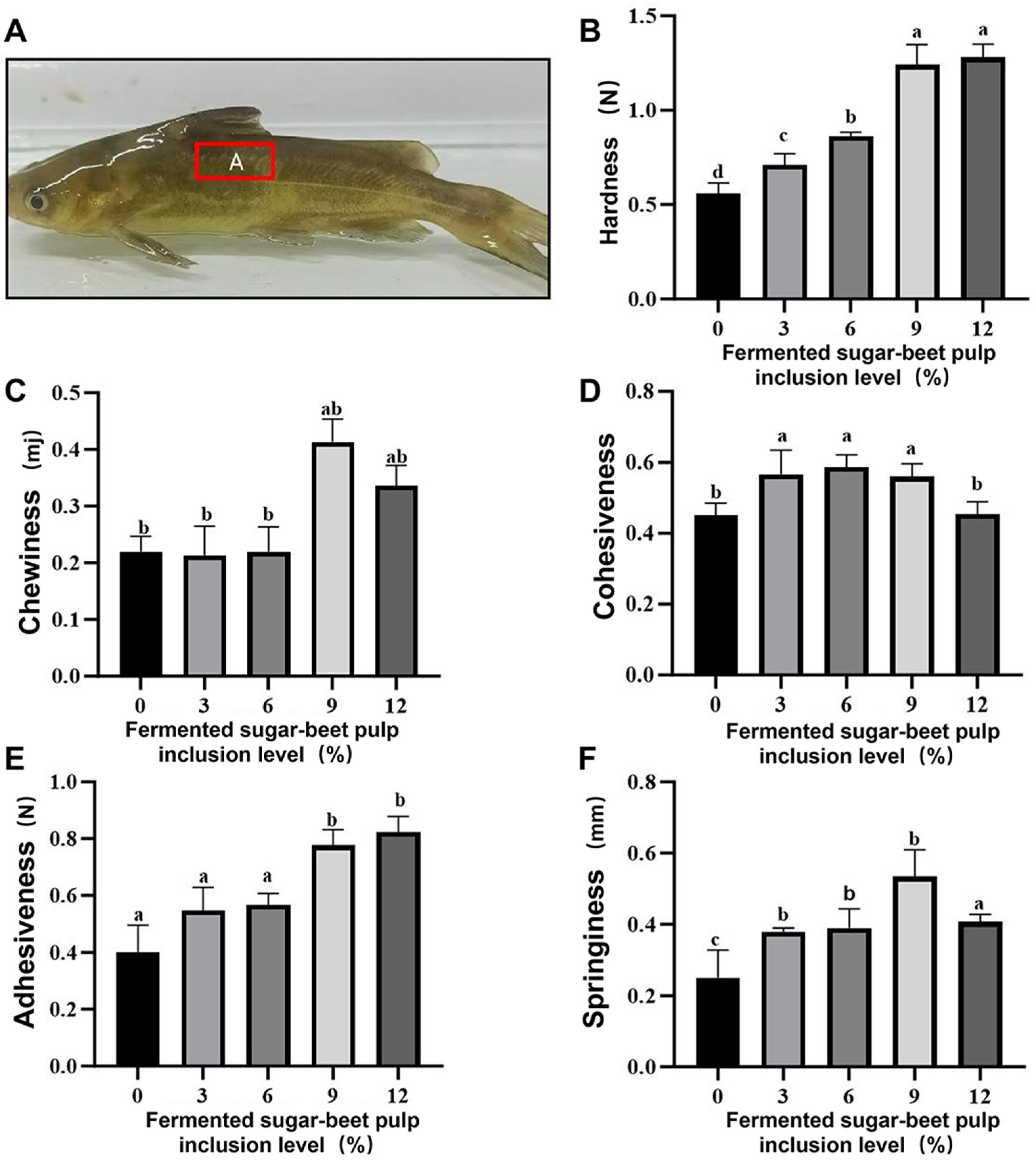
38]. Following blood collection, fish were dissected to determine individual viscera and liver weights, from which growth performance indices were calculated. The intestine was excised. The foregut was placed in centrifuge tubes and immediately stored at −80 °C for analysis of digestive and antioxidant enzyme activities and 16S rRNA sequencing; the remaining foregut samples were fixed in 4% paraformaldehyde for 24 h, subsequently rinsed with 70% ethanol (2–3 washes), and then transferred to 70% ethanol for preservation to maintain tissue integrity for subsequent morphological analysis. Muscle samples were obtained from the dorsal musculature above the lateral line of three fish per tank for texture profile analysis.
2.7. Growth Parameters and Morphological Index
Actual feed intake was calculated by weighing the feed offered prior to feeding and collecting uneaten feed 1 h post-feeding, which was then dried at 60 °C to constant weight. Individual body weight and length were measured to calculate growth and morphological indices, including weight gain rate (WGR), specific growth rate (SGR), feed conversion ratio (FCR), survival rate (SR), condition factor (CF), viscerosomatic index (VSI), and hepatosomatic index (HSI), using the following formulas [
39,
40,
41,
42]:
Muscle Texture Analysis
Muscle texture parameters were measured using a TVT-300XP texture analyzer (Perten Instruments, Beijing, China) and a TA-XT2i texture analyzer (Stable Micro Systems, Surrey, UK) [
43]. All muscle samples were uniformly bisected into blocks with dimensions of 1.00 cm × 1.00 cm × 0.50 cm (length × width × height). Texture Profile Analysis (TPA) was conducted to determine key parameters. The instrument settings were configured as follows: a pre-test speed of 2 mm/s, a test speed of 2 mm/s, a post-test speed of 2 mm/s, and a deformation of 20% based on sample thickness. Each sample was then exposed to two compression cycles, with an interval of 15 s between each cycle. The subsequent parameters were determined by obtaining the force-time curve: springiness, hardness, cohesiveness, chewiness, adhesiveness, and resilience. Gumminess and chewiness values were calculated by multiplying the hardness and cohesiveness values and the gumminess and springiness values, respectively [
44].
2.8. Determination of Serum Biochemical Indices
Upon completion of the feeding trial, the fish were fasted for 24 h. Ten representative fish were randomly selected from each aquarium, anesthetized and blood samples were collected from the caudal vein. After clotting at room temperature for 4 h, the serum was obtained by centrifugation (1342×
g for 10 min at 4 °C) and stored at −80 °C for subsequent analysis. Serum was prepared according to the method described by Niu et al. [
45]. The biochemical indices present in the serum were determined in accordance with the method outlined by Shi et al. [
46]. The parameters of interest, encompassing aspartate aminotransferase (AST), alanine aminotransferase (ALT), triglyceride (TG), glucose (GLU), total cholesterol (T-CHO), total protein (TP), malondialdehyde (MDA), and catalase (CAT), were measured in accordance with the protocols stipulated by the manufacturer (Nanjing Jiancheng Biotechnology Co., Ltd., Nanjing, China).
2.9. Intestinal Digestive Enzyme Activities
The intestinal tissue (0.1 g) that had been thawed was then homogenized with normal saline (1:9
w/
v) in an ice bath. The mixture was subsequently subjected to centrifugation at 2500 r/min for 10 min at 4 °C, with the aim of determining the activity of intestinal digestive enzymes. The supernatant was then analysed [
47]. According to the information provided in the kit’s description, trypsin exhibits catalytic activity for the hydrolysis of the ester bond in the substrate arginine ethyl ester at pH 8.0 and 37 °C. Enzyme activity is quantified by monitoring the increase in absorbance at 253 nm. One unit of activity (U/mg protein) is defined as the amount of enzyme per milligram of protein that produces an absorbance change of 0.003 per minute. A blue complex is generated upon the reaction of iodine solution with starch. Amylase, a digestive enzyme found in the saliva of many organisms, can hydrolyze starch. Activity of amylase is therefore measured by comparing the change in light absorption. One unit of amylase activity corresponds to the hydrolysis of 10 mg of starch per milligram of tissue protein under the specified assay conditions (37 °C, 30 min) [
48]. The activity of lipase was measured through the implementation of kits (Nanjing Jiancheng Biotechnology Co., Ltd., Nanjing, China).
2.10. Intestinal Antioxidant Activity
The intestinal samples were retrieved from a −80 °C ultra-low temperature freezer and thawed at 4 °C. After weighing, the samples were homogenized with normal saline at a ratio of 1:9 (g/mL). The homogenate was then centrifuged at 3000 r/min for 10 min at 4 °C. Subsequently, 500 µL of the supernatant was collected for analysis. Malondialdehyde (MDA) content was quantified using the thiobarbituric acid (TBA) method [
49], whereby MDA forms a red adduct measured at 532 nm. Total antioxidant capacity (T-AOC) was assessed by a ferrous ion reduction method [
50] and expressed relative to an FeSO
4 standard. Catalase (CAT) activity was determined according to the method of Moretti et al. [
51]. All assays, including MDA (nmol mg
−1 protein), T-AOC (nmol mg
−1 protein), and CAT activity (U mg
−1 protein), were performed using commercial kits (Nanjing Jiancheng Bioengineering Institute, Nanjing, China) in accordance with the manufacturer’s instructions.
2.11. Intestine Histology
The foregut samples were retrieved from 70% ethanol. Subsequent processing involved washing, dehydration in a graded ethanol series, clearing in xylene, and embedding in paraffin wax. The embedded blocks were sectioned at 5 μm thickness and stained with hematoxylin and eosin (H&E) for histological analysis [
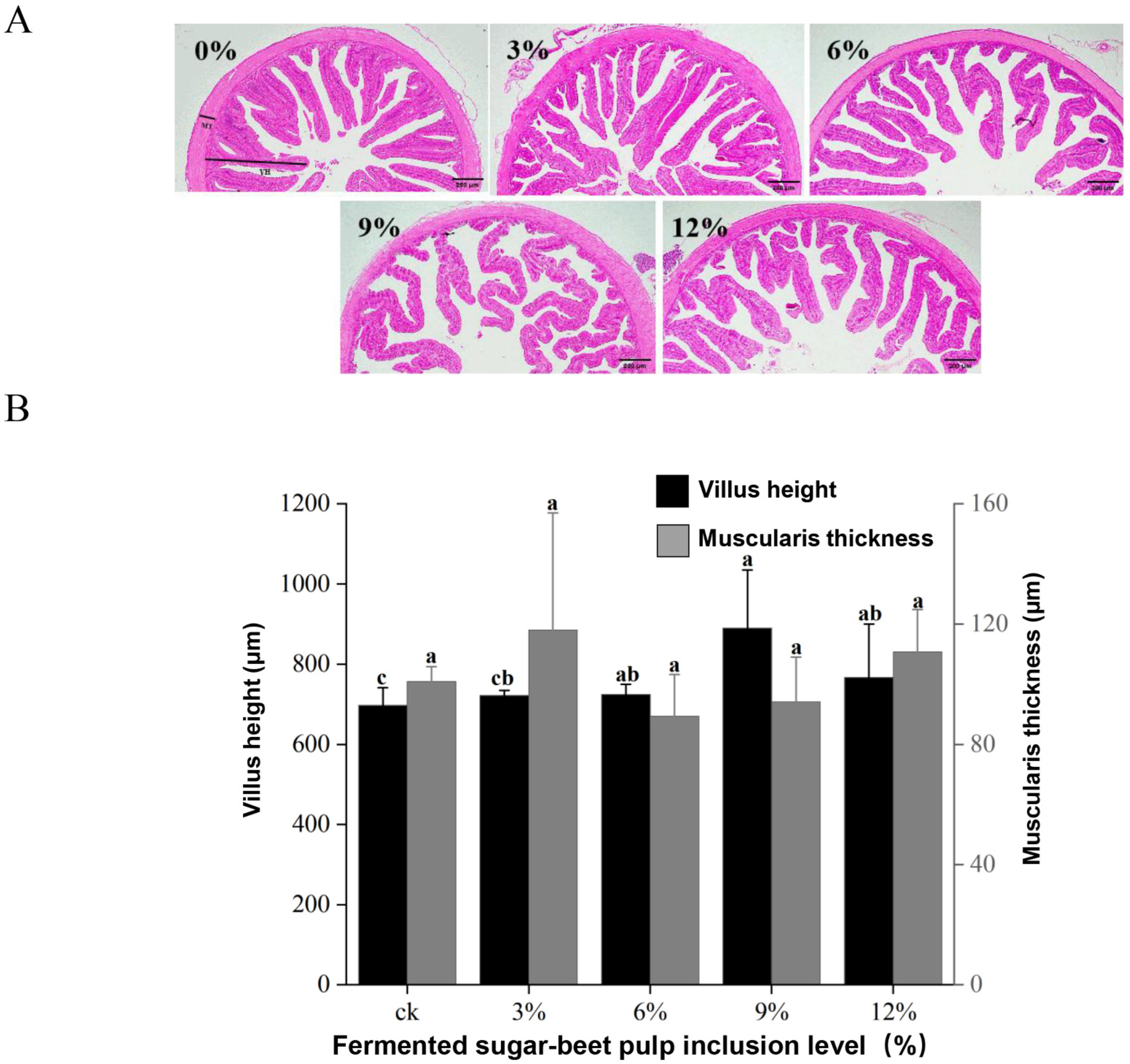
52]. Morphometric measurements of villus height, crypt depth, and muscularis thickness were performed.
2.12. Intestinal Microbial Community
Samples were shipped to Shanghai Majorbio Bio-pharm Technology Co., Ltd. (Shanghai, China) for DNA extraction and Illumina MiSeq sequencing. Genomic DNA was extracted from 50 mg of thawed intestinal tissue using SLX-Mlus buffer according to the manufacturer’s protocol. Briefly, tissue was homogenized in 725 μL of ice-cold SLX-Mlus buffer for 5 min and centrifuged at 10,000 r/min for 5 min, and the supernatant was collected. DNA quality was assessed by 1% agarose gel electrophoresis and spectrophotometry. The 16S rRNA gene was amplified and sequenced on the Illumina MiSeq PE300 platform (San Diego, CA, USA). The raw 16S rRNA sequencing reads have been deposited in the NCBI Sequence Read Archive (SRA) database under BioSample accession numbers SAMN54928432–SAMN54928446.
2.13. Statistical Analysis
The data are presented as the mean ± standard error of the mean (SEM). The statistical analysis was carried out using SPSS 22.0 software. For general growth, serum, intestinal enzyme and antioxidant indices, one-way ANOVA was followed by Duncan’s multiple comparison test so that differences among groups were assessed. For the analysis of differentially abundant intestinal microbial taxa across the five treatment groups, one-way ANOVA was performed followed by Conover–Iman post hoc test to rigorously evaluate the intergroup variations in microbial relative abundance. Statistically significant differences were considered to have been found at p < 0.05.
4. Discussion
This study demonstrates that solid-state fermentation using a specific microbial consortium can effectively convert sugar beet pulp into an ingredient with enhanced nutritional value and functional activity. The orthogonal optimization results provided important insights into the fermentation process. The inoculation ratio of
L. plantarum,
S. fibuligera, and
B. subtilis significantly affected the fermentation outcome. The optimal volume ratio of 1:3:3 yielded the highest comprehensive evaluation D-value (15.67%), primarily driven by a 21.95% increase in crude protein content and a 9.33% reduction in neutral detergent fiber. These nutritional improvements can be explained by distinct microbial mechanisms. This CP enrichment is likely attributable to microbial biomass (single-cell protein) synthesis utilizing the carbon and nitrogen sources present in SBP, a common phenomenon in microbial fermentation of plant substrates [
53]. Meanwhile, the degradation of fibrous components, including crude fiber and neutral detergent fiber, can be attributed to the synergistic action of extracellular enzymes—particularly cellulases and hemicellulases secreted by
B. subtilis and
S. fibuligera. These enzymes break down complex structural polysaccharides into simpler, more digestible molecules [
54].
Beyond macronutrient improvements, solid-state fermentation also significantly enhanced the protein quality of sugar beet pulp. We observed notable increases in both total amino acids (TAA) and essential amino acids (EAA), with particularly prominent rises in leucine, lysine, isoleucine, and arginine. The biological significance of these amino acids for aquaculture species is well established: leucine acts as a key regulator of muscle protein synthesis; lysine is often the first limiting amino acid in plant-based diets; arginine enhances immunity and serves as a precursor for nitric oxide; while isoleucine is involved in energy metabolism [
55]. The improved amino acid profile likely results from a dual mechanism: first, the hydrolysis of native SBP proteins into peptides and free amino acids by microbial proteases; and second, the synthesis and subsequent release of amino acids by proliferating microbial cells themselves [
56].
Furthermore, the solid-state fermentation process led to a substantial accumulation of organic acids, including lactic, propionic, and butyric acids, which increased the total volatile fatty acid content to 5.74 × 10
3 mg/kg. This quantitative increase in organic acids directly imparts significant functional properties to the fermented beet pulp (FBP), as these metabolites are not merely fermentation by-products but also active functional compounds. Lactic acid, primarily produced by
L. plantarum, serves as a feed acidifier that effectively inhibits enteropathogens [
57]. Meanwhile, propionic and butyric acids act as important energy sources for intestinal epithelial cells and play key roles in maintaining mucosal integrity and barrier function in fish [
58]. Together, these comprehensive enhancements in the nutrition and functionality of FBP establish the biochemical foundation that directly promotes growth performance and improves health status in fish.
The nutritional improvements in FBP translated directly into enhanced zootechnical performance in yellow catfish. Dietary inclusion of FBP significantly improved final body weight, weight gain rate (WGR), and specific growth rate (SGR) in a generally dose-dependent manner up to 9% inclusion (RM9 diet). The growth-promoting effect can be attributed to the composite action of multiple bioactive compounds in FBP. Firstly, organic acids likely improved the palatability of the diet and enhanced gut health by lowering luminal pH, modulating the microbiota, and increasing the activity of endogenous digestive enzymes, thereby improving nutrient digestibility and absorption [
59]. Secondly, the pre-digestive action of microbial enzymes in FBP may have increased the bioavailability of nutrients from the overall diet matrix [
60]. Thirdly, the high-quality microbial protein and readily available peptides in FBP provided excellent amino acid sources for protein accretion. However, our findings indicate that growth performance reached a plateau at the 12% inclusion level (RM12), with no statistically significant advantage over the 9% level (RM9), suggesting a potential optimal inclusion threshold. Beyond this point, even though fermentation partially degrades the fiber content in FBP, its rising proportion may start to dilute dietary energy density or mildly hinder nutrient utilization—a practical consideration commonly observed when incorporating fibrous materials into aquafeeds [
61]. It is noteworthy that, across all inclusion levels tested (3–12%), FBP did not adversely affect survival, feed conversion ratio (FCR), or somatic indices (condition factor, viscerosomatic index, or hepatosomatic index). These results affirm the safety and palatability of FBP and suggest that it does not trigger metabolic or physiological stress that could interfere with energy allocation or organ development.
In addition to promoting growth, dietary inclusion of FBP significantly enhanced fillet quality. Muscle texture serves as a vital quality indicator in aquatic products, directly influencing tenderness, springiness, and sensory properties [
62]. Hardness measures the muscle’s resistance to deformation and indicates structural integrity, while cohesiveness reflects the binding strength among muscle fibers. Springiness and resilience, in turn, capture the ability of muscle to recover its original shape after force is applied—together determining whether the eating experience is crisp and tender or soft and mushy [
63]. While environmental and farming practices also affect muscle texture, diet has been recognized as a primary modulating factor [
64]. Consistent with this principle, fermented beet pulp appears to improve fillet quality by enhancing muscle springiness, hardness, textural stability, and overall firmness. These improvements may be attributed to bioactive compounds produced during fermentation—including proteases, peptides, and organic acids—which could facilitate protein cross-linking or modify interactions between muscle fibers.
The benefits in growth and fillet quality were further supported by broader systemic and intestinal health improvements associated with FBP. Notably, we observed a significant decrease in serum aspartate aminotransferase (AST) activity across all FBP-fed groups. Since AST is a reliable marker of hepatocellular integrity, its reduction suggests a hepatoprotective effect, potentially resulting from lowered metabolic burden or the antioxidant activity of FBP [
65,
66]. Moreover, FBP supplementation favorably influenced lipid metabolism, significantly reducing serum total cholesterol (T-CHO) and triglyceride (TG)—especially in the higher inclusion groups (RM9 and RM12). In yellow catfish, these lipid parameters reflect metabolic regulation capacity, and their decline indicates improved utilization of dietary fats by tissues [
67]. This lipid-lowering effect may stem from the elevated dietary fiber in FBP, which could promote bile acid excretion and thus lower serum lipids, or from fermentation-derived compounds that modulate hepatic lipogenesis [
68]. In parallel, FBP boosted systemic antioxidant defenses. Our study showed that FBP supplementation significantly increased serum antioxidant capacity (measured as CAT activity) while reducing the oxidative damage marker MDA. These results point to clear antioxidant properties of fermented beet pulp, capable of strengthening antioxidant defenses and mitigating oxidative stress [
69,
70,
71,
72].
The health-promoting effects of FBP were especially evident at the intestinal level, which plays a central role in nutrient utilization. Digestive enzyme activity is a key functional gauge of feed efficiency. Here, FBP supplementation markedly increased intestinal lipase, trypsin, and amylase activities in yellow catfish, with the strongest effects seen in RM9 and RM12 groups. This pattern closely tracked the improved growth, suggesting that FBP enhances digestive function, raises feed utilization efficiency, and thereby supports growth [
73,
74]. Complementing these functional gains, intestinal structure also improved. We found a significant increase in villus length in the RM6, RM9, and RM12 groups, peaking in RM9, indicating that FBP primarily boosts intestinal absorptive capacity. This structural improvement may be linked to small-molecule peptides released during fermentation, which prior studies confirm can stimulate brush-border enzyme activity and promote villus growth [
75,
76]. Together, these functional and structural improvements highlight that FBP promotes nutrient use and growth through complementary functional and structural mechanisms in the intestine.
During metabolism, excess free radicals can lead to oxidative damage [
77]. To counteract this challenge, animals possess a defense system comprising antioxidant enzymes and reductive substances [
78]. The T-AOC level reflects the overall antioxidant capacity of fish [
79]. CAT is a key antioxidant enzyme that alleviates oxidative stress by breaking down hydrogen peroxide, thereby protecting intestinal tissues [
70]. MDA, a lipid peroxidation product, generally varies inversely with antioxidant enzyme levels [
80]. In our trial, RM9 and RM12 groups showed significantly higher T-AOC and CAT activity—with CAT peaking in RM12—while MDA content dropped to its lowest in RM9. This confirms that fermented beet pulp effectively reduced oxidative stress and strengthened antioxidant capacity in yellow catfish. Similar antioxidant benefits have been reported with fermented soybean meal in white shrimp [
81], and fermented rapeseed meal in juvenile red sea bream [
72]. The underlying mechanism may involve the intestinal absorption of antioxidant compounds produced during fermentation, thereby mitigating oxidative stress [
27].
Another important mechanism by which FBP supports intestinal health is through modulation of the gut microbiota, a vital ecosystem for host health [
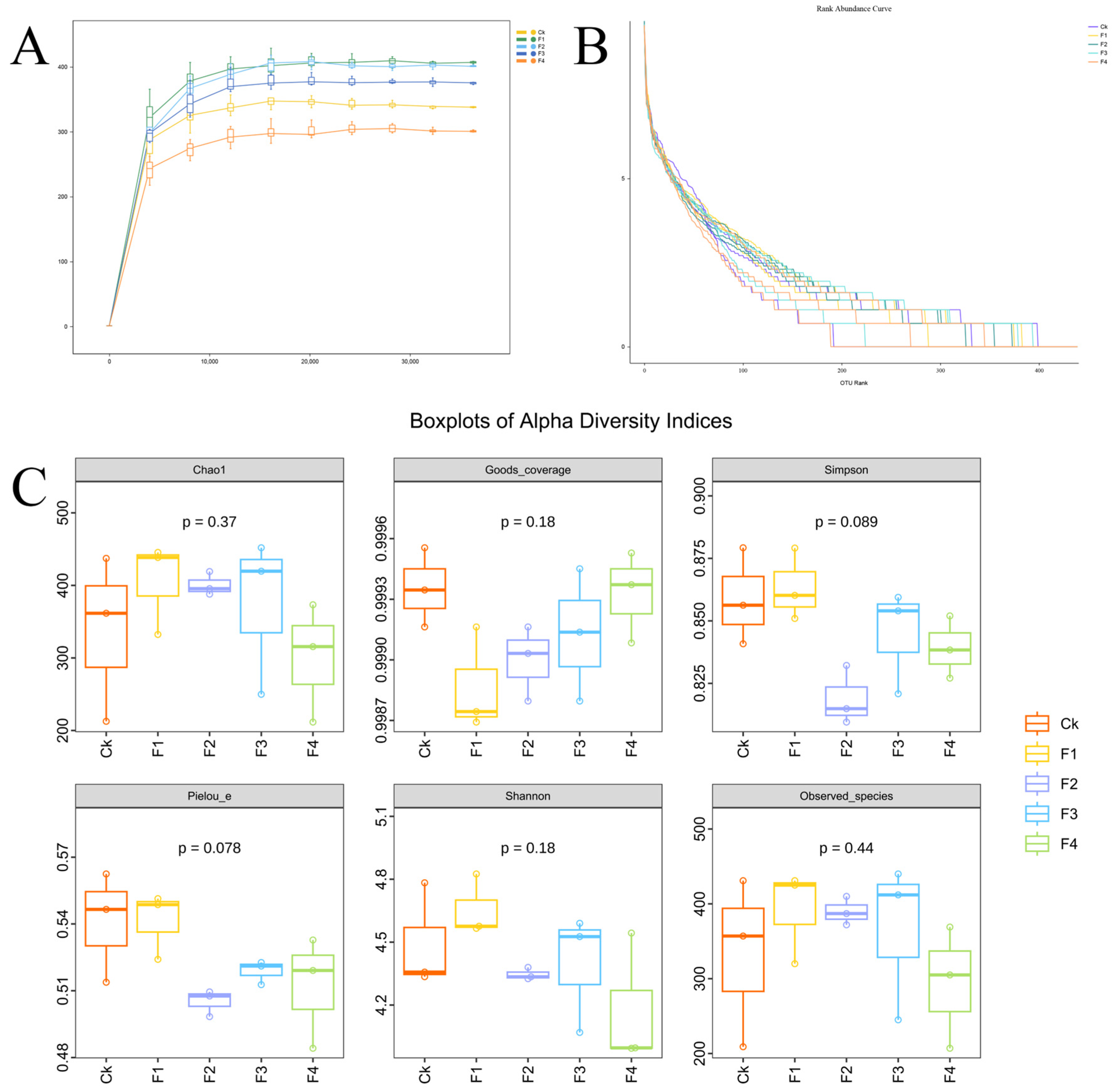
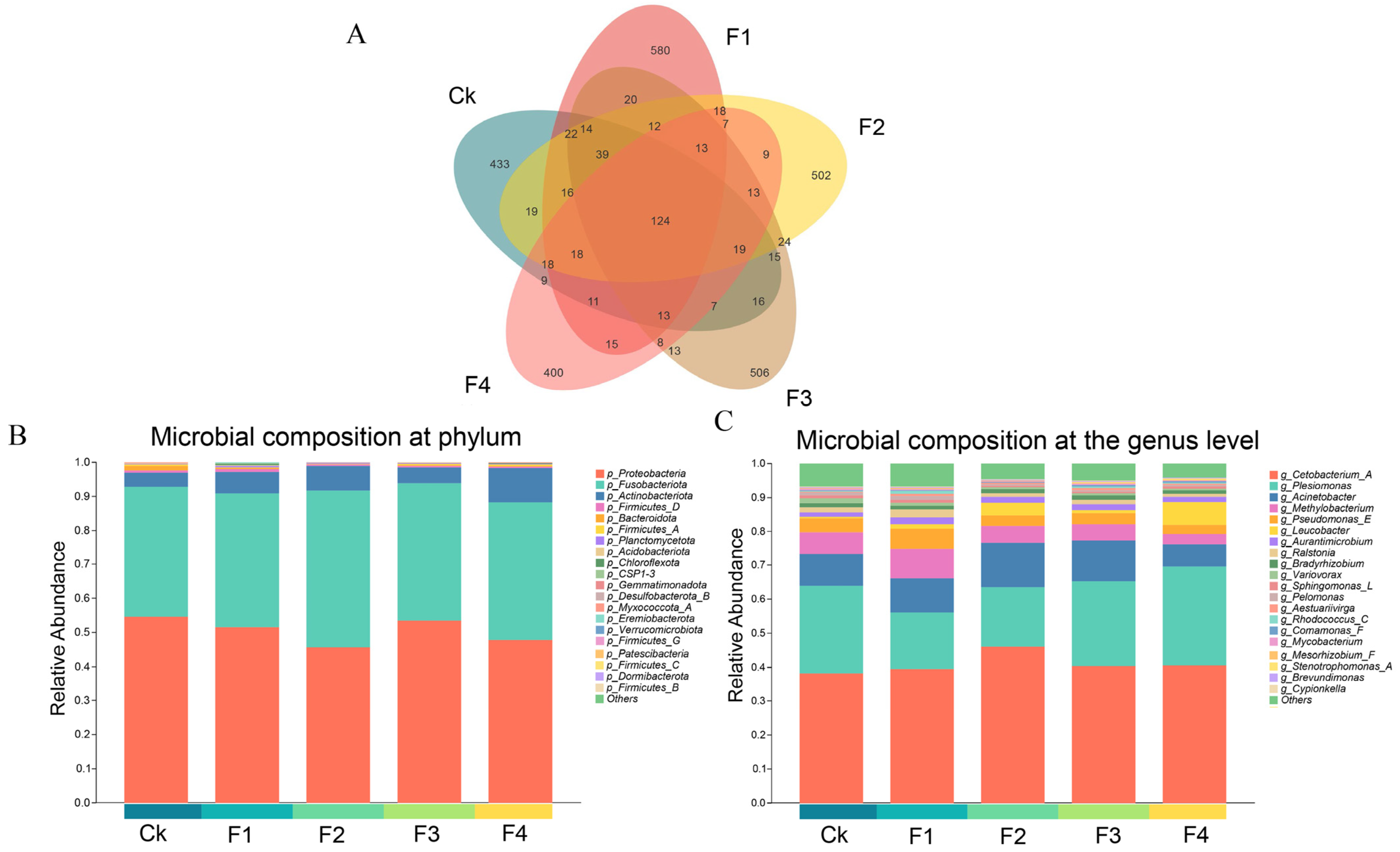
82]. Our data indicate that FBP did not significantly alter alpha diversity or dominant phyla composition, implying a relatively gentle effect on overall microbial structure. However, one-way ANOVA revealed significant differences in the relative abundances of
Actinobacteriota,
Fusobacteriota, and
Proteobacteria at the phylum level (
p < 0.05). At the genus level, statistical analysis identified significant differences in the relative abundances of several key taxa among groups (
p < 0.05). Post hoc analysis further confirmed that
Leucobacter was most significantly enriched in the F4 (12% FBP) group, with its abundance being significantly higher than that in all other groups. This finding is particularly significant because
Leucobacter—a core taxon identified in the intestines of various fish species—has been associated with potential probiotic functions, including carotenoid production and antioxidant activity [
83]. Recent studies have also demonstrated that specific probiotic treatments can enhance the intestinal abundance of
Leucobacter and improve host health outcomes [
84]. Notably,
Cetobacterium, a common anaerobic genus in fish intestines, plays a key role in producing vitamin B12 and participating in protein and carbohydrate metabolism, thereby contributing to host nutrition and intestinal health [
85,
86]. Although no statistically significant pairwise differences were observed for this genus among the treatment groups in the present study, the overall trend in its abundance warrants further attention in future research.
Taken together with the observed improvements in intestinal morphology, digestive function, and antioxidant status, these findings suggest that FBP modulates the gut microbiota in a taxon-specific manner—selectively influencing functional microbial groups involved in nutrient metabolism rather than inducing broad structural changes. This precise modulation may contribute to an optimized intestinal microenvironment and support host health.




 ,
,