1. Introduction
The sensory abilities of horses have evolved to support early danger recognition, which is essential for survival in a prey species [
1]. Horses rely on various senses to perceive and respond to different stimuli in their environment [
2], with a combination of visual, auditory, and likely olfactory cues as the most important in the detection of potential threats [
3]. Odours may be considered one of the most salient environmental stimuli [
4]. Therefore, they play a crucial role in eliciting context-specific behavioural responses [
2,
5]. Horses are thought to possess a highly developed sense of smell [
6], which they employ in diverse behavioural contexts. These include social interactions [
7], reproductive behaviour [
8], predator avoidance [
9] and foraging, particularly in evaluating food flavour [
10].
Efficient foraging is critical for survival and reproductive success and is shaped both by the nature of available forage and the animal’s selective feeding capacity [
11,
12]. As grazing and browsing herbivores, horses evolved physiological and behavioural adaptations for consuming a fibrous, plant-based diet. They typically employ a patch foraging strategy, selecting from a wide range of plant species using various sensory inputs [
13,
14]. Diet selection is influenced by sensory characteristics such as visual cues, odour, taste, texture, availability, and variety [
15,
16]. Horses can selectively consume feeds to meet nutritional needs, favouring energy-rich options and adjusting the diet based on the nutrient and energy content of available plant species [
16,
17]. However, individual taste preferences may override nutritional value, leading horses to select foods based on palatability rather than health benefits [
18]. Furthermore, previous experience with food, which may result in learned aversions or preferences and possibly post-ingestive nutrient feedback, is also crucial to dietary choices [
10]. For example, it was observed that horses exhibit a strong preference for sweet (sucrose) solutions over sour, bitter, or salty alternatives, although the role of taste in regulating food intake remains incompletely understood [
10].
Of the senses involved in foraging, olfaction appears to have the greatest influence, followed by taste [
10,
11]. Olfactory exploration in horses typically involves bringing the muzzle into close proximity to the odour source, allowing the animal to assess chemical cues [
19]. Horses often explore feed through olfactory investigation before ingestion, and the presence of a familiar odour may enhance acceptance of novel food items [
20]. Equines are sensitive to odours in their environment [
21] and may discriminate between them. Rørvang et al. [
19] demonstrated that horses were able to detect and distinguish between the odours of orange, peppermint, lavender, and cedarwood, with peppermint triggering the most pronounced exploratory and feeding-related responses. Understanding how horses respond to odours is crucial for predicting their reactions and ensuring safety for both the horses and handlers [
2]. Olfactory stimulation, including novel scents and certain essential oils, has been proposed as an environmental enrichment strategy for domestic horses. In particular, lavender essential oil has been shown to reduce physiological and behavioural indicators of stress, while broader reviews suggest potential calming effects of olfactory enrichment [
22].
Horses can form associations between specific scents and the corresponding tastes of food, even if they are initially unfamiliar with the taste itself [
19,
23]. Both the olfactory and gustatory senses are vital for food discrimination and preference. They function together with post-ingestive mechanisms to create learned associations between specific sensory cues and physiological outcomes, which can be either positive or negative [
24]. However, despite the close relationship between taste and smell, little research has been conducted on the sensory sensitivity of these modalities in horses [
1,
2,
9]. Based on the current literature, it remains unclear to what extent prior exposure to olfactory cues alone, as opposed to feeding experience, contributes to the olfactory recognition of a food during subsequent encounters. Although both olfaction and taste are known to play an important role in food selection in horses, olfaction is the primary sense providing herbivores with initial information about potential food sources. In the authors’ previous study [
25], horses were shown to be capable of discriminating between previously unknown poisonous and non-poisonous plants based on the sense of smell alone. Therefore, olfactory exploration of food sources has clear biological significance. However, it has not yet been clarified whether familiarity with a plant’s odour alone is sufficient for early discrimination, or whether previous gustatory experience is necessary to enable recognition of the plant based solely on olfactory cues. Clarifying this question may contribute to a better understanding of how horses integrate sensory stimuli prior to ingestion when recognising and evaluating potential food sources.
The aim of the study was to assess the influence of familiarity with the smell and taste of plants on horses’ olfactory exploration and, further, to determine the importance of this familiarity in the discrimination of plants based on smell alone. We hypothesized that horses would explore plants they already knew by smell and taste less intensively, followed by plants known by smell alone, and most intensively those that were initially completely unfamiliar.
4. Discussion
Although food choice is determined by nutrients, different food sensory characteristics (smell, taste and texture) and post-ingestive feedback (positive or negative) [
10], olfaction allows the first information to be perceived about the potential food. Consuming plants through sampling is an important mechanism in the association between the sensory properties of food and its metabolic consequences, resulting, among others, from its nutritional value [
13]. As shown in our previous study [
25], horses are able to gather information about the edibility of plants based on olfactory cues alone.
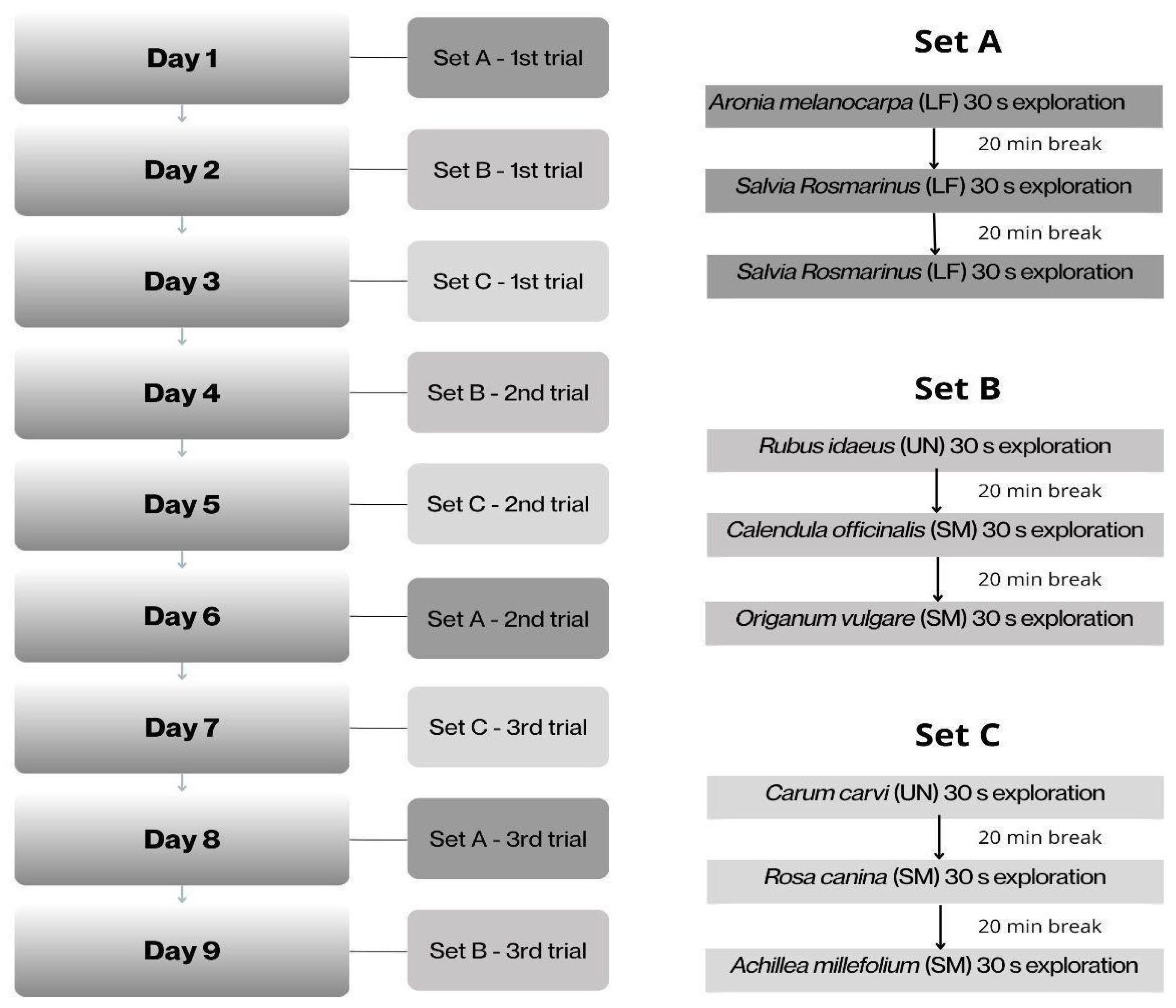
In the current study, the horses’ olfactory exploration of plants of different levels of sensory familiarity was compared. More specifically, animals were exposed to the smell of three groups of herbs: initially unfamiliar (the lowest level of familiarity; completely unfamiliar in the first trial—LF) and known by smell (moderate level of familiarity; after familiarising the horses with the smell—SM), as well as known by smell and taste (the highest level of familiarity—ST). As predicted, the horses explored the LF for the longest time, followed by SM and ST. However, a significant difference in the time of exploration was found only between LF and ST. Hence, it can be suggested that the horses’ olfactory exploration varies to some degree depending on the level of familiarity with a plant, which is discussed in detail as follows.
It was demonstrated that the sense of smell plays a key role in horses’ feed intake [
30] and is important in the first interactions with a novel food. A previous study [
20] showed that horses did not smell (or smelled briefly) the food they knew very well by smell and taste, i.e., oats. This finding corresponds to the fact that the horses in the current study also explored ST for the shortest time, followed by SM. More sensory experience shortened the time of exploration of the plant in subsequent encounters, probably due to its faster recognition. Simultaneously, less experience, as in the case of LF herbs, may need more cautious exploration. Hence, more time spent exploring LF plants compared to ST may have been due to the need to gather information on a plant that the horses had not yet encountered or had encountered only rarely. Given the risk of coming across unpalatable, pernicious or poisonous plants on pasture [
31], it is crucial for horses to collect as much information as possible based on the sense of smell. Previous studies have shown that olfactory exploration decreases in successive encounters [
4,
25]. Hence, it is possible that with greater experience of an olfactory cue, animals may require less time to recognize an odour in the future.
However, it should be noted that the main analysis of the current study focused on comparing the responses to the LF, SM, and ST plants based on the three trials. As shown in the authors’ previous study [
25], the exploration time of both poisonous and non-poisonous plants decreased gradually and significantly in subsequent trials. The reason for this may not have been solely because of faster recognition with growing olfactory experience, but also due to gradual habituation to the odours, as reported by Rørvang et al. [
4], or a lower motivation to participate in the tests, as shown by Mal et al. [
32]. In the current study, the number of trials was particularly important for LF plants, which were classified as those of the lowest level of familiarity. Horses explored LF plants for the longest in the first trial, when they were completely unknown to the horses, and for the shortest in the third trial, when they became somehow familiar. Therefore, it is possible that the horses learned to recognise the scent of a new plant on the first attempt and did not need to explore the plant as thoroughly on the subsequent attempt. This may also be suggested by the fact that, when considering all three trials, no significant differences were found in the olfactory exploration of SM and LF plants. This observation may simultaneously somehow limit the assumption that greater familiarity with the smell of a plant alone reduces the duration of olfactory exploration upon subsequent exposure. Unlike in the previous study [
25], only edible herbs for horses—not poisonous—were used. This may explain why the horses explored LF and SM for a similar amount of time: the scent of both herb types did not alert the horses to the presence of poison. Hence, it may be suggested that knowing a non-poisonous plant solely by smell does not affect how quickly horses recognise it. However, the reasons for this observation may also be completely different, as in the previously mentioned studies [
4,
26,
32]. It therefore seems reasonable that in future studies, when assessing horses’ reactions to plants with varying degrees of familiarity, only the first trial, or consecutive trials, treated independently, should be included in the comparisons. The comparison of the horses’ exploratory behaviour from all three trials may be a potential limitation of our study and should be taken into account when analysing the results of this work. Further, as observed, the first olfactory impression is of importance for horses, since it is explored the most thoroughly. This may have practical implications, as after just one exposure to a new scent, a horse can develop a positive or negative attitude toward it.
The above-mentioned observation, combined with the significantly shorter exploration time of ST compared to LF, may support the importance of the sense of taste in the olfactory recognition of encountered plants. It can be suggested that the more sensory experience (smell and taste) horses had with a plant in the past, the faster they recognised the plant based solely on their sense of smell in the future. Van den Berg et al. [
24] previously noted that pre-ingestive cues, like the smell and taste of foods, are crucial in diet selection and that volatiles and olfaction may be important factors when horses choose between familiar and unfamiliar foods [
13]. Another reason why the horses took the shortest time to sniff the herbs they had previously eaten during the learning phase (ST) may be the post-consumption effect. Since the herbs used in the present study were commonly intended for horses as supplements (were edible), the studied individuals probably experienced positive, or at least neutral, post-ingestive feedback in the case of becoming familiar with ST. According to other authors [
31,
33,
34], previous experience is crucial for conditioned food preferences or aversions and, hence, plays an important role in response to a re-encounter with the plants. However, no differences were observed in the duration of olfactory exploration between plants known only by scent, with which the horses had been previously familiarized (SM), and those known by both taste and scent (ST). This fact could, on the one hand, limit the role of the sense of taste in olfactory exploration and in the recognition of non-toxic plants through smell. On the other hand, as previously mentioned, horses may have quickly habituated to odours to which they were repeatedly exposed or have lost interest in them [
4,
32], and hence, no differences between SM and ST were observed. These results may have practical implications for introducing new foods into the diet of horses, where prior exposure to the odour could reduce neophobic responses [
24]. However, further research would be required to confirm the effects on feeding behaviour following preliminary olfactory explorations.
Practically, the only variable for which significant differences were observed among the factors studied (plant type, plant species, biological traits) was the duration of olfactory exploration. No significant differences, with a few exceptions for sex and plant species factors, were found in the frequency of exploration or in the occurrence of specific behaviours, i.e., crib nibbling, crib licking, mouth licking and empty-mouth chewing between the exploration of various types of herbs. Therefore, it may be suggested that these behaviours have lesser importance as indicators of the pre-consuming explorative behaviour of horses, which is in accordance with the authors’ previous studies [
25,
26].
Horses’ responses towards certain species of herbs varied only in a few cases between
Aronia melanocarpa and five other herbs in the time of exploration, and between
Aronia melanocarpa and four other herbs in the frequency of crib licking. In those cases, horses explored
Aronia melanocarpa for the longest and showed crib licking the most often. This herb was classified as LF, so on the one hand, this may result from a more thorough exploration of a plant with a low level of familiarity. However, on the other hand, the results may indicate that this herb was more attractive to horses and that explorative behaviour towards different plant species was influenced by individual preferences. This is in accordance with the observations made by Rørvang et al. [
19], who showed that despite the horses’ ability to distinguish between four different odours, they expressed significantly more interest when exposed to one of them. Moreover, in our previous study [
25], differences were observed in the exploration time of different non-poisonous plant species, which could indicate that they were not equally attractive to horses. Horses are not unique in this regard; other herbivorous species also have their own preferences regarding the flavour or type of food. For example, dairy cows may prefer vanilla or fenugreek flavours when given a choice of a new variety of feed [
35]. Sheep proved to be more selective than cattle when choosing the most frequently consumed plant from among several species available in the pasture sward [
36]. Therefore, the impact of the studied species of plants and possibly individual preferences of the horses on the results of the current study cannot be excluded. This is a potential limitation, although it would not be possible to select plants of equal attractiveness to horses. It would require prior exposure of the test horses to different herb species, which, in turn, would affect future results. A possible solution could be to use more plant species in future studies.
Regarding the effect of the studied biological traits of the horses (sex, horse type) on responses to herbs of different degrees of familiarity, no differences were observed between warmbloods and ponies, and only in two cases were sex-related differences observed: geldings licked the crib and their mouths significantly more often than mares when exploring SM. The overall differentiation in exploring various plant types resulted only from differences found within geldings and warmblood horses. In these cases, the tendencies were similar to those observed for all the studied horses: geldings and warmbloods explored LF significantly longer than ST. The outcomes suggest that for geldings and warmbloods, the degree of familiarity with a plant may be more important than for mares and ponies, for which no differences were observed. These horses are more cautious when exposed to the scent of less familiar plants (LF) and rely more on a previous taste experience. Similarly, in the study conducted by Wnuk et al. [
26], differences related to sex and horse type in the exploration of the familiar mint odour were infrequent, and the majority of significant differences observed in response to varying odour concentrations reflected within-group variations. Rørvang et al. [
30] previously noted that the horses’ olfactory interest in different plant odour oils varied with age and gestational status, but not sex. The rare differences in responses between geldings and mares in the current study can be cautiously interpreted as a result of their role in a herd. Since a dominant mare decides on the direction of the march and the time of rest under natural conditions [
37], it cannot be excluded that mares can also decide to consume plants based on the sense of smell more quickly. More acute olfaction in females than males could also be due to the role olfactory cues play in mother–offspring recognition [
38]. However, the few significant differences between horses of different sexes in the present study do not justify stating that there is a sex difference in olfactory ability. Considering the more varied olfactory exploration of warmblood horses compared to ponies according to the degree of familiarity, it is possible that the differences may be type- and/or breed-specific. Janczarek et al. [
39] found that purebred Arabian horses showed the greatest variety in pellet taste preferences, whereas primitive horses were more cautious (hesitating, sniffing) before consumption. In summary, in light of the obtained results, it is suggested that variables such as sex and breed type should be taken into account when investigating horses’ responses to food-related odours and tastes. This will facilitate interpretation and enhance the transparency of findings across different studies. Considering differential responses depending on these biological factors may be useful not only in equine nutritional research, but also in the development of horse care products or aromas used for environmental enrichment.



 ,
,