Metal Levels in Crab Sentinel Species from the Mediterranean Sea: Safety and Toxicological Risk Assessment
 , , ,
, , ,  ,
,
Simple Summary
Abstract
1. Introduction
2. Materials and Methods
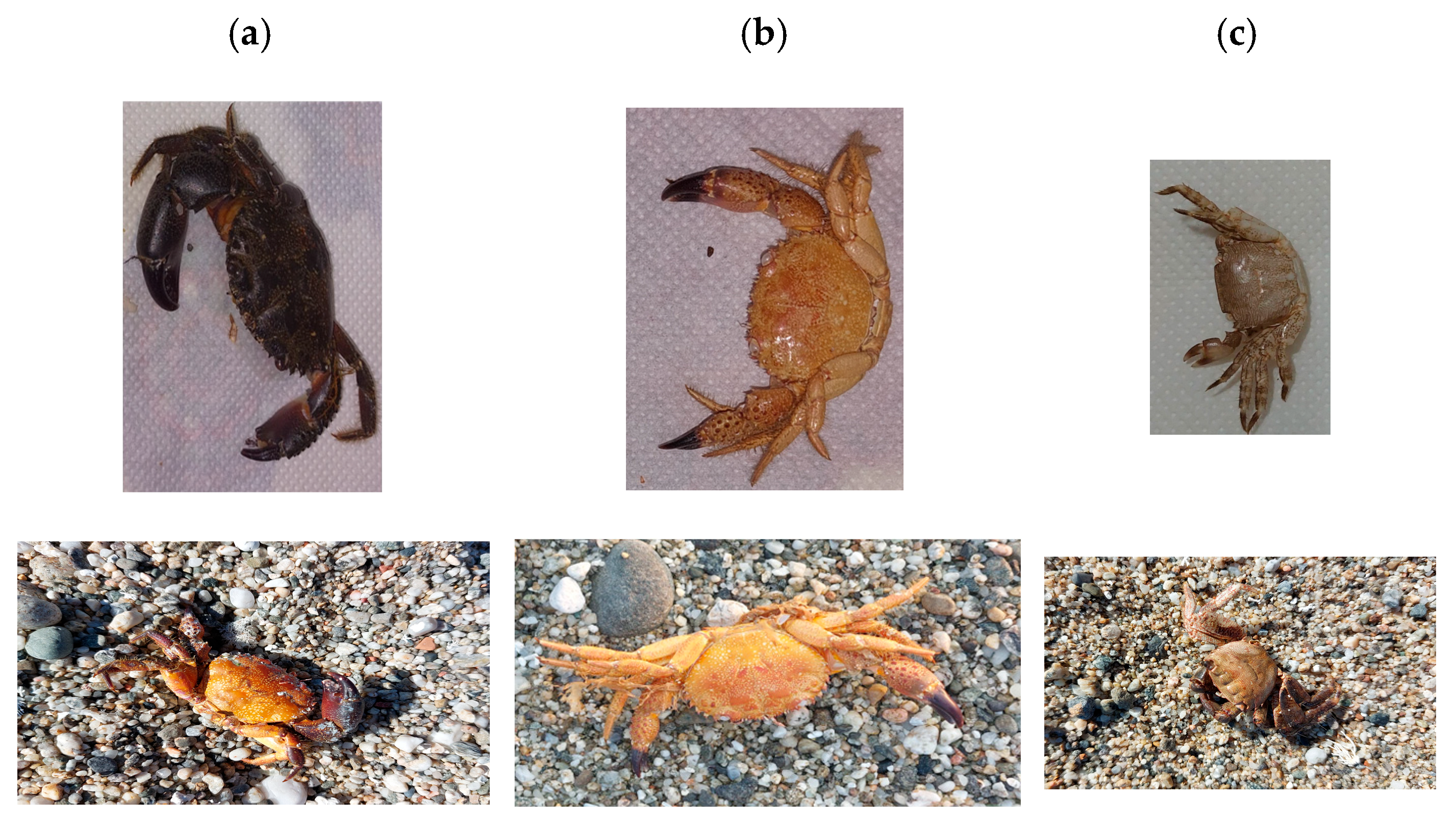
2.1. Sampling
2.2. Sample Preparation
2.3. ICP-MS Analysis
2.4. Hg Determination
2.5. Method Validation
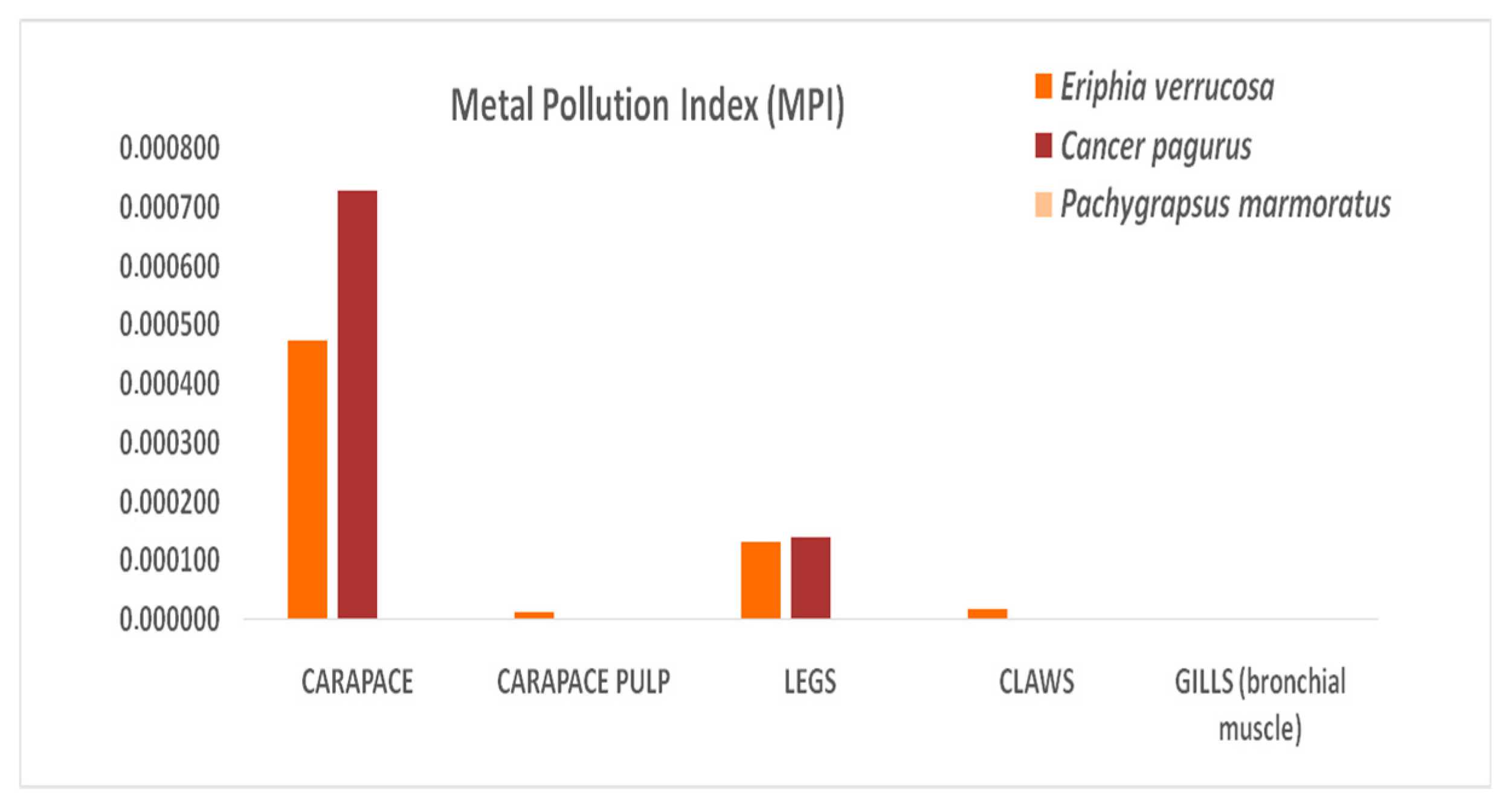
2.6. Parameters to Assess Metal Pollution and Crab Health Status
2.7. Statistical Analysis
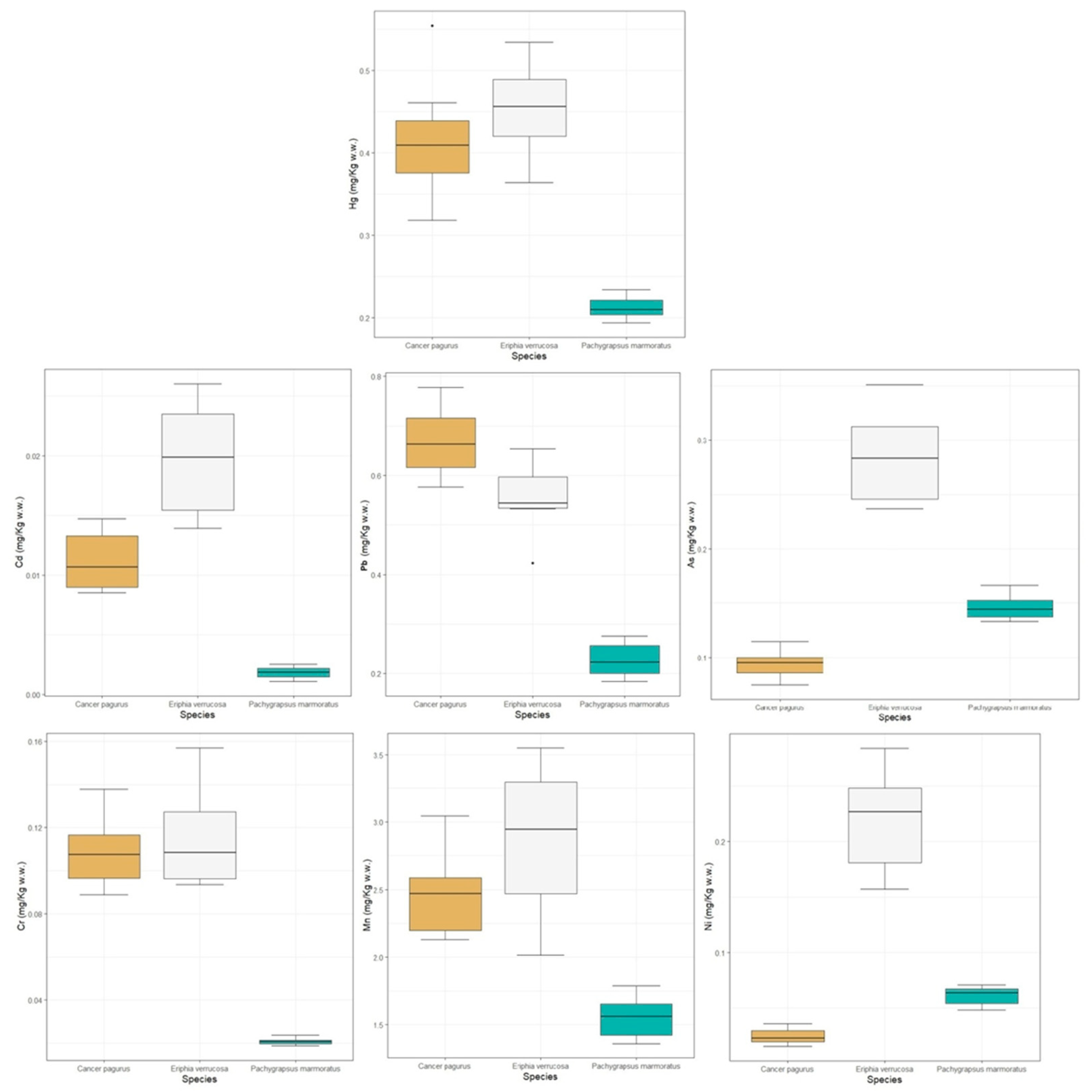
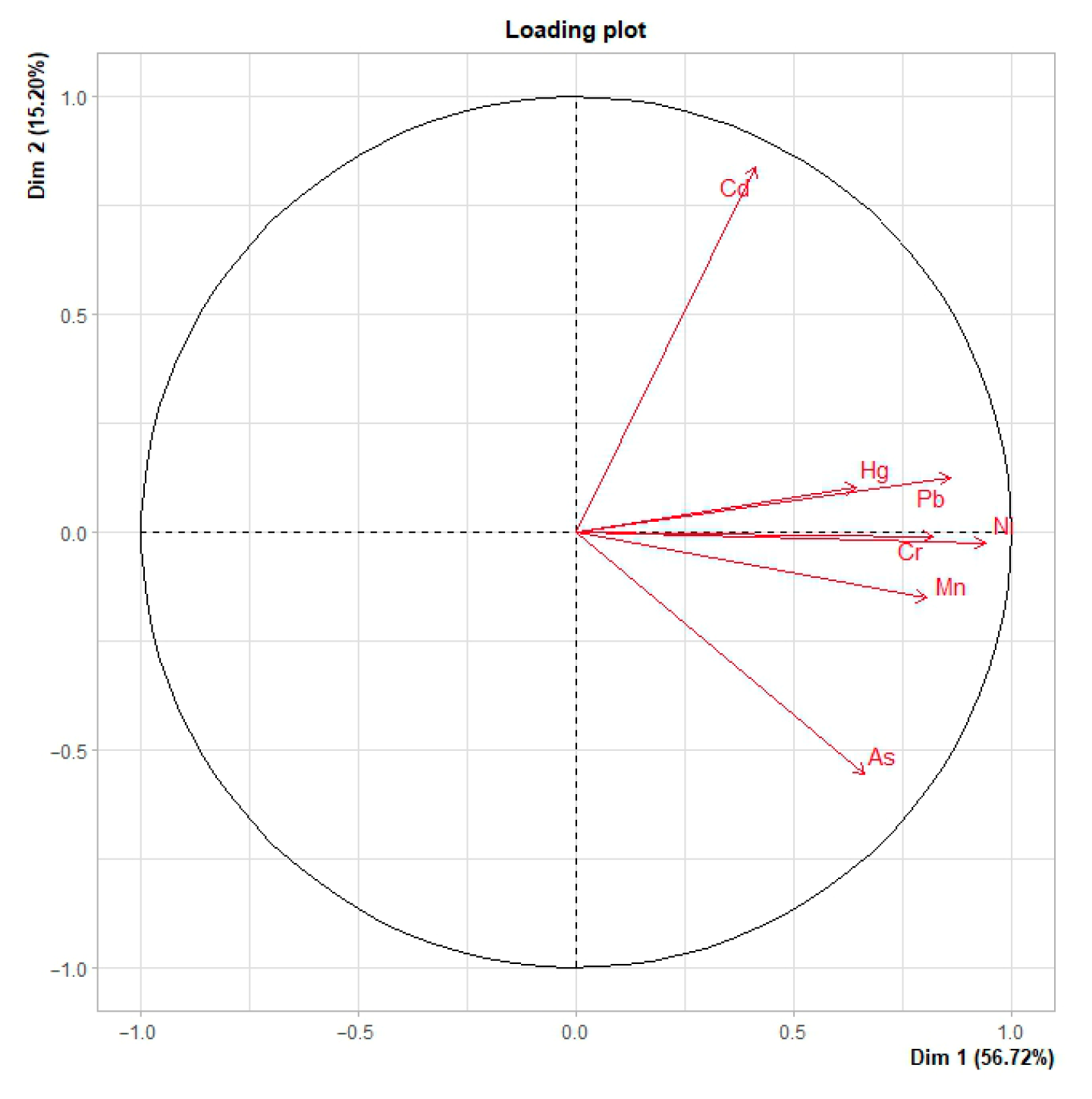
3. Results
4. Discussion
5. Conclusions
Author Contributions
Funding
Institutional Review Board Statement
Informed Consent Statement
Data Availability Statement
Conflicts of Interest
References
- Naccari, C.; Ferrantelli, V.; Cammilleri, G.; Ruga, S.; Castagna, F.; Bava, R.; Palma, E. Trace Elements in Stenella coeruleoalba: Assessment of Marine Environmental Pollution and Dolphin Health Status. Animals 2024, 14, 1514. [Google Scholar] [CrossRef] [Scilit] [PubMed]
- Cammilleri, G.; Galluzzo, F.G.; Fazio, F.; Pulvirenti, A.; Vella, A.; Lo Dico, G.M.; Macaluso, A.; Ciaccio, G.; Ferrantelli, V. Mercury Detection in Benthic and Pelagic Fish Collected from Western Sicily (Southern Italy). Animals 2019, 9, 594. [Google Scholar] [CrossRef] [Scilit]
- Krishnamoorthy, S.; Kannan, K.; Pasiyappazham, R.; Mohamed Saiyad, M.; Salem Salman, A.; Syed, M.B.A.; Pitchiah, S. Unveiling the silent threat: Heavy metal toxicity devastating impact on aquatic organisms and DNA damage. Mar. Pollut. Bull. 2024, 200, 116139. [Google Scholar] [CrossRef] [Scilit]
- Hazrat, A.; Ezzat, K.; Ikram, I. Environmental Chemistry and Ecotoxicology of Hazardous Heavy Metals: Environmental Persistence, Toxicity, and Bioaccumulation. Hindawi J. Chem. 2019, 2019, 6730305. [Google Scholar] [CrossRef] [Scilit]
- Eom, H.-J.; Haque, M.N.; Lee, S.; Rhee, J.-S. Exposure to metals premixed with microplastics increases toxicity through bioconcentration and impairs antioxidant defense and cholinergic response in a marine mysid. Comp. Biochem. Physiol. Part C Toxicol. Pharmacol. 2021, 249, 109142. [Google Scholar] [CrossRef] [Scilit]
- Al Mazed, M.; Rahman, M.A.; Ahmed, S.I. A Review on Effects of Heavy Metals on Aquatic Animals and Public Health Significance. Vet. Sci. Res. Rev. 2022, 8, 71–109. [Google Scholar] [CrossRef] [Scilit]
- Bonsignore, M.; Salvagio Manta, D.; Mirto, S.; Quinci, E.M.; Ape, F.; Montalto, V.; Gristina, M.; Traina, A.; Sprovieri, M. Bioaccumulation of heavy metals in fish, crustaceans, molluscs and echinoderms from the Tuscany coast. Ecotoxicol. Environ. Saf. 2018, 162, 554–562. [Google Scholar] [CrossRef] [Scilit] [PubMed]
- Simonetti, P.; Botté, S.E.; Marcovecchio, J.E. Heavy metal bioconcentration factors in the burrowing crab Neohelice granulata of a temperate ecosystem in South America: Bahía Blanca estuary, Argentina. Environ. Sci. Pollut. Res. 2018, 25, 34652–34660. [Google Scholar] [CrossRef] [Scilit]
- Mansour, S.A.; Sidky, M.M. Ecotoxicological studies. Heavy metals contaminating water and fish from Fayoum Governorate, Egypt. Food Chem. 2002, 78, 15–22. [Google Scholar] [CrossRef] [Scilit]
- Baki, M.A.; Hossain, M.M.; Akter, J.; Quraishi, S.B.; Haque Shojib, M.F.; Ullah, A.K.M.A.; Khan, M.F. Concentration of heavy metals in seafood (fishes, shrimp, lobster and crabs) and human health assessment in Saint Martin Island, Bangladesh. Ecotoxicol. Environ. Saf. 2018, 159, 153–163. [Google Scholar] [CrossRef] [Scilit] [PubMed]
- Haseeb-ur-Rehman, M.; Bano Munshi, A.; Atique, U.; Kalsoom, S. Metal pollution and potential human health risk assessment in major seafood items (fish, crustaceans, and cephalopods). Mar. Pollut. Bull. 2023, 188, 114581. [Google Scholar] [CrossRef] [Scilit]
- Thangal, S.H.; Muralisankar, T.; Mohan, K.; Santhanam, P.; Venmathi Maran, B.A. Biological and physiological responses of marine crabs to ocean acidification: A review. Environ. Res. 2024, 248, 118238. [Google Scholar] [CrossRef] [Scilit]
- Saher, N.U.; Siddiqui, A.S. Occurrence of heavy metals in sediment and their bioaccumulation in sentinel crab (Macrophthalmus depressus) from highly impacted coastal zone. Chemosphere 2019, 221, 89–98. [Google Scholar] [CrossRef] [Scilit]
- Good, B.L.; Rodden, M. Sub-lethal Effects of Heavy Metal Pollution on Intertidal Crustaceans in the Duwamish Waterway. SUURJ Seattle Univ. Undergrad. Res. J. 2018, 2, 74–87. [Google Scholar]
- Pinheiro, M.A.A.; Gandara e Silva, P.P.; de Almeida Duarte, L.F.; Aparecido Almeida, A.; Pinheiro Zanotto, F. Accumulation of six metals in the mangrove crab Ucides cordatus (Crustacea: Ucididae) and its food source, the red mangrove Rhizophora mangle (Angiosperma: Rhizophoraceae). Ecotoxicol. Environ. Saf. 2012, 81, 114–121. [Google Scholar] [CrossRef] [Scilit]
- Sherly Williams, E.; Lekshmi Priya, V.; Razeena Karim, L. Bioaccumulation of heavy metals in edible tissue of crab (Scylla serrata) from an estuarine Ramsar site in Kerala, South India. Watershed Ecol. Environ. 2022, 4, 59–65. [Google Scholar] [CrossRef] [Scilit]
- Raknuzzaman, M.; Ahmed, M.K.; Islam, M.S.; Habibullah-Al-Mamun, M.; Tokumura, M.; Sekine, M.; Masunaga, S. Trace metal contamination in commercial fish and crustaceans collected from coastal area of Bangladesh and health risk assessment. Environ. Sci. Pollut. Res. Int. 2016, 23, 17298–17310. [Google Scholar] [CrossRef] [Scilit] [PubMed]
- Santos, V.P.; Marques, N.S.S.; Maia, P.C.S.V.; Lima, M.A.B.; Franco, L.O.; Campos-Takaki, G.M. Seafood waste as an attractive source of chitin and chitosan production and their applications. Int. J. Mol. Sci. 2020, 21, 4290. [Google Scholar] [CrossRef] [Scilit] [PubMed]
- Nerdy, N.; Lestari, P.; Simorangkir, D.; Aulianshah, V.; Yusuf, F.; Kurniawan Bakri, T. Comparison of chitosan from crabs shell waste and shrimp shell waste as natural adsorbent against heavy metals and dyes. Int. J. Appl. Pharm. 2022, 14, 181–185. [Google Scholar] [CrossRef] [Scilit]
- Taylor, D.M. Metal concentrations in the edible claw and body muscle of a popular recreational crab species (Scylla serrata). Mar. Pollut. Bull. 2023, 197, 115703. [Google Scholar] [CrossRef] [Scilit]
- Turoczy, N.J.; Mitchell, B.D.; Levings, A.H.; Rajendram, V.S. Cadmium, copper, mercury, and zinc concentrations in tissues of the king crab (Pseudocarcinus gigas) from southeast Australian waters. Environ. Int. 2001, 27, 327–334. [Google Scholar] [CrossRef] [Scilit]
- Mouneyrac, M.; Amiard-Triquet, C.; Amiard, J.C.; Rainbow, P.S. Comparison of metallothionein concentrations and tissue distribution of trace metals in crabs (Pachygrapsus marmoratus) from a metal-rich estuary, in and out of the reproductive season. Comp. Biochem. Physiol. Part C Toxicol. Pharmacol. 2001, 129, 193–209. [Google Scholar] [CrossRef] [Scilit]
- Stillman, M.J.; Green, A.R.; Gui, Z.; Fowle, D.; Presta, P.A. Circular dichroism, emission and exafs studies of Ag, Cd, Cu, and Hg binding to metallothioneins and modeling the metal binding site. In Metallothionein IV; Klaassen, C., Ed.; Birkhauser Verlag: Basel, Switzerland, 1999; pp. 23–35. [Google Scholar]
- Adeleke, B.; Robertson-Andersson, D.; Moodley, G. Comparative analysis of trace metal levels in the crab Dotilla fenestrata, sediments and water in Durban Bay harbour, Richards Bay harbour and Mlalazi estuary, Kwazulu-Natal, South Africa. Heliyon 2020, 6, e04725. [Google Scholar] [CrossRef] [Scilit] [PubMed]
- Ngo-Massou, V.M.; Kottè-Mapoko, E.F.; Din, N. Heavy metal accumulation in the edible crab Cardisoma armatum (Brachyura: Gecarcinidae) and implications for human health risks. Sci. Afr. 2022, 16, e01248. [Google Scholar] [CrossRef] [Scilit]
- EA Report No 7/2018 European Waters Assessment of Status and Pressures 2018; Report2013; EEA, European Environment Agency: Copenhagen, Denmark, 2018; ISBN 978-92-9213-947-6.
- Bayrakli, B. Concentration and potential health risks of trace metals in warty crab (Eriphia verrucosa Forskal, 1775) from Southern Coasts of the Black Sea, Turkey. Environ. Sci. Pollut. Res. 2021, 28, 14739–14749. [Google Scholar] [CrossRef] [Scilit]
- Bilgin, J.; Çelik, E.S. The crabs of the sinop coasts of the black sea (Turkey). Sci. Eng. J. Firat Univ. 2004, 16, 337–345. [Google Scholar]
- Erdem, M.; Turan, H.; Kaya, Y. Mineral and trace element contents of warthy crabs (Eriphia verrucosa) and brown shrimp (Crangon crangon). Istanb. Univ. J. Fish. Aquat. Sci. 2015, 30, 26–31. [Google Scholar] [CrossRef] [Scilit]
- Dumitrache, C.; Konsulova, T. “Eriphia verrucosa Forskal”, 1755; Black Sea Red Data Book; United Nations Environment Programme: Nairobi, Kenya, 2009. [Google Scholar]
- Özdemir, S.; Özsandıkçı, U.; Erdem, Y.; Büyükdeveci, F. Catch composition of crab species that as by catch captured by trammel nets used on Sinop coasts. Turk. J. Marit. Mar. Sci. 2017, 3, 55–62. [Google Scholar]
- Lordan, R.; Zabetakis, I. Cadmium: A Focus on the Brown Crab (Cancer pagurus) Industry and Potential Human Health Risks. Toxics 2022, 10, 591. [Google Scholar] [CrossRef] [Scilit]
- Wiech, M.; Frantzen, S.; Duinker, A.; Rasinger, J.D.; Maage, A. Cadmium in brown crab Cancer pagurus. Effects of location, season, cooking and multiple physiological factors and consequences for food safety. Sci. Total Environ. 2020, 703, 134922. [Google Scholar] [CrossRef] [Scilit]
- Oliva, M.; De Marchi, L.; Cuccaro, A.; Casu, V.; Tardelli, F.; Monni, G.; Freitas, R.; Caliani, I.; Fossi, M.C.; Fratini, S.; et al. Effects of copper on larvae of the marbled crab Pachygrapsus marmoratus (Decapoda, Grapsidae): Toxicity test and biochemical marker responses. Comp. Biochem. Physiol. Part C Toxicol. Pharmacol. 2019, 223, 71–77. [Google Scholar] [CrossRef] [Scilit] [PubMed]
- Flores, A.A.; Paula, J. Population dynamics of the shore crab Pachygrapsus marmoratus (Brachyura: Grapsidae) in the Central Portuguese coast. J. Mar. Biol. Assoc. United Kingd. 2001, 82, 229–241. [Google Scholar] [CrossRef] [Scilit]
- Naccari, C.; Cicero, N.; Ferrantelli, V.; Giangrosso, G.; Vella, A.; Macaluso, A.; Naccari, F.; Dugo, G. Toxic Metals in Pelagic, Benthic and Demersal Fish Species from Mediterranean FAO Zone 37. Bull. Environ. Contam. Toxicol. 2015, 95, 567–573. [Google Scholar] [CrossRef] [Scilit]
- Usero, J.; González-Regalado, E.; Gracia, I. Trace metals in the bivalve molluscs Ruditapes decussatus and Ruditapes philippinarum from the atlantic coast of Southern Spain. Environ. Int. 1997, 23, 291–298. [Google Scholar] [CrossRef] [Scilit]
- Łuczynska, J.; Paszczyk, B.; Łuczynski, M.J. Fish as a bioindicator of heavy metals pollution in aquatic ecosystem of Pluszne Lake, Poland, and risk assessment for consumer’s health. Ecotoxicol. Environ. Saf. 2018, 153, 60–67. [Google Scholar] [CrossRef] [Scilit]
- Egbal, O.A.; Mohammed, E.A.; Afra, A.A.; Esam, M.K.R. Lenght-weight relationships and condition factors of five fresh water species in Roseires Reservoir, Sudan. Eur. J. Phys. Agric. Sci. 2017, 5, 26–33. [Google Scholar]
- Bat, L.; Arici, E.; Öztekin, A.; Şahin, F. Toxic metals in the warty crab in the southern Black Sea: Assessment of human health risk. Mar. Biol. J. 2020, 5, 3–11. [Google Scholar] [CrossRef] [Scilit]
- Robledo Ardila, P.A.; Álvarez-Alonso, R.; Árcega-Cabrera, F.; DuránValsero, J.J.; MoralesGarcía, R.; Lamas-Cosío, E.; Oceguera-Vargas, I.; Del Valls, A. Assessment and Review of Heavy Metals Pollution in Sediments of the Mediterranean Sea. Appl. Sci. 2024, 14, 1435. [Google Scholar] [CrossRef] [Scilit]
- Lambiase, S.; Ariano, A.; Serpe, F.P.; Scivicco, M.; Velotto, S.; Esposito, M.; Severino, L. Polycyclic aromatic hydrocarbons (PAHs), arsenic, chromium and lead in warty crab (Eriphia verrucosa): Occurrence and risk assessment. Environ. Sci. Pollut. Res. Int. 2021, 28, 35305–35315. [Google Scholar] [CrossRef] [Scilit]
- Mülayim, A.; Balkıs, H. Toxic metal (Pb, Cd, Cr, and Hg) levels in Rapana venosa (Valenciennes, 1846), Eriphia verrucosa (Forskal, 1775), and sediment samples from the Black Sea littoral (Thrace, Turkey). Mar. Pollut. Bull. 2015, 95, 215–222. [Google Scholar] [CrossRef] [Scilit]
- Ervik, H.; Lierhagen, S.; Asimakopoulos, A.G. Elemental content of brown crab (Cancer pagurus)–Is it safe for human consumption? A recent case study from Mausund, Norway. Sci. Total Environ. 2020, 716, 135175. [Google Scholar] [CrossRef] [Scilit] [PubMed]
- Connan, O.; Tack, K. Metals in marine environment (mollusc Patella sp., fish Labrus bergylta, crustacean Cancer pagurus, beach sand) in a nuclear area, the North Cotentin (France). Environ. Monit. Assess. 2010, 165, 67–86. [Google Scholar] [CrossRef] [Scilit]
- Uisondgo, C.U.U.; Uchenna, I.U.; Chidi Ukaegbu, M. Bioaccumulation of Heavy Metal Concentrations on the Tissues of Crab (Cancer pagurus) Found in Oferekpe River, Ikwo, Ebonyi State, Nigeria. World Appl. Sci. J. 2018, 36, 171–177. [Google Scholar]
- Ge, M.-H.; Wu, X.-Q.; Xu, W.; Wang, X.-Z.; Zhang, X.; Chen, Z.-W. Cadmium exposure in marine crabs from Jiaxing City, China: Insights into health risk assessment. Open Chem. 2025, 23, 20250135. [Google Scholar] [CrossRef] [Scilit]
- Caliani, I.; Cannicci, S.; Pretti, C.; Baratti, M.; Contini, G.; Vitale, M.; Casini, S.; Fossi, M.C.; Iannucci, A.; Fratini, S. A multidisciplinary integrated approach using Pachygrapsus marmoratus to assess the impact of port activities on mediterranean marine protected areas. Chemosphere 2023, 312, 137129. [Google Scholar] [CrossRef] [Scilit]
- Balal, A.; Obid, M.; Khatab, H.; Hasan, H. Determination of Lead and Cadmium in Marine Water and Crabs (Pachygrapsus marmoratus) from Tolmeitha Coast, Libya. AlQalam J. Med. Appl. Sci. 2025, 8, 1670–1677. [Google Scholar] [CrossRef] [Scilit]
- Álvaro, N.V.; Neto, A.I.; Couto, R.P.; Azevedo, J.M.; Rodrigues, A.S. Crabs tell the difference—Relating trace metal content with land use and landscape attributes. Chemosphere 2016, 144, 1377–1383. [Google Scholar] [CrossRef] [Scilit]
- Fratini, S.; Zane, L.; Ragionieri, L.; Vannini, M.; Cannicci, S. Relationship between heavy metal accumulation and genetic variability decrease in the intertidal crab Pachygrapsus marmoratus (Decapoda; Grapsidae). Estuarine Coast. Shelf Sci. 2008, 79, 679–686. [Google Scholar] [CrossRef] [Scilit]
- Omar, W.A.; Mikhail, W.Z.; Abdo, H.M.; Abou El Defan, T.A.; Poraas, M.M. Ecological Risk Assessment of Metal Pollution along Greater Cairo Sector of the River Nile, Egypt, Using Nile Tilapia, Oreochromis niloticus, as Bioindicator. J. Toxicol. 2015, 2015, 167319. [Google Scholar] [CrossRef] [Scilit] [PubMed]
- The European Commission. EU Regulation 2023/915 of 25 April 2023 on maximum levels for certain contaminants in food and repealing Regulation (EC) No 1881/2006. Off. J. Eur. Union 2023, L 119, 103–157. [Google Scholar]
- The European Commission. Commission Regulation (EU) 2025/1891 of 17 September 2025 amending Regulation (EU) 2023/915 as regards maximum levels of inorganic arsenic in fish and other seafood. Off. J. Europ. Union 2025, L 18.9, 1–4. [Google Scholar]





| Samples | N. | Sex | Carapace Length (cm) | Weight (g) |
|---|---|---|---|---|
| Eriphia verrucosa or “warty crab” | 8 | 4 F 4 M | 3.5–4 | 200–300 |
| Cancer pagurus or “brown crab” | 8 | 3 F 5 M | 3.0–4.2 | 400–500 |
| Pachygrapsus marmoratus or “marbled crab” | 8 | 2 F 6 M | 1.8–2.2 | 50–120 |
| Metals | Linearity (R2) | LOD (ηg g−1) | LOQ (ηg g−1) | Amount Added (ηg g−1) | Recovery (%) | RSD (%) |
|---|---|---|---|---|---|---|
| Hg | 0.998 | 0.022 | 0.042 | 1–20 | 99.89 | 1.02 |
| Pb | 1.00 | 0.146 | 1.398 | 1–20 | 98.97 | 0.42 |
| Cd | 0.998 | 0.022 | 0.031 | 1–20 | 99.99 | 1.77 |
| As | 0.999 | 0.014 | 0.021 | 1–20 | 99.99 | 1.27 |
| Cr | 0.999 | 0.021 | 0.073 | 1–50 | 98.90 | 1.45 |
| Mn | 0.996 | 0.104 | 0.162 | 1–50 | 99.95 | 2.05 |
| Ni | 0.996 | 0.041 | 0.184 | 1–20 | 99.93 | 4.32 |
| Eriphia verrucosa | ||||||
|---|---|---|---|---|---|---|
| METAL | CARAPACE (μg g−1) | CARAPACE PULP (μg g−1) | GILLS (μg g−1) | CLAWS (μg g−1) | BRONCHIAL MUSCLE (μg g−1) | |
| Hg | M.V ± s.d. | 0.956 ± 0.166 | 0.451 ± 0.057 | 0.785 ± 0.176 | 0.764 ± 0.161 | 0.495 ± 0.108 |
| Pb | M.V ± s.d. | 1.678 ± 0.245 | 0.554 ± 0.046 | 1.063 ± 0.463 | 1.321 ± 0.422 | 0.291 ± 0.095 |
| Cd | M.V ± s.d. | 0.034 ± 0.006 | 0.019 ± 0.007 | 0.032 ± 0.007 | 0.004 ± 0.001 | 0.003 ± 0.001 |
| As | M.V ± s.d. | 0.672 ± 0.130 | 0.284 ± 0.038 | 0.410 ± 0.072 | 0.536 ± 0.097 | 0.284 ± 0.083 |
| Cr | M.V ± s.d. | 0.218 ± 0.083 | 0.114 ± 0.022 | 0.094 ± 0.027 | 0.071 ± 0.018 | 0.046 ± 0.011 |
| Mn | M.V ± s.d. | 6.146 ± 1.122 | 2.876 ± 0.568 | 3.148 ± 0.482 | 3.886 ± 0.977 | 1.724 ± 0.513 |
| Ni | M.V ± s.d. | 0.547 ± 0.125 | 0.219 ± 0.024 | 0.298 ± 0.081 | 0.245 ± 0.102 | 0.092 ± 0.024 |
| Cancer pagurus | ||||||
|---|---|---|---|---|---|---|
| METAL | CARAPACE (μg g−1) | CARAPACE PULP (μg g−1) | GILLS (μg g−1) | CLAWS (μg g−1) | BRONCHIAL MUSCLE (μg g−1) | |
| Hg | M.V ± s.d. | 0.809 ± 0.122 | 0.415 ± 0.075 | 0.804 ± 0.118 | 0.824 ± 0.179 | 0.705 ± 0.108 |
| Pb | M.V ± s.d. | 1.685 ± 0.477 | 0.671 ± 0.044 | 1.445 ± 0.336 | 1.478 ± 0.405 | 0.148 ± 0.068 |
| Cd | M.V ± s.d. | 0.025 ± 0.009 | 0.011 ± 0.003 | 0.052 ± 0.013 | 0.006 ± 0.002 | 0.007 ± 0.003 |
| As | M.V ± s.d. | 0.457 ± 0.085 | 0.094 ± 0.008 | 0.241 ± 0.051 | 0.181 ± 0.055 | 0.120 ± 0.082 |
| Cr | M.V ± s.d. | 0.231 ± 0.008 | 0.108 ± 0.012 | 0.104 ± 0.015 | 0.028 ± 0.009 | 0.043 ± 0.017 |
| Mn | M.V ± s.d. | 5.516 ± 0.805 | 2.471 ± 0.148 | 3.252 ± 0.624 | 2.885 ± 0.317 | 0.679 ± 0.264 |
| Ni | M.V ± s.d. | 0.491 ± 0.127 | 0.025 ± 0.008 | 0.338 ± 0.062 | 0.251 ± 0.089 | 0.069 ± 0.018 |
| Pachygrapsus marmoratus | ||||||
|---|---|---|---|---|---|---|
| METAL | CARAPACE (μg g−1) | CARAPACE PULP (μg g−1) | GILLS (μg g−1) | CLAWS (μg g−1) | BRONCHIAL MUSCLE (μg g−1) | |
| Hg | M.V ± s.d. | 0.512 ± 0.085 | 0.212 ± 0.013 | 0.477 ± 0.172 | 0.558 ± 0.051 | 0.234 ± 0.056 |
| Pb | M.V ± s.d. | 0.429 ± 0.126 | 0.226 ± 0.018 | 0.458 ± 0.077 | 0.290 ± 0.073 | 0.115 ± 0.035 |
| Cd | M.V ± s.d. | 0.005 ± 0.001 | 0.002 ± 0.0007 | 0.004 ± 0.001 | 0.004 ± 0.001 | 0.012 ± 0.003 |
| As | M.V ± s.d. | 0.279 ± 0.071 | 0.146 ± 0.012 | 0.219 ± 0.044 | 0.086 ± 0.007 | 0.012 ± 0.002 |
| Cr | M.V ± s.d. | 0.046 ± 0.013 | 0.021 ± 0.008 | 0.064 ± 0.053 | 0.019 ± 0.005 | 0.032 ± 0.006 |
| Mn | M.V ± s.d. | 2.169 ± 0.234 | 1.549 ± 0.150 | 2.859 ± 0.468 | 1.904 ± 0.407 | 1.625 ± 0.292 |
| Ni | M.V ± s.d. | 0.154 ± 0.053 | 0.061 ± 0.007 | 0.133 ± 0.025 | 0.076 ± 0.014 | 0.045 ± 0.003 |
| Element | N for Each Species | p-Value |
|---|---|---|
| Hg | 8 | 2.77 × 10⁸ |
| Pb | 8 | 6.15 × 10³ |
| Cd | 8 | 1.04 × 10⁷ |
| As | 8 | 3.03 × 10⁴ |
| Cr | 8 | 8.30 × 10⁴ |
| Mn | 8 | 3.07 × 10¹⁰ |
| Ni | 8 | 4.11 × 10³ |
| CarapacePulp of Eriphia verrucosa | CarapacePulp of Cancer pagurus | ||
|---|---|---|---|
| Metal | EDI | Metal | EDI |
| Hg | 0.000097 | Hg | 0.000045 |
| Pb | 0.000119 | Pb | 0.000048 |
| Cd | 0.000004 | Cd | 0.000000 |
| As | 0.000061 | As | 0.000031 |
| Mn | 0.000616 | Mn | 0.000332 |
| Cr | 0.000024 | Cr | 0.000004 |
| Ni | 0.000047 | Ni | 0.000013 |
Disclaimer/Publisher’s Note: The statements, opinions and data contained in all publications are solely those of the individual author(s) and contributor(s) and not of MDPI and/or the editor(s). MDPI and/or the editor(s) disclaim responsibility for any injury to people or property resulting from any ideas, methods, instructions or products referred to in the content. |
© 2026 by the authors. Licensee MDPI, Basel, Switzerland. This article is an open access article distributed under the terms and conditions of the Creative Commons Attribution (CC BY) license.
Share and Cite
Naccari, C.; Cammilleri, G.; Cammarata, D.A.; Cicala, R.; Procopio, A.; Ferrantelli, V.; Palma, E. Metal Levels in Crab Sentinel Species from the Mediterranean Sea: Safety and Toxicological Risk Assessment. Animals 2026, 16, 857. https://doi.org/10.3390/ani16050857
Naccari C, Cammilleri G, Cammarata DA, Cicala R, Procopio A, Ferrantelli V, Palma E. Metal Levels in Crab Sentinel Species from the Mediterranean Sea: Safety and Toxicological Risk Assessment. Animals. 2026; 16(5):857. https://doi.org/10.3390/ani16050857
Chicago/Turabian StyleNaccari, Clara, Gaetano Cammilleri, Davide Alfonso Cammarata, Roberta Cicala, Antonio Procopio, Vincenzo Ferrantelli, and Ernesto Palma. 2026. "Metal Levels in Crab Sentinel Species from the Mediterranean Sea: Safety and Toxicological Risk Assessment" Animals 16, no. 5: 857. https://doi.org/10.3390/ani16050857
APA StyleNaccari, C., Cammilleri, G., Cammarata, D. A., Cicala, R., Procopio, A., Ferrantelli, V., & Palma, E. (2026). Metal Levels in Crab Sentinel Species from the Mediterranean Sea: Safety and Toxicological Risk Assessment. Animals, 16(5), 857. https://doi.org/10.3390/ani16050857