Article

Influence of Mulberry Leaves on the Fermentation Characteristics and Nutritional Value of Sugarcane Silage


by
Jozivaldo Prudêncio Gomes de Morais
1,
Mariana Campana
1,
Maria Eduarda Pieniz Hamerski
2,
Estefani Capucho
1,
João Gustavo Trofino Carassato
1,
Giovani Vignola Tirloni
1,
Ana Caroline Rossi
1 and
Tiago Antonio Del Valle
2,*
1
Departamento de Biotecnologia e Produção Vegetal e Animal, Centro de Ciências Agrárias, Universidade Federal de São Carlos, Araras 13604-900, SP, Brazil
2
Department of Animal Science, Rural Sciences Center, Federal University of Santa Maria, Santa Maria 97105-900, RS, Brazil
*
Author to whom correspondence should be addressed.
Animals 2026, 16(5), 819; https://doi.org/10.3390/ani16050819
Submission received: 31 January 2026 / Revised: 25 February 2026 / Accepted: 3 March 2026 / Published: 5 March 2026
(This article belongs to the Section Animal Nutrition)

Simple Summary

Sugarcane is an important feed for cattle in tropical regions, but its daily harvest is labor-intensive. While ensiling is a solution for year-round storage, sugarcane’s high sugar content often causes excessive fermentation losses and poor nutritional quality. This study evaluated mulberry leaves as a sustainable, farm-grown additive to solve these issues. Our results demonstrate that adding mulberry leaves significantly reduces nutrient losses during fermentation and improves the protein content and digestibility of the silage. By using a plant easily cultivated on farm, this research provides producers with a cost-effective and natural strategy to optimize animal nutrition. These findings contribute to the research community by offering a practical approach to minimize feed waste and promote more resilient and sustainable livestock production systems.

Abstract

Sugarcane ensiling is often compromised by low dry matter (DM) and high soluble carbohydrate content, which promote undesirable alcoholic fermentation and substantial nutrient losses. This study evaluated the inclusion of dehydrated mulberry leaves (Morus nigra) as a natural additive to modulate the fermentative profile and improve the quality of sugarcane silage. Treatments consisted of sugarcane silage without additives (CON) or with mulberry inclusion (MUL; 24 g/kg as-fed). During ensiling, CON silages acidified faster, whereas MUL silages maintained higher pH values and greater preservation of soluble solids. At silo opening (60 d), MUL silages exhibited lower ammonia nitrogen and a 59.1% reduction in total DM losses, primarily driven by reduced effluent production. Lactic acid concentration remained unaffected by treatments. Mulberry inclusion significantly enhanced the nutritive value by increasing DM and crude protein contents while reducing fiber fractions. Consequently, in vitro degradation of DM and neutral detergent fiber (NDF) increased by 27.8% and 72.6%, respectively. Upon aerobic exposure, MUL silages showed altered pH and soluble carbohydrate dynamics compared to CON. In conclusion, including mulberry leaves is an effective and sustainable strategy to mitigate fermentative losses, as well as improve the nutritive value of sugarcane silage.

1. Introduction

Sugarcane serves as a forage source in tropical ruminant production due to its high biomass yield and cost-effectiveness [1]. However, the logistical constraints of daily harvesting and wildfire risks during the dry season necessitate ensiling as a conservation strategy [2,3]. While ensiling ensures year-round feed availability, sugarcane’s low dry matter (DM) and high soluble carbohydrate content trigger a critical preservation challenge [4].
Under these conditions, yeasts metabolize sucrose and glucose into ethanol and CO2 [5]. This alcoholic fermentation not only causes substantial DM and energy losses but also compromises aerobic stability upon silo opening [6,7,8]. To mitigate these losses, researchers have tested chemical and microbial additives [9,10,11,12]; however, while urea or calcium oxide can inhibit yeasts, they often fail to improve the overall nutritional profile or are restricted by cost and handling risks.
Consequently, there is an urgent demand for sustainable, “on-farm” natural additives that simultaneously modulate fermentation and enhance silage nutritive value. Mulberry leaves (Morus nigra) emerge as a promising candidate due to their high crude protein content, low fiber fraction, and bioactive antioxidant compounds [13,14,15]. Beyond their nutritional benefits, dehydrated mulberry leaves may act as moisture adsorbents, increasing the DM of the ensiled mass to create an environment less conducive to spoilage [16].
Despite the potential of mulberry in other forage systems, its specific impact on sugarcane silage remains unexplored. Therefore, we hypothesized that including dehydrated mulberry leaves would shift the fermentative pattern, reducing ethanol-related losses and improving the nutritive value and aerobic stability of the silage. Thus, the objective of this study was to evaluate the effects of including dehydrated mulberry leaves on the fermentation profile, losses, chemical composition, in vitro degradation, and aerobic stability of sugarcane silage.

2. Materials and Methods

The experiment was conducted at the Centro de Ciências Agrárias (CCA) of the Universidade Federal de São Carlos, located in the municipality of Araras, São Paulo State, Brazil, from June to September 2023.

2.1. Treatments and Experimental Design

The experiment followed a randomized complete block design, with sugarcane cultivars (RB085436, RB085452, RB085446, and RB085472, Ridesa Ufscar, Araras, Brazil) serving as blocks (n = 4). Treatments consisted of: (1) Control (CON): sugarcane silage without additives; and (2) Mulberry (MUL): sugarcane silage with 24 g/kg (as-fed) or 86 g/kg (DM basis) of dehydrated black mulberry leaves. Experimental units (n = 8) were defined as treatment × block interaction effect. A total of 32 experimental units were used (8 for CON and 24 for MUL) to correctly evaluate the variables.

2.2. Ensiling, Sampling, and Aerobic Stability

Sugarcane was harvested manually and processed in a stationary chopper to a particle size of 1.5–2.0 cm. Black mulberry leaves (Morus nigra) were similarly chopped to ensure uniform mixing. Representative samples of each sugarcane cultivar and the mulberry leaves were collected prior to ensiling to determine particle size [17] and initial chemical composition (Table 1). Forage was manually mixed according to treatment proportions and packed into two types of experimental units. For the final evaluation (60 days), 32 PVC silos (30 cm diameter × 30 cm height) were filled to a target density of 650 kg fresh matter/m3. These units were equipped with a 5 kg layer of dry sand at the bottom for effluent collection. To monitor fermentation kinetics, a total of 192 vacuum-sealed plastic mini-silos (1 L each) were prepared. All silos were hermetically sealed and stored at room temperature (25 ± 2 °C). A destructive sampling design was employed, in which a dedicated set of 32 silos was opened at each sampling interval (12, 24, 48, 72, 120, and 168 h post-ensiling). Upon opening, the entire contents of each mini-silo were homogenized, and representative samples were collected for pH and soluble solids (Brix) analysis. Once sampled, these mini-silos were discarded and not reused for subsequent time points.
The PVC silos were weighed both at ensiling and opening to quantify fermentative losses. Upon opening, the silage was thoroughly homogenized, and a 500 g aliquot was subjected to a hydraulic press to extract the silage juice. The pH of the juice was immediately measured using a benchtop pH meter (PH2500; Marte Científica, Santa Rita do Sapucaí, Brazil). Soluble solids (Brix) were measured by refractometry [18] (method 990.35), representing the compounds dissolved in the plant juice, such as sugars, proteins, and minerals, which serve as substrates for microbial fermentation of the silage. Sub-samples of the fresh silage (unpressed) and of the juice extracted from the pressed portion were frozen and maintained at −20 °C until chemical analysis. For the aerobic stability test, 3 kg samples were placed in buckets (without compaction, simulating the feed-out phase) and kept uncovered in a climate-controlled room at 24 °C for 168 h. This duration was chosen to rigorously evaluate the impact of mulberry inclusion under conditions that favor rapid spoilage, as observed in tropical environments. Every 24 h, 15 g samples were collected to monitor pH and soluble solids content as described previously.

2.3. Chemical Analysis and In Vitro Assay

The silage fluid was thawed at room temperature, centrifuged (500× g for 15 min), and the supernatant was analyzed for fermentation products. Ammoniacal nitrogen was determined using the Kjeldahl method [18] (method 984.13), omitting the digestion step. Lactic acid was analyzed using a spectrophotometric method [19].
Samples frozen for chemical composition analysis were dried in a forced-air oven at 65 °C for 72 h and then ground in knife mills with 1 mm and 2 mm sieves to allow evaluation of chemical composition and in vitro degradation. Fresh sugarcane, mulberry, and silage samples were analyzed for dry matter [18] (DM; method 950.15), organic matter [18] (OM; calculated as 100 − ash, method 942.05), ether extract [18] (EE; method 920.39), and crude protein (CP; N × 6.25, method 984.13). The neutral detergent fiber (NDF) and acid detergent fiber (ADF) fractions were determined according to [20], using α-amylase and without the addition of sodium sulfite.
For the evaluation of in vitro ruminal degradation of DM and NDF, ruminal fluid was collected from two Holstein heifers (500 kg body weight) maintained on Megathyrsus maximus pasture without concentrate supplementation, via rumen cannula, and stored in anaerobic bottles heated to 39 °C until transported to the laboratory. The ruminal fluid was filtered through two layers of cheesecloth and mixed with McDougall’s [21] buffer (1948) at a ratio of 0.4 L of ruminal fluid (20%) to 1.6 L of buffer (80%), and then gassed with CO2.
The samples, processed to a 2 mm particle size [22] and placed in non-woven fabric (NWF) bags measuring 5 × 5 cm with a density of 100 g/m2 [23], were incubated in a Daisy-type incubator (Ankom Technology, Macedon, NY, USA) at 39 °C for 48 h. The sample weight was adjusted to less than 20 mg DM/cm2 [24]. After incubation, the bags were washed under running water to remove soluble residues, then dried at 55 °C for 72 h and at 105 °C for 2 h for the determination of indigestible DM [25]. Subsequently, the samples were analyzed for NDF content, allowing for the calculation of the in vitro degradation of DM and NDF.

2.4. Calculations and Statistical Analysis

Fermentation losses and dry matter recovery (DMR) were calculated according to Jobim et al. [26]. Gas losses (GL) were determined by the difference between the full silo weight at ensiling and at opening:
G L g k g D M   =   W S W E ( g )     W S W O ( g ) E D M   ( k g )
where WSWE is the total silo weight after ensiling, WSWO is the total silo weight at opening, and EDM is the ensiled dry matter.
Effluent losses (EL) were calculated using the weight variation of the empty silo containing the sand layer:
E L g k g D M   =   E S W E ( g )     E S W O ( g ) E D M   ( k g )
where ESWE is the empty silo weight at ensiling, and ESWO is the empty silo weight at opening. Total fermentation losses (TFL, g/kg DM) were calculated as the sum of GL and EL.
Dry matter recovery (DMR, g/kg) was determined by the ratio of dry matter at opening to ensiled dry matter:
D M R g k g   =   O D M   ( g ) E D M   ( k g )
The non-fiber carbohydrate (NFC) content was estimated as:
N F C   g k g D M   =   1000     ( A s h   +   C P   +   E E   +   N D F )
where CP is crude protein, EE is ether extract, and NDF is neutral detergent fiber, all expressed in g/kg DM.
Data were analyzed using the PROC MIXED procedure of SAS (version 9.4; SAS Institute Inc., Cary, NC, USA). The variables measured at a single time point (chemical composition, fermentation losses, and in vitro assays) were analyzed according to the following model:
Y i j k   =   µ   +   M i   +   b j : i   +   e i j k
where
Y i j k is the observed value;
µ is the overall mean;
M i is the fixed effect of mulberry inclusion ( i   =   0 ,   1 ) ;
b j : i is the random effect of block ( j   =   1   t o   4 ) ;
e i j k is the random residual error, assumed N   ( 0 ,   σ 2 e ).
Variables measured over time (pH and soluble solids during fermentation and aerobic exposure) were analyzed as repeated measures using the following model:
Y i j k l   =   µ   +   M i   +   b j : i   +   ω i j k   +   T l   +   M × T i l   +   e i j k l
where
T l is the fixed effect of evaluation time;
ω i j k is the random error associated with the experimental silo;
M × T i l is the fixed effect of the interaction between mulberry and time;
e i j k l is the random residual error, assumed N R M   ( 0 , R ) .
The R matrix represents the variance-covariance structure. Multiple structures (e.g., Compound Symmetry, Autoregressive, and Unstructured) were tested, and the best fit was selected based on the Bayesian methods (BIC). Significant effects were considered at p ≤ 0.05, while p-values between 0.05 and 0.10 were discussed as tendencies.

3. Results

3.1. Silage Fermentation Profile

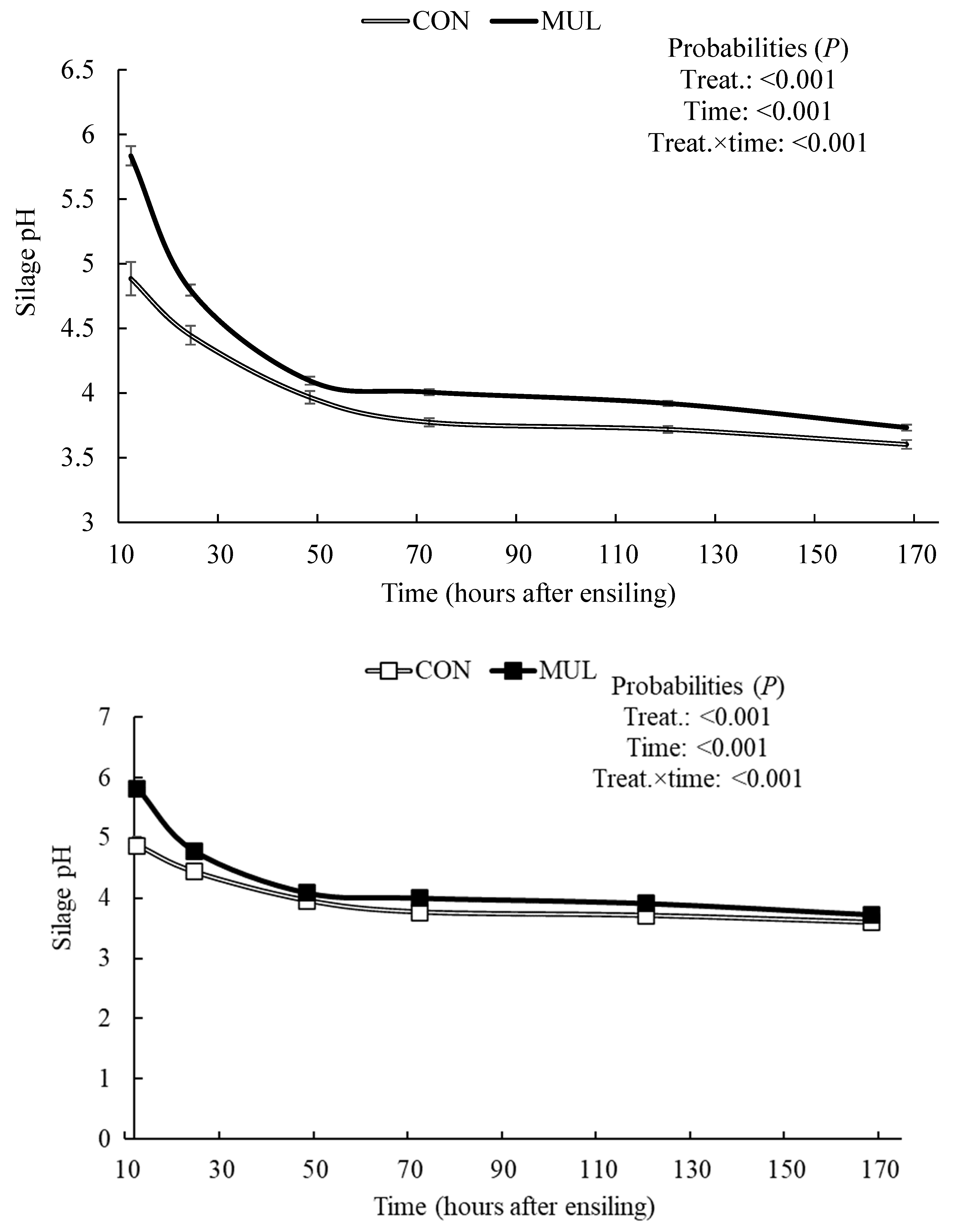
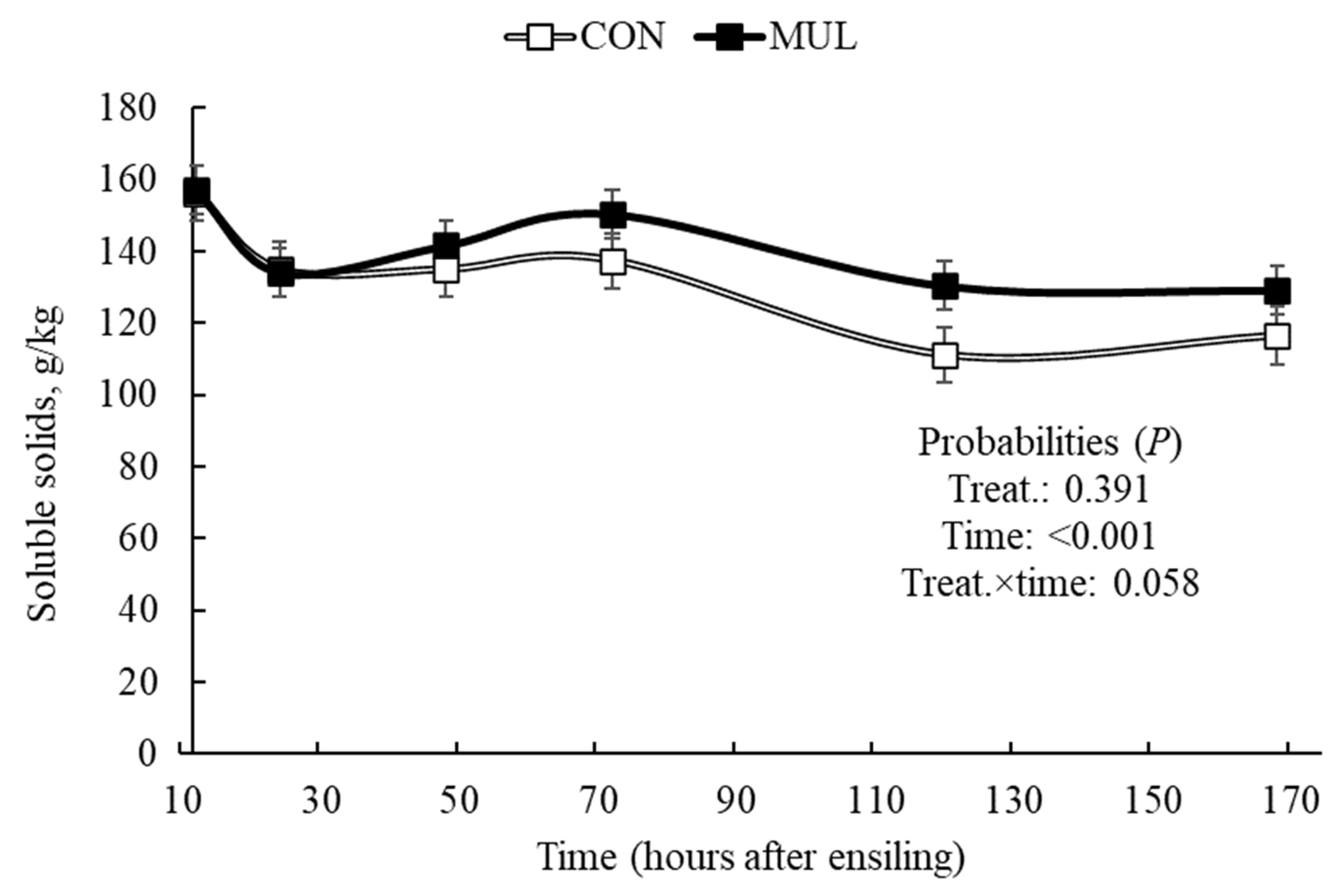
Treatment and fermentation time exerted a combined effect (p < 0.001) on silage pH (Figure 1). Although both treatments underwent acidification over time (p < 0.001), CON silages maintained a lower pH (p ≤ 0.05) during the initial fermentation stages. Consequently, the addition of MUL resulted in a higher final pH (p = 0.001) of the silage, with values of 3.51 for MUL and 3.30 for CON (Table 2). In general, treatments did not affect (p = 0.391) the soluble solids content of the silage (Figure 2). However, a trend toward a treatment and time interaction effect was observed (p = 0.058). Soluble carbohydrate content decreased in both treatments (p < 0.001). This reduction was more pronounced in CON silos compared to MUL silos, resulting in a treatment effect (p ≤ 0.05) 144 h after ensiling. Consequently, MUL silos showed higher soluble solids values (134 g/kg) compared to CON silos (105 g/kg) at the time of silo opening.
In addition, mulberry inclusion during the sugarcane ensiling reduced NH3-N by 41.3% (p = 0.012) without affecting (p = 0.685) lactic acid concentration (Table 2).

3.2. Fermentation Losses

Mulberry addition decreased (p < 0.001) silage effluent losses and tended to decrease (p = 0.068) gas losses (Table 2). Consequently, MUL showed a 59.1% reduction in total losses compared to CON. However, treatments did not affect dry matter recovery (p = 0.340), which averaged 863 g/kg.

3.3. Silage Chemical Composition and In Vitro Degradation

Mulberry inclusion increased (p ≤ 0.026) silage DM and CP, while reducing (p ≤ 0.010) OM, NDF, and ADF content (Table 3). Additionally, MUL tended to increase (p = 0.067) silage NFC compared to CON, with no effect (p = 0.809) on EE content. Therefore, mulberry enhanced (p ≤ 0.031) by 27.8 and 72.6% in vitro degradation of DM and NDF, respectively.

3.4. Aerobic Stability Assay

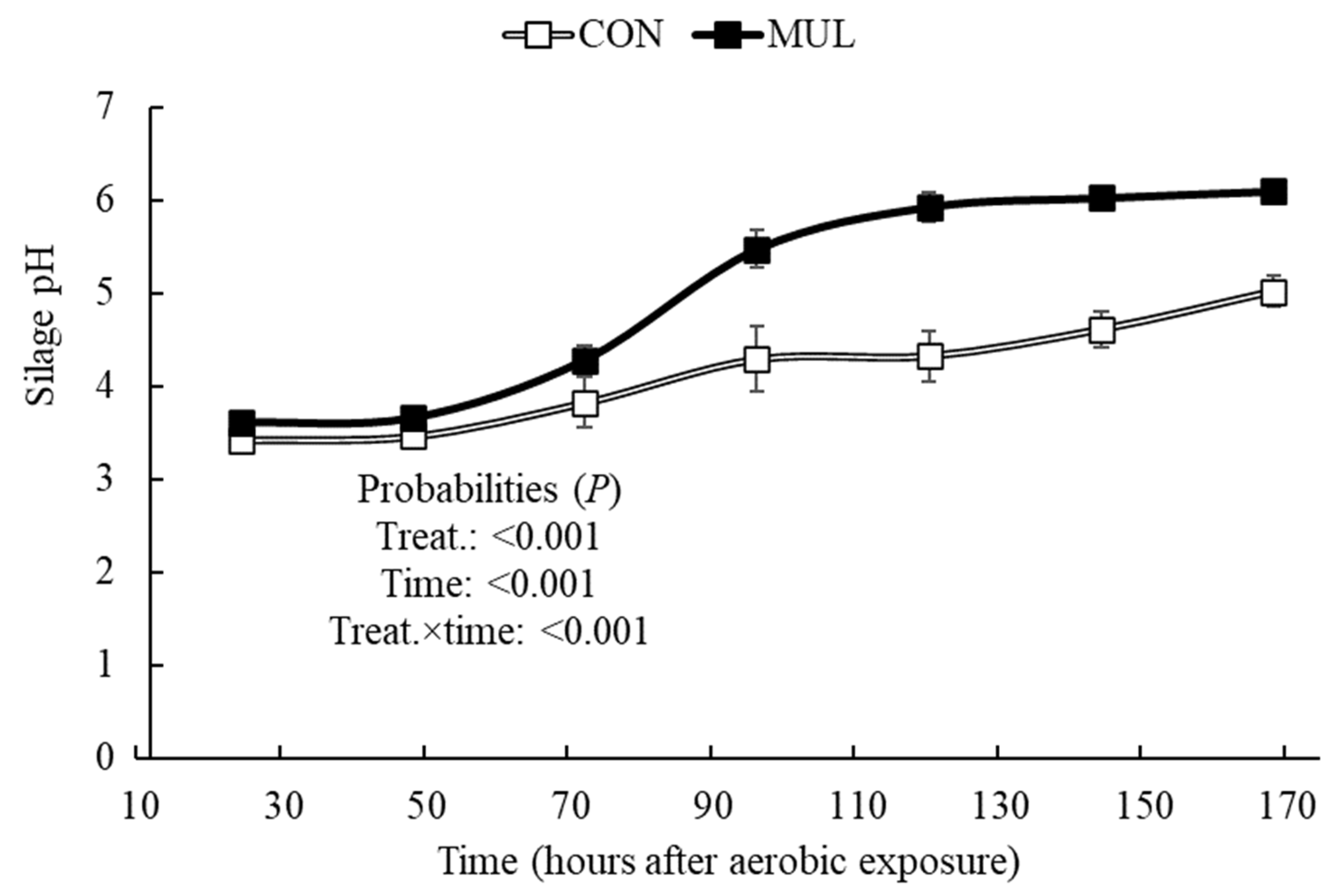
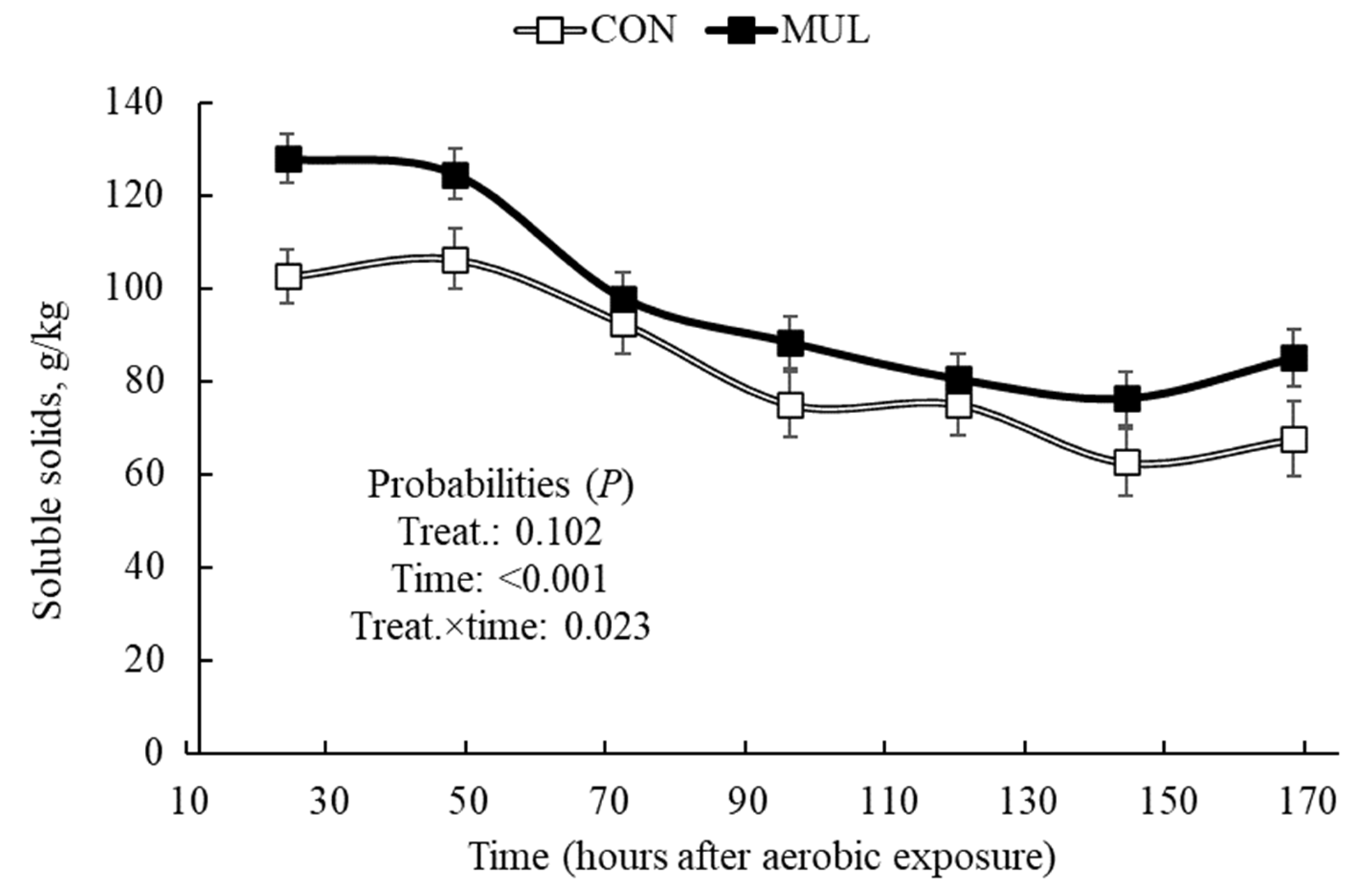
There was an MUL and time interaction effect (p < 0.001) on silage pH and soluble carbohydrate content after aerobic exposure (Figure 3 and Figure 4). Compared to CON, MUL silages showed a sharper pH increase over time, especially during prolonged aerobic exposure (Figure 3). Consequently, differences in soluble carbohydrates between treatments disappeared (p > 0.05) as exposure time progressed (Figure 4).

4. Discussion

This study hypothesized that incorporating dehydrated mulberry leaves into sugarcane silage would attenuate excessive pH drops, mitigate fermentative losses, and enhance both nutritive value and aerobic stability. Our findings largely support this hypothesis, as mulberry inclusion successfully increased silage pH, reduced effluent and total dry matter losses, and improved the overall nutritional profile. However, contrary to our expectations regarding aerobic stability, the MUL treatment exhibited a more rapid pH increase and a faster depletion of soluble solids upon air exposure.
Mulberry inclusion increased the final silage pH and attenuated the initial pH drop, reflecting a distinct acidification pattern compared to the control. The final pH in silages results from the balance between lactic acid synthesis and the forage’s buffering capacity [27]. While pure sugarcane typically exhibits low buffering capacity because of its low protein content, a factor that favors abrupt pH declines [5], mulberry leaves provide higher protein and mineral concentrations that enhance the buffering power [15,28]. The significant time × treatment interaction indicates that mulberry promoted a more controlled acidification process, which potentially prevents excessive hydrolysis. Thus, the inclusion of mulberry raised the final silage pH to 3.51, compared to 3.3 in the CON, remaining closer to the ideal range of 3.8 to 4.2 [5].
Silages containing dehydrated mulberry leaves maintained higher Brix values after 144 h of ensiling and at the final opening compared to CON, despite the overall decrease in soluble solids over time. Soluble solids, primarily sucrose, glucose, and fructose, serve as the essential substrates for microbial fermentation in sugarcane and typically lead to lactic acid production [29]. However, excessive sugar concentrations often trigger yeast proliferation and alcoholic fermentation, which increases ethanol synthesis and dry matter losses [30]. The greater sugar preservation observed in MUL silages suggests that mulberry inclusion successfully modulated carbohydrate consumption, likely by inhibiting inefficient fermentative pathways and preserving the energy density of the forage.
Lactic acid concentrations did not differ between treatments despite the observed variations in sugar preservation. Lactic acid serves as the primary agent in silage conservation because of its high acidifying capacity, which is approximately 10 to 12 times greater than that of other organic acids like acetic or propionic acid [31]. The stable lactic acid levels found in this study suggest that mulberry inclusion did not compromise the homofermentative pathway but rather contributed to more efficient energy preservation by maintaining adequate acidification without excessive sugar depletion. On the other hand, MUL decreased N-NH3 concentration compared to CON. The N-NH3 levels reflect intense protein degradation, where plant enzymes hydrolyze proteins into peptides and amino acids, followed by microbial conversion into amides, amines, and ammonia [32]. This proteolytic process, often associated with high-moisture silages and clostridial activity, leads to substantial nitrogen losses and reduces the overall nutritive value [29]. The lower N-NH3 release in MUL silages indicates superior nitrogen preservation, which likely resulted from the higher DM content of the mulberry leaves.
Mulberry inclusion markedly reduced effluent and total fermentative losses in sugarcane silage. This improvement directly relates to the 6.2% increase in DM content at ensiling (280 vs. 264 g/kg) provided by the dehydrated mulberry leaves. Adjuvants that promote even moderate increases in DM effectively mitigate losses in sugarcane silages by reducing effluent runoff and improving fermentative stability. Similar benefits occurred with the inclusion of forage peanut [33], pigeon pea [34], and rice bran [35], where higher initial DM content consistently reduced gas and effluent production while increasing nutrient recovery. However, MUL inclusion did not significantly affect DM recovery. This phenomenon occurs because effluent losses in sugarcane silages consist predominantly of water (moisture) rather than DM. Therefore, while reducing effluent production is critical for environmental and silos-management purposes, its impact on the final proportion of recovered DM may be negligible, explaining the lack of statistical difference in DMR between treatments.
Beyond the physical effect of moisture adsorption, the reduction in total losses reflects a shift in microbial efficiency. Fermentative losses, primarily driven by CO2 production, depend on the predominant microbial species and substrate availability [29,36]). While sugarcane silage typically harbors high yeast populations that convert glucose into ethanol and CO2 [5,37]), MUL inclusion reduced gas production. This effect likely stems from the bioactive compounds in mulberry, such as phenolic acids and flavonoids, which possess documented antifungal and antioxidant properties [38]. These compounds potentially inhibited yeast activity, thereby suppressing alcoholic fermentation and undesirable gas production [39]. Consequently, mulberry inclusion optimizes sugarcane silage through an integrated mechanism that combines increased DM content with biological modulation of the fermentative process.
Mulberry inclusion significantly improved the chemical composition of sugarcane silage by increasing DM and CP contents while reducing fiber fractions. The enhanced DM degradation observed in MUL silages stems from both the improved chemical profile and superior preservation of cellular constituents. In typical sugarcane silages, the conversion of sucrose into ethanol reduces DM recovery and proportionally increases the cell wall fraction, which impairs overall digestibility [7,40]. However, the greater sugar preservation and lower intrinsic fiber content of mulberry leaves [15] effectively counteracted this effect, resulting in a more digestible forage.
The NDF degradation of the CON-silage was notably low. While factors such as harvest maturity and genotype were not specifically evaluated in this study, they likely contributed to these findings. For instance, Carvalho et al. [41] reported that advanced maturity in sugarcane increases lignin deposition, directly impairing fiber digestibility. Furthermore, intrinsic genetic characteristics can significantly influence degradability profiles in sugarcane silages [42]. We acknowledge that the use of a single incubation time point (48 h) to assess degradability is a limitation of this study, as it does not capture the complete fermentation kinetics or microbial dynamics. Consequently, the low degradation observed in the CON group highlights the inherent limitations of sugarcane as a sole forage source and underscores the importance of strategies, such as the inclusion of mulberry, to enhance the nutritional value and ruminal degradation of these silages. Future research utilizing multi-point kinetic models and in vivo trials will be essential to further elucidate the mechanistic effects of mulberry inclusion on ruminal efficiency.
Mulberry silages exhibited lower aerobic stability compared to CON, characterized by a faster pH rise and an intensified depletion of soluble solids over the exposure period. Increases in pH during aerobic exposure reflect accelerated microbial activity, which directly compromises silage stability [43,44]. Although MUL silages maintained higher Brix values at opening, these residual soluble solids were rapidly consumed by yeasts and aerobic bacteria. This process triggers the oxidation of fermentable carbohydrates, leading to heat production and a subsequent rise in pH [36,45]. This reduced stability stems from the greater availability of both energy and nitrogen substrates provided by mulberry leaves. The higher CP content and lower initial N-NH3 concentration in MUL silages provided a rich environment for aerobic microorganisms at silo opening. Similarly, silages enriched with molasses often show reduced stability due to the high soluble carbohydrate content available for spoilage organisms [46]. These findings indicate that while mulberry leaves optimize the fermentation phase, the resulting nutrient-dense silage requires careful management after silo opening to prevent rapid spoilage.

5. Conclusions

The inclusion of dehydrated mulberry leaves in sugarcane silage enhances fermentation by increasing final pH, reducing dry matter losses, and improving chemical composition, with higher DM and CP and lower fiber fractions. Despite lower aerobic stability, mulberry leaves represent an effective and sustainable additive, providing a renewable feed source for ruminants and contributing to the nutritive preservation of the silage.

Author Contributions

Conceptualization, J.P.G.d.M., M.C. and T.A.D.V.; methodology, M.C., E.C., J.G.T.C., G.V.T. and A.C.R.; software, M.C.; validation, M.C.; formal analysis, T.A.D.V. and M.E.P.H.; investigation, M.C., E.C., J.G.T.C., G.V.T. and A.C.R.; resources, J.P.G.d.M.; data curation, T.A.D.V.; writing—original draft preparation, T.A.D.V. and M.E.P.H.; writing—review and editing, T.A.D.V. and M.E.P.H.; visualization, T.A.D.V.; supervision, J.P.G.d.M.; project administration, J.P.G.d.M. and M.C.; funding acquisition, J.P.G.d.M. All authors have read and agreed to the published version of the manuscript.

Funding

The APC was funded by Coordenação de Aperfeiçoamento de Pessoal de Nível Superior (CAPES, reference number 88881.709120/2022-01).

Institutional Review Board Statement

The animal study protocol was approved by the Ethics Committee of the Universidade Federal de São Carlos (protocol code 4690130924).

Informed Consent Statement

Not applicable.

Data Availability Statement

The data supporting the findings of this study are available from the corresponding author upon request.

Conflicts of Interest

The authors declare no conflicts of interest. The funders had no involvement in the study design; data collection, analysis, or interpretation; the writing of the manuscript; or the decision to publish the results.

References

  1. Dias, A.M.; Ítavo, L.C.V.; Damasceno, J.; Ítavo, C.C.B.F.; Santos, G.T.; Echeverria, D.M.S.; Gomes, E.N.O.; Junges, L. Calorimetry, chemical composition and in vitro digestibility of sugarcane treated with calcium hydroxide. Crop Pasture Sci. 2018, 69, 406–410. [Google Scholar] [CrossRef]
  2. Roth, A.P.D.T.P.; Reis, R.A.; Siqueira, G.R.; Roth, M.D.T.P.; de Resende, F.D.; Monteiro, R.R. Sugarcane silage production treated with additives at different times post burning. Rev. Bras. Zootec. 2010, 39, 88–96. [Google Scholar] [CrossRef][Green Version]
  3. Borges, A.L.C.C.; Silva, R.R.e.; Lage, H.F.; Campos, M.M. Sugarcane in dairy cattle feeding. In Proceedings of the VI Simpósio Mineiro e I Simpósio Nacional Sobre Nutrição de Gado de Leite, Belo Horizonte, Brazil, 13–15 April 2012; Available online: https://www.alice.cnptia.embrapa.br/alice/bitstream/doc/949092/1/Cana-de-acucar-na-alimentacao-de-bovinos-leiteiros.pdf (accessed on 2 February 2026).
  4. Ren, F.; He, R.; Zhou, X.; Gu, Q.; Xia, Z.; Liang, M.; Zhou, J.; Lin, B.; Zou, C. Dynamic changes in fermentation profiles and bacterial community composition during sugarcane top silage fermentation: A preliminary study. Bioresour. Technol. 2019, 285, 121315. [Google Scholar] [CrossRef]
  5. McDonald, P.; Henderson, A.R.; Heron, S.J.E. The Biochemistry of Silage, 2nd ed.; Chalcombe Publications: Aberystwyth, UK, 1991. [Google Scholar] [CrossRef]
  6. Santos, M.C.; Nussio, L.G.; Mourão, G.B.; Schmidt, P.; Mari, L.J.; Ribeiro, J.L.; Queiroz, O.C.M.; Zopollatto, M.; Sousa, D.P.; Sarturi, J.O.; et al. Nutritive value of sugarcane silage treated with chemical additives. Sci. Agric. 2009, 66, 159–163. [Google Scholar] [CrossRef]
  7. Cavali, J.; Pereira, O.G.; Valadares Filho, S.C.; Santos, E.M.; Carvalho, G.G.P.; Santos, M.V.; Porto, M.O.; Rodrigues, J.F.H. Bromatological and microbiological characteristics of sugarcane silages treated with calcium oxide. Rev. Bras. Zootec. 2010, 39, 1398–1408. [Google Scholar] [CrossRef]
  8. Leroy, A.; Devaux, M.-F.; Fanuel, M.; Chauvet, H.; Durand, S.; Alvarado, C.; Habrant, A.; Sandt, C.; Rogniaux, H.; Paës, G.; et al. Real-time imaging of enzymatic degradation of pretreated maize internodes reveals different cell types have different profiles. Bioresour. Technol. 2022, 353, 127140. [Google Scholar] [CrossRef] [PubMed]
  9. Alli, I.; Fairbairn, R.; Baker, B.E. The effects of ammonia on the fermentation of chopped sugarcane. Anim. Feed Sci. Technol. 1983, 9, 291–299. [Google Scholar] [CrossRef]
  10. Pedroso, A.F.; Rodrigues, A.A.; Barioni Júnior, W.; Souza, G.B. Fermentation parameters, quality and losses in sugarcane silages treated with chemical additives and a bacterial inoculant. Rev. Bras. Zootec. 2011, 40, 2318–2322. [Google Scholar] [CrossRef]
  11. Bueno, A.V.I.; Vigne, G.L.D.; Novinski, C.O.; Bayer, C.; Jobim, C.C.; Schmidt, P. Natamycin as a potential silage additive: A lab trial using sugarcane to assess greenhouse gas emissions. Rev. Bras. Zootec. 2020, 49, e20200017. [Google Scholar] [CrossRef]
  12. Gomes, A.L.M.; Bueno, A.V.I.; Osmari, M.P.; Machado, J.; Nussio, L.G.; Jobim, C.C.; Daniel, J.L.P. Effects of obligate heterofermentative lactic acid bacteria alone or in combination on the conservation of sugarcane silage. Front. Microbiol. 2021, 12, 643879. [Google Scholar] [CrossRef]
  13. Wang, W.X.; Yang, H.J.; Bo, Y.K.; Ding, S.; Cao, B.H. Nutrient composition, polyphenolic contents, and in situ protein degradation kinetics of leaves from three mulberry species. Livest. Sci. 2012, 146, 203–206. [Google Scholar] [CrossRef]
  14. Li, P.; You, M.; Du, Z.; Lu, Y.; Zuo, C.; Zhao, M.; Wang, H.; Yan, X.; Chen, C. Effects of N fertilization during cultivation and Lactobacillus plantarum inoculation at ensiling on chemical composition and bacterial community of mulberry silage. Front. Microbiol. 2021, 12, 735767. [Google Scholar] [CrossRef] [PubMed]
  15. de Morais, J.P.G.; Campana, M.; Gregorini, P.; Garcia, T.M.; Minussi, J.F.d.A.; Pereira, S.N.; Pereira, F.C.; Del Valle, T.A. In vitro evaluation of potentially edible Brazilian trees and shrubs in ruminant nutrition. Animals 2023, 13, 3703. [Google Scholar] [CrossRef] [PubMed]
  16. Yang, W.; Yang, F.; Feng, C.; Zhao, S.; Zhang, X.; Wang, Y. Fermentation properties and bacterial community composition of mixed silage of mulberry leaves and smooth bromegrass with and without Lactobacillus plantarum inoculation. Fermentation 2023, 9, 279. [Google Scholar] [CrossRef]
  17. Maulfair, D.D.; Fustini, M.; Heinrichs, A.J. Effect of varying total mixed ration particle size on rumen digesta and fecal particle size and digestibility in lactating dairy cows. J. Dairy Sci. 2011, 94, 3527–3536. [Google Scholar] [CrossRef]
  18. AOAC. Official Methods of Analysis, 17th ed.; Association of Official Analytical Chemists: Arlington, VA, USA, 2000. [Google Scholar]
  19. Pryce, J.D.A. A modification of the barker-summerson method for the determination of lactic acid. Analyst 1969, 94, 1151–1152. [Google Scholar] [CrossRef]
  20. Van Soest, P.J.; Robertson, J.B.; Lewis, B.A. Methods for dietary fiber, neutral detergent fiber, and nonstarch polysaccharides in relation to animal nutrition. J. Dairy Sci. 1991, 74, 3583–3597. [Google Scholar] [CrossRef]
  21. McDougall, E.I. Studies on ruminant saliva, 1. The composition and output of sheep’s saliva. Biochem. J. 1948, 43, 99–102. [Google Scholar] [CrossRef]
  22. Holden, L.A. Comparison of methods of in vitro dry matter digestibility for ten feeds. J. Dairy Sci. 1999, 82, 1791–1794. [Google Scholar] [CrossRef]
  23. Casali, A.O.; Detmann, E.; Valadares Filho, S.C.; Pereira, J.C.; Henriques, L.T.; Freitas, S.G.; Paulino, M.F. Influence of incubation time and particle size on indigestible compounds contents in cattle feeds and feces obtained by in situ procedures. Rev. Bras. Zootec. 2008, 37, 335–342. [Google Scholar] [CrossRef]
  24. Nocek, J.E. In situ and other methods to estimate ruminal protein and energy digestibility: A review. J. Dairy Sci. 1988, 71, 2051–2069. [Google Scholar] [CrossRef]
  25. Detmann, E.; Souza, M.A.; Valadares Filho, S.C.; Queiroz, A.C.; Berchielli, T.T.; Saliba, E.O.E.; Cabral, L.S.; Pina, D.S.; Ladeira, M.M.; Azevedo, J.A.G. Methods for Feed Analysis (INCT–Animal Science); Editora UFV: Viçosa, MG, Brazil, 2012. [Google Scholar]
  26. Jobim, C.C.; Nussio, L.G.; Reis, R.A.; Schmidt, P. Methodological advances in evaluation of preserved forage quality. Rev. Bras. Zootec. 2007, 36, 101–119. [Google Scholar] [CrossRef]
  27. Kung, L., Jr.; Shaver, R.D.; Grant, R.J. Silage review: Interpretation of chemical, microbial, and fermentation data of silages. J. Dairy Sci. 2018, 101, 4022–4033. [Google Scholar] [CrossRef]
  28. Dong, Z.; Wang, S.; Zhao, J.; Li, J.; Shao, T. Effects of additives on the fermentation quality, in vitro digestibility and aerobic stability of mulberry (Morus alba L.) leaves silage. Asian-Australas. J. Anim. Sci. 2020, 33, 1292–1300. [Google Scholar] [CrossRef]
  29. Wróbel, B.; Nowak, J.; Fabiszewska, A.; Paszkiewicz-Jasińska, A.; Przystupa, W. Dry matter losses in silages resulting from epiphytic microbiota activity—A comprehensive study. Agronomy 2023, 13, 450. [Google Scholar] [CrossRef]
  30. Ávila, C.L.S.; Santos, M.C.; Rooke, J.A. Identification and characterization of yeasts in sugarcane silages. J. Appl. Microbiol. 2010, 109, 1677–1685. [Google Scholar] [CrossRef] [PubMed]
  31. Muck, R.E.; Nadeau, E.M.G.; McAllister, T.A.; Contreras-Govea, F.E.; Santos, M.C.; Kung, L., Jr. Silage review: Recent advances and future uses of silage additives. J. Dairy Sci. 2018, 101, 3980–4000. [Google Scholar] [CrossRef] [PubMed]
  32. Albrecht, K.A.; Muck, R.E. Proteolysis in ensiled forage legumes that vary in tannin concentration. Crop Sci. 1991, 31, 464–469. [Google Scholar] [CrossRef]
  33. da Costa, D.R.; Ribeiro, K.G.; de Lima Cruz, G.F.; da Silva, T.C.; Cardoso, L.L.; Pereira, O.G. Mixed sugarcane and forage peanut silages treated with Lactobacillus buchneri. Ciênc. Anim. Bras. 2022, 23, e72352E. [Google Scholar] [CrossRef]
  34. Pereira, D.S.; Lana, R.P.; Carmo, D.L.; Costa, Y.K.S. Chemical composition and fermentative losses of mixed sugarcane and pigeon pea silage. Acta Sci. Anim. Sci. 2019, 41, e43709. [Google Scholar] [CrossRef]
  35. Campana, M.; de Morais, J.P.G.; Hamerski, M.E.P.; Massafera, V.A.; Sobires, P.D.; Capucho, E.; Osório, J.A.C.; Del Valle, T.A. Rice bran addition improves sugarcane silage nutritional value and aerobic stability. N. Z. J. Agric. Res. 2025, 68, 1875–1887. [Google Scholar] [CrossRef]
  36. Borreani, G.; Tabacco, E.; Schmidt, R.J.; Holmes, B.J.; Muck, R.E. Silage review: Factors affecting dry matter and quality losses in silages. J. Dairy Sci. 2018, 101, 3952–3979. [Google Scholar] [CrossRef] [PubMed]
  37. Rooke, J.A.; Hatfield, R.D. Biochemistry of ensiling. In Silage Science and Technology; Buxton, D.R., Muck, R.E., Harrison, J.H., Eds.; American Society of Agronomy: Madison, WI, USA, 2003; pp. 145–170. [Google Scholar] [CrossRef]
  38. Chen, C.; Mohamad Razali, U.H.; Saikim, F.H.; Mahyudin, A.; Mohd Noor, N.Q.I. Morus alba L. plant: Bioactive compounds and potential as a functional food ingredient. Foods 2021, 10, 689. [Google Scholar] [CrossRef] [PubMed]
  39. Cantoia Júnior, R.; Capucho, E.; Garcia, T.M.; Del Valle, T.A.; Campana, M.; Zilio, E.M.C.; Azevedo, E.B.; de Morais, J.P.G. Lemongrass essential oil in sugarcane silage: Fermentative profile, losses, chemical composition, and aerobic stability. Anim. Feed Sci. Technol. 2020, 260, 114371. [Google Scholar] [CrossRef]
  40. Santos, M.C.; Nussio, L.G.; Mourão, G.B.; Schmidt, P.; Mari, L.J.; Ribeiro, J.L. Influence of chemical additives on the fermentation profile, nutritive value, and losses of sugarcane silages. Rev. Bras. Zootec. 2008, 37, 1555–1563. [Google Scholar] [CrossRef]
  41. Carvalho, M.V.; Rodrigues, P.H.M.; Lima, M.L.P.; Anjos, I.A.; Landell, M.G.A.; Santos, M.V.; Silva, L.F.P. Chemical composition and digestibility of sugarcane harvested at two periods of the year. Braz. J. Vet. Res. Anim. Sci. 2010, 47, 298–306. [Google Scholar] [CrossRef]
  42. Sousa, D.O.; Velasquez, A.V.; Oliveira, C.A.; Souza, J.M.; Nadeau, E.; Silva, L.F.P. Effect of sugarcane genotype and maturity stage at harvest on feed intake and ruminal parameters of growing steers. Anim. Feed Sci. Technol. 2019, 257, 114258. [Google Scholar] [CrossRef]
  43. Bernardes, T.F.; Reis, R.A.; Amaral, R.C. Chemical and microbiological changes and aerobic stability of Marandu grass silages after silo opening. Rev. Bras. Zootec. 2009, 38, 1–8. [Google Scholar] [CrossRef][Green Version]
  44. Bernardes, T.F.; Reis, R.A.; Siqueira, G.R.; Amaral, R.C.; Pires, A.J.V. Aerobic stability of total mixed ration and Marandu grass silage using microbial or chemical additive. Rev. Bras. Zootec. 2007, 36, 754–762. [Google Scholar] [CrossRef]
  45. Pahlow, G.; Muck, R.E.; Driehuis, F.; Oude Elferink, S.J.W.H.; Spoelstra, S.F. Microbiology of ensiling. In Silage Science and Technology; Buxton, D.R., Muck, R.E., Harrison, J.H., Eds.; American Society of Agronomy: Madison, WI, USA, 2003; pp. 31–93. [Google Scholar] [CrossRef]
  46. Wang, T.; Huang, Z.; Zhang, N.; Kareem, K.; Sun, X.; Shang, C.; Hua, D.; Wang, X. Effects of molasses on the quality, aerobic stability, and ruminal degradation characteristics of mixed ensilage of seed-used zucchini peel residue and corn stalk. Front. Sustain. Food Syst. 2025, 9, 1560403. [Google Scholar] [CrossRef]
Figure 1. Changes in pH of sugarcane during the early stages of ensiling with or without the inclusion of dehydrated mulberry leaves.
Animals 16 00819 g001
Figure 2. Soluble solids concentration in sugarcane during the early stages of ensiling with or without the inclusion of dehydrated mulberry leaves.
Animals 16 00819 g002
Figure 3. pH of sugarcane silages with or without the inclusion of dehydrated mulberry leaves during aerobic exposure.
Animals 16 00819 g003
Figure 4. Soluble solids concentration in sugarcane silages with or without the inclusion of dehydrated mulberry leaves during aerobic exposure.
Animals 16 00819 g004
Table 1. Chemical composition and particle size of fresh sugarcane (n = 4; mean ± SD) and mulberry leaves (single sample).
ItemSugarcaneMulberry
Chemical composition, g/kg dry matter, unless stated
  Dry matter, g/kg fresh matter264 ± 7.7944
  Organic matter982 ± 1.9875
  Neutral detergent fiber 417 ± 24.4409
  Acid detergent fiber227 ± 19.6143
  Non-fiber carbohydrate532 ± 5.6292
  Ether extract12.8 ± 2.0330.2
  Crude protein21.3 ± 2.2 144
Particle size fresh sugarcane 1, g/kg
  >19 mm87.9 ± 22.537.54
  8 to 19 mm731 ± 41.7304
  4 to 8 mm87.5 ± 14.779.6
  <4 mm93.3 ± 25.2609
1 Maulfair et al. [17].
Table 2. Fermentation profile and losses of sugarcane silage with or without the inclusion of dehydrated mulberry leaves.
ItemTreatments 1p-Value 2
CONMUL
Fermentation profile
  Silage pH3.30 ± 0.0253.51 ± 0.0220.001
  Soluble solids (BRIX), g/kg105 ± 6.6134 ± 6.00.016
  Ammonia-N, g/kg N109 ± 9.264.0 ± 8.560.012
  Lactic acid, g/kg DM51.3 ± 4.0049.0 ± 3.680.685
Fermentation losses, g/kg as fed
  Effluent59.2 ± 4.7013.8 ± 4.34<0.001
Fermentation losses, g/kg DM 3
  Effluent238 ± 18.552 ± 17.0<0.001
  Gas losses, g/kg DM 3134 ± 10.9100 ± 10.70.068
  Total losses, g/kg DM 3372 ± 28.2152 ± 27.20.002
  Dry matter recovery, g/kg843 ± 27.8883 ± 27.00.340
Data are presented as means ± SEM. 1 Treatments: CONT: sugarcane silage without the inclusion of dehydrated mulberry leaves; MUL: sugarcane silage with the inclusion of dehydrated mulberry leaves. 2 p: probability of treatment effect. 3 DM: dry matter.
Table 3. Chemical composition and in vitro degradation of sugarcane silage with or without the inclusion of dehydrated mulberry leaves.
ItemTreatments 1p-Value 2
CONMUL
Chemical composition, g/kg dry matter, unless stated
  Dry matter, g/kg as-fed205 ± 5.7228 ± 5.50.026
  Organic matter974 ± 1.5963 ± 1.20.001
  Neutral detergent fiber608 ± 16.4516 ± 15.90.007
  Acid detergent fiber339 ± 10.8283 ± 10.60.010
  Non-fiber carbohydrates355 ± 15.0399 ± 12.20.067
  Ether extract18.0 ± 3.9019.1 ± 2.250.809
  Crude protein28.4 ± 2.2646.1 ± 2.020.001
In vitro degradation 3, g/kg
  Dry matter474 ± 27.0606 ± 23.20.008
  Neutral detergent fiber135 ± 33.6233 ± 21.50.031
Data are presented as means ± SEM. 1 CONT: sugarcane silage without dehydrated mulberry leaves; MUL: sugarcane silage with dehydrated mulberry leaves. 2 p: probability of treatment effect. 3 48 h in vitro assay.
Disclaimer/Publisher’s Note: The statements, opinions and data contained in all publications are solely those of the individual author(s) and contributor(s) and not of MDPI and/or the editor(s). MDPI and/or the editor(s) disclaim responsibility for any injury to people or property resulting from any ideas, methods, instructions or products referred to in the content.