Showing Behaviour in One Hundred and One Dogs: Gazing, Breed and Cephalic Index


Simple Summary
Abstract
1. Introduction
2. Materials and Methods
2.1. Ethic Statement
2.2. Subjects
2.3. Training for the Experimenters
2.4. Lineage
2.5. Cephalic Index
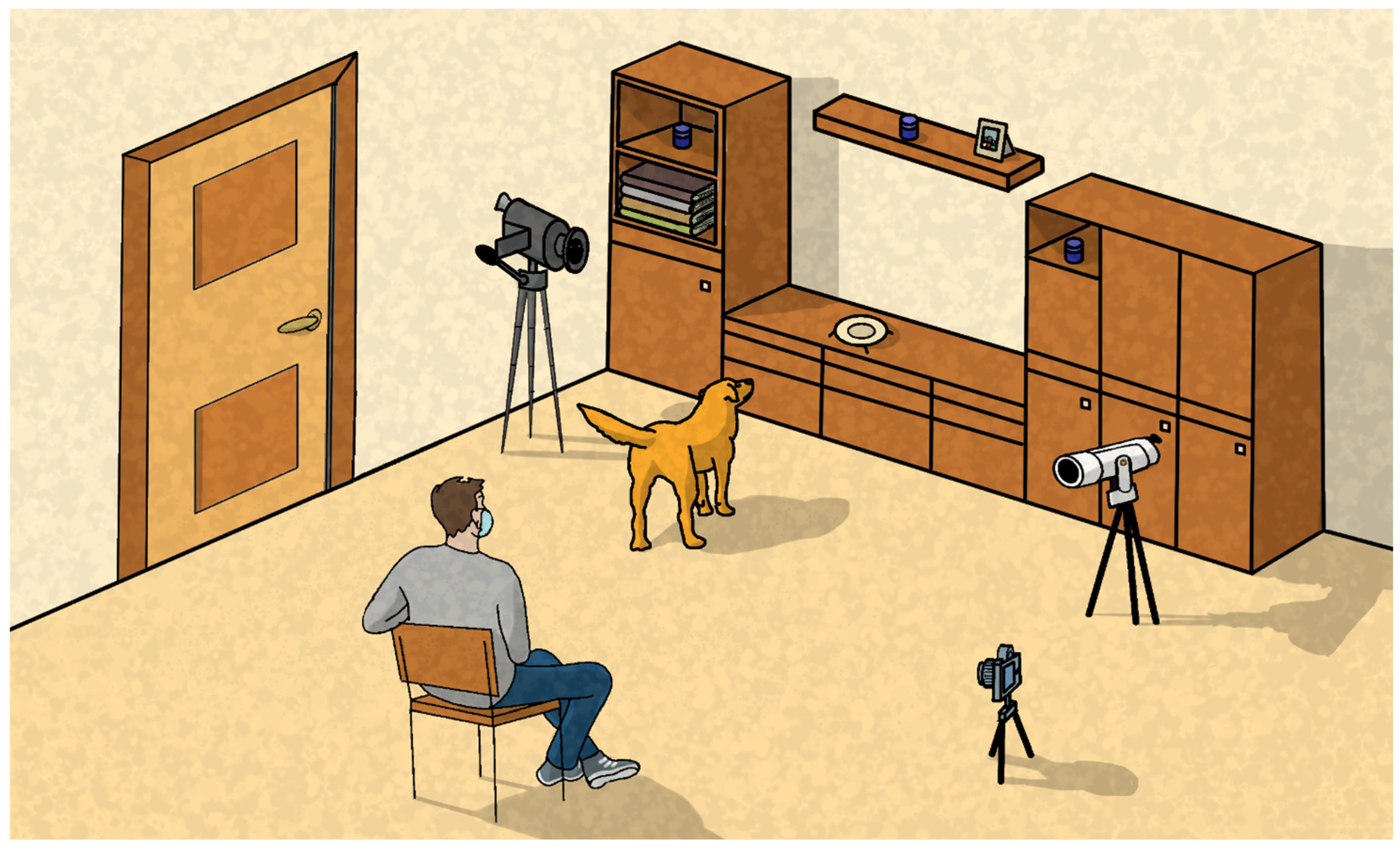
2.6. Task Procedure
2.7. Procedure
2.8. Video Analysis
2.9. Statistical Analysis
3. Results
3.1. Model 1
3.2. Model 2a
3.3. Model 2b
3.4. Model 3
3.5. Model 4
3.6. Model 5
4. Discussion
5. Conclusions
Supplementary Materials
Author Contributions
Funding
Institutional Review Board Statement
Informed Consent Statement
Data Availability Statement
Acknowledgments
Conflicts of Interest
References
- Aria, M.; Alterisio, A.; Scandurra, A.; Pinelli, C.; D’Aniello, B. The scholar’s best friend: Research trends in dog cognitive and behavioral studies. Anim. Cogn. 2021, 24, 541–553. [Google Scholar] [CrossRef] [PubMed]
- Bensky, M.K.; Gosling, S.D.; Sinn, D.L. The world from a dog’s point of view: A review and synthesis of dog cognition research. Adv. Study Anim. Behav. 2013, 45, 209–406. [Google Scholar]
- Kaminski, J.; Nitzschner, M. Do dogs get the point? A review of dog-human communication ability. Learn. Motiv. 2013, 44, 294–302. [Google Scholar] [CrossRef]
- Scheider, L.; Grassmann, S.; Kaminski, J.; Tomasello, M. Domestic dogs use contextual information and tone of voice when following a human pointing gesture. PLoS ONE 2011, 6, e21676. [Google Scholar] [CrossRef]
- Lakatos, G.; Gácsi, M.; Topál, J.; Miklósi, Á. Comprehension and utilisation of pointing gestures and gazing in dog–human communication in relatively complex situations. Anim. Cogn. 2012, 15, 201–213. [Google Scholar] [CrossRef]
- Müller, C.A.; Schmitt, K.; Barber, A.L.; Huber, L. Dogs can discriminate emotional expressions of human faces. Curr. Biol. 2015, 25, 601–605. [Google Scholar] [CrossRef]
- Range, F.; Marshall-Pescini, S.; Kratz, C.; Virányi, Z. Wolves lead and dogs follow, but they both cooperate with humans. Sci. Rep. 2019, 9, 3796. [Google Scholar] [CrossRef] [PubMed]
- D’Aniello, B.; Scandurra, A.; Alterisio, A.; Valsecchi, P.; Prato-Previde, E. The importance of gestural communication: A study of human–dog communication using incongruent information. Anim. Cogn. 2016, 19, 1231–1235. [Google Scholar] [CrossRef] [PubMed]
- Siniscalchi, M.; d’Ingeo, S.; Minunno, M.; Quaranta, A. Communication in dogs. Animals 2018, 8, 131. [Google Scholar] [CrossRef]
- Gácsi, M.; Miklósi, Á.; Varga, O.; Topál, J.; Csányi, V. Are readers of our face readers of our minds? Dogs show situation-dependent recognition of human attention. Anim. Cogn. 2004, 7, 144–153. [Google Scholar] [CrossRef]
- Hare, B.; Tomasello, M. Human-like social skills in dogs? Trends Cogn. Sci. 2005, 9, 439–444. [Google Scholar] [CrossRef] [PubMed]
- Topál, J.; Gergely, G.; Erdőhegyi, Á.; Csibra, G.; Miklósi, Á. Differential sensitivity to human communication in dogs, wolves, and human infants. Science 2009, 325, 1269–1272. [Google Scholar] [CrossRef]
- Reid, P.J. Adapting to the human world: Dogs’ responsiveness to our social cues. Behav. Process. 2009, 80, 325–333. [Google Scholar] [CrossRef] [PubMed]
- Virányi, Z.; Topál, J.; Gácsi, M.; Miklósi, Á.; Csányi, V. Dogs respond appropriately to cues of humans’ attentional focus. Behav. Process. 2004, 66, 161–172. [Google Scholar] [CrossRef]
- Kaminski, J.; Brauer, J.; Call, J.; Tomasello, M. Domestic dogs are sensitive to a human’s perspective. Behaviour 2009, 146, 979–998. [Google Scholar] [CrossRef]
- Prato-Previde, E.; Marshall-Pescini, S. Social looking in the domestic dog. In Domestic Dog Cognition and Behavior; Springer: Berlin/Heidelberg, Germany, 2014; pp. 101–131. [Google Scholar]
- Cavalli, C.; Carballo, F.; Bentosela, M. Gazing behavior during problem solving tasks in domestic dogs: A critical review. Dog Behav. 2018, 4, 23–44. [Google Scholar]
- Leavens, D.A.; Hopkins, W.D.; Thomas, R.K. Referential communication by chimpanzees (Pan troglodytes). J. Comp. Psychol. 2004, 118, 48–57. [Google Scholar] [CrossRef]
- Savalli, C.; Resende, B.; Gaunet, F. Eye contact is crucial for referential communication in pet dogs. PLoS ONE 2016, 11, e0162161. [Google Scholar] [CrossRef]
- Passalacqua, C.; Marshall-Pescini, S.; Barnard, S.; Lakatos, G.; Valsecchi, P.; Previde, E.P. Human-directed gazing behaviour in puppies and adult dogs, Canis lupus familiaris. Anim. Behav. 2011, 82, 1043–1050. [Google Scholar] [CrossRef]
- Mendes, J.W.W.; Resende, B.; Savalli, C. Effect of different experiences with humans in dogs’ visual communication. Behav. Process. 2021, 192, 104487. [Google Scholar] [CrossRef]
- Barrera, G.; Mustaca, A.; Bentosela, M. Communication between domestic dogs and humans: Effects of shelter housing upon the gaze to the human. Anim. Cogn. 2011, 14, 727–734. [Google Scholar] [CrossRef]
- Scandurra, A.; Prato-Previde, E.; Valsecchi, P.; Aria, M.; D’Aniello, B. Guide dogs as a model for investigating the effect of life experience and training on gazing behaviour. Anim. Cogn. 2015, 18, 937–944. [Google Scholar] [CrossRef]
- Konno, A.; Romero, T.; Inoue-Murayama, M.; Saito, A.; Hasegawa, T. Dog breed differences in visual communication with humans. PLoS ONE 2016, 11, e0164760. [Google Scholar] [CrossRef] [PubMed]
- Jakovcevic, A.; Elgier, A.M.; Mustaca, A.E.; Bentosela, M. Breed differences in dogs’ (Canis familiaris) gaze to the human face. Behav. Process. 2010, 84, 602–607. [Google Scholar] [CrossRef] [PubMed]
- Maglieri, V.; Prato-Previde, E.; Tommasi, E.; Palagi, E. Wolf-like or dog-like? A comparison of gazing behaviour across three dog breeds tested in their familiar environments. R. Soc. Open Sci. 2019, 6, 190946. [Google Scholar] [CrossRef] [PubMed]
- Sommese, A.; Nováková, K.; Šebková, N.F.; Bartoš, L. A wolfdog point of view on the impossible task paradigm. Anim. Cogn. 2019, 22, 1073–1083. [Google Scholar] [CrossRef]
- Pongrácz, P.; Hegedüs, D.; Sanjurjo, B.; Kővári, A.; Miklósi, Á. “We will work for you”–Social influence may suppress individual food preferences in a communicative situation in dogs. Learn. Motiv. 2013, 44, 270–281. [Google Scholar] [CrossRef]
- Pongrácz, P.; Lugosi, C.A. Cooperative but Dependent–Functional Breed Selection in Dogs Influences Human-Directed Gazing in a Difficult Object-Manipulation Task. Animals 2024, 14, 2348. [Google Scholar] [CrossRef]
- Bognár, Z.; Szabó, D.; Deés, A.; Kubinyi, E. Shorter headed dogs, visually cooperative breeds, younger and playful dogs form eye contact faster with an unfamiliar human. Sci. Rep. 2021, 11, 9293. [Google Scholar] [CrossRef]
- Miklósi, Á.; Polgárdi, R.; Topál, J.; Csányi, V. Intentional behaviour in dog-human communication: An experimental analysis of “showing” behaviour in the dog. Anim. Cogn. 2000, 3, 159–166. [Google Scholar] [CrossRef]
- Prato-Previde, E.; Pedretti, G.; Terruzzi, E.; Valsecchi, P. When the owner does not know: Comparing puppies and adult dogs’ showing behavior. Anim. Cogn. 2023, 26, 985–996. [Google Scholar] [CrossRef] [PubMed]
- Gaunet, F.; Deputte, B.L. Functionally referential and intentional communication in the domestic dog: Effects of spatial and social contexts. Anim. Cogn. 2011, 14, 849–860. [Google Scholar] [CrossRef]
- Savalli, C.; Ades, C.; Gaunet, F. Are Dogs Able to Communicate with Their Owners about a Desirable Food in a Referential and Intentional Way? PLoS ONE 2014, 9, e108003, Correction in PLoS ONE 2014, 9, e111387. [Google Scholar] [CrossRef]
- Cavalli, C.; Carballo, F.; Dzik, M.V.; Bentosela, M. Showing behavior in animal-assisted intervention and pet dogs. Behav. Process. 2020, 179, 104218. [Google Scholar] [CrossRef]
- Gaunet, F. How do guide dogs and pet dogs (Canis familiaris) ask their owners for their toy and for playing? Anim. Cogn. 2010, 13, 311–323. [Google Scholar] [CrossRef]
- Moser, A.Y.; Welch, M.; Brown, W.Y.; McGreevy, P.; Bennett, P.C. Methods of behavioral testing in dogs: A scoping review and analysis of test stimuli. Front. Vet. Sci. 2024, 11, 1455574. [Google Scholar] [CrossRef]
- Heberlein, M.T.; Turner, D.C.; Range, F.; Virányi, Z. A comparison between wolves, Canis lupus, and dogs, Canis familiaris, in showing behaviour towards humans. Anim. Behav. 2016, 122, 59–66. [Google Scholar] [CrossRef]
- Lit, L.; Schweitzer, J.B.; Oberbauer, A.M. Handler beliefs affect scent detection dog outcomes. Anim. Cogn. 2011, 14, 387–394. [Google Scholar] [CrossRef] [PubMed]
- Gácsi, M.; Györi, B.; Virányi, Z.; Kubinyi, E.; Range, F.; Belényi, B.; Miklósi, Á. Explaining dog wolf differences in utilizing human pointing gestures: Selection for synergistic shifts in the development of some social skills. PLoS ONE 2009, 4, e6584. [Google Scholar] [CrossRef]
- Sexton, C.L.; Buckley, C.; Lieberfarb, J.; Subiaul, F.; Hecht, E.E.; Bradley, B.J. What is written on a dog’s face? Evaluating the impact of facial phenotypes on communication between humans and canines. Animals 2023, 13, 2385. [Google Scholar] [CrossRef] [PubMed]
- Asher, L.; England, G.C.W.; Sommerville, R.; Harvey, N.D. Teenage dogs? Evidence for adolescent-phase conflict behaviour and an association between attachment to humans and pubertal timing in the domestic dog. Biol. Lett. 2020, 16, 20200097. [Google Scholar] [CrossRef]
- Dutrow, E.V.; Serpell, J.A.; Ostrander, E.A. Domestic dog lineages reveal genetic drivers of behavioral diversification. Cell 2022, 185, 4737–4755. [Google Scholar] [CrossRef]
- Georgevsky, D.; Carrasco, J.J.; Valenzuela, M.; McGreevy, P.D. Domestic dog skull diversity across breeds, breed groupings, and genetic clusters. J. Vet. Behav. 2014, 9, 228–234. [Google Scholar] [CrossRef]
- McGreevy, P.; Grassi, T.D.; Harman, A.M. A strong correlation exists between the distribution of retinal ganglion cells and nose length in the dog. Brain Behav. Evol. 2004, 63, 13–22. [Google Scholar] [CrossRef] [PubMed]
- McGreevy, P.D.; Georgevsky, D.; Carrasco, J.; Valenzuela, M.; Duffy, D.L.; Serpell, J.A. Dog behavior co-varies with height, bodyweight and skull shape. PLoS ONE 2013, 8, e80529. [Google Scholar] [CrossRef] [PubMed]
- Roberts, T.; McGreevy, P.; Valenzuela, M. Human induced rotation and reorganization of the brain of domestic dogs. PLoS ONE 2010, 5, e11946. [Google Scholar] [CrossRef] [PubMed]
- Byosiere, S.E.; Chouinard, P.A.; Howell, T.J.; Bennett, P.C. What do dogs (Canis familiaris) see? A review of vision in dogs and implications for cognition research. Psychon. Bull. Rev. 2018, 25, 1798–1813. [Google Scholar] [CrossRef]
- Neitz, J.; Geist, T.; Jacobs, G.H. Color vision in the dog. Vis. Neurosci. 1989, 3, 119–125. [Google Scholar] [CrossRef]
- Henschel, M.; Winters, J.; Müller, T.F.; Bräuer, J. Effect of shared information and owner behavior on showing in dogs (Canis familiaris). Anim. Cogn. 2020, 23, 1019–1034. [Google Scholar] [CrossRef]
- Brooks, M.E.; Kristensen, K.; van Benthem, K.J.; Magnusson, A.; Berg, C.W.; Nielsen, A.; Skaug, H.J.; Mächler, M.; Bolker, B.M. glmmTMB balances speed and flexibility among packages for zero-inflated generalized linear mixed modeling. R J. 2017, 9, 378–400. [Google Scholar] [CrossRef]
- Dobson, A. An Introduction to Generalized Linear Models; Chapman & Hall/CRC: Boca Raton, FL, USA, 2002. [Google Scholar]
- Soproni, K.; Miklósi, Á.; Topál, J.; Csányi, V. Dogs’(Canis familaris) responsiveness to human pointing gestures. J. Comp. Psychol. 2002, 116, 27–34. [Google Scholar] [CrossRef]
- Wobber, V.; Hare, B.; Koler-Matznick, J.; Wrangham, R.; Tomasello, M. Breed differences in domestic dogs’(Canis familiaris) comprehension of human communicative signals. Interact. Stud. 2009, 10, 206–224. [Google Scholar] [CrossRef]
- Lazarowski, L.; Waggoner, L.P.; Krichbaum, S.; Singletary, M.; Haney, P.; Rogers, B.; Angle, C. Selecting dogs for explosives detection: Behavioral characteristics. Front. Vet. Sci. 2020, 7, 597. [Google Scholar] [CrossRef]
- Fox, J.; Weisberg, S. An R Companion to Applied Regression; Sage: Thousand Oaks, CA, USA, 2019. [Google Scholar]
- Bretz, F.; Hothorn, T.; Westfall, P. Multiple Comparisons Using R; Chapman & Hall/CRC: Boca Raton, FL, USA, 2010. [Google Scholar]
- Lenth, R.V. Emmeans: Estimated Marginal Means; R Package Version 1.5.3; R Foundation for Statistic Computing: Vienna, Austria, 2020. [Google Scholar]
- Hare, B.; Brown, M.; Williamson, C.; Tomasello, M. The domestication of social cognition in dogs. Science 2002, 298, 1634–1636. [Google Scholar] [CrossRef]
- Kaminski, J.; Piotti, P. Current trends in dog-human communication: Do dogs inform? Curr. Dir. Psychol. Sci. 2016, 25, 322–326. [Google Scholar] [CrossRef]
- Pérez-Fraga, P.; Morvai, B.; Gerencsér, L.; Lehoczki, F.; Andics, A. Out-of-reach rewards elicit human-oriented referential communicative behaviours in family dogs but not in family pigs. Sci. Rep. 2023, 13, 811. [Google Scholar] [CrossRef]
- Leavens, D.A.; Russell, J.L.; Hopkins, W.D. Intentionality as measured in the persistence and elaboration of communication by chimpanzees (Pan troglodytes). Child Dev. 2005, 76, 291–306. [Google Scholar] [CrossRef]
- Duranton, C.; Gaunet, F. Canis sensitivus: Affiliation and dogs’ sensitivity to others’ behavior as the basis for synchronization with humans? J. Vet. Behav. 2015, 10, 513–524. [Google Scholar] [CrossRef]
- Brubaker, L.; Dasgupta, S.; Bhattacharjee, D.; Bhadra, A.; Udell, M.A. Differences in problem-solving between canid populations: Do domestication and lifetime experience affect persistence? Anim. Cogn. 2017, 20, 717–723. [Google Scholar] [CrossRef] [PubMed]
- Carballo, F.; Cavalli, C.M.; Gácsi, M.; Miklósi, Á.; Kubinyi, E. Assistance and therapy dogs are better problem solvers than both trained and untrained family dogs. Front. Vet. Sci. 2020, 7, 164. [Google Scholar] [CrossRef] [PubMed]
- Marshall-Pescini, S.; Passalacqua, C.; Barnard, S.; Valsecchi, P.; Prato-Previde, E. Agility and search and rescue training differently affects pet dogs’ behaviour in socio-cognitive tasks. Behav. Process. 2009, 81, 416–422. [Google Scholar] [CrossRef] [PubMed]
- Bognár, Z.; Iotchev, I.B.; Kubinyi, E. Sex, skull length, breed, and age predict how dogs look at faces of humans and conspecifics. Anim. Cogn. 2018, 21, 447–456. [Google Scholar] [CrossRef]
- Miklósi, Á.; Kubinyi, E.; Topál, J.; Gácsi, M.; Virányi, Z.; Csányi, V. A Simple Reason for a Big Difference. Wolves Do Not Look Back at Humans, but Dogs Do. Curr. Biol. 2003, 13, 763–766. [Google Scholar] [CrossRef]
- Smith, B.P.; Litchfield, C.A. Looking back at ‘looking back’: Operationalising referential gaze for dingoes in an unsolvable task. Anim. Cogn. 2013, 16, 961–971. [Google Scholar] [CrossRef]
- Cavalli, C.; Carballo, F.; Dzik, M.V.; Bentosela, M. Gazing as a help requesting behavior: A comparison of dogs participating in animal-assisted interventions and pet dogs. Anim. Cogn. 2020, 23, 141–147. [Google Scholar] [CrossRef]
- Bentosela, M.; Barrera, G.; Jakovcevic, A.; Elgier, A.M.; Mustaca, A.E. Effect of reinforcement, reinforcer omission and extinction on a communicative response in domestic dogs (Canis familiaris). Behav. Process. 2008, 78, 464–469. [Google Scholar] [CrossRef]
- Udell, M.A.R.; Dorey, N.R.; Wynne, C.D.L. The performance of stray dogs (Canis familiaris) living in a shelter on human-guided object-choice tasks. Anim. Behav. 2010, 79, 717–725. [Google Scholar] [CrossRef]
- Ujfalussy, D.J.; Bognár, Z.; Molnár, M.; Miklósi, Á.; Kubinyi, E. The difference between two brachycephalic and one mesocephalic dog breeds’ problem-solving performance suggests evidence for paedomorphism in behaviour. Sci. Rep. 2023, 13, 14284. [Google Scholar] [CrossRef]
- Hecht, J.; Horowitz, A. Seeing dogs: Human preferences for dog physical attributes. Anthrozoös 2015, 28, 153–163. [Google Scholar] [CrossRef]
- Packer, R.M.A.; O’Neill, D.G.; Fletcher, F.; Farnworth, M.J. Great expectations, inconvenient truths, and the paradoxes of the dog-owner relationship for owners of brachycephalic dogs. PLoS ONE 2019, 14, e0219918. [Google Scholar] [CrossRef] [PubMed]
- Barnard, S.; Marshall-Pescini, S.; Pelosi, A.; Passalacqua, C.; Prato-Previde, E.; Valsecchi, P. Breed, sex, and litter effects in 2-month old puppies’ behaviour in a standardised open-field test. Sci. Rep. 2017, 7, 1802. [Google Scholar] [CrossRef] [PubMed]



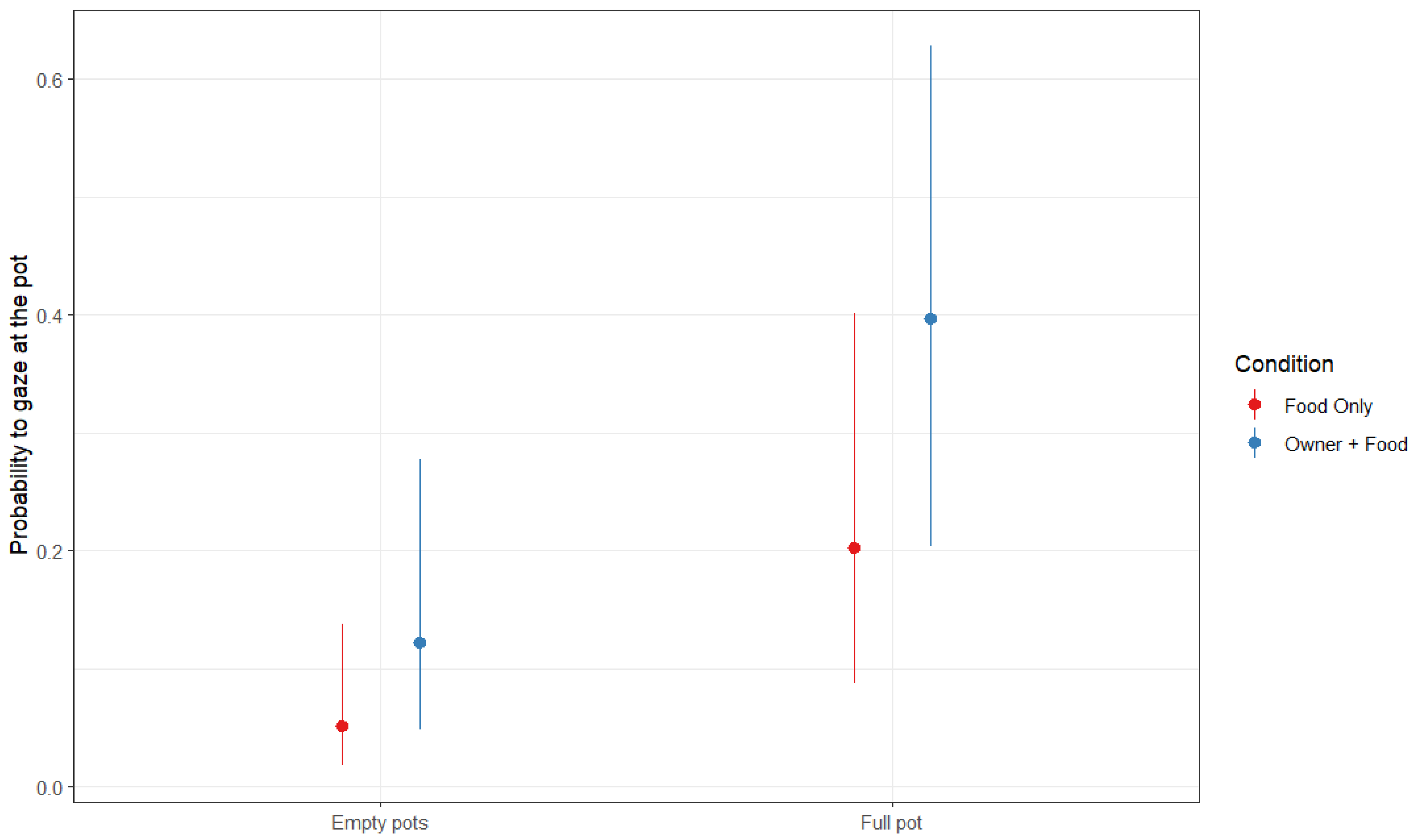
| Model 2a—Response variable: gazing at one of the pots (N = 404) | |||
| Tested variables | |||
| Variable | χ2 | df | p |
| Condition | 10.777 | 1 | 0.001 |
| Type of pot | 24.820 | 1 | <0.001 |
| Cephalic Index | 1.050 | 1 | 0.306 |
| Lineage | 12.395 | 6 | 0.054 |
| Control variables | |||
| Sex | 0.198 | 1 | 0.657 |
| Age | 4.270 | 1 | 0.039 |
| Trial order | 1.443 | 1 | 0.230 |
| Variance of the random factors: IDdog = 1.037 ± 1.019, IDowner = 6.935 × 10⁻⁹ ± 8.328 × 10⁻⁵ | |||
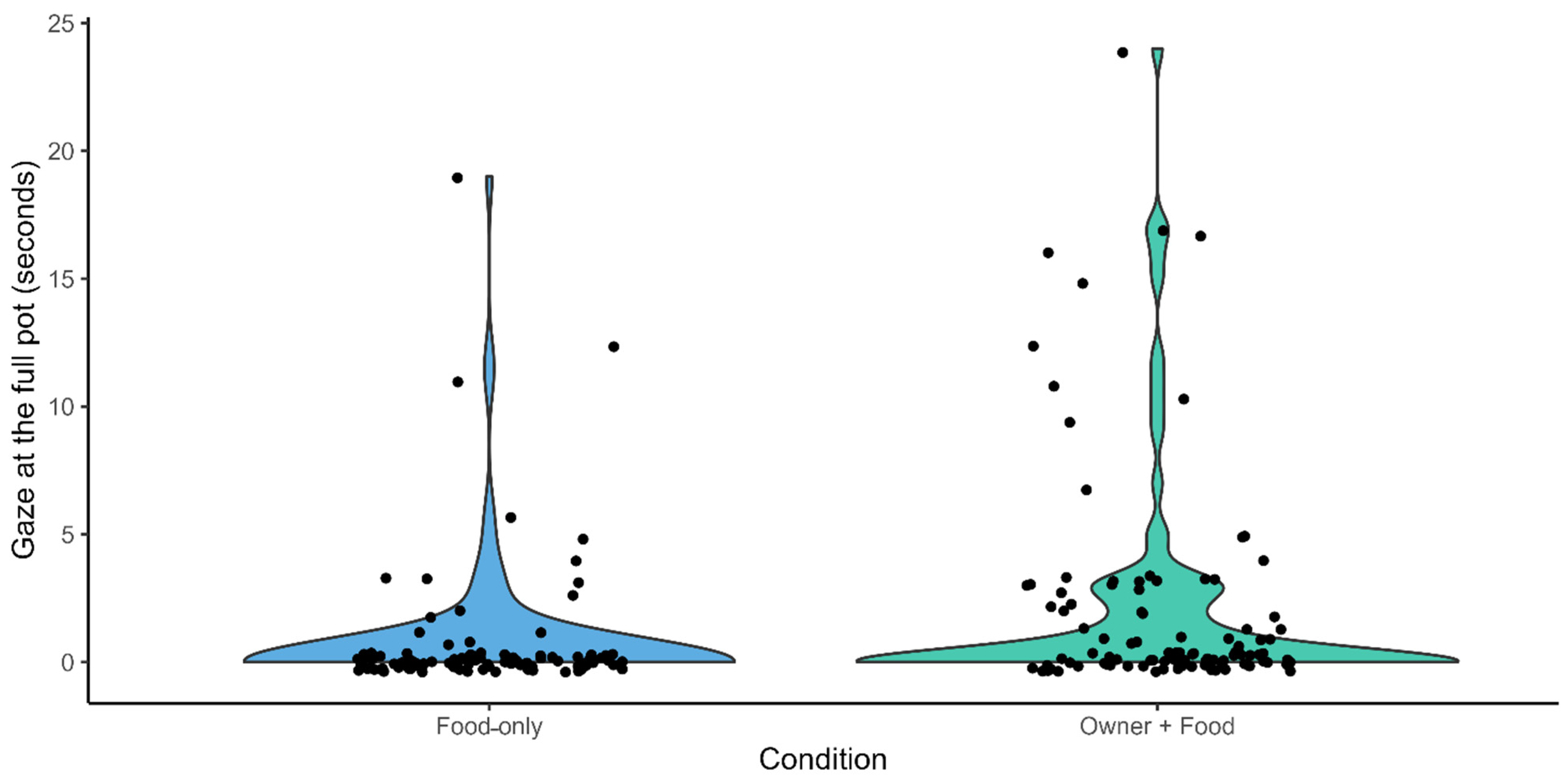
| Model 2b—Response variable: time spent gazing at the full pot (N = 202) | |||
| Tested variables | |||
| Variable | χ2 | df | p |
| Condition | 12.591 | 1 | <0.001 |
| Cephalic Index | 1.556 | 1 | 0.212 |
| Lineage | 7.867 | 6 | 0.248 |
| Control variables | |||
| Sex | 0.001 | 1 | 0.974 |
| Age | 0.083 | 1 | 0.774 |
| Trial order | 1.102 | 1 | 0.294 |
| Variance of the random factors: IDdog = 1.051 ± 1.025, IDowner = 6.087 × 10⁻⁸ ± 0.00025 | |||
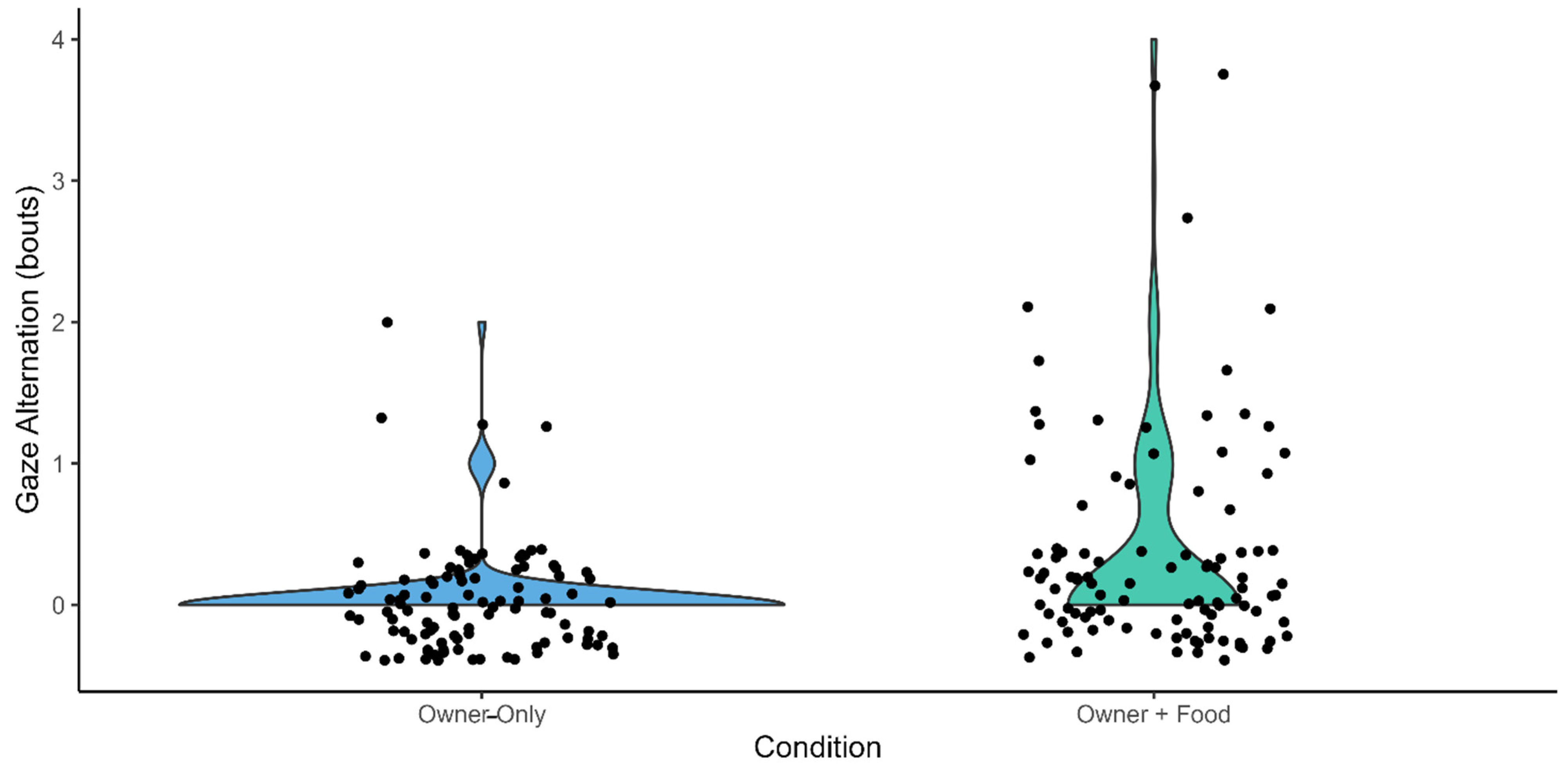
| Model 3—Response variable: number of gaze alternation (N = 202) | |||
| Tested variables | |||
| Variable | χ2 | df | p |
| Condition | 13.642 | 1 | <0.001 |
| Cephalic Index | 0.332 | 1 | 0.565 |
| Lineage | 0.214 | 6 | 0.643 |
| Control variables | |||
| Sex | 0.014 | 1 | 0.905 |
| Age | 2.236 | 1 | 0.135 |
| Trial order | 4.396 | 1 | 0.036 |
| Variance of the random factors: IDdog = 1.711 ± 1.308, IDowner = 1.019 × 10⁻⁵ ± 0.003 | |||
Disclaimer/Publisher’s Note: The statements, opinions and data contained in all publications are solely those of the individual author(s) and contributor(s) and not of MDPI and/or the editor(s). MDPI and/or the editor(s) disclaim responsibility for any injury to people or property resulting from any ideas, methods, instructions or products referred to in the content. |
© 2026 by the authors. Licensee MDPI, Basel, Switzerland. This article is an open access article distributed under the terms and conditions of the Creative Commons Attribution (CC BY) license.
Share and Cite
Commauda, S.; Maglieri, V.; Prato-Previde, E.; Palagi, E. Showing Behaviour in One Hundred and One Dogs: Gazing, Breed and Cephalic Index. Animals 2026, 16, 760. https://doi.org/10.3390/ani16050760
Commauda S, Maglieri V, Prato-Previde E, Palagi E. Showing Behaviour in One Hundred and One Dogs: Gazing, Breed and Cephalic Index. Animals. 2026; 16(5):760. https://doi.org/10.3390/ani16050760
Chicago/Turabian StyleCommauda, Samuele, Veronica Maglieri, Emanuela Prato-Previde, and Elisabetta Palagi. 2026. "Showing Behaviour in One Hundred and One Dogs: Gazing, Breed and Cephalic Index" Animals 16, no. 5: 760. https://doi.org/10.3390/ani16050760
APA StyleCommauda, S., Maglieri, V., Prato-Previde, E., & Palagi, E. (2026). Showing Behaviour in One Hundred and One Dogs: Gazing, Breed and Cephalic Index. Animals, 16(5), 760. https://doi.org/10.3390/ani16050760