Article

Integrated Phenotypic and Genomic Characterization of Cefotaxime/Clavulanic Acid Inhibitor-Positive Multidrug-Resistant Escherichia coli from Large-Scale Pig Farms in Hungary


1
Department of Pharmacology and Toxicology, University of Veterinary Medicine, István utca 2, H-1078 Budapest, Hungary
2
National Laboratory of Infectious Animal Diseases, Antimicrobial Resistance, Veterinary Public Health and Food Chain Safety, University of Veterinary Medicine, István utca 2, H-1078 Budapest, Hungary
3
One Health Institute, University of Debrecen, Nagyerdei Krt. 98, H-4032 Debrecen, Hungary
4
Department of Microbiology and Infectious Diseases, University of Veterinary Medicine, István utca 2, H-1078 Budapest, Hungary
5
Department of Bioinformatics, University of Debrecen, Nagyerdei Krt. 98, H-4032 Debrecen, Hungary
*
Author to whom correspondence should be addressed.
Animals 2026, 16(5), 722; https://doi.org/10.3390/ani16050722
Submission received: 8 February 2026 / Revised: 20 February 2026 / Accepted: 22 February 2026 / Published: 25 February 2026

Simple Summary

Antimicrobial resistance is a growing One Health concern because resistant bacteria and their resistance genes can circulate between animals, humans, and the environment. In pig production, E. coli is a key indicator organism and an important reservoir for resistance traits, including extended-spectrum β-lactamases (ESBLs) that reduce the effectiveness of critically important cephalosporins. Here, we investigated multidrug-resistant E. coli from large-scale pig farms in Hungary using standardized phenotypic testing and whole-genome sequencing to clarify the genetic basis of cefotaxime (CTX)/clavulanic acid (CLA) inhibitor-positive phenotypes. Among 203 isolates, 62.6% showed a CTX/CLA inhibitor-positive phenotype with a strong clavulanate inhibitory effect. Whole-genome sequencing of 116 CTX/CLA inhibitor-positive isolates detected classical ESBL-associated β-lactamase gene families (CTX-M and/or TEM) in 40.5% of genomes, and these determinants were predominantly predicted to be located on contigs of putative plasmid origin, suggesting a potentially mobile genetic context, although horizontal transfer was not demonstrated in this study. Notably, many isolates with a CTX/CLA inhibitor-positive phenotype lacked these classical ESBL gene calls, highlighting that inhibitor-based phenotypes can reflect heterogeneous and complex resistance architectures. Our findings underscore the value of combining phenotypic methods with genome-resolved interpretation to strengthen AMR surveillance and to support targeted antimicrobial stewardship and biosecurity interventions in pig production.

Abstract

Background: Extended-spectrum β-lactamase (ESBL)-producing E. coli are a major One Health concern because they compromise critically important cephalosporins and may spread via mobile genetic elements, including plasmids and transposon-associated modules, within food-animal production systems. Objectives: The aim of this study was to characterize cefotaxime (CTX)/clavulanic acid (CLA) inhibitor-positive phenotype profiles in pig-associated multidrug-resistant (MDR) E. coli and resolve their genetic basis using whole-genome sequencing, with emphasis on ESBL determinants and their predicted mobility context. Methods: MDR E. coli isolates (n = 203) from four large-scale pig farms in Hungary were tested by broth microdilution minimum inhibitory concentration (MIC) determination and Clinical and Laboratory Standards Institute (CLSI) inhibitor-based ESBL confirmation using cefotaxime with/without clavulanic acid. CTX/CLA inhibitor-positive isolates (inhibitor-positive phenotype) were subjected to whole-genome sequencing (WGS; n = 116) and resistome profiling; antimicrobial resistance genes (ARGs) were called against the Comprehensive Antibiotic Resistance Database (CARD) and mobility context was inferred using plasmid-origin and MGE-proximity prediction. Results: Overall, 127/203 isolates (62.6%) showed a CTX/CLA inhibitor-positive phenotype with a pronounced inhibitory effect (median cefotaxime/cefotaxime–clavulanate ratio: 33.3). In the sequenced subset (n = 116), 5427 ARG hits were identified (82 unique ARGs in the export), including frequent acquired determinants affecting tetracyclines, sulfonamides/trimethoprim, aminoglycosides, and phenicols; plasmid-mediated quinolone resistance (qnrB5) and mobilizable colistin resistance (mcr-1) were detected at low frequency. Classical β-lactamase genes were detected, including CTX-M (ESBL genes) and TEM alleles. CTX-M and/or TEM were detected in 47/116 genomes (40.5%), dominated by CTX-M-32 (11.2%) and TEM-1 (23.3%); detected ESBL determinants were predominantly predicted to be located on contigs predicted to be of plasmid origin, with a subset showing signatures consistent with transposition-associated mobilization. Conclusion: The high burden of inhibitor-positive phenotype, together with an inferred plasmid-/MGE-associated context for a subset of ESBL genes, and substantial phenotype–genotype heterogeneity, supports integrated phenotypic–genomic surveillance to refine AMR risk assessment and guide targeted stewardship and biosecurity interventions in pig production.

1. Introduction

Antimicrobial resistance (AMR) is widely recognized as a major and escalating threat to global health, food security, and sustainable animal production, driven by the combined selective pressure of antimicrobial use in human and veterinary medicine and the capacity of bacteria to acquire and disseminate resistance determinants [1,2,3]. Within food-producing systems, antimicrobials have historically been used not only for therapy but also, in some settings, for metaphylaxis and prophylaxis, creating sustained selection that favors multidrug-resistant (MDR) bacterial populations [4,5]. Because resistant bacteria and resistance genes circulate at the human–animal–environment interface, AMR is best addressed through a “One Health” framework that integrates surveillance and interventions across sectors [6,7,8,9].
Beyond public-health relevance, AMR also imposes measurable economic costs on livestock production through increased morbidity and mortality, reduced productivity, higher prevention and treatment expenditures, and potential disruption of trade in animal products. Macroeconomic modelling suggests that, without effective containment, AMR could reduce annual global GDP by 1.1% in a low-impact scenario and up to 3.8% in a high-impact scenario by 2050; output and trade in livestock and livestock products are projected to be particularly vulnerable, with low-income settings facing the largest relative losses. These projections further support the economic rationale for integrated AMR containment and surveillance investments across human and animal sectors [10].
Among livestock sectors, pig production represents a substantial consumer of antimicrobials globally, reflecting intensive production systems, high animal densities, and the need to control endemic bacterial disease [11,12,13]. National usage patterns can markedly deviate from European averages, underscoring the importance of country-specific surveillance and stewardship strategies [14]. Harmonized monitoring approaches for zoonotic and indicator bacteria have therefore become a cornerstone of European AMR risk assessment, enabling comparisons across time, regions, and production types and supporting targeted mitigation efforts [15,16]. In this context, robust data from large-scale pig farms are critical, as they inform veterinary decision-making [7,15].
E. coli is a central organism in AMR epidemiology because it is ubiquitous in the intestinal microbiota of animals and humans; it can act as a primary pathogen in multiple syndromes, and it serves as an efficient reservoir and vehicle for horizontal gene transfer of antimicrobial resistance genes (ARGs) [17,18,19]. The dissemination of ARGs can extend beyond farms through fecal shedding and environmental contamination, contributing to cyclic “farm-to-environment-to-farm” dynamics and increasing the likelihood that resistance determinants reach the food chain and, ultimately, human populations [2,3,20,21,22]. Importantly, the transfer of resistance plasmids across hosts has long been documented, illustrating that the movement of mobile genetic elements can link animal and human bacterial communities [23,24,25].
A particularly consequential AMR phenotype in E. coli is the production of extended-spectrum β-lactamases (ESBLs), enzymes that confer resistance to extended-spectrum cephalosporins and compromise treatment options in both veterinary and human medicine [26,27]. ESBL determinants—most notably within the CTX-M family, alongside TEM-derived variants—have diversified and expanded worldwide, with food-producing animals and their environments increasingly recognized as relevant reservoirs [28,29]. Within the European Union, ESBL-producing E. coli have been repeatedly reported in pigs and pork, and the farm-level ecology of ESBL carriage appears sensitive to antimicrobial use patterns and stewardship interventions [30,31,32,33]. Pig production is also relevant because occupational exposure has been associated with ESBL carriage in farm workers and pig farmers, supporting the plausibility of bidirectional transmission routes at the farm interface [34,35].
Accurate detection and characterization of ESBL-producing E. coli are therefore essential for surveillance and for guiding prudent antimicrobial use [7,15]. However, inhibitor-positive phenotype testing can be challenging in the presence of alternative β-lactam resistance mechanisms, particularly plasmid-mediated AmpC enzymes or chromosomal ampC overexpression, which may obscure or mimic ESBL phenotypes and reduce the reliability of routine confirmatory tests [36,37]. In addition, the clinical implications of ESBL and/or AmpC production can vary across strain backgrounds and resistance combinations, emphasizing the need for approaches that resolve underlying mechanisms rather than relying solely on phenotype [28,38]. In European pig production, ESBL-/AmpC-producing E. coli are repeatedly detected, and their reported prevalence varies widely across countries and study designs. For example, EU/EEA monitoring data for fattening pigs have shown country-level proportions ranging from 1.0% to 85.3% (2020–2021), highlighting substantial heterogeneity in their epidemiological background and surveillance approaches. Hungarian data also indicate a considerable ESBL burden in porcine samples, supporting the relevance of farm-level One Health-oriented surveillance in this setting [39,40].
From a swine management and treatment perspective, ESBL-associated resistance compromises the clinical utility of extended-spectrum cephalosporins (e.g., ceftiofur/cefquinome), which are considered critically important antimicrobials and are recommended for restricted, susceptibility-guided use in veterinary medicine. Reduced effectiveness of these agents can constrain empiric therapy for E. coli–associated disease (including enteric syndromes) and may increase reliance on alternative antimicrobial classes, reinforcing the need for prevention-oriented interventions (e.g., vaccination where applicable, hygiene, all-in/all-out flow, segregation, cleaning/disinfection, and movement control) alongside diagnostics and antimicrobial stewardship [41,42,43,44,45].
Whole-genome sequencing (WGS) and related next-generation sequencing (NGS) approaches offer a high-resolution framework to address these challenges by enabling the comprehensive identification of resistance determinants, the characterization of plasmid- and mobile-element-associated genes, and the contextual interpretation of complex phenotypic results [46,47]. Beyond mechanistic attribution, genome-based AMR profiling has suggested the potential to predict antimicrobial susceptibility from sequence data and to strengthen surveillance pipelines by linking genotype, phenotype, and epidemiological context [15,48,49]. In swine production specifically, WGS-based investigations have proven valuable for simultaneous assessment of ESBL-associated genes and broader AMR/virulence repertoires across animal and environmental compartments of farms [50].
Against this backdrop, the present study aimed to characterize MDR E. coli isolated from large-scale pig farms in Hungary, with a specific focus on ESBL production, by integrating phenotypic testing with WGS-based genomic analysis [15,50]. Beyond reporting prevalence, we explicitly quantify phenotype–genotype heterogeneity under a standardized (CTX)/clavulanic acid (CLA) inhibitor-based definition and interpret resistome findings under conservative, short-read-aware assumptions. This provides a practical surveillance framework that separates inhibitor-positive phenotypes from gene-confirmed ESBL determinants and highlights where gene-centric calling is likely to under-explain phenotype. The resulting dataset offers regionally relevant, age-stratified insight from large-scale pig production in Hungary. We sought to quantify and describe the inhibitor-positive phenotype in a large isolate collection, identify ESBL-encoding gene families and related β-lactam resistance determinants through WGS, and explicitly address phenotypic–genotypic discrepancies by considering alternative β-lactamase mechanisms that can confound ESBL detection. By combining standardized phenotyping with genome-resolved interpretation, our work provides a mechanistic baseline for surveillance and supports evidence-based antimicrobial stewardship in pig production.

2. Materials and Methods

2.1. Study Design, Farm Origin, and Isolate Collection

Ethical review and approval were waived for this study because no animals were sampled specifically for research purposes and no additional procedures were performed; all isolates were retrieved retrospectively from routine veterinary diagnostic submissions and subsequent institutional strain banking.
This study investigated MDR E. coli isolates originating from commercial, high-throughput (“large-scale”) pig production systems in Hungary, with a primary focus on the CTX/CLA inhibitor-positive phenotype and its genomic background. According to the strain-bank records, isolates were originally obtained by attending farm veterinarians as part of routine diagnostic activities and were submitted for bacteriological work-up within standard veterinary workflows. Isolates were collected over an approximately four-week period in late 2023 (November 2023). The originating holdings were located in three Hungarian regions (Nyugat-Dunántúl, Dél-Dunántúl, and Dél-Alföld); however, detailed farm-level metadata (e.g., herd size, antimicrobial usage, and biosecurity indicators) were not available for this retrospective diagnostic collection. Sampling was convenience-based within routine diagnostic submissions rather than a pre-planned systematic survey. Importantly, each isolate originated from a different individual pig (one isolate per animal); no repeated isolates from the same animal were included. Clinical status at the time of submission was not captured in a fully standardized manner across all submissions, whereas farm of origin and production stage/age category were recorded.
Specimens were transported to the Department of Epidemiology and Microbiology, University of Veterinary Medicine Budapest, using charcoal-containing Amies transport swab systems (Biolab Zrt., Budapest, Hungary). Following bacteriological isolation, pure cultures were provided for further analyses. Isolates were cryopreserved at −80 °C using the Microbank bead-based system (Pro-Lab Diagnostics, Richmond Hill, Canada) until testing. A total of 203 E. coli isolates were included in the phenotypic workflow. Here, the phenotypic workflow comprised standardized broth microdilution MIC testing across the selected antimicrobial panel. ESBL phenotype was then assessed by CTX/CLA inhibitor-based confirmation and interpreted using Clinical and Laboratory Standards Institute (CLSI) criteria. Species confirmation was subsequently achieved using matrix-assisted laser desorption ionization–time of flight (MALDI-TOF) mass spectrometry (Flextra-LAB Kft., Budapest, Hungary) and the Biotyper software, version 12.0 (Bruker Daltonics GmbH, Bremen, Germany; 2024 release).

2.2. Minimum Inhibitory Concentration (MIC) Determination

Minimum inhibitory concentrations (MICs) were determined prior to isolate selection for whole-genome sequencing, following the CLSI recommendations. CLSI breakpoints were used for resistance categorization where applicable [51].
Briefly, isolates stored at −80 °C were inoculated into 3 mL cation-adjusted Mueller–Hinton broth (CAMHB; Biolab Zrt., Budapest, Hungary) and incubated at 37 °C for 18–24 h. MIC testing was performed in sterile 96-well microtiter plates (VWR International, LLC., Debrecen, Hungary), prefilled with 90 µL CAMHB per well. Antibiotic stock solutions (Merck KGaA, Darmstadt, Germany) were prepared at 1024 µg/mL in accordance with CLSI guidance [52]. For each agent, 90 µL of the stock solution was dispensed into the first column, followed by two-fold serial dilutions across the plate. After the 10th column, excess volume was removed, resulting in a final volume of 90 µL per well.
Bacterial suspensions were adjusted to 0.5 McFarland using a nephelometer (Thermo Fisher Scientific, Budapest, Hungary). A 10 µL inoculum was added to each well as described in the CLSI-aligned workflow. Plates were incubated at 37 °C for 18–24 h, and MIC endpoints were read using the Sensititre SWIN automated reading system together with the VIZION system, version 3.4 (Thermo Fisher Scientific, Budapest, Hungary). Quality control was performed using E. coli ATCC 25922.
β-Lactamase activity was screened using a nitrocefin-based chromogenic cephalosporin assay (Cefinase-type). Nitrocefin is hydrolyzed by β-lactamases with a rapid yellow-to-red color change and is widely used as a sensitive, generic activity screen for β-lactamase production; however, it is not ESBL-specific, and its detectability may vary with enzyme type and expression level. In a recent Enterobacterales-focused evaluation of a nitrocefin-based biochemical assay, nitrocefin hydrolysis detected all ESBL producers (22/22) and all carbapenemase producers (36/36) at 105 CFU/mL, while remaining negative in all non-β-lactamase producers (15/15), supporting high sensitivity for clinically important β-lactamases and high specificity for absence of β-lactam hydrolysis [53,54]. Fresh overnight growth was used to prepare a heavy inoculum, which was applied to nitrocefin-impregnated disks/strips and observed for a color change from yellow to red. A color change within 5 min at room temperature was interpreted as β-lactamase-positive, while no color change within 15 min was considered negative. Quality control included E. coli ATCC 25922 (negative control) and E. coli ATCC 35218 (positive control). Results were recorded as a binary variable (positive/negative) and summarized by farm and age group.

2.3. CTX/Clavulanate Inhibitor-Based Phenotype Definition

Inhibitor-positive phenotype confirmation was performed according to the CLSI-recommended procedure [52]. For clarity, “CTX/CLA inhibitor-positive phenotype” refers solely to an inhibitor response in the CLSI ESBL confirmatory test performed with cefotaxime ± clavulanic acid and does not imply genetic confirmation; ESBL status is reserved for isolates with WGS-detected ESBL genes. MICs were determined for cefotaxime alone and for the cefotaxime–clavulanic acid combination, maintaining a constant clavulanic acid concentration of 4 µg/mL across all dilutions in the combination wells. Plates were incubated at 37 °C for 18–24 h, and isolates were interpreted as ESBL producers when the cefotaxime–clavulanic acid MIC was reduced by ≥3 two-fold dilution steps (i.e., ≥8-fold) compared with cefotaxime alone, in accordance with CLSI criteria. Inhibitor-positive-phenotype-positive isolates were prioritized for whole-genome sequencing.
Ceftazidime ± clavulanate was not included in the applied confirmatory panel; therefore, the phenotype definition should be interpreted as CTX-based inhibitor positivity.

2.4. Genomic DNA Extraction and Whole-Genome Sequencing

Genomic DNA was extracted using the Quick-DNA Fungal/Bacterial Miniprep Kit (Zymo Research, Irvine, CA, USA) according to the manufacturer’s instructions. Mechanical lysis was performed by bead beating using a TissueLyzer LT (Qiagen GmbH, Hilden, Germany) at 50 Hz for 5 min. Extracted DNA was stored at −20 °C until further processing.
Paired-end whole-genome sequencing was performed by Novogene (Cambridge, UK) on an Illumina NextSeq 500 platform, using Illumina sequencing-by-synthesis chemistry. Libraries were prepared using the Nextera XT DNA Library Preparation Kit (Illumina, San Diego, CA, USA), and dual indexing was performed with the Nextera XT Index Kit v2 Set A (Illumina, San Diego, CA, USA) i5/i7 primer pairs. Briefly, DNA was normalized to 0.2 ng/µL (2.5 µL input), and tagmentation was carried out at 55 °C for 6 min, followed by neutralization at room temperature for 5 min. Indexed libraries were amplified using 12 PCR cycles (95 °C for 10 s, 55 °C for 30 s, and 72 °C for 30 s), preceded by an initial denaturation step (95 °C for 30 s) and followed by a final extension step (72 °C for 5 min). Libraries were purified using the Geneaid Gel/PCR DNA Fragments Extraction Kit (Geneaid Biotech Ltd., New Taipei City, Taiwan), quantified with the Qubit dsDNA HS Assay Kit (Thermo Fisher Scientific, Waltham, MA, USA), pooled, and sequenced.

2.5. Read Processing, Genome Assembly, and Quality Assessment

Raw read quality was evaluated using FastQC v0.11.9, and reads were preprocessed using fastp v0.23.2-3 and Bloocoo v1.0.7 [55,56,57]. Adapter and quality trimming were performed using Trim Galore v0.6.6 [58]. De novo assemblies were generated using MEGAHIT v1.2.9 and SPAdes v4.0.0, and the resulting assemblies were merged using GAM-NGS v1.1b to obtain a robust draft genome per isolate [59,60,61].
Assembly quality and completeness were evaluated with QUAST v5.2 and BUSCO v5 [62,63]. Genome-level characteristics were estimated using GenomeScope v2.2 based on k-mer distributions [64].
Assembly quality metrics (contig count, N50, total length, GC%) are provided in Supplementary Table S1 to contextualize downstream plasmid-origin inference.

2.6. Resistome Calling and Mobility Inference

Open reading frames were predicted using Prodigal v2.6.3 [65]. Antimicrobial resistance genes (ARGs) were identified using Resistance Gene Identifier (RGI) v5.1.0 and ABRicate against the Comprehensive Antibiotic Resistance Database (CARD) [66]. Only hits meeting the CARD STRICT criterion and showing ≥90% sequence identity and ≥90% coverage were retained [47]. These conservative thresholds were selected to prioritize high-confidence ARG annotation for surveillance-grade interpretation. For per-isolate prevalence analyses, multiple hits corresponding to the same ARG in a given genome were collapsed to a single presence call to avoid double counting; fragmented/partial matches below thresholds were excluded.
Associations between ARGs and mobile genetic elements (MGEs) were assessed using MobileElementFinder v1.0.3; ARGs were classified as mobile when located within the organism-specific maximum transposon distance defined in the underlying database [67]. Plasmid origin of contigs was inferred using PlasFlow v1.1 [68]. For both MGE- and plasmid-associated signals, only predictions supported by contigs of at least 10,000 bp were considered. Species confirmation was performed using CheckM v1.2.2 and Kraken v1.1.1 [69,70].
Because mobility context was inferred from short-read assemblies, plasmid architecture and horizontal transfer potential cannot be confirmed without long-read sequencing and/or conjugation experiments. A schematic overview of the study design and analytical workflow is provided in Figure S1.

2.7. In Silico MLST

In silico multilocus sequence typing (MLST) was performed from assembled genomes using the E. coli Achtman 7-locus scheme. Alleles and sequence types (STs) were assigned based on full-length matches; MLST results were summarized at the ST level to describe lineage diversity within the sequenced subset.

3. Results

3.1. Isolate Set and Phenotypic Screening Outcomes

In total, 203 E. coli isolates were recovered from four large-scale pig farms in Hungary: Farm 1 in Dél-Dunántúl (n = 58), Farm 2 in Nyugat-Dunántúl (n = 70) and Farm 3 and Farm 4 in Dél-Alföld (n = 75). The cohort comprised isolates originating (Table 1) from three age groups (day-old piglets, n = 72; 4-week-old piglets, n = 65; and 6-week-old piglets, n = 66). CTX/CLA inhibitor-based confirmatory testing classified 127/203 isolates (62.6%) as having an inhibitor-positive phenotype (CTX-based), while β-lactamase positivity was recorded for 110/203 isolates (54.2%). Inhibitor-positive phenotype frequency varied across farms, ranging from 38.5% to 86.1%, and was highest among day-old piglets (75.0%) compared with 4-week-old (52.3%) and 6-week-old piglets (59.1%).

3.2. Phenotypic MIC Distributions Across the Antimicrobial Panel

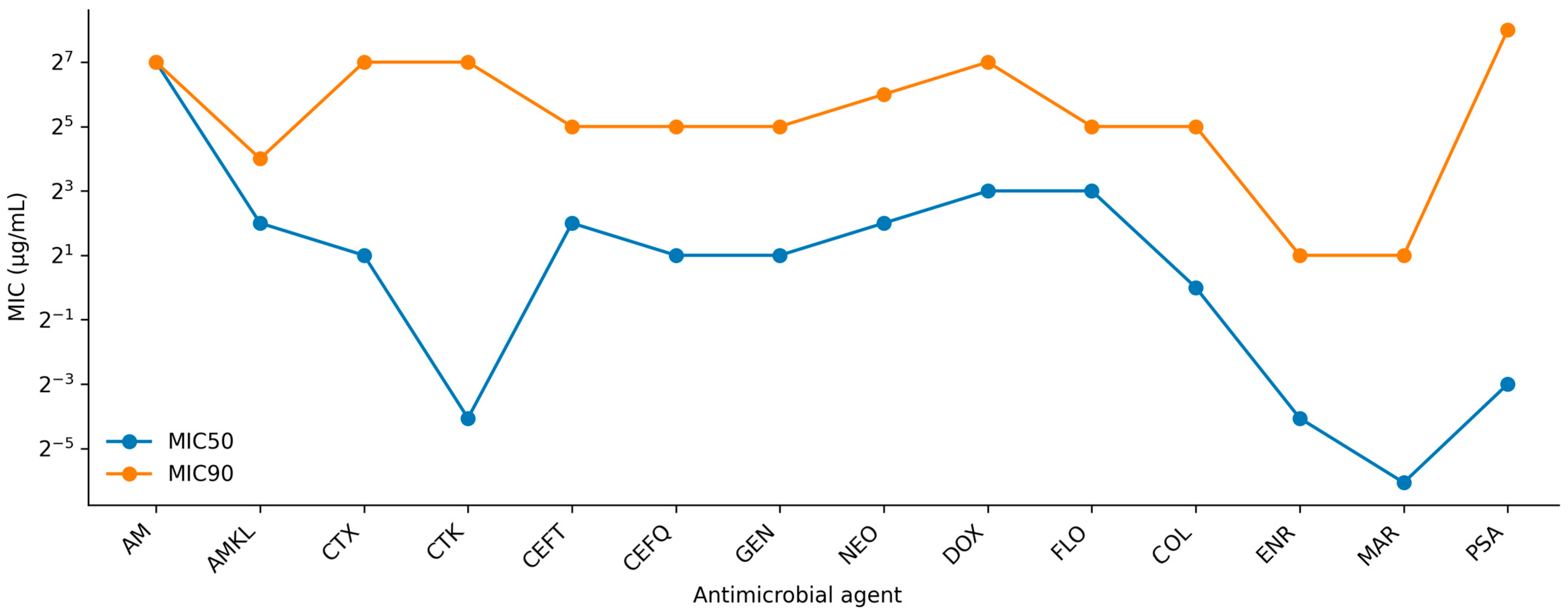
Broth microdilution revealed wide MIC distributions across the tested antimicrobial classes. At the cohort level, amoxicillin showed a high central tendency (MIC50/MIC90: 128/128), whereas fluoroquinolone MICs were lower on average (enrofloxacin MIC50/MIC90: 0.06/2; marbofloxacin MIC50/MIC90: 0.015/2). For third- and fourth-generation cephalosporins, cefotaxime and ceftiofur exhibited elevated upper-tail MICs (cefotaxime MIC50/MIC90: 2/128; ceftiofur MIC50/MIC90: 4/32). Colistin MICs displayed a broad range (MIC50/MIC90: 1/32), and trimethoprim–sulfamethoxazole showed pronounced heterogeneity (MIC50/MIC90: 0.125/256). Full MIC distributions are provided in Supplementary Table S2. Figure 1 shows the MIC50 and MIC90 across the antimicrobial panel. Table 2 summarizes the antimicrobial panel.

3.3. CTX/CLA Inhibitor-Based Testing Demonstrated a Robust Clavulanate Effect in CTX/CLA Inhibitor-Positive Isolates

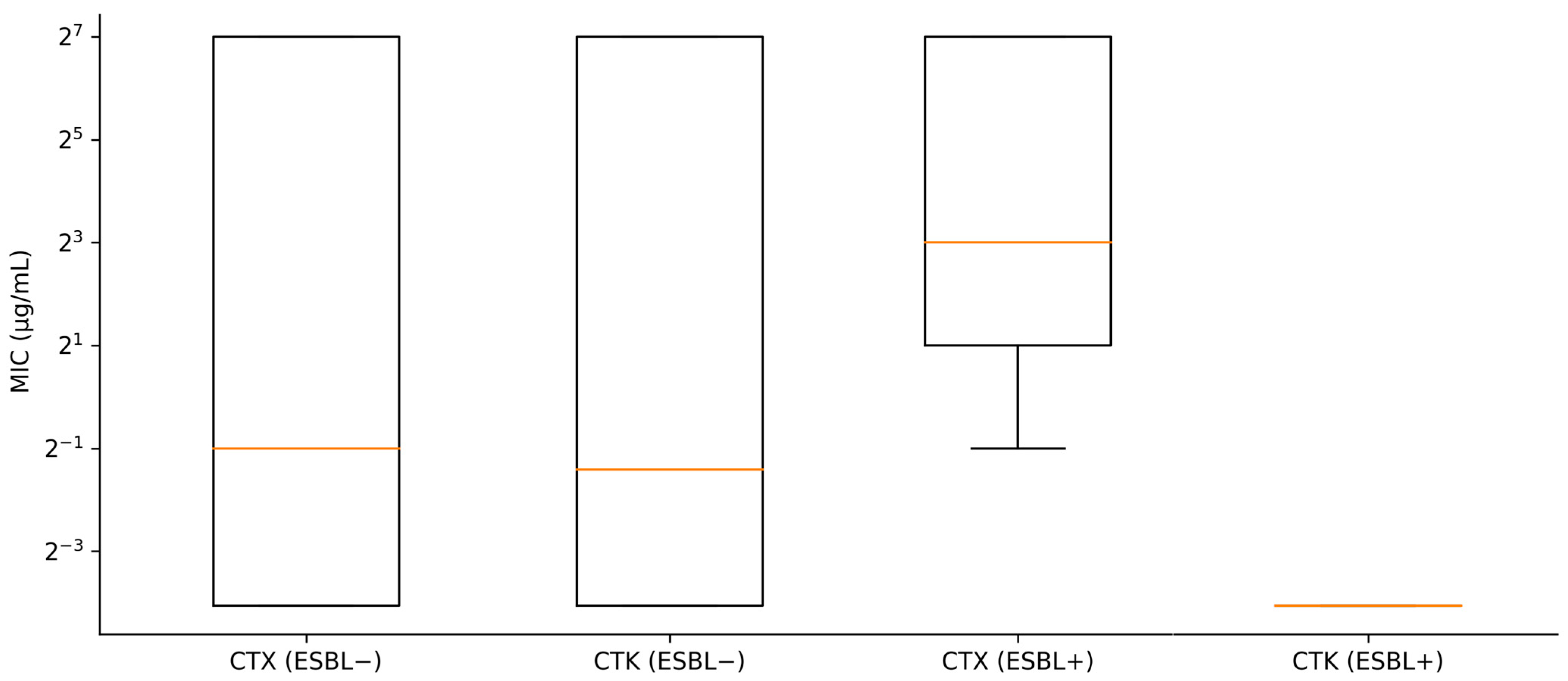
A pronounced clavulanate-associated MIC reduction was observed in CTX/CLA inhibitor-positive isolates (Figure 2). In the CTX/CLA inhibitor-positive group, the cefotaxime MIC50 was 8, while the cefotaxime–clavulanic acid MIC50 was 0.06, consistent with inhibitor-based phenotypic confirmation. In contrast, the CTX/CLA inhibitor-negative group showed a median cefotaxime/cefotaxime–clavulanic acid ratio of 1.0, whereas the inhibitor-positive group exhibited a substantially higher median ratio (33.3), indicating a strong inhibitory effect in the confirmed ESBL phenotype.
Cross-classification of the CTX/CLA inhibitor-positive phenotype status and nitrocefin β-lactamase screening showed that 76/127 (59.8%) ESBL phenotype-positive isolates were β-lactamase-positive, whereas 51/127 (40.2%) were β-lactamase-negative. Among ESBL phenotype-negative isolates, 34/76 (44.7%) were β-lactamase-positive.

3.4. WGS Resistome Overview in the Sequenced Subset

Whole-genome sequencing and resistome calling were performed for 116 CTX/CLA inhibitor-positive isolates (inhibitor-positive phenotype). Across this sequenced subset, 5427 ARG hits were identified, corresponding to an average of 46.8 hits per isolate and spanning 82 unique resistance-associated genes in the provided export. Several resistance-related loci were ubiquitous and largely consistent with a conserved chromosomal “core” background (e.g., multidrug efflux and regulatory determinants). In addition, multiple acquired-resistance determinants were detected at variable frequencies, including tetracycline (tet variants), sulfonamide (sul variants), trimethoprim (dfr variants), aminoglycoside-modifying enzymes, phenicol determinants (floR and catI), plasmid-mediated quinolone resistance (qnrB5), and the mobilizable colistin resistance determinant mcr-1.

3.5. Acquired-Resistance Determinants Beyond β-Lactams in the Sequenced Subset

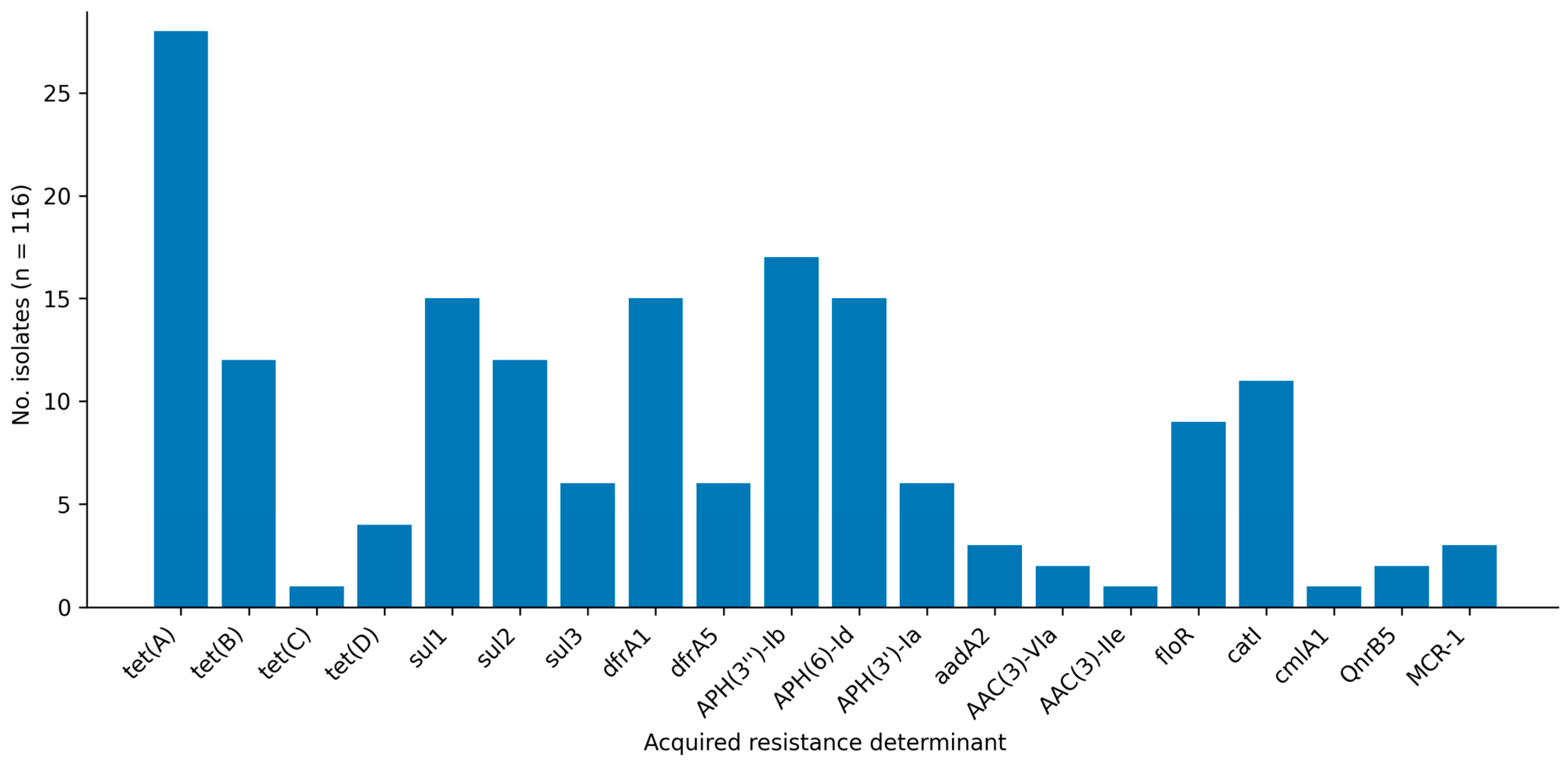
Across the 116 sequenced isolates, acquired-resistance determinants were detected for multiple antimicrobial classes (Table 3 and Figure 3). Tetracycline resistance genes were frequent, with tet(A) identified in 28/116 isolates (24.1%), tet(B) in 12/116 (10.3%), tet(D) in 4/116 (3.4%) and tet(C) in 1/116 (0.9%). Sulfonamide resistance determinants were also common (sul1, 15/116; 12.9%; sul2, 12/116; 10.3%; sul3, 6/116; 5.2%), and trimethoprim resistance genes were detected at comparable frequencies (dfrA1, 15/116; 12.9%; dfrA5, 6/116; 5.2%). Aminoglycoside-modifying enzymes occurred in a subset of isolates, including APH(3)-Ib (17/116; 14.7%), APH(6)-Id (15/116; 12.9%), and additional aminoglycoside-associated genes at lower prevalence. Phenicol-associated genes were detected, including floR (9/116; 7.8%) and catI (11/116; 9.5%). Plasmid-mediated quinolone resistance was infrequent (qnrB5, 2/116; 1.7%). Notably, the mobilizable colistin resistance determinant mcr-1 was present in 3/116 isolates (2.6%).

3.6. ESBL-Associated β-Lactamase Determinants and Their Predicted Mobility Context

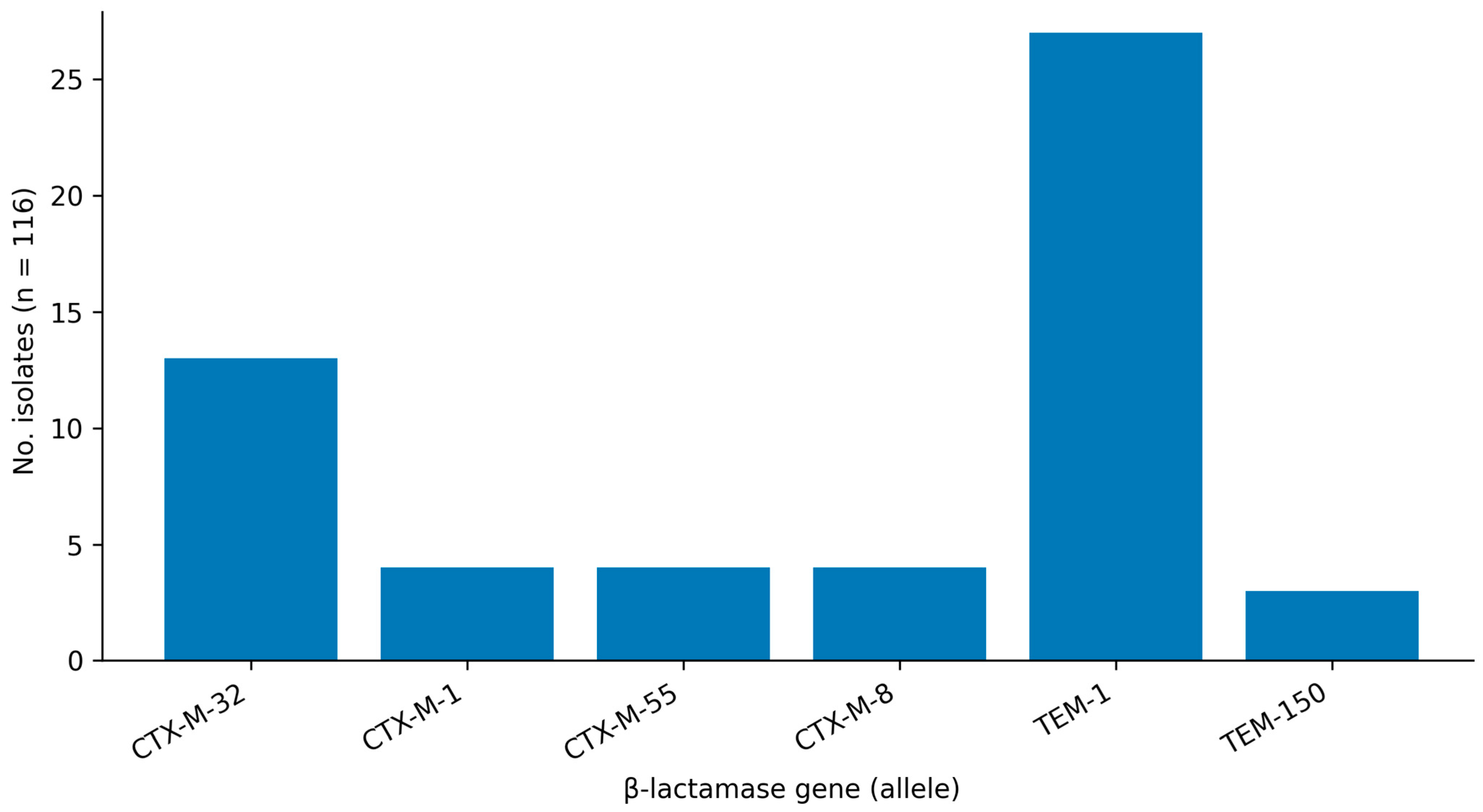
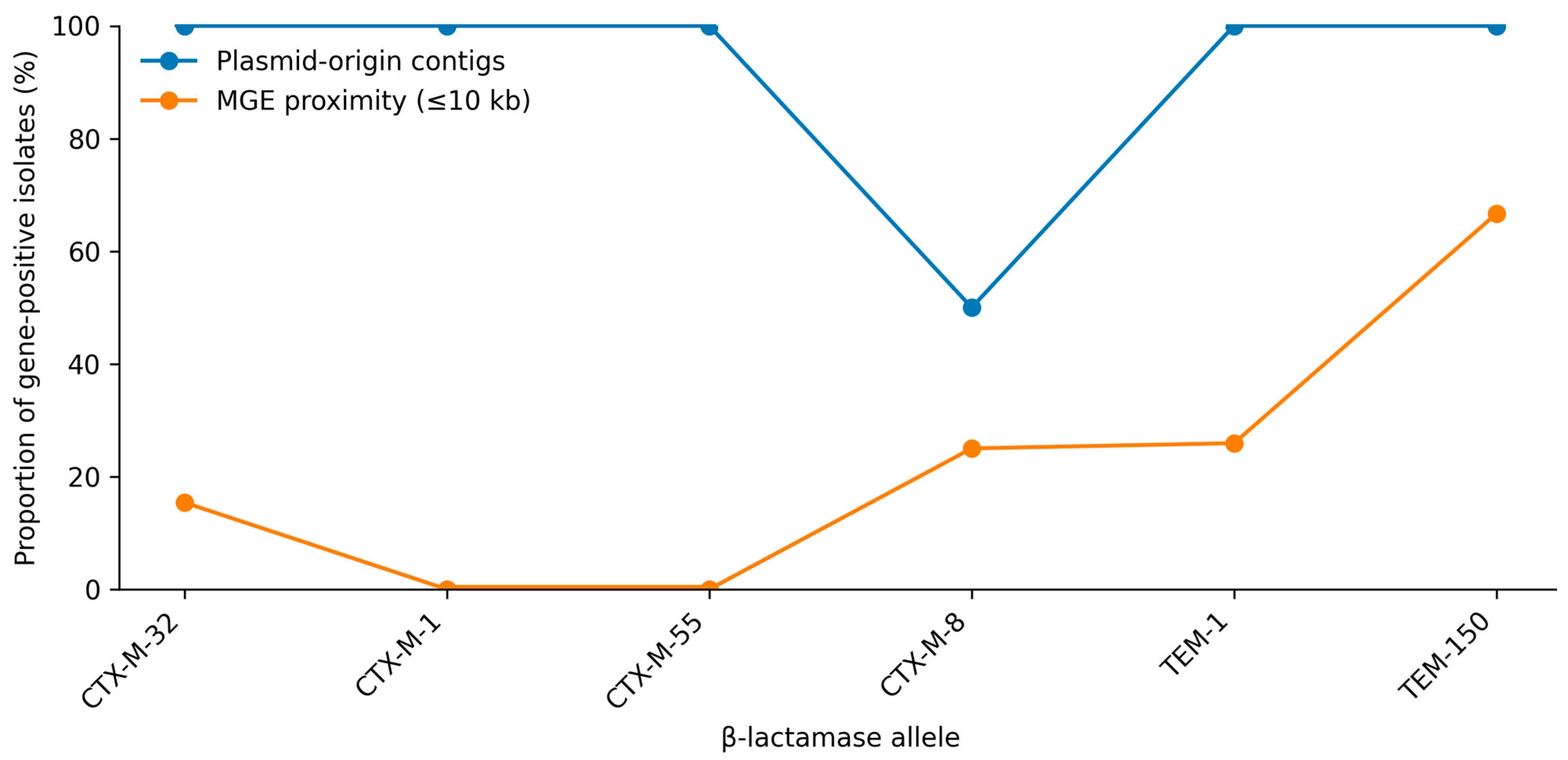
Within the sequenced subset, CTX-M-type β-lactamase genes were detected in 24/116 isolates (20.7%). The most frequent CTX-M allele was CTX-M-32 (13/116; 11.2%), while CTX-M-1, CTX-M-55, and CTX-M-8 each occurred in 4/116 isolates (3.4% each). TEM-type β-lactamase genes were identified in 30/116 isolates (25.9%), dominated by TEM-1 (27/116; 23.3%), with TEM-150 detected in 3/116 isolates (2.6%). Co-occurrence of CTX-M and TEM genes was observed in seven isolates (Figure 4).
PlasFlow-based classification indicated that contigs carrying CTX-M and TEM determinants were predominantly predicted to be of plasmid-origin. Mobile genetic element (MGE) proximity analysis further suggested that a subset of these determinants resided within 10 kb of insertion sequences or transposons. Specifically, CTX-M-32 was located within 10 kb of ISKpn26 in 2/13 isolates, CTX-M-8 was linked to an IS26-associated composite transposon in 1/4 isolates, TEM-1 was located within 10 kb of Tn2 or IS26 in 7/27 isolates, and TEM-150 showed proximity to Tn801 in 2/3 isolates. Collectively, these analyses suggest that CTX-M and TEM determinants detected in this study are predominantly located on contigs predicted to be of plasmid origin, and that a subset shows proximity signatures consistent with transposition-associated contexts (Table 4). These findings represent inferred mobility context from short-read assemblies and do not demonstrate plasmid architecture or horizontal transferability.

3.7. Genomic Resolution of ESBL Phenotypes and Mechanistic Heterogeneity

Although all 116 sequenced isolates originated from the phenotypic CTX/CLA inhibitor-positive phenotype, CTX-M and/or TEM determinants were identified in 47/116 isolates (40.5%) in the ARG output, leaving 69/116 isolates (59.5%) without detectable CTX-M or TEM alleles under the applied calling criteria (Figure 5). In parallel, chromosomal ampC-associated loci were near-ubiquitous (E. coli ampC detected in 115/116 isolates; E. coli ampC1 β-lactamase detected in 106/116 isolates), alongside a conserved background of multidrug efflux and regulatory determinants in the resistome output. These findings indicate that, within this inhibitor-positive phenotype group cohort, WGS-based ARG calling identified “classical” ESBL gene families in a substantial minority of isolates, while the majority lacked detectable CTX-M/TEM alleles, underscoring the importance of genome-resolved interpretation when inhibitor-positive phenotype confirmation is used as a selection gate for downstream characterization.

3.8. Population Structure by MLST

MLST of the 116 sequenced isolates (Supplementary Table S3) revealed high lineage diversity, with 54 distinct sequence types (STs) identified. No single ST dominated the dataset; the most frequent lineages were ST58 (11/116; 9.5%), ST137 (9/116; 7.8%), ST10 (8/116; 6.9%), and ST641 (6/116; 5.2%), while additional STs occurred at lower frequencies. This distribution is consistent with a heterogeneous population structure in the sequenced subset, suggesting that the inhibitor-positive phenotype is not restricted to a single clonal background.

4. Discussion

In this study, we provide a phenotype-to-genotype resolved view of third-generation cephalosporin non-susceptibility in E. coli from large-scale Hungarian pig production, using a large phenotypic panel (n = 203) coupled to targeted WGS of phenotypically CTX/CLA inhibitor-positive isolates (n = 116). The most striking finding is the high proportion of inhibitor-based ESBL phenotypes (62.6%), which while broadly consistent with reports describing 30–50% ESBL-producing E. coli in pig farms and pork-associated isolates in parts of Europe, still places these production settings at the high end of what is typically reported, underscoring the need for sustained, farm-level AMR control and surveillance [30,31].
A second key message is that the genomic “confirmation layer” fundamentally sharpens interpretation: among the 116 phenotypic inhibitor-positive phenotype group isolates with adequate DNA for sequencing, classical ESBL gene families were detected in 40.5% (47/116).
This magnitude aligns closely with an extensive European investigation reporting that 45% of ESBL-producing isolates from pigs carried ESBL genes, suggesting that phenotypic selection gates can substantially enrich isolates with ESBL-like behavior while still capturing a sizable fraction whose third-generation cephalosporin phenotype is driven by alternative mechanisms and/or remains unresolved with gene-centric calling alone [35].
From a One Health perspective, this matters because policy and risk communication often rely on simplified phenotypic labels; our data show that “ESBL phenotype” can represent a composite of mechanisms with different mobility and transmission potential, which should be explicitly recognized in surveillance pipelines and intervention strategies [6,7]. The farm- and age-stratified patterns add biological plausibility and practical relevance. Inhibitor-positive phenotype frequency was highest in day-old piglets and declined in older age groups, consistent with early-life colonization and rapid acquisition of resistant Enterobacterales via the sow, the environment, and management-associated contact [32,33].
This early-life burden is especially important because neonatal colonization can set the trajectory of the gut resistome and creates an early window where biosecurity, hygiene, and antimicrobial stewardship could have disproportionately large effects [5,11,12]. At the same time, β-lactamase activity varied markedly by farm and age group, indicating heterogeneous β-lactam resistance backgrounds across production settings and suggesting that selection and persistence of β-lactam resistance determinants are not restricted to the earliest production stage, reinforcing the need for longitudinal on-farm monitoring rather than single-timepoint screening.
At the gene-family level, our ESBL landscape is notable for the predominance of CTX-M and TEM determinants, but with a distribution that differs from the “canonical European” picture. While CTX-M-1 is widely described as a dominant lineage in multiple European contexts, we observed CTX-M-32 and CTX-M-55 among the most frequent alleles in our sequenced subset, with TEM-1 also common [28,71,72,73]. Such heterogeneity is in line with the broader literature showing substantial between-country and between-study variation, likely reflecting differences in antimicrobial use practices, farm management, animal movement networks, and methodological approaches (including sampling frame and ESBL confirmation strategy) [34,73,74,75]. Importantly, this is not merely a descriptive nuance: different ESBL alleles can be embedded in distinct plasmid backbones and mobilization contexts, which directly influences transfer rates, persistence under fluctuating selection, and spillover into humans [17,24,25].
Indeed, one of the most policy-relevant aspects of our dataset is the predicted mobility context of ESBL determinants. CTX-M-1 was detected exclusively on plasmid-associated contigs; CTX-M-32 and CTX-M-8 appeared frequently in plasmid contexts but also showed MGE linkage in a subset, and TEM family members displayed substantial MGE association (e.g., TEM-1 was frequently linked to MGE) [67,68,71]. This configuration is consistent with large-scale farms functioning as environments where plasmid- and IS/transposon-associated resistance modules may persist and circulate within the production ecosystem. However, in our dataset these conclusions remain inferential, as plasmid backbones and transfer were not resolved or experimentally assessed; therefore, any dissemination beyond the farms should be interpreted as a plausible risk pathway rather than confirmed transmission [34,35]. The implication of these results is forward-looking: risk mitigation should prioritize not only reducing selection pressure (e.g., stewardship and prudent use) but also interrupting the ecological and contact networks that facilitate MGE exchange, particularly in early life stages where colonization is established [5,11,12,17,24,25].
The predominance of CTX-M-32 observed here is consistent with reports from European piggeries where CTX-M-1 group variants, including CTX-M-32, circulate across diverse E. coli lineages but are frequently linked to successful conjugative plasmid backbones (notably IncI1/ST3 and IncN/ST1), supporting a predominantly plasmid-driven dissemination model in swine production settings [76]. In parallel, TEM-1 is a widespread narrow-spectrum β-lactamase in animal-associated E. coli and other Enterobacterales, often embedded in transposon- and IS26-rich resistance regions (e.g., Tn2/Tn3-family contexts) that facilitate reshuffling and co-selection on MDR plasmids; TEM-1-containing IS26/Tn2 modules have also been documented in swine-farm-associated Enterobacterales beyond E. coli (e.g., Salmonella) [77].
Within swine farm systems, dissemination of these determinants can plausibly occur via both clonal expansion of successful lineages and horizontal transfer of plasmids or transposon modules within the gut microbiota, and in high-density microbial matrices such as manure and slurry. Environmental persistence and recirculation routes—contaminated pen surfaces, equipment, water lines, personnel movement, and manure storage/land application with subsequent soil/runoff contamination—can further amplify cross-compartment spread and create opportunities for re-introduction into the herd [78]. Given that our mobility signals are inferred from short-read proximity and plasmid-origin prediction, these pathways should be interpreted as biologically plausible routes supported by prior literature rather than directly demonstrated within the present dataset [79].
The discrepancy between a robust CTX/CLA inhibitor-positive phenotype and the absence of CTX-M/TEM calls in a substantial fraction of sequenced isolates warrants cautious interpretation. Several non-mutually exclusive explanations may contribute to this pattern, including chromosomal mechanisms affecting β-lactam susceptibility (e.g., ampC regulatory variation), altered outer-membrane permeability (e.g., porin loss-of-function), and efflux/regulatory changes, as well as technical constraints inherent to gene-centric ARG calling and short-read assemblies. Importantly, these chromosomal promoter/attenuator variants, regulatory alterations, membrane permeability changes, and expression-level effects were not experimentally assessed in this study; therefore, they are discussed here strictly as hypotheses and were not inferred from the current dataset. In addition, plasmid-mediated AmpC families were not detected under the applied ARG-calling criteria, but we note that AmpC-mediated phenotypes remain a general consideration in inhibitor-based screening workflows. First, gene-centric AMR calling has known limitations; detection depends on assembly continuity, database representation of alleles, and parameter thresholds, and it does not capture regulatory variation, gene expression, or chromosomal mutation-driven resistance [47,66]. Second, β-lactam resistance in E. coli is multi-layered and can involve chromosomal cephalosporinase activity (e.g., ampC axis), porin changes, and efflux upregulation, which can shift MIC distributions and interact with inhibitor-based tests in ways that complicate categorical interpretation [27,36,37,38,73,80,81,82,83,84]. In our cohort, the widespread presence of chromosomal ampC-related loci in the resistome output supports the plausibility that non-classical or composite mechanisms contributed to the third-generation cephalosporin phenotype in at least a subset of isolates [37,38]. Importantly, plasmid-mediated AmpC families (e.g., CMY, DHA, FOX, MOX, ACC) were not detected under our applied CARD/RGI filtering, arguing against pAmpC as a dominant explanation in this sequenced subset. However, promoter or attenuator variants affecting chromosomal ampC expression, porin loss-of-function (ompC, ompF), and regulatory changes influencing efflux are not captured by gene-centric ARG calling; therefore, these mechanisms remain plausible but unconfirmed contributors to the observed CTX and CLA inhibitor-positive phenotype.
One plausible contributor to this apparent ESBL phenotype–genotype discordance is AmpC-mediated resistance, particularly chromosomal ampC promoter/attenuator mutations leading to ampC overexpression, which can elevate cefotaxime MICs without introducing a “new” acquired ARG detectable by gene-centric pipelines [85]. In addition, plasmid-mediated AmpC (e.g., CMY-type) can produce extended-spectrum cephalosporin non-susceptibility and complicate inhibitor-positive phenotype workflows; however, no plasmid-mediated AmpC families were detected under our applied calling/filters, so this mechanism cannot be confirmed in our dataset [86]. Finally, inhibitor-based confirmation tests are known to have methodological limitations and may yield discordant or occasionally false-positive ESBL interpretations depending on the underlying β-lactamase background and co-occurring permeability/efflux changes; accordingly, we interpret inhibitor-positivity as a phenotypic signal that may reflect heterogeneous resistance architectures rather than gene-confirmed ESBL production in every isolate [36].
Methodologically, these findings argue for an integrated interpretive workflow: inhibitor-based phenotyping remains valuable for initial triage, but WGS interpretation should ideally extend beyond acquired gene detection to include chromosomal mutational mechanisms and context-aware inference (e.g., porin/efflux signatures and regulatory variants) if the goal is to explain phenotype at isolate resolution [47,48,66].
Beyond β-lactams, the sequenced isolates carried a broad set of acquired-resistance determinants (e.g., tetracyclines, sulfonamides, trimethoprim, aminoglycoside-modifying enzymes, and phenicols), consistent with the concept that selection for ESBL plasmids often co-selects multi-class resistance through physical linkage and shared mobility platforms [17,24,25]. The detection of mcr-1 in a small subset is particularly important even at low frequency, because mobilizable colistin resistance is a recognized high-concern trait, and its co-occurrence potential with ESBL determinants has been documented in pig-associated E. coli [75,87]. Meanwhile, the pervasive identification of multidrug efflux and regulatory determinants highlights that the apparent “baseline” resistome architecture of production-associated E. coli can provide a permissive background for acquired genes to express clinically meaningful phenotypes under selection [88].
When positioned against European surveillance benchmarks, our results sit at an instructive intersection: inhibitor-positive phenotype positivity was high, while the WGS-confirmed presence of classical ESBL genes among phenotypically positive isolates (40.5%) is broadly comparable to European-scale observations and to reports across diverse settings (including Asia and Latin America), where prevalence varies widely and is frequently explained by differences in antimicrobial usage and study design [71,72,75]. For Hungary, this supports a dual conclusion. First, large-scale farms can harbor a substantial burden of cephalosporin-related resistance phenotypes and mobile ESBL gene pools, suggesting a plausible pathway for dissemination, while acknowledging that the present study infers mobility from short-read data and does not confirm transfer [34,35,71]. Second, risk assessment and intervention design should not equate “ESBL phenotype” with “classical ESBL genotype” without genomic verification, because the underlying mechanisms and transferability may differ materially [36,37,38,47,66,67].
Putting our findings into a regional context, ESBL/extended-spectrum cephalosporin resistance in pig-associated E. coli has been repeatedly documented across Central Europe. A longitudinal production-cycle investigation from the Czech Republic recovered CTX-M-producing E. coli across multiple age categories and demonstrated conjugative plasmids carrying CTX-M variants, supporting persistence and dissemination potential within pig production systems. These observations align with our inference that at least a subset of ESBL determinants in our dataset is associated with mobile contexts, while simultaneously underscoring that the inhibitor-positive phenotype signal can be detected across diverse genomic backgrounds and may not be fully captured by “classical ESBL gene” calls alone.
Several limitations also delineate the next steps that could elevate this work from a robust national snapshot to a mechanistic, high-impact One Health contribution. The WGS subset was derived from phenotypic CTX/CLA inhibitor-positive phenotype isolates, so genomic prevalence estimates are conditioned on that selection gate and should not be extrapolated to the full 203-isolate cohort without appropriate weighting. In addition, short-read assemblies constrain plasmid reconstruction and can fragment MGE contexts; long-read sequencing of representative CTX-M-32/CTX-M-55/TEM-150 carriers would enable complete plasmid resolution, replicon typing, and direct confirmation of transposon structures and insertion sequence contexts that are only inferred here [17,24,25,67,68]. Accordingly, the plasmid location, backbone structure, and true horizontal transferability of these determinants remain inferred rather than demonstrated; definitive confirmation would require long-read plasmid reconstruction and/or conjugation experiments. While MLST indicates substantial lineage diversity, higher-resolution phylogeny (cgMLST/SNP) integrated with plasmid epidemiology would further clarify whether observed ESBL determinant patterns reflect clonal expansion, plasmid epidemicity, or repeated introductions [46,48]. In addition, we did not evaluate ampC promoter/attenuator mutations, porin gene disruptions, or efflux regulatory variants through targeted variant analysis or functional assays; thus, chromosomal mechanisms remain unresolved in this dataset.
In Enterobacterales, CTX-M genes commonly occur in transposition units linked to insertion sequences that can facilitate capture and movement onto plasmids, and reports describe CTX-M-32 within IS-associated contexts consistent with transposition-mediated dissemination. Likewise, TEM-1 is frequently embedded in Tn3-family transposons (e.g., Tn2), and IS26 is widely implicated in restructuring resistance regions via composite-transposon-like arrangements and recombination. Importantly, in our dataset these interpretations are based on short-read proximity signatures rather than resolved element boundaries [89,90].
Farm-level antimicrobial usage data and detailed biosecurity indicators were not available for this strain-bank-based dataset, limiting causal attribution of between-farm and between-age-group differences. Nonetheless, the high frequency of CTX/CLA inhibitor-positive phenotypes supports reinforcing antimicrobial stewardship and core biosecurity measures that reduce fecal–oral transmission within and between production stages (e.g., hygiene barriers, age-group segregation/all-in–all-out management, manure handling practices, and personnel/equipment separation). This CTX-based inhibitor approach may not fully discriminate all AmpC- or inhibitor-resistant mechanisms, which may contribute to phenotype–genotype discordance in a subset of isolates [91].
From a management perspective, our results support translating surveillance outputs into targeted stewardship and biosecurity reinforcement [92]. Farm-level longitudinal data indicate that the occurrence of ESBL-producing E. coli is shaped not only by antimicrobial selection pressure but also by specific management practices, implying that coordinated reductions in the use of critically important cephalosporins; strict all-in/all-out flow; effective cleaning and disinfection between batches; segregation of sick animals; and tight control of movements of personnel, vehicles and equipment can reduce transmission and persistence. Modeling work similarly highlights that preventing introduction onto farms and ensuring rapid isolation of affected animals are high-impact levers [33,93]. Although detailed farm-level antimicrobial usage and biosecurity metadata were unavailable for our retrospective diagnostic collection, incorporating these parameters into future integrated surveillance would substantially improve risk attribution and the design of intervention bundles.
Overall, our findings suggest that large-scale pig production can act as a reservoir where inhibitor-positive cephalosporin resistance phenotypes are common and where a subset of CTX-M/TEM genes shows inferred plasmid-/MGE-associated context. The extent of horizontal transferability and dissemination cannot be confirmed without long-read reconstruction and/or conjugation assays, and we therefore frame dissemination as a risk consideration rather than a demonstrated outcome [71]. The early-life enrichment of ESBL phenotypes points to a critical intervention window, and the observed phenotype–genotype complexity argues for surveillance frameworks that combine standardized inhibitor-based testing with genome-resolved interpretation of both acquired genes and chromosomal mechanisms [36,37,38,66,67]. Such an integrated approach is the most direct path to translating AMR measurements into actionable control strategies that reduce both animal health burdens and the broader public health risk associated with antimicrobial resistance dissemination through the food chain and occupational exposure [6,7,34,44,74,94].

5. Conclusions

This study provides a phenotype-to-genotype assessment of third-generation cephalosporin resistance in pig-associated multidrug-resistant E. coli from large-scale farms in Hungary. CTX/CLA inhibitor-positive phenotypes were frequent in the overall cohort (127/203; 62.6%) and showed a strong inhibitory effect, indicating a substantial burden of ESBL-like β-lactam resistance in these production settings. Whole-genome sequencing of the CTX/CLA inhibitor-positive subset (n = 116) identified CTX-M and/or TEM β-lactamase determinants in 47/116 isolates (40.5%) and indicated that detected ESBL-associated genes were predominantly located on contigs predicted to be of plasmid origin, with additional signatures consistent with MGE-mediated mobilization in a subset. Beyond β-lactams, the presence of multiple acquired-resistance determinants (e.g., tetracycline, sulfonamide/trimethoprim, aminoglycoside-modifying enzymes, and phenicols) supports the likelihood of co-selection and persistence under on-farm antimicrobial exposure.
Importantly, the discordance between inhibitor-based ESBL phenotypes and the absence of “classical” ESBL gene families in the majority of sequenced isolates underscores that inhibitor-positive phenotype confirmation can reflect heterogeneous genetic architectures, including non-classical or composite resistance mechanisms that are not fully captured by gene-centric calling alone. Collectively, these findings argue for integrated surveillance workflows that pair standardized inhibitor-based phenotyping with genome-resolved interpretation, including mobility context, to more accurately quantify transmission risk and to guide targeted stewardship and biosecurity interventions, particularly in early production stages where inhibitor-positive phenotype frequency was highest. Future work leveraging long-read sequencing and combining chromosomal/plasmid epidemiology will be critical to fully resolving plasmid backbones, transposon structures, and dissemination routes and thereby translating these observations into actionable One Health risk-reduction strategies.

Supplementary Materials

The following supporting information can be downloaded at: https://www.mdpi.com/article/10.3390/ani16050722/s1. Table S1: Genome assembly quality metrics and ARG-calling post-processing rules. Per-isolate genome assembly statistics (e.g., number of contigs, total assembly length, GC content, N50/L50 and related fragmentation descriptors) for the sequenced dataset (n = 116), reported to contextualize plasmid-origin inference from short-read assemblies. Table S2: Full broth microdilution minimum inhibitory concentration (MIC) dataset for all E. coli isolates included in the study (n = 203), including isolate metadata (farm and age group) and MIC values for the complete antimicrobial panel. Table S3: Multilocus sequence typing (MLST) profiles of sequenced E. coli isolates. MLST results for all whole-genome sequenced isolates (n = 116). Sequence types (STs) were assigned in silico from assembled genomes using the Achtman E. coli MLST scheme. Figure S1: Overview of the study design and analytical workflow.

Author Contributions

Conceptualization, Á.K. and Á.J.; methodology, Á.K.; software, Á.K.; validation, Á.J., E.K. and E.F.; formal analysis, B.N., G.Á.T. and L.H.H.; investigation, Á.J.; resources, Á.K. and P.M.; data curation, B.N.; writing—original draft preparation, B.N. and E.K.; writing—review and editing, Á.K., E.F., G.Á.T., P.M. and L.H.H.; visualization, B.N.; supervision, Á.J.; project administration, G.Á.T. and L.H.H.; funding acquisition, Á.J. All authors have read and agreed to the published version of the manuscript.

Funding

This research was funded by Project no. RRF-2.3.1-21-2022-00001, implemented with the support provided by the Recovery and Resilience Facility (RRF), financed under the National Recovery Fund budget estimate, RRF-2.3.1-21 funding scheme.

Institutional Review Board Statement

Ethical review and approval were waived because the study used archived bacterial isolates originating from routine veterinary diagnostic submissions and subsequent strain banking; no animals were sampled specifically for this study, and no additional procedures were performed for research purposes. An institutional exemption statement is available upon request.

Informed Consent Statement

Not applicable.

Data Availability Statement

The datasets used and/or analyzed during the current study are available from the corresponding author on reasonable request. The sequencing data are available in the NCBI BioProject database under accession number PRJNA1404818 (accessed on 8 February 2026).

Acknowledgments

We would like to thank Éva Borbás and Tamásné Pénzes Imre for the preparation of the laboratory work.

Conflicts of Interest

The authors declare no conflicts of interest.

References

  1. Mancuso, G.; Midiri, A.; Gerace, E.; Biondo, C. Bacterial Antibiotic Resistance: The Most Critical Pathogens. Pathogens 2021, 10, 1310. [Google Scholar] [CrossRef]
  2. Kim, J.; Ahn, J. Emergence and Spread of Antibiotic-Resistant Foodborne Pathogens from Farm to Table. Food Sci. Biotechnol. 2022, 31, 1481–1499. [Google Scholar] [CrossRef] [PubMed]
  3. Thanner, S.; Drissner, D.; Walsh, F. Antimicrobial Resistance in Agriculture. mBio 2016, 7, e02227-15. [Google Scholar] [CrossRef]
  4. You, Y.; Silbergeld, E.K. Learning from Agriculture: Understanding Low-Dose Antimicrobials as Drivers of Resistome Expansion. Front. Microbiol. 2014, 5, 284. [Google Scholar] [CrossRef] [PubMed]
  5. Patel, S.J.; Wellington, M.; Shah, R.M.; Ferreira, M.J. Antibiotic Stewardship in Food-Producing Animals: Challenges, Progress, and Opportunities. Clin. Ther. 2020, 42, 1649–1658. [Google Scholar] [CrossRef]
  6. Danasekaran, R. One Health: A Holistic Approach to Tackling Global Health Issues. Indian. J. Community Med. 2024, 49, 260–263. [Google Scholar] [CrossRef] [PubMed]
  7. Aidara-Kane, A.; Angulo, F.J.; Conly, J.M.; Minato, Y.; Silbergeld, E.K.; McEwen, S.A.; Collignon, P.J. WHO Guideline Development Group World Health Organization (WHO) Guidelines on Use of Medically Important Antimicrobials in Food-Producing Animals. Antimicrob. Resist. Infect. Control 2018, 7, 7. [Google Scholar] [CrossRef]
  8. Farkas, Z.; Csorba, S.; Vribék, K.; Süth, M.; Czudor, Z.; Tényi, Á.; Jóźwiak, Á. Establishing a data infrastructure system for veterinary public health and food chain safety data through the development of a repositioning platform. Magy. Állatorvosok Lapja 2025, 147, 621–634. [Google Scholar] [CrossRef]
  9. Varga-Balogh, O.; Olasz, F. Role of microbiota in cattle reproduction: Literature review. Magy. Állatorvosok Lapja 2025, 147, 469–481. [Google Scholar] [CrossRef]
  10. World Bank. Drug-Resistant Infections: A Threat to Our Economic Future; World Bank: Washington, DC, USA, 2017. [Google Scholar]
  11. Lekagul, A.; Tangcharoensathien, V.; Yeung, S. Patterns of Antibiotic Use in Global Pig Production: A Systematic Review. Vet. Anim. Sci. 2019, 7, 100058. [Google Scholar] [CrossRef]
  12. Van Boeckel, T.P.; Brower, C.; Gilbert, M.; Grenfell, B.T.; Levin, S.A.; Robinson, T.P.; Teillant, A.; Laxminarayan, R. Global Trends in Antimicrobial Use in Food Animals. Proc. Natl. Acad. Sci. USA 2015, 112, 5649–5654. [Google Scholar] [CrossRef]
  13. Farkas, M.; Könyves, L.; Csorba, S.; Farkas, Z.; Józwiák, Á.; Süth, M.; Kovács, L. Biosecurity Situation of Large-Scale Poultry Farms in Hungary According to the Databases of National Food Chain Safety Office Centre for Disease Control and Biosecurity Audit System of Poultry Product Board of Hungary in the Period of 2021–2022. Magy. Állatorvosok Lapja 2024, 146, 723–742. [Google Scholar] [CrossRef]
  14. Grave, K.; Torren-Edo, J.; Mackay, D. Comparison of the Sales of Veterinary Antibacterial Agents between 10 European Countries. J. Antimicrob. Chemother. 2010, 65, 2037–2040. [Google Scholar] [CrossRef]
  15. Aerts, M.; Battisti, A.; Hendriksen, R.; Kempf, I.; Teale, C.; Tenhagen, B.-A.; Veldman, K.; Wasyl, D.; Guerra, B.; Liebana, E.; et al. Technical Specifications on Harmonised Monitoring of Antimicrobial Resistance in Zoonotic and Indicator Bacteria from Food-Producing Animals and Food. EFSA J. 2019, 17, 5709. [Google Scholar] [CrossRef]
  16. Somogyi, F.; Farkas, O. Possibilities of in vitro modelling of porcine infectious enteropathies: Literature review. Magy. Állatorvosok Lapja 2025, 147, 707–718. [Google Scholar] [CrossRef]
  17. Leclerc, Q.J.; Lindsay, J.A.; Knight, G.M. Mathematical Modelling to Study the Horizontal Transfer of Antimicrobial Resistance Genes in Bacteria: Current State of the Field and Recommendations. J. R. Soc. Interface 2019, 16, 20190260. [Google Scholar] [CrossRef] [PubMed]
  18. Silva, A.; Silva, V.; Pereira, J.E.; Maltez, L.; Igrejas, G.; Valentão, P.; Falco, V.; Poeta, P. Antimicrobial Resistance and Clonal Lineages of Escherichia coli from Food-Producing Animals. Antibiotics 2023, 12, 1061. [Google Scholar] [CrossRef] [PubMed]
  19. Hammerum, A.M.; Heuer, O.E. Human Health Hazards from Antimicrobial-Resistant Escherichia coli of Animal Origin. Clin. Infect. Dis. 2009, 48, 916–921. [Google Scholar] [CrossRef]
  20. Ma, L.; Li, B.; Jiang, X.-T.; Wang, Y.-L.; Xia, Y.; Li, A.-D.; Zhang, T. Catalogue of Antibiotic Resistome and Host-Tracking in Drinking Water Deciphered by a Large Scale Survey. Microbiome 2017, 5, 154. [Google Scholar] [CrossRef] [PubMed]
  21. Founou, L.L.; Founou, R.C.; Essack, S.Y. Antibiotic Resistance in the Food Chain: A Developing Country-Perspective. Front. Microbiol. 2016, 7, 1881. [Google Scholar] [CrossRef]
  22. Benmazouz, I.; Kövér, L.; Kardos, G. The Rise of Antimicrobial Resistance in Wild Birds: Potential AMR Sources and Wild Birds as AMR Reservoirs and Disseminators: Literature Review. Magy. Állatorvosok Lapja 2024, 146, 91–105. [Google Scholar] [CrossRef]
  23. Levy, S.B.; Fitzgerald, G.B.; Macone, A.B. Spread of Antibiotic-Resistant Plasmids from Chicken to Chicken and from Chicken to Man. Nature 1976, 260, 40–42. [Google Scholar] [CrossRef]
  24. Vrancianu, C.O.; Popa, L.I.; Bleotu, C.; Chifiriuc, M.C. Targeting Plasmids to Limit Acquisition and Transmission of Antimicrobial Resistance. Front. Microbiol. 2020, 11, 761. [Google Scholar] [CrossRef]
  25. Shintani, M.; Sanchez, Z.K.; Kimbara, K. Genomics of Microbial Plasmids: Classification and Identification Based on Replication and Transfer Systems and Host Taxonomy. Front. Microbiol. 2015, 6, 242. [Google Scholar] [CrossRef]
  26. Paterson, D.L.; Bonomo, R.A. Extended-Spectrum β-Lactamases: A Clinical Update. Clin. Microbiol. Rev. 2005, 18, 657–686. [Google Scholar] [CrossRef]
  27. Bradford, P.A. Extended-Spectrum β-Lactamases in the 21st Century: Characterization, Epidemiology, and Detection of This Important Resistance Threat. Clin. Microbiol. Rev. 2001, 14, 933–951. [Google Scholar] [CrossRef]
  28. Ewers, C.; Bethe, A.; Semmler, T.; Guenther, S.; Wieler, L.H. Extended-Spectrum β-Lactamase-Producing and AmpC-Producing Escherichia coli from Livestock and Companion Animals, and Their Putative Impact on Public Health: A Global Perspective. Clin. Microbiol. Infect. 2012, 18, 646–655. [Google Scholar] [CrossRef] [PubMed]
  29. Ur Rahman, S.; Ali, T.; Ali, I.; Khan, N.A.; Han, B.; Gao, J. The Growing Genetic and Functional Diversity of Extended Spectrum Beta-Lactamases. Biomed. Res. Int. 2018, 2018, 9519718. [Google Scholar] [CrossRef] [PubMed]
  30. Bergšpica, I.; Kaprou, G.; Alexa, E.A.; Prieto, M.; Alvarez-Ordóñez, A. Extended Spectrum β-Lactamase (ESBL) Producing Escherichia coli in Pigs and Pork Meat in the European Union. Antibiotics 2020, 9, 678. [Google Scholar] [CrossRef] [PubMed]
  31. Fournier, C.; Nordmann, P.; Pittet, O.; Poirel, L. Does an Antibiotic Stewardship Applied in a Pig Farm Lead to Low ESBL Prevalence? Antibiotics 2021, 10, 574. [Google Scholar] [CrossRef]
  32. Gāliņa, D.; Balins, A.; Valdovska, A. The Prevalence and Characterization of Fecal Extended-Spectrum-Beta-Lactamase-Producing Escherichia coli Isolated from Pigs on Farms of Different Sizes in Latvia. Antibiotics 2021, 10, 1099. [Google Scholar] [CrossRef]
  33. Dohmen, W.; Dorado-García, A.; Bonten, M.J.M.; Wagenaar, J.A.; Mevius, D.; Heederik, D.J.J. Risk Factors for ESBL-Producing Escherichia coli on Pig Farms: A Longitudinal Study in the Context of Reduced Use of Antimicrobials. PLoS ONE 2017, 12, e0174094. [Google Scholar] [CrossRef] [PubMed]
  34. Dahms, C.; Huebner, N.-O.; Kossow, A.; Mellmann, A.; Dittmann, K.; Kramer, A. Occurrence of ESBL-Producing Escherichia coli in Livestock and Farm Workers in Mecklenburg-Western Pomerania, Germany. PLoS ONE 2015, 10, e0143326. [Google Scholar] [CrossRef] [PubMed]
  35. Dohmen, W.; Bonten, M.J.M.; Bos, M.E.H.; van Marm, S.; Scharringa, J.; Wagenaar, J.A.; Heederik, D.J.J. Carriage of Extended-Spectrum β-Lactamases in Pig Farmers Is Associated with Occurrence in Pigs. Clin. Microbiol. Infect. 2015, 21, 917–923. [Google Scholar] [CrossRef]
  36. Robberts, F.J.L.; Kohner, P.C.; Patel, R. Unreliable Extended-Spectrum β-Lactamase Detection in the Presence of Plasmid-Mediated AmpC in Escherichia coli Clinical Isolates. J. Clin. Microbiol. 2009, 47, 358–361. [Google Scholar] [CrossRef]
  37. Kawamura, M.; Ito, R.; Tamura, Y.; Takahashi, M.; Umenai, M.; Chiba, Y.; Sato, T.; Fujimura, S. Overproduction of Chromosomal ampC β-Lactamase Gene Maintains Resistance to Cefazolin in Escherichia coli Isolates. Microbiol. Spectr. 2022, 10, e0005822. [Google Scholar] [CrossRef] [PubMed]
  38. Totté, J.E.; Quiblier, C.; Nolte, O.; Hinic, V.; Wunderink, H.F.; Egli, A.; Mancini, S. Phenotypic Susceptibility Profiles of AmpC- and/or Extended-Spectrum Beta-Lactamase-(Co)Producing Escherichia coli Strains. JAC Antimicrob. Resist. 2025, 7, dlaf091. [Google Scholar] [CrossRef]
  39. Balázs, B.; Nagy, J.B.; Tóth, Z.; Nagy, F.; Károlyi, S.; Turcsányi, I.; Bistyák, A.; Kálmán, A.; Sárközi, R.; Kardos, G. Occurrence of Escherichia coli Producing Extended Spectrum β-Lactamases in Food-Producing Animals. Acta Vet. Hung. 2021, 69, 211–215. [Google Scholar] [CrossRef]
  40. European Food Safety Authority (EFSA); European Centre for Disease Prevention and Control (ECDC). The European Union Summary Report on Antimicrobial Resistance in Zoonotic and Indicator Bacteria from Humans, Animals and Food in 2020/2021. EFSA J. 2023, 21, e07867. [Google Scholar] [CrossRef]
  41. Luppi, A. Swine Enteric Colibacillosis: Diagnosis, Therapy and Antimicrobial Resistance. Porc. Health Manag. 2017, 3, 16. [Google Scholar] [CrossRef]
  42. Jócsák, G.; Schilling-Tóth, B.; Bartha, T.; Tóth, I.; Ondrašovičová, S.; Kiss, D.S. Metal Nanoparticles—Immersion in the „tiny” World of Medicine. Magy. Állatorvosok Lapja 2025, 147, 115–127. [Google Scholar] [CrossRef]
  43. Kovács, L.; Nagy, D.; Könyves, L.; Jerzsele, Á.; Kerek, Á. Antimicrobial Properties of Essential Oils—Animal Health Aspects. Magy. Állatorvosok Lapja 2023, 145, 497–510. [Google Scholar] [CrossRef]
  44. Sebők, C.; Márton, R.A.; Meckei, M.; Neogrády, Z.; Mátis, G. Antimicrobial Peptides as New Tools to Combat Infectious Diseases. Magy. Állatorvosok Lapja 2024, 146, 181–191. [Google Scholar] [CrossRef]
  45. Kerek, Á.; Csanády, P.; Jerzsele, Á. Antiprotozoal and Antifungal Efficiency of Propolis—Part 2. Magy. Állatorvosok Lapja 2022, 144, 691–704. [Google Scholar]
  46. Kwong, J.C.; McCallum, N.; Sintchenko, V.; Howden, B.P. Whole Genome Sequencing in Clinical and Public Health Microbiology. Pathology 2015, 47, 199–210. [Google Scholar] [CrossRef]
  47. Alcock, B.P.; Raphenya, A.R.; Lau, T.T.Y.; Tsang, K.K.; Bouchard, M.; Edalatmand, A.; Huynh, W.; Nguyen, A.-L.V.; Cheng, A.A.; Liu, S.; et al. CARD 2020: Antibiotic Resistome Surveillance with the Comprehensive Antibiotic Resistance Database. Nucleic Acids Res 2020, 48, D517–D525. [Google Scholar] [CrossRef] [PubMed]
  48. Stoesser, N.; Batty, E.M.; Eyre, D.W.; Morgan, M.; Wyllie, D.H.; Del Ojo Elias, C.; Johnson, J.R.; Walker, A.S.; Peto, T.E.A.; Crook, D.W. Predicting Antimicrobial Susceptibilities for Escherichia coli and Klebsiella pneumoniae Isolates Using Whole Genomic Sequence Data. J. Antimicrob. Chemother. 2013, 68, 2234–2244. [Google Scholar] [CrossRef] [PubMed]
  49. Gordon, N.C.; Price, J.R.; Cole, K.; Everitt, R.; Morgan, M.; Finney, J.; Kearns, A.M.; Pichon, B.; Young, B.; Wilson, D.J.; et al. Prediction of Staphylococcus aureus Antimicrobial Resistance by Whole-Genome Sequencing. J. Clin. Microbiol. 2014, 52, 1182–1191. [Google Scholar] [CrossRef]
  50. Bonvegna, M.; Tomassone, L.; Christensen, H.; Olsen, J.E. Whole Genome Sequencing (WGS) Analysis of Virulence and AMR Genes in Extended-Spectrum β-Lactamase (ESBL)-Producing Escherichia coli from Animal and Environmental Samples in Four Italian Swine Farms. Antibiotics 2022, 11, 1774. [Google Scholar] [CrossRef]
  51. CLSI VET06; Methods for Antimicrobial Susceptibility Testing of Infrequently Isolated or Fastidious Bacteria Isolated from Animals. 1st ed.; Clinical and Laboratory Standards Institute: Wayne, PA, USA, 2017.
  52. CLSI M07; Methods for Dilution Antimicrobial Susceptibility Tests for Bacteria That Grow Aerobically. 11th ed.; Clinical and Laboratory Standards Institute: Wayne, PA, USA, 2018.
  53. Livermore, D.M.; Brown, D.F.J. Detection of β-Lactamase-Mediated Resistance. J. Antimicrob. Chemother. 2001, 48, 59–64. [Google Scholar] [CrossRef]
  54. Nordmann, P.; Helsens, N.; Kieffer, N.; Tinguely, C.; Greub, G.; Poirel, L. Rapid Detection of β-Lactamase Activity Using the Rapid Amp NP Test. Microbiol. Spectr. 2025, 13, e00782-24. [Google Scholar] [CrossRef]
  55. Andrews, S. FastQC: A Quality Control Tool for High Throughput Sequence Data; Babraham Institute: Cambridge, UK, 2010. [Google Scholar]
  56. Chen, S.; Zhou, Y.; Chen, Y.; Gu, J. Fastp: An Ultra-Fast All-in-One FASTQ Preprocessor. Bioinformatics 2018, 34, i884–i890. [Google Scholar] [CrossRef] [PubMed]
  57. Benoit, G.; Lavenier, D.; Lemaitre, C.; Rizk, G. Bloocoo, a Memory Efficient Read Corrector. In Proceedings of the European Conference on Computational Biology (ECCB), Strasbourg, France, 7–10 September 2014. [Google Scholar]
  58. Krueger, F.; James, F.; Ewels, P.; Afyounian, E.; Weinstein, M.; Schuster-Boeckler, B.; Hulselmans, G.; Sclamons. FelixKrueger/TrimGalore: V0.6.10—Add Default Decompression Path 2023; Zenodo: Geneva, Switzerland, 2023. [Google Scholar]
  59. Li, D.; Liu, C.-M.; Luo, R.; Sadakane, K.; Lam, T.-W. MEGAHIT: An Ultra-Fast Single-Node Solution for Large and Complex Metagenomics Assembly via Succinct de Bruijn Graph. Bioinformatics 2015, 31, 1674–1676. [Google Scholar] [CrossRef] [PubMed]
  60. Vasilinetc, I.; Prjibelski, A.D.; Gurevich, A.; Korobeynikov, A.; Pevzner, P.A. Assembling Short Reads from Jumping Libraries with Large Insert Sizes. Bioinformatics 2015, 31, 3262–3268. [Google Scholar] [CrossRef] [PubMed]
  61. Vicedomini, R.; Vezzi, F.; Scalabrin, S.; Arvestad, L.; Policriti, A. GAM-NGS: Genomic Assemblies Merger for next Generation Sequencing. BMC Bioinform. 2013, 14, S6. [Google Scholar] [CrossRef]
  62. Gurevich, A.; Saveliev, V.; Vyahhi, N.; Tesler, G. QUAST: Quality Assessment Tool for Genome Assemblies. Bioinformatics 2013, 29, 1072–1075. [Google Scholar] [CrossRef]
  63. Manni, M.; Berkeley, M.R.; Seppey, M.; Simao, F.A.; Zdobnov, E.M. BUSCO Update: Novel and Streamlined Workflows along with Broader and Deeper Phylogenetic Coverage for Scoring of Eukaryotic, Prokaryotic, and Viral Genomes. Mol. Biol. Evol. 2021, 38, 4647–4654. [Google Scholar] [CrossRef]
  64. Vurture, G.W.; Sedlazeck, F.J.; Nattestad, M.; Underwood, C.J.; Fang, H.; Gurtowski, J.; Schatz, M.C. GenomeScope: Fast Reference-Free Genome Profiling from Short Reads. Bioinformatics 2017, 33, 2202–2204. [Google Scholar] [CrossRef]
  65. Hyatt, D.; Chen, G.-L.; Locascio, P.F.; Land, M.L.; Larimer, F.W.; Hauser, L.J. Prodigal: Prokaryotic Gene Recognition and Translation Initiation Site Identification. BMC Bioinform. 2010, 11, 119. [Google Scholar] [CrossRef]
  66. Feldgarden, M.; Brover, V.; Haft, D.H.; Prasad, A.B.; Slotta, D.J.; Tolstoy, I.; Tyson, G.H.; Zhao, S.; Hsu, C.-H.; McDermott, P.F.; et al. Validating the AMRFinder Tool and Resistance Gene Database by Using Antimicrobial Resistance Genotype-Phenotype Correlations in a Collection of Isolates. Antimicrob. Agents Chemother. 2019, 63, e00483-19. [Google Scholar] [CrossRef]
  67. Johansson, M.H.K.; Bortolaia, V.; Tansirichaiya, S.; Aarestrup, F.M.; Roberts, A.P.; Petersen, T.N. Detection of Mobile Genetic Elements Associated with Antibiotic Resistance in Salmonella Enterica Using a Newly Developed Web Tool: MobileElementFinder. J. Antimicrob. Chemother. 2021, 76, 101–109. [Google Scholar] [CrossRef] [PubMed]
  68. Krawczyk, P.S.; Lipinski, L.; Dziembowski, A. PlasFlow: Predicting Plasmid Sequences in Metagenomic Data Using Genome Signatures. Nucleic Acids Res. 2018, 46, e35. [Google Scholar] [CrossRef]
  69. Parks, D.H.; Imelfort, M.; Skennerton, C.T.; Hugenholtz, P.; Tyson, G.W. CheckM: Assessing the Quality of Microbial Genomes Recovered from Isolates, Single Cells, and Metagenomes. Genome Res. 2015, 25, 1043–1055. [Google Scholar] [CrossRef]
  70. Wood, D.E.; Salzberg, S.L. Kraken: Ultrafast Metagenomic Sequence Classification Using Exact Alignments. Genome Biol. 2014, 15, R46. [Google Scholar] [CrossRef]
  71. European Food Safety Authority; European Centre for Disease Prevention and Control. The European Union Summary Report on Antimicrobial Resistance in Zoonotic and Indicator Bacteria from Humans, Animals and Food in 2016. EFSA J. 2018, 16, e05182. [Google Scholar] [CrossRef]
  72. Kim, H.; Kim, Y.A.; Seo, Y.H.; Lee, H.; Lee, K. Prevalence and Molecular Epidemiology of Extended-Spectrum-β-Lactamase (ESBL)-Producing Escherichia coli from Multiple Sectors of Poultry Industry in Korea. Antibiotics 2021, 10, 1050. [Google Scholar] [CrossRef] [PubMed]
  73. Meissner, K.; Sauter-Louis, C.; Heiden, S.E.; Schaufler, K.; Tomaso, H.; Conraths, F.J.; Homeier-Bachmann, T. Extended-Spectrum β-Lactamase-Producing Escherichia coli in Conventional and Organic Pig Fattening Farms. Microorganisms 2022, 10, 603. [Google Scholar] [CrossRef] [PubMed]
  74. Friese, A.; Schulz, J.; Laube, H.; von Salviati, C.; Hartung, J.; Roesler, U. Faecal Occurrence and Emissions of Livestock-Associated Methicillin-Resistant Staphylococcus aureus (laMRSA) and ESbl/AmpC-Producing E. coli from Animal Farms in Germany. Berl. Munch. Tierarztl. Wochenschr. 2013, 126, 175–180. [Google Scholar]
  75. Aguirre, L.; Vidal, A.; Seminati, C.; Tello, M.; Redondo, N.; Darwich, L.; Martín, M. Antimicrobial Resistance Profile and Prevalence of Extended-Spectrum Beta-Lactamases (ESBL), AmpC Beta-Lactamases and Colistin Resistance (mcr) Genes in Escherichia coli from Swine between 1999 and 2018. Porc. Health Manag. 2020, 6, 8. [Google Scholar] [CrossRef]
  76. Rodrigues, C.; Machado, E.; Peixe, L.; Novais, Â. IncI1/ST3 and IncN/ST1 Plasmids Drive the Spread of blaTEM-52 and blaCTX-M-1/-32 in Diverse Escherichia coli Clones from Different Piggeries. J. Antimicrob. Chemother. 2013, 68, 2245–2248. [Google Scholar] [CrossRef]
  77. Poirel, L.; Madec, J.-Y.; Lupo, A.; Schink, A.-K.; Kieffer, N.; Nordmann, P.; Schwarz, S. Antimicrobial Resistance in Escherichia coli. Microbiol. Spectr. 2018, 6. [Google Scholar] [CrossRef]
  78. Gao, L.; Hu, J.; Zhang, X.; Wei, L.; Li, S.; Miao, Z.; Chai, T. Application of Swine Manure on Agricultural Fields Contributes to Extended-Spectrum β-Lactamase-Producing Escherichia coli Spread in Tai’an, China. Front. Microbiol. 2015, 6, 313. [Google Scholar] [CrossRef]
  79. Allain, M.; Mahérault, A.C.; Gachet, B.; Martinez, C.; Condamine, B.; Magnan, M.; Kempf, I.; Denamur, E.; Landraud, L. Dissemination of IncI Plasmid Encoding Bla CTX-M-1 Is Not Hampered by Its Fitness Cost in the Pig’s Gut. Antimicrob. Agents Chemother. 2023, 67, e00111-23. [Google Scholar] [CrossRef]
  80. Bush, K.; Jacoby, G.A. Updated Functional Classification of Beta-Lactamases. Antimicrob. Agents Chemother. 2010, 54, 969–976. [Google Scholar] [CrossRef]
  81. Kumar, A.; Schweizer, H.P. Bacterial Resistance to Antibiotics: Active Efflux and Reduced Uptake. Adv. Drug Deliv. Rev. 2005, 57, 1486–1513. [Google Scholar] [CrossRef]
  82. Li, X.-Z.; Nikaido, H. Efflux-Mediated Drug Resistance in Bacteria. Drugs 2004, 64, 159–204. [Google Scholar] [CrossRef] [PubMed]
  83. Pungpian, C.; Angkititrakul, S.; Chuanchuen, R. Genomic Characterization of Antimicrobial Resistance in mcr-Carrying ESBL-Producing Escherichia coli from Pigs and Humans. Microbiology 2022, 168, 001204. [Google Scholar] [CrossRef] [PubMed]
  84. Bush, K.; Jacoby, G.A.; Medeiros, A.A. A Functional Classification Scheme for Beta-Lactamases and Its Correlation with Molecular Structure. Antimicrob. Agents Chemother. 1995, 39, 1211–1233. [Google Scholar] [CrossRef] [PubMed]
  85. Peter-Getzlaff, S.; Polsfuss, S.; Poledica, M.; Hombach, M.; Giger, J.; Böttger, E.C.; Zbinden, R.; Bloemberg, G.V. Detection of AmpC Beta-Lactamase in Escherichia coli: Comparison of Three Phenotypic Confirmation Assays and Genetic Analysis. J. Clin. Microbiol. 2011, 49, 2924–2932. [Google Scholar] [CrossRef]
  86. Thomson, K.S. Extended-Spectrum-β-Lactamase, AmpC, and Carbapenemase Issues. J. Clin. Microbiol. 2010, 48, 1019–1025. [Google Scholar] [CrossRef]
  87. Trongjit, S.; Chuanchuen, R. Whole Genome Sequencing and Characteristics of Escherichia coli with Co-Existence of ESBL and mcr Genes from Pigs. PLoS ONE 2021, 16, e0260011. [Google Scholar] [CrossRef] [PubMed]
  88. Li, X.-Z.; Nikaido, H. Efflux-Mediated Drug Resistance in Bacteria: An Update. Drugs 2009, 69, 1555–1623. [Google Scholar] [CrossRef] [PubMed]
  89. Branger, C.; Ledda, A.; Billard-Pomares, T.; Doublet, B.; Fouteau, S.; Barbe, V.; Roche, D.; Cruveiller, S.; Médigue, C.; Castellanos, M.; et al. Extended-Spectrum β-Lactamase-Encoding Genes Are Spreading on a Wide Range of Escherichia coli Plasmids Existing Prior to the Use of Third-Generation Cephalosporins. Microb. Genom. 2018, 4, e000203. [Google Scholar] [CrossRef]
  90. Findlay, J.; Mounsey, O.; Lee, W.W.Y.; Newbold, N.; Morley, K.; Schubert, H.; Gould, V.C.; Cogan, T.A.; Reyher, K.K.; Avison, M.B. Molecular Epidemiology of Escherichia coli Producing CTX-M and pAmpC β-Lactamases from Dairy Farms Identifies a Dominant Plasmid Encoding CTX-M-32 but No Evidence for Transmission to Humans in the Same Geographical Region. Appl. Environ. Microbiol. 2020, 87, e01842-20. [Google Scholar] [CrossRef]
  91. Zelendova, M.; Dolejska, M.; Masarikova, M.; Jamborova, I.; Vasek, J.; Smola, J.; Manga, I.; Cizek, A. CTX-M-Producing Escherichia coli in Pigs from a Czech Farm during Production Cycle. Lett. Appl. Microbiol. 2020, 71, 369–376. [Google Scholar] [CrossRef]
  92. Tsekouras, N.; Antoniadis, S.; Athanasakopoulou, Z.; Chatzopoulos, D.C.; Kantas, D.; Spyrou, V.; Christodoulopoulos, G.; Billinis, C.; Papatsiros, V.G. Can Improved Biosecurity Measures Reduce the Presence of the Most Common ESBL-Producing Enterobacteriaceae? A Study from Greek Pig Farms. Life 2025, 15, 1629. [Google Scholar] [CrossRef] [PubMed]
  93. MCarthy, C.; Viel, A.; Gavin, C.; Sanders, P.; Simons, R.R.L. Estimating the Likelihood of ESBL-Producing E. coli Carriage in Slaughter-Aged Pigs Following Bacterial Introduction onto a Farm: A Multiscale Risk Assessment. Microb. Risk Anal. 2022, 20, 100185. [Google Scholar] [CrossRef]
  94. Kovács, D.; Palkovicsné Pézsa, N.; Farkas, O.; Jerzsele, Á. Usage of Antibiotic Alternatives in Pig Farming: Literature Review. Magy. Állatorvosok Lapja 2021, 143, 281–282. [Google Scholar]
Figure 1. MIC50 and MIC90 across the antimicrobial panel (n = 203). MIC50 and MIC90 represent the 50th and 90th percentiles of the minimum inhibitory concentration (MIC) distributions for each antimicrobial. Values are shown on a log2-scaled y-axis (µg/mL). AM—amoxicillin, AMKL—amoxicillin–clavulanic acid, CTX—cefotaxime, CTK—cefotaxime–clavulanic acid, CEFT—ceftiofur, CEFQ—cefquinome, GEN—gentamicin, NEO—neomycin, DOX—doxycycline, FLO—florfenicol, COL—colistin, ENR—enrofloxacin, MAR—marbofloxacin, PSA—potentiated sulfonamide (trimethoprim–sulfamethoxazole).
Animals 16 00722 g001
Figure 2. Cefotaxime (CTX) and cefotaxime–clavulanic acid (CTK) minimum inhibitory concentration (MIC) distributions stratified by CTX/CLA inhibitor-based phenotype (n = 203). Boxplots show median and interquartile range; whiskers represent 1.5 × IQR. MICs are shown on a log2-scaled y-axis (µg/mL). −: negative; +: positive.
Animals 16 00722 g002
Figure 3. Prevalence of selected acquired-resistance genes in the sequenced CTX/CLA inhibitor-positive subset (n = 116). Bars indicate the number of isolates carrying each gene (presence/absence). Only selected acquired determinants of direct interpretive relevance to the tested panel and high-priority traits are shown.
Animals 16 00722 g003
Figure 4. Distribution of extended-spectrum β-lactamase (ESBL)-associated β-lactamase alleles in the sequenced subset (n = 116). Bars indicate the number of isolates carrying each allele (presence/absence). Mobility context was inferred from plasmid-origin prediction and mobile genetic element (MGE)-proximity signals derived from short-read assemblies.
Animals 16 00722 g004
Figure 5. Predicted mobility context of extended-spectrum β-lactamase (ESBL)-associated β-lactamase determinants (n = 116). Plasmid origin indicates the proportion of isolates in which a given determinant was detected on a contig classified as plasmid-derived; mobile genetic element (MGE) proximity indicates the proportion with a mobile element identified within ≤10 kb.
Animals 16 00722 g005
Table 1. Cohort structure and screening outcomes by farm and age group. β-lactamase positivity was determined by a nitrocefin-based chromogenic cephalosporin test. ESBL—extended-spectrum β-lactamase. CTX/CLA inhibitor-positive phenotype was defined by cefotaxime with/without clavulanate (CLSI inhibitor-based confirmation).
FarmAge GroupnCTX/CLA Inhibitor-Positive, n (%)β-Lactamase-Positive, n (%)
Farm 11-day2314 (60.9)20 (87.0)
Farm 14-week173 (17.6)12 (70.6)
Farm 16-week189 (50.0)10 (55.6)
Farm 21-day2219 (86.4)15 (68.2)
Farm 24-week2420 (83.3)20 (83.3)
Farm 26-week2416 (66.7)22 (91.7)
Farm 31-day1512 (80.0)1 (6.7)
Farm 34-week120 (0.0)0 (0.0)
Farm 36-week123 (25.0)1 (8.3)
Farm 41-day129 (75.0)0 (0.0)
Farm 44-week1211 (91.7)0 (0.0)
Farm 46-week1211 (91.7)9 (75.0)
Farm 1Total5826 (44.8)42 (72.4)
Farm 2Total7055 (78.6)57 (81.4)
Farm 3Total3915 (38.5)2 (5.1)
Farm 4Total3631 (86.1)9 (25.0)
All farms1-day7254 (75.0)36 (50.0)
All farms4-week6534 (52.3)32 (49.2)
All farms6-week6639 (59.1)42 (63.6)
All farmsOverall203127 (62.6)110 (54.2)
Table 2. Antimicrobial panel and minimum inhibitory concentration (MIC) summary statistics (n = 203).
AntimicrobialClassMIC Range (µg/mL)MIC50MIC90
AmoxicillinPenicillins1–128128128
Amoxicillin–clavulanic acidPenicillins/β-lactamase inhibitors1–32416
Cefotaxime3rd-generation cephalosporins0.06–1282128
Cefotaxime–clavulanic acid3rd-generation cephalosporins/β-lactamase inhibitors0.06–1280.06128
Ceftiofur3rd-generation cephalosporins0.06–32432
Cefquinome4th-generation cephalosporins0.015–32232
GentamicinAminoglycosides0.5–128232
NeomycinAminoglycosides1–128464
DoxycyclineTetracyclines0.5–1288128
FlorfenicolPhenicols2–128832
ColistinPolymyxins0.5–32132
EnrofloxacinFluoroquinolones0.015–320.062
MarbofloxacinFluoroquinolones0.015–320.0152
Trimethoprim–sulfamethoxazoleFolate pathway inhibitors0.125–2560.125256
Table 3. Prevalence of selected acquired-antimicrobial-resistance genes in the sequenced CTX/CLA inhibitor-positive subset (n = 116).
GeneAntimicrobial Classn (%)
ANT(3)-IIaAminoglycosides23 (19.8)
APH(3)-IbAminoglycosides17 (14.7)
APH(6)-IdAminoglycosides15 (12.9)
APH(3)-IaAminoglycosides6 (5.2)
ANT(2)-IaAminoglycosides6 (5.2)
aadA2Aminoglycosides3 (2.6)
AAC(3)-VIaAminoglycosides2 (1.7)
AAC(3)-IIeAminoglycosides1 (0.9)
qacHBiocides (QAC)3 (2.6)
qnrB5Fluoroquinolones2 (1.7)
fosA7Fosfomycin1 (0.9)
catIPhenicols11 (9.5)
floRPhenicols9 (7.8)
cmlA1Phenicols1 (0.9)
mcr-1Polymyxins (colistin)3 (2.6)
sul1Sulfonamides15 (12.9)
sul2Sulfonamides12 (10.3)
sul3Sulfonamides6 (5.2)
tet(A)Tetracyclines28 (24.1)
tet(B)Tetracyclines12 (10.3)
tet(D)Tetracyclines4 (3.4)
tet(C)Tetracyclines1 (0.9)
dfrA1Trimethoprim15 (12.9)
dfrA5Trimethoprim6 (5.2)
Table 4. Extended-spectrum β-lactamase (ESBL)-associated β-lactamase determinants and predicted mobility context in the sequenced subset (n = 116). MGE—mobile genetic element.
Genen (%)Plasmid-Origin n (%)Chromosome-Origin n (%)MGEs Within 10 kb n (%)Most Frequent MGEs (≤10 kb)MGE Types (≤10 kb)
CTX-M-14 (3.4)4 (100.0)0 (0.0)0 (0.0)
CTX-M-3213 (11.2)13 (100.0)0 (0.0)2 (15.4)ISKpn26 (n = 2)insertion sequence (n = 2)
CTX-M-554 (3.4)4 (100.0)0 (0.0)0 (0.0)
CTX-M-84 (3.4)2 (50.0)2 (50.0)1 (25.0)cn_3765_IS26 (n = 1)composite transposon (n = 1)
TEM-127 (23.3)27 (100.0)0 (0.0)7 (25.9)Tn2 (n = 6); IS26 (n = 1)unit transposon (n = 6); insertion sequence (n = 1)
TEM-1503 (2.6)3 (100.0)0 (0.0)2 (66.7)Tn801 (n = 2)unit transposon (n = 2)
Disclaimer/Publisher’s Note: The statements, opinions and data contained in all publications are solely those of the individual author(s) and contributor(s) and not of MDPI and/or the editor(s). MDPI and/or the editor(s) disclaim responsibility for any injury to people or property resulting from any ideas, methods, instructions or products referred to in the content.