



Entangled Bonds: Dyadic Dependence and Co-Regulation in Western Urban Human–Dog Relationships


Simple Summary
Abstract
1. Introduction
2. Methods
2.1. Search Strategy and Scope
2.2. Inclusion Criteria and Analytical Approach
2.3. Scope and Limitations
3. The Architecture of Control in Contemporary Human–Dog Relationships
3.1. Overprotection and the Culture of Control
3.2. Asymmetry, Infantilisation, and the Suspension of Canine Agency
4. Emotional Co-Regulation and the Mirror of Control
4.1. What Co-Regulation Is—And What It Is Not
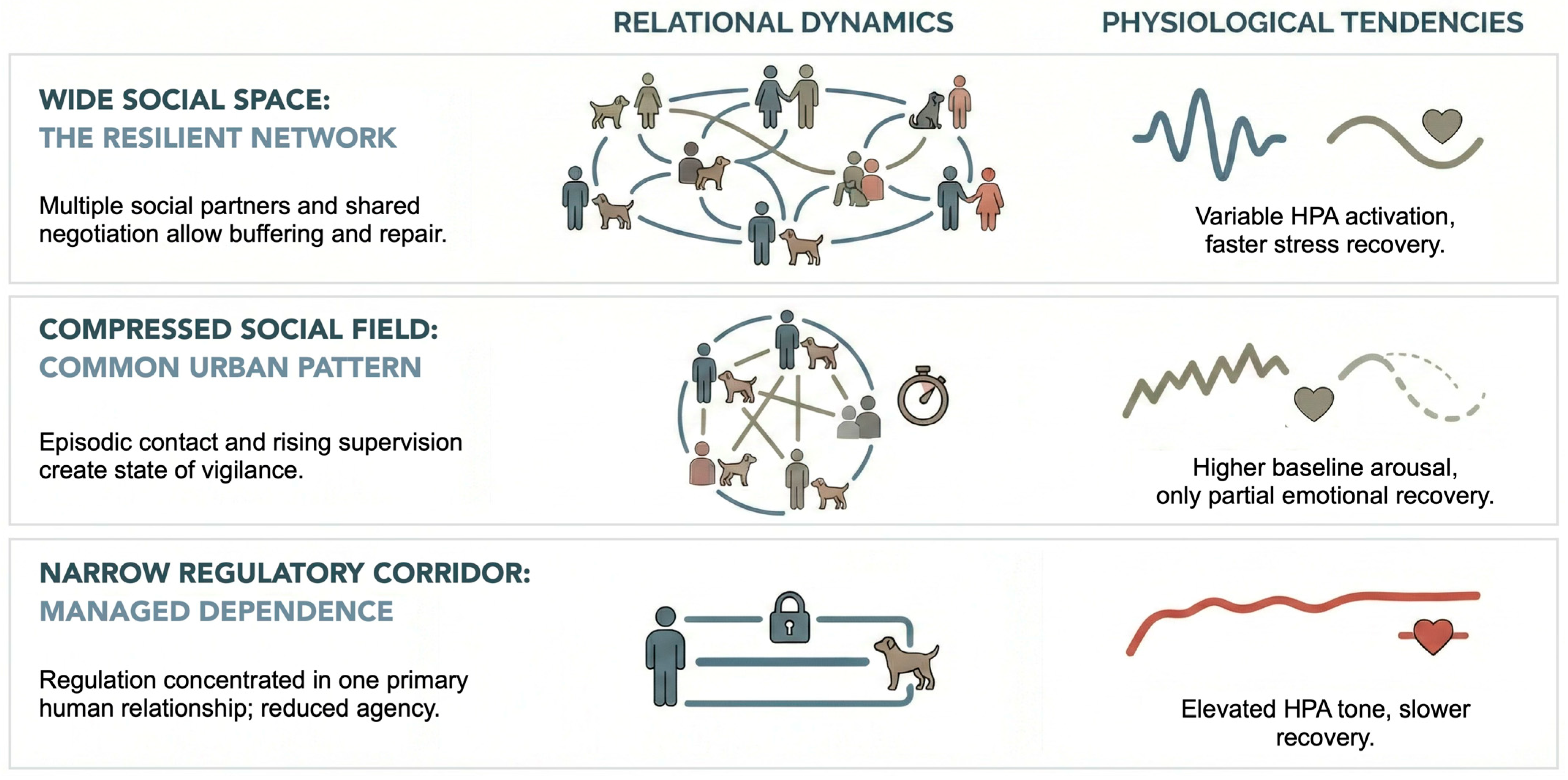
4.2. From Distributed Regulation to Dyadic Dependence
4.3. Physiological Coupling as a Pathway, Not a Cause
5. Dogs as Anchors of Embodied Social Life
6. Ethical and Welfare Considerations
7. Conclusions and Future Directions
Author Contributions
Funding
Institutional Review Board Statement
Informed Consent Statement
Data Availability Statement
Conflicts of Interest
References
- Puurunen, J.; Hakanen, E.; Salonen, M.K.; Mikkola, S.; Sulkama, S.; Araujo, C.; Lohi, H. Inadequate Socialisation, Inactivity, and Urban Living Environment Are Associated with Social Fearfulness in Pet Dogs. Sci. Rep. 2020, 10, 3527. [Google Scholar] [CrossRef]
- Leiss, W.; Beck, U.; Ritter, M.; Lash, S.; Wynne, B. Risk Society, Towards a New Modernity. Can. J. Sociol. Cah. Can. Sociol. 1994, 19, 544. [Google Scholar] [CrossRef]
- Wood, L.; Martin, K.; Christian, H.; Nathan, A.; Lauritsen, C.; Houghton, S.; Kawachi, I.; McCune, S. The Pet Factor—Companion Animals as a Conduit for Getting to Know People, Friendship Formation and Social Support. PLoS ONE 2015, 10, e0122085. [Google Scholar] [CrossRef] [PubMed]
- Delanoeije, J.; Verbruggen, M. Biophilia in the Home–Workplace: Integrating Dog Caregiving and Outdoor Access to Explain Teleworkers’ Daily Physical Activity, Loneliness, and Job Performance. J. Occup. Health Psychol. 2024, 29, 131–154. [Google Scholar] [CrossRef] [PubMed]
- Lieberman, A.; Schroeder, J. Two Social Lives: How Differences between Online and Offline Interaction Influence Social Outcomes. Curr. Opin. Psychol. 2020, 31, 16–21. [Google Scholar] [CrossRef]
- Suat, H.; Khairunnisa, A.; Rieuwpassa, S.; Lestari, F.I. Transformation of Social Interaction Patterns of the Young Generation in the Digital Age: An Analysis of the Influence of Social Media on Social Life and Local Culture. Socious J. 2025, 2, 17–29. [Google Scholar] [CrossRef]
- Powell, L.; Stefanovski, D.; Dreschel, N.A.; Serpell, J. The Impacts of Household Factors and Proxies of Human Social Determinants of Health on Dog Behavior. Prev. Vet. Med. 2025, 239, 106520. [Google Scholar] [CrossRef]
- Toohey, A.M.; Rock, M.J. Unleashing Their Potential: A Critical Realist Scoping Review of the Influence of Dogs on Physical Activity for Dog-Owners and Non-Owners. Int. J. Behav. Nutr. Phys. Act. 2011, 8, 46. [Google Scholar] [CrossRef]
- Cudworth, E. Posthuman Community in the Edgelands. Soc. Anim. 2017, 25, 384–403. [Google Scholar] [CrossRef]
- Lively, K.J.; Weed, E.A. Emotion Management: Sociological Insight into What, How, Why, and to What End? Emot. Rev. 2014, 6, 202–207. [Google Scholar] [CrossRef]
- Bussolari, C.; Currin-McCulloch, J.; Packman, W.; Kogan, L.; Erdman, P. “I Couldn’t Have Asked for a Better Quarantine Partner!”: Experiences with Companion Dogs during COVID-19. Animals 2021, 11, 330. [Google Scholar] [CrossRef]
- Sundman, A.-S.; Van Poucke, E.; Svensson Holm, A.-C.; Faresjö, Å.; Theodorsson, E.; Jensen, P.; Roth, L.S.V. Long-Term Stress Levels Are Synchronized in Dogs and Their Owners. Sci. Rep. 2019, 9, 7391. [Google Scholar] [CrossRef] [PubMed]
- Wirobski, G.; Range, F.; Schaebs, F.S.; Palme, R.; Deschner, T.; Marshall-Pescini, S. Life Experience Rather than Domestication Accounts for Dogs’ Increased Oxytocin Release during Social Contact with Humans. Sci. Rep. 2021, 11, 14423. [Google Scholar] [CrossRef] [PubMed]
- Duranton, C.; Bedossa, T.; Gaunet, F. Interspecific Behavioural Synchronization: Dogs Exhibit Locomotor Synchrony with Humans. Sci. Rep. 2017, 7, 12384. [Google Scholar] [CrossRef]
- Ren, W.; Yu, S.; Guo, K.; Lu, C.; Zhang, Y.Q. Disrupted Human–Dog Interbrain Neural Coupling in Autism-Associated Shank3 Mutant Dogs. Adv. Sci. 2024, 11, 2402493. [Google Scholar] [CrossRef]
- Junça-Silva, A. ‘Pawing’ Uncertainty! How Dogs Attenuate the Impact of Daily Hassles at Work on Uncertainty. BMC Psychol. 2023, 11, 251. [Google Scholar] [CrossRef] [PubMed]
- Peel, E. An Antidote to “Armageddon and Potential Doom”: Accounts of Canine-Human Companionship during COVID-19. Qual. Res. Psychol. 2025, 22, 56–80. [Google Scholar] [CrossRef]
- Udvarhelyi-Tóth, K.M.; Szalma, I.; Pélyi, L.; Udvari, O.; Kispeter, E.; Kubinyi, E. “My Little Son, My Everything”: Comparative Caregiving and Emotional Bonds in Dog and Child Parenting. Animals 2025, 15, 3358. [Google Scholar] [CrossRef]
- Koohsari, M.J.; Yasunaga, A.; Shibata, A.; Ishii, K.; Miyawaki, R.; Araki, K.; Nakaya, T.; Hanibuchi, T.; McCormack, G.R.; Oka, K. Dog Ownership, Dog Walking, and Social Capital. Humanit. Soc. Sci. Commun. 2021, 8, 126. [Google Scholar] [CrossRef]
- Bosworth, K. What Is ‘Affective Infrastructure’? Dialogues Hum. Geogr. 2023, 13, 54–72. [Google Scholar] [CrossRef]
- Wilson, H.F. Coming to Terms with Affective Infrastructure. Dialogues Hum. Geogr. 2023, 13, 81–85. [Google Scholar] [CrossRef]
- Orlando, E.M.; Chin, B.N. Human-Animal Bonds and Mental Health: Examining the Roles of Bond Strength, Interactions, and Attachment Security. Hum.-Anim. Interact. 2025, 13, 0005. [Google Scholar] [CrossRef]
- Malamud, R. The Internet of Animals: Human-Animal Relationships in the Digital Age. J. Anim. Ethics 2024, 14, 225–228. [Google Scholar] [CrossRef]
- Pinchak, N.P.; Browning, C.R.; Boettner, B.; Calder, C.A.; Tarrence, J. Paws on the Street: Neighborhood-Level Concentration of Households with Dogs and Urban Crime. Soc. Forces 2023, 101, 1888–1917. [Google Scholar] [CrossRef]
- Christian, H.; Wood, L.; Nathan, A.; Kawachi, I.; Houghton, S.; Martin, K.; McCune, S. The Association between Dog Walking, Physical Activity and Owner’s Perceptions of Safety: Cross-Sectional Evidence from the US and Australia. BMC Public Health 2016, 16, 1010. [Google Scholar] [CrossRef]
- Pidgeon, N.F. Safety Culture and Risk Management in Organizations. J. Cross-Cult. Psychol. 1991, 22, 129–140. [Google Scholar] [CrossRef]
- Sornette, D.; Cauwels, P. Trapped in the “Zero-Risk” Society and How to Break Free. SSRN Electron. J. 2020. [Google Scholar] [CrossRef]
- Slemon, A.; Jenkins, E.; Bungay, V. Safety in Psychiatric Inpatient Care: The Impact of Risk Management Culture on Mental Health Nursing Practice. Nurs. Inq. 2017, 24, e12199. [Google Scholar] [CrossRef]
- Aven, T. A Risk and Safety Science Perspective on the Precautionary Principle. Saf. Sci. 2023, 165, 106211. [Google Scholar] [CrossRef]
- Furedi, F. Culture of Fear: Risk-Taking and the Morality of Low Expectation; Revised edition; Continuum: London, UK; New York, NY, USA, 2002; ISBN 0-8264-5930-7. [Google Scholar]
- Widmer, S.; Albrechtslund, A. The Ambiguities of Surveillance as Care and Control: Struggles in the Domestication of Location-Tracking Applications by Danish Parents. Nord. Rev. 2021, 42, 79–93. [Google Scholar] [CrossRef]
- Cafazzo, S.; Marshall-Pescini, S.; Lazzaroni, M.; Virányi, Z.; Range, F. The Effect of Domestication on Post-Conflict Management: Wolves Reconcile While Dogs Avoid Each Other. R. Soc. Open Sci. 2018, 5, 171553. [Google Scholar] [CrossRef]
- Pongrácz, P. Social Learning in Dogs. In The Social Dog; Elsevier: Amsterdam, The Netherlands, 2014; pp. 249–293. ISBN 978-0-12-407818-5. [Google Scholar]
- Topál, J.; Miklósi, Á.; Csányi, V.; Dóka, A. Attachment Behavior in Dogs (Canis familiaris): A New Application of Ainsworth’s (1969) Strange Situation Test. J. Comp. Psychol. 1998, 112, 219–229. [Google Scholar] [CrossRef] [PubMed]
- Bray, E.E.; MacLean, E.L.; Hare, B.A. Context Specificity of Inhibitory Control in Dogs. Anim. Cogn. 2014, 17, 15–31. [Google Scholar] [CrossRef]
- Taggart, J.M. Dog Owner Interaction Style: The Transmission of Working Models in Human/Non-Human Caregiving Relationships. Ph.D. Thesis, University of Southampton, Southampton, UK, 2011. [Google Scholar]
- Marnfeldt, K.; Wilber, K. The Safety–Autonomy Grid: A Flexible Framework for Navigating Protection and Independence for Older Adults. Gerontologist 2025, 65, gnaf111. [Google Scholar] [CrossRef]
- Porges, S.W. The Polyvagal Theory: Neurophysiological Foundations of Emotions, Attachment, Communication, and Self-Regulation; The Norton Series on Interpersonal Neurobiology; W. W. Norton: New York, NY, USA, 2011; ISBN 978-0-393-70700-7. [Google Scholar]
- Anderson, K.L.; Casey, R.A.; Cooper, B.; Upjohn, M.M.; Christley, R.M. National Dog Survey: Describing UK Dog and Ownership Demographics. Animals 2023, 13, 1072. [Google Scholar] [CrossRef]
- Carvelli, A.; Scaramozzino, P.; Iacoponi, F.; Condoleo, R.; Della Marta, U. Size, Demography, Ownership Profiles, and Identification Rate of the Owned Dog Population in Central Italy. PLoS ONE 2020, 15, e0240551. [Google Scholar] [CrossRef] [PubMed]
- Westgarth, C.; Christley, R.M.; Pinchbeck, G.L.; Gaskell, R.M.; Dawson, S.; Bradshaw, J.W.S. Dog Behaviour on Walks and the Effect of Use of the Leash. Appl. Anim. Behav. Sci. 2010, 125, 38–46. [Google Scholar] [CrossRef]
- Trisko, R.K.; Sandel, A.A.; Smuts, B. Affiliation, Dominance and Friendship among Companion Dogs. Behaviour 2016, 153, 693–725. [Google Scholar] [CrossRef]
- Andersen, S.S.; Meyer, I.; Forkman, B.; Nielsen, S.S.; Sandøe, P. Regulating Companion Dog Welfare: A Comparative Study of Legal Frameworks in Western Countries. Animals 2021, 11, 1660. [Google Scholar] [CrossRef] [PubMed]
- Florian, T. Právní regulace venčení psů ve vybraných evropských zemích. Jurisprudence 2025, 1, 26–42. [Google Scholar] [CrossRef]
- Dietz, L.; Arnold, A.-M.K.; Goerlich-Jansson, V.C.; Vinke, C.M. The Importance of Early Life Experiences for the Development of Behavioural Disorders in Domestic Dogs. Behaviour 2018, 155, 83–114. [Google Scholar] [CrossRef]
- Guardini, G.; Bowen, J.; Mariti, C.; Fatjó, J.; Sighieri, C.; Gazzano, A. Influence of Maternal Care on Behavioural Development of Domestic Dogs (Canis familiaris) Living in a Home Environment. Animals 2017, 7, 93. [Google Scholar] [CrossRef]
- Awalt, S.L.; Boghean, L.; Klinkebiel, D.; Strasser, R. A Dog’s Life: Early Life Histories Influence Methylation of Glucocorticoid (NR3C1) and Oxytocin (OXTR) Receptor Genes, Cortisol Levels, and Attachment Styles. Dev. Psychobiol. 2024, 66, e22482. [Google Scholar] [CrossRef] [PubMed]
- Bonanni, R.; Cafazzo, S.; Abis, A.; Barillari, E.; Valsecchi, P.; Natoli, E. Age-Graded Dominance Hierarchies and Social Tolerance in Packs of Free-Ranging Dogs. Behav. Ecol. 2017, 28, 1004–1020. [Google Scholar] [CrossRef]
- Bhattacharjee, D.; Bhadra, A. Humans Dominate the Social Interaction Networks of Urban Free-Ranging Dogs in India. Front. Psychol. 2020, 11, 2153. [Google Scholar] [CrossRef] [PubMed]
- Dreschel, N.A.; Granger, D.A. Physiological and Behavioral Reactivity to Stress in Thunderstorm-Phobic Dogs and Their Caregivers. Appl. Anim. Behav. Sci. 2005, 95, 153–168. [Google Scholar] [CrossRef]
- Buttner, A.P.; Awalt, S.L.; Strasser, R. Early Life Adversity in Dogs Produces Altered Physiological and Behavioral Responses during a Social Stress-buffering Paradigm. J. Exp. Anal. Behav. 2023, 120, 6–20. [Google Scholar] [CrossRef]
- Espinosa, J.; Zapata, I.; Alvarez, C.E.; Serpell, J.A.; Kukekova, A.V.; Hecht, E.E. Influence of Early Life Adversity and Breed on Aggression and Fear in Dogs. Sci. Rep. 2025, 15, 32590. [Google Scholar] [CrossRef] [PubMed]
- Willen, R.M.; Schiml, P.A.; Hennessy, M.B. Enrichment Centered on Human Interaction Moderates Fear-Induced Aggression and Increases Positive Expectancy in Fearful Shelter Dogs. Appl. Anim. Behav. Sci. 2019, 217, 57–62. [Google Scholar] [CrossRef]
- Rivera, M.M.; Meyers-Manor, J.E. Beware of Strangers: Dogs’ Empathetic Response to Unknown Humans. Animals 2024, 14, 2130. [Google Scholar] [CrossRef]
- Graham, T.M.; Glover, T.D. On the Fence: Dog Parks in the (Un)Leashing of Community and Social Capital. Leis. Sci. 2014, 36, 217–234. [Google Scholar] [CrossRef]
- Vincent, A. Dog Parks as an Institutional Resource for Social Capital in the Urban Neighborhood. Soc. Anim. 2019, 29, 517–538. [Google Scholar] [CrossRef]
- Howse, M.S.; Anderson, R.E.; Walsh, C.J. Social Behaviour of Domestic Dogs (Canis familiaris) in a Public off-Leash Dog Park. Behav. Process. 2018, 157, 691–701. [Google Scholar] [CrossRef]
- Ward, C. Greeting Behavior between Dogs in a Dog Park. Pet Behav. Sci 2020, 10, 1–14. [Google Scholar] [CrossRef]
- Contu, F.; Di Santo, D.; Baldner, C.; Pierro, A. Examining the Interaction between Perceived Cultural Tightness and Prevention Regulatory Focus on Life Satisfaction in Italy. Sustainability 2023, 15, 1865. [Google Scholar] [CrossRef]
- Durnová, A.; Mohammadi, E. Intimacy, Home, and Emotions in the Era of the Pandemic. Sociol. Compass 2021, 15, e12852. [Google Scholar] [CrossRef]
- Jiao, J.; Segrin, C. Parent–Emerging-Adult-Child. Attachment and Overparenting. Fam. Relat. 2021, 70, 859–865. [Google Scholar] [CrossRef]
- Peterson, L.; Ewigman, B.; Kivlahan, C. Judgments Regarding Appropriate Child Supervision to Prevent Injury: The Role of Environmental Risk and Child Age. Child. Dev. 1993, 64, 934. [Google Scholar] [CrossRef]
- Morrongiello, B.A.; Klemencic, N.; Corbett, M. Interactions Between Child Behavior Patterns and Parent Supervision: Implications for Children’s Risk of Unintentional Injury. Child. Dev. 2008, 79, 627–638. [Google Scholar] [CrossRef]
- O’Kane, M.; Brussoni, M. Supervisory Neglect: Critical Questions Regarding Child Supervision and Protection System Responses. Child. Youth Serv. Rev. 2024, 158, 107473. [Google Scholar] [CrossRef]
- Gee, N.R.; Rodriguez, K.E.; Fine, A.H.; Trammell, J.P. Dogs Supporting Human Health and Well-Being: A Biopsychosocial Approach. Front. Vet. Sci. 2021, 8, 630465. [Google Scholar] [CrossRef]
- Stamataki, E.; Tragantzopoulou, P. ‘He’s Not Just a Dog… He’s Something Bigger… My Family.’ A Qualitative Study on Dog Ownership and Emotional Well-Being. Healthcare 2025, 13, 2666. [Google Scholar] [CrossRef] [PubMed]
- Townsend, L.; Gee, N.R. Recognizing and Mitigating Canine Stress during Animal Assisted Interventions. Vet. Sci. 2021, 8, 254. [Google Scholar] [CrossRef]
- Dye, H. Exploring Dog-Parent Guilt: Do Human Attachment Styles Play a Role? Hum.-Anim. Interact. 2024, 12, hai.2024.0040. [Google Scholar] [CrossRef]
- Northrope, K.; Ruby, M.B.; Howell, T.J. How Attachment to Dogs and to Other Humans Relate to Mental Health. Animals 2024, 14, 2773. [Google Scholar] [CrossRef]
- Butler, E.A.; Randall, A.K. Emotional Coregulation in Close Relationships. Emot. Rev. 2013, 5, 202–210. [Google Scholar] [CrossRef]
- Lyons, D. Developmental Cascades Linking Stress Inoculation, Arousal Regulation, and Resilience. Front. Behav. Neurosci. 2009, 3, 32. [Google Scholar] [CrossRef] [PubMed]
- Wanser, S.H.; Vitale, K.R.; Thielke, L.E.; Brubaker, L.; Udell, M.A.R. Spotlight on the Psychological Basis of Childhood Pet Attachment and Its Implications. Psychol. Res. Behav. Manag. 2019, 12, 469–479. [Google Scholar] [CrossRef]
- Thielke, L.E.; Udell, M.A.R. Characterizing Human–Dog Attachment Relationships in Foster and Shelter Environments as a Potential Mechanism for Achieving Mutual Wellbeing and Success. Animals 2019, 10, 67. [Google Scholar] [CrossRef]
- Lockyer, J.M.; Oliva, J.L. Better to Have Loved and Lost? Human Avoidant Attachment Style Towards Dogs Predicts Group Membership as ‘Forever Owner’ or ‘Foster Carer’. Animals 2020, 10, 1679. [Google Scholar] [CrossRef]
- Duranton, C.; Gaunet, F. Behavioural Synchronization from an Ethological Perspective: Overview of Its Adaptive Value. Adapt. Behav. 2016, 24, 181–191. [Google Scholar] [CrossRef]
- Walt, A.; Parker, R. Emotional Contagion in the Human/Dog Dyad—Physiological and Cognitive Consequences, and Implications for Pain Management: A Scoping Review. Res. Sq. 2023. [Google Scholar] [CrossRef]
- Zee, K.S.; Bolger, N. Physiological Coregulation during Social Support Discussions. Emotion 2023, 23, 825–843. [Google Scholar] [CrossRef]
- Ogi, A.; Mariti, C.; Baragli, P.; Sergi, V.; Gazzano, A. Effects of Stroking on Salivary Oxytocin and Cortisol in Guide Dogs: Preliminary Results. Animals 2020, 10, 708. [Google Scholar] [CrossRef]
- Gazzano, V.; Curadi, M.C.; Baragli, P.; Mariti, C.; Cecchi, F.; Cavallo, S.; Sacchettino, L.; Gazzano, A. Physiological and Behavioral Evaluation of Shelter Dogs During Veterinary Routine Health Checks. Vet. Sci. 2025, 12, 583. [Google Scholar] [CrossRef]
- Kunwar, V. The Impact of Social Media on Social Behaviour: A Double-Edged Sword. Int. J. Adv. Res. Sci. Commun. Technol. 2025, 5, 630–633. [Google Scholar] [CrossRef]
- Slemon, A.; Dhari, S. Envisioning a Safety Paradigm in Inpatient Mental Health Settings: Moving beyond Zero-Risk Approaches. SSM-Ment. Health 2024, 5, 100315. [Google Scholar] [CrossRef]
- Gilboa, I.; Minardi, S.; Wang, F. Schumpeter Lecture 2023: Rationality and Zero Risk. J. Eur. Econ. Assoc. 2024, 22, 1–33. [Google Scholar] [CrossRef]
- Slavich, G.M. Social Safety Theory: A Biologically Based Evolutionary Perspective on Life Stress, Health, and Behavior. Annu. Rev. Clin. Psychol. 2020, 16, 265–295. [Google Scholar] [CrossRef] [PubMed]
- Duffield, M. Risk-Management and the Fortified Aid Compound: Everyday Life in Post-Interventionary Society. J. Interv. Statebuilding 2010, 4, 453–474. [Google Scholar] [CrossRef]
- Lamontagne, A.; Gaunet, F. Behavioural Synchronisation between Dogs and Humans: Unveiling Interspecific Motor Resonance? Animals 2024, 14, 548. [Google Scholar] [CrossRef]
- Pop, D.A.; Rusu, A.S.; Pop-Vancea, V.; Papuc, I.; Contantinescu, R.; Miresan, V. Physiological Effects of Human-Animal Positive Interaction in Dogs—Review of the Literature. Bull. Univ. Agric. Sci. Vet. Med. Cluj-Napoca Anim. Sci. Biotechnol. 2014, 71, 102–110. [Google Scholar] [CrossRef] [PubMed]
- Koskela, A.; Törnqvist, H.; Somppi, S.; Tiira, K.; Kykyri, V.-L.; Hänninen, L.; Kujala, J.; Nagasawa, M.; Kikusui, T.; Kujala, M.V. Behavioral and Emotional Co-Modulation during Dog–Owner Interaction Measured by Heart Rate Variability and Activity. Sci. Rep. 2024, 14, 25201. [Google Scholar] [CrossRef] [PubMed]
- Odendaal, J.S.J.; Meintjes, R.A. Neurophysiological Correlates of Affiliative Behaviour between Humans and Dogs. Vet. J. 2003, 165, 296–301. [Google Scholar] [CrossRef]
- Petersson, M.; Uvnäs-Moberg, K.; Nilsson, A.; Gustafson, L.-L.; Hydbring-Sandberg, E.; Handlin, L. Oxytocin and Cortisol Levels in Dog Owners and Their Dogs Are Associated with Behavioral Patterns: An Exploratory Study. Front. Psychol. 2017, 8, 1796. [Google Scholar] [CrossRef] [PubMed]
- Li, F.H.; Froidevaux, N.M.; Kerr, M.L.; Smiley, P.A.; Hastings, P.D.; Borelli, J.L. Maternal Emotion Regulation and Parenting: A Physiological Perspective. Dev. Psychobiol. 2025, 67, e70044. [Google Scholar] [CrossRef]
- Slavich, G.M. Social Safety Theory: Understanding Social Stress, Disease Risk, Resilience, and Behavior during the COVID-19 Pandemic and Beyond. Curr. Opin. Psychol. 2022, 45, 101299. [Google Scholar] [CrossRef]
- Slavich, G.M.; Roos, L.G.; Mengelkoch, S.; Webb, C.A.; Shattuck, E.C.; Moriarity, D.P.; Alley, J.C. Social Safety Theory: Conceptual Foundation, Underlying Mechanisms, and Future Directions. Health Psychol. Rev. 2023, 17, 5–59. [Google Scholar] [CrossRef]
- Friedmann, E.; Gee, N.R.; Simonsick, E.M.; Resnick, B.; Gurlu, M.; Adesanya, I.; Shim, S. Pet Ownership, Pet Attachment, and Longitudinal Changes in Psychological Health—Evidence from the Baltimore Longitudinal Study of Aging. Geriatrics 2025, 10, 156. [Google Scholar] [CrossRef]
- Douglas, V.J.; Kwan, M.Y.; Gordon, K.H. Pet Attachment and the Interpersonal Theory of Suicide. Crisis 2023, 44, 14–20. [Google Scholar] [CrossRef]
- Hawkins, R.D.; Ellis, A.; Robinson, C. Exploring the Connection between Pet Attachment and Owner Mental Health: The Roles of Owner-Pet Compatibility, Perceived Pet Welfare, and Behavioral Issues. PLoS ONE 2025, 20, e0314893. [Google Scholar] [CrossRef]
- Pedretti, G.; Canori, C.; Costantini, E.; Palme, R.; Valsecchi, P.; Marshall-Pescini, S. Intra and Interspecific Audience Effect on Domestic Dogs’ Behavioural Displays and Facial Expressions. Sci. Rep. 2024, 14, 9546. [Google Scholar] [CrossRef] [PubMed]
- Duranton, C.; Bedossa, T.; Gaunet, F. When Walking in an Outside Area, Shelter Dogs (Canis familiaris) Synchronize Activity with Their Caregivers but Do Not Remain as Close to Them as Do Pet Dogs. J. Comp. Psychol. 2019, 133, 397–405. [Google Scholar] [CrossRef]
- Arkow, P. The Social Capital of Companion Animals. In Handbook on Animal-Assisted Therapy; Elsevier: Amsterdam, The Netherlands, 2019; pp. 51–60. ISBN 978-0-12-815395-6. [Google Scholar]
- Jones, E. Constructing Canine Consent: Conceptualising and Adopting a Consent-Focused Relationship with Dogs, 1st ed.; CRC Press: Boca Raton, FL, USA, 2024; ISBN 978-1-003-36145-9. [Google Scholar]
- Hiestand, K.M. The Autonomy Principle in Companion Veterinary Medicine: A Critique. Front. Vet. Sci. 2022, 9, 953925. [Google Scholar] [CrossRef]
- Rodríguez-Vizzuett, L.; Espinosa-Curiel, I.E.; Pérez-Espinosa, H. Digital Technology Supporting the Remote Human-Dog Interaction: Scoping Review. Animals 2023, 13, 699. [Google Scholar] [CrossRef]
- Duranton, C.; Gaunet, F. Behavioral Synchronization and Affiliation: Dogs Exhibit Human-like Skills. Learn. Behav. 2018, 46, 364–373. [Google Scholar] [CrossRef] [PubMed]
- Heurlin, J.; Barabás, G.; Roth, L.S.V. Behavioural Synchronisation between Different Groups of Dogs and Wolves and Their Owners/Handlers: Exploring the Effect of Breed and Human Interaction. PLoS ONE 2024, 19, e0302833. [Google Scholar] [CrossRef]
- Zhao, J.; Koohsari, M.J.; Li, J.; Luo, Y.; Kaczynski, A.T.; McCormack, G.R.; Oka, K.; Hanibuchi, T. Beyond Companionship: Psycho-Social Benefits of Pet Ownership. BMC Public Health 2025, 25, 2320. [Google Scholar] [CrossRef] [PubMed]
- Marshall-Pescini, S.; Schaebs, F.S.; Gaugg, A.; Meinert, A.; Deschner, T.; Range, F. The Role of Oxytocin in the Dog–Owner Relationship. Animals 2019, 9, 792. [Google Scholar] [CrossRef]
- Duranton, C.; Courby-Betremieux, C.; Gaunet, F. One- and Two-Month-Old Dog Puppies Exhibit Behavioural Synchronization with Humans Independently of Familiarity. Animals 2022, 12, 3356. [Google Scholar] [CrossRef]
- Van Den Berge, L. Parenting Support and the Role of Society in Parental Self-Understanding: Furedi’s Paranoid Parenting Revisited: Furedi’s Paranoid Parenting Revisited. J. Philos. Educ. 2013, 47, 391–406. [Google Scholar] [CrossRef]
- Emanuela, P.P.; Valsecchi, P. The Immaterial Cord: The Dog–Human Attachment Bond. In The Social Dog; Academic Press: San Diego, CA, USA, 2014; pp. 165–189. ISBN 978-0-12-407818-5. [Google Scholar]

| Dimension | Adaptive Co-Regulation | Maladaptive Dependence |
|---|---|---|
| HPA Axis (Cortisol) | Flexible cortisol variability; stable circadian rhythm; short recovery after stress | Flattened variability or chronically elevated baseline; prolonged recovery |
| Autonomic System (HRV) | HRV synchrony during positive interactions; independence during challenges | Excessive HRV coupling across all contexts; reduced self-regulation |
| Oxytocin and Bonding | Oxytocin peaks during affiliative contact (gaze, touch); supports recovery | Sustained oxytocin co-activation across contexts, maintaining dependence and stress contagion |
| Guardian Profile | Secure attachment; low chronic stress; balanced responsiveness within everyday social contexts | Anxious or avoidant attachment; high neuroticism; chronic vigilance embedded in daily routines |
| Canine Behaviour | Balance between proximity and exploration; rapid return to baseline | Excessive proximity-seeking; reduced exploration; problem-solving deficits |
| Functional Outcomes | Stress buffering; social flexibility; adaptive learning across relational settings | “Managed calm”; reduced flexibility; inhibition as stability |
Disclaimer/Publisher’s Note: The statements, opinions and data contained in all publications are solely those of the individual author(s) and contributor(s) and not of MDPI and/or the editor(s). MDPI and/or the editor(s) disclaim responsibility for any injury to people or property resulting from any ideas, methods, instructions or products referred to in the content. |
© 2026 by the authors. Licensee MDPI, Basel, Switzerland. This article is an open access article distributed under the terms and conditions of the Creative Commons Attribution (CC BY) license.
Share and Cite
Grynkiewicz, A.; Reinholz, A.; Imbir, K. Entangled Bonds: Dyadic Dependence and Co-Regulation in Western Urban Human–Dog Relationships. Animals 2026, 16, 715. https://doi.org/10.3390/ani16050715
Grynkiewicz A, Reinholz A, Imbir K. Entangled Bonds: Dyadic Dependence and Co-Regulation in Western Urban Human–Dog Relationships. Animals. 2026; 16(5):715. https://doi.org/10.3390/ani16050715
Chicago/Turabian StyleGrynkiewicz, Agnieszka, Anna Reinholz, and Kamil Imbir. 2026. "Entangled Bonds: Dyadic Dependence and Co-Regulation in Western Urban Human–Dog Relationships" Animals 16, no. 5: 715. https://doi.org/10.3390/ani16050715
APA StyleGrynkiewicz, A., Reinholz, A., & Imbir, K. (2026). Entangled Bonds: Dyadic Dependence and Co-Regulation in Western Urban Human–Dog Relationships. Animals, 16(5), 715. https://doi.org/10.3390/ani16050715

