Discovery of Four New FGF5 Variants Causing Long Hair in the Dog

 , ,
, ,  , and
, and 
Simple Summary
Abstract
1. Introduction
2. Materials and Methods
2.1. Animals
2.2. DNA Extraction and Sequencing
2.3. Data Analysis
3. Results
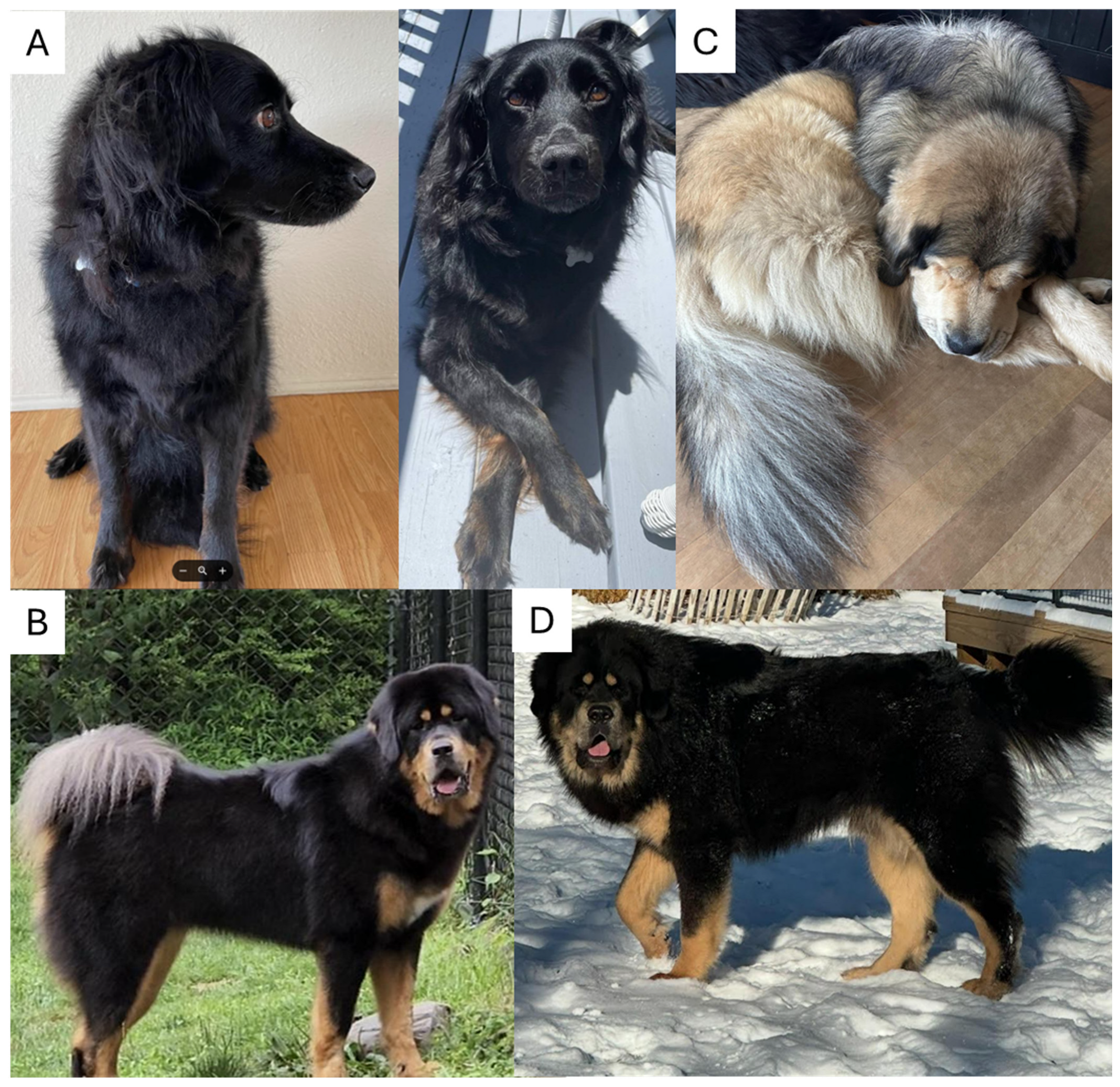
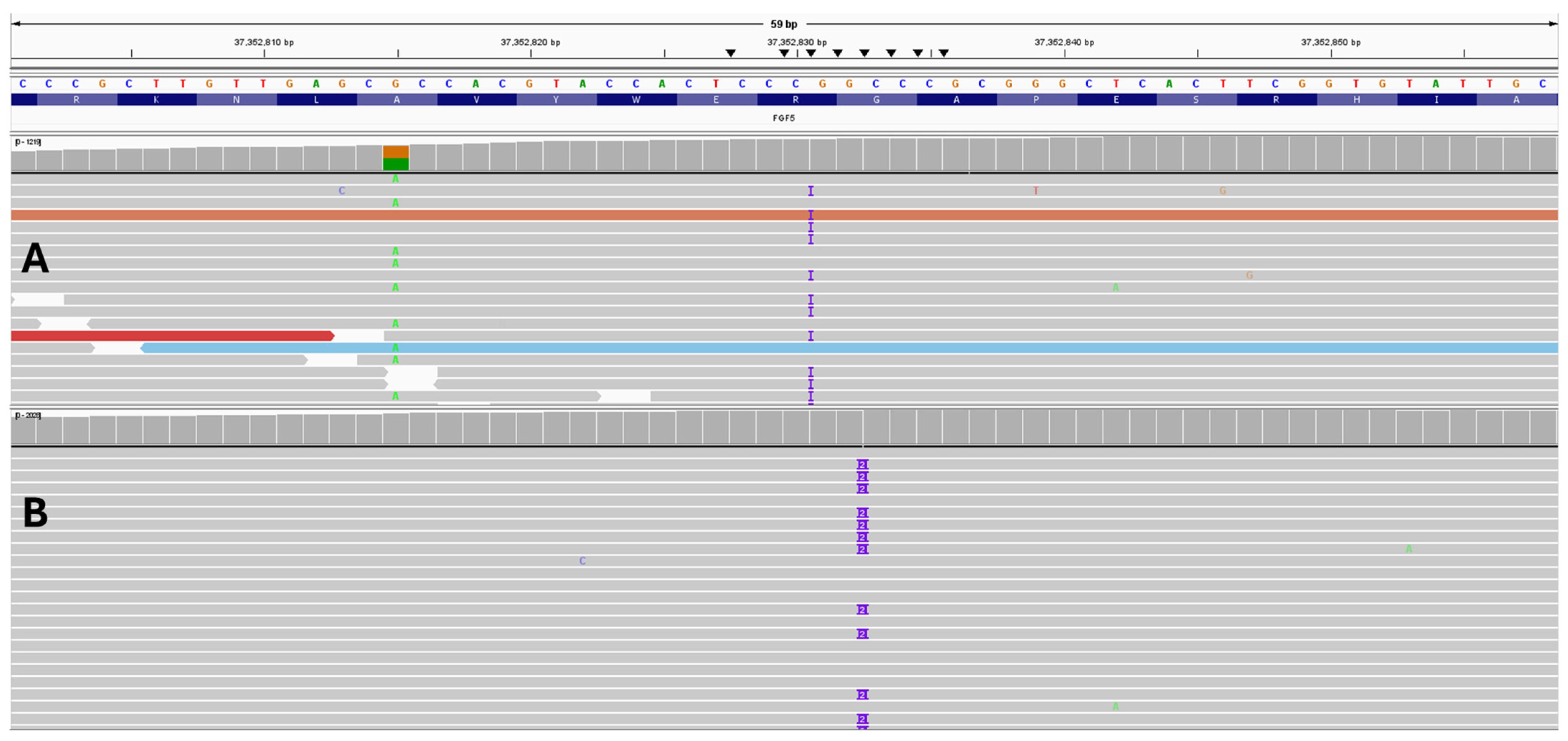
3.1. Putative Lh6 Variant in a Dog of Unknown Heritage
3.2. Tibetan Mastiff
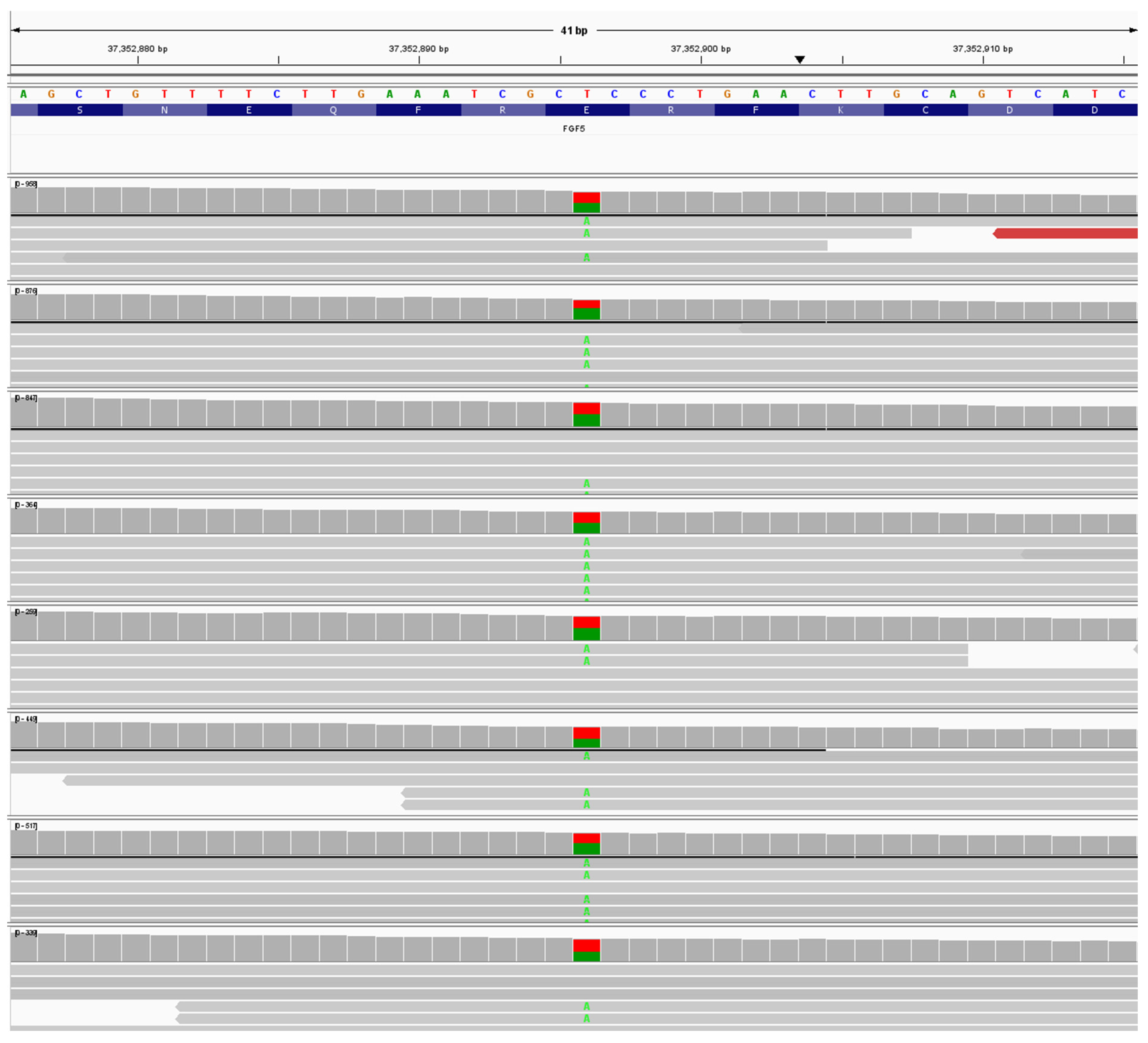
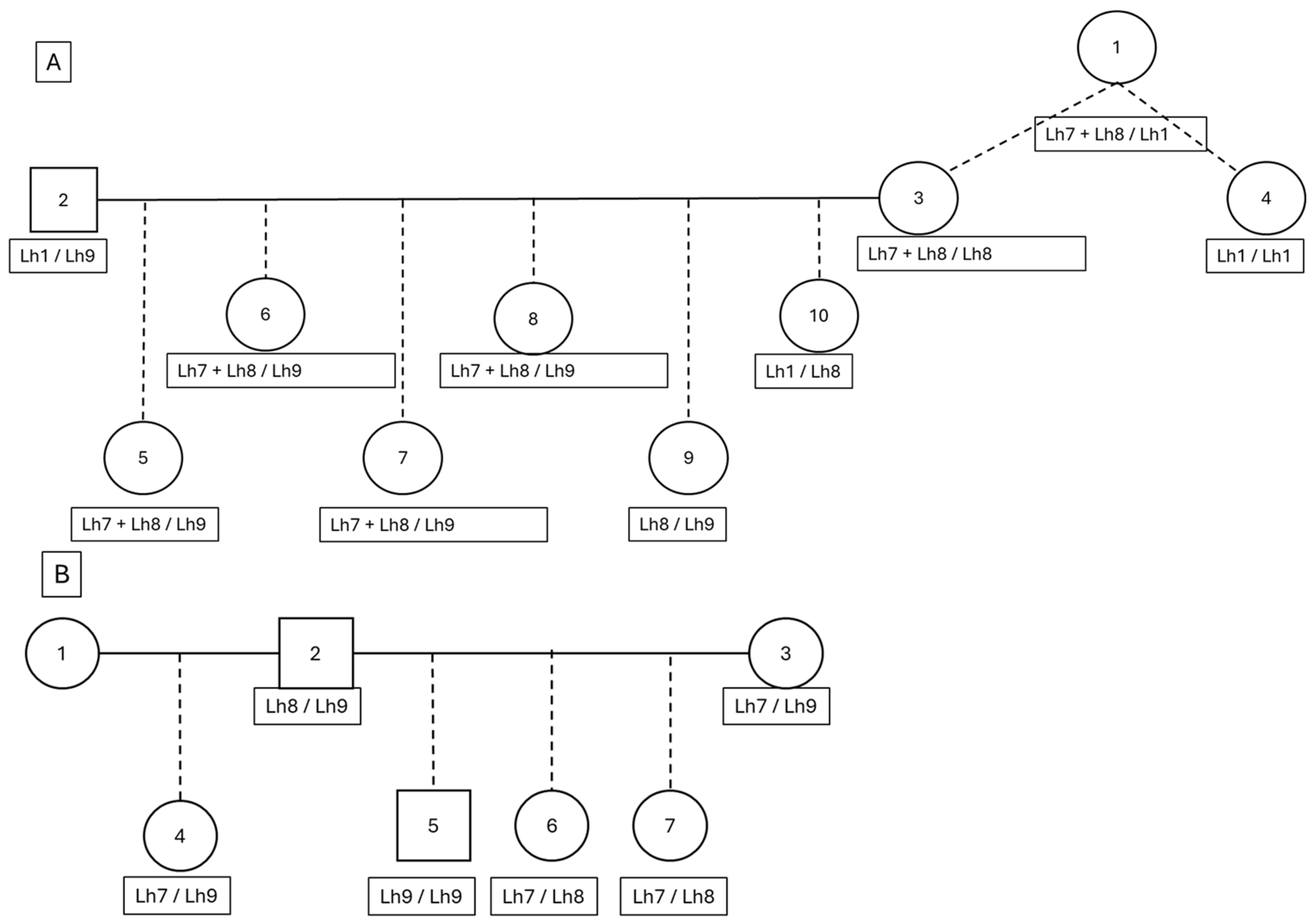
3.3. Putative Lh7 Variant
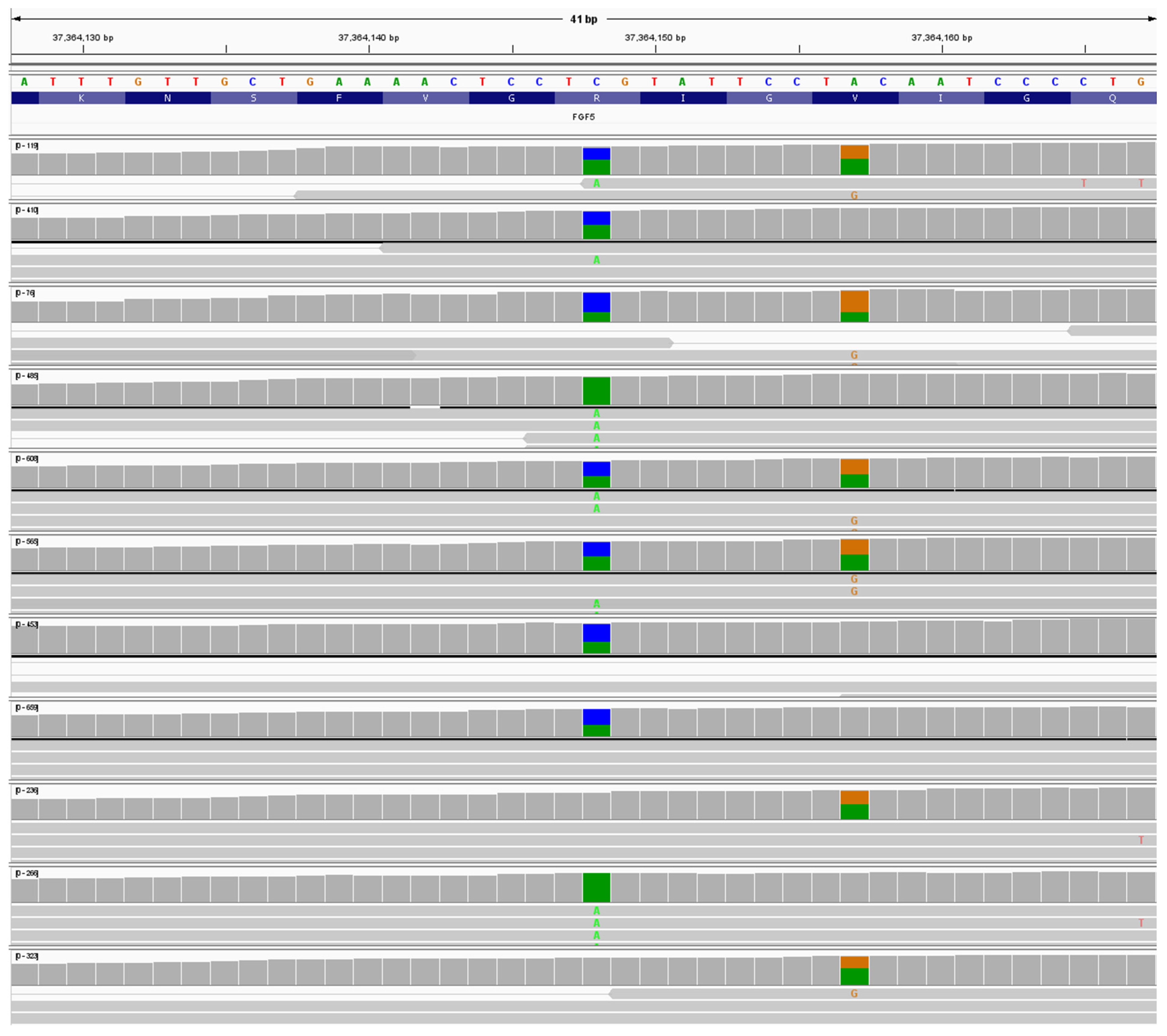
3.4. Putative Lh8 Variant
3.5. Putative Lh9
4. Discussion
5. Conclusions
Supplementary Materials
Author Contributions
Funding
Institutional Review Board Statement
Informed Consent Statement
Data Availability Statement
Acknowledgments
Conflicts of Interest
References
- Brancalion, L.; Haase, B.; Wade, C.M. Canine Coat Pigmentation Genetics: A Review. Anim. Genet. 2022, 53, 3–34. [Google Scholar] [CrossRef] [PubMed]
- Housley, D.J.E.; Venta, P.J. The Long and the Short of It: Evidence That FGF5 Is a Major Determinant of Canine ’Hair’-Itability. Anim. Genet. 2006, 37, 309–315. [Google Scholar] [CrossRef] [PubMed]
- Drögemüller, C.; Rüfenacht, S.; Wichert, B.; Leeb, T. Mutations within the FGF5 Gene Are Associated with Hair Length in Cats. Anim. Genet. 2007, 38, 218–221. [Google Scholar] [CrossRef] [PubMed]
- Higgins, C.A.; Petukhova, L.; Harel, S.; Ho, Y.Y.; Drill, E.; Shapiro, L.; Wajid, M.; Christiano, A.M. FGF5 Is a Crucial Regulator of Hair Length in Humans. Proc. Natl. Acad. Sci. USA 2014, 111, 10648–10653. [Google Scholar] [CrossRef] [PubMed]
- Legrand, R.; Tiret, L.; Abitbol, M. Two Recessive Mutations in Fgf5 Are Associated with the Long-Hair Phenotype in Donkeys. Genet. Sel. Evol. 2014, 46, 65. [Google Scholar] [CrossRef] [PubMed]
- Tammen, I.; Mather, M.; Leeb, T.; Nicholas, F.W. Online Mendelian Inheritance in Animals (OMIA): A Genetic Resource for Vertebrate Animals. Mamm. Genome 2024, 35, 556–564. [Google Scholar] [CrossRef] [PubMed]
- Dierks, C.; Mömke, S.; Philipp, U.; Distl, O. Allelic Heterogeneity of FGF5 Mutations Causes the Long-Hair Phenotype in Dogs. Anim. Genet. 2013, 44, 425–431. [Google Scholar] [CrossRef] [PubMed]
- Jagannathan, V.; Hitte, C.; Kidd, J.M.; Masterson, P.; Murphy, T.D.; Emery, S.; Davis, B.; Buckley, R.M.; Liu, Y.H.; Zhang, X.Q.; et al. Dog10k_boxer_tasha_1.0: A Long-Read Assembly of the Dog Reference Genome. Genes 2021, 12, 847. [Google Scholar] [CrossRef] [PubMed]
- Vasimuddin, M.; Sanchit, M.; Heng, L.; Aluru, S. Efficient Architecture-Aware Acceleration of BWA-MEM for Multicore Systems. In IEEE Parallel Distributed Processing Symposium (IPDPS); IEEE: New York, NY, USA, 2019. [Google Scholar] [CrossRef]
- Danecek, P.; Bonfield, J.K.; Liddle, J.; Marshall, J.; Ohan, V.; Pollard, M.O.; Whitwham, A.; Keane, T.; McCarthy, S.A.; Davies, R.M. Twelve Years of SAMtools and BCFtools. Gigascience 2021, 10, giab008. [Google Scholar] [CrossRef] [PubMed]
- Robinson, J.T.; Thorvaldsdóttir, H.; Winckler, W.; Guttman, M.; Lander, E.S.; Getz, G.; Mesirov, J.P. Integrative Genomics Viewer. Nat. Biotechnol. 2011, 29, 2426. [Google Scholar] [CrossRef] [PubMed]
- Letko, A.; Drögemüller, C. Two Brown Coat Colour-associated TYRP Variants (Bc and Bd) Occur in Leonberger Dogs. Anim. Genet. 2017, 48, 732–733. [Google Scholar] [CrossRef] [PubMed]
- Li, Y.; Zhao, X.; Pan, Z.; Xie, Z.; Liu, H.; Xu, Y.; Li, Q. The Origin of the Tibetan Mastiff and Species Identification of Canis Based on Mitochondrial Cytochrome c Oxidase Subunit i (COI) Gene and COI Barcoding. Animal 2011, 5, 1868–1873. [Google Scholar] [CrossRef] [PubMed]




| Variant (OMIA ID) | Position | Amino Acid Change | Protein Change | Breed Found | Reference |
|---|---|---|---|---|---|
| Lh1 (48) | NC_006614.4:g.37372096C>A | NM_001048129:c.284G>T | NP_001041594.1:p.C95F | many | [2] |
| Lh2 (104) | NC_006614.4:g.37352815G>A | NM_001048129:c.578C>T | NP_001041594.1:p.A193V | Akitas, Siberian huskies, Samoyeds | [7] |
| Lh3 (952) | NC_006614.4:g.37352821-37352836del16 | NM_001048129:c.556-571 | NP_001041594.1:p.A186Tfs71 | Eurasier | [7] |
| Lh4 (950) | NC_006614.4:g.37352831-37352832dupCC | NM_001048129:c.559-560dup | NP_001041594.1:p.R188Afs75 | Afghan hounds, Eurasier | [7] |
| Lh5 (418) | NC_006614.4:g.37364202A>T | NM_001048129:c.368-11T>A | Prevents splicing of exon 2 | Afghan hounds | [7] |
| Variant (OMIA ID) | Position | Amino Acid Change | Protein Change | PolyPhen-2 Score | SIFT Score | Breed Found | Reference |
|---|---|---|---|---|---|---|---|
| Lh6 | NC_006614.4: g.37352830-37352831insG | NM_001048129: c.562_563insC | NP_001041594.1: p.R188PfsX12 | Not analyzed | 0.02 | Mixed breed dog | This paper |
| Lh7 | NC_006614.4: g.37352896T>A | NM_001048129: c. 497A>T | NP_001041594.1: p.E166V | 0.999—probably damaging | 0.00 | Tibetan Mastiff | This paper |
| Lh8 | NC_006614.4: g.37364148C>A | NM_001048129: c. 410G>T | NP_001041594.1: p.R137L | 0.991—probably damaging | 0.01 | Tibetan Mastiff | This paper |
| Lh9 | NC_006614.4: g.37364157A>G | NM_001048129: c. 398T>C | NP_001041594.1: p.V133A | 1.000—probably damaging | 0.00 | Tibetan Mastiff | This paper |
| Position on NC_006614.4: | Allele | MAF | Breeds |
|---|---|---|---|
| 37,372,096 | Lh1 | 30.08% | 43 purebred breeds and multiple mixed breeds: Affenpinscher, Akita, Alaskan Klee Kai, Anatolian Shepherd Dog, Australian Cattle Dog, Australian Shepherd, Basenji, Belgian Malinois, Belgian Sheepdog, Belgian Tervuren, Bernedoodle, Bernese Mountain Dog, Border Collie, Brittany, Bullmastiff, Cavalier King Charles Spaniel, Chihuahua, Cocker Spaniel, Collie, Curly Coated Retriever, Dachshund, English Springer Spaniel, French Bulldog, German Shepherd, Golden Retriever, Great Pyrenees, Labradoodle, Labrador Retriever, Norfolk Terrier, Papillon, Pekingese, Pomsky, Poodle, Poodle (Toy), Portuguese Water Dog, Rottweiler, Russell Terrier, Sheepadoodle, Tibetan Mastiff, Toy Poodle, West Highland White Terrier, Xoloitzcuintli, Yorkshire Terrier |
| 37,352,815 | Lh2 | 0.34% | Siberian Husky, Mixed breeds |
| 37,35,2821 | Lh3 | 0.07% | Australian Cattle Dog |
| 37,352,832 | Lh4 | 0.20% | French Bulldog, Belgian Malinois |
| 37,364,202 | Lh5 | 0.00% | none |
| 37,352,830 | Lh6 | 0.07% | Mixed breed dog (Poodle, German Shepherd, Rottweiler) |
| 37,352,896 | Lh7 | 0.95% | Tibetan Mastiff and Anatolian Shepherd dog |
| 37,364,148 | Lh8 | 1.15% | Tibetan Mastiff |
| 37,364,157 | Lh9 | 0.88% | Tibetan Mastiff |
Disclaimer/Publisher’s Note: The statements, opinions and data contained in all publications are solely those of the individual author(s) and contributor(s) and not of MDPI and/or the editor(s). MDPI and/or the editor(s) disclaim responsibility for any injury to people or property resulting from any ideas, methods, instructions or products referred to in the content. |
© 2026 by the authors. Licensee MDPI, Basel, Switzerland. This article is an open access article distributed under the terms and conditions of the Creative Commons Attribution (CC BY) license.
Share and Cite
Everts, R.E.; Roane, T.; Caron, R.; Kunstadt, C.; Foster, G.; Lafayette, C. Discovery of Four New FGF5 Variants Causing Long Hair in the Dog. Animals 2026, 16, 699. https://doi.org/10.3390/ani16050699
Everts RE, Roane T, Caron R, Kunstadt C, Foster G, Lafayette C. Discovery of Four New FGF5 Variants Causing Long Hair in the Dog. Animals. 2026; 16(5):699. https://doi.org/10.3390/ani16050699
Chicago/Turabian StyleEverts, Robin E., Tim Roane, Rachael Caron, Cameron Kunstadt, Gabriel Foster, and Christa Lafayette. 2026. "Discovery of Four New FGF5 Variants Causing Long Hair in the Dog" Animals 16, no. 5: 699. https://doi.org/10.3390/ani16050699
APA StyleEverts, R. E., Roane, T., Caron, R., Kunstadt, C., Foster, G., & Lafayette, C. (2026). Discovery of Four New FGF5 Variants Causing Long Hair in the Dog. Animals, 16(5), 699. https://doi.org/10.3390/ani16050699