Figure 1.
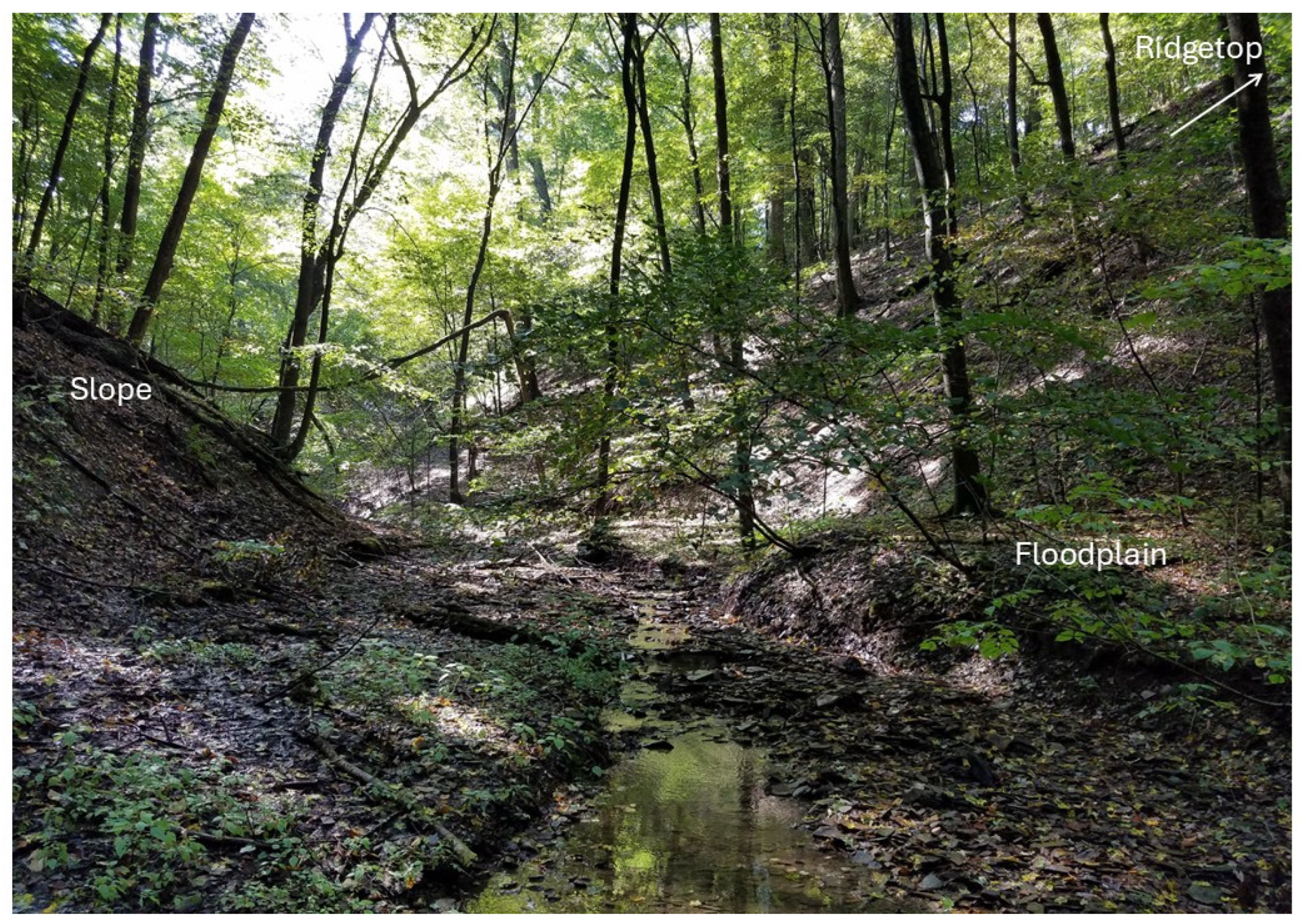
Photo of representative floodplain, and slope forest microhabitats adjacent to a first-order stream at Wooster Memorial Park, OH, USA. The ridgetop forest microhabitat would be found further upslope on the hilltop, as indicated by the arrow. Photo by R.M.L.
Figure 1.
Photo of representative floodplain, and slope forest microhabitats adjacent to a first-order stream at Wooster Memorial Park, OH, USA. The ridgetop forest microhabitat would be found further upslope on the hilltop, as indicated by the arrow. Photo by R.M.L.
Figure 2.
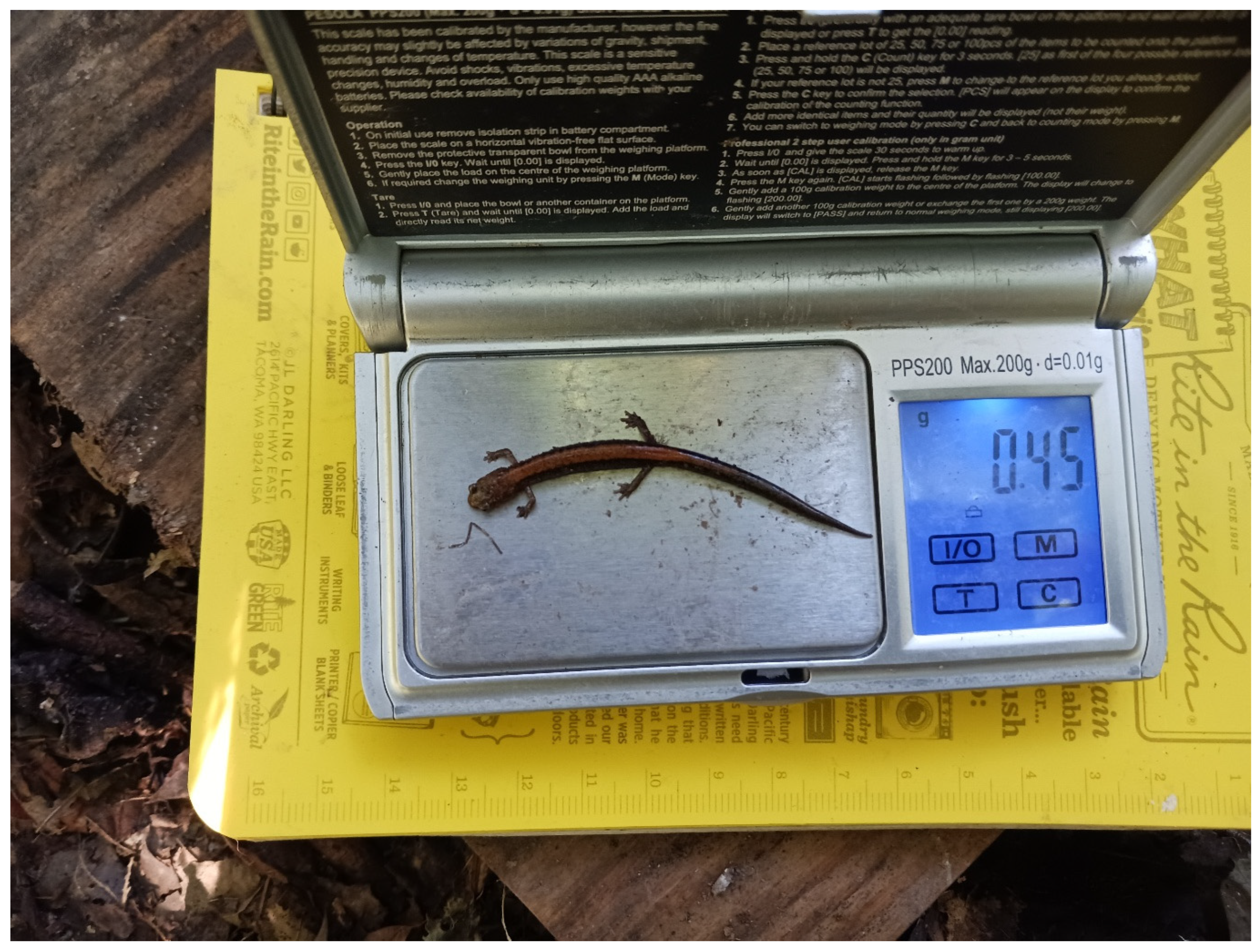
Plethodon cinereus individual on a digital balance with the metric scale in the image. Photographs such as these were used to determine body-size measurements (see text for details). Photo by R.M.L.
Figure 2.
Plethodon cinereus individual on a digital balance with the metric scale in the image. Photographs such as these were used to determine body-size measurements (see text for details). Photo by R.M.L.
Figure 3.
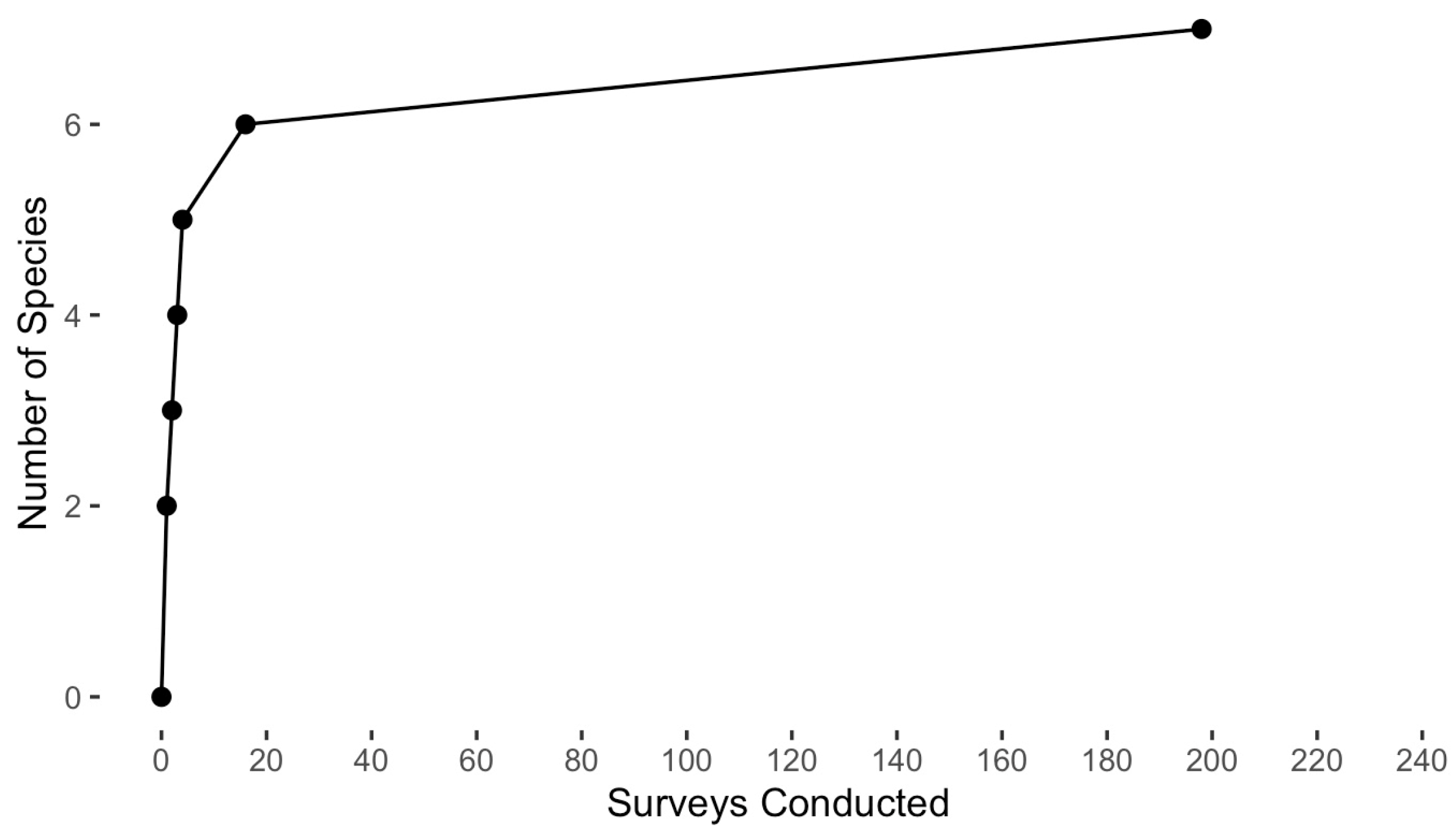
Species accumulation curve. A total of 7 plethodontid salamander species were detected during formal plot searches at WMP (n = 230 searches of twelve permanent forest plots, 2014–2023).
Figure 3.
Species accumulation curve. A total of 7 plethodontid salamander species were detected during formal plot searches at WMP (n = 230 searches of twelve permanent forest plots, 2014–2023).
Figure 4.
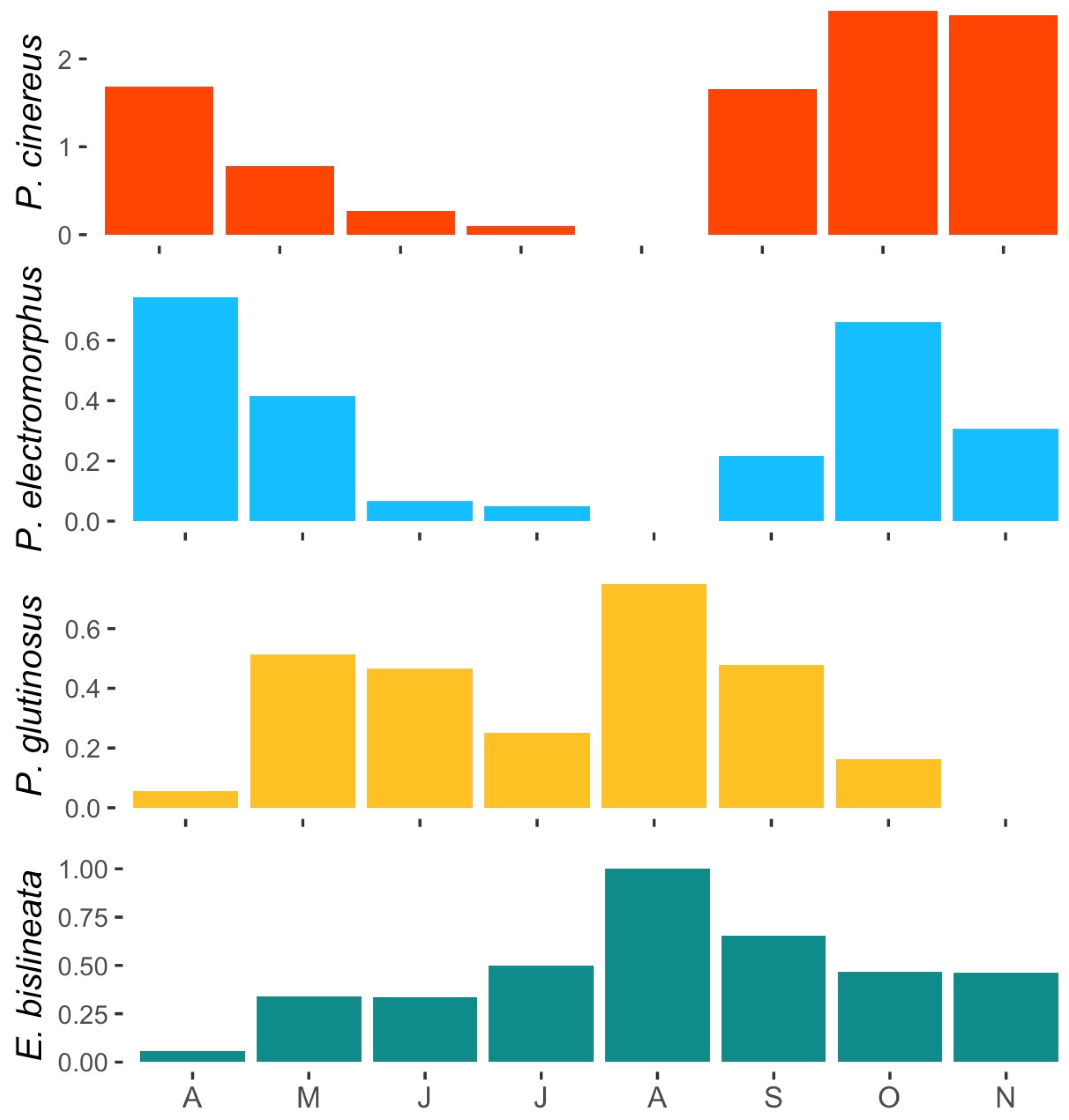
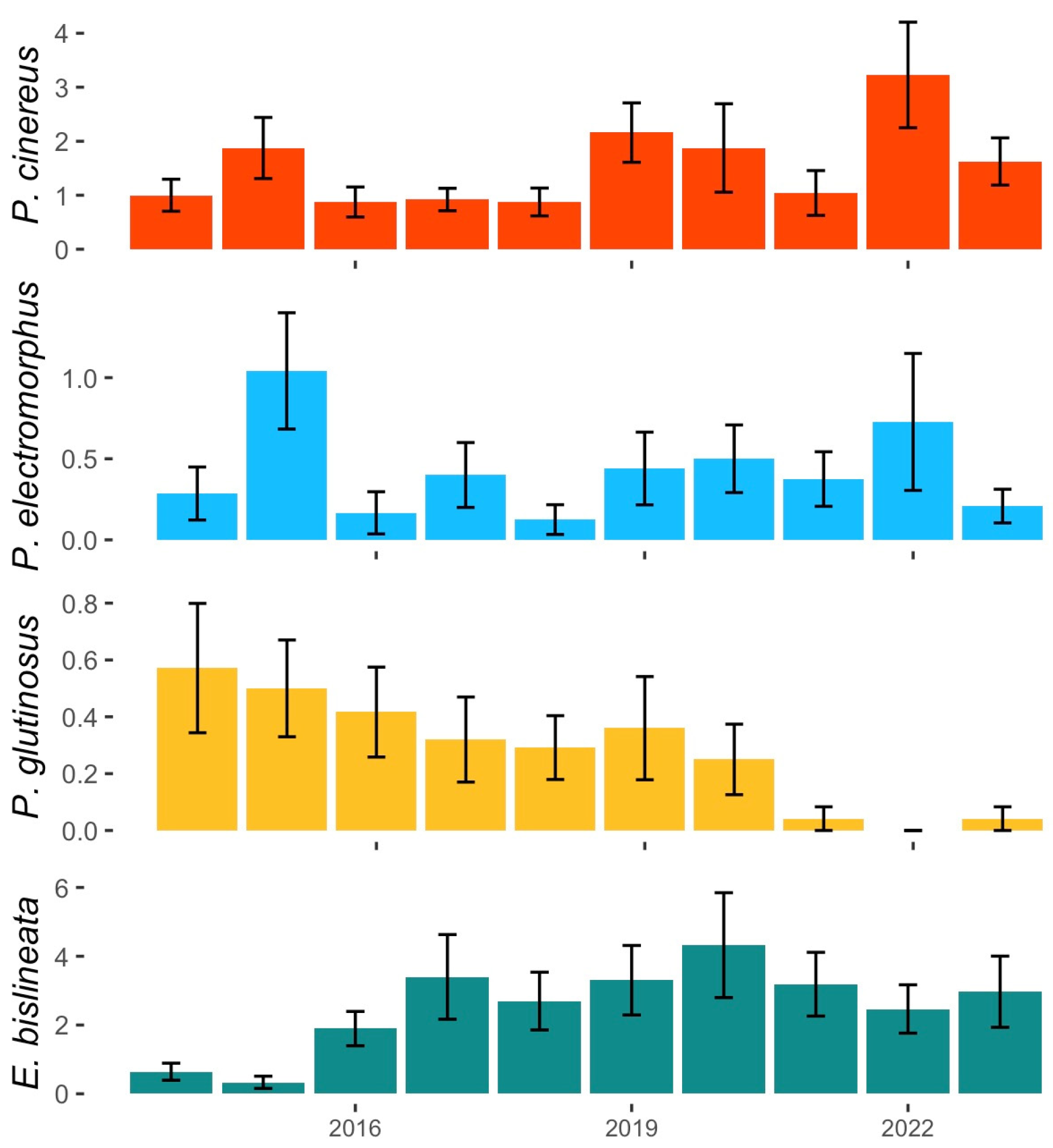
Abundance trends for P. cinereus, P. electromorphus, P. glutinosus and E. bislineata from the long-term monitoring plots at Wooster Memorial Park (2014–2023). For each year, the mean number of individuals encountered (all plots, all sampling events pooled) is shown ± SE. Linear regressions of pooled mean abundance versus time were non-significant for all species except P. glutinosus (T = −0.854, p < 0.001).
Figure 4.
Abundance trends for P. cinereus, P. electromorphus, P. glutinosus and E. bislineata from the long-term monitoring plots at Wooster Memorial Park (2014–2023). For each year, the mean number of individuals encountered (all plots, all sampling events pooled) is shown ± SE. Linear regressions of pooled mean abundance versus time were non-significant for all species except P. glutinosus (T = −0.854, p < 0.001).
Figure 5.
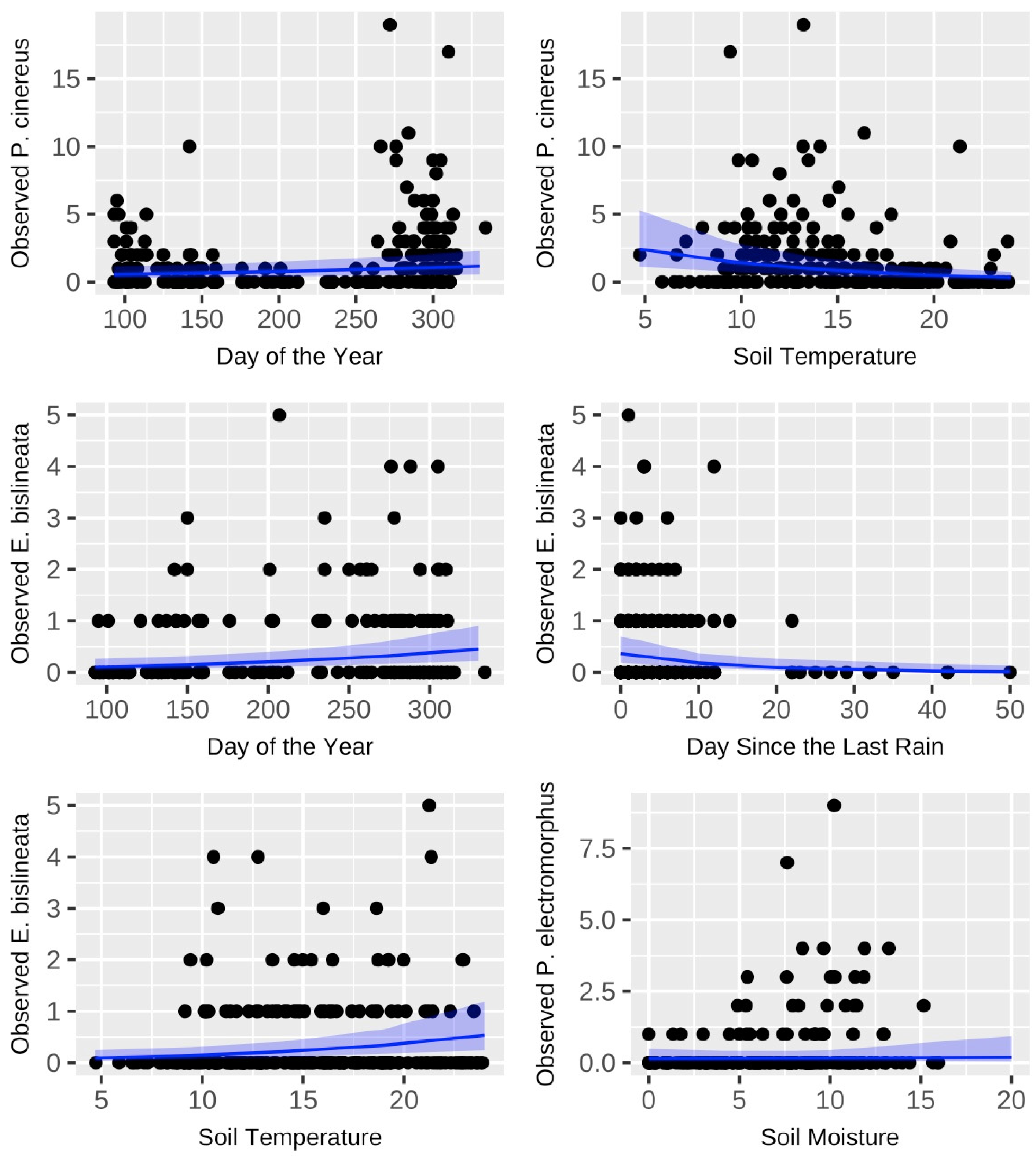
The effects ± 95% CI of each variable found to be significantly associated with salamander activity for each species examined. A generalized linear mixed model with negative binomial structure was used to determine whether there was a significant relationship between activity levels and the fixed effects: soil temperature, soil moisture, leaf litter depth, days since a soaking rain event and day of year. Black dots indicate counts for individual plot surveys. Blue shading indicates the 95% confidence interval for each depicted relationship. Statistical results can be found in
Table 4. Models were visualized using the “effects” and “ggplot2” packages in R.
Figure 5.
The effects ± 95% CI of each variable found to be significantly associated with salamander activity for each species examined. A generalized linear mixed model with negative binomial structure was used to determine whether there was a significant relationship between activity levels and the fixed effects: soil temperature, soil moisture, leaf litter depth, days since a soaking rain event and day of year. Black dots indicate counts for individual plot surveys. Blue shading indicates the 95% confidence interval for each depicted relationship. Statistical results can be found in
Table 4. Models were visualized using the “effects” and “ggplot2” packages in R.
Figure 6.
Number of individuals encountered per survey conducted (April–November) for P. cinereus, P. electromorphus, P. glutinosus and E. bislineata from the long-term monitoring plots at Wooster Memorial Park (2014–2023).
Figure 6.
Number of individuals encountered per survey conducted (April–November) for P. cinereus, P. electromorphus, P. glutinosus and E. bislineata from the long-term monitoring plots at Wooster Memorial Park (2014–2023).
Figure 7.
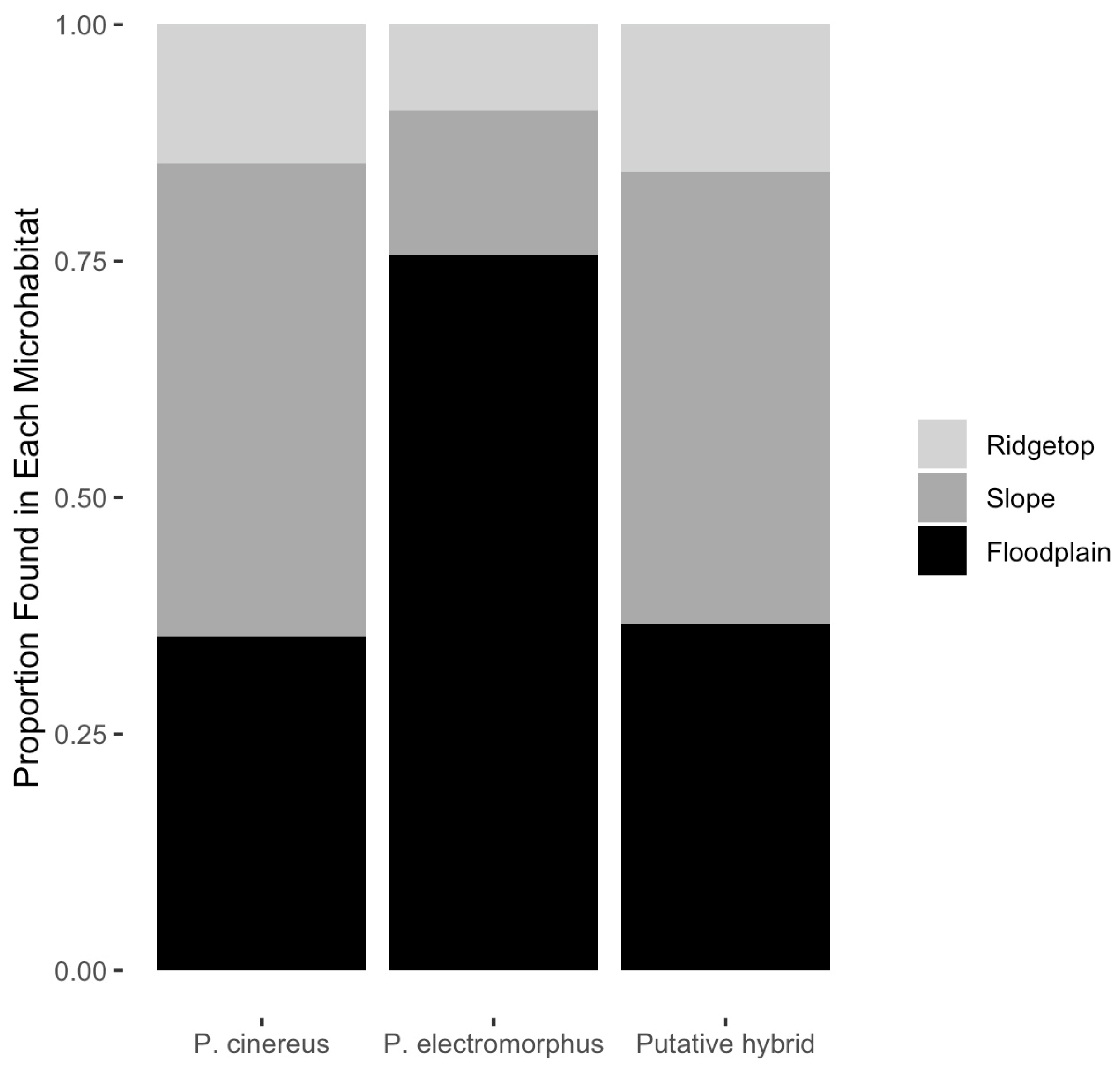
Mosaic plot of the relative frequency of salamander occurrence in the three sampled forest microhabitats (floodplain, slope and ridgetop, 2010–2023) at Wooster Memorial Park for P. cinereus (n = 808), P. electromorphus (n = 221) and their probable hybrids (n = 186). A X2 test for independence found that microhabitat preference was significantly different between P. cinereus and P. electromorphus (X2 = 117.1, df = 2, p < 0.001).
Figure 7.
Mosaic plot of the relative frequency of salamander occurrence in the three sampled forest microhabitats (floodplain, slope and ridgetop, 2010–2023) at Wooster Memorial Park for P. cinereus (n = 808), P. electromorphus (n = 221) and their probable hybrids (n = 186). A X2 test for independence found that microhabitat preference was significantly different between P. cinereus and P. electromorphus (X2 = 117.1, df = 2, p < 0.001).
Figure 8.
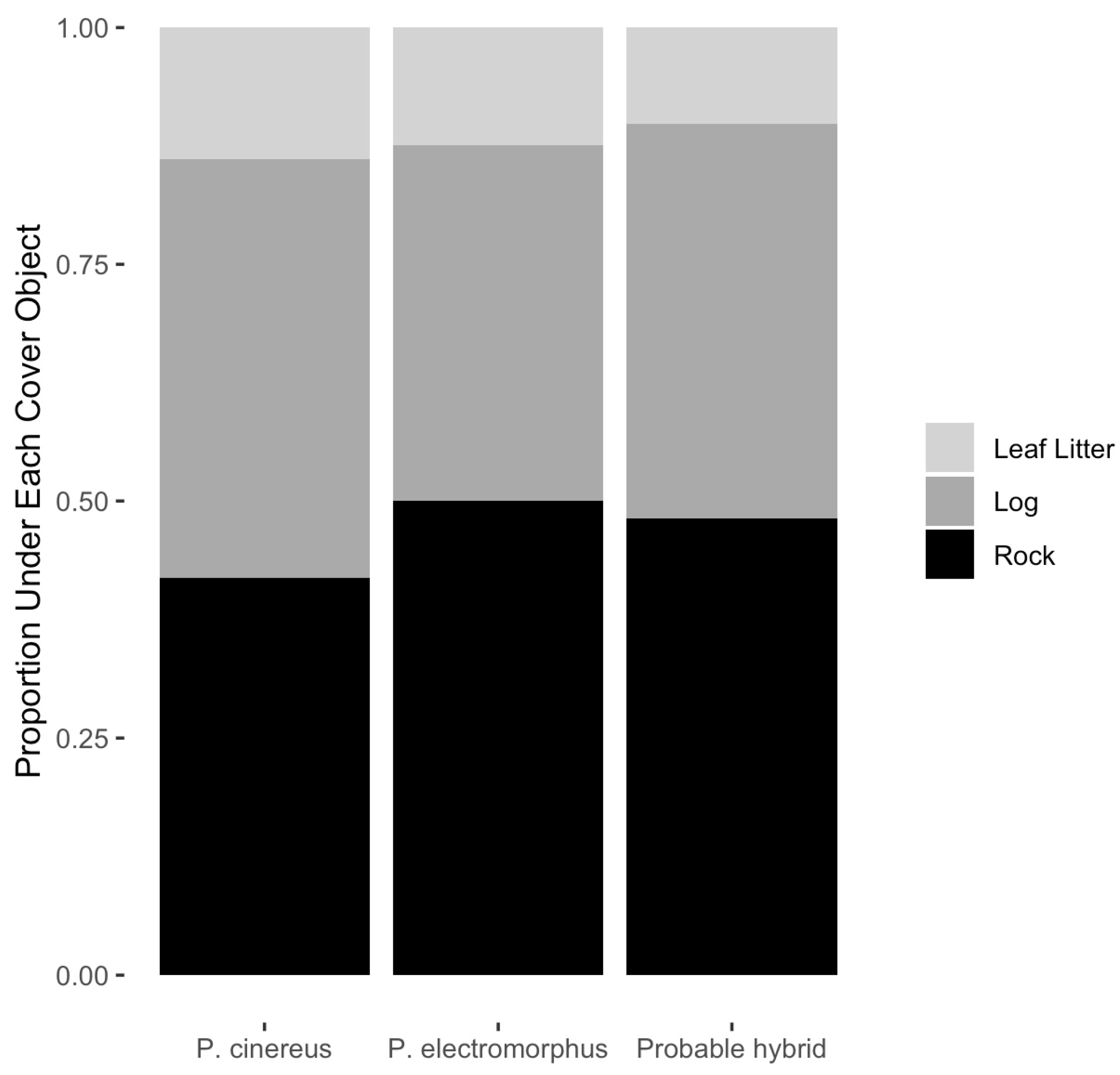
Mosaic plot of the relative frequency of salamander occurrence among cover object types (2010–2023) at Wooster Memorial Park for P. cinereus (n = 823), P. electromorphus (n = 282) and their probable hybrids (n = 245). While there was a trend for P. electromorphus to use more rock cover objects than P. cinereus, a X2 test for independence found that cover object preferences were not significantly different between these two species (X2 = 4.6, df = 2, p = 0.06).
Figure 8.
Mosaic plot of the relative frequency of salamander occurrence among cover object types (2010–2023) at Wooster Memorial Park for P. cinereus (n = 823), P. electromorphus (n = 282) and their probable hybrids (n = 245). While there was a trend for P. electromorphus to use more rock cover objects than P. cinereus, a X2 test for independence found that cover object preferences were not significantly different between these two species (X2 = 4.6, df = 2, p = 0.06).
Figure 9.
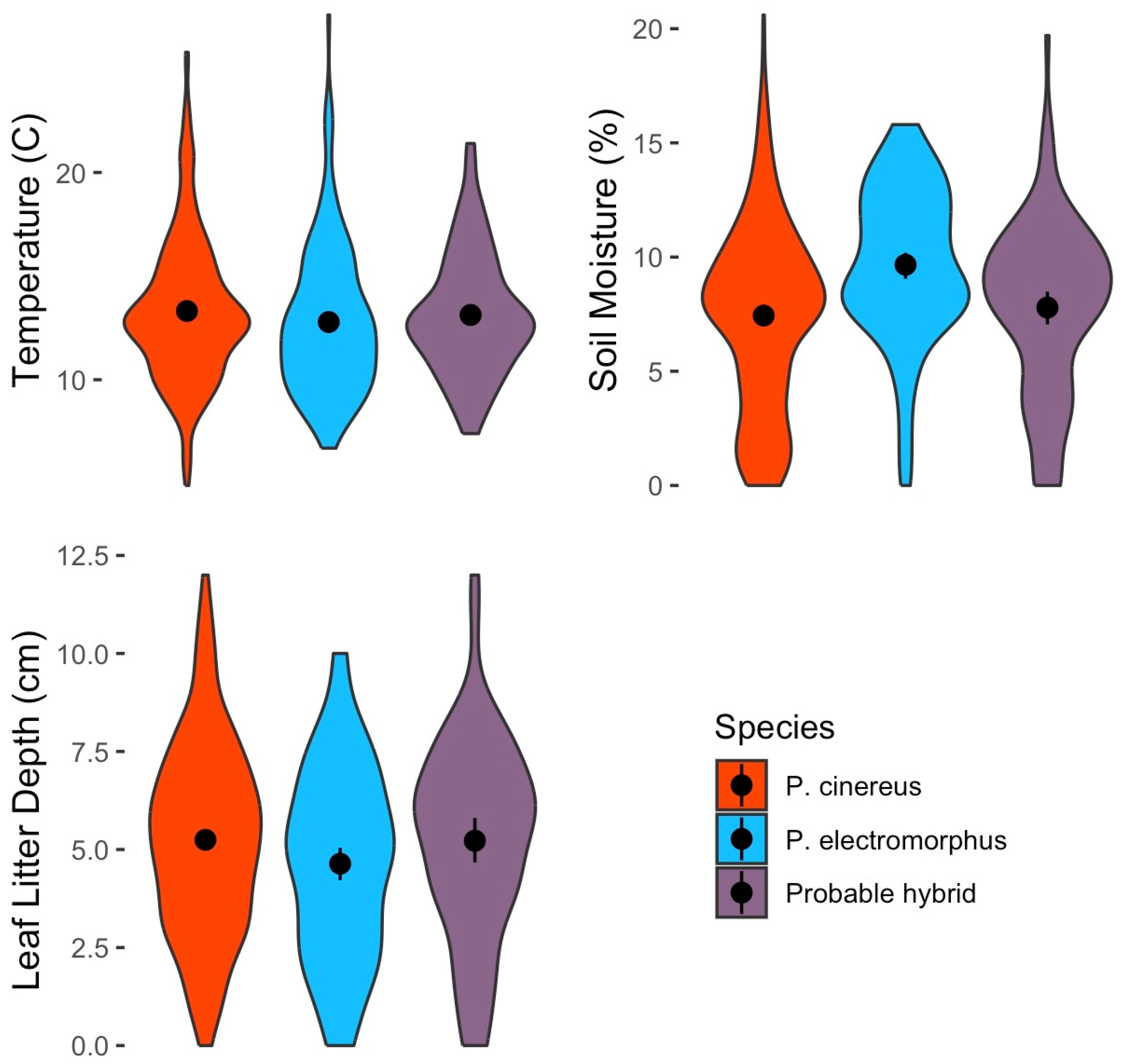
Violin plot comparing soil temperature (°C), soil moisture (%) and leaf litter depth (cm) at the capture point for P. cinereus (n = 416), P. electromorphus (n = 114) and their probable hybrids (n = 62). Means ± 95% C.I. are shown. There were no significant differences in soil surface temperature or leaf litter depth, but soil moisture was significantly greater for P. electromorphus (F = 8.53, p < 0.001).
Figure 9.
Violin plot comparing soil temperature (°C), soil moisture (%) and leaf litter depth (cm) at the capture point for P. cinereus (n = 416), P. electromorphus (n = 114) and their probable hybrids (n = 62). Means ± 95% C.I. are shown. There were no significant differences in soil surface temperature or leaf litter depth, but soil moisture was significantly greater for P. electromorphus (F = 8.53, p < 0.001).
Figure 10.
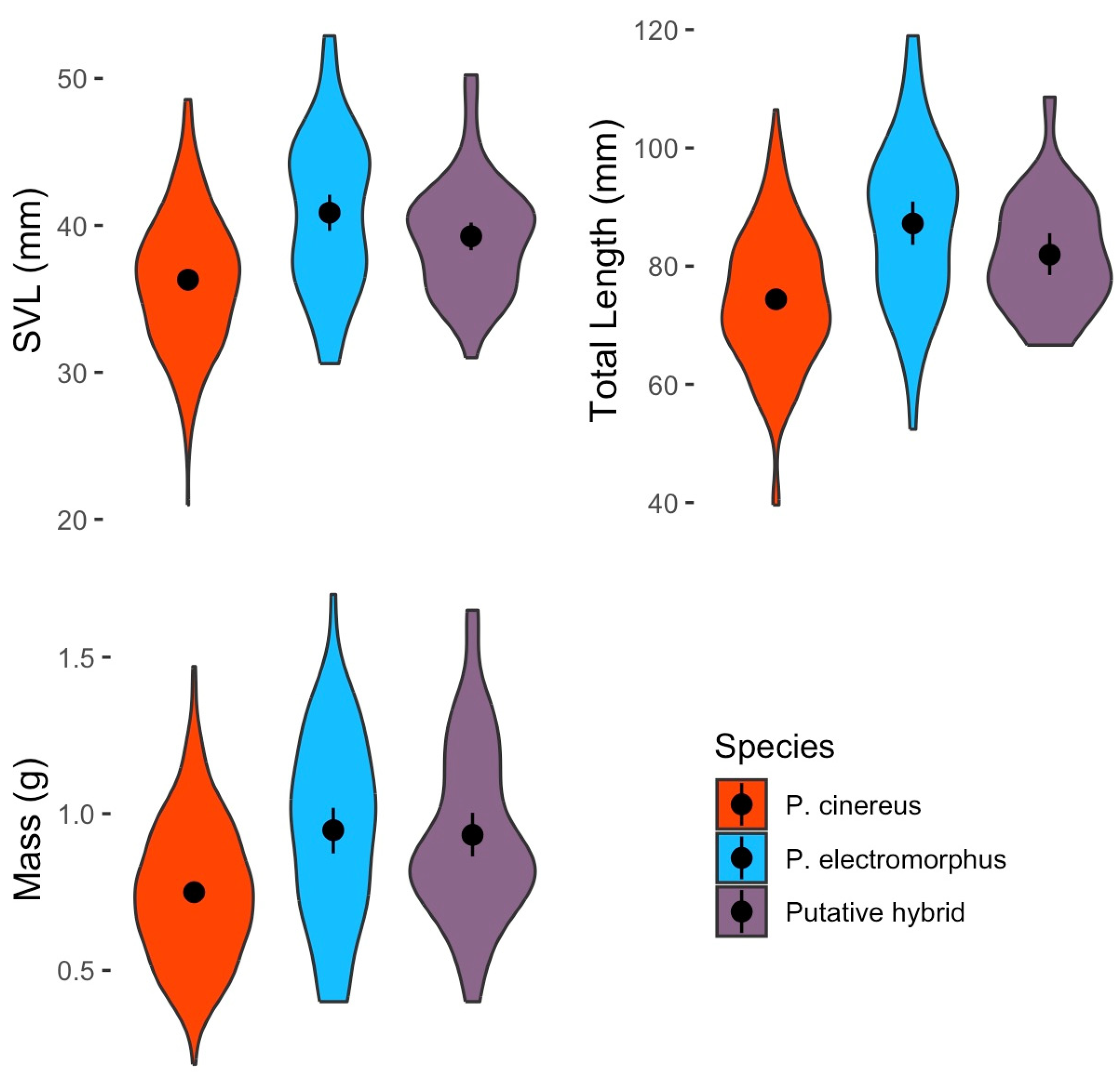
Violin plot comparing adult snout–vent length (SVL, mm), total length (TL, mm) and live body mass (g) for P. cinereus (n = 416), P. electromorphus (n = 108) and their probable hybrids (n = 62). Means ± 95% C.I. are shown. Individuals of P. cinereus were significantly smaller and of significantly lower body mass than individuals of P. electromorphus and probable hybrids (SVL: H = 41.2, df = 2, p < 0.001; TL: H = 40.3, df = 2, p < 0.001; live body mass: H = 33.1, df = 2, p < 0.001).
Figure 10.
Violin plot comparing adult snout–vent length (SVL, mm), total length (TL, mm) and live body mass (g) for P. cinereus (n = 416), P. electromorphus (n = 108) and their probable hybrids (n = 62). Means ± 95% C.I. are shown. Individuals of P. cinereus were significantly smaller and of significantly lower body mass than individuals of P. electromorphus and probable hybrids (SVL: H = 41.2, df = 2, p < 0.001; TL: H = 40.3, df = 2, p < 0.001; live body mass: H = 33.1, df = 2, p < 0.001).
Figure 11.
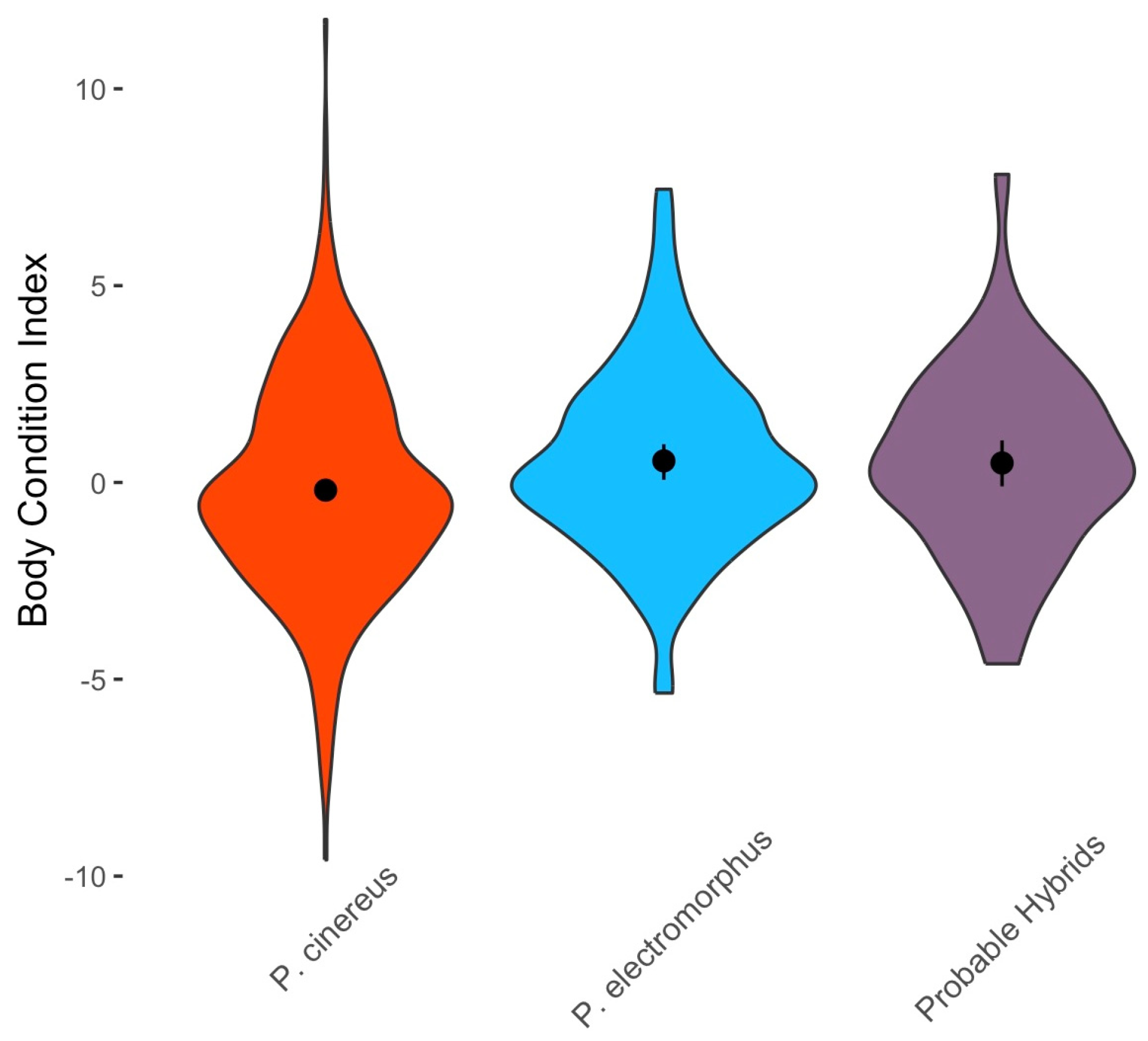
Violin plot comparing body condition index for P. cinereus (n = 289), P. electromorphus (n = 63) and their probable hybrids (n = 52). Body condition index represents the residuals from a linear regression of body mass and SVL. Means ± 95% C.I. are shown. No significant differences in body condition were found among P. cinereus, P. electromorphus and probable hybrids (F = 2.76, df = 2, p = 0.065).
Figure 11.
Violin plot comparing body condition index for P. cinereus (n = 289), P. electromorphus (n = 63) and their probable hybrids (n = 52). Body condition index represents the residuals from a linear regression of body mass and SVL. Means ± 95% C.I. are shown. No significant differences in body condition were found among P. cinereus, P. electromorphus and probable hybrids (F = 2.76, df = 2, p = 0.065).
Figure 12.
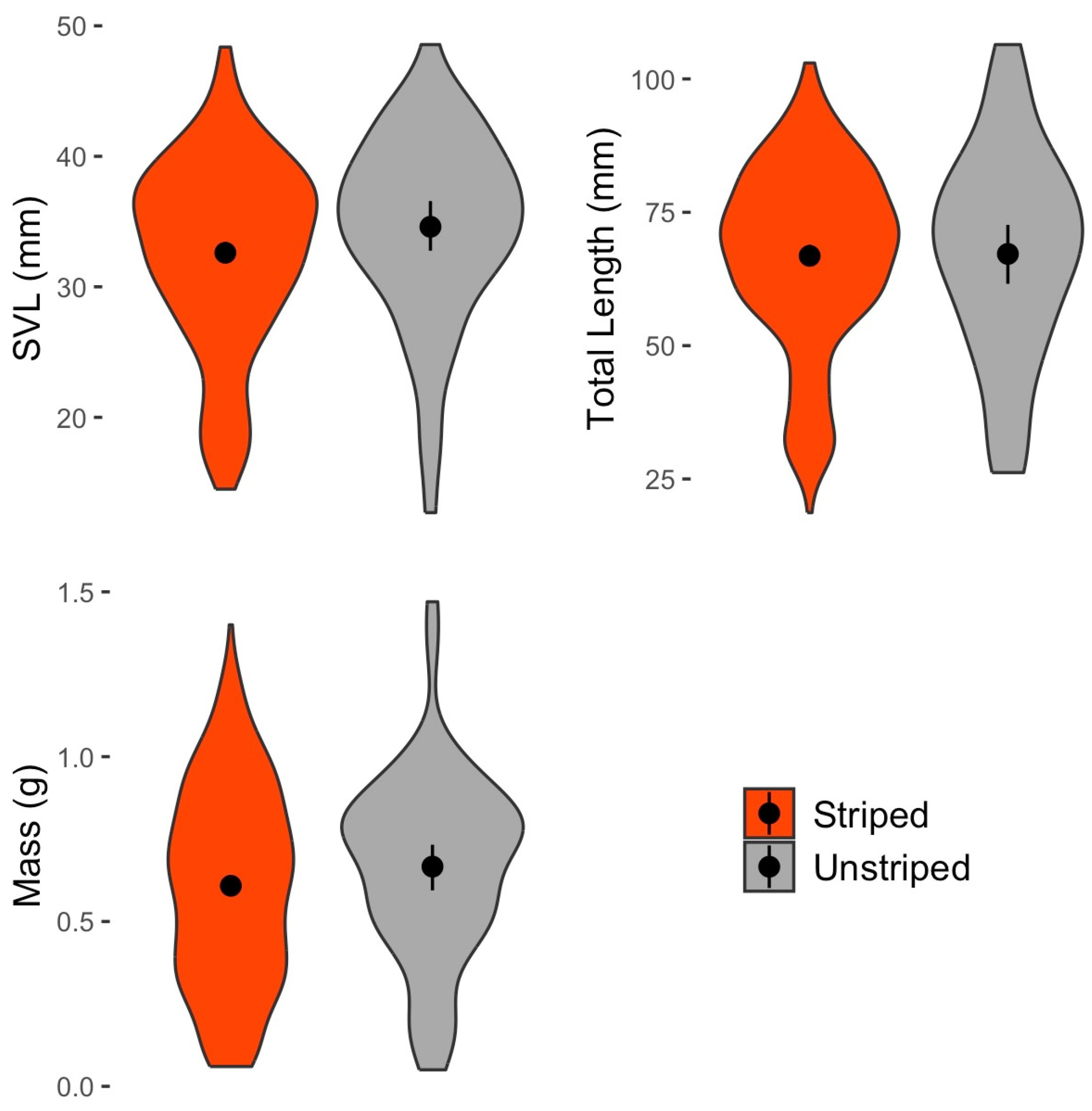
Violin plot comparing snout–vent length (SVL, mm), total length (TL, mm) and body mass (g) for the striped (n = 342) and unstriped (n = 59) color morphs of P. cinereus. Means ± 95% C.I. are shown. There were no statistically significant differences in SVL (p = 0.043, not significant after Bonferroni correction), TL (p = 0.996) or live body mass (p = 0.160).
Figure 12.
Violin plot comparing snout–vent length (SVL, mm), total length (TL, mm) and body mass (g) for the striped (n = 342) and unstriped (n = 59) color morphs of P. cinereus. Means ± 95% C.I. are shown. There were no statistically significant differences in SVL (p = 0.043, not significant after Bonferroni correction), TL (p = 0.996) or live body mass (p = 0.160).
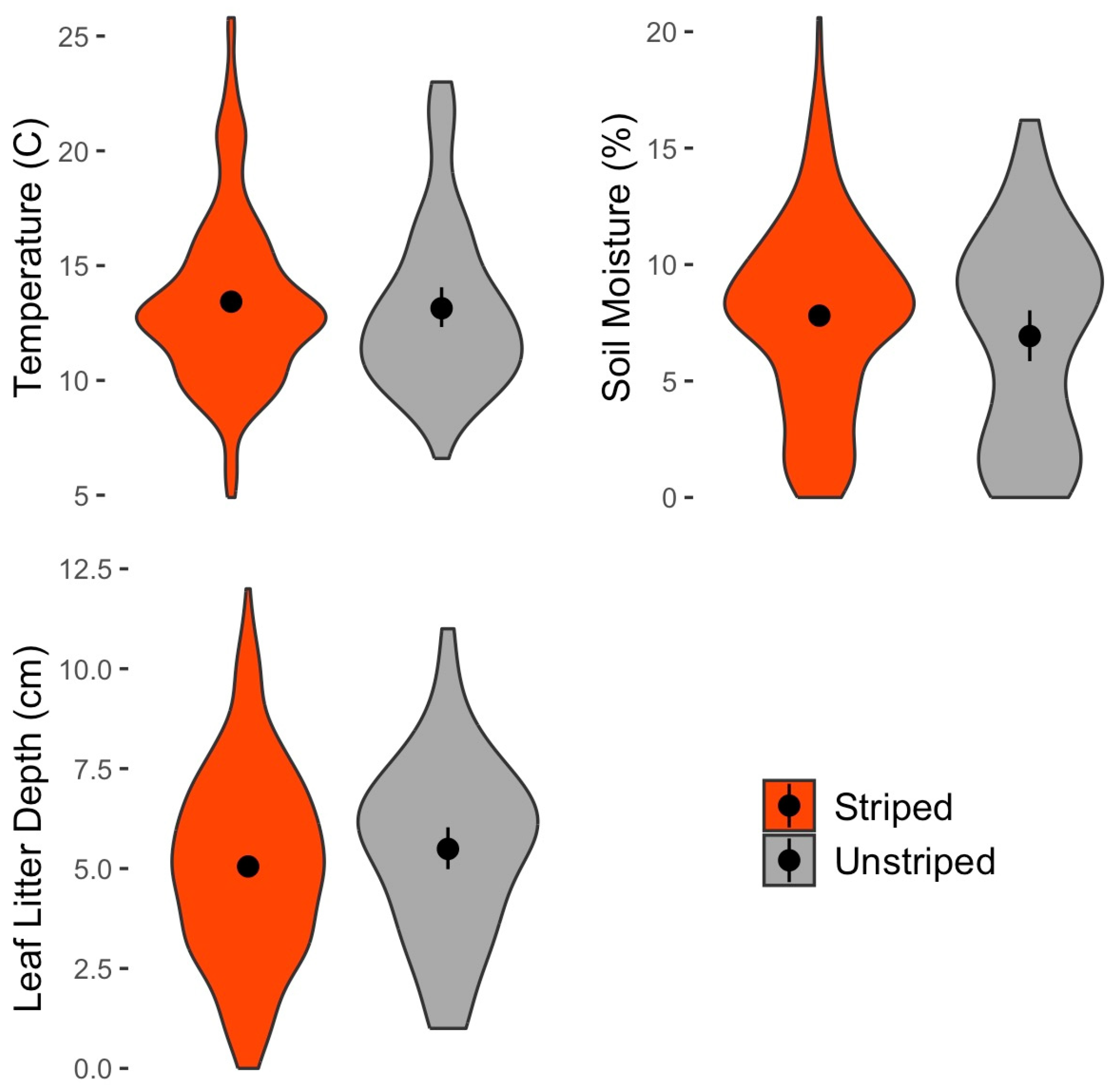
Figure 13.
Violin plot comparing soil surface temperature (°C), soil moisture (%) and leaf litter depth (cm) at the capture point for the striped (n = 410) and unstriped (n = 70) color morphs of P. cinereus. Means ± 95% C.I. are shown. Soil temperature (U = 11,594, n = 447, p = 0.312), soil moisture (U = 9593, n = 415, p = 0.287) and leaf litter depth (U = 9143, n = 403, p = 0.121) were all not significantly different between the color morphs.
Figure 13.
Violin plot comparing soil surface temperature (°C), soil moisture (%) and leaf litter depth (cm) at the capture point for the striped (n = 410) and unstriped (n = 70) color morphs of P. cinereus. Means ± 95% C.I. are shown. Soil temperature (U = 11,594, n = 447, p = 0.312), soil moisture (U = 9593, n = 415, p = 0.287) and leaf litter depth (U = 9143, n = 403, p = 0.121) were all not significantly different between the color morphs.
Table 1.
Latitude and longitude coordinates of the center of each long-term monitoring plot at WMP.
Table 1.
Latitude and longitude coordinates of the center of each long-term monitoring plot at WMP.
| Plot | Latitude | Longitude |
|---|
| Floodplain 1 | 40°49′06.467″ N | 82°01′48.366″ W |
| Floodplain 2 | 40°48′57.661″ N | 82°01′25.737″ W |
| Floodplain 3 | 40°48′56.980″ N | 82°01′12.327″ W |
| Floodplain 4 | 40°49′02.521″ N | 82°01′45.310″ W |
| Ridgetop 1 | 40°48′46.439″ N | 82°01′25.672″ W |
| Ridgetop 2 | 40°49′00.984″ N | 82°01′58.350″ W |
| Ridgetop 3 | 40°48′49.892″ N | 82°01′37.826″ W |
| Ridgetop 4 | 40°49′07.089″ N | 82°01′57.093″ W |
| Slope 1 | 40°48′45.644″ N | 82°01′21.222″ W |
| Slope 2 | 40°48′52.992″ N | 82°01′25.834″ W |
| Slope 3 | 40°48′56.671″ N | 82°01′07.050″ W |
| Slope 4 | 40°48′48.995″ N | 82°01′43.470″ W |
Table 2.
List of species of amphibians and reptiles encountered during fieldwork at Wooster Memorial Park and their pooled detections in long-term monitoring plots (2014–2023). 0 * indicates species detected outside of formal plot searches.
Table 2.
List of species of amphibians and reptiles encountered during fieldwork at Wooster Memorial Park and their pooled detections in long-term monitoring plots (2014–2023). 0 * indicates species detected outside of formal plot searches.
| Plethodon cinereus | 358 |
| Plethodon electromorphus | 99 |
| probable P. cinereus × P. electromorphus hybrid | 49 |
| Plethodon glutinosus | 62 |
| Eurycea bislineata | 95 |
| Eurycea longicauda | 6 |
| Desmognathus fuscus | 0 * |
| Notopthalmus viridescens | 9 |
| Hemidactylium scutatum | 1 |
| Ambystoma texanum | 0 * |
| Anaxyrus americanus | 27 |
| Pseudacris crucifer | 6 |
| Lithobates sylvaticus | 16 |
| Lithobates clamitans | 0 * |
| Lithobates palustris | 0 * |
| Diadophis punctatus | 9 |
| Pantherophis spiloides | 2 |
| Lampropeltis triangulum | 0 * |
Table 3.
Mean abundances (± 1 SE) for each salamander species detected in the long-term monitoring plots (100 m
2) at WMP (2014–2023). For
P. cinereus,
P. electromorphus, probable hybrids,
P. glutinosus and
E. bislineata, abundances were estimated from the final GLMM (see
Table 4). For all microhabitats pooled and for all other species, the raw abundances are reported.
Table 3.
Mean abundances (± 1 SE) for each salamander species detected in the long-term monitoring plots (100 m
2) at WMP (2014–2023). For
P. cinereus,
P. electromorphus, probable hybrids,
P. glutinosus and
E. bislineata, abundances were estimated from the final GLMM (see
Table 4). For all microhabitats pooled and for all other species, the raw abundances are reported.
| Species | Floodplain Microhabitat | Slope Microhabitat | Ridgetop Microhabitat | All Microhabitats |
|---|
| P. cinereus | 1.54 (0.12) | 2.70 (0.19) | 0.23 (0.02) | 1.6 (0.17) |
| P. electromorphus | 1.29 (0.19) | 0.46 (0.06) | 0.53 (0.04) | 0.43 (0.07) |
| probable hybrids | 0.22 (0.16) | 0.36 (0.09) | 0.05 (0.03) | 0.21 (0.04) |
| P. glutinosus | 0.19 (0.02) | 0.55 (0.05) | 0.07 (0.01) | 0.27 (0.04) |
| E. bislineata | 0.30 (0.08) | 0.75 (0.12) | 0.19 (0.06) | 0.41 (0.05) |
| E. longicauda | 0.06 (0.03) | 0.01 (0.01) | - | 0.03 (0.01) |
| N. viridescens | 0.04 (0.02) | 0.01 (0.01) | 0.07 (0.03) | 0.04 (0.01) |
| H. scutatum | 0.01 (0.01) | - | - | 0.004 (0.004) |
Table 4.
Results of generalized linear mixed models with negative binomial structure examining activity levels and abundance patterns for P. cinereus, P. electromorphus, P. glutinosus and E. bislineata at Wooster Memorial Park, 2014–2023. Fixed effects included in activity models were day of year (Julian Day), days since a soaking rain, soil temperature, soil moisture, leaf litter depth and year. We included plot identity as a random effect. The abundance models examined habitat type, earthworm abundance and year as fixed effects, and random effects included plot identity and any significant activity factors for that species. Statistically significant variables are noted in bold.
Table 4.
Results of generalized linear mixed models with negative binomial structure examining activity levels and abundance patterns for P. cinereus, P. electromorphus, P. glutinosus and E. bislineata at Wooster Memorial Park, 2014–2023. Fixed effects included in activity models were day of year (Julian Day), days since a soaking rain, soil temperature, soil moisture, leaf litter depth and year. We included plot identity as a random effect. The abundance models examined habitat type, earthworm abundance and year as fixed effects, and random effects included plot identity and any significant activity factors for that species. Statistically significant variables are noted in bold.
| | | P. cinereus | | P. electromorphus | P. glutinosus | E. bislineata | |
| Surface Activity Models | Parameter | Coefficient | p-Value | Coefficient | p-Value | Coefficient | p-Value | Coefficient | p-Value |
| | day of year | 0.003 | 0.018 | −0.003 | 0.158 | 0.002 | 0.173 | 0.005 | 0.009 |
| | days since rain | 0.009 | 0.542 | −0.017 | 0.43 | 0.24 | 0.087 | −0.06 | 0.021 |
| | soil temperature | −0.106 | <0.001 | −0.045 | 0.22 | 0.047 | 0.144 | 0.071 | 0.041 |
| | soil moisture | 0.051 | 0.276 | 0.101 | 0.008 | 0.002 | 0.952 | −0.003 | 0.948 |
| | leaf litter depth | 0.089 | 0.166 | 0.073 | 0.375 | −0.041 | 0.572 | 0.005 | 0.942 |
| | year | varies | 0.203 | varies | 0.793 | varies | 0.427 | varies | 0.083 |
| Abundance Models | habitat type | varies | <0.001 | varies | <0.001 | varies | 0.005 | varies | 0.013 |
| | earthworms | 0.009 | 0.579 | −0.048 | 0.014 | −0.002 | 0.903 | −0.017 | 0.274 |
| | year | varies | 0.049 | varies | 0.108 | varies | 0.42 | varies | 0.073 |
Table 5.
Pooled number of detections of P. cinereus, P. electromorphus and probable hybrids in plot searches in three forest microhabitat types at Wooster Memorial Park, 2010–2023. Includes data from both 10 × 25 m plots (2010–2015) and 10 × 10 m plots (2014–2023).
Table 5.
Pooled number of detections of P. cinereus, P. electromorphus and probable hybrids in plot searches in three forest microhabitat types at Wooster Memorial Park, 2010–2023. Includes data from both 10 × 25 m plots (2010–2015) and 10 × 10 m plots (2014–2023).
| | Floodplain | Slope | Ridgetop | Total |
|---|
| P. cinereus | 285 | 404 | 119 | 808 |
| P. electromorphus | 167 | 34 | 20 | 221 |
| probable hybrid | 68 | 89 | 29 | 186 |
Table 6.
Pooled number of detections of P. cinereus, P. electromorphus and possible hybrids in plot searches under three cover object types at Wooster Memorial Park, 2010–2023. Includes data from both 10 × 25 m plots (2010–2015) and 10 × 10 m plots (2014–2023).
Table 6.
Pooled number of detections of P. cinereus, P. electromorphus and possible hybrids in plot searches under three cover object types at Wooster Memorial Park, 2010–2023. Includes data from both 10 × 25 m plots (2010–2015) and 10 × 10 m plots (2014–2023).
| | Rock | Log | Leaf Litter | Total |
|---|
| P. cinereus | 345 | 364 | 114 | 823 |
| P. electromorphus | 141 | 106 | 35 | 282 |
| probable hybrid | 118 | 102 | 25 | 245 |
Table 7.
Distribution of P. cinereus and P. electromorphus hatchlings among forest microhabitat types in the long-term monitoring plots at WMP (2014–2023). Hybrids could not be assigned at very small body sizes and are not represented here.
Table 7.
Distribution of P. cinereus and P. electromorphus hatchlings among forest microhabitat types in the long-term monitoring plots at WMP (2014–2023). Hybrids could not be assigned at very small body sizes and are not represented here.
| Species | Floodplain | Slope | Ridgetop | Total |
|---|
| P. cinereus | 19 | 18 | 1 | 41 |
| P. electromorphus | 11 | 4 | 2 | 20 |
Table 8.
Mean snout–vent length (SVL), total length (TL) and body mass (g, ± 1 SE) of P. cinereus, P. electromorphus and their probable hybrids in the long-term monitoring plots at WMP (2014–2023). “Both” includes adult males and females as well as adult-sized individuals that were not assignable to sex in the field.
Table 8.
Mean snout–vent length (SVL), total length (TL) and body mass (g, ± 1 SE) of P. cinereus, P. electromorphus and their probable hybrids in the long-term monitoring plots at WMP (2014–2023). “Both” includes adult males and females as well as adult-sized individuals that were not assignable to sex in the field.
| Species | Life Stage | Sex | N | Mean TL (mm) | Mean SVL (mm) | Mean Live Body Mass (g) |
|---|
| Plethodon cinereus | Adult | both | 302 | 74.2 (0.8) | 36.1 (0.26) | 0.75 (0.01) |
| | Adult | female | 44 | 74.7 (1.8) | 36.5 (0.71) | 0.78 (0.03) |
| | Adult | male | 193 | 74.2 (0.8) | 36.7 (0.33) | 0.75 (0.02) |
| | Juvenile | - | 73 | 51.5 (1.3) | 26.5 (0.44) | 0.31 (0.01) |
| | Hatchling | - | 38 | 32.9 (1.3) | 18.6 (0.51) | 0.12 (0.01) |
| Plethodon electromorphus | Adult | both | 71 | 87.3 (1.9) | 40.2 (0.7) | 0.93 (0.04) |
| | Adult | female | 42 | 86.6 (2.6) | 39.4 (0.9) | 0.91 (0.06) |
| | Adult | male | 29 | 88.0 (2.8) | 41.4 (1.1) | 0.95 (0.05) |
| | Juvenile | - | 19 | 52.2 (2.7) | 27.2 (1.0) | 0.32 (0.04) |
| | Hatchling | - | 17 | 35.9 (1.5) | 18.9 (0.9) | 0.12 (0.02) |
| Probable hybrids | Adult | both | 60 | 81.9 (1.8) | 39.2 (0.5) | 0.92 (0.04) |
| | Adult | female | 21 | 86.8 (8.7) | 39.1 (1.0) | 0.98 (0.08) |
| | Adult | male | 39 | 81.1 (1.6) | 39.2 (0.6) | 0.90 (0.04) |
| | Juvenile | - | - | - | - | - |
| | Hatchling | - | - | - | - | - |
Table 9.
Frequency of the striped and unstriped color morphs of P. cinereus at WMP by year. 95% confidence intervals were estimated with the binomial exact calculation.
Table 9.
Frequency of the striped and unstriped color morphs of P. cinereus at WMP by year. 95% confidence intervals were estimated with the binomial exact calculation.
| Year | Striped | Unstriped | Total | % Striped | 95% C.I. |
|---|
| 2014 | 36 | 4 | 40 | 0.900 | 0.763–0.972 |
| 2015 | 44 | 7 | 51 | 0.863 | 0.737–0.943 |
| 2016 | 35 | 7 | 42 | 0.833 | 0.686–0.930 |
| 2017 | 11 | 1 | 12 | 0.917 | 0.615–0.998 |
| 2018 | 17 | 5 | 22 | 0.773 | 0.546–0.922 |
| 2019 | 38 | 9 | 47 | 0.809 | 0.667–0.909 |
| 2020 | 48 | 7 | 55 | 0.873 | 0.755–0.947 |
| 2021 | 42 | 12 | 54 | 0.778 | 0.644–0.880 |
| 2022 | 81 | 10 | 91 | 0.890 | 0.807–0.946 |
| 2023 | 61 | 9 | 70 | 0.871 | 0.770–0.939 |
| all years | 413 | 71 | 484 | 0.853 | 0.819–0.884 |
Table 10.
Field observations of mated pairs of P. cinereus, P. electromorphus and probable hybrids at Wooster Memorial Park (2014–2023).
Table 10.
Field observations of mated pairs of P. cinereus, P. electromorphus and probable hybrids at Wooster Memorial Park (2014–2023).
| Combination | Number of Pairs |
|---|
| cinereus-cinereus | 10 |
| electromorphus-electromorphus | 2 |
| electromorphus-cinereus | 5 |
| hybrid-hybrid | 3 |
| male cinereus-female hybrid | 3 |
| female cinereus-male hybrid | 4 |
| male electromorphus-female hybrid | 2 |
| Total | 29 |
Table 11.
List of known field-based continuous long-term population monitoring studies of plethodontid salamanders with species, locations, sampling methodologies, citations and length of time series (5-year minimum).
Table 11.
List of known field-based continuous long-term population monitoring studies of plethodontid salamanders with species, locations, sampling methodologies, citations and length of time series (5-year minimum).
| Study Species | Location | Length of Time Series (Years) | Sampling Methodologies | Research Focus | Citations |
|---|
| Aneides hardii | New Mexico, USA | 9 (1986–1996) | visual encounter searches | logging impact assessment | [83] |
| Aneides lugubris | California, USA | 5 (2006–2010) | capture-mark-recapture | growth, age at maturity, survival | [84] |
| Desmognathus aeneus | North Carolina, USA | 19 (1972–1990) | visual encounter searches | temporal trend analysis | [85] |
| Desmognathus fuscus complex | North Carolina and Tennessee, USA | 6 (1993–1995 and 1998–2000) | visual encounter searches | abundance estimation | [86] |
| Desmognathus monticola | North Carolina, USA | 19 (1972–1990) | visual encounter searches | temporal trend analysis | [85] |
| Desmognathus ochrophaeus | North Carolina, USA | 7 (1970–1976) | removal sampling, capture-mark-recapture | growth, survival and life history | [87] |
| Desmognathus ochrophaeus | North Carolina, USA | 19 (1972–1990) | visual encounter searches | temporal trend analysis | [85] |
| Desmognathus ochrophaeus complex | North Carolina and Tennessee, USA | 6 (1993–1995 and 1998–2000) | visual encounter searches | abundance estimation | [86] |
| Desmognathus quadramaculatus | North Carolina and Tennessee, USA | 6 (1993–1995 and 1998–2000) | visual encounter searches | abundance estimation | [86] |
| Desmognathus quadramaculatus | North Carolina, USA | 19 (1972–1990) | visual encounter searches | temporal trend analysis | [85] |
| Desmognathus wrightii | North Carolina and Tennessee, USA | 6 (1993–1995 and 1998–2000) | visual encounter searches | abundance estimation | [86] |
| Ensatina eschscholtzi | California, USA | 5 (1947–1951) | visual encounter searches | longevity, movement, phenology, growth | [81] |
| Eurycea bislineata | Ohio, USA | 10 (2014–2023) | visual encounter searches | temporal trend analysis | this study |
| Eurycea quadridigitata | South Carolina, USA | 16 (1979–1994) | drift fence with pitfall traps | temporal trend analysis | [13] |
| Eurycea wilderae | North Carolina and Tennessee, USA | 6 (1993–1995 and 1998–2000) | visual encounter searches | abundance estimation | [86] |
| Gyrinophilus porphyriticus | New Hampshire, USA | 20 (1999–2018) | visual encounter searches | variation in abundance and survival | [88,89] |
| Plethodon cinereus | 18 locations across the range | 7 (2013–2019) | spatial capture-recapture | density estimation | [28] |
| Plethodon cinereus | Ohio, USA | 6 (2003–2008) | artificial cover boards | food web dynamics | [90] |
| Plethodon cinereus | Ohio, USA | 10 (2014–2023) | visual encounter searches | temporal trend analysis | this study |
| Plethodon cinereus | Ontario, Canada | 18 (1999–2016) | artificial cover boards | temporal trend analysis | [91] |
| Plethodon cinereus | Virginia, USA | 14 (1966–1979) | visual encounter searches | interspecific competition | [92] |
| Plethodon cinereus | Virginia, USA | 17 (2005, 2008–2023) | visual encounter searches | longevity estimation | [93] |
| Plethodon electromorphus | Ohio, USA | 10 (2014–2023) | visual encounter searches | temporal trend analysis | this study |
| Plethodon glutinosus | Ohio, USA | 10 (2014–2023) | visual encounter searches | temporal trend analysis | this study |
| Plethodon hubrichti | Virginia, USA | 17 (2005, 2008–2023) | visual encounter searches | longevity estimation | [93] |
| Plethodon jordani | North Carolina, USA | 9 (1973–1981) | removal sampling | growth, age at maturity, survival | [94] |
| Plethodon jordani | North Carolina, USA | 15 (1976–1990) | visual encounter searches | temporal trend analysis | [85] |
| Plethodon shenandoah | Virginia, USA | 14 (1966–1979) | visual encounter searches | interspecific competition | [92] |
| Plethodon shermani | North Carolina, USA | 6 (2009–2014) | capture-mark-recapture | climate change impacts | [95] |
| Plethodon shermani/P. teyahalee | North Carolina, USA | 8 (2010–2017) | capture-mark-recapture | survival and fecundity | [96] |
| Plethodon shermani/P. teyahalee | North Carolina, USA | 17 (1974–1990) | visual encounter searches | hybrid zone dynamics | [62] |
| Plethodon shermani/P. teyahalee | North Carolina, USA | 15 (1976–1990) | visual encounter searches | temporal trend analysis | [85] |
| Speleomantes strinatii | Italy | 29 (1996–2024) | removal sampling | demography, climate change impacts | [82,97,98] |
| Speleomantes strinatii | Italy | 13 (1993–2005) | removal sampling | population regulation | [99] |