1. Introduction
Degradation of ice coverage currently observed in high latitudes due to global warming causes a deterioration of habitats, usable by fast-ice-dependant marine mammals. In this connection population-specific adaptations to variable sea ice regimes remain an important topic in marine mammal behavioral ecology. Certain populations of pagophilic marine mammals, whose centers of reproduction occur in lower latitudes, can represent a particular scientific interest, as their adaptations develop historically under least-stressful conditions. One such population—a rare non-fast ice breeding colony of spotted seal (Phoca largha Pallas, 1811)—exists in Peter the Great Bay (hereinafter: PGB), in the northwest of the East Sea/Sea of Japan (hereinafter: ES/SJ). This population can serve as a natural study system for exploration of life history divergence.
The spotted seal is an abundant species of Phocid seals (
Phocidae Gray, 1825) that inhabits near-shore waters in the Northern Pacific Ocean and the Pacific sector of the Arctic [
1]. Eight isolated reproductive centers of spotted seals are recognized within its range: three in the Bering Sea, two in the Okhotsk Sea (hereinafter OS), two in the ES/SJ, and one in the Yellow Sea [
2,
3]. Throughout most of its range, the spotted seal leads a pagophilic way of life, breeding and nursing its offspring on floating ice. However, the population inhabiting Peter the Great Bay routinely experiences limited, short-lived ice cover within the bay. Consequently, the PGB population of spotted seals is compelled to breed at the coastal rookery of the Rimsky-Korsakov Archipelago (RKA) [
3]. Currently, the archipelago is protected within the conservation area of the Far Eastern Marine Reserve. The PGB spotted seals can be distinguished from spotted seals of other populations by their larger body size, distinctive coloration of the newborn pelt, and several meristic characteristics [
3,
4]. The spotted seal population of PGB is the southernmost and least abundant in Russia. In the 1970s, it was assessed at just several hundred individuals [
4], but over the past half century, it has grown to approximately 4000 individuals [
5]. This increase has been attributed to protective measures applied by the Far Eastern Marine Reserve at the rookery of local spotted seals. The breeding season of the spotted seal in PGB is independent of ice conditions and is markedly prolonged, spanning from January to April [
3,
6]. At the end of spring and in early summer, once breeding and molting are complete, spotted seals leave PGB en masse and travel to summer–autumn feeding grounds in the north of the ES/SJ and the south of the OS [
3,
7]. Some spotted seals also travel southward along the Korean Peninsula. During the summer–autumn period, a portion of the population remains in PGB [
8]. Nesterenko and Katin [
8] estimated the number of spotted seals remaining in PGB during the summer at 450–500 individuals, which at that time accounted for 20% of the population. This remaining portion of the population has been termed “resident,” in contrast to the “migrating” seals that leave PGB [
8]. It has been speculated that genetic isolation may exist between these groups [
9]. Adult spotted seals tend to return to the same islands within RKA, and several individually recognizable (marked) seals have remained at the rookery across consecutive summer seasons [
8]. The migratory routes and spatial characteristics of migrating spotted seals from PGB are strongly understudied.
The reasons for the co-occurrence of two opposite life history tactics within the PGB population of spotted seals are unclear. It is plausible to assume that juvenile spotted seals (<3 years old) can develop their migratory behavior in early stages of life, which makes them a particularly valuable subject for research of life history tactics. The migratory behavior of juvenile spotted seals warrants particular attention, as this group is the most vulnerable and least experienced in the local population. To date, only three juvenile seals from PGB have been tagged with satellite tags, and all undertook long foraging migrations [
7]. The spatial characteristics of seals remaining in PGB during the summer–autumn season have not previously been assessed.
The primary aim of this research is to study the migratory behavior of juvenile spotted seals from the population of PGB. The objectives were to describe the utilization of space by juvenile spotted seals year-round; to confirm the emergence of different migratory tactics in juvenile spotted seals during the warm season; and to characterize these tactics by their spatial and speed-related properties.
2. Materials and Methods
To assess the spatial characteristics of spotted seals from the PGB population, satellite tags were deployed on nine spotted seals between 2017 and 2022: five were weaned pups, three were juvenile seals aged between 1 and 2 years, and one was a 2-year-old subadult (
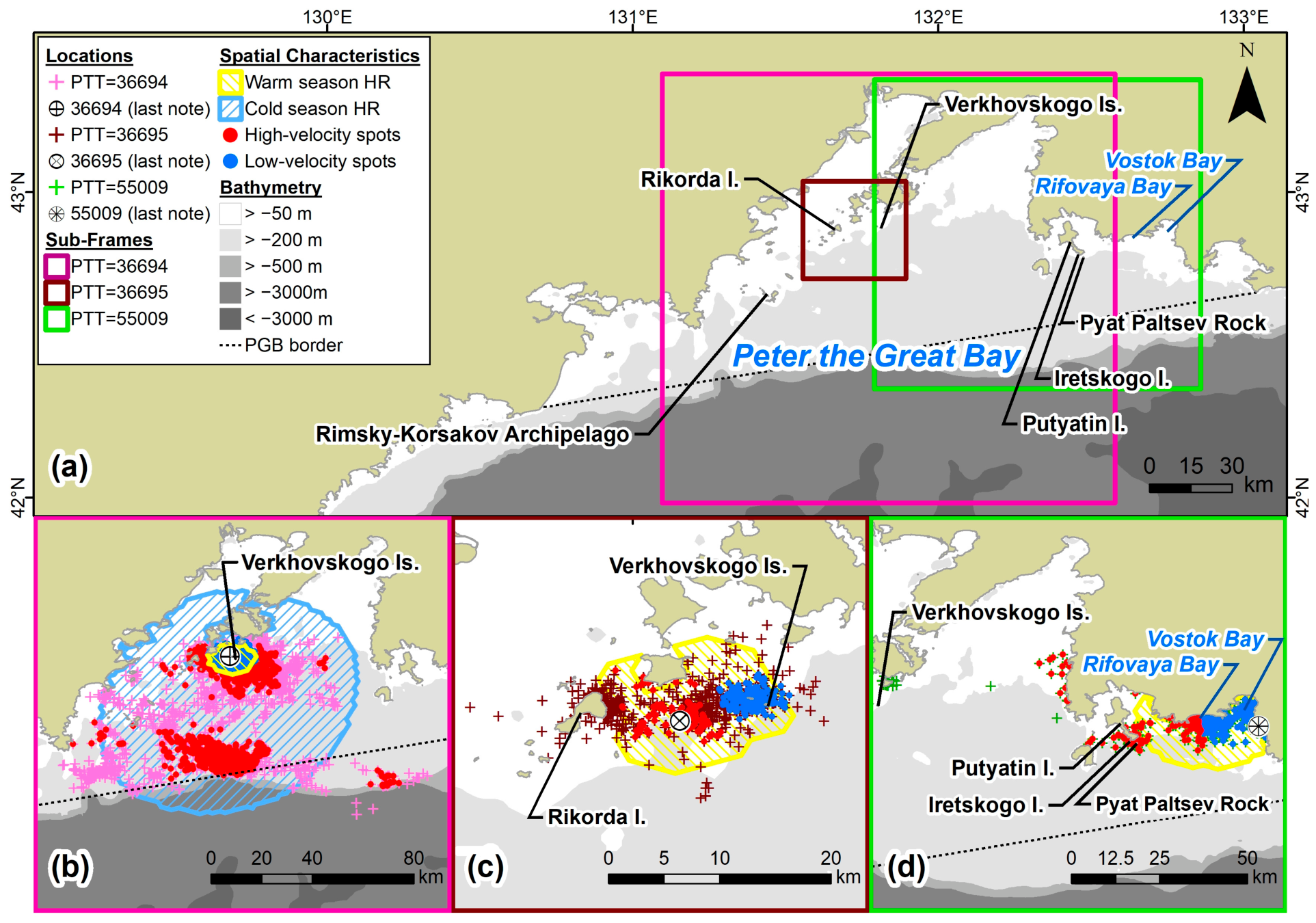
Table 1). The age of all seals was determined by means of external signs, such as body mass, length, girth, and claw size. No body parts (e.g., teeth, claws) were collected from the seals to determine age under laboratory conditions. Tagging was conducted after the breeding season. Four seals were tagged at the rookery of RKA, while the remaining five were tagged at nearby haul-outs situated 53 km northeast of RKA (Verkhovskogo Islands; hereinafter: VI) (
Figure 1). Satellite tags (SPOT-293A; ARGOS SPOT, Wildlife Computers, Inc., Redmond, WA, USA) were used. Tags were attached to the crown of each seal’s head using Loctite
TM Type 422 glue (Henkel Corp., Düsseldorf, Germany) or a two-component epoxy glue. Seals were released immediately after tagging. All spotted seals tagged in this study were born at the rookery on RKA, as no other breeding colonies of the species exist within PGB.
All received location data were preprocessed using the ARGOS Kalman filtering algorithm and subsequently underwent additional preprocessing with the SDA filtering algorithm [
10], implemented in the “argosfilter 0.70” R package [
11]. The threshold values used for the SDA parameters to remove records from the dataset were as follows: speeds exceeding 3.8 m/s over travel distances greater than 5 km [
12] and angles between successive locations greater than 15° at distances exceeding 2.5 km and greater than 25° at distances exceeding 5 km. In addition, records indicating speeds greater than 10 m/s (regardless of travel distance) or locations situated more than 1 km inland from the shoreline were removed.
Satellite tags are typically shed during the annual molting of spotted seals; however, they may occasionally be lost earlier for various reasons. In such cases, tags lost within the tidal zone may continue transmitting location data because the wet/dry sensor can keep switching tags on and off in response to the diurnal tidal cycles. To identify and remove such records from the dataset, each tag was operated for 1 day in an open area at a site with precisely known coordinates. The coordinates were determined using a Garmin eTrex 30x GPS/GLONASS handheld navigation device. For each received record, the Euclidean distance (deviation) between the observed coordinates provided by ARGOS and the true coordinates measured using GPS/GLONASS was calculated. These deviations were compiled into a control set of biases. Subsequently, for each received field record, the deviation of the observed coordinates from a “moving” center of mass was calculated, with the center of mass defined as a 5-day moving average of the X and Y coordinates. These deviations were then grouped into 5-day sequences calculated using an analogous “moving” procedure and compared with the control set of bias using a t-test (p = 0.05). If no statistically significant difference was detected between the 5-day datasets of observed deviations and the control set of bias for 30 consecutive days, the tag was considered lost within the tidal zone.
Statistically significant areas used by individual spotted seals were identified using the hotspot analysis method [
13]. This method proportionally compares densities of locations in aggregations of neighboring polygons (cells with side lengths of 5 km) to densities of locations in the bigger polygon that envelops a presumable range of PGB-spotted seals (i.e., ES/SJ, OS, and near-shore Japan). The disparity was considered significant when the positive score of the assigned Z(Gi*) statistic conformed to the 95% level of confidence (
p = 0.05). Clusters of areas with high densities of locations were designated significant to spotted seals (hereinafter key areas). Within these key areas, spotted seals were observed significantly more often than expected relative to other parts of their range. This method showed limited use in application to the distribution of spotted seals that remained in PGB, due to the small sizes of their summer habitats.
The hotspot analysis method was also used to identify locations with statistically significant changes in the horizontal movement speed of spotted seals. In that case speeds in aggregations of neighboring locations were proportionally compared to speeds observed through whole tracks of individual spotted seals. Locations classified as “low-velocity spots” or “high-velocity spots” were marking statistically significant (p = 0.05) clusters of points with consistently decreased and elevated, respectively, horizontal movement speed. Repeated decreases in horizontal movement speed were interpreted as markers of potential foraging, resting, or social behavior, as seals may spend more time submerged during such periods. Large key areas with clusters of low-velocity spots were classified as primary resting and foraging grounds when individual spotted seals repeatedly used them for extended periods. All other key areas were classified as secondary.
To examine intraseasonal changes in the spatial distribution of spotted seals, their home ranges (hereinafter HRs) were delineated, defined as the areas within which individual spotted seals could be found with a 95% probability [
14]. The warm season was defined as the period from May to October or, for migratory individuals, from the completion of summer migration (typically late June to early August [
7]) to October. The cold season was defined as beginning in November or, for migratory individuals, after the completion of the return autumn migration (typically occurring between November and December [
7]). Kernel density estimation was used to smooth the probability density distribution, with a raster cell size of 1500 m. This method does not allow statistically meaningful conclusions about areas used by spotted seals but can be used to compare changes in utilization of individual areas over time.
A direct comparison of movement speeds among spotted seals could be misleading, as migratory individuals would be expected to exhibit higher average movement speeds because they spend a greater proportion of their time traveling. To address this issue, only the speeds observed during transit passages were compared. To identify the transit movements, the tracks of individual spotted seals were divided into sequences of 8-h intervals, and the Rayleigh test for uniformity [
15] was applied at each interval. The Rayleigh test assesses departures from a uniform circular distribution and therefore can be used to determine whether a consistent travel direction is present within a given 8-h interval. When a significant average travel direction was detected, all records within a tested 8-h period were classified as part of a transit movement. The probability associated with the Rayleigh statistic (R) was estimated using its exponential approximation. Subsequently, the spotted seals were assigned to one of two clusters using the k-means clustering method [
16]. In k-means clustering the data are iteratively allocated to different clusters, each characterized by its own center of mass (centroid). After each reallocation, centroids are reevaluated. The process of reallocation aims to achieve a configuration of clusters at which every datum belongs to a cluster with a centroid closest to it. The process was ceased when no new changes in the configuration of clusters resulted in a decrease in the adopted proximity metric (
dE; the Euclidean distance). Clustering was based on the median movement speed of each individual during transit movements.
To compare differences between datasets, permutation tests were used [
17]. The function used to construct the achieved significance level (
ASL, permutation test statistic) was comparing a difference between means of tested variables. During each replication of the test, the difference of means from the observed dataset (
Θ) was fixed; at the same time, the difference of means from the permuted dataset (
Θ*) was a result of random re-sampling without replacement from the same dataset. In sequence of replications, whenever
Θ* was bigger than
Θ,
ASL was increased by 0.001. All permutation tests were run through 1000 replications. The critical value for the permutation test statistic was set at
ASL = 0.05 (which is analogous to
p = 0.05). The variables subjected to permutation tests are separately specified under lower sections.
All calculations were performed using the Asia North Equidistant Conic projection, whereas figures and other illustrative materials were prepared in WGS 84.
After preprocessing, 23,582 records remained in the working dataset (
Table 1). During the study, open-source map data from OpenStreetMap [
18] were used for shoreline information and data from the on-line resource “GEBCO Maps” [
19] for bathymetry. All data were processed using ArcMap 10.8, Microsoft Excel, R version 3.4.3, and GraphPad Prism 6.
4. Discussion
This study corroborates earlier findings of a migratory route from PGB to foraging grounds along the northern coast of the ES/SJ [
7,
25,
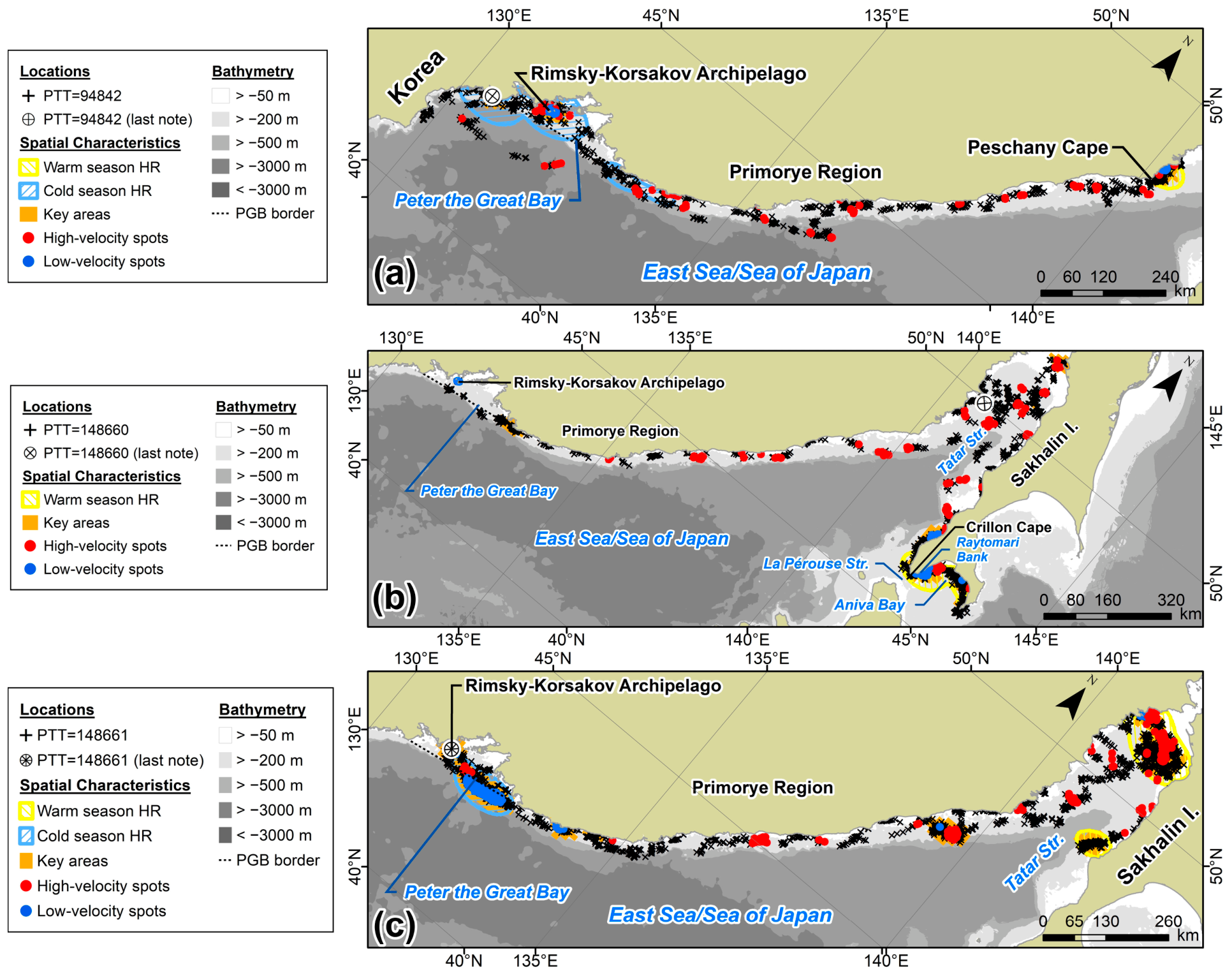
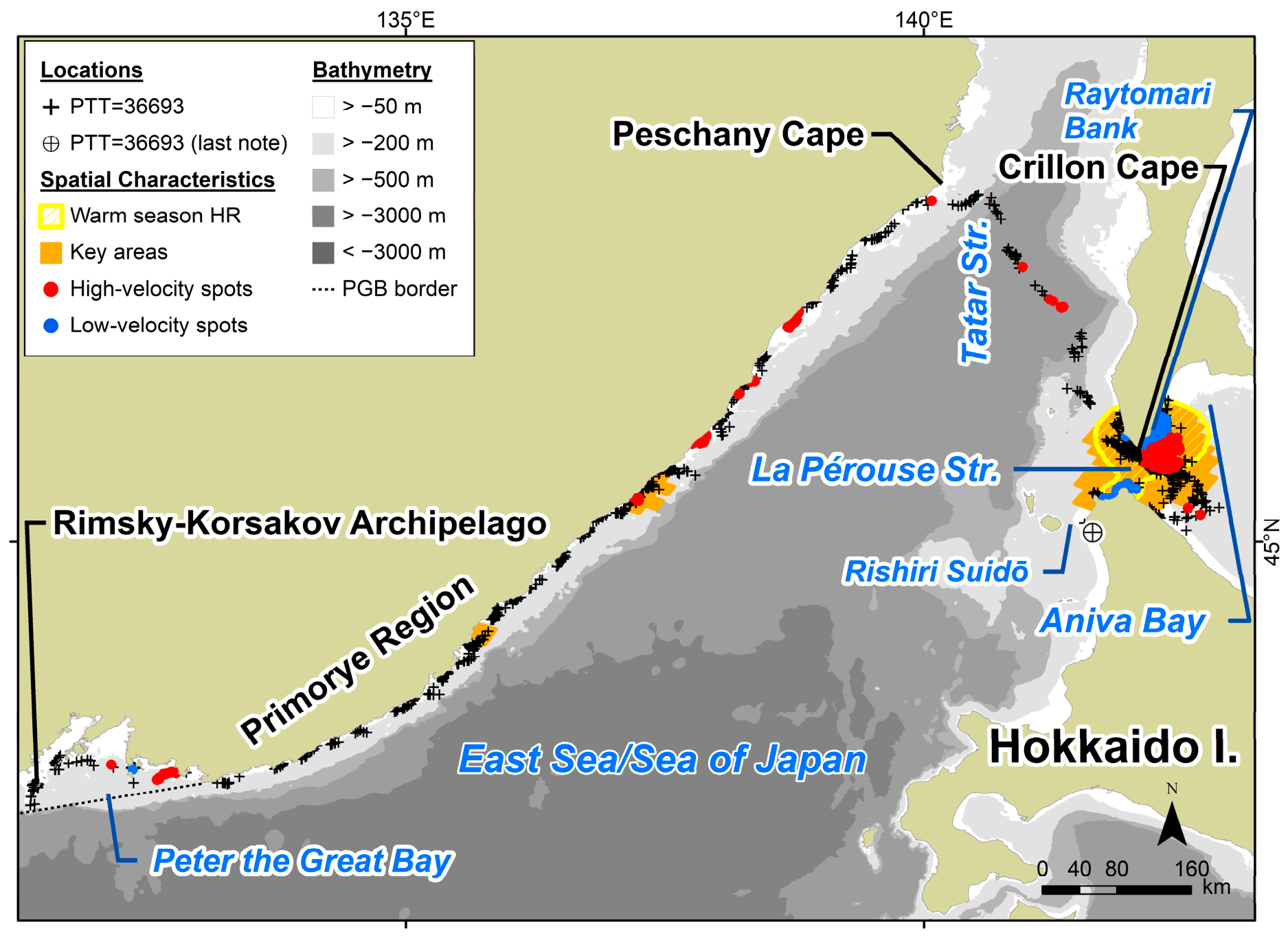
26]. Four of the nine tagged seals reliably spent the warm season within the Tatar Strait and in the southern part of the OS (
Figure 3 and
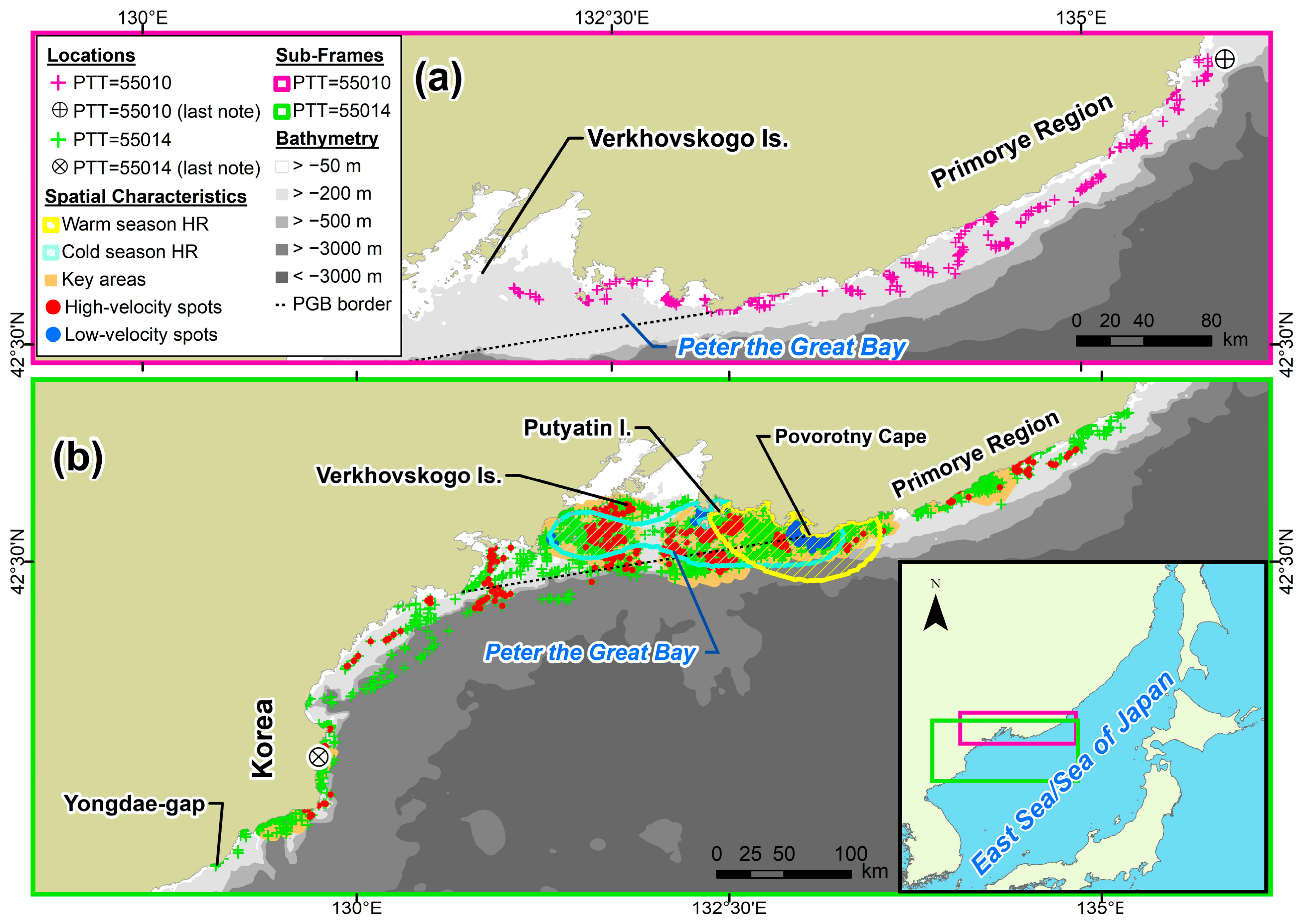
Figure 4). In addition, one yearling female (#55010;
Figure 2a) tagged at VI presumably began her summer migration in a northeastward direction, but her tag then ceased transmitting, and the female was lost from tracking. The presence of a migrating individual among the juvenile seals at the peripheral haul-out of VI is consistent with our earlier finding that, before the onset of long migrations, juvenile spotted seals may spend time in small areas situated close to the border of larger key areas they are about to leave [
7]. This behavior may be part of the preparation for a long migration.
The juvenile tagged seals occasionally traveled long distances southward along the near-shore waters of Korea (see
Figure 2b and
Figure 3a). These travels did not qualify as foraging migrations, as the juvenile seals did not form the main key areas during them.
The tagging location seemingly did not affect seals’ tendency to use high or low travel speeds. A mixed group of spotted seals, tagged at both RKA and VI, was assigned to the high-speed k-cluster. Seals in that group exhibited 48% higher median transit speed compared with spotted seals in the low-speed k-cluster, which was composed exclusively of nonmigrating spotted seals, all tagged at VI (
Table 3).
The observed difference in median speeds between the two k-clusters has high biological importance. Migrating spotted seals exhibited much higher activity levels during their transit passages, which should translate into substantially greater energy expenditure compared with nonmigrating seals. The proportion of transit records in the activity budget (
Table 3) and the size of HRs during the warm season were also higher in migrating spotted seals (
Table 2). It should be noted that the use of small water areas by juvenile spotted seals may be typical for nonmigrating individuals, as the same pattern has been observed in another spotted seal population [
27].
The reasons for the dissimilarity in spatial and speed characteristics between migrating and nonmigrating spotted seals are not completely clear. Reports of repeated observations of the same individually recognizable spotted seals in PGB during summer, year after year [
8], suggest a certain interannual stability within the nonmigrating group. Recent research on the genetics of PGB spotted seals revealed at least two mitochondrial lineages, leading Podlesnykh and Katin [
9] to suggest genetic isolation of the PGB spotted seal population. If such isolation does exist, it could have occurred historically due to sea-level changes associated with Pleistocene or later glaciations. This hypothesis currently lacks sufficient corroboration from genetic data and requires a thorough evaluation of both migrating and nonmigrating spotted seals within the PGB population. This evaluation would necessitate sampling (skin biopsy and hair collection) of individual spotted seals whose affiliation with one or the other ecological group is unambiguous. Correctly attributing spotted seals to specific ecological groups will require a well-designed seal-monitoring program within PGB.
If it is assumed that nonmigrating spotted seals belong to a stable demographic unit within the PGB population, then their group might be expected to gain a competitive advantage in the form of lower energetic expenditure, which could result in their numerical dominance over migrating spotted seals within a conceivable timeframe [
28]. However, as only about one-fifth of the population remains in PGB during the summer [
8], the suggestion of competitive superiority of the nonmigrating group is questionable. It seems more plausible that the nonmigrating group emerges annually in response to multiple factors. A reasonable explanation for the low number of spotted seals remaining in PGB in summer may be the relatively lower availability or abundance of local nutrient resources. For example, in summer, some typically cold-water prey species that form the base of the spotted seals’ diet—such as walleye pollack (
Gadus chalcogrammus) and navaga cod (
Eleginus gracilis)—tend to migrate below the 50-m isobath [
29], which can temporarily reduce their abundance in the shallow water areas of PGB (
Figure 1a). To compensate for this summer-time decrease in prey availability, spotted seals in PGB may be forced to resort to trophic specialization, relying more heavily on cephalopods, such as Japanese common squid (
Todarodes pacificus) [
8]. Since the early 1990s, the Japanese common squid has dominated the nekton biomass in the ES/SJ [
30], but its annual runs into PGB can be highly inconsistent, depending on short-term oceanographic conditions [
31]. This makes it an unreliable nutrient source for the PGB spotted seal population. It is possible that the nonmigrating juvenile spotted seals can rely on local concentrations of nutrient resources that can be formed by relatively small, slow-pacing prey species such as humpy shrimp (
Pandalus goniurus) and sculpins (
Cottidae gen. sp.) [
3]. Small patches of locally abundant biotopes that exist in proximity to traditional haul-outs of spotted seals can allow nonmigrating juvenile seals to remain in PGB during the warm season, while exhibiting low levels of activity. At the same time, when most juvenile seals face a broad situation of less predictable and available or exhaustible nutrient resources within PGB in the summer, they can travel to the northeast of ES/SJ. As during the warm season the cold-water prey species can be more available in colder areas, the migrating juvenile seals in the Tatar Strait and the OS can be less restricted by their energetic expenditures and possibly can keep a more active way of life, traveling faster or foraging in bigger HRs. This hypothesis is preliminary, and it needs further corroboration through research using bigger sample size data that should be supported by bio-logging techniques, such as stable isotope analysis of samples obtained from individually recognizable—preferably branded or plastic-tag marked—spotted seals, whose spatial characteristics are assessed throughout the warm season. It also requires dedicated comparative research of seasonal bio-productivity in PGB and in the areas used for warm-season foraging by migrating spotted seals.
Notably, some spotted seals may exhibit peculiar “hybrid” behavior. Female #55014 would formally be considered nonmigrating, as she did not perform (or possibly ceased) a foraging migration and never formed main key areas outside of PGB (
Figure 2b). At the same time, she maintained high transit speeds and used large water areas during the summer. Also, the female #94842 maintained high transit speeds but spent her warm season within a compact area north of Peschany Cape (
Figure 3a).
A single migrating female spotted seal (#36693) died in a human-related accident during her foraging trip along the northwestern coast of Hokkaido Island. The circumstances of the incident remain unclear, but the event highlights that conflict with fisheries represents a serious threat to juvenile spotted seals from the PGB population. Specialized research is needed to assess areas critical to PGB spotted seals in the nearshore waters of southwestern Sakhalin Island and northern Hokkaido Island and to determine whether migratory corridors (e.g., the Tatar Strait and the La Pérouse Strait) should be incorporated into conservation networks. At present, the breeding colony of spotted seals within PGB is adequately protected by the conservation area of the Far Eastern Marine Reserve, as no rookeries of this species exist beyond its protected boundary. Nevertheless, over time, the observed increase in the local spotted seal population [
5] could lead to the establishment of new breeding colonies in PGB and will require additional protective measures to preserve the local population.




 ,
,