Article

The First Ancient DNA Evidence of Zebu Husbandry in Thailand During the Prehistoric Through the Historic Periods

by
Pornchanok Yensookjai
1,
Suteera Prachumsarn
1,
Noppasin Sangtubsorn
1,
Yada Katanyuphan
1,
Pee Boonleang
1,
Pipad Krajaejun
2,
Athiwat Wattanapituksakul
3 and
Wunrada Surat
1,*
1
Department of Genetics, Faculty of Science, Kasetsart University, Bangkok 10900, Thailand
2
Department of History, Faculty of Liberal Arts, Thammasat University, Pathum Thani 12120, Thailand
3
The Timing and the Cause of the Transition in Domestic Cattle Species in Thailand Project, Department of Genetics, Faculty of Science, Kasetsart University, Bangkok 10900, Thailand
*
Author to whom correspondence should be addressed.
Animals 2026, 16(12), 1904; https://doi.org/10.3390/ani16121904 (registering DOI)
Submission received: 22 May 2026 / Revised: 16 June 2026 / Accepted: 18 June 2026 / Published: 19 June 2026
(This article belongs to the Section Animal Genetics and Genomics)

Simple Summary

Bos taurus (taurine) and Bos indicus (zebu) are domestic cattle species that originated in the Near East (Middle East) and the Indus Valley (Pakistan, northwest India, and Afghanistan), respectively. Zebu is the predominant traditional cattle lineage in Southeast Asia, whereas taurine cattle are exotic breeds imported from other countries. A previous study suggested that all Thai cattle dating to 3500–1700 years before present (YBP) belonged to the taurine lineage. This suggests that zebu cattle were introduced into Thailand at a later date and subsequently replaced the taurine population. This study analysed 26 cattle specimens collected from nine archaeological sites across Thailand, dating between 3400 and 600 YBP. Species identification was performed using partial mitochondrial DNA sequences obtained from four cattle remains from two archaeological sites, Khao Khuram (dated 1700–1500 YBP) and Sukhothai Historical Park (dated 850–650 YBP). DNA analyses showed that these ancient cattle were grouped with modern zebu cattle from India, China, and Cambodia, suggesting that zebu cattle linked to South Asian lineages had reached Thailand by at least 1700 YBP. The findings provide new insights into domestic animal mobility and transregional exchange networks that link South and Southeast Asia via overland and maritime routes.

Abstract

In Southeast Asia (SEA), Bos indicus (zebu) refers to the traditional cattle, whereas Bos taurus (taurine) refers to exotic breeds imported from foreign countries. Notably, a previous study reported that all Thai cattle dating to 3500–1700 years before present (YBP) belonged to the taurine lineage. This suggests that zebu may have been introduced into Thailand at a later date, subsequently replacing the taurine population. In the present study, we analysed 26 cattle remains from nine archaeological sites across Thailand dated to between 3400 and 600 YBP. Taxonomic classification of the specimens was determined using partial D-loop sequences. DNA from four cattle remains obtained from two archaeological sites (Khao Khuram, dated to 1700–1500 YBP, and Sukhothai Historical Park, dated to 850–650 YBP) was successfully amplified and sequenced. Both phylogenetic and haplotype network analyses showed that these remains were grouped in the same haplotype as modern zebu cattle from India, China, and Cambodia. The results suggest that ancient Thai cattle belonged to the zebu lineage and that zebu cattle were introduced into Thailand from India at least 1700 years ago. Furthermore, genetic relationships suggest two potential routes of introduction into Thailand and other SEA countries via overland and maritime routes.

1. Introduction

Domestic cattle are raised in more than 190 countries globally [1]. They serve vital roles as food sources and in the leather industry, agriculture, transportation, and ritual ceremonies [2,3]. There are two primary domestic cattle species, Bos taurus (taurine) and Bos indicus (zebu), that are distributed across Europe, the Americas, Australia/Oceania, Africa, and Asia [4]. B. taurus originated in the Near East approximately 10,000 YBP and was derived from Bos primigenius primigenius (wild aurochs) [5]. B. indicus originated in the Indus Valley approximately 8000 YBP and are descended from B. primigenius namadicus [6]. Both domestic lineages subsequently expanded globally. At present, most cattle in Europe and East Asia are B. taurus, whereas B. indicus predominates in South America, Africa, and Southeast Asia (SEA) [7].
B. taurus reached Europe and Africa between 7400 and 7000 YBP, followed by the introduction of B. indicus into these regions around 3500–2500 YBP [8,9]. In the Americas, B. taurus was first introduced into the Caribbean islands from Europe in 1492, with subsequent importations to the mainland occurring multiple times between the 16th and 18th centuries [10,11]. For B. indicus, documentation indicates that it was introduced to South America from the Indian subcontinent less than 150 years ago [12]. In East Asia, the earliest evidence of B. taurus dates to approximately 5500–5300 YBP in Northeast China [13]. B. indicus is currently widely distributed in Southern China. Although the mitochondrial DNA (mtDNA), Y chromosome and autosome from modern cattle suggest that B. indicus was imported into China between 5000–3000 YBP [14], no ancient DNA (aDNA) evidence has yet confirmed the exact timeline of its introduction into this region. In SEA, archaeological records indicate that cattle were reared millennia ago. However, only one aDNA study has confirmed that B. taurus was reared in Central and Northeastern Thailand between 3500 and 1700 YBP [15]. Given that B. indicus is the predominant traditional cattle species in modern SEA, including Thailand, and that B. taurus exists primarily as an exotic breed, two critical questions arise: when was B. indicus introduced to the region, and how did the ancient B. taurus populations become locally extinct?
In this study, we address the first of these questions. This research aimed to identify cattle species from skeletal remains recovered from nine archaeological sites across Thailand, dating between 3400 and 600 YBP. Among these, archaeological evidence associated with Indian trade networks has been discovered at three sites dating between 1700 and 1000 YBP. A partial mitochondrial D-loop region was selected for amplification. The resulting ancient DNA sequences were evaluated using phylogenetic, nucleotide polymorphism, and haplotype network analyses to elucidate the genetic relationships between ancient Thai cattle and B. taurus and B. indicus populations from other Asian regions. The data obtained from this study provide insights into the history of cattle husbandry and introduction pathways in SEA, particularly within Thailand.

2. Materials and Methods

2.1. Archaeological Sites and Sample Collection

A total of 26 cattle remains were collected from nine archaeological sites across Thailand that have been dated to approximately 3400–600 YBP. These sites were Wat Nakathewi (WNK), Si Bua Thong (SBT), Wat Jomsri (WJS), Khao Khuram (KKR), Ban Khumuang (BKM), Wiang Thakan (WTK), Kok Wat (KW), Wat Mahathat Sanburi (WMS) archaeological sites, and Sukhothai Historical Park (SKT) (Figure 1 and Table 1).
The WNK, SBT, and WJS sites, dated to approximately 3400–3200, 3000–2500, and 2400–1800 YBP, respectively, belong to the prehistoric period [16]. KKR represents a transitional period between the Iron Age and the early historical period, dating to approximately 1700–1500 YBP [16,17]. The remaining sites, BKM (1400–1000 YBP), WTK (1300–1000 YBP), KW (1300–1000 YBP), SKT (850–650 YBP), and WMS (700–600 YBP), are assigned to the historic period [16]. Among these nine sites, five (KKR, BKM, KW, SKT, and WMS) have yielded archaeological artifacts linked to India, such as carnelian beads and metal coins featuring Sanskrit inscriptions [16,17,18,19,20,21,22].

2.2. DNA Extraction, D-Loop Amplification, and DNA Sequencing

The surfaces of the cattle remains were cleaned using a hand drill before being exposed to ultraviolet (UV) light for 30 min inside a laminar flow hood. The specimens were then ground into powder using a sterilized mortar and pestle. Total DNA was extracted following the protocol in Damgaard et al. (2015) [23]. An extraction blank containing no bone powder was processed simultaneously with each sample batch. The extracted DNA was utilized as a template to amplify the mitochondrial D-loop region using two primer pairs. The first pair consisted of the forward primer (16022–16041): 5′-GCCCCATGCATATAAGCAAG-3′ [24] and the reverse primer (16315–16293): 5′-GGAAAGAATGGACCGTTTTAGAT-3′ [3]. The second pair consisted of the same forward primer and the reverse primer (16178–16159): 5′-CACGCGCATGGTAATTAAG-3′ [24]. PCR amplifications were performed in 50 μL reaction volumes containing 5 μL of 10× PCR buffer, 1.5 μL of 50 mM MgCl2, 1 μL of 10 mM dNTPs, 0.5 μL of rabbit serum albumin (Sigma-Aldrich, St. Louis, MO, USA), 0.5 μL of each primer, 0.2 μL of Platinum™ Taq DNA Polymerase (Invitrogen, Carlsbad, CA, USA), 4 μL of DNA template, and DNase-RNase-free water. The PCR cycling conditions were as described in Siripan et al. (2019) [15]. Amplification products were visualized via 2% agarose gel electrophoresis and stained with Prime Juice (Bio-Helix, New Taipei City, Taiwan). Successfully amplified PCR products were purified and subjected to Sanger sequencing using an ABI 3730XL DNA Analyzer (Applied Biosystems, Foster City, CA, USA).

2.3. Authentication of Ancient DNA

To prevent exogenous DNA contamination, all procedures, from sample preparation through DNA extraction and PCR setup, were performed in a dedicated laminar flow hood pre-exposed to UV light for 30 min. All equipment was cleaned with 3% H2O2, then sterilized with double-distilled water, prior to and immediately after use. Sterilized filter pipette tips were used exclusively throughout the extraction and amplification phases to prevent cross-contamination between samples. Negative controls (extraction blanks and PCR controls) were included in each experimental step. The investigators wore protective clothing, face masks, bouffant caps, and disposable gloves at all times during laboratory procedures. Ancient specimens and DNA were kept in the ancient laboratory, whereas modern cattle specimens and PCR products were not allowed in the laboratory. PCR was conducted in a separate laboratory.

2.4. Sequence Analyses

Raw DNA sequences were inspected and edited using BioEdit v7.2.5 [25]. Sequences obtained from the same specimen were aligned, and the primer sequences were trimmed. The resulting 116 bp D-loop sequences from ancient Thai cattle were compared against B. taurus and B. indicus reference sequences from various Asian countries available in the GenBank database. A total of 124 D-loop sequences from both species (Table S1) were included in subsequent analyses.
Phylogenetic trees and haplotype networks were constructed to identify species and evaluate genetic relationships between ancient Thai cattle from this study and reference sequences from Thailand and other countries. Bos javanicus was used as the outgroup. A neighbour-joining (NJ) phylogenetic tree was generated in MEGA11 [26] using the Maximum Composite Likelihood (MCL) model [27], while a maximum-likelihood tree was constructed using IQ-TREE v1.6.12 [28] with the HKY+F+G4 model [29]. A median-joining haplotype network was constructed using Hapsolutely 0.2.3 [30] and DnaSP6 [31].

3. Results and Discussion

3.1. Success of D-Loop Amplification and Sequencing

Twenty-six cattle specimens were used for the amplification of a partial D-loop region. However, only four ancient specimens (KKR1 (PZ513874), KKR2 (PZ513875), KKR3 (PZ513876), and SKT1 (PZ513877)) excavated from two archaeological sites, Khao Khuram and Sukhothai Historical Park, were successfully amplified and sequenced. The overall success rate was 16% (4 out of 26 specimens) (Table 1). However, at the Khao Khuram and Sukhothai sites, the success rates were 100% and 50%, respectively, indicating that DNA preservation at these two sites was better than at the others. Ancient DNA is usually degraded into small fragments of 40–500 bp [32]. Moreover, extreme DNA damage is often observed in tropical regions due to high temperatures and high humidity. Previously, approximately 70% of cattle remains collected from the Ban Chiang archaeological site in northeast Thailand, dating to 3550–2850 YBP, failed to amplify a 157 bp D-loop region [15]. This finding indicated that most ancient DNA in tropical areas, including Thailand, is heavily fragmented into segments of fewer than 160 bp.
Several factors, such as past flooding events, can affect DNA quantity and quality. KKR is located approximately 36 m above sea level, and no flooding events have been reported. Similarly, SKT was surrounded by ancient moats and earthen constructions that protected the ancient city from flooding. However, the other sites, including WJS, BKM, WMS, and KW, had been flooded several times, potentially resulting in severe DNA degradation. Water can destroy DNA through hydrolysis, a major factor causing DNA lesions in ancient specimens [33].
Previously, the most successful DNA extraction and amplification of ancient cattle remains in central and northeast Thailand came from specimens dated 2850–1750 YBP (66.67%; 12 out of 18 specimens), while the oldest specimens dated 3550–2850 YBP showed a lower success rate (28.57%; 8 out of 28 specimens) [15]. Notably, most of the specimens with high success rates were from the Ban Dung site, located in a salt production area [34]. High salinity can create an anhydrous environment in which DNA is well preserved due to limited water access in ancient specimens [35]. Recently, PCR amplification of a 159 bp D-loop region from ancient rhino specimens from two archaeological sites in northeast and central Thailand, dated 3550–2850 and 1250–450 YBP, failed [36]. Similarly, ancient specimens from WNK, the oldest site in this study, dated to between 3400 and 3200 YBP, also failed to yield PCR products for the 159 bp D-loop region. Hence, the age and conditions of archaeological sites may affect the quality and quantity of DNA preserved in ancient remains.
The condition of the specimens is also a significant factor for DNA preservation. Recently, two rhino teeth from Khao Samroi Yod National Park (both dated approximately 100 YBP) were successfully amplified [37]. One extracted from a mandible showed no cracks, and a 301 bp D-loop region was successfully amplified using a single set of primers, while the other, with a small crack on one root, required three sets of primers for nested and semi-nested PCR to produce overlapping products (sizes ranging between 159 and 170 bp) covering the 301 bp D-loop region [37]. In this study, no PCR products could be generated from cattle remains at seven archaeological sites because most of the remains were fragmented. Water and microbes can penetrate specimens through small cracks and destroy the internal DNA. Taken together, these findings indicate that the completeness and age of ancient remains, as well as the conditions at the archaeological sites, affected the success rate of DNA amplification and sequencing in this study.

3.2. Phylogenetic Analysis

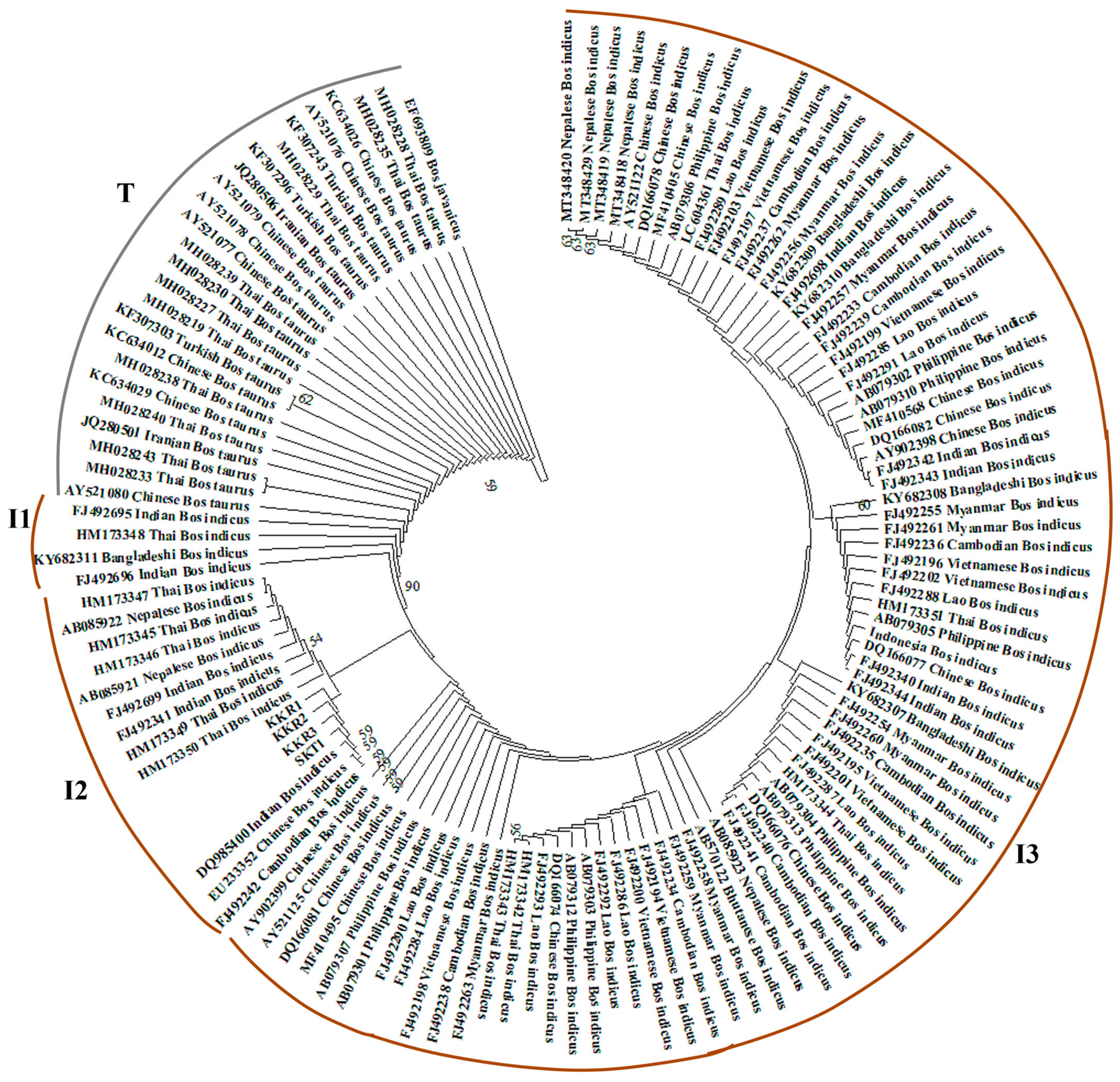
The NJ tree (Figure 2) and the ML tree (Figure S1) resolved two distinct groups corresponding to Bos taurus (T) and Bos indicus (I). The B. indicus group was further divided into three subclades, designated I1 to I3. I1 consisted of modern B. indicus from Thailand, India, and Bangladesh. The close relationship of the cattle from these countries suggests the introduction of cattle from India to Thailand via a coastal route. I2 comprised two subclades: the ancient Thai samples from this study (KKR1, KKR2, KKR3 and SKT1) and modern B. indicus from India, China, and Cambodia; and a subclade comprising modern B. indicus from Thailand, India, and Nepal, supported by bootstrap values of 59% and 54%, respectively. The clustering of KKR1, KKR2, KKR3, and SKT1 with B. indicus indicates that all ancient Thai specimens belonged to B. indicus, demonstrating a close genetic relationship. Moreover, grouping these ancient specimens with five modern Thai B. indicus individuals (HM173345–HM173347, HM173349–HM173350) suggests a close maternal affinity. The ancient Thai cattle sequences were highly similar to those of modern B. indicus from India (DQ985400), China (EU233352), and Cambodia (FJ492242). The results suggest that ancient Thai B. indicus shared a common ancestry with these modern populations. Furthermore, the close relationship among lineages from India, China, and Mainland Southeast Asia (MSEA) suggests that B. indicus may have been transported from India to Thailand via China using an overland Silk Road. Lastly, I3 consisted of B. indicus from Thailand, other MSEA countries, Island Southeast Asia (ISEA; Indonesia and the Philippines), China, and South Asia (Bangladesh, India, and Nepal). This clade demonstrated a close relationship among B. indicus from MSEA, ISEA, South Asia, and China. Given that MSEA, including Thailand, serves as a maritime trade station connecting China and India, these findings suggest a potential maritime trade route for the introduction of cattle from India to Thailand.
During the Early Historic period, the Thai-Malay Peninsula became an important interaction zone linking India and Southeast Asia through maritime and trans-peninsular trade networks. Archaeological evidence from sites such as Khao Sam Kaeo, Phu Khao Thong, and Khlong Thom indicates intensive exchange involving imported beads, coins, religious objects, and other prestige goods associated with India and Roman trade [16,38,39]. In this context, the close genetic relationship between Thai cattle and those from Island Southeast Asia (ISEA) suggests that the dispersal of B. indicus may have been connected to these maritime exchange systems. Archaeological evidence indicates regular interactions between India and Southeast Asia in antiquity. Maritime trade routes extending from China through Southeast Asia to India and the Mediterranean were established by approximately 2300 YBP [40]. For example, the Pak Klong Kluai shipwreck in Ranong Province has been dated to approximately 2100 YBP [41]. The vessel was constructed using mortise-and-tenon techniques commonly associated with Indian Ocean shipbuilding traditions. Nearby, the Phu Khao Thong archaeological site has yielded intaglios depicting Indian-style humped bull figures, as well as imported beads, Roman coins, and Brahmi inscriptions dating between the 1st century BCE and 3rd century CE [39]. Together, these finds reflect sustained maritime interaction between South Asia and Southeast Asia over 2000 years ago. Similar findings have also been reported in neighbouring Southeast Asian countries. At Phum Snay and Phum Sophy in Cambodia, bovine remains recovered from burial contexts together with trade goods such as carnelian beads point to connections between South and SEA during the Iron Age and the Early Historic period [42,43]. In Vietnam and Peninsular Malaysia, there is limited archaeozoological evidence for cattle husbandry. However, Early Historic materials from these regions include Indian-style humped cattle imagery associated with Hindu traditions, particularly within the Óc Eo cultural sphere [44,45]. Taken together, these archaeological data further support the connection between MSEA and ISEA through maritime trade and suggest that B. indicus may have spread into both regions through maritime and overland exchange networks.
In the present study, carnelian beads—among the earliest and most widespread maritime trade commodities from India—have been excavated at the Khao Khuram site, confirming historical contact between India and ancient Thai communities via maritime trade. Taken together, our results suggest that B. indicus was introduced into Thailand through two primary pathways: an overland Silk Road route via Bangladesh and Myanmar, and a maritime trade route. Furthermore, B. indicus from Thailand exhibited a close genetic relationship with Chinese populations in all five clades. Consistent with previous findings, multiple ancient DNA studies have documented the introduction of pigs, domestic cattle (B. taurus), and japonica rice from China to Thailand during the ancient period between 3500 and 1500 YBP [15,46,47,48]. Additional archaeological evidence suggests that B. indicus from India may have been introduced into South China and Southeast Asia between 3500 and 2500 YBP [49].

3.3. Nucleotide Polymorphism

The analysed cattle sequences were classified into 29 distinct haplotypes, with H1–H16 and H17–H29 belonging to B. indicus and B. taurus, respectively (Table S2). A total of 34 polymorphic sites were detected, comprising 32 transitions, one transversion, and one insertion/deletion (indel). B. taurus was differentiated from B. indicus by 11 nucleotide positions at sites 17, 41, 61, 68, 75, 76, 80, 81, 96, 97, and 102. Among these, 10 were transition substitutions: T to C (at position 17), A to G (at positions 41, 61, and 76), and C to T (at positions 68, 75, 81, 96, and 97). The remaining nucleotide position at site 102 was characterized by a deletion (gap) in B. indicus and an adenine (A) in B. taurus. Among the B. indicus populations, Thailand and India exhibited the highest haplotype diversity (seven haplotypes each), followed by Nepal (six haplotypes) and Cambodia (three haplotypes).
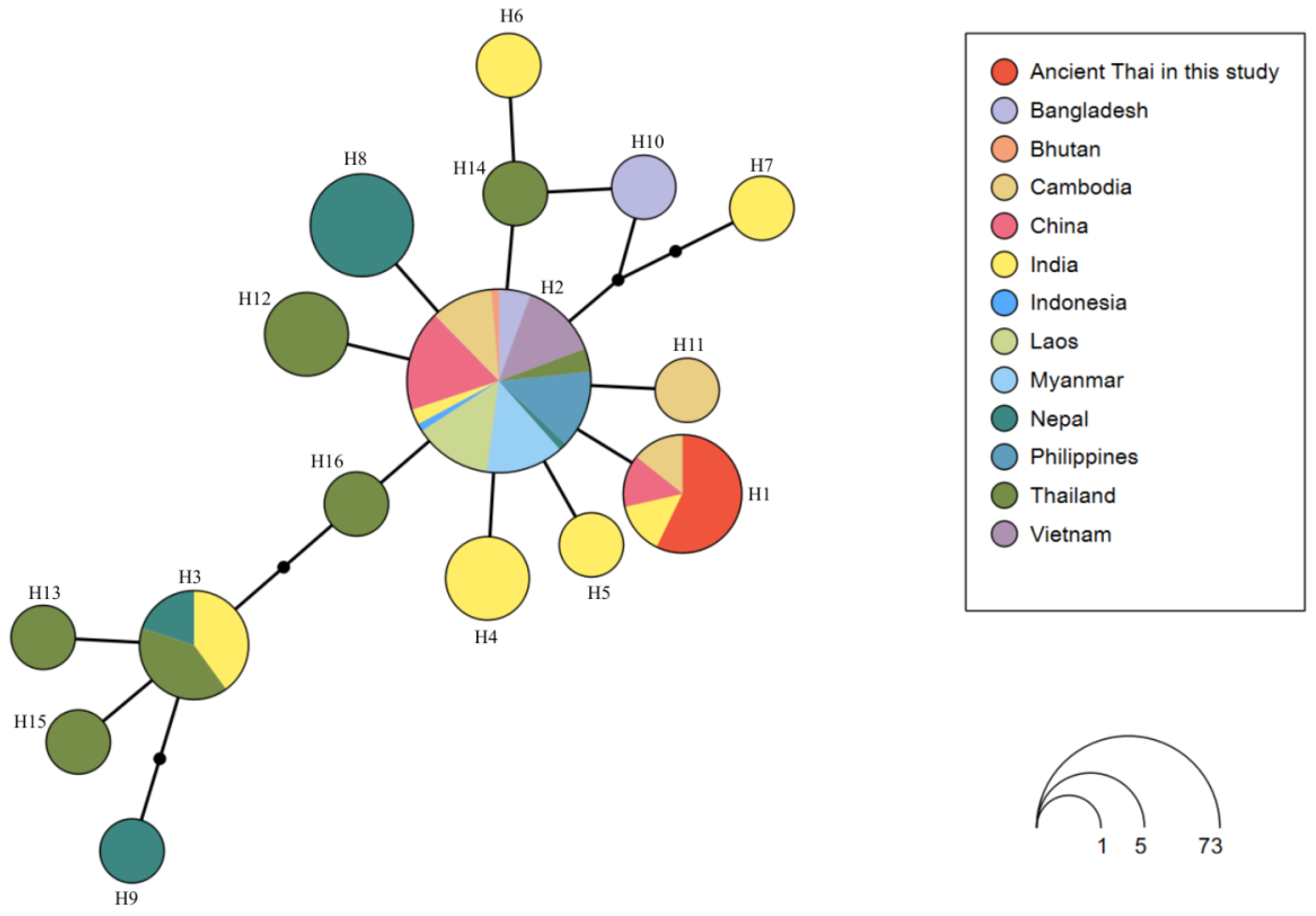
All ancient cattle specimens from this study clustered into a single haplotype, H1, together with B. indicus from India, China, and Cambodia. This result confirmed that the ancient remains belonged to B. indicus. Although the ancient Thai B. indicus specimens did not share a haplotype with modern Thai B. indicus, they displayed only a few nucleotide differences, supporting a very close genetic relationship. Modern Thai cattle were distributed across seven haplotypes. Two of these (H2 and H3) were shared with modern B. indicus from other countries, while the remaining five formed unique, local haplotypes. Consistent with a previous genome-wide study, a distinct Southeast Asian ancestry has been identified in indigenous Thai B. indicus, particularly in cattle populations from the southern region [50]. These findings imply that a distinct genetic pool of Thai B. indicus has evolved in isolation since its introduction to Thailand.

3.4. Haplotype Network Analyses

The median-joining network analysis was performed using only B. indicus sequences (Figure 3). The network exhibited a star-like topology centred on H2 as the predominant ancestral haplotype. This core haplotype contained 73 individuals from 12 countries spanning South Asia (India, Bangladesh, Nepal, and Bhutan), East Asia (China), Mainland SEA (Myanmar, Cambodia, Vietnam, Laos, and Thailand), and Island SEA (Indonesia and the Philippines). The remaining haplotypes diverged from H2 by only one to four nucleotide substitutions. All ancient Thai cattle from this study (KKR1, KKR2, KKR3, and SKT1) belonged to haplotype H1. Furthermore, the inclusion of modern B. indicus from India, China, and Cambodia within this haplotype indicates that B. indicus from Thailand, India, China, and Cambodia share a common maternal ancestor, and that this lineage has been continuously maintained in SEA from 1700 YBP to the present day.
Interestingly, B. indicus from Thailand was distributed across seven haplotypes (H2–H3, H12–H16), with H3, H13, H15, and H16 forming distinct lineages diverging from the central H2 haplotype. Haplotype H3 comprised B. indicus from Thailand, China, and Nepal. This genetic affinity supports an introduction pathway of B. indicus from India into Thailand and other MSEA nations via Nepal and China. Conversely, the co-clustering of Island SEA and Mainland SEA populations points toward a secondary wave of cattle importation through maritime trade networks.
The results from this study suggest that partial D-loop sequences can be used to identify cattle species. Moreover, the phylogenetic and haplotype network analyses have revealed genetic relationships between ancient Thai cattle and those from other countries, suggesting potential routes of introduction of B. indicus in ancient times. However, bootstrap values and the number of polymorphic sites detected among B. indicus are quite low for resolving population-level relationships. Hence, longer sequences, the complete D-loop, or whole mitochondrial DNA should be used for further study if possible. In addition, the nuclear genome should be included in ancient cattle studies to determine whether hybridisation occurred between B. indicus and B. taurus and SEA in ancient times.
Although domestic cattle have been raised in SEA for millennia, no previous ancient DNA studies have definitively confirmed the exact arrival timeline of B. indicus in the region, including Thailand. Rich archaeological assemblages linked to Indian trade have been uncovered at the Khao Sam Kaeo (KSK) site in Southern Thailand, dating to 2400–1500 YBP [38]. Furthermore, silver coins depicting a humped bull and Sanskrit inscriptions have been excavated in Dvaravati cities across Central Thailand, dating to approximately 1300 YBP [51,52]. The Dvaravati culture, heavily influenced by Indian religion, art, and language, flourished throughout Central and Northeast Thailand between 1500 and 900 YBP [53]. Previous studies have suggested that religious expansion from India reached the eastern regions of the country over 2000 YBP [54], potentially driving the dispersal of B. indicus into SEA [2]. Moreover, archaeological remnants of an early Buddhist shrine and miniature stupas dating to approximately 1500–1400 YBP have been documented near the Khao Khuram site, confirming the spread of Indian religious practices during the early historic period [16,17]. Additionally, a burial containing glass beads alongside a complete cattle skeleton at the KW archaeological site in Nakhon Si Thammarat Province suggests the presence of Brahmanical rituals in Southern Thailand between 1300 and 1000 YBP [22]. Two earthenware vessels containing Arabic silver coins were also discovered at KW, indicating robust maritime commerce between Thailand and the Middle East [22]. Collectively, these diverse archaeological records confirm intensive interaction between India and Thailand, particularly in the southern peninsula, as early as 2400 YBP. Furthermore, a modern DNA study of B. indicus using the mitogenome, Y chromosomes, and autosomes found that the cattle species was introduced into East Asia between 5000 and 3000 YBP via SEA along a coastal route [14]. Hence, it is possible that B. indicus was introduced into Thailand and the SEA between 5000 and 2400 YBP. Our ancient DNA evidence demonstrates that B. indicus had arrived in this region by at least 1700 YBP. The absence of successful amplification from older sites (WNK, SBT, and WJS) dated between 3400 and 1800 YBP does not rule out the absence of B. indicus at those times; it may only reflect poor DNA preservation. To determine whether cattle were introduced into Thailand prior to 1700 YBP, ancient specimens from archaeological sites older than 1700 YBP should be included in further studies. Remarkably, the presence of unique haplotypes in extant Thai B. indicus indicates that a distinct, localized gene pool has evolved over a long period, culminating in a unique Southeast Asian lineage. Further studies of pathogens in ancient cattle remains excavated from archaeological sites across broad age ranges throughout the country could provide insight into how ancient B. taurus populations became extinct.

4. Conclusions

In this study, the success rate of ancient DNA amplification and sequencing was 16% from four cattle specimens from two archaeological sites. The results indicated extreme DNA damage that is often observed in tropical regions. Notably, this study provides the first ancient DNA evidence demonstrating that B. indicus was raised in Thailand as early as 1700 YBP. The simultaneous confirmation of both B. indicus and B. taurus in the country around 1700 YBP suggests that these two cattle lineages co-existed in the country during historical times. Phylogenetic and haplotype network analyses, as well as archaeological evidence, support possible pathways for the introduction of B. indicus from India into Thailand, particularly via the maritime trade route. Because only four specimens from two archaeological sites were successfully amplified and sequenced in this study, further ancient DNA research with a larger sample size from broader archaeological contexts across Thailand and neighbouring SEA nations is required to fully elucidate the husbandry history and complex migratory routes of B. indicus in this region. The introduction of zebu cattle into Thailand should not be viewed solely as a biological event, but rather as part of broader historical transformations associated with the rise in maritime trade, early state formation, and long-distance cultural interactions across the Indian Ocean and Mainland Southeast Asia.

Supplementary Materials

The following supporting information can be downloaded at https://www.mdpi.com/article/10.3390/ani16121904/s1, Table S1: D-loop sequences of Bos species retrieved from GenBank database and used for nucleotide polymorphism, Neighbor-Joining and haplotype network analyses in this study; Table S2: Nucleotide polymorphism in a D-loop region in modern and ancient cattle; Figure S1: The maximum-likelihood relationship between the ancient Thai cattle (KKR1, KKR2, KKR3 and SKT1) in this study and available 124 D-loop sequences of Bos taurus and Bos indicus from GenBank database. Refs. [55,56,57,58,59,60,61,62,63,64,65,66,67,68] are cited in Supplementary Materials.

Author Contributions

Conceptualization, W.S.; Methodology, P.Y.; Investigation, P.Y., S.P., N.S., Y.K., P.B. and A.W.; Resources, P.K.; Writing—original draft, W.S.; Writing—review & editing, P.K. and W.S.; Supervision, W.S.; Project administration, W.S.; Funding acquisition, P.K. and W.S. All authors have read and agreed to the published version of the manuscript.

Funding

Pornchanok Yensookjai was supported by the Development and Promotion of Science and Technology Talents Project, Thailand. This project was funded by the National Research Council of Thailand (N42A650275) and Kasetsart University, Bangkok, Thailand (B4301-00121-65).

Institutional Review Board Statement

Our study used ancient cattle remains which died 3400–600 years ago. All ancient animal remains were collected from museums or archaeological sites. Hence, the review for ethics approval was not needed for this study.

Informed Consent Statement

Not applicable.

Data Availability Statement

The original contributions presented in this study are included in the article/Supplementary Materials. Further inquiries can be directed to the corresponding author.

Acknowledgments

The ancient cattle remains from Si Bua Thong and Ban Khumuang, Sukhothai Historic Park, Wat Mahathat Sanburi, Wiang Tha Kan, Wat Jomsri and Wat Nakathewi, Khao Kuram and Kok Wat archaeological sites were provided by the 3rd Regional Office of Fine Arts, Ayutthaya Province; the 4th Regional Office of Fine Arts, Lop Buri Province; the 6th Regional Office of Fine Arts, Sukhothai Province; the 7th Regional Office of Fine Arts, Chiang Mai Province; the 8th Regional Office of Fine Arts, Khon Kaen Province; the 11th Regional Office of Fine Arts, Songkhla Province and the 12th Regional Office of Fine Arts, Nakhon Si Thammarat, respectively.

Conflicts of Interest

The authors declare no conflicts of interest.

References

  1. World Population Review. Cattle Population by Country 2026. Available online: https://worldpopulationreview.com/country-rankings/cattle-population-by-country (accessed on 12 May 2026).
  2. MacHugh, D.E. Molecular Biogeography and Genetic Structure of Domesticated Cattle. Ph.D. Thesis, Trinity College, Dublin, Ireland, 1996. [Google Scholar]
  3. Cai, D.; Sun, Y.; Tang, Z.; Hu, S.; Li, W.; Zhao, X.; Xiang, H.; Zhou, H. The origins of Chinese domestic cattle as revealed by ancient DNA analysis. J. Archaeol. Sci. 2014, 41, 423–434. [Google Scholar] [CrossRef]
  4. Xia, X.; Qu, K.; Wang, Y.; Sinding, M.-H.S.; Wang, F.; Hanif, Q.; Ahmed, Z.; Lenstra, J.A.; Han, J.; Lei, C.; et al. Global dispersal and adaptive evolution of domestic cattle: A genomic perspective. Stress Biol. 2023, 3, 8. [Google Scholar] [CrossRef] [PubMed]
  5. Edwards, C.J.; Magee, D.A.; Park, S.D.E.; McGettigan, P.A.; Lohan, A.J.; Murphy, A.; Finlay, E.K.; Shapiro, B.; Chamberlain, A.T.; Richards, M.B.; et al. A complete mitochondrial genome sequence from a Mesolithic wild aurochs (Bos primigenius). PLoS ONE 2010, 5, e9255. [Google Scholar] [CrossRef] [PubMed]
  6. Decker, J.E.; McKay, S.D.; Rolf, M.M.; Kim, J.; Molina Alcalá, A.; Sonstegard, T.S.; Hanotte, O.; Götherström, A.; Seabury, C.M.; Praharani, L.; et al. Worldwide patterns of ancestry, divergence, and admixture in domesticated cattle. PLoS Genet. 2014, 10, e1004254. [Google Scholar] [CrossRef] [PubMed]
  7. Loftus, R.T.; MacHugh, D.E.; Bradley, D.G.; Sharp, P.M.; Cunningham, P. Evidence for two independent domestications of cattle. Proc. Natl. Acad. Sci. USA 1994, 91, 2757–2761. [Google Scholar] [CrossRef] [PubMed]
  8. Scheu, A.; Powell, A.; Bollongino, R.; Vigne, J.D.; Tresset, A.; Çakırlar, C.; Benecke, N.; Burger, J. The genetic prehistory of domesticated cattle from their origin to the spread across Europe. BMC Genet. 2015, 16, 54. [Google Scholar] [CrossRef] [PubMed]
  9. Pitt, D.; Sevane, N.; Nicolazzi, E.L.; MacHugh, D.E.; Park, S.D.E.; Colli, L.; Martinez, R.; Bruford, M.W.; Orozco-Terwengel, P. Domestication of cattle: Two or three events? Evol. Appl. 2019, 12, 123–136. [Google Scholar] [PubMed]
  10. Delsol, N.; Stucky, B.J.; Oswald, J.A.; Cobb, C.R.; Emery, K.F.; Guralnick, R. Ancient DNA confirms diverse origins of early post-Columbian cattle in the Americas. Sci. Rep. 2023, 13, 12444. [Google Scholar] [CrossRef] [PubMed]
  11. Reitz, E.J. The Spanish colonial experience and domestic animals. Hist. Arch. 1992, 26, 84–91. [Google Scholar] [CrossRef]
  12. Utsunomiya, Y.T.; Milanesi, M.; Fortes, M.R.S.; Porto-Neto, L.R.; Utsunomiya, A.T.H.; Silva, M.V.G.B.; Garcia, J.F.; Ajmone-Marsan, P. Genomic clues of the evolutionary history of Bos indicus cattle. Anim. Genet. 2019, 50, 557–568. [Google Scholar] [CrossRef] [PubMed]
  13. Cai, D.; Zhang, N.; Zhu, S.; Chen, Q.; Wang, L.; Zhao, X.; Ma, X.; Royle, T.C.A.; Zhou, H.; Yang, D.Y. Ancient DNA reveals evidence of abundant aurochs (Bos primigenius) in Neolithic Northeast China. J. Archaeol. Sci. 2018, 98, 72–80. [Google Scholar] [CrossRef]
  14. Chen, N.; Xia, X.; Hanif, Q.; Zhang, F.; Dang, R.; Huang, B.; Lyu, Y.; Luo, X.; Zhang, H.; Yan, H.; et al. Global genetic diversity, introgression, and evolutionary adaptation of indicine cattle revealed by whole genome sequencing. Nat. Commun. 2023, 14, 7803. [Google Scholar] [CrossRef] [PubMed]
  15. Siripan, S.; Wonnapinij, P.; Auetrakulvit, P.; Wangthongchaicharoen, N.; Surat, W. Origin of prehistoric cattle excavated from four archaeological sites in central and northeastern Thailand. Mitochondrial DNA Part A 2019, 30, 609–617. [Google Scholar] [CrossRef] [PubMed]
  16. The Fine Arts Department. Available online: https://www.finearts.go.th/ (accessed on 15 May 2026).
  17. Khawnuna, P. Excavation at Khao Khuram: An Early Historic Site of the Western Coast of Thailand. In Proceedings of the 2nd Congress of the Indo-Pacific Prehistory Association (IPPA), Chiang Mai, Thailand, 6–12 November 2022; p. 280. [Google Scholar]
  18. The Princess Maha Chakri Sirindhorn Anthropology Centre. Ban Khumuang Museum. Available online: https://db.sac.or.th/museum/ (accessed on 15 May 2026).
  19. UNESCO World Heritage Centre. Historic Town of Sukhothai and Associated Historic Towns. Available online: https://whc.unesco.org/en/list/574/ (accessed on 31 March 2026).
  20. Fine Arts Department. Royal Ploughing Ceremony: The Transition from the Past to the Present; Amarin Printing and Publishing: Bangkok, Thailand, 2022.
  21. Krajaejun, P. The excavation at Wat Mahathat Sanburi. SAAAP Newsl. 2019, 8, 12–15. [Google Scholar]
  22. Royal Irrigation Department, Ministry of Agriculture and Cooperatives, Thailand. Summary of Performance Report Under the Action Plan for Environmental Remediation and Development: Nakhon Si Thammarat City Flood Mitigation Project Under Royal Initiative (in Thai); Royal Irrigation Department: Bangkok, Thailand, 2025.
  23. Damgaard, P.B.; Margaryan, A.; Schroeder, H.; Orlando, L.; Willerslev, E.; Allentoft, M.E. Improving access to endogenous DNA in ancient bones and teeth. Sci. Rep. 2015, 5, 11184. [Google Scholar] [CrossRef] [PubMed]
  24. Troy, C.S.; MacHugh, D.E.; Bailey, J.F.; Magee, D.A.; Loftus, R.T.; Cunningham, P.; Chamberlain, A.T.; Sykes, B.C.; Bradley, D.G. Genetic evidence for Near-Eastern origins of European cattle. Nature 2001, 410, 1088–1091. [Google Scholar] [CrossRef] [PubMed]
  25. Hall, T.A. BioEdit: A user-friendly biological sequence alignment editor and analysis program for Windows 95/98/NT. Nucleic Acids Symp. Ser. 1999, 41, 95–98. [Google Scholar] [CrossRef]
  26. Tamura, K.; Stecher, G.; Kumar, S. MEGA11: Molecular evolutionary genetics analysis version 11. Mol. Biol. Evol. 2021, 38, 3022–3027. [Google Scholar] [CrossRef] [PubMed]
  27. Som, A. ML or NJ-MCL? A comparison between two robust phylogenetic methods. Comput. Biol. Chem. 2009, 33, 373–378. [Google Scholar] [CrossRef] [PubMed]
  28. Trifinopoulos, J.; Nguyen, L.T.; von Haeseler, A.; Minh, B.Q. W-IQ-TREE: A fast online phylogenetic tool for maximum likelihood analysis. Nucleic Acids Res. 2016, 44, W232–W235. [Google Scholar] [CrossRef] [PubMed]
  29. Hasegawa, M.; Kishino, H.; Yano, T. Dating of human-ape splitting by a molecular clock of mitochondrial DNA. J. Mol. Evol. 1985, 22, 160–174. [Google Scholar] [CrossRef] [PubMed]
  30. Vences, M.; Patmanidis, S.; Schmidt, J.-C.; Matschiner, M.; Miralles, A.; Renner, S. Hapsolutely: A user-friendly tool integrating haplotype phasing, network construction and haploweb calculation. Bioinform. Adv. 2024, 4, vbae083. [Google Scholar] [CrossRef] [PubMed]
  31. Rozas, J.; Ferrer-Mata, A.; Sánchez-DelBarrio, J.; Guirao-Rico, S.; Librado, P.; Ramos-Onsins, S.; Sánchez-Gracia, A. DnaSP 6: DNA sequence polymorphism analysis of large datasets. Mol. Biol. Evol. 2017, 34, 3299–3302. [Google Scholar] [CrossRef] [PubMed]
  32. Dabney, J.; Meyer, M.; Pääbo, S. Ancient DNA damage. Cold Spring Harb. Perspect. Biol. 2013, 5, a012567. [Google Scholar]
  33. Willerslev, E.; Cooper, A. Ancient DNA. Proc. Biol. Sci. 2005, 272, 3–16. [Google Scholar] [PubMed]
  34. Wongadsapaiboon, T. Excavation Report of the Ban Dung Archaeological Site; Archaeology Section, The 9th Regional Office of Fine Arts (Khon Kaen), Fine Arts Department, Ministry of Culture: Khon Kaen, Thailand, 2018.
  35. Rossi, C.; Ruß-Popa, G.; Mattiangeli, V.; McDaid, F.; Hare, A.J.; Davoudi, H.; Laleh, H.; Lorzadeh, Z.; Khazaeli, R.; Fathi, H.; et al. Exceptional ancient DNA preservation and fibre remains of a Sasanian saltmine sheep mummy in Chehrābād, Iran. Biol. Lett. 2021, 17, 20210222. [Google Scholar] [CrossRef] [PubMed]
  36. Katanyuphan, Y. Development of D-loop primers for studying mitochondrial lineage of ancient rhinoceros in Thailand. Master’s Thesis, Kasetsart University, Bangkok, Thailand, 2023. [Google Scholar]
  37. Katanyuphan, Y.; Krajaejun, P.; Wattanapituksakul, A.; Surat, W. The First report of rhino DNA in Thailand: A possible extinct Indian Javan subspecies, Rhinoceros sondaicus inermis. Animals 2025, 15, 1678. [Google Scholar] [CrossRef] [PubMed]
  38. Glover, I.C.; Bellina, B. Ban Don Ta Phet and Khao Sam Kaeo: The Earliest Indian Contacts Re-assessed. In Early Interactions Between South and Southeast Asia: Reflections on Cross-Cultural Exchange, Proceedings of International Conferences; ISEAS–Yusof Ishak Institute: Singapore, 2011; pp. 17–46. [Google Scholar]
  39. The Princess Maha Chakri Sirindhorn Anthropology Centre. Phu Khao Thong. Available online: https://archaeology.sac.or.th/archaeology (accessed on 20 May 2026).
  40. Higham, C. Early Mainland Southeast Asia: From First Humans to Angkor; River Books: Bangkok, Thailand, 2014. [Google Scholar]
  41. Kimura, J. 4 archaeological evidence of shipping and shipbuilding along the Maritime Silk Road. In The Maritime Silk Road: Global Connectivities, Regional Nodes, Localities; Billé, F., Mehendale, S., Lankton, W.J., Eds.; Amsterdam University press: Amsterdam, The Netherlands, 2022. [Google Scholar]
  42. O’Reilly, D.J.W.; von den Driesch, A.; Voeun, V. Archaeology and Archaeozoology of Phum Snay: A Late Prehistoric Cemetery in Northwestern Cambodia. Asian Perspect. 2006, 45, 188–211. [Google Scholar] [CrossRef]
  43. O’Reilly, D.J.W.; Shewan, L.; Beavan, N. Phum Sophy: An Iron Age Moated Site in Northwest Cambodia. J. Indo-Pac. Archaeol. 2015, 39, 81–97. [Google Scholar]
  44. Murphy, S.A. Revisiting the Bujang Valley: A Southeast Asian Entrepôt Complex on the Maritime Trade Route. J. R. Asiat. Soc. 2018, 28, 355–389. [Google Scholar]
  45. Bui, C.M. Images of Humped and Non-Humped Bovines in the Óc Eo Culture. SPAFA J. 2023, 7, 1–18. [Google Scholar] [CrossRef]
  46. Wannajuk, M.; Sangthong, P.; Natapintu, P.; Wonnapinij, P.; Vuttipongchaikij, S.; Kubera, A.; Won-In, K.; Mingmuang, M.; Surat, W. Ancient DNA of pigs in Thailand: Evidence of multiple origins of Thai pigs in the late Neolithic period. ScienceAsia 2013, 39, 456–465. [Google Scholar] [CrossRef][Green Version]
  47. Chittavichai, T.; Surat, W.; Wetchaphan, S.; Poungpan, S.; Boonmala, S.; Netmanee, S.; Auetrakulvit, P.; Khunsong, S.; Wattanapituksakul, A.; Shoosongdej, R. Origin and distribution of ancient Thai pig lineages. Int. J. Osteoarchaeol. 2021, 31, 406–416. [Google Scholar] [CrossRef]
  48. Castillo, C.C.; Tanaka, K.; Sato, Y.-I.; Ishikawa, R.; Bellina, B.; Higham, C.; Chang, N.; Mohanty, R.; Kajale, M.; Fuller, D. Archaeogenetic study of prehistoric rice remains from Thailand and India: Evidence of early japonica in South and Southeast Asia. Archaeol. Anthr. Sci. 2016, 8, 523–543. [Google Scholar]
  49. Higham, C. The Bronze Age of Southeast Asia; Cambridge University Press: Cambridge, UK, 1996. [Google Scholar]
  50. Wangkumhang, P.; Wilantho, A.; Shaw, P.J.; Flori, L.; Moazami-Goudarzi, K.; Gautier, M.; Duangjinda, M.; Assawamakin, A.; Tongsima, S. Genetic analysis of Thai cattle reveals a Southeast Asian indicine ancestry. PeerJ 2015, 27, e1318. [Google Scholar] [CrossRef] [PubMed]
  51. Boeles, J.J. The King of Sri Dvaravati and his regalia. J. Siam. Soc. 1964, 52, 99–114. [Google Scholar]
  52. Boisselier, J. Travaux de la mission archeologique francaise en Thaïlande (juillet–novembre 1966). Arts Asiat. 1972, 25, 27–90. [Google Scholar] [CrossRef]
  53. Murphy, S.A. Buddhism and its relationship to Dvaravati period settlement patterns and material culture in northeast Thailand and central Laos c. sixth–eleventh centuries AD: A historical ecology approach to the landscape of the Khorat Plateau. Asian Perspect. 2013, 52, 300–326. [Google Scholar] [CrossRef]
  54. Agarwal, R. Hinduism. In Religion in Southeast Asia: An Encyclopedia of Faiths and Cultures: An Encyclopedia of Faiths and Cultures; Athyal, J.M., Ed.; ABC-CLIO: Santa Barbara, CA, USA, 2015. [Google Scholar]
  55. Ariyaraphong, N.; Laopichienpong, N.; Singchat, W.; Panthum, T.; Ahmad, S.F.; Jattawa, D.; Duengkae, P.; Muangmai, N.; Suwanasopee, T.; Koonawootrittriron, S.; et al. High-level gene flow restricts genetic differentiation in dairy cattle populations in Thailand: Insights from large-scale mt D-Loop Sequencing. Animals 2021, 11, 1680. [Google Scholar] [CrossRef] [PubMed]
  56. Bhuiyan, M.; Bhuiyan, A.K.F.H.; Yoon, D.; Jeon, J.; Park, C.S.; Lee, J.H. Mitochondrial DNA diversity and origin of red Chittagong cattle. Asian-Australas. J. Anim. Sci. 2007, 20, 1478–1484. [Google Scholar] [CrossRef]
  57. Bonfiglio, S.; Ginja, C.; De Gaetano, A.; Achilli, A.; Olivieri, A.; Colli, L.; Tesfaye, K.; Agha, S.H.; Gama, L.T.; Cattonaro, F.; et al. Origin and spread of Bos taurus: New clues from mitochondrial genomes belonging to haplogroup T1. PLoS ONE 2012, 7, e39011. [Google Scholar] [CrossRef] [PubMed]
  58. Chen, S.; Lin, B.Z.; Baig, M.; Mitra, B.; Lopes, R.J.; Santos, A.M.; Magee, D.A.; Azevedo, M.; Tarroso, P.; Sasazaki, S.; et al. Zebu cattle are an exclusive legacy of the South Asia Neolithic. Mol. Biol. Evol. 2010, 27, 1–6. [Google Scholar] [CrossRef]
  59. Dorji, T.; Kaneda, M.; Lin, B.Z.; Takahashi, A.; Oyama, K.; Sasazaki, S.; Yamamoto, Y.; Kawamoto, Y.; Mannen, H. Mitochondrial DNA variation and genetic construction of indigenous cattle population in Bhutan. J. Anim. Genet. 2010, 38, 77–81. [Google Scholar] [CrossRef]
  60. Fujise, H.; Murakami, M.; Devkota, B.; Dhakal, I.; Takeda, K.; Hanada, H.; Fujitani, H.; Sasaki, M.; Kobayashi, K. Breeding distribution and maternal genetic lineages in Lulu, a dwarf cattle population in Nepal. Anim. Sci. J. 2003, 74, 1–5. [Google Scholar] [CrossRef]
  61. Gao, Y.; Gautier, M.; Ding, X.; Zhang, H.; Wang, Y.; Wang, X.; Faruque, M.O.; Li, J.; Ye, S.; Gou, X.; et al. Species composition and environmental adaptation of indigenous Chinese cattle. Sci. Rep. 2017, 7, 16103. [Google Scholar] [CrossRef] [PubMed]
  62. Gorkhali, N.; Dhakal, A.; Sapkota, S.; Sherpa, C.; Pokhrel, B.; Kolachhapati, M.; Bhattarai, N. Mitochondrial DNA polymorphisms in Nepalese Achhami cattle. Bangladesh J. Anim. Sci. 2020, 49, 22–28. [Google Scholar] [CrossRef]
  63. Hassanin, A.; Ropiquet, A. Resolving a zoological mystery: The kouprey is a real species. Proc. R. Soc. B Biol. Sci. 2007, 274, 2849–2855. [Google Scholar] [CrossRef] [PubMed]
  64. Komatsu, M.; Yasuda, Y.; Matias, J.M.; Niibayashi, T.; Abe-Nishimura, A.; Kojima, T.; Oshima, K.; Takeda, H.; Hasegawa, K.; Abe, S.; et al. Mitochondrial DNA polymorphisms of D-loop and three coding regions (ND2, ND4, ND5) in three Philippine native cattle: Indicus and taurus maternal lineages. Nihon Chikusan Gakkaiho 2004, 75, 363–378. [Google Scholar]
  65. Lai, S.J.; Liu, Y.P.; Liu, Y.X.; Li, X.W.; Yao, Y.G. Genetic diversity and origin of Chinese cattle revealed by mtDNA D-loop sequence variation. Mol. Phylogenet. Evol. 2006, 38, 146–154. [Google Scholar] [CrossRef] [PubMed]
  66. Li, R.; Li, C.; Liu, H.; Zeng, B.; Xiao, H.; Chen, S. Mitochondrial diversity and phylogeographic structure of native cattle breeds from Yunnan, Southwestern China. Livest. Sci. 2018, 214, 129–134. [Google Scholar] [CrossRef]
  67. Putri, A.; Farajallah, A.; Perwitasari, D. The origin of pesisir cattle based on D-loop mitochondrial DNA. Biodiversitas J. Biol. Divers. 2019, 20, 2603–2608. [Google Scholar] [CrossRef]
  68. Scheu, A.; Bollongino, R.; Tresset, A.; Vigne, J.D.; Cakirlar, C.; Benecke, N.; Burger, J. The arrival of the first domesticated cattle in Europe—An ancient DNA perspective. In Proceedings of the International Workgroup for Domestic Animal Bioarchaeology; Johannes Gutenberg-Universität: Mainz, Germany, 2013. [Google Scholar]
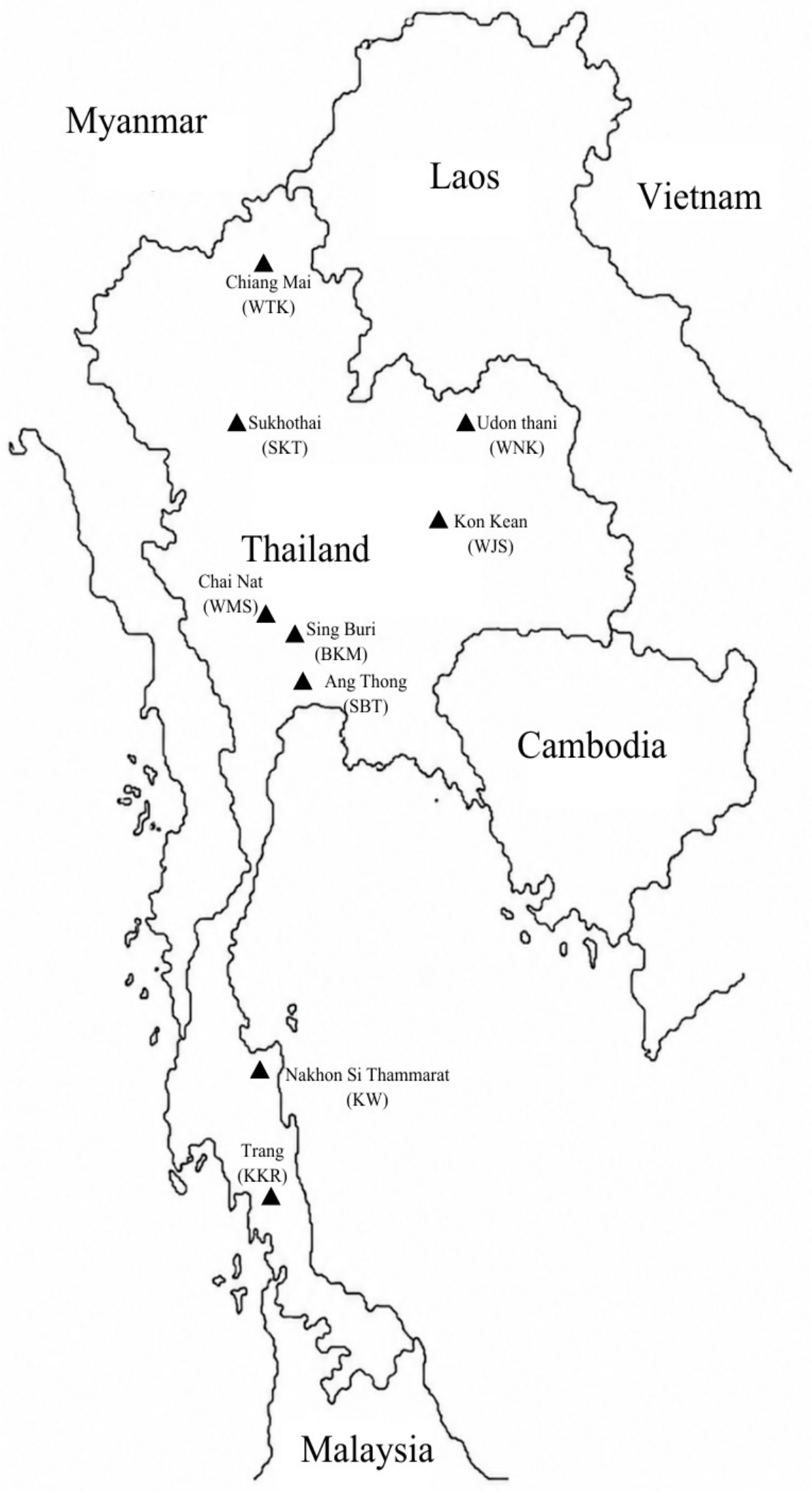
Figure 1. The locations of nine archaeological sites; Wat Nakathewi (WNK), Si Bua Thong (SBT), Wat Jomsri (WJS), Khao Khuram (KKR), Ban Khumuang (BKM), Wiang Thakan (WTK), Kok Wat (KW), Wat Mahathat Sanburi (WMS), and Sukhothai Historical Park (SKT).
Animals 16 01904 g001
Figure 2. The phylogenetic relationships between the ancient Thai cattle (KKR1, KKR2, KKR3, and SKT1) in this study and available 124 D-loop sequences of Bos taurus and Bos indicus from the GenBank database. I1, I2, and I3 represent clades of B. indicus, while T represents a clade of B. taurus. Bootstrap values (only those ≥ 50% are shown), indicating the percentages of 1000 replicates, are presented at each node. B. javanicus was used as the outgroup.
Animals 16 01904 g002
Figure 3. A haplotype network of D-loop sequences from ancient Thai cattle in this study (H1) and modern B. indicus from South Asia, East Asia, MSEA, and ISEA. The size of each circle is proportional to the number of sequences. Different cattle populations are shown by separate colours. The black dots that cross the lines on each branch indicate the number of mutations.
Animals 16 01904 g003
Table 1. Details of ancient specimens and results of D-loop amplification and sequencing.
Lab CodeSkeletal ElementArchaeological Site, ProvinceAge (YBP)Dating Method *PeriodSuccessful Amplifications and Sequencing
WNK1Long boneWat Nakathewi, Udon Thani3400–3200AMS of the artifact found nearbyPrehistoricNo
WNK2MetacarpalNo
WNK3HumerusNo
WNK4FemurNo
WNK5MandibleNo
SBT1
SBT2
Grand cuneiform
Long bone
Si Bua Thong, Ang Thong3000–2500Relative dating based on pottery pattern found nearbyPrehistoricNo
No
WJS1RadiusWat Jomsri, Khon Kean2400–1800AMS of the artifact found nearbyPrehistoricNo
WJS2Long boneNo
WJS3MetacarpalNo
WJS4RadiusNo
KKR1FemurKhao Khuram, Trang1700–1500AMS of the artifact found nearbyLate prehistoric-
early historic
Yes
KKR2PhalangeYes
KKR3ToothYes
BKM1TibiaBan Khumuang, Sing Buri1400–1000Relative dating based on Dvaravati-period artifactsHistoric
(Dvaravati)
No
BKM2FemurNo
BKM3RadiusNo
WTK1RadiusWiang Thakan, Chiang Mai1300–1000AMS of the artifact found nearbyHistoricNo
WTK2ScapulaNo
WTK3RadiusNo
KW1FemurKok Wat, Nakhon Si Thammarat1300–1000TL of the artifact found nearbyHistoricNo
SKT1MetacarpalSukhothai Historical Park,
Sukhothai
850–650Relative dating based on Sukhothai ceramics found nearbyHistoricYes
SKT2MetacarpalNo
WMS1Long boneWat Mahatat Sanburi, Chai Nat700–600AMS of the artifact found nearbyHistoricNo
WMS2RadiusNo
WMS3MetatarsusNo
* AMS = Accelerator Mass Spectrometry; TL = Thermoluminescence.
Disclaimer/Publisher’s Note: The statements, opinions and data contained in all publications are solely those of the individual author(s) and contributor(s) and not of MDPI and/or the editor(s). MDPI and/or the editor(s) disclaim responsibility for any injury to people or property resulting from any ideas, methods, instructions or products referred to in the content.