Influence of Dietary Supplementation with a Blend of Essential Oils, Tannins and Bioflavonoids on Milk Yield and Nutritional Properties and on Economic Sustainability of Buffalo Breeding

 , ,
, ,  and
and 
Simple Summary
Abstract
1. Introduction
2. Materials and Methods
2.1. Animals and Diets
2.2. Feed Analysis
2.3. Milk Analysis
2.4. Statistical Analysis
3. Results and Discussions
4. Economic Analysis
5. Conclusions
Author Contributions
Funding
Institutional Review Board Statement
Informed Consent Statement
Data Availability Statement
Acknowledgments
Conflicts of Interest
References
- Bhat, R.; Infascelli, F. The path to sustainable dairy industry: Addressing challenges and embracing opportunities. Sustainability 2025, 17, 3766. [Google Scholar] [CrossRef]
- Priyashantha, H. World dairy system sustainability: A milk quality perspective. Front. Sustain. Resour. Manag. 2025, 4, 1572962. [Google Scholar] [CrossRef]
- Pirondini, M.; Colombini, S.; Malagutti, L.; Rapetti, L.; Galassi, G.; Zanchi, R.; Crovetto, G.M. Effects of a selection of additives on in vitro ruminal methanogenesis and in situ and in vivo NDF digestibility. Anim. Feed Sci. Technol. 2015, 206, 14–22. [Google Scholar]
- García-Lozano, M.; Peña García, Y.; Arellano, K.; Lopez-Ortiz, C.; Balagurusamy, N. Livestock Methane Emission: Microbial Ecology and Mitigation Strategies; IntechOpen: London, UK, 2017. [Google Scholar]
- Belanche, A.; Newbold, C.J.; Morgavi, D.P.; Bach, A.; Zweifel, B.; Yáñez-Ruiz, D.R. A meta-analysis describing the effects of the essential oils blend Agolin Ruminant on performance, rumen fermentation and methane emissions in dairy cows. Animals 2020, 10, 620. [Google Scholar] [CrossRef] [PubMed]
- Grossi, S.; Compiani, R.; Rossi, L.; Dell’Anno, M.; Castillo, I.; Sgoifo Rossi, C.A. Effect of Slow-Release Urea Administration on Production Performance, Health Status, Diet Digestibility, and Environmental Sustainability in Lactating Dairy Cows. Animals 2021, 11, 2405. [Google Scholar] [CrossRef]
- European Commission. Regulation (EC) No. 1831/2003 of the European Parliament and of the Council of 22 September 2003 on Additives for Use in Animal Nutrition; European Commission: Brussels, Belgium, 2003; Available online: https://eur-lex.europa.eu/legal-content/EN/TXT/PDF/?uri=CELEX:32003R1831&rid=10 (accessed on 1 September 2025).
- Franz, C.; Baser, K.; Windisch, W. Essential oils and aromatic plants in animal feeding: A European perspective. Flavour Fragr. J. 2010, 25, 327–340. [Google Scholar] [CrossRef]
- Shen, J.; Liu, Z.; Yu, Z.; Zhu, W. Monensin and Nisin Affect Rumen Fermentation and Microbiota Differently In Vitro. Front. Microbiol. 2017, 8, 111. [Google Scholar] [CrossRef] [PubMed]
- Morittu, V.M.; Spina, A.A.; Iommelli, P.; Poerio, A.; Oliverio, F.V.; Britti, D.; Tudisco, R. Effect of integration of linseed and vitamin E in Charolaise × Podolica bulls’ diet on fatty acids profile, beef color and lipid stability. Agriculture 2021, 11, 1032. [Google Scholar] [CrossRef]
- Iommelli, P.; Spina, A.A.; Vastolo, A.; Infascelli, L.; Lotito, D.; Musco, N.; Tudisco, R. Functional and economic role of some Mediterranean medicinal plants in dairy ruminants’ feeding: A review of the effects of garlic, oregano, and rosemary. Animals 2025, 15, 657. [Google Scholar] [CrossRef]
- Bolouri, P.; Salami, R.; Kouhi, S.; Kordi, M.; Asgari Lajayer, B.; Hadian, J.; Astatkie, T. Applications of essential oils and plant extracts in different industries. Molecules 2022, 27, 8999. [Google Scholar] [CrossRef]
- Nehme, R.; Andrés, S.; Pereira, R.B.; Jemaa, M.B.; Bouhallab, S.; Ceciliani, F.; López, S.; Rahali, F.Z.; Ksouri, R.; Pereira, D.M.; et al. Essential oils in livestock: From health to food quality. Antioxidants 2021, 10, 330. [Google Scholar] [CrossRef] [PubMed]
- Bakkali, F.; Averbeck, S.; Averbeck, D.; Idaomar, M. Biological effects of essential oils—A review. Food Chem. Toxicol. 2008, 46, 446–475. [Google Scholar] [CrossRef] [PubMed]
- Coimbra, A.; Ferreira, S.; Duarte, A.P. Biological properties of Thymus zygis essential oil with emphasis on antimicrobial activity and food application. Food Chem. 2022, 393, 133370. [Google Scholar] [CrossRef] [PubMed]
- Calsamiglia, S.; Busquet, M.; Cardozo, P.; Castillejos, L.; Ferret, A. Invited review: Essential oils as modifiers of rumen microbial fermentation. J. Dairy Sci. 2007, 90, 2580–2595. [Google Scholar] [CrossRef]
- Benchaar, C.; Petit, H.V.; Berthiaume, R.; Whyte, T.D.; Chouinard, P.Y. Effects of addition of essential oils and monensin premix on digestion, ruminal fermentation, milk production, and milk composition in dairy cows. J. Dairy Sci. 2006, 89, 4352–4364. [Google Scholar] [CrossRef]
- Zhou, R.; Wu, J.; Lang, X.; Liu, L.; Casper, D.P.; Wang, C.; Zhang, L.; Wei, S. Effects of oregano essential oil on in vitro ruminal fermentation, methane production, and ruminal microbial community. J. Dairy Sci. 2019, 103, 2303–2314. [Google Scholar] [CrossRef]
- Elazab, M.A.; Zahran, S.M.; Elkomy, A.E.; Ahmed, M.H.; Kholif, A.E. Performance of Holstein dairy cows fed a diet supplemented with rosemary and ginger essential oils: Milk production, milk fatty acid, and ruminal fermentation. Ann. Anim. Sci. 2025, 25, 611–622. [Google Scholar] [CrossRef]
- Daning, D.; Widyobroto, B.; Yusiati, L.M.; Hanim, C. Effect of galangal (Alpinia galanga) essential oil supplementation on milk production, composition, and characteristics of fatty acids in dairy cows. Adv. Anim. Vet. Sci. 2022, 10, 192–202. [Google Scholar]
- Kung, L., Jr.; Williams, P.; Schmidt, R.J.; Hu, W. A blend of essential plant oils used as an additive to alter silage fermentation or used as a feed additive for lactating dairy cows. J. Dairy Sci. 2008, 91, 4793–4800. [Google Scholar] [CrossRef]
- Tekippe, J.A.; Tacoma, R.; Hristov, A.N.; Lee, C.; Oh, J.; Heyler, K.S.; Cassidy, T.W.; Varga, G.A.; Bravo, D. Effect of essential oils on ruminal fermentation and lactation performance of dairy cows. J. Dairy Sci. 2013, 96, 7892–7903. [Google Scholar] [CrossRef]
- Bassolé, I.H.N.; Juliani, H.R. Essential Oils in Combination and Their Antimicrobial Properties. Molecules 2012, 17, 3989–4006. [Google Scholar] [CrossRef]
- Bag, A.; Chattopadhyay, R.R. Evaluation of synergistic antibacterial and antioxidant efficacy of essential oils of spices and herbs in combination. PLoS ONE 2015, 10, e0131321. [Google Scholar] [CrossRef] [PubMed]
- Hart, K.J.; Jones, H.G.; Waddams, K.E.; Worgan, H.J.; Zweifel, B.; Newbold, C.J. An essential oil blend decreases methane emissions and increases milk yield in dairy cows. Open J. Anim. Sci. 2019, 9, 259–267. [Google Scholar] [CrossRef]
- Bach, A.; Elcoso, G.; Escartín, M.; Spengler, K.; Jouve, A. Modulation of milking performance, methane emissions, and rumen microbiome on dairy cows by dietary supplementation of a blend of essential oils. Animal 2023, 17, 100825. [Google Scholar] [CrossRef]
- Rossi, C.A.S.; Grossi, S.; Dell’Anno, M.; Compiani, R.; Rossi, L. Effect of a blend of essential oils, bioflavonoids and tannins on in vitro methane production and in vivo production efficiency in dairy cows. Animals 2022, 12, 728. [Google Scholar] [CrossRef] [PubMed]
- Abo-Donia, F.M.; Elaref, M.Y.; Mahgoub, A.E.-M.A.S.; Deraz, T.A.-E.A.; Nayel, U.A. Influence of diets supplemented with naturally protected or unprotected eucalyptus oil on methane production and lactating buffalo productivity. Trop. Anim. Health Prod. 2022, 54, 11. [Google Scholar] [CrossRef]
- Borghese, A.; Chiarotti, A.; Barile, V.L. Buffalo in the world: Situation and perspectives. In Biotechnological Applications in Buffalo Research; Springer: Singapore, 2022; pp. 3–31. [Google Scholar]
- Lotito, D.; Pacifico, E.; Matuozzo, S.; Musco, N.; Iommelli, P.; Zicarelli, F.; Tudisco, R.; Infascelli, F.; Lombardi, P. Colostrum composition, characteristics and management for buffalo calves: A review. Vet. Sci. 2023, 10, 358. [Google Scholar] [CrossRef]
- Prodotti Tipici Della Campania. Available online: https://agricoltura.regione.campania.it/tipici/mozzarella-bufala.html (accessed on 3 March 2026).
- Infascelli, F.; Gigli, S.; Campanile, G. Buffalo meat production: Performance infra-vitam and quality of meat. Vet. Res. 2004, 28, 143–148. [Google Scholar] [CrossRef]
- Wanapat, M. Comparative Aspects of Digestive Physiology and Nutrition in Buffaloes and Cattle. In Proceedings of Ruminant Physiology and Nutrition in Asia; Devendra, C., Imaizumi, E., Eds.; Japanese Society of Zootechnical Science: Sendai, Japan, 1989; pp. 27–43. [Google Scholar]
- Franzolin, M.H.T.; Silveira, A.C.; Franzolin, R. Efeitos de Dietas com Diferentes Níveis de Fibra em Detergente Neutro e do Tamanho de Poros de Sacos de Náilon Incubados no Rúmen sobre a Fauna Ruminal em Bubalinos e Bovinos. R. Bras. Zootec. 2002, 31, 716–723. [Google Scholar] [CrossRef][Green Version]
- Restitrisnani, V.; Sholihah, L.M.; Mukminah, N.; Ryanuari, R.G.; Luthfi, N.; A Prawoto, J.; Rianto, E.; Purnomoadi, A. Buffalo Is More Environmentally Friendly than Cattle Based on N Excretion. IOP Conf. Ser. Earth Environ. Sci. 2019, 247, 012050. [Google Scholar] [CrossRef]
- Campanile, G.; Di Palo, R.; Infascelli, F.; Gasparrini, B.; Neglia, G.; Zicarelli, F.; D’Occhio, M.J. Influence of rumen protein degradability on productive and reproductive performance in buffalo cows. Reprod. Nutr. Dev. 2003, 43, 557–566. [Google Scholar] [CrossRef]
- Cutrignelli, M.I.; Piccolo, G.; D’Urso, S.; Calabrò, S.; Bovera, F.; Tudisco, R.; Infascelli, F. Urinary excretion of purine derivatives in dry buffalo and Friesian cows. Ital. J. Anim. Sci. 2007, 6, 563–566. [Google Scholar] [CrossRef]
- Hristov, A.N.; Bannink, A.; Crompton, L.A.; Huhtanen, P.; Kreuzer, M.; McGee, M.; Nozière, P.; Reynolds, C.K.; Bayat, A.R.; Yáñez-Ruiz, D.R.; et al. Invited review: Nitrogen in ruminant nutrition: A review of measurement techniques. J. Dairy Sci. 2019, 102, 5811–5852. [Google Scholar] [CrossRef]
- Anitha, A.; Rao, K.S.; Suresh, J.; Moorthy, P.S.; Reddy, Y.K. A body condition score (BCS) system in Murrah buffaloes. Buffalo Bull. 2011, 30, 79–96. [Google Scholar]
- AOAC (Association of Official Analytical Chemists). Official Methods of Analysis of AOAC International, 20th ed.; AOAC International: Gaithersburg, MD, USA, 2015. [Google Scholar]
- Van Soest, P.J.; Robertson, J.B.; Lewis, B.A. Methods for dietary fiber, neutral detergent fiber, and nonstarch polysaccharides in relation to animal nutrition. J. Dairy Sci. 1991, 74, 3583–3597. [Google Scholar] [CrossRef] [PubMed]
- INRA. Feeding System for Ruminants; Wageningen Academic Publishers: Wageningen, The Netherlands, 2018. [Google Scholar]
- Folch, J.; Lees, M.; Sloane, G.H. A simple method for isolation and purification of total lipids from animal tissues. J. Biol. Chem. 1957, 226, 497–509. [Google Scholar] [CrossRef]
- Christie, W.W. Preparation of ester derivatives of fatty acids for chromatographic analysis. In Advances in Lipid Methodology; Oily Press: Bridgwater, UK, 1993; Volume 2, pp. 69–111. [Google Scholar]
- Hara, A.; Radin, N.S. Lipid Extraction of Tissues with a Low-Toxicity Solvent. Anal. Biochem. 1978, 90, 420–426. [Google Scholar] [CrossRef]
- Chouinard, P.Y.; Corneau, L.; Barbano, D.M.; Metzger, L.E.; Bauman, D.E. Conjugated linoleic acids alter milk fatty acid composition and inhibit milk fat secretion in dairy cows. J. Nutr. 1999, 129, 1579–1584. [Google Scholar] [CrossRef] [PubMed]
- Altiero, V.; Moio, L.; Addeo, F. Previsione della resa in mozzarella sulla base del contenuto in grasso e proteine del latte di bufala. Sci. Tec. Latt. Casearia 1989, 40, 425–433. [Google Scholar]
- Qamar, S.; Naveed ul Haque, M.; Hifzulrahman, M.; Asim Tausif, M.; Ahmad Khan, M.; Ullah Khan, E.; Hussain, J.; Tahir, H.; Anwar, S.; Saadullah, M.; et al. Effect of Grinding Size of Corn Grains at Two Starch Levels on Lactation Performance of Nili Ravi Buffaloes. J. Xi’an Shiyou Univ. Nat. Sci. Ed. 2024, 1–25. Available online: http://xisdxjxsu.asia (accessed on 25 January 2024).
- Infascelli, L.; Musco, N.; Iommelli, P.; Vassalotti, G.; Capezzuto, F.; Zicarelli, F.; Morittu, V.M.; Spina, A.A.; Infascelli, F.; Tudisco, R. Diet with high forage: Concentrate ratio improves milk nutritional properties and economic sustainability of buffalo breeding. Animals 2025, 15, 2050. [Google Scholar] [CrossRef] [PubMed]
- Arvidsson, K.; Gustavsson, A.M.; Martinsson, K. Effects of conservation method on fatty acid composition of silage. Anim. Feed Sci. Technol. 2009, 148, 241–252. [Google Scholar] [CrossRef]
- Capezzuto, F.; Infascelli, L.; Iommelli, P.; Franco, F.; Infascelli, F.; Tudisco, R. Inclusion of green fodder sorghum in the diet of lactating buffalo cows: Influence on milk yield and composition, and economic sustainability. Front. Vet. Sci. 2026, 13, 1758156. [Google Scholar] [CrossRef] [PubMed]
- Zicarelli, F.; Vianello, R.C.; Masiello, I.; Musco, N.; Iommelli, P.; Wanapat, M.; Lotito, D.; Lombardi, P.; Grossi, M.; Infascelli, F.; et al. Saccharomyces cerevisiae diet supplementation affects nutrient digestibility and milk and mozzarella cheese yield in dairy buffalo cows during the transition. Animals 2024, 14, 3689. [Google Scholar] [CrossRef]
- Peyraud, J.L.; Cellier, P.; Donnars, C.; Aarts, F.; Beline, F.; Bockstaller, C.; Veysset, P. Les flux d’azote en élevage de ruminants. Rencontres Rech. Rumin. 2012, 19, 41–48. [Google Scholar]
- Braun, H.-S.; Schrapers, K.T.; Mahlkow-Nerge, K.; Stumpff, F.; Rosendahl, J. Dietary supplementation of essential oils in dairy cows: Evidence for stimulatory effects on nutrient absorption. Animal 2019, 13, 518–523. [Google Scholar] [CrossRef]
- Ugbogu, E.A.; Elghandour, M.M.M.Y.; Ikpeazu, V.O.; Buendía, G.R.; Molina, O.M.; Arunsi, U.O.; Emmanuel, O.; Salem, A.Z.M. The potential impacts of dietary plant natural products on the sustainable mitigation of methane emission from livestock farming. J. Clean. Prod. 2019, 213, 915–925. [Google Scholar] [CrossRef]
- Giannenas, I.; Skoufos, J.; Giannakopoulos, C.; Wiemann, M.; Gortzi, O.; Lalas, S.; Kyriazakis, I. Effects of essential oils on milk production, milk composition, and rumen microbiota in Chios dairy ewes. J. Dairy Sci. 2011, 94, 5569–5577. [Google Scholar] [CrossRef] [PubMed]
- Benchaar, C.; Petit, H.V.; Berthiaume, R.; Ouellet, D.R.; Chiquette, J.; Chouinard, P.Y. Effects of essential oils on digestion, ruminal fermentation, rumen microbial populations, milk production, and milk composition in dairy cows fed alfalfa silage or corn silage. J. Dairy Sci. 2007, 90, 886–897. [Google Scholar] [CrossRef]
- Nousiainen, J.; Shingfield, K.J.; Huhtanen, P. Evaluation of milk urea nitrogen as a diagnostic of protein feeding. J. Dairy Sci. 2004, 87, 386–398. [Google Scholar] [CrossRef]
- Caprarulo, V.; Scaglia, E.; Simonetto, A.; Ferronato, G.; Sergi, V.; Giagnoni, L.; Gilioli, G. Modelling nitrogen excretion in dairy cows: An application to farms in the Po Valley (Italy). Animals 2026, 16, 294. [Google Scholar] [CrossRef]
- Entrena-Barbero, E.; Tarpani, R.R.Z.; Fernández, M.; Moreira, M.T.; Gallego-Schmid, A. Integrating circularity as an essential pillar of dairy farm sustainability. J. Clean. Prod. 2024, 458, 142508. [Google Scholar] [CrossRef]
- Díaz de Otálora, X.; Amon, B.; Balaine, L.; Dragoni, F.; Estellés, F.; Ragaglini, G.; Kieronczyk, M.; Jørgensen, G.H.M.; del Prado, A. Influence of farm diversity on nitrogen and greenhouse gas emission sources from key European dairy cattle systems: A step towards emission mitigation and nutrient circularity. Agric. Syst. 2024, 216, 103902. [Google Scholar] [CrossRef]
- Galloway, J.N.; Cowling, E.B. Reactive nitrogen and the world: 200 years of change. AMBIO J. Hum. Environ. 2002, 31, 64–71. [Google Scholar] [CrossRef]
- McCubbin, D.R.; Apelberg, B.J.; Roe, S.; Divita, F. Livestock Ammonia Management and Particulate-Related Health Benefits. Environ. Sci. Technol. 2002, 36, 1141–1146. [Google Scholar] [CrossRef]
- Motavalli, P.P.; Goyne, K.W.; Udawatta, R.P. Environmental Impacts of Enhanced-Efficiency Nitrogen Fertilizers. Crop Manag. 2008, 7, 1–15. [Google Scholar] [CrossRef]
- Caprarulo, V.; Ventura, V.; Amatucci, A.; Ferronato, G.; Gilioli, G. Innovations for reducing methane emissions in livestock toward a sustainable system: Analysis of feed additive patents in ruminants. Animals 2022, 12, 2760. [Google Scholar] [CrossRef]
- Al Rharad, A.; El Aayadi, S.; Avril, C.; Souradjou, A.; Sow, F.; Camara, Y.; Hornick, J.-L.; Boukrouh, S. Meta-Analysis of Dietary Tannins in Small Ruminant Diets: Effects on Growth Performance, Serum Metabolites, Antioxidant Status, Ruminal Fermentation, Meat Quality, and Fatty Acid Profile. Animals 2025, 15, 596. [Google Scholar] [CrossRef]
- Trinchese, G.; Cavaliere, G.; Penna, E.; De Filippo, C.; Cimmino, F.; Catapano, A.; Musco, N.; Tudisco, R.; Lombardi, P.; Infascelli, F.; et al. Milk from cow fed with high forage/concentrate ratio diet: Beneficial effect on rat skeletal muscle inflammatory state and oxidative stress through modulation of mitochondrial functions and AMPK activity. Front. Physiol. 2019, 9, 1969. [Google Scholar] [CrossRef]
- Song, J.; Wang, Y.; Fan, X.; Wu, H.; Han, J.; Yang, M.; Lu, L.; Nie, G. Trans-vaccenic acid inhibits proliferation and induces apoptosis of human nasopharyngeal carcinoma cells via a mitochondrial-mediated apoptosis pathway. Lipids Health Dis. 2019, 18, 46. [Google Scholar] [CrossRef]
- Degen, C.; Lochner, A.; Keller, S.; Kuhnt, K.; Dänicke, S.; Jahreis, G. Influence of in vitro supplementation with lipids from conventional and alpine milk on fatty acid distribution and cell growth of HT-29 cells. Lipids Health Dis. 2011, 10, 131. [Google Scholar] [CrossRef]
- Lim, J.-N.; Oh, J.-J.; Wang, T.; Lee, J.-S.; Kim, S.-H.; Kim, Y.-J.; Lee, H.-G. trans-11 18:1 Vaccenic Acid (TVA) Has a Direct Anti-Carcinogenic Effect on MCF-7 Human Mammary Adenocarcinoma Cells. Nutrients 2014, 6, 627–636. [Google Scholar] [CrossRef]
- Dyerberg, J.; Bang, H.O.; Hjorne, N. Fatty acid composition of the plasma lipids in Greenland Eskimos. Am. J. Clin. Nutr. 1975, 28, 958–966. [Google Scholar] [CrossRef]
- Bang, H.O.; Dyerberg, J.; Sinclair, H.M. The composition of the Eskimo food in north western Greenland. Am. J. Clin. Nutr. 1980, 33, 2657–2661. [Google Scholar] [CrossRef]
- Albert, C.M.; Campos, H.; Stampfer, M.J.; Ridker, P.M.; Manson, J.E.; Willett, W.C.; Ma, J. Blood levels of long-chain n-3 fatty acids and the risk of sudden death. N. Engl. J. Med. 2002, 346, 1113–1118. [Google Scholar] [CrossRef]
- Shearer, G.C.; Savinova, O.V.; Harris, W.S. Fish oil—How does it reduce plasma triglycerides? Biochim. Biophys. Acta 2012, 1821, 843–851. [Google Scholar] [CrossRef]
- Guo, X.F.; Li, K.L.; Li, J.M.; Li, D. Effects of EPA and DHA on blood pressure and inflammatory factors: A meta-analysis of randomized controlled trials. Crit. Rev. Food Sci. Nutr. 2019, 59, 3380–3393. [Google Scholar] [CrossRef]
- Jiao, J.; Li, Q.; Chu, J.; Zeng, W.; Yang, M.; Zhu, S. Effect of n-3 PUFA supplementation on cognitive function throughout the life span from infancy to old age: A systematic review and meta-analysis of randomized controlled trials. Am. J. Clin. Nutr. 2014, 100, 1422–1436. [Google Scholar] [CrossRef]
- Baker, E.J.; Cumberford, G.; Hanaway, P. Recognizing the health benefits of plant-sourced omega-3 stearidonic acid: Exploring its complementary role to preformed EPA/DHA. Lipids 2025, 60, 435–442. [Google Scholar] [CrossRef]
- Boukrouh, S.; Noutfia, A.; Moula, N.; Avril, C.; Hornick, J.-L.; Chentouf, M.; Cabaraux, J.-F. Effects of Sulla Flexuosa Hay as Alternative Feed Resource on Goat’s Milk Production and Quality. Animals 2023, 13, 709. [Google Scholar] [CrossRef]
- Boukrouh, S.; Karouach, F.; El Aayadi, S.; El Amiri, B.; Hornick, J.L.; Nilahyane, A.; Hirich, A. A systematic review and meta-analysis of the effects of inclusion of microalgae in dairy cows’ diets on nutrient digestibility, fermentation parameters, blood metabolites, milk production, and fatty acid profiles. Arch. Anim. Breed. 2026, 69, 101–115. [Google Scholar] [CrossRef]
- Boukrouh, S.; Mnaouer, I.; Mendes de Souza, P.; Hornick, J.L.; Nilahyane, A.; El Amiri, B.; Hirich, A. Microalgae supplementation improves goat milk composition and fatty acid profile: A meta-analysis and meta-regression. Arch. Anim. Breed. 2025, 68, 223–238. [Google Scholar] [CrossRef]
- Zicarelli, L.; Neglia, G.; Napolano, R.; Rubbio, D.; Caso, C.; Gasparrini, B.; Palo, D. Correction of the ratio between real cheese yield at 28 hours and protein according to chemical composition of buffalo milk. Ital. J. Anim. Sci. 2007, 6, 1108–1111. [Google Scholar] [CrossRef][Green Version]
- Palo, D.; Napolano, R.; Potena, A.; Galiero, G.; Fusco, G.; Gasparrini, B.; Zicarelli, F. Relationship among the cheese yield, the characteristics of the curd and those of buffalo milk. Ital. J. Anim. Sci. 2007, 6, 1096–1099. [Google Scholar] [CrossRef]
- Zicarelli, L.; Potena, A.; Rubbio, D.; Coletta, A.; Gasparrini, B.; Palo, D.; Di Rubbio, M.; Caso, C.; Di Palo, R. Estimation of buffalo cheese yield by using the chemical-physical parameters of the milk. Ital. J. Anim. Sci. 2007, 6, 1100–1103. [Google Scholar] [CrossRef]



| Sorghum silage | 10.0 |
| Grass silage * | 8.0 |
| Alfalfa hay | 3.0 |
| Polyphyte hay ** | 1.5 |
| Corn mash | 5.0 |
| Wheat meal | 2.0 |
| Wheat distillers | 1.0 |
| Commercial concentrate *** | 3.1 |
| Vit-min mix | 0.3 |
| CP | 139.7 ± 4.0 |
| EE | 38.2 ± 1.2 |
| CF | 235.4 ± 5.4 |
| NDF | 398.5 ± 1.1 |
| ADF | 204.3 ± 7.2 |
| ADL | 52.1 ± 1.3 |
| Ashes | 76.4 ± 2.0 |
| Starch | 266.3 ± 8.4 |
| UFL/kg DM | 0.91 |
| ∑ SFA | 22.7 ± 1.1 |
| ∑ MUFA | 20.3 ± 2.0 |
| ∑ PUFA | 57.0 ± 3.2 |
| ω6 PUFA | 30.6 ± 1.4 |
| ω3 PUFA | 26.4 ± 1.7 |
| BCS | DMI | MY | ||||
|---|---|---|---|---|---|---|
| Sampling Points | C | T | C | T | C | T |
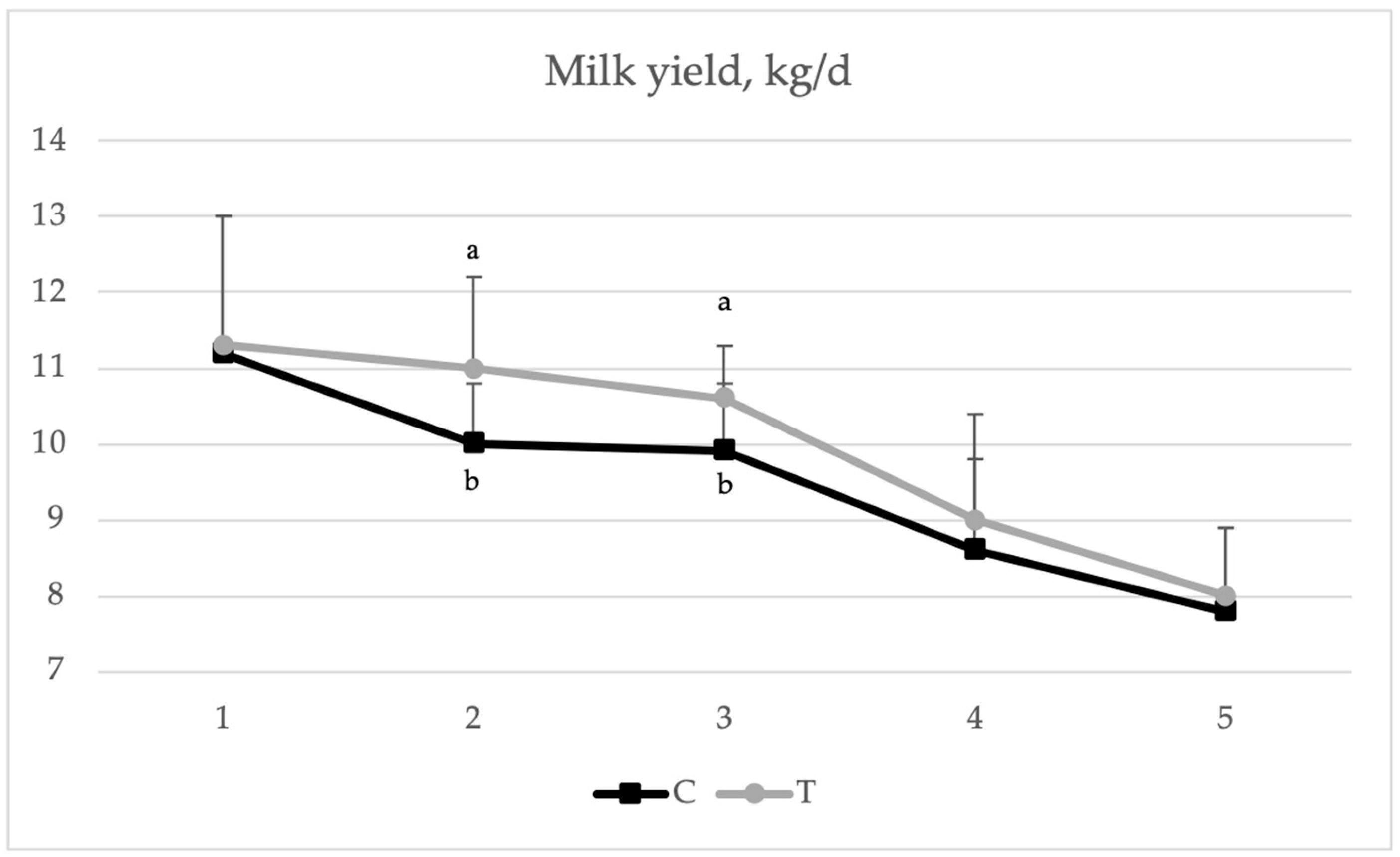
| 3.2 | 3.3 | 17.1 | 17.3 | 9.5 | 10.0 | |
| 1 | 3.1 | 3.2 | 17.0 | 17.1 | 11.2 | 11.3 |
| 2 | 3.2 | 3.2 | 17.0 | 17.1 | 10.0 b | 11.0 a |
| 3 | 3.2 | 3.3 | 17.1 | 17.3 | 9.9 b | 10.6 a |
| 4 | 3.2 | 3.3 | 17.1 | 17.4 | 8.6 | 9.0 |
| 5 | 3.3 | 3.3 | 17.1 | 17.4 | 7.8 | 8.0 |
| p G | NS | NS | NS | |||
| p S | NS | NS | * | |||
| p G x S | NS | NS | * | |||
| RMSE | 0.08 | 0.18 | 2.24 | |||
| Fat | Protein | Lactose | MUN | |||||
|---|---|---|---|---|---|---|---|---|
| Sampling Points | C | T | C | T | C | T | C | T |
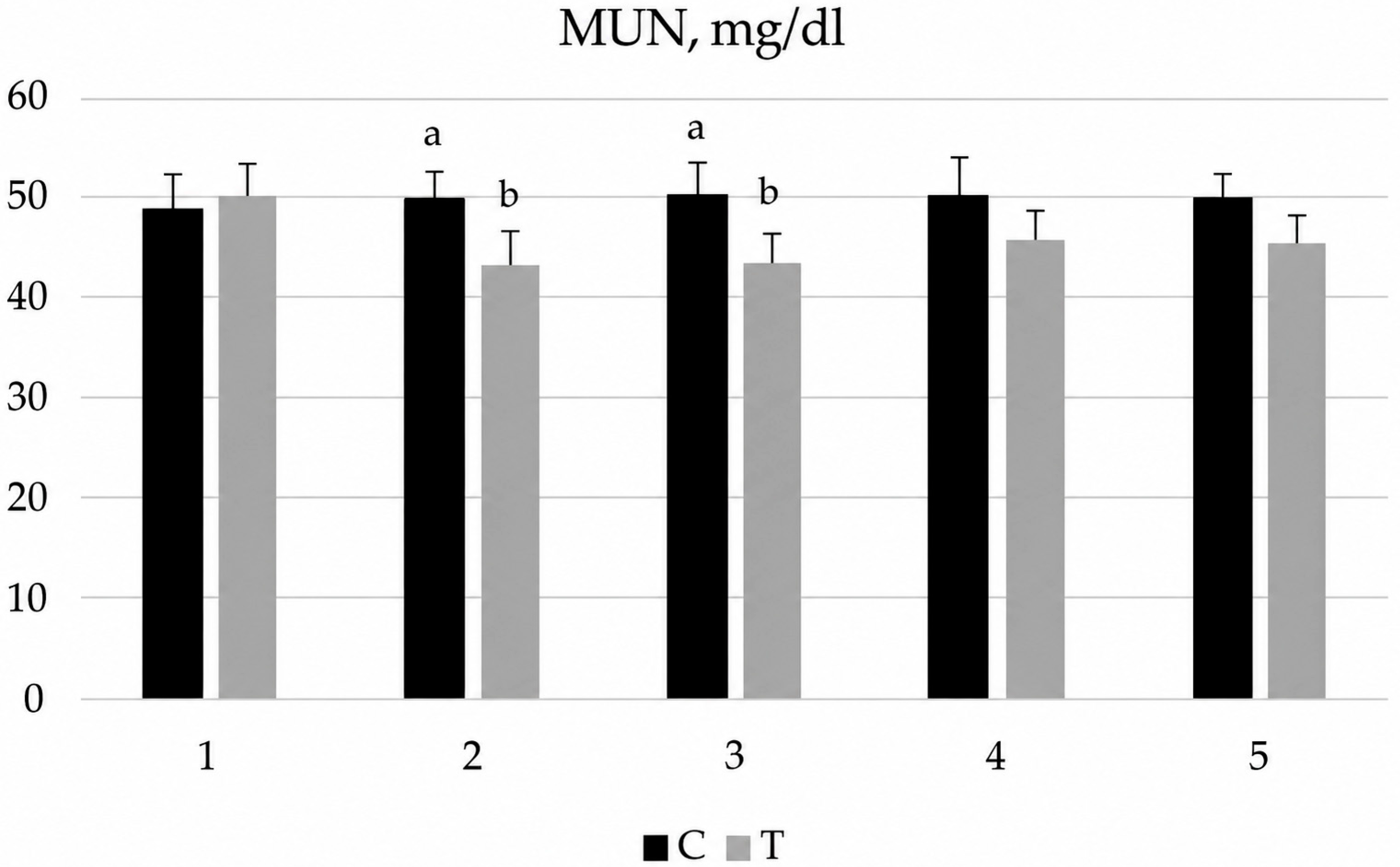
| 8.1 | 8.1 | 4.7 | 4.7 | 5.1 | 5.0 | 49.7 a | 45.6 b | |
| 1 | 7.5 | 7.4 | 4.7 | 4.6 | 4.9 | 5.0 | 48.7 | 49.5 |
| 2 | 7.8 | 7.5 | 4.5 | 4.7 | 5.3 | 5.1 | 49.6 a | 43.2 b |
| 3 | 8.0 | 8.0 | 4.7 | 4.6 | 5.1 | 5.1 | 50.3 a | 43.4 b |
| 4 | 8.6 | 8.8 | 4.8 | 4.9 | 5.0 | 5.0 | 50.0 a | 45.9 b |
| 5 | 8.8 | 9.1 | 4.7 | 4.8 | 5.0 | 5.0 | 50.0 a | 45.6 b |
| p G | NS | NS | NS | * | ||||
| p S | ** | ** | ** | * | ||||
| p G x S | NS | NS | NS | * | ||||
| RMSE | 1.11 | 0.323 | 2.81 | 9.11 | ||||
| Group | C | T | p G | p S | p G x S | RMSE |
|---|---|---|---|---|---|---|
| SFA | 72.2 | 68.7 | NS | NS | NS | 11.64 |
| MUFA | 24.8 | 22.44 | NS | NS | NS | 5.51 |
| PUFA | 2.49 | 2.47 | NS | NS | NS | 0.317 |
| ω6 | 1.91 | 1.75 | NS | NS | NS | 0.236 |
| ω3 | 0.159 | 0.159 | NS | NS | NS | 0.04 |
| CLA | 0.412 | 0.363 | NS | NS | NS | 0.106 |
| PUFA/SFA | 0.034 | 0.031 | NS | NS | NS | 0.005 |
| ω6/ω3 | 12.35 | 11.78 | NS | NS | NS | 2.79 |
| LA/ALA | 16.9 | 16.13 | NS | NS | NS | 4.7 |
| AA/EPA | 2.81 | 2.27 | NS | * | NS | 0.75 |
| C | T | p G | p S | p G x S | RMSE | |
|---|---|---|---|---|---|---|
| C4:0 | 3.610 | 3.905 | NS | NS | NS | 0.904 |
| C6:0 | 1.483 | 1.545 | NS | NS | NS | 0.229 |
| C8:0 | 1.267 | 1.035 | NS | NS | NS | 0.559 |
| C10:0 | 2.976 | 2.384 | NS | NS | NS | 1.366 |
| C11:0 | 0.090 | 0.079 | NS | NS | NS | 0.848 |
| C12:0 | 3.119 | 3.012 | NS | NS | NS | 0.956 |
| C13:0 | 0.085 | 0.082 | NS | NS | NS | 0.049 |
| C14:0 | 12.71 | 12.84 | NS | NS | NS | 1.423 |
| C14:1 | 0.318 | 0.353 | NS | NS | NS | 0.136 |
| C15:0 | 0.828 | 0.860 | NS | NS | NS | 0.254 |
| C16:0 | 35.91 | 35.95 | NS | NS | NS | 2.720 |
| C16:1 | 1.997 | 2.02 | NS | NS | NS | 0.737 |
| C17:0 | 0.455 | 0.315 | NS | NS | NS | 0.182 |
| C18:1 cis 6 | 0.131 | 0.073 | NS | NS | NS | 0.079 |
| C18:0 | 9.58 | 10.27 | NS | NS | NS | 1.510 |
| C18:1 trans 9 | 0.216 | 0.338 | NS | NS | NS | 0.180 |
| C18:1 trans 11 ω7 (TVA) | 1.316 b | 1.605 a | * | NS | NS | 0.352 |
| C18:1 cis 9 ω9 | 20.38 | 19.94 | NS | NS | NS | 1.779 |
| C18:1 cis 11 ω7 | 0.143 | 0.177 | NS | NS | NS | 0.073 |
| C18:1 cis 12 | 0.049 | 0.046 | NS | NS | NS | 0.031 |
| C18:2 trans ω6 | 0.036 | 0.040 | NS | NS | NS | 0.047 |
| C18:2 cis ω6 (LA) | 1.727 | 1.607 | NS | NS | NS | 0.212 |
| C20:0 | 0.131 | 0.123 | NS | NS | NS | 0.04 |
| C18:3 ω3 (ALA) | 0.104 | 0.121 | NS | NS | NS | 0.035 |
| CLA1 | 0.150 | 0.126 | NS | NS | NS | 0.087 |
| CLA2 | 0.194 | 0.202 | NS | NS | NS | 0.080 |
| C20:2 ω6 | 0.0228 | 0.023 | NS | NS | NS | 0.0066 |
| C22:0 | 0.076 | 0.063 | NS | NS | NS | 0.030 |
| C20:3 ω6 | 0.019 | 0.018 | NS | NS | NS | 0.0075 |
| C22:1 | 0.030 | 0.036 | NS | NS | NS | 0.018 |
| C20:4 ω6 (AA) | 0.079 | 0.077 | NS | NS | NS | 0.020 |
| C24:0 | 0.035 | 0.024 | NS | NS | NS | 0.019 |
| C20:5 ω3 (EPA) | 0.030 B | 0.042 A | ** | * | ** | 0.0094 |
| C24:1 | 0.023 | 0.019 | NS | NS | NS | 0.007 |
| C22:4 ω6 | 0.018 | 0.018 | NS | NS | NS | 0.008 |
| C22:5 ω3 (DPA) | 0.018 | 0.015 | NS | NS | NS | 0.0051 |
| Group | C (49 Heads) | T (49 Heads) | Δ C vs. T |
|---|---|---|---|
| Milk yield (kg) | 69,825 | 73,500 | 3675 |
| Income milk (1.7 EUR/kg) | 118,702,50 | 124,950,00 | 6247,50 |
| Cost EO blend (EUR) | - | 1,157,625 | 1,157,625 |
| Final income (EUR) | 118,702,50 | 123,792,375 | 5,089,875 |
| Group | C | T | Δ C vs. T |
|---|---|---|---|
| Milk yield (kg) | 69,825 | 73,500 | 3675 |
| MUN (mg/dL) | 49.7 | 45.6 | 4.1 |
| Mozzarella cheese yield (%) | 25.0 | 25.5 | 0.5 |
| Mozzarella cheese (kg) | 17,456.25 | 18,742.50 | 1286.25 |
Disclaimer/Publisher’s Note: The statements, opinions and data contained in all publications are solely those of the individual author(s) and contributor(s) and not of MDPI and/or the editor(s). MDPI and/or the editor(s) disclaim responsibility for any injury to people or property resulting from any ideas, methods, instructions or products referred to in the content. |
© 2026 by the authors. Licensee MDPI, Basel, Switzerland. This article is an open access article distributed under the terms and conditions of the Creative Commons Attribution (CC BY) license.
Share and Cite
Dibennardo, F.; Infascelli, L.; Iommelli, P.; Tudisco, R.; Iasi, A.; Musco, N.; Infascelli, F. Influence of Dietary Supplementation with a Blend of Essential Oils, Tannins and Bioflavonoids on Milk Yield and Nutritional Properties and on Economic Sustainability of Buffalo Breeding. Animals 2026, 16, 1649. https://doi.org/10.3390/ani16111649
Dibennardo F, Infascelli L, Iommelli P, Tudisco R, Iasi A, Musco N, Infascelli F. Influence of Dietary Supplementation with a Blend of Essential Oils, Tannins and Bioflavonoids on Milk Yield and Nutritional Properties and on Economic Sustainability of Buffalo Breeding. Animals. 2026; 16(11):1649. https://doi.org/10.3390/ani16111649
Chicago/Turabian StyleDibennardo, Federica, Lorenzo Infascelli, Piera Iommelli, Raffaella Tudisco, Allegra Iasi, Nadia Musco, and Federico Infascelli. 2026. "Influence of Dietary Supplementation with a Blend of Essential Oils, Tannins and Bioflavonoids on Milk Yield and Nutritional Properties and on Economic Sustainability of Buffalo Breeding" Animals 16, no. 11: 1649. https://doi.org/10.3390/ani16111649
APA StyleDibennardo, F., Infascelli, L., Iommelli, P., Tudisco, R., Iasi, A., Musco, N., & Infascelli, F. (2026). Influence of Dietary Supplementation with a Blend of Essential Oils, Tannins and Bioflavonoids on Milk Yield and Nutritional Properties and on Economic Sustainability of Buffalo Breeding. Animals, 16(11), 1649. https://doi.org/10.3390/ani16111649