Article

Pharmacokinetic Profiles of Pentoxifylline and Its 5-Hydroxyhexyl Metabolite Administered by Different Doses in Goats †

1
Department of Pharmacology and Toxicology, Faculty of Veterinary Medicine, University of Hatay Mustafa Kemal, Hatay 31060, Türkiye
2
Faculty of Veterinary Medicine, University of Selcuk, Konya 42031, Türkiye
3
College of Agriculture, Food and Natural Resources, Prairie View University, Prairie View, TX 77446, USA
4
Department of Pharmacology, Faculty of Veterinary Medicine, University of Murcia, 30100 Murcia, Spain
5
Department of Veterinary Sciences, University of Pisa, San Piero a Grado, 56121 Pisa, Italy
6
Department of Pharmacology and Toxicology, Faculty of Veterinary Medicine, University of Siirt, Siirt 56100, Türkiye
7
Department of Veterinary Medicine, Samandag Vocational School, Hatay Mustafa Kemal University, Hatay 31800, Türkiye
8
Department of Veterinary Medicine, Health Services Vocational School, University of Osmaniye Korkut Ata, Osmaniye 80100, Türkiye
9
Department of Pharmacology and Toxicology, Faculty of Veterinary Medicine, University of Selcuk, Konya 42031, Türkiye
*
Authors to whom correspondence should be addressed.
The abstract of this study will be presented as a poster at the 16th European Association for Veterinary Pharmacology and Toxicology, to be held in Thessaloniki, Greece, from 28 June–1 July 2026.
Animals 2026, 16(10), 1524; https://doi.org/10.3390/ani16101524
Submission received: 9 April 2026 / Revised: 10 May 2026 / Accepted: 13 May 2026 / Published: 15 May 2026
(This article belongs to the Section Animal System and Management)

Simple Summary

Pentoxifylline (PTX) is used to treat circulatory and inflammatory conditions, but its pharmacokinetics in goats remains unknown. This study evaluated intravenous PTX and its M-I metabolite at 10, 20, and 40 mg/kg doses. While 10 and 20 mg/kg doses behaved proportionally, 40 mg/kg caused disproportionately higher plasma concentrations and slower elimination for both compounds. Furthermore, M-I consistently achieved much higher plasma concentrations than PTX. Clinically, 10 mg/kg of PTX was safe; higher doses triggered temporary rapid heart rate and salivation. Although these pharmacokinetic variations might not proportionally alter therapeutic outcomes, they provide essential guidance for veterinarians to safely adjust dosages and avoid toxicity.

Abstract

This study examined dose-dependent alterations in the pharmacokinetics of pentoxifylline (PTX) and its 5-hydroxyhexyl (M-I) metabolite in goats. Goats were administered PTX intravenously at doses of 10, 20, and 40 mg/kg. PTX and M-I plasma concentrations were quantified by HPLC. The t1/2ʎz values of PTX and its M-I showed significant differences between dose groups. The 40 mg/kg dose of PTX showed lower ClT and Vdss values compared to the 10 and 20 mg/kg doses. For PTX and M-I, higher dose-normalized AUC values were obtained at a dose of 40 mg/kg compared to other doses. Compared to other doses, high dose-normalized C0.08 was obtained for PTX at a dose of 40 mg/kg, and a low dose-normalized Cmax was obtained for M-I at a dose of 10 mg/kg. The AUC0-lastM-I/AUC0-lastPTX ratios were 8.9%, 9.6%, and 10.6% for dosages of 10, 20, and 40 mg/kg, respectively, with the maximum ratio observed at the highest dosage. The findings indicated that the pharmacokinetics of PTX and M-I at a dosage of 40 mg/kg exhibited considerable variability in goats. This information may be helpful in adjusting the dosage regimen of PTX in goats, but further studies are needed to determine dose-dependent therapeutic efficacy and safety.

1. Introduction

Pentoxifylline (PTX), 1-(5-oxohexyl)-3,7-dimethylxanthine, is a methylxanthine derivative used in the treatment of peripheral vascular diseases. PTX increases intracellular cyclic adenosine monophosphate and cyclic guanosine monophosphate by non-selectively inhibiting the phosphodiesterase enzymes [1,2,3]. Furthermore, this medication promotes prostacyclin production while inhibiting thromboxane synthesis [1]. PTX enhances the flexibility of red blood cells by elevating erythrocyte ATP and cyclic nucleotide concentrations. This effect decreases blood viscosity by lowering erythrocyte aggregation and increasing fibrinolysis, resulting in lower plasma fibrinogen concentrations [4]. These effects increase blood flow to peripheral tissues and improve their oxygenation, exhibiting hemorheological effects [1]. PTX also has anti-inflammatory, antioxidant, and immunomodulatory effects [1,2,4]. PTX undergoes extensive metabolism in humans and animals, yielding many metabolites, with the principal metabolite being 5-hydroxyhexyl metabolite (M-I, lisofylline), which is formed in erythrocytes and the liver [1,5]. The pharmacological activity of the M-I metabolite is comparable to that of the parent substance and is effective in the treatment of sepsis, cancer, and type 1 diabetes [6].
PTX is approved by the U.S. Food and Drug Administration for the symptomatic management of intermittent claudication linked to chronic occlusive peripheral vascular diseases of the lower limbs [1]. It is also used to treat diabetic ulcers, cancer, endotoxemia, sepsis, vasculitis, seizure disorders, and collagen diseases because of its pharmacological properties [4,7]. PTX is also employed extra-label in veterinary medicine for conditions such as laminitis, cutaneous vasculitis, endometritis–placentitis, and sepsis in horses [8] as well as for contact allergy, atopic dermatitis, vasculitis, and systemic lupus erythematosus in dogs [9,10]. In goats, PTX has been shown to prevent fetal brain damage by reducing intrauterine inflammation [11] and to modulate changes in WBC and TNF-alpha caused by endotoxemia [12].
Pharmacokinetic studies allow for the quantitative determination of the absorption, distribution, metabolism, and excretion processes of drugs and make significant contributions to determining the appropriate dosage regimen for the target type of drug and reducing the risk of residues in food-producing animals [13,14]. The pharmacokinetics of PTX have been established in sheep [15], cattle [16], dogs [17], horses [8,18], chickens [19], rabbits [20], rats [21], and mice [22,23]. Although PTX has been used in some experimental trials in goats, there is no information on its pharmacokinetics [11,12,24]. PTX can be used for the treatment of diseases in goats that are associated with peripheral circulatory disorders and inflammation as a result of its pharmacological properties, but pharmacokinetic studies are needed for its effective use. The pharmacokinetics of PTX have shown significant variation across animal species and doses [8,15,16]; therefore, determination of pharmacokinetic data and dose-dependent pharmacokinetic variation in goats is necessary. This investigation was designed to investigate the pharmacokinetic changes in PTX and its M-I metabolite as a result of the intravenous (IV) administration of escalating doses (10, 20, and 40 mg/kg) of PTX to goats.

2. Materials and Methods

2.1. Chemicals

PTX (purity ≥ 99%) and M-I metabolite (purity ≥ 99%) analytical standards were purchased from TCI (Tokyo Chemical Industry, Tokyo, Japan) and from Sigma–Aldrich (St. Louis, MO, USA), respectively. HPLC-grade methanol was obtained from Chemlab (Zedelgem, Belgium). Sodium acetate buffer and acetic acid were all of analytically pure and purchased from Merck (Darmstadt, Germany).

2.2. Animals

In this study, nine female hair-breed goats weighing 26 ± 2 kg and 15–19 months of age were used. The goats were sourced from a private commercial enterprise located in Sirvan/Siirt. Following the anamnesis and clinical examination findings, the animals were assessed as healthy. For 15 days prior to the experiment, the goats were maintained in ideal hygienic conditions and subjected to regular monitoring to ensure the absence of any residual drug substances. The goats were fed a ration adequate for their developmental stage, and water and hay were provided ad libitum. The animals were maintained under identical circumstances before and during the investigation and were identified using ear tags and numbered collars. The Local Ethics Committee for Animal Research Studies at Siirt University (Siirt, Türkiye) accepted all study protocols (2023/05/29).

2.3. Experimental Design

The trial was carried out utilizing a crossover pharmacokinetic strategy, with a 15-day medication washout time between treatments. Nine goats were randomly divided into three subgroups, A, B, and C, with three goats in each group, and the study was conducted using a three-stage process. In the first stage, PTX was administered to group A at a dose of 10 mg/kg, to group B at 20 mg/kg, and to group C at 40 mg/kg. In the second and third stages, groups A, B, and C were rotated to receive different dose groups, and by the end of the study, all animals had received all three dose levels. PTX, dissolved in sterile water at a concentration of 50 mg/mL, was administered into the left jugular vein via a catheter (21G, 0.8 × 38 mm) over 1 min. Blood samples (1 mL) were collected via catheter from the right jugular vein at 0, 0.08, 0.17, 0.25, 0.33, 0.42, 0.5, 0.75, 1, 1.5, 2, 3, 4, 5, 6, 7, 8, 10, and 12 h and placed in lithium heparin-containing tubes. The tubes were gently agitated multiple times and centrifuged (4000× g for 10 min) within one hour. The plasma samples were placed into storage microcentrifuge tubes and refrigerated at −80 °C until analysis. In addition, the goats were monitored for adverse effects throughout the study period.

2.4. Determination of Plasma Drug Concentrations

Concentrations of PTX and its M-I metabolite were quantified from HPLC (Shimadzu, Tokyo, Japan) with ultraviolet detection, according to the method previously reported [15]. The HPLC system consisted of a UV detector, an autosampler, a pump, a column oven, and a degasser. The eluate was observed using UV light detection with a wavelength of 275 nm. A mobile phase composed of a mixture of sodium acetate buffer (0.025 M) and methanol (60:40, v/v), and an InertSustain C18 column (4.6 × 250 mm; 5 μm) placed in an oven at 40 °C were used. The flow rate was 1 mL/min and the run time 15 min.
Two hundred microliters of goat plasma aliquot were combined with three hundred microliters of methanol. Following a 45 s shaking period, the samples were subjected to centrifugation at 10,000× g for 10 min. Subsequently, the supernatant was transferred to an autosampler vial, and 20 μL was injected into the system. Limits of detection and quantification were 0.02 and 0.04 µg/mL for both PTX and M-I metabolite. The recovery ratio for PTX and M-I metabolite was >93%. The coefficient of variation and bias values for PTX and M-I metabolite were less than 7.44% and less than 6.40%, respectively.

2.5. Pharmacokinetic Analysis

A computer application (WinNonlin 6.1.0.173, Pharsight Corp. Mountain View, CA, USA) was utilized to ascertain pharmacokinetic parameters. Non-compartmental analysis was used to determine pharmacokinetic parameters, which are defined and abbreviated in the footnote to Table 1. For PTX, t1/2ʎz, MRT, Vdss, ClT, AUC, AUCextrap%, and C0.08 values were determined. The t1/2ʎz, MRT, AUC, AUCextrap%, Cmax, and Tmax values were calculated for M-I metabolite. The plasma C0.08, Cmax and Tmax were calculated by direct observation of concentration–time curves. The conversion ratio of PTX to M-I metabolite in different dose groups was calculated with the following formula (AUC0-∞ M-I/AUC0-∞PTX).

2.6. Statistical Analysis

The pharmacokinetic parameters were presented as geometric mean (min–max), except for Tmax, which was given as median. The statistical analysis was conducted using SPSS 22.0, with a p-value of 0.05 being statistically significant. The Shapiro–Wilk test was employed to evaluate data normality, while the Levene test was used to check homogeneity. Prior to statistical analysis, AUC, Cmax and C0.08 were standardized to a dosage of 10 mg/kg. The one-way analysis of variance (ANOVA) and post hoc Tukey test were utilized to evaluate differences in pharmacokinetic parameters.

3. Results

3.1. Safety

No systemic or local side effects were noted in goats after IV injection PTX at doses of 10 mg/kg. However, short-term (approximately 1 h) tachycardia and excessive salivation were observed at doses of 20 and 40 mg/kg. These signs and restlessness were more pronounced at the 40 mg/kg dose.

3.2. Pharmacokinetic Parameters of Pentoxifylline

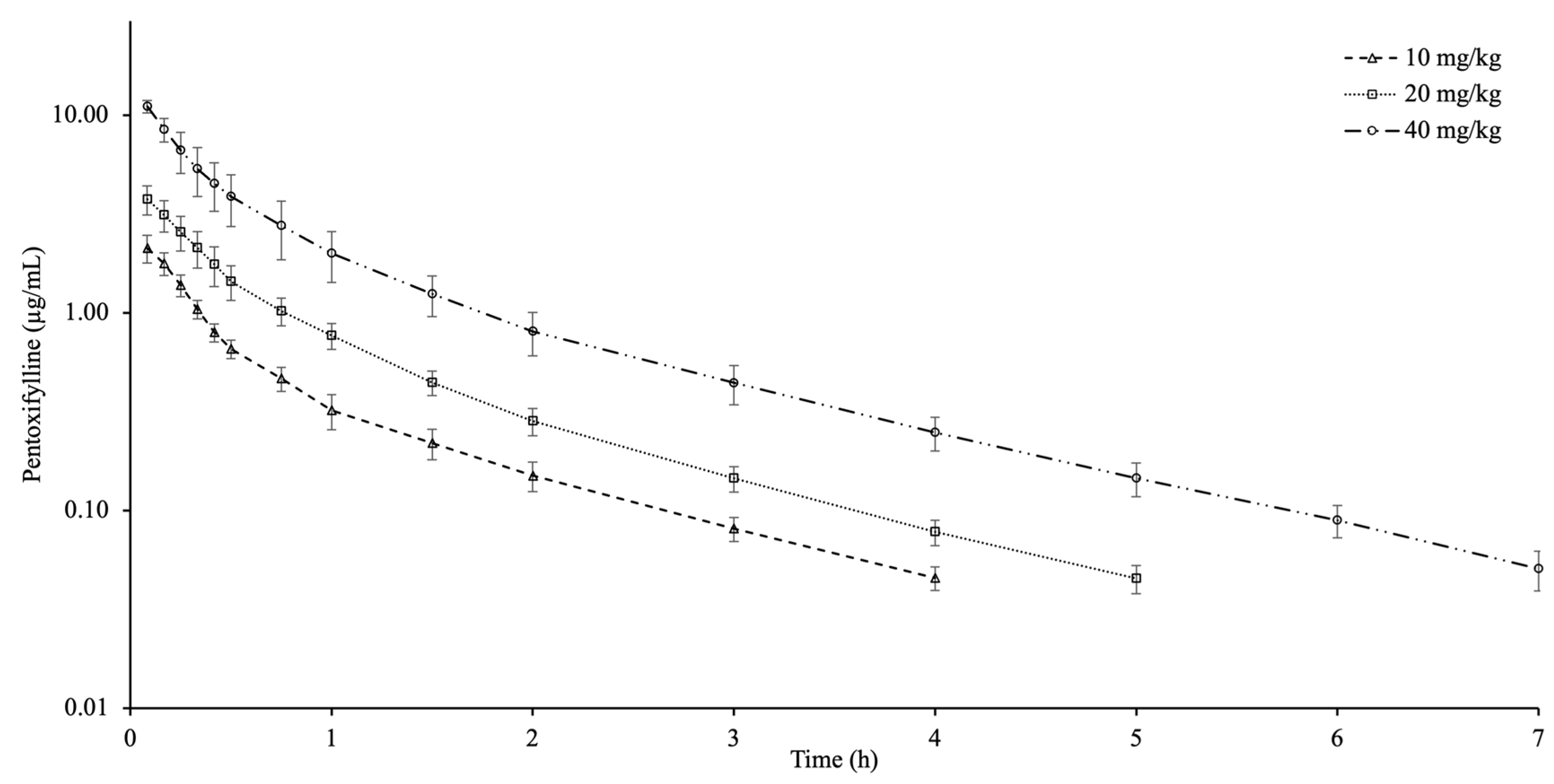
Plasma concentration curves of PTX after injection of different doses in goats are shown in Figure 1. The detection times of PTX in blood varied between dose groups and were detected for up to 4 h at 10 mg/kg, up to 5 h at 20 mg/kg, and up to 7 h at 40 mg/kg. Table 1 shows the pharmacokinetic data in goats after administering different doses of PTX. The t1/2ʎz exhibited notable variations among dose groups. The 40 mg/kg exhibited a higher dose-normalized AUC and C0.08, as well as a lower ClT and Vdss, in comparison to the 10 and 20 mg/kg. The AUCextrap remained below 6.09% across all dosage groups.

3.3. Pharmacokinetic Parameters of M-I Metabolite

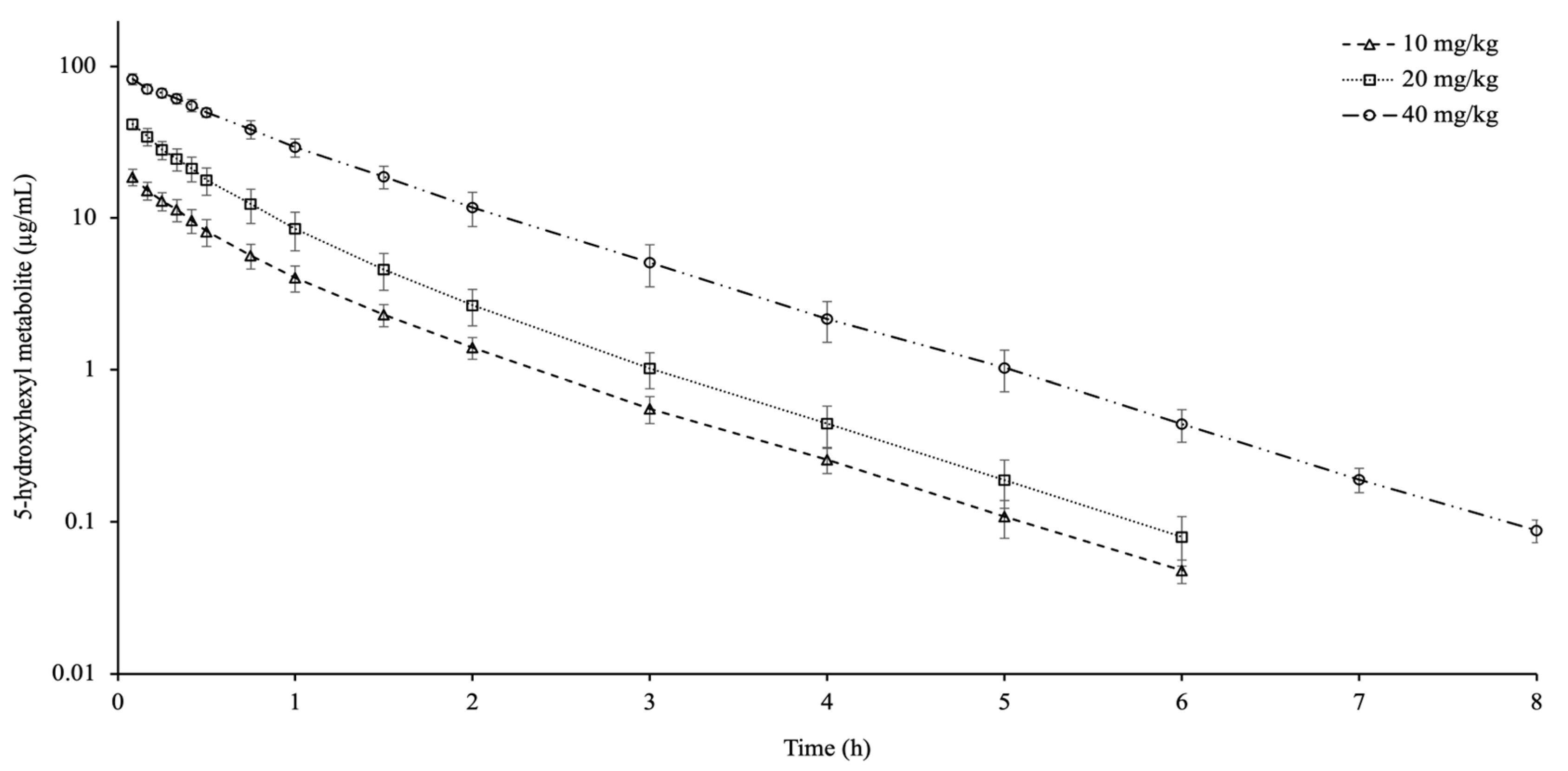
Pharmacokinetic data and plasma concentrations of the M-I metabolite following IV injection of different doses of PTX in goats are shown in Table 2 and Figure 2, respectively. M-I metabolite was observed for up to 6 h at doses of 10 and 20 mg/kg and up to 8 h at a dose of 40 mg/kg. The t1/2ʎz showed significant differences among dose groups. The dose-normalized AUC was higher at 40 mg/kg compared to other doses, while the dose-normalized Cmax was lower at 10 mg/kg compared to other doses. The AUC0-lastM-I/AUC0-lastPTX ratio was higher in the 40 mg/kg dose than in the other doses. Tmax was comparable throughout the dosage groups (p > 0.05). The AUCextrap was below 0.76% in all dose groups.

4. Discussion

Despite PTX being utilized in several experimental research studies involving goats [11,12], there is a lack of knowledge concerning its pharmacokinetics. This study explains, for the first time, the pharmacokinetics and dose-dependent alterations in pharmacokinetics of PTX in goats. The study concluded that the pharmacokinetics of PTX and its M-I metabolite in goats showed significant differences, particularly at the 40 mg/kg dose.
In goats, IV injection of PTX at a dosage of 10 mg/kg had no adverse effects, but doses of 20 and 40 mg/kg resulted in short-term tachycardia and excessive salivation. The administration of the medication to goats by infusion (0.3 mg/kg/min for 30 min or 0.5 mg/kg/min for 15 min) induced temporary tachycardia and a decrease in body temperature [12,25]. Hematological and biochemical parameters were also altered in goats at concentrations of 10–40 mg/kg [24]. While PTX does not cause any clinical signs in dogs [17,26], it has been documented to cause transient tachycardia, excessive salivation, and restlessness in sheep (IV, 40 mg/kg) [15]; transient excessive salivation and restlessness in cattle (IV, 10 mg/kg) [16]; and tachycardia, sweating, and muscle spasms in horses (IV, 8.5 mg/kg) [18]. Therefore, these adverse effects should be considered when PTX is used in goats, especially at doses of 20 and 40 mg/kg.
In goats, PTX was used as an IV infusion at a dose of 7.5–9 mg/kg (0.3 mg/kg/min over 30 min or 0.5 mg/kg/min over 15 min) and orally at a dose of 30–60 mg/kg [11,12,25]. Hematological and biochemical parameters were altered in goats at concentrations of 10–40 mg/kg; however, it was clinically well tolerated [24]. Although PTX showed some positive effects at a dose of 7.5 mg/kg in endotoxemic goats, it was insufficient to correct the acute phase response [25]. The impact of PTX is dose-dependent, and in rats and mice, elevated dosages have mitigated the adverse effects associated with LPS [17,25]. Therefore, goats were administered PTX at doses of 10, 20, and 40 mg/kg. PTX is recommended to be administered orally or intravenously. In this study, IV administration was preferred to determine dose-dependent changes in ClT and Vdss without the influence of the absorption process [27].
The high Vdss of PTX in goats after IV administration at doses of 10–40 mg/kg was 5.82–7.34 L/kg, which was comparable to the value in cattle (6.30 L/kg) [16] and higher than that reported in sheep (0.55–0.66 L/kg) [15], dogs (1.01–4.1 L/kg) [17,26], and horses (1.15–2.81 L/kg) [8,18]. The volume of distribution can vary depending on the physicochemical properties of the drugs, their binding ratio to plasma proteins, and body composition [28]. Although PTX is a hydrophilic drug that is highly soluble in water [29], it generally has a large volume of distribution. Despite its hydrophilic nature, its large distribution volume might be attributed to the plasma protein binding ratio. The data on PTX’s binding ratio to plasma proteins is inconsistent. Some studies report a plasma protein binding ratio of 70% [4], while others report no binding at all to plasma proteins and instead bind to erythrocytes [30]. The differences in PTX’s Vdss in animals may be due to variations in body components and plasma/erythrocytes protein binding ratios between species. The Vdss value at the 40 mg/kg dose decreased from 7.34 L/kg to 5.82 L/kg in comparison to the 10 and 20 mg/kg doses. However, in sheep, an increase in Vdss has been reported in the high-dose group [15]. PTX binds to 45% of erythrocytes, increasing their flexibility and allowing them to penetrate deeper into tissues [31]. The decrease in Vdss in goats at a dose of 40 mg/kg may be due to the reduction in ClT and increase in plasma concentration as a result of saturation of PTX binding to erythrocytes. A drug with a Vdss value significantly higher than 0.6 L/kg is considered to dissolve in a volume greater than the total amount of water in the body [32]. In rats and dogs, PTX concentrations in the brain, heart, liver, lungs, kidneys, and skeletal muscle were similar to those in plasma, indicating good tissue distribution [33]. Therefore, the decrease in Vdss at a dose of 40 mg/kg may be considered clinically insignificant.
PTX’s ClT decreased in hepatic impairment but remained constant in renal impairment [31,34]. Cimetidine reduced the ClT of PTX by inhibiting hepatic microsomal enzyme activity [35,36]. Therefore, the elimination of PTX is more dependent on biotransformation than renal excretion. The ClT of PTX is 2–4 times higher than that from the hepatic bloodstream, indicating that it is metabolized outside the liver [37]. PTX is metabolized into seven phase I metabolites (I-VII) in humans, with the M-I metabolite being predominant, formed in erythrocytes and liver [4,18]. PTX and M-I are converted into other metabolites in the liver, and less than 1% of both are excreted unchanged in the urine [34]. However, three metabolites of PTX were detected in dog plasma, and six metabolites were detected in horse urine [17]. This shows that the biotransformation of PTX varies among animal species. The high ClT of PTX in goats after IV injection at doses of 10–40 mg/kg was 5.16–7.21 L/h/kg, which was similar to the value in cattle (5.31 L/kg) [16] and higher than that reported in sheep (0.42–0.64 L/kg) [15], dogs (1.68–2.22 L/kg) [17,26], and horses (2.38–3.06 L/kg) [8,18]. Phase I reactions, such as oxidation and reduction, are important in the metabolism of PTX [4,8,35]. Enzymatic activities associated with biotransformation differ between animal species [38]. This may explain the variation in the ClT value of PTX across different animal species. The ClT of PTX in goats decreased after IV injection at a dose of 40 mg/kg in comparison to other doses. Similarly, dose-dependent decreases in ClT of PTX have been reported in sheep [15]. The dose-dependent decrease in ClT may be due to saturation of biotransformation enzymes in the liver or erythrocytes, which can lead to reduced metabolism and clearance of the drug at higher doses.
The t1/2ʎz after IV injection of PTX at different doses was 0.90–1.15 h, similar to that previously reported in cattle (1.05 h) [16], sheep (0.68–0.96 h) [15], and chickens (1.05 h) [19], but longer than that reported in horses (0.38 h) [8]. However, the t1/2ʎz value exhibited nearly a tenfold range in dogs, ranging from 0.28 h to 2.73 h [17,26]. Although it has been reported that the t1/2ʎz value is prolonged in sheep in a dose-dependent manner [15], the dose-dependent change in goats was obtained in the following order: 40 mg/kg > 10 mg/kg > 20 mg/kg. The t1/2ʎz is a hybrid pharmacokinetic parameter that is not a direct measure of an independent physiological process and is affected by changes in ClT and Vd values [39], species- and dose-dependent variations may result from differences in these parameters.
M-I is the active metabolite of PTX and has a pharmacological effect similar to the parent drug [6]. Dose-dependent alterations in M-I metabolite pharmacokinetic properties were observed in goats after administration of PTX at various doses. These alterations were most evident at the PTX dosage of 40 mg/kg. After administering PTX to goats at a dose of 40 mg/kg, the AUC value of the M-1 metabolite increased. Similarly, the AUC value of the M-1 metabolite increased in sheep at a dose of 40 mg/kg [15]. The M-I metabolite is converted into other metabolites in the liver, such as PTX, and less than 1% is excreted unchanged in the urine [17]. In this study, the AUC value of the M-I metabolite may have been elevated as a result of metabolic saturation.
The AUC0-lastM-I/AUC0-lastPTX ratio was 8.87, 9.62, and 10.62 at the 10, 20, and 40 mg/kg doses administered intravenously, respectively. This conversion ratio was higher than previously reported in cattle (1.34) [16], sheep (0.38–0.46) [15], horses (1.13–2.4) [8], dogs (0.63) [26], and chickens (1.52) [19]. PTX is metabolized to its M-I metabolite in erythrocytes and the liver, and this process is reversible [19,26]. PTX is rapidly metabolized to M-1, resulting in a quick increase in M-1 concentration and a corresponding decrease in PTX concentration within minutes [18]. The peak concentration of the M-I metabolite was achieved at 5 min in this study. Aldo-keto reductase and CYP2E1 enzymes play a key role in this conversion [15,40], and differences in the AUC0-lastM-I/AUC0-lastPTX conversion ratio among animal species may stem from differences in the activity of these enzymes [38]. The AUC0-lastM-I/AUC0-lastPTX conversion ratio was seen to rise at a dose of 40 mg/kg compared to doses of 10 and 20 mg/kg. However, the conversion ratio in sheep did not exhibit any dose-dependent variations [15]. PTX and M-I metabolism is reversible, and both undergo biotransformation reactions in the liver to be converted into other metabolites. In goats, the conversion rate may have been increased due to dose-dependent changes in various biotransformation processes.
There are no data available on the effective plasma concentrations of PTX in goats. The therapeutic concentration of PTX in humans ranges from 0.5 to 2 μg/mL depending on the indication [41] and >1 μg/mL for TNF-α inhibition in horses [42]. The concentration of PTX required to reduce blood viscosity by increasing deformability is 0.03 μg/mL for stiffened red blood cells and 20 μg/mL for normal red blood cells [22]. Following IV administration of PTX at doses of 10, 20, and 40 mg/kg to goats, the C0.08 values were 2.11, 3.73, and 11.07 μg/mL, respectively. These results show that in goats, PTX reached therapeutic concentrations at all three dose levels, excluding normal red blood cell deformability. However, PTX is converted into M-I and M-V metabolites with similar pharmacological effects, and this conversion differs between species, making it difficult to determine its therapeutic effect [34]. In goats, the Cmax of M-I after IV administration of PTX at dosages of 10, 20, and 40 mg/kg were 18.06, 41.47, and 82.22 μg/mL, respectively. These concentrations were significantly greater than those achieved for PTX. However, since these assessments are based on data reported in other animal species, they may not be applicable to goats, and it is crucial to determine the therapeutic concentrations of PTX and its M-I metabolite under different clinical conditions in goats.
This study has several limitations that impact the applicability of its findings. Although the biotransformation of PTX differs between species, the failure to examine metabolites apart from the M-I metabolite is a deficiency of this study. Although the target site of PTX is erythrocytes, the lack of determination of its binding ratio to erythrocytes and plasma proteins constitutes a deficiency. Furthermore, the lack of investigation into the therapeutic efficacy of PTX and its M-I metabolite is a limitation of the study.

5. Conclusions

This study provides the first comprehensive evaluation of the pharmacokinetics of PTX and its active M-I metabolite following IV administration in goats. Although significant pharmacokinetic variability was observed among the 10, 20, and 40 mg/kg dosages—most notably a reduction in ClT and Vdss at the highest dose—these variations do not strictly confirm non-linear kinetics, and their direct clinical relevance remains to be fully elucidated. Importantly, while PTX achieved potentially therapeutic plasma concentrations across all evaluated dose levels, the concentrations of the M-I metabolite were substantially higher, underscoring its pivotal role in the drug’s overall pharmacological profile in this species. From a clinical safety perspective, the 10 mg/kg dose was well-tolerated without adverse events; however, practitioners should exercise caution with higher doses (20 and 40 mg/kg), which precipitated transient adverse effects including tachycardia, excessive salivation, and restlessness. Ultimately, notable pharmacokinetic differences exist among the evaluated doses. However, these variations may not necessarily result in proportional changes to actual therapeutic outcomes (e.g., anti-inflammatory or hemorheological efficacy). Therefore, further clinical investigations are essential to determine the precise therapeutic efficacy, safety margins, and optimal dosage regimens for PTX and its M-I metabolite across various caprine pathological conditions.

Author Contributions

Supervision, O.C., M.H., K.U., M.G., P.M., D.D.C. and T.A.; project administration, O.C., M.H., K.U., M.G., P.M., D.D.C. and T.A.; investigation, O.C., D.C., S.K., H.R.C., F.A., I.B. and T.A.; methodology, O.C., D.D.C., D.C., S.K., H.R.C., F.A. and I.B.; formal analysis, O.C., D.D.C., K.U., M.H., M.G. and P.M.; writing—review and editing, O.C., M.H., K.U., M.G., P.M., D.D.C. and T.A.; funding acquisition, T.A. All authors have read and agreed to the published version of the manuscript.

Funding

This research was funded by the Coordination of Scientific Research Projects, University of Selcuk, Türkiye (Project No. 23401144).

Institutional Review Board Statement

The study was approved (2023/05-29) by the Local Ethics Committee for Animal Research Studies at Siirt University (Siirt, Türkiye), approve date: 31 October 2023.

Informed Consent Statement

Written informed consent was obtained from the owner of the animals involved in this study.

Data Availability Statement

The data presented in this study are available upon request from the corresponding authors.

Acknowledgments

The abstract of this study will be presented as a poster at the 16th European Association for Veterinary Pharmacology and Toxicology, to be held in Thessaloniki, Greece, from 28 June–1 July 2026.

Conflicts of Interest

The authors declare no conflicts of interest.

References

  1. Annamaraju, P.; Patel, P.; Baradhi, K.M. Pentoxifylline. 2024 Feb 29. In StatPearls [Internet]; StatPearls Publishing: Treasure Island, FL, USA, 2026. [Google Scholar]
  2. Kulcu Cakmak, S.; Cakmak, A.; Gonul, M.; Kilic, A.; Gul, U. Pentoxifylline use in dermatology. Inflamm. Allergy Drug Targets 2012, 11, 422–432. [Google Scholar] [CrossRef] [Scilit]
  3. Corum, O.; Ozdemir, O.; Hitit, M.; Corum, D.D.; Coskun, D.; Er, A. Pentoxifylline may restore kanamycin-induced renal damage in rats. Acta Sci. Vet. 2018, 46, 7. [Google Scholar] [CrossRef] [Scilit]
  4. Harris, E.; Schulzke, S.M.; Patole, S.K. Pentoxifylline in preterm neonates: A systematic review. Pediatr. Drugs 2010, 12, 301–311. [Google Scholar] [CrossRef] [Scilit]
  5. Aviado, D.M.; Porter, J.M. Pentoxifylline: A new drug for the treatment of intermittent claudication; mechanism of action, pharmacokinetics, clinical efficacy and adverse effects. Pharmacotherapy 1984, 4, 297–306. [Google Scholar] [CrossRef] [Scilit] [PubMed]
  6. Yang, Z.; Chen, M.; Nadler, J.L. Lisofylline: A potential lead for the treatment of diabetes. Biochem. Pharmacol. 2005, 69, 1–5. [Google Scholar] [CrossRef] [Scilit] [PubMed]
  7. Samlaska, C.P.; Winfield, E.A. Pentoxifylline. J. Am. Acad. Dermatol 1994, 30, 603–621. [Google Scholar] [CrossRef] [Scilit] [PubMed]
  8. Liska, D.A.; Akucewich, L.H.; Marsella, R.; Maxwell, L.K.; Barbara, J.E.; Cole, C.A. Pharmacokinetics of pentoxifylline and its 5-hydroxyhexyl metabolite after oral and intravenous administration of pentoxifylline to healthy adult horses. Am. J. Vet. Res. 2006, 67, 1621–1627. [Google Scholar] [CrossRef] [Scilit] [PubMed]
  9. Sykes, J.E.; Papich, M.P. Antiviral and Immunomodulatory Drugs. In Canine and Feline Infectious Diseases; Sykes, J.E., Ed.; Elsevier Saunders: St. Louis, MI, USA, 2014; pp. 54–65. [Google Scholar]
  10. Zagzoug, A.S.; Khair, M.H.; Kamel, M.A. The pharmacological and clinical effects of pentoxifylline on pet animals. J. Adv. Vet. Res. 2023, 13, 693–698. [Google Scholar]
  11. Sezik, M.; Koker, A.; Ozmen, O.; Haligur, M.; Kasikci, D.; Aydogan, A.; Ozatik, O. Antenatal pentoxifylline therapy to prevent endotoxin-induced fetal injury in the preterm goat model. Turk. J. Obstet. Gynecol. 2020, 17, 259. [Google Scholar] [CrossRef] [Scilit] [PubMed]
  12. Van Miert, A.; Van Duin, C.T.M.; Wensing, T. Effects of pentoxifylline and polymyxin B on the acute-phase-response to Escherichia coli endotoxin in dwarf goats. J. Vet. Pharmacol. Ther. 1997, 20, 61–68. [Google Scholar] [CrossRef] [Scilit]
  13. Dhillon, S.; Gill, K. Basic pharmacokinetics. In Clinical Pharmacokinetics; Pharmaceutical Press: London, UK, 2006; pp. 1–44. [Google Scholar]
  14. Uney, K.; Durna Corum, D.; Terzi, E.; Corum, O. Pharmacokinetics and bioavailability of carprofen in rainbow trout (Oncorhynchus mykiss) broodstock. Pharmaceutics 2021, 13, 990. [Google Scholar] [CrossRef] [Scilit]
  15. Corum, O.; Corum, D.D.; Atik, O.; Er, A.; Uney, K. Pharmacokinetics of pentoxifylline and its 5-hydroxyhexyl metabolite after intravenous administration of increasing doses to sheep. Am. J. Vet. Res. 2019, 80, 702–708. [Google Scholar]
  16. Uney, K.; Tras, B.; Corum, O.; Yildiz, R.; Maden, M. Pharmacokinetics of pentoxifylline and its 5-hydroxyhexyl metabolite following intravenous administration in cattle. Trop. Anim. Health Prod. 2019, 51, 435–441. [Google Scholar] [CrossRef] [Scilit]
  17. Marsella, R.; Nicklin, C.F.; Munson, J.W.; Roberts, S.M. Pharmacokinetics of pentoxifylline in dogs after oral and intravenous administration. Am. J. Vet. Res. 2000, 61, 631–637. [Google Scholar] [CrossRef] [Scilit] [PubMed]
  18. Crisman, M.V.; Wilcke, J.R.; Correll, L.S.; Irby, M.H. Pharmacokinetic disposition of intravenous and oral pentoxifylline in horses. J. Vet. Pharmacol. Ther. 1993, 16, 23–31. [Google Scholar] [CrossRef] [Scilit]
  19. De Boever, S.; Baert, K.; De Backer, P.; Croubels, S. Pharmacokinetics and oral bioavailability of pentoxyfylline in broiler chickens. J. Vet. Pharmacol. Ther. 2005, 28, 575–580. [Google Scholar] [CrossRef] [Scilit] [PubMed]
  20. Adcock, K.G.; Kyle, P.B.; Deaton, J.S.; Olivier, J.H.; Hogan, S.M. Pharmacokinetics of intranasal and intratracheal pentoxifylline in rabbits. Pharmacotherapy 2007, 27, 200–206. [Google Scholar] [CrossRef] [Scilit]
  21. Italiya, K.S.; Sharma, S.; Kothari, I.; Chitkara, D.; Mittal, A. Simultaneous estimation of lisofylline and pentoxifylline in rat plasma by high performance liquid chromatography-photodiode array detector and its application to pharmacokinetics in rat. J. Chromatogr. B 2017, 1061, 49–56. [Google Scholar] [CrossRef] [Scilit]
  22. Honess, D.J.; Dennis, I.F.; Bleehen, N.M. Pentoxifylline: Its pharmacokinetics and ability to improve tumour perfusion and radiosensitivity in mice. Radiother. Oncol. 1993, 28, 208–218. [Google Scholar] [CrossRef] [Scilit] [PubMed]
  23. Wyska, E. Pharmacokinetic-pharmacodynamic modeling of methylxanthine derivatives in mice challenged with high-dose lipopoly-saccharide. Pharmacology 2010, 85, 264–271. [Google Scholar] [CrossRef] [Scilit]
  24. Coskun, D.; Cetin, G.; Corum, O. Effect of ascending doses of pentoxifylline administration on biochemical and hematological parameters in goats. Kocatepe Vet. J. 2022, 15, 63–68. [Google Scholar]
  25. Van Duin, C.T.M.; Wensing, T.; Van Miert, A. Pentoxifylline pretreatment fails to block the acute-phase response to Escherichia coli endotoxin in dwarf goats. Vet. Res. Com. 1995, 19, 149–157. [Google Scholar] [CrossRef] [Scilit] [PubMed]
  26. Rees, C.A.; Boothe, D.M.; Boeckh, A.; Wilkie, S.; Esparza, T.; Green, R. Dosing regimen and hematologic effects of pentoxifylline and its active metabolites in normal dogs. Vet. Ther. 2003, 4, 188–196. [Google Scholar]
  27. Coskun, D.; Corum, O.; Durna Corum, D.; Cetin, G.; Irmak, M.; Ceyhan, H.R.; Uney, K. Age-related changes in the pharmacokinetics of meloxicam after intravenous administration in sheep. J. Vet. Pharmacol. Ther. 2023, 46, 326–331. [Google Scholar] [CrossRef] [Scilit]
  28. Marín, P.; Corum, O.; Corum, D.D.; Badillo, E.; Yuste, M.T.; Yildirim, O.; Terzi, E.; Gonzales, R.C.; Arriesgado, D.M.; Navarro, N.R.; et al. Plasma and muscle pharmacokinetics of ceftriaxone in nile tilapia (Oreochromis niloticus) after different administration routes. Antibiotics 2025, 14, 1253. [Google Scholar] [CrossRef] [Scilit]
  29. Bhardwaj, P.; Tripathi, P.; Pandey, S.; Gupta, R.; Khar, R.K.; Patil, P.R. Improved dermal delivery of pentoxifylline niosomes for the management of psoriasis: Development, optimization and in-vivo studies in imiquimod induced psoriatic plaque model. J. Drug Deliv. Sci. Technol. 2022, 75, 103643. [Google Scholar] [CrossRef] [Scilit]
  30. Sein Anand, J.; Wiergowski, M.; Wiśniewski, M.R.; Kosmowska, M.; Kata, M.; Woźniak, M.K. Fatal suicidal intoxication with pentoxifylline complicated by cardiovascular disorders. Toxics 2022, 10, 447. [Google Scholar] [CrossRef] [Scilit]
  31. Paap, C.M.; Simpson, K.S.; Horton, M.W.; Schaefer, K.L.; Lassman, H.B.; Sack, M.R. Multiple-dose pharmacokinetics of pentoxifylline and its metabolites during renal insufficiency. Ann. Pharmacother. 1996, 30, 724–729. [Google Scholar] [CrossRef] [Scilit] [PubMed]
  32. White, R.E. Role of ADME/PK in drug discovery, safety assessment, and clinical development. In Comprehensive Medicinal Chemistry III; Chackalamannil, S., Rotella, D., Ward, S.E., Eds.; Elsevier: Amsterdam, The Netherlands, 2017; pp. pp:1–33. [Google Scholar]
  33. Ward, A.; Clissold, S.P. Pentoxifylline: A review of its pharmacodynamic and pharmacokinetic properties, and its therapeutic efficacy. Drugs 1987, 34, 50–97. [Google Scholar] [CrossRef] [Scilit]
  34. Nicklasson, M.; Björkman, S.; Roth, B.; Jönsson, M.; Höglund, P. Stereoselective metabolism of pentoxifylline in vitro and in vivo in humans. Chirality 2002, 14, 643–652. [Google Scholar] [CrossRef] [Scilit]
  35. Luke, D.R.; Rocci, M.L., Jr.; Hoholick, C. Inhibition of pentoxifylline clearance by cimetidine. J. Pharm. Sci. 1986, 75, 155–157. [Google Scholar] [CrossRef] [Scilit] [PubMed]
  36. Mauro, V.F.; Mauro, L.S.; Hageman, J.H. Alteration of pentoxifylline pharmacokinetics by cimetidine. J. Clin. Pharmacol. 1988, 28, 649–654. [Google Scholar] [CrossRef] [Scilit]
  37. Rames, A.; Poirier, J.M.; LeCoz, F.; Midavaine, M.; Lecocq, B.; Grange, J.D.; Poupon, R.; Cheymol, G.; Jaillon, P. Pharmacokinetics of intravenous and oral pentoxifylline in healthy volunteers and in cirrhotic patients. Clin. Pharmacol. Ther. 1990, 47, 354–359. [Google Scholar] [CrossRef] [Scilit]
  38. Szotáková, B.; Baliharová, V.; Lamka, J.; Nožinová, E.; Wsól, V.; Velik, J.; Machala, M.; Neca, J.; Soucek, P.; Susova, S.; et al. Comparison of in vitro activities of biotransformation enzymes in pig, cattle, goat and sheep. Res. Vet. Sci. 2004, 76, 43–51. [Google Scholar] [CrossRef] [Scilit] [PubMed]
  39. Toutain, P.L.; Bousquet-Melou, A. Plasma clearance. J. Vet. Pharmacol. Ther. 2004, 27, 415–425. [Google Scholar] [CrossRef] [Scilit]
  40. Raoul, J.M.; Peterson, M.R.; Peterson, T.C. A novel drug interaction between the quinolone antibiotic ciprofloxacin and a chiral metabolite of pentoxifylline. Biochem. Pharmacol. 2007, 74, 639–646. [Google Scholar] [CrossRef] [Scilit] [PubMed]
  41. Regenthal, R.; Krueger, M.; Koeppel, C.; Preiss, R. Drug levels: Therapeutic and toxic serum/plasma concentrations of common drugs. J. Clin. Monit. Comput. 1999, 15, 529–544. [Google Scholar] [CrossRef] [Scilit]
  42. Barton, M.H.; Moore, J.N. Pentoxifylline inhibits mediator synthesis in an equine in vitro whole blood model of endotoxemia. Circ. Shock 1994, 44, 216–220. [Google Scholar]
Figure 1. Semi-logarithmic plasma concentration–time curves of pentoxifylline after intravenous administration at doses of 10, 20 and 40 mg/kg in goats (n = 9, mean ± SD).
Animals 16 01524 g001
Figure 2. Semi-logarithmic plasma concentration–time curves of 5-hydroxyhexyl metabolite after intravenous administration of pentoxifylline at doses of 10, 20, and 40 mg/kg in goats (n = 9, mean ± SD).
Animals 16 01524 g002
Table 1. Pharmacokinetic parameters of pentoxifylline following intravenous administrations at doses of 10, 20, and 40 mg/kg in goats (n = 9).
Parameters10 mg/kg20 mg/kg40 mg/kg
t1/2ʎz (h)1.01 (0.91–1.10)0.90 (0.83–0.96) a1.15 (1.02–1.27) b,c
AUC0-last (h*µg/mL)1.35 (1.14–1.62)2.72 (2.23–3.49)7.67 (6.29–10.78) b,c
AUC0-last/dose (h*µg/mL)0.13 (0.11–0.16)0.14 (0.11–0.17)0.19 (0.16–0.27) b,c
AUC0–∞ (h*µg/mL)1.42 (1.22–1.70)2.78 (2.28–3.57)7.75 (6.36–10.90) b,c
AUCextrap% (%)4.64 (3.38–6.09)2.08 (1.68–2.36)1.07 (0.76–1.59)
MRT0–∞ (h)1.04 (0.96–1.11)1.02 (0.93–1.10)1.13 (1.06–1.20) b,c
ClT (L/h/kg)7.06 (5.85–8.19)7.21 (5.60–8.74)5.16 (3.67–6.13) b,c
Vdss (L/kg)7.34 (5.81–9.11)7.33 (5.86–9.67)5.82 (4.38–6.93) b,c
C 0.08 (µg/mL)2.11 (1.81–2.72)3.73 (3.15–4.67)11.07 (10.14–12.54) b,c
a: This shows the difference on the same line between 20 mg/kg and 10 mg/kg (p < 0.05). b: This shows the difference on the same line between 40 mg/kg and 10 mg/kg (p < 0.05). c: This shows the difference on the same line between 40 mg/kg and 20 mg/kg (p < 0.05). t1/2ʎz: elimination half-life; AUC: area under the concentration–time curve; AUCextrap%: area under the plasma concentration–time curve extrapolated from tlast to ∞ in % of the total AUC; MRT: mean residence time; ClT: total body clearance; Vdss: volume of distribution at steady state; C0.08: PTX concentration at the time of initial sampling.
Table 2. Pharmacokinetic parameters of 5-hydroxyhexyl metabolite following intravenous administrations of pentoxifylline at doses of 10, 20, and 40 mg/kg in goats (n = 9).
Parameters10 mg/kg20 mg/kg40 mg/kg
t1/2ʎz (h)0.79 (0.70–0.86)0.74 (0.66–0.80) a0.84 (0.80–0.88) b,c
AUC0-last (h*µg/mL)12.51 (9.92–16.18)26.61 (17.27–33.22)82.21 (67.21–93.67) b,c
AUC0-last/dose (h*µg/mL)1.25 (0.99–1.62)1.33 (0.86–1.66)2.06 (1.74–2.37) b,c
AUC0–∞ (h*µg/mL)12.56 (9.96–16.24)26.69 (17.32–33.36)82.32 (67.29–94.94) b,c
AUCextrap% (%)0.46 (0.32–0.77)0.28 (0.18–0.51)0.12 (0.11–0.16)
MRT0–∞ (h)0.95 (0.92–1.07)0.84 (0.77–0.96) a1.12 (1.00–1.22) b,c
Cmax (µg/mL)18.06 (15.87–21.83)41.47 (34.89–45.82) a82.22 (72.26–95.88) b
Tmax (h)0.0830.0830.083
AUC0-lastM-I/AUC0-lastPTX (%)8.87 (8.15–9.51)9.62 (7.57–10.59)10.62 (8.70–12.02) b,c
a: This shows the difference on the same line between 20 mg/kg and 10 mg/kg (p < 0.05). b: This shows the difference on the same line between 40 mg/kg and 10 mg/kg (p < 0.05). c: This shows the difference on the same line between 40 mg/kg and 20 mg/kg (p < 0.05). t1/2ʎz: elimination half-life; AUC: area under the concentration–time curve; AUCextrap%: area under the plasma concentration–time curve extrapolated from tlast to ∞ in % of the total AUC; MRT: mean residence time; Cmax: peak plasma concentration; Tmax: time to reach the peak plasma concentration.
Disclaimer/Publisher’s Note: The statements, opinions and data contained in all publications are solely those of the individual author(s) and contributor(s) and not of MDPI and/or the editor(s). MDPI and/or the editor(s) disclaim responsibility for any injury to people or property resulting from any ideas, methods, instructions or products referred to in the content.