

Hypothesis

The Wrong Assumptions of the Effects of Climate Change on Marine Turtle Nests with Temperature-Dependent Sex Determination


by
Marc Girondot
Laboratoire Ecologie, Société, Evolution, Université Paris Saclay, Centre National de la Recherche Scientifique, AgroParisTech, 91190 Gif-sur-Yvette, France
Animals 2026, 16(1), 97; https://doi.org/10.3390/ani16010097 (registering DOI)
Submission received: 31 October 2025 / Revised: 16 December 2025 / Accepted: 28 December 2025 / Published: 29 December 2025
(This article belongs to the Section Herpetology)

Simple Summary

Climate change, caused by the increase in greenhouse gases, is warming the Earth’s atmosphere and oceans. This rise in temperature affects species such as marine turtles, whose sex is determined by the temperature of their nests. Warmer nests produce more females, while cooler ones produce more males. Many studies have used air or sea surface temperature to estimate nest temperature and predict future sex ratios, but this method is questionable. The temperature inside the sand depends mainly on solar radiation and the physical properties of the beach, such as moisture, texture, and heat transfer processes. Air temperature influences the surface but not necessarily the deeper layers, where turtle eggs develop. In fact, higher air temperature may dry the sand, reducing heat conduction and possibly limiting warming at nest depth. Therefore, using air temperature as a proxy can give misleading results, and more accurate models should include soil heat dynamics and solar radiation.

Abstract

Contemporary climate change, driven by anthropogenic greenhouse gas (GHG) emissions, has raised global temperatures by over 1 °C above pre-industrial levels, profoundly altering Earth’s energy balance. In marine turtles, which exhibit temperature-dependent sex determination (TSD), embryonic sex ratios are highly sensitive to nest temperature. Most studies predicting the effects of climate change on turtle sex ratios have used air temperature or sea surface temperature (SST) as proxies for nest temperature, despite limited empirical validation of this assumption. I question the validity of this approach by examining the physical mechanisms of heat transfer within beach soils, including conduction, convection, and radiation, and how they are modulated by factors such as soil texture, moisture, and solar radiation. The analysis highlights that while GHGs increase air temperature through the greenhouse effect, they do not directly alter incoming solar radiation, the principal driver of subsurface temperature. Furthermore, increased air temperature enhances evaporation and soil drying, reducing thermal conductivity and potentially lowering heat penetration into nesting depths. Consequently, air or SST proxies can misrepresent the actual thermal environment of marine turtle nests, leading to inaccurate or even reverse projections of sex ratios under climate change. A mechanistic approach integrating soil heat dynamics and solar radiation is therefore essential for realistic assessments of TSD responses and conservation planning in a warming world.

1. Introduction

Contemporary climate change represents one of the most pervasive environmental challenges of the Anthropocene. Driven primarily by the anthropogenic increase in greenhouse gas (GHG) concentrations since the onset of the industrial era, the Earth’s climate system is undergoing rapid and unprecedented transformations. Global mean surface temperature has already increased by more than 1 °C above pre-industrial levels, with warming projected to continue throughout the 21st century under most emission scenarios [1].
The primary mechanism underlying this warming is the enhanced greenhouse effect, whereby increased atmospheric concentrations of carbon dioxide (CO2), methane (CH4), nitrous oxide (N2O), and other radiatively active gases trap outgoing longwave radiation, thereby altering the global energy balance. This process raises mean air and ocean temperatures and changes many physical parameters in the atmosphere.
All marine turtle species exhibit temperature-dependent sex determination (TSD), a form of environmental sex determination in which the sex of the offspring is determined by the temperature experienced during embryonic development [2]. In these species, there are no genetic sex chromosomes; instead, a thermosensitive period (TSP) occurs during development, during which differences in nest temperature strongly influence gonadal differentiation [3]. Typically, warmer incubation temperatures produce female-biased offspring, whereas cooler temperatures produce more males, following a type Ia TSD pattern. The pivotal temperature—the temperature that yields a balanced 1:1 sex ratio [4]—usually lies between 28 °C and 30 °C, though it varies slightly among species, populations, and clutches [5]. The transitional range of temperatures (TRT), within which both sexes are produced [4], is often narrow, making sex ratios highly sensitive to subtle thermal variations. The effect of incubation temperature on sex ratio can be studied at the scale of a single nest or a set of nests in which temperature loggers record the exact thermal conditions. These temperatures are used to estimate the sex ratio using a methodology that calculates a constant temperature equivalent (CTE) applied within the TSP of development for sex determination [6]. Estimation of the limits of the TSP must take into account the temperature-dependent rate of development, and the CTE relies on a thermal reaction norm for sexualization that links a given temperature to its capacity to feminize an embryo [7]. It should be noted that other crude proxies have been used in the literature, but their capacity to predict sex ratio is generally very low [8].
The effects of climate change on the primary sex ratio of marine turtles—defined as the sex ratio of offspring—were among the first impacts highlighted by researchers [9,10]. This concern is particularly relevant for species with temperature-dependent sex determination (TSD), for which rising temperatures pose a direct threat [11,12,13]. Consequently, risk analyses assessing the threat of global warming to sea turtle survival through its effects on TSD have relied on large-scale temporal and spatial proxies of the primary sex ratio.
Air temperature [14,15,16,17,18,19,20] and sea surface temperature (SST) [21,22,23] are correlated with nest temperatures, and this correlation has often been interpreted as a direct causal relationship. Consequently, most—if not all—studies evaluating the impacts of climate change on temperature-dependent sex determination (TSD) in turtles have used air temperature or SST as proxies for nest temperature [24]. Given that both air temperature and SST are increasing due to anthropogenic greenhouse gas emissions, a feminization of marine turtle populations with temperature-dependent sex determination is expected, ultimately increasing the risk of extinction.
This reliance on atmospheric and oceanic temperature proxies largely reflects the limited availability of long-term beach soil or nest temperature records, in contrast to the widespread and long-term accessibility of air and SST data [25]. However, the validity of this approach remains questionable.
First, I will review the basics of heat transfer in soil and then establish the link with the thermal effect of beach soil. Finally, I will discuss the relevance of air or sea surface temperature when studying marine turtle nests and provide recommendations.

2. Fundamental Mechanisms of Heat Transfer in Soil

Marine turtle eggs incubate at depths of 40 to 80 cm in the soil. Sunlight brings radiant energy that warms the soil surface. The top few centimeters of soil absorb energy, leading to a rapid temperature increase. Heat moves downward through conduction, which is a slow process, keeping deeper soil layers cooler. Understanding the mechanisms of heat transfer provides a basic framework for understanding how heat is distributed in the soil environment and reaches the nest environment. The description of heat movement in soil is based on three main mechanisms [26]:
Radiation: Radiation plays a crucial role at the soil surface and is less important in the soil itself. The soil surface receives radiation from the sun and the atmosphere and radiates heat to the atmosphere [27]. This exchange of radiation at the surface defines the boundary conditions, or starting rule, for heat transfer in the soil profile.
Conduction: Conduction heat transfer is an energy transfer mechanism in which the thermal energy is transferred from more energetic to less energetic neighboring particles [28]. Conduction occurs in solids, liquids, and gases. In soil, heat spreads from one particle to another. This mechanism is particularly effective when soil particles are compact and in close contact with each other.
Convection: In contrast to heat conduction, energy transport by convective heat transfer goes along with an actual material flow. This involves heat transfer through the movement of fluids, such as air, water, or gas. In soil, convection occurs mainly through the movement of water in wet soil. When water warms up, it can move, carrying heat with it. This phenomenon is more significant in porous soils that are sufficiently moist. When soil is dry, convection occurs mainly through the movement of air by the same principle.

2.1. Factors Influencing Soil Beach Heat Transfer

Several factors determine how efficiently heat transfers through sand. These factors can be broadly categorized into soil properties and environmental conditions.

2.1.1. Soil Properties

Soil texture: The size and distribution of soil particles (sand, silt, and clay) significantly affect heat transfer. Sandy soils, with larger particles and less contact, generally conduct heat less effectively than clayey soils, which have smaller particles and greater surface area contact.
Soil moisture content: Water has a much higher thermal conductivity than air. As soil moisture increases, the thermal conductivity of the soil also increases, enhancing heat transfer. However, excessive water can also lead to evaporative cooling, which can counteract heat gain. The explanation of moisture’s role is therefore complex and context-dependent.
Soil organic matter: Organic matter acts as an insulator, reducing thermal conductivity. Soils with high organic matter content tend to warm up and cool down more slowly than mineral soils.
Soil porosity: The amount of pore space in the soil affects both conduction and convection. Pores filled with air reduce conduction, while water-filled pores enhance it and facilitate convection.

2.1.2. Environmental Conditions

Solar radiation: The intensity of solar radiation is the primary driver of soil heating. Higher solar radiation leads to greater heat input into the soil surface. The significance of solar radiation is undeniable as the fundamental energy source.
Air temperature: Air temperature influences the heat exchange at the soil surface. Warmer air can transfer heat to the soil, while cooler air can draw heat away.
Wind speed: Wind affects evaporation and convective heat transfer at the soil surface. Higher wind speeds can increase evaporative cooling and alter the surface energy balance.
Vegetation cover: Vegetation can shade the soil surface, reducing solar radiation input. It also affects evapotranspiration, which influences soil moisture and heat transfer.

3. Interplay of Factors Changing Beach Soil Temperature

The interplay between these effects is complex; therefore, I will make some simplifications to discuss the anticipated impacts of GHG on beach sand temperature at the nest level (−60 cm). A schematic representation is shown in Figure 1. The transfer of energy within the soil by a mix of conduction and convection is particularly difficult to anticipate because all the necessary conditions to apply the heat equation are broken; for example, the system is not homogeneous (solid, gas, and liquid are present in soil), and the model is open.
First, it is important to recall that the sun’s energy is not affected by GHGs; there is little to no change in the total solar irradiance from the sun itself, which varies only on small solar-cycle timescales (≈0.1%). Year-round solar radiation at the timescale of this discussion (years) is nearly constant and brings an energy E1 to Earth. A fraction of the sun’s energy arriving at the surface of Earth will be transferred by radiation into the soil. If only this factor is considered, no soil temperature change is anticipated due to an increase in GHGs. A fraction of the energy arriving on the soil surface is reemitted as infrared (E3).
A fraction of the energy transported by infrared (E3) will be absorbed by GHG, and it will provoke the well-known increase in air temperature (T’1 > T1). As the air temperature increases with GHG concentrations, the rate of liquid water evaporation at the Earth’s surface will also increase, with two consequences: (1) Increasing air temperature will increase evaporative cooling. This effect could even be enhanced by increased convection due to more frequent winds when GHGs are higher, owing to higher energy in the atmosphere. (2) The cloud cover will increase. The cloud cover will trap a fraction of the sun’s energy, and only a fraction (E2) can cross the cloud cover to arrive at the surface of the soil (E’2 < E2). Then, the sun’s energy at the surface of the Earth will be lower when GHGs increase (E’4 < E4), but this effect is thought to be minimal [29].
Higher air temperatures resulting from higher GHGs (T’1 > T1) will increase the temperature in the first centimeters of soil by convection (air–soil exchange). As already stated, this effect will also increase evaporation, and the soil surface will be drier. Soil moisture exerts a profound influence on soil heat transfer, primarily by altering the soil’s thermal properties. Water has a significantly higher thermal conductivity (around 0.6 W m−1 K−1) compared to air (around 0.025 W m−1 K−1) and soil minerals (ranging from 1 to 4 W m−1 K−1, depending on mineral type). Replacing water in soil pores with air dramatically decreases the overall thermal conductivity of the soil. This means that dry soils conduct heat much less efficiently than wet soils. Water also has a high specific heat capacity (around 4186 J kg−1 K−1), much greater than that of dry soil minerals (around 800–1000 J kg−1 K−1). Consequently, decreasing soil moisture content decreases the volumetric heat capacity of the soil, meaning dry soils can store less heat energy than wet soils for the same temperature change. Evaporation of water from the soil surface is a significant energy sink. When water evaporates, it absorbs the latent heat of vaporization from the soil, leading to cooling. This evaporative cooling effect is particularly pronounced in moist soils and can significantly moderate soil temperatures, especially during periods of high solar radiation. The intention behind considering evaporation is to account for surface energy losses.
The number of parameters underlying the schematic representation in Figure 1 is large and would benefit from a more formal representation using a network approach. The most advanced implementation to date is provided by the R package NicheMapR v. 3.3.2 [30], but it still falls short of capturing the required level of complexity. Furthermore, determining exact values for most of these parameters is lacking in most real-world situations.

4. Discussion

Greenhouse gas-driven climate change primarily modifies the Earth’s energy balance through enhanced trapping of outgoing infrared radiation, not by significantly changing the amount of incoming solar radiation. However, local solar radiation at the surface can still vary due to associated changes in cloud patterns, humidity, and aerosols.
When investigating subsurface processes, air temperature represents a poor proxy for the thermal conditions experienced below ground. This discrepancy arises because subsurface temperature dynamics are primarily governed by the absorption and dissipation of solar radiation, as well as by the thermal properties of the soil, rather than by short-term variations in ambient air temperature. Consequently, solar radiation should be considered the principal driver when modeling or interpreting underground thermal processes, whereas the direct use of air temperature may lead to substantial inaccuracies.
Because air or sea surface temperatures poorly represent the thermal environment experienced by eggs in natural nests, projections based on these proxies may misestimate future sex ratios and incubation conditions. A more mechanistic approach that accounts for solar radiation and substrate heat dynamics is therefore needed to improve the accuracy of climate change impact assessments on TSD. There are few publications that use mechanistic thermal models to estimate nest temperatures in marine turtles, and none of them explicitly addresses the effects of climate change [23,31].
A temporal trend in cohort sex ratios has been described for green turtle rookeries in the northern Great Barrier Reef, where it has been shown that predominantly females have been produced for more than two decades (99.1% of juveniles, 99.8% of subadults, and 86.8% of adult-sized turtles) [32]. This study hypothesizes that nest temperature has changed in response to increasing air temperature and that this change may be responsible for the feminization of recent cohorts. However, it should be noted that historical changes in the sex ratio covary with cohort age. An alternative hypothesis is that demographic changes in population structure could explain the observed patterns. For example, changes in cohort sex ratios have also been documented in Mediterranean populations of loggerhead turtles. Primary, subadult, and adult sex ratios have been estimated for loggerheads in the Mediterranean Sea, revealing a gradient in sex ratio: a strong female bias at the primary sex ratio stage [33,34], a moderate female bias among subadults [35], and either no bias [36,37,38] or a male bias [39] in adults. These findings suggest that demographic or behavioral processes, which do not directly reflect primary sex ratios, can strongly influence sex ratios at the subadult and adult stages [40].

5. Concluding Remarks

Climate change, which is largely an ongoing process, not only raises mean air and ocean temperatures but also amplifies the frequency and intensity of extreme events such as heatwaves, droughts, and heavy precipitation. However, such changes are not expected to directly alter deep beach sand temperatures at the depth of marine turtle nests and may even have the opposite effect due to changes in moisture in the upper centimeters of beach soil or increased interception of solar radiation by cloud cover before it reaches the soil surface.

Funding

This research received no external funding.

Institutional Review Board Statement

Not applicable.

Informed Consent Statement

Not applicable.

Data Availability Statement

No new data were created or analyzed in this study. Data sharing is not applicable to this article.

Acknowledgments

The authors thank the three referees, who contributed to the manuscript’s flow. The English of some sentences have been checked were assisted by ChatGPT (GPT-5.2, OpenAI).

Conflicts of Interest

The author declares no conflicts of interest.

Abbreviations

The following abbreviations are used in this manuscript:
CTEConstant Temperature Equivalent
GHGGreenhouse Gas
SSTSea Surface Temperature
TSDTemperature-Dependent Sex Determination
TRTTransitional Range of Temperatures
TSPThermosensitive Period of development for sex determination

References

  1. IPCC. Climate Change 2023: Synthesis Report. In Contribution of Working Groups I, II and III to the Sixth Assessment Report of the Intergovernmental Panel on Climate Change; IPCC: Geneva, Switzerland, 2023; pp. 35–115. [Google Scholar]
  2. Bull, J.J. Sex determination in reptiles. Q. Rev. Biol. 1980, 55, 3–21. [Google Scholar] [CrossRef]
  3. Girondot, M.; Monsinjon, J.; Guillon, J.-M. Delimitation of the embryonic thermosensitive period for sex determination using an embryo growth model reveals a potential bias for sex ratio prediction in turtles. J. Therm. Biol. 2018, 73, 32–40. [Google Scholar] [CrossRef] [PubMed]
  4. Mrosovsky, N.; Pieau, C. Transitional range of temperature, pivotal temperatures and thermosensitive stages for sex determination in reptiles. Amphibia-Reptilia 1991, 12, 169–179. [Google Scholar] [CrossRef]
  5. Krueger, C.J.; Girondot, M.; Janzen, F.J. The tortoise and the air: Climate shapes sex-ratio reaction norm variation in turtles. Evolution 2025, 79, qpaf126. [Google Scholar] [CrossRef] [PubMed]
  6. Girondot, M.; Carvajal, G.A.; Scott, K. Estimating hatchling sex ratios. In Research and Management Techniques for the Conservation of Sea Turtles; Phillott, A., Rees, A.F., Fuentes, M.M.P.B., Eds.; IUCN SSC Marine Turtle Specialist Group: Gland, Switzerland, 2025. [Google Scholar]
  7. Monsinjon, J.; Guillon, J.-M.; Wyneken, J.; Girondot, M. Thermal reaction norm for sexualization: The missing link between temperature and sex ratio for temperature-dependent sex determination. Ecol. Model. 2022, 473, 110119. [Google Scholar] [CrossRef]
  8. Fuentes, M.M.P.B.; Monsinjon, J.; Lopez, M.; Lara, P.; Santos, A.; dei Marcovaldi, M.A.G.; Girondot, M. Sex ratio estimates for species with temperature-dependent sex determination differ according to the proxy used. Ecol. Model. 2017, 365, 55–67. [Google Scholar] [CrossRef]
  9. Davenport, J. Sea turtles and the greenhouse effect. Br. Herpetol. Soc. Bull. 1989, 29, 11–15. [Google Scholar]
  10. Davenport, J. Temperature and the life-history strategies of sea turtles. J. Therm. Biol. 1997, 22, 479–488. [Google Scholar] [CrossRef]
  11. Mrosovsky, N. Sex ratios of sea turtles. J. Exp. Zool 1994, 270, 16–27. [Google Scholar] [CrossRef]
  12. Janzen, F.J. Climate change and temperature-dependent sex determination in reptiles. Proc. Natl. Acad. Sci. USA 1994, 91, 7487–7490. [Google Scholar] [CrossRef]
  13. Santidrián Tomillo, P.; Genovart, M.; Paladino, F.V.; Spotila, J.R.; Oro, D. Climate change overruns resilience conferred by temperature-dependent sex determination in sea turtles and threatens their survival. Glob. Change Biol. 2015, 21, 2980–2988. [Google Scholar] [CrossRef]
  14. Hays, G.C.; Broderick, A.C.; Glen, F.; Godley, B.J. Climate change and sea turtles: A 150-year reconstruction of incubation temperatures at a major marine turtle rookery. Glob. Change Biol. 2003, 9, 642–646. [Google Scholar] [CrossRef]
  15. Laloë, J.-O.; Cozens, J.; Renom, B.; Taxonera, A.; Hays, G.C. Effects of rising temperature on the viability of an important sea turtle rookery. Nat. Clim. Change 2014, 4, 513–518. [Google Scholar] [CrossRef]
  16. Laloë, J.-O.; Esteban, N.; Berkel, J.; Hays, G.C. Sand temperatures for nesting sea turtles in the Caribbean: Implications for hatchling sex ratios in the face of climate change. J. Exp. Mar. Biol. Ecol. 2016, 474, 92–99. [Google Scholar] [CrossRef]
  17. Laloë, J.-O.; Cozens, J.; Renom, B.; Taxonera, A.; Hays, G.C. Climate change and temperature-linked hatchling mortality at a globally important sea turtle nesting site. Glob. Change Biol. 2017, 23, 4922–4931. [Google Scholar] [CrossRef]
  18. Esteban, N.; Laloë, J.O.; Mortimer, J.A.; Guzman, A.N.; Hays, G.C. Male hatchling production in sea turtles from one of the world’s largest marine protected areas, the Chagos Archipelago. Sci. Rep. 2016, 6, 20339. [Google Scholar] [CrossRef]
  19. Patrício, A.R.; Marques, A.; Barbosa, C.; Broderick, A.C.; Godley, B.J.; Hawkes, L.A.; Rebelo, R.; Regalla, A.; Catry, P. Balanced primary sex ratios and resilience to climate change in a major sea turtle population. Mar. Ecol. Prog. Ser. 2017, 577, 189–203. [Google Scholar] [CrossRef]
  20. Patrício, A.R.; Varela, M.R.; Barbosa, C.; Broderick, A.C.; Catry, P.; Hawkes, L.A.; Regalla, A.; Godley, B.J. Climate change resilience of a globally important sea turtle nesting population. Glob. Change Biol. 2019, 25, 522–535. [Google Scholar] [CrossRef]
  21. Fuentes, M.M.P.B.; Maynard, J.A.; Guinea, M.; Bell, I.P.; Werdell, P.J.; Hamann, M. Proxy indicators of sand temperature help project impacts of global warming on sea turtles in northern Australia. Endanger. Species Res. 2009, 9, 33–40. [Google Scholar] [CrossRef]
  22. Girondot, M.; Kaska, Y. Nest temperatures in a loggerhead-nesting beach in Turkey is more determined by sea surface temperature than air temperature. J. Therm. Biol. 2015, 47, 13–18. [Google Scholar] [CrossRef]
  23. Bentley, B.P.; Kearney, M.R.; Whiting, S.D.; Mitchell, N.J. Microclimate modelling of beach sand temperatures reveals high spatial and temporal variation at sea turtle rookeries. J. Therm. Biol. 2020, 88, 102522. [Google Scholar] [CrossRef]
  24. Patrício, A.R.; Hawkes, L.A.; Monsinjon, J.R.; Godley, B.J.; Fuentes, M. Climate change and marine turtles: Recent advances and future directions. Endanger. Species Res. 2021, 44, 363–395. [Google Scholar] [CrossRef]
  25. Copernicus Climate Change Service (C3S). ERA5: Fifth Generation of ECMWF Atmospheric Reanalyses of the Global Climate; C3S: Barcelona, Spain, 2017. [Google Scholar]
  26. Campbell, G.S.; Norman, J.M. Heat flow in the soil. In An Introduction to Environmental Biophysics; Campbell, G.S., Norman, J.M., Eds.; Springer: New York, NY, USA, 1998; pp. 113–128. [Google Scholar]
  27. Bristow, R.L.; Campbell, G.S. On the relationship between incoming solar radiation and daily maximum and minimum temperature. Agric. For. Meteorol. 1984, 31, 159–166. [Google Scholar] [CrossRef]
  28. Dincer, I.; Siddiqui, O. Heat transfer aspects of energy. Compr. Energy Syst. 2018, 1, 422–477. [Google Scholar] [CrossRef]
  29. Kluft, L.; Stevens, B.; Brath, M.; Buehler, S.A. A conceptual framework for understanding longwave cloud effects on climate sensitivity. Atmos. Chem. Phys. 2025, 25, 9075–9084. [Google Scholar] [CrossRef]
  30. Kearney, M.R.; Porter, W.P. NicheMapR—An R package for biophysical modelling: The microclimate model. Ecography 2017, 40, 664–674. [Google Scholar] [CrossRef]
  31. Gammon, M.; Fossette, S.; Karrech, A.; McGrath, G.; Alkhatib, S.; Mitchell, N.J. An application of finite element analysis predicts unique temperatures and fates for flatback sea turtle embryos. J. Exp. Biol. 2025, 228, 250238. [Google Scholar] [CrossRef]
  32. Jensen, M.P.; Allen, C.D.; Eguchi, T.; Bell, I.P.; LaCasella, E.L.; Hilton, W.A.; Hof, C.A.M.; Dutton, P.H. Environmental warming and feminization of one of the largest sea turtle populations in the world. Curr. Biol. 2018, 28, 154–159. [Google Scholar] [CrossRef]
  33. Uçar, A.H.; Kaska, Y.; Ergene, S.; Aymak, C.; Kaçar, Y.; Kaska, A.; İli, P. Sex ratio estimation of the most eastern main loggerhead sea turtle nesting site: Anamur beach, Mersin, Turkey. Isr. J. Ecol. Evol. 2012, 58, 87–100. [Google Scholar] [CrossRef]
  34. Sarı, F.; Kaska, Y. Loggerhead sea turtle hatchling sex ratio differences between two nesting beaches in Turkey. Isr. J. Ecol. Evol. 2015, 61, 115–129. [Google Scholar] [CrossRef]
  35. Casale, P.; Lazar, B.; Pont, S.; Tomas, J.; Zizzo, N.; Alegre, F.; Badillo, J.; Di Summa, A.; Freggi, D.; Lackovic, G.; et al. Sex ratios of juvenile loggerhead sea turtles Caretta caretta in the Mediterranean Sea. Mar. Ecol. Prog. Ser. 2006, 324, 281–285. [Google Scholar] [CrossRef]
  36. Casale, P.; Freggi, D.; Maffucci, F.; Hochscheid, S. Adult sex ratios of loggerhead sea turtles (Caretta caretta) in two Mediterranean foraging grounds. Sci. Mar. 2014, 78, 303–309. [Google Scholar] [CrossRef]
  37. Cocci, P.; Bracchetti, L.; Angelini, V.; Bucchia, M.; Pari, S.; Mosconi, G.; Palermo, F.A. Development and pre-validation of a testosterone enzyme immunoassay (EIA) for predicting the sex ratio of immature loggerhead sea turtles (Caretta caretta) recovered along the western coast of the central Adriatic Sea. Mar. Biol. 2014, 161, 165–171. [Google Scholar] [CrossRef]
  38. White, M.; Boura, L.; Venizelos, L. Population structure for sea turtles at drini bay: An important nearshore foraging and developmental habitat in Albania. Chelonian Conserv. Biol. 2013, 12, 283–292. [Google Scholar] [CrossRef]
  39. Rees, A.F.; Margaritoulis, D.; Newman, R.; Riggall, T.E.; Tsaros, P.; Zbinden, J.A.; Godley, B.J. Ecology of loggerhead marine turtles Caretta caretta in a neritic foraging habitat: Movements, sex ratios and growth rates. Mar. Biol. 2013, 160, 519–529. [Google Scholar] [CrossRef]
  40. Rees, A.F.; Alfaro-Shigueto, J.; Barata, P.C.R.; Bjorndal, K.A.; Bolten, A.B.; Bourjea, J.; Broderick, A.C.; Campbell, L.M.; Cardona, L.; Carreras, C.; et al. Review: Are we working towards global research priorities for management and conservation of sea turtles? Endanger. Species Res. 2016, 31, 337–382. [Google Scholar] [CrossRef]
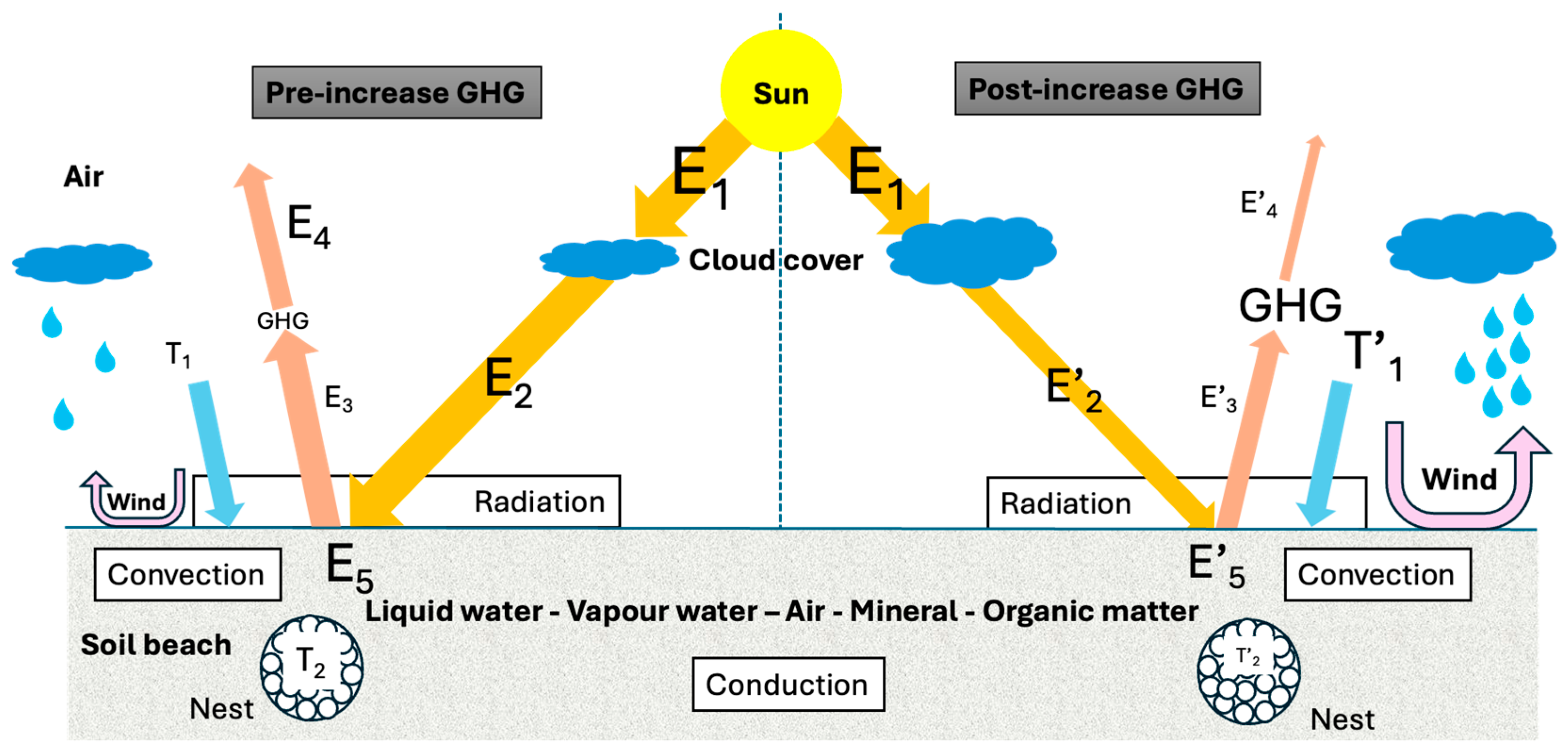
Figure 1. Schematic representation of the main energy transfer processes on a nesting beach before and after the increase in greenhouse gases (GHGs) due to human activity. Arrows indicate the direction of energy transfer. Droplets represent evaporation driven by rising air temperature and more wind, which leads to increased cloud cover.
Animals 16 00097 g001
Disclaimer/Publisher’s Note: The statements, opinions and data contained in all publications are solely those of the individual author(s) and contributor(s) and not of MDPI and/or the editor(s). MDPI and/or the editor(s) disclaim responsibility for any injury to people or property resulting from any ideas, methods, instructions or products referred to in the content.

