


Simple Summary
This study investigates the regulation of dermal papilla cells proliferation by TGFBR1, a differentially expressed gene identified through single-cell transcriptomic sequencing. The aim is to elucidate the molecular mechanisms through which TGFBR1 governs dermal papilla cells and the role of TGFBR1 in hair follicle development of fine-wool sheep. Single-cell transcriptomic sequencing data revealed significant downregulation of TGFBR1 in dermal papilla cells of ultra-fine-wool sheep, suggesting that this gene serves as a key negative regulator for wool fiber diameter. To validate this hypothesis, we constructed TGFBR1 overexpression plasmids and knockdown vectors for transfection into dermal papilla cells. Combined with functional assays such as EDU and CCK-8, we confirmed TGFBR1 exerts negative control over dermal papilla cell proliferation. Mechanistic studies revealed that TGFBR1 modulates the activity of multiple signaling pathways, including Wnt/β-catenin, BMP, and Notch, thereby influencing the proliferative capacity of fine-wool dermal papilla cells and hair follicle development. These findings provide valuable targets and theoretical references for developing molecular breeding strategies for fine-wool sheep.
Abstract
Dermal papilla cells (DPCs) serve as the signaling hub regulating hair follicle (HF) development and cyclical growth. This study aims to investigate the biological function and molecular mechanisms of TGFBR1 (transforming growth factor β receptor 1), a differentially expressed gene identified through single-cell transcriptomic sequencing (scRNA-seq) in the DPCs from fine-wool sheep. Primary DPCs were isolated and purified using a combination of enzymatic digestion and mechanical dissociation, followed by immunofluorescence identification (α-SMA and SOX2-positive). Following successful transfection with constructed TGFBR1 overexpression plasmids and siRNA interference vectors, cell proliferation was assessed via EDU staining and CCK-8 assays. mRNA expression of key genes in Wnt/β-catenin, BMP, and Notch signaling pathways (PCNA, CCND1, CTNNB1, SFRP2, BMP2, NOTCH3, SMAD4, etc.) was validated by RT-qPCR. Single-cell transcriptomics revealed significant downregulation of TGFBR1 in DPCs from fine-wool sheep. Functional validation demonstrated that TGFBR1 overexpression markedly suppressed DPC proliferation, whereas knockdown of TGFBR1 expression promoted DPC proliferation. Molecular mechanism studies showed that TGFBR1 overexpression significantly downregulated PCNA, CCND1, CTNNB1, NOTCH3, and SMAD4 while upregulating SFRP2, BMP2, and TGFB1 expression. These findings demonstrate that TGFBR1 acts as a negative regulator of DPCs proliferation by modulating the activity of multiple signaling pathways, including Wnt/β-catenin, BMP, and Notch, thereby suppressing the proliferative capacity of DPCs. This study not only provides new theoretical support for elucidating the role of the TGF-β signaling pathway in H development but also offers theoretical reference for in-depth research on molecular breeding in ultra -fine-wool sheep and the molecular mechanisms underlying HF development.
1. Introduction
Wool, as a vital natural textile material, possesses excellent biodegradability and renewability. Its unique biological properties, such as thermal insulation and felting capability, make it highly valued in the textile industry, conferring significant economic value [1]. As DPCs are the biological “production factories” of wool fibers, the structure and functional state of DPCs directly determine key physical properties such as fiber diameter (FD) and curvature. Among the diverse cellular components of the HFs, DPCs specialized mesenchymal cells located at the basal region of HFs play a central role in follicular morphogenesis, cyclic growth, and developmental regulation. They serve as the “signaling hub”, initiating and sustaining the hair cycle, releasing multiple growth factors via paracrine mechanisms, while activating key signaling pathways to precisely regulate follicular development and structural homeostasis [2]. Research indicates that the number and volume of DPCs are closely correlated with the FD, curvature morphology, and cyclical growth characteristics of HFs. When the number of DPCs falls below a critical threshold, even intact epithelial structures cannot initiate new hair growth, leading to follicular dysfunction [3]. Therefore, in-depth analysis of the biological characteristics of DPCs and their molecular regulatory mechanisms is crucial for understanding HF development and wool trait formation.
TGFBR1 is a key member of the serine/threonine protein kinase family, playing a vital role in the TGF-β/Smad signaling pathway. Its primary function is to mediate intracellular signal transduction as a transmembrane receptor [4]. By recognizing and binding the TGF-β ligand, this receptor translates extracellular signals into intracellular cascades, thereby extensively regulating key biological processes such as cell proliferation, migration, differentiation, and apoptosis [5,6]. Beyond activating the classical Smad-dependent pathway, TGFBR1 can activate other signaling pathways through non-canonical mechanisms, such as MAPK (mitogen-activated protein kinase) [7], PI3K (phosphatidylinositol-3-kinase) [8], and AKT (A serine/threonine kinase) [9], demonstrating its multifunctionality and complexity within cellular signaling networks. Numerous studies have elucidated TGFBR1’s regulatory functions across different cell types. For instance, all-trans retinoic acid (ATRA) reduces DPC proliferation and induces apoptosis via the TGF-β/Smad pathway, thereby influencing HF development [10]. MIR-22 regulates the downstream of smad3 signaling pathway by targeting TGFBR1, thereby inhibiting myoblast proliferation and promoting differentiation [11]. Knockdown of TGFBR1 in ST2 cells accelerates adipogenic differentiation [12]; Let-7a inhibits cell proliferation by targeting TGFBR1 in cervical carcinoma [13]. These studies collectively demonstrate that TGFBR1, as a key regulatory node, broadly participates in the molecular regulation of diverse cellular fate decisions. However, the specific biological mechanisms of this gene in DPC proliferation and differentiation remain unclear and warrant further systematic investigation.
Based on the aforementioned research background, this study uses fine-wool sheep as experimental subjects to systematically elucidate the biological functions of TGFBR1 in HF development. First, tissue localization analysis clarifies the expression characteristics of TGFBR1 for HF structures in skin. Subsequently, molecular biological techniques such as gene knockdown and overexpression are employed to regulate TGFBR1 expression levels in in vitro cultured DPCs, investigating its effects on key biological processes including DPCs proliferation and activity. Furthermore, by integrating studies on HF development-related signaling pathways, we elucidate the molecular mechanisms through which TGFBR1 participates in regulating DPC proliferation and HF morphogenesis. This research not only provides new experimental evidence for understanding the role of the TGF-β family in HF development but also lays a theoretical foundation for investigating the molecular regulatory networks governing HF development in fine-wool sheep breeding.
2. Materials and Methods
2.1. Animal Tissue Samples
All experimental animals used in this study were sourced from the Fine-Wool Sheep Core Breeding Farm (Gansu Provincial Sheep Breeding Technology Promotion Station, Sunan, Gansu, China). Under identical rearing conditions, six 14-month-old Alpine Merino ewes of the same paternal lineage were selected and divided into three groups of two each based on wool count and FD, an ultra-fine group (FD: <18 μm), a medium-fine group (FD: 18.1~20.0 μm), and a fine group (FD: 20.1~21.5 μm), for sampling. Skin tissue samples (0.5 cm × 0.5 cm) were collected from the scapular region of the experimental sheep using a skin biopsy punch (ACUDERM, Fort Lauderdale, FL, USA). Blood was rinsed off the tissue with PBS, and samples were preserved in PBS containing penicillin and streptomycin. Cell isolation experiments were conducted immediately upon arrival at the laboratory. The animal study protocol was approved by the Institutional Ethics Committee of the Institute of Animal Sciences, Chinese Academy of Agricultural Sciences (IAS-CAAS) (permit no. SYXK-2014-0002). Approval date: 13 May 2022.
2.2. ScRNA-Seq Data Analysis
ScRNA-seq data were generated using the 10× Genomics platform with Illumina Nova PE150 sequencing (Illumina, San Diego, CA, USA). Raw data underwent quality control using Cell Ranger (v.3.0), followed by clustering analysis with Seurat (v.5.2.0) and differential gene expression analysis. This study focused on cell lineages harboring LUM-labeled [14] and APOD-labeled [15] DPCs. TGFBR1, the gene selected for validation, was identified as a downregulated gene in the intergroup difference between ultra-fine group and fine group.
2.3. Isolation, Purification, and Immunofluorescence of DPCs
Under aseptic conditions, we collected a 0.5 cm × 0.5 cm skin tissue sample from the posterior margin of the shoulder blade of Alpine Merino sheep. DPCs were isolated using enzymatic digestion and mechanical dissociation. The skin tissue sample was immersed in 75% ethanol for 30 s, then rinsed with 10× PBS and 1× PBS separately for 3~5 min each. Wool and adipose tissue were trimmed from the skin using sterile surgical scissors. The tissue was then dissected into small pieces along the direction of HF growth and digested in 0.25% trypsin solution at 37 °C for 1.5~2 h. Once softened, we used a 1 mL syringe to isolate individual HF units. We incised the terminal bulbus pilosus and extruded the dermal papilla. We transferred the dermal papilla to a 48-well plate for culture using a pipette tip. Within 6~7 days, DPCs emerged from the papilla and adhered to the culture surface. Once densely populated, the cells were digested and passaged. Leveraging their adherent nature, DPCs were purified using differential digestion. After three consecutive purifications, DPCs more than 95% pure were obtained.
Identification of DPC marker proteins α-SMA and SOX2 was performed using immunofluorescence staining. Fourth or fifth -generation DPCs were seeded onto plates. When cells reached 60~70% confluence, medium was removed, cells were washed three times with PBS, and cells were fixed with 4% paraformaldehyde for 20 min. After three PBS washes, cells were permeabilized with 0.5% Triton X-100 for 10 min, followed by three PBS washes and blocking with 3% BSA for 1 h. After three PBS washes, we added 1:100 diluted primary antibody specific to the marker protein and incubated the cells overnight at 4 °C. We washed the cells three times with PBS, then added 1:100 diluted Cy3-labeled secondary antibody (goat anti-rabbit) (Biyun Tian, Shanghai, China) and incubated the cells for 1 h at room temperature in the dark. Finally, we washed the plates three times with PBS, stained the cell nuclei with DAPI at room temperature for 10 min, and obtained images using a confocal microscope. All cell cultures were performed at 37 °C in a 5% CO2 incubator.
2.4. Construction of Overexpression and Interference Vectors
Based on the TGFBR1 gene coding sequence published in the NCBI database, gene-specific primers containing double restriction sites for HindIII and EcoRI were designed. The products were directionally cloned into the eukaryotic expression vector to construct the pcDNA3.1(+) recombinant plasmid. The negative control vector pcDNA3.1-NC, recombinant plasmid pcDNA3.1-TGFBR1, and siRNA-TGFBR1 were designed and synthesized by GenePharma (Suzhou, China). Sequence information is shown in Table 1.
Table 1.
siRNA sequence information.
2.5. Real-Time Fluorescent Quantitative PCR (RT-qPCR)
Total RNA was extracted from DPCs using the Trizol method, with total RNA concentration measured by UV spectrophotometry (IMPLEN, Palo Alto, CA, USA). Total RNA samples extracted from DPCs following successful transfection (Zeta Life, San Francisco, CA, USA) were reverse-transcribed using a Prime Script™ RT Reagent Kit with gDNA Eraser (Vazyme, Nanjing, China) to obtain cDNA fragments. RT-qPCR primers were designed using NCBI Primer-Blast based on gene coding sequences published in the NCBI database. Primers were synthesized by Sangon Biotech Co., Ltd. (Shanghai, China) (Table 2). Reaction reagents were added to RNAse-free Eppendorf tubes, with β-actin serving as the internal control. Reaction protocol was 94 °C pre-denaturation for 30 s, 94 °C denaturation for 10 s, and 60 °C extension for 30 s, repeated for 40 cycles.
Table 2.
RT-qPCR primers.
2.6. Cell Proliferation and Viability Assays
EDU proliferation assay: DPCs were cultured until they reach a well-established, morphologically stable state. Cell proliferation was assessed using an EDU assay kit (Biyun Tian, China) 24 h after transfection with overexpression plasmids and siRNA. The EDU solution was diluted in medium to a 1:500 ratio. We added equal volumes to 6-well plates in a 1:1 ratio, incubated the plates for 2 h, aspirated the medium, and added 4% paraformaldehyde for 15 min at room temperature. After discarding the fixative, we washed the plates 3 times with 3% BSA-PBS solution for 3~5 min. We added 0.3% Triton X-100 permeabilization solution and incubated the plates for 15 min. The plates were thoroughly washed, then 500 μL Click reaction solution was added to each well. We gently shook the plate to ensure complete mixing of medium and reaction solution. We incubated the plate at room temperature in the dark for 30 min. After incubation, the plate was washed 3 times. We added Hoechst 33,342 reaction solution to the cells for nuclear staining. After 10 min, we observed cell proliferation under a fluorescence microscope and document images.
CCK-8 assay: Transfected DPCs were seeded into 96-well plates with three biological replicates per group. CCK-8 solution was added in the dark. After incubation at 37 °C in a 5% CO2 incubator for 2, 12, 24, 36, and 48 h, absorbance was measured at 450 nm.
2.7. Data Statistics and Analysis
RT-PCR results were analyzed for relative quantitative analysis by 2−ΔΔCt method. One-way ANOVA conducted with SPSS 22.0 (IBM, Armonk, NY, USA) software was used for statistical analysis. Experiments were designed with at least three biological replicates. All results are expressed as mean ± standard deviation (mean ± SD). * p < 0.05, ** p < 0.01, and *** p < 0.001 indicate statistical significance. All bar charts were generated using GraphPad Prism 10.0.
3. Results
3.1. Differentially Expressed Genes from DPCs in Ultra-Fine Group and Fine Group of Fine-Wool Sheep
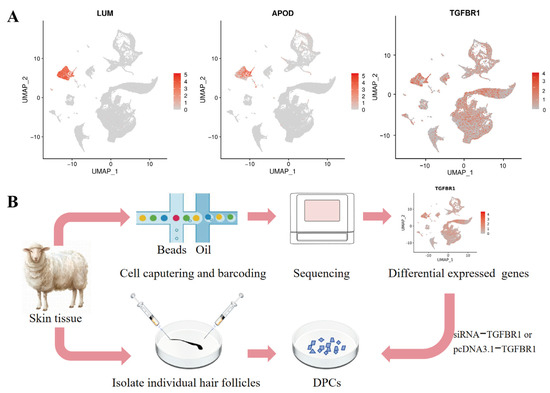
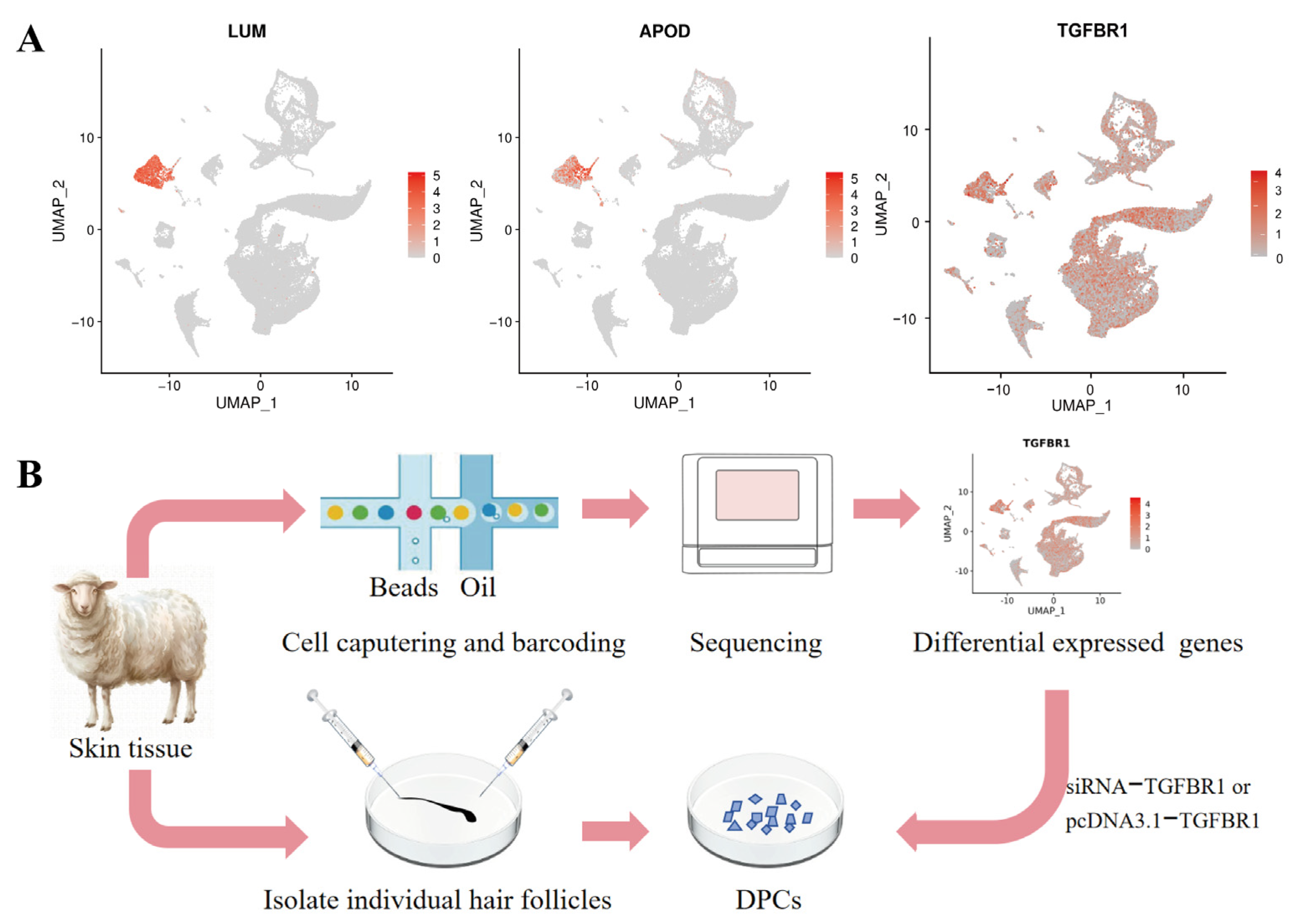
ScRNA-seq analysis revealed 147 significantly differentially expressed genes between the two DPC populations, comprising 71 significantly upregulated genes and 76 significantly downregulated genes (Table S1). UMAP visualization revealed that cell regions highly expressing LUM and APOD could be identified as DPCs (Figure 1A). Notably, among the differentially expressed genes, TGFBR1 exhibited widespread expression in the hair papilla region, suggesting its role in regulating DPC function.
Figure 1.
Screening and localization of differentially expressed genes in DPCs in ultra-fine group and fine group of fine-wool sheep. (A) Expression localization of LUM, APOD, and TGFBR1 in scRNA-seq analysis. Note: LUM is a marker gene for dermal cells; APOD is a marker gene for DPCs; (B) experimental workflow diagram of this study.
3.2. Isolation, Purification, and Identification of DPCs
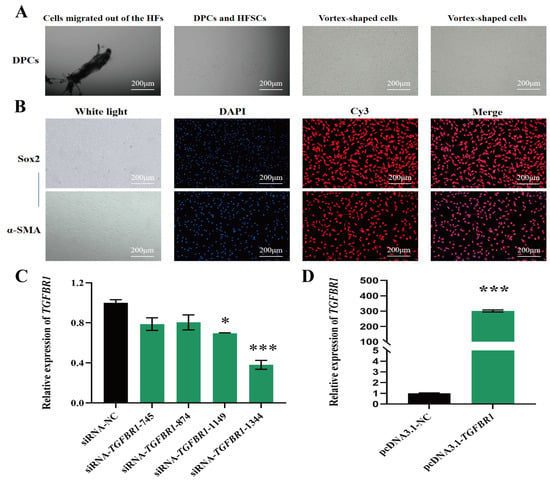
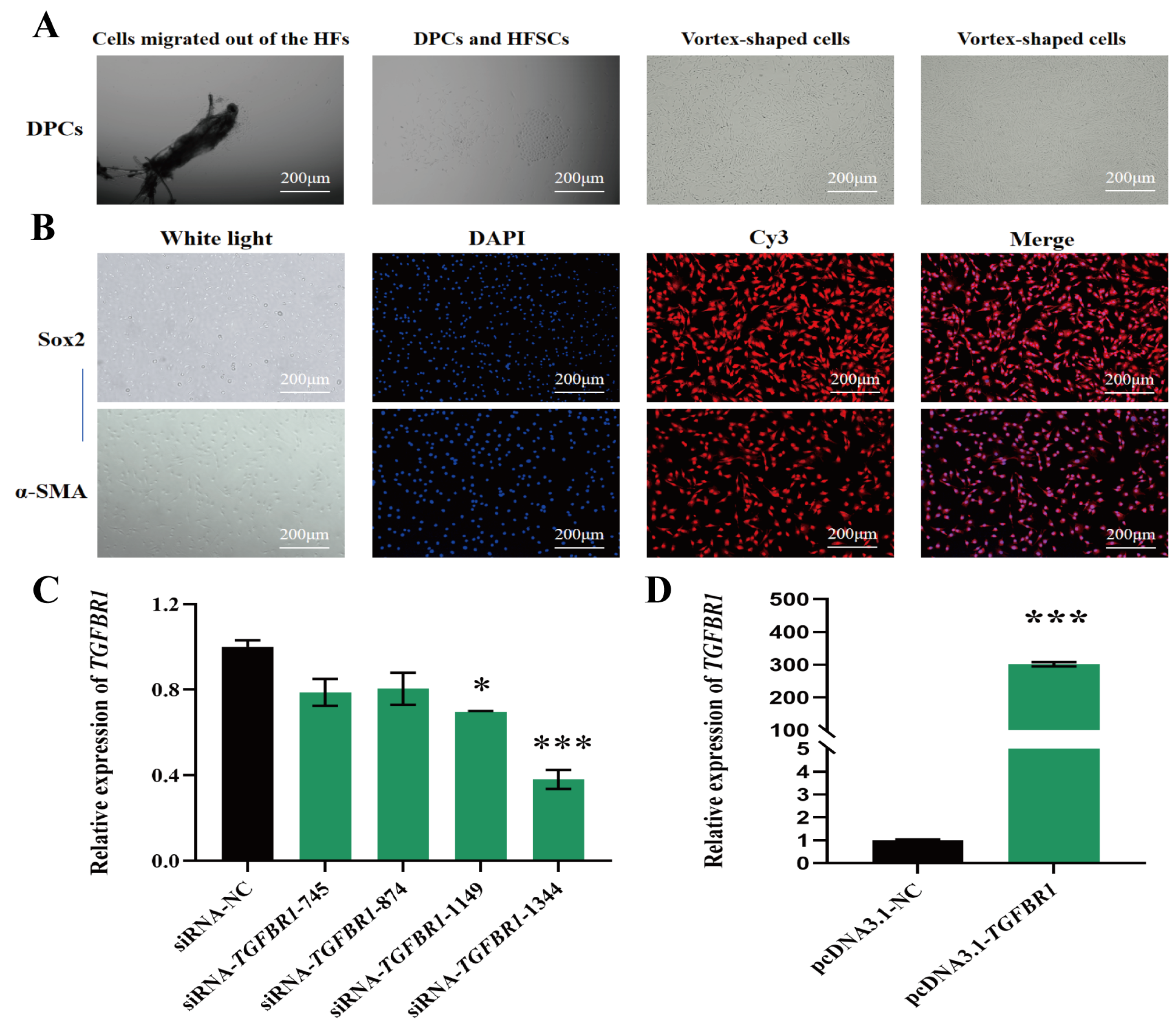
This study successfully isolated primary DPCs from fine-wool sheep using a combination of mechanical separation and enzymatic digestion, establishing a stable in vitro culture system (Figure 1B). Between 6 and 7 days post-follicle isolation, DPCs were observed migrating from the dermal papilla and adhering to the bottom of the culture dish. Their initial morphology was predominantly triangular, with plump cell bodies and abundant cytoplasm. As culture duration increased, cell morphology gradually changed, losing the initial triangular shape. The first passage was performed after around 10 days of culture. In the primary cell culture, in addition to the target DPCs, there were mixed populations of hair follicle stem cells (HFSCs) with a pebble-like morphology and long spindle-shaped fibroblast-like cells. After morphological stabilization, differential digestion ultimately yielded DPCs exhibiting stable growth characteristics, irregular spindle-shaped morphology, and characteristic vortex-like arrangement (Figure 2A). Immunofluorescence results revealed the significant positive expression of both markers in the cultured cells, thereby further confirming that the isolated cells were DPCs that were suitable for subsequent functional validation experiments (Figure 2B).
Figure 2.
Purification and identification of DPCs and the effect of TGFBR1 on their proliferation. (A) DPCs and HFSCs isolated from HFs, showing migrating and vortex-cultured DPCs; (B) immunofluorescence showing expression of α-SMA and SOX2 in isolated DPCs, where blue fluorescence indicates nuclear staining, and red fluorescence indicates target proteins; (C) expression of TGFBR1 interference fragment in DPCs after transfection; (D) expression of TGFBR1 overexpression vector in DPCs after transfection. * p < 0.05, and *** p < 0.001.
3.3. TGFBR1 Inhibits Proliferation of DPCs
RT-qPCR results showed that compared with the control and the empty vector control groups, TGFBR1 mRNA expression levels were significantly elevated in the overexpression group, confirming successful establishment of the overexpression system (Figure 2D). Among the four screened siRNA interference fragments, each siRNA exhibited varying degrees of reduced expression. However, TGFBR1-siRNA-1344 demonstrated the most pronounced knockdown efficiency, significantly downregulating TGFBR1 transcription levels. Consequently, TGFBR1-siRNA-1344 was selected as the effective interference tool for subsequent functional experiments (Figure 2C).
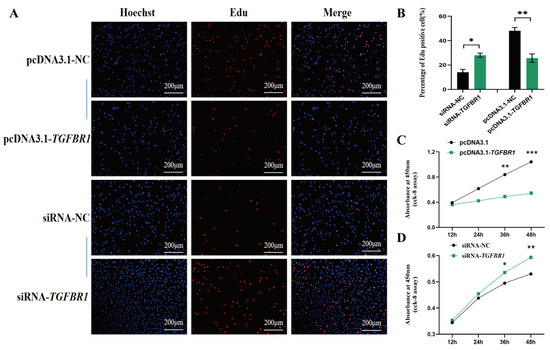
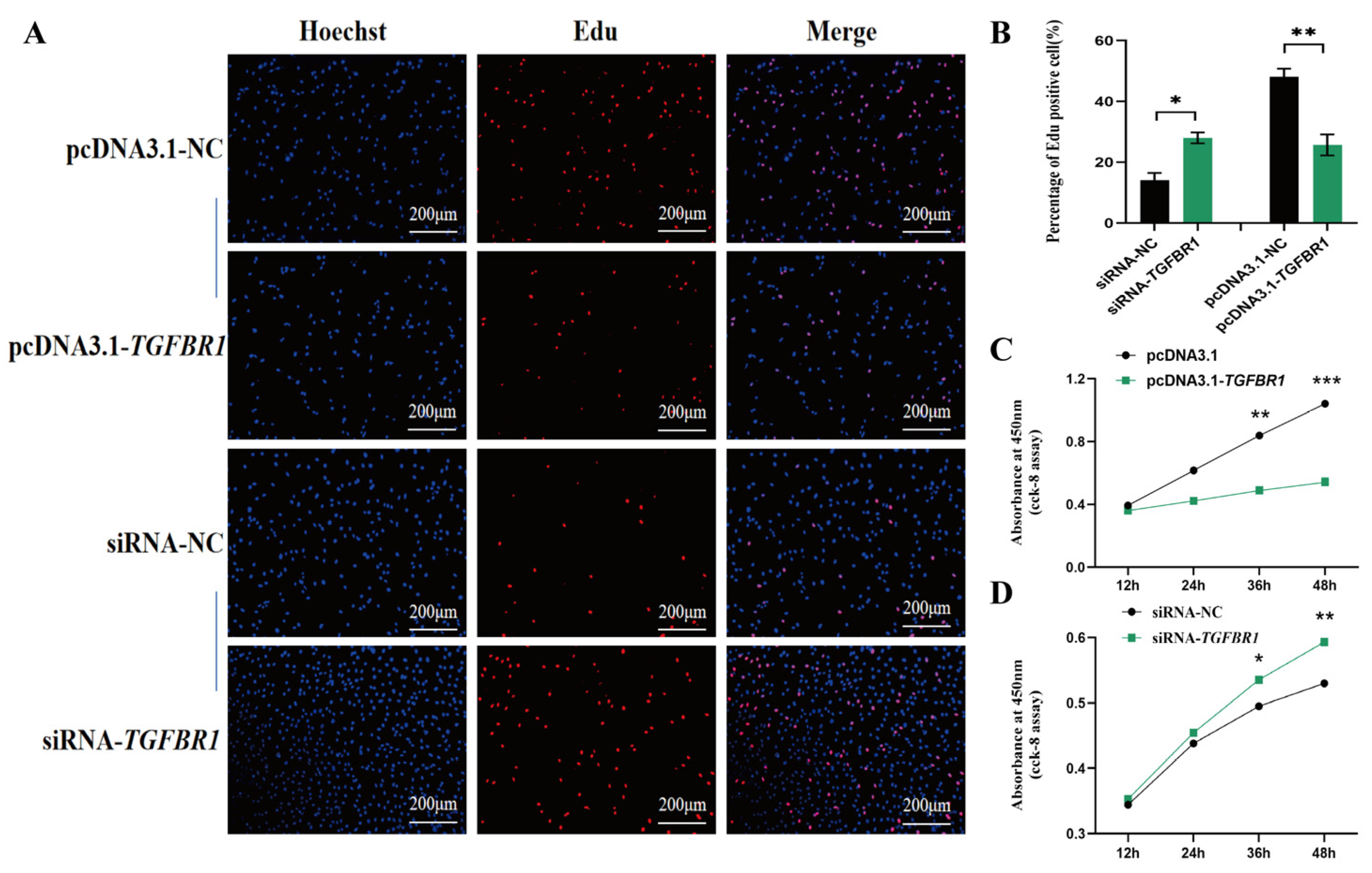
EDU assay results revealed that TGFBR1 overexpression significantly reduced the EDU-positive cell ratio, indicating marked inhibition of DPCs proliferation. Consistent with this, CCK-8 assays showed lower absorbance values in the overexpression group at all time points compared to the control group, further confirming TGFBR1’s inhibitory effect on DPC proliferation (Figure 3A–C). Conversely, after TGFBR1 knockdown, the EDU-positive cell ratio significantly increased, and CCK-8 assay results similarly demonstrated enhanced cell proliferation activity (Figure 3A,B,D).
Figure 3.
Effects of TGFBR1 on DPC proliferation. (A) Effects of TGFBR1 overexpression and knockdown on DPC proliferation. Red fluorescence indicates EDU; blue fluorescence indicates Hoechst staining. (B) EDU-positive cell rates after TGFBR1 overexpression and knockdown. (C) OD value curves for TGFBR1 overexpression at 12 h, 24 h, 36 h, and 48 h; (D) OD value curves for TGFBR1 knockdown at 12 h, 24 h, 36 h, and 48 h.* p < 0.05, ** p < 0.01, and *** p < 0.001.
3.4. TGFBR1 Regulates Genes Associated with HF Development
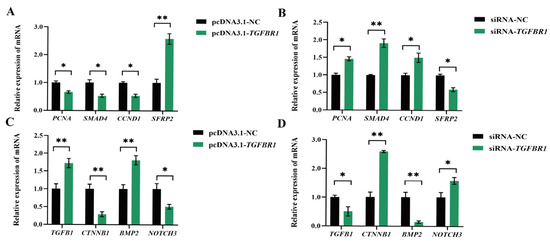
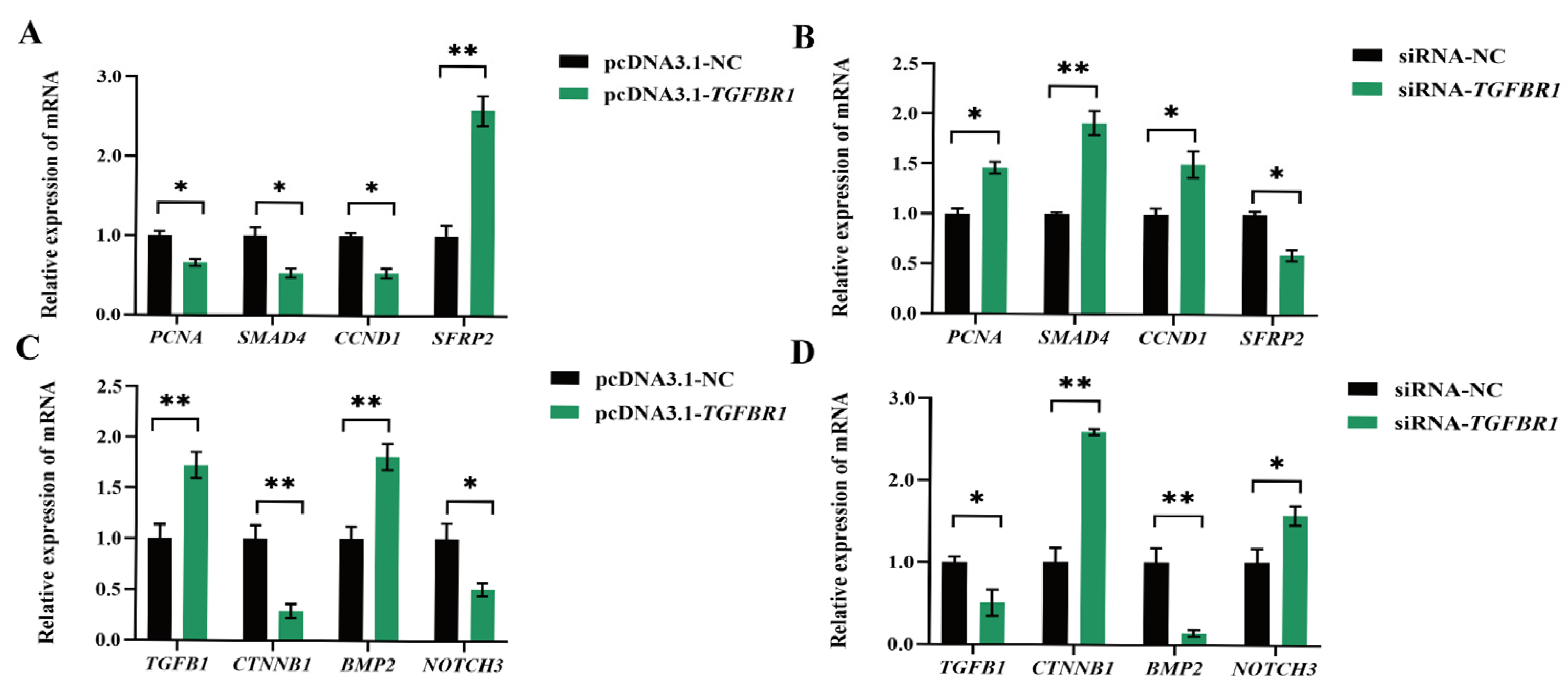
Experimental results demonstrated that TGFBR1 overexpression in DPCs significantly downregulated PCNA and CCND1 transcription levels. Concurrently, mRNA expressions of CTNNB1, NOTCH3, and SMAD4 were markedly suppressed. Correspondingly, the gene expressions of SFRP2, BMP2, and TGFB1 were significantly upregulated (Figure 4A,C). This expression pattern was perfectly validated in the reverse experiment: upon TGFBR1 knockdown, the suppressed genes (PCNA, CCND1, CTNNB1, NOTCH3, SMAD4) showed significantly increased expression, while the activated genes (SFRP2, BMP2, TGFB1) exhibited markedly decreased expression (Figure 4B,D).
Figure 4.
Effects of TGFBR1 on genes related to HF development. (A) Effects of TGFBR1 overexpression on PCNA, SMAD4, CCND1, and SFRP2 expression; (B) effects of TGFBR1 knockdown on PCNA, SMAD4, CCND1, and SFRP2 expression; (C) effects of TGFBR1 overexpression on TGFB1, CTNNB1, BMP2, and NOTCH3 expression; (D) effects of TGFBR1 knockdown on TGFB1, CTNNB1, BMP2, and NOTCH3 expressions. * p < 0.05, ** p < 0.01.
4. Discussion
As vital skin appendages, HFs serve as the fundamental biological basis for regulating hair formation and its key economic traits (e.g., diameter, curvature). Their morphogenesis and cyclical growth depend on intricate collaboration among multiple cell types, including DPCs, HFSCs, and matrix cells (Mxs) [16]. During embryonic development, HF formation relies on a series of interactions between the epidermal basal layer and dermal mesenchyme. Postnatally, localized mesenchymal cell clusters gradually differentiate into DPCs, which are subsequently enveloped by Mxs. These cells persist as DPCs, continuously influencing HF growth and development [17]. Furthermore, this process is tightly regulated by multiple signaling pathways, including the Wnt/β-catenin pathway, which promotes HF initiation and growth [18,19]; the BMP signaling pathway, involved in cell fate determination [20,21]; the SHH signaling pathway, which regulates morphogenesis [22]; the Notch signaling pathway, affecting stem cell maintenance and differentiation [23,24]; and the transforming growth factor TGF-β family, which is extensively involved in regulating cellular behavior [25]. These pathways form a complex regulatory network through paracrine and autocrine mechanisms, collectively determining the developmental progression and homeostasis of HFs. TGFBR1, as the specific receptor for the TGF-β signaling pathway, plays crucial roles in diverse tissues and cells. Typically, TGF-β ligand binding to its receptor activates downstream Smad proteins, thereby regulating target gene expression and influencing cellular processes including proliferation, differentiation, and apoptosis [26]. Studies indicate that TGFBR1 mediates Smad phosphorylation and downstream signaling to influence myoblast proliferation and differentiation [27]. Furthermore, microRNA-98 suppresses cardiac fibroblast differentiation by targeting TGFBR1, highlighting the receptor’s broad role in cell fate determination [28]. However, although the functions of TGFBR1 in various biological systems are increasingly well-defined, its specific mechanism of action in DPCs in fine-wool sheep remains to be systematically elucidated.
This study functionally validated TGFBR1 at the cellular level, which is a differentially downregulated gene in DPCs that was identified through scRNA-seq. The proliferative capacity of DPCs is fundamental to maintaining their population size and performing their functions, being crucial for the normal growth and development of HFs as well as their cyclical growth [29]. EDU and CCK-8 assays demonstrated that TGFBR1 expression directly influences DPCs proliferation capacity: overexpression significantly suppressed DPC proliferation, manifested as reduced EDU-positive cell proportions and decreased CCK-8 absorbance values. Conversely, knocking down TGFBR1 expression markedly enhanced cellular proliferation, suggesting TGFBR1 acts as a negative regulator of DPC proliferation. This further supports the critical role of the TGF-β signaling pathway in initiating the HF regression phase or maintaining the quiescent state of DPCs during the resting phase. Furthermore, the skin samples used for scRNA-seq in this study were collected in August, when the HFs of fine-wool sheep were in a vigorous growth phase. The differential downregulation of TGFBR1 in DPCs from ultra-fine-wool sheep aligns with its proliferation-inhibiting effect observed in functional validation experiments, providing additional evidence for the gene’s negative regulatory role in DPC growth from a natural expression pattern perspective.
RT-qPCR results for HF-development-related genes revealed a potential mechanism through which TGFBR1 influences DPC proliferation. PCNA, a classic marker assessing cell proliferation capacity [30], exhibited significantly reduced mRNA expression following TGFBR1 overexpression, providing molecular evidence for TGFBR1’s inhibitory effect on DPCs proliferation. The Wnt/β-catenin signaling pathway plays a crucial role in DPC proliferation and differentiation [31]. CNND1 and CTNNB1, the core downstream effectors promoting HF formation and development [32], both exhibited significantly downregulated mRNA expression following TGFBR1 overexpression, suggesting TGFBR1 influences Wnt/β-catenin signaling by suppressing downstream gene expression, thereby affecting DPC proliferation. SFRP2, a regulator of the Wnt pathway, plays a role in suppressing HF growth, degeneration, and remodeling by inhibiting keratinocyte proliferation [33]. Its upregulation following TGFBR1 overexpression provides further compelling evidence that TGFBR1 influences the Wnt/β-catenin signaling pathway. TGFB1, belonging to the same transforming growth factor β family as TGFBR1, inhibits HF epithelial cell growth and induces cell degeneration [34]. Its expression increases upon TGFBR1 overexpression, consistent with TGFB1’s known role in suppressing HF epithelial cell proliferation, further reinforcing TGFBR1’s proliferative inhibitory function. The BMP signaling pathway regulates cell proliferation, differentiation, and apoptosis in multiple organs, including skin [35]. In cashmere goat HFs, BMP2 is highly expressed during the resting phase but is barely detected during the active phase [36]. This finding further supports the hypothesis that TGFBR1 promotes the transition of DPCs to a quiescent state. SMAD4 is a key regulator of HF formation and development, synergistically modulating epidermal homeostasis via the TGF-β pathway [37], maintaining the morphological and structural integrity of HFSCs [38], and promoting DPC proliferation [39]. The Notch signaling pathway suppresses cell differentiation to promote proliferation in HFs, thereby maintaining stem cell characteristics, as a key component of this pathway. The NOTCH3 gene likely plays a crucial role in this process [40]. The significant reduction in SMAD4 and NOTCH3 following TGFBR1 overexpression further supports TGFBR1’s negative regulatory role in DPCs. Collectively, these findings indicate that TGFBR1 coordinates multiple signaling pathways, including Wnt/β-catenin, BMP, and Notch, to form a complex molecular network that finely regulates DPC proliferation capacity.
5. Conclusions
This study demonstrates that TGFBR1 is expressed in DPCs and inhibits DPC proliferation. Further mechanistic analysis revealed that TGFBR1 exerts this effect by modulating key signaling pathways, including Wnt/β-catenin, BMP, and Notch. These results identify TGFBR1 as a key negative regulator of DPC proliferation and provide new insights into the molecular mechanisms of hair follicle development. The findings offer potential implications for the genetic improvement of wool traits.
Supplementary Materials
The following supporting information can be downloaded at: https://www.mdpi.com/article/10.3390/ani16010036/s1, Table S1: Differentially expressed genes between the ultra-fine and fine groups.
Author Contributions
Conceptualization, T.X., Y.L. and T.G.; methodology, T.X., Y.L. and T.G.; software, C.Y., Y.S. and T.X.; validation, T.X. and Y.L.; formal analysis, T.X. and Y.L.; investigation, T.G., Y.L. and J.T.; resources, T.G. and C.Y.; data curation, Y.L., T.X. and T.G.; writing—original draft preparation, T.X.; writing—review and editing, T.G.; visualization, C.Y.; supervision, Z.L.; project administration, T.G. and C.Y.; funding acquisition, J.L. and T.G. All authors have read and agreed to the published version of the manuscript.
Funding
This research was supported by grants from the Science and Technology Innovation 2030-Major Program (2023ZD0405101), the Natural Science Foundation of Gansu Province (21JR7RA028), the China Agriculture Research System (CARS-39-02), and the Chinese Academy of Agricultural Sciences Technology Innovation Project (25-LZIHPS-07).
Institutional Review Board Statement
The animal study protocol was approved by the Institutional Ethics Committee of the Institute of Animal Sciences, Chinese Academy of Agricultural Sciences (IAS-CAAS) (permit no. SYXK-2014-0002). Approval date: 13 May 2022.
Informed Consent Statement
Informed consent for publication was obtained from the farm owner.
Data Availability Statement
All data are presented in this article.
Acknowledgments
The authors thank Novogene (Guangzhou, China) for their assistance with 10× genomics single-cell RNA sequencing.
Conflicts of Interest
The authors declare no conflicts of interest.
Abbreviations
The following abbreviations are used in this manuscript:
| HFs | Hair follicles |
| DPCs | Dermal papilla cells |
| HFSCs | Hair follicle stem cells |
| TGFBR1 | Transforming growth factor β receptor 1 |
| ScRNA-seq | Single-cell transcriptomic sequencing |
| FD | Fiber diameter |
| MAPK | Mitogen-activated protein kinase |
| PI3K | Phosphatidylinositol-3-kinase |
| AKT | A serine/threonine kinase |
| ATRA | All-trans retinoic acid |
| Mxs | Matrix cells |
References
- Szatkowski, P. The Influence of Various Chemical Modifications of Sheep Wool Fibers on the Long-Term Mechanical Properties of Sheep Wool/PLA Biocomposites. Materials 2025, 18, 3056. [Google Scholar] [CrossRef] [Scilit] [PubMed]
- Li, J.; Zhao, B.; Yao, S.; Dai, Y.; Zhang, X.; Yang, N.; Bao, Z.; Cai, J.; Chen, Y.; Wu, X. Dermal Papilla Cell-Derived Exosomes Regulate Hair Follicle Stem Cell Proliferation via LEF1. Int. J. Mol. Sci. 2023, 24, 3961. [Google Scholar] [CrossRef] [Scilit] [PubMed]
- Chi, W.; Wu, E.; Morgan, B.A. Dermal papilla cell number specifies hair size, shape and cycling and its reduction causes follicular decline. Development 2013, 140, 1676–1683. [Google Scholar] [CrossRef] [Scilit] [PubMed]
- Loboda, A.; Sobczak, M.; Jozkowicz, A.; Dulak, J. TGF-β1/Smads and miR-21 in Renal Fibrosis and Inflammation. Mediat. Inflamm. 2016, 2016, 1–12. [Google Scholar] [CrossRef] [Scilit]
- Zieba, J.; Forlenza, K.N.; Khatra, J.S.; Sarukhanov, A.; Duran, I.; Rigueur, D.; Lyons, K.M.; Cohn, D.H.; Merrill, A.E.; Krakow, D. TGFβ and BMP Dependent Cell Fate Changes Due to Loss of Filamin B Produces Disc Degeneration and Progressive Vertebral Fusions. PLoS Genet. 2016, 12, e1005936. [Google Scholar] [CrossRef] [Scilit]
- Zimowska, M.; Duchesnay, A.; Dragun, P.; Oberbek, A.; Moraczewski, J.; Martelly, I. Immunoneutralization of TGFbeta1 Improves Skeletal Muscle Regeneration: Effects on Myoblast Differentiation and Glycosaminoglycan Content. Int. J. Cell Biol. 2009, 2009, 659372. [Google Scholar] [CrossRef] [Scilit]
- Mu, D.; Cambier, S.; Fjellbirkeland, L.; Baron, J.L.; Munger, J.S.; Kawakatsu, H.; Sheppard, D.; Broaddus, V.C.; Nishimura, S.L. The integrin αvβ8 mediates epithelial homeostasis through MT1-MMP–dependent activation of TGF-β1. J. Cell Biol. 2002, 157, 493–507. [Google Scholar] [CrossRef] [Scilit]
- Vogelmann, R.; Nguyen-Tat, M.D.; Giehl, K.; Adler, G.; Wedlich, D.; Menke, A. TGF beta-induced downregulation of E-cadherin-based cell-cell adhesion depends on PI3-kinase and PTEN. J. Cell Sci. 2005, 118, 4901–4912. [Google Scholar] [CrossRef] [Scilit]
- Mu, Y.; Gudey, S.K.; Landstr, M.M. Non-Smad signaling pathways. Cell Tissue Res. 2012, 347, 11–20. [Google Scholar] [CrossRef] [Scilit]
- Nan, W.; Li, G.; Si, H.; Lou, Y.; Wang, D.; Guo, R.; Zhang, H. All-trans-retinoic acid inhibits mink hair follicle growth via inhibiting proliferation and inducing apoptosis of dermal papilla cells through TGF-beta 2/Smad2/3 pathway. Acta Histochemica: Zeitschrift fur Histologische Topochemie 2020, 122, 151603. [Google Scholar] [CrossRef] [Scilit]
- Liu, D.; Black, B.L.; Derynck, R. TGF-β inhibits muscle differentiation through functional repression of myogenic transcription factors by Smad3. Genes Dev. 2001, 15, 2950–2966. [Google Scholar] [CrossRef] [Scilit] [PubMed]
- Zhang, X.; Chang, A.; Li, Y.; Gao, Y.; Wang, H.; Ma, Z.; Li, X.; Wang, B. miR-140-5p regulates adipocyte differentiation by targeting transforming growth factor-β signaling. Sci. Rep. 2015, 5, 18118. [Google Scholar] [CrossRef] [Scilit] [PubMed]
- Wu, T.; Chen, X.; Peng, R.; Liu, H.; Yin, P.; Peng, H.; Zhou, Y.; Sun, Y.; Wen, L.; Yi, H.; et al. Let7a suppresses cell proliferation via the TGFβ/SMAD signaling pathway in cervical cancer. Oncol. Rep. 2016, 36, 3275–3282. [Google Scholar] [CrossRef] [Scilit] [PubMed]
- Gupta, K.; Levinsohn, J.; Linderman, G.; Chen, D.; Sun, T.Y.; Dong, D.; Taketo, M.M.; Bosenberg, M.; Kluger, Y.; Choate, K.; et al. Single-Cell Analysis Reveals a Hair Follicle Dermal Niche Molecular Differentiation Trajectory that Begins Prior to Morphogenesis. Dev. Cell 2019, 48, 17–31.e6. [Google Scholar] [CrossRef] [Scilit]
- Li, C.; He, X.; Wu, Y.; Li, J.; Zhang, R.; An, X.; Yue, Y. Single-Cell Transcriptome Sequence Profiling on the Morphogenesis of Secondary Hair Follicles in Ordos Fine-Wool Sheep. Int. J. Mol. Sci. 2024, 25, 584. [Google Scholar] [CrossRef] [Scilit]
- Greco, V.; Chen, T.; Rendl, M.; Schober, M.; Pasolli, H.A.; Stokes, N.; dela Cruz-Racelis, J.; Fuchs, E. A Two-Step Mechanism for Stem Cell Activation during Hair Regeneration. Cell Stem Cell 2009, 4, 155–169. [Google Scholar] [CrossRef] [Scilit]
- Rendl, M.; Lewis, L.; Fuchs, E. Molecular Dissection of Mesenchymal–Epithelial Interactions in the Hair Follicle. PLoS Biol. 2005, 3, e331. [Google Scholar] [CrossRef] [Scilit]
- Mayumi, I.; Zaixin, Y.; Thomas, A.; Cui, C.; Kim, N.; Millar, S.E.; Cotsarelis, G. Wnt-dependent de novo hair follicle regeneration in adult mouse skin after wounding. Nature 2007, 447, 316–320. [Google Scholar] [CrossRef] [Scilit]
- Biggs, L.C.; Mikkola, M.L. Early inductive events in ectodermal appendage morphogenesis. Semin. Cell Dev. Biol. 2014, 25–26, 11–21. [Google Scholar] [CrossRef] [Scilit]
- Massagué, J.; Chen, Y.G. Controlling TGF-beta signaling. Genes Dev. 2000, 14, 627–644. [Google Scholar] [CrossRef] [Scilit]
- Wu, P.; Zhang, Y.; Xing, Y.; Xu, W.; Guo, H.; Deng, F.; Ma, X.; Li, Y. Correction to: The balance of Bmp6 and Wnt10b regulates the telogen-anagen transition of hair follicles. Cell Commun. Signal. CCS 2020, 18, 4. [Google Scholar] [CrossRef] [Scilit] [PubMed]
- Woo, W.M.; Zhen, H.H.; Oro, A.E. Shh maintains dermal papilla identity and hair morphogenesis via a Noggin-Shh regulatory loop. Genes Dev. 2012, 26, 1235–1246. [Google Scholar] [CrossRef] [Scilit] [PubMed]
- Bach-Cuc, N.; Karine, L.; Anna, M.; Dario, A.; Vikram, D.; Giusy, D.G.; Maranke, I.K.; Zhang, Z.; Wang, J.; Alice, T.D.V.; et al. Cross-regulation between Notch and p63 in keratinocyte commitment to differentiation. Genes Dev. 2006, 20, 1028–1042. [Google Scholar] [CrossRef] [Scilit] [PubMed]
- Shadmehr, D.; Raphael, K. Notch signaling in bulge stem cells is not required for selection of hair follicle fate. Development 2009, 136, 891–896. [Google Scholar] [CrossRef] [Scilit]
- Niimori, D.; Kawano, R.; Felemban, A.; Niimori-Kita, K.; Tanaka, H.; Ihn, H.; Ohta, K. Tsukushi controls the hair cycle by regulating TGF-β1 signaling. Dev. Biol. 2012, 372, 81–87. [Google Scholar] [CrossRef] [Scilit]
- Pedro, S.; Andreia, S.; Carlos, C.A.; Verde, I. TGF-β1 in Vascular Wall Pathology: Unraveling Chronic Venous Insufficiency Pathophysiology. Int. J. Mol. Sci. 2017, 18, 2534. [Google Scholar] [CrossRef] [Scilit]
- Allen, R.E.; Boxhorn, L.K. Inhibition of skeletal muscle satellite cell differentiation by transforming growth factor-beta. J. Cell. Physiol. 2010, 133, 567. [Google Scholar] [CrossRef] [Scilit]
- Cheng, R.; Dang, R.; Zhou, Y.; Ding, M.; Hua, H. MicroRNA-98 inhibits TGF-β1-induced differentiation and collagen production of cardiac fibroblasts by targeting TGFBR1. Hum. Cell 2017, 30, 192–200. [Google Scholar] [CrossRef] [Scilit]
- Wang, M.; Wang, M.; Jiang, J.; Li, K.; Liang, H.; Wang, N.; Zou, Y.; Wang, D.; Zhou, S.; Tang, Y.; et al. THSD4 promotes hair growth by facilitating dermal papilla and hair matrix interactions. Theranostics 2025, 15, 3571. [Google Scholar] [CrossRef] [Scilit]
- Røst, L.M.; Ræder, S.B.; Olaisen, C.; Søgaard, C.K.; Sharma, A.; Bruheim, P.; Otterlei, M. PCNA regulates primary metabolism by scaffolding metabolic enzymes. Oncogene 2022, 42, 613–624. [Google Scholar] [CrossRef] [Scilit]
- Xiong, Y.; Liu, Y.; Song, Z.; Hao, F.; Yang, X. Identification of Wnt/β-catenin signaling pathway in dermal papilla cells of human scalp hair follicles: TCF4 regulates the proliferation and secretory activity of dermal papilla cell. J. Dermatol. 2014, 41, 84–91. [Google Scholar] [CrossRef] [Scilit]
- Yue, S.; Zhou, Y.; Petunia, M.; Liu, J.; Liu, C.; Sello, C.T.; Song, Y.; Feng, Z.; Li, S.; Yang, W.; et al. The role of CTNNB1 and LEF1 in feather follicles development of Anser cygnoides and Anser anser. Genes Genom. 2020, 42, 761–771. [Google Scholar] [CrossRef] [Scilit]
- Bong-Kyu, K.; Kim, Y.S. Expression of sfrp2 is increased in catagen of hair follicles and inhibits keratinocyte proliferation. Ann. Dermatol. 2014, 26, 79–87. [Google Scholar]
- Genta, P.; Simone, E.; Florence, H.; Dusserre, Y.; Mermod, N.; Calabrese, A. Nuclear factor I-C regulates TGF-{beta}-dependent hair follicle cycling. J. Biol. Chem. 2010, 285, 34115–34125. [Google Scholar]
- María, C.J.; Maia, O.F.; José, L.G.; Balañá, M.E. Androgens downregulate BMP2 impairing the inductive role of dermal papilla cells on hair follicle stem cells differentiation. Mol. Cell. Endocrinol. 2021, 520, 111096. [Google Scholar] [CrossRef] [Scilit]
- Cai, B.; Zheng, Y.; Yan, J.; Wang, J.; Liu, X.; Yin, G. BMP2-mediated PTEN enhancement promotes differentiation of hair follicle stem cells by inducing autophagy. Exp. Cell Res. 2019, 385, 111647. [Google Scholar] [CrossRef] [Scilit]
- Owens, P.; Bazzi, H.; Engelking, E.; Han, G.; Christiano, A.M.; Wang, X.J. Smad4-dependent desmoglein-4 expression contributes to hair follicle integrity. Dev. Biol. 2008, 322, 156–166. [Google Scholar] [CrossRef] [Scilit]
- Yang, L.; Wang, L.; Yang, X. Disruption of Smad4 in mouse epidermis leads to depletion of follicle stem cells. Mol. Biol. Cell 2009, 20, 882–890. [Google Scholar] [CrossRef] [Scilit]
- Fu, J.; Wang, D.; Liu, W.; Qi, Y.; Zhang, C.; Li, H.; Cai, J.; Ji, S.; Zhang, L.; Sun, F. miR-370-3p Inhibited the Proliferation of Sheep Dermal Papilla Cells by Inhibiting the Expression of SMAD4. Cells 2025, 14, 714. [Google Scholar] [CrossRef] [Scilit]
- Zhou, B.; Lin, W.; Long, Y.; Yang, Y.; Zhang, H.; Wu, K.; Chu, Q. Notch signaling pathway: Architecture, disease, and therapeutics. Signal Transduct. Target. Ther. 2022, 7, 95. [Google Scholar] [CrossRef] [Scilit]

Disclaimer/Publisher’s Note: The statements, opinions and data contained in all publications are solely those of the individual author(s) and contributor(s) and not of MDPI and/or the editor(s). MDPI and/or the editor(s) disclaim responsibility for any injury to people or property resulting from any ideas, methods, instructions or products referred to in the content. |
© 2025 by the authors. Licensee MDPI, Basel, Switzerland. This article is an open access article distributed under the terms and conditions of the Creative Commons Attribution (CC BY) license.