An Exploratory Study on Farming System and Meat Quality of Black Alpine Pig

 ,
,  , , , , and
Simple Summary
Abstract
1. Introduction
2. Materials and Methods
2.1. Farm Management and Data Collection
2.2. Meat Sampling
2.3. Color and Texture
2.4. Proximate Composition and Fatty Acid Analysis
2.5. Statistical Analysis
3. Results
3.1. Characterization of the Farming System Through On-Farm Data Collection
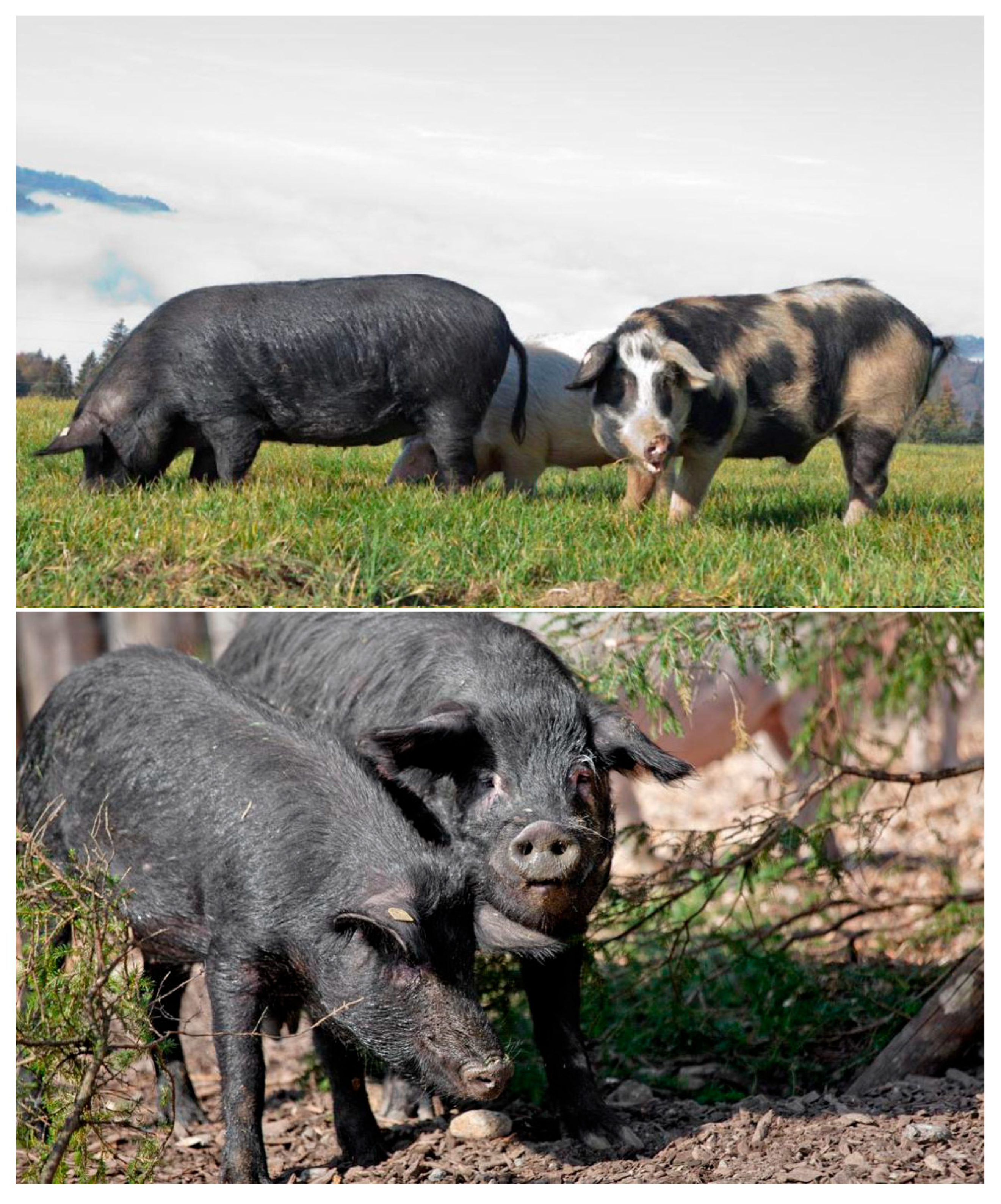
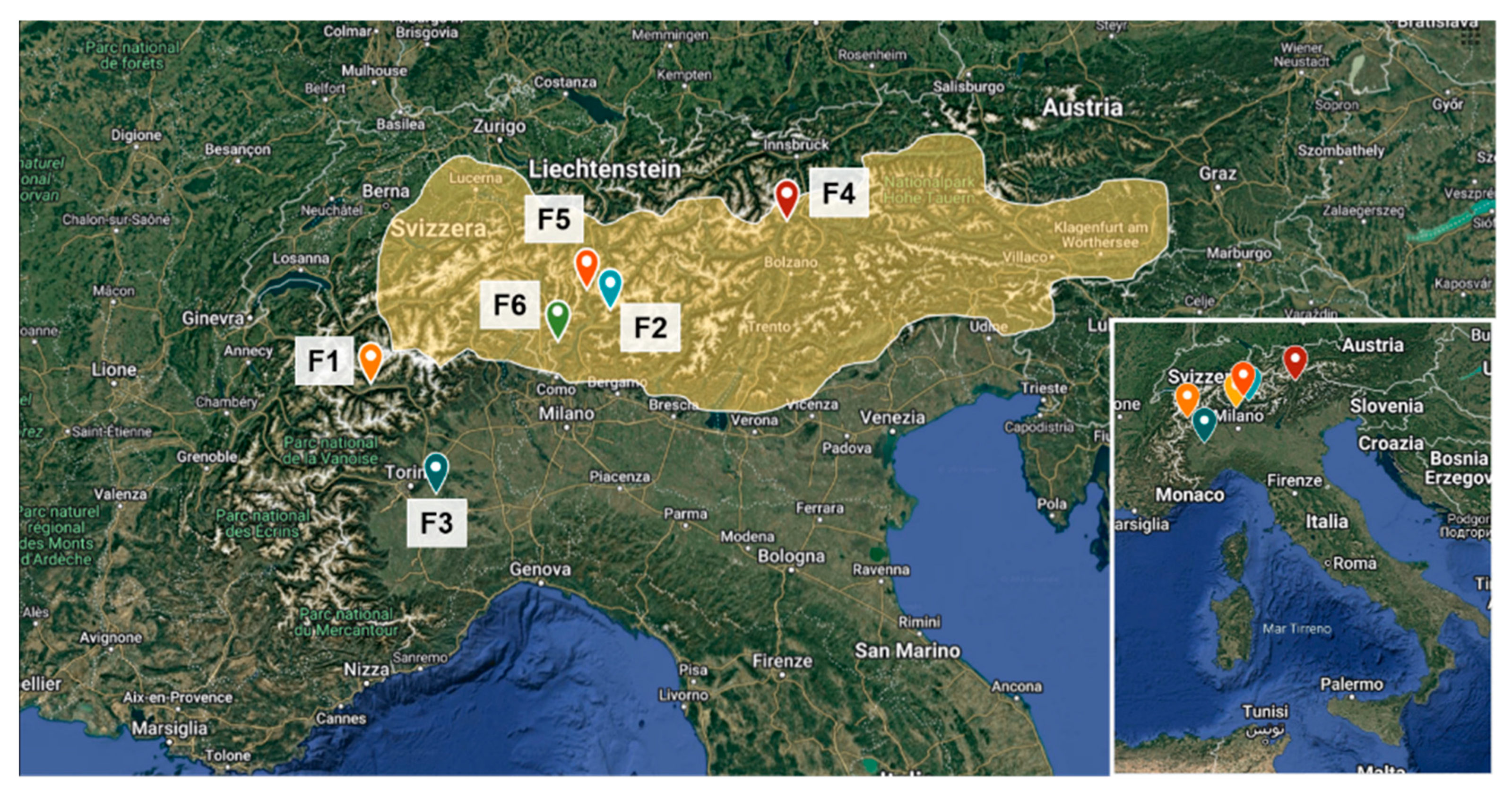
3.1.1. Farming System
3.1.2. Productive and Reproductive Performance of BAPs
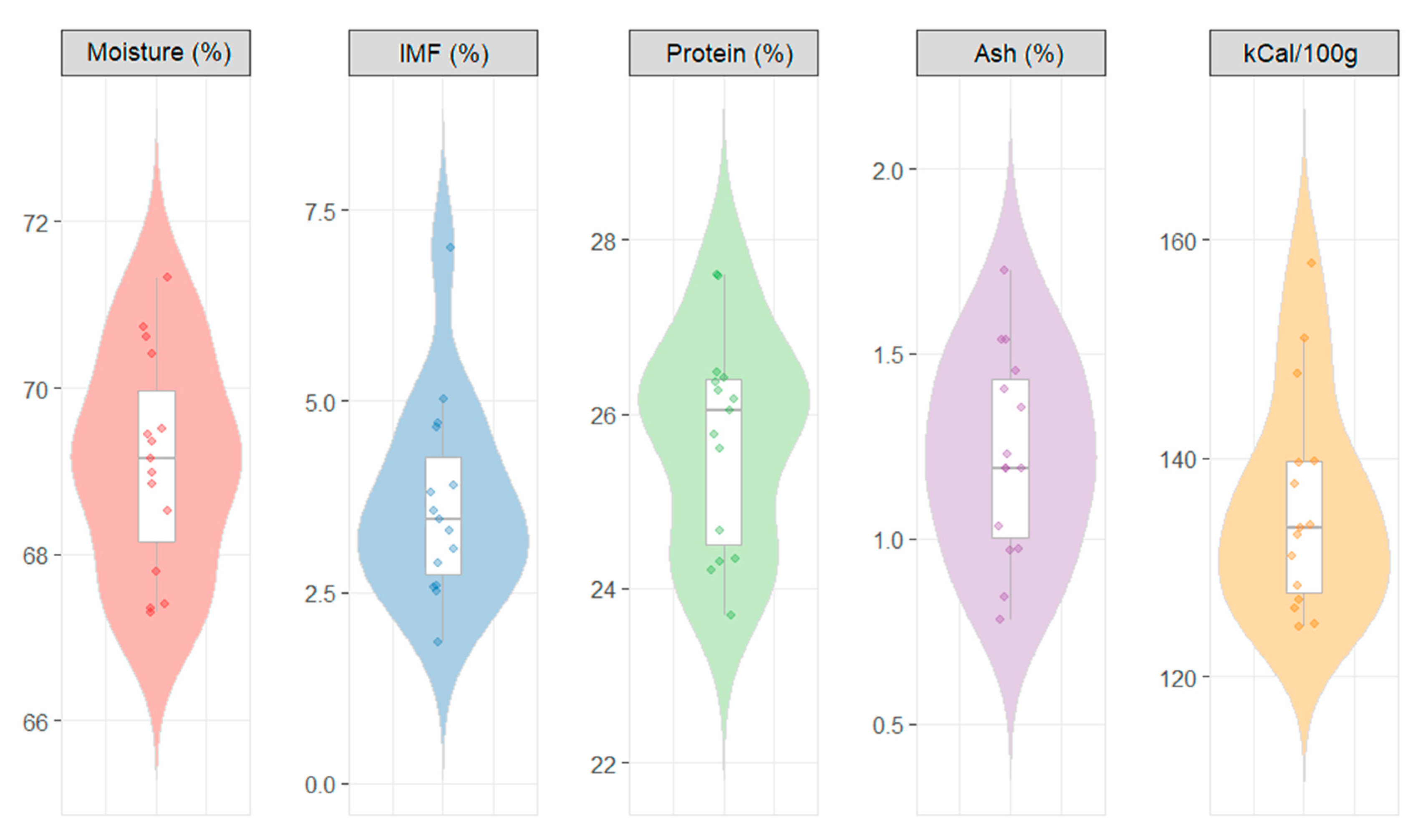
3.2. Meat Quality
3.3. Fatty Acid Distribution in Meat and Backfat
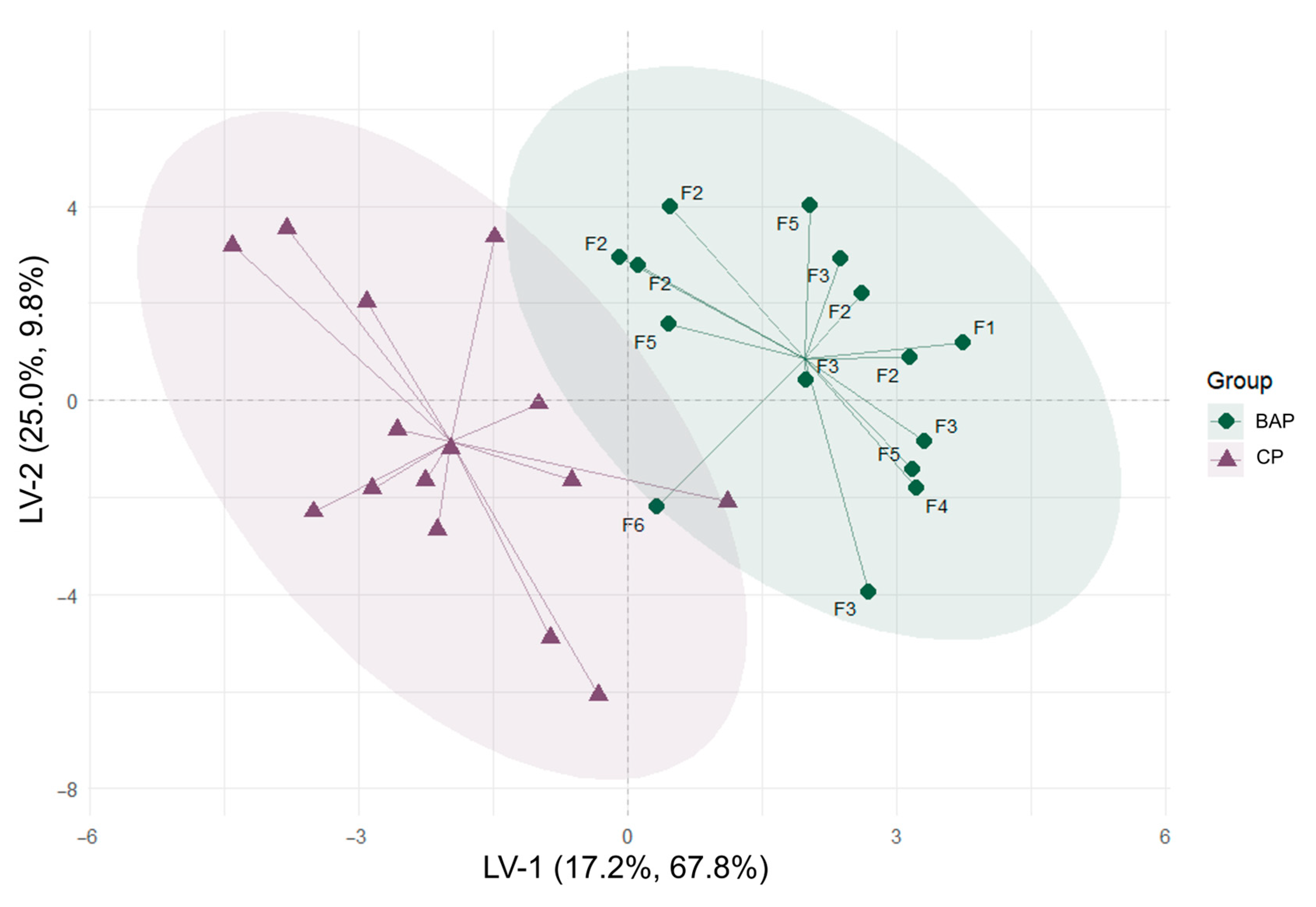
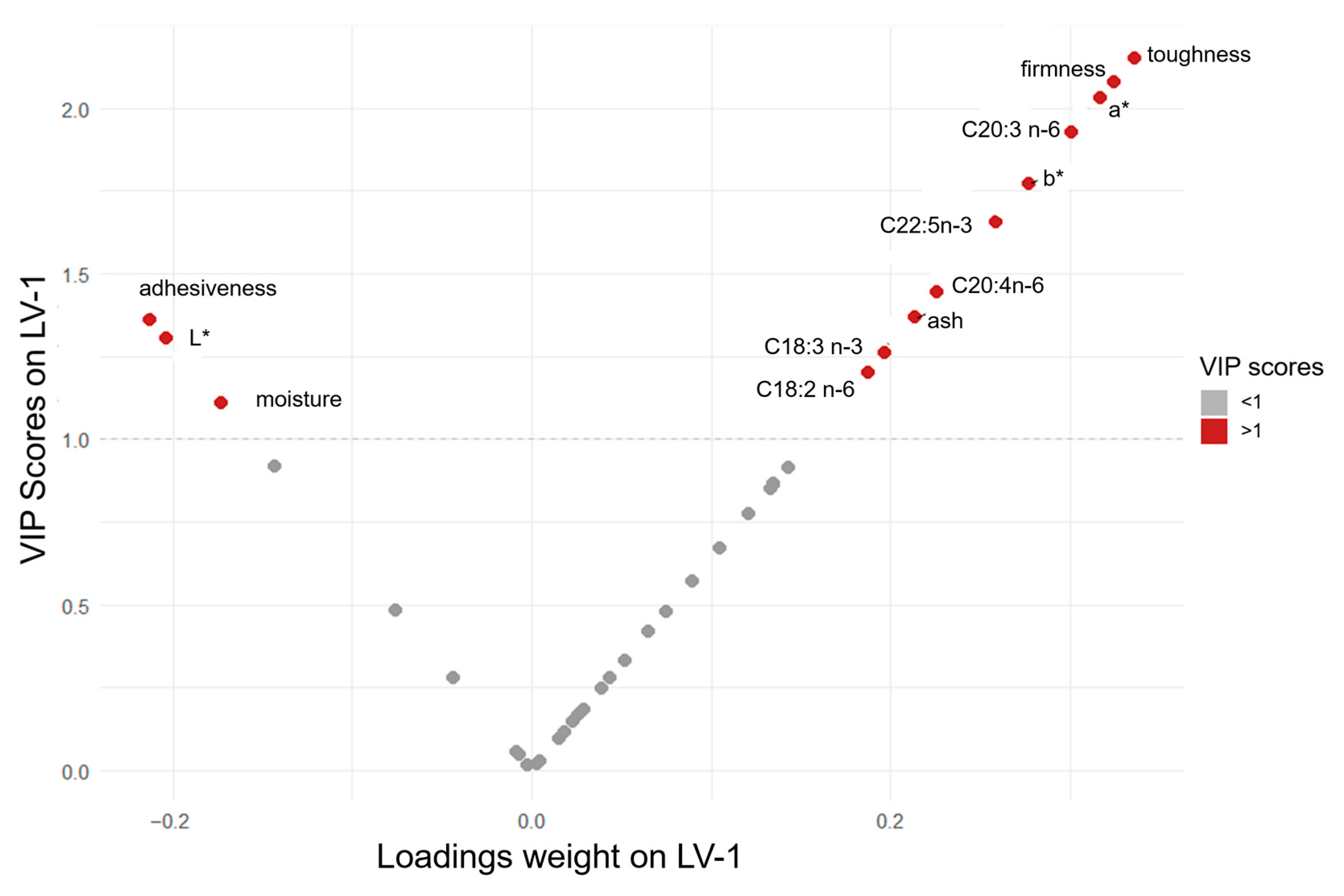
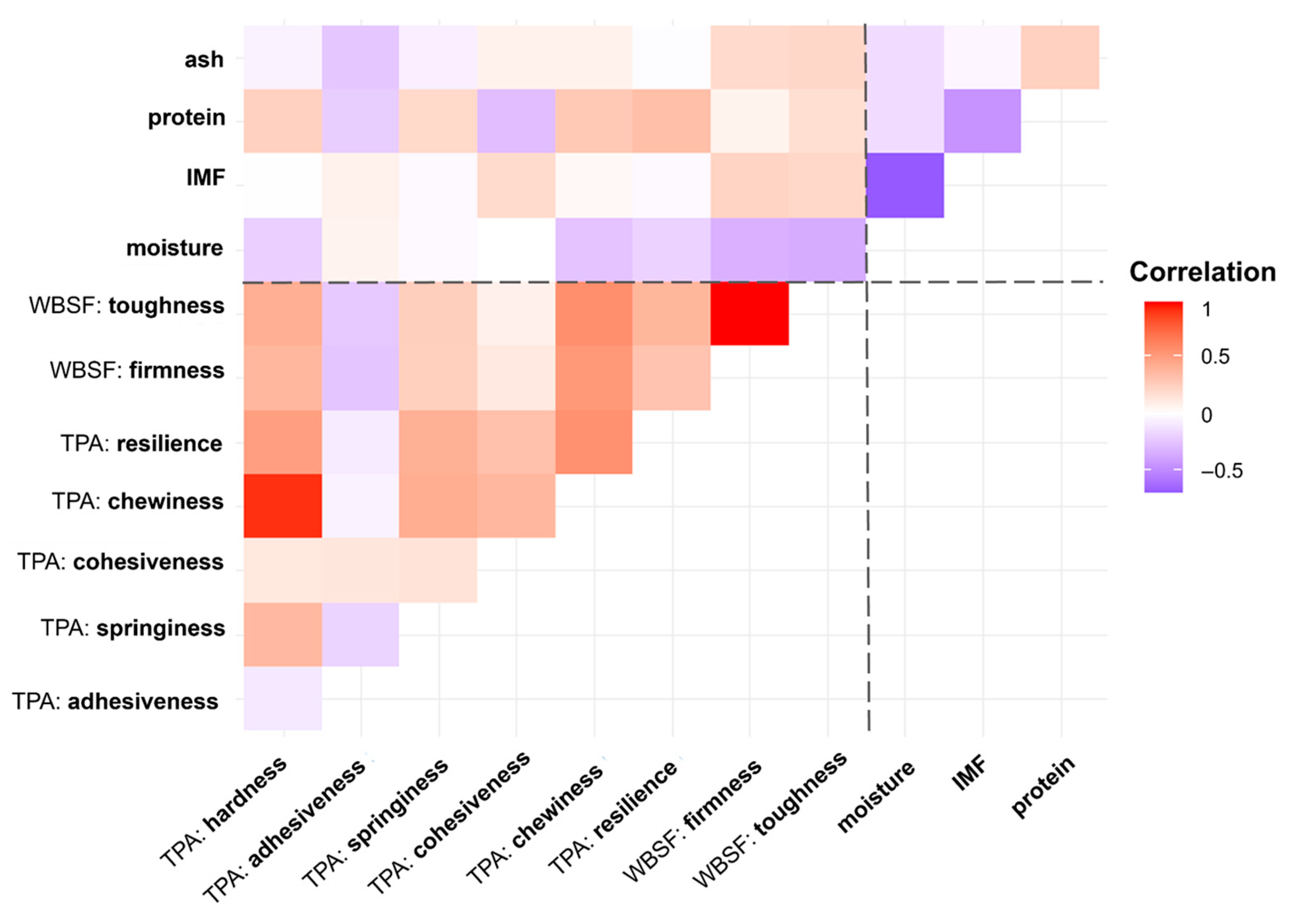
3.4. Multivariate Fingerprint of BAP Meat
4. Discussion
5. Conclusions
Supplementary Materials
Author Contributions
Funding
Institutional Review Board Statement
Informed Consent Statement
Data Availability Statement
Acknowledgments
Conflicts of Interest
References
- Mariani, E.; Summer, A.; Ablondi, M.; Sabbioni, A. Genetic Variability and Management in Nero Di Parma Swine Breed to Preserve Local Diversity. Animals 2020, 10, 538. [Google Scholar] [CrossRef]
- FAO Commission on Genetic Resources for Food and Agriculture. The Second Report on the State of the World’s Animal Genetic Resources for Food and Agriculture in Brief; Scherf, B.D., Pilling, D., Eds.; FAO Commission on Genetic Resources for Food and Agriculture Assessments: Rome, Italy, 2015. [Google Scholar]
- Bittante, G. Italian Animal Genetic Resources in the Domestic Animal Diversity Information System of FAO. Ital. J. Anim. Sci. 2011, 10, e29. [Google Scholar] [CrossRef]
- Čandek-Potokar, M.; Lukač, N.B.; Tomažin, U.; Škrlep, M.; Nieto, R. Analytical Review of Productive Performance of Local Pig Breeds. In European Local Pig Breeds—Diversity and Performance. A Study of Project TREASURE; IntechOpen: London, UK, 2019. [Google Scholar]
- Kusstatscher, K.; Grunenfelder, H.; Bellagamba, F.; Rossi, R.; Capelli, V.; Jaritz, G. The Black Alpine Pig-Rescue and Breeding. In Proceedings of the PROCEEDINGS IX Simposio Internacional sobre el Cerdo Mediterráneo, Portalegre, Portugal, 9–14 September 2018; pp. 67–69. [Google Scholar]
- Ministero delle politiche agricole alimentari e forestali. Linee Guida per la Conservazione e la Caratterizzazione Della Biodiversità Vegetale, Animale e Microbica di Interesse per l’Agricoltura. Piano Nazionale Sulla Biodiversità di Interesse Agricolo; INEA (Istituto Nazionale di Economia Agraria): Roma, Italy, 2013.
- Bonneau, M.; Lebret, B. Production Systems and Influence on Eating Quality of Pork. Meat Sci. 2010, 84, 293–300. [Google Scholar] [CrossRef] [PubMed]
- García-Gudiño, J.; Blanco-Penedo, I.; Gispert, M.; Brun, A.; Perea, J.; Font-i-Furnols, M. Understanding Consumers’ Perceptions towards Iberian Pig Production and Animal Welfare. Meat Sci. 2021, 172, 108317. [Google Scholar] [CrossRef]
- Pugliese, C.; Sirtori, F. Quality of Meat and Meat Products Produced from Southern European Pig Breeds. Meat Sci. 2012, 90, 511–518. [Google Scholar] [CrossRef]
- Santos Silva, J.; Tirapicos Nunes, J.L. Inventory and Characterization of Traditional Mediterranean Pig Production System. In Advantages and Contraints Toward Its Development; CIHEAM - IAMZ (Instituto Agronómico Mediterráneo de Zaragoza): Zaragoza, Spain, 2013. [Google Scholar]
- Huang, Y.; Zhou, L.; Zhang, J.; Liu, X.; Zhang, Y.; Cai, L.; Zhang, W.; Cui, L.; Yang, J.; Ji, J.; et al. A Large-Scale Comparison of Meat Quality and Intramuscular Fatty Acid Composition among Three Chinese Indigenous Pig Breeds. Meat Sci. 2020, 168, 108182. [Google Scholar] [CrossRef]
- Muriel, E.; Ruiz, J.; Ventanas, J.; Antequera, T. Free-Range Rearing Increases (n-3) Polyunsaturated Fatty Acids of Neutral and Polar Lipids in Swine Muscles. Food Chem. 2002, 78, 219–225. [Google Scholar] [CrossRef]
- Nevrkla, P.; Kapelański, W.; Václavková, E.; Hadaš, Z.; Cebulska, A.; Horký, P. Meat Quality and Fatty Acid Profile of Pork and Backfat from an Indigenous Breed and a Commercial Hybrid of Pigs. Ann. Anim. Sci. 2017, 17, 1215–1227. [Google Scholar] [CrossRef]
- Sarmiento-García, A.; Vieira-Aller, C. Improving Fatty Acid Profile in Native Breed Pigs Using Dietary Strategies: A Review. Animals 2023, 13, 1696. [Google Scholar] [CrossRef]
- Szyndler-Nędza, M.; Światkiewicz, M.; Migdał, Ł.; Migdał, W. The Quality and Health-Promoting Value of Meat from Pigs of the Native Breed as the Effect of Extensive Feeding with Acorns. Animals 2021, 11, 789. [Google Scholar] [CrossRef]
- Moretti, V.M.; Madonia, G.; Diaferia, C.; Mentasti, T.; Paleari, M.A.; Panseri, S.; Pirone, G.; Gandini, G. Chemical and Microbiological Parameters and Sensory Attributes of a Typical Sicilian Salami Ripened in Different Conditions. Meat Sci. 2004, 66, 845–854. [Google Scholar] [CrossRef]
- Zumbo, A.; Sutera, A.M.; Tardiolo, G.; D’Alessandro, E. Sicilian Black Pig: An Overview. Animals 2020, 10, 2326. [Google Scholar] [CrossRef]
- Pugliese, C.; Sirtori, F.; D’Adorante, S.; Parenti, S.; Rey, A.; Lopez-Bote, C.; Franci, O. Effect of Pasture in Oak and Chestnut Groves on Chemical and Sensorial Traits of Cured Lard of Cinta Senese Pigs. Ital. J. Anim. Sci. 2009, 9, 131–142. [Google Scholar] [CrossRef]
- Food and Agriculture Organization of the United Nations (FAO). Secondary Guidelines for Development of National Farm Animal Genetic Resources Management Plans: Manage-Ment of Small Populations at Risk; Food and Agriculture Organization of the United Nations: Rome, Italy, 1998; pp. 43–52. [Google Scholar]
- Echegaray, N.; Rosmini, M.; Pateiro, M.; Dominguez, R.; Munekata, P.E.S.; Lorenzo, J.M.; Santos, E.M.; Bermudez, R. Texture Analysis. In Methods to Assess the Quality of Meat Products; Lorenzo, J.M., Dominguez, R., Pateiro, M., Munekata, P.E.S., Eds.; Springer Science+Business Media: Berlin, Germany, 2022; pp. 29–40. [Google Scholar]
- AOAC. Official Methods of Analysis of AOAC International, 17th ed.; Association of Analytical Communities: Gaithersburg, MD, USA, 2002. [Google Scholar]
- Folch, J.; Lees, M.; Sloane Stanley, G.H. A Simple Method for the Isolation and Purification of Total Lipids from Animal Tissues. J. Biol. Chem. 1957, 226, 497–509. [Google Scholar] [CrossRef] [PubMed]
- Christie, W.W. Gas Chromatographic Analysis of Fatty Acid Derivatives. In LIPID ANALYSIS. Isolation, Separation, Identification and Structural Analysis of Lipids; Christie, W.W., Ed.; The Oily Press: Bridgwater, UK, 2003; Volume 15, pp. 225–254. [Google Scholar]
- Vahmani, P.; Rolland, D.C.; McAllister, T.A.; Block, H.C.; Proctor, S.D.; Guan, L.L.; Prieto, N.; López-Campos, Ó; Aalhus, J.L.; Dugan, M.E.R. Effects of Feeding Steers Extruded Flaxseed on Its Own before Hay or Mixed with Hay on Animal Performance, Carcass Quality, and Meat and Hamburger Fatty Acid Composition. Meat Sci. 2017, 131, 9–17. [Google Scholar] [CrossRef] [PubMed]
- Ferrari, P. Linee Guida Della Regione per Allevare Suini All’aperto; Agricoltura–Regione Emilia Romagna: Bologna, Italy, 2008; Volume 36, pp. 70–72. [Google Scholar]
- European Union Council. Council Directive 2008/120/EC of 18 December 2008 Laying down Minimum Standards for the Protection of Pigs. Off. J. Eur. Union 2008, 47, 5–13. [Google Scholar]
- Bakare, A.G.; Ndou, S.P.; Chimonyo, M. Influence of Physicochemical Properties of Fibrous Diets on Behavioural Reactions of Individually Housed Pigs. Livest. Sci. 2013, 157, 527–534. [Google Scholar] [CrossRef]
- Pesenti Rossi, G.; Dalla Costa, E.; Filipe, J.F.S.; Mazzola, S.M.; Motta, A.; Borciani, M.; Gastaldo, A.; Canali, E.; Pilia, F.; Argenton, M.; et al. Does Immunocastration Affect Behaviour and Body Lesions in Heavy Pigs? Vet. Sci. 2022, 9, 410. [Google Scholar] [CrossRef]
- Bona, M.D.; Schiavon, S.; Carraro, L.; Gallo, L. Growth Performance, Carcass Traits and Meat Quality of Growing Pigs on Different Feeding Regimes Slaughtered at 145 Kg BW. Ital. J. Anim. Sci. 2016, 15, 419–427. [Google Scholar] [CrossRef]
- Aquilani, C.; Sirtori, F.; Franci, O.; Acciaioli, A.; Bozzi, R.; Pezzati, A.; Pugliese, C. Effects of Protein Restriction on Performances and Meat Quality of Cinta Senese Pig Reared in an Organic System. Animals 2019, 9, 310. [Google Scholar] [CrossRef]
- Fortina, R.; Barbera, S.; Lussiana, C.; Mimosi, A.; Tassone, S.; Rossi, A.; Zanardi, E. Performances and Meat Quality of Two Italian Pig Breeds Fed Diets for Commercial Hybrids. Meat Sci. 2005, 71, 713–718. [Google Scholar] [CrossRef]
- Edwards, S.A. Product Quality Attributes Associated with Outdoor Pig Production. Livest. Prod. Sci. 2005, 94, 5–14. [Google Scholar] [CrossRef]
- Martins, J.M.; Fialho, R.; Albuquerque, A.; Neves, J.; Freitas, A.; Nunes, J.T.; Charneca, R. Growth, Blood, Carcass and Meat Quality Traits from Local Pig Breeds and Their Crosses. Animal 2020, 14, 636–647. [Google Scholar] [CrossRef]
- Franci, O.; Bozzi, R.; Pugliese, C.; Acciaioli, A.; Campodoni, G.; Gandini, G. Performance of Cinta Senese Pigs and Their Crosses with Large White. 1 Muscle and Subcutaneous Fat Characteristics. Meat Sci. 2005, 69, 545–550. [Google Scholar] [CrossRef]
- Tejeda, J.F.; Hernández-Matamoros, A.; Paniagua, M.; González, E. Effect of Free-Range and Low-Protein Concentrated Diets on Growth Performance, Carcass Traits, and Meat Composition of Iberian Pig. Animals 2020, 10, 273. [Google Scholar] [CrossRef]
- Ripoll, G.; Joy, M.; Muñoz, F.; Albertí, P. Meat and Fat Colour as a Tool to Trace Grass-Feeding Systems in Light Lamb Production. Meat Sci. 2008, 80, 239–248. [Google Scholar] [CrossRef]
- Lebret, B.; Prevolnik Povše, M.; Čandek-Potokar, M. Muscle and Fat Colour. In A Handbook of Reference Methods for Meat Quality Assessment; Font-i-Furnols, M., Čandek-Potokar, M., Maltin, C., Prevolnik Povse, M., Eds.; SRUC: Edinburgh, UK, 2015. [Google Scholar]
- Carrapiso, A.I.; García, C. Instrumental Colour of Iberian Ham Subcutaneous Fat and Lean (Biceps Femoris): Influence of Crossbreeding and Rearing System. Meat Sci. 2005, 71, 284–290. [Google Scholar] [CrossRef] [PubMed]
- Van Oeckel, M.J.; Warnants, N.; Boucqueâ, C.V. Pork Tenderness Estimation by Taste Panel, Warner-Bratzler Shear Force and On-Line Methods. Meat Sci. 1999, 53, 259–267. [Google Scholar] [CrossRef] [PubMed]
- Ruiz De Huidobro, F.; Miguel, E.; Blázquez, B.; Onega, E. A Comparison between Two Methods (Warner-Bratzler and Texture Profile Analysis) for Testing Either Raw Meat or Cooked Meat. Meat Sci. 2005, 69, 527–536. [Google Scholar] [CrossRef] [PubMed]
- Choe, J.H.; Choi, M.H.; Rhee, M.S.; Kim, B.C. Estimation of Sensory Pork Loin Tenderness Using Warner-Bratzler Shear Force and Texture Profile Analysis Measurements. Asian-Australas. J. Anim. Sci. 2016, 29, 1029–1036. [Google Scholar] [CrossRef]
- Li, X.; Ha, M.; Warner, R.D.; Hewitt, R.J.E.; D’Souza, D.N.; Dunshea, F.R. Genetic Lines Influenced the Texture, Collagen and Intramuscular Fat of Pork Longissimus and Semimembranosus. Meat Sci. 2024, 207, 109376. [Google Scholar] [CrossRef]
- Daza, A.; Latorre, M.A.; Olivares, A.; López Bote, C.J. The Effects of Male and Female Immunocastration on Growth Performances and Carcass and Meat Quality of Pigs Intended for Dry-Cured Ham Production: A Preliminary Study. Livest. Sci. 2016, 190, 20–26. [Google Scholar] [CrossRef]
- Rossi, R.; Ratti, S.; Pastorelli, G.; Crotti, A.; Corino, C. The Effect of Dietary Vitamin E and Verbascoside on Meat Quality and Oxidative Stability of Longissimus Dorsi Muscle in Medium-Heavy Pigs. Food Res. Int. 2014, 65, 88–94. [Google Scholar] [CrossRef]
- Corino, C.; Rossi, R.; Musella, M.; Pastorelli, G.; Cannata, S. Effect of Different Production Typologies on Chemical, Physical and Sensory Characteristics of Italian Commercial Pork. J. Sci. Food Agric. 2009, 89, 463–469. [Google Scholar] [CrossRef]
- Ianni, A.; Bennato, F.; Martino, C.; Odoardi, M.; Sacchetti, A.; Martino, G. Qualitative Attributes of Commercial Pig Meat from an Italian Native Breed: The Nero d’Abruzzo. Foods 2022, 11, 1297. [Google Scholar] [CrossRef]
- Hocquette, J.F.; Gondret, F.; Baza, E.; Mdale, F.; Jurie, C.; Pethick, D.W. Intramuscular Fat Content in Meat-Producing Animals: Development, Genetic and Nutritional Control, and Identification of Putative Markers. Animal 2010, 4, 303–319. [Google Scholar] [CrossRef]
- Comin, M.; Pesenti Rossi, G.; Lanzoni, L.; Prasinou, P.; Lopez, A.; Vignola, G.; Barbieri, S.; Dalla Costa, E. Heavy Pigs Reared for Italian Dry-Cured Products: Does Immunocastration Influence the Fatty Acid Profile of Loins and Backfat? Animals 2024, 14, 1284. [Google Scholar] [CrossRef]
- Ma, X.; Jiang, Z.; Lai, C. Significance of Increasing N-3 PUFA Content in Pork on Human Health. Crit. Rev. Food Sci. Nutr. 2016, 56, 858–870. [Google Scholar] [CrossRef] [PubMed]
- Nilzen, V.; Babol, J.; Dutta, P.C.; Lundeheim, N.; Enfalt, A.-C.; Lundstrom, K. Free Range Rearing of Pigs with Access to Pasture Grazing - Effect on Fatty Acid Composition and Lipid Oxidation Products. Meat Sci. 2001, 267–275. [Google Scholar] [CrossRef] [PubMed]
- Tejerina, D.; García-Torres, S.; Cabeza De Vaca, M.; Vázquez, F.M.; Cava, R. Effect of Production System on Physical-Chemical, Antioxidant and Fatty Acids Composition of Longissimus Dorsi and Serratus Ventralis Muscles from Iberian Pig. Food Chem. 2012, 133, 293–299. [Google Scholar] [CrossRef]
- Salvatori, G.; Filetti, F.; Di Cesare, C.; Maiorano, G.; Pilla, F.; Oriani, G. Lipid Composition of Meat and Backfat from Casertana Purebred and Crossbred Pigs Reared Outdoors. Meat Sci. 2008, 80, 623–631. [Google Scholar] [CrossRef]
- Sun, Y.; Xiao, Y.; Li, C.; Yang, J.; Yang, S.; Yang, B.; Huang, L. A Parallel Survey on the Fatty Acid Composition in Backfat and Longissimus Lumborum and Comparison of Their Associations with Growth and Carcass Traits in Pigs. Livest. Sci. 2022, 263, 104984. [Google Scholar] [CrossRef]
- Wood, J.D.; Enser, M.; Fisher, A.V.; Nute, G.R.; Sheard, P.R.; Richardson, R.I.; Hughes, S.I.; Whittington, F.M. Fat Deposition, Fatty Acid Composition and Meat Quality: A Review. Meat Sci. 2008, 78, 343–358. [Google Scholar] [CrossRef] [PubMed]
- Lebret, B.; Mourot, J. Caractéristiques et Qualitédes Tissus Chez Le Porc. Facteurs de Variation Non Génétiques. INRA Prod. Animal. 1998, 2, 131–143. [Google Scholar]
- Mokrzycki, W.S.; Tatol, M. Colour Difference ∆E—A Survey. Mach. Graph. Vis. 2012, 20, 383–411. [Google Scholar]
- Rincker, P.J.; Killefer, J.; Ellis, M.; Brewer, M.S.; McKeith, F.K. Intramuscular Fat Content Has Little Influence on the Eating Quality of Fresh Pork Loin Chops. J. Anim. Sci. 2008, 86, 730–737. [Google Scholar] [CrossRef]
- Han, Q.; Huang, X.; He, J.; Zeng, Y.; Yin, J.; Yin, Y. Intramuscular Fat Deposition in Pig: A Key Target for Improving Pork Quality. J. Integr. Agric. 2025, 24, 4461–4483. [Google Scholar] [CrossRef]



| Farm 1 | Farm 2 | Farm 3 | Farm4 | Farm 5 | Farm 6 | |
|---|---|---|---|---|---|---|
| Province | Aosta | Sondrio | Alessandria | Bolzano | Sondrio | Como |
| Region | Valle d’Aosta | Lombardia | Piemonte | Alto Adige | Lombardia | Lombardia |
| Altitude (m asl) | 1000 | 450 | 200 | 1500 | 1200 | 400 |
| Farm size (ha) | 0.9 | 12 | 30 | 6 | 4 | 0.6 |
| Total animals | 20 | 30 | 15 | 9 | 78 | 6 |
| F1 | F2 | F3 | F4 | F5 | F6 | |
|---|---|---|---|---|---|---|
| N° of sows | 2 | 2 | 2 | 1 | 5 | 5 |
| N° of gilts/young boars | 1 | 2 | 0 | 8 | 0 | 0 |
| N° of boars | 0 | 1 | 1 | 1 | 2 | 1 |
| N° of fattening pigs | 18 | 25 | 12 | 0 | 71 | 0 |
| Total animals | 21 | 30 | 15 | 10 | 78 | 6 |
| Production Parameter | Average Value |
|---|---|
| Live weight at slaughter (kg) | 140–180 |
| Age at slaughter (months) | 24–48 |
| Average daily gain (g per day) | 150–200 |
| Carcass weight (kg) | 115–150 |
| Carcass yield (%) | 82–83 |
| Backfat thickness (mm) | 40–80 |
| Parameter | Average Value |
|---|---|
| Piglets born alive per litter | 8–12 |
| Stillborn piglets per litter | 1–3 |
| Weaned piglets per litter | 8–12 |
| Piglet birth weight (g) | 800–1000 |
| Variable | Mean (min; max) | SD | Median (Q1; Q3) | IQR | CV |
|---|---|---|---|---|---|
| Texture | |||||
| Hardness (kg) | 5.5 (2.7; 8.5) | 1.3 | 5.7 (4.7; 5.9) | 1.2 | 0.2 |
| Adhesiveness (g × s) | 3.6 (0.6; 8.5) | 2.3 | 3.3 (2.3; 3.9) | 1.7 | 0.6 |
| Springiness (%) | 0.6 (0.5; 0.7) | 4.4 | 0.6 (0.6; 0.6) | 0.0 | 0.1 |
| Cohesiveness (%) | 0.6 (0.6; 0.7) | 2.5 | 0.6 (0.6; 0.6) | 0.0 | 0.0 |
| Chewiness (kg) | 2.2 (0.9; 3.5) | 0.7 | 2.2 (1.7; 2.7) | 1.0 | 0.3 |
| Resilience (%) | 0.3 (0.2; 0.3) | 1.8 | 0.3 (0.2; 0.3) | 0.0 | 0.1 |
| Firmness (kg) | 3.0 (2.0; 4.0) | 0.5 | 3.1 (2.9; 3.1) | 0.3 | 0.2 |
| Toughness (kg × s) | 12.1 (7.3; 15.3) | 2.1 | 12.5 (12.2; 13.2) | 1.0 | 0.2 |
| Color | |||||
| L* | 45.3 (37.6; 53.0) | 4.4 | 45.1 (43.4; 47.7) | 4.3 | 0.1 |
| a* | 6.5 (2.9; 11.0) | 2.1 | 5.9 (5.6; 7.2) | 1.6 | 0.3 |
| b* | 11.0 (7.8; 13.9) | 1.7 | 10.5 (9.8; 12.5) | 2.7 | 0.2 |
| pH | 5.4 (5.0; 5.8) | 0.2 | 5.5 (5.2; 5.7) | 0.5 | 0.0 |
| Fatty Acid | Mean (min; max) | SD | Median (Q1; Q3) | IQR | CV |
|---|---|---|---|---|---|
| 12:0 | 3.2 (1.4; 7.4) | 1.9 | 2.3 (1.9; 4.1) | 2.2 | 61.2 |
| 14:0 | 47.5 (20.5; 104.5) | 26.3 | 37.9 (30.6; 56.8) | 26.3 | 55.5 |
| 15:0 | 1.4 (1.0; 2.5) | 0.4 | 1.3 (1.1; 1.5) | 0.4 | 27.0 |
| 16:0 | 787.2 (383.5; 1571.7) | 381.6 | 633.3 (513.7; 936.2) | 422.6 | 48.5 |
| 17:0 | 6.6 (4.4; 10.8) | 1.9 | 6.4 (5.0; 7.2) | 2.2 | 28.6 |
| 18:0 | 388.7 (206.2; 816.6) | 191.2 | 342.4 (240.0; 467.4) | 227.4 | 49.2 |
| 20:0 | 7.3 (3.2; 17.4) | 3.7 | 6.2 (4.8; 8.4) | 3.5 | 51.1 |
| 22:0 | 1.4 (0.6; 2.7) | 0.7 | 1.1 (1.0; 1.8) | 0.8 | 51.5 |
| 24:0 | 7.7 (5.4; 12.9) | 2.1 | 7.1 (6.0; 8.9) | 2.9 | 27.9 |
| ∑SFAs | 1250.9 (646.8; 2515.5) | 604.6 | 1034.3 (807.4; 1480.8) | 673.4 | 48.3 |
| 14:1 | 0.9 (0.4; 1.8) | 0.4 | 0.7 (0.6; 1.0) | 0.4 | 46.9 |
| 16:1 | 122.9 (54.9; 246.3) | 51.8 | 104.1 (92.8; 138.9) | 46.1 | 42.1 |
| 18:1 n-9 | 1340.2 (583.8; 2564.0) | 600.3 | 1144.9 (907.7; 1611.7) | 704.0 | 44.8 |
| 18:1 n-7 | 175.0 (89.3; 307.6) | 59.8 | 163.4 (135.6; 198.3) | 62.7 | 34.2 |
| C20:1 n-9 | 32.9 (15.8; 54.1) | 13.0 | 29.6 (22.2; 41.5) | 19.3 | 39.4 |
| C24:1 n-9 | 1.0 (0.6; 1.7) | 0.3 | 0.9 (0.8; 1.1) | 0.3 | 31.6 |
| ∑MUFAs | 1672.9 (745.5; 3175.4) | 721.2 | 1429.0 (1154.4; 1986.4) | 832.0 | 43.1 |
| 18:2 n-6 | 261.6 (194.6; 405.9) | 63.9 | 235.5 (213.1; 285.4) | 72.2 | 24.4 |
| 18:3 n-6 | 1.3 (0.9; 2.1) | 0.3 | 1.3 (1.1; 1.5) | 0.4 | 24.2 |
| 18:3 n-3 | 11.1 (5.1; 21.5) | 4.9 | 10.5 (7.2; 12.7) | 5.5 | 43.7 |
| 20:2 n-6 | 11.7 (6.6; 20.6) | 4.2 | 11.0 (8.7; 13.5) | 4.9 | 35.4 |
| 20:3 n-6 | 8.4 (6.3; 12.0) | 1.5 | 8.0 (7.4; 9.4) | 2.1 | 18.3 |
| 20:3 n-3 | 3.4 (0.7; 5.9) | 1.5 | 3.3 (2.4; 4.2) | 1.9 | 44.6 |
| 20:4 n-6 | 69.0 (49.4; 92.2) | 11.4 | 70.0 (63.5; 75.2) | 11.8 | 16.5 |
| 20:5 n-3 | 2.0 (0.7; 4.8) | 1.0 | 1.9 (1.5; 2.1) | 0.6 | 50.8 |
| 22:5 n-3 | 9.3 (5.5; 12.1) | 2.1 | 9.6 (7.7; 11.3) | 3.5 | 23.0 |
| 22:6 n-3 | 1.9 (0.8; 3.1) | 0.7 | 1.5 (1.3; 2.4) | 1.1 | 37.5 |
| ∑PUFAs | 378.0 (289.4; 547.2) | 73.8 | 369.6 (321.7; 402.2) | 80.5 | 19.5 |
| n-3 | 27.7 (19.2; 41.7) | 6.9 | 27.6 (22.1; 30.9) | 8.8 | 24.8 |
| n-6 | 380.4 (274.7; 607.0) | 106.6 | 349.7 (306.2; 393.8) | 87.6 | 28.0 |
| n-6/n-3 | 14.2 (7.9; 19.7) | 4.0 | 14.3 (10.8; 18.6) | 7.8 | 28.3 |
| IMF n = 15 | BF n = 15 | p-Value | |
|---|---|---|---|
| 14:0 | 1.4 ± 0.2 | 1.5 ± 0.2 | ns |
| 16:0 | 23.3 ± 1.7 | 23.5 ± 2.3 | ns |
| 17:0 | 0.2 ± 0.1 | 0.4 ± 0.1 | <0.001 |
| 18:0 | 11.6 ± 1.4 | 11.9 ± 1.4 | ns |
| 20:0 | 0.2 ± 0.1 | 0.2 ± 0.1 | ns |
| 24:0 | 0.3 ± 0.1 | 0.1 ± 0.0 | <0.001 |
| ΣSFAs | 37.2 ± 2.9 | 37.8 ± 3.5 | ns |
| 16:1 | 3.7 ± 0.5 | 2.4 ± 0.4 | <0.001 |
| 18:1 n-9 | 40.0 ± 2.3 | 43.0 ± 1.7 | 0.003 |
| 18:1 n-7 | 5.4 ± 0.8 | 3.5 ± 0.4 | <0.001 |
| 20:1 n-9 | 1.0 ± 0.2 | nd | <0.001 |
| ΣMUFAs | 50.3 ± 2.8 | 48.5 ± 2.2 | ns |
| 18:2 n-6 | 8.6 ± 2.2 | 12.0 ± 3.1 | <0.001 |
| 18:3 n-3 | 0.4 ± 0.1 | 0.7 ± 0.3 | <0.001 |
| 20:2 n-6 | 0.4 ± 0.1 | 0.7 ± 0.2 | <0.001 |
| 20:3 n-6 | 0.3 ± 0.1 | 0.1 ± 0.0 | <0.001 |
| 20:3 n-3 | 0.1 ± 0.1 | 0.2 ± 0.1 | 0.039 |
| 20:4 n-6 (ARA) | 2.4 ± 1.0 | 0.1 ± 0.1 | <0.001 |
| 22:5 n-3 (DPA) | 0.3 ± 0.2 | 0.1 ± 0.0 | <0.001 |
| ΣPUFAs | 12.6 ± 3.5 | 13.9 ± 3.6 | ns |
| Σn-3 | 0.9 ± 0.3 | 0.9 ± 0.4 | ns |
| Σn-6 | 13.4 ± 6.3 | 12.9 ± 3.3 | ns |
| n-6/n-3 ratio | 14.2 ± 4.0 | 14.9 ± 5.3 | ns |
Disclaimer/Publisher’s Note: The statements, opinions and data contained in all publications are solely those of the individual author(s) and contributor(s) and not of MDPI and/or the editor(s). MDPI and/or the editor(s) disclaim responsibility for any injury to people or property resulting from any ideas, methods, instructions or products referred to in the content. |
© 2025 by the authors. Licensee MDPI, Basel, Switzerland. This article is an open access article distributed under the terms and conditions of the Creative Commons Attribution (CC BY) license.
Share and Cite
Lopez, A.; Bellagamba, F.; Rossi, R.; Greco, M.; Mainardi, E.; Corino, C.; Moretti, V.M. An Exploratory Study on Farming System and Meat Quality of Black Alpine Pig. Animals 2026, 16, 22. https://doi.org/10.3390/ani16010022
Lopez A, Bellagamba F, Rossi R, Greco M, Mainardi E, Corino C, Moretti VM. An Exploratory Study on Farming System and Meat Quality of Black Alpine Pig. Animals. 2026; 16(1):22. https://doi.org/10.3390/ani16010022
Chicago/Turabian StyleLopez, Annalaura, Federica Bellagamba, Raffaella Rossi, Margherita Greco, Edda Mainardi, Carlo Corino, and Vittorio Maria Moretti. 2026. "An Exploratory Study on Farming System and Meat Quality of Black Alpine Pig" Animals 16, no. 1: 22. https://doi.org/10.3390/ani16010022
APA StyleLopez, A., Bellagamba, F., Rossi, R., Greco, M., Mainardi, E., Corino, C., & Moretti, V. M. (2026). An Exploratory Study on Farming System and Meat Quality of Black Alpine Pig. Animals, 16(1), 22. https://doi.org/10.3390/ani16010022