


Simple Summary
New Zealand fur seals are generally thought to be increasing in numbers around New Zealand, although relatively few colonies are monitored regularly. We provide updates on pup abundance and condition from three colonies (Wekakura Point, Cape Foulwind and Taumaka Island) on the West Coast of New Zealand’s South Island where pup abundance has been declining. We found that pup numbers have continued to fall, and that pup condition has varied significantly through time. From the maximum numbers of pups born at each colony in the 1990s, Wekakura Point has declined by 83%, Cape Foulwind by 71% and Taumaka Island by 61% to 2025. There have been consistencies between the colonies in the pup abundance trends, as well as correlations between years of low pup abundance and poor pup condition. Pup mortality has been substantially higher at Taumaka Island than at either Wekakura Point or Cape Foulwind. Given the trends observed, and previous research into the impacts of climate change on marine ecosystems in this region, it seems likely that environmental change is influencing fur seal pup production and condition. However, this mechanism and other potential influences on the observed population trends require further study.
Abstract
New Zealand fur seals (Arctocephalus forsteri) were severely exploited by historical hunting. However, recently assessed colonies in New Zealand are mostly thought to be growing or stable. The exceptions are three colonies (Wekakura Point, Cape Foulwind and Taumaka Island) on the West Coast of the South Island (‘WCSI’), previously documented as in decline. We used mark-recapture and morphometric data to update understandings of pup abundance and condition at these colonies. Pup abundance has continued to decline. In 2025, 186 (95% CI = 178–194) pups were estimated at Wekakura Point, 131 (95% CI = 122–140) at Cape Foulwind and 566 (95% CI = 555–577) at Taumaka Island, representing declines of 83%, 71% and 61% from the respective maxima in the 1990s. Rates of decline have slowed at Wekakura Point and Cape Foulwind since 2016 but have increased at Taumaka Island. Pup condition demonstrated substantial interannual variation. Cape Foulwind pups had the greatest average mass and body condition index score, followed by Wekakura Point and then Taumaka Island. There have been consistencies between years of particularly low pup abundance and condition across the colonies, suggesting common stressors; however, there are likely also some localised factors. Emerging diseases and marine environmental change are evaluated as potential drivers.
1. Introduction
As with other pinniped species globally, New Zealand fur seal/kekeno (Arctocephalus forsteri) were subjected to uncontrolled historical harvesting which drove them to the brink of extinction [1,2,3,4,5,6]. Although the cessation or reduction in commercial sealing in most countries has allowed for recoveries [3,7,8,9,10,11], in recent decades previously increasing pinniped populations have experienced declining abundance; for example, Australian fur seal (Arctocephalus pusillus doriferus) and Antarctic fur seal (Arctocephalus gazella) [11,12,13]. Among the confirmed and potential causes for declines in pinniped populations are emerging diseases [14,15,16], long-term environmental change as well as stochasticity [17,18,19,20] and competition from and bycatch in commercial fisheries [21,22,23].
Determining causation for pinniped population change is complex [13,24,25]. Longitudinal monitoring offers the ability to detect real population change over time [24,26,27] with greater reliability than short-term studies, which may struggle to account for interannual variation in parameters such as survival and fecundity [28,29]. The insights gathered from regular sampling also provide opportunities to move beyond detecting change into interpreting causation, which can inform management action [30,31,32,33]. In contrast, when population data are missing, the implementation of appropriate mitigation responses can be impeded [23,30,34]. Longitudinal monitoring programmes that focus on sentinel species have benefits beyond conserving or managing the programme’s subject. For example, detection of high mercury levels in bottlenose dolphins (Tursiops truncatus) in Florida have raised concerns about human consumption of seafood derived from the same locale [35]. Similarly, monitoring relatively abundant species can provide important information for understanding potential risks to rarer taxa that occupy comparable ecological or geographic niches [36,37]. While longitudinal monitoring programmes are typically resource intensive [38,39] the advent and continual improvement of remote sensing technologies, such as unmanned aerial vehicles (UAVs) and satellite imagery, can reduce these costs [40].
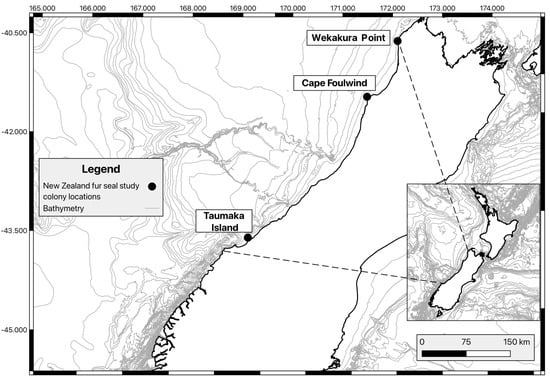
Fur seal population monitoring has been ad hoc or non-existent for large areas of New Zealand [41]. A study of three colonies (Wekakura Point, Cape Foulwind and Taumaka Island) on the West Coast of New Zealand’s South Island (‘WCSI’) (Figure 1) represents the only multi-decadal monitoring programme for fur seals in New Zealand where both pup production and condition assessments are conducted. In otariids, pup production is used as a proxy for population abundance, as pups are confined to land until weaning and are instantly recognisable [42,43,44]. As female otariids are central-place income breeders, pup production is sensitive to changes in the local marine environment that impact prey abundance and distribution, and other factors that can impact female mortality [45,46,47]. Therefore, consistently executed pup production monitoring can enable detection of change in local marine ecosystems. Similarly, pathogens may impact pinniped reproductive cycles [20,48], meaning consistent monitoring may also be able to detect evidence for the presence of emerging diseases. Pinniped pup condition depends on a range of factors including female foraging efficiency [19,49]—itself dependent on both female experience [47,50] and the reliability of prey sources [18,51]—as well as female condition [52,53] and pathogen presence within the population [54,55,56]. Thus, monitoring pup condition can provide insights into both population health and female foraging efficiency. Further, as pup condition impacts survival both pre- and post-weaning [29,56], population-level changes in pup body condition may impact future population trajectories.
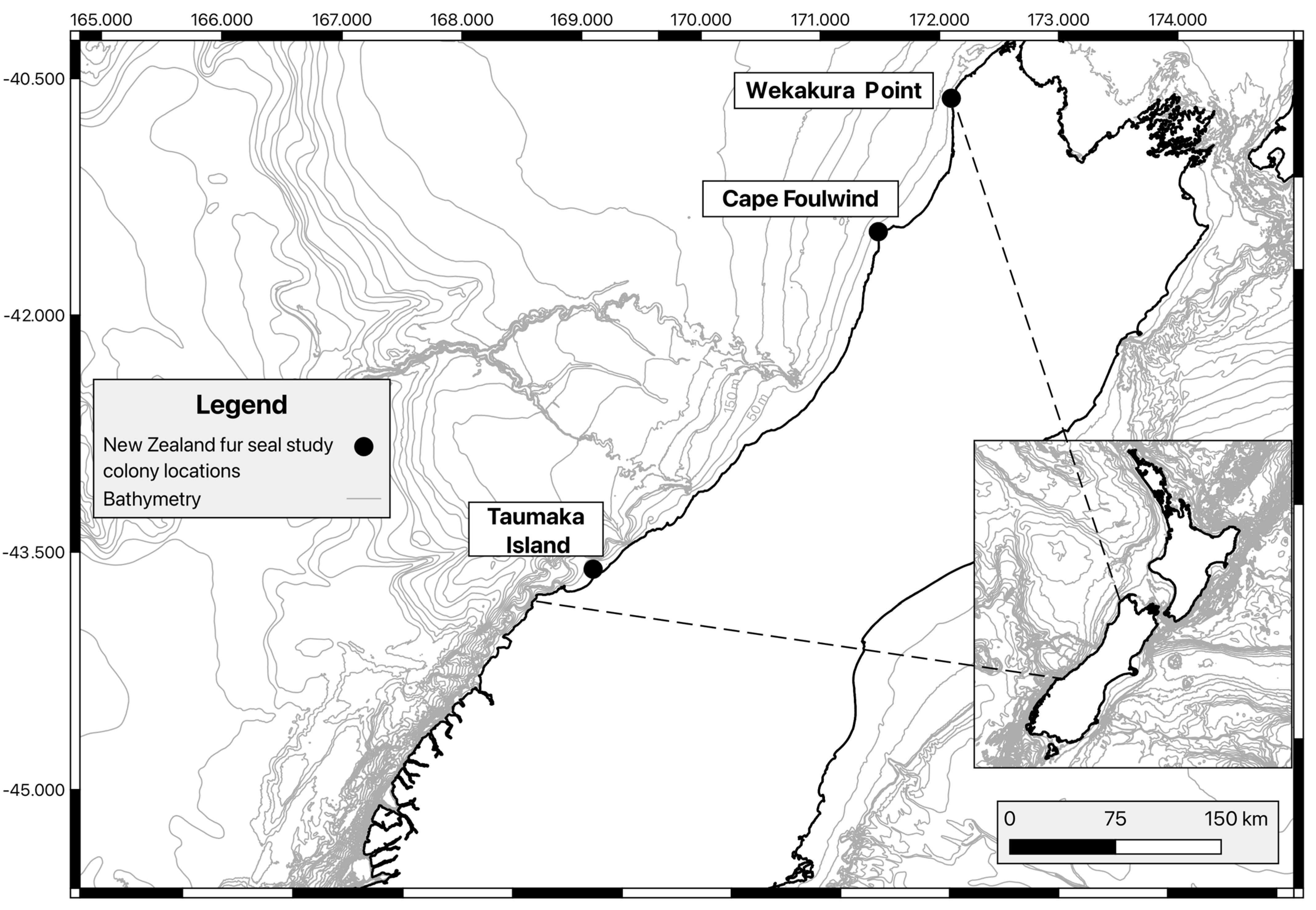
Figure 1.
Locations of the New Zealand fur seal colonies (Wekakura Point, Cape Foulwind and Taumaka Island) on the West Coast of New Zealand’s South Island where pups have been surveyed in most years between 1991/92 and 2025.
The WCSI New Zealand fur seal monitoring programme was established following concerns about high fur seal bycatch rates in the WCSI commercial hoki (Macruronus novaezelandiae) middle-depth trawl fishery in 1989 and 1990, and a previous report [57] described substantial declines in pup numbers over the period 1990/1991–2015/2016 (henceforth, breeding seasons are referred to by later year, e.g., 1991–2016) for all three study colonies. From their respective recorded maxima in the early/mid-1990s, by 2016 Wekakura Point had declined 79%, Cape Foulwind 69% and Taumaka Island by 34%. All colonies experienced abrupt drops in pup abundance in 1999–2000, and years with low pup masses corresponded with years where pup production estimates sharply declined [57].
Since 2016, another four seasons (2018, 2020, 2023 and 2025) of pup abundance and condition data have been collected at the WCSI colonies. Here, we use these data to update estimates of annual pup abundance trends at the only fur seal colonies in New Zealand known to be in long-term decline. We also use all the available pup morphometric data (1991–2025) to assess trends in pup condition using metrics comparable with previous fur seal studies [32,43].
Our objectives were to:
- Establish whether previously observed trends in New Zealand fur seal pup abundance and condition have continued.
- Examine the comparability of trends at the three study breeding colonies on the WCSI.
- Provide recommendations for future research to determine the causes of the observed population trends.
2. Methods
2.1. Study Sites
Wekakura Point and Cape Foulwind are both on New Zealand’s mainland, while Taumaka Island is an island of approximately 20 ha, located ~5 kilometres offshore, and is part of the Open Bay Islands group (Figure 1). Cape Foulwind is accessible on foot by authorised personnel, while Wekakura Point and Taumaka Island are accessed by helicopter.
2.2. Live Pup Abundance Estimates 2018–2025
Live pup abundance estimates between 2018 and 2025 were derived from mark-recapture methods [42,43,44,58]. Fieldwork was undertaken as close as possible to the final week of January in each assessment year—a period when all pups in each breeding season had been born, after large territorial bulls have left the colonies and before pups are proficient swimmers and may no longer be confined to land [43,44,59]. There were, however, some deviations from this timeframe (Table 1).
Table 1.
Summary of the methods and results from New Zealand fur seal pup mark-recapture (2018–2025) at the three study colonies on the West Coast of the South Island of New Zealand.
Up to and including 2020, pups were marked with Allflex button tags inserted 15 mm from the trailing edge of each foreflipper. From 2023, pups were marked by trimming a small patch of outer fur on their heads [43,59,60]. Between 1991 and 2016, mark-recapture took place in most summer breeding seasons. Since 2016, assessments have occurred in 2018, 2020, 2023 and 2025. Over the study, the numbers of pups marked have decreased substantially due to declining colony sizes, as the aim of marking was to mark > 50% of the potential numbers of pups produced in a given season. Effort was made to spread marking consistently throughout each colony. The areas covered at Wekakura Point and Cape Foulwind have varied somewhat through time (K. Simister, pers. comm.), and to allow for this during analyses, data from the “Block Field” sector of Cape Foulwind were excluded from abundance analyses in this report.
Typically, recaptures commenced the day after marking was completed, allowing sufficient time for unmarked and marked pups to mingle [43,44,59,60]. Given the short period of time between marking and recapture, tag loss was assumed to be zero.
Occasionally, recaptures were delayed due to weather or personnel constraints (Table 1). During recapture counts, if a marked vs. unmarked designation could not be made confidently, an individual was discounted. Recapture methodologies differed between colonies due to variation in accessibility and terrain but were standardised by colony. At Wekakura Point, recaptures were made by a line of people traversing the colony and adjoining coastal zone on foot; at Cape Foulwind, recapture counts were made by a single person from selected clifftop vantage points; and at Taumaka Island recapture counts were made by a single person walking the length of the colony area in which marking was performed. For each marking session, there were typically five recapture counts, except at Taumaka Island in 2018 when only three were conducted. Personnel conducting the recapture counts changed between 2018 and 2023 at Cape Foulwind (K. Simister, pers. comm.), and in 2016 and 2018 at Taumaka Island.
The ratio of marked to unmarked pups in each recapture sample was input into a modified Petersen estimate [61] as follows:
For each replicate i, M is the number of marked fur seal pups, Ci represents the total number of pups in the recapture sample and Ri is the number of marked pups in the recapture sample. Consequently, the total estimate of live pups, P, is calculated from the mean of the Q Petersen estimators as:
The standard error (SE) of P was calculated from the individual estimates [62] as:
Counts of dead pups observed during marking have been made since 1997. To maintain a consistent methodology throughout the study, these counts are ignored for the purposes of the mark-recapture estimates and analysed separately.
2.3. Pup Condition Observations
Biometric data were collected from a subset of captured pups and comprise measurements of mass (kg) and length (cm) [32,43]. Pup condition sample sizes are provided in Table S1. Pups were placed in polypropylene or light canvas weighing bags and weighed using 20 kg Pesola hook scales (precision of ±0.1 kg). A draper’s tape measure was used to record pup length. Measurements were taken from nose-tip to tail-tip with pups restrained in an outstretched position. Dates of measurement have occasionally varied over the study period (Figure S1), although surveys have mostly been concentrated in the last week of January.
2.4. Body Condition Index Calculations
Two different Body Condition Indices (BCI), in addition to pup mass, were adopted to assess pup condition between 1991 and 2025.
Body Condition Index 1 (BCI1) was calculated by dividing a pup’s mass by its length [19,43,63]. Body Condition Index 2 (BCI2) was derived by dividing a pup’s observed mass (ObsM) by its expected mass (ExpM) [19,32,43]. ExpM was calculated by regressing logeMass against logeLength, and applying the regression equation to logeLength, where a and b are the least-squares regression coefficients [32]:
logeExpM = a + b × LogeLength
BCI2 results > 1 indicate that pups are in better-than-expected condition, whereas results < 1 indicate that pups are in worse-than-expected condition [32,43].
2.5. Statistical Analyses
2.5.1. Effect of Year on Live Pup Abundances 1991/92–2025
Generalized additive models (GAMs) were used to analyse the effect of year on mean live pup abundance estimates derived from mark-recapture across the duration of the study: 1991–2025 for Cape Foulwind and Taumaka Island, and 1992–2025 for Wekakura Point. These analyses included 2012–2014 at Cape Foulwind and Taumaka Island, when data were collected by a different researcher (H. Best, unpublished data). GAMs were selected to allow for non-linear effects of year on pup abundance [64] and were fitted using the mgcv package [65] in R (version 4.4.3) [66]. A Gaussian distribution with an identity link function was assumed for Cape Foulwind and Taumaka Island, whereas for Wekakura Point a gamma distribution with a log link function was assumed.
Derivatives can be used to identify important moments of change in GAMs being used to assess temporal trends [64,67]. Here, change in the sign (positive/negative) of the first order derivative (the gradient) of the smooths was used to identify when the trajectory of pup abundance changed from positive to negative, or vice versa (‘turning points’). The derivatives were calculated using the gratia package [68], and significance was assessed by determining whether the 95% confidence interval of the relevant derivative included zero [64,67].
To determine whether the rates of annual change in live pup abundances had varied between the period studied by Roberts and Neale (1991/2–2016) [57] and the current study (2016–2025), annual average percentage changes in pup abundance were calculated for each colony in both periods.
2.5.2. Pan-Colony Pup Mass and Condition Models
Using pup condition data from all three colonies (‘pan-colony models’), linear models were fitted to pup mass and BCI1 in R to predict these measurements in response to a suite of explanatory variables: Year, Sex, Colony, Day of measurement (as well as interactions between these variables). The variables were included in a global model, and second-order Akaike’s Information Criterion (AICc) was used to select a preferred model structure, using the MuMIn package version 1.48.4 [69]. Model structures were not considered if they would involve large numbers of parameters, to avoid overfitting. BCI2 was used to compare pup condition from all colonies in all years [32].
2.5.3. Individual Colony Pup Mass and Condition Models
To compare mass and condition trends over time for each colony, the respective preferred model structures for mass and BCI1 were retained, with the variable ‘Colony’ removed as a predictor. Due to a low spread of days at some colonies, in particular at Taumaka Island (Figure S1), the day effect was fixed to the values obtained from the pan-colony models. Inter-survey percentage change in model standardised mass and BCI1 results was used to evaluate the extent of change in pup mass and condition between surveys. Relationships between pup mass and pup abundance were assessed through correlation analysis and scatterplots.
3. Results
3.1. Live Pup Abundance Estimates
Live fur seal (Arctocephalus forsteri) pup abundance estimates between 2018 and 2025 are shown in Table 1.
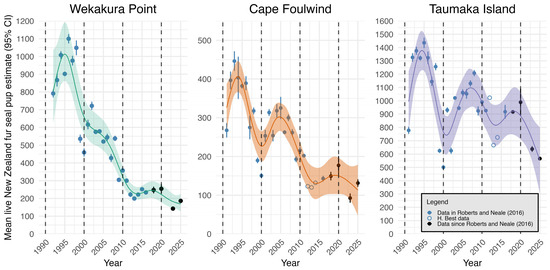
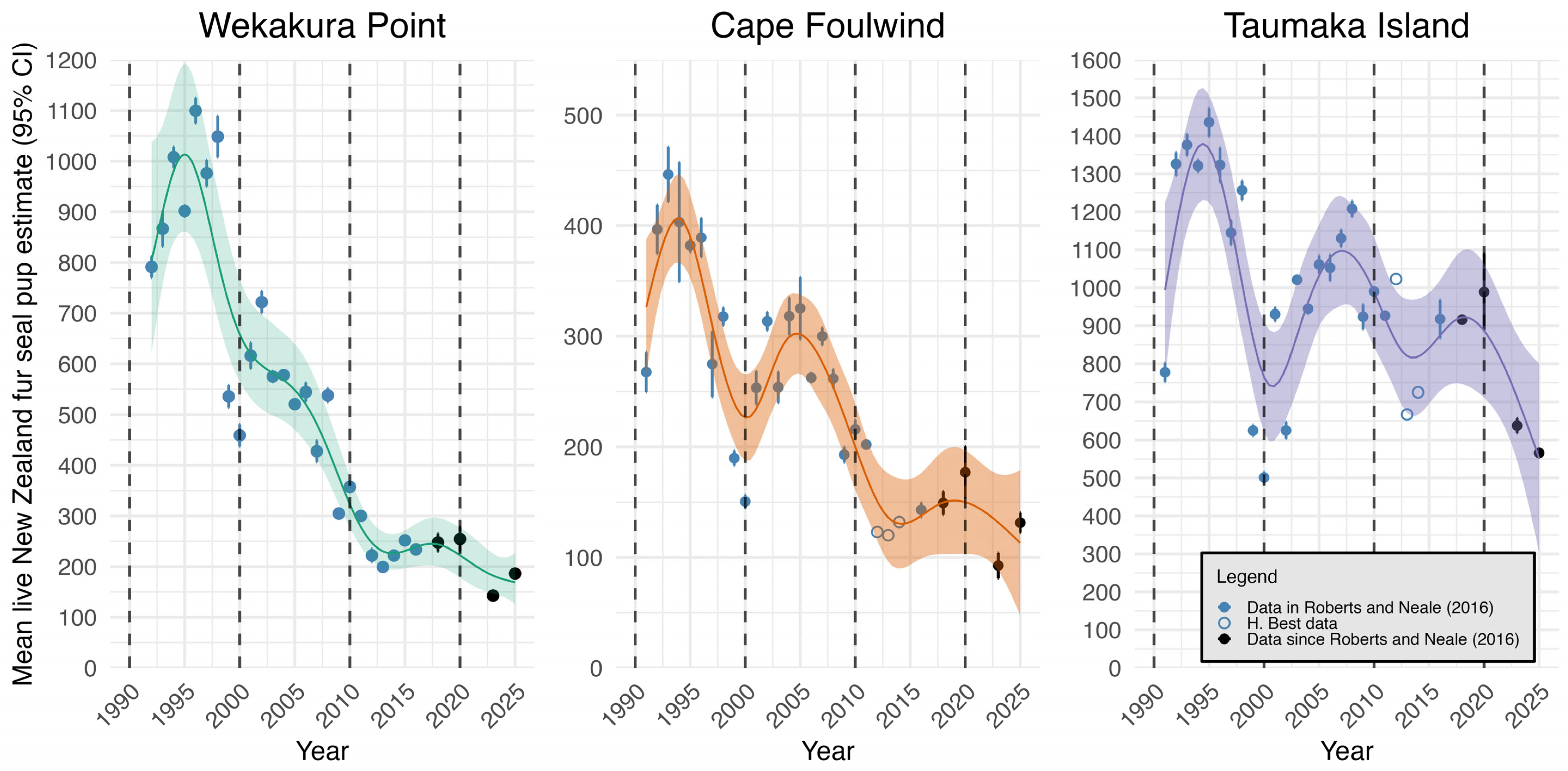
Between 2016 (the last year of Roberts and Neale [57]) and 2018, pup production was largely stable at all colonies (Figure 2). It then increased somewhat between 2018 and 2020, before dropping sharply between 2020 and 2023. Live pup abundance at Wekakura Point and Cape Foulwind increased from 2023 to 2025 but continued to fall at Taumaka Island.
Figure 2.
Mean live pup abundance estimates from mark-recapture at the three WCSI colonies, with smooths from the GAMs of pup estimate against year overlaid. Hollow points are used for years from Cape Foulwind and Taumaka Island when data were collected without error ranges (H. Best). The shaded areas represent the 95% confidence interval [57].
3.2. Effects of Year on Live Pup Abundance Estimates
The results of the GAMs exploring the impact of year on live pup abundance are plotted in Figure 2 and presented in Table 2. In each case the models explained a substantial proportion of the deviance, and the smooth terms for year were highly significant.
Table 2.
GAM results showing relationships between Year and Live Pup Abundance at each colony.
Turning points in the trajectory of live pup abundance estimates at Wekakura Point were identified in 1995/1996 (positive to negative), 2014 (negative to positive) and 2017/2018 (positive to negative) (Figure 2). The 95% confidence intervals showed that 1995/1996 was the only turning point when the associated derivative was significantly different from zero. Indeed, since 2012, the only period where the gradient of the GAM smooth was significantly different from zero was in 2021/2022, when the gradient was significantly negative.
Turning points in the trajectory of live pup abundance at Cape Foulwind were identified in 1994/1995 (positive to negative), 1999/2000 (negative to positive), 2005/2006 (positive to negative), 2014/2015 (negative to positive) and 2018/2019 (positive to negative). First-order derivatives showed significant positive gradients between 1991 and 1993 and 2001–2003, and significant negative gradients between 1994 and 1999 and 2007–2012. Since 2012, the gradient for Cape Foulwind has been non-significant.
Turning points in the trajectory of live pup abundance at Taumaka Island were identified in 1994/1995 (positive to negative), 2000/2001 (negative to positive), 2007/2008 (positive to negative), 2014/2015 (negative to positive) and 2018 (positive to negative). First-order derivatives showed significant positive gradients between 1991 and 1994 and 2002–2005 and significant negative gradients between 1995 and 2000, 2009–2011 and 2021–2023.
Comparisons of percentage change in live pup abundance estimates from each colony’s recorded maximum to 2016 (the final year of Roberts and Neale [57]) and 2016–2025 are presented in Table 3.
Table 3.
Percentage change in live New Zealand fur seal pup abundances at the WCSI colonies comparing the declines between the maximum recorded at each colony to 2016 (the end of the period studied by Roberts and Neale) with the data collected between 2016 and 2025.
3.3. Dead Pup Counts
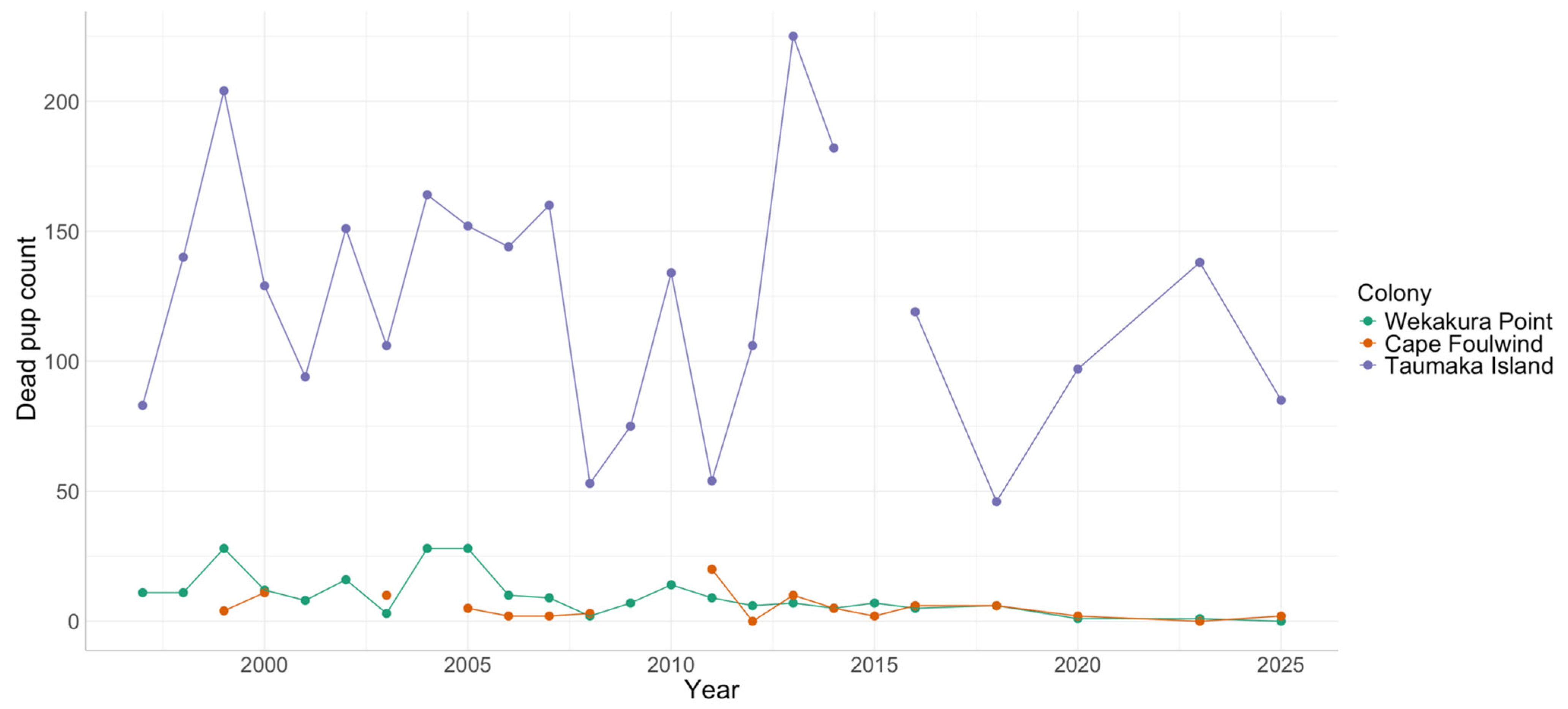
Dead pup counts have been consistently much higher at Taumaka Island than at Wekakura Point or Cape Foulwind (Table S2) and this pattern has continued between 2016 and 2025 (Figure 3). On average, since dead pup counts started in 1997, dead pup counts as a percentage of total pups (live plus dead) has been 12.7% (range 4.2–25.2%) at Taumaka Island, compared to 2.3% (range 0–5.4%) at Wekakura Point and 3% (0–9%) at Cape Foulwind.
Figure 3.
Counts of dead New Zealand fur seal pups at the Wekakura Point, Cape Foulwind and Taumaka Island colonies between 1997 and 2025.
Sharp declines in the live pup abundance estimates in 2023 (Table 1) coincided with a high dead pup count at Taumaka Island, but not at Wekakura Point and Cape Foulwind, where dead pup counts remained low. The 2018 dead pup count at Taumaka Island was the lowest ever recorded for that colony.
3.4. Pup Size and Condition
Between 1991 and 2025, mean pup mass at Wekakura Point was 6.68 kg (range = 3–13 kg), and mean BCI 1 was 0.09 kg/cm (range = 0.05–0.17 kg/cm). At Cape Foulwind, mean pup mass was 6.88 kg (range = 3–11.8 kg) and mean BCI1 was 0.1 kg/cm (range = 0.04–0.17 kg/cm). At Taumaka Island, mean pup mass was 6.12 kg (range = 2.16–11.4 kg) and mean BCI1 was 0.09 kg/cm (range = 0.04–0.14 kg/cm).
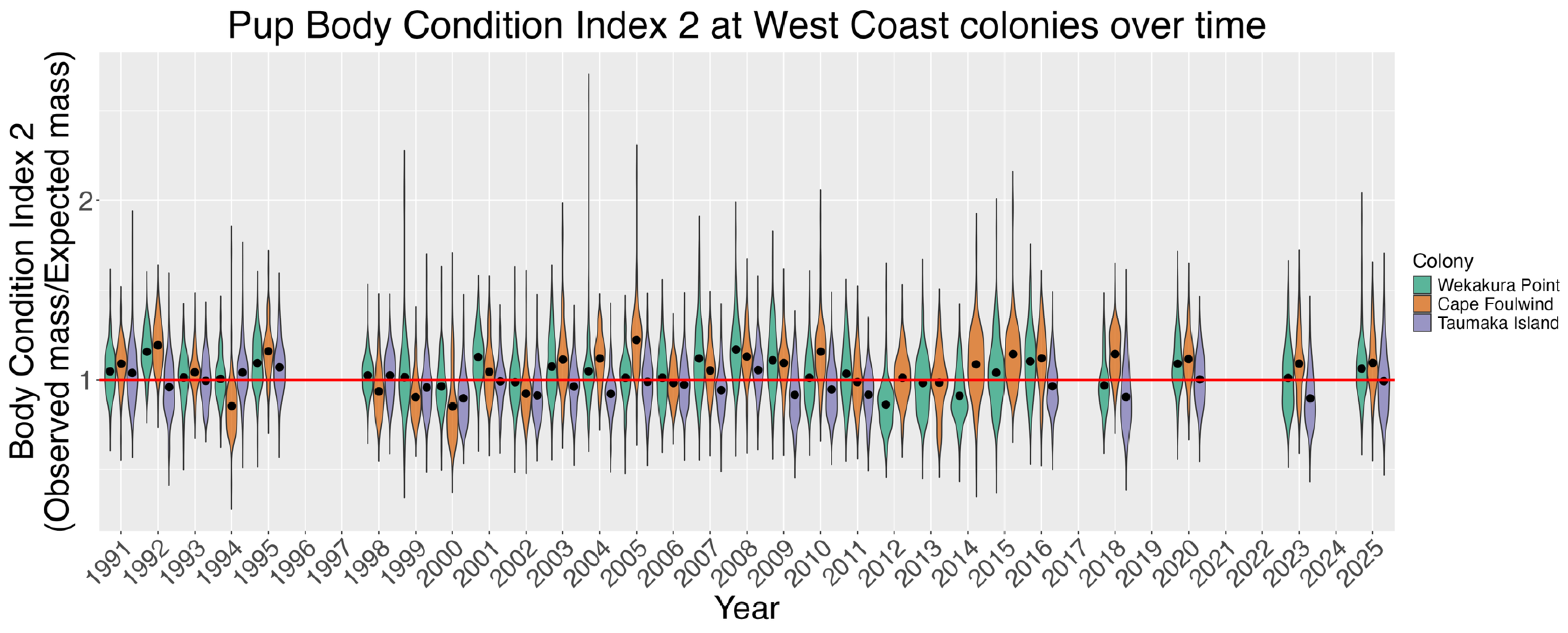
BCI2 was used to compare the pups from all colonies in all years (Figure 4). BCI2 values greater than 1 indicate pups were in better-than-expected condition, whereas values less than 1 indicate pups were in worse-than-expected-condition. On average, Wekakura Point pups were in better-than-expected condition in 22 out of 28 years, and in worse-than expected condition in 6. On average, Cape Foulwind pups were in better-than-expected condition in 20 out of 28 years, and in worse-than-expected condition in 8. On average, Taumaka Island pups were in better-than-expected condition in 6 out of 24 years, and in worse-than-expected condition in 18.
Figure 4.
BCI2 values for fur seal pups sampled at Wekakura Point, Cape Foulwind and Taumaka Island, derived from a comparison of all pups at all colonies in all years. Violin shapes show the frequency of values, and black dots denote annual means. Values above 1 denote pups in better-than-expected condition, and values below 1 denote pups in worse-than-expected condition.
3.4.1. Pan-Colony Pup Mass and Condition Model Results
Results of the AIC(c) model selections are in Tables S3 and S4.
The preferred pan-colony mass model (adj. r2 = 0.22, F33,12377 = 109.9, p < 0.001) included Colony, Day, Sex and Year. On average, Taumaka Island pups were 0.75 kg (95% CI = 0.69–0.81 kg, p < 0.001) lighter than Cape Foulwind pups and Wekakura Point pups were 0.14 kg lighter than Cape Foulwind pups (95% CI = 0.08–0.2 kg, p < 0.001). Pup mass increased by 0.04 kg per day (95% CI = 0.03–0.05 kg, p < 0.001), and male pups were 0.69 kg heavier than female pups (95% CI = 0.64–0.73 kg, p < 0.001). Most years were significantly different (p < 0.05) from the model baseline with full model results shown in Table S5.
The preferred BCI1 model (adj. r2 = 0.21, F30,11,576 = 104.4, p < 0.001) included Colony, Sex and Year. On average, Taumaka Island pups were 0.01 kg/cm lighter than Cape Foulwind pups (95% CI = 0.009–0.01 kg/cm, p < 0.001), and Wekakura Point pups were 0.002 kg/cm lighter than Cape Foulwind pups (95% CI = 0.001–0.003 kg/cm, p < 0.001). Male pups were 0.01 kg/cm heavier than females (95% CI = 0.006–0.007 kg/cm, p < 0.001). Most years were significantly different (p < 0.05) from the model baseline with full model results shown in Table S6.
3.4.2. Individual Colony Pup Mass and Condition Model Results
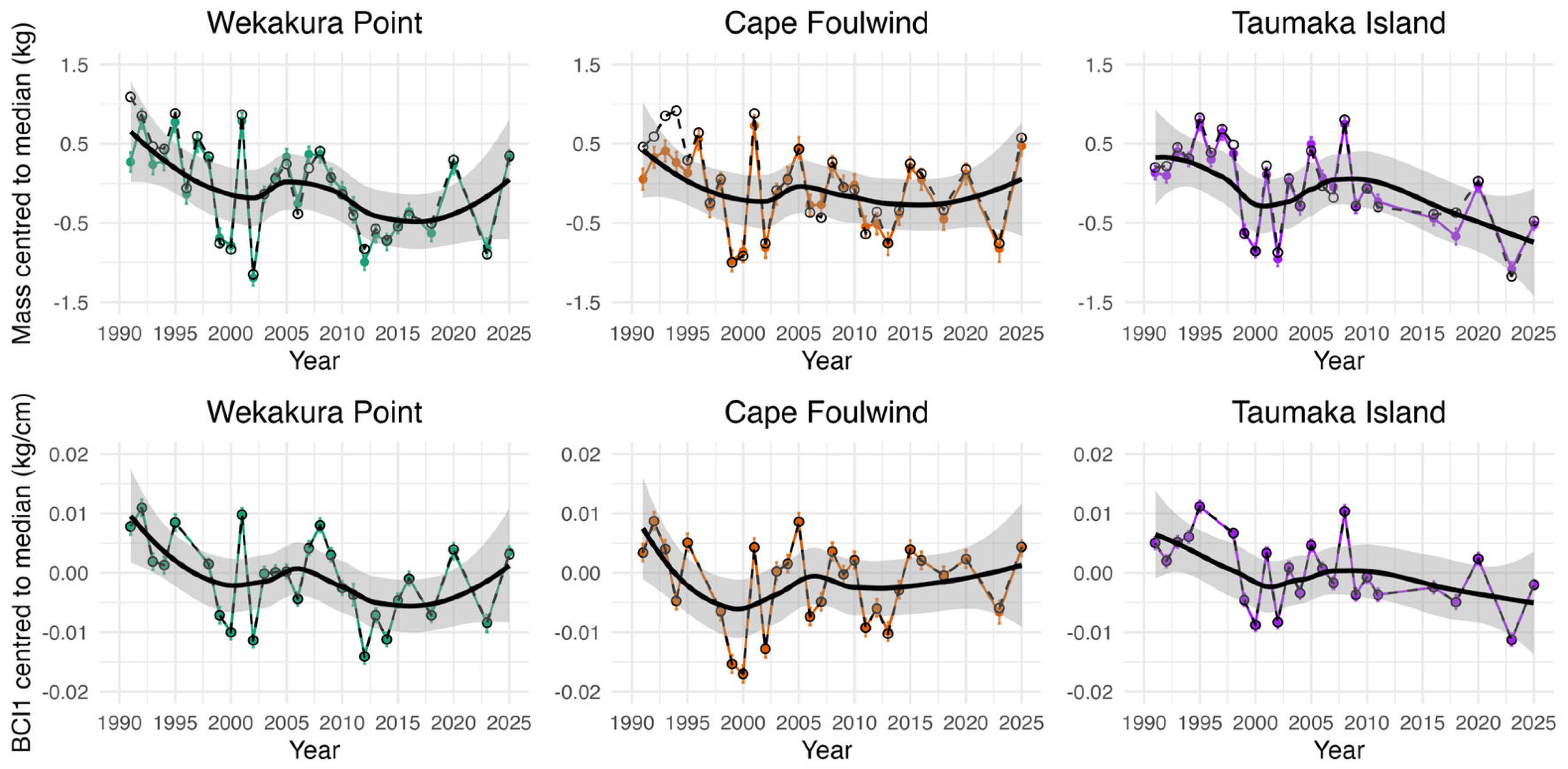
The individual colony linear models showed that male pups had significantly higher mass and BCI1 than female pups (p < 0.001), and most years were significantly different from the baseline for each colony (p < 0.05). Annual average pup masses and BCI1, as well as model standardised estimates, are presented in Figure 5. Model standardised mass estimates were typically close to raw values, with deviations occurring in years when pups were weighed later in the season—for example, 1991 at Wekakura Point, 1991–1994 at Cape Foulwind and 2018 at Taumaka Island.
Figure 5.
Annual average pup mass and BCI1 (dashed lines) and model standardised estimates with standard error bars (coloured lines) for the three WCSI study colonies. Both non-standardised and standardised estimates have been centred to median, and LOESS smoothers (span = 0.75) have been applied to aid trend visualisation.
Using the model standardised estimates, inter-survey percentage change for mass and BCI1 was calculated to determine when the largest changes occurred (Table S7).
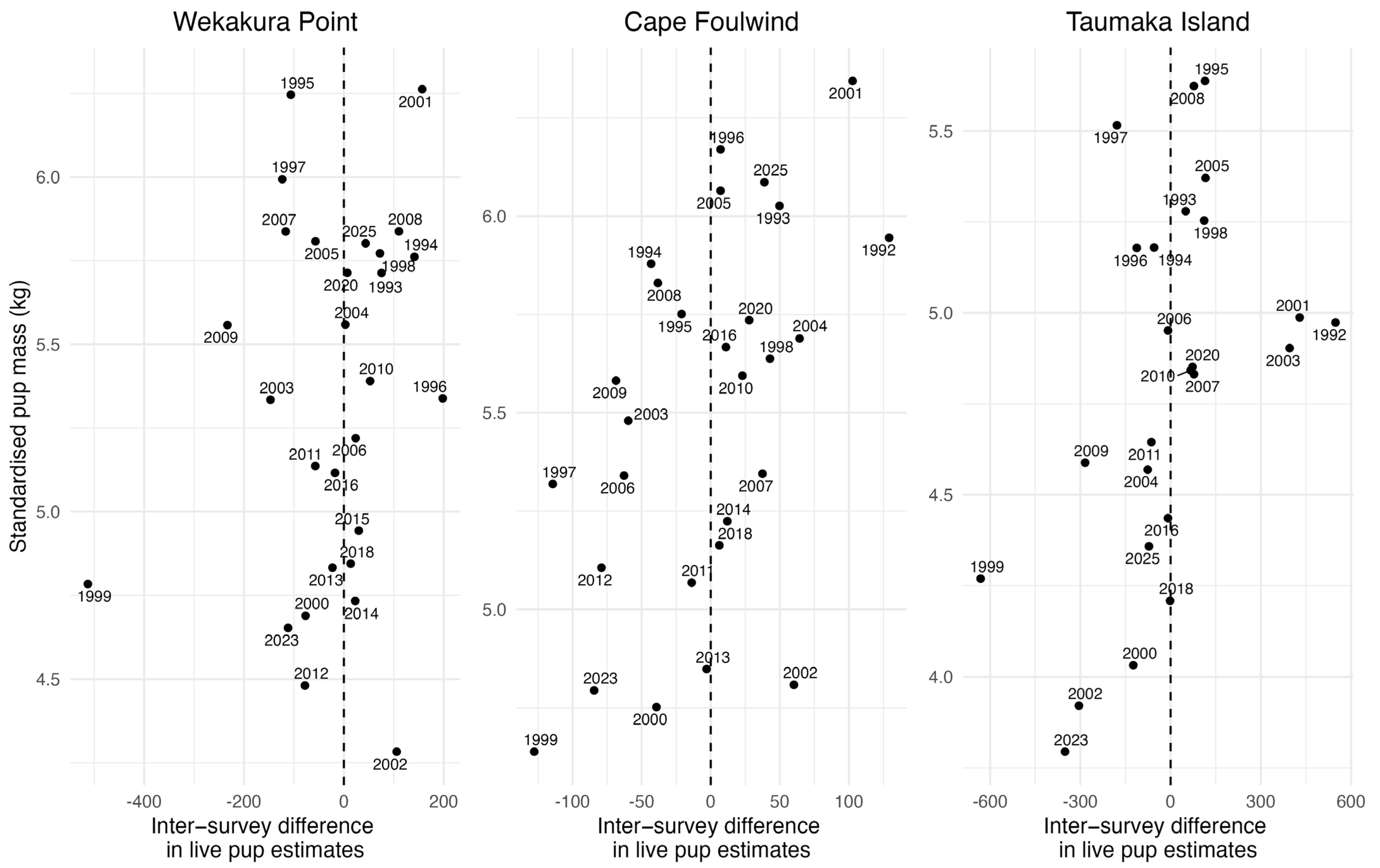
Pearson’s product-moment correlations found a weak, non-significant correlation between standardized pup mass and the inter-survey difference in live pup abundance estimates at Wekakura Point (r = 0.19, p = 0.32) and moderate, significant correlations between these variables at Cape Foulwind (r = 0.51, p < 0.01) and Taumaka Island (r = 0.49, p < 0.05). These relationships are shown in Figure 6.
Figure 6.
Pairwise scatterplots showing relationships between model standardised fur seal pup mass and the inter-survey difference in live pup abundance at the three WCSI study colonies.
4. Discussion
Through a consistently executed long-term monitoring programme, this study demonstrates continued declines in live pup abundance at three New Zealand fur seal (Arctocephalus forsteri) breeding colonies on the West Coast of New Zealand’s South Island. These declines now total 83% at Wekakura Point, 71% at Cape Foulwind and 61% at Taumaka Island from each respective recorded maximum in the early/mid-1990s. Over this period, pup condition has been highly variable, with correlations between the trajectories of pup condition and pup abundance.
The sustained declines in pup abundance at the colonies monitored in this study contrast with recent findings on the East Coast of New Zealand’s South Island [59,60], and more broadly with population trends observed in New Zealand fur seal colonies elsewhere in New Zealand, where colony sizes have largely been stable or increasing [7,44,70,71]. However, in other pinniped species, there are recent records of declines among previously growing populations [11,12,13].
The longitudinal nature of this dataset enables the detection of both consistencies and nuances in the trends across the colonies. For example, at all three colonies there were troughs in pup abundance around 2000, 2010–2012 and 2023, with relative peaks in the mid-1990s, around 2005 and 2016–2020. Wekakura Point and Cape Foulwind produced their lowest ever live recorded pup estimates in 2023: 143 (95% CI = 133–152) and 93 (95% CI = 81–104), respectively. Taumaka Island’s 2025 estimate of 566 (95% CI 555–577) is the second lowest ever recorded after 500 (95% CI = 486–516) in 2000. Future data collection is required to determine whether the declines in 2023 and 2025 relative to 2020 will be followed by increases, as previously observed, or whether the populations will continue to decline towards zero.
Since 2012, there have been more gradual rates of population change at Cape Foulwind and Wekakura Point relative to Taumaka Island. Taumaka Island is also the only colony where the rate of population change has become more negative since 2016 [57] (Table 3), and where pup mortality has been consistently high relative to the other two.
That male pups were heavier and had higher BCI1 than females, and that pups were heavier and higher BCI1 when measured later in the season conforms to both expectations and past studies [43,72,73]. On average, Cape Foulwind pups were the heaviest and had the highest BCI1, followed by Wekakura Point and then Taumaka Island. From BCI2, Wekakura Point and Cape Foulwind pups were in better-than-expected condition in most years, whereas Taumaka Island pups were in worse-than-expected condition in most years (Figure 4). Pup mass and BCI1 have varied substantially at the three colonies through time, with consistencies in their temporal trends (Figure 5). There were also correlations between declines in live pup abundance estimates and decreases in pup condition, including in recent years. For example, between 2020 and 2023 average pup mass decreased by 16.4–21.8% at the three study colonies at the same time as they experienced their largest inter-assessment decreases in live pup abundance estimates since 2016. Average pup mass then increased substantially (14.9–26.9%) at all colonies from 2023 to 2025. At Wekakura Point and Cape Foulwind live pup abundance estimates also increased, but continued to decrease at Taumaka Island.
4.1. Potential Causes of the Colony Declines
Establishing causation for long-term population declines in pinnipeds is complex due to the variety of potential drivers [13,24,25]. WCSI live pup abundance estimates between 1991 and 2025 demonstrate both episodic drops, sometimes followed by partial recoveries (Figure 2), and long-term declines.
4.1.1. Episodic Drops in Pup Abundance
Unless associated with low pup survival [74,75], episodic drops in pup numbers are typically a reflection of low pup production [76,77]. Reductions to pinniped pup production can result from direct mortality of females—for example, through bycatch in fisheries [33,78]—but also through environmentally mediated factors that impact fecundity. For example, due to the energetic costs associated with gestation and pup rearing, nutritionally stressed females may fail to implant following embryonic diapause [28] or abort in late gestation [79,80]. Changing oceanographic conditions, such as increases to sea surface temperature (SST), can engender changes to pinniped prey location and reliability, forcing lactating females to expend varying levels of energy when foraging [18,81,82], which may then impact fecundity [80,83]. Such a relationship may explain why sharp drops in pup production at all three colonies between 1998 and 2000 and, to a lesser extent, around 2010, aligned with strong, warm La Niña events [84], as warmer waters have been associated with poorer foraging conditions in several pinnipeds [18,82]. Roberts et al. (2022) [84] found that WCSI fur seal productivity was reduced in years with elevated SST, when the surface chlorophyll-a (chl-a) concentration was low, the latter driven by shallowing of the mixed layer depth. Intense warm extremes in the New Zealand region have occurred between November–March in 2017/2018, 2018/2019, 2021/2022 and 2022/2023, with the highest marine heatwave anomalies occurring off the WCSI [85]. During this period (2016–2023), the overall trend at the WCSI colonies has been towards lower pup abundance. Given the findings of Roberts et al. (2022) [84], and correlations between high WCSI SST and low fur seal productivity on the WCSI between 2018 and 2023, it seems likely that changing marine environmental conditions are at least partly contributing to the observed declines in WCSI pup abundance at these colonies.
Disease can also impact fecundity [20,48], as well as survival [16,86,87] in pinnipeds. Recently, a divergent strain of canine distemper virus (CDV) was detected in Kaikōura’s New Zealand fur seals through consistent colony monitoring [88]. This pathogen was associated with an Unusual Mortality Event and substantially reduced pup production at the region’s largest colony as well as high observed rates of starvation and nutritional stress (Hall et al. in prep). CDV has subsequently been detected at Mātakitaki-a-Kupe/Cape Palliser, near Wellington, the largest recorded fur seal colony on New Zealand’s North Island (Taylor et al. in prep), again in association with elevated observed mortality. Only a limited number of necropsies have been performed at the WCSI colonies over the study period, and future monitoring should incorporate disease screening, so that the potential contribution of CDV or other pathogens to the recorded declines can be determined.
4.1.2. Long-Term Declines in Breeding Colony Sizes
In addition to the abrupt drops in pup abundance there have also been protracted declines, which are more likely to reflect reduced survival across multiple female age classes [19,89,90], or emigration (see below), than reduced fecundity or pup survival. Pinniped survival can be impacted by numerous non-mutually exclusive factors including disease [16,88,91], legal or illegal anthropogenic killings [92,93,94], bycatch mortality [22,95,96,97], entanglement [23,98], interactions with human infrastructure such as roads and oil extraction and transportation activities [60,99,100], injuries from aggressive in-colony con-specific encounters [101,102], predation [12,103,104] and starvation as a result of changes to prey availability [105].
On the WCSI, predation can be discounted as a substantial cause of pup mortality during the surveying window, as New Zealand fur seals lack terrestrial predators, and pups at this stage are on land or in shallow pools around the colony. Not enough is known about predation of adult fur seals on the WCSI, so this cannot be discounted. The long-term nature of the pup abundance declines means that fatal in-colony encounters between fur seals is also an unsatisfactory explanation, as the frequency of such encounters should reduce as colony density decreases [106]. On the East Coast of the South Island, fur seal colony accessibility has been associated with illegal killings [94] and roadkill mortality [99]. By contrast, the three WCSI study colonies are much harder to access, meaning terrestrial human activities are less likely to impact fur seal survival. At sea, however, New Zealand fur seals suffer high rates of incidental capture and mortality [97,107,108]. Between 2002/03 and 2022/23, 2044 fur seals were reported captured in trawl fisheries in New Zealand waters, and a further 517 in surface longline fisheries [109], with the WCSI known as a hotspot for fur seal bycatch [34]. Thus, WCSI fur seal survival is impacted directly by bycatch in trawl, set and surface longline fisheries. Due to reduced fur seal monitoring frequency at the WCSI colonies since 2016, some precision has been lost when assessing potential relationships between fur seal bycatch and population trends, particularly given the substantial assessment-to-assessment variability in live pup abundance estimates. Preferably, monitoring should return to an annual basis.
As well as potentially impacting WCSI fur seal fecundity, nutritional stress may also impact local fur seal survival. There are links between condition and both pre- and post-weaning survival in pinniped pups [29,56], which then impact future population sizes in a lagged effect due to lower recruitment [19,98]. As pup condition can be used as a proxy for female foraging success [18,19], low pup condition likely indicates concomitant nutritional stress in females that could reduce survival in this cohort as well [105]. Adult females are particularly important to pinniped population trajectories [110,111,112], and their status as central-place foragers [113,114], means features of the local marine environment can drive inter-colony differences in condition [17,115].
The combination of considerably higher pup mortality and significantly lower condition (mass and BCI1) at Taumaka Island relative to the other colonies may indicate that Taumaka Island declines are being influenced primarily by poor pup survival. Contrastingly, lower pup mortality at Wekakura Point and Cape Foulwind could indicate that their declines are being influenced more by lower pup production (either through declining female survival or low breeding rates) than poor pup survival, as has been suggested for California sea lions (Zalophus californianus) at colonies in the Gulf of California [18]. Importantly, both poor pup survival and low pup production could relate to prey availability, as the timing of prey scarcity can influence both otariid pup production and pup survival rates [18,105]. Comparative analysis of foraging habits [116,117,118] between females from the WCSI colonies, combined with scat sampling [119,120] and isotopic analysis of vibrissae and/or pup fur [18,121] would benefit understandings of the relative ease with which females from the three colonies can find prey, as well as elucidating the prey items targeted and the trophic level(s) at which they are foraging.
Despite the nuances, both poor survival and occasional abrupt pup production decreases have likely impacted all three colonies, as all have experienced both long-term declines and episodic drops, and similarities in the trends at the three colonies are consistent with shared drivers [84] (Figure 2). If, as seems likely, reduced female foraging efficiency (linked to prey availability) is among these drivers [51,84], changes to colony densities through time might explain some of the variation in their rates of decline. Effects of reduced foraging efficiency should be at least somewhat density dependent, with fewer resources per individual at larger colonies [18,32]. Fur seal abundance at Taumaka Island initially decreased more slowly than at the northern colonies, and this colony remains substantially larger in terms of pup production. Thus, a bottom-up limitation from reduced female foraging efficiency may now act more strongly on the Taumaka Island colony than either of the others [18], perhaps partially explaining why the former is now declining more rapidly.
Migration out of the study area could also engender the observed reductions in WCSI pup abundance, as has been observed in Cape fur seals (Arctocephalus pusillus) in Southern Africa [3]. As this research focuses only on the three study colonies, this cannot be quantitatively assessed. While there have been suggestions that some Wekakura Point fur seals might have relocated to other colonies in the surrounding area (L. Angus, pers. comm.), no data have been collected to support this, and there is no suggestion of a similar phenomenon at either Cape Foulwind or Taumaka Island. Limited fur seal monitoring in New Zealand makes it hard to assess such claims [41], and large-scale surveying would be required to detect such movement [3,30]. The last time that the entire WCSI region was surveyed was by helicopter in January 2009 [122].
4.2. Recommendations for Future Monitoring and Research
4.2.1. Abundance and Health Monitoring
Ideally, WCSI fur seal monitoring should revert to an annual basis to avoid masking interannual variability. As the WCSI monitoring programme represents one of two longitudinal fur seal population studies in New Zealand, and the only one to include condition monitoring, this work is important for broader understandings of the species in New Zealand. This is particularly important in the context of threats such as Highly Pathogenic Avian Influenza (HPAI)—which has been associated with catastrophic mortality in pinniped species in the Southern Hemisphere [14,16], and is getting closer to New Zealand—and the effects of climate change on marine ecosystems [23,123]. Pinnipeds can be effective sentinels for threats such as new diseases [88,124] and environmental change [82,125], and continued monitoring would enable the use of fur seal abundance and body condition measurements to detect changes, such as reduced food availability (pup abundance and body condition) or novel pathogens (pup abundance and survival). The results of future monitoring of pup condition and abundance should also be assessed in context with rates of fisheries bycatch and mortality through time, as another known source of mortality to fur seals in the region.
4.2.2. Diet and Foraging Studies
Updated research on WSCI fur seal diet and foraging could elucidate how these parameters may be contributing to the trajectories outlined in this study. Routine scat and regurgitate sampling can be effective for understanding the biomass contributions of different prey species to fur seal diet [120]. This, combined with satellite telemetry studies of foraging behaviour and the location of important foraging grounds for lactating female fur seals would provide much needed spatial and temporal data to inform models seeking to understand and mitigate risks to the species [107].
4.3. Conclusions
The data presented here demonstrate continued declines at three New Zealand fur seal colonies on the West Coast of New Zealand’s South Island, as well as highly variable pup condition. This contrasts with most recent population studies of the species in New Zealand, where other monitored colonies appear to be growing or stable.
Given the temporal consistencies between pup production and pup body condition trends at the WCSI colonies, and previously recorded links between fur seal pup productivity and climate drivers [84], it seems likely that marine environmental change is playing a role in the trends observed here. However, in the context of the recent discovery of CDV in New Zealand fur seals [88] and the particularly high number of direct mortalities in fisheries [34,108], it is important that a range of potential drivers continue to be assessed, and mitigation options implemented where possible.
Supplementary Materials
The following supporting information can be downloaded at: https://www.mdpi.com/article/10.3390/ani16010121/s1, Figure S1: Mean date (Julian date) of pup measurements used in the analyses of the WCSI study colonies through time; Table S1: Sample sizes used for analyses of pup mass. BCI1 and BCI2 sample sizes are equivalent unless stated otherwise in brackets, except for 1996 and 1997 (*), when no length data were collected meaning BCI1 and BCI2 could not be calculated; Table S2: Counts of dead pups by colony from the three WCSI study colonies, with live numbers calculated from mark-recapture, and dead pups as a percentage of the total (live + dead); Table S3: Comparison of models considered for predicting mass of pups born at WCSI fur seal colonies. Models are displayed in ascending order of AICc. Only the first 10 models are provided; Table S4: Comparison of models considered for predicting pup BCI1 born at WCSI fur seal colonies. Models are displayed in ascending order of AICc. Only the first 10 models are provided; Table S5: Results of the preferred pan-colony pup mass model; Table S6: Results of the preferred pan-colony pup BCI1 model; Table S7: Inter-survey changes in model standardised pup mass and pup BCI1 at the WCSI colonies For concision, only changes >10% are shown.
Author Contributions
A.A.H., D.N., B.L.C. and J.S.W. developed the study’s conceptualization. Methodology was designed by A.A.H., D.N., J.R. and J.S.W. Formal analysis was carried out by A.A.H. and J.R. Investigation, field data collection and curation were conducted by D.N. Resources were provided by D.N. and J.S.W.; A.A.H. prepared the original manuscript draft, and all authors (A.A.H., D.N., J.R., B.L.C. and J.S.W.) contributed to writing, reviewing and editing. Visualization was completed by A.A.H. and J.R. Supervision was provided by B.L.C. and J.S.W., and project administration was undertaken by D.N. and J.S.W. Funding was acquired by J.S.W. All authors have read and agreed to the published version of the manuscript.
Funding
This work was funded by the New Zealand Department of Conservation.
Institutional Review Board Statement
Pup capture and handling procedures operated under the Department of Conservation’s 2018 New Zealand sea lion and fur seal pup tagging Standard Operating Procedure (SOP), which complies with the New Zealand Animal Welfare Act 1999. Under section 5 (3) (a), (b) and (c) of the Animal Welfare Act 1999, DOC staff (or external staff working under DOC) following this SOP do not require Animal Ethics Committee approval for the work being carried out, provided it is a part of the routine management of the species covered by this document (Phocarctos hookeri and Arctocephalus forsteri).
Data Availability Statement
The datasets analysed during the current study are available from the corresponding author on reasonable request. Data collected during surveys of New Zealand fur seal at the study colonies can be found at https://furseals.dragonfly.co.nz/ (URL accessed on 3 March 2025).
Acknowledgments
The authors acknowledge the multiple Department of Conservation (DOC) staff, tangata whenua representatives and volunteers involved in the field monitoring at the three colonies, with particular thanks to Hugh Best, Jacinda Amey, Justin Blaikie, Doug Cairns, Tracey Dearlove, Scott Freeman, Graeme Quinn, Daniel Sawyers and Kate Simister. Kekeno—New Zealand fur seal—is a taonga species (and noted as such in the Ngāi Tahu Claims Settlement Act 1998), and the monitored colonies are within the rohe (tribal areas) of Ngāti Waewae (Wekakura Point and Cape Foulwind) and Ngāti Māhaki ki Makaawhio (Taumaka). Access to Taumaka for this work was allowed and supported by the island’s owners, the Taumaka me Popotai Trust. Pup capture and handling procedures were approved by the Department of Conservation Animal Ethics Committee and Te Rūnanga o Ngāi Tahu Group Management and followed the Canadian Council on Animal Care guidelines for wildlife handling. The demographic database for WCSI NZ fur seals was developed and maintained by Dragonfly Data Science, and Hannah Hendriks (DOC) assisted with data curation. The field work and production of this report were funded by the Department of Conservation. The authors also wish to thank the anonymous reviewers whose feedback improved this manuscript.
Conflicts of Interest
Author Alasdair A. Hall is employed by the company “Hall Marine Consulting” and author Jim Roberts is employed by the company “Anemone Consulting Limited”. The remaining authors declare no conflicts of interest.
References
- Ling, J.K. Exploitation of Fur Seals and Sea Lions from Australian, New Zealand and Adjacent Subantarctic Islands during the Eighteenth, Nineteenth and Twentieth Centuries. Aust. Zool. 1990, 31, 323–350. [Google Scholar] [CrossRef] [Scilit]
- Kirkwood, R.; Pemberton, D.; Gales, R.; Hoskins, A.J.; Mitchell, T.; Shaughnessy, P.D.; Arnould, J.P.Y. Continued Population Recovery by Australian Fur Seals. Mar. Freshw. Res. 2010, 61, 695–701. [Google Scholar] [CrossRef] [Scilit]
- Kirkman, S.P.; Oosthuizen, W.H.; Meÿer, M.A.; Seakamela, S.M.; Underhill, L.G. Prioritising Range-Wide Scientific Monitoring of the Cape Fur Seal in Southern Africa. Afr. J. Mar. Sci. 2011, 33, 495–509. [Google Scholar] [CrossRef] [Scilit]
- Crespo, E.A.; Schiavini, A.C.M.; García, N.A.; Franco-Trecu, V.; Goodall, R.N.P.; Rodríguez, D.; Stenghel Morgante, J.; de Oliveira, L.R. Status, Population Trend and Genetic Structure of South American Fur Seals, Arctocephalus Australis, in Southwestern Atlantic Waters. Mar. Mamm. Sci. 2015, 31, 866–890. [Google Scholar] [CrossRef] [Scilit]
- Dussex, N.; Robertson, B.C.; Salis, A.T.; Kalinin, A.; Best, H.; Gemmell, N.J. Low Spatial Genetic Differentiation Associated with Rapid Recolonization in the New Zealand Fur Seal Arctocephalus forsteri. J. Hered. 2016, 107, 581–592. [Google Scholar] [CrossRef] [Scilit]
- Smith, I.W. Historical Documents, Archaeology and 18th Century Seal Hunting in New Zealand. In Oceanic Culture History. Essays in Honour of Roger Green; New Zealand Journal of Archaeology Special Publication: Dunedin, New Zealand, 1996; pp. 675–688. [Google Scholar]
- Lalas, C.; Bradshaw, C.J.A. Folklore and Chimerical Numbers: Review of a Millennium of Interaction between Fur Seals and Humans in the New Zealand Region. N. Z. J. Mar. Freshw. Res. 2001, 35, 477–497. [Google Scholar] [CrossRef] [Scilit]
- Berry, O.; Spiller, L.C.; Campbell, R.; Hitchen, Y.; Kennington, W.J. Population Recovery of the New Zealand Fur Seal in Southern Australia: A Molecular DNA Analysis. J. Mammal. 2012, 93, 482–490. [Google Scholar] [CrossRef] [Scilit]
- Milano, V.N.; Grandi, M.F.; Schiavini, A.C.M.; Crespo, E.A. Sea Lions (Otaria flavescens) from the End of the World: Insights of a Recovery. Polar Biol. 2020, 43, 695–706. [Google Scholar] [CrossRef] [Scilit]
- Milano, V.N.; Grandi, M.F.; Schiavini, A.C.M.; Crespo, E.A. Recovery of South American Fur Seals from Fuegian Archipelago (Argentina). Mar. Mamm. Sci. 2020, 36, 1022–1032. [Google Scholar] [CrossRef] [Scilit]
- Forcada, J.; Hoffman, J.I.; Gimenez, O.; Staniland, I.J.; Bucktrout, P.; Wood, A.G. Ninety Years of Change, from Commercial Extinction to Recovery, Range Expansion and Decline for Antarctic Fur Seals at South Georgia. Glob. Chang. Biol. 2023, 29, 6867–6887. [Google Scholar] [CrossRef] [Scilit]
- Nagel, R.; Stainfield, C.; Fox-Clarke, C.; Toscani, C.; Forcada, J.; Hoffman, J.I. Evidence for an Allee Effect in a Declining Fur Seal Population. Proc. R. Soc. B Biol. Sci. 2021, 288, rspb.2020.2882. [Google Scholar] [CrossRef] [Scilit] [PubMed]
- Krause, D.J.; Brownell, R.L.; Bonin, C.A.; Woodman, S.M.; Shaftel, D.; Watters, G.M. Evaluating Threats to South Shetland Antarctic Fur Seals amidst Population Collapse. Mamm. Rev. 2024, 54, 30–46. [Google Scholar] [CrossRef] [Scilit]
- Ulloa, M.; Fernández, A.; Ariyama, N.; Colom-Rivero, A.; Rivera, C.; Nuñez, P.; Sanhueza, P.; Johow, M.; Araya, H.; Torres, J.C.; et al. Mass Mortality Event in South American Sea Lions (Otaria flavescens) Correlated to Highly Pathogenic Avian Influenza (HPAI) H5N1 Outbreak in Chile. Vet. Q. 2023, 43, 1–10. [Google Scholar] [CrossRef] [Scilit]
- Tomás, G.; Marandino, A.; Panzera, Y.; Rodríguez, S.; Wallau, G.L.; Dezordi, F.Z.; Pérez, R.; Bassetti, L.; Negro, R.; Williman, J.; et al. Highly Pathogenic Avian Influenza H5N1 Virus Infections in Pinnipeds and Seabirds in Uruguay: Implications for Bird-Mammal Transmission in South America. Virus Evol. 2024, 10, veae031. [Google Scholar] [CrossRef] [Scilit]
- Campagna, C.; Uhart, M.; Falabella, V.; Campagna, J.; Zavattieri, V.; Vanstreels, R.E.T.; Lewis, M.N. Catastrophic Mortality of Southern Elephant Seals Caused by H5N1 Avian Influenza. Mar. Mamm. Sci. 2024, 40, 322–325. [Google Scholar] [CrossRef] [Scilit]
- Elorriaga-Verplancken, F.R.; Sierra-Rodríguez, G.E.; Rosales-Nanduca, H.; Acevedo-Whitehouse, K.; Sandoval-Sierra, J. Impact of the 2015 El Niño-Southern Oscillation on the Abundance and Foraging Habits of Guadalupe Fur Seals and California Sea Lions from the San Benito Archipelago, Mexico. PLoS ONE 2016, 11, e0155034. [Google Scholar] [CrossRef] [Scilit] [PubMed]
- Cruz-Vallejo, R.A.; Elorriaga-Verplancken, F.R.; Rosales-Nanduca, H.; Hernández-Camacho, C.J.; Moncayo-Estrada, R.; Gómez-Gutiérrez, J.; González-Armas, R.; Rodríguez-Rafael, E.D.; González-López, I. Abundance, Isotopic Amplitude, and Pups Body Mass of California Sea Lions (Zalophus californianus) from the Southwest Gulf of California during Anomalous Warming Events. Mar. Biol. 2024, 171, 133. [Google Scholar] [CrossRef] [Scilit]
- Wall, D.; Thalmann, S.; Wotherspoon, S.; Lea, M.A. Is Regional Variability in Environmental Conditions Driving Differences in the Early Body Condition of Endemic Australian Fur Seal Pups? Wildl. Res. 2023, 50, 993–1007. [Google Scholar] [CrossRef] [Scilit]
- Romero, M.A.; Bartés, S.N.; Grandi, M.F.; Brogger, M.; Svendsen, G.; González, R.; Crespo, E.A. Impact of the Avian Influenza Outbreak on the Population Dynamics of South American Sea Lions Otaria byronia in Northern Patagonia. Mar. Mamm. Sci. 2025, 41, e70031. [Google Scholar] [CrossRef] [Scilit]
- Meyer, S.; Robertson, B.C.; Chilvers, B.L.; Krkošek, M. Marine Mammal Population Decline Linked to Obscured By-Catch. Proc. Natl. Acad. Sci. USA 2017, 114, 11781–11786. [Google Scholar] [CrossRef] [Scilit] [PubMed]
- Luck, C.; Jessopp, M.; Cronin, M.; Rogan, E. Using Population Viability Analysis to Examine the Potential Long-Term Impact of Fisheries Bycatch on Protected Species. J. Nat. Conserv. 2022, 67, 126157. [Google Scholar] [CrossRef] [Scilit]
- Kovacs, K.M.; Aguilar, A.; Aurioles, D.; Burkanov, V.; Campagna, C.; Gales, N.; Gelatt, T.; Goldsworthy, S.D.; Goodman, S.J.; Hofmeyr, G.J.G.; et al. Global Threats to Pinnipeds. Mar. Mamm. Sci. 2012, 28, 414–436. [Google Scholar] [CrossRef] [Scilit]
- Robertson, B.C.; Chilvers, B.L. The Population Decline of the New Zealand Sea Lion Phocarctos hookeri: A Review of Possible Causes. Mamm. Rev. 2011, 41, 253–275. [Google Scholar] [CrossRef] [Scilit]
- Baylis, A.M.M.; Orben, R.A.; Arnould, J.P.Y.; Christiansen, F.; Hays, G.C.; Staniland, I.J. Disentangling the Cause of a Catastrophic Population Decline in a Large Marine Mammal. Ecology 2015, 96, 2834–2847. [Google Scholar] [CrossRef] [Scilit]
- Sydeman, W.J.; Allen, S.G. Pinniped Population Dynamics in Central California: Correlations with Sea Surface Temperature and Upwelling Indices. Mar. Mamm. Sci. 1999, 15, 446–461. [Google Scholar] [CrossRef] [Scilit]
- Chilvers, B.L. Using Life-history Traits of New Zealand Ealand Sea Lions, Auckland Islands to Clarify Potential Causes of Decline. J. Zool. 2012, 287, 240–249. [Google Scholar] [CrossRef] [Scilit]
- Boyd, I.L. Environmental and Physiological Factors Controlling the Reproductive Cycles of Pinnipeds. Can. J. Zool. 1991, 69, 1135–1148. [Google Scholar] [CrossRef] [Scilit]
- Beauplet, G.; Barbraud, C.; Chambellant, M.; Guinet, C. Interannual Variation in the Post-Weaning and Juvenile Survival of Subantarctic Fur Seals: Influence of Pup Sex, Growth Rate and Oceanographic Conditions. J. Anim. Ecol. 2005, 74, 1160–1172. [Google Scholar] [CrossRef] [Scilit]
- McIntosh, R.R.; Kirkman, S.P.; Thalmann, S.; Sutherland, D.R.; Mitchell, A.; Arnould, J.P.Y.; Salton, M.; Slip, D.J.; Dann, P.; Kirkwood, R. Understanding Meta-Population Trends of the Australian Fur Seal, within Sights for Adaptive Monitoring. PLoS ONE 2018, 13, e0200253. [Google Scholar] [CrossRef] [Scilit]
- Guinet, C.; Jouventin, P.; Georges, J.-Y. Long Term Population Changes of Fur Seals Arctocephalus gazella and Arctocephalus Tropicalis on Subantarctic (Crozet) and Subtropical (St. Paul and Amsterdam) Islands and Their Possible Relationship to El Niño Southern Oscillation. Antarct. Sci. 1994, 6, 473–478. [Google Scholar] [CrossRef] [Scilit]
- Bradshaw, C.J.A.; Davis, L.S.; Lalas, C.; Harcourt, R.G. Geographic and Temporal Variation in the Condition of Pups of the New Zealand Fur Seal (Arctocephalus forsteri): Evidence for Density Dependence and Differences in the Marine Environment. J. Zool. 2000, 252, 41–51. [Google Scholar] [CrossRef]
- Meyer, S.; Robertson, B.C.; Chilvers, B.L.; Krkošek, M. Population Dynamics Reveal Conservation Priorities of the Threatened New Zealand Sea Lion Phocarctos hookeri. Mar. Biol. 2015, 162, 1587–1596. [Google Scholar] [CrossRef] [Scilit]
- Abraham, E.R.; Tremblay-Boyer, L.; Berkenbusch, K. Estimated Captures of New Zealand Fur Seal, Common Dolphin, and Turtles in New Zealand Commercial Fisheries, to 2017–18; Ministry for Primary Industries: Wellington, New Zealand, 2021.
- Reif, J.S.; Schaefer, A.M.; Bossart, G.D. Atlantic Bottlenose Dolphins (Tursiops truncatus) as a Sentinel for Exposure to Mercury in Humans: Closing the Loop. Vet. Sci. 2015, 2, 407–422. [Google Scholar] [CrossRef] [Scilit]
- Wenger, S.J. Use of Surrogates to Predict the Stressor Response of Imperiled Species. Conserv. Biol. 2008, 22, 1564–1571. [Google Scholar] [CrossRef] [Scilit]
- Grittz, G.S.; Machado, G.M.O.; Vibrans, A.C.; de Gasper, A.L. Commonness as a Reliable Surrogacy Strategy for the Conservation Planning of Rare Tree Species in the Subtropical Atlantic Forest. Biodivers. Conserv. 2024, 33, 1895–1907. [Google Scholar] [CrossRef] [Scilit]
- Prosekov, A.; Kuznetsov, A.; Rada, A.; Ivanova, S. Methods for Monitoring Large Terrestrial Animals in the Wild. Forests 2020, 11, 808. [Google Scholar] [CrossRef] [Scilit]
- Pollock, K.H.; Nichols, J.D.; Simons, T.R.; Farnsworth, G.L.; Bailey, L.L.; Sauer, J.R. Large Scale Wildlife Monitoring Studies: Statistical Methods for Design and Analysis. Environmetrics 2002, 13, 105–119. [Google Scholar] [CrossRef] [Scilit]
- Willis, K.S. Remote Sensing Change Detection for Ecological Monitoring in United States Protected Areas. Biol. Conserv. 2015, 182, 233–242. [Google Scholar] [CrossRef] [Scilit]
- Hall, A.A.; Chilvers, B.L.; Weir, J.S. Towards an Abundance Estimate for New Zealand Fur Seal in New Zealand. Aquat. Conserv. 2025, 35, e70142. [Google Scholar] [CrossRef] [Scilit]
- Berkson, J.M.; DeMaster, D.P. Use of Pup Counts in Indexing Population Changes in Pinnipeds. Can. J. Fish. Aquat. Sci. 1985, 42, 873–879. [Google Scholar] [CrossRef] [Scilit]
- Boren, L.J.; Muller, C.G.; Gemmell, N.J. Colony Growth and Pup Condition of the New Zealand Fur Seal (Arctocephalus forsteri) on the Kaikoura Coastline Compared with Other East Coast Colonies. Wildl. Res. 2006, 33, 497–505. [Google Scholar] [CrossRef] [Scilit]
- Chilvers, B.L. Pup Numbers, Estimated Population Size, and Monitoring of New Zealand Fur Seals in Doubtful/Pateā, Dusky and Breaksea Sounds, and Chalky Inlet, Fiordland, New Zealand 2021. N. Z. J. Mar. Freshw. Res. 2021, 57, 75–87. [Google Scholar] [CrossRef] [Scilit]
- Geeson, J.J.; Hobday, A.J.; Speakman, C.N.; Arnould, J.P.Y. Environmental Influences on Breeding Biology and Pup Production in Australian Fur Seals. R. Soc. Open Sci. 2022, 9, 211399. [Google Scholar] [CrossRef] [Scilit]
- Lea, M.-A.; Guinet, C.; Yves, C.; Duhamel, G.; Dubroca, L.; Pruvost, P.; Hindell, M. Impacts of Climatic Anomalies on Provisioning of a Southern Ocean Predator. Mar. Ecol. Prog. Ser. 2006, 310, 77–94. [Google Scholar] [CrossRef] [Scilit]
- Guinet, C.; Roux, J.P.; Bonnet, M.; Mison, V. Effect of Body Size, Body Mass, and Body Condition on Reproduction of Female South African Fur Seals (Arctocephalus Pusillus) in Namibia. Can. J. Zool. 1998, 76, 1418–1424. [Google Scholar] [CrossRef] [Scilit]
- Grandi, M.F.; Sosa Drouville, A.; Fiorito, C.D. Reproductive Alterations in South American Sea Lion during the Avian Influenza H5N1 Outbreak in Northern Patagonia. Acta Biol. Colomb. 2025, 30, 127–137. [Google Scholar] [CrossRef] [Scilit]
- Lunn, N.J.; Boyd, I.L.; Barton, T.; Croxall, J.P. Factors Affecting the Growth Rate and Mass at Weaning of Antarctic Fur Seals at Bird Island, South Georgia. J. Mammal. 1993, 74, 908–919. [Google Scholar] [CrossRef] [Scilit]
- Lunn, N.J.; Boyd, I.L.; Croxall, J.P. Reproductive Performance of Female Antarctic Fur Seals: The Influence of Age, Breeding Experience, Environmental Variation and Individual Quality. J. Anim. Ecol. 1994, 63, 827. [Google Scholar] [CrossRef] [Scilit]
- Speakman, C.N.; Hoskins, A.J.; Hindell, M.A.; Costa, D.P.; Hartog, J.R.; Hobday, A.J.; Arnould, J.P.Y. Environmental Influences on Foraging Effort, Success and Efficiency in Female Australian Fur Seals. Sci. Rep. 2020, 10, 17710. [Google Scholar] [CrossRef] [Scilit] [PubMed]
- Ellis, S.L.; Don Bowen, W.; Boness, D.J.; Iverson, S.J. Maternal Effects on Offspring Mass and Stage of Development at Birth in the Harbor Seal, Phoca vitulina. J. Mammal. 2000, 81, 1143–1156. [Google Scholar] [CrossRef] [Scilit]
- Avery, J.P.; Zinn, S.A. Extraordinary Diversity of the Pinniped Lactation Triad: Lactation and Growth Strategies of Seals, Sea Lions, Fur Seals, and Walruses. Anim. Front. 2023, 13, 86–95. [Google Scholar] [CrossRef] [Scilit] [PubMed]
- Lindsay, S.A.; Fulham, M.; Caraguel, C.G.B.; Gray, R. Mitigating Disease Risk in an Endangered Pinniped: Early Hookworm Elimination Optimizes the Growth and Health of Australian Sea Lion Pups. Front. Vet. Sci. 2023, 10, 1161185. [Google Scholar] [CrossRef] [Scilit]
- Brock, P.M.; Hall, A.J.; Goodman, S.J.; Cruz, M.; Acevedo-Whitehouse, K. Immune Activity, Body Condition and Human-Associated Environmental Impacts in a Wild Marine Mammal. PLoS ONE 2013, 8, e67132. [Google Scholar] [CrossRef] [Scilit]
- Hall, A.J.; McConnell, B.J.; Barker, R.J. Factors Affecting First-Year Survival in Grey Seals and Their Implications for Life History Strategy. J. Anim. Ecol. 2001, 70, 138–149. [Google Scholar] [CrossRef] [Scilit]
- Roberts, J.; Neale, D. Census & Individual Size of New Zealand Fur Seal/Kekeno Pups on the West Coast South Island from 1991 to 2016; Prepared for Department of Conservation. NIWA Client Report 2016005WN; National Institute of Water & Atmospheric Research Ltd.: Wellington, New Zealand, 2016. [Google Scholar]
- Shaughnessy, P.D.; Gales, N.J.; Dennis, T.E.; Goldsworthy, S.D. Distribution and Abundance of New Zealand Fur Seals, Arctocephalus forsteri, in South Australia and Western Australia. Wildl. Res. 1994, 21, 667. [Google Scholar] [CrossRef] [Scilit]
- Hall, A.A.; Chilvers, B.L.; Weir, J.S.; Boren, L.J. Earthquake Impacts on a Protected Pinniped in New Zealand. Aquat. Conserv. 2024, 34, e4055. [Google Scholar] [CrossRef] [Scilit]
- Hall, A.A.; Chilvers, B.L.; Weir, J.S. Planning for a Pinniped Response during a Marine Oil Spill. Environ. Sci. Pollut. Res. 2025, 32, 10929–10944. [Google Scholar] [CrossRef] [Scilit] [PubMed]
- Chapman, D.G. Inverse, Multiple and Sequential Sample Censuses. Biometrics 1952, 8, 286. [Google Scholar] [CrossRef] [Scilit]
- Gales, N.J.; Fletcher, D.J. Abundance, Distribution and Status of the New Zealand Sea Lion, Phocarctos hookeri. Wildl. Res. 1999, 26, 35–52. [Google Scholar] [CrossRef] [Scilit]
- Pitcher, K.W. Variation in Blubber Thickness of Harbor Seals in Southern Alaska. J. Wildl. Manag. 1986, 50, 463–466. [Google Scholar] [CrossRef] [Scilit]
- Fewster, R.M.; Buckland, S.T.; Siriwardena, G.M.; Baillie, S.R.; Wilson, J.D. Analysis of Population Trends for Farmland Birds Using Generalized Additive Models. Ecology 2000, 81, 1970–1984. [Google Scholar] [CrossRef]
- Wood, S.N. Generalized Additive Models: An Introduction with R, 2nd ed.; CRC Press: Boca Raton, FL, USA, 2017; ISBN 9781498728348. [Google Scholar]
- R Core Team. R: A Language and Environment for Statistical Computing; R Foundation for Statistical Computing: Vienna, Austria, 2025. Available online: https://www.r-project.org/ (accessed on 1 August 2025).
- Simpson, G.L. Modelling Palaeoecological Time Series Using Generalised Additive Models. Front. Ecol. Evol. 2018, 6, 149. [Google Scholar] [CrossRef] [Scilit]
- Simpson, G.L. gratia: An R package for exploring generalized additive models. J. Open Source Softw. 2024, 9, 6962. [Google Scholar] [CrossRef] [Scilit]
- Bartoń, K. Package “MuMIn” Multi-Model Inference. 2025. Available online: https://cran.r-project.org/web/packages/MuMIn/MuMIn.pdf (accessed on 1 July 2025).
- Watson, D.M.; Beaven, B.; Bradshaw, C.J.A. Population Trends of New Zealand Fur Seals in the Rakiura Region Based on Long-Term Population Surveys and Traditional Ecological Knowledge. N. Z. J. Mar. Freshw. Res. 2015, 49, 106–118. [Google Scholar] [CrossRef] [Scilit]
- MacDiarmid, A.; Lalas, C. Rapid Recolonisation of South-Eastern New Zealand by New Zealand Fur Seals Arctocephalus forsteri; Unpublished Final Research Report prepared for the Ministry of Fisheries project ZBD2005-5 MS12 Part E; Ministry of Fisheries: Wellington, New Zealand, 2014; 17p.
- Bradshaw, C.J.A.; Harcourt, R.G.; Davis, L.S. Male-Biased Sex Ratios in New Zealand Fur Seal Pups Relative to Environmental Variation. Behav. Ecol. Sociobiol. 2003, 53, 297–307. [Google Scholar] [CrossRef] [Scilit]
- Chilvers, B.L.; Wilson, K.J.; Hickling, G.J. Suckling Behaviours and Growth Rates of New Zealand Fur Seals, Arctocephalus forsteri, at Cape Foulwind, New Zealand. N. Z. J. Zool. 1995, 22, 263–270. [Google Scholar] [CrossRef] [Scilit]
- Campagna, C.; Condit, R.; Ferrari, M.; Campagna, J.; Eder, E.; Uhart, M.; Vanstreels, R.E.T.; Falabella, V.; Lewis, M.N. Predicting Population Consequences of an Epidemic of High Pathogenicity Avian Influenza on Southern Elephant Seals. Mar. Mamm. Sci. 2025, 41, e70009. [Google Scholar] [CrossRef] [Scilit]
- Soto, K.H.; Trites, A.W.; Arias-Schreiber, M. The Effects of Prey Availability on Pup Mortality and the Timing of Birth of South American Sea Lions (Otaria flavescens) in Peru. J. Zool. 2004, 264, 419–428. [Google Scholar] [CrossRef] [Scilit]
- Boyd, I.L. Pup Production and Distribution of Breeding Antarctic Fur Seals (Arctocephalus gazella) at South Georgia. Antarct. Sci. 1993, 5, 17–24. [Google Scholar] [CrossRef] [Scilit]
- McIntosh, R.R.; Sorrell, K.J.; Thalmann, S.; Mitchell, A.; Gray, R.; Schinagl, H.; Arnould, J.P.Y.; Dann, P.; Kirkwood, R. Sustained Reduction in Numbers of Australian Fur Seal Pups: Implications for Future Population Monitoring. PLoS ONE 2022, 17, e0265610. [Google Scholar] [CrossRef] [Scilit] [PubMed]
- Leung, E.S.; Chilvers, B.L.; Nakagawa, S.; Moore, A.B.; Robertson, B.C. Sexual Segregation in Juvenile New Zealand Sea Lion Foraging Ranges: Implications for Intraspecific Competition, Population Dynamics and Conservation. PLoS ONE 2012, 7, e45389. [Google Scholar] [CrossRef] [Scilit] [PubMed]
- Mckenzie, J.; Parry, L.J.; Page, B.; Goldsworthy, S.D. Estimation of Pregnancy Rates and Reproductive Failure in New Zealand Fur Seals (Arctocephalus forsteri). J. Mammal. 2005, 86, 1237–1246. [Google Scholar] [CrossRef] [Scilit]
- Gibbens, J.; Parry, L.J.; Arnould, J.P.Y. Influences on Fecundity in Australian Fur Seals (Arctocephalus Pusillus Doriferus). J. Mammal. 2010, 91, 510–518. [Google Scholar] [CrossRef] [Scilit]
- Florko, K.R.N.; Tai, T.C.; Cheung, W.W.L.; Ferguson, S.H.; Sumaila, U.R.; Yurkowski, D.J.; Auger-Méthé, M. Predicting How Climate Change Threatens the Prey Base of Arctic Marine Predators. Ecol. Lett. 2021, 24, 2563–2575. [Google Scholar] [CrossRef] [Scilit]
- McIntyre, T.; Ansorge, I.; Bornemann, H.; Plötz, J.; Tosh, C.; Bester, M. Elephant Seal Dive Behaviour Is Influenced by Ocean Temperature: Implications for Climate Change Impacts on an Ocean Predator. Mar. Ecol. Prog. Ser. 2011, 441, 257–272. [Google Scholar] [CrossRef] [Scilit]
- Juárez-Ruiz, A.; Pardo, M.A.; Hernández-Montoya, J.C.; Elorriaga-Verplancken, F.R.; MilanÉs-Salinas, M.D.L.Á.; Norris, T.; Beier, E.; Heckel, G. Guadalupe Fur Seal Pup Production Predicted from Annual Variations of Sea Surface Temperature in the Southern California Current Ecosystem. ICES J. Mar. Sci. 2022, 79, 1637–1648. [Google Scholar] [CrossRef] [Scilit]
- Roberts, J.O.; Escobar-Flores, P.C.; Datta, S.; Edwards, C.T.T.; O’Driscoll, R.L. Climate Effects on Key Fish and Megafauna Species of the New Zealand Subantarctic Zone and Adjacent Regions of High Productivity; New Zealand Aquatic Environment and Biodiversity Report No. 300; Fisheries New Zealand Tini a Tangaroa: Wellington, New Zealand, 2022. [Google Scholar]
- Salinger, M.J.; Trenberth, K.E.; Diamond, H.J.; Behrens, E.; Fitzharris, B.B.; Herold, N.; Smith, R.O.; Sutton, P.J.; Trought, M.C.T. Climate Extremes in the New Zealand Region: Mechanisms, Impacts and Attribution. Int. J. Climatol. 2024, 44, 5809–5824. [Google Scholar] [CrossRef] [Scilit]
- Puryear, W.; Sawatzki, K.; Hill, N.; Foss, A.; Stone, J.J.; Doughty, L.; Walk, D.; Gilbert, K.; Murray, M.; Cox, E.; et al. Highly Pathogenic Avian Influenza A(H5N1) Virus Outbreak in New England Seals, United States. Emerg. Infect. Dis. 2023, 29, 786–791. [Google Scholar] [CrossRef] [Scilit]
- Leguia, M.; Garcia-Glaessner, A.; Muñoz-Saavedra, B.; Juarez, D.; Barrera, P.; Calvo-Mac, C.; Jara, J.; Silva, W.; Ploog, K.; Amaro, L.; et al. Highly Pathogenic Avian Influenza A (H5N1) in Marine Mammals and Seabirds in Peru. Nat. Commun. 2023, 14, 5489. [Google Scholar] [CrossRef] [Scilit]
- Wilson, A.; Gias, E.; Little, A.; Jauregui, R.; Low, Y.S.; Pulford, D.; Steyn, A.; Sylvester, K.; Green, D.; O’Keefe, J.; et al. Genome Sequence of a Divergent Strain of Canine Distemper Virus Detected in New Zealand Fur Seals. Genome Announc. 2025, 14, e0015125. [Google Scholar] [CrossRef] [Scilit] [PubMed]
- Roberts, J.; Doonan, I. Quantitative Risk Assessment of Threats to New Zealand Sea Lions; New Zealand Aquatic Environment and Biodiversity Report No. 166; Ministry for Primary Industries, Manatū Ahu Matua: Wellington, New Zealand, 2016. [Google Scholar]
- Chilvers, B.L.; Wilkinson, I.S.; Childerhouse, S. New Zealand Sea Lion, Phocarctos hookeri, Pup Production—1995 to 2006. N. Z. J. Mar. Freshw. Res. 2007, 41, 205–213. [Google Scholar] [CrossRef] [Scilit]
- Härkönen, T.; Dietz, R.; Reijnders, P.; Teilmann, J.; Harding, K.; Hall, A.; Brasseur, S.; Siebert, U.; Goodman, S.J.; Jepson, P.D.; et al. A review of the 1988 and 2002 phocine distemper virus epidemics in European harbour seals. Dis. Aquat. Org. 2006, 68, 115–130. [Google Scholar] [CrossRef] [Scilit] [PubMed]
- Kirkman, S.P.; Lavigne, D.M. Assessing the Hunting Practices of Namibia’s Commercial Seal Hunt. S. Afr. J. Sci. 2010, 106, 1–3. [Google Scholar] [CrossRef] [Scilit]
- Emami-Khoyi, A.; Paterson, A.M.; Hartley, D.A.; Boren, L.J.; Cruickshank, R.H.; Ross, J.G.; Murphy, E.C.; Else, T.A. Mitogenomics Data Reveal Effective Population Size, Historical Bottlenecks, and the Effects of Hunting on New Zealand Fur Seals (Arctocephalus forsteri). Mitochondrial DNA A DNA Mapp. Seq. Anal. 2018, 29, 567–580. [Google Scholar] [CrossRef] [Scilit]
- Stuff. Department of Conservation Police Have “solid Lead” in Kaikōura Seal Killing Case—DOC. Available online: https://www.stuff.co.nz/environment/300658609/police-have-solid-lead-in-kaikura-seal-killing-case--doc (accessed on 10 August 2022).
- Goldsworthy, S.D.; Page, B. A Risk-Assessment Approach to Evaluating the Significance of Seal Bycatch in Two Australian Fisheries. Biol. Conserv. 2007, 139, 269–285. [Google Scholar] [CrossRef] [Scilit]
- Goldsworthy, S.D.; Page, B.; Hamer, D.J.; Lowther, A.D.; Shaughnessy, P.D.; Hindell, M.A.; Burch, P.; Costa, D.P.; Fowler, S.L.; Peters, K.; et al. Assessment of Australian Sea Lion Bycatch Mortality in a Gillnet Fishery, and Implementation and Evaluation of an Effective Mitigation Strategy. Front. Mar. Sci. 2022, 9, 799102. [Google Scholar] [CrossRef] [Scilit]
- Pavanato, H.; Schattschneider, J.; Childerhouse, S.; Briscoe, D. Assessment of New Zealand Fur Seal/Kekeno Bycatch by Trawlers in the Cook Strait Hoki Fishery; Prepared for Department of Conservation. Cawthron Report No. 3854; Cawthron Institute: Nelson, New Zealand, 2023. [Google Scholar]
- McIntosh, R.R.; Kirkwood, R.; Sutherland, D.R.; Dann, P. Drivers and Annual Estimates of Marine Wildlife Entanglement Rates: A Long-Term Case Study with Australian Fur Seals. Mar. Pollut. Bull. 2015, 101, 716–725. [Google Scholar] [CrossRef] [Scilit]
- Hall, A.A.; Chilvers, B.L.; Weir, J.S.; Vidulich, A.; Godfrey, A.J.R. Post-Earthquake Highway Reconstruction: Impacts and Mitigation Opportunities for New Zealand Pinniped Population. Ocean. Coast. Manag. 2023, 245, 106851. [Google Scholar] [CrossRef] [Scilit]
- Mearns, A.J.; Levine, E.; Ender, R.Y.; Helton, D.; Loughlin, T. Protecting Fur Seals during Spill Response: Lessons from the San Jorge (Uruguay) Oil Spill. In Proceedings of the International Oil Spill Conference, Washington, DC, USA, 7–12 March 1999; American Petroleum Institute: Washington, DC, USA, 1999; pp. 467–470. [Google Scholar]
- Mattlin, R.H. Pup Mortality of the New Zealand Fur Seal (Arctocephalus forsteri Lesson). N. Z. J. Ecol. 1978, 1, 138–144. [Google Scholar]
- Chilvers, B.L.; Robertson, B.C.; Wilkinson, I.S.; Duignan, P.J.; Gemmell, N.J. Male Harassment of Female New Zealand Sea Lions, Phocarctos Hookeri: Mortality, Injury, and Harassment Avoidance. Can. J. Zool. 2005, 83, 642–648. [Google Scholar] [CrossRef] [Scilit]
- Lucas, Z.; Stobo, W.T. Shark-inflicted Mortality on a Population of Harbour Seals (Phoca vitulina) at Sable Island, Nova Scotia. J. Zool. 2000, 252, 405–414. [Google Scholar] [CrossRef]
- Reisinger, R.R.; de Bruyn, P.J.N.; Bester, M.N. Predatory Impact of Killer Whales on Pinniped and Penguin Populations at the Subantarctic Prince Edward Islands: Fact and Fiction. J. Zool. 2011, 285, 1–10. [Google Scholar] [CrossRef] [Scilit]
- Roux, J.-P. The Impact of Environmental Variability on the Seal Population. Namib. Brief. 1988, 20, 138–140. [Google Scholar]
- Reid, K.; Forcada, J. Causes of Offspring Mortality in the Antarctic Fur Seal, Arctocephalus gazella: The Interaction of Density Dependence and Ecosystem Variability. Can. J. Zool. 2005, 83, 604–609. [Google Scholar] [CrossRef] [Scilit]
- MacKenzie, D.I.; Fletcher, D.J.; Dillingham, P.W.; Meyer, S.; Pavanato, H. Updated Spatially Explicit Fisheries Risk Assessment for New Zealand Marine Mammal Populations; Fisheries New Zealand, Ministry for Primary Industries: Wellington, New Zealand, 2022; ISBN 9781991052261. [Google Scholar]
- Abraham, E.R.; Berkenbusch, K. Estimated Captures of New Zealand Fur Seal, New Zealand Sea Lion, Common Dolphin, and Turtles in New Zealand Commercial Fisheries, 1995–96 to 2014–15; Ministry for Primary Industries, Manatū Ahu Matua: Wellington, New Zealand, 2017.
- Ministry for Primary Industries. Marine Mammals Overview. Aquatic Environment and Biodiversity Annual Review (AEBAR); Ministry for Primary Industries: Wellington, New Zealand, 2025.
- Chilvers, B.L.; Wilkinson, I.S.; Mackenzie, D.I. Predicting Life-History Traits for Female New Zealand Sea Lions, Phocarctos hookeri: Integrating Short-Term Mark-Recapture Data and Population Modeling. J. Agric. Biol. Env. Stat. 2010, 15, 259–278. [Google Scholar] [CrossRef]
- Pistorius, P.A.; Bester, M.N.; Lewis, M.N.; Taylor, F.E.; Campagna, C.; Kirkman, S.P. Adult Female Survival, Population Trend, and the Implications of Early Primiparity in a Capital Breeder, the Southern Elephant Seal (Mirounga Leonina). J. Zool. 2004, 263, 107–119. [Google Scholar] [CrossRef] [Scilit]
- Reimer, J.R.; Caswell, H.; Derocher, A.E.; Lewis, M.A. Ringed Seal Demography in a Changing Climate. Ecol. Appl. 2019, 29, e01855. [Google Scholar] [CrossRef] [Scilit]
- Harcourt, R.G. Advances in New Zealand Mammalogy 1990–2000: Pinnipeds. J. R. Soc. N. Z. 2001, 31, 135–160. [Google Scholar] [CrossRef] [Scilit]
- Arthur, B.; Hindell, M.; Bester, M.; Trathan, P.; Jonsen, I.; Staniland, I.; Oosthuizen, W.C.; Wege, M.; Lea, M.A. Return Customers: Foraging Site Fidelity and the Effect of Environmental Variability in Wide-Ranging Antarctic Fur Seals. PLoS ONE 2015, 10, e0120888. [Google Scholar] [CrossRef] [Scilit]
- Gálvez, C.; Pardo, M.A.; Elorriaga-Verplancken, F.R. Impacts of Extreme Ocean Warming on the Early Development of a Marine Top Predator: The Guadalupe Fur Seal. Prog. Ocean. 2020, 180, 102220. [Google Scholar] [CrossRef] [Scilit]
- Jeanniard-Du-dot, T.; Trites, A.W.; Arnould, J.P.Y.; Guinet, C. Reproductive Success Is Energetically Linked to Foraging Efficiency in Antarctic Fur Seals. PLoS ONE 2017, 12, e0174001. [Google Scholar] [CrossRef] [Scilit]
- Kirkman, S.P.; Costa, D.P.; Harrison, A.-L.; Kotze, P.G.H.; Oosthuizen, W.H.; Weise, M.; Botha, J.A.; Arnould, J.P.Y. Dive Behaviour and Foraging Effort of Female Cape Fur Seals Arctocephalus pusillus pusillus. R. Soc. Open Sci. 2019, 6, 191369. [Google Scholar] [CrossRef] [Scilit]
- Foo, D.; McMahon, C.; Hindell, M.; Goldsworthy, S.; Bailleul, F. Influence of Shelf Oceanographic Variability on Alternate Foraging Strategies in Long-Nosed Fur Seals. Mar. Ecol. Prog. Ser. 2019, 615, 189–204. [Google Scholar] [CrossRef] [Scilit]
- Kliska, K.; Mcintosh, R.R.; Jonsen, I.; Hume, F.; Dann, P.; Kirkwood, R.; Harcourt, R. Environmental Correlates of Temporal Variation in the Prey Species of Australian Fur Seals Inferred from Scat Analysis. R. Soc. Open Sci. 2022, 9, 211723. [Google Scholar] [CrossRef] [Scilit] [PubMed]
- Lalas, C.; Webster, T. Contrast in the Importance of Arrow Squid as Prey of Male New Zealand Sea Lions and New Zealand Fur Seals at The Snares, Subantarctic New Zealand. Mar. Biol. 2014, 161, 631–643. [Google Scholar] [CrossRef] [Scilit]
- Galbraith, D.; Chilvers, B.L. Establishment of a Stable Isotope Database for New Zealand Fur Seal Breeding Colonies Using Δ13C and Δ15N in Pup Vibrissae. N. Z. J. Mar. Freshw. Res. 2025, 59, 1164–1186. [Google Scholar] [CrossRef] [Scilit]
- Baker, B.; Jensz, K.; Cawthorn, M.; Cunningham, R. Census of New Zealand Fur Seals on the West Coast of New Zealand’s South Island. Report Prepared for Deepwater Group Limited; Latitude 42 Consultants: Kettering, Australia, 2009. [Google Scholar]
- Bas, M.; Ouled-Cheikh, J.; Fuster-Alonso, A.; Julià, L.; March, D.; Ramírez, F.; Cardona, L.; Coll, M. Potential Spatial Mismatches Between Marine Predators and Their Prey in the Southern Hemisphere in Response to Climate Change. Glob. Chang. Biol. 2025, 31, e70080. [Google Scholar] [CrossRef] [Scilit] [PubMed]
- Baily, J.L.; Foster, G.; Brown, D.; Davison, N.J.; Coia, J.E.; Watson, E.; Pizzi, R.; Willoughby, K.; Hall, A.J.; Dagleish, M.P. Salmonella Infection in Grey Seals (Halichoerus grypus), a Marine Mammal Sentinel Species: Pathogenicity and Molecular Typing of Salmonella Strains Compared with Human and Livestock Isolates. Env. Microbiol. 2016, 18, 1078–1087. [Google Scholar] [CrossRef] [Scilit]
- Beltran, R.S.; Payne, A.R.; Marm Kilpatrick, A.; Hale, C.M.; Reed, M.; Hazen, E.L.; Bograd, S.J.; Jouma, J.; Robinson, P.W.; Houle, E.; et al. Elephant Seals as Ecosystem Sentinels for the Northeast Pacific Ocean Twilight Zone. Science 2025, 387, 764–769. [Google Scholar] [CrossRef] [Scilit]

Disclaimer/Publisher’s Note: The statements, opinions and data contained in all publications are solely those of the individual author(s) and contributor(s) and not of MDPI and/or the editor(s). MDPI and/or the editor(s) disclaim responsibility for any injury to people or property resulting from any ideas, methods, instructions or products referred to in the content. |
© 2025 by the authors. Licensee MDPI, Basel, Switzerland. This article is an open access article distributed under the terms and conditions of the Creative Commons Attribution (CC BY) license.