Quantitative Postnatal Maturation of the Feline Testis from 6 to 36 Months: A Stereological and DHH Immunomorphological Analysis

Simple Summary
Abstract
1. Introduction
2. Materials and Methods
2.1. Ethical Statement
2.2. Animals and Samples
2.3. Macroscopic Morphometry and Volume Estimation
2.4. Histological Processing and Correction of Shrinkage Artifacts
2.5. Sectioning and Tissue Preparation
2.6. Morphological and Stereological Analysis
- -
- Volume density (VV%) of seminiferous epithelium, tubular lumen, interstitial space, Sertoli cells, and Leydig cells (via point counting).
- -
- Surface density (SV) of seminiferous tubules (via intersection counting).
- -
- Numerical density (QA) of Sertoli, Leydig, and germ cells (cells/mm2).
- -
- Total volume (V) for each compartment, calculated as VV × corrected testicular volume per sample.
2.7. Immunohistochemistry
- (i)
- The percentage of immunoreactive area (IRA, %), defined as the proportion of the interstitial area occupied by DHH-positive staining, serving as an estimate of the spatial extent of immunolabeled Leydig cells;
- (ii)
- The integrated optical density (IOD) of the DAB signal, reflecting the relative intensity of immunostaining within the immunoreactive area.
2.8. Statistical Analysis
3. Results
3.1. Macroscopic Morphometric Variables
3.2. Stereological Parameters of Testicular Compartments
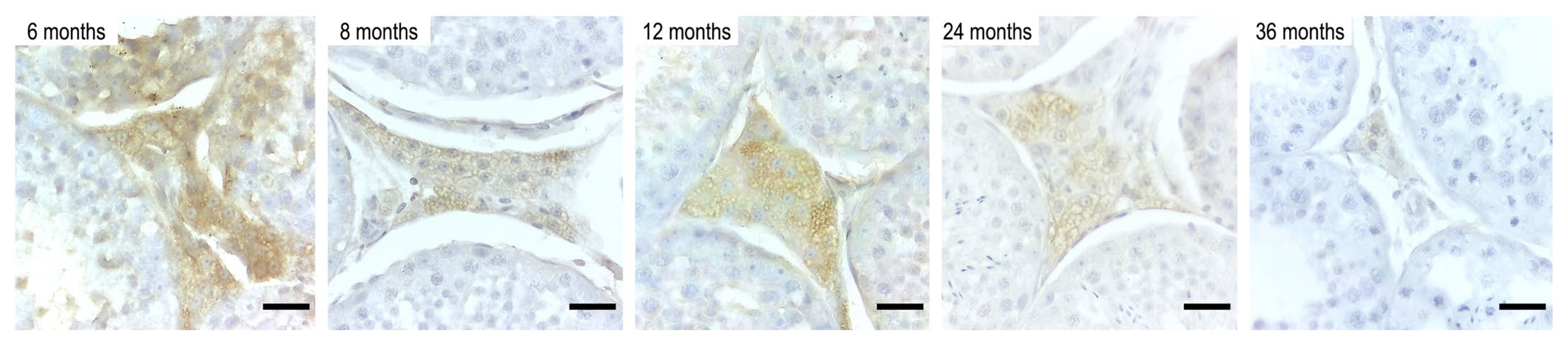
3.3. Immunohistochemical Detection of DHH in Leydig Cells
3.4. Age-Dependent Correlations in Body Weight and Testicular Characteristics
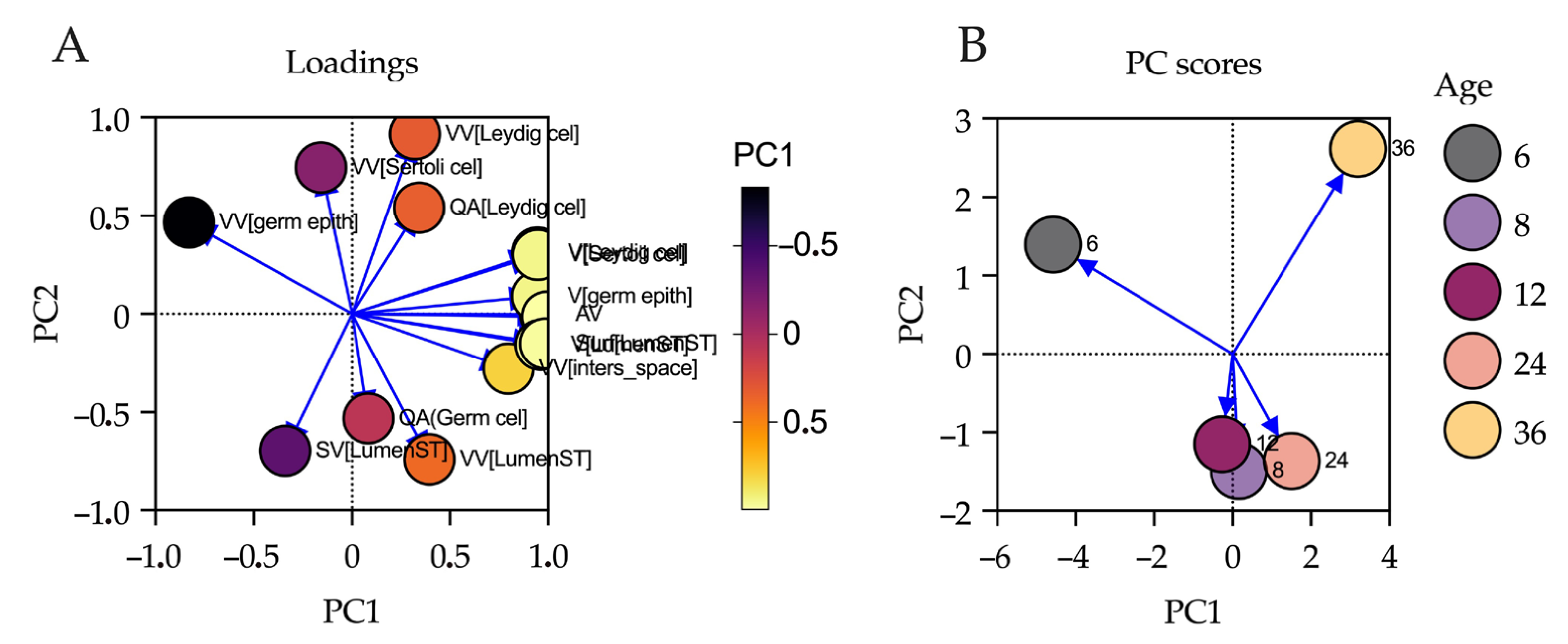
3.5. Principal Component Analysis (PCA)
4. Discussion
4.1. Postnatal Testicular Maturation in the Domestic Cat
4.2. Stereological Interpretation of the Interstitial Compartment
4.3. Dynamics of Sertoli Cells and the Spermatogenic Epithelium
4.4. Functional Role of DHH in Interstitial Maturation
4.5. Multivariate Analysis: Structural Validation via Principal Component Analysis
4.6. Functional Integration of the Testis and Epididymis: Synchronized Maturation of the Male Reproductive Tract
4.7. Limitations and Future Directions
5. Conclusions
Supplementary Materials
Author Contributions
Funding
Institutional Review Board Statement
Informed Consent Statement
Data Availability Statement
Acknowledgments
Conflicts of Interest
Abbreviations
| AR | androgen receptor |
| BSA | Bovine Serum Albumin |
| BW | Body Weight |
| CE | Coefficient of Error |
| CV | Coefficient of Variation |
| DAB | 3,3′-Diaminobenzidine |
| DHH | Desert Hedgehog |
| DNA | Deoxyribonucleic Acid |
| FIJI | Fiji ImageJ (Image Processing Software) |
| GSI | Gonadosomatic Index |
| HRP | Horseradish Peroxidase |
| ICVGAN | International Committee on Veterinary Gross Anatomical Nomenclature |
| ICVHN | International Committee on Veterinary Histological Nomenclature |
| IGF1 | Insulin-Like Growth Factor 1 |
| IOD | Integrated Optical Density |
| IQR | Interquartile Range |
| IUR | Isotropic Uniform Random (sectioning) |
| LH | Luteinizing Hormone |
| PBS | Phosphate-Buffered Saline |
| PCA | Principal Component Analysis |
| QA | Numerical Density (cells/mm2) |
| SD | Standard Deviation |
| SEM | Standard Error of the Mean |
| SURS | Systematic Uniform Random Sampling |
| SV | Surface Density |
| TW | Testicular Weight |
| VABS | Absolute Volume (mm3/testis) |
| VolREF | Reference Volume |
| VV | Volume Density (Volume Fraction, %) |
References
- Sowińska, N. Kot domowy jako model badawczy w procedurach wspomaganego rozrodu dzikich kotowatych [The domestic cat as a research model in the assisted reproduction procedures of wild felids]. Postep. Biochem. 2021, 67, 362–369. [Google Scholar] [CrossRef]
- Pintus, E.; Kadlec, M.; Karlasová, B.; Popelka, M.; Ros-Santaella, J.L. Spermatogenic activity and sperm traits in post-pubertal and adult tomcats (Felis catus): Implication of intra-male variation in sperm size. Cells 2021, 10, 624. [Google Scholar] [CrossRef] [PubMed]
- Salinas, P.; Escobar, D. Stereological and morphometric insights into epididymal development in domestic cats (Felis silvestris catus) from 6 to 48 months. Res. Vet. Sci. 2025, 191, 105690. [Google Scholar] [CrossRef] [PubMed]
- Griswold, M.D. The central role of Sertoli cells in spermatogenesis. Semin. Cell Dev. Biol. 1998, 9, 411–416. [Google Scholar] [CrossRef]
- Zirkin, B.R.; Papadopoulos, V. Leydig cells: Formation, function, and regulation. Biol. Reprod. 2018, 99, 101–111. [Google Scholar] [CrossRef]
- Johnson, L.; Thompson, D.L., Jr.; Varner, D.D. Role of Sertoli cell number and function on regulation of spermatogenesis. Anim. Reprod. Sci. 2008, 105, 23–51. [Google Scholar] [CrossRef]
- Colgan, T.J.; Norris, H.J.; Foster, W.; Kurman, R.J.; Fox, C.H. Predicting the outcome of endometrial hyperplasia by quantitative analysis of nuclear features using a linear discriminant function. Int. J. Gynecol. Pathol. 1983, 1, 347–352. [Google Scholar] [CrossRef]
- Vom Saal, F.S.; Finch, C.E.; Nelson, J.F. Natural history and mechanisms of reproductive aging in humans, laboratory rodents, and other selected vertebrates. In The Physiology of Reproduction, 2nd ed.; Knobil, E., Neill, J.D., Eds.; Raven Press: New York, NY, USA, 1994; Chapter 61; pp. 1213–1314. [Google Scholar]
- Abah, K.O.; Fontbonne, A.; Partyka, A.; Nizanski, W. Effect of male age on semen quality in domestic animals: Potential for advanced functional and translational research? Vet. Res. Commun. 2023, 47, 1125–1137. [Google Scholar] [CrossRef]
- Jewgenow, K.; Pukazhenthi, B.S.; Schoen, J. Analysis of Sertoli cell efficiency allows the differentiation between two fundamentally different forms of feline teratospermia. Theriogenology 2013, 79, 261–266. [Google Scholar] [CrossRef]
- Axnér, E.; Linde-Forsberg, C. Sperm morphology in the domestic cat, and its relation with fertility: A retrospective study. Reprod. Domest. Anim. 2007, 42, 282–291. [Google Scholar] [CrossRef]
- Pukazhenthi, B.S.; Neubauer, K.; Jewgenow, K.; Howard, J.; Wildt, D.E. The impact and potential etiology of teratospermia in the domestic cat and its wild relatives. Theriogenology 2006, 66, 112–121. [Google Scholar] [CrossRef] [PubMed]
- Howard, C.V.; Reed, M.G. Unbiased Stereology: Three-Dimensional Measurement in Microscopy; Garland Science: London, UK, 2005. [Google Scholar]
- Gundersen, H.J.; Bagger, P.; Bendtsen, T.F.; Evans, S.M.; Korbo, L.; Marcussen, N.; Møller, A.; Nielsen, K.; Nyengaard, J.R.; Pakkenberg, B.; et al. The new stereological tools: Disector, fractionator, nucleator and point sampled intercepts and their use in pathological research and diagnosis. APMIS 1988, 96, 857–881. [Google Scholar] [CrossRef] [PubMed]
- Nistal, M.; Paniagua, R.; Regadera, J.; Santamarìa, L.; Amat, P. A quantitative morphological study of human Leydig cells from birth to adulthood. Cell Tissue Res. 1986, 246, 229–236. [Google Scholar] [CrossRef] [PubMed]
- Nistal, M.; Abaurrea, M.A.; Paniagua, R. Morphological and histometric study on the human Sertoli cell from birth to the onset of puberty. J. Anat. 1982, 134, 351–363. [Google Scholar]
- Russell, L.D.; Clermont, Y. Degeneration of germ cells in normal, hypophysectomized and hormone treated hypophysectomized rats. Anat. Rec. 1977, 187, 347–366. [Google Scholar] [CrossRef]
- Roosen-Runge, E.C. Quantitative studies on spermatogenesis in the albino rat. III. Volume changes in the cells of seminiferous tubules. Anat. Rec. 1955, 123, 385–390. [Google Scholar] [CrossRef]
- O’Hara, W.A.; Azar, W.J.; Behringer, R.R.; Renfree, M.B.; Pask, A.J. Desert hedgehog is a mammal-specific gene expressed during testicular and ovarian development in a marsupial. BMC Dev. Biol. 2011, 11, 72. [Google Scholar] [CrossRef]
- Dilower, I.; Niloy, A.J.; Kumar, V.; Kothari, A.; Lee, E.B.; Rumi, M.A.K. Hedgehog Signaling in Gonadal Development and Function. Cells 2023, 12, 358. [Google Scholar] [CrossRef]
- Kawai, Y.; Noguchi, J.; Akiyama, K.; Takeno, Y.; Fujiwara, Y.; Kajita, S.; Tsuji, T.; Kikuchi, K.; Kaneko, H.; Kunieda, T. A missense mutation of the Dhh gene is associated with male pseudohermaphroditic rats showing impaired Leydig cell development. Reproduction 2011, 141, 217–225. [Google Scholar] [CrossRef]
- Fleming, P.; Crawford, H.; Auckland, C.; Calver, M. Nine ways to score nine lives—Identifying appropriate methods to age domestic cats (Felis catus). J. Zool. 2021, 314, 211–226. [Google Scholar] [CrossRef]
- Bellows, J.; Center, S.; Daristotle, L.; Estrada, A.H.; Flickinger, E.A.; Horwitz, D.F.; Lascelles, B.D.; Lepine, A.; Perea, S.; Scherk, M.; et al. Evaluating aging in cats: How to determine what is healthy and what is disease. J. Feline Med. Surg. 2016, 18, 551–570. [Google Scholar] [CrossRef]
- Zucker, I.; Morin, L.P. Photoperiodic influences on testicular regression, recrudescence and the induction of scotorefractoriness in male golden hamsters. Biol. Reprod. 1977, 17, 493–498. [Google Scholar] [CrossRef]
- Scherle, W. A simple method for volumetry of organs in quantitative stereology. Mikroskopie 1970, 26, 57–60. [Google Scholar]
- Noorafshan, A. Stereology as a valuable tool in the toolbox of testicular research. Ann. Anat. 2014, 196, 57–66. [Google Scholar] [CrossRef]
- Dorph-Petersen, K.A.; Nyengaard, J.R.; Gundersen, H.J. Tissue shrinkage and unbiased stereological estimation of particle number and size. J. Microsc. 2001, 204, 232–246. [Google Scholar] [CrossRef]
- Mattfeldt, T.; Mall, G.; Gharehbaghi, H.; Möller, P. Estimation of surface area and length with the orientator. J. Microsc. 1990, 159, 301–317. [Google Scholar] [CrossRef]
- Geuna, S.; Herrera-Rincon, C. Update on stereology for light microscopy. Cell Tissue Res. 2015, 360, 5–12. [Google Scholar] [CrossRef][Green Version]
- Schindelin, J.; Arganda-Carreras, I.; Frise, E.; Kaynig, V.; Longair, M.; Pietzsch, T.; Preibisch, S.; Rueden, C.; Saalfeld, S.; Schmid, B.; et al. Fiji: An open-source platform for biological-image analysis. Nat. Methods 2012, 9, 676–682. [Google Scholar] [CrossRef]
- Tschanz, S.A.; Burri, P.H.; Weibel, E.R. A simple tool for stereological assessment of digital images: The STEPanizer. J. Microsc. 2011, 243, 47–59. [Google Scholar] [CrossRef]
- International Committee on Veterinary Gross Anatomical Nomenclature (ICVGAN). Nomina Anatomica Veterinaria, 6th ed.; Editorial Committee Hanover, World Association of Veterinary Anatomists: Freiburg, Germany, 2017; Available online: https://www.wava-amav.org/downloads/nav_6_2017.zip (accessed on 17 December 2025).
- International Committee on Veterinary Histological Nomenclature (ICVHN). Nomina Histologica Veterinaria. World Association of Veterinary Anatomists. 2017. Available online: https://www.wava-amav.org/downloads/NHV_2017.pdf (accessed on 17 December 2025).
- West, M.J. Introduction to stereology. Cold Spring Harb. Protoc. 2012, 7, 843–851. [Google Scholar] [CrossRef]
- Gundersen, H.J.; Jensen, E.B.; Kiêu, K.; Nielsen, J. The efficiency of systematic sampling in stereology—Reconsidered. J. Microsc. 1999, 193, 199–211. [Google Scholar] [CrossRef] [PubMed]
- Thongphakdee, A.; Sukparangsi, W.; Comizzoli, P.; Chatdarong, K. Reproductive biology and biotechnologies in wild felids. Theriogenology 2020, 150, 360–373. [Google Scholar] [CrossRef] [PubMed]
- Morato, R.G.; Stabach, J.A.; Fleming, C.H.; Calabrese, J.M.; De Paula, R.C.; Ferraz, K.M.; Kantek, D.L.; Miyazaki, S.S.; Pereira, T.D.; Araujo, G.R.; et al. Space use and movement of a Neotropical top predator: The endangered jaguar. PLoS ONE 2016, 11, e0168176. [Google Scholar] [CrossRef] [PubMed]
- Swanson, W.F. Application of assisted reproduction for population management in felids: The potential and reality for conservation of small cats. Theriogenology 2006, 66, 49–58. [Google Scholar] [CrossRef]
- Morais, R.N.; Mucciolo, R.G.; Gomes, M.L.; Lacerda, O.; Moraes, W.; Moreira, N.; Graham, L.H.; Swanson, W.F.; Brown, J.L. Seasonal analysis of semen characteristics, serum testosterone and fecal androgens in the ocelot (Leopardus pardalis), margay (L. wiedii) and tigrina (L. tigrinus). Theriogenology 2002, 57, 2027–2041. [Google Scholar] [CrossRef]
- Valentini, L.; Zupa, R.; Pousis, C.; Cuko, R.; Corriero, A. Proliferation and apoptosis of cat (Felis catus) male germ cells during breeding and non-breeding seasons. Vet. Sci. 2022, 9, 447. [Google Scholar] [CrossRef]
- França, L.R.; Avelar, G.F.; Almeida, F.F. Spermatogenesis and sperm transit through the epididymis in mammals with emphasis on pigs. Theriogenology 2005, 63, 300–318. [Google Scholar] [CrossRef]
- Orth, J.M.; Gunsalus, G.L.; Lamperti, A.A. Evidence from Sertoli cell-depleted rats indicates that spermatid number in adults depends on numbers of Sertoli cells produced during perinatal development. Endocrinology 1988, 122, 787–794. [Google Scholar] [CrossRef]
- Midzak, A.; Rone, M.; Aghazadeh, Y.; Culty, M.; Papadopoulos, V. Mitochondrial protein import and the genesis of steroidogenic mitochondria. Mol. Cell. Endocrinol. 2011, 336, 70–79. [Google Scholar] [CrossRef]
- Mori, H.; Christensen, A.K. Morphometric analysis of Leydig cells in the normal rat testis. J. Cell Biol. 1980, 84, 340–354. [Google Scholar] [CrossRef]
- Brennan, J.; Tilmann, C.; Capel, B. Pdgfr-alpha mediates testis cord organization and fetal Leydig cell development in the XY gonad. Genes Dev. 2003, 17, 800–810. [Google Scholar] [CrossRef]
- Yao, H.H.; Whoriskey, W.; Capel, B. Desert Hedgehog/Patched 1 signaling specifies fetal Leydig cell fate in testis organogenesis. Genes Dev. 2002, 16, 1433–1440. [Google Scholar] [CrossRef]
- Clark, A.M.; Garland, K.K.; Russell, L.D. Desert hedgehog (Dhh) gene is required in the mouse testis for formation of adult-type Leydig cells and normal development of peritubular cells and seminiferous tubules. Biol. Reprod. 2000, 63, 1825–1838. [Google Scholar] [CrossRef]
- Bitgood, M.J.; Shen, L.; McMahon, A.P. Sertoli cell signaling by Desert hedgehog regulates the male germline. Curr. Biol. 1996, 6, 298–304. [Google Scholar] [CrossRef]
- Bashawat, M.; Braun, B.C.; Müller, K.; Hermann, B.P. Molecular phenotyping of domestic cat (Felis catus) testicular cells across postnatal development—A model for wild felids. Theriogenology Wild 2023, 2, 100031. [Google Scholar] [CrossRef]
- Holekamp, K.E.; Sisk, C.L. Effects of dispersal status on pituitary and gonadal function in the male spotted hyena. Horm. Behav. 2003, 44, 385–394. [Google Scholar] [CrossRef]
- Elcock, L.H.; Schoning, P. Age-related changes in the cat testis and epididymis. Am. J. Vet. Res. 1984, 45, 2380–2384. [Google Scholar] [CrossRef]
- Brown, J.L. Comparative endocrinology of domestic and nondomestic felids. Theriogenology 2006, 66, 25–36. [Google Scholar] [CrossRef]
- Costa, D.S.; Paula, T.A.; Matta, S.L. The intertubular compartment morphometry in capybaras (Hydrochoerus hydrochaeris) testis. Anim. Reprod. Sci. 2006, 91, 173–179. [Google Scholar] [CrossRef]
- Ceregatti, G.; Feitosa, W.B. Male reproductive physiology of neotropical felids. Theriogenol. Wild 2023, 2, 100023. [Google Scholar] [CrossRef]
- Costa, G.M.; Chiarini-Garcia, H.; Morato, R.G.; Alvarenga, R.L.; França, L.R. Duration of spermatogenesis and daily sperm production in the jaguar (Panthera onca). Theriogenology 2008, 70, 1136–1146. [Google Scholar] [CrossRef]
- Siemieniuch, M.J.; Wocławek-Potocka, I. Morphological features of the seminiferous epithelium in cat (Felis catus, L. 1758) testes. J. Reprod. Dev. 2007, 53, 1125–1130. [Google Scholar] [CrossRef]
- Tsutsui, T.; Kuwabara, S.; Kuwabara, K.; Kugota, Y.; Kinjo, T.; Hori, T. Development of spermatogenic function in the sex maturation process in male cats. J. Vet. Med. Sci. 2004, 66, 1125–1127. [Google Scholar] [CrossRef]
- Amelkina, O.; Silva, A.M.D.; Silva, A.R.; Comizzoli, P. Transcriptome dynamics in developing testes of domestic cats and impact of age on tissue resilience to cryopreservation. BMC Genom. 2021, 22, 847. [Google Scholar] [CrossRef]
- Guo, J.; Nie, X.; Giebler, M.; Mlcochova, H.; Wang, Y.; Grow, E.J.; DonorConnect; Kim, R.; Tharmalingam, M.; Matilionyte, G.; et al. The dynamic transcriptional cell atlas of testis development during human puberty. Cell Stem Cell 2020, 26, 262–276. [Google Scholar] [CrossRef]
- Braun, B.C.; Okuyama, M.W.; Müller, K.; Dehnhard, M.; Jewgenow, K. Steroidogenic enzymes, their products and sex steroid receptors during testis development and spermatogenesis in the domestic cat (Felis catus). J. Steroid Biochem. Mol. Biol. 2018, 178, 135–149. [Google Scholar] [CrossRef]
- Green, C.D.; Ma, Q.; Manske, G.L.; Shami, A.N.; Zheng, X.; Marini, S.; Moritz, L.; Sultan, C.; Gurczynski, S.J.; Moore, B.B.; et al. A comprehensive roadmap of murine spermatogenesis defined by single-cell RNA-Seq. Dev. Cell 2018, 46, 651–667. [Google Scholar] [CrossRef]
- França, L.R.; Silva, V.A.; Chiarini-Garcia, H., Jr.; Garcia, S.K.; Debeljuk, L. Cell proliferation and hormonal changes during postnatal development of the testis in the pig. Biol. Reprod. 2000, 63, 1629–1636. [Google Scholar] [CrossRef]
- Su, J.; Yang, Y.; Wang, D.; Su, H.; Zhao, F.; Zhang, C.; Zhang, M.; Li, X.; He, T.; Li, X.; et al. A dynamic transcriptional cell atlas of testes development after birth in Hu sheep. BMC Biol. 2025, 23, 78. [Google Scholar] [CrossRef]
- Wang, S.; Wang, H.; Jin, B.; Yan, H.; Zheng, Q.; Zhao, D. scRNA-seq and scATAC-seq reveal that Sertoli cell mediates spermatogenesis disorders through stage-specific communications in non-obstructive azoospermia. eLife 2025, 13, RP97958. [Google Scholar] [CrossRef]
- França, L.R.; Russell, L.D. The Testis of Domestic Animals. In Male Reproduction: A Multidisciplinary Overview; Regadera, J., Martinez-Garcia, F., Eds.; Churchill Livingstone: Madrid, Spain, 1998; pp. 197–219. [Google Scholar]
- Cortes, D.; Müller, J.; Skakkebaek, N.E. Proliferation of Sertoli cells during development of the human testis assessed by stereological methods. Int. J. Androl. 1987, 10, 589–596. [Google Scholar] [CrossRef]
- Zhang, M.; Yan, Y.; Peng, G.; Gao, S.; Li, H.; Li, Y. Single-cell RNA sequencing reveals an atlas of Meihua pig testis cells. Animals 2025, 15, 752. [Google Scholar] [CrossRef]
- Stévant, I.; Neirijnck, Y.; Borel, C.; Escoffier, J.; Smith, L.B.; Antonarakis, S.E.; Dermitzakis, E.T.; Nef, S. Deciphering cell lineage specification during male sex determination with single-cell RNA sequencing. Cell Rep. 2018, 22, 1589–1599. [Google Scholar] [CrossRef]
- Zou, S.S.; Li, Z.; Hu, H.L. Desert hedgehog regulates the proliferation and differentiation of Leydig cells: An update. Zhonghua Nan Ke Xue = Natl. J. Androl. 2012, 18, 172–175. [Google Scholar]
- Qin, J.; Tsai, M.J.; Tsai, S.Y. Essential roles of COUP-TFII in Leydig cell differentiation and male fertility. PLoS ONE 2008, 3, e3285. [Google Scholar] [CrossRef]
- Mehta, P.; Singh, P.; Gupta, N.J.; Sankhwar, S.N.; Chakravarty, B.; Thangaraj, K.; Rajender, S. Mutations in the desert hedgehog (DHH) gene in the disorders of sexual differentiation and male infertility. J. Assist. Reprod. Genet. 2021, 38, 1871–1878. [Google Scholar] [CrossRef]
- Werner, R.; Merz, H.; Birnbaum, W.; Marshall, L.; Schröder, T.; Reiz, B.; Kavran, J.M.; Bäumer, T.; Capetian, P.; Hiort, O. 46,XY gonadal dysgenesis due to a homozygous mutation in Desert Hedgehog (DHH) identified by exome sequencing. J. Clin. Endocrinol. Metab. 2015, 100, E1022–E1029. [Google Scholar] [CrossRef]
- Canto, P.; Söderlund, D.; Reyes, E.; Méndez, J.P. Mutations in the desert hedgehog (DHH) gene in patients with 46,XY complete pure gonadal dysgenesis. J. Clin. Endocrinol. Metab. 2004, 89, 4480–4483. [Google Scholar] [CrossRef]
- Amin, A.M.S.; Salem, M.M.I.; Ashour, A.F.; El Nagar, A.G. Principal component analysis of phenotypic and breeding value data for semen traits in Egyptian buffalo bulls. Trop. Anim. Health Prod. 2024, 56, 135. [Google Scholar] [CrossRef]
- Shrivastav, A.M.; Ali, N.; Singh, N.; Lunenfeld, E.; Abdulhalim, I.; Huleihel, M. Identification of spermatogenesis in individual seminiferous tubules and testicular tissue of adult normal and busulfan-treated mice employing Raman spectroscopy and principal component analysis. Spectrochim. Acta A Mol. Biomol. Spectrosc. 2024, 315, 124232. [Google Scholar] [CrossRef]
- Sharpe, R.M.; McKinnell, C.; Kivlin, C.; Fisher, J.S. Proliferation and functional maturation of Sertoli cells, and their relevance to disorders of testis function in adulthood. Reproduction 2003, 125, 769–784. [Google Scholar] [CrossRef]
- Ariyaratne, H.B.; Chamindrani Mendis-Handagama, S. Changes in the testis interstitium of Sprague Dawley rats from birth to sexual maturity. Biol. Reprod. 2000, 62, 680–690. [Google Scholar] [CrossRef]




| 6 | 8 | 12 | 24 | 36 | p-Value | |
|---|---|---|---|---|---|---|
| BW (kg) | 2.58 ab ± 0.476 [18.5%] | 3.02 ± 0.46 [15.2%] | 3.3 ± 0.367 [11.1%] | 3.58 a ± 0.39 [10.9%] | 3.91 b ± 0.619 [15.9%] | 0.0027 |
| TW (g) | 36.3 abcd ± 7.71 [21.3] | 69.2 a ± 12.8 [18.5] | 60.4 b ± 13.2 [21.9] | 66.5 c ± 10.6 [16.0] | 63.5 d ± 12.7 [19.9] | 0.0016 |
| T-index Right | 39 abcd ± 10.7 [27.3] | 70 a ± 14.3 [20.4] | 69.9 b ± 11.9 [17.1] | 66.4 c ± 8.65 [13.0] | 65.3 d ± 13.8 [21.2] | 0.0026 |
| T-index Left | 35.8 abcd ± 7.67 [21.4] | 67.8 a ± 12.8 [18.9] | 59 b ± 13.2 [22.4] | 64.6 c ± 10.5 [16.2] | 61.1 d ± 12.5 [20.5] | 0.0023 |
| GSI | 36 abcd ± 1.18 [3.29] | 90.8 ae ± 12.6 [13.9] | 86.5 bf ± 9.08 [10.5] | 104 c ± 8.1 [7.78] | 130 def ± 22.1 [17.0] | <0.0001 |
| 6 m | 8 m | 12 m | 24 m | 36 m | p-Value | |
|---|---|---|---|---|---|---|
| IRA | 18.17 (3.43) | 9.877 (1.29) | 9.183 (0.48) | 7.185 (0.50) | 3.084 (0.18) | p < 0.0001 |
| IOD | 0.7442 (0.02) | 0.6397 (0.02) | 0.5605 (0.04) | 0.5153 (0.02) | 0.2452 (0.02) | p < 0.0001 |
| Comparison | Pearson’s r | R2 | 95% Confidence Interval | p-Value | Interpretation | Comparison |
|---|---|---|---|---|---|---|
| Age vs. BW | 0.9302 | 0.8653 | 0.2674 to 0.9955 | 0.0219 | Strong and significant positive correlation. Body weight increased significantly with age. | Age vs. BW |
| Age vs. TW | 0.4344 | 0.1887 | −0.7262 to 0.9519 | 0.4648 | Weak correlation, not significant. | Age vs. TW |
| Age vs. Right T-index | 0.3555 | 0.1264 | −0.7675 to 0.9422 | 0.557 | Weak correlation, not significant. | Age vs. Right T-index |
| Age vs. Left T-index | 0.402 | 0.1616 | −0.7442 to 0.9480 | 0.5023 | Weak correlation, not significant. | Age vs. Left T-index |
| Age vs. GSI | 0.8453 | 0.7146 | −0.1453 to 0.9896 | 0.0713 | Strong correlation, but not significant at 5%. May be biologically relevant. | Age vs. GSI |
Disclaimer/Publisher’s Note: The statements, opinions and data contained in all publications are solely those of the individual author(s) and contributor(s) and not of MDPI and/or the editor(s). MDPI and/or the editor(s) disclaim responsibility for any injury to people or property resulting from any ideas, methods, instructions or products referred to in the content. |
© 2025 by the authors. Licensee MDPI, Basel, Switzerland. This article is an open access article distributed under the terms and conditions of the Creative Commons Attribution (CC BY) license.
Share and Cite
Salinas, P.; Conei, D.; Miglino, M.A.; Paz, E. Quantitative Postnatal Maturation of the Feline Testis from 6 to 36 Months: A Stereological and DHH Immunomorphological Analysis. Animals 2026, 16, 10. https://doi.org/10.3390/ani16010010
Salinas P, Conei D, Miglino MA, Paz E. Quantitative Postnatal Maturation of the Feline Testis from 6 to 36 Months: A Stereological and DHH Immunomorphological Analysis. Animals. 2026; 16(1):10. https://doi.org/10.3390/ani16010010
Chicago/Turabian StyleSalinas, Paulo, Daniel Conei, María Angélica Miglino, and Erwin Paz. 2026. "Quantitative Postnatal Maturation of the Feline Testis from 6 to 36 Months: A Stereological and DHH Immunomorphological Analysis" Animals 16, no. 1: 10. https://doi.org/10.3390/ani16010010
APA StyleSalinas, P., Conei, D., Miglino, M. A., & Paz, E. (2026). Quantitative Postnatal Maturation of the Feline Testis from 6 to 36 Months: A Stereological and DHH Immunomorphological Analysis. Animals, 16(1), 10. https://doi.org/10.3390/ani16010010