


What Do We Know About Children’s and Adolescents’ Formal and Non-Formal Learning in the Zoo? A Systematic Literature Review


Simple Summary
Abstract
1. Introduction
1.1. Zoos as Educational Institutions
1.2. Existing Literature Reviews on the Topic of Learning in the Zoo
1.2.1. Focuses of the Literature Reviews
1.2.2. Differentiation According to the Age of the Subjects in the Studies of the Literature Reviews
- Learning activities for children and adolescents in the zoo are often a part of activities organised by schools, so they are often not a free-choice learning; by contrast, learning activities for adults are rarely formal and nearly always “free-choice learning” (see Ref. [24]).
- The cognitive capacities of adults and non-adults are different (see, e.g., Jean Piaget’s theory of cognitive development, Ref. [25]).
- Another difference between adults and children or young people are their prior experiences. Adults have generally gathered more experiences given the longer time they have lived [26]. Prior experiences build up concepts that have an essential effect on learning (see, e.g., conceptual change theory [27]).
1.2.3. Learning Arrangements Investigated by the Studies in the Literature Reviews
1.2.4. Operationalisation of the Effects in the Studies in the Literature Reviews
1.2.5. Research Methods of the Studies in the Literature Reviews
1.2.6. Results of the Studies in the Literature Reviews
1.3. Objectives and Research Questions
- (RQ1) What teaching and learning methods are used for teaching and learning processes at the zoo with school classes/adolescents/children?
- (RQ2) How are the effects on teaching and learning processes or the learning environment in relation to school classes/adolescents/children at the zoo operationalised in the published works?
- (RQ3) How are these effects measured using research methods?
- (RQ4) What effects on school classes/adolescents/children have been identified so far, and how are these related to teaching and learning methods or the learning environment?
2. Materials and Methods
2.1. Search for Literature
- (1)
- Publications are peer reviewed: This applies to all publications included in the Web of Science database: “The peer review status of a journal is a requirement in the journal evaluation process for inclusion in Web of Science Core Collection” [32]. The use of peer-reviewed publications should maintain the quality of the included works at a reliable level.
- (2)
- Publications are articles from journals: This usually goes hand-in-hand with the attribute of being peer reviewed.
- (3)
- Publications from the years 2000–2024: This allowed 25 years to be covered in the literature review.
2.2. Selection of Studies to Be Included
2.3. Qualitative Analysis and Creation of a Data Matrix
- Data exploration: Key points regarding the study design of the included studies were noted and a summary for each study was prepared, to obtain an overview when comparing studies and developing codes.
- Creation and application of the category system: The category system was created inductively from the data material and summaries, and definitions of the categories were formulated.
- Coding based on categories and describing results: The step was done in the original texts (studies) using the software MAXQDA version 24.8.0 [41], and the codes from each study were transferred to a data matrix in nominal scales; text sections and a summary of the result of each study were also transferred in the data matrix.
- Analysis: See Section 2.4.
- Conclusion drawing and consequence identification: See Results (Section 3).
2.4. Data Analysis Using the Data Matrix
3. Results
3.1. Descriptive Statistics of the Studies
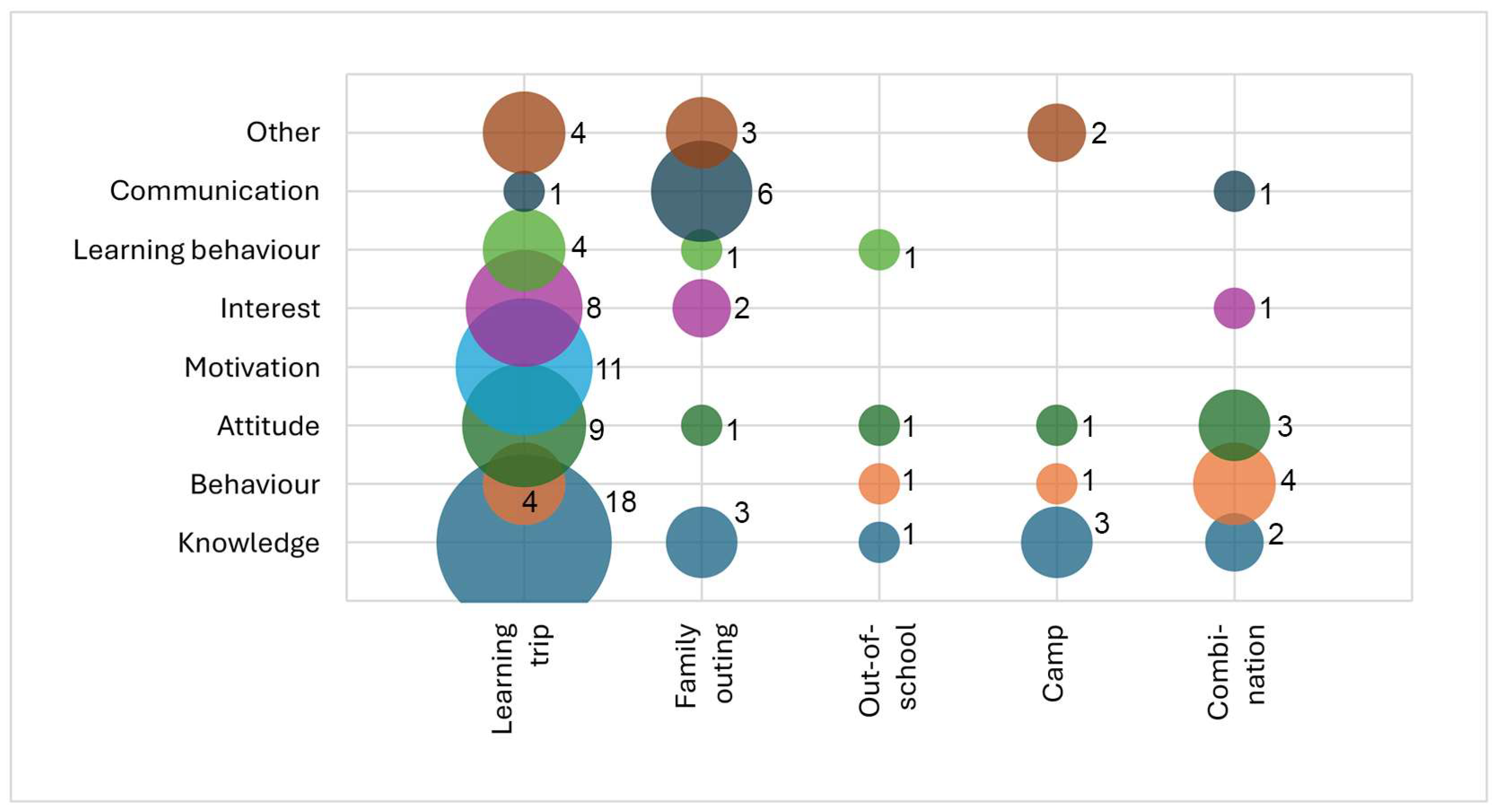
3.2. Learning Arrangements Investigated in the Studies Found (Results Related to Research Question 1)
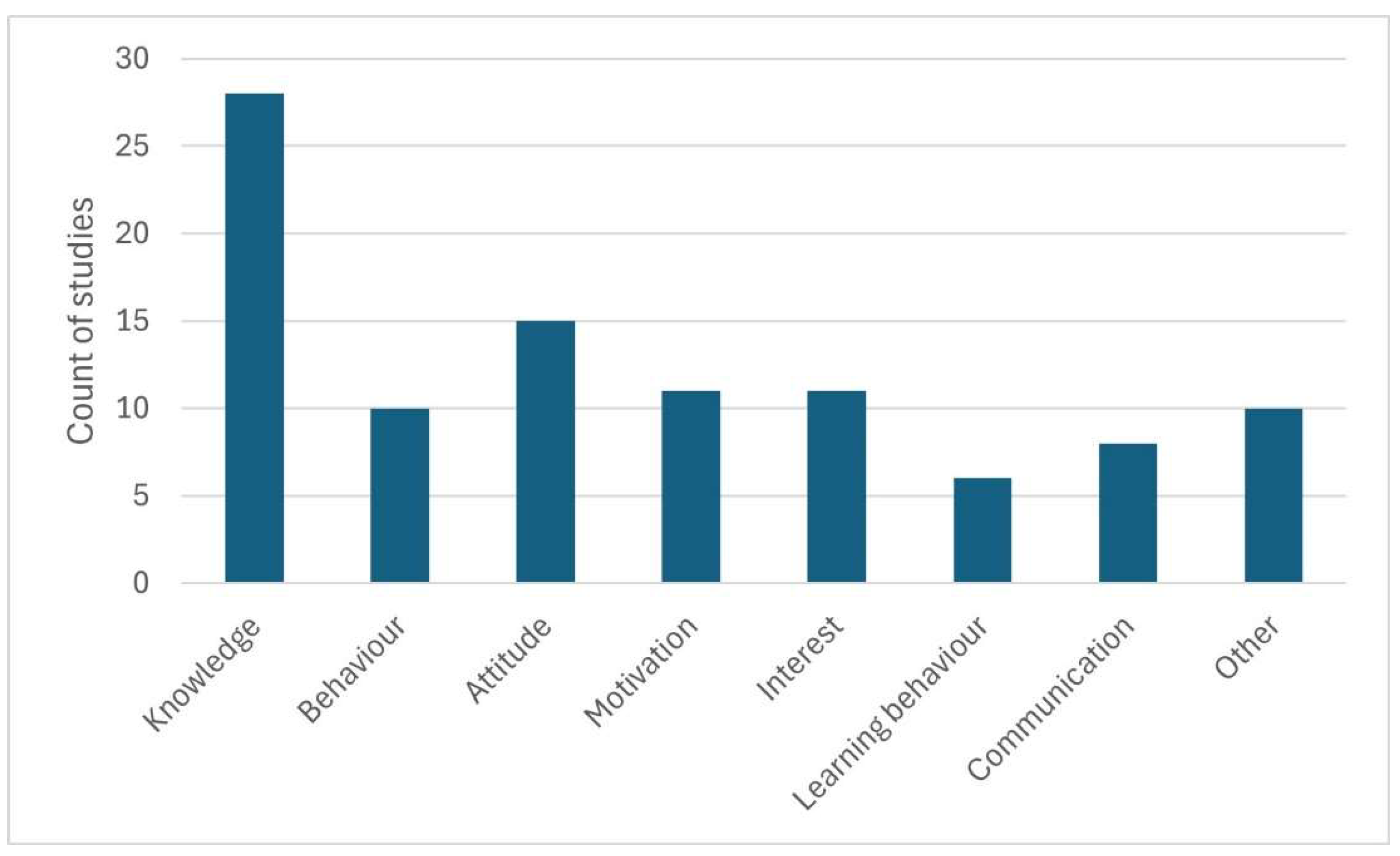
3.3. Variables Measured in the Studies Found (Results Related to Research Question 2)
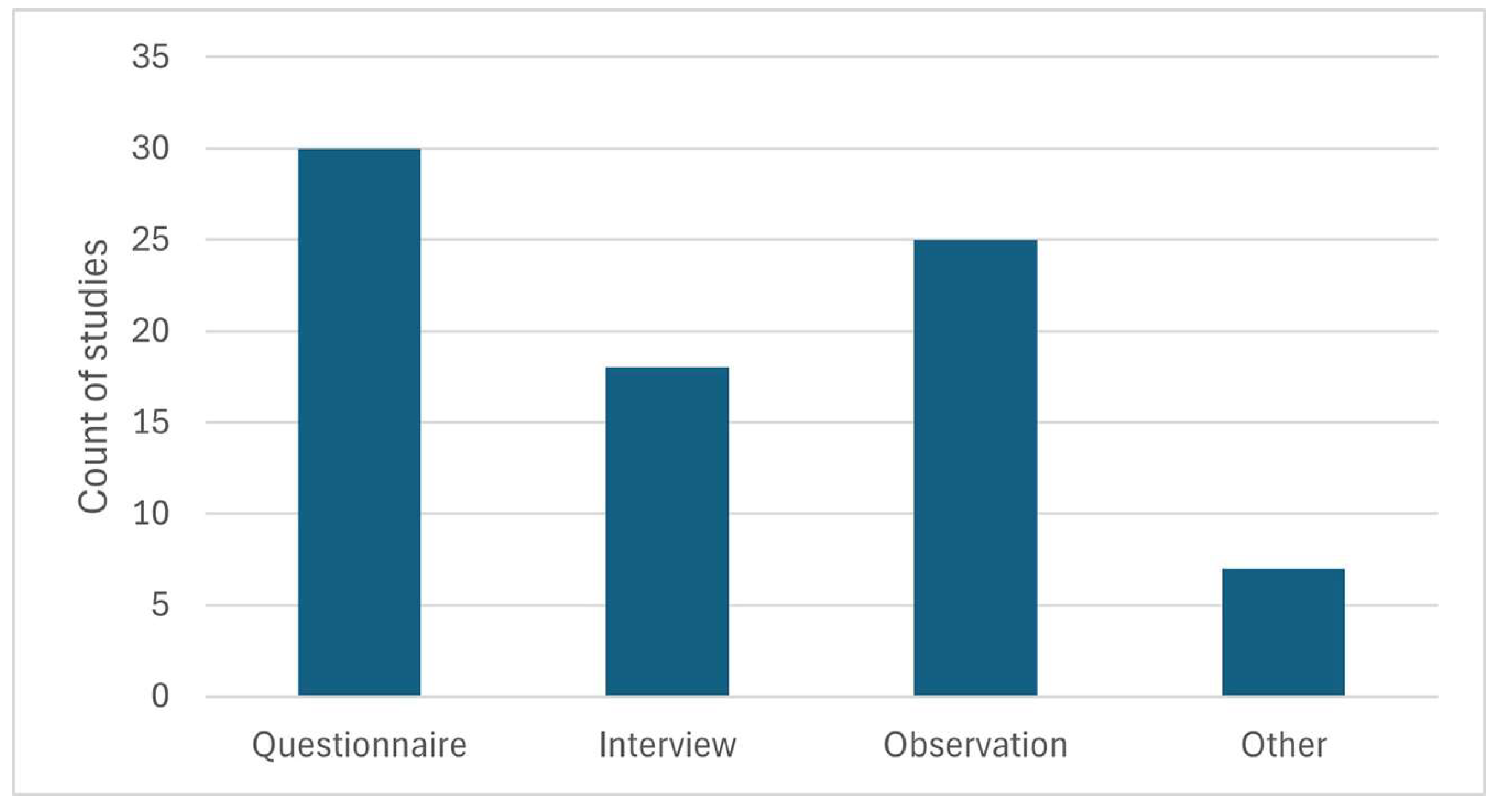
3.4. Methodological Design of the Studies Found (Results Related to Research Question 3)
3.5. Survey Instruments Used in the Studies Found (Results Related to Research Question 3)
3.6. Results of the Studies Found (Results Related to Research Question 4)
- Direct contact with animals (examined in three studies) has a positive effect on attitude (e.g., Ref. [60]).
- Parent–child conversations have a positive effect on attitudes, interest and communication itself, depending on the study (analysed in three studies; e.g., Ref. [63]).
- Attending a camp at the zoo has positive effects on the variable knowledge (examined in two studies; e.g., Ref. [64]).
- Virtual devices (examined in two studies) have an influence on knowledge and other variables (e.g., Ref. [45]).
4. Discussion
4.1. Interpretation of the Results
- knowledge
- behaviour (including intention)
- attitudes
- motivation
- interest
- learning behaviour
- communication
4.2. Limitations
4.3. Implications
- Research is needed on the impact and design of the three-step method (first, preparation of the learning, second, learning at the extracurricular location, and third, follow-up of the learning). None of the studies presented here explicitly examined the impact of the individual steps (as independent elements). In addition, there is a lack of research examining methods and design elements for the preparation and follow-up steps. Interesting questions for future research could include, for example: What effect/significance do preparation and follow-up have on the learning process in terms of cognition, motivation, interest, learning behaviour and environmental behaviour? How should preparation and/or follow-up be structured to best support the learning process? The method of repetition has already been examined in a study as an element at the end of a zoo visit, but not as a separate step in the follow-up, and has been shown to have an effect on interest and motivation [73]. Further analyses of methods such as reflection or task formats for consolidating and securing the content covered at the zoo are lacking.
- There is still a lack of further investigation of previously uninvestigated methods of teaching–learning work in zoos. These could be, for example, work on observation tasks, information boards, task formats or existing structural or functional models in the zoo. It would be very useful here to compare the methods that are already being used in practice and those that have already been investigated.
- There is a great need for research relating to children and young people with special educational needs. This research is lacking and must be implemented urgently.
- Another area with great potential for expanding learning at the zoo is informal and non-formal learning for children or young people. Thus far, research on this topic has only been conducted in Australia, Brazil, Canada, Ireland, the United States and the United Kingdom.
- In view of the significance of the results, further studies that include follow-up measurements are also needed.
- The zoo is a rich learning environment, and educational visits to the zoo are suitable for children and young people. Schools should therefore make use of this and include it in their planning. The informal and non-formal educational opportunities for children and young people are promising, according to the main findings of the studies, and should be further expanded.
- Many of the methods/elements (learning arrangements) presented and examined are suitable for practical use and can be implemented there.
- The zoo is an important and interesting place of learning for children and young people and should therefore be used more extensively for formal education. However, this also requires educational policy and curricular implementations.
5. Conclusions
Funding
Institutional Review Board Statement
Informed Consent Statement
Data Availability Statement
Acknowledgments
Conflicts of Interest
Appendix A

| McNally et al. [17] | Schilbert and Scheersoi [12] | Godinez and Fernandez [13] | Mellish et al. [14] | Nygren and Ojalammi [15] | Dierking et al. [16] | |
|---|---|---|---|---|---|---|
| Thematic focus | Conservation education | Conservation education | Influence of the zoo on visitors | Conservation education | Conservation education | Conservation education |
| Groups of people involved | Zoo visitors in general (i.e., families, school classes, individual visitors) | Zoo visitors in general (i.e., families, school classes, individual visitors) | Zoo visitors in general (no differentiation in the text) | Zoo visitors in general (adults) | Zoo visitors in general (i.e., families, school classes, individual visitors) | Zoo visitors in general (adults and children) |
| Differentiation by age groups | No | No | No | No | No | In the areas of prior knowledge, attitudes, affect and behaviour, otherwise not |
| Selection criteria for the literature included |
|
|
|
|
| Studies that measured the following:
|
| Time period (articles recorded from/to) | 2017–2021 | 2011–2020 | Not specified (maximum until 2019) | 1998–2016 | 2007–2016 | Not specified (maximum until 2002) |
| Operationalisation of effects of the studies (dependent variables) | Knowledge, beliefs, behaviour, intentions | Knowledge, beliefs, behaviour | Behaviour, perception, conservation efforts | --- | Note that many of the studies use very different terms for their dependent variables | Conservation learning (knowledge, attitudes, affect, behaviour), perception of the animals |
| Research methods of the studies presented | --- | --- | There is no explicit statement on this except that a control group is often missing | Questionnaires, interviews, observations, games | Questionnaires, self-reports in conjunction with quantitative methods | Interviews, observations, questionnaires, Card-reading methods |
| Effects found | A visit to the zoo and interaction in the zoo have a positive effect on many variables | --- | Zoo visits have a positive influence on visitors’ knowledge of nature conservation, attitudes and behaviour. Repeated visits to the zoo are particularly beneficial, as regular visitors have more knowledge about nature conservation, more positive attitudes toward nature conservation and are more involved in nature conservation activities | --- | Visitors are usually already aware of nature conservation. The social context and the material after the visit support the learning objectives of the visit | Visitors do not come to zoos and aquariums specifically to learn more about conservation issues. Overall, the study results indicate that interactive, experience-oriented and emotionally appealing teaching/learning methods have positive effects |
| No. | Article (Authors) | Year | Country of Authors | Journal | Type of Visit | Instrument | Time of measurement | Distance Follow-Up (Weeks) | Category of the Examined/Varied Variable | Investigated Relationship | Dependent or Observed Variable | Sample | |||||||||||||||
|---|---|---|---|---|---|---|---|---|---|---|---|---|---|---|---|---|---|---|---|---|---|---|---|---|---|---|---|
| Questionnaire | Interview | Observation | Other | Pre | On-Site | Post | Follow-Up | Knowledge | Behaviour | Attitudes | Motivation | Interest | Learning Behav. | Communication | Other | Age Min | Age Max | Sample Size | |||||||||
| 1 | Taylor and Duram [44] | 2021 | USA | Sustainability | Family outing, Learning trip | X | Zoo visits | Correlation | + | + | 18 | 68 | 136 | ||||||||||||||
| 2 | Spooner et al. [61] | 2019 | Australia, UK | Environmental Education Research | Family outing | X | X | X | Theatre | Causal relationship | + | 5 | 9 | 215 | |||||||||||||
| 3 | Kimble [52] | 2014 | UK | Studies in Educational Evaluation | Learning trip | X | X | X | X | X | Learning trip | Correlation | + | + | + | 0 | 0 | 8 | 9 | 180 | |||||||
| 4 | Visscher et al. [74] | 2009 | USA | Zoo Biology | Learning trip | X | X | Lecture/guided tour | Causal relationship | + | 10 | 10 | 67 | ||||||||||||||
| 5 | Nazaruk and Klim-Klimaszewska [66] | 2017 | Poland | Journal of Baltic Science Education | Learning trip | X | X | X | Urban/rural children | Causal relationship | 0 | NA | 6 | 6 | 90 | ||||||||||||
| 6 | Kian et al. [18] | 2021 | Canada | Frontiers in Psychology | Camp | X | X | Age | Causal relationship | + | + | 4 | 10 | 122 | |||||||||||||
| 7 | Jakobsson et al. [73] | 2024 | Sweden | International Journal of Science Education | Learning trip | X | X | X | X | 4 | Repetition | Causal relationship | 0 | + | + | 10 | 11 | 81 | |||||||||
| 8 | Conrad et al. [19] | 2021 | USA | Journal of Experimental Child Psychology | Family outing | X | X | X | Anthropomorphisms | Causal relationship | 0 | + | 4 | 7 | 48 | ||||||||||||
| 9 | Rahm and Ash [20] | 2008 | Canada, USA | Learning Environments Research | Family outing, Out-of-school | X | X | X | X | X | 48 | Participation of socially disadvantaged people | Descriptive study | + | 9 | 12 | 4 | ||||||||||
| 10 | Collins et al. [28] | 2021 | Ireland | Anthrozoos | Learning trip, Camp | X | X | Enrichment | Causal relationship | + | 6 | 12 | 1127 | ||||||||||||||
| 11 | Collins et al. [59] | 2020 | Ireland | Environmental Education Research | Learning trip, Camp | X | X | X | X | 24 | Enrichment | Causal relationship | + | + | 0 | 9 | 12 | 110 | |||||||||
| 12 | Collins et al. [75] | 2020 | Ireland | The Journal of Environmental Education | Learning trip | X | X | X | X | Enrichment | Causal relationship | + | + | 0 | 9 | 12 | 501 | ||||||||||
| 13 | Campana et al. [62] | 2023 | USA | Journal of Librarianship and Information Science | Out-of-school | X | X | Theatre | Descriptive study | + | 3 | 6 | 121 | ||||||||||||||
| 14 | Seybold et al. [68] | 2014 | Germany | International Journal of Science and Mathematics Education | Learning trip | X | X | X | X | 7 | Combination of school lesson and zoo | Causal relationship | 0 | - | 0 | 9 | 13 | 1013 | |||||||||
| No. | Article (Authors) | Year | Country of Authors | Journal | Type of Visit | Instrument | Time of Measurement | Distance Follow-Up (Weeks) | Category of the Examined/Varied Variable | Investigated Relationship | Dependent or Observed Variable | Sample | |||||||||||||||
|---|---|---|---|---|---|---|---|---|---|---|---|---|---|---|---|---|---|---|---|---|---|---|---|---|---|---|---|
| Questionnaire | Interview | Observation | Other | Pre | On-Site | Post | Follow-Up | Knowledge | Behaviour | Attitudes | Motivation | Interest | Learning Behav. | Communication | Other | Age Min | Age Max | Sample Size | |||||||||
| 15 | Sattler and Bogner [76] | 2016 | Germany | Environmental Education Research | Learning trip | X | X | X | X | 6 | Sation work | Causal relationship | + | 15 | 17 | 117 | |||||||||||
| 16 | Sandberg et al. [21] | 2011 | Netherlands | Computers & Education | Learning trip | X | X | X | Inclusion of virtual media | Causal relationship | + | 8 | 10 | 75 | |||||||||||||
| 17 | Wünschmann et al. [77] | 2017 | Germany | Research in Science Education | Learning trip | X | X | X | X | 3 | Learning trip | Causal relationship | + | 0 | 8 | 10 | 65 | ||||||||||
| 18 | Randler et al. [78] | 2012 | Germany | Journal of Science Education and Technology | Learning trip | X | X | X | X | X | 6 | Student-centred approach | Causal relationship | + | 10 | 12 | 845 | ||||||||||
| 19 | Douglas and Katz [57] | 2009 | USA | Afterschool Matters | Out-of-school | X | X | X | X | Specific education programme | Causal relationship | + | + | + | 10 | 12 | 20 | ||||||||||
| 20 | Collins and O’ Riordan [79] | 2022 | Ireland | Environmental Education Research | Learning trip, Camp | X | X | X | X | X | Enrichment | Causal relationship | + | + | 0 | 6 | 12 | 501 | |||||||||
| 21 | Chung et al. [45] | 2019 | USA | International Journal of Information and Learning Technology | Family outing | X | X | X | X | Inclusion of virtual media | Causal relationship | + | + | NA | 5 | 12 | 91 | ||||||||||
| 22 | Bølling et al. [65] | 2017 | Denmark | International Journal of Primary, Elementary and Early Years Education | Learning trip | X | X | X | X | Learning trip | Descriptive study | + | 12 | 13 | 26 | ||||||||||||
| 23 | Dohn [54] | 2011 | Denmark | Science Education | Learning trip | X | X | X | X | X | X | Learning trip | Causal relationship | + | 17 | 19 | 16 | ||||||||||
| 24 | Basten et al. [80] | 2014 | Germany | Science Education | Learning trip | X | X | X | X | 10 | Motivation through accompanying persons | Causal relationship | 0 | + | 10 | 12 | 206 | ||||||||||
| 25 | Da Silva et al. [60] | 2021 | Brazil | Journal of Ethnobiology and Ethnomedicine | Learning trip | X | X | X | Direct contact with animals | Causal relationship | + | 7 | 17 | 72 | |||||||||||||
| 26 | Jensen [29] | 2014 | UK | Conservation Biology | Learning trip | X | X | X | Lecture/guided tour | Causal relationship | + | + | NA | 7 | 15 | 2839 | |||||||||||
| 27 | Kleespies et al. [70] | 2020 | Germany | Frontiers in Psychology | Learning trip | X | X | X | Direct contact with animals, conversation with animal keepers | Causal relationship | + | 16 | 19 | 608 | |||||||||||||
| No. | Article (Authors) | Year | Country of Authors | Journal | Type of Visit | Instrument | Time of Measurement | Distance Follow-Up (Weeks) | Category of the Examined/Varied Variable | Investigated Relationship | Dependent or Observed Variable | Sample | |||||||||||||||
|---|---|---|---|---|---|---|---|---|---|---|---|---|---|---|---|---|---|---|---|---|---|---|---|---|---|---|---|
| Questionnaire | Interview | Observation | Other | Pre | On-Site | Post | Follow-Up | Knowledge | Behaviour | Attitudes | Motivation | Interest | Learning Behav. | Communication | Other | Age Min | Age Max | Sample Size | |||||||||
| 28 | Badger and Shapiro [46] | 2019 | UK | Cognitive Development | Learning trip | X | X | X | Direct contact with animals | Causal relationship | 0 | 5 | 6,8 | 252 | |||||||||||||
| 29 | Marth and Bogner [81] | 2017 | Germany | Studies in Educational Evaluation | Learning trip | X | X | X | X | 48 | Specific education program | Causal relationship | + | 10 | 13 | 324 | |||||||||||
| 30 | Davidson et al. [47] | 2010 | USA, New Zealand, Canada | Science Education | Learning trip | X | X | X | X | X | X | X | X | 16 | Learning trip | Descriptive study | 0 | 0 | 0 | 0 | 0 | 0 | + | 11 | 13 | 67 | |
| 31 | Counsell et al. [82] | 2024 | UK | Environmental Education Research | Learning trip | X | X | X | Specific education program | Causal relationship | + | + | + | 7 | 11 | 2099 | |||||||||||
| 32 | Dohn [55] | 2013 | Denmark | International Journal of Science Education | Learning trip | X | X | X | X | X | Lecture/guided tour | Descriptive study | + | 17 | 19 | 21 | |||||||||||
| 33 | Penn [48] | 2009 | UK | Zoo Biology | unclear | X | X | Theatre | Causal relationship | 0 | + | 4 | 10 | 348 | |||||||||||||
| 34 | Ocular et al. [83] | 2022 | USA | Frontiers in Psychology | Family outing | X | X | X | X | 3 | Parent–child conversation | Causal relationship | +/0 | 3 | 8 | 62 | |||||||||||
| 35 | Collins et al. [84] | 2019 | Ireland | Applied Animal Behavior Science | Learning trip, Camp | X | X | Enrichment | Causal relationship | + | 6 | 12 | 1127 | ||||||||||||||
| 36 | Joy et al. [85] | 2021 | USA, UK | Frontiers in Psychology | Family outing | X | X | Zoo educator | Causal relationship | 0 | 3 | 14 | 63 | ||||||||||||||
| 37 | Massarani et al. [63] | 2022 | Brazil | Science Education | Family outing | X | X | X | X | Parent–child conversation | Descriptive study | + | + | + | 7 | 12 | 7 | ||||||||||
| 38 | Unger and Fisher [64] | 2019 | USA | Journal of Experimental Child Psychology | Camp | X | X | X | Camp | Causal relationship | + | 4 | 9 | 60 | |||||||||||||
| 39 | Faria and Chaga [56] | 2013 | Portugal | International Journal of Science Education | Learning trip | X | X | X | X | Lecture/guided tour | Descriptive study | + | + | 6 | 18 | 191 | |||||||||||
| 40 | Gillespie and Melber [49] | 2014 | USA | The Journal of Museum Education | Learning trip | X | X | X | X | X | X | Specific education program | Causal relationship | + | + | 12 | 14 | 110 | |||||||||
| 41 | Heim and Holt [67] | 2022 | USA | Journal of Experiential Education | Learning trip | X | X | X | Self-directed learning | Causal relationship | 0 | 0 | NA | 18 | 22 | 78 | |||||||||||
| No. | Article (Authors) | Year | Country of Authors | Journal | Type of Visit | Instrument | Time of Measurement | Distance Follow-Up (Weeks) | Category of the Examined/Varied Variable | Investigated Relationship | Dependent or Observed Variable | Sample | |||||||||||||||
|---|---|---|---|---|---|---|---|---|---|---|---|---|---|---|---|---|---|---|---|---|---|---|---|---|---|---|---|
| Questionnaire | Interview | Observation | Other | Pre | On-Site | Post | Follow-Up | Knowledge | Behaviour | Attitudes | Motivation | Interest | Learning Behav. | Communication | Other | Age Min | Age Max | Sample Size | |||||||||
| 42 | Kruse and Card [86] | 2004 | USA | The Journal of Environmental Education | Camp | X | X | X | X | 4 | Participation in animal care | Causal relationship | + | + | + | 10 | 18 | 383 | |||||||||
| 43 | Cainey et al. [87] | 2012 | UK | Educational Research and Evaluation | Learning trip | X | X | X | X | X | Lecture/guided tour | Causal relationship | + | 4 | 11 | 138 | |||||||||||
| 44 | Buchholz and Pyles [88] | 2018 | USA | The Reading Teacher | Learning trip | X | X | X | X | X | X | Learning trip | Descriptive study | NA | NA | NA | NA | NA | NA | NA | NA | 5 | 6 | 28 | |||
| 45 | Tuttle et al. [89] | 2017 | USA | School Science and Mathematics | Family outing | X | X | Navigators | Descriptive study | + | 3 | 9 | 101 | ||||||||||||||
| 46 | Wheaton and Ash [50] | 2008 | USA | Journal of Museum Education | Camp | X | X | X | X | X | 24 | Camp | Descriptive study | + | 12 | 13 | 2 | ||||||||||
| 47 | Kras [58] | 2022 | USA | Community College Journal of Research and Practice | Learning trip | X | X | Specific education program | Causal relationship | + | + | + | 18 | 22 | 14 | ||||||||||||
| 48 | Kelly et al. [90] | 2022 | USA | The Social Science Journal | Family outing | X | X | X | X | Parent–child conversation | Correlation | + | 3 | 8 | 22 | ||||||||||||
| 49 | Kisiel et al. [51] | 2012 | USA | Science Education | Family outing | X | X | X | X | Touch tank | Descriptive study | + | + | 3 | 17 | 41 | |||||||||||
| 50 | Kopczak et al. [91] | 2015 | USA | Environmental Education Research | Family outing | X | X | X | X | X | Conservation with animal keepers | Descriptive study | + | 3 | 17 | 41 | |||||||||||
| 51 | Tofield et al. [53] | 2003 | New Zealand | Research in Science & Technological Education | Learning trip | X | X | X | X | X | Learning trip | Descriptive study | + | + | + | + | 6 | 17 | 100 | ||||||||
References
- Meier, J. Handbuch Zoo: Moderne Tiergartenbiologie; Haupt: Bern, Switzerland, 2009. [Google Scholar]
- Verband der Zoologischen Gärten e.V. (VdZ). Lernort Zoo: Zentrale Ergebnisse der VdZ-Bildungsstudie; VdZ: Berlin, Germany, 2021; p. 6. [Google Scholar]
- World Association of Zoos and Aquariums (WAZA). Understanding Animals and Protecting Them—About the World Zoo and Aquarium Conservation Strategy. 2006. Available online: https://www.waza.org/wp-content/uploads/2019/03/Marketing-brochure.pdf (accessed on 6 August 2025).
- Deinet, U.; Derecik, A. Die Bedeutung außerschulischer Lernorte für Kinder und Jugendliche: Eine raumtheoretische und aneignungsorientierte Betrachtungsweise. In Pädagogik Außerschulischer Lernorte: Eine Interdisziplinäre Annäherung; Erhorn, J., Schwier, J., Eds.; Transcript: Bielefeld, Germany, 2016; Chapter 2; pp. 15–28. [Google Scholar]
- Gebhard, U. Kind und Natur: Die Bedeutung der Natur für Die Psychische Entwicklung; Springer VS: Heidelberg, Germany, 2020. [Google Scholar]
- Wendt, P. Der Zoo als Lernwelt für Grundschulkinder. Prax. Grundsch. 2012, 2, 4–5. [Google Scholar]
- Falk, J.; Dierking, L. The 95 Percent Solution. Am. Sci. 2010, 6, 486–493. [Google Scholar] [CrossRef]
- Banks, J.; Au, K.; Ball, A.F.; Bell, P.; Gordon, E.; Gutierrez, K.; Brice-Heath, S.; Lee, C.D.; Mahiri, J.; Nasir, N.; et al. Learning in and Out of School in Diverse Environments. Life-Long, Life-Wide, Life-Deep; The LIFE Center (University of Washington, Stanford University and SRI) & the Center for Multicultural Education, University of Washington: Washington, DC, USA, 2007. [Google Scholar]
- Smith, F. We’re All Going to the Zoo Tomorrow. Prim. Sci. 2013, 126, 23–26. [Google Scholar]
- Sauerborn, P.; Brühne, T. Didaktik des Außerschulischen Lernens; Schneider Verlag: Baltmannsweiler, Germany, 2012. [Google Scholar]
- Stocklmayer, S.M.; Rennie, L.J.; Gilbert, J.K. The roles of the formal and informal sectors in the provision of effective science education. Stud. Sci. Educ. 2010, 1, 1–44. [Google Scholar] [CrossRef]
- Schilbert, J.; Scheersoi, A. Learning outcomes measured in zoo and aquarium conservation education. Conserv. Biol. 2023, 1, e13891. [Google Scholar] [CrossRef]
- Godinez, A.M.; Fernandez, E.J. What Is the Zoo Experience? How Zoos Impact a Visitor’s Behaviors, Perceptions, and Conservation Efforts. Front. Psychol. 2019, 10, 1746. [Google Scholar] [CrossRef] [PubMed]
- Mellish, S.; Ryan, J.C.; Pearson, E.L.; Tuckey, M.R. Research methods and reporting practices in zoo and aquarium conservation-education evaluation. Conserv. Biol. 2019, 1, 40–52. [Google Scholar] [CrossRef]
- Nygren, N.V.; Ojalammi, S. Conservation education in zoos: A literature review. TRACE J. Hum.-Anim. Stud. 2018, 4, 62–76. [Google Scholar] [CrossRef]
- Dierking, L.D.; Burtnyk, K.; Büchner, K.S.; Falk, J.H. Visitor Learning in Zoos and Aquariums: A Literature Review; Association of Zoos and Aquariums: Silver Spring, MD, USA, 2002. [Google Scholar]
- McNally, X.; Webb, T.L.; Smith, C.; Moss, A.; Gibson-Miller, J. A meta-analysis of the effect of visiting zoos and aquariums on visitors’ conservation knowledge, beliefs, and behavior. Conserv. Biol. 2025, 1, e14237. [Google Scholar] [CrossRef]
- Kian, T.; Parmar, P.K.; Fabiano, G.F.; Pathman, T. Tell Me About Your Visit With the Lions. Eliciting Event Narratives to Examine Children’s Memory and Learning During Summer Camp at a Local Zoo. Front. Psychol. 2021, 12, 657454. [Google Scholar] [CrossRef]
- Conrad, M.; Marcovitch, S.; Boseovski, J.J. The friendly fossa: The effect of anthropomorphic language on learning about unfamiliar animals through both storybooks and live animal experiences. J. Exp. Child Psychol. 2021, 201, 104985. [Google Scholar] [CrossRef]
- Rahm, J.; Ash, D. Learning Environments at the Margin. Case Studies of Disenfranchised Youth Doing Science in an Aquarium and an After-School Program. Learn. Environ. Res. 2008, 1, 49–62. [Google Scholar] [CrossRef]
- Sandberg, J.; Maris, M.; Geus, K. Mobile English Learning. An Evidence-Based Study with Fifth Graders. Comput. Educ. 2011, 1, 1334–1347. [Google Scholar] [CrossRef]
- Xie, Y.; Zheng, Y.; Yang, Y. The Relationship Between Students’ Awareness of Environmental Issues and Attitudes Toward Science and Epistemological Beliefs—Moderating Effect of Informal Science Activities. Res. Sci. Educ. 2023, 53, 1185–1201. [Google Scholar] [CrossRef]
- Härtel, T.; Randler, C.; Baur, A. Using Species Knowledge to Promote Pro-Environmental Attitudes? The Association among Species Knowledge, Environmental System Knowledge and Attitude towards the Environment in Secondary School Students. Animals 2023, 6, 972. [Google Scholar] [CrossRef]
- Falk, J.H.; Reinhard, E.M.; Vernon, C.L.; Bronnenkant, K.; Heimlich, J.E.; Deans, N.L. Why Zoos and Aquariums Matter: Assessing the Impact of a Visit to a Zoo or Aquarium; Association of Zoos and Aquariums: Silver Spring, MD, USA, 2007. [Google Scholar]
- Ginsburg, H.P.; Opper, S. Piaget’s Theory of Intellectual Development; Prentice-Hall: Englewood Cliffs, NJ, USA, 1988. [Google Scholar]
- Knowles, M.S.; Holton, E.F.; Robinson, P.A.; Caraccioli, C. The Adult Learner: The Definitive Classic in Adult Education and Human Resource Development, 10th ed.; Routledge Taylor & Francis Group: Abingdon, UK, 2025. [Google Scholar]
- Posner, G.J.; Strike, K.A.; Hewson, P.W.; Gertzog, W.A. Accommodation of a scientific conception: Toward a theory of conceptual change. Sci. Educ. 1982, 2, 211–227. [Google Scholar] [CrossRef]
- Collins, C.; McKeown, S.; McSweeney, L.; Flannery, K.; Kennedy, D.; O’Riordan, R. Children’s Conversations Reveal In-Depth Learning at the Zoo. Anthrozoos 2021, 1, 17–32. [Google Scholar] [CrossRef]
- Jensen, E. Evaluating Children’s Conservation Biology Learning at the Zoo. Conserv. Biol. 2014, 4, 1004–1011. [Google Scholar] [CrossRef]
- Zawacki-Richter, O.; Kerres, M.; Bedenlier, S.M.; Bond, M.; Buntins, K. Systematic Reviews in Educational Research: Methodology, Perspectives and Application; S. vi; Springer VS: Heidelberg, Germany, 2020. [Google Scholar]
- Siddaway, A.P.; Wood, A.M.; Hedges, L.V. How to Do a Systematic Review: A Best Practice Guide for Conducting and Reporting Narrative Reviews, Meta-Analyses, and Meta-Syntheses. Annu. Rev. Psychol. 2019, 70, 747–770. [Google Scholar] [CrossRef]
- Web of Science. Available online: https://support.clarivate.com/ScientificandAcademicResearch/s/article/Web-of-Science-Core-Collection-Explanation-of-peer-reviewed-journals?language=en_US (accessed on 5 March 2025).
- Rönnebeck, S.; Bernholt, S.; Ropohl, M. Searching for a common ground—A literature review of empirical research on scientific inquiry activities. Stud. Sci. Educ. 2016, 2, 161–197. [Google Scholar] [CrossRef]
- Citavi, version 6.14.0.0; Swiss Academic Software GmbH: Wädenswil, Switzerland, 2023.
- Hempel, S. Conducting Your Literature Review (Concise Guides to Conducting Behavioral, Health, and Social Science Research Series); American Psychological Association: Washington, DC, USA, 2020. [Google Scholar]
- Hempel, S. Conducting Your Literature Review (Concise Guides to Conducting Behavioral, Health, and Social Science Research Series); American Psychological Association: Washington, DC, USA, 2020; pp. 54–55. [Google Scholar]
- Fortescue, K.; Judkins, H.; Stone, D. Changing Elementary Students’ Environmental-Based Attitudes Using an Outdoor Learning Experience: Watershed Investigations. Connect. Sci. Learn. 2024, 2, 58–65. [Google Scholar] [CrossRef]
- Lawrence, V.; Houghton, S.; Tannock, R.; Douglas, G.; Durkin, K.; Whiting, K. ADHD outside the laboratory: Boys’ executive function performance on tasks in videogame play and on a visit to the zoo. J. Abnorm. Child Psychol. 2002, 5, 447–462. [Google Scholar] [CrossRef]
- R, version 4.4.3. A Language and Environment for Statistical Computing. R Foundation for Statistical Computing: Vienna, Austria, 2025.
- Kuckartz, U.; Dresing, T.; Rädiker, S.; Stefer, C. Qualitative Evaluation: Der Einstieg in Die Praxis; Springer VS: Wiesbaden, Germany, 2008. [Google Scholar]
- MAXQDA Analytics Pro, version 24.8.0; VERBI Software: Berlin, Germany, 2024.
- Bewersdorff, A.; Seßer, K.; Baur, A.; Kasneci, E.; Nerdel, C. Assessing Student Errors in Experimentation Using Artificial Intelligence and Large Language Models. A Comparative Study with Human Raters. Comput. Educ. Artif. Intell. 2023, 5, 100177. [Google Scholar] [CrossRef]
- Kuckartz, U. Mixed Methods: Methodologie, Forschungsdesigns und Analyseverfahren; Springer VS: Heidelberg, Germany, 2014. [Google Scholar]
- Taylor, J.A.; Duram, L.A. Linking Personal Experience to Global Concern. How Zoo Visits Affect Sustainability Behavior and Views of Climate Change. Sustainability 2021, 13, 7117. [Google Scholar] [CrossRef]
- Chung, T.; Wilsey, S.; Mykita, A.; Lesgold, E.; Bourne, J. Quick Response Code Scanning for Children’s Informal Learning. Int. J. Inf. Learn. Technol. 2019, 1, 38–51. [Google Scholar] [CrossRef]
- Badger, J.R.; Shapiro, L.R. We’re going to the zoo. Interactive educational activities with animals boost category-based induction in children. Cogn. Dev. 2019, 49, 1–10. [Google Scholar] [CrossRef]
- Davidson, S.K.; Passmore, C.; Anderson, D. Learning on Zoo Field Trips. The Interaction of the Agendas and Practices of Students, Teachers, and Zoo Educators. Sci. Educ. 2010, 1, 122–141. [Google Scholar] [CrossRef]
- Penn, L. Zoo Theater’s Influence on Affect and Cognition. A Case Study From the Central Park Zoo in New York. Zoo Biol. 2009, 5, 412–428. [Google Scholar] [CrossRef] [PubMed]
- Gillespie, K.L.; Melber, L.M. Connecting Students around the World through a Collaborative Museum Education Program. J. Mus. Educ. 2014, 1, 108–120. [Google Scholar] [CrossRef]
- Wheaton, M.; Ash, D. Exploring Middle School Girls’ Ideas about Science at a Bilingual Marine Science Camp. J. Mus. Educ. 2008, 2, 131–141. [Google Scholar] [CrossRef]
- Kisiel, J.; Rowe, S.; Vartabedian, M.A.; Kopczak, C. Evidence for Family Engagement in Scientific Reasoning at Interactive Animal Exhibits. Sci. Educ. 2012, 6, 1047–1070. [Google Scholar] [CrossRef]
- Kimble, G. Children learning about biodiversity at an environment center, a museum and at live animal shows. Stud. Educ. Eval. 2014, 41, 48–57. [Google Scholar] [CrossRef]
- Tofield, S.; Coll, R.K.; Vyle, B.; Bolstad, R. Zoos as a Source of Free Choice Learning. Res. Sci. Technol. Educ. 2003, 1, 67–99. [Google Scholar] [CrossRef]
- Dohn, N.B. Situational Interest of High School Students Who Visit an Aquarium. Sci. Educ. 2011, 2, 337–357. [Google Scholar]
- Dohn, N.B. Upper Secondary Students’ Situational Interest. A Case Study of the Role of a Zoo Visit in a Biology Class. Int. J. Sci. Educ. 2013, 16, 2732–2751. [Google Scholar] [CrossRef]
- Faria, C.; Chagas, I. Investigating School-Guided Visits to an Aquarium. What Roles for Science Teachers? Int. J. Sci. Educ. Part B Commun. Public Engagem. 2013, 2, 159–174. [Google Scholar] [CrossRef]
- Douglas, J.A.; Katz, C. It’s All Happening at the Zoo. Children’s Environmental Learning after School. Afterschool Matters 2009, 8, 36–45. [Google Scholar]
- Kras, N. Nature-Based Learning at an Urban Community College. A Case Study at the Central Park Zoo. Community Coll. J. Res. Pract. 2022, 6, 452–456. [Google Scholar] [CrossRef]
- Collins, C.; Corkery, I.; McKeown, S.; McSweeney, L.; Flannery, K.; Kennedy, D.; O’Riordan, R. Quantifying the long-term impact of zoological education. A study of learning in a zoo and an aquarium. Environ. Educ. Res. 2020, 7, 1008–1026. [Google Scholar] [CrossRef]
- Da Silva, M.X.G.; Braga-Pereira, F.; Da Silva, M.C.; de Oliveira, J.V.; de Faria Lopes, S.; Alves, R.R.N. What are the factors influencing the aversion of students towards reptiles? J. Ethnobiol. Ethnomed. 2021, 17, 35. [Google Scholar] [CrossRef]
- Spooner, S.L.; Jensen, E.A.; Tracey, L.; Marshall, A.R. Evaluating the impacts of theatre-based wildlife and conservation education at the zoo. Environ. Educ. Res. 2019, 8, 1231–1249. [Google Scholar] [CrossRef]
- Campana, K.; Kociubuk, J.; Hlad, K. Playful stories: Exploring the use of dramatic play in storytimes. J. Librariansh. Inf. Sci. 2023, 4, 1015–1027. [Google Scholar] [CrossRef]
- Massarani, L.; Ibanes Aguiar, B.; Magalhães de Araujo, J.; Scalfi, G.; Kauano, R.; Bizerra, A. Is There Room for Science at Aquariums? An Analysis of Family Conversations and Interactions during Visits to AquaRio, Rio de Janeiro, Brazil. Sci. Educ. 2022, 6, 1605–1630. [Google Scholar] [CrossRef]
- Unger, L.; Fisher, A.V. Rapid, experience-related changes in the organization of children’s semantic knowledge. J. Exp. Child Psychol. 2019, 179, 1–22. [Google Scholar] [CrossRef] [PubMed]
- Bølling, M.; Hartmeyer, R.; Bentsen, P. Seven Place-Conscious Methods to Stimulate Situational Interest in Science Teaching in Urban Environments. Education 3-13 2017, 2, 162–175. [Google Scholar] [CrossRef]
- Nazaruk, S.K.; Klim-Klimaszewska, A. Direct Learning about Nature in 6-Year-Old Children Living in Urban and Rural Environments and the Level of Their Knowledge and Skills. J. Balt. Sci. Educ. 2017, 4, 524–532. [Google Scholar] [CrossRef]
- Heim, A.B.; Holt, E.A. Undergraduates’ Motivation Following a Zoo Experience. Status Matters but Structure Does Not. J. Exp. Educ. 2022, 1, 68–87. [Google Scholar] [CrossRef]
- Seybold, B.; Braunbeck, T.; Randler, C. Primate Conservation. An Evaluation of Two Different Educational Programs in Germany. Int. J. Sci. Math. Educ. 2014, 2, 285–305. [Google Scholar] [CrossRef]
- KMK [Standing Conference of the Ministers of Education and Cultural Affairs]. Sonderpädagogische Förderung in Schulen 2011 Bis 2020; KMK: Berlin, Germany, 2020. [Google Scholar]
- Kleespies, M.W.; Guebert, J.; Popp, A.; Hartmann, N.; Dietz, C.; Spengler, T.; Becker, M.; Dierkes, P.W. Connecting High School Students With Nature. How Different Guided Tours in the Zoo Influence the Success of Extracurricular Educational Programs. Front. Psychol. 2020, 11, 1804. [Google Scholar] [CrossRef] [PubMed]
- Chow, J.C.; Ekholm, E. Do published studies yield larger effect sizes than unpublished studies in education and special education? A meta-review. Educ. Psychol. Rev. 2018, 3, 727–744. [Google Scholar] [CrossRef]
- Fanelli, D. Negative results are disappearing from most disciplines and countries. Scientometrics 2012, 3, 891–904. [Google Scholar] [CrossRef]
- Jakobsson, A.; Loberg, J.; Kjork, M. Retrieval-based learning versus discussion. Which review practice will better enhance primary school students’ knowledge of scientific content? Int. J. Sci. Educ. 2024, 12, 1216–1238. [Google Scholar] [CrossRef]
- Visscher, N.C.; Snider, R.; Stoep, G.V. Comparative Analysis of Knowledge Gain Between Interpretive and Fact-Only Presentations at an Animal Training Session. An Exploratory Study. Zoo Biol. 2009, 28, 488–495. [Google Scholar] [CrossRef] [PubMed]
- Collins, C.; Corkery, I.; McKeown, S.; McSweeney, L.; Flannery, K.; Kennedy, D.; O’Riordan, R. An educational intervention maximizes children’s learning during a zoo or aquarium visit. J. Environ. Educ. 2020, 5, 361–380. [Google Scholar] [CrossRef]
- Sattler, S.; Bogner, F.X. Short- and Long-Term Outreach at the Zoo. Cognitive Learning about Marine Ecological and Conservational Issues. Environ. Educ. Res. 2016, 2, 252–268. [Google Scholar] [CrossRef]
- Wünschmann, S.; Wüst-Ackermann, P.; Randler, C.; Vollmer, C.; Itzek-Greulich, H. Learning Achievement and Motivation in an Out-of-School Setting—Visiting Amphibians and Reptiles in a Zoo is More Effective than a Lesson at School. Res. Sci. Educ. 2017, 3, 497–518. [Google Scholar] [CrossRef]
- Randler, C.; Kummer, B.; Wilhelm, C. Adolescent Learning in the Zoo. Embedding a Non-Formal Learning Environment to Teach Formal Aspects of Vertebrate Biology. J. Sci. Educ. Technol. 2012, 3, 384–391. [Google Scholar] [CrossRef]
- Collins, C.; O’Riordan, R. Data Triangulation Confirms Learning in the Zoo Environment. Environ. Educ. Res. 2022, 2, 295–317. [Google Scholar] [CrossRef]
- Basten, M.; Meyer-Ahrens, I.; Fries, S.; Wilde, M. The Effects of Autonomy-Supportive vs. Controlling Guidance on Learners’ Motivational and Cognitive Achievement in a Structured Field Trip. Sci. Educ. 2014, 6, 1033–1053. [Google Scholar] [CrossRef]
- Marth, M.; Bogner, F.X. Does the issue of bionics within a student-centered module generate long-term knowledge? Stud. Educ. Eval. 2017, 55, 117–124. [Google Scholar] [CrossRef]
- Counsell, G.; Edney, G.; Dick, S. Improving awareness on sustainable palm oil. Measuring the effectiveness of a repeat-engagement zoo outreach programme. Environ. Educ. Res. 2024, 2, 153–169. [Google Scholar] [CrossRef]
- Ocular, G.; Kelly, K.R.; Millan, L.; Neves, S.; Avila, K.; Hsieh, B.; Maloles, C. Contributions of naturalistic parent-child conversations to children’s science learning during informal learning at an aquarium and at home. Front. Psychol. 2022, 13, 943648. [Google Scholar] [CrossRef]
- Collins, C.; Quirke, T.; McKeown, S.; Flannery, K.; Kennedy, D.; O’Riordan, R. Zoological education. Can it change behaviour? Appl. Anim. Behav. Sci. 2019, 220, 104857. [Google Scholar] [CrossRef]
- Joy, A.; Law, F.; Mcguire, L.; Mathews, C.; Hartstone-Rose, A.; Winterbottom, M.; Rutland, A.; Fields, G.E.; Mulvey, K.L. Understanding Parents’ Roles in Children’s Learning and Engagement in Informal Science Learning Sites. Front. Psychol. 2021, 12, 635839. [Google Scholar] [CrossRef]
- Kruse, C.K.; Card, J.A. Effects of a Conservation Education Camp Program on Campers’ Self-Reported Knowledge, Attitude, and Behavior. J. Environ. Educ. 2004, 4, 33–45. [Google Scholar] [CrossRef]
- Cainey, J.; Bowker, R.; Humphrey, L.; Murray, N. Assessing Informal Learning in an Aquarium Using Pre- and Post-Visit Drawings. Educ. Res. Eval. 2012, 3, 265–281. [Google Scholar] [CrossRef]
- Buchholz, B.A.; Pyles, D.G. Scientific Literacy in the Wild. Using Multimodal Texts in and out of School. Read. Teach. 2018, 1, 61–70. [Google Scholar] [CrossRef]
- Tuttle, N.; Mentzer, G.A.; Strickler, L.; Bloomquist, D.; Hapgood, S.; Molitor, S.; Kaderavek, J.; Czerniak, C.M. Exploring How Families Do Science Together. Adult-Child Interactions at Community Science Events. Sch. Sci. Math. 2017, 5, 175–182. [Google Scholar] [CrossRef]
- Kelly, K.R.; Ocular, G.; Austin, A. Adult-child science language during informal science learning at an aquarium. Soc. Sci. J. 2022, 4, 532–542. [Google Scholar] [CrossRef]
- Kopczak, C.; Kisiel, J.F.; Rowe, S. Families Talking about Ecology at Touch Tanks. Environ. Educ. Res. 2015, 1, 129–144. [Google Scholar] [CrossRef]
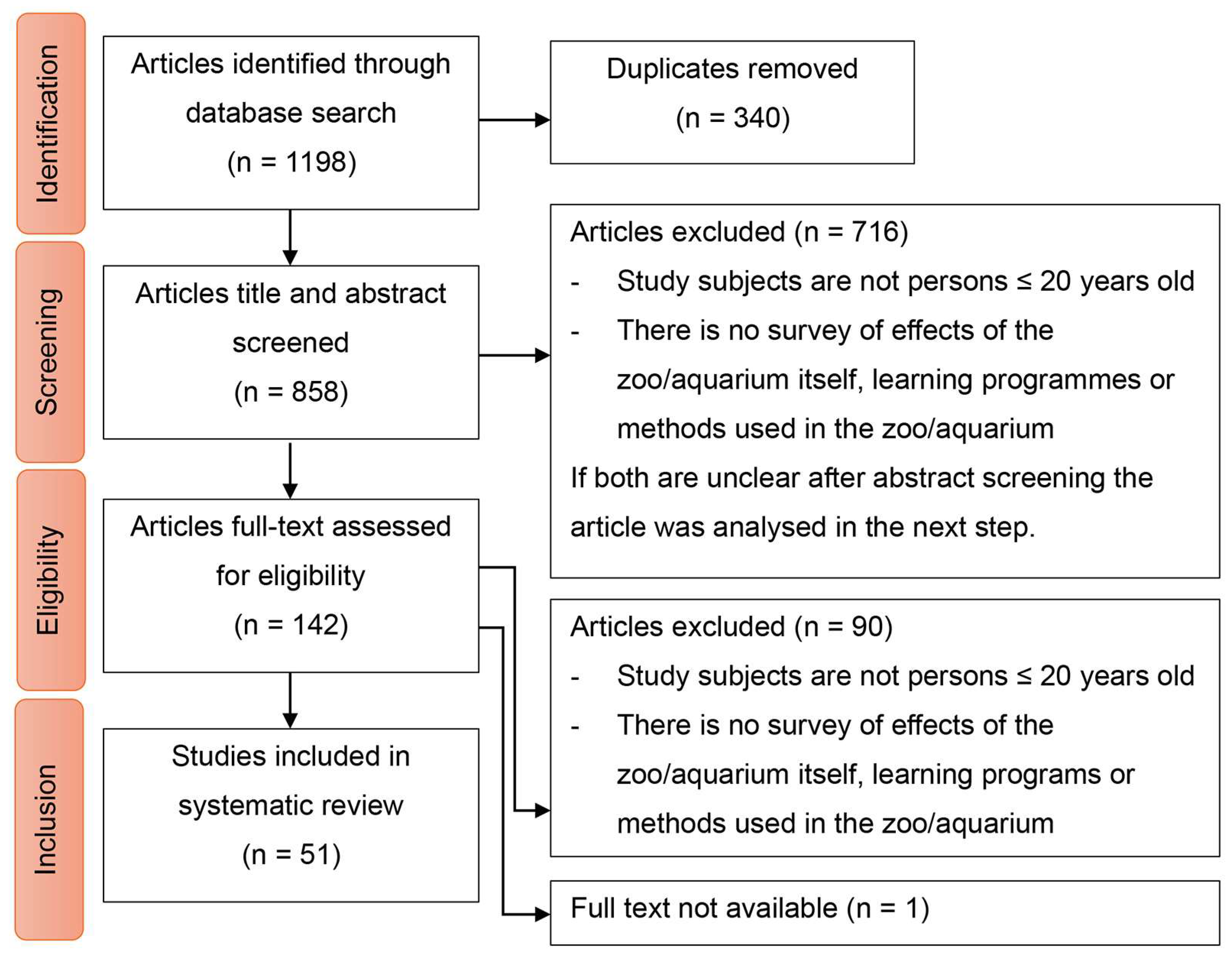
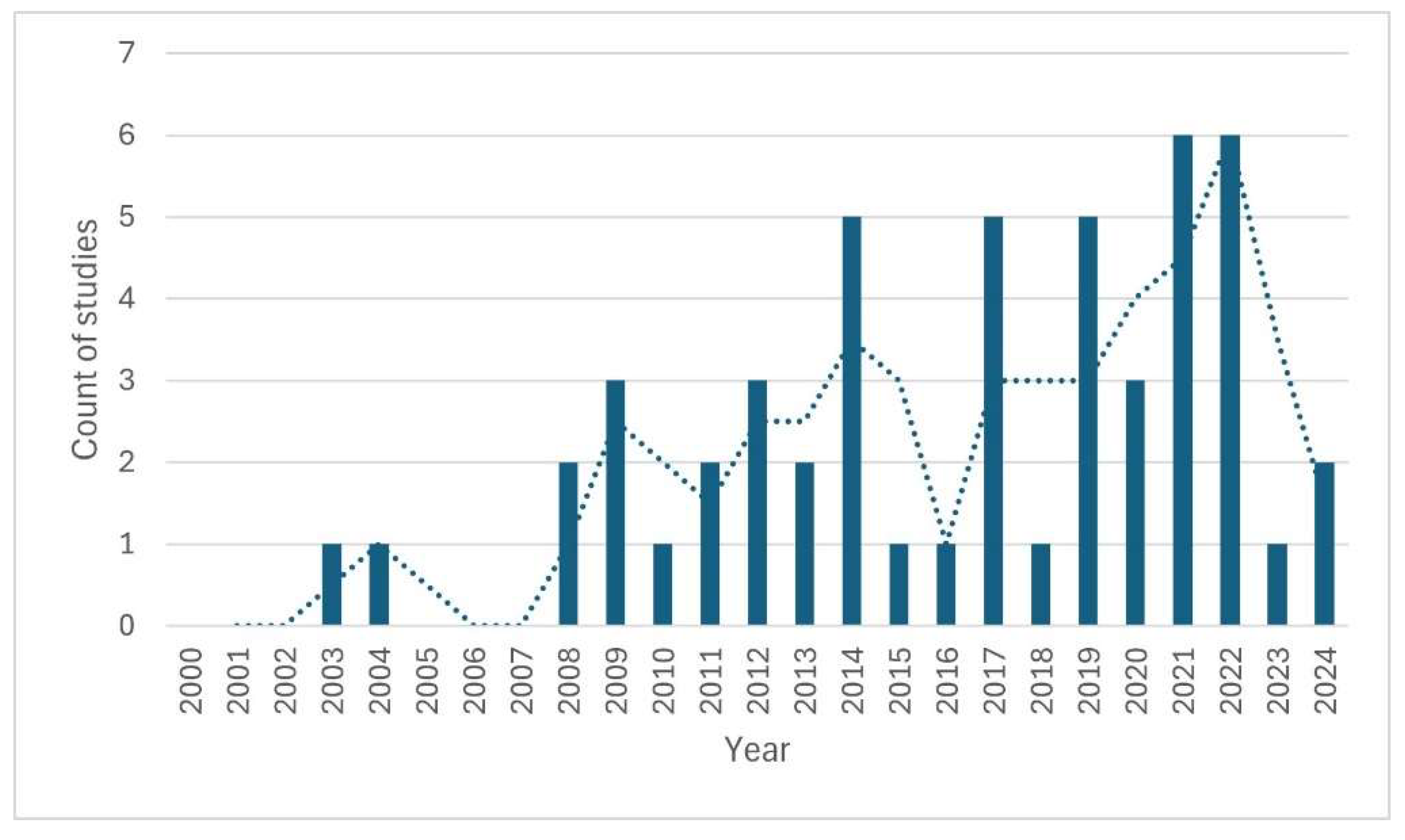
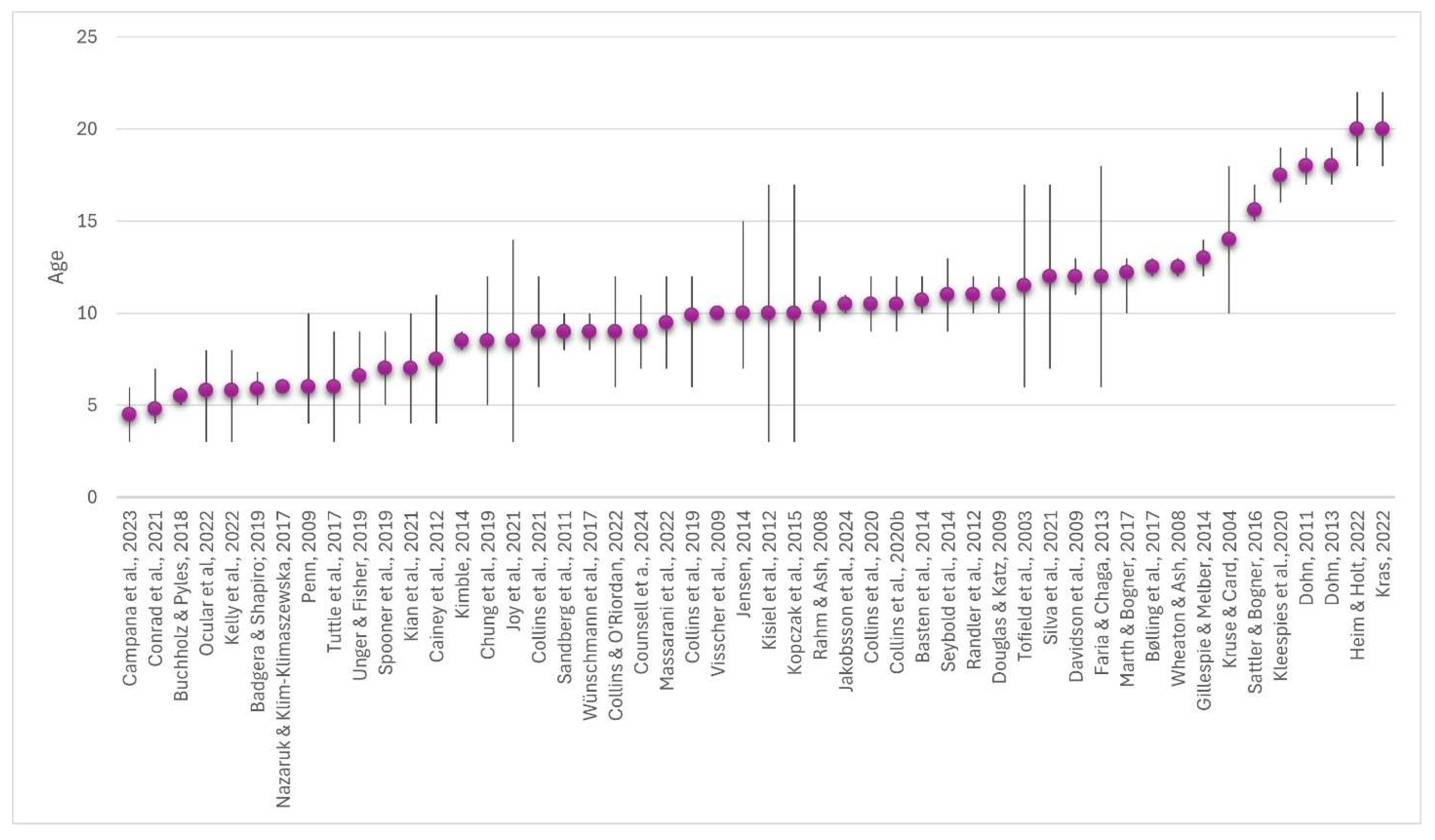
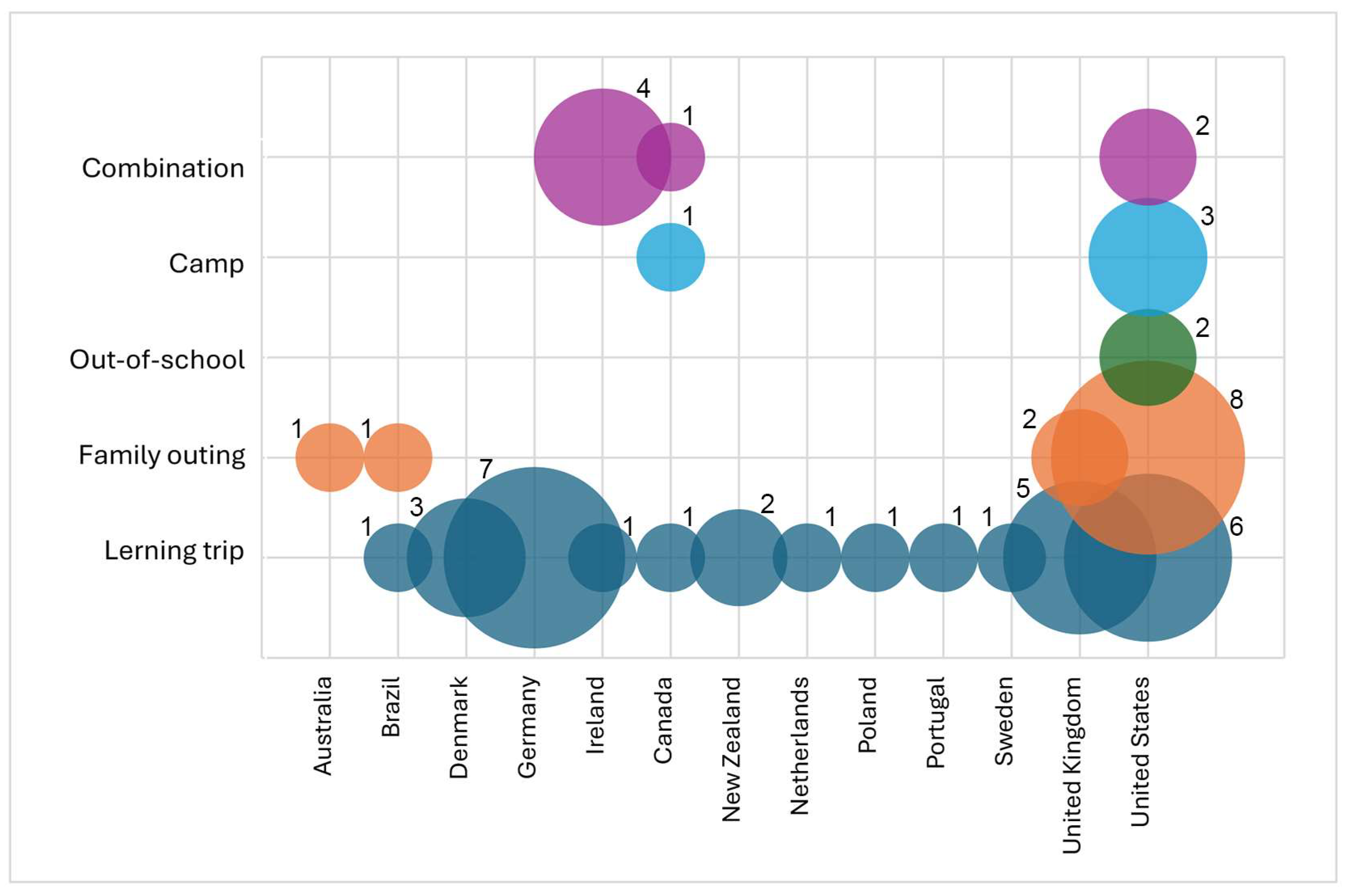
| Search Keyword Combination | Justification |
|---|---|
| High approval rating among experts: M = 4.83; SD = 0.37 (Max: 5–Min: 1). |
| High to good approval rating among experts: M = 4.17; SD = 0.90 (Max: 5–Min: 1). |
| High approval rating among experts: M = 4.83; SD = 0.37 (Max: 5–Min: 1). |
| Note from the experts: Use “educational visit/trip” or “school trip”. A common term in the literature is “field trips”. |
| Note from the experts: include “informal” or “non-formal”. |
| Note from the experts: delete “setting” in “out of school setting”. (Agreement among experts with “setting”: M = 3.67; SD = 0.94 (Max: 5–Min: 1)) |
| PI/EMS | Inclusion Criteria | Exclusion Criteria |
|---|---|---|
| Population “The population criterion encourages you to characterize the study population that is included in the research you are looking for. A very broad characterization is ‘Are you looking for children or adults or both?’” [36] | Children and adolescents ≤ 20 years of age as well as adults who report retrospectively Target group: Kindergarten children, primary school children, secondary school children in grades 7–9 and 10–12 (in the United States, undergraduate students were also included) | Adults > 20 years of age who do not report retrospectively |
| Independent variable or intervention/exposure “The intervention is the independent variable in an experiment (the part you manipulate to find out its effects). It is the treatment the treatment group receives in intervention research studies. In the context of observational studies, this domain is the exposure of interest (e.g., classroom size when you are evaluating the effect of classroom size on school grades). In any other context this is the element that you think will have an effect on something or someone (e.g., personality traits when you are evaluating the effect of personality traits on college success).” [36] | Exposure of interest: learning environment: zoo or aquarium | Learning environment is neither a zoo nor an aquarium |
| Measure “This dimension should characterize the type of data you are interested in, that is, what the study should assess and report on to be of interest to you. This is about the type of assessment and the measure (e.g., test scores) that were used to determine whether there was an effect or what kind of effect there was. This is the dependent variable in experiments. In the biomedical literature this is the outcome or effect measure.” [36] | The effects of the learning location or effects related to them on visitors/learners were surveyed | No effects were recorded |
| Study design “This dimension focuses on the type of publication, research study, and methodological approach you are looking for. Are you interested only in empirical studies that report data, or theoretical papers as well? Can the study be a write-up of an experiment or an observational study? Must the publication report quantitative or qualitative data to be of interest? Does the paper need to report a particular analytic method (e.g., multivariate analysis)? And so forth.” [36] | Qualitative and quantitative data | No data were recorded |
| Country | Studies |
|---|---|
| Australia | 1 |
| Brazil | 2 |
| Canada | 3 |
| Denmark | 3 |
| Germany | 7 |
| Ireland | 5 |
| Netherlands | 1 |
| New Zealand | 2 |
| Poland | 1 |
| Portugal | 1 |
| Sweden | 1 |
| United Kingdom | 8 |
| United States | 21 |
| Type of Education | Type of Visit to the Zoo/Aquarium |
|---|---|
| Formal education | Learning trip: Visitors visit the zoo or aquarium in connection with an event organised by their school, university or kindergarten. |
| Non-formal education | Family outing: Visitors visit the zoo or aquarium with their families. Out-of-school: Visitors do not visit the zoo or aquarium as part of a school, university, or kindergarten event, nor do they visit with their families. Camp: A camp is a special form of out-of-school setting. A camp lasts several days and includes overnight stays. |
| --- | Combination: e.g., Taylor and Duram [44] collected data during a learning trip and family outings; Rahm and Ash [20] collected data during family outings and out-of-school programmes. |
|
|
| Category of Dependent Variable | Definition |
|---|---|
| Knowledge | Knowledge about animals, nature, the environment, species protection or nature conservation. |
| Behaviour | Reported or observed environmental behaviour, nature conservation actions or intentions to act. |
| Attitude | Attitude toward nature, animals or the environment. |
| Motivation | Self-reported or observed motivation in learning or in lessons. |
| Interest | Interest in science, animals, nature and/or the environment. |
| Learning behaviour | Observable behaviour in the learning process, participation in class, occurrence of disruptions and/or refusal to learn. Does not include communication between learners and family members. |
| Communication | Conversations with others. |
| Other | Unlike the variables described. |
| Children and Adolescents | Adults (McNally et al. [17]; Mellish et al. [14]; Information of the Studies in This Review) | |
|---|---|---|
| Lecture/guided tour | X | X |
| Repetition | X | --- |
| Station work | X | --- |
| Self-directed learning | X | --- |
| Inclusion of virtual media | X | X |
| Enrichment | X | --- |
| Direct contact with animals | X | X |
| Conversation with animal keepers | X | X |
| Theatre | X | X |
| Anthropomorphism | X | --- |
| Parents as navigators | X | --- |
| Touch tank | X | X |
| Zoo educator | X | X |
| Camp | X | --- |
| Participation in animal care | X | --- |
| Additional texts | --- | X |
| Tour of a zoo/aquarium | --- | X |
| Bus tour | --- | X |
| Children and Adolescents | Adults (McNally et al. [17]; Mellish et al. [14]; Information of the Studies in This Review) | |
|---|---|---|
| Knowledge | X | X |
| Behaviour (also intention) | X | X |
| Attitude | X | X |
| Motivation | X | --- |
| Interest | X | --- |
| Learning behaviour | X | --- |
| Communication | X | X |
| Others | X | X |
Disclaimer/Publisher’s Note: The statements, opinions and data contained in all publications are solely those of the individual author(s) and contributor(s) and not of MDPI and/or the editor(s). MDPI and/or the editor(s) disclaim responsibility for any injury to people or property resulting from any ideas, methods, instructions or products referred to in the content. |
© 2025 by the author. Licensee MDPI, Basel, Switzerland. This article is an open access article distributed under the terms and conditions of the Creative Commons Attribution (CC BY) license (https://creativecommons.org/licenses/by/4.0/).
Share and Cite
Baur, A. What Do We Know About Children’s and Adolescents’ Formal and Non-Formal Learning in the Zoo? A Systematic Literature Review. Animals 2025, 15, 3533. https://doi.org/10.3390/ani15243533
Baur A. What Do We Know About Children’s and Adolescents’ Formal and Non-Formal Learning in the Zoo? A Systematic Literature Review. Animals. 2025; 15(24):3533. https://doi.org/10.3390/ani15243533
Chicago/Turabian StyleBaur, Armin. 2025. "What Do We Know About Children’s and Adolescents’ Formal and Non-Formal Learning in the Zoo? A Systematic Literature Review" Animals 15, no. 24: 3533. https://doi.org/10.3390/ani15243533
APA StyleBaur, A. (2025). What Do We Know About Children’s and Adolescents’ Formal and Non-Formal Learning in the Zoo? A Systematic Literature Review. Animals, 15(24), 3533. https://doi.org/10.3390/ani15243533

