Article

The Function of the Lysophospholipase 1 (LYPLA1) Gene in Fetal Sheep Myoblast Proliferation and Myogenic Differentiation

by
Zhanpeng Zhang
1,2,3,
Yi Yin
1,2,3,
Huiguo Yang
4,
Kanati Shalike
4,
Yanglin Nie
5,
Xiukai Cao
1,2,
Zehu Yuan
1,2 and
Wei Sun
1,2,3,*
1
Joint International Research Laboratory of Agriculture and Agri-Product Safety of Ministry of Education of China, Yangzhou University, Yangzhou 225009, China
2
International Joint Research Laboratory in Universities of Jiangsu Province of China for Domestic Animal Germplasm Resources and Genetic Improvement, Yangzhou University, Yangzhou 225009, China
3
College of Animal Science and Technology, Yangzhou University, Yangzhou 225009, China
4
Institute of Animal Husbandry, Xinjiang Academy of Animal Sciences, Urumqi 830013, China
5
Anin Dairy (Jiangsu) Co., Ltd., Huaian 211600, China
*
Author to whom correspondence should be addressed.
Animals 2025, 15(23), 3474; https://doi.org/10.3390/ani15233474
Submission received: 14 November 2025 / Revised: 1 December 2025 / Accepted: 1 December 2025 / Published: 2 December 2025

Simple Summary

This study aimed to investigate whether a candidate gene (LYPLA1) associated with sheep growth affects the proliferation and differentiation of fetal sheep myoblasts. Myoblasts were isolated from fetal sheep skeletal muscle. Our findings revealed that knocking down LYPLA1 gene activity significantly reduced muscle cell proliferation and differentiation. Conversely, increasing LYPLA1 gene activity effectively promoted myoblast proliferation and differentiation. These results demonstrate that LYPLA1 influences fetal sheep myoblast proliferation and differentiation. This study provides important theoretical support for the use of LYPLA1 as a molecular marker for improving sheep meat traits and is expected to have potential value in improving livestock production efficiency and promoting agricultural economic development.

Abstract

Evidence from genome-wide association studies (GWAS) links genetic variants near the LYPLA1 locus to variations in sheep muscle development. To further investigate whether LYPLA1 expression plays a role in fetal sheep myoblast development, we performed gain-of-function/loss-of-function analyses targeting LYPLA1 using siRNA and recombinant vectors. CCK-8 assays, EdU staining, and flow cytometry were used to investigate the effects of both LYPLA1 knockdown and overexpression on the proliferation of fetal sheep myoblasts. Furthermore, this study investigated the effect of LYPLA1 on myogenic differentiation by means of indirect immunofluorescence staining with MyHC and quantitative analysis of myogenic regulatory factor (MRF) expression. The results showed that downregulation of LYPLA1 significantly reduced cell viability and proliferation rate, arrested myoblasts in the G2 phase, and inhibited proliferation. These effects were reversed when LYPLA1 was overexpressed. Furthermore, LYPLA1 knockdown significantly impaired myotube formation during terminal differentiation (days 5–7). This defect was correlated with a marked reduction in the expression of myogenic regulatory factors (MRFs). This effect was reversed when LYPLA1 was highly expressed. In summary, this study demonstrates that LYPLA1 promotes the proliferation and differentiation of fetal sheep myoblasts, establishing its potential as a target for the molecular breeding of sheep.

1. Introduction

Sheep are widely raised due to their strong adaptability to the environment and high reproductive capacity, thus holding significant importance in the agricultural economy. Sheep growth traits are one of the main economic traits. Maximizing the economic value of sheep during the breeding process is also the main goal of breeders [1]. Therefore, the genetic improvement of sheep growth traits, especially research on muscle growth and development, has been widely studied.
In recent years, genome-wide association studies (GWAS) have provided important clues for the genetic improvement of sheep by identifying genetic variants associated with sheep growth [2,3,4,5,6]. In a GWAS study on milk production traits in 1813 ewes [7], the candidate gene LYPLA1 was found to be associated with milk production. In addition, WANG et al. sorted and analyzed the whole-genome resequencing genotypes from 1150 sheep and found that the LYPLA1 gene may significantly affect the weight of sheep [8]. Studies have found that the protein encoded by the LYPLA1 gene has hydrolysis S-palmitoylation modification and participates in the regulation of Wnt/β-catenin, Ras, and other signaling pathways [9]. Protein palmitoylation is a potent post-translational modification and is the only reversible lipid modification identified to date [10]. Current proteomic analyses have identified nearly a thousand palmitoylated proteins, which have been observed to be involved in specific biological mechanisms, such as differentiation, activation, immune response, proliferation, and migration [11,12], and play important functions in organisms. In view of the currently known GWAS results and the function of the LYPLA1 gene, we speculate that the LYPLA1 gene plays an important role in the muscle growth and development of sheep as a potential candidate gene.
The basic process of skeletal muscle development begins in early embryonic development, originating from mesenchymal stem cells in the mesoderm [13]. Mesenchymal stem cells form myogenic progenitor cells under the regulation of transcription factors and further differentiate into myoblasts. The withdrawal of myoblasts from the cell cycle after proliferation cessation is followed by their differentiation and fusion into multinucleated myotubes [14,15,16]. Existing research shows that the amount and quality of meat produced by animals are closely related to the number of muscle fibers, and the number of muscle fibers of animals is determined during pregnancy; that is, the number of muscle fibers will no longer increase after delivery [17,18]. Therefore, the prenatal period is a key factor in determining the quality and composition of an individual’s skeletal muscle. This stage not only determines the number of muscle fibers and muscle quality after birth but also has a profound impact on its subsequent production efficiency [19,20,21]. Therefore, this study directly targets the fetal development stage, using a sheep fetal myoblast model to analyze key cellular events in muscle fiber formation and establish a theoretical basis for improving mutton yield and quality from the developmental source. Since there has been no research on the effect of the LYPLA1 gene on the function of sheep myoblasts, we selected fetal sheep myoblasts as experimental materials to verify the function of the LYPLA1 gene.
In this study, we sought to elucidate the effects of the LYPLA1 gene on the proliferation and differentiation of fetal sheep myoblasts by performing functional analyses at the cellular level. First, we quantified the expression levels of myogenic regulatory factors (MRFs) in fetal sheep myoblasts at different differentiation stages and determined that the isolated and purified fetal sheep myoblasts had good differentiation potential. Subsequently, we constructed an LYPLA1 gene overexpression vector and siRNA to study the effect of the LYPLA1 gene on myoblast proliferation. Finally, this experiment established an in vitro myoblast differentiation model to study the effect of the LYPLA1 gene on myoblast differentiation. In summary, this study hopes to clarify the regulatory role of the LYPLA1 gene in sheep muscle development at the cellular level through the above experiments in order to provide a theoretical basis for the genetic improvement of muscle growth in sheep.

2. Materials and Methods

2.1. Ethical Statement

The animal experiments in the current study were reviewed and approved by the Experimental Animal Ethics Committee of Yangzhou University (approval number 202103279, approval date 8 March 2021).

2.2. Sample Collection

The Hu sheep used in this study were supplied by Suzhou Taihu Dongshan Sheep Industry Development Co., Ltd. (Suzhou, China). In this experiment, we selected two healthy adult pregnant ewes of similar weight (the gestation age of their fetuses was approximately 85 days) and collected longissimus dorsi muscle tissue samples from the two fetuses for myoblast isolation. To ensure the sterility and integrity of the samples, we used strictly sterilized equipment to collect tissue samples such as the longissimus dorsi muscle, heart, lung, kidney, and liver tissue from Hu sheep. Following collection, tissue samples were immediately frozen in liquid nitrogen. All samples were subsequently stored at −80 °C in the laboratory prior to subsequent experiments.

2.3. Isolation, Purification, and Identification of Fetal Sheep Myoblasts

Primary sheep myoblasts were isolated from sheep longissimus dorsi muscle tissue via collagenase type II digestion [22]. The cell culture incubator was set at 37 °C and 5% CO2, and the cells were cultured in high-glucose DMEM medium (complete medium) containing a mixture of 10% fetal bovine serum (FBS) and 2% penicillin–streptomycin. The cells were purified via differential adhesion using a previous method [23]. After purification, primary myoblasts were obtained, which were then digested with 0.25% trypsin and transferred into 1.5 mL cryovials. They were then stored in liquid nitrogen for long-term use in subsequent experiments.

2.4. Vector Construction and Small Interfering RNA Synthesis

The small interfering RNA used in this experiment was designed and synthesized by GenePharma Pharmaceutical Technology Co., Ltd. (Shanghai, China). The specific sequence information of the small interfering RNA (siRNA) targeting the sheep LYPLA1 gene is shown in Table 1. Among them, NC (negative control) was used as a negative control.
The LYPLA1 gene was amplified via PCR using complementary DNA (cDNA) extracted from sheep tissue as a template. The designed primers are listed in Table 2. In this experiment, we used the pcDNA3.1(+) vector, which does not contain the fluorescent protein gene. The recombinant vector was constructed according to the instructions of the ClonEx-press II One-Step Cloning Kit (Vazyme Biotech Co., Ltd., Nanjing, China). The sequenced vector was named pcDNA3.1(+)-LYPLA1 and stored at −20 °C for subsequent experiments.

2.5. Cell Transfection and Induced Differentiation

According to the instructions of jetPRIME transfection reagent (Polyplus transfection, Strasbourg, Illkirch, France), when the confluence of the myoblasts after passage reached 40–50%, transfection with small interfering RNA fragments targeting the LYPLA1 gene was performed; when the cell confluence reached 60–70%, transfection with an LYPLA1 overexpression recombinant plasmid was performed. The transfection groups were set up as follows: for overexpression, pcDNA3.1(+) and pcDNA3.1(+)-LYPLA1; for knockdown, siRNA-LYPLA1 and NC. Each group was assayed in three replicates. When the confluence reached 80–90% post-transfection, the complete growth medium (GM, 90% high-glucose DMEM, 10% FBS) was replaced with differentiation medium (DM, 98% high-glucose DMEM, 2% horse serum), which was changed every 48 h, to induce in vitro differentiation of fetal myoblasts.

2.6. Total RNA Extraction and Real-Time Quantitative Polymerase Chain Reaction (RT-qPCR)

Total RNA extraction from all samples in this experiment was performed according to the TRNzol Universal Total RNA Extraction Kit (TIANGEN, Beijing, China). The extracted RNA was detected and then stored at −80 °C. We performed reverse transcription using the FastKing One-Step Genomic cDNA First-Strand Synthesis Premix (TIANGEN, Beijing, China) according to the manufacturer’s instructions, and the reaction system was as follows: 4 μL of 5× FastKing-RT SuperMix, 1 μg of Total RNA, and RNase-Free ddH2O to 20 μL. The reaction program was set as follows: 42 °C for 15 min, 95 °C for 3 min, and a stop temperature of 4 °C. The RT-PCR reaction reagent used was ChamQ SYBR qPCR Master Mix (Vazyme Biotech Co., Ltd., Nanjing, China). Cell proliferation markers CDK2, Cyclin D1, and PCNA were selected to reflect G1/S phase transition, early process, and DNA replication activity, respectively, so as to comprehensively judge the proliferation level. The myogenic differentiation markers MyoD1, Myf5, MyoG, and MRF4 were selected to span the entire myogenesis process, from lineage commitment (MyoD1/Myf5) through terminal differentiation (MyoG) to functional maturation (MRF4). Primers were designed using the Primer-BLAST tool on the NCBI website. The primers are listed in Table 3.

2.7. 5-Ethynyl-2′-deoxyuridine (EdU) Assay for Cell Proliferation

Subsequent EdU staining experiments were performed according to the Cell-Light EdU Apollo In Vitro Kit protocol (RIBOBIO, Guangzhou, China). First, myoblasts were plated in 96-well plates with GM. After transfection, EdU staining and Hoechst staining were performed when the cell density reached approximately 90%. Second, fluorescence images were taken using an inverted fluorescence microscope (Nikon, Minato, Tokyo, Japan). Finally, we quantified the cell number in each field using Image J (National Institutes of Health, Bethesda, MD, USA). The cell proliferation rate was calculated by using the following formula: number of EdU-stained cells/number of Hoechst-stained cells × 100%.

2.8. Cell Vitality Detection Using the Cell Counting Kit-8 (CCK-8) Assay

Cell viability was assessed using the CCK-8 Cell Counting Kit protocol (Vazyme, Nanjing, China). Relative cell viability can be indirectly assessed by measuring optical density (OD) at 450 nm using a Tecan Infinite F200/M200 multi-function microplate reader (Tecan, Männedorf, Switzerland). When myoblasts reach a confluence suitable for transfection, the OD value is used as the OD value at 0 h. Cells are then transfected, with 6–8 replicate wells per group. OD values are measured 24 h after transfection and again at 48 h and 72 h.

2.9. Cell Cycle Analysis via Flow Cytometry

Cells were treated according to the instructions of the Cell Cycle Detection Kit (Beyotime, Shanghai, China). First, myoblasts were plated and transfected in 6-well plates. Then, 24–48 h after transfection, the cells were detached using trypsin and collected via centrifugation into a 1.5 mL tube. Subsequently, they were resuspended in pre-cooled 70% ethanol and fixed via incubation at 4 °C for 12–16 h. Before measurement, they were stained with freshly prepared propidium iodide staining solution at 37 °C in the dark for 30 min. After PI staining, the DNA content of the cells was detected using a flow cytometer (BD, Franklin Lakes, NJ, USA), and then the DNA content distribution was assessed with FlowJo software (V 10.8.1, BD Biosciences, Franklin Lakes, NJ, USA).

2.10. Cell Immunofluorescence Assay

Immunofluorescence staining was used to analyze cell differentiation. Before performing the cell immunofluorescence assay, myoblasts were seeded into a 24-well plate containing complete culture medium. At 24–48 h after transfection, when the cells reached 90% confluence, the complete culture medium was replaced with differentiation medium and cultured for 5–7 days. As described in previous experiments [24], first, the cells were washed with PBS 2–3 times, 4% paraformaldehyde was added, and the cells were incubated at room temperature for 30 min to fix them. The cells were then washed three times with PBS, permeabilized with 0.5% Triton X-100 at room temperature for 20 min, washed three times with PBS, and then incubated with 5% goat serum at room temperature for 1 h. The cells were incubated with the prepared primary antibody solution (MYH3 Antibody, 1:100, Affinity Bioscience, Cincinnati, OH, USA, REF#DF9647) at 4 °C overnight. The primary antibody targets the protein MYH3. followed by three washes with PBS and incubation with the prepared secondary antibody solution (Goat Anti-Rabbit IgG H&L (Alexa Fluor® 488), 1:200, Abcam, Cambridge Science Park, Cambridge, UK, REF#ab150077) at 37 °C in the dark for one hour. Finally, the cells were incubated with DAPI staining solution (Boster Biological Technology, Wuhan, China, Catalog#AR1176) at room temperature in the dark for 3–5 min, rinsed with PBS, and immediately placed under an inverted fluorescence microscope (Nikon, Minato, Tokyo, Japan) for photography.

2.11. Statistical Analysis

All results in this experiment were analyzed using SPSS software (IBM SPSS Statistics 19, SPSS, Inc., Chicago, IL, USA). Differences between groups were compared using an independent samples t-test for two groups and one-way analysis of variance (ANOVA) for multiple groups. All experimental results are presented in graphical form, with error bars representing the standard error (SEM). A p-value < 0.05 was considered statistically significant.

3. Results

3.1. Isolation and Purification of Fetal Sheep Myoblasts and Quantitative Identification of MRFs

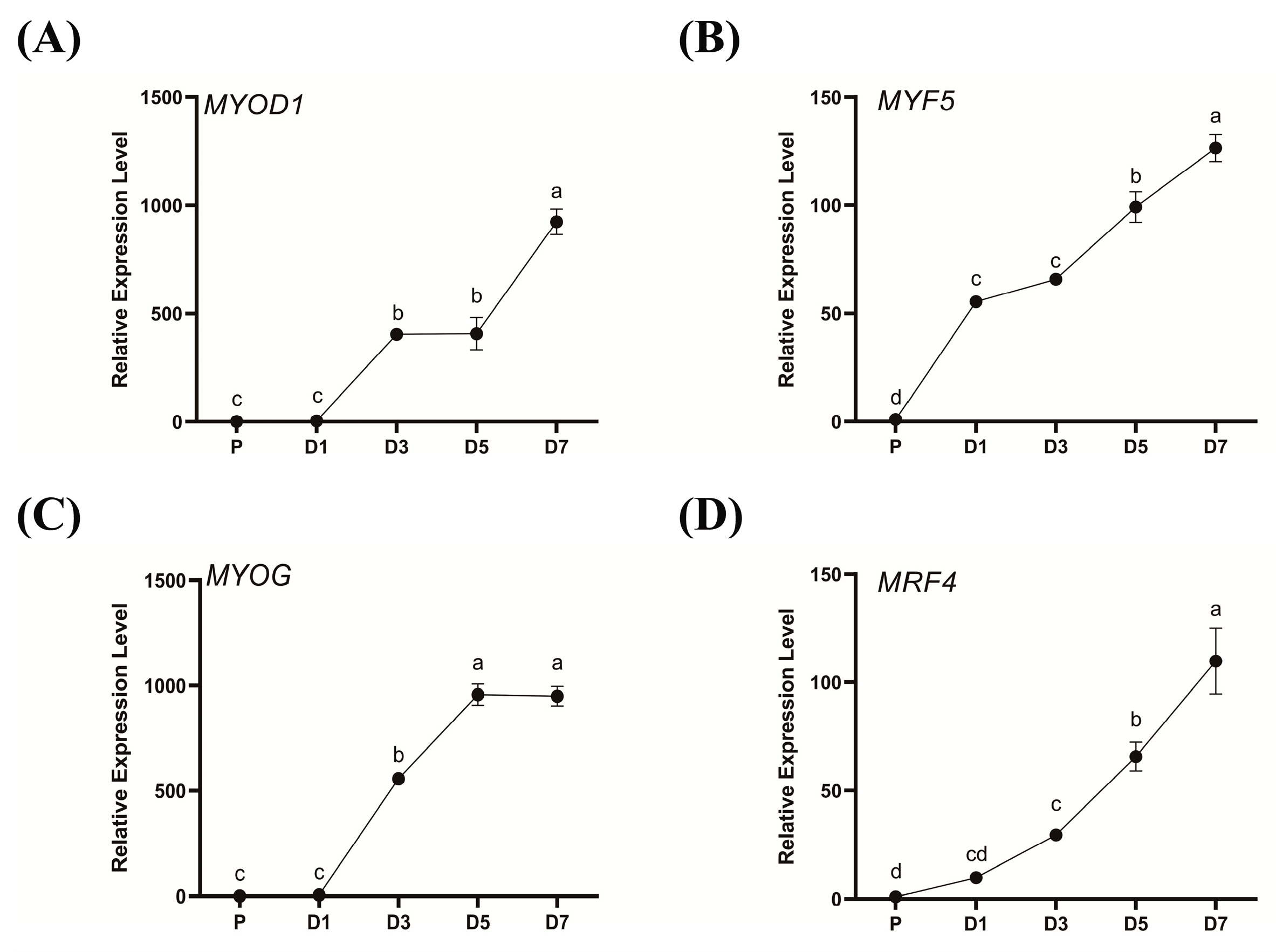
This study successfully isolated and purified fetal sheep myoblasts using the Type II collagenase digestion method. We observed that the purified fetal sheep myoblasts grew well, exhibiting a distinctly elongated spindle shape, and formed myotubes after induced differentiation (Figure S1). Subsequently, we used RT-PCR to detect the relative expression of MRFs in myoblasts at different times of differentiation induction, and took day 0 (P) without changing the differentiation medium as the control group. We found that the expression levels of MyoD1 and MyoG gradually increased from day 3 to day 7 of differentiation induction (Figure 1B,D). The relative expression levels of Myf5 and MRF4 gradually increased during the seven days of differentiation induction and reached a peak on day 7 (Figure 1C,E) (p < 0.05). These results confirmed that the isolated fetal sheep myoblasts were of high purity and differentiation potential, establishing them as a reliable model for subsequent research.

3.2. Effect of LYPLA1 Interference on the Proliferation of Fetal Sheep Myoblasts

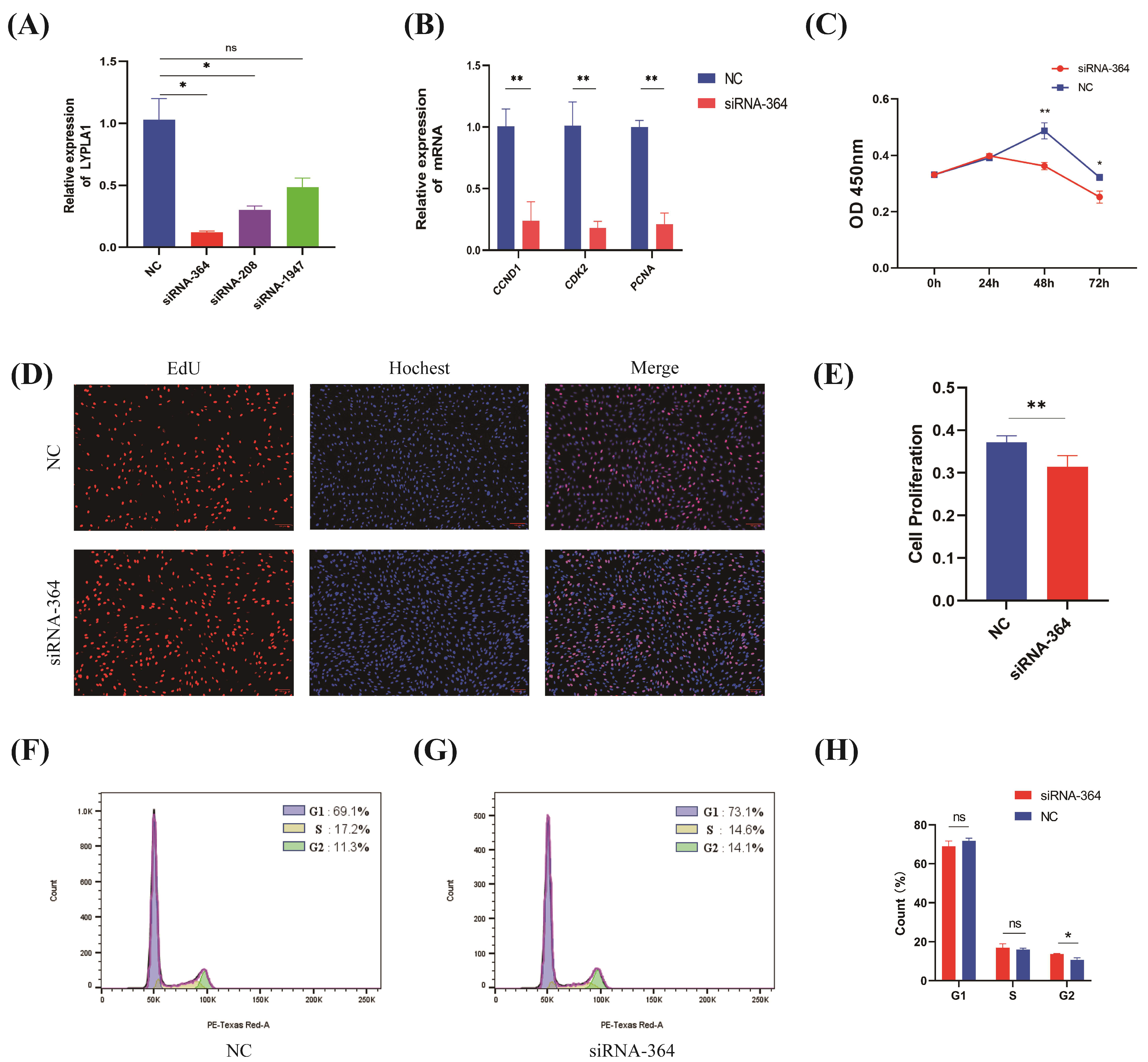
To investigate the function of the LYPLA1 gene, we transfected siRNA targeting LYPLA1 into fetal sheep myoblasts. The relative expression of the LYPLA1 gene was quantified using RT-qPCR. A significant reduction in the relative expression level of the LYPLA1 gene was observed in the siRNA-364 and siRNA-208 treatment groups (p < 0.05) (Figure 2A). siRNA-364 exhibited stronger interference efficiency than siRNA-208 and was hence chosen for further analysis. We transfected siRNA-364 into fetal sheep myoblasts and performed RT-PCR, CCK-8 assays, EdU staining, and flow cytometry to analyze cell cycle distribution. RT-PCR results showed that the relative expression of proliferation marker genes in the siRNA-364-treated group was significantly lower than that in the control group (p < 0.01) (Figure 2B). CCK-8 assays for cell viability revealed that the OD values of the siRNA-364-treated group were significantly lower than those in the control group at both 48 and 72 h (p < 0.05) (Figure 2C), indicating that LYPLA1 knockdown reduced cell viability. EdU staining revealed that the proportion of EdU-positive cells in the siRNA-364-treated group was significantly lower than that in the control group (p < 0.01) (Figure 2D,E). Cell cycle analysis revealed that the number of cells in the G2 phase was significantly increased in the siRNA-364-treated group compared with the control group (p < 0.05) (Figure 2F–H), indicating that LYPLA1 knockdown significantly inhibited cell proliferation.

3.3. Effects of LYPLA1 Gene Overexpression on the Proliferation of Fetal Sheep Myoblasts

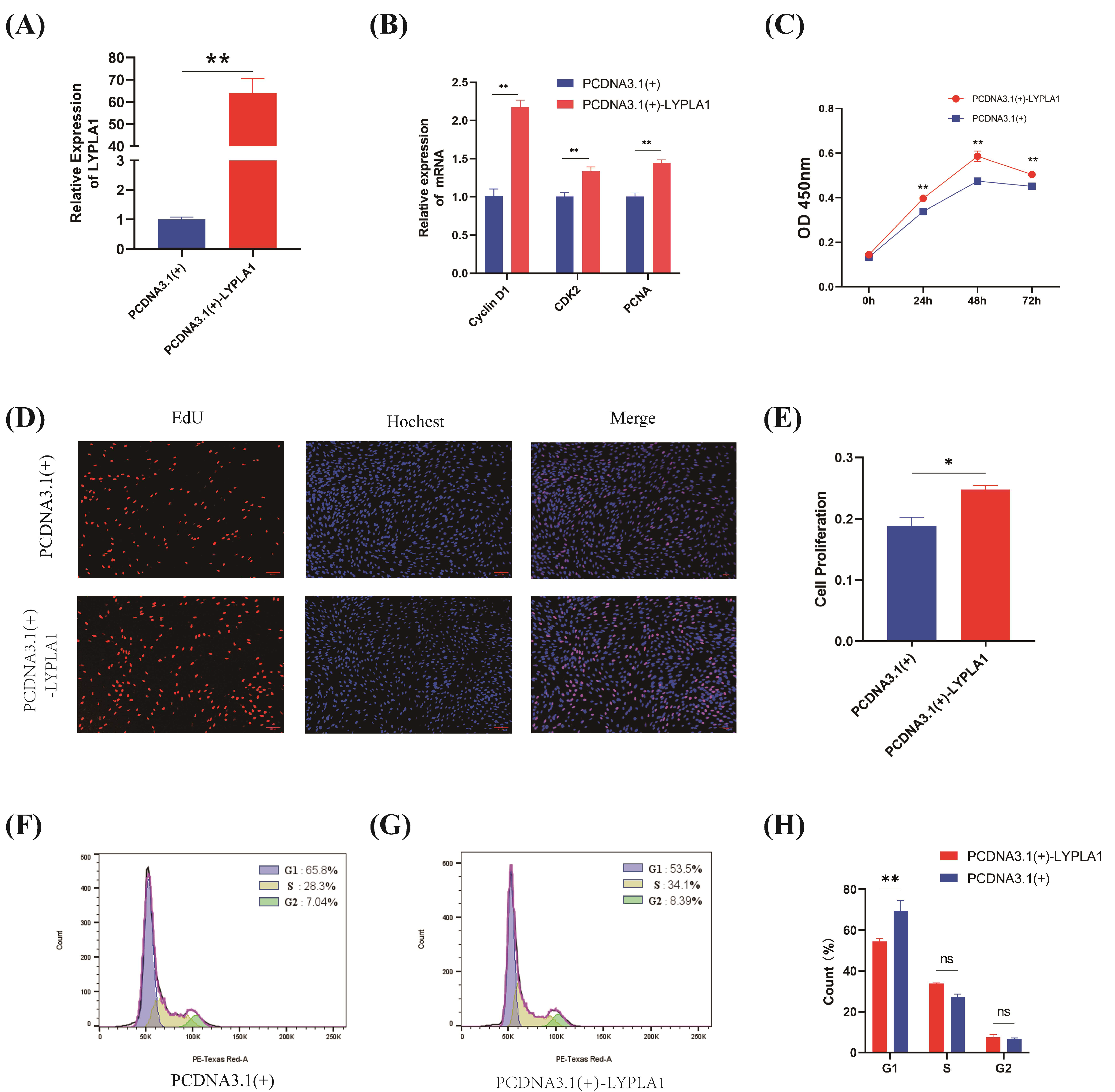
To investigate whether LYPLA1 overexpression also affects the proliferation of fetal sheep myoblasts, in this study, a recombinant LYPLA1 overexpression plasmid was successfully constructed. We transfected the overexpression recombinant plasmid into fetal sheep myoblasts and assayed the relative expression of LYPLA1 using RT-PCR. It was observed that the relative expression of LYPLA1 in the pcDNA3.1(+)-LYPLA1-treated group was significantly higher than that in the control group (p < 0.01) (Figure 3A). Subsequently, RT-PCR was used to assay the relative expression of proliferation marker genes, which was significantly higher in the pcDNA3.1(+)-LYPLA1-treated group than in the control group (p < 0.01) (Figure 3B). Cell viability assays using CCK-8 assays showed that the OD values of the pcDNA3.1(+)-LYPLA1-treated group were significantly higher than those in the control group at 24, 48, and 72 h (p < 0.01) (Figure 3C). EdU staining results showed that the proportion of EdU-positive cells in the pcDNA3.1(+)-LYPLA1-treated group was significantly higher than that in the control group (p < 0.05) (Figure 3D,E), indicating that increased LYPLA1 gene expression enhances cell viability. Cell cycle analysis revealed a significant increase in the number of cells in the G1 phase in the control group compared with the treated group (p < 0.01) (Figure 3F–H), indicating that cell proliferation was arrested in the control group. These results suggest that changes in LYPLA1 gene expression significantly affect the proliferation of fetal sheep myoblasts.

3.4. Effects of LYPLA1 Gene Interference on the Differentiation of Fetal Sheep Myoblasts

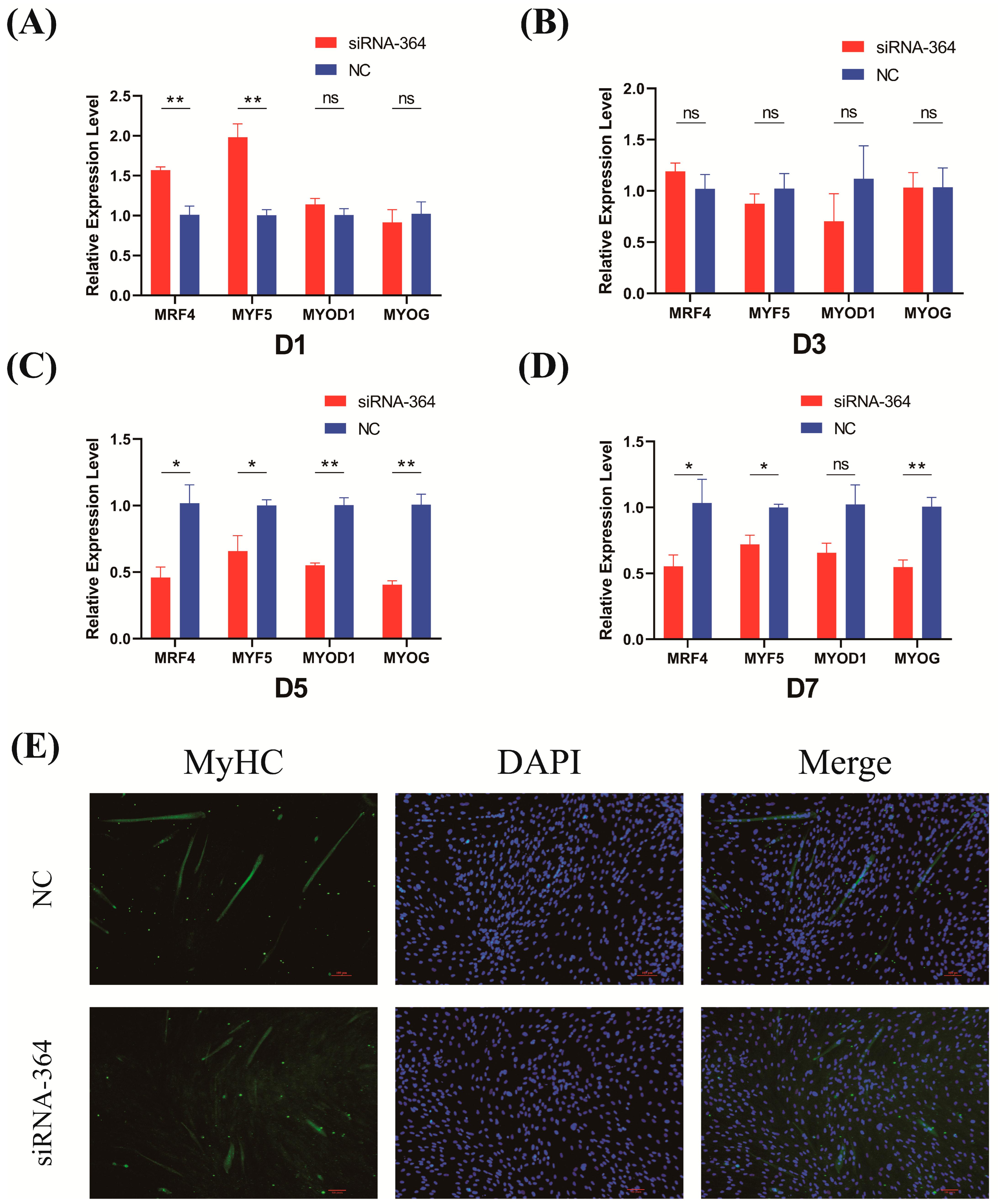
To further investigate the effect of LYPLA1 gene expression on fetal sheep myoblast differentiation, we transfected fetal sheep myoblasts with siRNA-364 and replaced the growth medium with differentiation medium to establish an in vitro differentiation model. Total RNA was extracted from cells on days 1, 3, 5, and 7 of differentiation induction. Relative expression of MyoD1, MyoG, Myf5, and MRF4 was assessed by RT-PCR using reverse-transcribed cDNA as a template. RT-PCR results showed that LYPLA1 knockdown upregulated the relative expression of Myf5 and MRF4 on days 1–3 of in vitro differentiation (p < 0.01) (Figure 4A,B). However, on days 5–7 of in vitro differentiation induction, LYPLA1 knockdown significantly downregulated the mRNA levels of key myogenic regulatory factors (MyoD1, MyoG, Myf5, and MRF4) (p < 0.05 or p < 0.01) (Figure 4C,D). Furthermore, indirect immunofluorescence analysis of MyHC on day 7 of differentiation revealed clear inhibition of myogenesis in the siRNA-364-treated group versus the control, with fewer fused myotubes and a lower degree of differentiation. These results indicate that LYPLA1 gene knockdown inhibits late-stage myoblast differentiation.

3.5. Effects of LYPLA1 Gene Overexpression on the Differentiation of Fetal Sheep Myoblasts

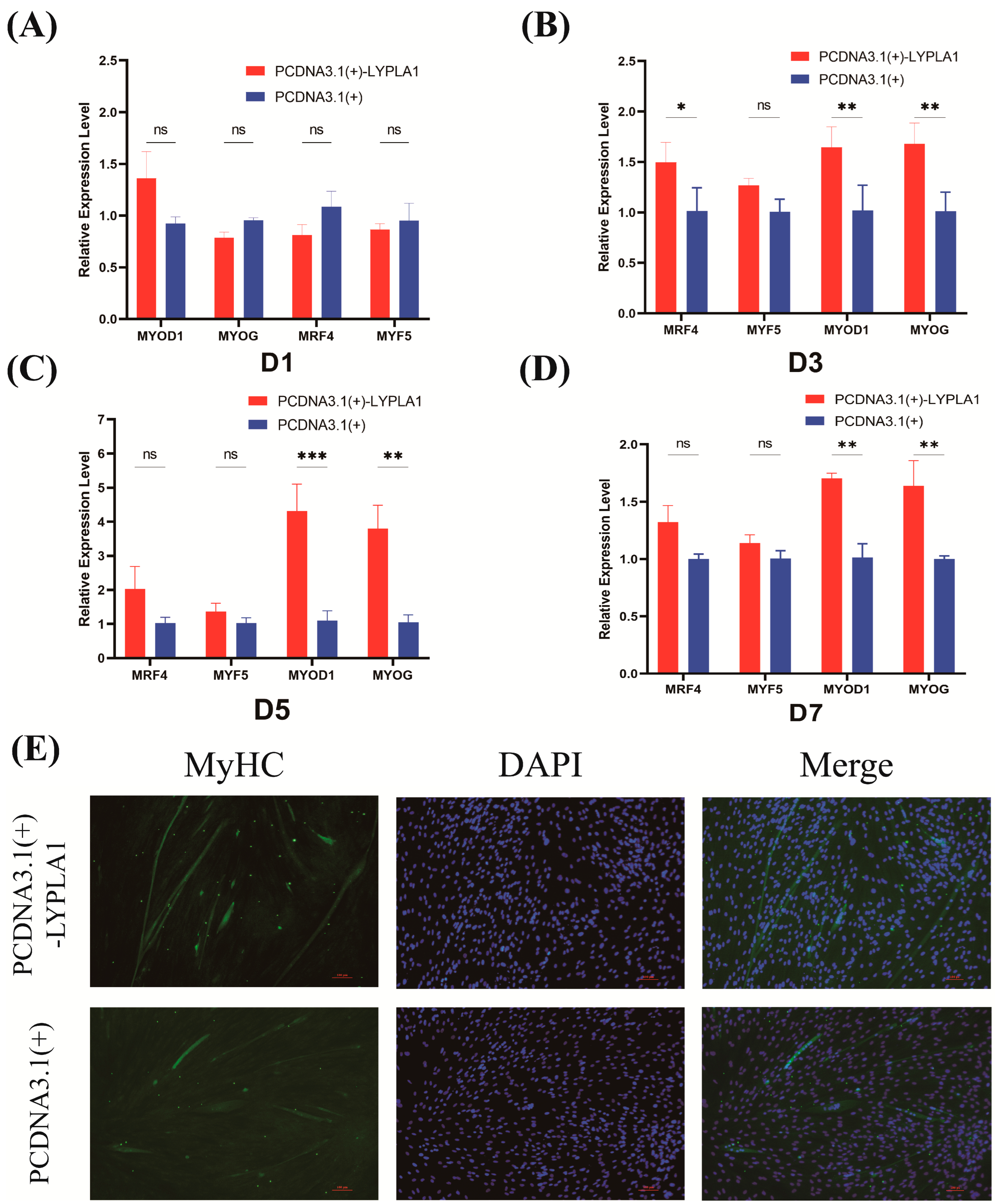
Then, we transfected the LYPLA1 gene overexpression recombinant plasmid into fetal sheep myoblasts to explore whether its overexpression also affects their differentiation. RT-PCR analysis was performed to profile the expression of key myogenic regulatory factors (MyoD1, MyoG, Myf5, and MRF4) on days 1, 3, 5, and 7 of differentiation. RT-PCR results showed that LYPLA1 overexpression significantly upregulated the mRNA levels of key myogenic regulatory factors (MyoD1, MyoG, Myf5, and MRF4) on days 1–7 of differentiation (Figure 5A–D). Indirect immunofluorescence analysis of MyHC on day 7 of myoblast differentiation (Figure 5E) showed that myogenic differentiation was significantly promoted in the pcDNA3.1(+)-LYPLA1-treated group compared with the control group, with a higher number of fused myotubes and a higher degree of differentiation. Therefore, LYPLA1 overexpression promotes myoblast differentiation. In summary, changes in LYPLA1 gene expression can significantly affect the differentiation process of fetal sheep myoblasts.

4. Discussion

The protein encoded by the LYPLA1 gene exhibits depalmitoylation and lysophospholipase activity [25,26] and may be involved in Ras localization and signal transduction [9]. Its expression is broadly distributed across tissues such as the muscle, lens, and kidney [27]. GWAS has provided evidence that the LYPLA1 gene is a candidate gene affecting birth weight and weaning weight [28]. Based on this, we speculate that LYPLA1 may regulate the proliferation and differentiation of myoblasts at the transcriptional and translational levels by modulating the palmitoylation cycle of key proteins (such as Ras itself) in the Ras signaling pathway.
In this study, fetal sheep myoblasts were successfully isolated and purified, and an in vitro differentiation model was established. Quantitative analysis demonstrated a progressive increase in MyoD1 and MyoG expression levels from day 3 to day 7 of differentiation. In addition, the relative expression levels of Myf5 and MRF4 reached a peak on the seventh day of differentiation induction, and the changes in MRF expression in this study were consistent with the reported expression pattern [29]. Experiments have shown that the activation of Myf5 and MyoD1 during myoblast proliferation is a determinant of early myogenesis, and MyoG and MRF4 act downstream to strictly control and maintain terminal differentiation [30,31,32]. Therefore, the myoblasts extracted in this experiment have high purity and good differentiation potential, which can provide a reliable in vitro model for subsequent functional studies of the LYPLA1 gene.
To elucidate the role of LYPLA1 in myoblast proliferation, we performed both gain- and loss-of-function studies. The results of this experiment showed that the LYPLA1 gene is a positive regulator of myoblast proliferation. After interfering with the expression of the LYPLA1 gene, cell viability and proliferation rate were significantly decreased, and the cell cycle was arrested in the G2 phase. In contrast, overexpression of the LYPLA1 gene significantly promoted cell viability and proliferation rate. This finding is consistent with the reported function of the LYPLA1 gene in cell cycle regulation and growth in other cell types. For example, Zhang et al. found in a study on cervical cancer that overexpression of the LYPLA1 gene can promote cervical cancer cells to overcome cell cycle arrest and promote proliferation [33]. Similar results were found in another study on non-small cell lung cancer [34]. In this regard, we believe that the LYPLA1 gene may play an important role in different cells and different biological processes.
Evidence indicates that myogenic differentiation requires prior cell cycle exit, defining proliferation and differentiation as distinct biological phases [35,36]. To further investigate the impact of LYPLA1 on myoblast differentiation, we knocked down LYPLA1 expression in an in vitro differentiation model. We found that knockdown of LYPLA1 slightly upregulated some MRFs (such as Myf5 and MRF4) during the early stages of differentiation (days 1–3) but significantly inhibited the expression of all key MRFs and myotube formation during the critical mid to late stages of differentiation (days 5–7). We hypothesize that this phenomenon may reflect an early compensatory mechanism activated by cells in response to the loss of LYPLA1 function. Since LYPLA1 is involved in regulating cell cycle exit, its knockdown may attempt to initiate differentiation by temporarily upregulating the expression of certain early myogenic regulatory factors. However, this initial gene expression compensation failed to effectively advance the differentiation process. Furthermore, overexpression of LYPLA1 induced differentiation and strongly upregulated MRF expression throughout the entire differentiation phase and significantly promoted myotube formation. These results suggest that insufficient LYPLA1 expression may prevent myoblasts from successfully transitioning from proliferation to differentiation, resulting in severe defects in the late stages of differentiation. Overall, we found that changes in LYPLA1 expression affect the differentiation process of ovine embryonic myoblasts. These findings provide important theoretical support for the potential application of LYPLA1 as a molecular marker for ovine breeding and improvement.
In summary, this study, based on the growth and development of sheep muscle, revealed for the first time that the LYPLA1 gene promotes proliferation and differentiation in fetal sheep myoblasts. These results will provide an important theoretical basis for the use of the LYPLA1 gene as a potential molecular marker for sheep breeding improvement.

5. Conclusions

Finally, this study revealed the role of the LYPLA1 gene in regulating the proliferation and differentiation of fetal sheep myoblasts. Through this study, we hope to provide an important theoretical basis for the use of the LYPLA1 gene as a potential molecular marker for improving meat traits and also to open up new ideas for its further application in sheep molecular breeding in the future.

Supplementary Materials

The following supporting information can be downloaded at https://www.mdpi.com/article/10.3390/ani15233474/s1. Figure S1: Morphology of fetal sheep myoblasts during induction of differentiation 1–7 days.

Author Contributions

Conceptualization, W.S., Z.Y., X.C. and Z.Z.; methodology, Z.Z., Y.Y. and Z.Y.; software, Z.Z. and Y.Y.; validation, Y.Y. and Z.Z.; formal analysis, H.Y., K.S. and Y.N.; investigation, H.Y. and K.S.; resources, H.Y., Y.N. and W.S.; data curation, X.C. and K.S.; writing—original draft preparation, Z.Z. and Y.Y.; writing—review and editing, Z.Z., Z.Y., X.C. and W.S.; visualization, H.Y. and K.S.; supervision, K.S. and Y.N.; project administration, H.Y. and Y.N.; funding acquisition, Z.Y. and W.S. All authors have read and agreed to the published version of the manuscript.

Funding

This work was supported by the National Natural Science Foundation of China (32202624); National Natural Science Foundation of China-CGIAR (32061143036); the Natural Science Foundation of the Jiangsu Higher Education Institutions of China (22KJA230001); the Jiangsu 333 Distinguished Talents Project Foundation ((2022) 2-323); the Jiangsu Agricultural Science and Technology Innovation Fund (CX (23)1036); the Science and Technology Aid Xinjiang Uygur Autonomous Region Project (2024E02019); and the Distinguished Talents Project Foundation of Yangzhou University, High-end Foreign Expert Introduction Project (G2022014148L).

Institutional Review Board Statement

The animal study protocol was approved by the Experimental Animal Ethical Committee of Yangzhou University (approval number 202103279; approval date 8 March 2021).

Informed Consent Statement

Not applicable.

Data Availability Statement

The original contributions presented in this study are included in the article/Supplementary Material. Further inquiries can be directed to the corresponding author.

Conflicts of Interest

Author Yanglin Nie is employed by the company “Anin Dairy (Jiangsu) Co., Ltd.”. The remaining authors declare no conflicts of interest.

References

  1. Mohammadabadi, M.; Bordbar, F.; Jensen, J.; Du, M.; Guo, W. Key Genes Regulating Skeletal Muscle Development and Growth in Farm Animals. Animals 2021, 11, 835. [Google Scholar] [CrossRef]
  2. Jiang, J.; Cao, Y.; Shan, H.; Wu, J.; Song, X.; Jiang, Y. The GWAS Analysis of Body Size and Population Verification of Related SNPs in Hu Sheep. Front. Genet. 2021, 12, 642552. [Google Scholar] [CrossRef]
  3. Kirichenko, A.A.; Zlobin, A.S.; Shashkova, T.I.; Volkova, N.A.; Iolchiev, B.S.; Bagirov, V.A.; Borodin, P.M.; Karssen, L.C.; Tsepilov, Y.A.; Aulchenko, Y.S. The GWAS-MAP|ovis platform for aggregation and analysis of genome-wide association study results in sheep. Vavilovskii Zh. Genet. I Sel. 2022, 26, 378–384. [Google Scholar] [CrossRef]
  4. Li, R.; Gong, M.; Zhang, X.; Wang, F.; Liu, Z.; Zhang, L.; Yang, Q.; Xu, Y.; Xu, M.; Zhang, H.; et al. A sheep pangenome reveals the spectrum of structural variations and their effects on tail phenotypes. Genome Res. 2023, 33, 463–477. [Google Scholar] [CrossRef]
  5. Han, B.; Tian, D.; Li, X.; Liu, S.; Tian, F.; Liu, D.; Wang, S.; Zhao, K. Multiomics Analyses Provide New Insight into Genetic Variation of Reproductive Adaptability in Tibetan Sheep. Mol. Biol. Evol. 2024, 41, msae058. [Google Scholar] [CrossRef]
  6. Zhang, Y.; Zhang, X.; Li, C.; Tian, H.; Weng, X.; Lin, C.; Zhang, D.; Zhao, Y.; Li, X.; Cheng, J.; et al. Rumen microbiome and fat deposition in sheep: Insights from a bidirectional mendelian randomization study. npj Biofilms Microbiomes 2024, 10, 129. [Google Scholar] [CrossRef]
  7. Mohammadi, H.; Farahani, A.H.K.; Moradi, M.H.; Mastrangelo, S.; Di Gerlando, R.; Sardina, M.T.; Scatassa, M.L.; Portolano, B.; Tolone, M. Weighted Single-Step Genome-Wide Association Study Uncovers Known and Novel Candidate Genomic Regions for Milk Production Traits and Somatic Cell Score in Valle del Belice Dairy Sheep. Animals 2022, 12, 1155. [Google Scholar] [CrossRef]
  8. Wang, W.; Zhang, Y.; Zhang, X.; Li, C.; Yuan, L.; Zhang, D.; Zhao, Y.; Li, X.; Cheng, J.; Lin, C.; et al. Heritability and recursive influence of host genetics on the rumen microbiota drive body weight variance in male Hu sheep lambs. Microbiome 2023, 11, 197. [Google Scholar] [CrossRef]
  9. Duncan, J.A.; Gilman, A.G. A cytoplasmic acyl-protein thioesterase that removes palmitate from G protein alpha subunits and p21(RAS). J. Biol. Chem. 1998, 273, 15830–15837. [Google Scholar] [CrossRef]
  10. Magee, A.I.; Courtneidge, S.A. Two classes of fatty acid acylated proteins exist in eukaryotic cells. EMBO J. 1985, 4, 1137–1144. [Google Scholar] [CrossRef]
  11. Magee, A.I.; Gutierrez, L.; McKay, I.A.; Marshall, C.J.; Hall, A. Dynamic fatty acylation of p21N-ras. EMBO J. 1987, 6, 3353–3357. [Google Scholar] [CrossRef]
  12. Martin, B.R.; Wang, C.; Adibekian, A.; Tully, S.E.; Cravatt, B.F. Global profiling of dynamic protein palmitoylation. Nat. Methods 2011, 9, 84–89. [Google Scholar] [CrossRef]
  13. Buckingham, M.; Bajard, L.; Chang, T.; Daubas, P.; Hadchouel, J.; Meilhac, S.; Montarras, D.; Rocancourt, D.; Relaix, F. The formation of skeletal muscle: From somite to limb. J. Anat. 2003, 202, 59–68. [Google Scholar] [CrossRef]
  14. Braun, T.; Gautel, M. Transcriptional mechanisms regulating skeletal muscle differentiation, growth and homeostasis. Nat. Rev. Mol. Cell Biol. 2011, 12, 349–361. [Google Scholar] [CrossRef]
  15. Du, M.; Wang, B.; Fu, X.; Yang, Q.; Zhu, M.J. Fetal programming in meat production. Meat Sci. 2015, 109, 40–47. [Google Scholar] [CrossRef]
  16. Chal, J.; Pourquié, O. Making muscle: Skeletal myogenesis in vivo and in vitro. Development 2017, 144, 2104–2122. [Google Scholar] [CrossRef]
  17. Ashmore, C.R.; Robinson, D.W.; Rattray, P.; Doerr, L. Biphasic development of muscle fibers in the fetal lamb. Exp. Neurol. 1972, 37, 241–255. [Google Scholar] [CrossRef]
  18. Du, M.; Yan, X.; Tong, J.F.; Zhao, J.; Zhu, M.J. Maternal obesity, inflammation, and fetal skeletal muscle development. Biol. Reprod. 2010, 82, 4–12. [Google Scholar] [CrossRef]
  19. Rehfeldt, C.; Kuhn, G. Consequences of birth weight for postnatal growth performance and carcass quality in pigs as related to myogenesis. J. Anim. Sci. 2006, 84 (Suppl. 13), E113–E123. [Google Scholar] [CrossRef]
  20. Du, M.; Tong, J.; Zhao, J.; Underwood, K.R.; Zhu, M.; Ford, S.P.; Nathanielsz, P.W. Fetal programming of skeletal muscle development in ruminant animals. J. Anim. Sci. 2010, 88, E51–E60. [Google Scholar] [CrossRef]
  21. Du, M.; Zhao, J.X.; Yan, X.; Huang, Y.; Nicodemus, L.V.; Yue, W.; McCormick, R.J.; Zhu, M.J. Fetal muscle development, mesenchymal multipotent cell differentiation, and associated signaling pathways. J. Anim. Sci. 2011, 89, 583–590. [Google Scholar] [CrossRef] [PubMed]
  22. Wu, H.; Ren, Y.; Li, S.; Wang, W.; Yuan, J.; Guo, X.; Liu, D.; Cang, M. In vitro culture and induced differentiation of sheep skeletal muscle satellite cells. Cell Biol. Int. 2012, 36, 579–587. [Google Scholar] [CrossRef]
  23. Han, Y.; Guo, W.; Su, R.; Zhang, Y.; Yang, L.; Borjigin, G.; Duan, Y. Effects of sheep slaughter age on myogenic characteristics in skeletal muscle satellite cells. Anim. Biosci. 2022, 35, 614–623. [Google Scholar] [CrossRef] [PubMed]
  24. Zhan, S.; Qin, C.; Li, D.; Zhao, W.; Nie, L.; Cao, J.; Guo, J.; Zhong, T.; Wang, L.; Li, L.; et al. A Novel Long Noncoding RNA, lncR-125b, Promotes the Differentiation of Goat Skeletal Muscle Satellite Cells by Sponging miR-125b. Front. Genet. 2019, 10, 1171. [Google Scholar] [CrossRef]
  25. Hirano, T.; Kishi, M.; Sugimoto, H.; Taguchi, R.; Obinata, H.; Ohshima, N.; Tatei, K.; Izumi, T. Thioesterase activity and subcellular localization of acylprotein thioesterase 1/lysophospholipase 1. Biochim. Biophys. Acta 2009, 1791, 797–805. [Google Scholar] [CrossRef]
  26. Adibekian, A.; Martin, B.R.; Chang, J.W.; Hsu, K.L.; Tsuboi, K.; Bachovchin, D.A.; Speers, A.E.; Brown, S.J.; Spicer, T.; Fernandez-Vega, V.; et al. Characterization of a Selective, Reversible Inhibitor of Lysophospholipase 1 (LYPLA1). In Probe Reports from the NIH Molecular Libraries Program; National Center for Biotechnology Information (US): Bethesda, MD, USA, 2010. [Google Scholar]
  27. Szabo, L.; Morey, R.; Palpant, N.J.; Wang, P.L.; Afari, N.; Jiang, C.; Parast, M.M.; Murry, C.E.; Laurent, L.C.; Salzman, J. Statistically based splicing detection reveals neural enrichment and tissue-specific induction of circular RNA during human fetal development. Genome Biol. 2015, 16, 126. [Google Scholar] [CrossRef]
  28. Bejarano, D.H.; Martínez, R.A.; Rocha, J.F. Genome-wide association study for growth traits in Blanco Orejinegro and Romosinuano cattle. Trop. Anim. Health Prod. 2023, 55, 358. [Google Scholar] [CrossRef]
  29. Stickland, N.C. A quantitative study of muscle development in the bovine foetus (Bos indicus). Anat. Histol. Embryol. 1978, 7, 193–205. [Google Scholar] [CrossRef] [PubMed]
  30. Rawls, A.; Valdez, M.R.; Zhang, W.; Richardson, J.; Klein, W.H.; Olson, E.N. Overlapping functions of the myogenic bHLH genes MRF4 and MyoD revealed in double mutant mice. Development 1998, 125, 2349–2358. [Google Scholar] [CrossRef]
  31. Perry, R.L.; Rudnick, M.A. Molecular mechanisms regulating myogenic determination and differentiation. Front. Biosci. A J. Virtual Libr. 2000, 5, D750–D767. [Google Scholar] [CrossRef]
  32. Buckingham, M.; Rigby, P.W. Gene regulatory networks and transcriptional mechanisms that control myogenesis. Dev. Cell 2014, 28, 225–238. [Google Scholar] [CrossRef] [PubMed]
  33. Zhang, Y.; Zheng, M.; Zhang, L.; Yuan, P.; Zhou, J.; Wang, Y.; Wang, H. LncRNA LOXL1-AS1 Facilitates the Oncogenic Character in Cervical Cancer by the miR-526b-5p/LYPLA1 Axis. Biochem. Genet. 2022, 60, 1298–1312. [Google Scholar] [CrossRef] [PubMed]
  34. Mohammed, A.; Zhang, C.; Zhang, S.; Shen, Q.; Li, J.; Tang, Z.; Liu, H. Inhibition of cell proliferation and migration in non-small cell lung cancer cells through the suppression of LYPLA1. Oncol. Rep. 2019, 41, 973–980. [Google Scholar] [CrossRef] [PubMed]
  35. Stockdale, F.E.; Holtzer, H. DNA synthesis and myogenesis. Exp. Cell Res. 1961, 24, 508–520. [Google Scholar] [CrossRef]
  36. Allen, R.E.; Merkel, R.A.; Young, R.B. Cellular aspects of muscle growth: Myogenic cell proliferation. J. Anim. Sci. 1979, 49, 115–127. [Google Scholar] [CrossRef]
Figure 1. Expression analysis of MRFs in fetal sheep myoblasts at different differentiation time points (AD): RT-PCR was used to detect the relative expression of MyoD1 (A), Myf5 (B), MyoG (C), and MRF4 (D) in fetal sheep myoblasts on days 1, 3, 5, and 7 of differentiation induction. Different lowercase letters indicate significant differences (p < 0.05).
Animals 15 03474 g001
Figure 2. Functional verification of the effect of LYPLA1 interference on fetal sheep myoblast proliferation. (A) RT-PCR detection of siRNA efficiency targeting LYPLA1 gene expression in fetal sheep myoblasts; (B) RT-PCR detection of relative expression levels of proliferation marker genes in fetal sheep myoblasts transfected with siRNA-364; (C) detection of cell viability using the CCK-8 assay in fetal sheep myoblasts following siRNA-364 transfection at 0 h, 24 h, 48 h, and 72 h; (D) EdU staining image of fetal sheep myoblasts transfected with siRNA-364; (E) effect of siRNA-364 transfection on the proliferation rate of fetal sheep myoblasts; (F,G) flow cytometry detection of the distribution of fetal sheep myoblasts at different cell cycle stages after transfection with siRNA-364; (H) percentage of fetal sheep myoblasts at different cell cycle stages after transfection with siRNA-364. * p < 0.05; ** p < 0.01; ns, not significant (p > 0.05); n = 3.
Animals 15 03474 g002
Figure 3. Functional validation of the effect of overexpression of LYPLA1 on the proliferation of fetal sheep myoblasts. (A) RT-PCR detection of the efficiency of pcDNA3.1(+)-LYPLA1 targeting LYPLA1 gene expression in fetal sheep myoblasts; (B) RT-PCR detection of the relative expression levels of proliferation marker genes in fetal sheep myoblasts transfected with pcDNA3.1(+)-LYPLA1; (C) detection of cell viability using the CCK-8 assay in fetal sheep myoblasts following pcDNA3.1(+)-LYPLA1 transfection at 0 h, 24 h, 48 h, and 72 h. (D) EdU staining image of fetal sheep myoblasts transfected with pcDNA3.1(+)-LYPLA1; (E) proliferation rate of fetal sheep myoblasts transfected with pcDNA3.1(+)-LYPLA1; (F,G) flow cytometry detection of the distribution of fetal sheep myoblasts at different cell cycle stages transfected with pcDNA3.1(+)-LYPLA1; (H) percentage of fetal sheep myoblasts at different cell cycle stages transfected with pcDNA3.1(+)-LYPLA1. * p < 0.05; ** p < 0.01; ns, not significant (p > 0.05); n = 3.
Animals 15 03474 g003
Figure 4. Functional verification of the effect of LYPLA1 gene interference on fetal sheep myoblast differentiation. (AD) RT-PCR detection of the relative expression levels of MyoD1, Myf5, MyoG, and MRF4 on days 1, 3, 5, and 7 of induction differentiation of fetal sheep myoblasts transfected with siRNA-364; (E) inverted fluorescence microscopy observation of MyHC immunofluorescence staining on day 7 of induction differentiation of fetal sheep myoblasts transfected with siRNA-364. * p < 0.05; ** p < 0.01; ns, not significant (p > 0.05); n = 3.
Animals 15 03474 g004
Figure 5. Functional verification of the effect of LYPLA1 gene overexpression on fetal sheep myoblast differentiation. (AD) RT-PCR detection of the relative expression levels of MyoD1, Myf5, MyoG, and MRF4 in fetal sheep myoblasts transfected with pcDNA3.1(+)-LYPLA1 on days 1, 3, 5, and 7 of induction differentiation; (E) inverted fluorescence microscopy observation of MyHC immunofluorescence staining in fetal sheep myoblasts transfected with pcDNA3.1(+)-LYPLA1 on day 7 of induction differentiation. * p < 0.05, ** p < 0.01, *** p < 0.001, ns p > 0.05, n = 3 biological replicates.
Animals 15 03474 g005
Table 1. Sequence information for siRNA and NC.
Gene NamesiRNA NameSequence (5′-3′)
LYPLA1siRNA-208F: CCAUCAUGGUUUGACAUUATT
R: UAAUGUCAAACCAUGAUGGTT
siRNA-364F: GGAGCUUUAUCUCUGUACATT
R: UGUACAGAGAUAAAGCUCCTT
siRNA-1947F: AUUUUUCAAACUAUCGGUUTT
R: AACCGAUAGUUUGAAAAAUTT
NCNC-FUUCUCCGAACGUGUCACGUTT
NC-RACGUGACACGUUCGGAGAATT
Table 2. Primers used in plasmid construction.
Gene NamePrimer NameSequence (5′-3′)Product Length
LYPLA1LYPLA1-FggagacccaagctggctagcTGTATGTGCGGCAATAACATGTC679 bp
LYPLA1-RaacgggccctctagactcgagGACGATGCTGGTGTGCACTTC
Note: In the primer sequences, the lowercase letters at the 5′-end represent the 15 bp homologous arm from the linearized pcDNA3.1(+) vector. The underlined lowercase letters denote the restriction enzyme sites. The remaining uppercase letters correspond to the insertion fragment sequences.
Table 3. Specific primers used for RT-PCR.
Gene NamePrimer NameSequence (5′-3′)GenBank Accession
LYPLA1LYPLA1-FGATTGGGAGACACAGGGCATNM_001306103.1
LYPLA1-RGCATGCGGGCAGATGTATTT
CDK2CDK2-FTGGGCCAGGCAGGATTTTAGNM_001142509.1
CDK2-RGTCGAAGGTGAGGTACTGGC
Cyclin D1Cyclin D1-FGCTTCCTCTCCTATCACCGCXM_027959928.2
Cyclin D1-RGGCTTTGGGGTCCAAGTTCT
PCNAPCNA-FTCTGCAAGTGGAGAACTTGGAAXM_004014340.5
PCNA-RAGGAGACAGTGGAGTGGCTT
MyoD1MyoD1-FAACTGTTCCGACGGCATGATNM_001009390.1
MyoD1-RTGTAGTAAGCGCGGTCGTAG
Myf5Myf5-FCCTCAAGTTGCTCTGATGGCXM_015094556.3
Myf5-RATCCAGGTTGCTCTGAGTTGG
MyoGMyoG-FCTCAACCAGGAGGAGCGTGATNM_001174109.1
MyoG-RGTGGGCATCTGTAGGGTCCG
MRF4MRF4-FGCTACAGACCCAAGCAGGAANM_001134782.1
MRF4-RCGAGGCCGATGAATCAATGC
GAPDHGAPDH-FTCTCAAGGGCATTCTAGGCTACNM_001190390.1
GAPDH-RGCCGAATTCATTGTCGTACCAG
Disclaimer/Publisher’s Note: The statements, opinions and data contained in all publications are solely those of the individual author(s) and contributor(s) and not of MDPI and/or the editor(s). MDPI and/or the editor(s) disclaim responsibility for any injury to people or property resulting from any ideas, methods, instructions or products referred to in the content.