Assessing Ecogeographic Rules in Two Sigmodontine Rodents along an Elevational Gradient in Central Chile

1
Departamento de Química y Biología, Facultad de Ciencias Naturales, Universidad de Atacama, Copiapó 1532297, Chile
2
Instituto de Biología, Facultad de Ciencias, Pontificia Universidad Católica de Valparaíso, Valparaíso 2373223, Chile
3
Laboratorio de Biología Evolutiva, Facultad de Ciencias Biológicas, Pontificia Universidad Católica de Chile, Santiago 8331150, Chile
*
Author to whom correspondence should be addressed.
Animals 2024, 14(6), 830; https://doi.org/10.3390/ani14060830
Submission received: 6 November 2023
/
Revised: 24 January 2024
/
Accepted: 29 January 2024
/
Published: 8 March 2024
(This article belongs to the Special Issue Adaptations for Animal Survival: Morphological Features or Physiological Mechanisms)
Simple Summary
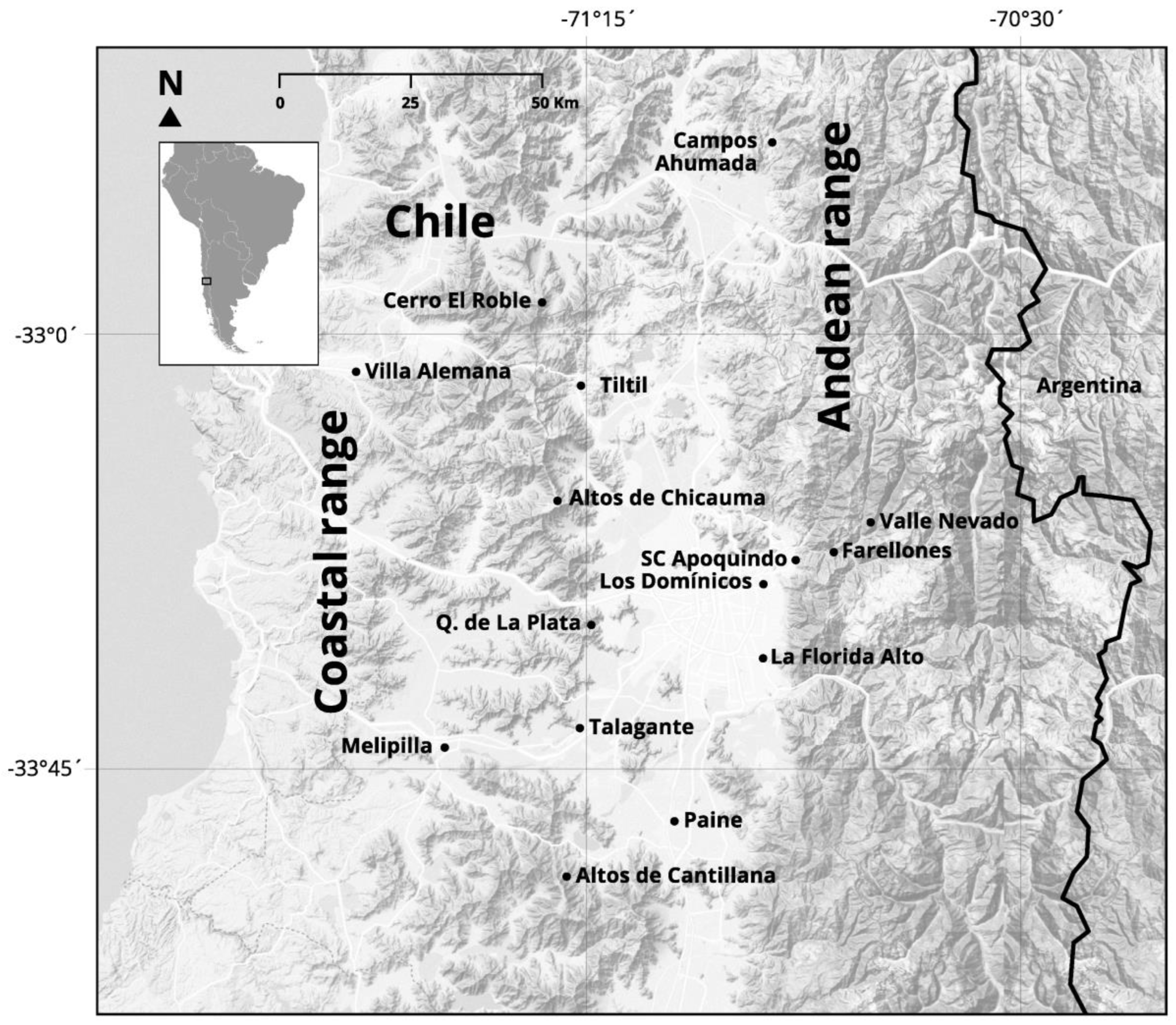
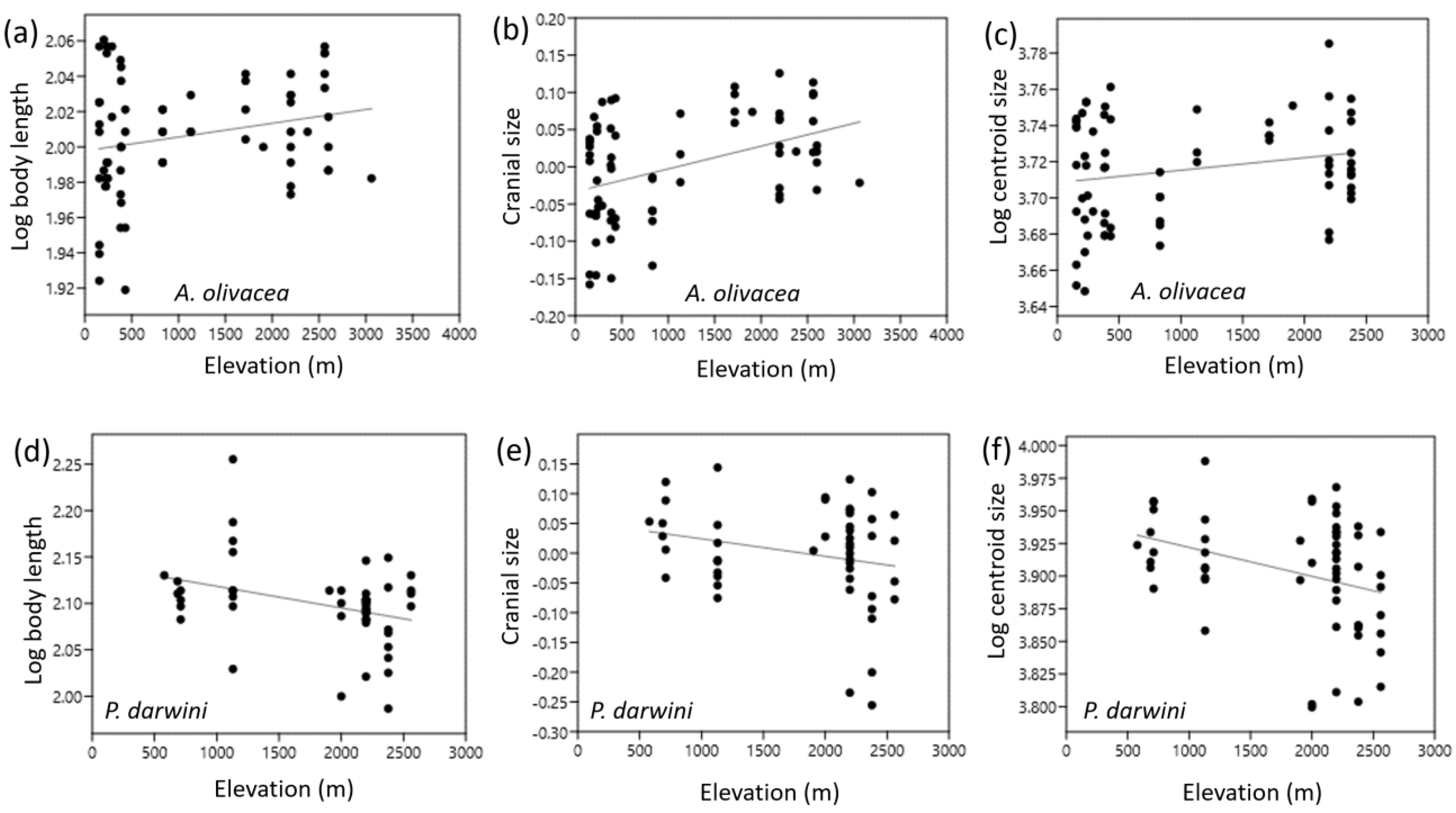
Two ecogeographic rules predict morphological changes along latitudinal clines based on thermoregulatory causes. To maintain corporal heat in cold environments (higher latitudes), larger body sizes and shorter appendages and limbs are predicted by Bergmann’s and Allen’s rules, respectively. Both rules may also apply to elevational gradients, due to the decrease in external temperature as elevation increases. We evaluated whether these ecogeographic rules were true in two rodent species across an elevational gradient in central Chile. The species studied were Abrothrix olivacea and Phyllotis darwini, which coexist across this altitudinal range. Our results showed a low support for these rules, as well as an opposite body size trend between both species. Other than morphology, physiological and behavioral strategies could be more critical to thermoregulating in high, montane environments, and new hypotheses should be tested to explain the morphological changes that we observed in this study.
Abstract
Bergmann’s and Allen’s rules are two classic ecogeographic rules concerning the physiological mechanisms employed by endotherm vertebrates for heat conservation in cold environments, which correlate with adaptive morphological changes. Thus, larger body sizes (Bergmann’s rule) and shorter appendages and limbs (Allen’s rule) are expected in mammals inhabiting cold environments (higher latitudes). Both rules may also apply to elevational gradients, due to the decrease in external temperature as elevation increases. In this study, we evaluated whether these patterns were true in two coexisting sigmodontine rodents across an elevational gradient in central Chile. We analyzed whether the size of the skull, body, and appendages of Abrothrix olivacea (n = 70) and Phyllotis darwini (n = 58) correlated with elevation, as predicted by these rules in a range between 154 and 2560 m. Our data revealed weak support for the Bergmann and Allen predictions. Moreover, we observed opposite patterns when expectations of Bergmann’s rules were evaluated, whereas Allen’s rule just fitted for ear size in both rodent species. Our results suggest that morphological changes (cranial, body, and appendage sizes) may play a minor role in the thermoregulation of these two species at high elevations, although behavioral strategies could be more critical. Other ecological and environmental variables could explain the morphological trends observed in our study. These hypotheses should be assessed in future studies to consider the relative contribution of morphology, behavior, and physiological mechanisms to the thermal adaptation of these two rodent species at high elevations.
Keywords:
Allen’s rule; Bergmann’s rule; elevation; morphometrics; small mammals