Evaluating the Presence of Disgust in Animals

School of Psychological Sciences, Macquarie University, Sydney, NSW 2109, Australia
*
Author to whom correspondence should be addressed.
Animals 2024, 14(2), 264; https://doi.org/10.3390/ani14020264
Submission received: 1 December 2023
/
Revised: 12 January 2024
/
Accepted: 13 January 2024
/
Published: 15 January 2024
(This article belongs to the Special Issue Interrelationships between Animal Behaviors and Control of Diseases)
Simple Summary
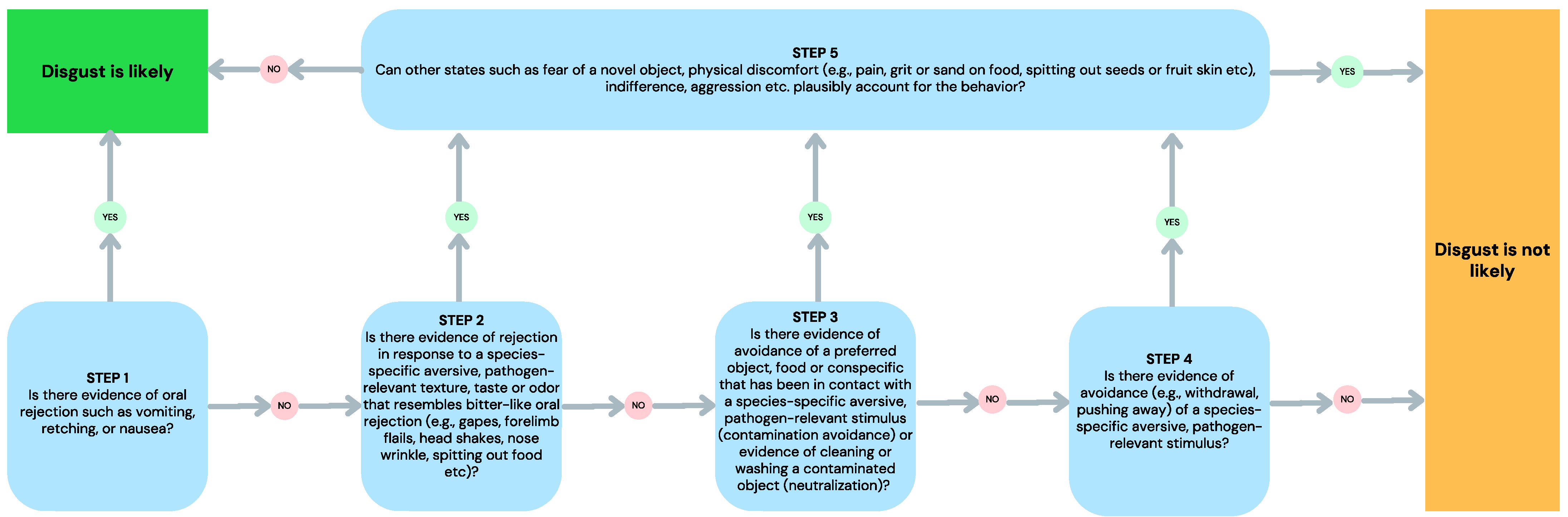
It has been argued that the emotion of disgust is unique to humans. The limited research on this question suggests that animals experience some form of disgust, although the extent remains unclear. To assist researchers in evaluating evidence of disgust in animals, we introduce a disgust decision tree that takes into account alternative explanations for avoidance behavior. This framework is applied to several animal examples. While there is evidence for disgust in animals, we acknowledge that there is a notable difference, even between disgust in humans and other great apes. We explore some of the reasons for this difference and raise the possibility that heightened human disgust may be a recent cultural development.
Abstract
The emotion of disgust in humans is widely considered to represent a continuation of the disease-avoidance behavior ubiquitous in animals. The extent to which analogs of human disgust are evident in nonhuman animals, however, remains unclear. The scant research explicitly investigating disgust in animals has predominantly focused on great apes and suggests that disgust might be present in a highly muted form. In this review, we outline the main approaches to disgust. We then briefly discuss disease-avoidance behavior in nonhuman animals, proposing a set of criteria against which evidence for the presence or absence of disgust in animals can be evaluated. The resultant decision tree takes into account other plausible causes of avoidance and aversion when evaluating whether it is likely that the behavior represents disgust. We apply this decision tree to evaluate evidence of disgust-like behavior (e.g., avoidance of carrion and avoidance of feces-contaminated food) in several examples, including nonhuman great apes. Finally, we consider the large disparity between disgust in humans compared to muted disgust in other great apes, examining the possibility that heightened disgust in humans is a relatively recent cultural acquisition.
Keywords:
continuity; pathogens; disease avoidance; contamination; great apes; decision tree