Testing the Accuracy of Wearable Technology to Assess Sleep Behaviour in Domestic Dogs: A Prospective Tool for Animal Welfare Assessment in Kennels
by
 and
and
Ivana Gabriela Schork
1,
Isabele Aparecida Manzo
2,
Marcos Roberto Beiral de Oliveira
2,
Fernanda Vieira Costa
3,
Robert John Young
1 and
Cristiano Schetini De Azevedo
2,* 1
School of Sciences, Engineering & Environment, Peel Building, University of Salford, Manchester M5 4WT, UK
2
Departamento de Evolução, Biodiversidade e Meio Ambiente, Instituto de Ciências Exatas e Biológicas, Universidade Federal de Ouro Preto, Campus Morro do Cruzeiro, s/n, Bauxita, Ouro Preto 35400-000, Minas Gerais, Brazil
3
Departamento de Ecologia, Instituto de Ciências Biológicas, Bloco E, s/n, Universidade de Brasília, Campus Darcy Ribeiro, Asa Norte, Brasília 70910-900, Distrito Federal, Brazil
*
Author to whom correspondence should be addressed.
Animals 2023, 13(9), 1467; https://doi.org/10.3390/ani13091467
Submission received: 13 March 2023
/
Revised: 7 April 2023
/
Accepted: 24 April 2023
/
Published: 26 April 2023
(This article belongs to the Special Issue Behavior and Welfare of Canids)
Simple Summary
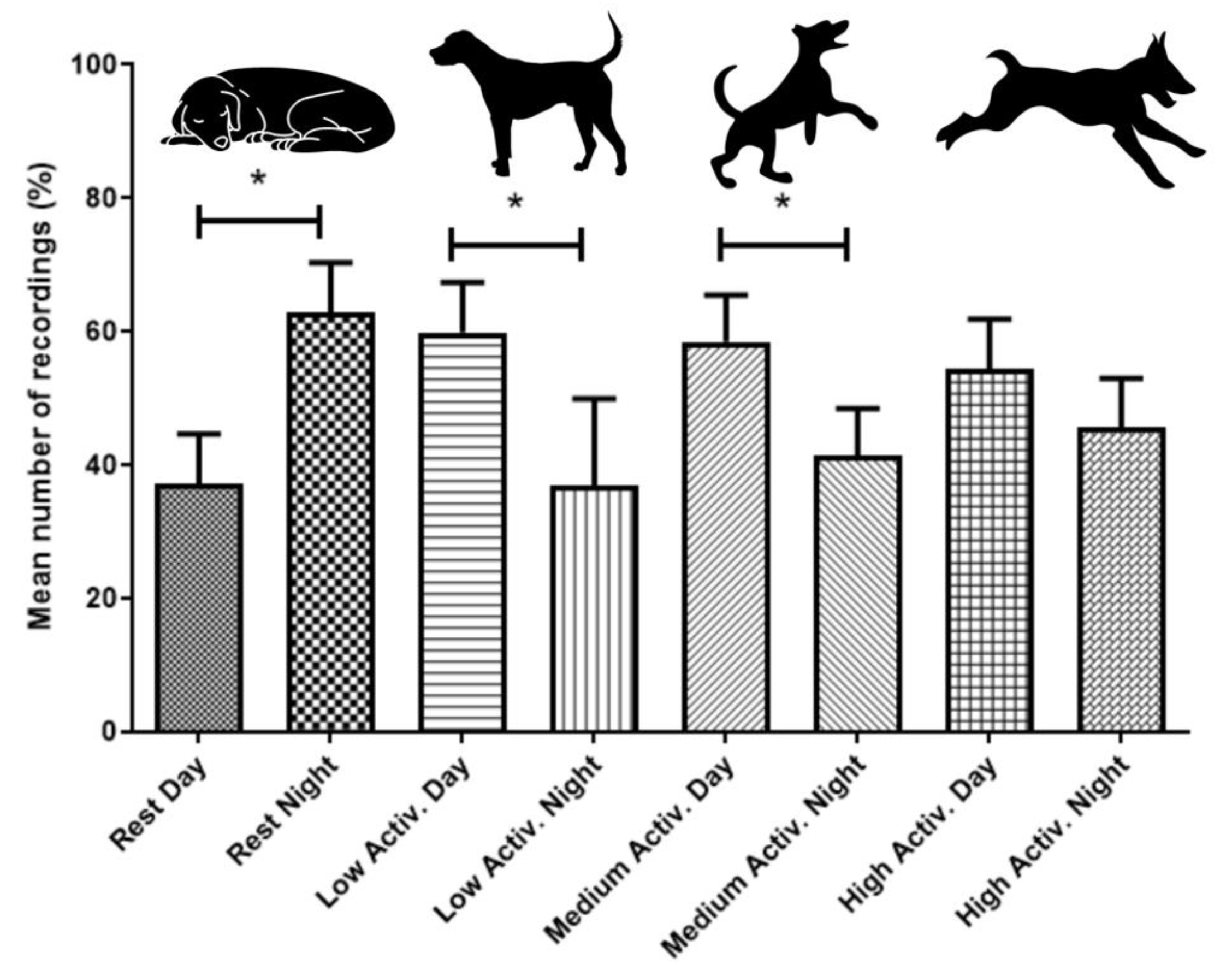
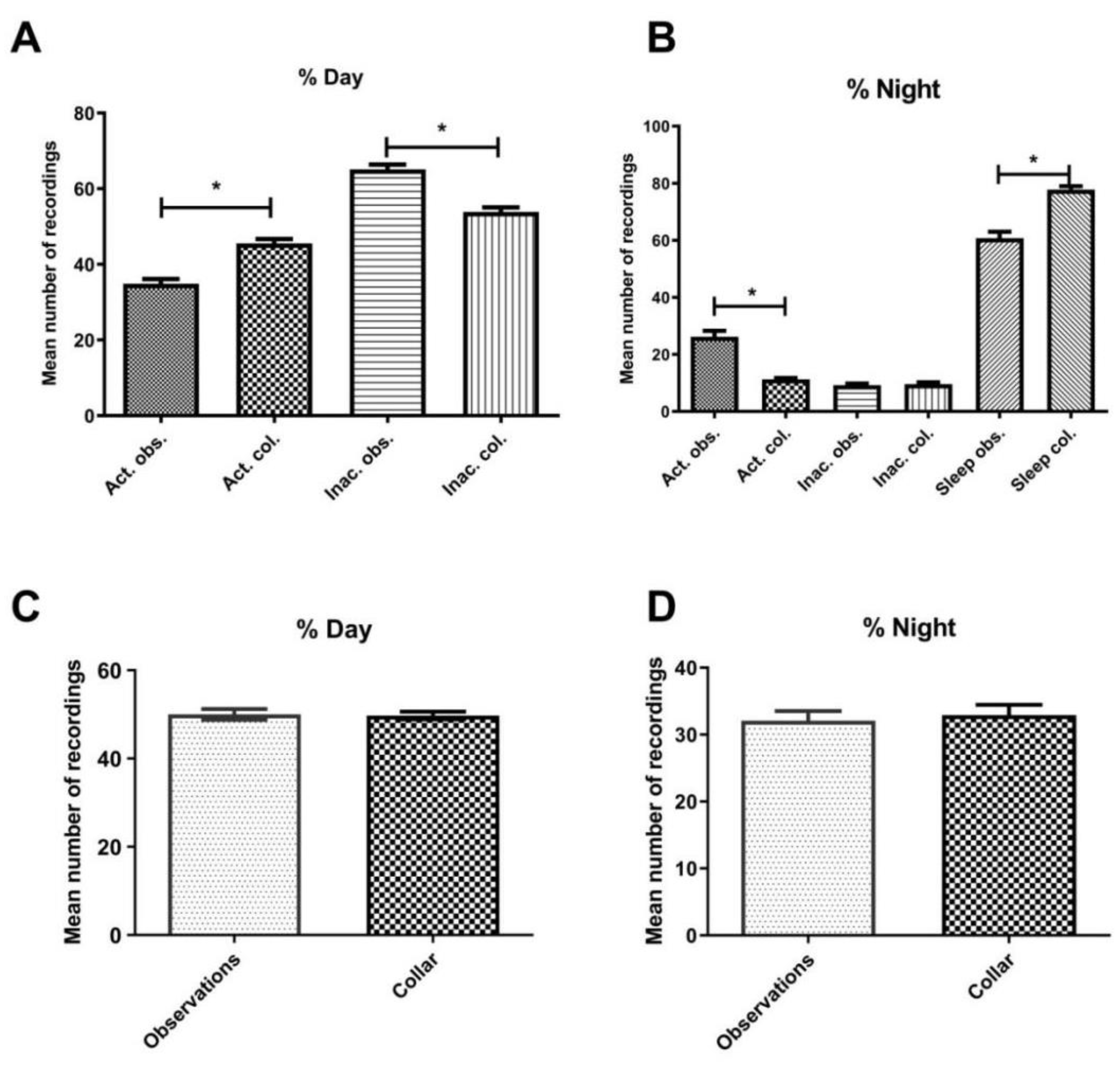
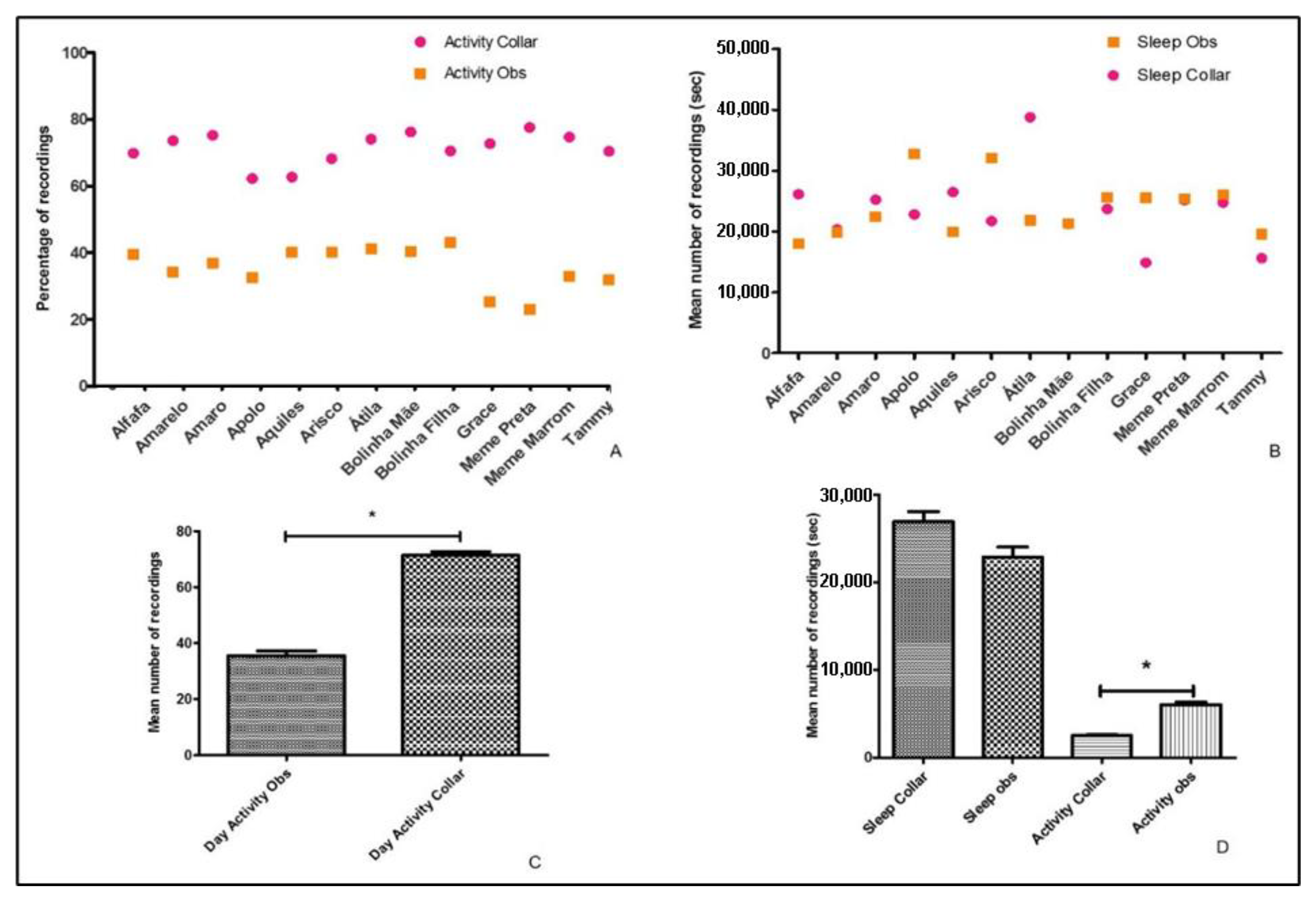
Quality and quantity of sleep can be, potentially, used as an animal welfare indicator. However, sleep data collection can be difficult, since it often involves animal manipulation, which can disrupt sleep patterns. Thus, it is important to test new, non-invasive, methodologies to measure sleep. Wearable technologies are now being tested in sleep studies. However, data recorded by wearable technologies need to be validated by comparisons with data collected using standard methods of behavioural recording. In this paper, we tested the accuracy of wearable technology to investigate sleep behaviour in domestic dogs. To acquire behaviour and physiological data from the dogs, the study used a smart-sensing collar from the brand PetPace™. Behavioural data collected by the collar were compared with data collected using focal sampling with instantaneous recording every 30 s for 20 days. Comparisons between methods showed differences in certain behaviours, such as inactivity and activity for diurnal recordings. Despite this, total activity and total sleep recorded were similar between methods. Overall, the used wearable technology shows potential to be a useful, and a less-time consuming, tool for the evaluation of behaviours and for the assessment of wellbeing in dogs.
Abstract
Sleep is a physiological process that has been shown to impact both physical and psychological heath of individuals when compromised; hence, it has the potential to be used as an indicator of animal welfare. Nonetheless, evaluating sleep in non-human species normally involves manipulation of the subjects (i.e., placement of electrodes on the cranium), and most studies are conducted in a laboratory setting, which limits the generalisability of information obtained, and the species investigated. In this study, we evaluated an alternative method of assessing sleep behaviour in domestic dogs, using a wearable sensor, and compared the measurements obtained to behavioural observations to evaluate accuracy. Differences between methods ranged from 0.13% to 59.3% for diurnal observations and 0.1% to 95.9% for nocturnal observations for point-by-point observations. Comparisons between methods showed significant differences in certain behaviours, such as inactivity and activity for diurnal recordings. However, total activity and total sleep recorded did not differ statistically between methods. Overall, the wearable technology tested was found to be a useful, and a less-time consuming, tool in comparison to direct behavioural observations for the evaluation of behaviours and their indication of wellbeing in dogs. The agreement between the wearable technology and directly observed data ranged from 75% to 99% for recorded behaviours, and these results are similar to previous findings in the literature.
Keywords:
sleep; PetpaceTM collar; physiology; wellbeing