



Environmental and Breed Risk Factors Associated with the Prevalence of Subclinical Mastitis in Dual-Purpose Livestock Systems in the Arauca Floodplain Savannah, Colombian Orinoquia

 , , and
Simple Summary
Abstract
1. Introduction
2. Materials and Methods
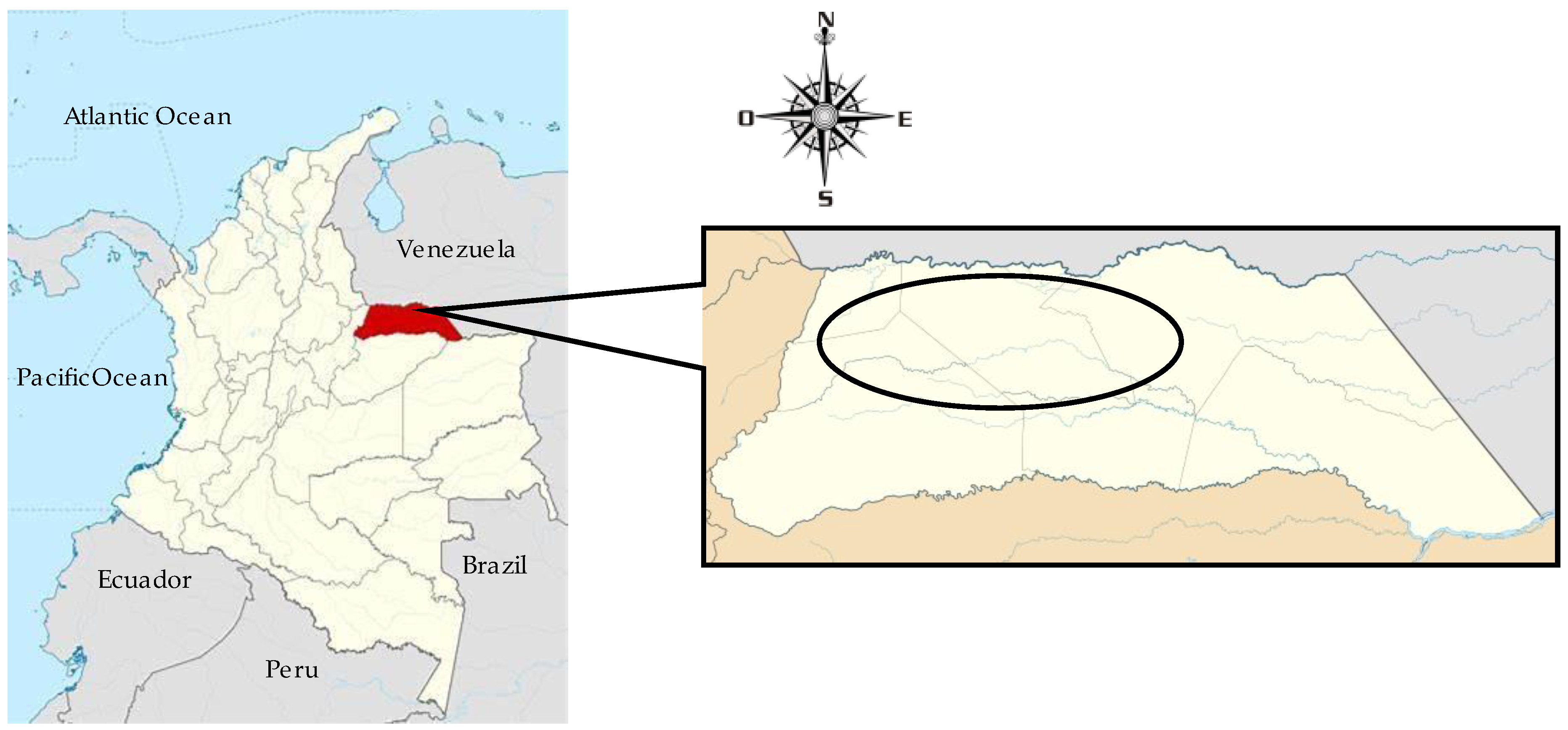
2.1. Study Area
2.2. Evaluated Animals
- Taurus-Indicus (F1 cows Zebu x Holstein, Zebu x Brown Swiss, Zebu x Norman, and Zebu x Simental; n = 275)
- Indicus predominance (Cows with a phenotype higher than 50% Indicus of the Gyr, Guzerat, and Brahman breeds; n = 184)
- Composite breed (Gyrolando breed cows). The Gyrolando breed is a composite breed resulting from the cross between the Holstein breed (Bos taurus) and the Gyr breed (Bos indicus), with a racial pattern in grade 5/8 Holstein + 3/8 Gyr (n = 22).
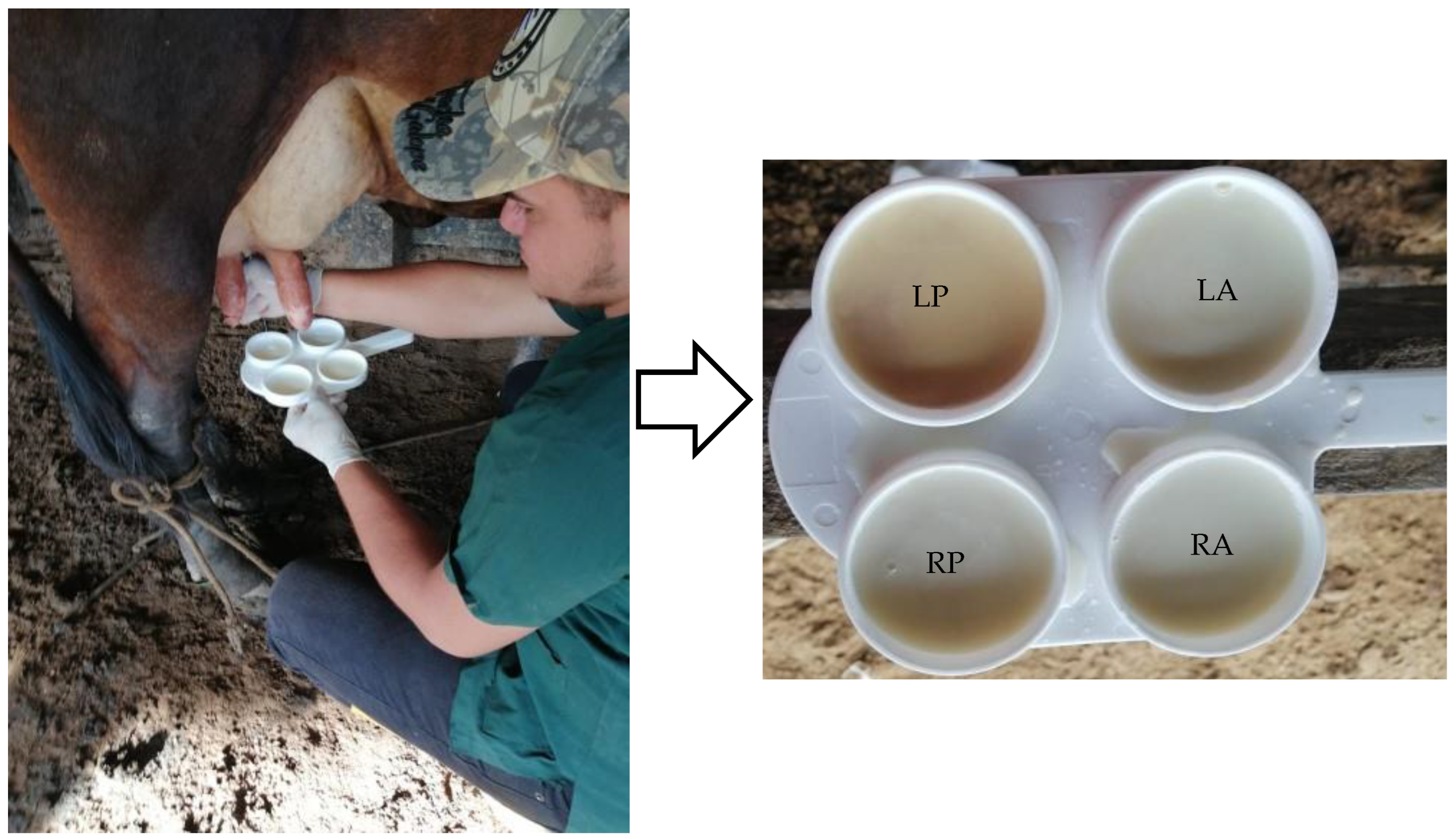
2.3. California Mastitis Test (CMT)
2.4. Prevalence Determination
- Cow-level prevalence = (number of positive cows/total number of sampled cows) × 100
- Prevalence at the level of total mammary quarters = (total number of positive mammary quarters/total number of sampled mammary quarters) × 100
- Prevalence at the level of the mammary quarter by position = (total number of positive mammary quarters per position/total number of mammary quarters per position) × 100
2.5. Statistical Analysis
| Ni = | i-th modeled probability of having SCM-positive animals |
| π = | odds ratio: (1 − π) probability of not having the presence of SCM |
| M = | slope |
| X1 = | effect of the age variable (3 to 10 years) |
| X2 = | effect of the milk production variable (2 to 12 L) |
| X3 = | effect of the lactation month variable (1 to 7) |
| X4 = | effect of the body condition variable (1 to 5) |
| X5 = | effect of the climatic period variable (rainy and dry) |
| X6 = | effect of the number of cows variable (1 = 7 to 16 cows; 2 = 17 to 26 cows; 3 ≥ 26 cows) |
| X7 = | effect of the breed variable (1 = Taurus-Indicus; 2 = Indicus predominance; 3 = composite breed) |
| X8 = | effect of the calving number variable (1 to 8) |
| εi = | accumulated error |
| βi = | regression coefficients associated with each independent variable. |
3. Results
4. Discussion
5. Conclusions
Author Contributions
Funding
Institutional Review Board Statement
Informed Consent Statement
Data Availability Statement
Acknowledgments
Conflicts of Interest
References
- Mera, R.; Muñoz, M.; Artieda, J.; Ortíz, P.; González, R.; Vega, V. Mastitis bovina y su repercusión en la calidad de la leche. Rev. Elect. Vat. 2017, 18, 1–16. [Google Scholar]
- Cuenca-Condoy, M.; García-Bracho, D.; Reinoso-García, L.; González-Rojas, J.; Torracchi-Carrasco, J. Detección de Mastitis Subclínica Bovina y factores asociados, en fincas lecheras de la Provincia del Cañar—Biblián, Ecuador. Rev. Cientif. FCV-LUZ 2021, 31, 93–97. [Google Scholar] [CrossRef] [Scilit]
- Girma, A.; Tamir, D. Prevalence of Bovine Mastitis and Its Associated Risk Factors among Dairy Cows in Ethiopia during 2005–2022: A Systematic Review and Meta-Analysis. Vet. Med. Int. 2022, 2022, 7775197. [Google Scholar] [CrossRef] [Scilit] [PubMed]
- Ndahetuye, J.B.; Twambazimana; Nyman, A.-K.; Karege, C.; Tukei, M.; Ongol, M.P.; Persson, Y.; Båge, R. A cross sectional study of prevalence and risk factors associated with subclinical mastitis and intramammary infections, in dairy herds linked to milk collection centers in Rwanda. Med. Vet. Prev. 2020, 179, 105007. [Google Scholar] [CrossRef] [Scilit]
- Oliveira, C.; Sousa, M.; Silva, N.; Mendonça, C.; Silveira, J.; Oaigen, R.; Andrade, S.; Barbosa, J. Prevalência e etiologia da mastite bovina na bacia leiteira de Rondon do Pará, estado do Pará. Pesq. Vet. Bras. 2011, 31, 104–110. [Google Scholar] [CrossRef] [Scilit]
- Viguier, C.; Arora, S.; Gilmartin, N.; Welbeck, K.; O’Kennedy, R. Mastitis detection: Current trends and future perspectives. Trends Biotechnol. 2009, 27, 486–493. [Google Scholar] [CrossRef] [Scilit] [PubMed]
- Bardhan, D. Estimates of economic losses due to clinical mastitis in organized dairy farms. Indian J. Dairy Sci. 2013, 66, 168–172. [Google Scholar]
- Sinha, M.K.; Thombare, N.N.; Monddal, B. Subclinical Mastitis in Dairy Animals: Incidence, Economics, and Predisposing Factors. Sci. World J. 2014, 15, 1–4. [Google Scholar] [CrossRef] [Scilit]
- Steeneveld, W.; Hogeveen, H.; Barkema, H.W.; Van Den Broek, J.; Huirne, R.B.M. The Influence of Cow Factors on the Incidence of Clinical Mastitis in Dairy Cows. J. Dairy Sci. 2008, 91, 1391–1402. [Google Scholar] [CrossRef] [Scilit]
- Kebebew, G.; Jorga, E. Prevalence and risk factors of bovine mastitis in Ambo town of West Shewa Zone, Oromia, Ethiopia. Ethiop. Vet. J. 2016, 20, 123–134. [Google Scholar] [CrossRef] [Scilit]
- Akter, S.; Rahman, M.; Sayeed, A.; Islam, N.; Hossain, D.; Hoque, A.; Koop, G. Prevalence, aetiology and risk factors of subclinical mastitis in goats in Bangladesh. Small Rumin. Res. 2020, 184, 106046. [Google Scholar] [CrossRef] [Scilit]
- Schukken, Y.H.; Barb, D.; Hertl, J.; Gröhn, Y.T. Correlated time to event data: Modeling repeated clinical mastitis data from dairy cattle in New York State. Prev. Vet. Med. 2010, 97, 150–156. [Google Scholar] [CrossRef] [Scilit] [PubMed]
- Ali, W.; Yaqoob, M.; Arshad, A.; Dai, G.; Ullah, S.; Arshad, M.; Ullah, I.; Ullah, I. Bacterial and antibiotic profile of mastitic milk of beetal goat in District Jhelum. Pak. J. Zool. 2021, 53, 1–5. [Google Scholar] [CrossRef] [Scilit]
- Olivares-Pérez, J.; Kholif, A.E.; Rojas-Hernández, S.; Elghandour, M.M.; Salem, A.Z.M.; Bastida, A.Z.; Velázquez-Reynoso, D.; Cipriano-Salazar, M.; Camacho-Díaz, L.M.; Alonso-Fresan, M.U.; et al. Prevalence of bovine subclinical mastitis, its etiology and diagnosis of antibiotic resistance of dairy farms in four municipalities of a tropical region of Mexico. Trop. Anim. Health Prod. 2015, 47, 1497–1504. [Google Scholar] [CrossRef] [Scilit] [PubMed]
- Mesele, F.; Leta, S.; Amenu, K.; Abunna, F. Occurrence of Escherichia Coli O157:H7 in lactating cows and dairy farm environment and the antimicrobial susceptibility pattern at adami Tulu Jido Kombolcha District, Ethiopia. BMC Vet. Res. 2023, 19, 6. [Google Scholar] [CrossRef] [Scilit]
- Insua, D.A.; Oses, R.R.; Saura, G.G.; Pedraza, M.A. Impacto de la humedad relativa mínima en la prevalencia de mastitis subclinica bovina utilizando regresión lineal. Rev. Elect. Vet. 2010, 11, 1–9. [Google Scholar]
- Ramírez Sánchez, J.M. Prevalencia y factores predisponentes a mastitis subclínica en establos lecheros de la provincia de Trujillo. Rev. CEDAMAZ 2015, 5, 12–23. [Google Scholar]
- Ranasinghe, R.M.S.B.K.; Deshapriya, R.M.C.; Abeygunawardana, D.I.; Rahularaj, R.; Dematawewa, C.M.B. Subclinical mastitis in dairy cows in major milk-producing areas of Sri Lanka: Prevalence, associated risk factors, and effects on reproduction. J. Dairy Sci. 2021, 104, 12900–12911. [Google Scholar] [CrossRef] [Scilit]
- Ormaza Montenegro, D.J.; Rueda Abad, R.J.; Huera Ordóñez, D.S.; Ibarra Rosero, E.M. Mastitis bovina en el cantón Montúfar-Carchi. Prevalencia, agente causal y factores de riesgo. AXIOMA—Rev. Científ. Investig. Docenc. Proyec. Soc. 2021, 1, 5–10. [Google Scholar]
- Murphy, S.; Martin, N.; Barbano, D.; Wiedmann, M. Influence of raw milk quality on processed dairy products: How do raw milk quality test results relate to product quality and yield? J. Dairy Sci. 2016, 99, 10128–10149. [Google Scholar] [CrossRef] [Scilit]
- Mekonnen, S.A.; Koop, G.; Melkie, S.T.; Getahun, C.D.; Hogeveen, H.; Lam, T. Prevalence of subclinical mastitis and associated risk factors at cow and herd level in dairy farms in North-West Ethiopia. Prev. Vet. Med. 2017, 145, 23–31. [Google Scholar] [CrossRef] [Scilit] [PubMed]
- Deb, R.; Kumar, A.; Chakraborty, S.; Kumar Verma, A.; Tiwuari, R.; Dhama, K.; Singh, U.; Kumar, S. Trends in Diagnosis and Control of Bovine Mastitis: A review. Pakist. J. Biol. Sci. 2013, 16, 1653–1661. [Google Scholar] [CrossRef] [Scilit] [PubMed]
- Badiuzzaman, M.; Samad, M.A.; Siddiki, S.H.M.F.; Islam, M.T.; Saha, S. Subclinical mastitis in lactating cows: Comparison of four screening tests and effect of animal factors on its occurrence. Bangl. J. Vet. Med. 2015, 13, 41–50. [Google Scholar] [CrossRef] [Scilit]
- Maldonado-Arias, D.F.; Santos-Calderón, C.R.; Quilapanta-Guamán, A.E.; Mena-Miño, L.A. Diagnosis of Subclinical Mastitis Using Three Methods for Control and Treatment. Dom. Cien. 2022, 8, 773–790. [Google Scholar]
- Sanford, C.J.; Keefe, G.P.; Sanchez, J.; Dingwell, R.T.; Barkema, H.W.; Leslie, K.E.; Dohoo, I.R. Test characteristics from latent-class models of the California Mastitis Test. Prev. Vet. Med. 2006, 77, 96–108. [Google Scholar] [CrossRef] [Scilit] [PubMed]
- Bedoya, C.C.; Castañeda, V.H.; Wolter, W. Métodos de detección de la mastitis bovina. Rev. Elect. Vet. 2007, 8, 1–17. [Google Scholar]
- Gómez-Quispe, O.E.; Santivañez-Ballón, C.S.; Arauco-Villa, F.; Espezua-Flores, O.H.; Manrique-Meza, J. Criterios de Interpretación para California Mastitis Test en el Diagnóstico de Mastitis Subclínica en Bovinos. Rev. Investig. Vet. Perú 2015, 26, 86–95. [Google Scholar] [CrossRef] [Scilit]
- Hoque, M.N.; Das, Z.C.; Talukder, A.K.; Alam, M.S.; Rahman, A.N. Different screening tests and milk somatic cell count for the prevalence of subclinical bovine mastitis in Bangladesh. Trop. Anim. Health Prod. 2014, 47, 79–86. [Google Scholar] [CrossRef] [Scilit]
- Mellenberger, R.; Roth, C.J. Hoja de Información de la Prueba de Mastitis California (CMT). 2000. Available online: https://bit.ly/43iegJq (accessed on 23 December 2022).
- NMC. Laboratory Handbook on Bovine Mastitis, 3rd ed.; National Mastitis Council, Inc.: New Prague, MN, USA, 2017; p. 151. [Google Scholar]
- Philpot, W.N.; Nickerson, S.N. Winning the Fight against Mastitis; Westfalia Surge, Inc.: Naperville, IL, USA, 2001; p. 192. [Google Scholar]
- Guízar, J.I.; Bedolla, J.L.C. Determinación de la prevalencia de mastitis bovina en el municipio de Tarímbaro, Michoacán, mediante la prueba de California. Rev. Electrón. Vet. 2008, 9, 1–35. [Google Scholar]
- AL-Edany, A.A.; Khudor, M.H.; AL-Mousawi, K.S. Comparison of three indirect tests for the diagnosis of bovine subclinical mastitis caused by coagulase negative staphylococci with their susceptibility to seven antibiotics. Bas. J. Vet. Res. 2012, 11, 75–83. [Google Scholar] [CrossRef] [Scilit]
- Hernández, J.M.; Bedoya, J.L. Importancia del conteo de células somáticas en la calidad de la leche. Rev. Elect. Vet. 2008, 9, 1–35. [Google Scholar]
- Kivaria, F.M.; Noordhuizen, J.P.; Nielen, M. Interpretation of California mastitis test scores using Staphylococcus aureus culture results for screening of subclinical mastitis in low yielding smallholder dairy cows in the Dar es Salaam region of Tanzania. Prev. Vet. Med. 2007, 78, 274–285. [Google Scholar] [CrossRef] [Scilit]
- Salamanca Carreño, A.; Vélez-Terranova, M.; Tamasaukas, R.; Jáuregui-Jiménez, R.; Parés-Casanova, P.M.; Arias-Landazábal, J.N. Assessment of the Prevalence of Subclinical Mastitis in Dual Purpose Livestock System of Colombian Orinoquia: On-Farm Diagnostic Tests Comparison. Preprints. Org 2023, 2023040902, 1–16. [Google Scholar]
- IDEAM—Instituto de Hidrología, Meteorología y Estudios Ambientales. Información Aeronáutica. Climatología. Available online: http://bart.ideam.gov.co/cliciu/arauca/precipitacion.htm (accessed on 23 December 2022).
- Arauca. Clima: Arauca, Aeropuerto Santiago Pérez (En línea). Available online: https://es.allmetsat.com/clima/venezuela.php?code=80099 (accessed on 3 October 2023).
- López, J.; Vaccaro, L. Comportamiento productivo de cruces Holstein Friesian-cebú comparados con Pardo Suizo-cebú en sistemas de doble propósito en tres zonas de Venezuela. Zoot. Trop. 2002, 20, 397–414. [Google Scholar]
- Sheen, S.; Riesco, A. Factores que afectan la producción de leche en vacas de doble propósito en el trópico húmedo (Pucallpa). Rev. Investig. Vet. Perú. 2002, 13, 25–31. [Google Scholar]
- Manterola, C.; Otzen, T. Valoración Clínica del Riesgo, Interpretación y Utilidad Práctica. Int. J. Morphol. 2015, 33, 842–849. [Google Scholar] [CrossRef] [Scilit]
- Santivañez-Ballón, C.S.; Gómez-Quispe, O.E.; Cárdenas-Villanueva, L.A.; Escobedo-Enríquez, M.H.; Bustinza-Cardenas, R.H.; Peña-Sánchez, J. Prevalencia y factores asociados a la mastitis subclínica bovina en los Andes peruanos. Vet. Zoot. 2013, 7, 92–104. [Google Scholar] [CrossRef] [Scilit]
- Edmonson, A.J.; Lean, I.J.; Weaver, L.D.; Farver, T.; Webster, G. A Body Condition Scoring Chart for Holstein Dairy Cows. J. Dairy Sci. 1989, 71, 68–78. [Google Scholar] [CrossRef] [Scilit]
- Taucher, E. Bioestadística; Editorial Universitaria: Santiago de Chile, Chile, 1997; p. 310. [Google Scholar]
- InfoStat. InfoStat Versión 2020. Manual del Usuario. Universidad Nacional de Córdoba, Argentina. 2020. Available online: https://www.infostat.com.ar/index.php?mod=page&id=46 (accessed on 12 June 2023).
- Sarker, S.C.; Parvin, M.S.; Rahman, A.K.M.; Islam, M.T. Prevalence and risk factors of subclinical mastitis in lactating dairy cows in north and south regions of Bangladesh. Trop. Anim. Health Prod. 2013, 45, 1171–1176. [Google Scholar] [CrossRef] [Scilit]
- Sanotharan, N.; Pagthinathan, M.; Nafees, M.S.M. Prevalence of bovine subclinical mastitis and its association with bacteria and risk factors in milking cows of Batticaloa district in Sri Lanka. Int. J. Sci. Res. Innov. Technol. 2016, 3, 137–150. [Google Scholar]
- Rahularaj, R.; Deshapriya, R.M.C.; Ranasinghe, K.M.S.B.K. Influence of bovine sub-clinical mastitis and associated risk factors on calving interval in a population of crossbred lactating cows in Sri Lanka. Trop. Anim. Health Prod. 2019, 51, 2413–2419. [Google Scholar] [CrossRef] [Scilit] [PubMed]
- Sánchez Herencia, D.; Mamani-Mango, G.D. Mastitis subclínica bovina y factores de riesgo ambientales en pequeños productores de ganado lechero criado en alta montaña. Rev. Investig. Vet. Perú 2022, 33, e20466. [Google Scholar] [CrossRef] [Scilit]
- Mojica, J.; Jaramillo, D. Prevalencia de mastitis subclínica en sistemas de producción bovina doble propósito de la vereda Matepiña del municipio de Arauca. Rev. Sist. Prod. Agroecol. 2014, 5, 126–142. [Google Scholar] [CrossRef] [Scilit]
- Bari, M.S.; Rahman, M.M.; Persson, Y.; Derks, M.; Sayeed, M.A.; Hossain, D.; Singha, S.; Hoque, M.A.; Sivaraman, S.; Fernando, P.; et al. Subclinical mastitis in dairy cows in south-Asian countries: A review of risk factors and etiology to prioritize control mmastitis in dairy cows in south-Asian countries: A review of risk factors and etiology to prioritize control measures. Vet. Res. Commun. 2022, 46, 621–640. [Google Scholar] [CrossRef] [Scilit] [PubMed]
- Begum, M.; Hossain, M.; Ershaduzzaman, M.; Islam, M.; Rana, M. Study on prevalence and risk factors of subclinical mastitis in lactating dairy cows in rajshahi and rangpur division of Bangladesh. Wayamba J. Anim. Sci. 2015, 14, 1129–1137. [Google Scholar]
- Fesseha, H.; Mathewos, M.; Aliye, S.; Wolde, A. Study on Prevalence of Bovine Mastitis and Associated Risk Factors in Dairy Farms of Modjo Town and Suburbs, Central Oromia, Ethiopia. Vet. Med. Res. Rep. 2021, 12, 271–283. [Google Scholar] [CrossRef] [Scilit]
- Radostits, O.M.; Gay, C.C.; Hinchcliff, K.W.; Constable, P.D. Vet. Medic: A Text Book of the Disease of Cattle, Horses, Sheep, Pigs and Goats, 10th ed.; Mosby Elsevier Ltd.: Toronto, ON, Canada, 2007; p. 2156. [Google Scholar]
- Biffa, D.; Debela, E.; Beyene, F. Prevalence and Risk Factors of Mastitis in Lactating Dairy Cows in Southern Ethiopia. Int. J. Appl. Res. Vet. Med. 2005, 3, 189–198. [Google Scholar]
- Szyda, J.; Mielczarek, M.; Frąszczak, M.; Minozzi, G.; Williams, J.L.; Wojdak-Maksymiec, K. The Genetic Background of Clinical Mastitis in Holstein-Friesian Cattle. Animal 2019, 13, 2156–2163. [Google Scholar] [CrossRef] [Scilit]
- Santman-Berends, I.M.G.A.; Swinkels, J.M.; Lam, T.J.G.M.; Keurentjes, J.; van Schaik, G. Evaluation of udder health parameters and risk factors for clinical mastitis in Dutch dairy herds in the context of a restricted antimicrobial usage policy. J. Dairy Sci. 2016, 99, 2930–2939. [Google Scholar] [CrossRef] [Scilit]
- Muluye, M.; Alemayehu, K.; Gizaw, S. Milk production performances of local and crossbred dairy cows in West Gojam Zone, Amhara Region, Ethiopía. J. Appl. Sci. 2017, 10, 35–46. [Google Scholar]

| Total sampled cows | 481 | % | |
| Affected mammary quarters 1 | |||
| 1 | 85 | 17.7 | |
| 2 | 30 | 6.2 | |
| 3 | 14 | 2.9 | |
| 4 | 22 | 4.6 | |
| Positive cows | 151 | ||
| Cow-level prevalence | 31.4 | ||
| Total mammary quarters sampled | 1924 | % | |
| Positives | 275 | ||
| Prevalence at the level of total mammary quarters | 14.3 | ||
| Prevalence at the level of mammary quarters by position | |||
| Mammary quarters | n | Positives | |
| RP | 481 | 77 | 16.0 |
| LP | 481 | 64 | 13.3 |
| RA | 481 | 71 | 14.8 |
| LA | 481 | 63 | 13.1 |
| Variable | RP | LP | RA | LA | Positive Mammary Quarters | Positive Cows | Sampled Cows | % |
|---|---|---|---|---|---|---|---|---|
| Number of cows in production | ||||||||
| 7–16 cows | 26 | 20 | 23 | 27 | 96 | 60 | 153 | 39.2 |
| 17–26 cows | 25 | 26 | 33 | 23 | 107 | 53 | 194 | 27.3 |
| >26 cows | 26 | 18 | 15 | 13 | 72 | 37 | 134 | 27.6 |
| Daily milk production/cow | ||||||||
| 2 to 5 L | 41 | 33 | 41 | 33 | 148 | 78 | 237 | 32.9 |
| 6 to 12 L | 36 | 31 | 30 | 30 | 127 | 72 | 244 | 29.5 |
| Lactation month | ||||||||
| 1–3 months | 46 | 39 | 45 | 38 | 168 | 99 | 327 | 30.3 |
| More than 3 months | 31 | 25 | 26 | 25 | 107 | 51 | 154 | 33.1 |
| Cow age | ||||||||
| 3 and 4 years | 17 | 17 | 22 | 16 | 72 | 41 | 153 | 26.8 |
| 5 years | 29 | 21 | 21 | 24 | 95 | 50 | 153 | 32.7 |
| 6 or more years | 31 | 26 | 28 | 23 | 108 | 59 | 175 | 33.7 |
| Climatic period | ||||||||
| Rainy | 73 | 57 | 66 | 56 | 252 | 128 | 411 | 31.1 |
| Dry | 4 | 7 | 5 | 7 | 23 | 22 | 70 | 31.4 |
| Body condition | ||||||||
| 2.5–3.5 | 40 | 32 | 32 | 27 | 131 | 69 | 208 | 33.2 |
| 3.6–4.5 | 37 | 32 | 39 | 36 | 144 | 81 | 273 | 29.7 |
| Calving number | ||||||||
| 1 | 13 | 12 | 16 | 13 | 54 | 33 | 116 | 28.4 |
| 2 | 27 | 19 | 21 | 22 | 88 | 49 | 165 | 29.7 |
| 3 | 15 | 16 | 15 | 12 | 58 | 26 | 92 | 28.3 |
| >4 | 22 | 17 | 19 | 17 | 75 | 42 | 108 | 38.9 |
| Breed | ||||||||
| Taurus-Indicus | 43 | 43 | 44 | 36 | 166 | 93 | 275 | 33.8 |
| Indicus predominance | 27 | 16 | 24 | 24 | 91 | 46 | 184 | 25.0 |
| Composite breed | 7 | 5 | 3 | 3 | 18 | 11 | 22 | 50.0 |
| Regressor Variables | OR | Wald LI-LS (95%) | p-Value |
|---|---|---|---|
| Environmental factors | |||
| Age | 1.23 | 0.94–1.61 | NS |
| Calvings | 0.95 | 0.70–1.30 | NS |
| Lactation | 0.98 | 0.83–1.15 | NS |
| Body condition | 0.67 | 0.27–1.62 | NS |
| Period | 0.52 | 0.25–1.08 | NS |
| Number of cows a | |||
| 7 to 16 | 2.29 | 1.29–4.07 | 0.005 |
| 17 to 26 | 1.07 | 0.64–1.79 | NS |
| Milk production | 0.88 | 0.77–1.00 | 0.045 |
| Genetic factors | |||
| Breed b | |||
| Taurus-Indicus | 1.79 | 1.15–2.79 | 0.009 |
| Composite breed | 3.95 | 1.50–10.40 | 0.005 |
Disclaimer/Publisher’s Note: The statements, opinions and data contained in all publications are solely those of the individual author(s) and contributor(s) and not of MDPI and/or the editor(s). MDPI and/or the editor(s) disclaim responsibility for any injury to people or property resulting from any ideas, methods, instructions or products referred to in the content. |
© 2023 by the authors. Licensee MDPI, Basel, Switzerland. This article is an open access article distributed under the terms and conditions of the Creative Commons Attribution (CC BY) license (https://creativecommons.org/licenses/by/4.0/).
Share and Cite
Salamanca-Carreño, A.; Vélez-Terranova, M.; Barajas-Pardo, D.P.; Tamasaukas, R.; Jáuregui-Jiménez, R.; Parés-Casanova, P.M. Environmental and Breed Risk Factors Associated with the Prevalence of Subclinical Mastitis in Dual-Purpose Livestock Systems in the Arauca Floodplain Savannah, Colombian Orinoquia. Animals 2023, 13, 3815. https://doi.org/10.3390/ani13243815
Salamanca-Carreño A, Vélez-Terranova M, Barajas-Pardo DP, Tamasaukas R, Jáuregui-Jiménez R, Parés-Casanova PM. Environmental and Breed Risk Factors Associated with the Prevalence of Subclinical Mastitis in Dual-Purpose Livestock Systems in the Arauca Floodplain Savannah, Colombian Orinoquia. Animals. 2023; 13(24):3815. https://doi.org/10.3390/ani13243815
Chicago/Turabian StyleSalamanca-Carreño, Arcesio, Mauricio Vélez-Terranova, Diana Patricia Barajas-Pardo, Rita Tamasaukas, Raúl Jáuregui-Jiménez, and Pere M. Parés-Casanova. 2023. "Environmental and Breed Risk Factors Associated with the Prevalence of Subclinical Mastitis in Dual-Purpose Livestock Systems in the Arauca Floodplain Savannah, Colombian Orinoquia" Animals 13, no. 24: 3815. https://doi.org/10.3390/ani13243815
APA StyleSalamanca-Carreño, A., Vélez-Terranova, M., Barajas-Pardo, D. P., Tamasaukas, R., Jáuregui-Jiménez, R., & Parés-Casanova, P. M. (2023). Environmental and Breed Risk Factors Associated with the Prevalence of Subclinical Mastitis in Dual-Purpose Livestock Systems in the Arauca Floodplain Savannah, Colombian Orinoquia. Animals, 13(24), 3815. https://doi.org/10.3390/ani13243815

