Simple Summary
It is difficult to improve the reproductive performance of sheep (fecundity, fertility, and prolificacy) through the simple selection of animals that are outstanding due to phenotype. The genetic transmission of the reproductive performance to progeny is of low effectiveness for these types of traits, which is why traditional selection has not been successful. Presently, there is scarce information about the reproduction of Katahdin sheep and apparently no information about genes associated with reproductive traits. In this study, a genetic scan was conducted to detect genes associated with fecundity in Katahdin ewes. It was found that genes expressed in reproductive tissues tend to be reported frequently as candidates; that is, they are genes that directly influence the fecundity of ewes: CNOT11, GLUD1, GRID1, MAPK8, and CCL28. Other genes have indirect influence, for example, those that affect hormonal processes such as lipid synthesis: ADIRF, CCL28, and HMGCS1. New genes associated with the fecundity of Katahdin ewes are reported in this study.
Abstract
One of the strategies to genetically improve reproductive traits, despite their low inheritability, has been the identification of candidate genes. Therefore, the objective of this study was to detect candidate genes associated with fecundity through the fixation index (FST) and runs of homozygosity (ROH) of selection signatures in Katahdin ewes. Productive and reproductive records from three years were used and the genotypes (OvineSNP50K) of 48 Katahdin ewes. Two groups of ewes were identified to carry out the genetic comparison: with high fecundity (1.3 ± 0.03) and with low fecundity (1.1 ± 0.06). This study shows for the first time evidence of the influence of the CNOT11, GLUD1, GRID1, MAPK8, and CCL28 genes in the fecundity of Katahdin ewes; in addition, new candidate genes were detected for fecundity that were not reported previously in ewes but that were detected for other species: ANK2 (sow), ARHGAP22 (cow and buffalo cow), GHITM (cow), HERC6 (cow), DPF2 (cow), and TRNAC-GCA (buffalo cow, bull). These new candidate genes in ewes seem to have a high expression in reproduction. Therefore, future studies are needed focused on describing the physiological basis of changes in the reproductive behavior influenced by these genes.
1. Introduction
In Mexico, sheep (Ovis aries) are abundant in arid and temperate zones, where their meat is an important food source for families of scarce resources and consumers of traditional and festive dishes. However, more information is needed about the species to improve the reproductive characteristics of economic interest, such as fertility [1].
Fertility, fecundity, and prolificacy are the three key reproductive traits to attain sustainable sheep production [2,3]. Fecundity is the ability of animals to produce progeny and it is important in production systems, given that it impacts directly other traits such as prolificacy, number, and kilograms of weaned lambs and the total kilograms of meat produced [2,3,4]. Although in Mexico sheep of the Katahdin breed are not as abundant as those of the Pelibuey breed, the first stand out for their tolerance to heat and their high growth speed and weight gain [5,6]. In addition, it is a rustic breed with a high tolerance to parasites in comparison to wool sheep [6], and it has a prolificacy of 1.3 [7] with double and triple births [5].
Reproductive traits in sheep are of low inheritability, which is why selection by phenotype results in scarce annual genetic gain [8]. The identification of candidate genes is one of the strategies to improve these traits, and these genes are known as fecundity genes or Fec genes [9]. Three important genes have been identified that affect fecundity in ewes: BMPR1B gene or FecB (bone morphogenetic protein receptor, type 1B), BMP15 gene or FecX (bone morphogenetic protein 15), and GDF9 gene or FecG (growth differentiation factor 9) [9,10]. The GDF9 gene is expressed in the luteum tissue and in all the development stages of the ovarian follicle, and it directly influences the prolificacy of ewes; in addition, it has been shown that a total absence of its expression leads to infertility of the ewes [11].
In addition to the major genes, other genes associated with fecundity have been detected in different breeds of sheep, such as: PDGERL, FSHR, LEPR, KLF5, and PDGFRL (selection signature detection) [12]. Some other genes associated with prolificacy are: FLT1, CCL2 (classic GWAS, or Genome-Wide Association Study) [8], ODZ1, ODZ3, LTBP3, DSCAM [13], ESR1, GHR, ETS1, MMP15, FLI1, and SPP1 (classic GWAS) [14].
Because of this, it is necessary to explore more genetic mechanisms for fecundity in ewes through the identification of candidate genes. Given the genetic differences between breeds, the application of a GWAS is pertinent to find genes associated with fecundity [15]. There are different GWAS methodologies to find candidate markers: the classical GWAS or marker by marker [16]; the use of machine learning [17,18]; the retrospective association analysis [18]; and the most novel molecular methodology, the use of selection signatures [2,19].
Artificial (or natural) genetic selection has left a footprint in the genomes of animals; these footprints are known as selection signatures, which provide information about the domestication and evolution processes that resulted in the animal species and breeds currently known. There are selection signatures based on the construction of haplotypes that measure the similarity between DNA segments of two populations, such as haplotype homozygosity extended between populations (XP-EHH) and the hapFLK statistics. Other types of signatures based on the individual measure of marker diversity are fixation index, Tajima’s D, and runs of homozygosity (ROH) [20].
ROH are selection signatures widely used for candidate gene detection in small ruminants [20]. ROH are contiguous lengths of homozygous genotypes surrounding a favorable mutation [12,20] and are evidence of inbreeding. This kind of selection signature is used to detect haplotypes with high homozygosity throughout the population. In sheep it has helped to find candidate genes [12].
The objective of this study was to detect candidate genes associated with fecundity through the fixation index (FST) and run of homozygosity (ROH) of selection signatures in Katahdin ewes.
2. Materials and Methods
2.1. Ethical Declarations
Based on the regulations for the use and care of animals destined to research at Colegio de Postgraduados [21], 0.5 mL of blood was collected per ewe by puncture of the jugular vein with sterile syringe, under the criteria of the NOM-062-ZOO-1999 for technical specifications for the production, care, and use of laboratory animals [22]. These blood samples were used for genotyping of animals.
2.2. Phenotypes
Records from three years (2019–2021) of the number of offspring birthed per ewe by mounting were used as a measure of the fecundity of 48 Katahdin ewes from the Agricultural and Livestock Production Unit “Quinta San Francisco”, found in Hidalgo, Mexico, with coordinates 19°54′56″ N, 98°40′12″ W and altitude of 2500 m [23], with average age and number of births of 4.48 ± 1.28 years and 3.2 ± 1.31, respectively. In addition, the year of registry, age in years, body condition (1–5 scale), hours to estrus, and number of births per ewe were observed.
For the size of the sample used, the potency of the statistical test was determined using the pwr package [24] of R [25]. The entry values of the function in R were the size of the sample (48), the significance (0.5) and the method (Xi2).
To perform the statistical correction of the phenotypes, a logistic regression was used with the Gaussian model, with the use of the glm function of the stats package of R version 4.2.0 [25]. The year of the record, age in years, body condition, hours until estrus, and number of births were used as independent variables, and were tested via the Wald Xi2 test, and from them only the intercept of the model and body condition were statistically significant. The response variable was fecundity, measured as the number of offspring per mounting per year per ewe (0, 1 or 2 lambs). According to the results of the Wald Xi2 test, only the intercept of the model and body condition were incorporated in the adjustment of the final model (p < 0.05):
where y is the annual fecundity, is the intercept of the model, is the estimator associated with body condition, and is the body condition. The adjustment of the model obtained an accuracy of prediction of 75.4%. The phenotypes adjusted with this model were used to carry out the rest of the analyses.
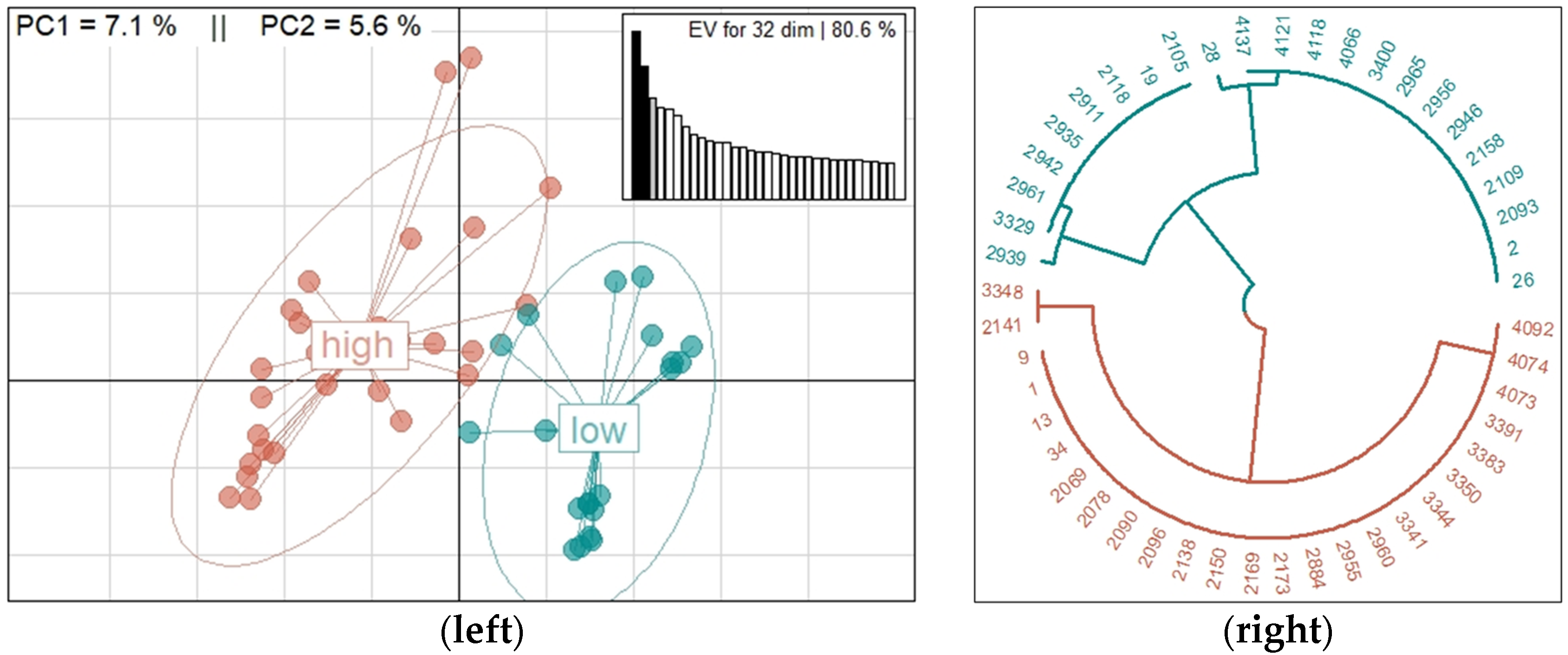
To verify the presence of two subpopulations in the population of Katahdin ewes (high and low fecundity), a hierarchical cluster analysis was conducted. The hierarchical grouping analysis was carried out using the Euclidian distances matrix of the phenotypes adjusted by the model, through the stats package [25], through the hclust and cutree functions, to classify the ewes into high and low fecundity. Finally, a circular dendrogram was constructed from the previous results using the circlize dendogram function of the dendextend R package [26], to observe 23 ewes classified as “high fecundity” and 25 as “low fecundity”.
A t-test was conducted to determine if there were differences (p < 0.05) between the means of fecundity in the subpopulations created; the t.test function of the stats package [25] for groups with non-homogeneous variance was used.
2.3. Genotypes
Blood samples from 48 Katahdin ewes were genotyped with the Illumina OvineSNP 50K chip (NEOGEN, Lincoln, NE, U.S.A., https://www.neogen.com/, accessed on 23 March 2022). For the quality control of genotypes (51,867 markers), the following single nucleotide or punctual (SNP) polymorphisms were eliminated: with a level of frequency of allele lower than 0.05 (3838), those that were not in Hardy–Weinberg equilibrium (516; p > 0.000001), and those with a call percentage lower than 90% (261). The final number of markers after quality control was 47,084 SNP.
2.4. Population Structure
To observe the correspondence of the phenotypic and genotypic divergences of the population, a principal components analysis (PCA) was conducted through the adegenet R package [27]. The entry variables for dimension reduction were the 47,084 SNP markers and the fecundity (high or low) of the ewes was used as a supplementary variable.
2.5. Selection Signatures
To find the different proportions of the genome with contiguous homozygous genotypes (ROH), the PLINK 1.07 software was used [28] to create the ped and map files. Later, the detectRUNS package of R [29] was useful to find the proportions of the homozygous genome. Because these proportions also differed in length and type between the groups of ewes of high and low prolificacy, the function used was slidingRuns for the method of sliding windows with 50k of opening. The values for the slidingRuns function parameters were: windowSize = 15, threshold = 0.05, minSNP = 20, maxOppWindow = 1, and maxMissWindow = 1.
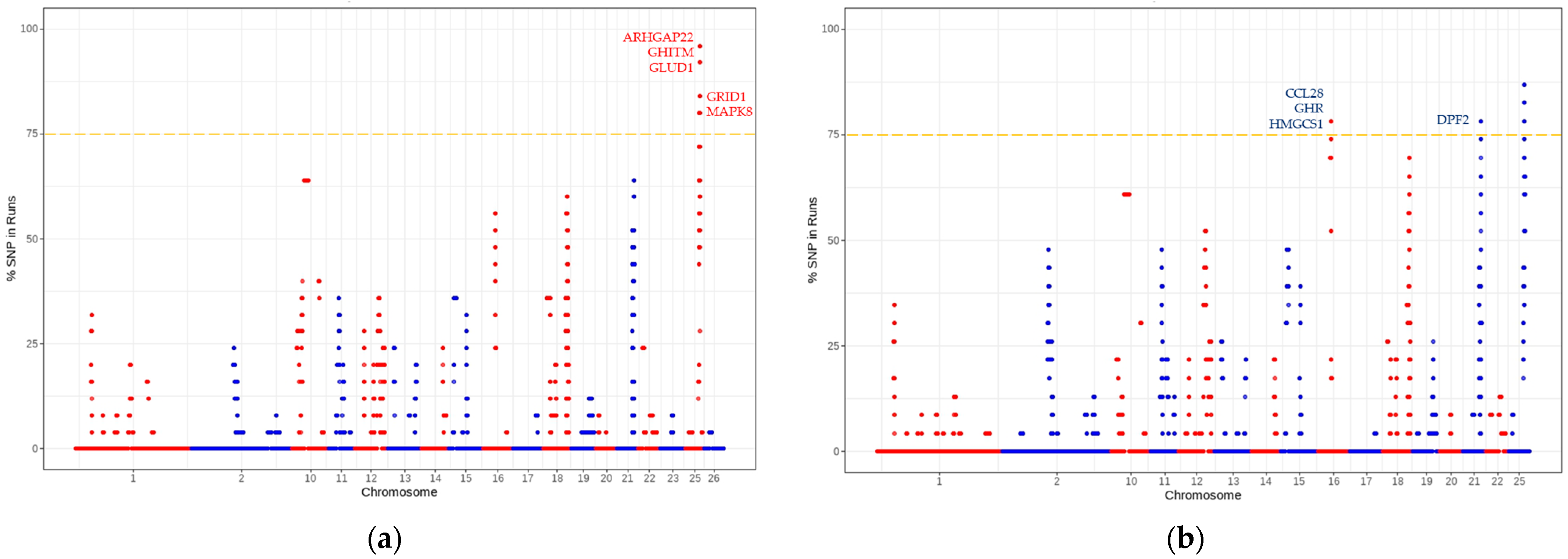
With the plot_manhattanRuns function of the same package, a Manhattan graph was built that shows the SNP that are most frequently detected within a ROH by subpopulations. Haplotypes formed through ROH above 75% of frequency and made up by three or more markers were considered as candidates.
On the other hand, FST fixation indexes were obtained for both subpopulations with the use of the pegas [30] and adegenet packages [27]. To identify the SNP related to fecundity, the difference between the fixation values per SNP between the subpopulations was calculated. Markers with the highest 20% were considered as candidates.
2.6. Detection of Candidate Genes
To find the genes associated with the candidate SNP markers, the position and the chromosome were considered. Genomic regions with a range of ±50 K pb around the candidate SNP were considered as candidate regions with reference to the genome (https://www.ncbi.nlm.nih.gov/assembly/GCF_000298735.2, retrieved on 15 June 2022); the candidate genes were detected as those found in these regions.
3. Results
3.1. Population Structure
For the sample size of 48 animals and p = 0.05, the power of the test was 0.7. The graphic representation of the PCA is shown on the left side on Figure 1. The points in the PCA represent the ewes under study, located in function of their genotypic divergence, while the ellipses represent the groups phenotypically formed according to the fecundity of the ewes. Two differentiated genetic groups were observed from the animal population, which in addition agree with the phenotypical classification given by the supplementary variable, fecundity. The mean for high fecundity of ewes was 1.3 ± 0.03 lambs per mounting, while for low fecundity it was 1.1 ± 0.06 lambs per mounting (p < 0.05). The circular dendrogram is shown on the right side of Figure 1, which was built from Euclidian phenotypical distances, which illustrate the significant difference (p = 3.3 × 10⁻¹³) between the subpopulations of sheep of high (blue) and low (red) fecundity.
Figure 1.
Graphic representation of the principal components analysis (PCA; (left)) and dendrogram built from Euclidian distances (right). Both representations show the subpopulations of Katahdin ewes in agreement with their level of fecundity (high or low). For the PCA, the Eigenvalues (EV) of 32 dimensions are shown whose sum of variances is equal to 80.6%, in addition to the variance explained by the first (PC1) and second (PC2) dimension.
3.2. Candidate Genes
Candidate markers were found for the ROH and FST, 79 and 14, respectively. The details of the results for the ROH are shown in Table 1; only candidate haplotypes containing more than three SNP were considered. Table 1 also shows the start and end of the ROH segments. The total length of the genome, considering only 25 chromosomes, was 2.784 billion bp. The total ROH were 569 for the high fecundity group and 552 for the low fecundity group.
Table 1.
Information of detected runs of homozygosity (ROH) in the genome of Katahdin sheep.
According to the information from the Ovis_aries_v4.0 genome, a total of five candidate genes associated with low fecundity and 10 with high fecundity were obtained, through the ROH method (Figure 2). On the other hand, with the FST method, seven other candidate genes associated with high fecundity were found (Table 2), different from those detected by the ROH method.
Figure 2.
Genomic distribution of positive selection signatures for high (a) and low (b) fecundity using the frequency of SNP in the different ROH haplotypes in Katahdin ewes. The yellow dotted line indicates the minimum frequency required to consider ROH/SNP as candidates (75%).
Table 2.
Candidate genes putatively selected by two statistical methods of selection signature detection affecting fecundity in Katahdin ewes and reproduction traits reported in other studies.
Table 2 shows the candidate genes found in this study associated with fecundity, which includes previous reports of associations with other reproductive characteristics. Meanwhile, Figure 2 shows the Manhattan graph for high and low fecundity with the five and three principal candidate genes, respectively, identified by the ROH method (Table 2), with effects on the fecundity of Katahdin ewes and in reproductive traits.
In this study, 17 genes associated with high fecundity and five with low fecundity were observed. Once these genes were selected through selection signatures (FST and ROH), they were filtered according to functions previously reported as being associated with reproduction in sheep, cattle, deer, horses, and pigs (Table 2).
4. Discussion
4.1. Population Structure
The power of the test of 0.7 is acceptable to obtain significant real differences. Including this test allowed validating the results, since the in-mass genotyping of animals is not available [54]. This impacts the few populations of the Katahdin breed that are present in Mexico, given that they limit the application of new genomic methodologies for their genetic improvement.
In genome-whole association studies and studies of genetic diversity, the use of multivariate analysis is common to characterize the genetic and phenotypic structure of the populations. The most used methods are PCA [9,55,56] and metric multidimensional scaling [57,58]. As in other studies with sheep [15,49,59], in this study, the PCA made it possible to graphically observe the genetic and phenotypic differences of Katahdin ewes. Most of the candidate genes detection studies are based on two clearly divergent groups of animals: lines [57], breeds [55], and groups formed by a phenotype of a quantitative trait (such as the number of horns) [59]. In this study, we used individuals from the same population and created two groups based on their fecundity using multivariate analysis as in other studies [58]. As it was expected, the population structure in our study was different from other studies in which the divergence among groups is evident in the PCA or in the multidimensional scaling. Nonetheless, we found that the divergence used in this study was enough to detect candidate genes associated with fecundity.
4.2. Candidate genes
The gene CNOT11 or CCR4-NOT transcription complex subunit 11 was reported as the candidate gene for pregnancy rate [31]. The gene expression in ewes takes place primarily in the uterus, the placenta membranes, and the embryo; in addition, together with the genes SDHA, PPIA, RPS9, and RPL19, it is one of the most stable marker genes in reproductive and fetal tissues [53]. In this study, with the use of the FST method, it was found that the CNOT11 gene is a candidate for fecundity in Katahdin ewes, with a possible influence in the success of embryo formation and the culmination of pregnancy [53].
The ANK2 (ankyrin 2) gene is known for its effect on productive characteristics. In bovines, it affects the meat and carcass quality [60], and in sheep it has been proven that it has an impact on the characteristics associated with growth, such as weight at weaning and finalization weight, as well as quality of the wool [61]. In sheep, no previous studies are known about the effect of the ANK2 gene on reproduction, but they are in pig reproduction [34].
Contrary to what was found in this study, there are reports in sows of the negative impact of the ANK2 gene on the structure of the granulose cells, which consequently have a negative effect on fecundity [34]. In this study, it was found that the ANK2 gene is associated with high fecundity in ewes. The profile of expression of the ANK2 gene on tissues of the sow has been scarcely studied, although it seems to have a different profile from that of the ewe. In the sow, the expression of the ANK2 gene on the ovary is higher than in the ewe [62,63]. On the other hand, the expression of the ANK2 gene in ewes is abundant in tissues of the neuro-endocrine system, such as the pituitary, the hypothalamus, the cerebellum, and the cerebrum [62]. Probably, the reproductive effects of ANK2 differ between ewes and sows, due to the difference in tissues where they have their highest expressions. In ewes, the effect of ANK2 could be due to changes in the secretion and segregation of hormones, while in sows it could be due to a local effect related to the functioning of the ovary and sexual organs [62,63].
No previous reports that associate the HERC6 gene (HECT and RLD domain containing E3 ubiquitin protein ligase family member 6) with reproductive traits in ewes were found; however, there are reports of associations with growth, composition of the carcass, body size, weight, height, and milk production [64]. It was found that the HERC6 gene, together with the PARP12, RNF213 and ZNFX1 genes, is involved in the early gestation of bovines (day 18) [49]. The main role of these genes, regulated by the IFNT, is the immune response to establish and maintain the uterine receptivity to implantation [49].
In our study, the HERC6 gene, detected through ROH, was a candidate gene for low fecundity, which suggests the confirmation of its effect in the early gestation in sheep as well as in bovines. That this gene is strongly fixed in ewes with low fecundity could be indicative of its negative effect on the species, since it seems that the profile of gene expression in both species is the same [49,62], with a significant presence during the first 20 days of gestation in uterus and cervix.
The CCL25 and CCL28 genes (C-C motif chemokine ligands 25 and 28) were found with high expression during the early fetal development in sheep [50]. In particular, the CCL28 gene is associated with the recruitment of immune cells in the spleen and the nasal mucosa of the fetus, which leads to the development of a functional immunological system pre-birth. In addition, there is evidence of the influence of the gene during the transfer of antibodies during lactation [50]. The CCL28 gene also influences the gastric immunity of animals in any stage of life [50]. In our study, CCL28 turned out to be a candidate gene for low fecundity, which signals a negative relationship between the innate level of immunity of the offspring and the number of lambs born per ewe per mounting.
This study confirms the DPF2 (double PHD fingers 2), ARHGAP22 (Rho GTPase activating protein 22), and GHITM (growth hormone inducible transmembrane protein) genes as candidates for fecundity in Katahdin ewes. In bovines, the DPF2 gene was reported as a candidate for fertility and reproductive traits [65]; in addition, the expression of the gene in sheep is high in sexual tissues, such as testicles, uterus, and ovaries [62]. On the other hand, the ARHGAP22 gene was reported in many species as a candidate for feminine reproductive traits [39]; the expression of the gene happens primarily in the placental membranes and in the ovary [62], which suggests an effect on the persistence of gestation in sheep. The GHITM gene has been associated with the persistence of metritis and reproductive traits in Holstein cows; it was found that it plays a defining role in the immune response of the organism in the presence of a bacterial infection (metritis), particularly in the cycle, the metabolism, and the cell communication [40]. In addition, there is evidence of high expression of the GHITM gene in the luteum body, ovaries, and uterus [62].
In this study, candidate genes were found for high fecundity with effects on reproductive traits that have been reported few times in the literature. The GLUD1 or glutamate dehydrogenase 1 gene was associated with the metabolism of carbon that happens during development and follicle maturation in sheep [41], although there are no reports of their levels of expression in organs related with reproduction; this gene can have a relevant effect on the fecundity of Katahdin ewes. Another gene without reports of expression in sheep is the TRNAC-GCA or transfer RNA cysteine (anticodon GCA) gene; in bovines, this gene affects sperm quality [47]. In this study, it was found that the TRNAC-GCA gene is associated with high fecundity in Katahdin ewes, which confirms the importance of the gene in reproductive traits, at least in bovines and sheep.
The mitogen-activated protein kinase 8 (MAPK8) gene is important in ovine reproduction. In this study of association, its effect on the high fecundity of Katahdin ewes is confirmed. The MAPK8 gene has a high expression in organs associated with reproduction, such as ovaries, pituitary, embryo tissues, and testicles [62]. It is one of the most studied genes in sheep, since it participates in the physiological processes of the ovary, particularly in the cells of the granulose, where it is part of follicle development, and consequently affects traits associated with fertility and with fecundity and prolificacy [44,66].
One of the genes associated most with reproductive traits in sheep is the glutamate ionotropic receptor delta type subunit 1 or GRID1 gene [42]. In this study, it was associated with high fecundity of Katahdin ewes, while in other studies it was associated with size of the litter [42] and fertility [12]. The expression of the GRID1 gene in sheep seems to happen in organs of the neuroendocrine system, particularly in the hypothalamus and the cerebrum, and there are reports of its expression in testicles and ovaries in lower numbers [62].
In this study, we considered other genes as candidates, which have not been previously related with reproductive traits, but whose function in the organism could indirectly influence the physiological processes that lead to reproductive phenomena. For example, FST made it possible to determine that the ATG10 [autophagy related 10] and RPS23 [ribosomal protein S23] genes are candidates for high fecundity in ewes; however, the main action of the genes happens in the immune system, which could impact indirectly the fecundity of the ewes in this study [32,33,41].
On the other hand, candidate genes for the metabolism of fat and energy can also be indirectly related to reproduction (as was found in this study), given the lipid composition of some reproductive hormones such as testosterone, progesterone, and prostaglandin. Thus, the genes in this situation are: CAMK2D [35] (calcium/calmodulin dependent protein kinase II delta), STK32B [36] (serine/threonine kinase 32B), HMGCS1 [52] (3-hydroxy-3-methylglutaryl-CoA synthase 1), ADIRF [38] (adipogenesis regulatory factor), LRIT1 [43], and UGT8 [37] (UDP glycosyltransferase 8).
5. Conclusions
This study is the first to find candidate genes for fecundity in Katahdin ewes in Mexico. These candidate genes were detected through the selection signatures FST and ROH, which confirmed the influence of the five genes CNOT11, GLUD1, GRID1, MAPK8, and CCL28 on the characteristics of fertility in sheep; in addition, six other new candidate genes were detected that had not been previously reported for this species: ANK2 (sows), ARGHGAP22 (cows), GHITM (cows), HERC6 (cows), DPF2, and TRNAC-GCA (cows). The 17 new candidate genes for fecundity in sheep, found in this study, seem to have a high expression in reproductive organs. However, studies are necessary to elucidate the physiological basis of the changes in reproductive behavior influenced by these genes.
Author Contributions
R.S.-R. carried out the research work, conceptualization, data collection and writing—original draft preparation. M.Z.T.-C. participated in data curation, methodology, formal analysis, and results interpretation. J.G.-S., C.M.B.-P. and S.C.-V. participated in critical revisions, validation, visualization, and supervision. C.C.-R. led the research work, resources, conceptualization, methodology, supervision, and writing—review and editing. All authors have read and agreed to the published version of the manuscript.
Funding
Consejo Nacional de Ciencia y Tecnología: 12033006.
Institutional Review Board Statement
The animal study protocol was approved by the Ethics Committee of Colegio de Postgraduados (COBlAN/009/22, 8 December 2022).
Informed Consent Statement
Written informed consent has been obtained from the animals’ owner to publish this paper.
Data Availability Statement
Data are available from first author Reyna Sánchez-Ramos, <rey_1014@hotmail.com> upon request.
Acknowledgments
The authors wish to thank CONACYT for the financial support granted to the first author during her years of studies for a Master’s in Sciences. The authors also wish to thank Campus Montecillo and San Luis Potosí, Colegio de Postgraduados, for the financial support given to carry out this research and the Lines of Generation and/or Application of Knowledge: Technological Innovation and Food Security in Livestock Production (Campus Montecillo) and Sustainable Management of Natural Resources (Campus SLP); and the ranch “Quinta San Francisco”, municipality of Zempoala, state of Hidalgo, for providing the group of Katahdin ewes to obtain data; and Dante Josafet Hernández Rubio for his support in the logistics for sheep management.
Conflicts of Interest
The authors declare no conflict of interest.
References
- Vázquez-Martínez, I.; Jaramillo-Villanueva, J.L.; Bustamante-González, Á.; Vargas-López, S.; Calderón-Sánchez, F.; Torres-Hernández, G.; Pittroff, W. Structure and typology of sheep production units in central México. Agric. Soc. Y Desarro. 2018, 15, 85–97. Available online: https://www.scielo.org.mx/scielo.php?script=sci_arttext&pid=S1870-54722018000100085&lng=es&tlng=en (accessed on 23 June 2022).
- Gootwine, E. Invited review: Opportunities for genetic improvement toward higher prolificacy in sheep. Small Rumin. Res. 2020, 186, 106090. [Google Scholar] [CrossRef]
- Ivanova, T.; Stoikova-Grigorova, R.; Bozhilova-Sakova, M.; Ignatova, M.; Dimitrova, I.; Koutev, V. Phenotypic and genetic characteristics of fecundity in sheep. A review. Bulg. J. Agric. Sci. 2021, 27, 1002–1008. Available online: https://www.researchgate.net/profile/Milena-Bozhilova/publication/356064326_Phenotypic_and_genetic_characteristics_of_fecundity_in_sheep_A_review/links/618a82d6d7d1af224bca6ba5/Phenotypic-and-genetic-characteristics-of-fecundity-in-sheep-A-review.pdf (accessed on 15 July 2022).
- Davis, T.C.; White, R.R. Breeding animals to feed people: The many roles of animal reproduction in ensuring global food security. Theriogenology 2020, 150, 27–33. [Google Scholar] [CrossRef] [PubMed]
- Chay-Canul, A.J.; García-Herrera, R.A.; Magaña-Monforte, J.G.; Macias-Cruz, U.; Luna-Palomera, C. Productividad de ovejas Pelibuey y Katahdin en el trópico húmedo. Ecosistemas Y Recur. Agropecu. 2019, 6, 159–165. [Google Scholar] [CrossRef]
- UNO. 2022. Available online: https://www.uno.org.mx/razas_ovinas/katahdin.html (accessed on 23 August 2022).
- González-Godínez, A.; Urrutia-Morales, J.; Gámez-Vázquez, H.G. Comportamiento reproductivo de ovejas Dorper y Katahdin empadradas en primavera en el norte de México. Trop. Subtrop. Agroecosyst. 2014, 17, 123–127. [Google Scholar]
- Ghiasi, H.; Abdollahi-Arpanahi, R. The candidate genes and pathways affecting litter size in sheep. Small Rumin. Res. 2021, 205, 106546. [Google Scholar] [CrossRef]
- Wang, J.; Wang, X.; Wang, W.; Li, F.; Zhang, D.; Li, X.; Zhanga, Y.; Zhaoa, Y.; Zhaoa, L.; Xua, D.; et al. Molecular characterization and expression of RPS23 and HPSE and their association with hematologic parameters in sheep. Gene 2022, 837, 146654. [Google Scholar] [CrossRef]
- Gebreselassie, G.; Berihulay, H.; Jiang, L.; Ma, Y. Review on Genomic Regions and Candidate Genes Associated with Economically Important Production and Reproduction Traits in Sheep (Ovies aries). Animals 2019, 10, 33. [Google Scholar] [CrossRef]
- Silva, J.; Van den Hurk, R.; Van Tol, H.; Roelen, B.; Figueiredo, J. Expression of growth differentiation factor 9 (GDF9), bone morphogenetic protein 15 (BMP15), and BMP receptors in the ovaries of goats. Mol. Reprod. Dev. 2005, 70, 11–19. [Google Scholar] [CrossRef]
- Nosrati, M.; Asadollahpour Nanaei, H.; Amiri Ghanatsaman, Z.; Esmailizadeh, A. Whole genome sequence analysis to detect signatures of positive selection for high fecundity in sheep. Reprod. Domes. Anim. 2018, 54, 358–364. [Google Scholar] [CrossRef]
- Cockrum, R.R.; Pickering, N.K.; Anderson, R.M.; Hyndman, D.L.; Bixley, M.J.; Dodds, K.G.; Stobart, R.H.; McEwan, J.C.; Cammack, K.M. Identification of single nucleotide polymorphisms associated with feed efficiency in rams. Proc. West. Sect. Am. Soc. Anim. Sci. 2012, 63, 79–83. Available online: https://www.researchgate.net/publication/265382096_IDENTIFICATION_OF_SINGLE_NUCLEOTIDE_POLYMORPHISMS_ASSOCIATED_WITH_FEED_EFFICIENCY_IN_RAMS (accessed on 18 July 2022).
- Xu, S.-S.; Gao, L.; Xie, X.-L.; Ren, Y.-L.; Shen, Z.-Q.; Wang, F.; Shen, M.; Eyϸórsdóttir, E.; Hallsson, J.H.; Kiseleva, T.; et al. Genome-wide association analyses highlight the potential for different genetic mechanisms for litter size among sheep breeds. Front. Genet. 2018, 9, 118. [Google Scholar] [CrossRef] [PubMed]
- Li, X.; Yang, J.; Shen, M.; Xie, X.-L.; Liu, G.-J.; Xu, Y.-X.; Lv, F.-H.; Yang, H.; Yang, Y.-L.; Liu, C.-B.; et al. Whole-genome resequencing of wild and domestic sheep identifies genes associated with morphological and agronomic traits. Nat. Commun. 2020, 11, 1–16. [Google Scholar] [CrossRef] [PubMed]
- Hayes, B. Overview of statistical methods for genome-wide association studies (GWAS). Genome-wide association studies and genomic prediction. Methods Mol. Biol. 2013, 1019, 149–169. [Google Scholar] [CrossRef]
- Díez, D.F.; Sánchez, L.F.; Moreno, V.; Moratalla-Navarro, F.; Molina de la Torre, A.J.; Martín Sánchez, V. GASVeM: A new machine learning methodology for multi-SNP analysis of GWAS data based on genetic algorithms and support vector machines. Mathematics 2021, 9, 654. [Google Scholar] [CrossRef]
- Mortezaei, Z.; Tavallaei, M. Novel directions in data pre-processing and genome-wide association study (GWAS) methodologies to overcome ongoing challenges. IMU 2021, 24, 100586. [Google Scholar] [CrossRef]
- McRae, K.M.; McEwan, J.C.; Dodds, K.G.; Gemmell, N.J. Signatures of selection in sheep bred for resistance or susceptibility to gastrointestinal nematodes. BMC Genom. 2014, 15, 637. [Google Scholar] [CrossRef]
- Saravanan, K.A.; Panigrahi, M.; Kumar, H.; Bhushan, B.; Dutt, T.; Mishra, B.P. Selection signatures in livestock genome: A review of concepts, approaches, and applications. Livest. Sci. 2020, 241, 104257. [Google Scholar] [CrossRef]
- COLPOS (Colegio de Postgraduados). Reglamento para el uso y Cuidado de Animales Destinados a la Investigación en el Colegio de Postgraduados; Dirección de Investigación: Colegio de Posgraduados: Montecillo, México, 2019. Available online: http://www.colpos.mx/wb_pdf/norma_interna/reglamento_usoycuidadoanimales_050819.pdf (accessed on 15 January 2022).
- SAGARPA (Secretaría de Agricultura, Ganadería, Desarrollo Rural, Pesca, y Alimentación). Norma Oficial Mexicana NOM-062-ZOO-1999, Especificaciones Técnicas para la Producción, Cuidado y uso de los Animales de Laboratorio; Diario Oficial de La Federación: Ciudad de México, México, 2001; pp. 107–165. Available online: https://www.gob.mx/cms/uploads/attachment/file/203498/NOM-062-ZOO-1999_220801.pdf (accessed on 15 January 2022).
- García, E. Modificaciones al Sistema de Clasificación Climática de Köppen: Para Adaptarlo a las Condiciones de la República Mexicana, 5th ed.; Instituto de Geografía: UNAM México: Ciudad de México, México, 2004. Available online: http://www.publicaciones.igg.unam.mx/index.php/ig/catalog/view/83/82/251-1 (accessed on 10 March 2022).
- Champely, S.; pwr: Basic Functions for Power Analysis. R Package Version 1.3-0. 2020. Available online: https://CRAN.R-project.org/package=pwr (accessed on 18 August 2022).
- R Core Team. R: A Language and Environment for Statistical Computing; R Foundation for Statistical Computing: Vienna, Austria, 2022; Available online: https://www.R-project.org/ (accessed on 15 August 2022).
- Galili, T. dendextend: An R package for visualizing, adjusting, and comparing trees of hierarchical clustering. Bioinformatics 2015, 31, 3718–3720. [Google Scholar] [CrossRef]
- Jombart, T.; Ahmed, I. adegenet 1.3-1: New tools for the analysis of genome-wide SNP data. Bioinformatics 2011, 27, 3070–3071. [Google Scholar] [CrossRef] [PubMed]
- Purcell, S.; Neale, B.; Todd-Brown, K.; Thomas, L.; Ferreira, M.A.R.; Bender, D.; Maller, J.; Sklar, P.; Bakker, P.I.W.; Daly, M.J.; et al. PLINK: A toolset for whole-genome association and population-based linkage analysis. Am. J. Hum. Genet. 2007, 81, 559–575. [Google Scholar] [CrossRef] [PubMed]
- Biscarini, F.; Cozzi, P.; Gaspa, G.; Marras, G. detectRUNS: Detect Runs of Homozygosity and Runs of Heterozygosity in Diploid Genomes. R Package Version 0.9.6. 2019. Available online: https://CRAN.R-project.org/package=detectRUNS (accessed on 20 August 2022).
- Paradis, E. pegas: An R package for population genetics with an integrated-modular approach. Bioinformatics 2010, 26, 419–420. [Google Scholar] [CrossRef] [PubMed]
- Sozoniuk, M.; Jamio, M.; Kankofer, M.; Kowalczyk, K. Reference gene selection in bovine caruncular epithelial cells under pregnancy-associated hormones exposure. Res. Sq. 2022, 12, 12742. [Google Scholar] [CrossRef] [PubMed]
- Kravitz, A.; Pelzer, K.; Sriranganathan, N. The paratuberculosis paradigm examined: A review of host genetic resistance and innate immune fitness in mycobacterium avium subsp. paratuberculosis infection. Front. Vet. Sci. 2021, 8, 721706. [Google Scholar] [CrossRef]
- Sah, N.; Wu, G.; Bazer, F.W. Regulation of gene expression by amino acids in animal cells. In Amino Acids in Nutrition and Health; Wu, G., Ed.; Advances in Experimental Medicine and Biology; Springer: Cham, Switzerland, 2021; Volume 1332, pp. 1–15. [Google Scholar] [CrossRef]
- Kulus, J.; Kulus, M.; Kranc, W.; Jopek, K.; Zdun, M.; Józkowiak, M.; Jaśkowski, J.M.; Piotrowska-Kampisty, H.; Bukowska, D.; Antosok, P.; et al. Transcriptomic profile of new gene markers encoding proteins responsible for structure of porcine ovarian granulosa cells. Biology 2021, 10, 1214. [Google Scholar] [CrossRef]
- Luo, R.; Dai, X.; Zhang, L.; Li, G.; Zheng, Z. Genome-Wide DNA Methylation Patterns of Muscle and Tail-Fat in Dairy Meade Sheep and Mongolian Sheep. Animals 2022, 12, 1399. [Google Scholar] [CrossRef]
- Wang, H.; Zhang, L.; Cao, J.; Wu, M.; Ma, X.; Liu, Z.; Liu, R.; Zhao, F.; Wei, C.; Du, L. Genome-wide specific selection in three domestic sheep breeds. PLoS ONE 2015, 10, e0128688. [Google Scholar] [CrossRef]
- Kim, E.; Elbeltagy, A.; Aboul-Naga, A.; Rischkowsky, B.; Sayre, B.; Mwacharo, J.; Rothschild, M. Multiple genomic signatures of selection in goats and sheep indigenous to a hot arid environment. Heredity 2015, 116, 255–264. [Google Scholar] [CrossRef]
- Wang, S.; Liu, J.; Zhao, W.; Wang, G.; Gao, S. Selection of candidate genes for differences in fat metabolism between cattle subcutaneous and perirenal adipose tissue based on RNA-seq. Anim. Biotechnol. 2021, 23, 1–12. [Google Scholar] [CrossRef]
- Klein, S.; Yin, T.; Swalve, H.; König, S. Single-step genomic best linear unbiased predictor genetic parameter estimations and genome-wide associations for milk fatty acid profiles, interval from calving to first insemination, and ketosis in Holstein cattle. J. Dairy Sci. 2021, 104, 10921–10933. [Google Scholar] [CrossRef] [PubMed]
- Piersanti, R.; Horlock, A.; Block, J.; Santos, J.; Sheldon, I.; Bromfield, J. Persistent effects on bovine granulosa cell transcriptome after resolution of uterine disease. Reproduction 2019, 158, 35–46. [Google Scholar] [CrossRef] [PubMed]
- Wang, H.; Feng, X.; Muhatai, G.; Wang, L. Expression profile analysis of sheep ovary after superovulation and estrus synchronisation treatment. Vet. Med. Sci. 2022, 8, 1276–1287. [Google Scholar] [CrossRef] [PubMed]
- Gholizadeh, M.; Esmaeili-Fard, S.M. Meta-analysis of genome-wide association studies for litter size in sheep. Theriogenology 2022, 180, 103–112. [Google Scholar] [CrossRef] [PubMed]
- Steinhauser, C.B.; Lambo, C.A.; Askelson, K.; Burns, G.W.; Behura, S.K.; Spencer, T.E.; Bazer, F.W.; Satterfield, M.C. Placental transcriptome adaptations to maternal nutrient restriction in sheep. Int. J. Mol. Sci. 2021, 22, 7654. [Google Scholar] [CrossRef]
- Nan, Y.; Xie, Y.; Zhu, M.; Yang, H.; Zhao, Z. MicroRNA-200c Mediates the Mechanism of MAPK8 Gene Regulating Follicular Development in sheep. Kafkas Univ. Vet. Fak. Derg. 2021, 27, 279–284. [Google Scholar] [CrossRef]
- Weldenegodguad, M.; Pokharel, K.; Niiranen, L.; Soppela, P.; Ammosov, I.; Honkatukia, M.; Lindeberg, H.; Peippo, J.; Reilas, T.; Mazzullo, N.; et al. Adipose gene expression profiles reveal insights into the adaptation of northern Eurasian semi-domestic reindeer (Rangifer tarandus). Commun. Biol. 2021, 4, 1170. [Google Scholar] [CrossRef]
- de Souza, T.C.; de Souza, T.C.; Rovadoscki, G.A.; Coutinho, L.L.; Mourão, G.B.; de Camargo, G.M.F.; Costa, R.B.; de Carvalho, G.G.P.; Pedrosa, V.B.; Pinto, L.F.B. Genome-wide association for plasma urea concentration in sheep. Livest. Sci. 2021, 248, 104483. [Google Scholar] [CrossRef]
- Michailidou, S.; Tsangaris, G.T.; Tzora, A.; Skoufos, I.; Banos, G.; Argiriou, A.; Arsenos, G. Analysis of genome-wide DNA arrays reveals the genomic population structure and diversity in autochthonous Greek goat breeds. PLoS ONE 2016, 14, e0226179. [Google Scholar] [CrossRef]
- Min, B.; Cho, S.; Park, J.S.; Lee, Y.G.; Kim, N.; Kang, Y.K. Transcriptomic features of bovine blastocysts derived by somatic cell nuclear transfer. G3 Genes Genomes Genet. 2015, 5, 2527–2538. [Google Scholar] [CrossRef]
- Forde, N.; Duffy, G.B.; McGettigan, P.A.; Browne, J.A.; Mehta, J.P.; Kelly, A.K.; Mansouri-Attia, N.; Sandra, O.; Loftus, B.J.; Crowe, M.A.; et al. Evidence for an early endometrial response to pregnancy in cattle: Both dependent upon and independent of interferon tau. Physiol. Genomics 2012, 44, 799–810. [Google Scholar] [CrossRef] [PubMed]
- Meurens, F.; Whale, J.; Brownlie, R.; Dybvig, T.; Thompson, D.; Gerdts, V. Expression of mucosal chemokines TECK/CCL25 and MEC/CCL28 during fetal development of the ovine mucosal immune system. Immunology 2007, 120, 544–555. [Google Scholar] [CrossRef]
- Cobanoglu, O.; Kul, E.; Gurcan, E.; Abaci, S.; Cankaya, S. Determination of the association of GHR/AluI gene polymorphisms with milk yield traits in Holstein and Jersey cattle raised in Turkey. Arch. Anim. Breed. 2021, 64, 417–424. [Google Scholar] [CrossRef] [PubMed]
- Steele, M.; Dionissopoulos, L.; AlZahal, O.; Doelman, J.; McBride, B. Rumen epithelial adaptation to ruminal acidosis in lactating cattle involves the coordinated expression of insulin-like growth factor-binding proteins and a cholesterolgenic enzyme. J. Dairy Sci. 2012, 95, 318–327. [Google Scholar] [CrossRef] [PubMed]
- Cheng, L.; Yu, J.; Hu, X.; Xiang, M.; Xia, Y.; Tao, B.; Du, X.; Wang, D.; Zhao, S.; Chen, H. Identification of reliable reference genes for expression studies in maternal reproductive tissues and foetal tissues of pregnant cows. Reprod. Dom. Anim. 2020, 55, 1554–1564. [Google Scholar] [CrossRef]
- Mrode, R.; Ojango, J.M.K.; Okeyo, A.M.; Mwacharo, J.M. Genomic selection and use of molecular tools in breeding programs for indigenous and crossbred cattle in developing countries: Current status and future prospects. Front. Genet. 2019, 9, 694. [Google Scholar] [CrossRef] [PubMed]
- Lei, Z.; Sun, W.; Guo, T.; Li, J.; Zhu, S.; Lu, Z.; Qiao, G.; Han, M.; Zhao, H.; Yang, B.; et al. Genome-wide selective signatures reveal candidate genes associated with hair follicle development and wool shedding in sheep. Gene 2021, 12, 1924. [Google Scholar] [CrossRef]
- Duarte, I.N.H.; Bessa, A.F.d.O.; Rola, L.D.; Genuíno, M.V.H.; Rocha, I.M.; Marcondes, C.R.; Righetti, M.C.; de Correia, A.R.L.; Prado, M.D.; Pearse, B.D.; et al. Cross-population selection signatures in Canchim composite beef cattle. PLoS ONE 2022, 17, e0264279. [Google Scholar] [CrossRef] [PubMed]
- Iffland, H.; Wellmann, R.; Schmid, M.; Preuß, S.; Tetens, J.; Bessei, W.; Bennewitz, J. Genome wide mapping of selection signatures and genes for extreme feather pecking in two divergently selected laying hen lines. Animals 2020, 10, 262. [Google Scholar] [CrossRef]
- Trujano-Chavez, M.Z.; Ruíz-Flores, A.; López-Ordaz, R.; Pérez-Rodríguez, P. Genetic diversity in reproductive traits of Braunvieh cattle determined with SNP markers. Vet. Med. Sci. 2022, 8, 1709–1720. [Google Scholar] [CrossRef]
- Kijas, J.W.; Hadfield, T.; Naval, S.M.; Cockett, N. Genome-wide association reveals the locus responsible for four-horned ruminant. Anim Genet. 2016, 47, 258–262. [Google Scholar] [CrossRef] [PubMed]
- Borges, B.O.; Curi, R.A.; Baldi, F.; Feitosa, F.L.B.; Andrade, W.B.F.D.; Albuquerque, L.G.D.; Oliveira, H.N.D.; Chardulo, L.A.L. Polymorphisms in candidate genes and their association with carcass traits and meat quality in Nellore cattle. Pesqui. Agropecu. Bras. 2014, 49, 364–371. [Google Scholar] [CrossRef]
- Mohammadi, H.; Rafat, S.; Moradi Shahrbabak, H.; Shodja, J.; Moradi, M. Genome-wide association study and gene ontology for growth and wool characteristics in Zandi sheep. JLST. 2020, 8, 45–55. [Google Scholar] [CrossRef]
- Jiang, Y.; Xie, M.; Chen, W.; Talbot, R.; Maddox, J.F.; Faraut, T.; Wu, C.; Muzny, D.M.; Li, Y.; Zhang, W.; et al. The sheep genome illuminates biology of the rumen and lipid metabolism. Science 2014, 344, 1168–1173. [Google Scholar] [CrossRef] [PubMed]
- Li, M.; Chen, L.; Tian, S.; Lin, Y.; Tang, Q.; Zhou, X.; Li, D.; Yeung, C.K.; Che, T.; Jin, L.; et al. Comprehensive variation discovery and recovery of missing sequence in the pig genome using multiple de novo assemblies. Genome Res. 2016, 27, 865–874. [Google Scholar] [CrossRef] [PubMed]
- Yurchenko, A.A.; Deniskova, T.E.; Yudin, N.S.; Dotsev, A.V.; Khamiruev, T.N.; Selionova, M.I.; Egorov, S.V.; Reyer, H.; Wimmers, K.; Zinovieva, N.A.; et al. High-density genotyping reveals signatures of selection related to acclimation and economically important traits in 15 local sheep breeds from Russia. BMC Genom. 2019, 20, 294. [Google Scholar] [CrossRef]
- Fonseca, P.; Id-Lahoucine, S.; Reverter, A.; Medrano, J.; Fortes, M.; Casellas, J.; Miglior, F.; Brito, L.; Carvalho, M.R.S.; Schenkel, C.F.S.; et al. Combining multi-OMICs information to identify key-regulator genes for pleiotropic effect on fertility and production traits in beef cattle. PLoS ONE 2018, 13, e0205295. [Google Scholar] [CrossRef]
- Relav, L.; Estienne, A.; Price, C.A. Dual-specificity phosphatase 6 (DUSP6) mRNA and protein abundance is regulated by fibroblast growth factor 2 in sheep granulosa cells and inhibits c-Jun N-terminal kinase (MAPK8) phosphorylation. Mol. Cell Endocrinol. 2021, 531, 111297. [Google Scholar] [CrossRef]
Disclaimer/Publisher’s Note: The statements, opinions and data contained in all publications are solely those of the individual author(s) and contributor(s) and not of MDPI and/or the editor(s). MDPI and/or the editor(s) disclaim responsibility for any injury to people or property resulting from any ideas, methods, instructions or products referred to in the content. |
© 2023 by the authors. Licensee MDPI, Basel, Switzerland. This article is an open access article distributed under the terms and conditions of the Creative Commons Attribution (CC BY) license (https://creativecommons.org/licenses/by/4.0/).