Genetic Parameter Estimates for Teat and Mammary Traits in Commercial Sows
1
Department of Animal Science, North Carolina State University, Raleigh, NC 27695, USA
2
Smithfield Premium Genetics, Rose Hill, NC 28458, USA
*
Author to whom correspondence should be addressed.
Animals 2023, 13(15), 2400; https://doi.org/10.3390/ani13152400
Submission received: 6 June 2023
/
Revised: 13 July 2023
/
Accepted: 18 July 2023
/
Published: 25 July 2023
(This article belongs to the Section Animal Genetics and Genomics)
Simple Summary
The use of genetic selection in livestock has allowed farmers to enhance the sustainability of their operations by producing animals that require fewer inputs relative to animal outputs. In swine, geneticists have selected for sows that farrow larger litters, which has reduced the feed required per piglet produced. Yet challenges remain with piglet survival from birth to weaning. Utilizing genetic selection to increase the sow teat number may be a strategy to enhance piglet nutrient access and therefore piglet survival. More publicly available data are needed to confirm associations between sow teat traits and piglet weaning traits. Hence, the current study explores the genetic relationships among sow teat traits at farrowing with the number of piglets at weaning and identifies strategies to enhance piglet survival and sustainable pig production. The results suggest geneticists should incorporate the number of functional teats a sow has at farrowing into genetic selection programs to improve piglet survival and animal well-being.
Abstract
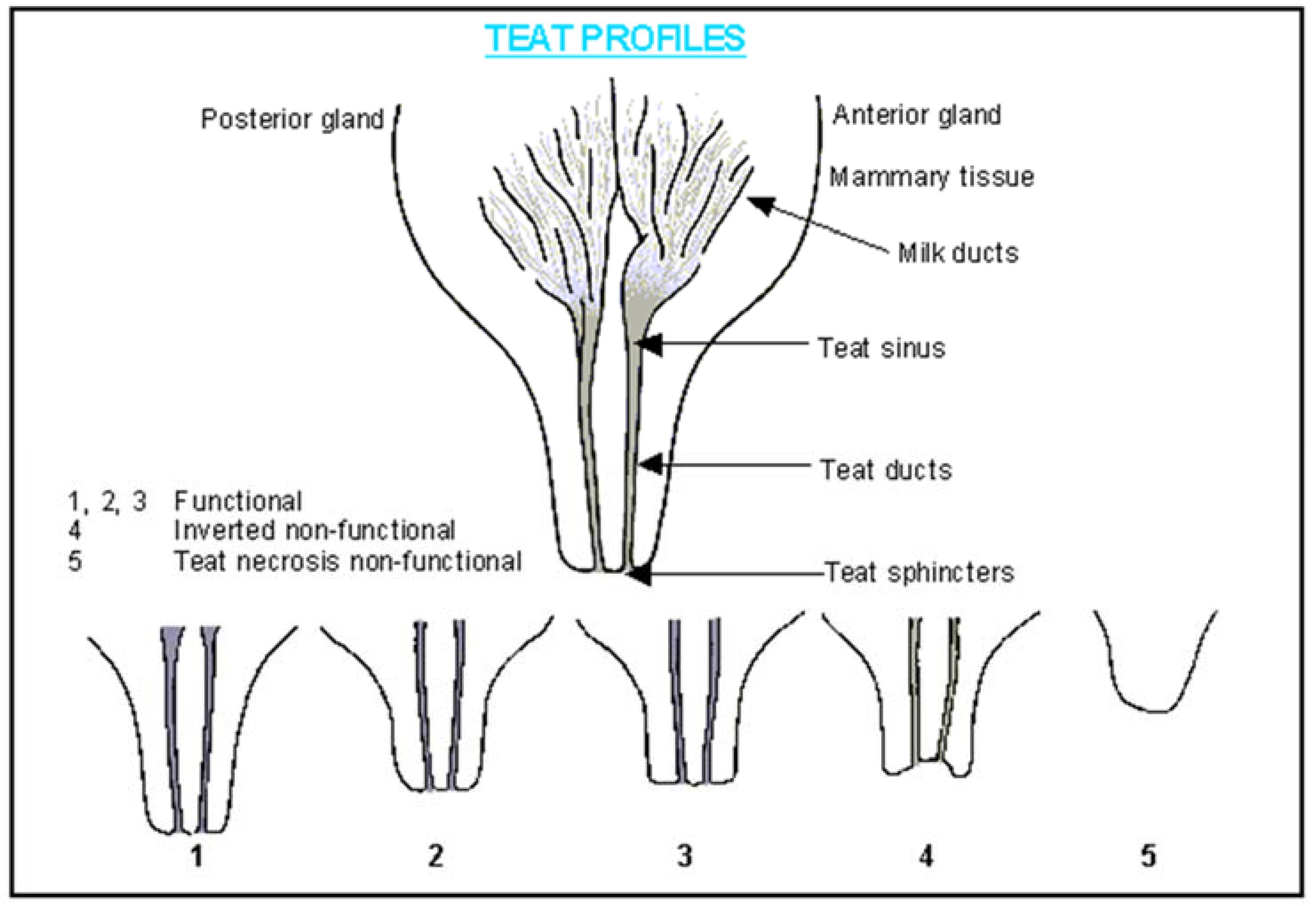
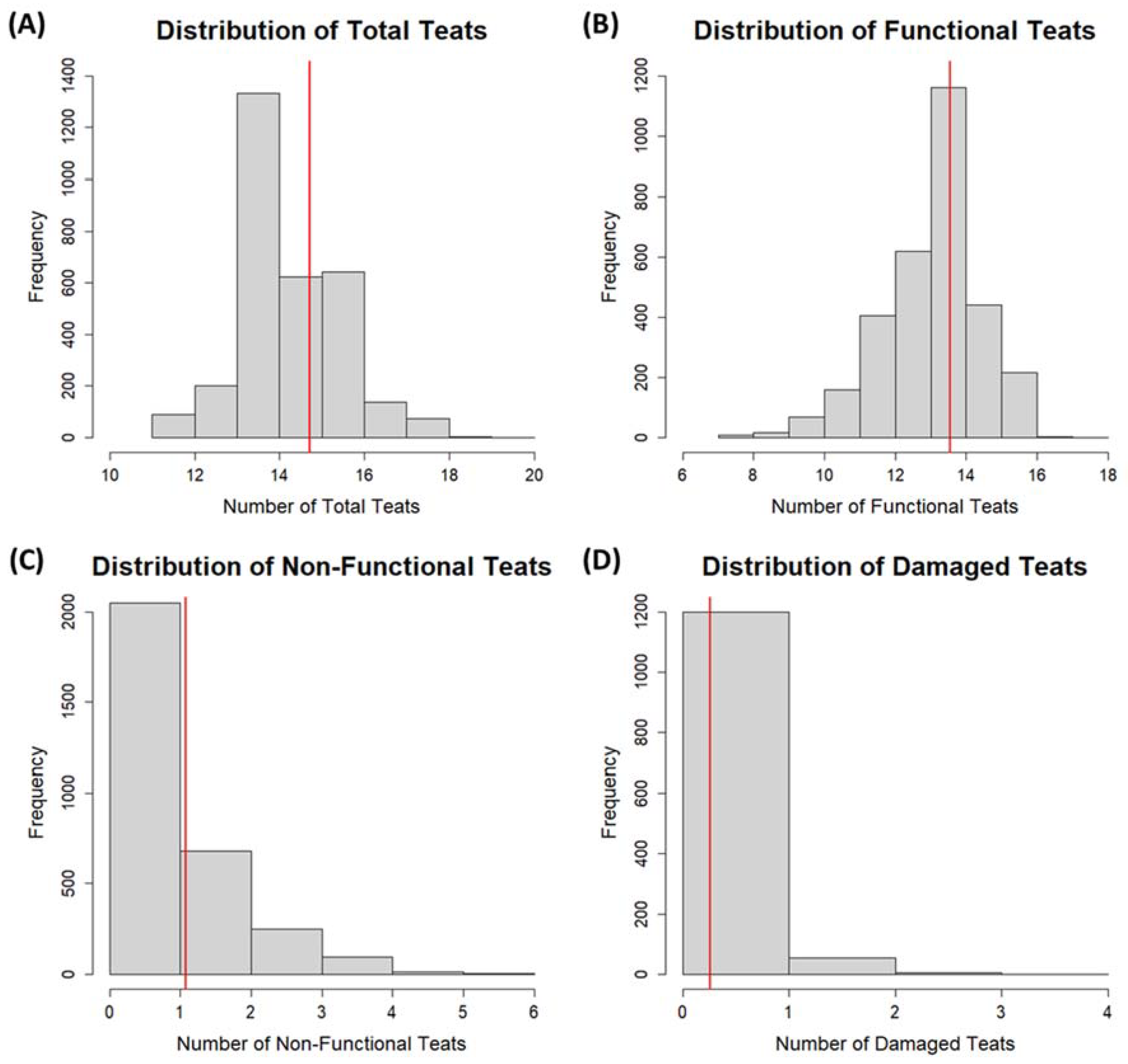
The objective was to evaluate the genetics of sow teat and mammary traits at farrowing and at weaning. Data were recorded on 3099 Landrace × Large White F1 sows. Underline traits included the total teat number (TT), the functional teat number (FT), the non-functional teat number (NFT), the damaged teat number (DT), and the number of functional mammary glands (FMG). Variance components were estimated using AIREMLF90. Means for TT, FT, and NFT at farrowing were 14.93, 13.90, and 1.03, respectively. Heritability estimates for TT, FT, and NFT ranged from 0.18 to 0.37, 0.16 to 0.28, and 0.14 to 0.18, respectively. Estimates of heritability for DT and FMG at weaning were 0.03 and 0.06, respectively. Estimated genetic correlations between FT with TT and NFT were 0.68 to 0.78 and −0.19 to −0.57, respectively. Genetic correlation estimates between TT, FT, and NFT with the number weaned were 0.25, 0.50, and −0.38, respectively. An increase of one TT and FT enhanced (p < 0.05) the number weaned by 0.14 to 0.16 and 0.18 to 0.27 piglets, respectively. The results suggest that genetically increasing the number of functional teats on a sow at farrowing would improve the number of piglets at weaning.
Keywords:
functional teat; heritability; lactation; piglet survival; sow