In Silico Predictions on the Productive Life Span and Theory of Its Developmental Origin in Dairy Cows

Russia Research Institute of Animal Physiology, Biochemistry, and Nutrition—Branch of the Federal Science Center for Animal Husbandry Named after Academy Member L. K. Ernst, 249010 Borovsk, Russia
*
Author to whom correspondence should be addressed.
Animals 2022, 12(6), 684; https://doi.org/10.3390/ani12060684
Submission received: 25 January 2022
/
Revised: 28 February 2022
/
Accepted: 2 March 2022
/
Published: 9 March 2022
(This article belongs to the Special Issue Dairy Cow Behavior, Welfare, and Productivity)
Simple Summary
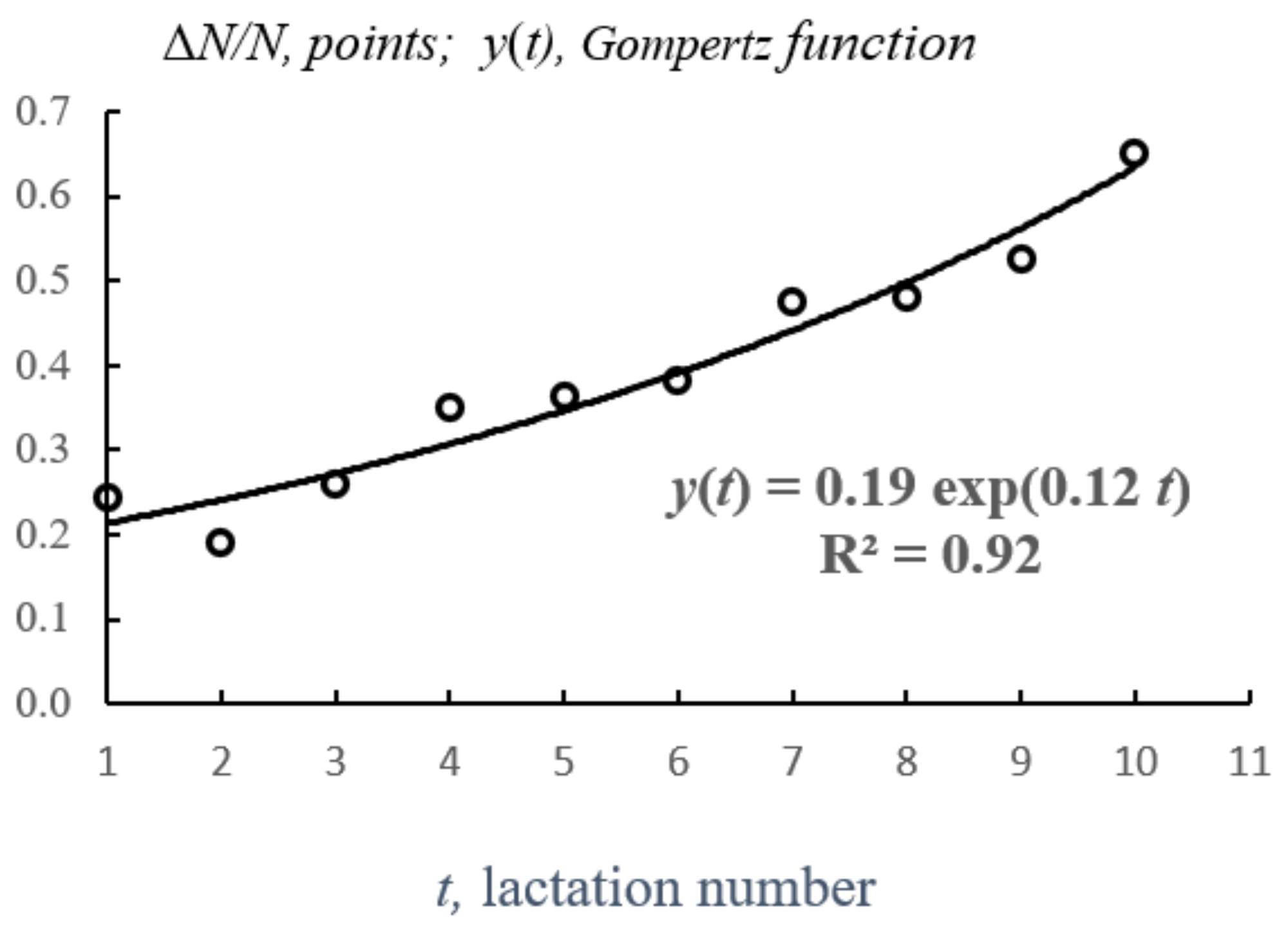
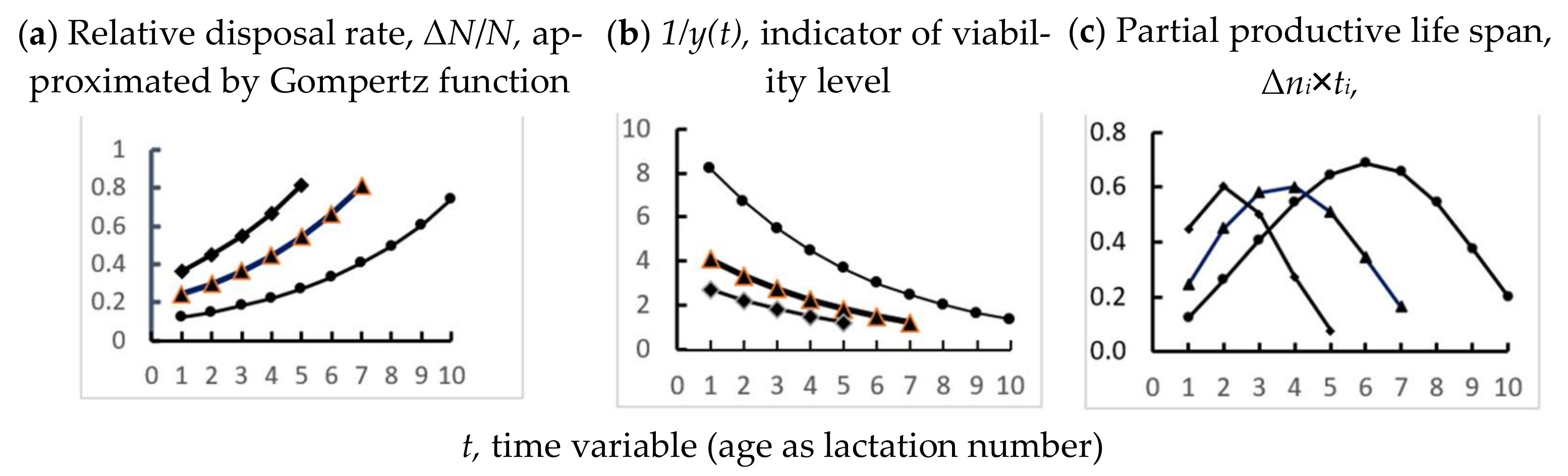
Dairy cows are susceptible to a range of welfare factors, which lead to worsening health problems and shorten their productive life span. The health and welfare status of dairy cows could be improved if unwanted abnormalities and risk factors are detected in a timely manner, i.e., before diseases start to occur. Therefore, in addition to veterinary monitoring, quantitative parameters are necessary to predict the risks of early culling of cows. In the study of the age dynamics of culling rate in dairy cow populations, it was found that the average productive life span can be predicted by registration of the reciprocal relative disposal rate (culling for sum of reasons + death). This indicator represents the viability index, which has a maximal value at the first lactation and decreases in subsequent lactations with an inverse exponential trend. According to available scientific information, the structural prerequisites for this index are laid down during prenatal development and in the early periods of postnatal life; therefore, it is necessary to create a system of continuous monitoring of the physiological status of mothers and young animals.
Abstract
Animal welfare includes health but also concerns the need for natural factors that contribute to the increase in viability. Therefore, quantitative parameters are necessary to predict the risks of early culling of cows. In the study of the age dynamics of the disposal rate (culling for sum of reasons + death) in dairy cow populations, it was found that the average productive life span can be predicted by the value of the reciprocal culling/death rate (reciprocal value of Gompertz function) at the first lactation. This means that this potential of viability is formed during the developmental periods preceding the onset of lactation activity. Therefore, taking into account current data in the field of developmental biology, it can be assumed that the structural prerequisites for viability potential are laid down during prenatal development and in the early periods of postnatal life. To prevent unfavorable deviations in these processes due to negative welfare effects, it is advisable to monitor the physiological status of mothers and young animals using biosensors and Big Data systems.