You are currently viewing a new version of our website. To view the old version click .
Animals
  • Article
  • Open Access

28 September 2022

Traditional Conceptions of the Legal Person and Nonhuman Animals

Law Department, Universitat Pompeu Fabra, 08005 Barcelona, Spain
This article belongs to the Special Issue Animal Advocacy: Legal Status, Rights & Responsibilities

Simple Summary

Every student comes across traditional conceptions of the legal person during law school. Professors usually explain that humans and corporations are legal persons, and that legal personhood is the most important category within the legal system as legal persons can enter into different legal relations, hold rights, and bear duties. Nonhuman animals are usually not mentioned in courses of this sort. This article examines four traditional concepts of the legal person and argues that nonhuman animals can be considered persons according to each concept. It notes that the law does not consider the concept of the human the same as the concept of the legal person, and that animals may benefit from an ecumenical defense, considering that legal practitioners such as judges commonly use these four traditional concepts of legal personhood, sometimes in the same ruling.

Abstract

Since Roman law, the category of the legal person has been the most relevant legal category, allowing humans and entities to act within the law and enter into legal relations. The legal system does not consider nonhuman animals as legal persons but as property or as sentient beings regulated by the rules of property. Throughout history, there have been different concepts of the legal person, and some are still relevant today. This article examines four traditional concepts of legal personhood, arguing that nonhuman animals can be considered persons according to each concept. The article reaches three main conclusions. First, the legal person is not the same as the human. Second, the debate between the equivalence and the subset views poses a dilemma between a revolution or the reform of animals’ legal status. Third, an ecumenical defense of animal legal personhood may benefit animals as it supports animal persons according to any of the traditional concepts of legal personhood.

1. Introduction

Great confusion has surrounded the concept of the person as it has not only been examined in law but also in theology, philosophy, psychology, sociology, and anthropology. In law, there is great confusion because there are different concepts of the person. A law student will learn that the legal person can be anything the law says is a legal person, a subject of rights, or an entity with the capacity to hold rights or duties. These concepts of legal personhood do not exclude each other. In fact, judges sometimes reference several in the same ruling. This paper distinguishes and examines four traditional concepts of legal personhood that are still relevant today and argues that none imply that only a human and never a nonhuman animal (animal) can be considered a person in each of the specified senses:
(i)
Personification of a set of norms.
(ii)
Status or role.
(iii)
Legal capacity to hold rights and bear duties.
(iv)
Subject of rights.
I propose an ecumenical defense of animal legal personhood, arguing that animals can be considered legal persons according to all four traditional concepts of the legal person. Legal personhood can also be understood as a cluster concept, but I do not examine this concept in the article. An ecumenical defense of animal legal personhood may benefit animals for at least four reasons. First, legal practitioners such as judges commonly use these four traditional concepts of legal personhood, sometimes in the same ruling. Second, animal legal personhood has a greater chance of success by demonstrating that animals can be considered legal persons according to the four traditional definitions instead of choosing only one concept. Third, having several definitions of legal personhood may benefit animals because one concept may be more suitable in some cases, depending on the animal’s particular circumstances or characteristics. Fourth, demonstrating that animals can be considered legal persons according to any of these traditional concepts indicates that the case for animal legal personhood is strong, revealing to legal practitioners and the public that animal legal personhood is a serious claim.
This article is structured as follows. Section 2 examines Kelsen’s concept of the legal person, understood as a personification of a set of norms. Section 3 examines the Roman law concept of the legal person as the status or role one plays in society. Section 4 examines the concept of the legal person as the capacity to hold rights and bear duties. Section 5 examines the concept of the legal person as the subject of rights, revealing a dilemma between the equivalence and the subset views. Finally, this article ends with a conclusion.

2. Personification of a Set of Norms

Some think that individuals have certain rights independently of what other humans have done (natural rights), and some think that to say that an individual has rights only means that somebody has granted him or her those rights (positive rights). In other words, that all rights are equally artificial conventions. This position leads to the conception of legal personhood as a useful fiction or mere convention that needs not be related to any physical or metaphysical reality.
Philosopher and legal scholar Hans Kelsen is the main exponent of this position. He proposed the Pure Theory of Law because he believed politics and morality were contaminating traditional legal philosophy, reducing the law to a social science [1] (p. 53). Kelsen claimed that the concept of the legal subject or the person is “simply an artificial aid to thought, a heuristic concept created by legal cognition—under the pressure of a personifying, anthropomorphic legal language—in order to illustrate the data to be dealt with.” [1] (p. 46). Hence, person is “simply a personifying expression for the unity of a bundle of legal obligations and legal rights, that is, the unity of a complex of norms.” [1] (p. 47).
In other words, the legal person is simply a personification of a set of legal rules [2] (p. 26) or the meeting place for a set of rules [3] (p. 314). This concept of legal personhood has influenced contemporary authors, such as legal scholar Rafael Verdera, who defines the legal person as the meeting point and center for the assignment of rights and duties [4] (p. 202). Moreover, courts also use this concept of legal personhood. For example, in Cecilia’s case, judge María Alejandra Mauricio stated that:
Most animals and, specifically, great apes are also made up of flesh and bones, are born, suffer, drink, play, sleep, have the capacity for abstraction, love, are gregarious, etc. Thus, the category of subject as the center for the imputation of norms (or “subject of rights”) would not only include the human being but also great apes—orangutans, gorillas, bonobos and chimpanzees. [5]
It is undeniable that animals are the meeting point for a set of rules in our legal systems. Indeed, animal welfare, environmental, conservationist, and anticruelty regulations protect animals as individuals and species. Positivism supports animal legal personhood because anything can be a legal person as long as the law recognizes this status to an entity or being. Therefore, we can defend animal legal personhood using Kelsen’s theory.

3. Status or Role

Legal personhood understood as status originated in Roman law, where the legal person referred to the role played in society [6] (p. 751). People in Ancient Rome could be free or slaves; citizens or foreigners; sui iuris (free Roman women and men who were not subjected to the authority of the paterfamilias) or alieni iuris [3] (p. 307). Everyone had a status in Ancient Rome because it simply meant having a position within Roman society [6] (p. 752). Unfortunately, legal personhood as status was used to discriminate and exploit different groups within society.
Even though legal personhood as a status is mainly linked to Roman law, some scholars have continued using it during the 20th century [7] (p. 15) and 21st century [8] (p.53). This concept of legal personhood can be used to extend legal personhood to animals, rather than to exclude them. Indeed, people still have different statuses within society that are relevant to the law, such as being a citizen, resident, married, single, divorced, or heir, among others. Hence, legal personhood is like a mask or a hat that we employ to play different roles in the legal world as creditor or debtor, plaintiff or defendant, lessee or lessor, owner, or possessor [8] (p. 53). All these legal roles carry different rights and duties. Therefore, legal personhood as a status no longer indicates social classes to discriminate people but specific relevant roles people have within society that are relevant to the law.
One cannot appeal to this understanding of legal personhood to attempt to exclude animals because animals can also play different roles. For example, they can be family members, they can be workers that eventually retire, they can be guides or assistants, they can be victims of illegal activities and natural disasters [9] (p. 1954–1955). Hence, I argue that animals can also be considered legal persons in the sense of status due to the different roles they play in society, which are relevant to the law. There are at least three arguments to defend that companion animals are legal persons in the sense of status: an anthropological argument, an empirical argument, and a legal argument.
First, many people consider dogs, cats, and other domesticated animals as family members. During 2011, The Harris Poll of 2184 adults in the US determined that 91% considered their companion animal as a family member [10]. The same trend can be found in a national survey conducted among 1500 adults in the US in 2017, revealing that 94% considered their dogs as family members [11]. This survey also revealed the special bond that exists between people and their dogs. For instance, 56% say hello to their dog first when they come home and 54% would consider ending a romantic relationship if they believe their dog does not like their partner [11].
Second, psychological research has shown that people view animals as family members [12] (p. 550). In fact, people can be as attached to their dog as to their mothers, siblings, best friends, and significant others, and even closer to their dogs than to their fathers [13] (p. 261). Moreover, research on the bereavement process following the death of a companion animal has also confirmed that people and animals have such a close relationship that their death causes grief [14] (p. 267). These results confirm that companion animals play a significant role in society as family members.
Third, the family is the basic social institution protected by law. For example, the Spanish Constitution ensures the family’s social, economic, and legal protection [15]. In Latin America, the 1980 Chilean Constitution [16] and the 1991 Colombian Constitution recognize the family as the fundamental institution of society [17]. Judges have also started to treat companion animals similar to children and, thus, examine shared custody and visitation in divorce cases [18] (p. 229). For example, on 27 May 2019, a Spanish court in Valladolid granted shared custody of dog Cachas, ordering that he should spend six months with each spouse, allowing visitations on weekends [19]. Therefore, the consideration of some animals as family members has pushed judges to apply family law to animals, acknowledging that their legal status as property is unsuitable for solving these types of cases. Furthermore, Law 17/2021 of 15 December 2021, which amended the Spanish Civil Code, now regulates companion animals’ shared custody and visitation in divorce and separation cases, ordering judges to consider the animal’s welfare when deciding these cases [20]. Not only are family law courts recognizing companion animals as family members. For instance, Argentine criminal judge Gustavo Daniel Castro recognized dog Tita, who was shot dead by a policeman, as a “nonhuman daughter” and recognized the plaintiff as Tita’s “father,” as well as recognizing Tita a subject of rights and nonhuman person [21]. Hence, courts worldwide are recognizing multispecies families, so undoubtedly, companion animals play a role in society relevant to the law as family members, specifically as nonhuman daughters or sons.
Finally, legal personhood understood as status should not be necessarily limited to companion animals. Philosophers Sue Donaldson and Will Kymlicka propose a political theory of animal rights, which is based on the different relationships between humans and animals that generate distinctive rights and responsibilities [22] (p. 9). According to this theory, domesticated animals should be considered as full citizens because we have bred them to be interdependent with humans. Animals in the wild should be seen as separate sovereign communities and liminal opportunistic animals should be treated like migrants or denizens [22] (p. 14). Their specific rights and the duties humans have towards animals will depend on the status they have within society.

5. Subject of Rights

The legal person as the subject of rights is another classic textbook definition [57] (p. 9). As the subject of rights has the capacity to hold rights, the concept of legal personhood as a subject of rights is often confused with the previous concept of legal personhood as the legal capacity to hold rights or duties [3] (p. 311). This section first examines who can be a subject of rights and the following section examines the problems of this definition of legal personhood.

5.1. Who Can Be a Subject of Rights?

Rights need a subject, who is identified as the legal person [2] (p. 24). Scholars have argued for decades about who can be a subject of rights. On the one hand, the will theory links the capacity to choose or express one’s will to bearing rights, so only those who can express their will can hold rights. Therefore, this theory excludes children, the dead, people in a vegetative state, and people who due to their age or an intellectual disability cannot express their will [58] (p. 17).
On the other hand, whether a being has a will of its own is irrelevant when deciding whom the law considers a subject of rights. The community creates subjects of rights when it recognizes a being or entity as a unit with interests deserving social protection [59] (p. 26). Thus, the interest theory argues that rights protect interests, and therefore, children, the elderly, and people with intellectual disabilities can hold rights. It is obvious that the interest theory of rights, which is very widely held in philosophy, makes the case for animal rights much easier than the will theory, or even, as some argue, directly supports animal rights [3] (p. 312).
This, however, does not mean that if the will theory is true, animal rights cannot be defended. It is unclear what it means to be able to choose, or if being able to choose certain things is enough to hold rights according to the will theory [58] (p. 18). Perhaps it means that at least some animals are able to choose [58] (p. 18). The following three examples demonstrate animals’ ability to choose:
(i)
Animal welfare preference tests.
(ii)
Primatological research on capuchin monkeys, sooty mangabeys, and chimps.
(iii)
Observation of orcas’ behavior in the wild.
First, animal welfare scientists normally discuss animals’ preferences, desires, and motivations when assessing an animal’s welfare through preference tests [60] (p. 31). During these tests, the animal has to choose between different options or environments, such as temperature, illumination, bedding, and flooring [61] (p. 159), as well as whom the animal prefers to approach and under what conditions [62] (p. 349). Furthermore, animal welfare scientists have also suggested that animals’ motivation is not limited to obtaining desirable outcomes and avoiding undesirable ones but they are also motivated to learn and manage the world around them [63] (p. 7).
Second, primatologists have also observed apes’ ability to choose, sometimes through unethical experiments. For instance, research has shown that capuchin monkeys refused to eat when the lever that allowed them to receive food gave another monkey an electric shock. Some monkeys did not eat for twelve days to prevent other monkeys from suffering [64] (p. 178). Chimpanzees are also capable of choosing. They develop complex social relations that imply choosing allies and defining the advantages and disadvantages of different options [64] (p. 71). Another study on sooty mangabeys and chimps shows the complex decision-making process in grooming. Both species had to choose a partner from a group of available individuals. These animals had to take the social environment into account before selecting a partner, such as avoiding grooming an individual that had strong social relationships with another bystander and considering the available partners’ rank in their decision [65] (p. 9). Other examples of animal choice provided by de Waal involving chimpanzees and dolphins convinced choice theorist Hillel Steiner that some animals should have rights [58] (p. 19).
Chimpanzees show both culturally influenced preferences and idiosyncratic preferences that have no adaptive explanation. For example, even if building a nest at 3 m is enough to obtain security against predators, chimpanzees of different areas build at different heights, ranging from 3 to 45 m, and within each group some individuals make the extra effort involved in building at enormous altitudes for no apparent reasons but sheer taste [66] (p. 114), [30] (p. 219).
Third, the case of orcas is particularly striking because while all orcas are remarkably similar and can benefit from eating other mammals, some entire populations do not do so and tend to avoid those who do [67] (p. 705). Even some individual members of the populations which sometimes eat mammals can refrain from doing so. For example, on 10 January 2022, witnesses caught on video a pod of orcas freeing a trapped humpback whale off the Western Australian south coast near Bremer Bay. Even though Bremer Bay orcas often eat humpback whales, and the tangled humpback whale would have been an easy meal, the orcas decided to free the whale from the entangled rope [68].
Confronted with the choice between the will and interest theory of rights, I would, I think with most, find the latter most plausible. Some, however, have responded to the choice theory, attempting to combine the two. Legal scholar Alexander Nékám, for example, argues that every right needs an administrator, who can only be a human capable of expressing her will. The subject or beneficiary of the right, however, can be any being or entity, which the community considers a unit with significant interests that require legal protection [59] (p. 33). In other words, only administrators (e.g., guardians) must be able to express their wills, while subjects of rights merely need to possess interests that the community deems essential to protect. The legal system reflects this position because it requires representatives and guardians to be paradigmatic adults who can express their will but does not require the wards to express their wills. As wards are vulnerable due to immaturity, illness, or cognitive abilities, they require the protection of their interests through a guardian or representative.

5.2. Problems with the Subject of Rights View

There are two main criticisms to the conception of legal personhood as merely entailing a subject of rights. First, some reject identifying legal personhood with being the subject of rights because this concept overlooks the passive function of personhood related to bearing duties and responsibility, and makes personhood depend on the number of rights a being gains or loses [2] (p. 29). This objection seems question begging to me, as it is far from obvious that there is something wrong with being guided by the number of recognized rights an individual or group of individuals possess.
Second, Kurki’s criticism that the orthodox view of legal personhood fails to explain the contemporary theory of rights also applies to the concept of the legal person as a subject of rights. Indeed, animals are currently subjects of rights because they hold certain rights but are not considered legal persons. Adopting a conception of legal personhood that takes rights possession as a sufficient condition for personhood may be beneficial to animals as it may enable judges to consider animals as legal persons, if they also grant them some rights, as happened in chimp Cecilia’s and orangutan Sandra’s cases.
In Sandra’s case, judge Elena Liberatori (a premonitory name) actually made the inverse inference, claiming that Sandra was a person and therefore a right holder: “nonhuman person, thereby, a subject of rights […] Sandra’s classification as a ‘nonhuman person,’ and in consequence, a subject of rights […]” [37] (pp. 6–7). In Cecilia’s case, judge Mauricio argued that the law identifies the concept of the person with the concept of subject of rights and declared great apes in general, and Cecilia, in particular, as subjects of rights [5] (p. 31). Mass media made Cecilia and Sandra famous as the first nonhuman natural legal persons in history [69] [70].
Are the legal person and the subject of rights interchangeable concepts? If so (let us call this the equivalence view), does it matter if animals are considered one thing or the other? Those who hold the equivalence view think that whenever a judge recognizes that an animal has some rights, the judge is granting the animal legal personhood as occurred in Sandra and Cecilia’s cases. Others believe that only some subjects of rights (humans) are, additionally, persons [3] (p. 318], and some believe that animals are subjects of rights but not legal persons [71] (p. 67), [72] (p. 324).
At this point, one may think. Oh well, what’s in a word? It does not really matter what label we use, so long as they receive the proper protections. But the label is not entirely inconsequential. Replacing the equivalence view with the view that having rights is necessary but not sufficient for legal personhood (let us call this the subset view) may not be beneficial to animals for three reasons.
First, the subset view leads to creating an intermediate category for animals, where animals may hold some rights, most likely weak rights [41] (p. 544), derived from animal welfare and anticruelty provisions as this has been the common trend worldwide. If the only rights granted to animals are related to welfare, and anticruelty provisions, recognizing animals as subjects of rights will coexist with their regulation as property, as animals can be regulated as property while holding some basic rights [73]. In short, animals’ situation will not really change in this scenario.
Second, including all humans born alive and separated from the mother into the same category (physical persons) implies excluding other beings from that category, stressing the sharp contrast between humans and other beings [74] (p. 23). This places humans in a higher legal category so human interests would continue generally trumping animal interests. This is the legal equivalent of a position in moral philosophy held by many self-declared antispeciesists, such as philosophers Peter Vallentyne [75] and Shelly Kagan [76], who accord animals a lower moral status than they accord humans, declaring all their interests as having lesser moral importance. Persons have had the highest legal status since antiquity, so putting all animals in a different legal category than humans supports human exceptionalism.
Third, even though sentient animals have far more in common with humans than with nonsentient beings [77] (p. 68), the category of subjects of rights could include animals, and other nonsentient beings that also hold legal rights, such as nature and its elements, such as rivers, mangroves, and forests, which have been recognized as subjects of rights in different countries from India, Bangladesh, and New Zealand to Colombia and Ecuador. This category could also include other nonsentient beings such as idols or ships [78] (p. 138), which are not legally protected due to their vulnerability like humans and animals but due to other reasons such as worship or business.
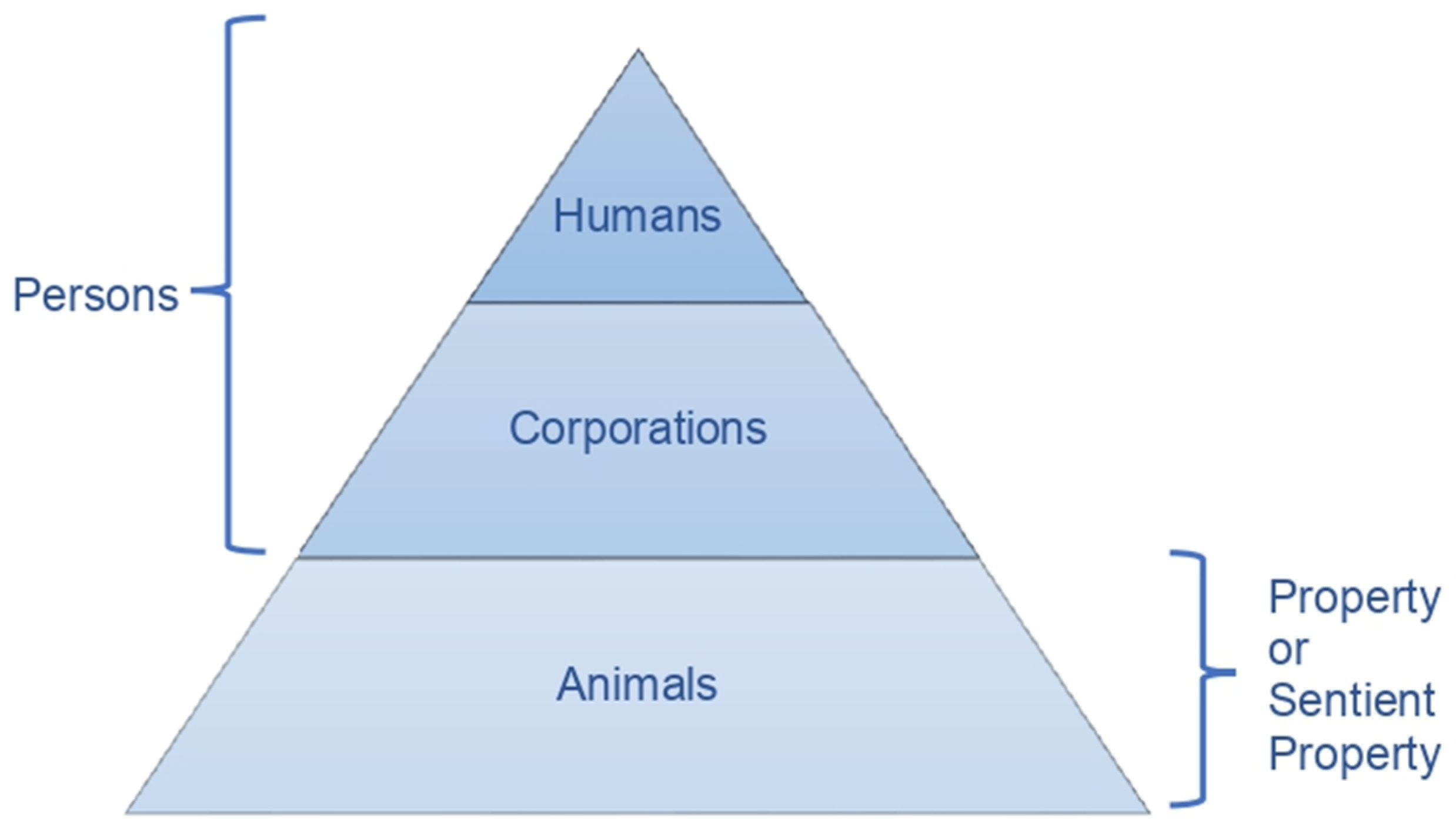
The subset view leads to the following organization of the legal universe (Figure 1):
Figure 1. The Subset View.
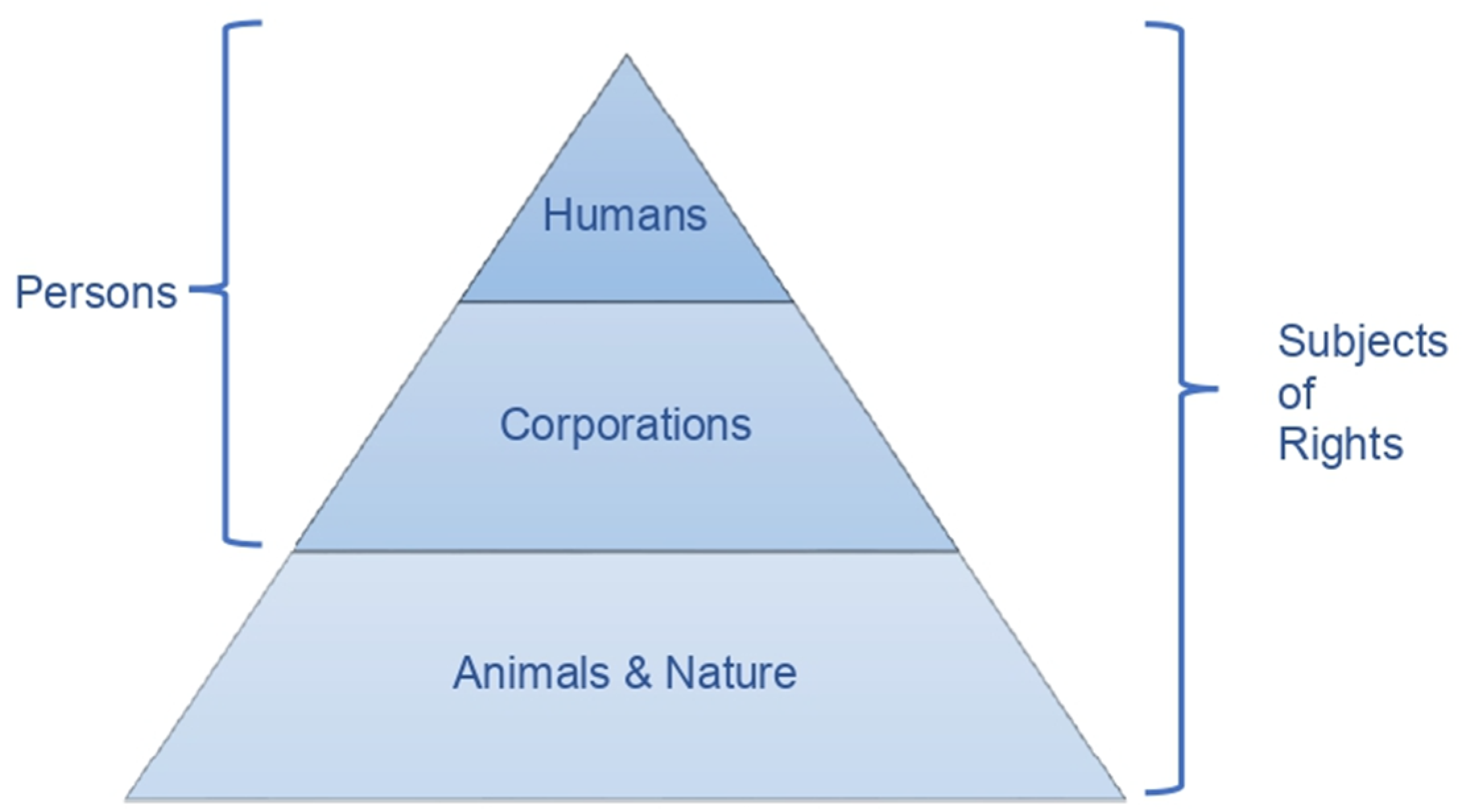
An important variation on this model involves classifying corporations as subjects of rights but not persons, because only humans are legal persons [79] (p. 234). The subset view looks similar to how the law regulates animals today in most countries, as the next diagram shows (Figure 2):
Figure 2. Animals’ Current Legal Regulation.
As explained above, the equivalence view makes animal legal personhood more achievable as holding rights is considered a sufficient condition for personhood, helping to break the personhood barrier, and expanding the movement and support for animal persons. However, the subset view is currently more acceptable for legal practitioners because it separates humans from other animals and maintains humans in the highest legal category, creating an intermediate category for animals. So, a dilemma emerges. Should we choose between a revolution or a reform of animals’ legal status? The subset view may be more acceptable for legal practitioners in the short term, but we should also strive to include at least some animals in the highest legal category with humans, so their interests can trump humans’ interests and they can enjoy the fundamental rights commonly granted to physical legal persons and the procedural guarantees that ensure those fundamental rights.
In sum, according to the will and interest theories, animals can be considered subjects of rights. However, the law protects vulnerable people’s interests, such as children and intellectually disabled people, rather than protecting only those who can express their will. The law even protects animals through anticruelty, welfare, and environmental regulations, supporting the argument that Western legal systems adopt the interest theory instead of the will theory [77] (p. 43). Traditionally, the legal person has been understood as the subject of rights, but in recent years a trend that separates these concepts has emerged. The subset view may be more acceptable to legal practitioners in the short term, but the equivalence view applied to animals strives for a revolution by breaking the legal personhood barrier that separates humans from other sentient animals.

6. Conclusions

The concept of the person has been examined in different fields such as psychology, theology, and philosophy, making it hard to define. Throughout history, different conceptions of the legal person have emerged. Some have become common among legal practitioners. I propose an ecumenical defense of animal legal personhood, arguing that animals can be considered legal persons according to four traditional concepts of legal personhood:
(i)
Legal personhood as the personification of a set of norms.
(ii)
Legal personhood as status or role.
(iii)
Legal personhood as the legal capacity to hold rights and bear duties.
(iv)
Legal personhood as the subject of rights.
These concepts vary depending on one’s theoretical framework, the role of the entity (or being), legal capacity, and holding rights. Throughout history, completely different entities, including idols, ships, corporations, charities, animals, rivers, mangroves, forests, and even nature in general, have been considered somewhere a legal person. It is thus unsurprising that the definition of what that means has significantly varied too.
If we follow Kelsen’s theory and embrace positivism, animals can be legal persons, as can anything the law recognizes as such. Roman law is responsible for developing the concept of the legal person as the different roles we play in society. Currently, animals play important roles within our societies, as family members or according to Donaldson and Kymlicka, as citizens, denizens, or migrants [22]. Animals can also possess the capacity to hold rights, and even though duties are not a necessary condition for legal personhood, many animals bear duties within their communities or can be put under a duty by the law. According to the interest and will theories, animals can also be considered subjects of rights.
Despite the variety of definitions of legal personhood and the confusions some of them originate, we can draw three conclusions. First, the law does not consider the terms human and legal person as the same. The concept of the human is a biological category that indicates who belongs to the Homo sapiens species, which can be determined through genetic testing. Second, the debate regarding the equivalence and the subset views of the subject of rights poses a dilemma between a revolution or the reform of animals’ legal status. Even though we may be able to advance animals’ legal protection in the short term by choosing the subset view as it does not challenge human exceptionalism, we should strive to include at least some animals in the physical legal person category with humans so their interests can trump humans’ interests. Third, an ecumenical defense of animal legal personhood may benefit animals as it supports animal persons according to any of the traditional concepts of legal personhood, considering that all these concepts are commonly used by legal practitioners, sometimes even in the same ruling.

Funding

This research was funded by Agència de Gestió d’Ajuts Universitaris i de Recerca (AGAUR), FI-DGR grant (2021FI_B2 00122).

Institutional Review Board Statement

Not applicable.

Data Availability Statement

The data presented in this study are available on request from the corresponding author. The data are not publicly available due to privacy.

Acknowledgments

The author would like to thank Carlos Contreras, Paula Casal, the anonymous reviewers, and the editors of the journal for their valuable help and comments.

Conflicts of Interest

The author declares no conflict of interest.

References

  1. Kelsen, H. Introduction to the Problems of Legal Theory: A Translation of the First Edition of the Reine Rechtslehre or Pure Theory of Law; translated by Bonnie Litschewski Paulson and Stanley L. Paulson; Oxford University Press: New York, NY, USA, 1992. [Google Scholar]
  2. De Castro y Bravo, F. Derecho Civil de España, 1st ed.; Civitas: Madrid, Spain, 2008. [Google Scholar]
  3. Corral Talciani, H. El concepto jurídico de persona. Una propuesta de reconstrucción unitaria. Rev. Chil. Derecho 1990, 17, 301–321. [Google Scholar]
  4. Verdera Server, R. Lecciones de Derecho Civil. Derecho Civil I, 2nd ed.; Tirant lo Blanch: Valencia, Spain, 2019. [Google Scholar]
  5. Tercer Juzgado de Garantías de Mendoza [J.G.Men.] [Third Criminal Court of Mendoza], 3/11/2016, “Presentación Efectuada Por AFADA Respecto del Chimpancé ‘Cecilia’ Sujeto No Humano,” [Expte. Nro.] P-72.254/15, (Arg.). Available online: http://www.saij.gob.ar/3er-juzgado-garantias-local-mendoza-presentacion-efectuada-afadarespecto-chimpance-cecilia-sujeto-humano-fa16190011-2016-11-03/123456789-110-0916-1ots-eupmocsollaf (accessed on 12 August 2022).
  6. De Cossío, A. Evolución del concepto de la personalidad, y sus repercusiones en el Derecho privado. Rev. Derecho Priv. 1942, 26, 749–762. [Google Scholar]
  7. de Cossío, A. El moderno concepto de la personalidad y la teoría de los “estados” en el Derecho Civil actual. Rev. Derecho Priv. 1943, 27, 1–16. [Google Scholar]
  8. Mussawir, E.; Parsley, C. The Law of Persons Today: At the Margins of Jurisprudence. Law Humanit. 2017, 11, 44–63. [Google Scholar] [CrossRef]
  9. Irvine, L. Animals and Sociology. Sociol. Compass 2008, 2, 1954–1971. [Google Scholar] [CrossRef]
  10. PR Newswire. Available online: https://www.prnewswire.com/news-releases/pets-really-are-members-of-the-family-123604964.html (accessed on 8 August 2022).
  11. Rover. Available online: https://www.rover.com/blog/the-truth-about-dog-people-infographic/ (accessed on 12 August 2022).
  12. Albert, A.; Bulcroft, K. Pets, Families, and the Life Course. J. Marriage Fam. 1988, 50, 543–552. [Google Scholar] [CrossRef]
  13. Kurdek, L.A. Pet Dogs as Attachment Figures. J. Soc. Pers. Relatsh. 2008, 25, 247–266. [Google Scholar] [CrossRef]
  14. Archer, J.; Winchester, G. Bereavement Following Death of a Pet. Br. J. Psychol. 1994, 85, 259–271. [Google Scholar] [CrossRef] [PubMed]
  15. 1978 Spanish Constitution. Boletín Oficial del Estado [BOE], No. 311. 29 December 1978. Available online: https://www.boe.es/buscar/act.php?id=BOE-A-1978-31229 (accessed on 12 August 2022).
  16. 1980 Chilean Constitution. Decreto No. 100, 17 September 2005. Available online: https://www.bcn.cl/formacioncivica/constitucion.html (accessed on 12 August 2022).
  17. 1991 Colombian Constitution. Gaceta Constitucional No. 116, 20 July 1991. Available online: http://www.secretariasenado.gov.co/constitucion-politica (accessed on 12 August 2022).
  18. Kindregan, C.P. Pets in Divorce: Family Conflict over Animal Custody. Am. J. Fam. Law 2013, 26, 227–232. [Google Scholar]
  19. Juzgado de Primera Instancia 9 de Valladolid [Juzgado de Primera Instancia 9] [Court of First Instance 9 of Valladolid], 27/5/2019, [Expte. Nro.] 1068-2018 (Spain). Available online: https://vlex.es/vid/791223221 (accessed on 12 August 2022).
  20. Law 17/2021, of 15 December, Amending the Civil Code, the Mortgage Law, and the Law of Civil Procedure, on the Legal Regime of Animals de 15 de Diciembre. Boletín Oficial del Estado [BOE], No. 30. Available online: https://www.boe.es/diario_boe/txt.php?id=BOE-A-2021-20727 (accessed on 12 August 2022).
  21. Oficina Judicial de Rawson, Provincia del Chubut [O.J.R.] [Criminal Court of Rawson], 10/6/2021, “C., M.M.M. s/Denuncia Maltrato Animal,” (Arg.). Available online: https://www.juschubut.gov.ar/images/centro-juris/Temisnet/Ofi_Jud_RW/OJ2P0481S21W__TITA.pdf (accessed on 12 August 2022).
  22. Donaldson, S.; Kymlicka, W. Zoopolis. A Political Theory of Animal Rights; Oxford University Press: New York, NY, USA, 2011. [Google Scholar]
  23. López de la Cruz, L. La persona. In Derecho Civil I Parte General y Derecho de la Persona, 3rd ed.; López y López, Á.M., Valpuesta Fernández, R., Eds.; Tirant lo Blanch: Valencia, Spain, 2019; pp. 81–100. [Google Scholar]
  24. Cupp, R.L.J. Moving beyond Animal Rights: Legal/Contractualist Critique. San Diego Law Rev. 2009, 46, 27–84. [Google Scholar]
  25. Kramer, M.H. Do Animals and Dead People Have Legal Rights? Can. J. Law Jurisprud. 2001, 14, 29–54. [Google Scholar] [CrossRef]
  26. Barber, N. The Myth of Culture. Why We Need a Genuine Natural Science of Societies; Cambridge Scholars Publishing: Newcastle, UK, 2008. [Google Scholar]
  27. Casal, P. Ethics and Primatology. An Interview with Frans de Waal. Mètode 2011, 69, 24–30. [Google Scholar]
  28. De Waal, F. Good Natured. The Origins of Right and Wrong in Humans and Other Animals; Harvard University Press: Cambridge, UK, 1996. [Google Scholar]
  29. De Waal, F. Chimpanzee Politics. Power and Sex Among Apes; The John Hopkins University Press: Baltimore, MA, USA, 2000. [Google Scholar]
  30. Casal, P.; Singer, P. Los Derechos de los Simios; Editorial Trotta: Madrid, Spain, 2022. [Google Scholar]
  31. Sykes, K. Human Drama, Animal Trials: What the Medieval Animal Trials Can Teach Us About Justice for Animals. Anim. Law 2011, 17, 273–311. [Google Scholar]
  32. Nonhuman Rights Project v. Lavery, No. 518336, N.Y. Sup. Ct. Appellate Div. Third Jud. Dep., 4 December 2014. Available online: https://www.nonhumanrights.org/content/uploads/Appellate-Decision-in-Tommy-Case-12-4-14.pdf (accessed on 26 September 2022).
  33. Garner, B. Person. In Black’s Law Dictionary, 11th ed.; Thomson Reuters: St. Paul, MN, USA, 2019. [Google Scholar]
  34. Salmond, J.; Fitzgerald, P.J. Salmond on Jurisprudence, 12th ed.; Sweet & Maxwell: London, UK, 1966. [Google Scholar]
  35. Nonhuman Right Blog. Available online: https://www.nonhumanrights.org/blog/first-department-wildly-wrong/ (accessed on 12 August 2022).
  36. Corte Suprema de Justicia [C.S.J.] [Supreme Court], Sala. Civ. Julio 26, 2017, M.S: L. Tolosa Villabona, Expediente AHC4806-2017 (Colom.). Available online: https://www.nonhumanrights.org/content/uploads/Chucho-decision.pdf (accessed on 12 August 2022).
  37. Cámara Federal de Casación Penal [C.F.C.P.] [Federal Criminal Cassation Court], Second Chamber, 18/12/2014, “Orangutana Sandra s/ Recurso de Casación s/ Habeas Corpus,” No 2603/14 (Arg.). Available online: http://www.saij.gob.ar/camara-federal-casacion-penal-federal-ciudad-autonoma-buenos-aires-orangutana-sandra-recurso-cadacion-habeas-corpus-fa14261110-2014-12-18/123456789-011-1624-1ots-eupmocsollaf (accessed on 26 August 2022).
  38. Juzgado Contencioso Administrativo y Tributario No. 4 de la Ciudad de Buenos Aires [J.C.A.T.] [Court for Contentious-Administrative and Tax Proceedings No. 4 of the city of Buenos Aires], 21.10.2015, “Asociación de Funcionarios y Abogados por los Derechos de los Animales y Otros c. GBCA Sobre Amparo,” No. A2174-2015/0 (Arg.). Available online: https://www.animallaw.info/case/asociacion-de-funcionarios-y-abogados-por-los-derechos-de-los-animales-y-otros-contra-gcba (accessed on 26 August 2022).
  39. Cámara Contencioso Administrativo y Tributario de la Ciudad Autónoma de Buenos Aires [C.C.A.T.B.A.] [Contentious Administrative and Tax Court of the City of Buenos Aires], 14.6.2016, “Orangutana Sandra-Sentencia de Cámara- Sala I del Fuero Contencioso Administrativo y Tributario CABA,” (Arg.). Available online: https://www.animallaw.info/case/%E2%80%9Casociaci%C3%B3n-de-funcionarios-y-abogados-por-los-derechos-de-los-animales-y-otros-c-gcba-s-amparo. (accessed on 26 August 2022).
  40. Corte Constitucional del Ecuador [C.C.E.] [Ecuadorian Constitutional Court], 22 Diciembre 2020, J.R. Ávila & J. A. Grijalva, Caso 253-20-JH (Ecu.). Available online: http://esacc.corteconstitucional.gob.ec/storage/api/v1/10_DWL_FL/e2NhcnBldGE6J3RyYW1pdGUnLCB1dWlkOic3ZmMxMjVmMi1iMzZkLTRkZDQtYTM2NC1kOGNiMWIwYWViMWMucGRmJ30= (accessed on 12 August 2022).
  41. Stucki, S. Towards a Theory of Legal Animal Rights: Simple and Fundamental Rights. Oxf. J. Leg. Stud. 2020, 40, 533–560. [Google Scholar] [CrossRef] [PubMed]
  42. Kurki, V. A Theory of Legal Personhood; Oxford University Press: New York, NY, USA, 2019. [Google Scholar]
  43. Wise, S.M. Legal Personhood and The Nonhuman Rights Project. Anim. Law 2010, 17, 1–11. [Google Scholar]
  44. Kurki, V. Legal Personhood and Animal Rights. J. Anim. Ethics 2021, 11, 47–62. [Google Scholar] [CrossRef]
  45. Great Ape Project Brazil. Available online: https://www.projetogap.org.br/es/noticia/gap-brasil-momentos-vividos-por-la-chimpance-cecilia-libertada-por-habeas-corpus-en-el-santuario-de-grandes-primates-de-sorocaba-sp/ (accessed on 12 August 2022).
  46. Nonhuman Rights Project. Available online: https://www.nonhumanrights.org/client-kiko/ (accessed on 12 August 2022).
  47. Nonhuman Rights Blog. Available online: https://www.nonhumanrights.org/blog/update-elephant-rights-lawsuit-12-28-17/ (accessed on 26 August 2022).
  48. Nonhuman Rights Project. Available online: https://www.nonhumanrights.org/client-tommy/ (accessed on 12 August 2022).
  49. Nonhuman Rights Project. Available online: https://www.nonhumanrights.org/client-happy/ (accessed on 12 August 2022).
  50. Cupp, R.L.J. Children, Chimps, and Rights: Arguments from “Marginal” Cases. Ariz. State Law J. 2013, 45, 1–52. [Google Scholar]
  51. Corte Suprema de Justicia [C.S.J.] [Supreme Court], Sala. Cas. Pen. Octubre 10, 2017, M.P: F. Bolaños Palacios, Expediente STP16597-2017 (Colom.). Available online: https://cortesuprema.gov.co/corte/ (accessed on 12 August 2022).
  52. Contreras, C. Derecho Animal en Colombia a partir de la Ley 1774 de 2016: Las sentencias de la Corte Constitucional y de la Corte Suprema en los dos primeros años (2016–2018) de vigencia del estatuto de los animales como no cosas y seres sintientes. Rev. Gen. Derecho Anim. Estud. Interdiscip. Bienestar Anim. 2018, 2, 1–165. [Google Scholar]
  53. New York Consolidated Laws, Civil Practice Law and Rules, § 7002 (a) (2013). United States. Available online: https://law.justia.com/codes/new-york/2013/cvp/article-70/7002/ (accessed on 12 August 2022).
  54. Nonhuman Rights Project v. Lavery, No. 2013-02051 (N.Y. Sup. Ct. Fulton County, 3 December 2013). Available online: https://www.nonhumanrights.org/content/uploads/Fulton-Cty-hearing-re.-Tommy-12-2-13.pdf (accessed on 12 August 2022).
  55. Organic Law 6/1984, of May 24, which regulates the habeas corpus procedure. Boletín Oficial del Estado [BOE], No. 126, 26 May 1984 (Spain). Available online: https://www.boe.es/buscar/act.php?id=BOE-A-1984-11620 (accessed on 12 August 2022).
  56. Law 1095/2006, which regulates article 30 of the Constitution, 2 November 2006, Diario Oficial [D.O.] 46440, (Colom.). Available online: https://www.funcionpublica.gov.co/eva/gestornormativo/norma.php?i=22087 (accessed on 12 August 2022).
  57. Rogel Vide, C.; Espín Alba, I. Derecho de la Persona, 2nd ed.; Reus Editorial: Madrid, Spain, 2018. [Google Scholar]
  58. Casal, P. Los derechos homínidos. Una defensa ecuménica. Daimon Rev. Int. Filos. 2018, 73, 7–25. [Google Scholar]
  59. Nékám, A. The Personality Conception of the Legal Entity; Harvard University Press: Cambridge, UK, 1938. [Google Scholar]
  60. Kirkden, R.D.; Pajor, E.A. Using preference, motivation and aversion tests to ask scientific questions about animals’ feelings. Appl. Anim. Behav. Sci. 2006, 100, 29–47. [Google Scholar] [CrossRef]
  61. Fraser, D.; Matthews, L.R. Preference and motivation testing. In Animal Welfare; Appleby, M.C., Hughes, B.O., Eds.; CAB International: New York, NY, USA, 1997; pp. 159–173. [Google Scholar]
  62. Erhard, H.W. Assessing the relative aversiveness of two stimuli: Single sheep in the arena test. Anim. Welf. 2003, 12, 349–358. [Google Scholar]
  63. Franks, B. What do animals want? Anim. Welf. 2019, 28, 1–10. [Google Scholar] [CrossRef]
  64. de Waal, F. Our Inner Ape: A Leading Primatologist Explains Why We Are Who We Are; Riverhead: New York, NY, USA, 2005. [Google Scholar]
  65. Mielke, A.; Preis, A.; Samuni, L.; Gogarten, J.F.; Wittig, R.M.; Crockford, C. Flexible decision-making in grooming partner choice in sooty mangabeys and chimpanzees. R. Soc. Open Sci. 2018, 5, 1–13. [Google Scholar] [CrossRef] [PubMed]
  66. Fruth, B.; Hohmann, G. Comparative Analyses of Nest Building Behavior in Bonobos and Chimpanzees. In Chimpanzee Culutres; Wrangham, R.W., McGrew, W., de Waal, F., Heltne, P., Eds.; Harvard University Press: Cambridge, UK, 1994; pp. 109–128. [Google Scholar]
  67. Schrope, M. Killer in the Kelp. Nature 2007, 445, 703–705. [Google Scholar] [CrossRef] [PubMed]
  68. Daily Mail Australia. Available online: https://www.dailymail.co.uk/news/article-10412601/Incredible-moment-pod-killer-whales-appear-free-humpback-tangled-ropes.html?ito=native_share_article-masthead (accessed on 12 August 2022).
  69. Moreno, M. Cecilia, la Primera Chimpancé a la Que Declaran “Persona.” El Español. 2017. Available online: https://www.elespanol.com/ciencia/medio-ambiente/20170407/206729898_0.html (accessed on 12 August 2022).
  70. González, E. “Sandra”, la Orangutana Que se Convirtió en “Persona.” El País. 2019. Available online: https://elpais.com/elpais/2019/06/17/eps/1560778649_547496.html (accessed on 12 August 2022).
  71. Pietrzykowski, T. Towards modest naturalization of personhood in law. Revus J. Const. Theory Philos. Law 2017, 32, 59–71. [Google Scholar] [CrossRef][Green Version]
  72. Mañalich Raffo, J.P. Animalidad y subjetividad. Rev. Derecho (Valdivia) 2018, 31, 321–337. [Google Scholar] [CrossRef]
  73. Favre, D. Living Property: A New Status for Animals Within the Legal System. Marquette Law Rev. 2010, 93, 1021–1070. [Google Scholar]
  74. Esposito, R. The Dispositif of the Person. Law Cult. Humanit. 2012, 8, 17–30. [Google Scholar] [CrossRef]
  75. Vallentyne, P. Of Mice and Men: Equality and Animals. J. Ethics 2005, 9, 403–433. [Google Scholar] [CrossRef]
  76. Kagan, S. How to Count Animals, More or Less; Oxford University Press: Oxford, UK, 2019. [Google Scholar]
  77. Bilchitz, D. Moving beyond Arbitrariness: The Legal Personhood and Dignity of Non-Human Animals. South Afr. J. Hum. Rights 2009, 25, 38–72. [Google Scholar] [CrossRef][Green Version]
  78. Tudor, S. Some Implications for Legal Personhood of Extending Legal Rights to Non-Human Animals. Aust. J. Leg. Philos. 2010, 35, 134–139. [Google Scholar]
  79. Lacalle Noriega, M. La Persona Como Sujeto del Derecho; Dykinson: Madrid, Spain, 2016. [Google Scholar]
Publisher’s Note: MDPI stays neutral with regard to jurisdictional claims in published maps and institutional affiliations.

Article Metrics

Citations

Article Access Statistics

Multiple requests from the same IP address are counted as one view.