
Introducing Mediterranean Lupins in Lamb Diets: Effects on Carcass Composition, Meat Quality, and Intramuscular Fatty Acid Profile
by
 , , , , , , and
Mariana Almeida
1,2,3,* ,
,
Sofia Garcia-Santos
4,
Daniela Carloto
3,
André Arantes
3,
Jose M. Lorenzo
5,6 ,
,
José António Silva
1,2,3,
Virgínia Santos
1,2,3,
Jorge Azevedo
1,2,3,
Cristina Guedes
1,2,3,
Luís Ferreira
3,4 and
and
Severiano Silva
1,2,3
1
Veterinary and Animal Research Centre (CECAV), University of Trás-os-Montes e Alto Douro, Quinta de Prados, 5000-801 Vila Real, Portugal
2
Associate Laboratory for Animal and Veterinary Sciences (AL4AnimalS), University of Trás-os-Montes e Alto Douro, Quinta de Prados, 5000-801 Vila Real, Portugal
3
Department of Animal Science, University of Trás-os-Montes e Alto Douro, Quinta de Prados, 5000-801 Vila Real, Portugal
4
Centre for the Research and Technology Agro-Environmental and Biological Sciences (CITAB), University of Trás-os-Montes e Alto Douro, Quinta de Prados, 5000-801 Vila Real, Portugal
5
Centro Tecnológico de la Carne de Galicia, Rúa Galicia N°4, Parque Tecnológico de Galicia, San Cibrán das Viñas, 32900 Ourense, Spain
6
Área de Tecnología de los Alimentos, Facultad de Ciencias de Ourense, Universidad de Vigo, 32004 Ourense, Spain
*
Author to whom correspondence should be addressed.
Animals 2022, 12(14), 1758; https://doi.org/10.3390/ani12141758
Submission received: 20 May 2022
/
Revised: 4 July 2022
/
Accepted: 7 July 2022
/
Published: 8 July 2022
(This article belongs to the Special Issue Novel Feed Ingredients: Improving Health Status, Milk and Meat Quality in Small Ruminants)
Simple Summary
The main aim of this preliminary study was to evaluate the effects of replacing soybean meal with lupins on carcass traits, meat characteristics, meat characteristics, and meat fatty acid profile in lambs. Two trials were conducted: In trial 1, the soybean meal was partially replaced by Lupinus albus or Lupinus luteus; in trial 2, lambs were fed four diets with graded levels of Lupinus luteus, ranging from 0 to 200 g/kg. The lambs were slaughtered to evaluate carcass characteristics, meat composition, and fatty acids profile. Carcass composition was not affected (p > 0.05) by diet in both trials. Meat quality attributes did not vary (p < 0.05) between trials 1 and 2. Overall, fatty acid content was not affected by diet (p > 0.05) in both trials. Soybean meal produced the same results as lupins in this study, indicating the latter as a potential alternative protein source, although research should focus on meat palatability.
Abstract
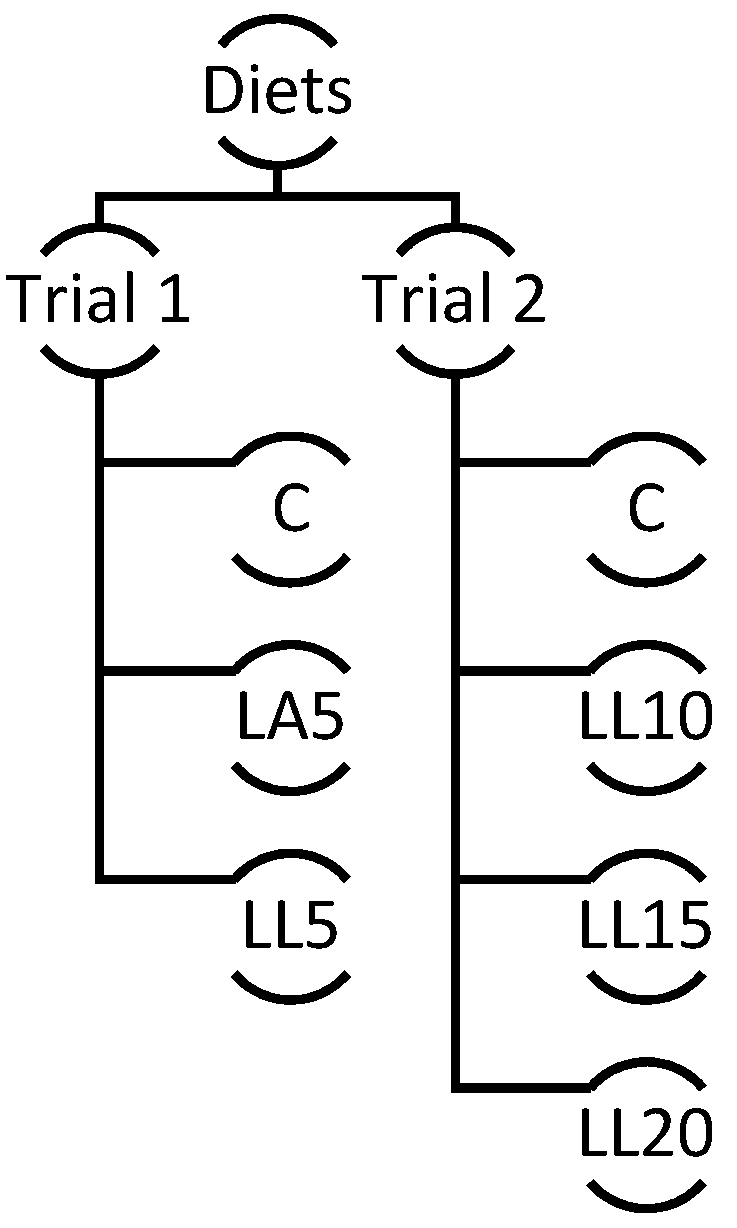
The objective of this preliminary study was to evaluate the effects of partial replacement of soybean meal by lupins on lambs’ diets, on the carcass traits, meat characteristics, and meat fatty acid profile. Two trials were conducted: In trial 1, the soybean meal (control; C) was partially replaced by Lupinus albus or Lupinus luteus (50 g/kg; LA5 and LL5, respectively); in trial 2, lambs were fed four diets with graded levels of Lupinus luteus (0, 100, 150 and 200 g/kg; C, LL10, LL15, LL20, respectively). At the end of the feeding trials, animals were slaughtered to evaluate carcass characteristics and meat composition, including fatty acids. Carcass composition in tissues was not affected (p > 0.05) by diet in both trials. Additionally, no significant (p < 0.05) differences were observed in meat quality attributes between diets in trials 1 and 2. Overall, the Longissimus muscle’s fatty acid content was not affected by diet (p > 0.05) in both trials. Carcass and meat quality was overall comparable between lambs fed with soybean meal and lupins, indicating the latter as a potential alternative protein source. However, the lack of significant differences could also be attributed to the small sample size.
Keywords:
lupins; lambs; meat quality; pH; color; carcass characteristics; fatty acids