Reduction of Salmonella Typhimurium Cecal Colonisation and Improvement of Intestinal Health in Broilers Supplemented with Fermented Defatted ‘Alperujo’, an Olive Oil By-Product

 , ,
, ,  ,
,  ,
,
Simple Summary
Abstract
1. Introduction
2. Materials and Methods
2.1. Ethical Approval and Animal Welfare
2.2. Animal Groups and Feed
2.3. Salmonella Typhimurium Challenge
2.4. Postmortem Examination and Samplings
2.5. Salmonella spp. Detection and Culture Conditions
2.6. Real-Time PCR for Salmonella spp. Detection
2.7. 16S rRNA Library Preparation and Sequencing
2.8. Bioinformatics and Data Analysis
2.9. Histological Processing, and Histopathological and Histomorphometric Analysis
2.10. Statistical Analysis
3. Results
3.1. Clinical Signs and Gross Findings
3.2. Salmonella Typhimurium Colonisation in the Cecum
3.3. Intestinal Histopathology
3.4. Intestinal Morphology
3.5. Cecal Microbiota
4. Discussion
5. Conclusions
Author Contributions
Funding
Acknowledgments
Conflicts of Interest
References
- EFSA. The European Union summary reports on trends and sources of zoonoses, zoonotic agents and food-borne outbreaks in 2016. EFSA J. 2017, 15, 5077. [Google Scholar] [CrossRef]
- Jazi, V.; Mohebodini, H.; Ashayerizadeh, A.; Shabani, A.; Barekatain, R. Fermented soybean meal ameliorates Salmonella Typhimurium infection in young broiler chickens. Poult. Sci. 2019, 98, 5648–5660. [Google Scholar] [CrossRef] [PubMed]
- Fasina, Y.O.; Bowers, J.B.; Hess, J.B.; McKee, S.R. Effect of dietary glutamine supplementation on Salmonella colonization in the ceca of young broiler chicks. Poult. Sci. 2010, 89, 1042–1048. [Google Scholar] [CrossRef]
- Awad, W.A.; Aschenbach, J.R.; Khayal, B.; Hess, C.; Hess, M. Intestinal epithelial responses to Salmonella enterica serovar Enteritidis: Effects on intestinal permeability and ion transport. Poult. Sci. 2012, 91, 2949–2957. [Google Scholar] [CrossRef] [PubMed]
- Sibanda, N.; McKenna, A.; Richmond, A.; Ricke, S.C.; Callaway, T.; Stratakos, A.C.; Gundogdu, O.; Corcionivoschi, N. A review of the effect of management practices on campylobacter prevalence in poultry farms. Front. Microbiol. 2018, 9, 2002. [Google Scholar] [CrossRef] [PubMed]
- Jazi, V.; Foroozandeh, A.D.; Toghyani, M.; Dastar, B.; Rezaie-Koochaksaraie, R.; Toghyani, M. Effects of Pediococcus acidilactici, mannan-oligosaccharide, butyric acid and their combination on growth performance and intestinal health in young broiler chickens challenged with Salmonella Typhimurium. Poult. Sci. 2018, 97, 2034–2043. [Google Scholar] [CrossRef] [PubMed]
- Abudabos, A.M.; Hussein, E.O.S.; Ali, M.H.; Al-Ghadi, M.Q. The effect of some natural alternative to antibiotics on growth and changes in intestinal histology in broiler exposed to Salmonella challenge. Poult. Sci. 2018, 98, 1441–1446. [Google Scholar] [CrossRef]
- Guo, L.; Gong, S.; Wang, Y.; Sun, Q.; Duo, K.; Fei, P. Antibacterial activity of olive oil polyphenol extract against Salmonella Typhimurium and Staphylococcus aureus: Possible Mechanisms. Foodborne Pathog. Dis. 2019, 17, 396–403. [Google Scholar] [CrossRef]
- Alburquerque, J.A.; Gonzálvez, J.; García, D.; Cegarra, J. Agrochemical characterisation of “alperujo”, a solid by-product of the two-phase centrifugation method for olive oil extraction. Bioresour. Technol. 2004, 91, 195–200. [Google Scholar] [CrossRef]
- Medina, E.; Romero, C.; Brenes, M.; de Castro, A. Antimicrobial activity of olive oil, vinegar, and various beverages against foodborne pathogens. J. Food Prot. 2007, 70, 1194–1199. [Google Scholar] [CrossRef]
- Herrero-Encinas, J.; Blanch, M.; Pastor, J.J.; Mereu, A.; Ipharraguerre, I.R.; Menoyo, D. Effects of a bioactive olive pomace extract from Olea europaea on growth performance, gut function, and intestinal microbiota in broiler chickens. Poult. Sci. 2020, 99, 2–10. [Google Scholar] [CrossRef] [PubMed]
- Karaosmanoglu, H.; Soyer, F.; Ozen, B.; Tokatli, F. Antimicrobial and antioxidant activities of Turkish extra virgin olive oils. J. Agric. Food Chem. 2010, 58, 8238–8245. [Google Scholar] [CrossRef] [PubMed]
- Bisignano, G.; Tomaino, A.; Cascio, R.L.; Crisafi, G.; Uccella, N.; Saija, A. On the In-vitro antimicrobial activity of oleuropein and hydroxytyrosol. J. Pharm. Pharmacol. 1999, 51, 971–974. [Google Scholar] [CrossRef] [PubMed]
- Rebollada-Merino, A.; Bárcena, C.; Ugarte-Ruiz, M.; Porras, N.; Mayoral-Alegre, F.J.; Tomé-Sánchez, I.; Domínguez, L.; Rodríguez-Bertos, A. Effects on intestinal mucosal morphology, productive parameters and microbiota composition after supplementation with fermented defatted alperujo (FDA) in laying hens. Antibiotics 2019, 8, 215. [Google Scholar] [CrossRef]
- Rebollada-Merino, A.; Ugarte-Ruiz, M.; Hernández, M.; Miguela-Villoldo, P.; Abad, D.; Cuesta-Álvaro, P.; Rodríguez-Lázaro, D.; de Juan, L.; Domínguez, L.; Rodríguez-Bertos, A. Dietary supplementation with fermented defatted “alperujo” induces modifications of the intestinal mucosa and cecal microbiota of broiler chickens. Poult. Sci. 2020. online ahead of print. [Google Scholar] [CrossRef]
- Azcarate-Peril, M.A.; Butz, N.; Cadenas, M.B.; Koci, M.; Ballou, A.; Mendoza, M.; Ali, R.; Hassan, H. An attenuated Salmonella enterica serovar Typhimurium strain and galacto-oligosaccharides accelerate clearance of Salmonella infections in poultry through modifications to the gut microbiome. Appl. Environ. Microbiol. 2017, 84, e02526-17. [Google Scholar] [CrossRef] [PubMed]
- Asociación Española de Normalización (UNE). Available online: https://www.une.org/encuentra-tu-norma/busca-tu-norma/norma?c=N0058760 (accessed on 15 September 2020).
- Miguela-Villoldo, P.; Hernández, M.; Moreno, M.A.; Rodríguez-Lázaro, D.; Quesada, A.; Domínguez, L.; Ugarte-Ruiz, M. National colistin sales versus colistin resistance in Spanish pig production. Res. Vet. Sci. 2019, 123, 141–143. [Google Scholar] [CrossRef]
- Rodríguez-Lázaro, D.; Gonzalez-García, P.; Delibato, E.; De Medici, D.; García-Gimeno, R.M.; Valero, A.; Hernandez, M. Next day Salmonella spp. detection method based on real-time PCR for meat, dairy and vegetable food products. Int. J. Food Microbiol. 2014, 184, 113–120. [Google Scholar] [CrossRef]
- Rodríguez-Lázaro, D.; Hernández, M.; Esteve, T.; Hoorfar, J.; Pla, M. A rapid and direct real time PCR-based method for identification of Salmonella spp. J. Microbiol. Methods 2003, 54, 381–390. [Google Scholar] [CrossRef]
- Klindworth, A.; Pruesse, E.; Schweer, T.; Peplies, J.; Quast, C.; Horn, M.; Glöckner, F.O. Evaluation of general 16S ribosomal RNA gene PCR primers for classical and next-generation sequencing-based diversity studies. Nucleic Acids Res. 2013, 41, e1. [Google Scholar] [CrossRef]
- Bolyen, E.; Rideout, J.R.; Dillon, M.R.; Bokulich, N.A.; Abnet, C.C.; Al-Ghalith, G.A.; Alexander, H.; Alm, E.J.; Arumugam, M.; Asnicar, F.; et al. Reproducible, interactive, scalable and extensible microbiome data science using QIIME 2. Nat. Biotechnol. 2019, 37, 852–857. [Google Scholar] [CrossRef] [PubMed]
- Callahan, B.J.; McMurdie, P.J.; Rosen, M.J.; Han, A.W.; Johnson, A.J.A.; Holmes, S.P. DADA2: High-resolution sample inference from Illumina amplicon data. Nat. Methods 2016, 13, 581–583. [Google Scholar] [CrossRef] [PubMed]
- Wang, Q.; Garrity, G.M.; Tiedje, J.M.; Cole, J.R. Naive Bayesian classifier for rapid assignment of rRNA sequences into the new bacterial taxonomy. Appl. Environ. Microbiol. 2007, 73, 5261–5267. [Google Scholar] [CrossRef]
- Quast, C.; Pruesse, E.; Yilmaz, P.; Gerken, J.; Schweer, T.; Yarza, P.; Peplies, J.; Glöckner, F.O. The SILVA ribosomal RNA gene database project: Improved data processing and web-based tools. Nucleic Acids Res. 2013, 41, 590–596. [Google Scholar] [CrossRef]
- Faber, T.A.; Dilger, R.N.; Iakiviak, M.; Hopkins, A.C.; Price, N.P.; Fahey, G.C. Ingestion of a novel galactoglucomannan oligosaccharide-arabinoxylan (GGMO-AX) complex affected growth performance and fermentative and immunological characteristics of broiler chicks challenged with Salmonella Typhimurium. Poult. Sci. 2012, 91, 2241–2254. [Google Scholar] [CrossRef] [PubMed]
- Menanteau, P.; Kempf, F.; Trotereau, J.; Virlogeux-Payant, I.; Gitton, E.; Dalifard, J.; Gabriel, I.; Rychlik, I.; Velge, P. Role of systemic infection, cross contaminations and super-shedders in Salmonella carrier state in chicken. Environ. Microbiol. 2018, 20, 3246–3260. [Google Scholar] [CrossRef] [PubMed]
- Bjerrum, L.; Engberg, R.M.; Pedersen, K. Infection models for Salmonella Typhimurium DT110 in day-old and 14-day-old broiler chickens kept in isolators. Avian Dis. 2003, 47, 1474–1480. [Google Scholar] [CrossRef]
- Fasina, Y.O.; Hoerr, F.J.; McKee, S.R.; Conner, D.E. Influence of Salmonella enterica serovar Typhimurium infection on intestinal goblet cells and villous morphology in broiler chicks. Avian Dis. 2010, 54, 841–847. [Google Scholar] [CrossRef]
- Beal, R.; Wigley, P.; Powers, C.; Hulme, S.; Barrow, P.; Smith, A. Age at primary infection with Salmonella enterica serovar Typhimurium in the chicken influences persistence of infection and subsequent immunity to re-challenge. Vet. Immunol. Immunopathol. 2004, 100, 151–164. [Google Scholar] [CrossRef]
- Marcq, C.; Cox, E.; Szalo, I.M.; Thewis, A.; Beckers, Y. Salmonella Typhimurium oral challenge model in mature broilers: Bacteriological, immunological, and growth performance aspects. Poult. Sci. 2010, 90, 59–67. [Google Scholar] [CrossRef]
- Shang, Y.; Regassa, A.; Kim, J.H.; Kim, W.K. The effect of dietary fructooligosaccharide supplementation on growth performance, intestinal morphology, and immune responses in broiler chickens challenged with Salmonella Enteritidis lipopolysaccharides. Poult. Sci. 2015, 94, 2887–2897. [Google Scholar] [CrossRef] [PubMed]
- Adhikari, P.; Cosby, D.E.; Cox, N.A.; Franca, M.S.; Williams, S.M.; Gogal, R.M.; Ritz, C.W.; Kim, W.K. Effect of dietary fructooligosaccharide supplementation on internal organs Salmonella colonization, immune response, ileal morphology, and ileal immunohistochemistry in laying hens challenged with Salmonella Enteritidis. Poult. Sci. 2018, 97, 2525–2533. [Google Scholar] [CrossRef]
- Brito, J.R.F.; Xu, Y.; Hinton, M.; Pearson, G.R. Pathological findings in the intestinal tract and liver of chicks after exposure to Salmonella serotypes Typhimurium or Kedougou. Br. Vet. J. 1995, 151, 311–323. [Google Scholar] [CrossRef]
- Zhang, B.; Li, G.; Shahid, M.S.; Gan, L.; Fan, H.; Lv, Z.; Yan, S.; Guo, Y. Dietary l-arginine supplementation ameliorates inflammatory response and alters gut microbiota composition in broiler chickens infected with Salmonella enterica serovar Typhimurium. Poult. Sci. 2020, 99, 1862–1874. [Google Scholar] [CrossRef] [PubMed]
- Van Immerseel, F.; De Buck, J.; De Smet, I.; Mast, J.; Haesebrouck, F.; Ducatelle, R. Dynamics of immune cell infiltration in the caecal lamina propria of chickens after neonatal infection with a Salmonella Enteritidis strain. Dev. Comp. Immunol. 2002, 26, 355–364. [Google Scholar] [CrossRef]
- Wigley, P. Immunity to bacterial infection in the chicken. Dev. Comp. Immunol. 2013, 41, 413–417. [Google Scholar] [CrossRef]
- Xie, S.; Li, Y.; Zhao, S.; Lv, Y.; Yu, Q. Salmonella infection induced intestinal crypt hyperplasia through Wnt/β-catenin pathway in chicken. Res. Vet. Sci. 2020, 130, 179–183. [Google Scholar] [CrossRef]
- Shao, Y.; Guo, Y.; Wang, Z. β-1,3/1,6-Glucan alleviated intestinal mucosal barrier impairment of broiler chickens challenged with Salmonella enterica serovar Typhimurium. Poult. Sci. 2013, 92, 1764–1773. [Google Scholar] [CrossRef]
- Shao, Y.; Lei, Z.; Yuan, J.; Yang, Y.; Guo, Y.; Zhang, B. Effect of zinc on growth performance, gut morphometry, and cecal microbial community in broilers challenged with Salmonella enterica serovar Typhimurium. J. Microbiol. 2014, 52, 1002–1011. [Google Scholar] [CrossRef]
- Almeida, J.A.S.; Ponnuraj, N.P.; Lee, J.J.; Utterback, P.; Gaskins, H.R.; Dilger, R.N.; Pettigrew, J.E. Effects of dietary clays on performance and intestinal mucus barrier of broiler chicks challenged with Salmonella enterica serovar Typhimurium and on goblet cell function in vitro. Poult. Sci. 2014, 93, 839–847. [Google Scholar] [CrossRef]
- Rajani, J.; Dastar, B.; Samadi, F.; Karimi-Torshizi, M.A.; Abdulkhani, A.; Esfandyarpour, S. Effect of extracted galactoglucomannan oligosaccharides from pine wood (Pinus brutia) on Salmonella Typhimurium colonisation, growth performance and intestinal morphology in broiler chicks. Br. Poult. Sci. 2016, 57, 682–692. [Google Scholar] [CrossRef]
- Aljumaah, M.R.; Alkhulaifi, M.M.; Abudabos, A.M.; Alabdullatifb, A.; El-Mubarak, A.H.; Al Suliman, A.R.; Stanley, D. Organic acid blend supplementation increases butyrate and acetate production in Salmonella enterica serovar Typhimurium challenged broilers. PLoS ONE 2020, 15, e0232831. [Google Scholar] [CrossRef]
- Liu, J.D.; Bayir, H.O.; Cosby, D.E.; Cox, N.A.; Williams, S.M.; Fowler, J. Evaluation of encapsulated sodium butyrate on growth performance, energy digestibility, gut development, and Salmonella colonization in broilers. Poult. Sci. 2017, 96, 3638–3644. [Google Scholar] [CrossRef]
- Kelly, C.; Gundogdu, O.; Pircalabioru, G.; Cean, A.; Scates, P.; Linton, M.; Pinkerton, L.; Magowan, E.; Stef, L.; Simiz, E.; et al. The in vitro and in vivo effect of carvacrol in preventing Campylobacter infection, colonization and in improving productivity of chicken broilers. Foodborne Pathog. Dis. 2017, 14, 341–349. [Google Scholar] [CrossRef] [PubMed]
- Ijaz, U.Z.; Sivaloganathan, L.; McKenna, A.; Richmond, A.; Kelly, C.; Linton, M.; Stratakos, A.C.; Lavery, U.; Elmi, A.; Wren, B.W.; et al. Comprehensive longitudinal microbiome analysis of the chicken cecum reveals a shift from competitive to environmental drivers and a window of opportunity for Campylobacter. Front. Microbiol. 2018, 9, 2452. [Google Scholar] [CrossRef] [PubMed]
- Richards, P.; Fothergill, J.; Bernardeau, M.; Wigley, P. Development of the caecal microbiota in three broiler breeds. Front. Vet. Sci. 2019, 6, 201. [Google Scholar] [CrossRef] [PubMed]
- Kempf, F.; Menanteau, P.; Rychlik, I.; Kubasová, T.; Trotereau, J.; Virlogeux-Payant, I.; Schaeffer, S.; Schouler, C.; Drumo, R.; Guitton, E.; et al. Gut microbiota composition before infection determines the Salmonella super- and low-shedder phenotypes in chicken. Microb. Biotechnol. 2020, 13, 1611–1630. [Google Scholar] [CrossRef] [PubMed]
- Rychlik, I. Composition and function of chicken gut microbiota. Animals 2020, 10, 103. [Google Scholar] [CrossRef]
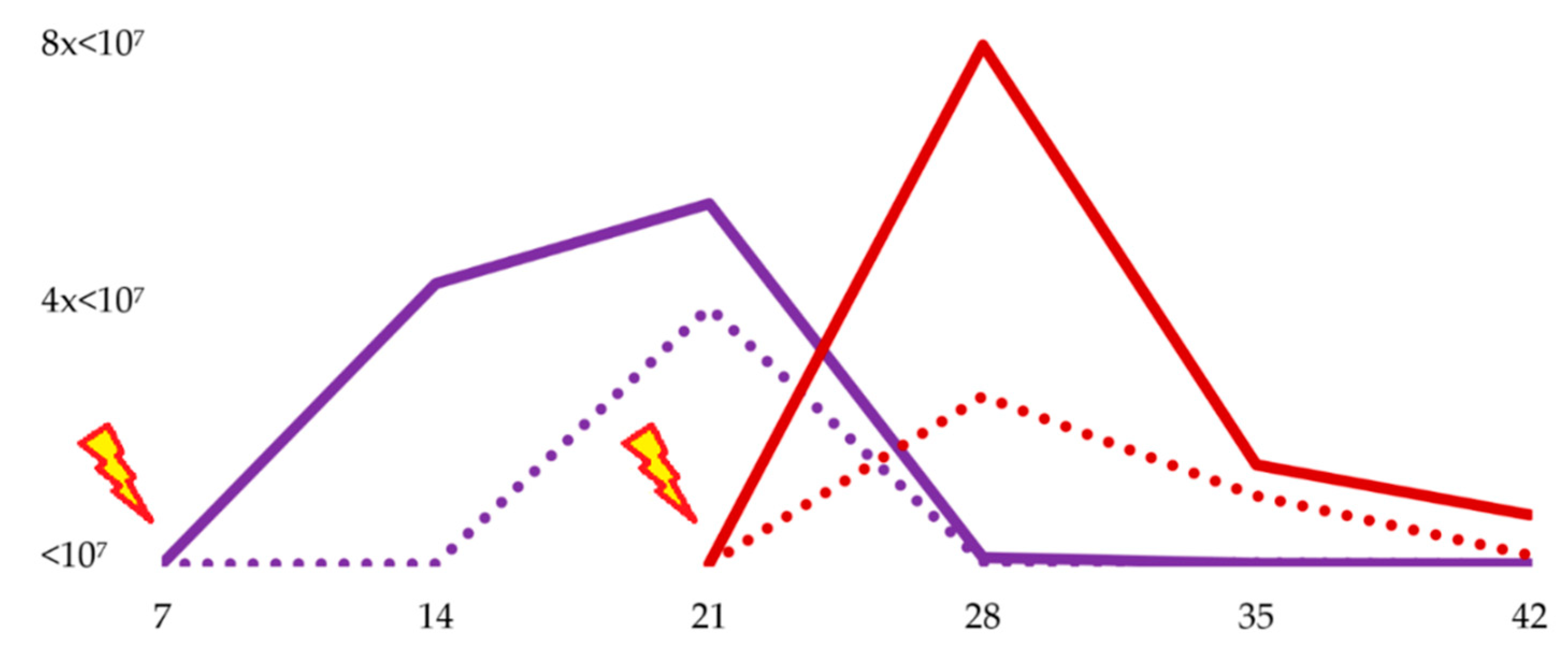


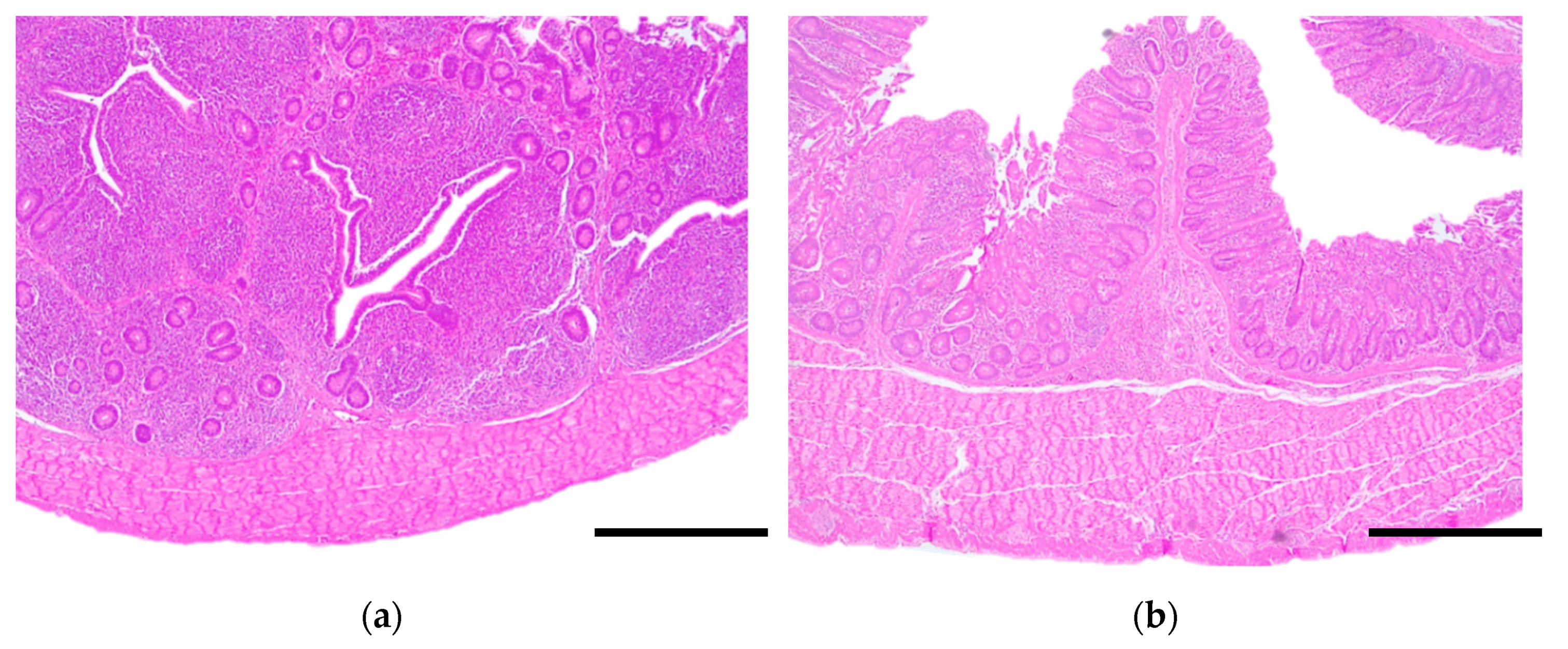



| Determination | Results |
|---|---|
| Moisture 103° (%w.w.) | 12.20 |
| Crude protein (Kjeldahl) (%w.w.) | 6.40 |
| Brute fat (%w.w.) | 3.00 |
| Ash content (%w.w.) | 7.70 |
| Lignin (%w.w.) | 23.30 |
| Acid detergent fibre (%w.w.) | 39.20 |
| Neutral detergent fibre (%w.w.) | 49.30 |
| Tannins (%w.w.) | 0.06 |
| Oleic acidity index (%w.w.) | 46.10 |
| Peroxide value (%w.w.) | 7.90 |
| Total polyphenols (meq/kg) | 0.89 |
| Crude fibre (%w.w.) | 27.70 |
| Days-Old | Control | Treated | p-Value 1 | |
|---|---|---|---|---|
| 7 | Culture | <102 | <102 | 1.000 |
| qPCR | * | * | 1.000 | |
| 14 | Culture | 4.21 × 10⁷ | <102 | 0.008 |
| qPCR | 9.94 × 10⁵ | 2.58 × 10⁵ | 0.056 | |
| 21 | Culture | 5.40 × 10⁷ | 3.84 × 10⁷ | 0.381 |
| qPCR | 9.95 × 10⁵ | 9.96 × 10⁴ | 0.032 | |
| 28 | Culture | 9.78 × 10⁵ | 2.93 × 10⁵ | 1.000 |
| qPCR | 3.53 × 10⁵ | 3.86 × 10⁵ | 1.000 | |
| 35 | Culture | 5.23 × 10⁵ | 2.19 × 10⁵ | 1.000 |
| qPCR | 2.25 × 10³ | 6.95 × 10³ | 0.222 | |
| 42 | Culture | <102 | <102 | 1.000 |
| qPCR | 3.14 × 10⁴ | * | 0.444 |
| Days-Old | Control | Treated | p-Value 1 | |
|---|---|---|---|---|
| 7 | Culture | <102 | <102 | 1.000 |
| qPCR | * | * | 1.000 | |
| 14 | Culture | <102 | <102 | 1.000 |
| qPCR | * | * | 1.000 | |
| 21 | Culture | <102 | <102 | 1.000 |
| qPCR | * | * | 1.000 | |
| 28 | Culture | 7.77 × 10⁷ | 2.51 × 10⁷ | 0.075 |
| qPCR | 2.37 × 10⁶ | 4.68 × 10⁵ | 0.016 | |
| 35 | Culture | 1.49 × 10⁷ | 1.02 × 10⁵ | 0.602 |
| qPCR | 8.04 × 10⁵ | 4.95 × 10⁵ | 0.310 | |
| 42 | Culture | 7.37 × 10⁶ | 1.35 × 10⁶ | 0.076 |
| qPCR | 5.18 × 10⁵ | 1.31 × 10⁵ | 0.016 |
| 7-Day-Old Challenged | 21-Day-Old Challenged | ||||||
|---|---|---|---|---|---|---|---|
| Days-Old | Control | Treated | p-Value 1 | Control | Treated | p-Value 1 | |
| 7 | Culture | 0/5 | 0/5 | 2 | 0/5 | 0/5 | 2 |
| qPCR | 0/5 | 0/5 | 2 | 0/5 | 0/5 | 2 | |
| 14 | Culture | 5/5 | 0/5 | >0.05 | 0/5 | 0/5 | 2 |
| qPCR | 5/5 | 4/5 | >0.05 | 0/5 | 0/5 | 2 | |
| 21 | Culture | 5/5 | 3/5 | >0.05 | 0/5 | 0/5 | 2 |
| qPCR | 5/5 | 4/5 | >0.05 | 0/5 | 0/5 | 2 | |
| 28 | Culture | 3/5 | 3/5 | >0.05 | 5/5 | 3/5 | >0.05 |
| qPCR | 5/5 | 5/5 | 2 | 5/5 | 5/5 | 2 | |
| 35 | Culture | 2/5 | 2/5 | >0.05 | 5/5 | 5/5 | 2 |
| qPCR | 5/5 | 5/5 | >0.05 | 5/5 | 5/5 | 2 | |
| 42 | Culture | 0/5 | 0/5 | 2 | 5/5 | 5/5 | 2 |
| qPCR | 2/5 | 0/5 | >0.05 | 5/5 | 5/5 | 2 | |
| Control | Supplemented | p-Value 1 | |||||
|---|---|---|---|---|---|---|---|
| N | Mean | SD | N | Mean | SD | ||
| 7-Day-Old Challenge | |||||||
| Duodenum Villus Heights | |||||||
| 7 days | 100 | 539.81 | 192.04 | 100 | 853.62 | 217.81 | <0.001 |
| 14 days | 100 | 896.95 | 193.71 | 100 | 1028.75 | 398.60 | 0.006 |
| 21 days | 100 | 1208.45 | 281.81 | 100 | 1188.42 | 202.38 | 0.767 |
| 28 days | 100 | 1118.62 | 225.74 | 100 | 1200.56 | 246.92 | 0.011 |
| 35 days | 100 | 893.23 | 203.78 | 100 | 1258.92 | 269.51 | <0.001 |
| 42 days | 100 | 923.01 | 225.90 | 100 | 1310.98 | 241.50 | <0.001 |
| Duodenum Crypt Depths | |||||||
| 7 days | 100 | 78.14 | 16.49 | 100 | 89.16 | 26.49 | 0.001 |
| 14 days | 100 | 93.91 | 29.84 | 100 | 131.74 | 134.48 | <0.001 |
| 21 days | 100 | 128.09 | 49.01 | 100 | 141.61 | 44.84 | 0.005 |
| 28 days | 100 | 137.74 | 39.52 | 100 | 153.28 | 35.11 | 0.001 |
| 35 days | 100 | 124.56 | 37.50 | 100 | 151.71 | 38.22 | <0.001 |
| 42 days | 100 | 107.82 | 37.22 | 100 | 122.56 | 39.46 | 0.012 |
| Cecum Crypt Depths | |||||||
| 7 days | 100 | 181.72 | 61.43 | 100 | 227.93 | 105.39 | 0.002 |
| 14 days | 100 | 266.79 | 76.54 | 100 | 288.37 | 90.69 | 0.189 |
| 21 days | 100 | 204.25 | 71.28 | 100 | 235.64 | 91.31 | 0.028 |
| 28 days | 100 | 276.78 | 69.49 | 100 | 266.57 | 109.68 | 0.006 |
| 35 days | 100 | 234.47 | 65.44 | 100 | 249.76 | 78.30 | 0.208 |
| 42 days | 100 | 233.19 | 67.96 | 100 | 353.70 | 165.79 | <0.001 |
| 21-Day-Old Challenge | |||||||
| Duodenum Villus Heights | |||||||
| 28 days | 100 | 1052.40 | 323.90 | 100 | 1353.79 | 220.63 | <0.001 |
| 35 days | 100 | 1039.11 | 233.53 | 100 | 1193.80 | 195.27 | <0.001 |
| 42 days | 100 | 888.01 | 200.58 | 100 | 1210.86 | 233.54 | <0.001 |
| Duodenum Crypt Depths | |||||||
| 28 days | 100 | 145.07 | 45.43 | 100 | 158.67 | 47.70 | 0.033 |
| 35 days | 100 | 125.94 | 35.36 | 100 | 133.36 | 33.81 | 0.179 |
| 42 days | 100 | 120.93 | 32.62 | 100 | 154.44 | 36.30 | <0.001 |
| Cecum Crypt Depths | |||||||
| 28 days | 100 | 298.80 | 144.55 | 100 | 272.91 | 116.46 | 0.354 |
| 35 days | 100 | 230.23 | 128.98 | 100 | 325.47 | 236.05 | <0.001 |
| 42 days | 100 | 238.19 | 98.04 | 100 | 409.40 | 246.84 | <0.001 |
Publisher’s Note: MDPI stays neutral with regard to jurisdictional claims in published maps and institutional affiliations. |
© 2020 by the authors. Licensee MDPI, Basel, Switzerland. This article is an open access article distributed under the terms and conditions of the Creative Commons Attribution (CC BY) license (http://creativecommons.org/licenses/by/4.0/).
Share and Cite
Rebollada-Merino, A.; Ugarte-Ruiz, M.; Hernández, M.; Miguela-Villoldo, P.; Abad, D.; Rodríguez-Lázaro, D.; de Juan, L.; Domínguez, L.; Rodríguez-Bertos, A. Reduction of Salmonella Typhimurium Cecal Colonisation and Improvement of Intestinal Health in Broilers Supplemented with Fermented Defatted ‘Alperujo’, an Olive Oil By-Product. Animals 2020, 10, 1931. https://doi.org/10.3390/ani10101931
Rebollada-Merino A, Ugarte-Ruiz M, Hernández M, Miguela-Villoldo P, Abad D, Rodríguez-Lázaro D, de Juan L, Domínguez L, Rodríguez-Bertos A. Reduction of Salmonella Typhimurium Cecal Colonisation and Improvement of Intestinal Health in Broilers Supplemented with Fermented Defatted ‘Alperujo’, an Olive Oil By-Product. Animals. 2020; 10(10):1931. https://doi.org/10.3390/ani10101931
Chicago/Turabian StyleRebollada-Merino, Agustín, María Ugarte-Ruiz, Marta Hernández, Pedro Miguela-Villoldo, David Abad, David Rodríguez-Lázaro, Lucía de Juan, Lucas Domínguez, and Antonio Rodríguez-Bertos. 2020. "Reduction of Salmonella Typhimurium Cecal Colonisation and Improvement of Intestinal Health in Broilers Supplemented with Fermented Defatted ‘Alperujo’, an Olive Oil By-Product" Animals 10, no. 10: 1931. https://doi.org/10.3390/ani10101931
APA StyleRebollada-Merino, A., Ugarte-Ruiz, M., Hernández, M., Miguela-Villoldo, P., Abad, D., Rodríguez-Lázaro, D., de Juan, L., Domínguez, L., & Rodríguez-Bertos, A. (2020). Reduction of Salmonella Typhimurium Cecal Colonisation and Improvement of Intestinal Health in Broilers Supplemented with Fermented Defatted ‘Alperujo’, an Olive Oil By-Product. Animals, 10(10), 1931. https://doi.org/10.3390/ani10101931