


Abstract
Geminiviruses are circular single-stranded DNA plant viruses encapsidated into geminate virion particles, which infect many crops and vegetables and, hence, represent significant agricultural constraints worldwide. To maintain their broad-range host spectrum and establish productive infection, the geminiviruses must circumvent a potent plant antiviral immune system, which consists of a multilayered perception system represented by RNA interference sensors and effectors, pattern recognition receptors (PRR), and resistance (R) proteins. This recognition system leads to the activation of conserved defense responses that protect plants against different co-existing viral and nonviral pathogens in nature. Furthermore, a specific antiviral cell surface receptor signaling is activated at the onset of geminivirus infection to suppress global translation. This review highlighted these layers of virus perception and host defenses and the mechanisms developed by geminiviruses to overcome the plant antiviral immunity mechanisms.
1. Introduction
Geminiviruses are circular single-stranded DNA viruses grouped into one of the largest and most successful families of plant viruses (Geminiviridae family) [1]. Collectively, the geminiviruses cause devasting diseases in a large variety of economically relevant crops and vegetables, resulting in the most diverse symptoms. The broad-range host spectrum of the viruses from the Geminiviridae family may be associated with the large capacity of geminiviruses to overcome the multilayered antiviral immune system of the plant cell, which is broadly divided into RNA interference (RNAi), pathogen-associated molecular pattern (PAMP)-triggered immunity (PTI), and effector-triggered immunity (ETI) (see Abbreviations) [2]. Signaling from the cell surface, PTI is the first line of plant defense mediated by immune pattern recognition receptors (PRRs), which detect and interact with conserved molecular motifs from the pathogens, PAMPs [3]. As a second line of defense, ETI is mediated by intracellular immune receptors that specifically recognize, directly or indirectly, viral effectors delivered into the cytosol by the pathogens.
RNAi or RNA-silencing-derived antiviral immunity is a well-characterized plant antiviral immunity mechanism, which has been shown to operate against virtually all plant viruses [4,5]. Likewise, ETI, also referred to as resistance (R) gene-mediated immunity, has long been recognized as an efficient plant defense layer against viruses [6,7]. Studies with plant viruses pioneered in describing hallmarks in ETI responses, including the hypersensitive response (HR), salicylic acid accumulation, and systemic acquired resistance (SAR) [8,9,10]. In addition, several viral effectors (avirulence gene products) and their cognate R proteins have been characterized [2]. Emerging evidence has demonstrated that the classical PTI characterized in nonviral pathogen–plant interactions also operates against plant viruses [11,12]. These multilayered immune defenses are activated and suppressed by viral components or effectors, functioning as virulence factors in susceptible genotypes and as avirulence (Avr) factors in resistant genotypes.
Like any other plant virus, geminiviruses both activate and suppress RNA-silencing-mediated antiviral immunity. Infected hosts accumulate geminivirus-derived small interfering RNA (siRNA) of 21–24 bp, and almost all geminivirus proteins have been shown to suppress critical steps in the RNA-silencing mechanism [13]. Evidence that viral PTI functions against geminiviruses includes the finding that PTI upstream receptors are virulence targets of geminivirus proteins, which can also suppress downstream PTI-like responses, fulfilling the concept that PTI must be inhibited for successful infection [14,15]. Likewise, some geminiviruses proteins have been shown to activate and suppress ETI-like responses [16]. As further evidence that plants deploy ETI to fight geminiviruses, the tomato Ty-1 locus, which confers resistance to tomato yellow leaf curl virus (TYLCV), encodes a nucleotide-binding leucine-rich repeat (NLR) domain-containing protein, a reminiscent structural configuration of typical ETI receptors [17]. This review focuses on RNA silencing and the antiviral innate immunity mechanisms that plants deploy to fight viruses and the strategy that geminiviruses evolved to overcome these defense barriers. Virtually all geminiviral proteins, which carry a primary function (movement, replication, encapsidation) required to complete the virus life cycle, evolved to accommodate virulence functions as well. Although not covered in this review, hormone signaling has been shown to be connected with anti-geminiviral immunity. For in-depth information on this topic, the reader is referred to a recent review in the molecular interplay between hormones and geminiviruses [18].
2. Structural and Functional Organization of the Geminivirus Genome
The Geminiviridae family encompasses circular single-stranded DNA viruses that are packed into icosahedral, geminate virion particles. The family is further divided into nine genera (Begomovirus, Mastrevirus, Capulavirus, Curtovirus, Becurtovirus, Eragrovirus, Grablovirus, Topocuvirus, and Turncurtovirus), according to the genome organization and phylogenetic relationship of the geminivirus species and types of the transmissible insect vectors [19].
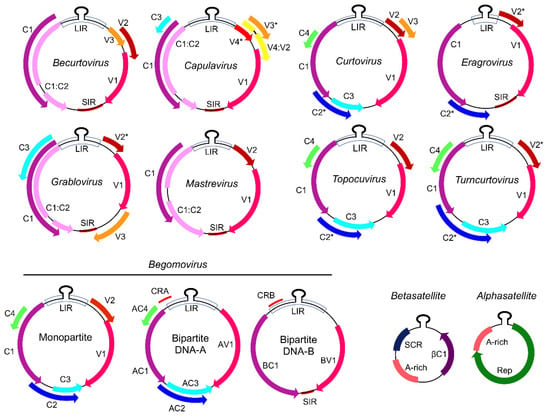
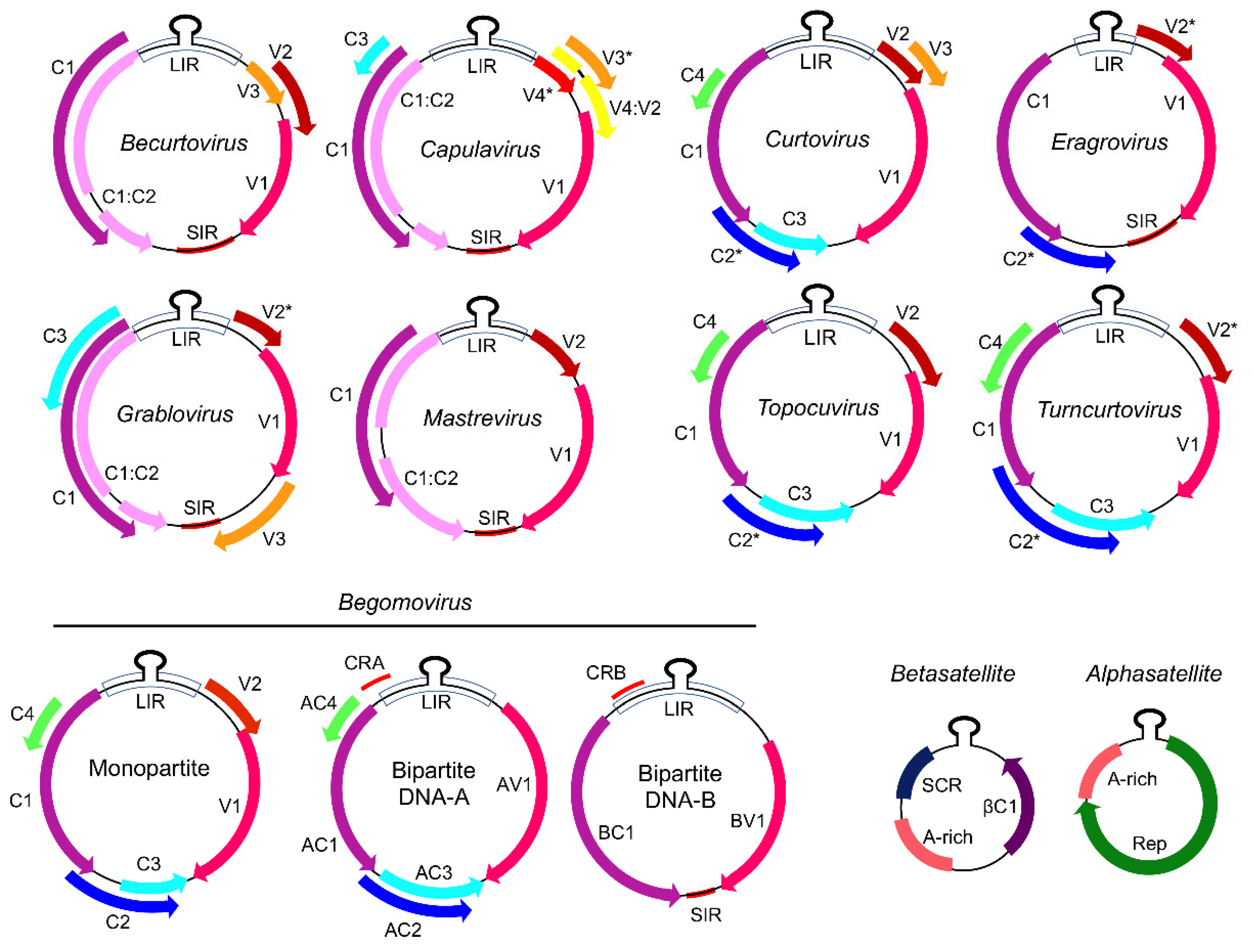
The geminiviruses can be either monopartite with a single genomic configuration (DNA-A-like) or bipartite with two genomic components, designated DNA-A and DNA-B, with a coding capacity ranging from 4 to 8 viral proteins (Figure 1). Their genome is transcribed into bidirectional transcriptional units from the origin of replication (Ori). The functional structures of Ori include a conserved stem-loop structure and the nonanucleotide sequence TAGTATTAC that constitutes the site of replication initiation by the viral replication initiator protein (Rep), encoded by the complementary-sense strand and, hence, also designated C1 (AC1) [1]. The remaining complementary-sense strand-encoded viral proteins are designated C2 (AC2), which functions as a transcriptional activator protein (TrAP); C3 (AC3), or replication enhancer protein (REn); C4 (AC4), a pathogenicity determinant; and C5 (AC5), not identified in all geminivirus genomes. The virion strand encodes V1 (AV1); the coat protein (CP); V2 (AV2), which exhibits movement functions; and V3, not present in all geminivirus genomes.
Figure 1.
Genomic organization of geminiviruses (Geminiviridae family). The Geminiviridae family includes nine genera represented by monopartite or bipartite species. LIR denotes the long intergenic region; SIR, the short intergenic region; and CR, the common region. The open reading frame (ORF) C1/AC1 encodes the replication initiator protein (Rep) and C3/AC3 encodes the replication enhancer protein (Ren), which are associated with replication. The ORF C2/AC2 encodes a transcriptional activator protein (TrAP) that controls the transcription of viral and host genes; C4/AC4 is a virulence factor. The capsid protein (CP) is indicated in the monopartite and bipartite genomes, as V1 and AV1. In monopartite species, V2 represents the movement protein (MP). V3, present in some genomes, is an inhibitor of gene silencing. ORFs with asterisks (*) have not been functionally assayed. In bipartite begomoviruses, MP (BC1) is encoded by the DNA-B, which also encodes the nuclear shuttle protein, NSP (BV1), which facilitates the nucleocytoplasmic movement of viral DNA. Bipartite begomoviruses are often associated with ssDNA satellites, i.e., the alphasatellites, which encode a replication protein (Rep), and the betasatellites, which encode the virulence-related βC1 protein. A-rich is a conserved adenine rich region of the DNA satellites, and SCR is the satellite conserved region. Adapted from [1]
The B component of bipartite geminiviruses encodes BC1 and BV1. BV1 is a nuclear shuttling protein (NSP) that facilitates the intracellular transport of viral DNA from the nucleus to the cell periphery and assists BV1, the classic movement protein (MP), to move the viral DNA to the adjacent, uninfected cell via plasmodesmata [20]. Some geminiviruses are often associated with DNA satellites, designated beta- and alphasatellites, which affect geminiviral pathogenicity and symptom development [21,22] (Figure 1). The genus Betasatellite belongs to the family Tolecusatellitidae, whereas the Alphasatellite genus belongs to the Alphasatellitidae family. These circular ssDNA satellites are approximately 1–1.4 kb ssDNA; alphasatellites encode a replication-associated protein (Rep), whereas the betasatellites encode βC1 involved in symptom induction and suppression of transcriptional and post-transcriptional gene silencing.
5. Does PAMP-Triggered Immunity Operate against Geminiviruses? What about Effector-Triggered Immunity?
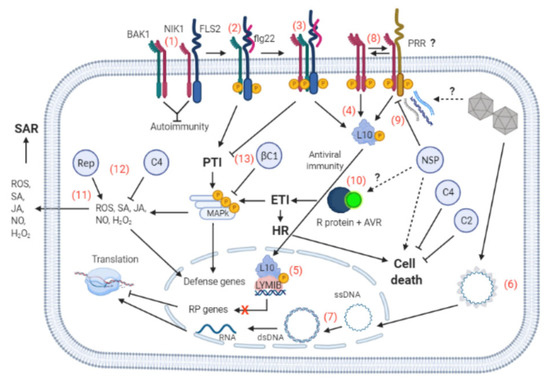
In plant–virus interactions, the host immune system often recognizes viral components or effectors to activate defenses [2]. The plant antiviral innate defense consists of a two-level perception system represented by the cell surface receptor, PRR, and the intracellular immune receptors, the resistance (R) proteins [6]. PRRs are represented by two classes of transmembrane receptors, the receptor-like kinases (RLKs) and receptor-like proteins (RLPs). These PRRs recognize PAMPs exclusively expressed by pathogens, or endogenous danger signals released by host plants during infection, designated damage-associated molecular patterns (DAMPs) [88]. Activation of RLKs and RLPs often requires a coreceptor to form an active immune complex [89]. Mechanistically, PAMPs/DAMPs function as ligands that induce dimerization/oligomerization of single-pass transmembrane receptor PRRs with RLK coreceptors to initiate signaling via phosphorylation-induced activation of the immune complexes [88]. Downstream events of PTI activation include ROS accumulation, followed by MAP kinase cascade activation, induction of PTI-associated defense genes, ethylene and salicylic acid synthesis, and callose deposition [90] (Figure 3).
Figure 3.
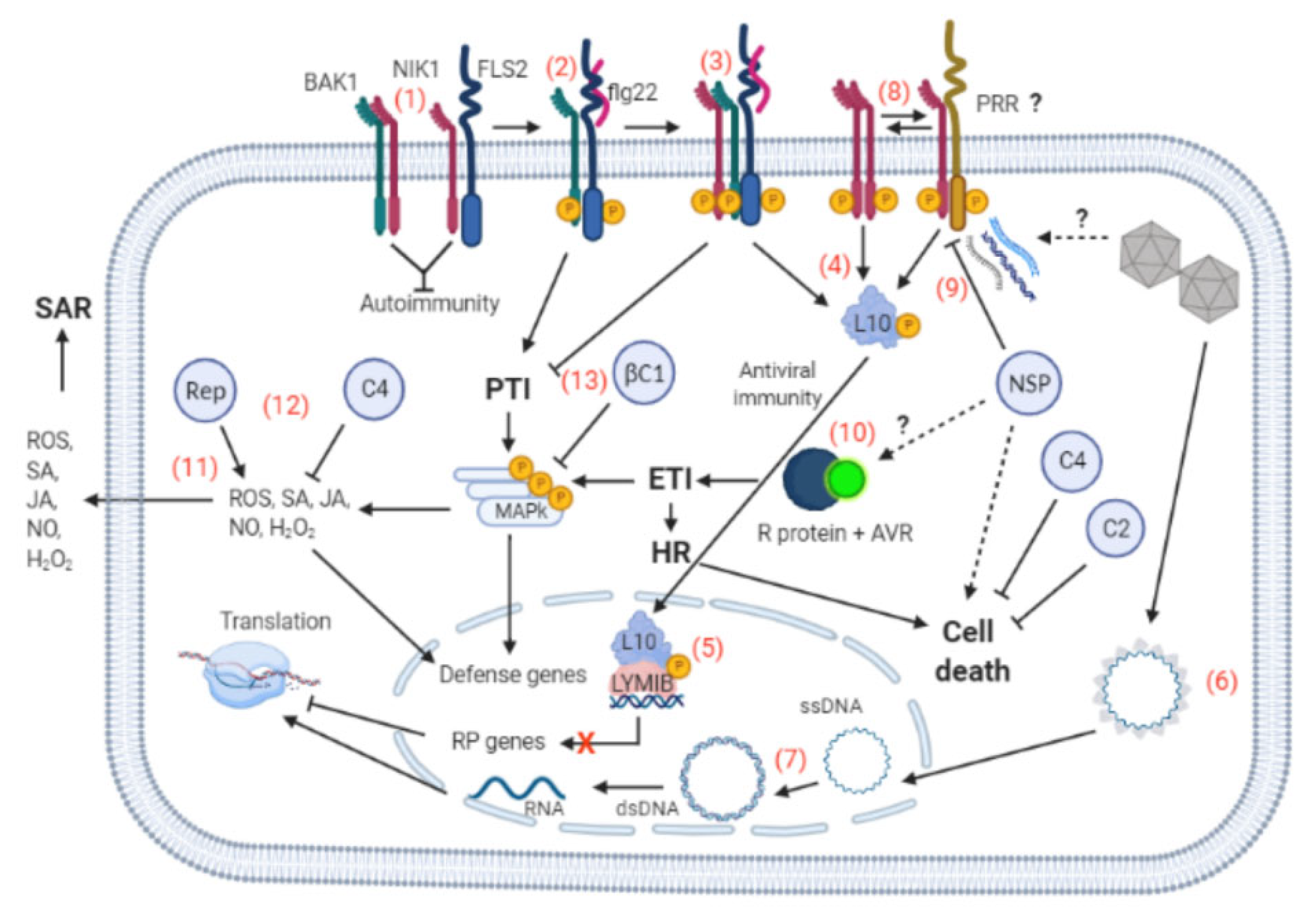
Antiviral innate immunity, interactions with viral suppressors and bacterial PTI (1). Under normal, resting conditions, NSP-interacting kinase 1 (NIK1) is bound to the flagellin receptor FLS2 (Flagellin-sensitive 2) and coreceptor BAK1 (Brassinosteroid insensitive 1-associated receptor kinase 1) to prevent autoimmunity. (2) Upon bacterial infection, the bacterial PAMP (pathogen-associated molecular pattern) flg22 is sensed by FLS2, inducing its oligomerization with BAK1, which results in phosphorylation-mediated activation of the immune complex to initiate PAMP-triggered immunity (PTI), activating the mitogen-activated protein kinase (MAPK) cascade and inducing defense genes. (3) Activated BAK1 also phosphorylates NIK1 at Thr-474, which in turn inhibits further PTI (4) and activates the NIK1-mediated antiviral signaling pathway, mediating ribosomal protein 10 (RPL10) phosphorylation. (5) Phosphorylated RPL10 is translocated to the nucleus, where it interacts with L10-interacting Myb domain-containing protein (LIMYB) to repress protein ribosomal (RB) genes and translational factors, suppressing global translation. (6) In infected cells, the geminivirus particles are disassembled in the cytoplasm and the CP-viral ssDNA complex is directed to the nucleus where (7) the viral ssDNA is converted into dsDNA for replication and transcription of the viral genome. (8) Begomoviruses-derived nucleic acids also function as viral PAMPs inducing NIK1 dimerization with itself or an unidentified viral PAMP recognition receptor (PRR) to transduce the antiviral signal that culminates in translational suppression. Then, viral mRNA is not efficiently translated impairing infection. (9) The begomovirus nuclear shuttling protein (NSP) counters the activation of this defense pathway by binding to the NIK1 kinase domain and, hence, prevents phosphorylation and transduction of the antiviral signal that otherwise would impair infection. (10) In resistant genotypes, NSP may also function as an avirulence (AVR) factor to activate effector-triggered immunity (ETI) via resistance (R) protein recognition, inducing hypersensitive response (HR) and cell death. (11) The PTI and ETI products (ROS, SA, JA, NO, H2O2) can induce defense genes and systemic acquired resistance (SAR). Geminivirus suppressors of innate immunity include (12) C4 that inhibits PTI by interacting and inhibiting FLS2 and along with Rep inhibits SA- and ROS-dependent signaling; C4 and C2 inhibit HR and cell death. (13) Furthermore, the betasatellite βC1 inhibits the MAP kinase cascade. The question marks indicate either events not well clarified or unknown. See Figure 1 for the designations of the viral proteins. The figure was created with BioRender.com.
Although geminiviral PAMPs and their cognate PRRs have not been identified, several lines of evidence indicate that PTI is part of the host defense arsenal against geminivirus infection. First, the C4 protein from TYLCV has been shown to associate with a classical PRR, the bacterial flagellin receptor FLS2 (Flagellin-sensitive 2), and inhibits early PTI responses [14] (Figure 3). TYLCV C4 also interacts with NSP-interacting kinase 1 (NIK1), an antiviral immune leucine-rich repeat receptor-like kinase (LRR-RLK) that protects plants against begomoviruses [15]. NSP from CabLCV associates with the almost universal coreceptor of PRRs, the Brassinosteroid insensitive 1-associated kinase 1 (BAK1) [91]. NSP interaction with the BAK1 kinase domain may prevent phosphorylation and activation of the coreceptor in the same fashion as it does with the receptor-like kinase NIK1 [92]. Second, geminiviral proteins also activate and suppress downstream immune events of PTI activation (Figure 3). Rep from different geminiviruses induces PTI-associated marker genes and SA-dependent defenses [93,94]. However, when co-expressed with TYLCV C4 protein, Rep redirects C4 to the chloroplasts, where it acts as a PTI suppressor by reducing SA- and ROS-dependent defense signals [93]. The C4 immune-suppressing function co-opts a protein trafficking route directed by protein myristoylation/de-myristoylation processing [95]. Upon geminivirus infection, a fraction of the membrane-bound N-myristoylated C4 protein is de-myristoylated and translocated to the chloroplast. Inside the chloroplast, non-myristoylated C4 interacts with the thylakoid membrane-bound plant calcium-sensing receptor (CAS) and hampers SA biosynthesis and mediated defenses [95]. Finally, the betasatellite βC1 protein from TYLCCV has been shown to interfere with PTI-induced MAPK activation and downstream responses by targeting mitogen-activated protein kinase kinase 2 (MKK2) in Arabidopsis thaliana and N. benthamiana (Figure 3) [96,97,98].
The second level of microbe perception by the host plant is mediated by intracellular immune receptors (R proteins), which recognize pathogen avirulent effectors to activate ETI [3,93,99]. ETI represents a more specific and robust line of host defense, often associated with programmed cell death, HR that restricts the pathogen to the site of infection [100]. Most, but not all, antiviral R proteins harbor a nucleotide-binding leucine-rich repeat (NLR) domain, reminiscent of nonviral intracellular R proteins, which are further classified into coiled-coil (CC)-NLR or Toll/interleukin 1 receptor-like (TIR)-NLR proteins [2,6,101]. The natural Ty-2 resistance locus to TYLCV encodes an NB-LRR protein, named TYNBS1, which might mediate ETI-like resistance. However, the geminiviral effector that would interact specifically with TYNBS1 to activate ETI remains to be determined. Therefore, the underlying mechanism for TYNBS1 activation to mediate resistance is still elusive [17].
Compelling evidence that plants deploy ETI against geminiviruses results from infectivity assays demonstrating that geminiviruses induce and suppress HR and ETI-like responses. In Arabidopsis, CabLCV infection induces HR- and senescence-related genes without developing a visible cell death phenotype [102]. More specifically, TYLCV, cotton leaf curl Kokhran virus (CLCuKoV) and ACMV Rep, bean dwarf mosaic virus (BDMV) and bean golden yellow mosaic virus (BGYMV) NSP, and CLCuKoV V2 have been shown to induce HR (Figure 3) [81,103,104]. In contrast, the C2 proteins from the papaya leaf curl virus (PaLCuV) and CLCuKoV have been shown to inhibit V2-mediated HR, and C2 from tomato leaf curl New Delhi virus (ToLCNDV) suppresses NSP-mediated HR [105,106]. Likewise, TYLCV infection reduces cell death in tomato plants, which is induced by the inactivation of heat shock protein 90 (HSP90) and suppressor of the G2 allele of skp1 (SGT1), via an unknown TYLCV-mediated cell death suppression mechanism [107]. In contrast, the underlying mechanism for the cell death-suppressing activity of C4 from tomato leaf curl Yunnan virus (TLCYnV) has been recently unraveled [16]. C4 interacts with hypersensitive induced reaction 1 (HIR1), promotes its degradation by impairing HIR1 self-oligomerization, and hence inhibits the HIR1-mediated HR, increasing virus pathogenicity. Although several lines of evidence indicate that both monopartite and bipartite begomoviruses induce and suppress HR, with few exceptions, the mechanisms underlying these viral activities are still far from understood.
7. Conclusions
In RNA-silencing-mediated antiviral immunity, two mechanisms are fundamental to protect plants against invading nucleic acids from viruses, PTGS and TGS. PTGS is used as a defense mechanism against RNA and DNA viruses, whereas TGS targets virus DNA. PTGS acts at the post-transcriptional level by directing mRNA targets to degradation or translational suppression. In contrast, TGS represses transcription of target loci by controlling the chromatin methylation status and heterochromatin formation. Geminiviruses have evolved different suppressing strategies of host RNA-silencing-derived antiviral defenses. The geminiviral suppressors of RNA silencing can interfere with PTGS, TGS, and downstream events of TGS. They also act by activating or inducing the expression of endogenous suppressors. The immune-suppressing activities of geminiviruses may account for their broad host range and compromise the success of siRNA-based strategies for engineering host resistance.
The interactions of the plant’s innate immune system with geminiviruses are far less understood. Nevertheless, growing evidence has demonstrated that the classical plant PTI limits geminivirus infection similarly to nonviral pathogens. Geminiviral proteins have been shown to target PTI components to both induce and suppress PTI-like responses. Furthermore, begomoviruses-derived nucleic acids act as viral PAMPs and activate the transmembrane receptor NIK1, which shares with PTI coreceptors conserved regulatory mechanisms for activation. However, geminiviral PAMPs and their cognate PRRs have yet to be identified, and hence, the mechanism of geminiviral PTI activation remains unknown.
Likewise, plants may deploy ETI as part of the defense arsenal to combat geminiviruses. Accordingly, geminivirus infection induces ETI-like responses, including cell death, HR, ROS, SA accumulation in resistant genotypes, and at least one isolated resistant gene to TYLCV encodes an NLR protein, although the cognate geminiviral effector (Avr gene) is missing. The current studies designed to uncover geminiviral PTI- and ETI-suppressing functions are limited as they mostly target conserved features between the antiviral and anti-nonviral pathogen immunity. The discovery of geminiviral PAMPs and their cognate PRRs, intracellular R proteins, and the matching geminiviral effectors will potentially shed light on the mechanism of antiviral PTI and ETI activation uncovering specific and conserved features and their specific roles in resistance against viruses.
Author Contributions
R.M.T., G.A.S.R. and M.A.F. wrote the first draft of the manuscript. E.P.B.F. conceived and supervised the review topics. All authors contributed to the article and approved the submitted version. All authors have read and agreed to the published version of the manuscript.
Funding
This work was partially funded by Coordenação de Aperfeiçoamento de Pessoal de Nível Superior (CAPES) finance code 001, Conselho Nacional de Desenvolvimento Cientifico e Tecnológico (CNPq), Fundação de Amparo à Pesquisa do Estado de Minas Gerais (FAPEMIG), and the National Institute of Science and Technology in Plant–Pest interactions. R.M.T. and G.A.S.R. are supported by FAPEMIG and CNPq graduate fellowships, respectively. M.A. is a recipient of a CNPq post-doctoral fellowship.
Conflicts of Interest
The authors declare no conflict of interest.
Abbreviations
| ACMV | African cassava mosaic virus |
| ADKs | Adenosine kinases |
| AGO | Argonaute |
| AS2 | Asymmetric leaves 2 |
| Avr | Avirulence |
| BAK1 | Brassinosteroid insensitive 1-associated receptor kinase 1 |
| BAM1 | Barely any meristem 1 |
| BCTV | Beet curly top virus |
| BDMV | Bean dwarf mosaic virus |
| BGYMV | Bean golden yellow mosaic virus |
| BRI-1 | Brassinosteroid insensitive 1 |
| BSCTV | Beet severe curly top virus |
| CabLCV | Cabbage leaf curl virus |
| CAS | Calcium-sensing receptor |
| CC-NLR | Coiled-coil nucleotide-binding leucine-rich repeat |
| CLCuKoV | Cotton leaf curl Kokhran virus |
| CLCuMuV | Cotton leaf curl Multan virus |
| CP | Coat protein |
| CTM3 | Chromomethylase 3 |
| DAMPs | Damage-associated molecular patterns |
| DCLs | Dicers |
| dsDNA | Double-stranded DNA |
| DRM2 | DNA (cytosine-5)-methyltransferase 2 |
| dsRNA | Double-stranded RNA |
| ETI | Effector-triggered immunity |
| FLS2 | Flagellin-sensitive 2 |
| H3K9 | Histone H3 lysine 9 |
| HEN1 | Hua enhancer 1 |
| HIR1 | Hypersensitive induced reaction 1 |
| HR | Hypersensitive response |
| HSP90 | Heat shock protein 90 |
| JA | Jasmonic acid |
| Kyp2/suvh4 | suvh4/kryptonite2 |
| LIR | Long intergenic region |
| LRR-RLK | Leucine-rich repeat receptor-like kinase |
| lncRNAs | Long non-coding RNAs |
| MAPK | Mitogen-activated protein kinase |
| MET1 | Methyltransferase 1 |
| miRNA | MicroRNA |
| MKK2 | Mitogen-activated protein kinase kinase 2 |
| MP | Movement protein |
| mRNA | Messenger RNA |
| MYMIV | Mungbean yellow mosaic India |
| MYMV | Mungbean yellow mosaic virus-Vigna |
| NbHDA6 | Nicotiana benthamiana histone deacetylase 6 |
| NB-LRR | Nucleotide-binding site-leucine-rich repeat |
| NIK1 | NSP-interacting kinase1 |
| NLR | Nucleotide-binding leucine-rich repeat |
| NSP | Nuclear shuttling protein |
| nt | Nucleotides |
| ORF | Open reading frame |
| Ori | Origin of replication |
| PaLCuV | Papaya leaf curl virus |
| PAMP | Pathogen-associated molecular pattern |
| pol | Polymerase |
| PRR | Pattern recognition receptor |
| PTGS | Post-transcriptional gene silencing |
| PTI | PAMP-triggered immunity |
| R | Resistance |
| RdDM | RNA-directed DNA methylation |
| RdRP or RDR | RNA-dependent RNA polymerase |
| REn | Replication enhancer protein |
| Rep | Replication initiator protein |
| rgs-CaM | Regulator of G-protein signaling calmodulin-like |
| RISC | RNA-induced silencing complex |
| RITS | RNA-induced transcriptional silencing complex |
| RLK | Receptor-like kinase |
| RNAi | RNA interference |
| ROS | Reactive oxygen species |
| RP | Ribosomal protein |
| SA | Salicylic acid |
| SAHH | S-adenosyl-L-homocysteine hydrolase |
| SAM | S-adenosyl methionine |
| SAMDC1 | S-adenosyl-methionine decarboxylase 1 |
| SAR | Systemic acquired resistance |
| SERK1-5 | Somatic embryogenesis receptor kinase 1–5 |
| SGS3 | Suppressor gene silencing 3 |
| SGT1 | Suppressor of the G2 allele of skp1 |
| SIR | Short intergenic region |
| siRNA | Small interfering RNA |
| ssDNA | Single-stranded DNA |
| ssRNA | Single-stranded RNA |
| TGMV | Tomato golden mosaic virus |
| TGS | Transcriptional gene silencing |
| Thr | Threonine |
| TIR-NLR | Toll/interleukin 1 receptor-like nucleotide-binding leucine-rich repeat |
| TLCYnV | Tomato leaf curl Yunnan virus |
| ToLCNDV | Tomato leaf curl New Delhi virus |
| ToSRV | Tomato severe rugose virus |
| ToYSV | Tomato yellow spot virus |
| TrAP | Transcriptional activator protein |
| TYLCCV | Tomato yellow leaf curl China virus |
| TYLCSV | Tomato yellow leaf curl Sardinia virus |
| TYLCV | Tomato yellow leaf curl virus |
| UTR | Untranslated region |
| vsiRNAs | Virus-derived short interfering RNAs |
| VSRs | Viral suppressors of RNA silencing |
| WDV | Wheat dwarf virus |
| WEL1 | Werner exonuclease-like 1 |
References
- Kumar, R.V. Plant antiviral immunity against Geminiviruses and viral counter-defense for survival. Front. Microbiol. 2019, 10, 1460. [Google Scholar] [CrossRef] [Scilit] [PubMed]
- Calil, I.P.; Fontes, E.P.B. Plant immunity against viruses: Antiviral immune receptors in focus. Ann. Bot. 2017, 119, 711–723. [Google Scholar] [CrossRef] [Scilit]
- Jones, J.D.; Dangl, J.L. The plant immune system. Nature 2006, 444, 323–329. [Google Scholar] [CrossRef] [Scilit]
- Li, F.; Wang, A. RNA-Targeted Antiviral Immunity: More Than Just RNA Silencing. Trends Microbiol. 2019, 27, 792–805. [Google Scholar] [CrossRef] [Scilit] [PubMed]
- Pooggin, M.M. Small RNA-Omics for plant virus identification, virome reconstruction, and antiviral defense characterization. Front. Microbiol. 2018, 9, 2779. [Google Scholar] [CrossRef] [Scilit] [PubMed]
- Gouveia, B.C.; Calil, I.P.; Machado, J.P.B.; Santos, A.A.; Fontes, E.P.B. Immune receptors and coreceptors in antiviral innate immunity in plants. Front. Microbiol. 2017, 7, 2139. [Google Scholar] [CrossRef] [Scilit] [PubMed]
- Mandadi, K.K.; Scholthof, K.-B.G. Plant immune responses against viruses: How does a virus cause disease? Plant Cell 2013, 25, 1489–1505. [Google Scholar] [CrossRef] [Scilit] [PubMed]
- Holmes, F.O. Local lesions in tobacco mosaic. Bot. Gaz. 1929, 87, 39–55. [Google Scholar] [CrossRef] [Scilit]
- Holmes, F.O. Inheritance of resistance to tobacco-mosaic disease in tobacco. Phytopathoogy 1938, 28, 553–561. [Google Scholar]
- Ross, A.F. Systemic acquired resistance induced by localized virus infections in plants. Virology 1961, 14, 340–358. [Google Scholar] [CrossRef] [Scilit]
- Amari, K.; Niehl, A. Nucleic acid-mediated PAMP-triggered immunity in plants. Curr. Opin. Virol. 2020, 42, 32–39. [Google Scholar] [CrossRef] [Scilit]
- Teixeira, R.M.; Ferreira, M.A.; Raimundo, G.A.; Loriato, V.A.; Reis, P.A.; Fontes, E.P.B. Virus perception at the cell surface: Revisiting the roles of receptor-like kinases as viral pattern recognition receptors. Mol. Plant Pathol. 2019, 20, 1196–1202. [Google Scholar] [CrossRef] [Scilit] [PubMed]
- Loriato, V.A.P.; Martins, L.G.C.; Euclydes, N.C.; Reis, P.A.B.; Duarte, C.E.M.; Fontes, E.P.B. Engineering resistance against geminiviruses: A review of suppressed natural defenses and the use of RNAi and the CRISPR/Cas system. Plant Sci. 2020, 292, 110410. [Google Scholar] [CrossRef] [Scilit]
- Gómez, B.G.; Zhang, D.; Díaz, R.T.; Wei, Y.; Macho, A.P.; Lozano-Durán, R. The C4 protein from Tomato Yellow leaf curl virus can broadly interact with plant receptor-like kinases. Viruses 2019, 11, 1009. [Google Scholar] [CrossRef] [Scilit]
- Macho, A.P.; Lozano-Duran, R. Molecular dialogues between viruses and receptor-like kinases in plants. Mol. Plant Pathol. 2019, 20, 1191–1195. [Google Scholar] [CrossRef] [Scilit] [PubMed]
- Mei, Y.; Ma, Z.; Wang, Y.; Zhou, X. Geminivirus C4 antagonizes the HIR1-mediated hypersensitive response by inhibiting the HIR1 self-interaction and promoting degradation of the protein. New Phytol. 2020, 225, 1311–1326. [Google Scholar] [CrossRef] [Scilit]
- Yamaguchi, H.; Ohnishi, J.; Saito, A.; Ohyama, A.; Nunome, T.; Miyatake, K.; Fukuoka, H. An NB-LRR gene, TYNBS1, is responsible for resistance mediated by the Ty-2 Begomovirus resistance locus of tomato. Theor. Appl. Genet. 2018, 131, 1345–1362. [Google Scholar] [CrossRef] [Scilit]
- Ghosh, D.; Chakraborty, S. Molecular interplay between phytohormones and geminiviruses: A saga of a never-ending arms race. J. Exp. Bot. 2021, in press. [Google Scholar] [CrossRef] [Scilit]
- Zerbini, F.M.; Briddon, R.W.; Idris, A.; Martin, D.P.; Moriones, E.; Navas-Castillo, J.; Rivera-Bustamante, R.; Roumagnac, P.; Varsani, A. ICTV Virus Taxonomy Profile: Geminiviridae. J. Gen. Virol. 2017, 98, 131–133. [Google Scholar] [CrossRef] [Scilit] [PubMed]
- Martins, L.G.C.; Raimundo, G.A.S.; Ribeiro, N.G.A.; Silva, J.C.F.; Euclydes, N.C.; Loriato, V.A.P.; Duarte, C.E.M.; Fontes, E.P.B. A Begomovirus Nuclear Shuttle Protein-Interacting Immune Hub: Hijacking Host Transport Activities and Suppressing Incompatible Functions. Front. Plant Sci. 2020, 11, 398. [Google Scholar] [CrossRef] [Scilit]
- Briddon, R.W.; Martin, D.P.; Roumagnac, P.; Navas-Castillo, J.; Fiallo-Olivé, E.; Moriones, E.; Lett, J.-M.; Zerbini, F.M.; Varsani, A. Alphasatellitidae: A new family with two subfamilies for the classification of geminivirus- and nanovirus-associated alphasatellites. Arch. Virol. 2018, 163, 2587–2600. [Google Scholar] [CrossRef] [Scilit]
- Yang, X.; Guo, W.; Li, F.; Sunter, G.; Zhou, X. Geminivirus-associated betasatellites: Exploiting chinks in the antiviral arsenal of plants. Trends Plant Sci. 2019, 24, 519–529. [Google Scholar] [CrossRef] [Scilit] [PubMed]
- Ding, S.W.; Voinnet, O. Antiviral immunity directed by small RNAs. Cell 2007, 130, 413–426. [Google Scholar] [CrossRef] [Scilit]
- Akbergenov, R.; Si-Ammour, A.; Blevins, T.; Amin, I.; Kutter, C.; Vanderschuren, H.; Zhang, P.; Gruissem, W.; Meins, F.; Hohn, T.; et al. Molecular characterization of geminivirus-derived small RNAs in different plant species. Nucleic Acids Res. 2006, 34, 462–471. [Google Scholar] [CrossRef] [Scilit]
- Bouché, N.; Lauressergues, D.; Gasciolli, V.; Vaucheret, H. An antagonistic function for Arabidopsis DCL2 in development and a new function for DCL4 in generating viral siRNAs. EMBO J. 2006, 25, 3347–3356. [Google Scholar] [CrossRef] [Scilit] [PubMed]
- Reinhart, B.J.; Weinstein, E.G.; Rhoades, M.W.; Bartel, B.; Bartel, D.P. MicroRNAs in plants. Genes Dev. 2002, 16, 1616–1626. [Google Scholar] [CrossRef] [Scilit]
- Xie, Z.; Johansen, L.K.; Gustafson, A.M.; Kasschau, K.D.; Lellis, A.D.; Zilberman, D.; Jacobsen, S.E.; Carrington, J.C. Genetic and functional diversification of small RNA pathways in plants. PLoS Biol. 2004, 2, e104. [Google Scholar] [CrossRef] [Scilit]
- Wang, X.-B.; Jovel, J.; Udomporn, P.; Wang, Y.; Wu, Q.; Li, W.-X.; Gasciolli, V.; Vaucheret, H.; Ding, S.-W. The 21-nucleotide, but not 22-nucleotide, viral secondary small interfering RNAs direct potent antiviral defense by two cooperative Argonautes in Arabidopsis thaliana. Plant Cell 2011, 23, 1625–1638. [Google Scholar] [CrossRef] [Scilit]
- Baulcombe, D. RNA silencing in plants. Nature 2004, 431, 356–363. [Google Scholar] [CrossRef] [Scilit] [PubMed]
- Blevins, T.; Rajeswaran, R.; Aregger, M.; Borah, B.K.; Schepetilnikov, M.; Baerlocher, L.; Farinelli, L.; Meins, F.; Hohn, T.; Pooggin, M.M. Massive production of small RNAs from a non-coding region of Cauliflower mosaic virus in plant defense and viral counter-defense. Nucleic Acids Res. 2011, 39, 5003–5014. [Google Scholar] [CrossRef] [Scilit]
- Li, J.; Yang, Z.; Yu, B.; Liu, J.; Chen, X. Methylation protects miRNAs and siRNAs from a 3′-end uridylation activity in Arabidopsis. Curr. Biol. 2005, 15, 1501–1507. [Google Scholar] [CrossRef] [Scilit]
- Yang, Z.Y.; Ebright, Y.W.; Yu, B.; Chen, X.M. HEN1 recognizes 21–24 nt small RNA duplexes and deposits a methyl group onto the 2′ OH of the 3′ terminal nucleotide. Nucleic Acids Res. 2006, 34, 667–675. [Google Scholar] [CrossRef] [Scilit]
- Yu, B.; Yang, Z.; Li, J.; Minakhina, S.; Yang, M.; Padgett, R.W.; Steward, R.; Chen, X. Methylation as a crucial step in plant microRNA biogenesis. Science 2005, 307, 932–935. [Google Scholar] [CrossRef] [Scilit]
- Bühler, M.; Verdel, A.; Moazed, D. Tethering RITS to a nascent transcript initiates RNAi- and heterochromatin-dependent gene silencing. Cell 2006, 125, 873–886. [Google Scholar] [CrossRef] [Scilit] [PubMed]
- Song, J.J.; Smith, S.K.; Hannon, G.J.; Joshua-Tor, L. Crystal structure of Argonaute and its implications for RISC slicer activity. Science 2004, 305, 1434–1437. [Google Scholar] [CrossRef] [Scilit] [PubMed]
- Verdel, A.; Jia, S.; Gerber, S.; Sugiyama, T.; Gygi, S.; Grewal, S.I.S.; Moazed, D. RNAi-mediated targeting of heterochromatin by the RITS complex. Science 2004, 303, 672–676. [Google Scholar] [CrossRef] [Scilit] [PubMed]
- Deleris, A.; Gallego-Bartolome, J.; Bao, J.; Kasschau, K.D.; Carrington, J.C.; Voinnet, O. Hierarchical action and inhibition of plant dicer-like proteins in antiviral defense. Science 2006, 313, 68–71. [Google Scholar] [CrossRef] [Scilit]
- Baumberger, N.; Baulcombe, D.C. Arabidopsis ARGONAUTE1 is an RNA slicer that selectively recruits microRNAs and short interfering RNAs. Proc. Natl. Acad. Sci. USA 2005, 102, 11928–11933. [Google Scholar] [CrossRef] [Scilit] [PubMed]
- Bhattacharjee, S.; Zamora, A.; Azhar, M.T.; Sacco, M.A.; Lambert, L.H.; Moffett, P. Virus resistance induced by NB-LRR proteins involves Argonaute4-dependent translational control. Plant J. 2009, 58, 940–951. [Google Scholar] [CrossRef] [Scilit] [PubMed]
- Ghoshal, B.; Sanfaçon, H. Symptom recovery in virus-infected plants: Revisiting the role of RNA silencing mechanisms. Virology 2015, 479–480, 167–179. [Google Scholar] [CrossRef] [Scilit] [PubMed]
- Karran, R.A.; Sanfaçon, H. Tomato ringspot virus coat protein binds to ARGONAUTE 1 and suppresses the translation repression of a reporter gene. Mol. Plant Microbe Interact. 2014, 27, 933–943. [Google Scholar] [CrossRef] [Scilit] [PubMed]
- Ma, X.; Nicole, M.C.; Meteignier, L.V.; Hong, N.; Wang, G.; Moffett, P. Different roles for RNA silencing and RNA processing components in virus recovery and virus-induced gene silencing in plants. J. Exp. Bot. 2015, 66, 919–932. [Google Scholar] [CrossRef] [Scilit]
- Brodersen, P.; Sakvarelidze-Achard, L.; Bruun-Rasmussen, M.; Dunoyer, P.; Yamamoto, Y.Y.; Sieburth, L.; Voinnet, O. Widespread translational inhibition by plant miRNAs and siRNAs. Science 2008, 320, 1185–1190. [Google Scholar] [CrossRef] [Scilit]
- Fátyol, K.; Ludman, M.; Burgyán, J. Functional dissection of a plant Argonaute. Nucleic Acids Res. 2016, 44, 1384–1397. [Google Scholar] [CrossRef] [Scilit]
- Iwakawa, H.O.; Tomari, Y. Molecular insights into microRNA-mediated translational repression in plants. Mol. Cell 2013, 52, 591–601. [Google Scholar] [CrossRef] [Scilit]
- Lanet, E.; Delannoy, E.; Sormani, R.; Floris, M.; Brodersen, P.; Crété, P.; Voinnet, O.; Robaglia, C. Biochemical evidence for translational repression by Arabidopsis microRNAs. Plant Cell 2009, 21, 1762–1768. [Google Scholar] [CrossRef] [Scilit]
- Wilczynska, A.; Bushell, M. The complexity of miRNA-mediated repression. Cell Death Differ. 2015, 22, 22–33. [Google Scholar] [CrossRef] [Scilit]
- Raja, P.; Sanville, B.C.; Buchmann, R.C.; Bisaro, D.M. Viral genome methylation as an epigenetic defense against geminiviruses. J. Virol. 2008, 82, 8997–9007. [Google Scholar] [CrossRef] [Scilit]
- Matzke, M.A.; Moshe, R.A. RNA-directed DNA methylation: An epigenetic pathway of increasing complexity. Nat. Rev. Genet. 2014, 5, 394–408. [Google Scholar] [CrossRef] [Scilit]
- El-Shami, M.; Pontier, D.; Lahmy, S.; Braun, L.; Picart, C.; Vega, D.; Hakimi, M.-A.; Jacobsen, S.E.; Cooke, R.; Lagrange, T. Reiterated WG/GW motifs form functionally and evolutionarily conserved ARGONAUTE-binding platforms in RNAi-related components. Genes Dev. 2007, 21, 2539–2544. [Google Scholar] [CrossRef] [Scilit] [PubMed]
- Fang, X.; Qi, Y. RNAi in plants: An Argonaute-Centered view. Plant Cell 2016, 28, 272–285. [Google Scholar] [CrossRef] [Scilit] [PubMed]
- Raja, P.; Jackel, J.N.; Li, S.; Heard, I.M.; Bisaro, D.M. Arabidopsis double-stranded RNA binding protein DRB3 participates in methylation-mediated defense against geminiviruses. J. Virol. 2014, 88, 2611–2622. [Google Scholar] [CrossRef] [Scilit] [PubMed]
- Rodríguez-Negrete, E.A.; Carrillo-Tripp, J.; Rivera-Bustamante, R.F. RNA silencing against geminivirus: Complementary action of posttranscriptional gene silencing and transcriptional gene silencing in host recovery. J. Virol. 2009, 83, 1332–1340. [Google Scholar] [CrossRef] [Scilit]
- Aregger, M.; Borah, B.K.; Seguin, J.; Rajeswaran, R.; Gubaeva, E.G.; Zvereva, A.S.; Windels, D.; Vazquez, F.; Blevins, T.; Farinelli, L.; et al. Primary and secondary siRNAs in geminivirus-induced gene silencing. PLoS Pathog. 2012, 8, e1002941. [Google Scholar] [CrossRef] [Scilit]
- Wang, J.; Yu, W.; Yang, Y.; Li, X.; Chen, T.; Liu, T.; Ma, N.; Yang, X.; Liu, R.; Zhang, B. Genome-wide analysis of tomato long non-coding RNAs and identification as endogenous target mimic for microRNA in response to TYLCV infection. Sci. Rep. 2015, 5, 16946. [Google Scholar] [CrossRef] [Scilit] [PubMed]
- Sun, Y.W.; Tee, C.S.; Ma, Y.H.; Wang, G.; Yao, X.M.; Ye, J. Attenuation of histone methyltransferase KRYPTONITE-mediated transcriptional gene silencing by Geminivirus. Sci. Rep. 2015, 5, 16476. [Google Scholar] [CrossRef] [Scilit] [PubMed]
- Csorba, T.; Kontra, L.; Burgyan, J. Viral silencing suppressors: Tools forged to fine-tune host-pathogen coexistence. Virology 2015, 479, 85–103. [Google Scholar] [CrossRef] [Scilit]
- Ding, S.W. RNA-based antiviral immunity. Nat. Rev. Immunol. 2020, 10, 632–644. [Google Scholar] [CrossRef] [Scilit]
- Incarbone, M.; Dunoyer, P. RNA silencing and its suppression: Novel insights from in planta analyses. Trends Plant Sci. 2013, 18, 382–392. [Google Scholar] [CrossRef] [Scilit]
- Yang, Z.; Li, Y. Dissection of RNAi-based antiviral immunity in plants. Curr. Opin. Virol. 2018, 32, 88–99. [Google Scholar] [CrossRef] [Scilit]
- Rodríguez-Negrete, E.; Lozano-Durán, R.; Piedra-Aguilera, A.; Cruzado, L.; Bejarano, E.R.; Castillo, A.G. Geminivirus Rep protein interferes with the plant DNA methylation machinery and suppresses transcriptional gene silencing. New Phytol. 2013, 199, 464–475. [Google Scholar] [CrossRef] [Scilit]
- Wang, Y.; Dang, M.; Hou, H.; Mei, Y.; Qian, Y.; Zhou, X. Identification of an RNA silencing suppressor encoded by a mastrevirus. J. Gen. Virol. 2014, 95, 2082–2088. [Google Scholar] [CrossRef] [Scilit]
- Chung, H.Y.; Lacatus, G.; Sunter, G. Geminivirus AL2 protein induces expression of, and interacts with, a calmodulin-like gene, an endogenous regulator gene silencing. Virology 2014, 460, 108–118. [Google Scholar] [CrossRef] [Scilit] [PubMed]
- Jackel, J.N.; Buchmann, R.C.; Singhal, U.; Bisaro, D.M. Analysis of geminivirus AL2 and L2 proteins reveals a novel AL2 silencing suppressor activity. J. Virol. 2015, 89, 3176–3187. [Google Scholar] [CrossRef] [Scilit]
- Trinks, D.; Rajeswaran, R.; Shivaprasad, P.V.; Akbergenov, R.; Oakeley, E.J.; Veluthambi, K.; Hohn, T.; Pooggin, M.M. Suppression of RNA silencing by a geminivirus nuclear protein, AC2, correlates with transactivation of host genes. J. Virol. 2005, 79, 2517–2527. [Google Scholar] [CrossRef] [Scilit]
- Wang, H.; Buckley, K.J.; Yang, X.; Buchmann, R.C.; Bisaro, D.M. Adenosine kinase inhibition and suppression of RNA silencing by geminivirus AL2 and L2 proteins. J. Virol. 2005, 79, 7410–7418. [Google Scholar] [CrossRef] [Scilit]
- Castillo-González, C.; Liu, X.; Huang, C.; Zhao, C.; Ma, Z.; Hu, T.; Sun, F.; Zhou, Y.; Zhou, X.; Wang, X.-J.; et al. Geminivirus-encoded TrAP suppressor inhibits the histone methyltransferase SUVH4/KYP to counter host defense. Elife 2015, 4, e06671. [Google Scholar] [CrossRef] [Scilit] [PubMed]
- Wang, H.; Hao, L.; Shung, C.Y.; Sunter, G.; Bisaro, D.M. Adenosine kinase is inactivated by geminivirus AL2 and L2 proteins. Plant Cell 2003, 15, 3020–3032. [Google Scholar] [CrossRef] [Scilit] [PubMed]
- Kumar, V.; Mishra, S.K.; Rahman, J.; Taneja, J.; Sundaresan, G.; Mishra, N.S.; Mukherjee, S.K. Mungbean yellow mosaic Indian virus-encoded AC2 protein suppresses RNA silencing by inhibiting Arabidopsis RDR6 and AGO1 activities. Virology 2015, 486, 158–172. [Google Scholar] [CrossRef] [Scilit] [PubMed]
- Zhang, Z.; Chen, H.; Huang, X.; Xia, R.; Zhao, Q.; Lai, J.; Teng, K.; Li, Y.; Liang, L.; Du, Q.; et al. BSCTV C2 attenuates the degradation of SAMDC1 to suppress DNA methylation-mediated gene silencing in Arabidopsis. Plant Cell 2011, 23, 273–288. [Google Scholar] [CrossRef] [Scilit]
- Amin, I.; Patil, B.L.; Briddon, R.W.; Mansoor, S.; Fauquet, C.M. Comparison of phenotypes produced in response to transient expression of genes encoded by four distinct begomoviruses in Nicotiana benthamiana and their correlation with the levels of developmental miRNAs. Virol. J. 2011, 8, 238. [Google Scholar] [CrossRef] [Scilit] [PubMed]
- Sunitha, S.; Shanmugapriya, G.; Balamani, V.; Veluthambi, K. Mungbean yellow mosaic virus (MYMV) AC4 suppresses post-transcriptional gene silencing and an AC4 hairpin RNA gene reduces MYMV DNA accumulation in transgenic tobacco. Virus Genes 2013, 46, 496–504. [Google Scholar] [CrossRef] [Scilit] [PubMed]
- Rosas-Diaz, T.; Zhang, D.; Fan, P.; Wang, L.; Ding, X.; Jiang, Y.; Jimenez-Gongora, T.; Medina-Puche, L.; Zhao, X.; Feng, Z.; et al. A virus-targeted plant receptor-like kinase promotes cell-to-cell spread of RNAi. Proc. Natl. Acad. Sci. USA 2018, 115, 1388–1393. [Google Scholar] [CrossRef] [Scilit]
- Ismayil, A.; Haxim, Y.; Wang, Y.; Li, H.; Qian, L.; Han, T.; Chen, T.; Jia, Q.; Liu, A.Y.; Zhu, S.; et al. Cotton Leaf Curl Multan virus C4 protein suppresses both transcriptional and post-transcriptional gene silencing by interacting with SAM synthetase. PLoS Pathog. 2018, 14, e1007282. [Google Scholar] [CrossRef] [Scilit] [PubMed]
- Vinutha, T.; Kumar, G.; Garg, V.; Canto, T.; Palukaitis, P.; Ramesh, S.; Praveen, S. Tomato geminivirus encoded RNAi suppressor protein, AC4 interacts with host AGO4 and precludes viral DNA methylation. Gene 2018, 678, 184–195. [Google Scholar] [CrossRef] [Scilit]
- Li, F.; Xu, X.; Huang, C.; Gu, Z.; Cao, L.; Hu, T.; Ding, M.; Li, Z.; Zhou, X. The AC5 protein encoded by Mungbean yellow mosaic India virus is a pathogenicity determinant that suppresses RNA silencing-based antiviral defenses. New Phytol. 2015, 208, 555–569. [Google Scholar] [CrossRef] [Scilit]
- Luna, A.P.; Rodríguez-Negrete, E.A.; Morilla, G.; Wang, L.; Lozano-Durán, R.; Castillo, A.G.; Bejarano, E.R. V2 from a curtovirus is a suppressor of post-transcriptional gene silencing. J. Gen. Virol. 2017, 98, 2607–2614. [Google Scholar] [CrossRef] [Scilit] [PubMed]
- Luna, A.P.; Romero-Rodríguez, B.; Rosas-Díaz, T.; Cerero, L.; Rodríguez-Negrete, E.A.; Castillo, A.G.; Bejarano, E.R. Characterization of Curtovirus V2 protein, a functional homolog of begomovirus V2. Front. Plant Sci. 2020, 11, 835. [Google Scholar] [CrossRef] [Scilit] [PubMed]
- Wang, B.; Yang, X.; Wang, Y.; Xie, Y.; Zhou, X. Tomato yellow leaf curl virus V2 interacts with host histone deacetylase 6 to suppress methylation-mediated transcriptional gene silencing in plants. J. Virol. 2018, 92, e0036-1. [Google Scholar] [CrossRef] [Scilit]
- Glick, E.; Zrachya, A.; Levy, Y.; Mett, A.; Gidoni, D.; Belausov, E.; Citovsky, V.; Gafni, Y. Interaction with host SGS3 is required for suppression of RNA silencing by tomato yellow leaf curl virus V2 protein. Proc. Natl. Acad. Sci. USA 2008, 105, 157–161. [Google Scholar] [CrossRef] [Scilit]
- Amin, I.; Hussain, K.; Akbergenov, R.; Yadav, J.S.; Qazi, J.; Mansoor, S.; Hohn, T.; Fauquet, C.M.; Briddon, R.W. Suppressors of RNA silencing encoded by the components of the cotton leaf curl begomovirus-beta satellite complex. Mol. Plant Microbe Interact. 2011, 24, 973–983. [Google Scholar] [CrossRef] [Scilit] [PubMed]
- Lu, Q.Y.; Yang, L.; Huang, J.; Zheng, L.; Sun, X. Identification and subcellular location of an RNA silencing suppressor encoded by mulberry crinkle leaf virus. Virology 2019, 526, 45–51. [Google Scholar] [CrossRef] [Scilit] [PubMed]
- Yang, X.; Xie, Y.; Raja, P.; Li, S.; Wolf, J.N.; Shen, Q.; Bisaro, D.M.; Zhou, X. Geminivirus activates ASYMMETRIC LEAVES 2 to accelerate cytoplasmic DCP2-mediated mRNA turnover and weakens RNA silencing in Arabidopsis. PLoS Pathog. 2015, 11, e1005196. [Google Scholar]
- Saeed, M.; Briddon, R.; Dalakouras, A.; Krczal, G.; Wassenegger, M. Functional analysis of Cotton Leaf Curl Kokhran Virus/Cotton Leaf Curl Multan beta satellite RNA silencing suppressors. Biology 2015, 4, 697–714. [Google Scholar] [CrossRef] [Scilit] [PubMed]
- Yang, X.; Xie, Y.; Raja, P.; Li, S.; Wolf, J.N.; Shen, Q.; Bisaro, D.M.; Zhou, X. Suppression of methylation-mediated transcriptional gene silencing by βC1-SAHH protein interaction during geminivirus-beta satellite infection. PLoS Pathog. 2011, 7, e1002329. [Google Scholar] [CrossRef] [Scilit] [PubMed]
- Kamal, H.; Minhas, F.-U.-A.A.; Tripathi, D.; Abbasi, W.A.; Hamza, M.; Mustafa, R.; Khan, M.Z.; Mansoor, S.; Pappu, H.R.; Amin, I. βC1, pathogenicity determinant encoded by Cotton leaf curl Multan beta satellite, interacts with calmodulin-like protein 11 (Gh-CML11) in Gossypium hirsutum. PLoS ONE 2019, 14, e0225876. [Google Scholar] [CrossRef] [Scilit]
- Li, F.; Huang, C.; Li, Z.; Zhou, X. Suppression of RNA Silencing by a plant DNA virus satellite requires a host calmodulin-like protein to repress RDR6 expression. PLoS Pathog. 2014, 10, e1003921. [Google Scholar] [CrossRef] [Scilit] [PubMed]
- Macho, A.P.; Zipfel, C. Targeting of plant pattern recognition receptor-triggered immunity by bacterial type-III secretion system effectors. Curr. Opin. Microbiol. 2015, 23, 14–22. [Google Scholar] [CrossRef] [Scilit]
- Ma, X.; Xu, G.; He, P.; Chan, L. SERKing coreceptors for Receptors. Trends Plant Sci. 2016, 21, 1017–1033. [Google Scholar] [CrossRef] [Scilit] [PubMed]
- Bigeard, J.; Colcombet, J.; Hirt, H. Signaling mechanisms in pattern-triggered immunity (PTI). Mol. Plant 2015, 8, 521–539. [Google Scholar] [CrossRef] [Scilit]
- Sakamoto, T.; Deguchi, M.; Brustolini, O.J.; Santos, A.A.; Silva, F.F.; Fontes, E.P.B. The tomato RLK superfamily: Phylogeny and functional predictions about the role of the LRRII-RLK subfamily in antiviral defense. BMC Plant Biol. 2012, 12, 229. [Google Scholar] [CrossRef] [Scilit]
- Fontes, E.P.B.; Santos, A.A.; Luz, D.F.; Waclawovsky, A.J.; Chory, J. The geminivirus NSP acts as a virulence factor to suppress an innate transmembrane receptor kinase-mediated defense signaling. Genes Dev. 2004, 18, 2545–2556. [Google Scholar] [CrossRef] [Scilit]
- Aguilar, E.; Gomez, B.G.; Lozano-Duran, R. Recent advances on the plant manipulation by geminiviruses. Curr. Opin. Plant Biol. 2020, 56, 56–64. [Google Scholar] [CrossRef] [Scilit] [PubMed]
- Wang, D.; Zhang, X.; Yao, X.; Zhang, P.; Fang, R.; Ye, J. A 7-amino-acid motif of Rep protein essential for virulence is critical for triggering host defense against Sri Lankan cassava mosaic virus. Mol. Plant Microbe Interact. 2020, 33, 78–86. [Google Scholar] [CrossRef] [Scilit]
- Medina-Puche, L.; Tan, H.; Dogra, V.; Wu, M.; Rosas-Diaz, T.; Wang, L.; Ding, X.; Zhang, D.; Fu, X.; Kim, C.; et al. A Defense Pathway Linking Plasma Membrane and Chloroplasts and Co-opted by Pathogens. Cell 2020, 182, 1109–1124.e25. [Google Scholar] [CrossRef] [Scilit] [PubMed]
- Li, F.; Yang, X.; Bisaro, D.M.; Zhou, X. The βC1 Protein of Geminivirus-Betasatellite Complexes: A Target and Repressor of Host Defenses. Mol. Plant 2018, 11, 1424–1426. [Google Scholar] [CrossRef] [Scilit]
- Cui, X.; Tao, X.; Xie, Y.; Fauquet, C.M.; Zhou, X. A DNAβ associated with Tomato yellow leaf curl China virus is required for symptom induction. J. Virol. 2004, 78, 13966–13974. [Google Scholar] [CrossRef] [Scilit]
- Hu, T.; Huang, C.; He, Y.; Castillo-González, C.; Gui, X.; Wang, Y.; Zhang, X.; Zhou, X. βC1 protein encoded in geminivirus satellite concertedly targets MKK2 and MPK4 to counter host defense. PLoS Pathog. 2019, 15, e1007728. [Google Scholar] [CrossRef] [Scilit] [PubMed]
- Decroocq, V.; Salvador, B.; Sicard, O.; Glasa, M.; Cosson, P.; Svanella-Dumas, L.; Revers, F.; García, J.A.; Candresse, T. The determinant of potyvirus ability to overcome the RTM resistance of Arabidopsis thaliana maps to the N-terminal region of the coat protein. Mol. Plant Microbe Interact. 2009, 22, 1302–1311. [Google Scholar] [CrossRef] [Scilit] [PubMed]
- Dalio, R.J.D.; Paschoal, D.; Arena, G.D.; Magalhães, D.M.; Oliveira, T.S.; Merfa, M.V.; Maximo, H.J.; Machado, M.A. Hypersensitive response: From NLR pathogen recognition to cell death response. Ann. Appl. Biol. 2020; in press. [CrossRef] [Scilit]
- Ando, S.; Miyashita, S.; Takahashi, H. Plant defense systems against cucumber mosaic virus: Lessons learned from CMV—Arabidopsis interactions. J. Gen. Plant Pathol. 2019, 85, 174–181. [Google Scholar] [CrossRef] [Scilit]
- Ascencio-Ibáñez, J.T.; Sozzani, R.; Lee, T.J.; Chu, T.M.; Wolfinger, R.D.; Cella, R.; Hanley-Bowdoin, L. Global analysis of Arabidopsis gene expression uncovers a complex array of changes impacting pathogen response and cell cycle during geminivirus infection. Plant Physiol. 2008, 148, 436–454. [Google Scholar] [CrossRef] [Scilit] [PubMed]
- Garrido-Ramirez, E.R.; Sudarshana, M.R.; Lucas, W.J.; Gilbertson, R.L. Bean dwarf mosaic virus BV1 protein is a determinant of the hypersensitive response and avirulence in Phaseolus vulgaris. Mol. Plant Microbe Interact. 2000, 13, 1184–1194. [Google Scholar] [CrossRef] [Scilit] [PubMed]
- Selth, L.A.; Randles, J.W.; Rezaian, M.A. Host responses to transient expression of individual genes encoded by Tomato leaf curl virus. Mol. Plant Microbe Interact. 2004, 17, 27–33. [Google Scholar] [CrossRef] [Scilit] [PubMed]
- Hussain, M.; Mansoor, S.; Iram, S.; Zafar, Y.; Briddon, W. The hypersensitive response to Tomato leaf curl New Delhi virus nuclear shuttle protein is inhibited by transcriptional activator protein. Mol. Plant Microbe Interact. 2007, 20, 1581–1588. [Google Scholar] [CrossRef] [Scilit]
- Mubin, M.; Amin, I.; Amrao, L.; Briddon, R.W.; Mansoor, S. The hypersensitive response induced by the V2 protein of a monopartite begomovirus is countered by the C2 protein. Mol. Plant Pathol. 2010, 11, 245–254. [Google Scholar] [CrossRef] [Scilit]
- Moshe, A.; Gorovits, R.; Liu, Y.; Czosnek, H. Tomato plant cell death induced by inhibition of HSP90 is alleviated by tomato yellow leaf curl virus infection. Mol. Plant Pathol. 2016, 17, 247–260. [Google Scholar] [CrossRef] [Scilit]
- Machado, J.P.B.; Calil, I.P.; Santos, A.A.; Fontes, E.P.B. Translational control in plant antiviral immunity. Genet. Mol. Biol. 2017, 40, 292–304. [Google Scholar] [CrossRef] [Scilit] [PubMed]
- Mohr, I.; Sonenber, N. Host Translation at the Nexus of Infection and Immunity. Cell Host Microbe 2012, 12, 470–483. [Google Scholar] [CrossRef] [Scilit]
- Stern-Ginossar, N.; Thompson, S.R.; Mathews, M.B.; Mohr, I. Translational Control in Virus-Infected Cells. Cold Spring Harb. Perspect Biol. 2019, 11, a03300. [Google Scholar] [CrossRef] [Scilit]
- Brustolini, O.J.; Machado, J.P.B.; Condori-Apfata, J.A.; Coco, D.; Deguchi, M.; Loriato, V.A.; Pereira, W.A.; Alfenas-Zerbini, P.; Zerbini, F.M.; Inoue-Nagata, A.K.; et al. Sustained NIK-mediated antiviral signalling confers broad-spectrum tolerance to begomoviruses in cultivated plants. Plant Biotechnol. J. 2015, 13, 1300–1311. [Google Scholar] [CrossRef] [Scilit] [PubMed]
- Machado, J.P.B.; Brustolini, O.J.B.; Mendes, G.C.; Santos, A.A.; Fontes, E.P.B. NIK1, a host factor specialized in antiviral defense or a novel general regulator of plant immunity? Bioessays 2015, 37, 1236–1242. [Google Scholar] [CrossRef] [Scilit]
- Zorzatto, C.; Machado, J.P.B.; Lopes, K.V.G.; Nascimento, K.J.T.; Pereira, W.A.; Brustolini, O.J.B.; Reis, P.A.B.; Calil, I.P.; Deguchi, M.; Sachetto-Martins, G.; et al. NIK1-mediated translation suppression functions as a plant antiviral immunity mechanism. Nature 2015, 520, 679–682. [Google Scholar] [CrossRef] [Scilit]
- Mariano, A.C.; Andrade, M.O.; Santos, A.A.; Carolino, S.M.; Oliveira, M.L.; Baracat-Pereira, M.C.; Brommonshenkel, S.H.; Fontes, E.P. Identification of a novel receptor-like protein kinase that interacts with a geminivirus nuclear shuttle protein. Virology 2004, 318, 24–31. [Google Scholar] [CrossRef] [Scilit] [PubMed]
- Hosseini, S.; Schmidt, E.D.L.; Bakker, F.T. Leucine-rich repeat receptor-like kinase II phylogenetics reveals five main clades throughout the plant kingdom. Plant J. 2020, 103, 547–560. [Google Scholar] [CrossRef] [Scilit]
- Zhang, X.S.; Choi, J.H.; Heinz, J.; Chetty, C.S. Domain-specific positive selection contributes to the evolution of Arabidopsis leucine rich repeat receptor-like kinase (LRR RLK) genes. J. Mol. Evol. 2006, 63, 612–621. [Google Scholar] [CrossRef] [Scilit]
- Santos, A.A.; Lopes, K.V.G.; Apfata, J.A.C.; Fontes, E.P.B. NSP-interacting kinase, NIK: A transducer of plant defence signalling. J. Exp. Bot. 2010, 61, 3839–3845. [Google Scholar] [CrossRef] [Scilit]
- Santos, A.A.; Carvalho, C.M.; Florentino, L.H.; Ramos, H.J.O.; Fontes, E.P.B. Conserved threonine residues within the A-loop of the receptor NIK differentially regulate the kinase function required for antiviral signaling. PLoS ONE 2009, 4, e5781. [Google Scholar] [CrossRef] [Scilit] [PubMed]
- Carvalho, C.M.; Santos, A.A.; Pires, S.R.; Rocha, C.S.; Saraiva, D.I.; Machado, J.P.B.; Mattos, E.C.; Fietto, L.G.; Fontes, E.P.B. Regulated nuclear trafficking of rpL10A mediated by NIK1 represents a defense strategy of plant cells against viruses. PLoS Pathog. 2008, 4, e1000247. [Google Scholar] [CrossRef] [Scilit]
- Rocha, C.S.; Santos, A.A.; Machado, J.P.B.; Fontes, E.P.B. The ribosomal protein L10/QM-like protein is a component of the NIK-mediated antiviral signaling. Virology 2008, 380, 165–169. [Google Scholar] [CrossRef] [Scilit]
- Li, B.; Ferreira, M.A.; Huang, M.; Camargos, L.F.; Yu, X.; Teixeira, R.M.; Carpinetti, P.A.; Mendes, G.C.; Gouveia-Mageste, B.C.; Liu, C.; et al. The receptor-like kinase NIK1 targets FLS2/BAK1 immune complex and inversely modulates antiviral and antibacterial immunity. Nat. Commun. 2019, 10, 4996. [Google Scholar] [CrossRef] [Scilit]
Publisher’s Note: MDPI stays neutral with regard to jurisdictional claims in published maps and institutional affiliations. |
© 2021 by the authors. Licensee MDPI, Basel, Switzerland. This article is an open access article distributed under the terms and conditions of the Creative Commons Attribution (CC BY) license (https://creativecommons.org/licenses/by/4.0/).