


Prevalence and Risk Factors for ESBL/AmpC-E. coli in Pre-Weaned Dairy Calves on Dairy Farms in Germany
 , , and
Abstract
1. Introduction
2. Materials and Methods
2.1. Study Design
2.2. Participation Criteria
2.3. Sampling and Transportation
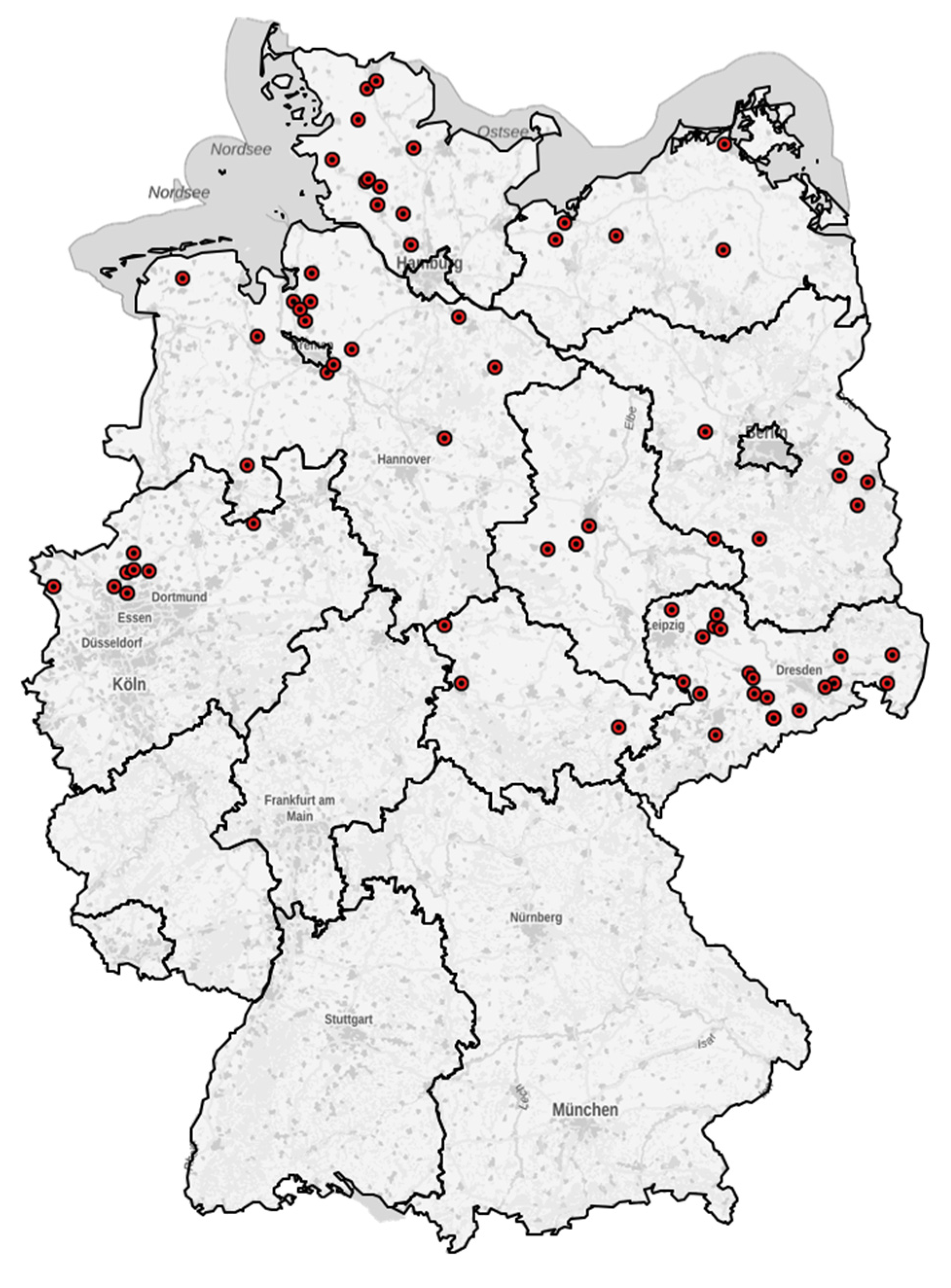
2.4. Location of the Farms
2.5. Questionnaire and Data Collection
2.6. ESBL/AmpC-E. coli Isolation and Characterization
2.7. Data Analysis
3. Results
3.1. ESBL/AmpC-E. coli Prevalence of Calves and Cows
3.2. Description of Farm Management Practices
3.3. Risk Factors for the Occurrence of ESBL/AmpC-E. coli in Calves and Cows
4. Discussion
4.1. Prevalence Data
4.2. Risk Factors for the Occurrence of ESBLAmpC-E. coli in Calves
4.3. Risk Factors for the Occurrence of ESBLAmpC-E. coli in Cows
5. Conclusions
Supplementary Materials
Author Contributions
Funding
Data Availability Statement
Acknowledgments
Conflicts of Interest
References
- Eurosurveillance Editorial Team. WHO member states adopt global action plan on antimicrobial resistance. Eurosurveillance 2015, 20, 21137. [Google Scholar]
- Tacconelli, E.; Carrara, E. Discovery, research, and development of new antibiotics: The WHO priority list of antibiotic-resistant bacteria and tuberculosis. Lancet Infect. Dis. 2017, 18, 318–327. [Google Scholar] [CrossRef] [Scilit]
- Knothe, H.; Shah, P. Transferable resistance to cefotaxime, cefoxitin, cefamandole and cefuroxime in clinical isolates of Klebsiella pneumoniae and Serratia marcescens. Infection 1983, 11, 315–317. [Google Scholar] [CrossRef] [Scilit]
- Grover, N.; Sahni, A.K. Therapeutic challenges of ESBLS and AmpC beta-lactamase producers in a tertiary care center. Med. J. Armed Forces India 2013, 69, 4–10. [Google Scholar] [CrossRef] [Scilit]
- Palmeira, J.D.; Ferreira, H.M.N. Extended-spectrum beta-lactamase (ESBL)-producing Enterobacteriaceae in cattle production–a threat around the world. Heliyon 2020, 6, e03206. [Google Scholar] [CrossRef] [Scilit] [PubMed]
- Kaesbohrer, A.; Bakran-Lebl, K. Diversity in prevalence and characteristics of ESBL/pAmpC producing E. coli in food in Germany. Vet. Microbiol. 2019, 233, 52–60. [Google Scholar] [CrossRef] [Scilit] [PubMed]
- Tenhagen, B.A.; Käsbohrer, A. Antimicrobial resistance in E. coli from different cattle populations in Germany. Tierarztl. Prax. 2020, 48, 218–227. [Google Scholar] [CrossRef] [Scilit]
- Ali, T.; Ali, I. The growing genetic and functional diversity of extended spectrum beta-lactamases. Biomed Res. Int. 2018, 2018, 1–14. [Google Scholar] [CrossRef] [Scilit]
- Homeier-Bachmann, T.; Heiden, S.E. Antibiotic-Resistant Enterobacteriaceae in Wastewater of Abattoirs. Antibiotics 2021, 10, 568. [Google Scholar] [CrossRef] [Scilit]
- Dahms, C.; Hübner, N.-O. Occurrence of ESBL-Producing Escherichia coli in Livestock and Farm Workers in Mecklenburg-Western Pomerania, Germany. PLoS ONE 2015, 10, e0143326. [Google Scholar] [CrossRef] [Scilit]
- Friese, A.; Schulz, J. Faecal occurrence and emissions of livestock-associated methicillin-resistant Staphylococcus aureus (laMRSA) and ESBL/AmpC-producing E. coli from animal farms in Germany. Berl. Munch. Tierarztl. Wochenschr. 2013, 126, 175–180. [Google Scholar]
- Mir, R.A.; Weppelmann, T.A. Colonization Dynamics of Cefotaxime Resistant Bacteria in Beef Cattle Raised without Cephalosporin Antibiotics. Front. Microbiol. 2018, 9, 500. [Google Scholar] [CrossRef] [Scilit]
- Schmid, A.; Hörmansdorfer, S. Prevalence of Extended-Spectrum β-Lactamase-Producing Escherichia coli on Bavarian Dairy and Beef Cattle Farms. Appl. Environ. Microbiol. 2013, 79, 3027–3032. [Google Scholar] [CrossRef] [Scilit] [PubMed]
- Hordijk, J.; Fischer, E.A.J. Dynamics of faecal shedding of ESBL- or AmpC-producing Escherichia coli on dairy farms. J. Antimicrob. Chemother. 2019, 74, 1531–1538. [Google Scholar] [CrossRef] [Scilit] [PubMed]
- Duse, A.; Waller, K.P. Risk factors for antimicrobial resistance in fecal Escherichia coli from preweaned dairy calves. J. Dairy Sci. 2015, 98, 500–516. [Google Scholar] [CrossRef] [Scilit] [PubMed]
- Hille, K.; Ruddat, I. Cefotaxime-resistant E. coli in dairy and beef cattle farms-Joint analyses of two cross-sectional investigations in Germany. Prev. Vet. Med. 2017, 142, 39–45. [Google Scholar] [CrossRef] [Scilit] [PubMed]
- Hille, K.; Felski, M. Association of farm-related factors with characteristics profiles of extended-spectrum β-lactamase-/plasmid-mediated AmpC β-lactamase-producing Escherichia coli isolates from German livestock farms. Vet. Microbiol. 2018, 223, 93–99. [Google Scholar] [CrossRef] [Scilit]
- Odenthal, S.; Akineden, Ö. Extended-spectrum β-lactamase producing Enterobacteriaceae in bulk tank milk from German dairy farms. Internat. J. Food Microbiol. 2016, 238, 72–78. [Google Scholar] [CrossRef] [Scilit]
- Merlino, J.; Siarakas, S. Evaluation of CHROMagar Orientation for differentiation and presumptive identification of gram-negative bacilli and Enterococcus species. J. Clin. Microbiol. 1996, 34, 1788–1793. [Google Scholar] [CrossRef] [Scilit]
- Vinueza-Burgos, C.; Ortega-Paredes, D. Characterization of cefotaxime resistant Escherichia coli isolated from broiler farms in Ecuador. PLoS ONE 2019, 14, e0207567. [Google Scholar] [CrossRef] [Scilit]
- Akaike, H. A new look at the statistical model identification. IEEE Trans. Autom. Control 1974, 19, 716–723. [Google Scholar] [CrossRef] [Scilit]
- Snow, L.C.; Warner, R.G. Risk factors associated with extended spectrum beta-lactamase Escherichia coli (CTX-M) on dairy farms in North West England and North Wales. Prev. Vet. Med. 2012, 106, 225–234. [Google Scholar] [CrossRef] [Scilit]
- Heuvelink, A.E.; Gonggrijp, M.A. Prevalence of extended-spectrum and AmpC beta-lactamase-producing Escherichia coli in Dutch dairy herds. Vet. Microbiol. 2019, 232, 58–64. [Google Scholar] [CrossRef] [Scilit] [PubMed]
- Gonggrijp, M.A.; Santman-Berends, I. Prevalence and risk factors for extended-spectrum beta-lactamase- and AmpC-producing Escherichia coli in dairy farms. J. Dairy Sci. 2016, 99, 9001–9013. [Google Scholar] [CrossRef] [Scilit]
- Terentjeva, M.; Streikisa, M. Prevalence and Antimicrobial Resistance of Escherichia coli, Enterococcus spp. and the Major Foodborne Pathogens in Calves in Latvia. Foodborne Pathog. Dis. 2019, 16, 35–41. [Google Scholar] [CrossRef] [Scilit] [PubMed]
- Manga, I.; Hasman, H. Fecal Carriage and Whole-Genome Sequencing-Assisted Characterization of CMY-2 Beta-Lactamase-Producing Escherichia coli in Calves at Czech Dairy Cow Farm. Foodborne Pathog. Dis. 2019, 16, 42–53. [Google Scholar] [CrossRef] [Scilit] [PubMed]
- Watson, E.; Jeckel, S. Epidemiology of extended spectrum beta-lactamase E. coli (CTX-M-15) on a commercial dairy farm. Vet. Microbiol. 2012, 154, 339–346. [Google Scholar] [CrossRef] [Scilit]
- Horton, R.A.; Duncan, D. Longitudinal study of CTX-M ESBL-producing E. coli strains on a UK dairy farm. Res. Vet Sci. 2016, 109, 107–113. [Google Scholar] [CrossRef] [Scilit] [PubMed]
- Dolejska, M.; Jurcickova, Z. IncN plasmids carrying bla CTX-M-1 in Escherichia coli isolates on a dairy farm. Vet. Microbiol. 2011, 149, 513–516. [Google Scholar] [CrossRef] [Scilit]
- Brunton, L.A.; Duncan, D. A survey of antimicrobial usage on dairy farms and waste milk feeding practices in England and Wales. Vet Rec. 2012, 171, 296. [Google Scholar] [CrossRef] [Scilit] [PubMed]
- USDA-APHIS. Dairy 2007—Part I: Reference of Dairy Cattle Health and Management Practices in the Untited States 2007; USDA-APHIS: Fort Collins, CO, USA, 2007.
- Brunton, L.A.; Reeves, H.E. A longitudinal field trial assesing the impact of feeding waste milk containing antibiotic residues on the prevalence of ESBL-producing Escherichia coli in calves. Prev. Vet. Med. 2014, 117, 403–412. [Google Scholar] [CrossRef] [Scilit] [PubMed]
- Pereira, R.V.; Siler, J.D. Effect of on-farm use of antimicrobial drugs on resistance in fecal Escherichia coli of preweaned dairy calves. J. Dairy Sci. 2014, 97, 7644–7654. [Google Scholar] [CrossRef] [Scilit]
- Gullberg, E.; Cao, S. Selection of resistant bacteria at very low antibiotic concentrations. PLoS Pathog. 2011, 7, e1002158. [Google Scholar] [CrossRef] [Scilit] [PubMed]
- Pereira, R.V.; Lima, S. Ingestion of Milk Containing Very Low Concentration of Antimicrobials: Longitudinal Effect on Fecal Microbiota Composition in Preweaned Calves. PLoS ONE 2016, 11, e0147525. [Google Scholar] [CrossRef] [Scilit]
- Randall, L.; Heinrich, K. Detection of antibiotic residues and association of cefquinome residues with the occurrence of Extended-Spectrum β-Lactamase (ESBL)-producing bacteria in waste milk samples from dairy farms in England and Wales in 2011. Res. Vet. Sci. 2014, 96, 15–24. [Google Scholar] [CrossRef] [Scilit]
- Aust, V.; Knappstein, K. Feeding untreated and pasteurized waste milk and bulk milk to calves: Effects on calf performance, health status and antibiotic resistance of faecal bacteria. J. Anim. Physiol. Anim. Nutr. 2013, 97, 1091–1103. [Google Scholar] [CrossRef] [Scilit]
- Edrington, T.; Farrow, R. Age and diet effects on faecal populations and antibiotic resistance of a multi-drug resistant Escherichia coli in dairy calves. Agric. Food Anal. Bacteriol. 2012, 2, 162–174. [Google Scholar]
- Heinemann, C.; Leubner, C.D. Hygiene management in newborn individually housed dairy calves focusing on housing and feeding practices. J. Anim. Sci. 2020, 99. [Google Scholar] [CrossRef] [Scilit]
- Sigrist, S.M. Bakteriell Kontaminierte Desinfektionsmittel und Gerätschaften beim Melkakt als Mögliche Quelle für Mastitiden; University of Zurich: Zürich, Switzerland, 2010. [Google Scholar]
- Vannucchi, C.I.; Silva, L.G. Oxidative stress and acid–base balance during the transition period of neonatal Holstein calves submitted to different calving times and obstetric assistance. J. Dairy Sci. 2019, 102, 1542–1550. [Google Scholar] [CrossRef] [Scilit]
- Gulliksen, S.M.; Lie, K.I. Risk Factors Associated with Colostrum Quality in Norwegian Dairy Cows. J. Dairy Sci. 2008, 91, 704–712. [Google Scholar] [CrossRef] [Scilit]
- Mormède, P. Exploration of the hypothalamic–pituitary–adrenal function as a tool to evaluate animal welfare. Physiol. Behav. 2007, 92, 317–339. [Google Scholar] [CrossRef] [Scilit] [PubMed]
- Adler, A.; Sturlesi, N. Prevalence, Risk Factors, and Transmission Dynamics of Extended-Spectrum-beta-Lactamase-Producing Enterobacteriaceae: A National Survey of Cattle Farms in Israel in 2013. J. Clin. Microbiol. 2015, 53, 3515–3521. [Google Scholar] [CrossRef] [Scilit]
- Maillard, J.Y. Chapter 37—Testing the Effectiveness of Disinfectants and Sanitizers. In Handbook of Hygiene Control in the Food Industry, 2nd ed.; Lelieveld, H., Holah, J., Gabrić, D., Eds.; Woodhead Publishing: San Diego, CA, USA, 2016; pp. 569–586. [Google Scholar]
- Merchel, P.; Pereira, B. Short- and Long-Term Transcriptomic Responses of Escherichia coli to Biocides: A Systems Analysis. Appl. Environ. Microbiol. 2020, 86, e00708–e00720. [Google Scholar] [CrossRef] [Scilit]
- Heuer, H.; Schmitt, H. Antibiotic resistance gene spread due to manure application on agricultural fields. Curr. Opin. Microbiol. 2011, 14, 236–243. [Google Scholar] [CrossRef] [Scilit] [PubMed]
- Lynn, T.V.; Hancock, D.D. The occurrence and replication of Escherichia coli in cattle feeds. J. Dairy Sci. 1998, 81, 1102–1108. [Google Scholar] [CrossRef] [Scilit]

| Farm Prevalence of ESBL/AmpC-E. coli (%) | |||
|---|---|---|---|
| Calves (n = 1442) | Dams (n = 1374) | Cow-Calf Pairs (n = 1385 *) | |
| Minimum | 0 | 0 | 0 |
| Maximum | 100 | 88.9 | 87.5 |
| Mean | 63.5 | 18 | 13.6 |
| 95% confidence interval | 57.4–69.5 | 12.5–23.5 | 8.7–18.4 |
| Standard deviation | 25.6 | 23.3 | 20.3 |
| Median | 66.1 | 8.3 | 5.1 |
| 1.Quartile | 45.7 | 0 | 0 |
| 3. Quartile | 86.2 | 28.1 | 20.6 |
| Farm Management Factors | Implementation n = 72 (%) |
|---|---|
| Application of ß-lactam antibiotics | 100 |
| Antibiotic dry cow therapy in general | 91.7 |
| Use of intramammary seal | 84.7 |
| Included preventive treatments for cows * | 69.4 |
| Existing biogas reactor | 66.7 |
| Strictly used treatment schedules for calves | 61.1 |
| Self-production of basic feed | 55.6 |
| Application of chinolons | 55.6 |
| Antibiotic treatment of every case of clinical mastitis | 50 |
| Daily cleaning of calf feeding equipment | 29.2 |
| Dry teat cleaning before milking process | 20.6 |
| Use of disinfection in the calving area | 13.9 |
| Sampled calves were treated with antibiotics ** | 10.0 |
| Calf Feeding Management Factors | Implementation n = 72 (%) |
|---|---|
| Colostrum feeding until three hours after birth | 81.9 |
| Identical feeding irrelevant of the sex | 80.6 |
| Feeding of waste milk (in total and mixed ration) | 66.7 |
| Feeding < 5 L per day | 61.1 |
| First meal ≥ 4 L colostrum | 45.8 |
| Feeding milk replacer exclusively | 19.4 |
| Management Factors | Odds Ratio | p Value |
|---|---|---|
| Use of waste milk (nonsalable) | 3.2154 | 0.0313 |
| In-house biogas reactor | 0.2381 | 0.0363 |
| Treatment schedules for calves | 0.2762 | 0.0392 |
| Application of chinolons | 0.3005 | 0.0395 |
| Using milk replacer exclusively | 0.3182 | 0.0632 |
| Included preventive treatments for cows | 0.2807 | 0.0646 |
| Daily cleaning of calf feeding equipment | 2.9000 | 0.0837 |
| Outsourced heifer rearing | 0.3056 | 0.0853 |
| Calf < 1 h with the dam | 0.4162 | 0.1032 |
| Outsourced heifer rearing at several other locations | 0.3478 | 0.1291 |
| Management Factors | Odds Ratio | p Value |
|---|---|---|
| Use of waste milk (nonsalable) | 9.65 | 0.005 |
| Included preventive treatments for cows | 0.13 | 0.029 |
| Daily cleaning of calf feeding equipment | 6.03 | 0.021 |
| Management Factors | Odds Ratio | p Value |
|---|---|---|
| Dry teat cleaning | 0.2125 | 0.0124 |
| No disinfection of calving area | 0.2987 | 0.0282 |
| Self-production of basic feed | 2.8121 | 0.0404 |
| Outsourced heifer rearing in another location of the own farm | 2.7329 | 0.0582 |
| Separate husbandry of waste milk cows | 2.7143 | 0.0849 |
| Waste milk cows milked at the end | 2.2857 | 0.1026 |
| Use of Benestermycin® | 0.4402 | 0.1120 |
| Co-husbandry of calving and sick cows | 3.5714 | 0.1195 |
| Outsourced heifer rearing at several locations | 0.3415 | 0.1243 |
| Use of lime in the calving area | 2.5968 | 0.1300 |
| Use of Fenicols | 2.1685 | 0.1354 |
| Co-calving on deep bedding | 5.7391 | 0.1397 |
Publisher’s Note: MDPI stays neutral with regard to jurisdictional claims in published maps and institutional affiliations. |
© 2021 by the authors. Licensee MDPI, Basel, Switzerland. This article is an open access article distributed under the terms and conditions of the Creative Commons Attribution (CC BY) license (https://creativecommons.org/licenses/by/4.0/).
Share and Cite
Weber, L.P.; Dreyer, S.; Heppelmann, M.; Schaufler, K.; Homeier-Bachmann, T.; Bachmann, L. Prevalence and Risk Factors for ESBL/AmpC-E. coli in Pre-Weaned Dairy Calves on Dairy Farms in Germany. Microorganisms 2021, 9, 2135. https://doi.org/10.3390/microorganisms9102135
Weber LP, Dreyer S, Heppelmann M, Schaufler K, Homeier-Bachmann T, Bachmann L. Prevalence and Risk Factors for ESBL/AmpC-E. coli in Pre-Weaned Dairy Calves on Dairy Farms in Germany. Microorganisms. 2021; 9(10):2135. https://doi.org/10.3390/microorganisms9102135
Chicago/Turabian StyleWeber, Laura Patricia, Sylvia Dreyer, Maike Heppelmann, Katharina Schaufler, Timo Homeier-Bachmann, and Lisa Bachmann. 2021. "Prevalence and Risk Factors for ESBL/AmpC-E. coli in Pre-Weaned Dairy Calves on Dairy Farms in Germany" Microorganisms 9, no. 10: 2135. https://doi.org/10.3390/microorganisms9102135
APA StyleWeber, L. P., Dreyer, S., Heppelmann, M., Schaufler, K., Homeier-Bachmann, T., & Bachmann, L. (2021). Prevalence and Risk Factors for ESBL/AmpC-E. coli in Pre-Weaned Dairy Calves on Dairy Farms in Germany. Microorganisms, 9(10), 2135. https://doi.org/10.3390/microorganisms9102135

