Isolation, Identification of Three Prometryn-Degrading Strains and Their Synthetic Consortium: Degradation Characteristics and Soil Remediation Potential

 , , , and
 Abstract
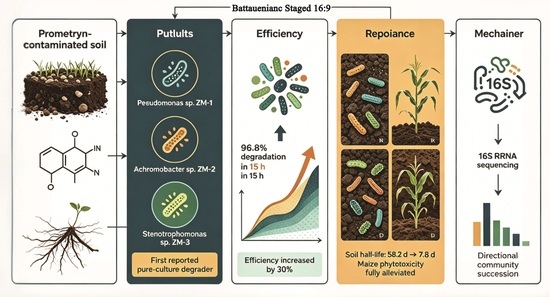
Share and Cite
Liang, D.; Wang, W.; Wang, Y.; Xiao, S.; Hao, Y.; Song, Y.; Sun, L.; Kong, Q.; Xin, J. Isolation, Identification of Three Prometryn-Degrading Strains and Their Synthetic Consortium: Degradation Characteristics and Soil Remediation Potential. Microorganisms 2026, 14, 2057. https://doi.org/10.3390/microorganisms14092057
Liang D, Wang W, Wang Y, Xiao S, Hao Y, Song Y, Sun L, Kong Q, Xin J. Isolation, Identification of Three Prometryn-Degrading Strains and Their Synthetic Consortium: Degradation Characteristics and Soil Remediation Potential. Microorganisms. 2026; 14(9):2057. https://doi.org/10.3390/microorganisms14092057
Chicago/Turabian StyleLiang, Dong, Wenru Wang, Yuhao Wang, Shuangcai Xiao, Yu Hao, Yutong Song, Lirui Sun, Qingmin Kong, and Jiaying Xin. 2026. "Isolation, Identification of Three Prometryn-Degrading Strains and Their Synthetic Consortium: Degradation Characteristics and Soil Remediation Potential" Microorganisms 14, no. 9: 2057. https://doi.org/10.3390/microorganisms14092057
APA StyleLiang, D., Wang, W., Wang, Y., Xiao, S., Hao, Y., Song, Y., Sun, L., Kong, Q., & Xin, J. (2026). Isolation, Identification of Three Prometryn-Degrading Strains and Their Synthetic Consortium: Degradation Characteristics and Soil Remediation Potential. Microorganisms, 14(9), 2057. https://doi.org/10.3390/microorganisms14092057