Review

Filamentous Algae for Wastewater Circularity: A Review of Wastewater Treatment, Resource Recovery, and Biorefinery Opportunities


1
Gansu Microalgae Technology Innovation Center, Hexi University, Zhangye 734000, China
2
College of Agriculture and Ecological Engineering, Hexi University, Zhangye 734000, China
3
College of Life Science and Engineering, Hexi University, Zhangye 734000, China
*
Authors to whom correspondence should be addressed.
Those authors contributed equally to this work.
Microorganisms 2026, 14(8), 1702; https://doi.org/10.3390/microorganisms14081702

Submission received: 24 June 2026 / Revised: 27 July 2026 / Accepted: 28 July 2026 / Published: 3 August 2026

Abstract

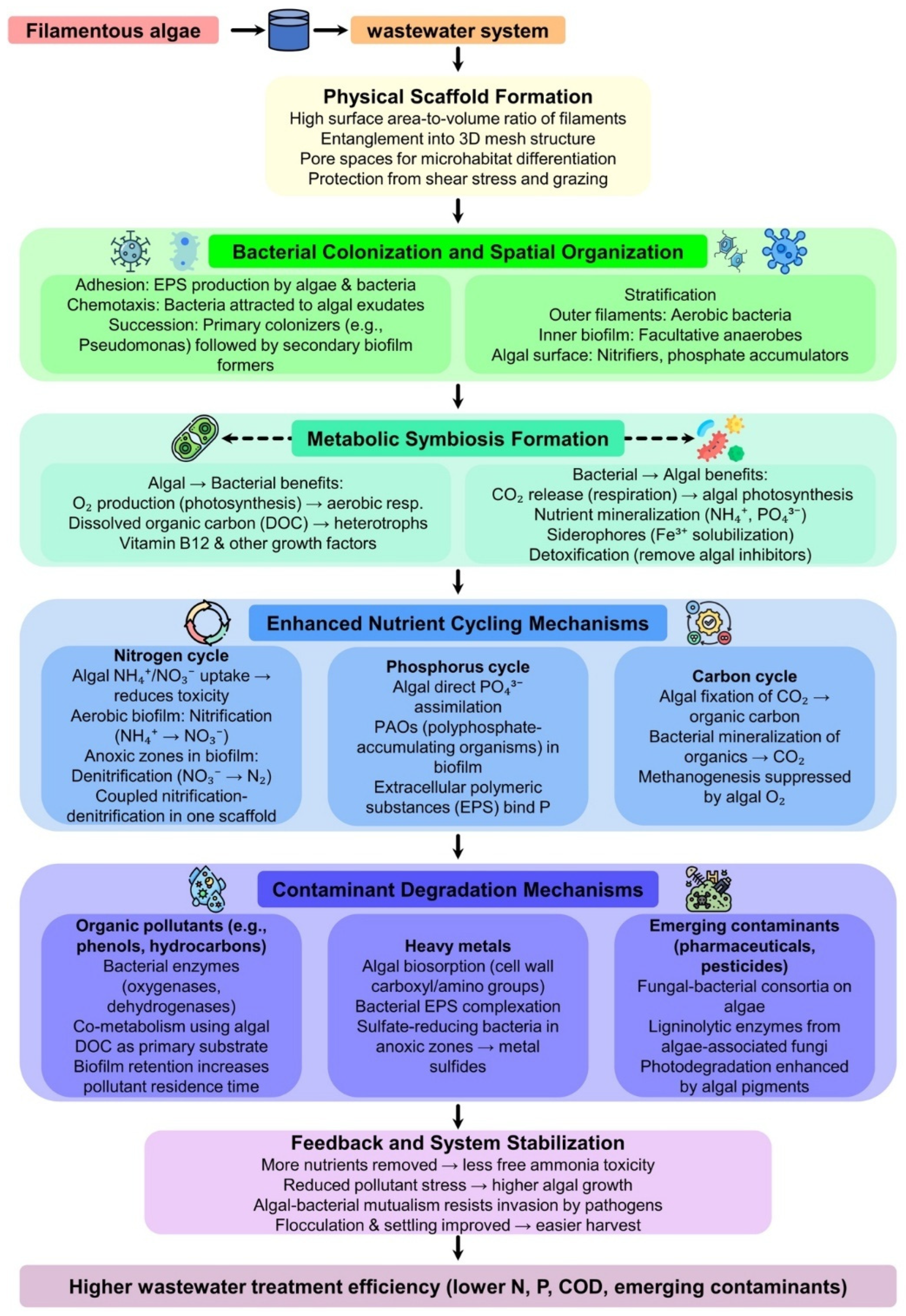
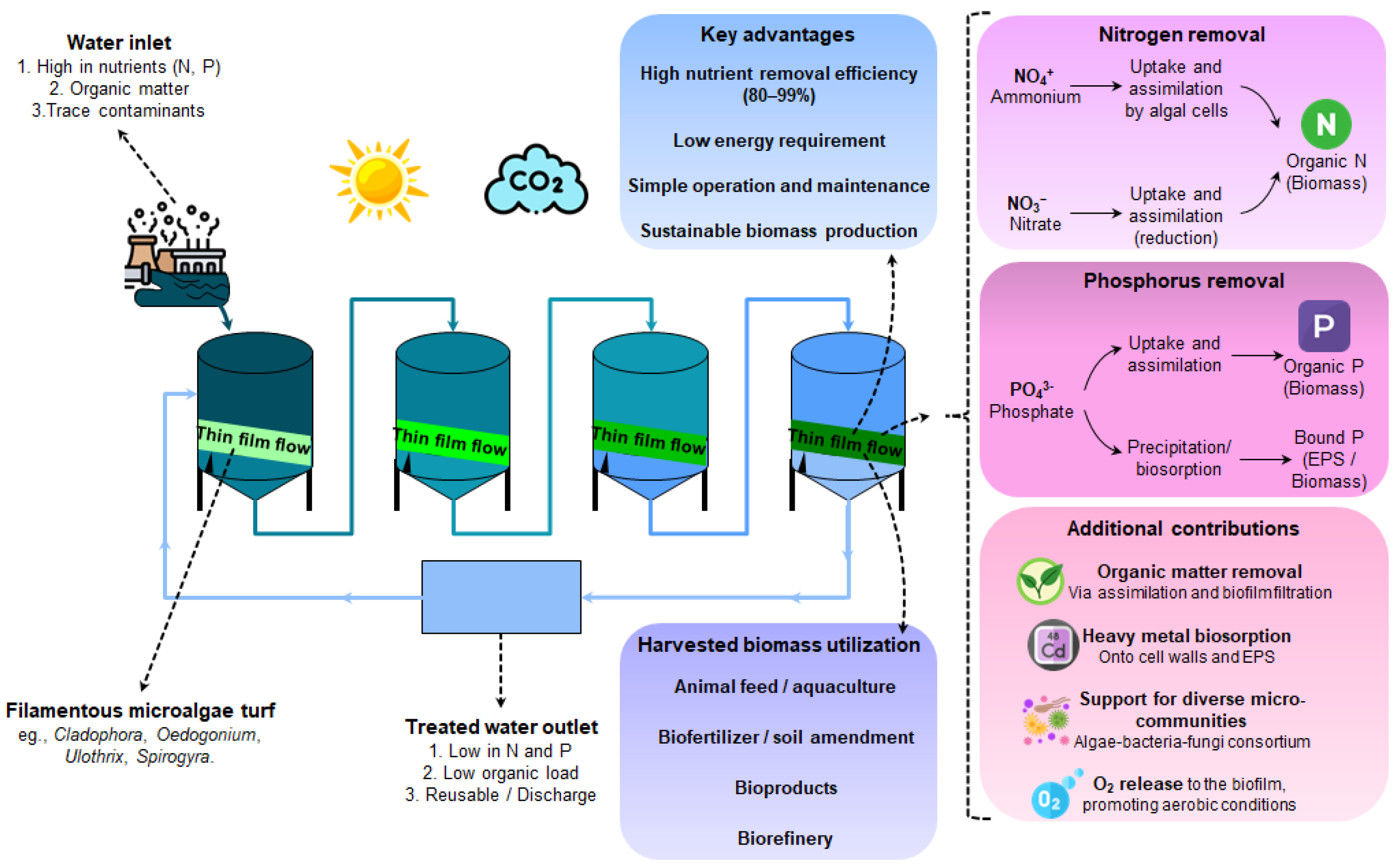
Wastewater treatment is undergoing a transition from pollutant removal toward resource recovery, creating opportunities to integrate environmental remediation with circular bioeconomy principles. Filamentous algae have attracted increasing attention as multifunctional biological platforms because their attached growth habit facilitates biomass harvesting while supporting nutrient recovery and biomass valorization. This review synthesizes current knowledge on the roles of filamentous algae in wastewater treatment, with emphasis on nutrient and contaminant removal, biomass production, and the generation of bioenergy, biofertilizers, aquafeeds, and cellulose-based biomaterials. It highlights how filamentous algae differ from conventional suspended microalgae through improved biomass retention, simpler harvesting, and compatibility with attached-growth systems such as algal turf scrubbers and biofilm reactors. The review also examines the ecological interactions between filamentous algae and associated microbial communities that underpin nutrient cycling and treatment performance. Beyond wastewater treatment, it critically evaluates the opportunities and challenges associated with downstream biomass valorization, including biofuel production and the recovery of high-value products within integrated biorefinery frameworks. In addition, the review discusses the principal barriers to large-scale implementation, including limited field-scale validation, variability in biomass quality, contaminant safety, downstream processing requirements, regulatory uncertainty, and the need for comprehensive techno-economic and environmental assessments. Finally, it highlights emerging research directions involving systems biology, advanced process monitoring, artificial intelligence-assisted process control, and integrated biorefinery concepts that may support future development. By integrating biological, engineering, and sustainability perspectives, this review provides a comprehensive framework for understanding the potential of filamentous algae to support resilient wastewater treatment systems and accelerate the transition toward circular resource management.
Keywords: resource recovery; algal biorefinery; emerging contaminant removal; circular bioeconomy; biofertilizers resource recovery; algal biorefinery; emerging contaminant removal; circular bioeconomy; biofertilizers