Article

Prevalence, Genomic Characterization, and Transmission Patterns of Cronobacter spp. in Low-Water-Activity Foods from Hunan Province, China

Hunan Provincial Center for Disease Control and Prevention (Hunan Academy of Preventive Medicine), Changsha 410005, China
*
Author to whom correspondence should be addressed.
Microorganisms 2026, 14(6), 1320; https://doi.org/10.3390/microorganisms14061320
Submission received: 15 May 2026 / Revised: 7 June 2026 / Accepted: 10 June 2026 / Published: 12 June 2026
(This article belongs to the Section Food Microbiology)

Abstract

Cronobacter spp. are opportunistic foodborne pathogens that can cause neonatal meningitis, necrotizing enterocolitis, and sepsis. This study conducted a systematic contamination survey and whole-genome epidemiological analysis of 562 low-water-activity food samples in Hunan Province of China. The results showed an overall Cronobacter spp. detection rate of 41.99% (236/562), with spices exhibiting the highest contamination rate (60.06%), and with high-level contamination samples (>110 MPN/g) concentrated in this category. The 236 isolates comprised 6 species, 120 sequence types, and 39 clonal complexes, with C. sakazakii being the most frequently isolated species (64.83%) and high-risk clones ST4, ST1, ST148, and ST64 prevailing. Multiple virulence genes (TraJ, fur, rcsAB, rpoS) and antimicrobial resistance genes (qnrS1, blaTEM-1, blaCTX-M-55, blaLAP-2, aac(3)-IId, aadA2, tet(A), floR, mcr-9.1, sul2) were detected. Core genome multilocus sequence typing (cgMLST) identified two clustering patterns: Cluster C, whose genetic clustering was consistent with transmission associated with potential common upstream raw materials across different brands and provinces, and Cluster G, whose clustering suggested potential persistent colonization in the production environment across multiple batches of the same brand. This study elucidates the contamination characteristics of Cronobacter spp. in low-water-activity foods from Hunan Province and provides a basis for WGS-based active surveillance and supply chain traceability.

1. Introduction

Cronobacter spp. are facultatively anaerobic, Gram-negative opportunistic pathogens belonging to the family Enterobacteriaceae [1]. The genus is currently divided into seven species and three subspecies, including C. sakazakii, C. malonaticus, C. turicensis, C. muytjensii, C. condimenti, C. universalis, and C. dublinensis [2]. Infections in immunocompromised individuals (such as the elderly and infants) can cause meningitis, necrotizing enterocolitis, septicemia, and neurological sequelae, with mortality rates ranging from 40% to 80% [3,4]. The pathogenicity and virulence factors vary among different species of this genus; all six species except C. condimenti are considered pathogenic [5,6]. Among them, C. sakazakii is the most frequently isolated and most virulent species [7]. Of note, infections in adults can also manifest as septicemia, osteomyelitis, and pneumonia [8,9].
Cronobacter spp. exhibit remarkable environmental tolerance and can survive for extended periods under acidic, hyperosmotic, and extremely low-water-activity conditions [10]. To date, contamination by Cronobacter spp. has been detected in a variety of food matrices, including powdered infant formula, spices, cereals, meat, raw vegetables, and rice and flour products [11,12,13,14,15,16]. However, systematic studies on its transmission routes, molecular epidemiological characteristics, and pathogenic mechanisms remain limited. Although whole-genome sequencing (WGS) has revealed the antimicrobial resistance and virulence factor profiles of foodborne Cronobacter spp. isolates from certain regions of China [16], the prevalence, resistance spectrum, and virulence characteristics of Cronobacter spp. in low-water-activity foods in Hunan Province have yet to be systematically elucidated.
This study focused on three categories of low-water-activity foods (aw < 0.85): spices, medicinal and edible foods, and cereal-based complementary foods for infants and young children. This classification is consistent with the water activity values reported for spices [17], medicinal and edible foods [18], and cereal-based complementary foods for infants and young children [19] in the literature. Although the low-water-activity of these foods theoretically inhibits microbial proliferation, the intrinsic desiccation tolerance of Cronobacter spp. enables their long-term survival in such matrices, thereby posing a potential risk. The consumer base for these foods is broad—spices are daily seasonings, while medicinal and edible foods and cereal-based complementary foods are particularly prevalent among infants, young children, and middle-aged and elderly populations in China, which include immunocompromised susceptible individuals.
Therefore, this study aims to systematically assess the contamination risk of Cronobacter spp. in low-water-activity foods from Hunan Province through strain isolation and identification, WGS, and antimicrobial susceptibility testing. The specific objectives are to: (1) determine the contamination status, species distribution, and dominant clonal lineages of Cronobacter spp. across different food categories; (2) analyze antimicrobial resistance phenotypes and their genetic determinants; (3) elucidate the distribution and functional characteristics of virulence genes; and (4) investigate the transmission patterns and potential contamination sources of the strains by combining core genome multilocus sequence typing (cgMLST) with epidemiological data. This study will provide a scientific basis for continuous monitoring, contamination traceability, and the development of effective public health prevention and control strategies in the low-water-activity food supply chain.

2. Materials and Methods

2.1. Strain Source, Collection and Preparation

As part of the national food safety risk monitoring program, a total of 562 low-water-activity food samples were collected from farmers’ markets, supermarkets, retail stores, and online shops across 11 prefecture-level cities in Hunan Province during 2023–2024. These samples included 338 spice samples (Pepper, Chili, Cumin, Sichuan pepper, Cassia, Star anise, Fennel, Bay leaf, Five-spice powder, Tsaoko, other), 110 samples of medicinal and edible foods (Jujube, Fox nut, Black sesame, Licorice, Kudzu root, Ejiao), and 114 samples of cereal-based complementary foods for infants and young children (Raw cereal-based complementary foods and Standard cereal-based complementary foods).
The samples were transported under sealed, cool, dry, and ambient temperature conditions. Upon arrival, they were stored by category in the sample room and tested within three days. Cross-contamination, environmental contamination, and any changes in the counts or growth capacity of intrinsic food microorganisms were strictly avoided throughout the process. Sampling coverage varied by year; some prefecture-level cities participated in both years, while others participated only in one year. Detailed information on all 236 isolates (species, ST, CC type, source, sampling location, and date) is provided in Supplementary Table S1.

2.2. Isolation and Identification of Cronobacter spp.

The isolation of Cronobacter spp. was performed by municipal Centers for Disease Control and Prevention (CDC) following the national standard GB 4789.40-2016 (updated to GB 4789.40-2024 in 2024) for qualitative testing and most probable number (MPN) enumeration [20,21]. The brief procedure was as follows: three portions each of 100 g, 10 g, and 1 g of samples were weighed and added to 900 mL, 90 mL, and 9 mL of sterile buffered peptone water, respectively, to prepare 1:10 sample homogenates for incubation. Subsequently, 1 mL of the enrichment culture was transferred to 10 mL of modified lauryl sulfate tryptose broth with vancomycin (mLST-Vm) and incubated. Following enrichment, the cultures were streaked onto two Enterobacter sakazakii chromogenic agar plates. Suspected colonies (green or blue-green) were picked and streaked onto tryptic soy agar (TSA) plates. Presumptive colonies were identified by biochemical tests or mass spectrometry.
Confirmation and in-depth analysis of the isolates were conducted at the provincial CDC. After all the isolates were sent to the provincial CDC, each isolate was re-confirmed using the VITEK 2 automated microbial identification system (bioMérieux, Marcy-l’Étoile, France). Subsequently, antimicrobial susceptibility testing as well as whole-genome sequencing and analysis were performed on all the confirmed isolates.

2.3. Antimicrobial Susceptibility Testing

Antimicrobial susceptibility testing was performed using the broth microdilution method with the AutoMic-i600 automatic antimicrobial susceptibility testing system (Autobio, Zhengzhou, China) according to the manufacturer’s instructions. A total of 23 antimicrobial agents from 10 classes were selected for testing based on recommendations from national and international surveillance networks (e.g., NARMS, CARSS, CHINET, and the Pathogen Identification Network), as well as guidelines from the Clinical and Laboratory Standards Institute (CLSI), the U.S. Food and Drug Administration (FDA), and the European Committee on Antimicrobial Susceptibility Testing (EUCAST).
The tested antimicrobial agents included: quinolones (ciprofloxacin, nalidixic acid); penicillins (ampicillin); cephalosporins (ceftazidime, cefotaxime, cefoxitin, cefepime, cefuroxime, cefazolin, ceftiofur); β-lactam/β-lactamase inhibitor combinations (ampicillin/sulbactam); carbapenems (ertapenem, imipenem, meropenem); aminoglycosides (gentamicin, amikacin); tetracyclines (tetracycline, tigecycline); amphenicols (chloramphenicol, florfenicol); polymyxins (polymyxin E, polymyxin B); and the dual folate antagonist combination antibiotic (trimethoprim/sulfamethoxazole).
The minimal inhibitory concentration (MIC) for each antimicrobial was determined and interpreted using a unified set of breakpoints compiled from the following publicly available standards: CLSI M100-S34, CLSI M45-A3, CLSI VET01-A4, FDA and EUCAST [22,23,24,25,26]. Escherichia coli ATCC 25922 and Pseudomonas aeruginosa ATCC 27853 were used as quality control strains. Isolates resistant to three or more classes of antimicrobial agents were defined as multidrug-resistant (MDR) strains [27]. To ensure transparency and reproducibility, the complete breakpoint table is provided in Supplementary Table S3.

2.4. Whole Genome Sequencing and Data Processing

Genomic DNA was extracted using the TIANamp Bacterial DNA Kit (Tiangen Biotech, Beijing, China) according to the manufacturer’s instructions. WGS was performed by Novogene Bioinformatics Technology Co., Ltd. (Beijing, China) using the Illumina NovaSeq 6000 platform (Illumina, San Diego, CA, USA) with 150 bp paired-end (PE150) sequencing technology. Raw reads were processed using Fastp to remove adapter sequences and low-quality reads, yielding clean data [28]. Clean reads were assembled using SPAdes v3.15.0 software with default parameters [29]. Sequencing quality was assessed by evaluating sequencing depth, genome coverage, Q20/Q30 values, and assembly statistics (number of contigs and N50 values). Only assemblies that met quality thresholds for contig count and single-base error rate were used for subsequent analyses. Detailed quality metrics for each isolate were provided in Supplementary Table S2.

2.5. Bioinformatic Analysis

The cleaned sequencing data were uploaded to the Microobench platform (Zhongwei Shuchuang Technology Co., Ltd., Beijing, China)—a pathogenic microorganism analysis workstation—for subsequent bioinformatics analysis. Multilocus sequence typing (MLST) was performed based on seven housekeeping genes (atpD, fusA, glnS, gltB, gyrB, infB, pps) using the PubMed ST database. Virulence genes were identified by alignment against the Virulence Factor Database (VFDB) [30], requiring sequence identity ≥ 90% and coverage ≥ 90%. Antimicrobial resistance genes were identified by alignment against the Comprehensive Antibiotic Resistance Database (CARD) [31] using the same thresholds. All of the above thresholds were the default parameters of the Microobench platform.
Pan-genome analysis was performed based on genome annotation files (GFF) using Panaroo (version 1.6.0). The core genome was constructed under strict mode (--clean_mode strict), and the core gene set was extracted using both the default core gene threshold and a threshold of 90% (--core_threshold 0.9). After obtaining the core gene alignment sequence (core_gene_alignment_filtered.aln), a maximum likelihood phylogenetic tree was constructed using IQ-TREE software under the GTR + G substitution model, with branch support evaluated by 1000 bootstrap replicates, to assess the overall evolutionary relationships of the 236 Cronobacter spp. isolates.
To investigate the genetic relatedness among isolates, cgMLST was performed. Based on cgMLST allele profiles, a phylogenetic tree was constructed using the single-linkage clustering algorithm implemented in the Microobench platform. A threshold of ≤10 allele differences was used to define genomic clusters [32,33]. By integrating sampling information (date, city, county, market, and sample type), the identified genomic clusters were further categorized into two descriptive categories: (C) common-source-supported clusters (isolates with high genomic similarity but lacking strong spatiotemporal links within the same cluster, suggesting potential common upstream sources) and (G) genomic clusters only (clusters based solely on genomic similarity without clear spatiotemporal or source associations, representing background lineages). It should be noted that this classification was descriptive and does not directly equate to confirmed transmission events, nor can it completely exclude the possibility of cross-contamination during sampling or laboratory processing.
Due to the limited number of isolates of the other five species (C. malonaticus, C. turicensis, C. muytjensii, C. universalis, and C. dublinensis), conducting cgMLST analysis and phylogenetic tree construction for them would not be statistically meaningful. Therefore, cgMLST was performed only for C. sakazakii in this study to elucidate the transmission patterns of its isolates.

3. Results

3.1. Isolation and Prevalence of Cronobacter spp.

The detection rate and contamination level of Cronobacter spp. were analyzed in 562 low-water-activity food samples from Hunan Province of China, with an overall detection rate of 41.99% (236/562). The samples included 338 spices, 110 medicinal and edible foods, and 114 cereal-based complementary foods for infants and young children, with positive isolation rates of 60.06% (203/338), 13.64% (15/110), and 15.79% (18/114), respectively. Among the 236 positive samples, the contamination levels of Cronobacter spp. showed a skewed distribution: 68.22% (161/236) had contamination levels below 10 MPN/g, 15.68% (37/236) had levels between 10 and 110 MPN/g, and 16.10% (38/236) had levels exceeding 110 MPN/g. Among the 38 food samples with contamination levels exceeding 110 MPN/g, spices accounted for the highest proportion (36 samples in total), including pepper (12), cumin (17), chili (3), Sichuan pepper (2), and fennel (2). In addition, high contamination levels were also detected in jujube (1 sample) among medicinal and edible foods and in one sample of raw cereal-based complementary food for infants and young children (Table 1).

3.2. Species Distribution and Dominant Clonal Lineages of Cronobacter spp.

Among the 236 Cronobacter spp. isolates, six species were identified based on PubMLST analysis. C. sakazakii was the most frequently isolated species, accounting for 64.83% (153/236), followed by C. malonaticus (14.83%, 35/236), C. turicensis (8.47%, 20/236), C. muytjensii (5.93%, 14/236), C. dublinensis (4.23%, 10/236), and C. universalis (1.69%, 4/236). A total of 120 sequence types (STs) were identified, belonging to 39 clonal complexes (CCs). C. sakazakii exhibited the highest genetic diversity, comprising 61 STs and 25 CCs, with the dominant STs being ST4 (13 isolates), ST1 (12 isolates), ST148 (11 isolates), and ST64 (11 isolates), and the corresponding dominant CCs being CC4 (13 isolates), CC1 (12 isolates), CC16 (11 isolates), and CC64 (11 isolates). For C. malonaticus, 24 STs were identified, with ST211 (5 isolates) being the most common, and the main clonal complex was CC200 (5 isolates). The remaining species were isolated in smaller numbers, with a more dispersed distribution of STs.
From the perspective of food sources, spices were the category with the largest proportion of Cronobacter spp. isolates in this study, with 203 isolates detected, followed by medicinal and edible foods (15 isolates) and infant cereals (18 isolates). Notably, C. sakazakii was most frequently detected in spices (126 isolates) and was also present in both medicinal and edible foods and infant cereals. In contrast, C. muytjensii and C. universalis were detected only in spices. The identification of these dominant sequence type clonal strains provided a critical framework for subsequent studies on the dissemination of associated resistance and virulence determinants (Table 2).

3.3. Virulence Gene Profiles and Key Determinants

The virulence gene repertoire of 236 Cronobacter spp. isolates was systematically analyzed according to the Virulence Factor Database (VFDB) classification (Table 3).
Regarding adherence, the Sfp fimbriae gene was detected in 4.24% of isolates, while the REPEC fimbriae gene, essential for host colonization, was found in only 1.27% of isolates.
For effector delivery systems, the Type VI Secretion System-II (T6SS-II) was present in all the isolates, suggesting its core role in interbacterial competition. The T6SS was detected in 50.42% of isolates, whereas the T6SS-III was identified in only two isolates (0.84%). The Type III Secretion System (T3SS) was also rare, with a detection rate of 0.84%.
In terms of immune modulation, capsule biosynthesis genes were present in all the isolates, facilitating bacterial persistence and immune evasion. LPS-associated genes were detected in only 1.27% of isolates.
For invasion, the TraJ gene, involved in virulence plasmid spread, was detected in 2.12% of isolates. All the isolates carried genes for peritrichous flagella, enabling motility and chemotaxis.
Among the regulatory genes, fur (involved in nutrient sensing and virulence expression) and rcsAB were present in all the isolates. The detection rate of rpoS was 99.58%, which was closely associated with desiccation tolerance.

3.4. Antimicrobial Resistance Phenotypes and Their Genetic Determinants

Antimicrobial susceptibility testing was performed on 236 Cronobacter spp. isolates, with the results summarized by antibiotic category in Table 4. Overall, Cronobacter spp. isolates remained largely susceptible to most tested antibiotics, with only a few isolates exhibiting resistance or intermediate phenotypes. Five isolates (2.12%) were MDR.
Quinolones: All the isolates were susceptible (99.58%) or intermediate (0.42%) to ciprofloxacin, with no resistant strains detected. The resistance rate to nalidixic acid was 0.85% (2/236). The qnrS1 gene was detected in 1.27% of the isolates.
Penicillins and cephalosporins: All the isolates were fully susceptible (100%) to ceftazidime, cefotaxime, and cefepime. For cefoxitin, the intermediate rate was 30.93% (73/236) and the resistance rate was 5.08% (12/236). For cefazolin, the intermediate rate was 24.15% (57/236) and the resistance rate was 68.22% (161/236). For ampicillin, the resistance rate was 0.42% (1/236). For ceftiofur, the resistance rate was 0.42% (1/236). Detected resistance genes included blaCTX-M-55 (0.42%), blaTEM-1 (0.42%), and blaLAP-2 (0.84%).
β-lactam/β-lactamase inhibitor combinations and carbapenems: All the isolates were fully susceptible to ampicillin/sulbactam, ertapenem, imipenem, and meropenem.
Aminoglycosides: Gentamicin resistance was observed in 0.42% (1/236) of isolates, with an additional 0.42% (1/236) showing intermediate susceptibility. All the isolates were susceptible to amikacin. Detected resistance genes included aac(3)-IId and aadA2.
Tetracyclines: Tetracycline resistance was observed in 0.85% (2/236) of isolates. All the isolates were susceptible to tigecycline. Detected genes included tet(A) (0.42%).
Amphenicols: For chloramphenicol, the intermediate rate was 1.69% (4/236) and the resistance rate was 0.85% (2/236). For florfenicol, 29.24% (69/236) of isolates were susceptible, 62.71% (148/236) were intermediate, and 8.05% (19/236) were resistant. The floR gene was detected in 0.84% of isolates.
Polymyxins: For polymyxin E, the resistance rate was 2.54% (6/236). The mobile colistin resistance gene mcr-9.1 was detected in 3.81% of isolates.
Dual folate antagonist combination antibiotic: Trimethoprim/sulfamethoxazole resistance was observed in 0.85% (2/236) of isolates. Detected resistance genes included sul2 (0.84%), dfrA12 (0.42%), and dfrA17 (0.84%).

3.5. Phylogenetic Relationships of Cronobacter spp. Isolates Based on Core Genome Analysis

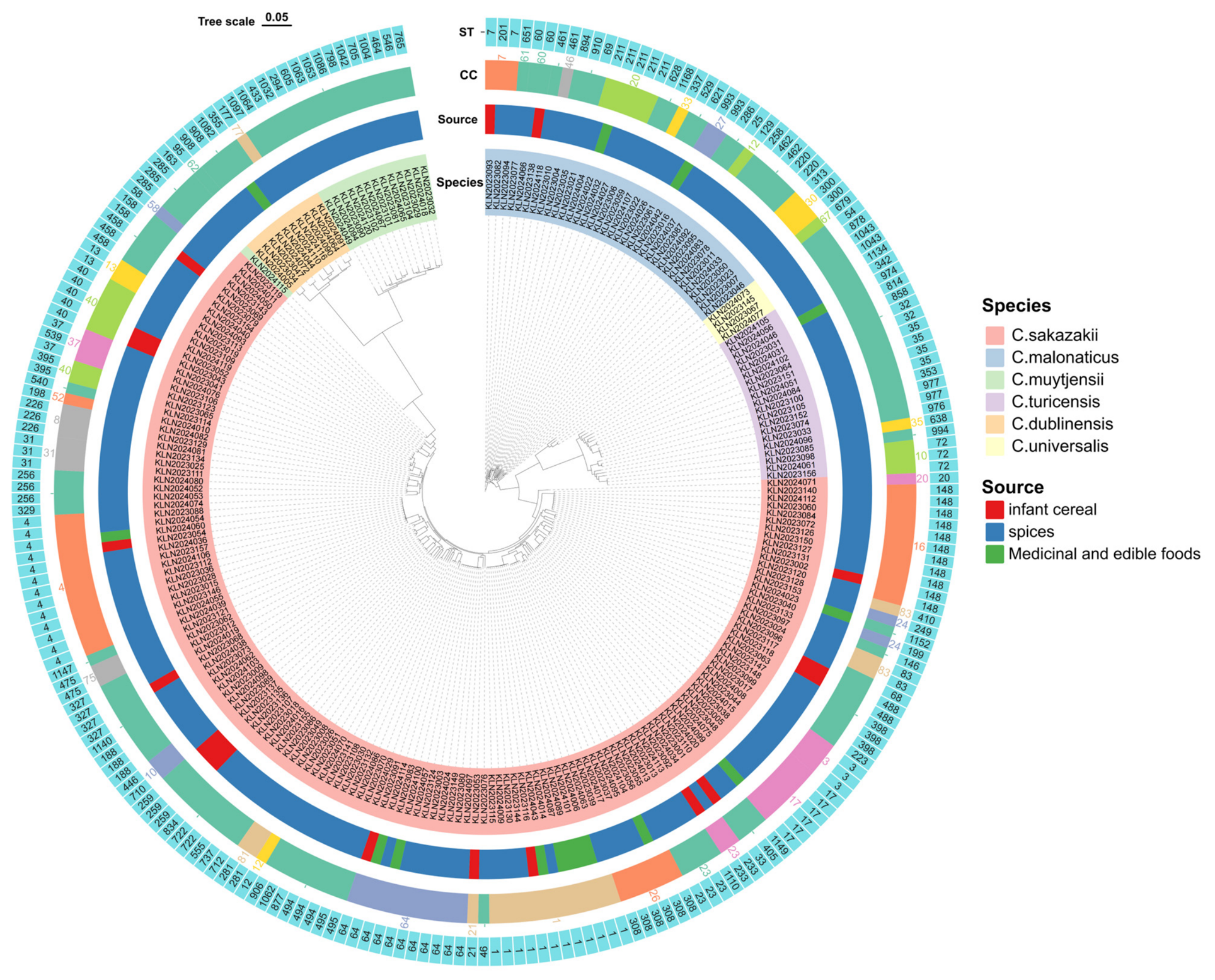
To elucidate the overall evolutionary relationships among the 236 Cronobacter spp. isolates, a maximum-likelihood phylogenetic tree was constructed based on pan-genome analysis (Figure 1).
The phylogenetic tree clearly clustered the 236 isolates into six species-specific clades, consistent with the species identification based on MLST analysis. C. sakazakii formed the largest clade, comprising 153 isolates, followed by C. malonaticus (35 isolates), C. turicensis (20 isolates), C. muytjensii (14 isolates), C. dublinensis (10 isolates), and C. universalis (4 isolates).

3.6. Genomic Epidemiology and Transmission Patterns

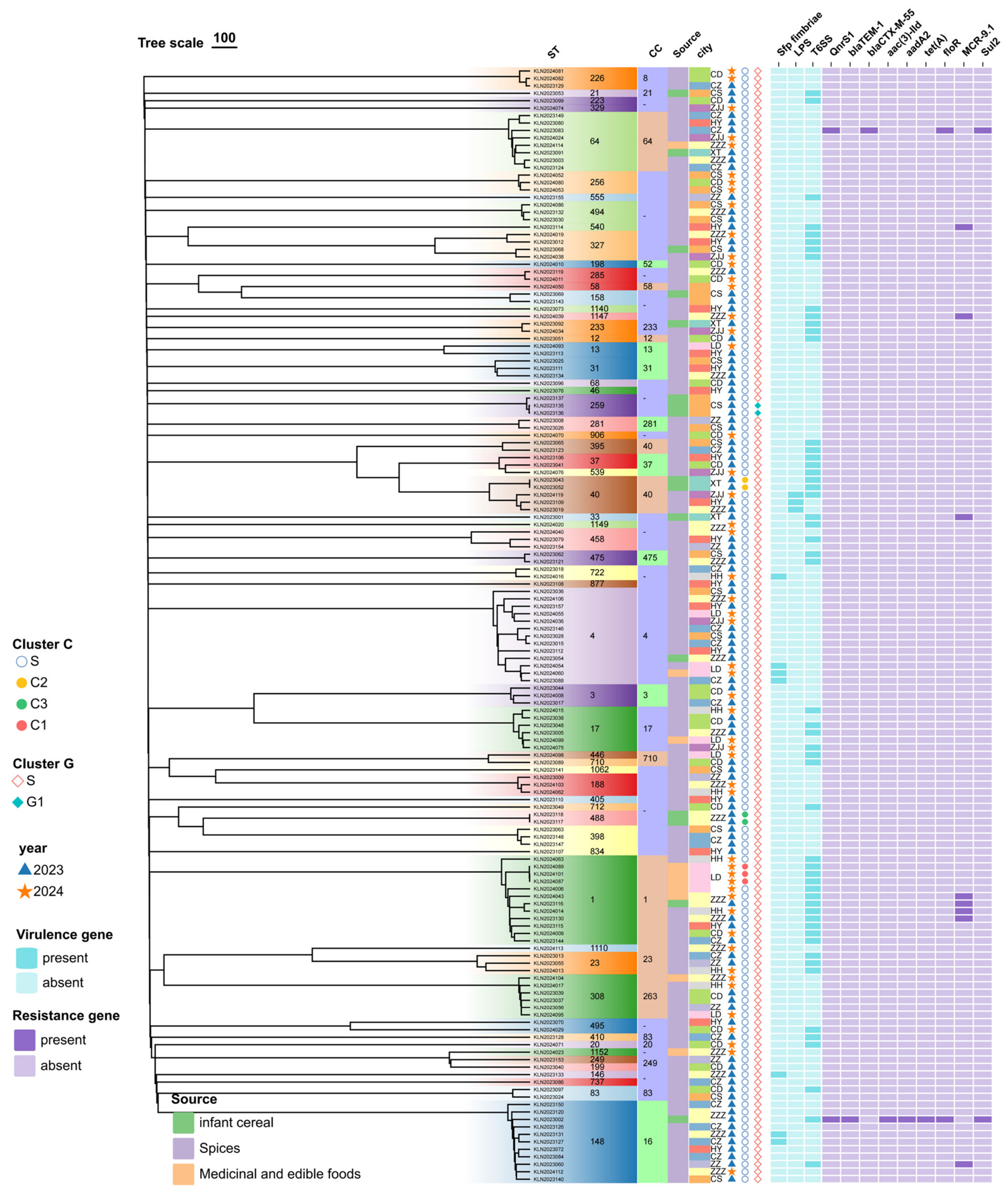
CgMLST was performed to investigate the genetic relatedness among 153 C. sakazakii isolates recovered from different food products in Hunan Province, using a threshold of ≤10 allele differences to define genomic clusters. A total of 4 genomic clusters were identified and categorized into two types based on epidemiological evidence: common source-supported clusters (C) and genomic clusters only (G) (Table 5, Figure 2).
Common source-supported clusters (C). Three clusters (seven isolates) were assigned to this category, comprising isolates with high genomic similarity (0–2 allele differences) recovered from different time points or different sampling sites, but lacking strong spatiotemporal links (e.g., same-day and same-market exposure). These clusters suggested contamination from shared upstream sources in the supply chain.
Cluster C1 comprised three isolates collected from three different districts/counties in Loudi City within three days (3–5 September 2024; Ejiao brown sugar, Ejiao jujube, and ready-to-eat black sesame paste), with 1–2 allele differences.
Cluster C2 comprised two isolates collected from two different districts in Xiangtan City on the same day (24 May 2023; Lugang Cang and Beilaikeqin infant cereal products), with 0 allele differences.
Cluster C3 comprised two isolates collected from two different towns in Fenghuang County, Xiangxi Prefecture, on the same day (27 June 2023; Beileizhi and Tuxiaobei raw infant cereal products), with 0 allele differences.
Category G (genomic clusters only). Cluster G1 comprised two isolates with genomic similarity but no discernible epidemiological links and was assigned to this category, representing persistent or intermittent background lineages.
Cluster G1 comprised two isolates from Little Freddie brand infant cereal products in Changsha City (2 allele differences). Despite sharing the same manufacturer, they were assigned to Category G due to different sampling dates (12 days apart), production dates (38 days apart), and retail channels.
Among the four genomic clusters (C1–C3 and G1) identified by cgMLST, except for T6SS which was present in clusters C1 and C2, the distribution of other key virulence and antimicrobial resistance-associated genes (sfp fimbriae, LPS, qnrS1, blaTEM-1, blaCTX-M-55, aac(3)-IId, aadA2, tet(A), floR, mcr-9.1, sul2) was sporadic across all the clusters, with no statistically significant lineage enrichment observed.

4. Discussion

4.1. Contamination Level of Cronobacter spp. in Low-Water-Activity Food Samples

The contamination level of Cronobacter spp. in 562 low-water-activity food samples from Hunan Province indicated that these foods serve as potential reservoirs of Cronobacter spp., which is consistent with the strong desiccation tolerance of this genus, particularly C. sakazakii [34]. Compared with similar studies in China and internationally, the detection rate in spices from Hunan Province (60.06%) was significantly higher than that in powdered spices from Nanning (25.0%) [12] and low-water-activity functional foods from Brazil (36.2%) [35], and also slightly higher than a previous report on retail spices in China (57.1%) [36]. However, due to differences in sample types and scales across these studies, accurate comparisons of detection rates were difficult, which also limits in-depth analysis of genetic diversity and transmission patterns. Regarding contamination levels, among the 38 high-risk samples exceeding 110 MPN/g, 36 originated from spices, indicating that this category not only has a high detection rate but also exhibits more severe contamination levels. In contrast, fewer high-level contamination samples were found in medicinal and edible foods and infant cereals. The samples in this study were collected from different pathways in Hunan Province, suggesting that the differences in contamination levels among different food categories may be associated with raw material sources, processing techniques, and storage conditions, the specific causes of which require further investigation in subsequent studies.

4.2. Species Distribution, Dominant Clones, and Pathogenesis of Cronobacter spp.

Based on PubMLST analysis, the 236 Cronobacter spp. isolates were identified and this result was consistent with the species identification based on the pan-genome maximum-likelihood phylogenetic tree.
A total of 120 STs belonging to 39 CCs were identified among all the isolates. C. sakazakii exhibited the highest genetic diversity, encompassing 61 STs and 25 CCs, with the dominant STs being ST4 (n = 13), ST1 (n = 12), ST148 (n = 11), and ST64 (n = 11). These were primarily sourced from spices and were also distributed in medicinal and edible foods as well as infant cereals. According to the PubMLST database, all four STs can be recovered from food, environmental, and clinical samples. Previous studies have shown that ST4, ST1, and ST64 are the predominant types of C. sakazakii in commercially available infant formula in China [37]; ST4, ST17, ST1, and ST64 are the dominant STs among clinical isolates [38]; while ST64, ST148, and ST4 are predominant in raw materials and production environments of infant formula factories [39]. Neonatal meningitis cases are primarily caused by C. sakazakii ST4 [40], and ST1 has been isolated from sputum samples of a newborn with severe pneumonia [41]. According to PubMLST records, an ST148 isolate was obtained from the blood sample of a 64-year-old patient in Denmark in 2009 [5]. Collectively, these findings indicate that different STs exhibit distinct clinical association profiles: ST4 is highly associated with neonatal meningitis and necrotizing enterocolitis; ST1 primarily causes respiratory and systemic infections in infants; ST148 tends to cause disease in immunocompromised elderly individuals; while ST64 is mainly detected in food products with relatively limited clinical reports of disease. For the other five species, the number of isolates was relatively small, with scattered ST distributions. These results suggest that Cronobacter spp. prevention and control strategies should move toward differentiation and precision.

4.3. Virulence Gene Profiles and Pathogenic Implications

In this study, a systematic virulence gene profiling analysis was performed on 236 Cronobacter spp. isolates, revealing the multi-layered pathogenic potential of this genus.
Adhesion and environmental persistence: The sfp fimbrial gene cluster exhibits species specificity, and strains carrying it show higher cytotoxicity [42]. Adhesion is not only the first step in host infection but also a core mechanism for the environmental persistence of Cronobacter spp.—C. sakazakii can form biofilms on the surface of infant formula production equipment, which is a key reason for its survival under extreme desiccation conditions and consequent recurrent contamination [43,44].
Effector delivery system: The type VI secretion system-II (T6SS-II) is present in all the isolates. The genome of C. sakazakii ATCC 12868 contains two functionally differentiated T6SS gene clusters: T6SS-1 is primarily involved in host pathogenicity, while T6SS-2 mainly mediates interbacterial competition [45,46]. T6SS exhibits species specificity, with highly cytotoxic isolates possessing a more complete T6SS gene cluster structure [42]. Moreover, T6SS gene clusters are located on mobile genetic elements, and structural variations among different species reflect ongoing genomic recombination and adaptive evolution [47].
Immune modulation and invasion: Capsule synthesis-related genes are universally present and serve as key factors for the long-term survival of this bacterium in dry environments. LPS can induce strong intestinal inflammation and disrupt intestinal barrier integrity [48]. TraJ, as a conjugative transfer regulatory protein, promotes the horizontal dissemination of virulence factor-carrying plasmids among populations, representing an important mechanism for the rapid spread of virulence factors [46,47].
Global regulation: The fur gene acts as an iron-responsive global regulator linking nutrient sensing with virulence expression. Studies have confirmed that rcsAB is a key regulator of C. sakazakii virulence [49], while rpoS is particularly critical for its desiccation tolerance in low-water-activity foods.
In summary, given that children, the elderly, and immunocompromised individuals are at high risk of infection by this bacterium in low-water-activity foods, further elucidation of its pathogenic mechanisms is of significant public health importance for the development of precise prevention and control strategies.

4.4. Antimicrobial Resistance Mechanisms and Clinical Implications

Antibiotic susceptibility analysis of 236 Cronobacter spp. isolates in this study indicated that this genus remains largely susceptible to most tested antibiotics, with a low rate of MDR. This finding is consistent with several recent studies—although Cronobacter spp. is widely distributed in foods and the environment, the overall level of acquired resistance remains limited [50,51]. Carbapenems (imipenem, meropenem, ertapenem), β-lactam/β-lactamase inhibitor combinations (ampicillin/sulbactam), and third- and fourth-generation cephalosporins (ceftazidime, cefotaxime, cefepime) all maintained complete susceptibility, indicating that these drugs can still serve as reliable treatment options for severe Cronobacter spp. infections. However, beneath the overall low resistance level, there are hidden concerns that warrant attention. Although the proportion of multidrug-resistant strains is low, their emergence indicates that the accumulation of resistance genes has begun to occur. Previous studies have reported that multidrug resistance has also been detected in C. sakazakii isolates from infant foods, and some clinical isolates can carry multiple resistance plasmids simultaneously [41,52]. Therefore, continuous monitoring of antimicrobial resistance trends in Cronobacter spp. is essential to prevent potential therapeutic challenges.
In this study, cefazolin showed a high resistance rate, and cefoxitin also displayed a moderate-to-high proportion of non-susceptibility, whereas the detection rates of acquired β-lactamase genes were extremely low. This phenotype-genotype “discordance” is not a true contradiction but rather reflects the intrinsic resistance characteristics of Cronobacter spp. mediated by chromosomally encoded AmpC-type β-lactamases. Pan-genome analysis has confirmed that the β-lactamase-encoding genes blaCSA and blaCMA are present in almost all Cronobacter spp. genomes [48,53]. These chromosomally encoded AmpC enzymes effectively hydrolyze first-generation cephalosporins and cephamycins but have limited hydrolytic activity against third- and fourth-generation cephalosporins, perfectly explaining why ceftazidime, cefotaxime, and cefepime maintain complete susceptibility.
In contrast, the phenotype and genotype for other classes of antibiotics showed good consistency. The tetracycline resistance rate was generally consistent with the detection rate of the tet(A) gene. The active efflux pump encoded by tet(A) is a classical mechanism of tetracycline resistance [54]. The chloramphenicol resistance rate corresponded well with the detection rate of the floR gene. The efflux pump encoded by floR can confer resistance to both chloramphenicol and florfenicol. The trimethoprim/sulfamethoxazole resistance rate could be explained by the combined carriage of sul2 and dfrA12/dfrA17 genes. Notably, the susceptibility profile of florfenicol exhibited a pattern distinctly different from other antibiotics—only a small proportion of isolates were susceptible, the majority were intermediate, and a notable fraction were resistant, yet the detection rate of the floR gene was extremely low. This severe phenotype-genotype mismatch is not a data anomaly but rather reveals the multi-layered nature of antimicrobial resistance mechanisms in Cronobacter spp.: chromosomally encoded multidrug efflux pump systems may become overexpressed under environmental stress, actively extruding florfenicol, a process controlled by global regulatory factors and independent of acquired resistance genes [55]; Cronobacter spp. may reduce membrane permeability by modifying outer membrane structures, thereby decreasing intracellular drug accumulation, manifesting as elevated MIC values or intermediate susceptibility in routine antimicrobial susceptibility testing [56]; and the interpretation of “intermediate” status based on current clinically derived breakpoint criteria should be approached with caution, as this status may represent an early signal of resistance evolution [57]. Transcriptomic studies have demonstrated that Cronobacter spp. can activate multidrug efflux systems in response to antibiotic stimulation by regulating chemotaxis-related genes [58]. Future studies should further elucidate the molecular basis of reduced susceptibility to florfenicol in this genus.
In this study, the mcr-9.1 gene was detected in some isolates, yet the phenotypic colistin resistance rate was low, suggesting that the presence of this gene does not necessarily lead to high-level clinical resistance. Previous studies have indicated that the expression of mcr-9.1 is regulated by multiple factors, including promoter mutations, insertion sequence-mediated regulation, and synergistic interactions with host lipid A modification genes, and that mcr-9.1-mediated resistance often manifests as low-level or heteroresistance, which is easily underestimated by routine MIC assays [55]. Therefore, relying solely on genomic sequencing may overestimate clinical risk, while exclusive dependence on phenotypic testing may overlook resistance gene reservoirs. This study did not assess the transcriptional level of mcr-9.1 or the polymorphisms in its upstream regulatory region. Future studies should integrate transcriptomics and refined antimicrobial susceptibility testing to elucidate its regulatory mechanisms and dynamic changes under environmental stress, thereby improving the accuracy of antimicrobial resistance surveillance.
The antimicrobial resistance profile data from this study have direct implications for the empirical treatment of Cronobacter spp. infections. The high-risk populations for Cronobacter spp. infection are newborns and premature infants, which can cause meningitis, necrotizing enterocolitis, and bacteremia, with extremely high mortality rates. Based on the data from this study: (1) Carbapenems and third- and fourth-generation cephalosporins (completely susceptible) can be used as the first choice for empirical treatment of severe Cronobacter spp. infections; (2) Cefazolin should not be used for infections caused by this genus due to its high intrinsic resistance rate; (3) Colistin, as a last-line drug, should be used after comprehensive evaluation combining the antimicrobial susceptibility testing results and mcr-9.1 gene screening. From the perspective of public health surveillance, existing epidemiological evidence suggests that low-water-activity foods are one of the important potential transmission vehicles for Cronobacter spp. Resistant strains in food production environments not only directly threaten susceptible populations but also may facilitate the further spread of mobile resistance genes within microbial communities along the food chain. The dissemination of mcr-9.1 plasmids among microorganisms in food processing environments is of particular concern, as colistin is one of the last-resort options for treating multidrug-resistant Gram-negative bacterial infections.

4.5. Genomic Epidemiology and Transmission Patterns

This study identified four genomically clustered groups with high genetic relatedness (C1–C3 and G1) through cgMLST, which suggests the possible existence of two coexisting potential contamination transmission routes in the low-water-activity food supply chain of Hunan Province.
Category C clusters exhibited high genetic relatedness across different brands and provinces. By assessing the genetic relatedness among isolates to investigate possible transmission patterns, this pattern suggests the risk that different end-product manufacturers may share the same upstream raw material supplier or co-packing facility. Lu et al., in a survey of four powdered infant formula (PIF) factories in China, demonstrated that strains from the same production facility were phylogenetically more closely related than those from different facilities, with PIF residues, fluidized beds, and drying areas being the main positive contamination zones [59]. Gan et al., in a study of a PIF factory in Shaanxi Province, revealed close phylogenetic relationships among isolates from raw materials and production environment samples, suggesting cross-contamination between processing workshops and the external environment [39]. Together, these lines of evidence suggest that the traditional recall model based on “brand/manufacturer” may have limitations in addressing such potential cross-regional risks, and risk assessment needs to be validated through more in-depth ingredient-level traceability investigations.
Category G clusters: Hypothesis of persistent colonization in the production environment based on genetic relatedness. G1 clusters exhibited high temporal genetic relatedness within the same brand. This pattern suggests the possible existence of persistent colonization in the production environment, leading to intermittent contamination of different batches of products by the strains. Stevens et al., using cgMLST analysis of C. sakazakii isolated from a Swiss PIF factory over a 15-year period, directly demonstrated that the ST83 clonal group persisted in the same factory for more than 15 years, forming an evolving persistent population [60]. The molecular mechanisms supporting such persistence include biofilm formation, subpopulation development, and high tolerance to environmental stressors [61,62]. Given this, the public health implication of Category G clusters is that routine finished product batch testing may not be able to effectively identify the potential risk of persistent colonization in the production environment. Therefore, it is recommended to initiate more in-depth environmental monitoring programs targeting the relevant production facilities, including regular and systematic sampling and traceability investigations in key areas of the processing workshop, to verify whether specific environmental reservoirs exist.
The sporadic distribution of virulence and resistance genes in this study indicates that relying solely on cgMLST clustering or ST typing cannot reliably predict the resistance profile or virulence potential of a given strain. Future research urgently needs to integrate long-read sequencing and plasmid typing technologies to systematically characterize the transmission network of resistance plasmids within the C. sakazakii population, thereby providing targeted intervention evidence for source control.

5. Conclusions

In this study, a systematic WGS analysis of Cronobacter spp. in low-water-activity foods from Hunan Province revealed the distribution patterns, genetic diversity, and resistance and virulence characteristics of this pathogen in specific food matrices. The results showed an overall detection rate of Cronobacter spp. of 41.99%, with spices exhibiting the most severe contamination (60.06%) and serving as the main source of high-level contamination (>110 MPN/g). C. sakazakii was the most frequently isolated species (64.83%), and globally high-risk clinical clones such as ST4, ST1, ST148, and ST64 were widely prevalent. The study found that the isolates maintained 100% susceptibility to carbapenems and third-/fourth-generation cephalosporins, with a multidrug resistance rate of only 2.12%. Multiple resistance-associated genes (qnrS1, blaTEM-1, blaCTX-M-55, blaLAP-2, aac(3)-IId, aadA2, tet(A), floR, mcr-9.1, sul2) were detected. The detection rate of mcr-9.1 (3.81%) was higher than the phenotypic resistance rate (2.54%), suggesting a hidden transmission risk under gene silencing. Virulence genes (TraJ, fur, rcsAB, rpoS) covered adhesion, effector delivery, immune evasion, and global regulation, conferring strong pathogenic potential and environmental adaptability.
Two clustering patterns with differentiated interventions: Category C (cross-brand/cross-province strains with high genetic relatedness): This pattern suggests the possibility of a common source at the upstream raw material or supply chain level. It is recommended to conduct traceability investigations and validation across regional supply chains. Category G (strains from the same brand with high temporal genetic relatedness): This pattern suggests the possible existence of persistent colonization in the production environment. It is recommended to strengthen targeted environmental monitoring, zonal sampling, and cleaning and disinfection verification. The above assessments are intended to provide a reference for prioritizing subsequent risk assessment, sampling strategies, and traceability efforts. Their certainty needs to be comprehensively validated by integrating more epidemiological and environmental evidence.
This study provides a relatively comprehensive genomic epidemiological baseline for the precise risk assessment of Cronobacter spp. in low-water-activity foods from Hunan Province, China, to date, and establishes a scientific foundation for the implementation of WGS-based routine surveillance and supply chain traceability mechanisms.

Supplementary Materials

The following supporting information can be downloaded at https://www.mdpi.com/article/10.3390/microorganisms14061320/s1. Table S1: Basic characteristics of 236 Cronobacter spp. isolates; Table S2: Sequencing and assembly quality metrics for 236 Cronobacter spp. isolates. Table S3: Breakpoints used for antimicrobial susceptibility testing of Cronobacter spp. isolates in this study.

Author Contributions

F.L.: Conceptualization, Methodology, Formal analysis, Investigation, Writing—original draft, Funding acquisition. Z.Z., Y.M. and W.Z.: Investigation, Data curation. T.L.: Project administration, Supervision, Investigation. S.C.: Writing—review & editing, Project administration, Supervision, Investigation. All authors have read and agreed to the published version of the manuscript.

Funding

This research was funded by the Science and Technology Department of Hunan Province, grant numbers 2026JJ82039 and 2025JJ80675, and by the Hunan Provincial Health Commission, grant number 20254441.

Institutional Review Board Statement

Not applicable.

Informed Consent Statement

Not applicable.

Data Availability Statement

The data presented in this study are openly available in Genome Sequence Archive (GSA) at https://ngdc.cncb.ac.cn/gsa/ (accessed on 7 June 2026), reference number CRA042174.

Acknowledgments

We thank the China National Center for Food Safety Risk Assessment for their technical support and guidance. We are also grateful to the following municipal Centers for Disease Control and Prevention for their assistance in sample collection and Cronobacter spp. isolation: Changsha CDC, Zhuzhou CDC, Xiangtan CDC, Changde CDC, Hengyang CDC, Chenzhou CDC, Yiyang CDC, Loudi CDC, Huaihua CDC, Zhangjiajie CDC, and Xiangxi Prefecture CDC.

Conflicts of Interest

The authors declare no conflicts of interest.

References

  1. Iversen, C.; Lehner, A.; Mullane, N.; Bidlas, E.; Cleenwerck, I.; Marugg, J.; Fanning, S.; Stephan, R.; Joosten, H. The taxonomy of Enterobacter sakazakii: Proposal of a new genus Cronobacter gen. nov. and descriptions of Cronobacter sakazakii comb. nov. Cronobacter sakazakii subsp. sakazakii, comb. nov., Cronobacter sakazakii subsp. malonaticus subsp. nov., Cronobacter turicensis sp. nov., Cronobacter muytjensii sp. nov., Cronobacter dublinensis sp. nov. and Cronobacter genomospecies 1. BMC Evol. Biol. 2007, 7, 64. [Google Scholar] [CrossRef]
  2. Joseph, S.; Cetinkaya, E.; Drahovska, H.; Levican, A.; Figueras, M.J.; Forsythe, S.J. Cronobacter condimenti sp. nov., isolated from spiced meat, and Cronobacter universalis sp. nov., a species designation for Cronobacter sp. genomospecies 1, recovered from a leg infection, water and food ingredients. Int. J. Syst. Evol. Microbiol. 2012, 62, 1277–1283. [Google Scholar] [CrossRef] [PubMed]
  3. Chauhan, R.; Singh, N.; Pal, G.K.; Goel, G. Trending biocontrol strategies against Cronobacter sakazakii: A recent updated review. Food Res. Int. 2020, 137, 109385. [Google Scholar] [CrossRef]
  4. Zhang, C.; Liu, S.; Zhang, B.; Chen, Y.; Dong, Q.; Lan, P.; Zhou, J.; Fang, L. Deciphering Cronobacter sakazakii Pathogenesis: From Host Invasion to Future Directions. Microorganisms 2026, 14, 572. [Google Scholar] [CrossRef]
  5. Li, C.; Zeng, H.; Zhang, J.; He, W.; Ling, N.; Chen, M.; Wu, S.; Lei, T.; Wu, H.; Ye, Y.; et al. Prevalence, Antibiotic Susceptibility, and Molecular Characterization of Cronobacter spp. Isolated from Edible Mushrooms in China. Front. Microbiol. 2019, 10, 283. [Google Scholar] [CrossRef]
  6. Ling, N.; Jiang, X.; Forsythe, S.; Zhang, D.; Shen, Y.; Ding, Y.; Wang, J.; Zhang, J.; Wu, Q.; Ye, Y. Food safety risks and contributing factors of Cronobacter spp. Engineering 2021, 7, 149–161. [Google Scholar] [CrossRef]
  7. Zeng, H.; Zhang, J.; Wu, Q.; He, W.; Wu, H.; Ye, Y.; Li, C.; Ling, N.; Chen, M.; Wang, J.; et al. Reconstituting the History of Cronobacter Evolution Driven by Differentiated CRISPR Activity. Appl. Environ. Microbiol. 2018, 84, e00267-18. [Google Scholar] [CrossRef]
  8. Finkelstein, S.; Negrete, F.; Jang, H.; Gangiredla, J.; Mammel, M.; Patel, I.R.; Chase, H.R.; Woo, J.; Lee, Y.; Wang, C.Z.; et al. Prevalence, Distribution, and Phylogeny of Type Two Toxin-Antitoxin Genes Possessed by Cronobacter Species where C. sakazakii Homologs Follow Sequence Type Lineages. Microorganisms 2019, 7, 554. [Google Scholar] [CrossRef] [PubMed]
  9. Patrick, M.E.; Mahon, B.E.; Greene, S.A.; Rounds, J.M.; Cronquist, A.B.; Wymore, K.; Boothe, E.; Lathrop, S.L.; Palmer, A.; Bowen, A. Incidence of Cronobacter spp. Infections, United States, 2003–2009. Emerg. Infect. Dis. 2014, 20, 1520–1523. [Google Scholar] [CrossRef] [PubMed]
  10. Ye, Y.; Li, H.; Wu, Q.; Chen, M.; Lu, Y.; Yan, C. Isolation and phenotypic characterization of Cronobacter from dried edible macrofungi samples. J. Food Sci. 2014, 79, M1382–M1386. [Google Scholar] [CrossRef]
  11. Hayman, M.M.; Edelson-Mammel, S.G.; Carter, P.J.; Chen, Y.I.; Metz, M.; Sheehan, J.F.; Tall, B.D.; Thompson, C.J.; Smoot, L.A. Prevalence of Cronobacter spp. and Salmonella in Milk Powder Manufacturing Facilities in the United States. J. Food Prot. 2020, 83, 1685–1692. [Google Scholar] [CrossRef]
  12. Zhang, L.; Bu, K.; Yang, H.; Li, P.; He, Z.; Wu, T.; Li, X.; Nong, H.; Wu, S.; Qin, J.; et al. Genomic Profiling and Virulence Characterization of Cronobacter sakazakii Strains Isolated from Powdered Spices and Instant Cereals in Nanning, China. Foodborne Pathog. Dis. 2025, 11, fpd20240180. [Google Scholar] [CrossRef]
  13. Lou, X.; Yu, H.; Wang, X.; Qi, J.; Zhang, W.; Wang, H.; Si, G.; Song, S.; Huang, C.; Liu, T.; et al. Potential reservoirs and routes of Cronobacter transmission during cereal growing, processing and consumption. Food Microbiol. 2019, 79, 90–95. [Google Scholar] [CrossRef] [PubMed]
  14. Zeng, H.; Li, C.; Ling, N.; Zhang, J.; Chen, M.; Lei, T.; Wu, S.; Yang, X.; Luo, D.; Ding, Y.; et al. Prevalence, genetic analysis and CRISPR typing of Cronobacter spp. isolated from meat and meat products in China. Int. J. Food Microbiol. 2020, 321, 108549. [Google Scholar] [CrossRef]
  15. Ling, N.; Li, C.; Zhang, J.; Wu, Q.; Zeng, H.; He, W.; Ye, Y.; Wang, J.; Ding, Y.; Chen, M.; et al. Prevalence and Molecular and Antimicrobial Characteristics of Cronobacter spp. Isolated from Raw Vegetables in China. Front. Microbiol. 2018, 9, 1149. [Google Scholar] [CrossRef]
  16. Li, Q.; Li, C.; Ye, Q.; Gu, Q.; Wu, S.; Zhang, Y.; Wei, X.; Xue, L.; Chen, M.; Zeng, H.; et al. Occurrence, molecular characterization and antibiotic resistance of Cronobacter spp. isolated from wet rice and flour products in Guangdong, China. Curr. Res. Food Sci. 2023, 7, 100554. [Google Scholar] [CrossRef] [PubMed]
  17. Voelker, A.L.; Sommer, A.A.; Mauer, L.J. Moisture sorption behaviors, water activity-temperature relationships, and physical stability traits of spices, herbs, and seasoning blends containing crystalline and amorphous ingredients. Food Res. Int. 2020, 136, 109608. [Google Scholar] [CrossRef] [PubMed]
  18. Wu, Q.; Meng, Q.; Zhang, Y.; Qi, F.; Han, T.; Liu, Z.; Chen, R.; Luo, X. Analysis of moisture absorption characteristics of Scorpio based on theory of water activity and water molecular mobility. Chin. Tradit. Herb. Drugs 2025, 6, 1926–1934. [Google Scholar] [CrossRef]
  19. Forsido, S.F.; Welelaw, E.; Belachew, T.; Hensel, O. Effects of storage temperature and packaging material on physico-chemical, microbial and sensory properties and shelf life of extruded composite baby food flour. Heliyon 2021, 7, e06821. [Google Scholar] [CrossRef]
  20. GB 4789.40-2016; National Food Safety Standard-Food Microbiological Examination: Cronobacter spp. Standardization Administration of China. Standards Press of China: Beijing, China, 2016.
  21. GB 4789.40-2024; National Food Safety Standard-Food Microbiological Examination: Cronobacter spp. Standardization Administration of China. Standards Press of China: Beijing, China, 2024.
  22. CLSI Supplement M100-S34; Performance Standards for Antimicrobial Susceptibility Testing, 34th ed. Clinical and Laboratory Standards Institute: Wayne, PA, USA, 2024.
  23. CLSI Document M45-A3; Methods for Antimicrobial Dilution and Disk Susceptibility Testing of Infrequently Isolated or Fastidious Bacteria, 3rd ed. Clinical and Laboratory Standards Institute: Wayne, PA, USA, 2016.
  24. CLSI Document VET01-A4; Performance Standards for Antimicrobial Disk and Dilution Susceptibility Tests for Bacteria Isolated from Animals, 4th ed. Clinical and Laboratory Standards Institute: Wayne, PA, USA, 2013.
  25. U.S. Food and Drug Administration. Antibacterial Susceptibility Test Interpretive Criteria. 2024. Available online: https://www.fda.gov/drugs/development-resources/antibacterial-susceptibility-test-interpretive-criteria (accessed on 7 June 2026).
  26. European Committee on Antimicrobial Susceptibility Testing. Breakpoint Tables for Iterpretation of MICs and Zone Diameters, Version 14.0. 2024. Available online: https://www.eucast.org/clinical_breakpoints/ (accessed on 7 June 2026).
  27. Magiorakos, A.P.; Srinivasan, A.; Carey, R.B.; Carmeli, Y.; Falagas, M.E.; Giske, C.G.; Harbarth, S.; Hindler, J.F.; Kahlmeter, G.; Olsson-Liljequist, B.; et al. Multidrug-resistant, extensively drug-resistant and pandrug-resistant bacteria: An international expert proposal for interim standard definitions for acquired resistance. Clin. Microbiol. Infect. 2012, 18, 268–281. [Google Scholar] [CrossRef]
  28. Chen, S.; Zhou, Y.; Chen, Y.; Gu, J. fastp: An ultra-fast all-in-one FASTQ preprocessor. Bioinformatics 2018, 34, i884–i890. [Google Scholar] [CrossRef]
  29. Bankevich, A.; Nurk, S.; Antipov, D.; Gurevich, A.A.; Dvorkin, M.; Kulikov, A.S.; Lesin, V.M.; Nikolenko, S.I.; Pham, S.; Prjibelski, A.D.; et al. SPAdes: A new genome assembly algorithm and its applications to single-cell sequencing. J. Comput. Biol. 2012, 19, 455–477. [Google Scholar] [CrossRef]
  30. Chen, L.; Zheng, D.; Liu, B.; Yang, J.; Jin, Q. VFDB 2016: Hierarchical and refined dataset for big data analysis—10 years on. Nucleic Acids Res. 2016, 44, D694–D697. [Google Scholar] [CrossRef] [PubMed]
  31. Alcock, B.P.; Huynh, W.; Chalil, R.; Smith, K.W.; Raphenya, A.R.; Wlodarski, M.A.; Edalatmand, A.; Petkau, A.; Syed, S.A.; Tsang, K.K.; et al. CARD 2023: Expanded curation, support for machine learning, and resistome prediction at the Comprehensive Antibiotic Resistance Database. Nucleic Acids Res. 2023, 51, D690–D699. [Google Scholar] [CrossRef]
  32. Pearce, M.E.; Alikhan, N.F.; Dallman, T.J.; Zhou, Z.; Grant, K.; Maiden, M.C.J. Comparative analysis of core genome MLST and SNP typing within a European Salmonella serovar Enteritidis outbreak. Int. J. Food Microbiol. 2018, 2, 1–11. [Google Scholar] [CrossRef]
  33. Gong, H.J.; Zheng, D.Y.; Si, J.L.; Wang, X.; He, M.; Wang, L.; Wen, Y.; Yong, W. Etiological identification and molecular typing analysis of a foodborne disease outbreak case caused by Cronobacter spp. in Nanjing City. Chin. J. Food Hyg. 2024, 36, 1010–1016. [Google Scholar] [CrossRef]
  34. Koseki, S.; Nakamura, N.; Shiina, T. Comparison of desiccation tolerance among Listeria monocytogenes, Escherichia coli O157:H7, Salmonella enterica, and Cronobacter sakazakii in powdered infant formula. J. Food Prot. 2015, 78, 104–110. [Google Scholar] [CrossRef] [PubMed]
  35. Cechin, C.D.F.; Carvalho, G.G.; Kabuki, D.Y. Occurrence, genetic characterization, and antibiotic susceptibility of Cronobacter spp. isolated from low water activity functional foods in Brazil. Food Microbiol. 2024, 122, 104570. [Google Scholar] [CrossRef]
  36. Liu, M.; Hu, G.; Shi, Y.; Liu, H.; Li, J.; Shan, X.; Hu, J.; Cui, J.; Liu, L. Contamination of Cronobacter spp. in Chinese Retail Spices. Foodborne Pathog. Dis. 2018, 15, 637–644. [Google Scholar] [CrossRef]
  37. Fei, P.; Man, C.; Lou, B.; Forsythe, S.J.; Chai, Y.; Li, R.; Niu, J.; Jiang, Y. Genotyping and Source Tracking of Cronobacter sakazakii and C. malonaticus Isolates from Powdered Infant Formula and an Infant Formula Production Factory in China. Appl. Environ. Microbiol. 2015, 81, 5430–5439. [Google Scholar] [CrossRef] [PubMed]
  38. Lepuschitz, S.; Ruppitsch, W.; Pekard-Amenitsch, S.; Forsythe, S.J.; Cormican, M.; Mach, R.L.; Piérard, D.; Allerberger, F.; EUCRONI Study Group. Multicenter Study of Cronobacter sakazakii Infections in Humans, Europe, 2017. Emerg. Infect. Dis. 2019, 25, 515–522. [Google Scholar] [CrossRef] [PubMed]
  39. Gan, X.; Li, M.; Yan, S.; Wang, X.; Wang, W.; Li, F. Genomic Landscape and Phenotypic Assessment of Cronobacter sakazakii Isolated from Raw Material, Environment, and Production Facilities in Powdered Infant Formula Factories in China. Front. Microbiol. 2021, 12, 686189. [Google Scholar] [CrossRef]
  40. Hariri, S.; Joseph, S.; Forsythe, S.J. Cronobacter sakazakii ST4 strains and neonatal meningitis, United States. Emerg. Infect. Dis. 2013, 19, 175–177. [Google Scholar] [CrossRef]
  41. Shi, L.; Liang, Q.; Zhan, Z.; Feng, J.; Zhao, Y.; Chen, Y.; Huang, M.; Tong, Y.; Wu, W.; Chen, W.; et al. Co-occurrence of 3 different resistance plasmids in a multi-drug resistant Cronobacter sakazakii isolate causing neonatal infections. Virulence 2018, 9, 110–120. [Google Scholar] [CrossRef]
  42. Cui, J.; Hu, J.; Du, X.; Yan, C.; Xue, G.; Li, S.; Cui, Z.; Huang, H.; Yuan, J. Genomic Analysis of Putative Virulence Factors Affecting Cytotoxicity of Cronobacter. Front. Microbiol. 2020, 7, 3104. [Google Scholar] [CrossRef]
  43. Phair, K.; Pereira, S.G.; Kealey, C.; Fanning, S.; Brady, D.B. Insights into the mechanisms of Cronobacter sakazakii virulence. Microb. Pathog. 2022, 169, 105643. [Google Scholar] [CrossRef]
  44. Negi, N.; Sharma, N.; Kaur, H.; Lallar, R.; Thakur, N. Deciphering Cronobacter sakazakii pathogenicity: Exploring virulence factors and host interactions: A short review. S. Afr. J. Bot. 2024, 175, 201–209. [Google Scholar] [CrossRef]
  45. Wang, M.; Cao, H.; Wang, Q.; Xu, T.; Guo, X.; Liu, B. The Roles of Two Type VI Secretion Systems in Cronobacter sakazakii ATCC 12868. Front. Microbiol. 2018, 9, 2499. [Google Scholar] [CrossRef] [PubMed]
  46. Jang, H.; Gopinath, G.R.; Eshwar, A.; Srikumar, S.; Nguyen, S.; Gangiredla, J.; Patel, I.R.; Finkelstein, S.B.; Negrete, F.; Woo, J.; et al. The Secretion of Toxins and Other Exoproteins of Cronobacter: Role in Virulence, Adaption, and Persistence. Microorganisms 2020, 8, 229. [Google Scholar] [CrossRef] [PubMed]
  47. Lee, I.P.A.; Andam, C.P. Pan-genome diversification and recombination in Cronobacter sakazakii, an opportunistic pathogen in neonates, and insights to its xerotolerant lifestyle. BMC Microbiol. 2019, 19, 306. [Google Scholar] [CrossRef] [PubMed]
  48. Ling, N.; Zhang, X.; Forsythe, S.; Zhang, D.; Shen, Y.; Zhang, J.; Ding, Y.; Wang, J.; Wu, Q.; Ye, Y. Bacteroides fragilis ameliorates Cronobacter malonaticus lipopolysaccharide-induced pathological injury through modulation of the intestinal microbiota. Front. Immunol. 2022, 13, 931871. [Google Scholar] [CrossRef]
  49. Chen, X.; Xue, J.; Dong, X.; Lu, P. Uncovering virulence factors in Cronobacter sakazakii: Insights from genetic screening and proteomic profiling. Appl. Environ. Microbiol. 2023, 89, e0102823. [Google Scholar] [CrossRef]
  50. Odeyemi, O.A.; Sani, N.A. Antibiotic resistance, putative virulence factors and curli fimbrination among Cronobacter species. Microb. Pathog. 2019, 136, 103665. [Google Scholar] [CrossRef]
  51. Fei, P.; Jiang, Y.; Gong, S.; Li, R.; Jiang, Y.; Yuan, X.; Wang, Z.; Kang, H.; Ali, M.A. Occurrence, Genotyping, and Antibiotic Susceptibility of Cronobacter spp. in Drinking Water and Food Samples from Northeast China. J. Food Prot. 2018, 8, 456–460. [Google Scholar] [CrossRef]
  52. Gan, X.; Li, M.; Xu, J.; Yan, S.; Wang, W.; Li, F. Emerging of Multidrug-Resistant Cronobacter sakazakii Isolated from Infant Supplementary Food in China. Microbiol. Spectr. 2022, 10, e0119722. [Google Scholar] [CrossRef]
  53. Holý, O.; Parra-Flores, J.; Bzdil, J.; Cabal-Rosel, A.; Daza-Prieto, B.; Cruz-Córdova, A.; Xicohtencatl-Cortes, J.; Rodríguez-Martínez, R.; Acuña, S.; Forsythe, S.; et al. Screening of Antibiotic and Virulence Genes from Whole Genome Sequenced Cronobacter sakazakii Isolated from Food and Milk-Producing Environments. Antibiotics 2023, 12, 851. [Google Scholar] [CrossRef] [PubMed]
  54. Roberts, M.C. Tetracycline resistance determinants: Mechanisms of action, regulation of expression, genetic mobility, and distribution. FEMS Microbiol. Rev. 1996, 19, 1–24. [Google Scholar] [CrossRef] [PubMed]
  55. Song, D.; Qi, X.; Huang, Y.; Jia, A.; Liang, Y.; Man, C.; Yang, X.; Jiang, Y. Comparative proteomics reveals the antibiotic resistance and virulence of Cronobacter isolated from powdered infant formula and its processing environment. Int. J. Food Microbiol. 2023, 407, 110374. [Google Scholar] [CrossRef]
  56. Mousavi, Z.E.; Hunt, K.; Koolman, L.; Butler, F.; Fanning, S. Cronobacter Species in the Built Food Production Environment: A Review on Persistence, Pathogenicity, Regulation and Detection Methods. Microorganisms 2023, 11, 1379. [Google Scholar] [CrossRef]
  57. Mousavi, Z.E.; Koolman, L.; Macori, G.; Fanning, S.; Butler, F. Comprehensive Genomic Characterization of Cronobacter sakazakii Isolates from Infant Formula Processing Facilities Using Whole-Genome Sequencing. Microorganisms 2023, 11, 2749. [Google Scholar] [CrossRef] [PubMed]
  58. Li, H.; Fu, S.; Song, D.; Qin, X.; Zhang, W.; Man, C.; Yang, X.; Jiang, Y. Identification, Typing and Drug Resistance of Cronobacter spp. in Powdered Infant Formula and Processing Environment. Foods 2023, 12, 1084. [Google Scholar] [CrossRef]
  59. Lu, Y.; Liu, P.; Li, C.; Sha, M.; Fang, J.; Gao, J.; Xu, X.; Matthews, K.R. Prevalence and Genetic Diversity of Cronobacter Species Isolated from Four Infant Formula Production Factories in China. Front. Microbiol. 2019, 10, 1938. [Google Scholar] [CrossRef] [PubMed]
  60. Stevens, M.J.A.; Cernela, N.; Stephan, R.; Lehner, A. Comparative genomics of Cronobacter sakazakii strains from a powdered infant formula plant reveals evolving populations. LWT—Food Sci. Technol. 2023, 184, 115034. [Google Scholar] [CrossRef]
  61. Negrete, F.J.; Ko, K.; Jang, H.; Hoffmann, M.; Lehner, A.; Stephan, R.; Fanning, S.; Tall, B.D.; Gopinath, G.R. Complete genome sequences and genomic characterization of five plasmids harbored by environmentally persistent Cronobacter sakazakii strains ST83 H322 and ST64 GK1025B obtained from powdered infant formula manufacturing facilities. Gut Pathog. 2022, 14, 23. [Google Scholar] [CrossRef] [PubMed]
  62. Aly, M.A.; Domig, K.J.; Kneifel, W.; Reimhult, E. Whole Genome Sequencing-Based Comparison of Food Isolates of Cronobacter sakazakii. Front. Microbiol. 2019, 10, 1464. [Google Scholar] [CrossRef]
Figure 1. Maximum-likelihood phylogenetic tree of 236 Cronobacter spp. isolates based on core genome analysis. The tree was constructed using IQ-TREE with the GTR + G model and 1000 bootstrap replicates. Branch colors indicate species: C. sakazakii (red), C. malonaticus (blue), C. muytjensii (green), C. turicensis (purple), C. dublinensis (orange), and C. universalis (yellow). The outer rings represent sequence type (ST), clonal complex (CC), and food source (spices, medicinal and edible foods, infant cereals), respectively. Scale bar = 0.05 nucleotide substitutions per site.
Microorganisms 14 01320 g001
Figure 2. Phylogenetic relationships and distribution of key virulence and resistance genes among 153 °C. sakazakii isolates. The phylogenetic tree was constructed based on cgMLST analysis. Heatmaps show the presence (dark) or absence (light) of selected virulence genes (Sfp fimbriae, LPS, T6SS) and resistance genes (QnrS1, blaTEM-1, blaCTX-M-55, aac(3)-IId, aadA2, tet(A), floR, mcr-9.1, Sul2). Clusters were labeled according to Table 5, with categories C and G distinguished by different shapes and colors.
Microorganisms 14 01320 g002
Table 1. Prevalence and contamination level of Cronobacter spp. in 562 low-water-activity food samples (Spices, Medicinal and Edible foods, and Infant cereals 1) from Hunan Province, China.
Food TypeFood CategoryAnalyzed Samples, nPositive Samples, n (%)No. of Positive Samples by Quantitative Methods by MPN/g Range
MPN < 1010 ≤ MPN < 110110 ≤ MPN
SpicePepper6962(91.30)371312
Chili7131(43.66)2263
Cumin6251(82.26)29517
Sichuan pepper4528(62.22)2602
Cassia349(26.47)900
Star anise225(22.73)410
Fennel107(70.00)412
Bay leaf75(71.43)410
Five-spice powder52(40.00)200
Tsaoko52(40.00)200
Other81(12.50)100
Total338203(60.06)1402736
Medicinal and Edible foodsJujube202(10.00)101
Fox nut11(100.00)100
Black sesame297(24.14)430
Licorice51(20.00)010
Kudzu root11(100.00)100
Ejiao543(5.56)300
Total11015(13.64)1041
Infant cerealsR-CBCF 2547(12.96)241
S-CBCF 36011(18.33)920
Total11418(15.79)1161
 Overall562236(41.99)1613738
11C 1 Cereal-based complementary foods for infants and young children. 2 Raw cereal-based complementary food for infants and young children. 3 Standard cereal-based complementary food for infants and young children.
Table 2. Characteristics of dominant Cronobacter spp. clones isolated from low-water-activity foods (Spices, Medicinal and Edible foods, and Infant cereals).
Bacterial SpeciesPositive Samples, n (%)Predominant ST (s)Predominant CC (s)Source
C. sakazakii153 (64.83)61 STs; ST4 (13), ST1 (12), ST148 (11), ST64 (11)25 CCs; CC4 (13), CC1 (12), CC16 (11), CC64 (11)Spices (126), Infant cereal (16),
Medicinal and Edible foods (11)
C. malonaticus35 (14.83)24 STs; ST211 (5)10 CCs; CC200 (5), CC7 (3), CC300 (3)Spices (31), Infant cereal (2),
Medicinal and Edible foods (2)
C. turicensis20 (8.47)13 STs; ST35 (4), ST72 (3)2 CCs; CC1009 (3), CC359 (1)Spices (19), Medicinal and Edible foods (1)
C. muytjensii14 (5.93)10 STs; ST1004 (1), ST1032 (1)Spices (14)
C. dublinensis10 (4.23)9 STs; ST908 (2)2 CCs; CC162 (1), CC177 (1)Spices (9), Medicinal and edible foods (1)
C. universalis4 (1.69)3 STs; ST1043 (2)Spices (4)
Total236 (100)120 STs39 CCs236
Table 3. Prevalence of virulence factors based on VFDB classification.
VFDB CategoryVirulence Factor/SystemPositive Samples, n (%)Key Function
AdherenceSfp fimbriae10 (4.24)Enhanced cytotoxicity
REPEC fimbriae3 (1.27)Essential for host colonization
Effector delivery systemType III Secretion System (T3SS)2 (0.84)Participate in host cell invasion and immunoregulation
Type VI Secretion System (T6SS)119 (50.42)Species specificity
Type VI Secretion System-II (T6SS-II)236 (100)Interbacterial competition
Type VI Secretion System-III (T6SS-III)2 (0.84)Bactericidal function
Immune modulationCapsule236 (100)Aid in bacterial persistence in the host and immune system evasion
LPS3 (1.27)Help bacteria modulate host immune responses or evade immune surveillance
InvasionTraJ5 (2.12)Spread of virulence plasmids
MotilityPeritrichous flagella236 (100)Motility and chemotaxis
Regulationfur236 (100)Nutrient sensing and virulence expression
rcsAB236 (100)Key regulatory factors of virulence
rpoS235 (99.58)Desiccation tolerance
Table 4. Antimicrobial resistance phenotypes and genetic determinants by antibiotic usage category.
Antimicrobial GroupAntibioticPhenotype (n = 236)Main Genetic Determinant(s)Prevalence (%)
N (%) of SN (%) of IN (%) of R
QuinolonesCiprofloxacin235 (99.58)1 (0.42)0 (0.00)QnrS1; emrB; emrR1.27; 93.64; 20.33
Nalidixic acid234 (99.15)0 (0.00)2 (0.85)QnrS1; emrB; emrR1.27; 93.64; 20.33
PenicillinsAmpicillin235 (99.58)0 (0.00)1 (0.42)blaTEM-1; blaLAP-20.42; 0.84
CephalosporinsCeftazidime236 (100.00)0 (0.00)0 (0.00)
Cefotaxime236 (100.00)0 (0.00)0 (0.00)
Cefoxitin151 (63.56)73 (30.93)12 (5.08)blaCTX-M-55; blaTEM-1; blaCMA-1; blaCMA-2; blaCSA-1; blaCSA-2; blaLAP-20.42; 0.42; 5.08; 18.22; 48.73; 17.80; 0.84
Cefepime236 (100.00)0 (0.00)0 (0.00)
Cefuroxime232 (98.31)4 (1.69)0 (0.00)blaCTX-M-55; blaTEM-10.42; 0.42
Cefazolin18 (7.63)57 (24.15)161 (68.22)blaCTX-M-55; blaTEM-1; blaCMA-1; blaCMA-2; blaCSA-1; blaCSA-2; blaLAP-20.42; 0.42; 5.08; 18.22; 48.73; 17.80; 0.84
Ceftiofur235 (99.58)0 (0.00)1 (0.42)
β-lactam/β-lactamase inhibitor combinationsAmpicillin/sulbactam235 (99.58)1 (0.42)0 (0.00)blaTEM-10.42
CarbapenemsErtapenem236 (100.00)0 (0.00)0 (0.00)
Imipenem236 (100.00)0 (0.00)0 (0.00)
Meropenem236 (100.00)0 (0.00)0 (0.00)
AminoglycosidesGentamicin234 (99.15)1 (0.42)1 (0.42)aac(3)-IId; aadA20.42; 0.42
Amikacin236 (100.00)0 (0.00)0 (0.00)
TetracyclinesTetracycline234 (99.15)0 (0.00)2 (0.85)tet(A)0.42
Tigecycline236 (100.00)0 (0.00)0 (0.00)
AmphenicolsChloramphenicol230 (89.15)4 (1.69)2 (0.85)floR0.84
Florfenicol69 (29.24)148 (62.71)19 (8.05)floR0.84
PolymyxinsPolymyxin E0 (0.00)230 (97.46)6 (2.54)mcr-9.1; bacA3.81; 20.34
Polymyxin B0 (0.00)236 (100.00)0 (0.00)mcr-9.1; bacA3.81; 20.34
Dual folate antagonist combination antibioticTrimethoprim/
sulfamethoxazole
234 (99.15)0 (0.00)2 (0.85)sul2; dfrA12; dfrA170.84; 0.42; 0.84
S, susceptibility; I, intermediate resistance; R, resistant.
Table 5. Characteristics of genomic clusters identified by cgMLST analysis.
ClusterCategoryNo.AllelesEpidemiological ContextInterpretation
C1Common source31–2LD city (three days, 3–5 September 2024); three different areasLocalized temporal cluster 
C2Common source20XT city (same day, 24 May 2023); two different areasLocalized temporal cluster 
C3Common source20ZZZ city (same day, 27 June 2023); two different areasLocalized temporal cluster 
G1Genomic22CS city (12 days apart, 5 July 2023 vs. 17 July 2023); offline vs. onlinePotential persistent or intermittent contamination lineage
Abbreviations: LD, Loudi; XT, Xiangtan; ZZZ, Xiangxi Tujia and Miao Autonomous Prefecture; CS, Changsha.
Disclaimer/Publisher’s Note: The statements, opinions and data contained in all publications are solely those of the individual author(s) and contributor(s) and not of MDPI and/or the editor(s). MDPI and/or the editor(s) disclaim responsibility for any injury to people or property resulting from any ideas, methods, instructions or products referred to in the content.