Targeting Zoonotic Spillover Drivers for Global Pandemic Prevention: A Narrative Review

 , , , ,
  , ,
, , 
 and
and 
Abstract
1. Introduction
2. Historical and Evolutionary Drivers of Zoonotic Viral Spillover
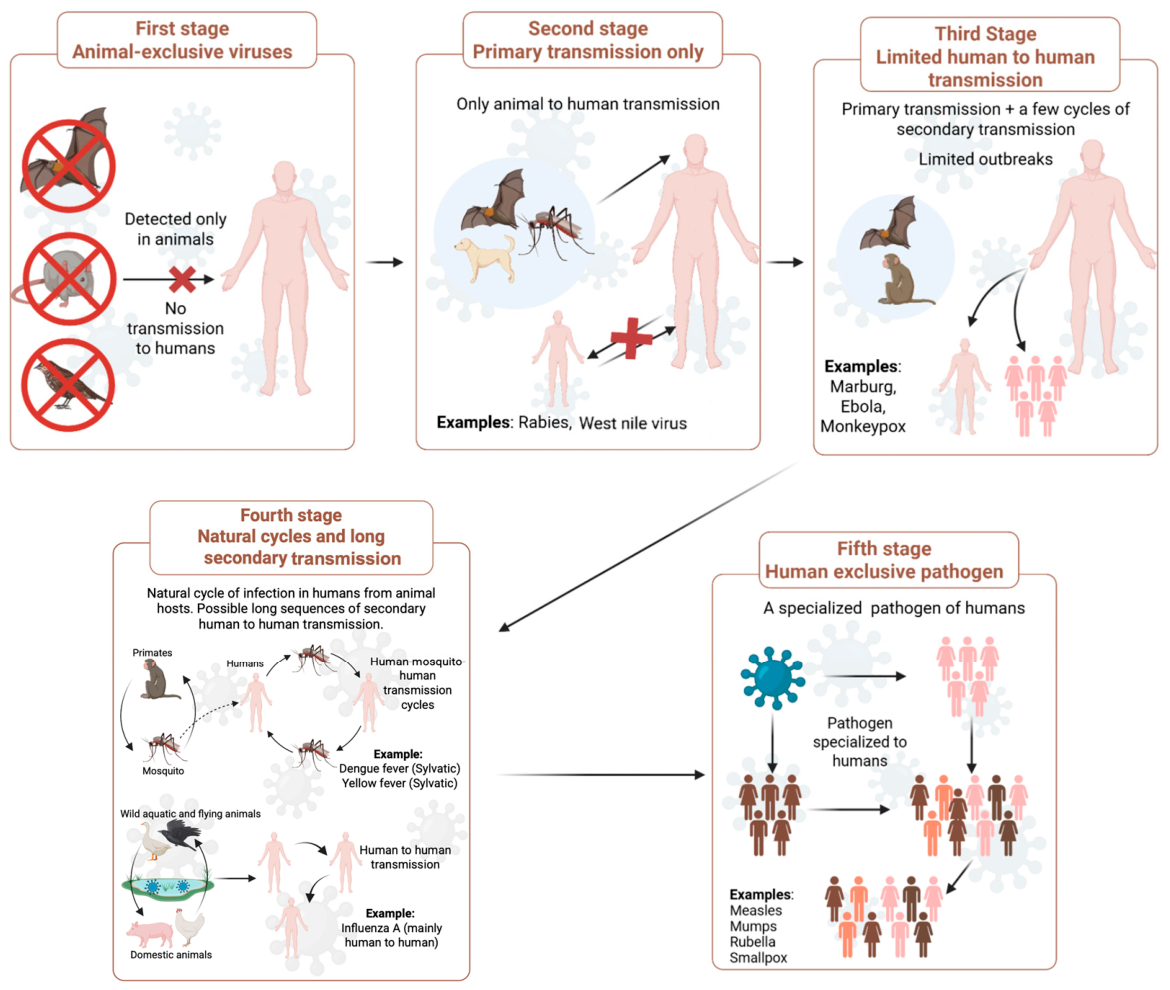
3. Stages of Viral Adaptation and Zoonotic Transmission
4. Mechanisms Driving the Transition from Spillover to Pandemic
4.1. Ecological Framework and Wildlife Reservoirs of Zoonoses
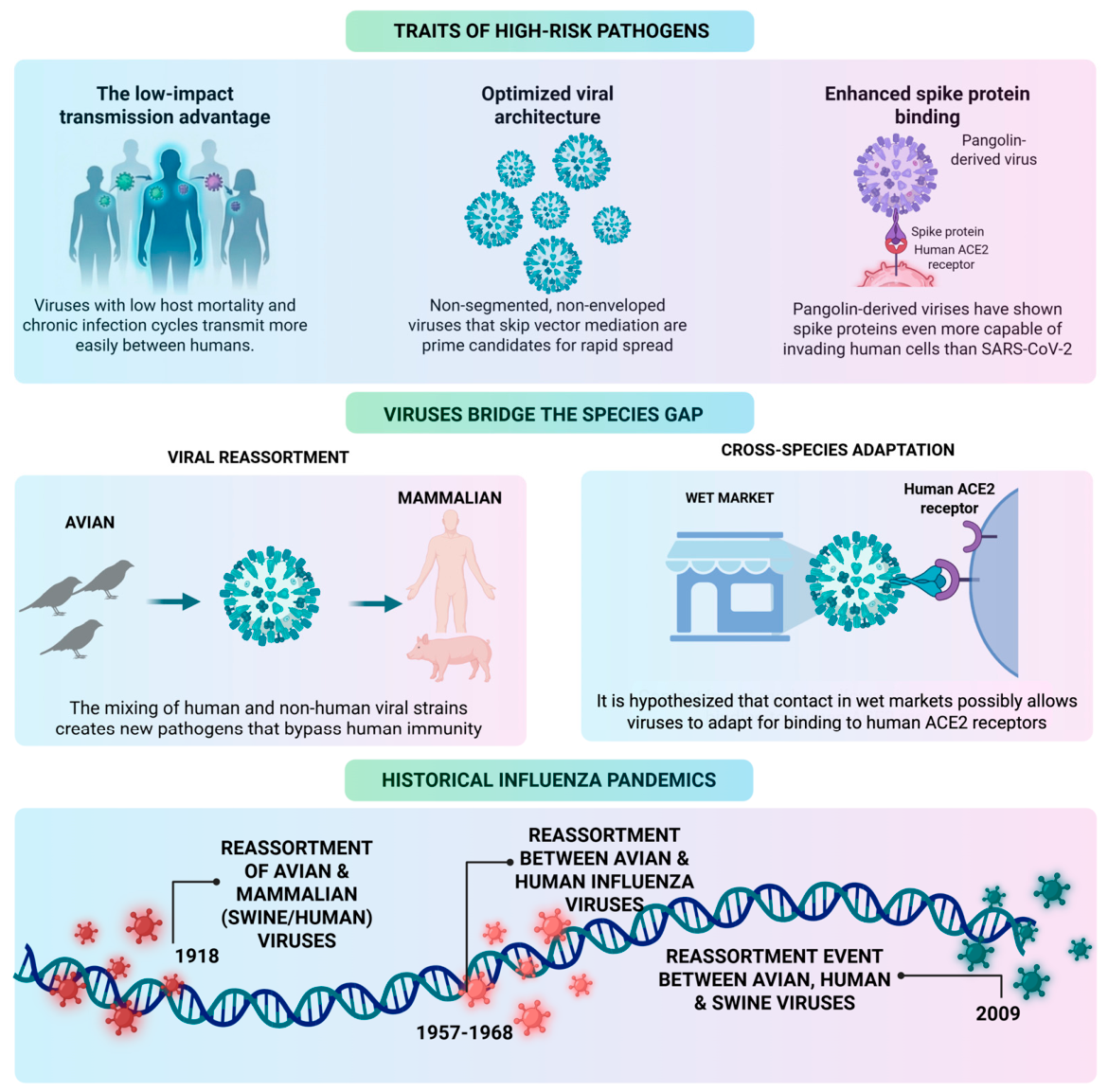
4.2. Pathogen-Specific Determinants of Adaptive Transmission
4.3. Host-Specific Susceptibility and Immunological Determinants
4.4. Anthropogenic Drivers and Commercial Wildlife Interfaces
4.5. Environmental Encroachment and Climate-Driven Vector Dynamics
5. Pandemic Prevention Frameworks and One Health Surveillance
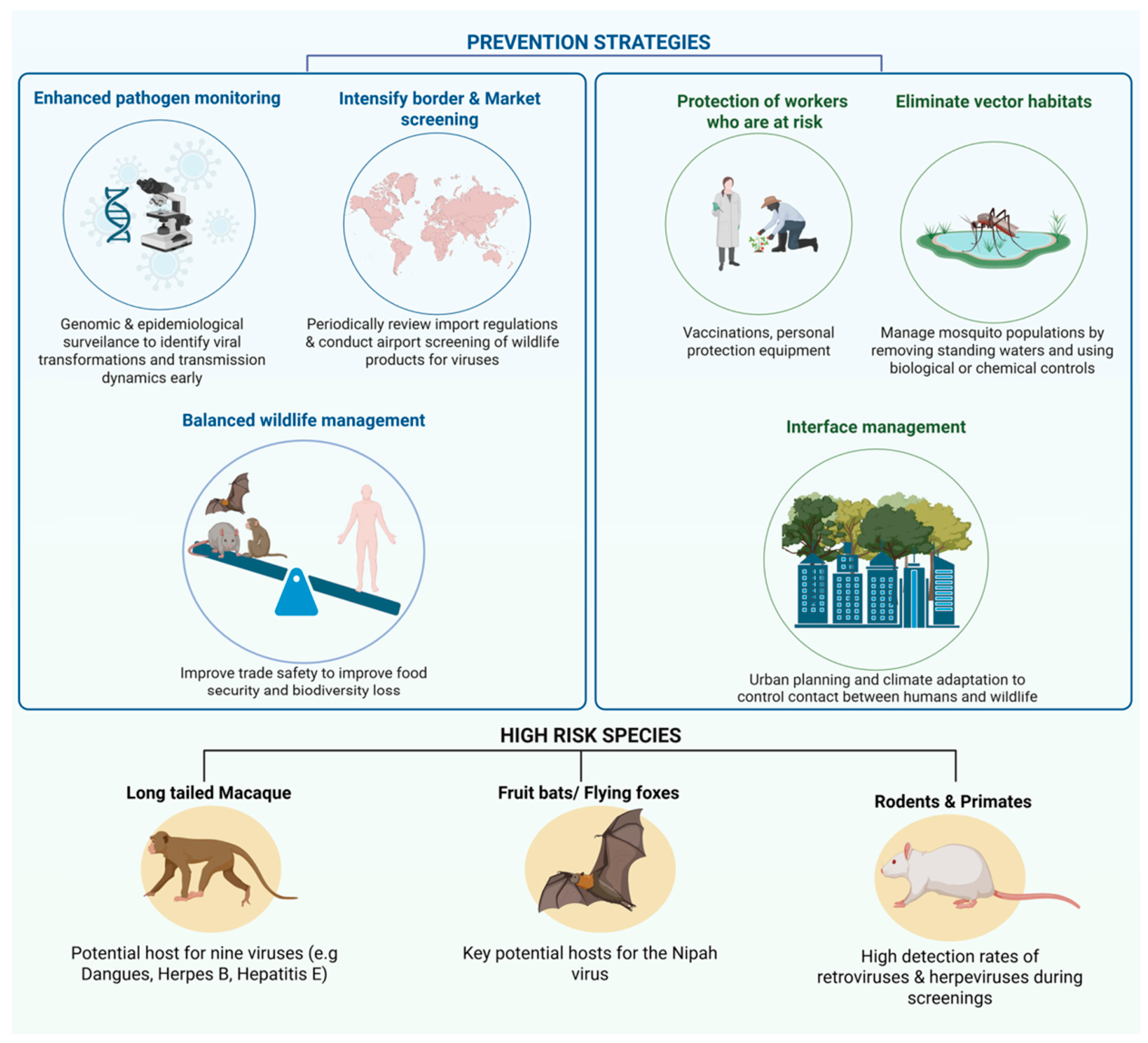
5.1. Mitigation Strategies for Wildlife-Associated Zoonoses
5.2. Control Methodologies for Vector-Borne Pathogens
6. Knowledge Gaps and Future Directions
Structured Operational Actions
- Identify Receptor Co-evolution: Fund deep-sequencing and structural biology projects focusing on how viral surface glycoproteins bind to animal vs. human cellular receptors [194].
- Profile Tissue Tropism: Map downstream intracellular restrictions (such as host polymerase inhibitors or innate immune system evasion pathways) that limit replication in human cells.
- Target Biodiversity Hotspots: Direct molecular screening teams explicitly to primary tropical forest borders, land-use change zones, and active agricultural frontiers [195].
- Build Non-invasive Bio-banks: Systematically archive fecal, saliva, and environmental DNA (eDNA) samples from bats, rodents, and wild non-human primates to uncover hidden viral diversity without harming native ecosystems [196].
- Monitor High-Risk Interfaces: Establish ongoing, multi-year medical monitoring of forest workers, miners, livestock handlers, and wildlife trade market vendors [197].
- Utilize Multiplex Serology: Run regular pan-viral serological panels on these cohorts to catch unrecognized, mild, or self-limiting spillover events before human-to-human transmission evolves [198].
- Merge Multi-Sector Data: Create computational platforms that combine ecological tracking data (deforestation rates, wildlife migration patterns, climate anomalies) with veterinary diagnostics and human hospital admission feeds [199].
- Co-locate Sampling Networks: Ensure that when a wildlife disease cluster or unexpected die-off is investigated, local livestock and adjacent human communities are simultaneously sampled.
- Enact Open-Access Frameworks: Build globally accessible, secure digital sequence repositories that guarantee immediate, unhindered sharing of genetic data during suspected outbreaks [199].
- Harmonize Metadata Standards: Enforce universal protocols for describing sample locations, host species, environmental metadata, and clinical definitions across different nations.
- Incentivize Sovereign Cloud/Lab Infrastructure: Provide direct financial and technical investments to build advanced genomics labs, training facilities, and localized data hubs directly inside resource-limited, high-risk regions.
- Reform Benefit-Sharing Mechanisms: Guarantee that the global South nations providing raw viral surveillance data receive early, equitable, and low-cost access to any resulting diagnostics, vaccines, or therapeutics [200].
- Formulate Measurable Indicators: Convert abstract ecological risk models into clear, actionable metrics (e.g., specific boundaries on wildlife trading or thresholds for deforestation) that lawmakers can legally enforce.
- Mandate Transdisciplinary Advisory Panels: Embed permanent One Health scientists directly into national security, environmental protection, and financial planning ministries rather than leaving them isolated inside public health agencies [201].
7. Conclusions
- Targeted Surveillance: Deploy continuous genetic sequencing at high-risk animal–human interfaces, such as live animal markets and deforestation frontiers, to detect early pathogen mutations.
- Integrated Data Sharing: Establish unified, real-time global databases that link veterinary, environmental, and human health data to identify spillover flags before widespread transmission occurs.
- Infrastructure Investment: Strengthen local healthcare infrastructure in spillover hot spots to ensure rapid diagnostics, immediate isolation capabilities, and swift decentralized containment responses.
- One Health Frameworks: Institutionalize collaborative policies across environmental, agricultural, and public health sectors to regulate wildlife trade and preserve natural habitats, directly reducing human–animal exposure.
Author Contributions
Funding
Institutional Review Board Statement
Informed Consent Statement
Data Availability Statement
Conflicts of Interest
References
- Modrow, S.; Falke, D.; Truyen, U.; Schätzl, H. Viruses: Definition, Structure, Classification. In Molecular Virology; Springer: Berlin/Heidelberg, Germany, 2013; Volume 17. [Google Scholar] [CrossRef]
- Gonzalez, J.P.; Souris, M.; Valdivia-Granda, W. Global Spread of Hemorrhagic Fever Viruses: Predicting Pandemics. Hemorrhagic Fever Viruses 2018, 1604, 3. [Google Scholar] [CrossRef]
- Sampath, S.; Khedr, A.; Qamar, S.; Tekin, A.; Singh, R.; Green, R.; Kashyap, R. Pandemics Throughout the History. Cureus 2021, 13, e18136. [Google Scholar] [CrossRef]
- Toccalino, D.; Haag, H.; Estrella, M.J.; Cowle, S.; Fuselli, P.; Ellis, M.J.; Gargaro, J.; Colantonio, A. Addressing the Shadow Pandemic: COVID-19 Related Impacts, Barriers, Needs, and Priorities to Health Care and Support for Women Survivors of Intimate Partner Violence and Brain Injury. Arch. Phys. Med. Rehabil. 2022, 103, 1466. [Google Scholar] [CrossRef]
- Van Assche, J. The Social–Psychological Consequences of COVID-19: An Integrative Review and Research Agenda. Int. J. Environ. Res. Public Health 2026, 23, 179. [Google Scholar] [CrossRef]
- Penninx, B.W.J.H.; Benros, M.E.; Klein, R.S.; Vinkers, C.H. How COVID-19 shaped mental health: From infection to pandemic effects. Nat. Med. 2022, 28, 2027–2037. [Google Scholar] [CrossRef]
- Jiang, X.; Fan, Z.; Li, S.; Yin, H. A Review on Zoonotic Pathogens Associated with Non-Human Primates: Understanding the Potential Threats to Humans. Microorganisms 2023, 11, 246. [Google Scholar] [CrossRef] [PubMed]
- Wertheim, J.O.; Hostager, R.; Ryu, D.; Merkel, K.; Angedakin, S.; Arandjelovic, M.; Ayimisin, E.A.; Babweteera, F.; Bessone, M.; Brun-Jeffery, K.J.; et al. Discovery of Novel Herpes Simplexviruses in Wild Gorillas, Bonobos, and Chimpanzees Supports Zoonotic Origin of HSV-2. Mol. Biol. Evol. 2021, 38, 2818–2830. [Google Scholar] [CrossRef] [PubMed]
- Nielsen, S.H.; van Dorp, L.; Houldcroft, C.J.; Pedersen, A.G.; Allentoft, M.E.; Vinner, L.; Margaryan, A.; Pavlova, E.; Chasnyk, V.; Nikolskiy, P.; et al. 31,600-year-old human virus genomes support a Pleistocene origin for common childhood infections. bioRxiv 2021. [Google Scholar] [CrossRef]
- De-Dios, T.; Scheib, C.L.; Houldcroft, C.J. An Adagio for Viruses, Played Out on Ancient DNA. Genome Biol. Evol. 2023, 15, evad047. [Google Scholar] [CrossRef] [PubMed]
- Van Blerkom, L.M. Role of viruses in human evolution. Am. J. Phys. Anthropol. 2003, 122, 14–46. [Google Scholar] [CrossRef]
- Vigne, J.D. The origins of animal domestication and husbandry: A major change in the history of humanity and the biosphere. C. R. Biol. 2011, 334, 171–181. [Google Scholar] [CrossRef]
- Barreiro, L.B.; Quintana-Murci, L. Evolutionary and population (epi)genetics of immunity to infection. Hum. Genet. 2020, 139, 723–732. [Google Scholar] [CrossRef]
- Benton, M.L.; Abraham, A.; LaBella, A.L.; Abbot, P.; Rokas, A.; Capra, J.A. The influence of evolutionary history on human health and disease. Nat. Rev. Genet. 2021, 22, 269–283. [Google Scholar] [CrossRef] [PubMed]
- Ito, H.; Sugiyama, M.; Masubuchi, K.; Mori, Y.; Minamoto, N. Complete nucleotide sequence of a group A avian rotavirus genome and a comparison with its counterparts of mammalian rotaviruses. Virus Res. 2001, 75, 123–138. [Google Scholar] [CrossRef]
- Gignoux, C.R.; Henn, B.M.; Mountain, J.L. Rapid, global demographic expansions after the origins of agriculture. Proc. Natl. Acad. Sci. USA 2011, 108, 6044–6049. [Google Scholar] [CrossRef] [PubMed]
- Irving-Pease, E.K.; Refoyo-Martínez, A.; Barrie, W.; Ingason, A.; Pearson, A.; Fischer, A.; Sjögren, K.G.; Halgren, A.S.; Macleod, R.; Demeter, F.; et al. The selection landscape and genetic legacy of ancient Eurasians. Nature 2024, 625, 312–320. [Google Scholar] [CrossRef]
- Brinkworth, J.F.; Barreiro, L.B. The contribution of natural selection to present-day susceptibility to chronic inflammatory and autoimmune disease. Curr. Opin. Immunol. 2014, 31, 66–78. [Google Scholar] [CrossRef]
- Okada, H.; Kuhn, C.; Feillet, H.; Bach, J.F. The “hygiene hypothesis” for autoimmune and allergic diseases: An update. Clin. Exp. Immunol. 2010, 160, 1–9. [Google Scholar] [CrossRef]
- Narayan, K.G.; Sinha, D.K.; Singh, D.K. Handbook of Management of Zoonoses; Springer Nature: Berlin/Heidelberg, Germany, 2024; pp. 1–1134. [Google Scholar] [CrossRef]
- Wolfe, N.D.; Dunavan, C.P.; Diamond, J. Origins of major human infectious diseases. Nature 2007, 447, 279. [Google Scholar] [CrossRef] [PubMed]
- Reperant, L.A.; Cornaglia, G.; Osterhaus, A.D.M.E. The Importance of Understanding the Human–Animal Interface: From Early Hominins to Global Citizens. In One Health: The Human-Animal-Environment Interfaces in Emerging Infectious Diseases; Springer: Berlin/Heidelberg, Germany, 2013; Volume 365, p. 49. [Google Scholar] [CrossRef]
- Kaján, G.L.; Doszpoly, A.; Tarján, Z.L.; Vidovszky, M.Z.; Papp, T. Virus-Host Coevolution with a Focus on Animal and Human DNA Viruses. J. Mol. Evol. 2020, 88, 41–56. [Google Scholar] [CrossRef]
- Switzer, W.M.; Salemi, M.; Shanmugam, V.; Gao, F.; Cong, M.E.; Kuiken, C.; Bhullar, V.; Beer, B.E.; Vallet, D.; Gautier-Hion, A.; et al. Ancient co-speciation of simian foamy viruses and primates. Nature 2005, 434, 376–380. [Google Scholar] [CrossRef]
- Hutson, C.L.; Lee, K.N.; Abel, J.; Carroll, D.S.; Montgomery, J.M.; Olson, V.A.; Li, Y.U.; Davidson, W.; Hughes, C.; Dillon, M.; et al. Monkeypox Zoonotic Associations: Insights from Laboratory Evaluation of Animals Associated with the Multi-State Us Outbreak. Am. J. Trop. Med. Hyg. 2007, 76, 757–768. [Google Scholar] [CrossRef]
- Pauciullo, S.; Zulian, V.; La Frazia, S.; Paci, P.; Garbuglia, A.R. Spillover: Mechanisms, Genetic Barriers, and the Role of Reservoirs in Emerging Pathogens. Microorganisms 2024, 12, 2191. [Google Scholar] [CrossRef] [PubMed]
- Di Giulio, D.B.; Eckburg, P.B. Human monkeypox: An emerging zoonosis. Lancet Infect. Dis. 2004, 4, 15–25, Erratum in Lancet Infect. Dis. 2004, 4, 251. [Google Scholar] [CrossRef]
- Pybus, O.G.; Rambaut, A. Evolutionary analysis of the dynamics of viral infectious disease. Nat. Rev. Genet. 2009, 10, 540. [Google Scholar] [CrossRef] [PubMed]
- Ellwanger, J.H.; Zambra, F.M.B.; Guimarães, R.L.; Chies, J.A.B. MicroRNA-Related Polymorphisms in Infectious Diseases-Tiny Changes With a Huge Impact on Viral Infections and Potential Clinical Applications. Front. Immunol. 2018, 9, 01316. [Google Scholar] [CrossRef] [PubMed]
- Pekar, J.; Worobey, M.; Moshiri, N.; Scheffler, K.; Wertheim, J.O. Timing the SARS-CoV-2 index case in Hubei province. Science 2021, 372, 412–417. [Google Scholar] [CrossRef]
- Borremans, B.; Faust, C.; Manlove, K.R.; Sokolow, S.H.; Lloyd-Smith, J.O. Cross-species pathogen spillover across ecosystem boundaries: Mechanisms and theory. Philos. Trans. R. Soc. Lond. B. Biol. Sci. 2019, 374, 20180344. [Google Scholar] [CrossRef]
- Venter, M.; Manuguerra, J.C.; Watson, J.M.; Fischer, T.K.; Blacksell, S.D.; Summermatter, K.; Damon, I.K.; Drosten, C.; Alviola, P.; Assiri, A.; et al. COVID’s origins: What we do and don’t know. Nature 2026, 650, 829–833. [Google Scholar] [CrossRef]
- WHO Calls for Further Studies, Data on Origin of SARS-CoV-2 Virus, Reiterates That All Hypotheses Remain Open. Available online: https://www.who.int/news/item/30-03-2021-who-calls-for-further-studies-data-on-origin-of-sars-cov-2-virus-reiterates-that-all-hypotheses-remain-open (accessed on 8 June 2026).
- Independent Assessment of the Origins of SARS-CoV-2, Developed by the Scientific Advisory Group for the Origins of Novel Pathogens (SAGO). Available online: https://www.who.int/publications/m/item/independent-assessment-of-the-origins-of-sars-cov-2-from-the-scientific-advisory-group-for-the-origins-of-novel-pathogens (accessed on 8 June 2026).
- Becker, D.J.; Washburne, A.D.; Faust, C.L.; Pulliam, J.R.C.; Mordecai, E.A.; Lloyd-Smith, J.O.; Plowright, R.K. Dynamic and integrative approaches to understanding pathogen spillover. Philos. Trans. R. Soc. Lond. B. Biol. Sci. 2019, 374, 20190014. [Google Scholar] [CrossRef]
- Guito, J.C.; Kirejczyk, S.G.M.; Schuh, A.J.; Amman, B.R.; Sealy, T.K.; Graziano, J.; Spengler, J.R.; Harmon, J.R.; Wozniak, D.M.; Prescott, J.B.; et al. Coordinated inflammatory responses dictate Marburg virus control by reservoir bats. Nat. Commun. 2024, 15, 1826. [Google Scholar] [CrossRef]
- Sundaram, M.; Gottdenker, N.L.; Stephens, P.R. Where is the elusive primary ebolavirus reservoir and how do we find It? Bioscience 2025, biaf050. [Google Scholar] [CrossRef]
- Alvarez, X.; Midkiff, C.; Kuroda, M.J.; Mohan, M.; Lackner, A.A. Detecting the Simian Immunodeficiency Virus Reservoir as Viral DNA and RNA in Situ Simultaneously as a Model to Monitor Viral Latency. AIDS Res. Hum. Retroviruses 2014, 30, 205. [Google Scholar] [CrossRef]
- Ahmed, R.; Nasheri, N. Animal reservoirs for hepatitis E virus within the Paslahepevirus genus. Vet. Microbiol. 2023, 278, 109618. [Google Scholar] [CrossRef]
- Klivleyeva, N.; Glebova, T.; Saktaganov, N.; Webby, R. Cases of Interspecies Transmission of Influenza A Virus from Swine to Humans. Vet. Sci. 2025, 12, 873. [Google Scholar] [CrossRef]
- Li, Y.; Wang, F.; Kan, R.; Cao, H.; Tang, C.; Yue, H.; Zhang, B. Genetic and immunological characterization of G9 group A porcine rotaviruses in China. Zoonoses Public Health 2022, 69, 694–703. [Google Scholar] [CrossRef] [PubMed]
- Halpin, K.; Rota, P. A Review of Hendra Virus and Nipah Virus Infections in Man and Other Animals. In Zoonoses: Infections Affecting Humans and Animals; Springer: Dordrecht, The Netherlands, 2014; Volume 997. [Google Scholar] [CrossRef]
- Ambat, A.S.; Zubair, S.M.; Prasad, N.; Pundir, P.; Rajwar, E.; Patil, D.S.; Mangad, P. Nipah virus: A review on epidemiological characteristics and outbreaks to inform public health decision making. J. Infect. Public Health 2019, 12, 634–639. [Google Scholar] [CrossRef] [PubMed]
- de Oliveira, R.C.; Guterres, A.; Fernandes, J.; D’Andrea, P.S.; Bonvicino, C.R.; de Lemos, E.R.S. Hantavirus Reservoirs: Current Status with an Emphasis on Data from Brazil. Viruses 2014, 6, 1929. [Google Scholar] [CrossRef]
- Eskew, E.A.; Bird, B.H.; Ghersi, B.M.; Bangura, J.; Basinski, A.J.; Amara, E.; Bah, M.A.; Kanu, M.C.; Kanu, O.T.; Lavalie, E.G.; et al. Reservoir displacement by an invasive rodent reduces Lassa virus zoonotic spillover risk. Nat. Commun. 2024, 15, 3589. [Google Scholar] [CrossRef]
- Curaudeau, M.; Besombes, C.; Nakouné, E.; Fontanet, A.; Gessain, A.; Hassanin, A. Identifying the Most Probable Mammal Reservoir Hosts for Monkeypox Virus Based on Ecological Niche Comparisons. Viruses 2023, 15, 727. [Google Scholar] [CrossRef] [PubMed]
- Stephens, P.R.; Gottdenker, N.; Schatz, A.M.; Schmidt, J.P.; Drake, J.M. Characteristics of the 100 largest modern zoonotic disease outbreaks. Philos. Trans. R. Soc. B 2021, 376, 20200535. [Google Scholar] [CrossRef]
- Brüssow, H.; Figuerola, J. The Spread of the Mosquito-Transmitted West Nile Virus in North America and Europe. Microb. Biotechnol. 2025, 18, e70120. [Google Scholar] [CrossRef]
- Tham, H.W.; Balasubramaniam, V.; Ooi, M.K.; Chew, M.F. Viral determinants and vector competence of Zika Virus transmission. Front. Microbiol. 2018, 9, 334397. [Google Scholar] [CrossRef] [PubMed]
- Gianchecchi, E.; Cianchi, V.; Torelli, A.; Montomoli, E. Yellow Fever: Origin, Epidemiology, Preventive Strategies and Future Prospects. Vaccines 2022, 10, 372. [Google Scholar] [CrossRef] [PubMed]
- Islam, M.T.; Quispe, C.; Herrera-Bravo, J.; Sarkar, C.; Sharma, R.; Garg, N.; Fredes, L.I.; Martorell, M.; Alshehri, M.M.; Sharifi-Rad, J.; et al. Production, Transmission, Pathogenesis, and Control of Dengue Virus: A Literature-Based Undivided Perspective. BioMed Res. Int. 2021, 2021, 4224816. [Google Scholar] [CrossRef]
- Petersen, L.R.; Powers, A.M. Chikungunya: Epidemiology. F1000Research 2016, 5, F1000 Faculty Rev-82. [Google Scholar] [CrossRef]
- Coalson, J.E.; Anderson, E.J.; Santos, E.M.; Garcia, V.M.; Romine, J.K.; Dominguez, B.; Richard, D.M.; Little, A.C.; Hayden, M.H.; Ernst, K.C. The Complex Epidemiological Relationship between Flooding Events and Human Outbreaks of Mosquito-Borne Diseases: A Scoping Review. Environ. Health Perspect. 2021, 129, 96002, Erratum in Environ. Health Perspect. 2021, 129, 129001. [Google Scholar] [CrossRef]
- Mulvey, P.; Duong, V.; Boyer, S.; Burgess, G.; Williams, D.T.; Dussart, P.; Horwood, P.F. The Ecology and Evolution of Japanese Encephalitis Virus. Pathogens 2021, 10, 1534. [Google Scholar] [CrossRef] [PubMed]
- Asokan, S.; Isiaka, I.D.; Jacob, T.; Vijayan, S.; Rajeswary, D. Middle East Respiratory Syndrome Coronavirus (MERS-CoV): An underestimated betacoronavirus with pandemic potential. Diagn. Microbiol. Infect. Dis. 2026, 115, 117367. [Google Scholar] [CrossRef]
- Huang, Y.; Xie, J.; Guo, Y.; Sun, W.; He, Y.; Liu, K.; Yan, J.; Tao, A.; Zhong, N. Sars-cov-2: Origin, intermediate host and allergenicity features and hypotheses. Healthcare 2021, 9, 1132. [Google Scholar] [CrossRef]
- Yang, Y.; Zheng, M.; Liu, Y.; Wang, Y.; Xu, Y.; Zhou, Y.; Sun, D.; Chen, L.; Li, H. Analysis of Intermediate Hosts and Susceptible Animals of SARS-CoV-2 by Computational Methods. Zoonoses 2021, 1, 994. [Google Scholar] [CrossRef]
- Husain, M. Influenza A Virus H5N1 Subtype: Resurgent Interspecies and Intercontinental Transmission, and a New Host. Pathogens 2025, 15, 6. [Google Scholar] [CrossRef]
- Jones, K.E.; Patel, N.G.; Levy, M.A.; Storeygard, A.; Balk, D.; Gittleman, J.L.; Daszak, P. Global trends in emerging infectious diseases. Nature 2008, 451, 990–993. [Google Scholar] [CrossRef]
- Cleaveland, S.; Haydon, D.T.; Taylor, L. Overviews of pathogen emergence: Which pathogens emerge, when and why? Curr. Top. Microbiol. Immunol. 2007, 315, 85–111. [Google Scholar] [CrossRef] [PubMed]
- Jagadesh, S.; Zhao, C.; Mulchandani, R.; Van Boeckel, T.P. Mapping Global Bushmeat Activities to Improve Zoonotic Spillover Surveillance by Using Geospatial Modeling. Emerg. Infect. Dis. 2023, 29, 742. [Google Scholar] [CrossRef]
- Bengis, R.G.; Leighton, F.A.; Fischer, J.R.; Artois, M.; Mörner, T.; Tate, C.M. The role of wildlife in emerging and re-emerging zoonoses. OIE Rev. Sci. Tech. 2004, 23, 497–511. [Google Scholar] [CrossRef]
- Olival, K.J.; Hosseini, P.R.; Zambrana-Torrelio, C.; Ross, N.; Bogich, T.L.; Daszak, P. Host and viral traits predict zoonotic spillover from mammals. Nature 2017, 546, 646–650, Erratum in Nature 2017, 548, 612. [Google Scholar] [CrossRef]
- Luis, A.D.; Hayman, D.T.S.; O’Shea, T.J.; Cryan, P.M.; Gilbert, A.T.; Pulliam, J.R.C.; Mills, J.N.; Timonin, M.E.; Willis, C.K.R.; Cunningham, A.A.; et al. A comparison of bats and rodents as reservoirs of zoonotic viruses: Are bats special? Proc. Biol. Sci. 2013, 280, 20122753. [Google Scholar] [CrossRef] [PubMed]
- O’Shea, T.J.; Cryan, P.M.; Cunningham, A.A.; Fooks, A.R.; Hayman, D.T.S.; Luis, A.D.; Peel, A.J.; Plowright, R.K.; Wood, J.L.N. Bat flight and zoonotic viruses. Emerg. Infect. Dis. 2014, 20, 741–745. [Google Scholar] [CrossRef] [PubMed]
- Brook, C.E.; Boots, M.; Chandran, K.; Dobson, A.P.; Drosten, C.; Graham, A.L.; Grenfell, B.T.; Müller, M.A.; Ng, M.; Wang, L.F.; et al. Accelerated viral dynamics in bat cell lines, with implications for zoonotic emergence. Elife 2020, 9, e48401. [Google Scholar] [CrossRef]
- Huang, Z.; Whelan, C.V.; Foley, N.M.; Jebb, D.; Touzalin, F.; Petit, E.J.; Puechmaille, S.J.; Teeling, E.C. Longitudinal comparative transcriptomics reveals unique mechanisms underlying extended healthspan in bats. Nat. Ecol. Evol. 2019, 3, 1110–1120. [Google Scholar] [CrossRef]
- Nieto-Rabiela, F.; Wiratsudakul, A.; Suzán, G.; Rico-Chávez, O. Viral networks and detection of potential zoonotic viruses in bats and rodents: A worldwide analysis. Zoonoses Public Health 2019, 66, 655–666. [Google Scholar] [CrossRef] [PubMed]
- Morens, D.M.; Taubenberger, J.K.; Harvey, H.A.; Memoli, M.J. The 1918 influenza pandemic: Lessons for 2009 and the future. Crit. Care Med. 2010, 38, e10–e20. [Google Scholar] [CrossRef]
- Morens, D.M.; North, M.; Taubenberger, J.K. Eyewitness accounts of the 1510 influenza pandemic in Europe. Lancet 2010, 376, 1894. [Google Scholar] [CrossRef]
- Morens, D.M.; Taubenberger, J.K.; Folkers, G.K.; Fauci, A.S. Pandemic Influenza’s 500th Anniversary. Clin. Infect. Dis. Off. Publ. Infect. Dis. Soc. Am. 2010, 51, 1442. [Google Scholar] [CrossRef]
- Prichard, A.; Fothergill, J. INFLUENZA IN 1775. Lancet 1894, 143, 175–176. [Google Scholar] [CrossRef]
- David Patterson, K. Pandemic and epidemic influenza, 1830–1848. Soc. Sci. Med. 1985, 21, 571–580. [Google Scholar] [CrossRef] [PubMed]
- Gairdner, W.T. THE INFLUENZA OF 1847 AND 1857. Lancet 1890, 135, 49. [Google Scholar] [CrossRef]
- Valleron, A.J.; Meurisse, S.; Boelle, P.Y. Historical Analysis of the 1889–1890 Pandemic in Europe. Int. J. Infect. Dis. 2008, 12, e95. [Google Scholar] [CrossRef]
- Taubenberger, J.K.; Morens, D.M. The 1918 Influenza Pandemic and Its Legacy. Cold Spring Harb. Perspect. Med. 2020, 10, a038695. [Google Scholar] [CrossRef]
- Al Hajjar, S.; McIntosh, K. The first influenza pandemic of the 21st century. Ann. Saudi Med. 2010, 30, 1. [Google Scholar] [CrossRef]
- Burke, D.S.; Schleunes, A. A Self-Fulfilling Prophecy Pandemic: The 1977 “Russian Flu”. Perspect. Biol. Med. 2024, 67, 386–405. [Google Scholar] [CrossRef]
- Strathdee, S.A.; Martin, N.K.; Pitpitan, E.V.; Stockman, J.K.; Smith, D.M. What the HIV Pandemic Experience Can Teach the United States About the COVID-19 Response. J. Acquir. Immune Defic. Syndr. 2020, 86, 1. [Google Scholar] [CrossRef]
- COVID-19 Deaths|WHO COVID-19 Dashboard. Available online: https://data.who.int/dashboards/covid19/deaths?n=c (accessed on 19 March 2026).
- 2009 H1N1 Pandemic (H1N1pdm09 Virus)|Pandemic INFLUENZA (Flu)|CDC. Available online: https://archive.cdc.gov/www_cdc_gov/flu/pandemic-resources/2009-h1n1-pandemic.html (accessed on 31 May 2026).
- Morens, D.M.; Taubenberger, J.K.; Fauci, A.S. The persistent legacy of the 1918 influenza virus. N. Engl. J. Med. 2009, 361, 225–229, Erratum in N. Engl. J. Med. 2009, 361, 1123. [Google Scholar] [CrossRef]
- Nakajima, K.; Desselberger, U.; Palese, P. Recent human influenza A (H1N1) viruses are closely related genetically to strains isolated in 1950. Nature 1978, 274, 334–339. [Google Scholar] [CrossRef]
- Geoghegan, J.L.; Senior, A.M.; Di Giallonardo, F.; Holmes, E.C. Virological factors that increase the transmissibility of emerging human viruses. Proc. Natl. Acad. Sci. USA 2016, 113, 4170–4175. [Google Scholar] [CrossRef] [PubMed]
- Scholtissek, C.; Rohde, W.; Von Hoyningen, V.; Rott, R. On the origin of the human influenza virus subtypes H2N2 and H3N2. Virology 1978, 87, 13–20. [Google Scholar] [CrossRef]
- Kawaoka, Y.; Krauss, S.; Webster, R.G. Avian-to-human transmission of the PB1 gene of influenza A viruses in the 1957 and 1968 pandemics. J. Virol. 1989, 63, 4603–4608. [Google Scholar] [CrossRef] [PubMed]
- Schäffr, J.R.; Kawaoka, Y.; Bean, W.J.; Süss, J.; Senne, D.; Webster, R.G. Origin of the pandemic 1957 H2 influenza a virus and the persistence of its possible progenitors in the avian reservoir. Virology 1993, 194, 781–788. [Google Scholar] [CrossRef] [PubMed]
- Garten, R.J.; Davis, C.T.; Russell, C.A.; Shu, B.; Lindstrom, S.; Balish, A.; Sessions, W.M.; Xu, X.; Skepner, E.; Deyde, V.; et al. Antigenic and genetic characteristics of swine-origin 2009 A(H1N1) influenza viruses circulating in humans. Science 2009, 325, 197–201. [Google Scholar] [CrossRef]
- Smith, G.J.D.; Vijaykrishna, D.; Bahl, J.; Lycett, S.J.; Worobey, M.; Pybus, O.G.; Ma, S.K.; Cheung, C.L.; Raghwani, J.; Bhatt, S.; et al. Origins and evolutionary genomics of the 2009 swine-origin H1N1 influenza A epidemic. Nature 2009, 459, 1122–1125. [Google Scholar] [CrossRef]
- Smith, G.J.D.; Bahl, J.; Vijaykrishna, D.; Zhang, J.; Poon, L.L.M.; Chen, H.; Webster, R.G.; Peiris, J.S.M.; Guan, Y. Dating the emergence of pandemic influenza viruses. Proc. Natl. Acad. Sci. USA 2009, 106, 11709–11712. [Google Scholar] [CrossRef]
- Conceicao, C.; Thakur, N.; Human, S.; Kelly, J.T.; Logan, L.; Bialy, D.; Bhat, S.; Stevenson-Leggett, P.; Zagrajek, A.K.; Hollinghurst, P.; et al. The SARS-CoV-2 Spike protein has a broad tropism for mammalian ACE2 proteins. PLoS Biol. 2020, 18, e3001016. [Google Scholar] [CrossRef]
- Naguib, M.M.; Li, R.; Ling, J.; Grace, D.; Nguyen-Viet, H.; Lindahl, J.F. Live and Wet Markets: Food Access versus the Risk of Disease Emergence. Trends Microbiol. 2021, 29, 573. [Google Scholar] [CrossRef] [PubMed]
- Marrana, M. Epidemiology of disease through the interactions between humans, domestic animals, and wildlife. In One Health Integrated Approach to 21st Century Challenges to Health; Academic Press: Cambridge, MA, USA, 2022; pp. 73–111. [Google Scholar] [CrossRef]
- Beyerstedt, S.; Casaro, E.B.; Rangel, É.B. COVID-19: Angiotensin-converting enzyme 2 (ACE2) expression and tissue susceptibility to SARS-CoV-2 infection. Eur. J. Clin. Microbiol. Infect. Dis. 2021, 40, 905. [Google Scholar] [CrossRef]
- Lytras, S.; Xia, W.; Hughes, J.; Jiang, X.; Robertson, D.L. The animal origin of SARS-CoV-2. Science 2021, 373, 968–970. [Google Scholar] [CrossRef]
- Elste, J.; Saini, A.; Mejia-Alvarez, R.; Mejía, A.; Millán-Pacheco, C.; Swanson-Mungerson, M.; Tiwari, V. Significance of Artificial Intelligence in the Study of Virus-Host Cell Interactions. Biomolecules 2024, 14, 911. [Google Scholar] [CrossRef]
- Johnson, N.P.A.S.; Mueller, J. Updating the accounts: Global mortality of the 1918-1920 “Spanish” influenza pandemic. Bull. Hist. Med. 2002, 76, 105–115. [Google Scholar] [CrossRef] [PubMed]
- Taubenberger, J.K.; Morens, D.M. 1918 Influenza: The mother of all pandemics. Emerg. Infect. Dis. 2006, 12, 15–22. [Google Scholar] [CrossRef]
- Olson, D.R.; Simonsen, L.; Edelson, P.J.; Morse, S.S. Epidemiological evidence of an early wave of the 1918 influenza pandemic in New York City. Proc. Natl. Acad. Sci. USA 2005, 102, 11059–11063. [Google Scholar] [CrossRef] [PubMed]
- Ahmed, R.; Oldstone, M.B.A.; Palese, P. Protective immunity and susceptibility to infectious diseases: Lessons from the 1918 influenza pandemic. Nat. Immunol. 2007, 8, 1188. [Google Scholar] [CrossRef] [PubMed]
- Shanks, G.D.; Brundage, J.F. Pathogenic responses among young adults during the 1918 influenza pandemic. Emerg. Infect. Dis. 2012, 18, 201–207. [Google Scholar] [CrossRef]
- Short, K.R.; Kedzierska, K.; van de Sandt, C.E. Back to the Future: Lessons Learned From the 1918 Influenza Pandemic. Front. Cell. Infect. Microbiol. 2018, 8, 00343. [Google Scholar] [CrossRef]
- Mina, M.J.; Metcalf, C.J.E.; De Swart, R.L.; Osterhaus, A.D.M.E.; Grenfell, B.T. Long-term measles-induced immunomodulation increases overall childhood infectious disease mortality. Science 2015, 348, 694–699. [Google Scholar] [CrossRef]
- Griffin, D.E. Measles virus-induced suppression of immune responses. Immunol. Rev. 2010, 236, 176–189. [Google Scholar] [CrossRef] [PubMed]
- Otte, J.; Pica-Ciamarra, U. Emerging infectious zoonotic diseases: The neglected role of food animals. One Health 2021, 13, 100323. [Google Scholar] [CrossRef]
- Sun, X.; Tian, W.; Zhang, Y.; Yang, L.; Jin, Y.; Li, S.; Wang, X. Pathogens infected or carried by exotic pets pose emerging threat to human health. Anim. Zoonoses 2025, 1, 170–177. [Google Scholar] [CrossRef]
- Cossengue, P.R.; Brea, J.F.; Tavares, F.O. The Transformative Power of Ecotourism: A Comprehensive Review of Its Economic, Social, and Environmental Impacts. Land 2025, 14, 1531. [Google Scholar] [CrossRef]
- Muehlenbein, M.P. Ecotourism. In Travel Medicine; Elsevier: Amsterdam, The Netherlands, 2019; pp. 363–369. [Google Scholar] [CrossRef]
- Milbank, C.; Vira, B. Wildmeat consumption and zoonotic spillover: Contextualising disease emergence and policy responses. Lancet Planet. Health 2022, 6, e439–e448. [Google Scholar] [CrossRef]
- Jindal, M.; Stone, H.; Lim, S.; MacIntyre, C.R. A Geospatial Perspective Toward the Role of Wild Bird Migrations and Global Poultry Trade in the Spread of Highly Pathogenic Avian Influenza H5N1. GeoHealth 2025, 9, e2024GH001296. [Google Scholar] [CrossRef] [PubMed]
- Hahn, B.H.; Shaw, G.M.; De Cock, K.M.; Sharp, P.M. AIDS as a zoonosis: Scientific and public health implications. Science 2000, 287, 607–614. [Google Scholar] [CrossRef]
- Hussein, H.A. Brief review on ebola virus disease and one health approach. Heliyon 2023, 9, e19036. [Google Scholar] [CrossRef]
- Shipley, R.; Wright, E.; Selden, D.; Wu, G.; Aegerter, J.; Fooks, A.R.; Banyard, A.C. Bats and Viruses: Emergence of Novel Lyssaviruses and Association of Bats with Viral Zoonoses in the EU. Trop. Med. Infect. Dis. 2019, 4, 31. [Google Scholar] [CrossRef]
- Russotto, Y.; Micali, C.; Pellicanò, G.F.; Nunnari, G.; Venanzi Rullo, E. HIV and Mediterranean Zoonoses: A Review of the Literature. Infect. Dis. Rep. 2022, 14, 694–709. [Google Scholar] [CrossRef]
- Nielsen, M.R.; Pouliot, M.; Meilby, H.; Smith-Hall, C.; Angelsen, A. Global patterns and determinants of the economic importance of bushmeat. Biol. Conserv. 2017, 215, 277–287. [Google Scholar] [CrossRef]
- van Velden, J.; Wilson, K.; Biggs, D. The evidence for the bushmeat crisis in African savannas: A systematic quantitative literature review. Biol. Conserv. 2018, 221, 345–356. [Google Scholar] [CrossRef]
- Wilkie, D.S.; Wieland, M.; Boulet, H.; Le Bel, S.; van Vliet, N.; Cornelis, D.; BriacWarnon, V.; Nasi, R.; Fa, J.E. Eating and conserving bushmeat in Africa. Afr. J. Ecol. 2016, 54, 402–414. [Google Scholar] [CrossRef]
- Nasi, R.; Taber, A.; Vliet, N. Van Empty forests, empty stomachs? Bushmeat and livelihoods in the Congo and Amazon Basins. Int. For. Rev. 2011, 13, 355–368. [Google Scholar] [CrossRef]
- Zisadza, J.; Mrewa, A.T.; Khosa, A.; Mutematemi, S.A.; Muvengwi, J. Illegal Hunting and Bushmeat Trade around Save Valley Conservancy. Environ. Manag. 2025, 75, 2722–2735. [Google Scholar] [CrossRef]
- Booth, H.; Clark, M.; Milner-Gulland, E.J.; Amponsah-Mensah, K.; Antunes, A.P.; Brittain, S.; Castilho, L.C.; Campos-Silva, J.V.; de Araujo Lima Constantino, P.; Li, Y.; et al. Investigating the risks of removing wild meat from global food systems. Curr. Biol. 2021, 31, 1788–1797.e3. [Google Scholar] [CrossRef]
- Mozer, A.; Prost, S. An introduction to illegal wildlife trade and its effects on biodiversity and society. Forensic Sci. Int. Anim. Environ. 2023, 3, 100064. [Google Scholar] [CrossRef]
- Matseketsa, G.; Krüger, K.; Gandiwa, E. Rule-breaking in terrestrial protected areas of sub-Saharan Africa: A review of drivers, deterrent measures and implications for conservation. Glob. Ecol. Conserv. 2022, 37, e02172. [Google Scholar] [CrossRef]
- Dell, B.A.M.; Souza, M.J.; Willcox, A.S. Attitudes, practices, and zoonoses awareness of community members involved in the bushmeat trade near Murchison Falls National Park, northern Uganda. PLoS ONE 2020, 15, e0239599, Erratum in PLoS ONE 2025, 20, e0325743. [Google Scholar] [CrossRef]
- Shivaprakash, K.N.; Sen, S.; Paul, S.; Kiesecker, J.M.; Bawa, K.S. Mammals, wildlife trade, and the next global pandemic. Curr. Biol. 2021, 31, 3671–3677.e3. [Google Scholar] [CrossRef]
- MacPherson, D.W.; Gushulak, B.D.; Baine, W.B.; Bala, S.; Gubbins, P.O.; Holtom, P.; Segarra-Newnham, M. Population mobility, globalization, and antimicrobial drug resistance. Emerg. Infect. Dis. 2009, 15, 1727–1732. [Google Scholar] [CrossRef]
- Falendysz, E.A.; Lopera, J.G.; Rocke, T.E.; Osorio, J.E. Monkeypox Virus in Animals: Current Knowledge of Viral Transmission and Pathogenesis in Wild Animal Reservoirs and Captive Animal Models. Viruses 2023, 15, 905. [Google Scholar] [CrossRef]
- Morens, D.M.; Fauci, A.S. Monkeypox virus (MPXV): A Brief account of global spread, epidemiology, virology, clinical features, pathogenesis, and therapeutic interventions. Infect. Med. 2023, 2, 262–272. [Google Scholar] [CrossRef]
- Likos, A.M.; Sammons, S.A.; Olson, V.A.; Frace, A.M.; Li, Y.; Olsen-Rasmussen, M.; Davidson, W.; Galloway, R.; Khristova, M.L.; Reynolds, M.G.; et al. A tale of two clades: Monkeypox viruses. J. Gen. Virol. 2005, 86, 2661–2672. [Google Scholar] [CrossRef]
- Rothan, H.A.; Byrareddy, S.N. The epidemiology and pathogenesis of coronavirus disease (COVID-19) outbreak. J. Autoimmun. 2020, 109, 102433. [Google Scholar] [CrossRef]
- Xiao, X.; Newman, C.; Buesching, C.D.; Macdonald, D.W.; Zhou, Z.M. Animal sales from Wuhan wet markets immediately prior to the COVID-19 pandemic. Sci. Rep. 2021, 11, 11898. [Google Scholar] [CrossRef]
- De Wit, E.; Van Doremalen, N.; Falzarano, D.; Munster, V.J. SARS and MERS: Recent insights into emerging coronaviruses. Nat. Rev. Microbiol. 2016, 14, 523–534. [Google Scholar] [CrossRef] [PubMed]
- White, R.J.; Razgour, O. Emerging zoonotic diseases originating in mammals: A systematic review of effects of anthropogenic land-use change. Mamm. Rev. 2020, 50, 336–352. [Google Scholar] [CrossRef] [PubMed]
- Can, Ö.E.; D’Cruze, N.; Macdonald, D.W. Dealing in deadly pathogens: Taking stock of the legal trade in live wildlife and potential risks to human health. Glob. Ecol. Conserv. 2019, 17, e00515. [Google Scholar] [CrossRef]
- Daszak, P. Anatomy of a pandemic. Lancet 2012, 380, 1883–1884. [Google Scholar] [CrossRef]
- Clifford Astbury, C.; Lee, K.M.; Mcleod, R.; Aguiar, R.; Atique, A.; Balolong, M.; Clarke, J.; Demeshko, A.; Labonté, R.; Ruckert, A.; et al. Policies to prevent zoonotic spillover: A systematic scoping review of evaluative evidence. Glob. Health 2023, 19, 82. [Google Scholar] [CrossRef]
- Kilpatrick, A.M.; Randolph, S.E. Drivers, dynamics, and control of emerging vector-borne zoonotic diseases. Lancet 2012, 380, 1946–1955. [Google Scholar] [CrossRef]
- Jones, B.A.; Grace, D.; Kock, R.; Alonso, S.; Rushton, J.; Said, M.Y.; McKeever, D.; Mutua, F.; Young, J.; McDermott, J.; et al. Zoonosis emergence linked to agricultural intensification and environmental change. Proc. Natl. Acad. Sci. USA 2013, 110, 8399–8404. [Google Scholar] [CrossRef]
- Kreuder Johnson, C.; Hitchens, P.L.; Smiley Evans, T.; Goldstein, T.; Thomas, K.; Clements, A.; Joly, D.O.; Wolfe, N.D.; Daszak, P.; Karesh, W.B.; et al. Spillover and pandemic properties of zoonotic viruses with high host plasticity. Sci. Rep. 2015, 5, 14830. [Google Scholar] [CrossRef]
- Sangkachai, N.; Gummow, B.; Hayakijkosol, O.; Suwanpakdee, S.; Wiratsudakul, A. A review of risk factors at the human-animal-environmental interface of garbage dumps that are driving current and emerging zoonotic diseases. One Health 2024, 19, 100915. [Google Scholar] [CrossRef]
- Vairo, F.; Di Pietrantonj, C.; Pasqualini, C.; Mammone, A.; Lanini, S.; Nicastri, E.; Castilletti, C.; Ferraro, F.; Di Bari, V.; Puro, V.; et al. The Surveillance of Chikungunya Virus in a Temperate Climate: Challenges and Possible Solutions from the Experience of Lazio Region, Italy. Viruses 2018, 10, 501. [Google Scholar] [CrossRef] [PubMed]
- Olofsson, J.; Tolf, C.; Lindqvist, R.; Gwon, Y.D.; Blom, S.; van Toor, M.L.; Näslund, J.; Lindström, A.; Lilja, T.; Chiyo, P.; et al. Evidence of exposure to West Nile virus and Usutu virus in migratory birds in Sweden. IJID One Health 2024, 5, 100039. [Google Scholar] [CrossRef]
- Tao, K.; He, C.; Zhang, T.; Xiao, C.; Du, L.; Li, Z.; Shao, D.; Wei, J.; Li, B.; Qiu, Y.; et al. Evidence of WNV infection in migratory birds passing through Xinjiang, China, using viral genome amplicon approach. Front. Microbiol. 2025, 16, 1468530. [Google Scholar] [CrossRef] [PubMed]
- Liang, J.; Peng, Y.; Zhu, Z.; Li, X.; Xing, W.; Li, X.; Yan, M.; Yuan, Y. Impacts of changing climate on the distribution of migratory birds in China: Habitat change and population centroid shift. Ecol. Indic. 2021, 127, 107729. [Google Scholar] [CrossRef]
- Klempa, B. Hantaviruses and climate change. Clin. Microbiol. Infect. 2009, 15, 518–523. [Google Scholar] [CrossRef]
- Torres-Pérez, F.; Ferrada, N.; Astudillo, R.; Ferrés, M.; Vial, P.A.; Marquet, P.A.; Parra, A.; Mertz, G.J.; Eduardo Palma, R. Hantavirus infections and small mammal diversity in Chile: No differences between protected and unprotected areas highlight the need for public health strategies. PLoS Negl. Trop. Dis. 2025, 19, e0013668. [Google Scholar] [CrossRef]
- Sarker, R.; Roknuzzaman, A.S.M.; Haque, M.A.; Islam, M.R.; Kabir, E.R. Upsurge of dengue outbreaks in several WHO regions: Public awareness, vector control activities, and international collaborations are key to prevent spread. Health Sci. Rep. 2024, 7, e2034. [Google Scholar] [CrossRef]
- Dalpadado, R.; Amarasinghe, D.; Gunathilaka, N.; Ariyarathna, N. Bionomic aspects of dengue vectors Aedes aegypti and Aedes albopictus at domestic settings in urban, suburban and rural areas in Gampaha District, Western Province of Sri Lanka. Parasit. Vectors 2022, 15, 148. [Google Scholar] [CrossRef] [PubMed]
- Dalpadado, R.; Amarasinghe, D.; Gunathilaka, N. Water quality characteristics of breeding habitats in relation to the density of Aedes aegypti and Aedes albopictus in domestic settings in Gampaha district of Sri Lanka. Acta Trop. 2022, 229, 106339. [Google Scholar] [CrossRef]
- Clifford Astbury, C.; Demeshko, A.; Aguilar, R.; Mapatano, M.A.; Li, A.; Togño, K.C.; Shi, Z.; Wang, Z.; Wu, C.; Yambayamba, M.K.; et al. Wildlife policy, the food system and One Health: A complex systems analysis of unintended consequences for the prevention of emerging zoonoses in China, the Democratic Republic of the Congo and the Philippines. BMJ Glob. Health 2025, 10, e016313. [Google Scholar] [CrossRef]
- Velayudhan, R. Brief Overview of the World Health Organization “Vector Control Global Response 2017–2030” and “Vector Control Advisory Group” Activities. In Area-wide Integrated Pest Management; CRC Press: Boca Raton, FL, USA, 2021; pp. 633–644. [Google Scholar] [CrossRef]
- Petrovan, S.O.; Aldridge, D.C.; Bartlett, H.; Bladon, A.J.; Booth, H.; Broad, S.; Broom, D.M.; Burgess, N.D.; Cleaveland, S.; Cunningham, A.A.; et al. Post COVID-19: A solution scan of options for preventing future zoonotic epidemics. Biol. Rev. Camb. Philos. Soc. 2021, 96, 2694–2715. [Google Scholar] [CrossRef] [PubMed]
- Efoua Tomo, N.; Pouliquen, A.; Boupana Mapeyi, G.A.; Makouloutou-Nzassi, P.; N’dilimabaka, N.; Ngoubangoye, B.; Cornelis, D.; Lebel, S.; Peyre, M.; Olive, M.M.; et al. Co-designing zoonotic diseases prevention practices when people depend on wild meat. One Health 2025, 20, 101074. [Google Scholar] [CrossRef]
- Li, X.; Giorg, E.E.; Marichannegowda, M.H.; Foley, B.; Xiao, C.; Kong, X.P.; Chen, Y.; Gnanakaran, S.; Korber, B.; Gao, F. Emergence of SARS-CoV-2 through recombination and strong purifying selection. Sci. Adv. 2020, 6, abb9153. [Google Scholar] [CrossRef]
- Roberts, M.; Dobson, A.; Restif, O.; Wells, K. Challenges in modelling the dynamics of infectious diseases at the wildlife–human interface. Epidemics 2021, 37, 100523. [Google Scholar] [CrossRef]
- Smith, K.M.; Anthony, S.J.; Switzer, W.M.; Epstein, J.H.; Seimon, T.; Jia, H.; Sanchez, M.D.; Huynh, T.T.; Galland, G.G.; Shapiro, S.E.; et al. Zoonotic viruses associated with illegally imported wildlife products. PLoS ONE 2012, 7, e29505. [Google Scholar] [CrossRef]
- Bair-Brake, H.; Bell, T.; Higgins, A.; Bailey, N.; Duda, M.; Shapiro, S.; Eves, H.E.; Marano, N.; Galland, G. Is that a rodent in your luggage? A mixed method approach to describe bushmeat importation into the United States. Zoonoses Public Health 2014, 61, 97–104. [Google Scholar] [CrossRef] [PubMed]
- Lankau, E.W.; Sinclair, J.R.; Schroeder, B.A.; Galland, G.G.; Marano, N. Public Health Implications of Changing Rodent Importation Patterns-United States, 1999–2013. Transbound. Emerg. Dis. 2017, 64, 528–537. [Google Scholar] [CrossRef]
- Aguiar, R.; Gray, R.; Gallo-Cajiao, E.; Ruckert, A.; Astbury, C.C.; Labonté, R.; Tsasis, P.; Viens, A.M.; Wiktorowicz, M. Preventing zoonotic spillover through regulatory frameworks governing wildlife trade: A scoping review. PLoS ONE 2025, 20, e0312012. [Google Scholar] [CrossRef]
- Allen, T.; Murray, K.A.; Zambrana-Torrelio, C.; Morse, S.S.; Rondinini, C.; Di Marco, M.; Breit, N.; Olival, K.J.; Daszak, P. Global hotspots and correlates of emerging zoonotic diseases. Nat. Commun. 2017, 8, 1124. [Google Scholar] [CrossRef] [PubMed]
- Jenkins, C.N.; Pimm, S.L.; Joppa, L.N. Global patterns of terrestrial vertebrate diversity and conservation. Proc. Natl. Acad. Sci. USA 2013, 110, E2603–E2610. [Google Scholar] [CrossRef]
- Bonwitt, J.; Dawson, M.; Kandeh, M.; Ansumana, R.; Sahr, F.; Brown, H.; Kelly, A.H. Unintended consequences of the ‘bushmeat ban’ in West Africa during the 2013–2016 Ebola virus disease epidemic. Soc. Sci. Med. 2018, 200, 166–173. [Google Scholar] [CrossRef] [PubMed]
- McNamara, J.; Robinson, E.J.Z.; Abernethy, K.; Midoko Iponga, D.; Sackey, H.N.K.; Wright, J.H.; Milner-Gulland, E. COVID-19, Systemic Crisis, and Possible Implications for the Wild Meat Trade in Sub-Saharan Africa. Environ. Resour. Econ. 2020, 76, 1045–1066. [Google Scholar] [CrossRef]
- Harvey-Carroll, J.; Simo, F.T.; Sonn-Juul, T.; Tsafack, J.P.; Aka’a, S.J.D.; Nchembi Tarla, F.; Fowler, A.; Ingram, D.J. Continued availability and sale of pangolins in a major urban bushmeat market in Cameroon despite national bans and the COVID-19 outbreak. Afr. J. Ecol. 2022, 60, 146–152. [Google Scholar] [CrossRef]
- Lambert, H.; Elwin, A.; Assou, D.; Auliya, M.; Harrington, L.A.; Hughes, A.C.; Mookerjee, A.; Moorhouse, T.; Petrossian, G.A.; Sun, E.; et al. Chains of Commerce: A Comprehensive Review of Animal Welfare Impacts in the International Wildlife Trade. Animals 2025, 15, 971. [Google Scholar] [CrossRef]
- Morcatty, T.Q.; Pereyra, P.E.R.; Ardiansyah, A.; Imron, M.A.; Hedger, K.; Campera, M.; Nekaris, K.A.I.; Nijman, V. Risk of Viral Infectious Diseases from Live Bats, Primates, Rodents and Carnivores for Sale in Indonesian Wildlife Markets. Viruses 2022, 14, 2756. [Google Scholar] [CrossRef] [PubMed]
- Debnath, F.; Chakraborty, D.; Deb, A.; Saha, M.; Dutta, S. Increased human-animal interface & emerging zoonotic diseases: An enigma requiring multi-sectoral efforts to address. Indian J. Med. Res. 2021, 153, 577. [Google Scholar] [CrossRef]
- van den Berg, H.; da Silva Bezerra, H.S.; Chanda, E.; Al-Eryani, S.; Nagpal, B.N.; Gasimov, E.; Velayudhan, R.; Yadav, R.S. Management of insecticides for use in disease vector control: A global survey. BMC Infect. Dis. 2021, 21, 468. [Google Scholar] [CrossRef] [PubMed]
- Ridha, M.R.; Marlinae, L.; Zubaidah, T.; Fadillah, N.A.; Widjaja, J.; Rosadi, D.; Rahayu, N.; Ningsih, M.; Desimal, I.; Sofyandi, A. Control methods for invasive mosquitoes of Aedes aegypti and Aedes albopictus (Diptera: Culicidae) in Indonesia. Vet. World 2023, 16, 1952–1963. [Google Scholar] [CrossRef]
- Baldacchino, F.; Caputo, B.; Chandre, F.; Drago, A.; della Torre, A.; Montarsi, F.; Rizzoli, A. Control methods against invasive Aedes mosquitoes in Europe: A review. Pest Manag. Sci. 2015, 71, 1471–1485. [Google Scholar] [CrossRef]
- Richard, M.; Knauf, S.; Lawrence, P.; Mather, A.E.; Munster, V.J.; Müller, M.A.; Smith, D.; Kuiken, T. Factors determining human-to-human transmissibility of zoonotic pathogens via contact. Curr. Opin. Virol. 2017, 22, 7–12. [Google Scholar] [CrossRef]
- Guth, S.; Visher, E.; Boots, M.; Brook, C.E. Host phylogenetic distance drives trends in virus virulence and transmissibility across the animal-human interface. Philos. Trans. R. Soc. Lond. B. Biol. Sci. 2019, 374, 20190296. [Google Scholar] [CrossRef] [PubMed]
- Maginnis, M.S. Virus–Receptor Interactions: The Key to Cellular Invasion. J. Mol. Biol. 2018, 430, 2590–2611. [Google Scholar] [CrossRef] [PubMed]
- Lauring, A.S.; Andino, R. Quasispecies theory and the behavior of RNA viruses. PLoS Pathog. 2010, 6, 1–8. [Google Scholar] [CrossRef] [PubMed]
- Domingo, E.; Perales, C. Viral quasispecies. PLoS Genet. 2019, 15, e1008271. [Google Scholar] [CrossRef]
- Gilbertson, B.; Duncan, M.; Subbarao, K. Role of the viral polymerase during adaptation of influenza A viruses to new hosts. Curr. Opin. Virol. 2023, 62, 101363. [Google Scholar] [CrossRef]
- Tan, C.C.S.; van Dorp, L.; Balloux, F. The evolutionary drivers and correlates of viral host jumps. Nat. Ecol. Evol. 2024, 8, 960–971. [Google Scholar] [CrossRef]
- Rabaa, M.A.; Tue, N.T.; Phuc, T.M.; Carrique-Mas, J.; Saylors, K.; Cotten, M.; Bryant, J.E.; Nghia, H.D.T.; Van Cuong, N.; Pham, H.A.; et al. The Vietnam Initiative on Zoonotic Infections (VIZIONS): A Strategic Approach to Studying Emerging Zoonotic Infectious Diseases. Ecohealth 2015, 12, 726. [Google Scholar] [CrossRef]
- Johnson, C.K.; Hitchens, P.L.; Pandit, P.S.; Rushmore, J.; Evans, T.S.; Young, C.C.W.; Doyle, M.M. Global shifts in mammalian population trends reveal key predictors of virus spillover risk. Proc. Biol. Sci. 2020, 287, 20192736. [Google Scholar] [CrossRef]
- Anthony, S.J.; Epstein, J.H.; Murray, K.A.; Navarrete-Macias, I.; Zambrana-Torrelio, C.M.; Solovyov, A.; Ojeda-Flores, R.; Arrigo, N.C.; Islam, A.; Khan, S.A.; et al. A strategy to estimate unknown viral diversity in mammals. mBio 2013, 4, e00598-13. [Google Scholar] [CrossRef]
- Zinsstag, J.; Kaiser-Grolimund, A.; Heitz-Tokpa, K.; Sreedharan, R.; Lubroth, J.; Caya, F.; Stone, M.; Brown, H.; Bonfoh, B.; Dobell, E.; et al. Advancing One human–animal–environment Health for global health security: What does the evidence say? Lancet 2023, 401, 591–604. [Google Scholar] [CrossRef]
- Sikkema, R.S.; Koopmans, M. Viral emergence and pandemic preparedness in a One Health framework. Nat. Rev. Microbiol. 2026, 24, 29–44. [Google Scholar] [CrossRef] [PubMed]
- Mwatondo, A.; Rahman-Shepherd, A.; Hollmann, L.; Chiossi, S.; Maina, J.; Kurup, K.K.; Hassan, O.A.; Coates, B.; Khan, M.; Spencer, J.; et al. A global analysis of One Health Networks and the proliferation of One Health collaborations. Lancet 2023, 401, 605–616. [Google Scholar] [CrossRef]
- Odone, A.; Barbati, C.; Amadasi, S.; Schultz, T.; Resnik, D.B. Artificial intelligence and infectious diseases: An evidence-driven conceptual framework for research, public health, and clinical practice. Lancet Infect. Dis. 2025, 26, e152–e167. [Google Scholar] [CrossRef]
- Gibson, G.C.; Fox, S.J.; Javan, E.; Ptak, S.E.; Ibrahim, O.M.; Lachmann, M.; Meyers, L.A. Improving outbreak forecasts through model augmentation. Proc. Natl. Acad. Sci. USA 2025, 122, e2508575122. [Google Scholar] [CrossRef]
- Trump, B.D.; Galaitsi, S.; Cegan, J.; Linkov, I. How Will AI Shape the Future of Pandemic Response? Early Clues from Data Analytics. Risk Anal. 2025, 45, 4544–4556. [Google Scholar] [CrossRef]
- Mollentze, N.; Babayan, S.A.; Streicker, D.G. Identifying and prioritizing potential human-infecting viruses from their genome sequences. PLoS Biol. 2021, 19, 3001390. [Google Scholar] [CrossRef]
- Brüssow, H. Monkeypox Virus: WHO’s Second Public Health Emergency of International Concern Within 2 Years. Microb. Biotechnol. 2025, 18, e70142. [Google Scholar] [CrossRef]
- Gostin, L.O.; Jha, A.K.; Finch, A. The Mpox Global Health Emergency—A Time for Solidarity and Equity. N. Engl. J. Med. 2024, 391, 1265–1267. [Google Scholar] [CrossRef]
- Abubakar, I.; Lutwama, J.; Kyobutungi, C.; Sankoh, O. Mpox global emergency: Strengthening African leadership. Lancet 2024, 404, 1286–1288. [Google Scholar] [CrossRef]
- Alakija, A. Leveraging lessons from the COVID-19 pandemic to strengthen low-income and middle-income country preparedness for future global health threats. Lancet Infect. Dis. 2023, 23, e310–e317. [Google Scholar] [CrossRef]
- Sharp, A.; Jain, V.; Alimi, Y.; Bausch, D.G. Policy and planning for large epidemics and pandemics—Challenges and lessons learned from COVID-19. Curr. Opin. Infect. Dis. 2021, 34, 393–400. [Google Scholar] [CrossRef]
- Crealock-Ashurst, B.; Levanita, S.; Frischer, S.R.; Adhikari, S.; Mwebia, W.; Kadri-Alabi, Z.; Davidson, L.; Jeena, L.; Evans, M.; Morley, G.; et al. PEARLES challenges and solutions to the implementation of clinical research responses to epidemics and pandemics: A scoping review. eClinicalMedicine 2025, 85, 103294. [Google Scholar] [CrossRef]
- McCloskey, B.; Dar, O.; Zumla, A.; Heymann, D.L. Emerging infectious diseases and pandemic potential: Status quo and reducing risk of global spread. Lancet Infect. Dis. 2014, 14, 1001–1010. [Google Scholar] [CrossRef]
- de Vries, M.; Kearney, T.; Monadjem, A.; Taylor, P.J.; Markotter, W. Beyond spillover: Leveraging zoonotic disease research to advance biodiversity conservation. One Health 2025, 21, 101280. [Google Scholar] [CrossRef]
- Riaz, A. Zoonotic Spillover and Pandemic Risk: A Review of Transmission Pathways and Mitigation Approaches. Prem. J. Infect. Dis. 2025, 3, 100003. [Google Scholar] [CrossRef]
- Bhatia, B.; Sonar, S.; Khan, S.; Bhattacharya, J. Pandemic-Proofing: Intercepting Zoonotic Spillover Events. Pathogens 2024, 13, 1067. [Google Scholar] [CrossRef]
- Sharan, M.; Vijay, D.; Yadav, J.P.; Bedi, J.S.; Dhaka, P. Surveillance and response strategies for zoonotic diseases: A comprehensive review. Sci. One Health 2023, 2, 100050. [Google Scholar] [CrossRef]
- Weiss, R.A.; Sankaran, N. Emergence of epidemic diseases: Zoonoses and other origins. Fac. Rev. 2022, 11, 2. [Google Scholar] [CrossRef]
- Allayeh, A.; Hamza, I.A.; Mao, K.; Gao, C.; Hamza, H.; Zhang, H. Elements of Viral Outbreak Preparedness: Lessons, Strategies, and Future Directions. Viruses 2025, 18, 50. [Google Scholar] [CrossRef]
- Kayembe-Mulumba, B.; N’gattia, A.K.; Belizaire, M.R.D. One Health, Many Gaps: Rethinking Epidemic Intelligence in Resource-Limited Settings to Prepare for the Global Threat of Disease X. Microorganisms 2025, 13, 2615. [Google Scholar] [CrossRef]
- Carvalho, R.L.; Anjos, D.; Harmange, C.; Pinter, A.; Faust, C.; Streicker, D.; Lorenz, C.; Prist, P.R.; Metzger, J.P. Unpacking the risks of zoonotic and vector-borne pathogen transmission to humans in the context of environmental change. One Earth 2025, 8, 101348. [Google Scholar] [CrossRef]



| Virus | Reservoir | Intermediate Host | Vector | Transmission to Humans | Ref |
|---|---|---|---|---|---|
| Marburg | Fruit bats | Non-human primates (amplifying) | None | Contact with wildlife/fluids | [36] |
| Ebola | Fruit bats | Non-human primates (amplifying) | None | Contact with wildlife/fluids | [37] |
| SIV | Old world primates | None | None | Wildlife handling and consumption | [38] |
| Hepatitis E | Domestic pigs and wild boars | None | None | Fecal-oral route, pork consumption | [39] |
| Swine influenza viruses (Type A, subtypes H1N1, H1N2, H3N2) | Pigs | None | None | Direct contact (pig farmers and pork producers) | [40] |
| Rota viruses G3, G5 and G9 (Group A Rotavirus) | Pigs | None | None | Fecal-oral, contaminated soil and water | [41] |
| Hendra | Fruit bats | Horses (amplifying) | None | Contact with infected horse fluids | [42] |
| Nipah | Fruit bats | Pigs (amplifying) | None | Contact with infected pig/bat fluids or contaminated food | [43] |
| Hantaviruses | Rodents | None identified | None | Direct contact or inhalation of aerosolized rodent secretions | [44] |
| Lassa | Rodents (Mastomys) | None identified | None | Direct contact or inhalation of aerosolized rodent secretions | [45] |
| Mpox | Small mammals (e.g., squirrels, rodents) | None required | None | Contact with infected animal lesions, body fluids or carcasses. | [46] |
| Rift Valley fever | Mosquitoes | Domestic ruminants | Primarily Aedes mosquitoes | Vector-borne and handling livestock tissue | [47] |
| West Nile | Birds (primarily passerine/songbirds) | None (mammals dead-end) | Culex mosquitoes | Vector-borne | [48] |
| Zika | Humans/Primates | None | Aedes mosquitoes (Aedes aegypti and Aedes albopictus) | Vector-borne | [49] |
| Yellow fever | All primates | None | Primarily Aedes mosquitoes | Vector-borne | [50] |
| Dengue | Humans/Primates | None | Aedes mosquitoes (Aedes aegypti and Aedes albopictus) | Vector-borne | [51] |
| Chikungunya | Humans, other primates, rodents, birds | None | Aedes mosquitoes (Aedes aegypti and Aedes albopictus) | Vector-borne | [52] |
| Ross River | Marsupials | None | Over 40 species of mosquitoes (mainly Aedes and Culex species) | Vector-borne | [53] |
| Japanese encephalitis | Wading birds (herons, egrets) | Pigs are the most important amplifying hosts | Culex mosquitoes | Vector-borne | [54] |
| MERS-CoV | Bats | Dromedary camels | None | Direct contact or consuming of raw/unpasteurized camel products | [55] |
| SARS-CoV-1 | Bats | Masked palm civets, raccoon dogs | None | Direct contact with infected animals or their secretions | [56] |
| SARS-CoV-2 | Bats (likely) | Unverified (pangolins and civets remain unconfirmed hypotheses) | None | Direct contact with infected animals or their secretions | [57] |
| Influenza A, subtype H5N1 | Wild waterfowl (ducks, geese, shorebirds) | Domestic poultry/Dairy cattle (act as highly susceptible spillover hosts) | None | Direct contact with sick/dead birds, infected livestock or contaminated environments (feces, litter) | [58] |
| Pandemic | Virus | Years | Estimated Deaths | Ref. |
|---|---|---|---|---|
| “Influenza” pandemic | Unknown (The influenza virus was identified in 1930s) | 1510 | Unknown (Death registration began in 1837) | [70] |
| “Influenza” pandemic | Unknown (The influenza virus was identified in 1930s) | 1557–1559 | Unknown (Death registration began in 1837) | [71] |
| “Influenza” pandemic | Unknown (The influenza virus was identified in 1930s) | 1580 | Unknown (Death registration began in 1837) | [71] |
| “Influenza” pandemic | Unknown (The influenza virus was identified in 1930s) | 1729–1733 | Unknown (Death registration began in 1837) | [71] |
| “Influenza” pandemic | Unknown (The influenza virus was identified in 1930s) | 1761 | Unknown (Death registration began in 1837) | [71] |
| “Influenza” pandemic | Unknown (The influenza virus was identified in 1930s) | 1775 | Unknown (Death registration began in 1837) | [72] |
| “Influenza” pandemic | Unknown (The influenza virus was identified in 1930s) | 1781–1782 | Unknown (Death registration began in 1837) | [71] |
| “Influenza” pandemic | Unknown (The influenza virus was identified in 1930s) | 1830–1833 | Unknown (Death registration began in 1837) | [73] |
| “Influenza” pandemic | Unknown (The influenza virus was identified in 1930s) | 1847–1851 | Unknown | [74] |
| “Russian flu” | Unknown (The influenza virus was identified in 1930s) | 1889–1890 | ~1 million | [75] |
| “Spanish flu” | Influenza A virus, subtype H1N1 | 1918–1919 | >50 million | [76] |
| “Asian flu” | Influenza A virus, subtype H2N2 | 1957–1958 | ~1–2 million | [76] |
| “Hong Kong flu” | Influenza A virus, subtype H3N2 | 1968–1969 | ~¾ million | [77] |
| “Russian flu” | Influenza A virus, subtype H1N1 | 1977–1979 | ~700.000 | [78] |
| HIV/AIDS pandemic | HIV | 1981–present | ~45 million (until 2026) | [79] |
| “Swine flu” | Influenza A virus, subtype H1N1 | 2009–2010 | Laboratory-confirmed deaths: 18.449 officially reported to the WHO by mid-2010 * | [77] |
| COVID-19 pandemic | COVID-19 | 2019–present | ~7.11 million confirmed deaths (until 2026) ** | [80] |
| Phase | Pathogen Factors | Host Factors | Human Activities |
|---|---|---|---|
| 1. Initial Cross-Species Jump |
|
|
|
| 2. Within-Host Adaptation |
| ||
| 3. Human-to-Human Spread |
|
|
|
| Interface | Key Stakeholders/Target Areas | Key Interventions | Major Challenges |
|---|---|---|---|
| Occupational | Hunters, Foresters, Zoo Workers | Targeted safety training. Mandatory vaccinations (e.g., rabies). Provision of personal protective equipment (PPE) (gloves and masks). | Poverty, lack of clean water, and deeply ingrained cultural livelihood dependencies frequently limit compliance. |
| Local Market | Traders, Consumers, Domestic Animals | Strict market hygiene rules. Physical separation of diverse species. Consumer education on thorough cooking processes. | Standard hygiene guidelines fail without strict enforcement. Economic pressures in low-income regions bypass rules. Species separation is difficult to sustain without top-down market restructure. |
| Global Trade | Importers, Exporters, Border Control | Airport and border screening. Real-time data sharing and regulation alignment. Intergovernmental surveillance body funded by high-income countries. | High-income importing nations drive macroeconomic dependencies. Severe lack of global equity in funding and resource distribution. Import bans risk pushing the wildlife trade underground rather than mitigating it. |
| Ecological and Urban-Agricultural | Urban Planners, Farmers, Displaced Wildlife | Urban buffers and infrastructure design. Strict land-use zoning against forest encroachment. Livestock biosecurity barriers. | Deforestation and fragmented landscapes create dangerous “edge effects”. Interventions require massive, cross-sectoral One Health cooperation. Commercial pressure from agriculture, logging, and development limits success. |
| Interface | Focus and Target | Interventions |
|---|---|---|
| Environmental and Sylvatic Interface (Source Control) | Preventing mosquito amplification in natural and semi-natural habitats before they interact with human populations | Biological control: Bacillus thuringiensis, Wolbachia. Environmental management: Larval source reduction (eliminating stagnant water) and habitat elimination (removing containers, puddles, and water cavities around residential areas). |
| Peri-Domestic and Agricultural Interface (Buffer Zones) | Targeting transition zones where invasive vectors breed in man-made environments and interact with livestock, working humans, and residential borders. | Larval source reduction and container management. Insect growth regulators (IGRs). |
| Domestic and Urban Interface (Direct Human Transmission) | Securing the immediate living space where the probability of vector-to-human contact and pathogen spillover is highest. | Vector control: Chemical control (Insecticide application, Pyrathroids, IGRs) and biological control (Bacillus thuringiensis, Wolbachia). Personal and community measures: Personal protective measures (Bed nets, repellents, long-sleeved clothing) and community education. |
Disclaimer/Publisher’s Note: The statements, opinions and data contained in all publications are solely those of the individual author(s) and contributor(s) and not of MDPI and/or the editor(s). MDPI and/or the editor(s) disclaim responsibility for any injury to people or property resulting from any ideas, methods, instructions or products referred to in the content. |
© 2026 by the authors. Licensee MDPI, Basel, Switzerland. This article is an open access article distributed under the terms and conditions of the Creative Commons Attribution (CC BY) license.
Share and Cite
Mpakosi, A.; Cholevas, V.; Lianou, A.; Tziraki, F.; Vogiatzis, I.; Cholevas, S.; Tzouvelekis, I.; Mironidou-Tzouveleki, M.; Tsante, K.A.; Tsakri, D.; et al. Targeting Zoonotic Spillover Drivers for Global Pandemic Prevention: A Narrative Review. Microorganisms 2026, 14, 1316. https://doi.org/10.3390/microorganisms14061316
Mpakosi A, Cholevas V, Lianou A, Tziraki F, Vogiatzis I, Cholevas S, Tzouvelekis I, Mironidou-Tzouveleki M, Tsante KA, Tsakri D, et al. Targeting Zoonotic Spillover Drivers for Global Pandemic Prevention: A Narrative Review. Microorganisms. 2026; 14(6):1316. https://doi.org/10.3390/microorganisms14061316
Chicago/Turabian StyleMpakosi, Alexandra, Vasileios Cholevas, Alexandra Lianou, Foteini Tziraki, Ioannis Vogiatzis, Stamatios Cholevas, Ioannis Tzouvelekis, Maria Mironidou-Tzouveleki, Konstantina A. Tsante, Deny Tsakri, and et al. 2026. "Targeting Zoonotic Spillover Drivers for Global Pandemic Prevention: A Narrative Review" Microorganisms 14, no. 6: 1316. https://doi.org/10.3390/microorganisms14061316
APA StyleMpakosi, A., Cholevas, V., Lianou, A., Tziraki, F., Vogiatzis, I., Cholevas, S., Tzouvelekis, I., Mironidou-Tzouveleki, M., Tsante, K. A., Tsakri, D., Petrakis, V., Ioannou, P., Bonovas, S., Sokou, R., & Tsantes, A. G. (2026). Targeting Zoonotic Spillover Drivers for Global Pandemic Prevention: A Narrative Review. Microorganisms, 14(6), 1316. https://doi.org/10.3390/microorganisms14061316