Review

Engineering Plant-Associated Microorganisms for Bioremediation and Sustainable Agriculture

by
Aurora I. Flores
1,
Luzmaría R. Morales-Cedeño
1,
Pedro D. Loeza-Lara
2,
Mauricio Schoebitz
3,4,
Ma. del Carmen Orozco-Mosqueda
5 and
Gustavo Santoyo
1,*
1
Genomic Diversity Laboratory, Institute of Biological and Chemical Research, Universidad Michoacana de San Nicolas de Hidalgo, Morelia 58030, Mexico
2
Food Genomics, Universidad de La Ciénega del Estado de Michoacán de Ocampo, Sahuayo 59103, Michoacán, Mexico
3
Department of Soil Science and Natural Resources, Faculty of Agronomy, Universidad de Concepción, Concepción P.O. Box 160 C, Chile
4
Center of Biotechnology, Universidad de Concepción, Concepción P.O. Box 160 C, Chile
5
Department of Biochemical and Environmental Engineering, National Technological Institute of Mexico in Celaya, Celaya 38010, Guanajuato, Mexico
*
Author to whom correspondence should be addressed.
Microorganisms 2026, 14(6), 1203; https://doi.org/10.3390/microorganisms14061203
Submission received: 21 April 2026 / Revised: 6 May 2026 / Accepted: 17 May 2026 / Published: 26 May 2026

Abstract

As food demand increases, agricultural practices have evolved, prompting increased exploration of sustainable ecological techniques and utilization of plant-associated microorganisms. In this context, plant fitness has been enhanced by plant growth-promoting microorganisms (PGPM), which stimulate growth through direct mechanisms, such as improved nutrient availability and phytohormone production, as well as indirect mechanisms, including protection against phytopathogens and suppression of soil-borne diseases. However, these innate capabilities of PGPM can be further improved through genomic modification or editing. This article reviews advances in the genomic engineering of plant-beneficial microorganisms as tools to enhance their positive effects on crop performance and environmental remediation. The genetic modification strategies analyzed here include random mutagenesis, targeted genome editing (such as CRISPR-Cas), gene over-expression, genome shuffling, RNA interference, metabolic pathway engineering, and synthetic biology approaches. These tools have enabled the optimization of functions, such as nitrogen fixation, phosphate solubilization, secondary metabolite production, biocontrol, stress tolerance, and bioremediation. However, we propose expanding the discussion of their regulation and use in various countries. Additionally, these modifications must be efficient and safe for the beneficial microbiota associated with the target crop, as well as for humans, animals, and the environment, all of which depend on sustainable agricultural practices.

1. Introduction

Global population growth continues to be a major concern, with projections from the United Nations Department of Economic and Social Affairs estimating that the world population will reach 8.5 billion by 2030 and 9.7 billion by 2050 [1]. This demographic expansion is expected to significantly increase food demand, which may surpass agricultural production under current farming practices [2]. To address this challenge, modern agriculture has heavily relied on the widespread use of chemical fertilizers to enhance crop yield [3]. While effective in boosting productivity, their excessive and prolonged use has led to severe environmental consequences, including soil acidification, nitrogen leaching into groundwater, eutrophication of aquatic ecosystems, soil degradation, biodiversity loss, and increased greenhouse gas emissions [4,5]. Moreover, exposure to chemical fertilizers has been associated with adverse human health effects, particularly affecting liver and kidney function [6].
In parallel, crop productivity is further constrained by multiple biotic and abiotic stress factors, including plant pathogens, insect and arthropod predation [7], climate change [7,8], salinity [9], environmental pollution [10], soil degradation [11], and other stress conditions [12]. These challenges highlight the urgent need for sustainable agricultural strategies that can maintain high productivity while preserving environmental integrity and plant health. In this regard, the development and implementation of integrated approaches that simultaneously enhance crop yield, resilience, and ecosystem stability have become global priorities [13,14,15].
Thus, plant growth-promoting microorganisms (PGPM) have emerged as an alternative to agrochemicals in the pursuit of more sustainable agriculture. PGPM enhance plant growth through direct mechanisms, including phytostimulation—mediated by the production of phytohormones such as indole-3-acetic acid (IAA), cytokinins, and gibberellins, as well as modulation of ethylene levels via ACC deaminase—and biofertilization processes such as biological nitrogen fixation, phosphate solubilization (e.g., via gluconic, citric, and oxalic acids), potassium mobilization, and siderophore-mediated iron acquisition. Representative plant-beneficial rhizobacteria include species within the genera Pseudomonas, Bacillus, as well as rhizobia such as Rhizobium and Bradyrhizobium, which are well known for their multifunctional roles in nutrient cycling and plant stimulation. In addition, PGPM improve plant performance through indirect mechanisms, including biocontrol—via the production of antimicrobial compounds (e.g., lipopeptides such as surfactin, iturin, and fengycin), antibiotics, volatile organic compounds (VOCs), and lytic enzymes (e.g., chitinases, glucanases, and proteases)—as well as rhizoremediation and stress mitigation through osmolyte production, antioxidant enzyme induction, and systemic resistance activation. These beneficial traits are also widely documented in filamentous fungi such as Trichoderma spp., grass-associated endophytes such as Epichloë spp., and root endophytes such as Serendipita indica [16,17].
In this context, microalgae are increasingly recognized as complementary PGPM due to their capacity to modulate plant development through the production of phytohormones, release of bioactive metabolites, and contribution to nutrient mobilization and rhizosphere stabilization. Among them, Chlamydomonas reinhardtii stands out as a model species capable of producing indole-3-acetic acid and other signaling molecules that influence root development. Its well-characterized genome and advanced genetic toolkit enable precise metabolic engineering, positioning it as a promising chassis for the development of next-generation bioinoculants with enhanced functional performance under agricultural conditions [18].
However, despite the well-documented benefits of plant growth-promoting microorganisms (PGPM), their translation from controlled conditions to field applications remains inconsistent. This limitation largely arises from environmental variability, competition with resident microbiota, and complex rhizosphere interactions that constrain stable colonization and functional expression of beneficial traits. Model genera such as Pseudomonas and Bacillus, although extensively characterized for their plant-beneficial activities, often display context-dependent performance, highlighting the need for strategies that enhance their ecological fitness and functional reliability [19].
Advances in genetic engineering provide a powerful framework to address these constraints by enabling the rational improvement of microbial traits. According to the World Health Organization (WHO), genetically modified organisms (GMOs) are those whose genetic material has been altered using modern biotechnological tools. In microorganisms, these approaches include precise genome editing (e.g., CRISPR-Cas systems), gene over-expression, pathway rewiring, and synthetic biology-driven circuit design, allowing the enhancement of key functions such as root colonization, stress resilience, and the biosynthesis of phytohormones and antimicrobial metabolites [17].
While most commercial GMOs to date correspond to engineered crops with resistance to biotic or chemical stresses [20], increasing attention is being directed toward genetically engineered microorganisms (GEMs) as next-generation agricultural inputs. In this context, bacterial systems such as Pseudomonas and Bacillus, along with fungal platforms such as Trichoderma, represent highly tractable models for engineering multifunctional traits, including enhanced biocontrol activity, nutrient mobilization, and environmental adaptability. In addition to promoting plant growth, GEMs offer significant potential for rhizosphere engineering and bioremediation through their targeted metabolic capabilities.
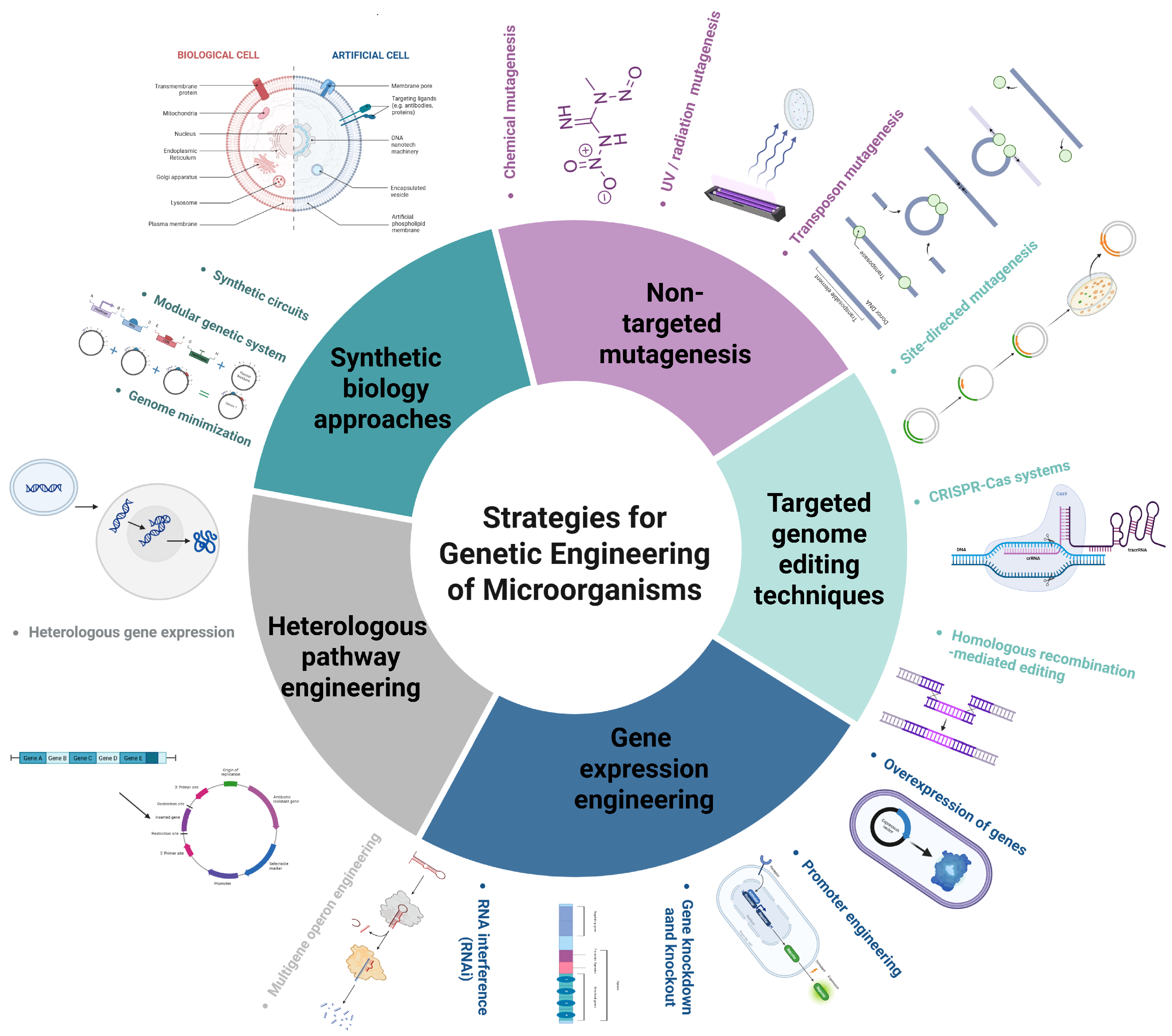
Therefore, this review provides a comprehensive overview of current genetic/genomic engineering strategies applied to microorganisms with agricultural relevance (Figure 1). We discuss key technological advances, their application to model PGPM systems, and the opportunities and limitations associated with their deployment as bioinoculants, biocontrol agents, and bioremediators in sustainable agricultural systems.
The diagram summarizes the five main approaches discussed in this review: (1) non-targeted mutagenesis, including chemical, physical (radiation), and transposon-based methods; (2) targeted genome editing techniques, such as site-directed mutagenesis, CRISPR–Cas systems, and homologous recombination; (3) gene expression engineering, including gene over-expression and RNA interference; (4) heterologous pathway engineering for the introduction and optimization of biosynthetic pathways in alternative hosts; and (5) synthetic biology approaches based on the design and construction of modular genetic systems. Created in https://BioRender.com.

2. Biocontrol and Plant Growth Promotion Strategies

Biological approaches to crop protection and productivity enhancement have gained increasing attention as sustainable alternatives to conventional agricultural practices in recent years. This topic has been extensively reviewed by leading experts in the field [21]; therefore, we provide only a brief overview of the general mechanisms underlying biocontrol and plant growth promotion. In this context, a biocontrol mechanism can be defined as any process in which the survival or activity of a pathogen is reduced through the action of other organisms, ultimately leading to a decrease in disease incidence [22]. Recently, microbiological tools used in crop cultivation have predominantly focused on bacteria, yeasts, and soil-associated fungi, with comparatively less attention given to other microbial groups with potential agricultural relevance [23,24,25].
According to Pirttilä et al. [25], improving plant health presents several challenges, including the continuous search for efficient microorganisms capable of supporting plant growth under diverse stress conditions. Likewise, microorganisms face multiple limitations that can affect their performance in the field, such as difficulties in monitoring, environmental sensitivity, transient persistence in soil, limited host range, competition with native microbiota, and constraints related to formulation stability and industrial scalability [23]. Furthermore, a comprehensive evaluation of microorganisms used as bioinoculants and biofertilizers is essential, moving beyond laboratory and in vitro studies, as agricultural conditions within the plant holobiont are significantly more complex and dynamic [26].
In recent years, omics-based approaches have been increasingly used to study plant growth promotion and biocontrol of phytopathogens, enabling a deeper understanding of plant–microbe and microbe–microbe interactions at multiple biological levels. Comparative genomics, for instance, has been used to identify gene clusters associated with antimicrobial compound production and rhizosphere competence, as shown in Pseudomonas and Bacillus species [27]. Likewise, transcriptomic analyses have revealed key regulatory networks involved in root colonization, such as the expression of adhesion factors, motility-related genes, and biofilm formation in Bacillus subtilis and Pseudomonas fluorescens [28]. Functional genomics studies have further identified critical genes required for efficient root colonization, including those encoding flagellar components, exopolysaccharides, and quorum sensing systems [29].
Metabolomics has also provided valuable insights into the biosynthesis of secondary metabolites, such as lipopeptides (e.g., surfactin, iturin, and fengycin in Bacillus spp.) and phenazines or pyoluteorin in Pseudomonas spp., which are directly involved in pathogen suppression [30]. In parallel, omics approaches have elucidated mechanisms underlying tolerance to abiotic stresses and nutrient acquisition, including osmoprotectant synthesis, ion transport regulation, and enhanced nitrogen and phosphorus metabolism [31]. Additionally, studies have demonstrated how beneficial microorganisms activate plant defense systems, for example, through induced systemic resistance (ISR) mediated by jasmonic acid and ethylene signaling pathways [32].
At the community level, recent research has shown that specific bioinoculants can shape the rhizosphere microbiome by recruiting beneficial microbial consortia, as observed in crops such as maize and wheat, where enrichment of Actinobacteria and Proteobacteria is associated with improved plant health and disease suppression [33]. Furthermore, plant responses to microbial volatiles—such as 2,3-butanediol and acetoin produced by Bacillus spp.—have been linked to growth promotion and systemic resistance [34]. These advances have driven the development of genetically engineered microorganisms (GEMs) with enhanced biocontrol and plant growth-promoting capabilities [35]. Integrated multi-omics analyses have also uncovered complex metabolic and transcriptional reprogramming underlying plant resistance to pathogens, including coordinated regulation of defense-related genes, phytohormone signaling, and secondary metabolism [36].
Consequently, genetic modification strategies for PGPM have focused on enhancing key functional traits. These include improved nutrient acquisition, such as biological nitrogen fixation through the optimization of nif gene clusters in Azospirillum and Rhizobium [37,38,39,40], and phosphate solubilization via over-expression of organic acid production pathways in Pseudomonas and Bacillus species solubilization [40,41,42,43,44,45]. Other strategies involve increasing siderophore production (e.g., pyoverdine in Pseudomonas) [46,47,48], boosting the synthesis of antimicrobial secondary metabolites [49,50,51,52,53], and enhancing the expression of hydrolytic enzymes such as chitinases, glucanases, and proteases that degrade fungal cell walls [54,55,56].
Additional targets include improving root colonization through the regulation of chemotaxis, motility, and biofilm formation, as well as strengthening biocontrol traits by engineering pathways involved in antibiotic production and competition with pathogens [39,40,57]. Moreover, efforts to increase stress tolerance have focused on traits such as ACC deaminase activity, osmolyte production (e.g., proline, trehalose), and reactive oxygen species (ROS) detoxification mechanisms [42,47,58,59].
Recent advances in omics approaches have led to a surge in studies linking microbial genes to plant phenotypes under field conditions [60]. While these correlation-based analyses provide valuable insights into community structure and potential functions, they do not establish causality. Distinguishing correlation from causation remains a key challenge in the study of plant growth-promoting microorganisms (PGPM). Functional validation—through gene manipulation, mutant analysis, and controlled or semi-controlled inoculation assays—is essential to confirm that inferred mechanisms directly contribute to plant growth promotion or biocontrol. Without such validation, associative data risk being overinterpreted, particularly under variable field conditions. Integrating omics with rigorous experimental validation is therefore critical to achieve mechanistically grounded and reliable agricultural applications, supporting a shift from conventional inoculant selection toward microbiome engineering strategies [61]; importantly, genetically engineered microorganisms are also integral to these validation frameworks, enabling direct testing of causal relationships between specific traits and plant responses (Figure 2).

3. Genomic Engineering Strategies in Microorganisms

3.1. Non-Targeted Mutagenesis

A mutant arises from spontaneous or experimentally induced mutagenesis. The effects of mutations can be classified as direct or indirect. Direct effects involve genomic alterations that modify gene structure or expression, whereas indirect effects impact the organism’s phenotype. Silent mutations consist of nucleotide changes that do not affect gene function, typically occurring in intergenic or non-coding regions. In contrast, mutations in coding regions are particularly relevant, as they may lead to functional changes in gene products [62].
Non-targeted mutagenesis, also known as random mutagenesis, is induced by chemical or physical mutagens, generating mutations across the genome without predefined targets. Mutation frequencies vary widely depending on the mutagen and organism, typically ranging from ~10−6 to 10−3 mutations per gene per generation, often requiring the screening of large mutant populations to identify desirable phenotypes. Although this approach has been widely used in breeding programs, its applications are limited by its unspecific nature, low efficiency in recovering beneficial mutations, and the time-consuming processes required for mutant selection and characterization [63]. In contrast to modern genome-editing technologies such as CRISPR-based systems, which enable precise, targeted, and often predictable modifications at specific loci, non-targeted mutagenesis lacks control over mutation location and outcome [64]. Nevertheless, mutations—whether spontaneous or induced—remain a valuable source of genetic diversity. They may involve single base changes (e.g., substitutions, inversions, or deletions) or larger-scale events such as gene rearrangements, chromosomal alterations, or insertion of mobile elements that affect gene structure and expression. Mutations arise through two main mechanisms: spontaneous mutations result from errors during DNA replication, whereas induced mutations are caused by physical or chemical mutagens, or biological agents such as viruses [62]. In contrast, induced mutations are caused by physical or chemical mutagens, or biological agents such as viruses, which disrupt normal base pairing and can also be inherited. Despite being relatively imprecise, mutagenesis remains widely used due to its simplicity and capacity to generate broad phenotypic diversity [65].

3.1.1. Chemical Mutagenesis

Chemical mutagenesis is a classical strategy for generating mutants, valued for its simplicity, flexibility, and low cost, as it does not require exogenous DNA [66]. Common mutagens include diethyl sulfate (DES), ethyl methanesulfonate (EMS), isopropyl methanesulfonate (iPMS), ethylenimine (EI), N-nitroso-N-ethylurea (NEU), N-nitroso-N-methylurea (NMU), 1,4-bisdiazoacetylbutane, sodium azide (NaN3), and base analogs such as 5-bromodeoxyuridine and 2-aminopurine [65,67,68]. These agents primarily induce mutations through alkylation, base modification, or mispairing, leading to nucleotide substitutions [65]. Despite its widespread use, chemical mutagenesis has important limitations. The process is random and non-targeted, often resulting in deleterious effects, metabolic instability, or loss of beneficial traits. Consequently, extensive screening is required to identify desirable phenotypes, making it labor-intensive. In addition, the hazardous nature of many mutagens and the lack of precision have driven the adoption of safer and more controllable genome engineering approaches in modern microbial biotechnology.

3.1.2. UV/Radiation Mutagenesis

The mutagenic effects of radiation were proposed in the early 20th century and later confirmed by Hermann J. Muller in fruit flies [69] and Lewis J. Stadler in barley [70]. Common physical mutagens include ultraviolet (UV) radiation, X-rays, gamma rays, cosmic rays, and particle radiation (e.g., α and β particles, neutrons), as well as emerging approaches such as atmospheric and room-temperature plasma (ARTP) and laser radiation [65,68]. UV radiation remains a classic tool for random mutagenesis, primarily inducing cyclobutane pyrimidine dimers and 6–4 photoproducts that block DNA replication [71]. However, its effectiveness may be reduced in phototrophic organisms due to photoprotective pigments and efficient DNA repair systems. In contrast, ionizing radiation (e.g., X-rays and gamma rays) induces more severe damage, including deletions, chromosomal fragmentation, and translocations, thereby increasing mutation rates and generating broader phenotypic diversity. These genomic alterations have been exploited to obtain plant-associated microorganisms with improved functional traits, such as enhanced production of phytohormones, antibiotics, and hydrolytic enzymes, as well as increased tolerance to abiotic stresses. Emerging technologies such as ARTP and laser-based mutagenesis offer advantages such as short exposure times and high mutant diversity, facilitating the identification of variants with improved plant growth-promoting or biocontrol capacities [72]. Nevertheless, physical mutagenesis requires specialized infrastructure and often lacks precise control, with limited data on mutation rates, cell survival, and long-term genetic stability of induced mutations [65].

3.1.3. Transposon Mutagenesis

Transposons, or transposable elements (TEs), are mobile DNA sequences widely distributed across genomes [73,74]. They are present in all domains of life and contribute to processes such as adaptation, gene regulation, and the generation of genetic diversity [75]. TEs are broadly classified into two types: retrotransposons and DNA transposons, both of which have been adapted as tools for genome engineering [74,76,77].
Due to their ability to mediate stable DNA insertions, transposons are powerful tools in functional genomics. They can carry relatively large DNA fragments or multiple genes and are generally more cost-effective than viral vectors [73]. However, their semi-random integration can disrupt essential genes, potentially causing genomic instability and unintended mutational effects [74].
Among the most widely used transposon systems are Sleeping Beauty (SB), piggyBac (PB), and Tol2, which have been successfully applied for exogenous DNA insertion across diverse organisms, from cultured cells to vertebrates [73]. In bacteria, one of the most extensively studied systems is Tn5, a DNA transposon that operates via a “cut-and-paste” mechanism mediated by a transposase that recognizes inverted repeat sequences. Beyond its mechanistic relevance, Tn5 has been widely used in plant growth-promoting microorganisms (PGPM) to generate insertional mutant libraries for identifying genes involved in key traits such as phytohormone production, nutrient solubilization, root colonization, and biocontrol activity. By linking gene disruption to phenotypic outcomes, Tn5-based approaches enable the functional characterization of PGPM. While similar insertional mutagenesis strategies have been explored in other systems, including microalgae, their application remains comparatively limited and less standardized. These aspects are discussed in more detail in subsequent sections [77].

3.2. Targeted Genome Editing

3.2.1. Site-Directed Mutagenesis

Targeted mutagenesis is a fundamental tool in modern genetic engineering, enabling precise and controlled modifications of defined DNA sequences. Unlike random mutagenesis, it facilitates the rational evaluation and optimization of specific phenotypic traits [78].
Among these approaches, site-directed mutagenesis (SDM) stands out for its ability to introduce specific nucleotide changes, including multiple mutations in a single reaction. The method relies on the design of oligonucleotide primers carrying the desired modifications, which are incorporated into plasmid DNA through PCR, generating precise sequence alterations [79].
In addition to point mutations, SDM allows for insertions and deletions. However, its efficiency can be reduced in GC-rich regions or sequences with repeats and strong secondary structures, which hinder primer annealing and PCR amplification. Moreover, successful implementation requires prior knowledge of the target sequence [78,79,80].

3.2.2. CRISPR-Cas Systems

CRISPR–Cas systems have become the leading genome-editing technology. Originally identified as an adaptive immune mechanism in bacteria and archaea, they protect against bacteriophages and foreign DNA by incorporating fragments of invading sequences into CRISPR arrays, which are later recognized and targeted for degradation [81].
Genome editing with CRISPR–Cas relies on a guide RNA (gRNA) that directs a Cas nuclease to a specific DNA sequence adjacent to a protospacer adjacent motif (PAM). The nuclease introduces a double-strand break, which is repaired by cellular mechanisms. Two main repair pathways are involved: non-homologous end joining (NHEJ), which typically generates insertions or deletions, and homology-directed repair (HDR), which enables precise sequence modifications using a DNA template [82,83].
CRISPR–Cas systems are classified into two major classes. Class 1 (types I and III) employs multi-protein effector complexes and is predominantly found in archaea, whereas Class 2 (types II, IV, V, and VI) relies on a single Cas nuclease and is more common in bacteria [84,85].
Compared with earlier genome-editing tools, such as meganucleases, zinc finger nucleases (ZFNs), and TAL effector nucleases (TALENs), CRISPR–Cas systems are simpler and more versatile, as retargeting only requires redesigning the gRNA [82]. Beyond generating gene knockouts or insertions, CRISPR technologies enable gene regulation, epigenetic editing, and high-throughput functional screening [82,83].
These features have positioned CRISPR–Cas as a powerful platform across multiple fields. In medicine, it has shown promise in correcting genetic mutations and treating monogenic disorders such as sickle cell anemia and other hemoglobinopathies, as well as in cancer and infectious disease research [82,86,87,88,89,90]. In agriculture, CRISPR-based approaches have transformed crop improvement by enabling precise modifications associated with stress tolerance and productivity [91,92,93,94,95].

3.2.3. Homologous Recombination/Recombineering

Homologous recombination is a molecular process in which DNA molecules with identical or highly similar sequences exchange genetic information. It plays a central role in DNA repair, particularly in the correction of double-strand breaks and the maintenance of genomic stability [96].
In genetic engineering, this mechanism is exploited to achieve targeted genome modification. Exogenous DNA is designed with homologous flanking regions that direct its integration into a specific genomic locus. Sequence exchange occurs only when sufficient homology exists between the donor DNA and the target site, with the required length depending on the recombination system used [97,98].
Several recombineering strategies have been developed based on this principle, including RecA-dependent recombination, the λ Red and RecET systems, and integration via suicide plasmids [97]. In eukaryotes, gene targeting approaches and homology-directed repair (HDR) are widely used [99]. HDR can be enhanced by programmable nucleases, such as CRISPR–Cas, TALENs, and ZFNs, which introduce site-specific double-strand breaks, facilitating precise genetic modifications [82,100].

3.3. Gene Expression Engineering

3.3.1. Gene Over-Expression

Gene over-expression involves increasing the expression of a gene beyond its native levels or regulatory patterns, most commonly in unicellular systems [101]. This strategy underpins the heterologous production of recombinant proteins and has been widely used for the large-scale synthesis of biotechnologically relevant compounds.
Successful implementation requires careful consideration of several factors, including the selection of an appropriate host organism (e.g., bacteria, yeasts, fungi, or microalgae), the design of a suitable expression vector, promoter choice, selectable markers, and the incorporation of affinity tags to facilitate protein purification. Despite its advantages, gene over-expression can impose a metabolic burden on the host. The production of non-essential or excessive proteins may disrupt cellular homeostasis, impair growth, or even result in toxicity, limiting the efficiency of recombinant protein expression systems [102].

3.3.2. RNA Interference (RNAi)

RNA interference (RNAi) is a gene-silencing technology widely used across biological systems, particularly in plant defense [103]. It operates by introducing double-stranded RNA (dsRNA) into cells, triggering the degradation or suppression of target RNA molecules in a sequence-specific manner [104,105]. Recent advances include the development of small artificial RNAs, which enable more precise and efficient gene regulation.
RNAi has also gained importance in environmental and agricultural applications as an eco-friendly strategy for pest and disease control. Its high specificity allows targeted action while minimizing off-target effects on non-target organisms [106]. RNAi approaches can be broadly classified into two types: (1) endogenous expression, where dsRNA is produced within the target organism (either stably or transiently), and (2) exogenous application, in which RNAi molecules are generated externally and subsequently taken up by the organism [104].
This technology has been successfully applied to control a wide range of agricultural pests, including insects (e.g., Sitobion avenae, Schizaphis graminum, Lygus lineolaris, Acyrthosiphon pisum, and Helicoverpa armigera) [107,108,109,110,111], phytopathogenic fungi (e.g., Botrytis cinerea, Phytophthora parasitica, and Fusarium verticillioides) [111,112,113,114], Phytophthora parasitica var. nicotianae [115], and plant-parasitic nematodes (e.g., Heterodera schachtii, Meloidogyne javanica, Pratylenchus vulnus, Meloidogyne enterolobii, and Ditylenchus destructor) [116,117,118,119,120].

3.4. Heterologous Gene Expression

The increasing availability of genomic data, together with advances in genome mining and biosynthetic gene cluster (BGC) annotation, has greatly expanded the discovery and optimization of specialized metabolites. These approaches have enabled the identification of silent or poorly expressed BGCs in native hosts, uncovering new sources of bioactive compounds [121].
Heterologous expression has emerged as a key strategy for the functional characterization and production of BGCs in alternative hosts. This can be achieved through multicopy plasmid systems or stable genomic integration, which improves genetic stability and allows tighter control of gene expression [121]. Beyond simple gene transfer, heterologous expression enables the introduction of new metabolic capabilities, activation of cryptic biosynthetic pathways, and reinforcement of specific biochemical routes. As such, it represents a powerful tool for the targeted production of valuable metabolites and the redesign of microbial metabolism [102,121,122,123].

3.5. Synthetic Biology Approaches

Synthetic biology (SB) is an engineering-driven discipline focused on the design and construction of biological systems and functions that do not naturally occur [124]. It enables the rational assembly of genes and modular biological components—either naturally derived or synthetically designed—to reprogram and redesign cellular functions [125]. SB integrates multiple fields, including molecular biology, systems biology, chemistry, biophysics, and computational modeling [126].
A central concept in SB is the development of genetic circuits, inspired by electronic logic gates, which allow cells to sense, process, and respond to specific signals. These circuits typically consist of three core elements: sensors, processors, and actuators, enabling programmable control of cellular behavior [127]. Recent advances have expanded the library of standardized and interchangeable biological parts, commonly known as BioBricks. These include synthetic promoters, riboswitches, engineered transcription factors, ribosome binding sites (RBS), coding sequences, and terminators. Among these, synthetic promoters play a key regulatory role, as they can be rationally designed to control transcription through specific interactions with transcription factors and the transcriptional machinery [128]. This modular architecture enhances the ability to design, assemble, and fine-tune biological systems, facilitating the production of enzymes, specialized metabolites, and engineered phenotypes, as well as enabling the generation of detectable biological signals [129].

3.6. Synthetic Genomes and Genome Minimization

The design of synthetic and minimal genomes represents a major recent advance in biotechnology and genetic engineering. Early work by Hutchison et al. [75], established a minimal gene set in Mycoplasma genitalium, initially comprising 525 genes, which was later reduced to approximately 250 genes [130]. These studies demonstrated that bacterial cells can be sustained with highly reduced, artificially designed genomes. Genome reduction, achieved through the elimination of non-essential sequences, can facilitate the incorporation of heterologous biosynthetic pathways and improve the efficiency of engineered functions. Consequently, genome minimization has emerged as a promising strategy for developing optimized microbial platforms in biotechnology and agriculture.
However, this approach should be applied with caution. Genes considered non-essential under laboratory conditions may play important roles in complex environments, such as the rhizosphere or during endophytic colonization of plants. Given that these interactions are not yet fully understood, the removal of such genes could compromise traits related to plant growth promotion or environmental fitness.

4. Genetically Engineered Microorganisms

GEMs are organisms from all domains of life whose genomes have been deliberately modified using genetic engineering tools. These organisms have broad applications across multiple sectors. In the food industry, they are used as ingredients and processing aids [131]; in agriculture, GEMs enhance nutrient availability, improve plant–microbe interactions, and function as biocontrol agents. Additionally, they play important roles in industrial and environmental applications, including the production of biofuels, commodity chemicals, and advanced materials, as well as in bioremediation processes. This review focuses on GEMs developed for agricultural applications, particularly those designed to promote plant growth and sustainability, as well as microorganisms engineered to enhance bioremediation capacity.

4.1. Biocontrol Engineered Microorganisms

Biocontrol agents (BCAs) comprise a diverse group of organisms, including bacteria, fungi, protozoa, viruses, insects, mites, and nematodes, that suppress plant pathogens through multiple biological mechanisms [132]. This review focuses on microbial BCAs, particularly bacteria, fungi, and protozoa. Their modes of action include the induction of systemic resistance, production of antibiotics, siderophores, and antimicrobial metabolites such as non-ribosomal peptides (NRPs), ribosomal peptides (RPs), and polyketides (PKs). Among NRPs, cyclic lipopeptides are especially important due to their broad-spectrum activity against fungal and bacterial pathogens. Additional mechanisms include mycoparasitism, competition for nutrients and space, and the production of volatile organic compounds (VOCs) [133,134].
Despite their potential, BCAs do not always provide consistent or effective protection under all conditions. However, recent advances in molecular biology and biotechnology offer new opportunities to enhance their efficacy [135]. Developments in genomics have facilitated the identification, characterization, and improvement of BCAs, including the discovery of biosynthetic gene clusters (BGCs) that underlie their functional traits and mechanisms of action [136]. The effectiveness of BCAs can be further improved through genetic engineering approaches, such as CRISPR/Cas9, gene regulation (over-expression or knockout), and RNA interference (RNAi), among others [137].
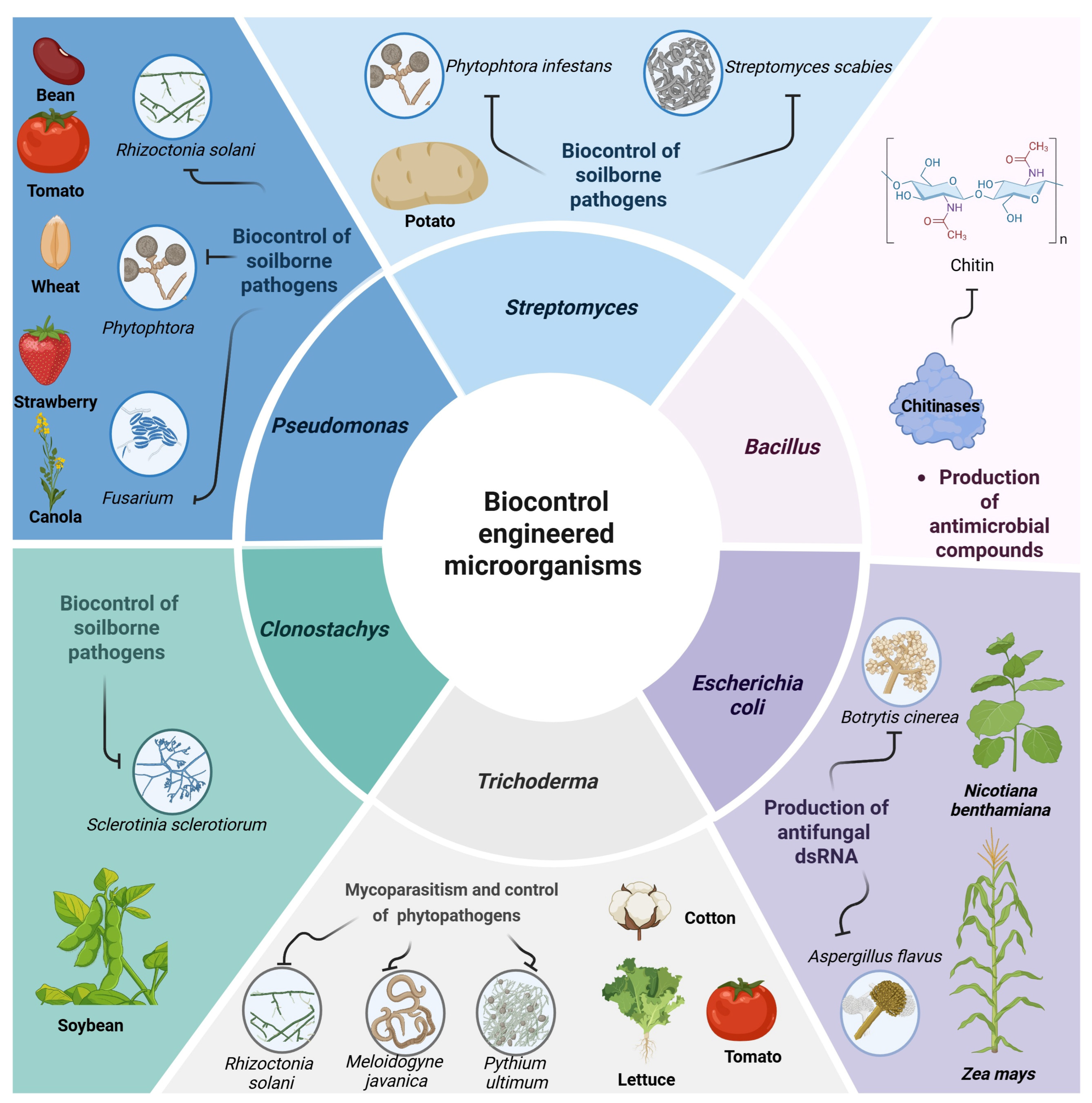
For example, Barahona et al. [138] generated a triple mutant of Pseudomonas fluorescens F113, targeting the kinB, sadB, and wspR genes (KSW mutant) via directed mutagenesis. This mutant exhibited enhanced motility, increased competitiveness for rhizosphere colonization, and improved biocontrol performance compared to the wild-type strain, demonstrating that enhanced colonization capacity can directly translate into improved biocontrol efficacy. In some cases, beneficial traits from one species can be transferred to another to enhance biocontrol capacity. For instance, Downing and Thomson [139] introduced the chiA gene from Serratia marcescens into an endophytic Pseudomonas fluorescens using a heterologous recombination approach. The resulting strain showed effective biocontrol activity against the phytopathogenic fungus Rhizoctonia solani in bean seedlings under controlled conditions.
Another strategy to enhance BCA performance is genome shuffling (GS), which accelerates the generation of genetic diversity and can be effectively combined with random mutagenesis to improve target traits. This approach is particularly suitable for microorganisms with a defined sexual cycle or those amenable to protoplast fusion, allowing iterative recombination among selected parental lines [140]. Through successive rounds of recombination and selection, GS facilitates the accumulation of beneficial genetic variations linked to desirable phenotypes [141].
Originally described by Zhang et al. [142] GS represents a rapid evolutionary strategy that merges features of conventional breeding with DNA shuffling at the whole-genome scale. By enabling multi-parental recombination, it generates highly diverse combinatorial libraries, surpassing the limitations of biparental crosses. When applied to pre-selected microbial populations, GS can yield strains with significantly enhanced performance, including improved metabolite production. A notable example is the increased tylosin yield achieved in Streptomyces fradiae, underscoring the value of GS as a non-recombinant tool for microbial improvement and metabolic engineering [143], applied this technique to enhance the biocontrol capacity of Streptomyces strains against Streptomyces scabies and Phytophthora infestans, two major potato pathogens. Six fusants with improved in vitro antagonistic activity were selected. Although all retained the ability to produce geldanamycin, none showed over-production of this antibiotic. Instead, enhanced antagonistic activity was associated with increased diversity of secreted metabolites: while parental strains produced 7–8 metabolites, fusants produced 12–15. Biocontrol assays demonstrated that four of the six fusants provided better protection of potato tubers than the parental strains. These results suggest that improved biocontrol was linked to metabolic diversification rather than over-production of a single compound.
Biocontrol agents exhibit a wide diversity of mechanisms of action, often operating simultaneously or in a context-dependent manner. However, determining which mechanisms are most effective remains challenging due to the high variability in environmental conditions, crop species, and the specific traits of each microorganism, and therefore requires rigorous experimental validation. Relevant examples of genetically engineered microorganisms are summarized in Table 1 and illustrated in Figure 2.

4.2. Modified Microorganisms with Improved PGP Traits

4.2.1. Plant Growth-Promoting Bacteria

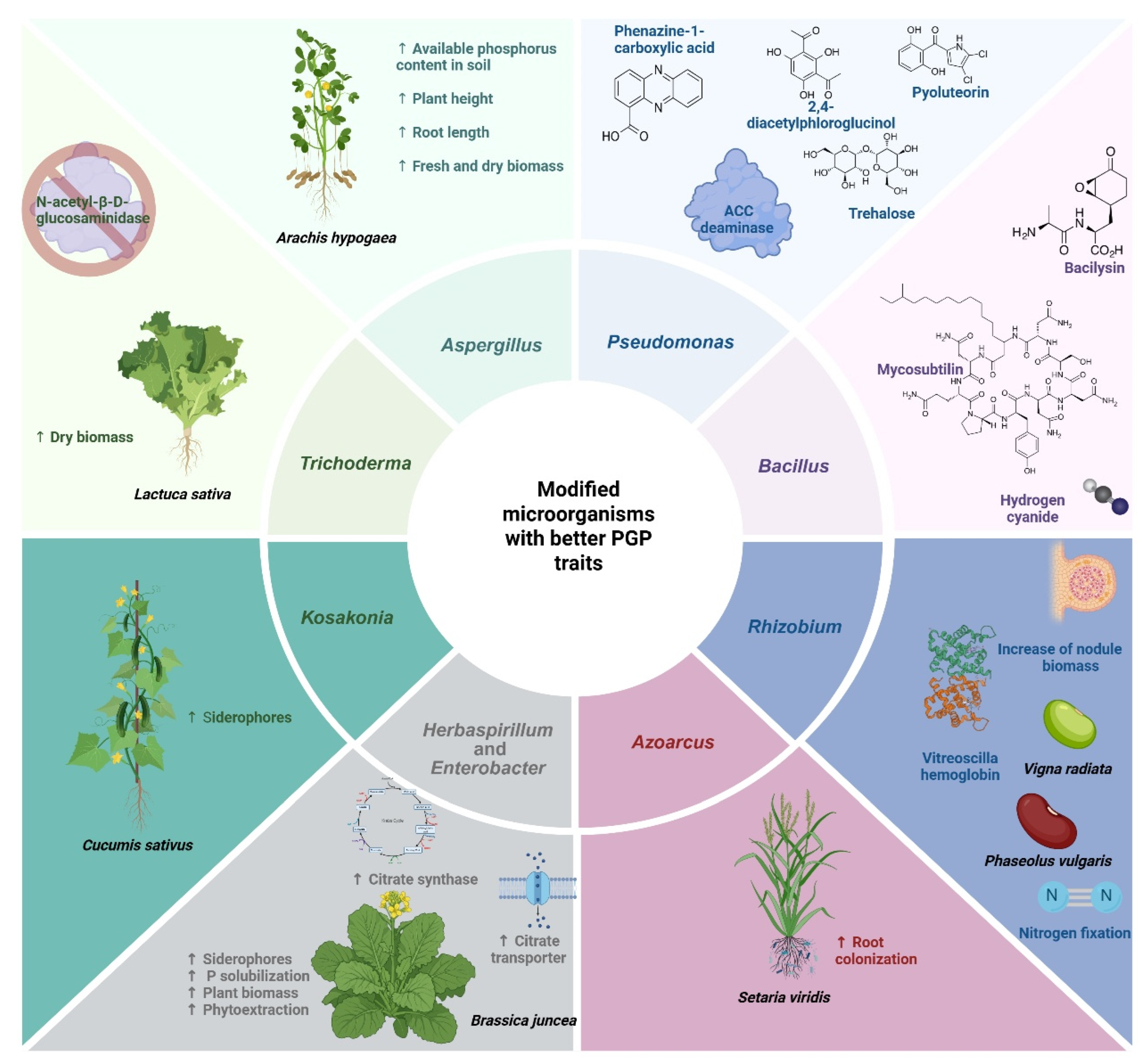
Numerous studies have demonstrated the application of both targeted and random mutagenesis, as well as gene over-expression strategies, to enhance key functional traits in plant-associated microorganisms. These traits include root colonization, nutrient solubilization, secondary metabolite production, and tolerance to abiotic stress (Table 2, Figure 3).
Transposon mutagenesis, particularly using Tn5 systems and their derivatives (EZ-Tn5, mini-Tn5), has been widely employed to identify genes involved in essential functions for rhizosphere establishment. For example, in Kosakonia radicincitans GXGL-4A, Tn5 mutagenesis enabled the identification of mutants with enhanced siderophore production, which translated into improved cucumber growth [46]. Similarly, in Rhizobium sp. MR-54, Tn5 mutagenesis revealed genes associated with increased root nodulation and fructooligosaccharide solubilization, leading to improved performance in mung bean plants [40].
More advanced approaches, such as transposon insertion sequencing (TnSeq), have enabled the systematic evaluation of gene contributions to rhizosphere colonization. In this context, studies on Azoarcus olearius DQS4 and Herbaspirillum seropedicae SmR1 demonstrated that specific mutations can significantly enhance colonization capacity in Setaria viridis, highlighting the value of genetic tools for identifying key determinants in plant–microorganism interactions [57].
In parallel, non-targeted chemical and physical mutagenesis using agents such as N-methyl-N′-nitro-N-nitrosoguanidine (NTG), methyl methanesulfonate (MMS), ethyl methanesulfonate (EMS), and UV radiation has been widely used to generate variants with improved phenotypes. A recent study shows that Chlamydomonas reinhardtii (an alga) produces extracellular IAA via LAO1, negatively affecting its growth at high concentrations [152]; however, the plant growth-promoting bacterium Methylobacterium aquaticum mitigates these effects while benefiting from the interaction, illustrating a mutualistic auxin-mediated exchange. This highlights the broader significance of IAA as a key signaling molecule in microbe-associated systems, including plant growth-promoting bacteria. Notable examples include strains of Pseudomonas fluorescens, Pseudomonas simiae, and Pseudomonas corrugata with enhanced phosphate solubilization, siderophore production, ACC deaminase activity, and IAA synthesis, leading to improved plant growth and stress tolerance in crops such as wheat, mung bean, and rice [41,44,59]. Similarly, chemical mutagenesis of Rhizobium tropici CIAT889 increased nodular biomass in Phaseolus vulgaris, further underscoring the relevance of optimizing IAA-associated traits for agricultural performance [39].
Gene over-expression strategies have also proven highly effective in enhancing specific metabolic functions. For instance, over-expression of genes involved in trehalose biosynthesis in Pseudomonas sp. UW4 improved plant tolerance to salinity in tomato, underscoring the role of compatible solutes in abiotic stress adaptation [58]. Similarly, over-expression of genes associated with siderophore production and phosphate solubilization in Enterobacter sp. NBRI K28 and Herbaspirillum seropedicae Z67 resulted in enhanced plant growth and improved nutrient acquisition [45,48].
Furthermore, both classical and modern studies have demonstrated that increased production of antimicrobial metabolites significantly enhances biocontrol activity. Genetically modified Bacillus subtilis and Pseudomonas fluorescens showed elevated production of compounds such as mycosubtilin, bacilysin, phenazines, and polyketides, leading to improved control of soil-borne pathogens including Pythium, Fusarium, Rhizoctonia, and Gaeumannomyces across various crops [49,51,53].
Collectively, these studies demonstrate that genetic engineering strategies have enabled the identification and optimization of key metabolic pathways involved in plant growth promotion and biocontrol. As a result, bacteria are increasingly being developed as versatile and customizable platforms for the design of improved bioinoculants aimed at enhancing crop productivity and health.
Table 2. Representative examples of genetically engineered microorganisms for enhanced plant growth.
Modified MicroorganismGenetic Modification Technique UsedImproved TraitBeneficiated Crop(s)Reference
Azoarcus olearius DQS4 and Herbaspirillum seropedicae SmR1Transposon mutagenesis sequencing (TnSeq) approachGene mutations that positively impacted the ability of bacterial strains to colonize roots.Setaria viridis[57]
Aspergillus niger v. TieghAtmospheric Room Temperature Plasma (ARTP)Improved the P content in the soil. Increased plant height, root length, fresh biomass and dry biomass in pot experiments.Penut seedlings[153]
Bacillus licheniformis PM7Ultraviolet radiation, Ethyl methanesulfonate and Ethidium bromide mutagenesisIncrease in phosphate solubilization, siderophore and HCN production, as well as enhanced antifungal activity against Phytophthora capsici, Fusarium oxysporum, and Dematophora necatrix. Additionally, improved root and shoot growth parameters in tomato plants.Tomato seeds cv. Solan lalima[43]
Bacillus subtilis BBG100Gene over-expressionIncrease in mycosubtilin production and biocontrol of Pythium aphanidermatum.Tomato seedlings[50]
Bacillus subtilis PY79CRISPR/Cas9 systemImproved Bacilysin production.-[49]
Bacillus subtilis and Pseudomonas fluorescensUV mutagenesis and Ethyl Methane Sulfonate (EMS) MutagenesisIncrease in phosphate solubilization, plant height, dry weight, root, shoot dry weight and chlorophyll content.Oryza sativa var. ADT 43[44]
Enterobacter sp. NBRI K28Gene over-expressionSiderophore over-production and increase in P solubilization, capable of stimulating plant biomass and enhancing phytoextraction of Ni, Zn and Cr.Brassica juncea[48]
Herbaspirillum seropedicae Z67Gene over-expressionOver-expression of citrate synthase (gltA1) citrate transporter (citC) genes and increase in phosphate solubilization.Oryza sativa[45]
Kosakonia radicincitans GXGL-4ATn5 transposon mutagenesisAble to synthesize siderophore.Cucumber seedlings[46]
Pseudomonas corrugata NRRL B-30409Chemical treatment with N-methyl-N’-nitro-N-nitrosoguanidineIncrease in phosphate solubilization at lower temperatures and growth parameters in wheat.Wheat plants[41]
Pseudomonas fluorescens ATCC 13525Chemical treatment with N-methyl-N’-nitro-N-nitrosoguanidineSiderophore over-production and increase in root elongation at low temperature.Mung bean[47]
Pseudomonas fluorescens CHA0Gene over-expressionOver-produces the antimicrobial compounds polyketides 2,4-diacetylphloroglucinol and pyoluteorin and displays enhanced biocontrol activity against Pythium ultimum.Cucumis sativus L.[51]
Pseudomonas fluorescens GM BCAMini-Tn5 transposon mutagenesisConstitutive expression of phenazine-1-carboxylic acid and improved biocontrol activity against Pythium spp., Fusarium spp., Gaeumannomyces graminis var. tritici, Phytophtora cinnamomi and Rhizoctonia solani.Pea, wheat and sugar beet seeds[53]
Pseudomonas koreensis AK-1Chemical treatment with N-methyl-N’-nitro-N-nitrosoguanidineAble to induce plant growth in drought stress by PEG. Increase in solubilized inorganic phosphates.Glycine max L. var. JS9560[42]
Pseudomonas mosselii 923EZ-Tn5 transposome systemPseudoiodinine over-production and antagonistic activity against Xanthomonas oryzae pv. Oryzae and and X. oryzae pv. Oryzicola.Rice seedlings[154]
Pseudomonas putida WCS358rMini-Tn5 lacZ1 transposonThe antifungal compound phenazine-1-carboxylic acid is constitutively produced and exerts biocontrol activity toward Gaeumannomyces graminis var.tritici.Field-grown wheat[52]
Rhizobium sp. MR-54Tn5 transposon mutagenesisHigher root nodulation and P-solubilization.Green gram[40]
Pseudomonas simiae AUChemical treatment with N-methyl-N’-nitro-N-nitrosoguanidineIncrease in ACC deaminase (ACC-D) activity, indole acetic acid (IAA) production and inorganic phosphate (Pi) solubilization. Enhancement of plant growth parameters and drought tolerance.Mung bean[59]
Pseudomonas sp. UW4Gene over-expressionTrehalose over-expression and protected tomato plants under salt stress.Lycopersicon esculentum cv. Saladette[58]
Pseudomonas putida WCS358rMini-Tn5 lacZ1 transposonThe antifungal compound phenazine-1-carboxylic acid is constitutively produced and exerts biocontrol activity toward Gaeumannomyces graminis var.tritici.Field-grown wheat[52]
Rhizobium etli CE3Triparental matingExpression of vhb gene. Bean plants treated with the engineered strain showed increased nitrogenase activity and higher total nitrogen levels.Phaseolus vulgaris cv. Negro Jamapa seeds[37]
Rhizobium etli CFN42Gene over-expressionIncrease in nitrogenase activity, plant weight, and plant nitrogen content. Increase in seed yield, higher nitrogen content, and nitrogen yield in seeds.Phaseolus vulgaris[38]
Rhizobium tropici CIAT889Treatment with methyl methanesulfonate (MMS)Increase in nodule biomass per plant.Phaseolus vulgaris L. cv. Carioca BRS Estilo[39]
Rhizobium sp. MR-54Tn5 transposon mutagenesisHigher root nodulation and P-solubilization.Green gram[40]
Trichoderma hamatum GD12Insertional mutagenesisN-acetyl-β-d-glucosaminidase gene disruption enhances the growth of lettuce seedlings.Lettuce seedlings[55]

4.2.2. Plant-Beneficial Fungi

Similarly to bacteria, fungi—particularly species of Trichoderma and Aspergillus—have been extensively studied as biocontrol agents and plant growth promoters due to their ability to colonize the rhizosphere, produce hydrolytic enzymes, solubilize nutrients, and suppress phytopathogens (Table 2). In this context, various mutagenesis and genetic engineering strategies have been applied to enhance key functional traits and improve their performance under controlled agricultural conditions.
One of the earliest approaches involved insertional mutagenesis to identify genes associated with fungus–plant interactions. For instance, disruption of the gene encoding N-acetyl-β-D-glucosaminidase in T. hamatum GD12 significantly increased lettuce growth. This finding suggests that modifications in chitin-degrading pathways can influence root colonization dynamics and promote plant growth, even without directly enhancing antagonistic activity against pathogens [55].
In addition, non-conventional mutagenesis techniques such as atmospheric room-temperature plasma (ARTP) have been applied to A. niger with promising results. This approach induces random mutations that significantly improve nutrient solubilization, particularly phosphorus availability, as well as plant growth parameters including plant height, root length, and biomass in peanut seedlings. These results indicate that ARTP can generate beneficial phenotypic variation without the need for targeted genetic modification [153].
Directed gene over-expression has also been widely used in Trichoderma species to enhance biocontrol activity. For example, over-expression of the prb1 gene in T. harzianum, which encodes an extracellular protease involved in the degradation of fungal and nematode structures, led to increased enzymatic activity and improved control of the nematode Meloidogyne javanica under infection conditions [56].
Similarly, transformants of T. harzianum overexpressing prb1 showed a significant reduction in disease caused by Rhizoctonia solani in in vitro assays. This study also demonstrated a relationship between pathogen suppression and the induction of plant defense-related enzymes, providing a foundation for the development of improved strains with practical agricultural applications [54].
Collectively, these studies demonstrate that both random mutagenesis and targeted genetic modification are effective strategies to enhance fungal traits associated with plant growth promotion and biocontrol. However, most studies have been conducted under controlled conditions, highlighting the need for further evaluation in complex agricultural environments where soil interactions play a critical role.

5. Plant-Beneficial Microalgae

One group of PGPM that has not been as extensively explored as bacteria or fungi—organisms that exhibit greater capacity to survive under extreme conditions such as drought—is microalgae. However, their applications in sustainable agriculture and biotechnology are broad (e.g., biostimulants, nutraceuticals, food, aquaculture feed, and biofuels). Some microalgal species belonging to genera such as Acutodesmus, Calothrix, Chlamydomonas, Chlorella, Dunaliella, Porphyridium, Scenedesmus, and Spirulina have been shown to be excellent producers of metabolites that stimulate plant growth, in addition to enhancing plant immune responses against potential pathogens [155]. Therefore, their cells have been used as bioreactors to produce phytohormones, amino acids, pigments, lipids, and antioxidants, which can be applied as biostimulants in crops [156].
Experimental studies have demonstrated that microalgae are capable of promoting plant growth. For instance, the application of Acutodesmus dimorphus has been reported as effective as a biofertilizer and biostimulant in tomato plants [157]. Similarly, extracts of Chlorella vulgaris, Nannochloropsis salina, and Arthrospira platensis applied to bean plants have increased crop yield and improved the nutritional quality of the seeds [158]. Likewise, the application of Chlorella vulgaris to seeds and plants of Triticum aestivum var. Achtar has been shown to significantly improve wheat germination and growth [159]. Positive effects on seed germination in Solanum lycopersicum and Hordeum vulgare have also been documented after the application of Chlorella vulgaris and Scenedesmus obliquus [160] as well as on the growth of Beta vulgaris L. subsp. cycle, where C. vulgaris S45 showed biostimulatory activity. Together, these studies demonstrate how microalgae can improve plant growth, by producing phytohormones and additional bioactive compounds that play a role in plant growth. In a recent study [161], genomic engineering techniques such as CRISPR/Cas9, TALENs, zinc finger nucleases (ZFNs), and conventional genetic transformation approaches using Agrobacterium have been reviewed to enhance the quantity and quality of various bioactive compounds [161]. Microalgae are also being utilized and optimized for bioremediation processes, particularly in aquatic environments. Given the extensive number of high-quality review articles on microalgae and cyanobacteria, as well as their role in biotechnology, including remediation and sustainable agriculture, we recommend the following readings for further insight into the topic [152,161,162].
Despite recent advances in gene-editing tools, the use of genetically modified microalgae to biostimulate plants remains under-researched. Although metabolic pathways have been optimized to generate bioactive compounds, confirmation of these organisms as biostimulants and biofertilizers in plant-microalgae systems remains limited. In this regard, studies demonstrating the potential of genetically modified microalgae to enhance plant growth-promoting traits are presented in Table 3, which summarizes significant research in this developing field.

6. Bioremediation of Contaminated Agricultural Soils

Beneficial soil microorganisms, including bacteria and fungi, play a key role in maintaining soil health by participating in nutrient cycling, mineral solubilization, phytohormone production, and pathogen suppression. Many of these microorganisms also possess natural abilities to degrade environmental contaminants. Advances in genetic engineering have enabled the enhancement of these traits by optimizing metabolic pathways, increasing the expression of degradative enzymes, or introducing new catabolic functions. As a result, engineered microorganisms can improve bioremediation efficiency while indirectly promoting plant growth by restoring soil quality and reducing toxicity, contributing to more sustainable agricultural systems.
Soil is a complex and dynamic environment that can be affected by multiple sources of pollution. According to Wołejko et al. [168], five major types of anthropogenic pollutants have been identified.
Among the most persistent contaminants are pesticides, which tend to bioaccumulate and retain their molecular integrity and biological activity for extended periods after their release into the soil. The degradation rates of pesticides tend to vary widely depending on their physicochemical properties and the environmental conditions in which they are found; therefore, their half-life usually ranges from days to months or even years [169].
Another major group of pollutants includes heavy metals (HMs), commonly defined as elements with densities greater than 5 g·cm−3. This group comprises metals and metalloids with potential toxic effects, such as arsenic (As), cadmium (Cd), chromium (Cr), lead (Pb), mercury (Hg), copper (Cu), zinc (Zn), and nickel (Ni). In recent decades, HMs have become a significant source of environmental pollution derived from both natural and anthropogenic activities [170]. These elements have been detected at toxic concentrations in soil, water, sediments, and living organisms, posing serious risks to ecosystems and human health [170,171,172]. Phytoremediation has emerged as an important strategy to mitigate soil contamination and can be categorized into phytovolatilization, phytoextraction, phytostabilization, and phytodegradation, depending on environmental conditions and pollutant characteristics [170].
Additionally, the movement of pesticides from soil to water is a significant concern. The transport of pesticides from soil to water is an additional environmental concern. Through leaching processes, pesticides can contaminate groundwater and spread via hydrological systems, extending their persistence and causing both short- and long-term ecological damage. Pesticides may undergo transformation into metabolites through photochemical, chemical, and microbial processes [173]. Microbial biodegradation plays a central role in the detoxification of these compounds by converting complex or toxic molecules into simpler, less harmful forms through specific enzymatic pathways. In this process, microorganisms produce enzymes—such as oxygenases, dehydrogenases, and reductases—that catalyze oxidation–reduction reactions, breaking chemical bonds and transforming pollutants into intermediates that can be further metabolized or mineralized (e.g., to CO2 and H2O). In addition to direct degradation, complementary mechanisms enhance removal efficiency: biosorption involves the binding of contaminants to cell surfaces; bioaccumulation refers to their uptake and intracellular sequestration; bioaugmentation introduces specialized degraders to accelerate the process; and bioleaching mobilizes metals through microbially driven chemical changes. Together, these processes contribute to the effective remediation of contaminated environments [174].
Key enzymes involved in bioremediation include cytochrome P450 monooxygenases, laccases, dehalogenases, dehydrogenases, hydrolases, proteases, and lipases [175]. Furthermore, advances in genetic engineering have enabled the development of microorganisms with enhanced degradative capabilities for a wide range of pollutants, including synthetic dyes from the textile industry [176], alkanes and aromatic compounds [177,178,179], and pesticides [180,181,182].

7. Genetic Engineering of Microorganisms: An Approach to Enhance Heavy Metal Removal and Bioremediation

Microalgae have attracted considerable attention as promising biological systems for heavy metal (HM) removal due to their high capacity for metal uptake and tolerance. Elevated levels of HM resistance have been reported in various phototrophic microorganisms; for example, members of Chlorophyta can tolerate copper concentrations of up to 15 µM [183]. Consequently, microalgae are increasingly recognized as effective and sustainable platforms for bioremediation.
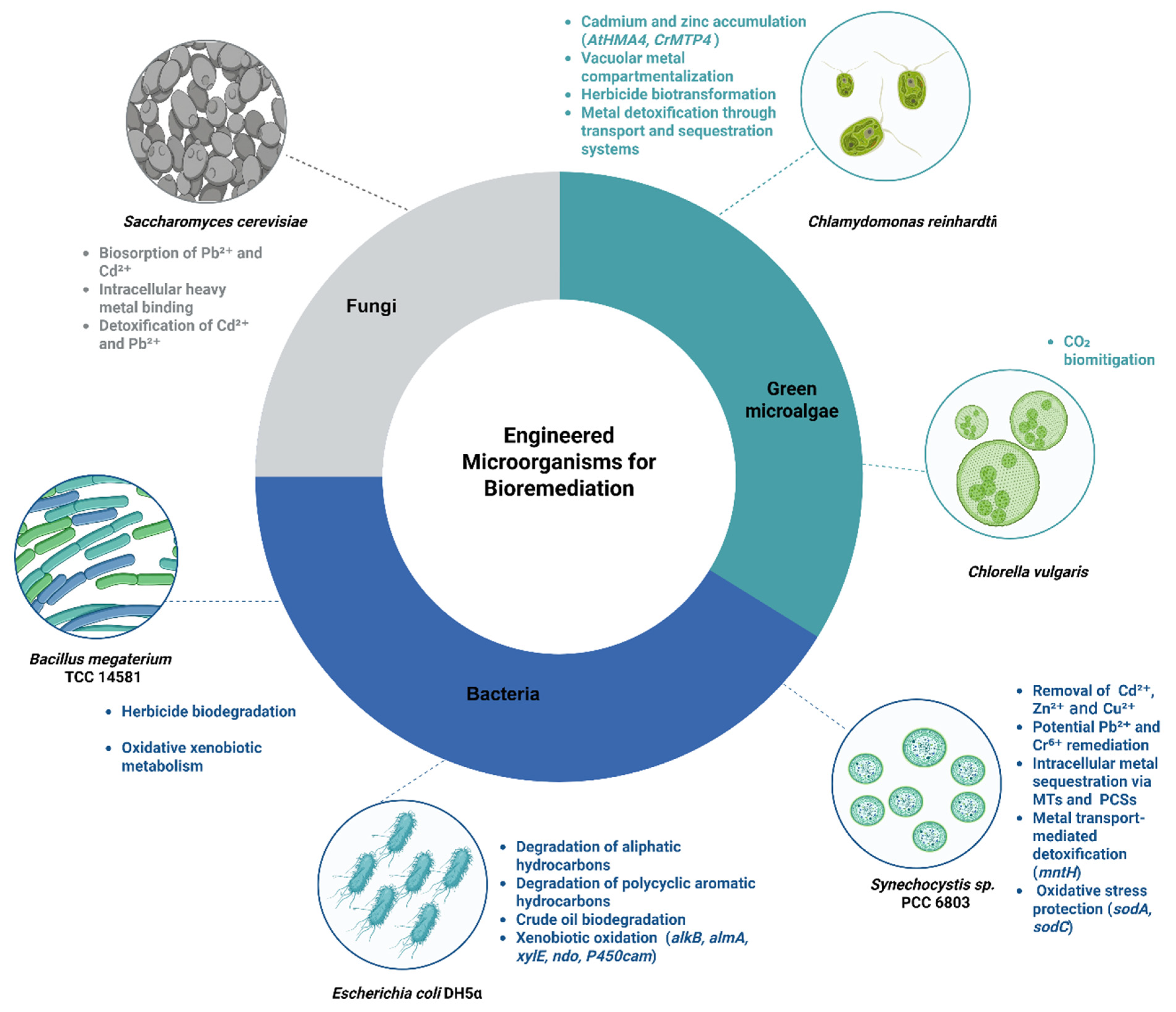
One of the most widely studied models is Chlamydomonas reinhardtii, which has been genetically engineered to enhance metal accumulation and tolerance. Over-expression of the metal transporter gene CrMTP4 in C. reinhardtii CC125 improved intracellular metal compartmentalization and tolerance [184]. Similarly, heterologous expression of the plant metal transporter AtHMA4 increased Cd and Zn accumulation, demonstrating the potential of cross-kingdom gene transfer to enhance metal uptake mechanisms [185]. In addition, chloroplast transformation to express a synthetic gene encoding γ-glutamylcysteine synthetase significantly improved Cd removal efficiency [186]. Likewise, transformation of C. reinhardtii using Agrobacterium tumefaciens carrying the ACR3 transporter gene enhanced arsenate uptake from the medium [187].
Genetically engineered bacteria have emerged as powerful bioremediation tools. A well-characterized example is Synechocystis sp. PCC 6803, a cyanobacterium engineered to improve Cd and Zn removal. In this strain, the introduction of genes encoding phytochelatin synthases (PCSs) and metallothioneins (MTs) increased intracellular metal sequestration capacity [188]. These cysteine-rich peptides facilitate detoxification through metal chelation and compartmentalization. Furthermore, the expression of mntH, HMP3, sodA, and sodC genes enhanced oxidative stress tolerance, potentially improving Pb and Cr removal under metal-induced stress conditions [189].
Yeasts also represent versatile platforms for heavy metal biosorption. In Saccharomyces cerevisiae W303-1A, expression of EC20 significantly improved Pb2+ and Cd2+ biosorption capacity [190]. Similarly, heterologous expression of the human metallothionein gene MT2A enhanced intracellular metal-binding capacity, highlighting the potential of yeast systems for bioremediation applications [191].
Beyond heavy metal removal, metabolic engineering has expanded the environmental applications of genetically modified microorganisms. For example, expression of the enzyme P450 BM3 MT35 conferred the ability to metabolize herbicides in both Chlamydomonas reinhardtii and Bacillus megaterium TCC 14581 [192]. Likewise, Escherichia coli DH5α engineered to express hydrocarbon-degrading genes (alkB, almA, xylE, ndo, and p450cam) exhibited enhanced degradation of dodecane, benzo(a)pyrene, and crude oil [193]. In addition, heterologous expression of fructose-1,6-bisphosphate aldolase in Chlorella vulgaris improved CO2 biomitigation efficiency, demonstrating that pathway optimization can enhance both pollutant removal and carbon capture [194].
In the case of molybdenum (Mo), it is an essential micronutrient; however, its excess in irrigation water—associated with mining or geogenic sources—can negatively affect crop growth and metabolism. In this context, algae–bacteria consortia represent a promising alternative for its remediation, as synergistic interactions facilitate metal removal through processes such as biosorption and chemical transformation, thereby improving water quality for agricultural use [195].
Overall, these studies demonstrate that genetic engineering significantly enhances microbial capabilities for heavy metal sequestration, oxidative stress tolerance, and pollutant degradation (Table 4; Figure 4). By integrating metal-binding proteins, transport systems, antioxidant defenses, and engineered metabolic pathways, genetically modified microorganisms represent a promising and scalable strategy for sustainable bioremediation.

8. Undesired Results in Genome Engineering: Opportunities for Improvement

When evaluating the potential drawbacks of genetically modified organisms (GMOs), three main aspects are commonly considered: (i) risks to biodiversity and ecosystem dynamics, including impacts on soil, water, and biological communities; (ii) risks associated with gene flow and unintended genetic recombination; and (iii) the potential development of resistance in target organisms [196].
Among these concerns, the loss of biodiversity in non-target organisms remains a major ecological issue [197]. However, evidence regarding the environmental impact of genetically modified crops, particularly those expressing Bacillus thuringiensis (Bt) toxins, has been mixed. Bt crops—including cotton, maize, potato, tomato, rice, eggplant, and cruciferous vegetables—have been engineered with genes encoding insecticidal proteins active against larvae of Lepidoptera and Coleoptera. Commonly used genes, including Cry1Ac, Cry1Ab/c, Cry1Ac + CpTI, Cry1Ac + Cry2Ab, Cry1A + Cry1F, Cry1F, Vip3A, and Vip3A + Cry1Ab, demonstrated no consistent harmful effects of Bt crops on non-target insect populations. A review by Yu et al. [198] reported no consistent harmful effects of Bt crops on non-target insect populations.
Field-based studies further support this perspective. Xing et al. [199] evaluated the impact of Bt maize expressing the Cry1Ac protein on non-target arthropods over a three-year period in northern China. Using ecological indices such as species richness, Shannon diversity, and multivariate community analyses, the authors reported the presence of more than 80 arthropod species in both Bt and non-Bt maize systems, with no significant differences in abundance, diversity, or community structure. These findings suggest that Bt maize expressing Cry1Ac does not negatively affect non-target arthropod biodiversity under field conditions.
In contrast, more subtle, non-lethal effects have been reported in some cases. Lanzoni et al. [200] investigated the impact of Bt maize expressing the Cry1Ab protein on Rhopalosiphum maidis, a non-target aphid species. Although no mortality differences were observed, individuals feeding on Bt maize exhibited changes in fecundity, population growth rates, and developmental timing. These results indicate that Bt crops may influence the physiology and population dynamics of non-target organisms, even in the absence of direct toxicity, highlighting the importance of assessing sublethal and long-term ecological effects.
A comprehensive meta-analysis by Meisler et al. [201] provides further insight into these interactions. This study analyzed 233 field experiments conducted between 1997 and 2017 across 13 countries, encompassing 7279 records of invertebrates from multiple taxonomic groups. While Bt maize primarily targets Lepidoptera and Coleoptera, the dataset included a wide range of non-target taxa such as Acarina, Aphelenchida, Araneae, Collembola, Dermaptera, Diplura, Diptera, Haplotaxida, Hemiptera, Isopoda, Lithobiomorpha, Mecoptera, Mononchida, and Neuroptera, many of which play important ecological roles as predators or decomposers. Despite variability among individual studies, the meta-analysis found no consistent evidence of widespread adverse effects of Bt maize on non-target invertebrate communities. These findings emphasize the importance of long-term, large-scale, and comparative studies for accurately assessing the environmental risks associated with genetically modified organisms.
Genetic engineering in microorganisms is often associated with metabolic costs that can compromise cellular fitness and, consequently, functional performance. The introduction and expression of heterologous genes, as well as the rewiring of native regulatory networks, impose an energetic and resource burden on the host, diverting carbon, ATP, and reducing power away from growth and stress tolerance. This trade-off can result in slower growth rates, reduced competitiveness in complex environments such as soil, and decreased persistence under field conditions [202]. Moreover, engineered traits that are advantageous under controlled laboratory settings may become unstable or selectively disadvantageous in natural ecosystems, where microorganisms face fluctuating environmental pressures and competition with native microbiota. As a result, maintaining the balance between enhanced functionality and metabolic efficiency remains a major challenge in the design of robust and effective engineered PGPM for agricultural applications.

9. Synthetic Communities

Despite extensive efforts to enhance plant growth-promoting (PGP) activities, the use of single microorganisms often proves insufficient in complex soil ecosystems [203,204]. In addition, individually applied inoculants frequently exhibit low colonization efficiency after introduction into the rhizosphere. This limitation arises because PGP traits are typically the result of interactions among multiple microorganisms. Consequently, the beneficial effects of a single microorganism can be reduced or inhibited by environmental fluctuations, microbial competition, and the lack of synergistic interactions with native microbiota [205,206]. To address these challenges, the reconstruction of microbiomes through synthetic communities (SynComs) has emerged as a promising strategy. SynComs are designed to emulate natural microbial consortia and to modulate specific functions, such as plant growth promotion and stress tolerance [207]. For instance, Aleksieienko et al. [208] developed a SynCom capable of enhancing drought tolerance and reducing wilting and leaf loss in seedlings of Quercus pubescens and Sorbus domestica.
Similarly, Schmitz et al. [209] designed a SynCom that promoted plant growth in tomato under saline and non-sterile conditions. Their findings highlight the importance of microbial interactions, as synergistic effects among community members can be maintained even in complex, non-sterile environments.
More recently, Liu et al. [205] evaluated a SynCom containing Rhizobium pusense TYQ1 as a biocontrol agent against Meloidogyne incognita. The SynCom significantly reduced root galls and egg masses, outperforming both individual strains and incomplete consortia, which exhibited lower inhibitory capacity.
In a related study Karanastasi et al. [203], inoculated tomato plants infected with M. javanica using a commercial inoculant and two SynComs. All treatments reduced nematode-associated parameters, including egg masses, eggs per root, and total progeny, while also increasing plant biomass despite infection. Notably, SynCom1 showed effects comparable to the commercial inoculant.
Additional studies further support the effectiveness of SynComs under field conditions Fonseca-Garcia et al. [210], developed a SynCom that significantly increased dry biomass in sorghum plants, while Hao et al. [211] demonstrated that a Trichoderma-based SynCom enhanced stem length and thickness in cucumber seedlings.
Collectively, these findings demonstrate that SynComs represent stable, functional, and effective microbial consortia for agricultural applications. By leveraging synergistic microbial interactions, they offer a promising strategy for pest control, plant growth promotion, and the development of more sustainable and resilient agricultural systems.

10. Future Perspectives

Although genetically modified organisms were initially considered a major innovation in the late 1990s and early 2000s, this approach has significantly evolved. It is now widely recognized that the application of a single microorganism is often insufficient in complex environments, where it must compete with an established and highly dynamic native microbiome. This competitive pressure frequently limits its persistence and functional effectiveness.
In contrast, engineered synthetic communities (SynComs) have emerged as a robust alternative, overcoming many of the limitations associated with single-strain inoculants. SynComs are capable of maintaining functionality under non-sterile, field-relevant conditions and have demonstrated effectiveness in enhancing plant growth and tolerance to abiotic stresses such as drought and salinity. Future strategies are likely to integrate genetically modified bacteria or fungi within SynComs to further improve performance under variable and stressful soil–climatic conditions.
Concurrently, advances in genetic engineering—particularly with the development of precise tools such as CRISPR-Cas—have shifted attention toward the direct improvement of crops with enhanced tolerance to biotic and abiotic stresses [91]. Notable examples include potato and maize varieties with increased drought resistance [92,93,94], as well as Solanum tuberosum lines with reduced susceptibility to Phytophthora infestans [95] and Alternaria solani [212]. Importantly, these strategies are not mutually exclusive; rather, they can be integrated to achieve synergistic effects, provided that environmental safety and ecosystem integrity are carefully considered.
Among the most widely adopted genetically modified crops are those expressing genes from Bacillus thuringiensis (Bt) [213]. This bacterium produces insecticidal toxins that effectively control agricultural pests while posing minimal risk to human health. The adoption of Bt crops has led to a reduction in insecticide use [214], along with increased yields and improved economic return [213]. Similarly, virus resistance has been achieved through the introduction of viral genes, reducing susceptibility to infections and enhancing crop productivity [197,215]. In addition, herbicide tolerance—conferred by the insertion of resistance genes—has enabled more efficient weed management, reducing the overall number of herbicides applied in fields with high weed pressure [216,217].
Microalgae present several constraints compared to bacteria when considered as platforms for genetic engineering and field deployment as PGPM. In contrast to many bacterial systems, microalgae generally exhibit slower growth rates, more complex cellular organization, and lower transformation efficiencies, which limit rapid strain optimization and scalability. Genetic manipulation in microalgae often requires more sophisticated tools and selection strategies, and stable expression of transgenes can be affected by gene silencing, positional effects, and regulatory complexity [218]. Moreover, their performance under field conditions is less predictable, as microalgae are highly sensitive to environmental fluctuations such as light intensity, temperature, and water availability, which can impact their survival and functional consistency in the rhizosphere. In addition, large-scale cultivation and formulation of microalgae-based inoculants remain technically and economically more challenging than for bacterial counterparts. These limitations highlight the need for improved genetic tools, robust chassis design, and formulation strategies to fully exploit microalgae as next-generation plant growth-promoting platforms [219].

11. Field Performance, Regulation, and Risk Assessment

The increasing demand for food, together with environmental concerns associated with agriculture, underscores the need for more sustainable practices. In this context, GEMs have emerged as valuable tools to enhance plant growth under abiotic stress and phytopathogenic pressure, as well as to improve bioremediation processes. However, their effectiveness under field conditions is often constrained by soil complexity, competition with native microbiota, and challenges related to stability, colonization, and persistence. In addition, plant growth-promoting microorganisms (PGPM) encompass not only bacteria and fungi but also algae, which can contribute to plant productivity through nutrient mobilization and bioactive compound production [220]. Nevertheless, algal performance tends to be highly dependent on specific environmental conditions and may not be consistent across diverse field settings or geographic regions. In contrast, many bacterial and fungal PGPM exhibit greater resilience, partly due to their ability to form resistant structures such as spores, which facilitates their use as inoculants with improved shelf life and survival under storage and adverse conditions such as drought. These constraints collectively highlight the limitations of single-microorganism approaches in replicating the complexity of natural rhizosphere interactions.
The regulatory landscape governing the use of GEMs and other PGPM varies considerably across countries, reflecting differences in risk perception, agricultural priorities, and legal frameworks. In general, regulatory systems aim to ensure environmental and human safety while enabling innovation; however, the level of stringency and the criteria for approval differ widely. For instance, some regions apply precautionary approaches with extensive biosafety evaluations and field trial restrictions, whereas others adopt more flexible frameworks that facilitate commercialization. This heterogeneity can hinder the global deployment of PGPM-based technologies, as products developed and validated in one country may face significant regulatory barriers in another. Moreover, the classification of these microorganisms—particularly when genetic modification is involved—can further complicate approval processes and delay their adoption in agriculture.
Risk assessment is a central component of these regulatory frameworks and typically involves evaluating potential impacts on non-target organisms, soil biodiversity, and ecosystem functions, as well as the likelihood of persistence and horizontal gene transfer. While many PGPM are considered low-risk due to their natural occurrence in soil environments, uncertainties remain regarding their long-term ecological effects, especially under diverse field conditions [221]. Standardized protocols for assessing efficacy and safety are still evolving, and there is a growing need for integrative approaches that combine laboratory, greenhouse, and field data. Strengthening risk assessment strategies, together with harmonizing international regulations, will be essential to ensure the safe and effective implementation of PGPM and GEM-based solutions in sustainable agriculture.

12. Conclusions

Genomic engineering should not be applied in isolation but integrated with ecological principles and good agricultural practices, while addressing biosafety considerations, particularly under open conditions. Thus, the future of agricultural biotechnology lies not only in modifying individual organisms but also in designing functional microbial communities. We, therefore, propose the integration of GEMs, SynComs, and multi-omics approaches as they represent a promising path toward more resilient and sustainable agricultural systems.

Author Contributions

A.I.F., investigation, writing—original draft preparation; L.R.M.-C., P.D.L.-L., M.S. and M.d.C.O.-M., writing—review and editing; G.S., conceptualization, supervision, validation, writing—review and editing. All authors have read and agreed to the published version of the manuscript.

Funding

Our research projects are funded by CIC-UMSNH (2025–2026).

Data Availability Statement

Not applicable.

Conflicts of Interest

The authors declare no conflicts of interest.

Abbreviations

The following abbreviations are used in this manuscript:
ACC deaminase1-aminocyclopropane-1-carboxylate deaminase
ARTPAtmospheric and room-temperature plasma
BCAsBiocontrol agents
BGCsBiosynthetic gene clusters
CO2Carbon dioxide
CRISPRClustered Regularly Interspaced Short Palindromic Repeats
CasCRISPR-associated proteins
dsRNADouble-stranded RNA
GEMsGenetically engineered microorganisms
GMOsGenetically modified organisms
gRNAGuide RNA
HMsHeavy metals
HDRHomology-directed repair
IAAIndole-3-acetic acid
ISRInduced systemic resistance
NHEJNon-homologous end joining
NRPsNon-ribosomal peptides
PGPMPlant growth-promoting microorganisms
PKsPolyketides
PAMProtospacer adjacent motif
ROSReactive oxygen species
RPsRibosomal peptides
RNAiRNA interference
SDMSite-directed mutagenesis
SynComsSynthetic communities
TnSeqTransposon insertion sequencing
VOCsVolatile organic compounds

References

  1. United Nations Department of Economic and Social Affairs. World Population Prospects 2022: Summary of Results; Stylus Publishing, LLC: Sterling, VA, USA, 2022. [Google Scholar]
  2. FAO. How to Feed the World in 2050. In Proceedings of the Expert Meeting on How to Feed the World in 2050, Rome, Italy, 24–26 June 2009; Available online: https://www.fao.org/4/ak542e/ak542e00.htm (accessed on 20 January 2026).
  3. Sharafi, S.; Mottaghi, F.; Omidvari, F. Tracking Agricultural Transformation: Fertilizer Efficiency and Crop Production Trends Worldwide (1961–2022). Clean. Circ. Bioeconomy 2025, 12, 100191. [Google Scholar] [CrossRef]
  4. Hina, N.S. Global Meta-Analysis of Nitrate Leaching Vulnerability in Synthetic and Organic Fertilizers over the Past Four Decades. Water 2024, 16, 457. [Google Scholar] [CrossRef]
  5. de Vries, W. Impacts of Nitrogen Emissions on Ecosystems and Human Health: A Mini Review. Curr. Opin. Environ. Sci. Health 2021, 21, 100249. [Google Scholar] [CrossRef]
  6. Menadi, S.; Boubidi, F.S.; Bouchelaghem, R.; Messarah, M.; Boumendjel, A. Occupational Exposure to the Dust of Chemical Fertilizers (NPK 15.15.15): Effect on Biochemical Parameters and Oxidative Stress Status among Workers in Annaba. Comp. Clin. Pathol. 2024, 33, 437–444. [Google Scholar] [CrossRef]
  7. Bielza, P.; Balanza, V.; Cifuentes, D.; Mendoza, J.E. Challenges facing arthropod biological control: Identifying traits for genetic improvement of predators in protected crops. Pest Manag. Sci. 2020, 76, 3517–3526. [Google Scholar] [CrossRef]
  8. Raza, A.; Razzaq, A.; Mehmood, S.S.; Zou, X.; Zhang, X.; Lv, Y.; Xu, J. Impact of Climate Change on Crops Adaptation and Strategies to Tackle Its Outcome: A Review. Plants 2019, 8, 34. [Google Scholar] [CrossRef] [PubMed]
  9. Ahmed, M.; Tóth, Z.; Decsi, K. The Impact of Salinity on Crop Yields and the Confrontational Behavior of Transcriptional Regulators, Nanoparticles, and Antioxidant Defensive Mechanisms under Stressful Conditions: A Review. Int. J. Mol. Sci. 2024, 25, 2654. [Google Scholar] [CrossRef]
  10. Rashid, A.; Schutte, B.J.; Ulery, A.; Deyholos, M.K.; Sanogo, S.; Lehnhoff, E.A.; Beck, L. Heavy Metal Contamination in Agricultural Soil: Environmental Pollutants Affecting Crop Health. Agronomy 2023, 13, 1521. [Google Scholar] [CrossRef]
  11. Aleminew, A. Impacts of Land Degradation on Crop Yields and Its Management Options: A Review. Agric. Rev. 2023, 45, 127–131. [Google Scholar] [CrossRef]
  12. Lesk, C.; Rowhani, P.; Ramankutty, N. Influence of Extreme Weather Disasters on Global Crop Production. Nature 2016, 529, 84–87. [Google Scholar] [CrossRef]
  13. Rockström, J.; Williams, J.; Daily, G.; Noble, A.; Matthews, N.; Gordon, L.; Wetterstrand, H.; DeClerck, F.; Shah, M.; Steduto, P.; et al. Sustainable Intensification of Agriculture for Human Prosperity and Global Sustainability. Ambio 2017, 46, 4–17. [Google Scholar] [CrossRef]
  14. Pandey, P.; Irulappan, V.; Bagavathiannan, M.V.; Senthil-Kumar, M. Impact of Combined Abiotic and Biotic Stresses on Plant Growth and Avenues for Crop Improvement by Exploiting Physio-Morphological Traits. Front. Plant Sci. 2017, 8, 237767. [Google Scholar] [CrossRef]
  15. Kumar, L.; Chhogyel, N.; Gopalakrishnan, T.; Hasan, M.K.; Jayasinghe, S.L.; Kariyawasam, C.S.; Kogo, B.K.; Ratnayake, S. Climate Change and Future of Agri-Food Production. In Future Foods: Global Trends, Opportunities, and Sustainability Challenges; Academic Press: Cambridge, MA, USA, 2022; pp. 49–79. [Google Scholar]
  16. Pérez-Montaño, F.; Aparicio, N.; Arenas, F.; Arjona, J.M.; Camacho, M.; Fernández-García, N.; García-Fraile, P.; Goicoechea, N.; Macías-Naranjo, S.; Matías, J.; et al. Emerging Crops and Plant Growth-Promoting Bacteria (PGPB): A Synergistic Approach to Climate-Resilient Agriculture. Microbiome 2025, 13, 228. [Google Scholar] [CrossRef]
  17. Igiehon, B.C.; Babalola, O.O.; Hassen, A.I. Rhizosphere Competence and Applications of Plant Growth-Promoting Rhizobacteria in Food Production–A Review. Sci. Afr. 2024, 23, e02081. [Google Scholar] [CrossRef]
  18. Brito-Lopez, C.; Van Der Wielen, N.; Barbosa, M.; Karlova, R. Plant Growth-Promoting Microbes and Microalgae-Based Biostimulants: Sustainable Strategy for Agriculture and Abiotic Stress Resilience. Philos. Trans. R. Soc. Lond. B Biol. Sci. 2025, 380, 20240251. [Google Scholar] [CrossRef]
  19. Song, P.; Deng, Y.; Yu, Y.; Zhang, L.; Liu, Y. Plant Growth-Promoting Microorganisms Mediate Plant Metabolic Reprogramming to Manage the Rhizospheric Microbiome. Microorganisms 2026, 14, 578. [Google Scholar] [CrossRef] [PubMed]
  20. Kamthan, A.; Chaudhuri, A.; Kamthan, M.; Datta, A. Genetically Modified (GM) Crops: Milestones and New Advances in Crop Improvement. Theor. Appl. Genet. 2016, 129, 1639–1655. [Google Scholar] [CrossRef] [PubMed]
  21. Compant, S.; Cassan, F.; Kostić, T.; Johnson, L.; Brader, G.; Trognitz, F.; Sessitsch, A. Harnessing the Plant Microbiome for Sustainable Crop Production. Nat. Rev. Microbiol. 2025, 23, 9–23. [Google Scholar] [CrossRef]
  22. Garrett, S.D. Toward Biological Control of Soil-Borne Plant Pathogens. In Ecology of Soil-Borne Plant Pathogens; University of California Press: Berkeley, CA, USA, 2024; pp. 4–16. [Google Scholar] [CrossRef]
  23. Al Raish, S.M.; Sourani, O.M.; Abu-Elsaoud, A.M. Plant Growth-Promoting Microorganisms as Biocontrol Agents: Mechanisms, Challenges, and Future Prospects. Appl. Microbiol. 2025, 5, 44. [Google Scholar] [CrossRef]
  24. Aamir, M.; Rai, K.K.; Zehra, A.; Dubey, M.K.; Kumar, S.; Shukla, V.; Upadhyay, R.S. Microbial Bioformulation-Based Plant Biostimulants: A Plausible Approach toward next Generation of Sustainable Agriculture. In Microbial Endophytes: Functional Biology and Applications; Woodhead Publishing: Cambridge, UK, 2020; pp. 195–225. [Google Scholar] [CrossRef]
  25. Pirttilä, A.M.; Tabas, H.M.P.; Baruah, N.; Koskimäki, J.J. Biofertilizers and Biocontrol Agents for Agriculture: How to Identify and Develop New Potent Microbial Strains and Traits. Microorganisms 2021, 9, 817. [Google Scholar] [CrossRef] [PubMed]
  26. Portal-Gonzalez, N.; Wang, W.; He, W.; Santos-Bermudez, R. Engineering Plant Holobionts for Climate-Resilient Agriculture. ISME J. 2025, 19, wraf158. [Google Scholar] [CrossRef] [PubMed]
  27. Wang, Z.; Lu, K.; Liu, X.; Zhu, Y.; Liu, C. Comparative Functional Genome Analysis Reveals the Habitat Adaptation and Biocontrol Characteristics of Plant Growth-Promoting Bacteria in NCBI Databases. Microbiol. Spectr. 2023, 11, e0500722. [Google Scholar] [CrossRef] [PubMed]
  28. Chen, L.; Qu, Z.; Yu, W.; Zheng, L.; Qiao, H.; Wang, D.; Wei, B.; Zhao, Z. Comparative Genomic and Transcriptome Analysis of Bacillus velezensis CL-4 Fermented Corn Germ Meal. AMB Express 2023, 13, 10. [Google Scholar] [CrossRef]
  29. Pranav, P.S.; Sivakumar, R.; Suvekbala, V.; Rajendhran, J. Genome-Wide Identification of Root Colonization Fitness Genes in Plant Growth Promoting Pseudomonas asiatica Employing Transposon-Insertion Sequencing. Ann. Microbiol. 2024, 74, 40. [Google Scholar] [CrossRef]
  30. Mohamad, O.A.A.; Liu, Y.H.; Huang, Y.; Kuchkarova, N.; Dong, L.; Jiao, J.Y.; Fang, B.Z.; Ma, J.B.; Hatab, S.; Li, W.J. Metabonomic Analysis to Identify Exometabolome Changes Underlying Antifungal and Growth Promotion Mechanisms of Endophytic Actinobacterium Streptomyces albidoflavus for Sustainable Agriculture Practice. Front. Microbiol. 2024, 15, 1439798. [Google Scholar] [CrossRef]
  31. Elakkya, M.; González-Salazar, L.A.; López-Reyes, K.; Rebelo-Romão, I.; Sousa, A.; Gödde, V.; Niehaus, K.; Thenappan, D.P.; Vilchez, J.I.; Paul, S.; et al. Comparative Genomics and Metabolomics Reveal Phytohormone Production, Nutrient Acquisition, and Osmotic Stress Tolerance in Azotobacter chroococcum W5. Front. Microbiol. 2025, 16, 1626016. [Google Scholar] [CrossRef]
  32. Singh, R. Microbial Allies: Enhancing Plant Defense via Phenylpropanoid Pathway and Lignification. Plant Physiol. 2025, 197, kiaf059. [Google Scholar] [CrossRef]
  33. Du, X.Q.; Sun, T.X.; Xu, W.L.; Zhu, T.; Wang, Q.; Gu, P.W.; Lu, J. Multi-Omics Analysis Reveals the Specific Role of Biocontrol Reagents against Tomato Bacterial Wilt. Front. Plant Sci. 2025, 16, 1620460. [Google Scholar] [CrossRef]
  34. Olimi, E.; Duller, M.; Stangl, M.; Bickel, S.; Battisti, A.; Kusstatscher, P.; Wicaksono, W.A.; Abdelfattah, A.; Cernava, T.; Berg, G. Plant Microbiome Responses to Bioinoculants and Volatiles. Environ. Microbiome 2025, 20, 55. [Google Scholar] [CrossRef]
  35. Shahid, M.; Shafi, Z. Multi-Omics and Molecular Engineering Insights into Pseudomonas Spp.-Mediated Biocontrol of Root-Knot Nematodes: An Updated Perspective. Physiol. Mol. Plant Pathol. 2025, 140, 102972. [Google Scholar] [CrossRef]
  36. Zhang, F.; Mu, F.; Hu, Q.; Sun, H.; Lan, M.; Li, Y.; Yang, H.; Zhu, M.; Ma, J.; Zhang, H.; et al. Integrated Multi-Omics Reveals Terpenoid-Driven Metabolic and Transcriptional Regulation Underlying Sweetpotato Resistance to Black Rot Disease. BMC Plant Biol. 2025, 25, 1692. [Google Scholar] [CrossRef]
  37. Ramírez, M.; Valderrama, B.; Arredondo-Peter, R.; Soberón, M.; Mora, J.; Hernández, G. Rhizobium etli Genetically Engineered for the Heterologous Expression of Vitreoscilla Sp. Hemoglobin: Effects on Free-Living and Symbiosis. Mol. Plant. Microbe. Interact. 1999, 12, 1008–1015. [Google Scholar] [CrossRef]
  38. Peralta, H.; Mora, Y.; Salazar, E.; Encarnación, S.; Palacios, R.; Mora, J. Engineering the NifH Promoter Region and Abolishing Poly-Hydroxybutyrate Accumulation in Rhizobium etli Enhance Nitrogen Fixation in Symbiosis with Phaseolus vulgaris. Appl. Environ. Microbiol. 2004, 70, 3272–3281. [Google Scholar] [CrossRef]
  39. Fiori, A.K.; Gutuzzo, G.d.O.; Sanzovo, A.W.d.S.; Andrade, D.d.S.; de Oliveira, A.L.M.; Rodrigues, E.P. Effects of Rhizobium tropici Azide-Resistant Mutants on Growth, Nitrogen Nutrition and Nodulation of Common Bean (Phaseolus vulgaris L.). Rhizosphere 2021, 18, 100355. [Google Scholar] [CrossRef]
  40. Dahale, S.K.; Prashanthi, S.K.; Krishnaraj, P.U. Rhizobium Mutant Deficient in Mineral Phosphate Solubilization Activity Shows Reduced Nodulation and Plant Growth in Green Gram. Proc. Natl. Acad. Sci. India Sect. B Biol. Sci. 2016, 86, 723–734. [Google Scholar] [CrossRef]
  41. Pankaj Trivedi, T.S. Pseudomonas corrugata (NRRL B-30409) Mutants Increased Phosphate Solubilization, Organic Acid Production, and Plant Growth at Lower Temperatures. Curr. Microbiol. 2007, 56, 140–144. [Google Scholar] [CrossRef]
  42. Kasotia, A.; Choudhary, D.K. Induced Inorganic Phosphate Solubilization Through N-Methyl-N’-Nitro-N-Nitrosoguanidine Treated Mutants of Pseudomonas koreensis Strain AK-1 (MTCC Number 12058) Under Polyethylene Glycol. Proc. Natl. Acad. Sci. India Sect. B Biol. Sci. 2016, 86, 115–123. [Google Scholar] [CrossRef]
  43. Kumar, G.; Chauhan, A.; Bhardwaj, S.; Shukla, M.; Sharma, S. Enhancing Phosphate Uptake and Antifungal Activity in Tomato Plants via Bacillus licheniformis Mutagenesis: Evaluating Growth Parameters. Braz. J. Microbiol. 2024, 55, 4035–4046. [Google Scholar] [CrossRef]
  44. Sivasakthi, S.; Saranraj, P.; Sujitha, D. Mutation Based Strain Improvement of Pgpr Isolates (Pseudomonas fluorescens & Bacillus subtilis) for the Improvement of Growth and Yield of Paddy (Oryza sativa L.). Available online: https://www.researchgate.net/publication/282133164_Mutation_Based_Strain_Improvement_of_Pgpr_Isolates_Pseudomonas_fluorescens_Bacillus_subtilis_for_the_Improvement_of_Growth_and_Yield_of_Paddy_Oryza_sativa_L#fullTextFileContent (accessed on 18 January 2025).
  45. Wagh, J.; Bhandari, P.; Shah, S.; Archana, G.; Naresh Kumar, G. Over-expression of Citrate Operon in Herbaspirillum seropedicae Z67 Enhances Organic Acid Secretion, Mineral Phosphate Solubilization and Growth Promotion of Oryza sativa. Plant Soil 2014, 383, 73–86. [Google Scholar] [CrossRef]
  46. Feng, B.-Y.; Zhang, M.T.; Su, G.X.; Bao, Y.Q.; Xu, Y.; Chen, Y.P. Siderophore Synthesis Ability of the Nitrogen-Fixing Bacterium (NFB) GXGL-4A Is Regulated at the Transcriptional Level by a Transcriptional Factor (TrX) and an Aminomethyltransferase-Encoding Gene (Amt). Curr. Microbiol. 2022, 79, 369. [Google Scholar] [CrossRef]
  47. Katiyar, V.; Goel, R. Siderophore Mediated Plant Growth Promotion at Low Temperature by Mutant of Fluorescent pseudomonad. Plant Growth Regul. 2004, 42, 239–244. [Google Scholar] [CrossRef]
  48. Kumar, K.V.; Singh, N.; Behl, H.M.; Srivastava, S. Influence of Plant Growth Promoting Bacteria and Its Mutant on Heavy Metal Toxicity in Brassica juncea Grown in Fly Ash Amended Soil. Chemosphere 2008, 72, 678–683. [Google Scholar] [CrossRef] [PubMed]
  49. Abdulmalek, H.W.; Yazgan-Karataş, A. Improvement of Bacilysin Production in Bacillus subtilis by CRISPR/Cas9-Mediated Editing of the 5’-Untranslated Region of the bac Operon. J. Microbiol. Biotechnol. 2023, 33, 410–418. [Google Scholar] [CrossRef] [PubMed]
  50. Leclè, V.; Béchet, M.; Adam, A.; Guez, J.-S.; Wathelet, B.; Ongena, M.; Thonart, P.; Gancel, F.; Ne Chollet-Imbert, M.; Jacques, P. Mycosubtilin Overproduction by Bacillus subtilis BBG100 Enhances the Organism’s Antagonistic and Biocontrol Activities. Appl. Environ. Microbiol. 2005, 71, 4577–4584. [Google Scholar] [CrossRef] [PubMed]
  51. Girlanda, M.; Perotto, S.; Moenne-Loccoz, Y.; Bergero, R.; Lazzari, A.; Defago, G.; Bonfante, P.; Luppi, A.M. Impact of Biocontrol Pseudomonas fluorescens CHA0 and a Genetically Modified Derivative on the Diversity of Culturable Fungi in the Cucumber Rhizosphere. Appl. Environ. Microbiol. 2001, 67, 1851–1864. [Google Scholar] [CrossRef]
  52. Glandorf, D.C.M.; Verheggen, P.; Jansen, T.; Jorritsma, J.W.; Smit, E.; Leeflang, P.; Wernars, K.; Thomashow, L.S.; Laureijs, E.; Thomas-Oates, J.E.; et al. Effect of Genetically Modified Pseudomonas putida WCS358r on the Fungal Rhizosphere Microflora of Field-Grown Wheat. Appl. Environ. Microbiol. 2001, 67, 3371–3378. [Google Scholar] [CrossRef]
  53. Timms-Wilson, T.M.; Kilshaw, K.; Bailey, M.J. Risk Assessment for Engineered Bacteria Used in Biocontrol of Fungal Disease in Agricultural Crops. Plant Soil 2004, 266, 57–67. [Google Scholar] [CrossRef]
  54. Flores, A.; Chet, I.; Herrera-Estrella, A. Improved Biocontrol Activity of Trichoderma harzianum by Over-Expression of the Proteinase Encoding Gene Prb1. Curr. Genet. 1997, 31, 30–37. [Google Scholar] [CrossRef]
  55. Ryder, L.S.; Harris, B.D.; Soanes, D.M.; Kershaw, M.J.; Talbot, N.J.; Thornton, C.R. Saprotrophic Competitiveness and Biocontrol Fitness of a Genetically Modified Strain of the Plant-Growth-Promoting Fungus Trichoderma hamatum GD12. Microbiology 2012, 158, 84–97. [Google Scholar] [CrossRef]
  56. Sharon, E.; Bar-Eyal, M.; Chet, I.; Herrera-Estrella, A.; Kleifeld, O.; Spiegel, Y. Biological Control of the Root-Knot Nematode Meloidogyne javanica by Trichoderma harzianum. Phytopathology 2001, 91, 687–693. [Google Scholar] [CrossRef]
  57. do Amaral, F.P.; Tuleski, T.R.; Pankievicz, V.C.S.; Melnyk, R.A.; Arkin, A.P.; Griffitts, J.; Tadra-Sfeir, M.Z.; Maltempi de Souza, E.; Deutschbauer, A.; Monteiro, R.A.; et al. Diverse Bacterial Genes Modulate Plant Root Association by Beneficial Bacteria. mBio 2020, 11, e03078-20. [Google Scholar] [CrossRef]
  58. Del Carmen Orozco-Mosqueda, M.; Duan, J.; DiBernardo, M.; Zetter, E.; Campos-García, J.; Glick, B.R.; Santoyo, G. The Production of ACC Deaminase and Trehalose by the Plant Growth Promoting Bacterium Pseudomonas Sp. UW4 Synergistically Protect Tomato Plants against Salt Stress. Front. Microbiol. 2019, 10, 84–97. [Google Scholar] [CrossRef]
  59. Kumari, S.; Vaishnav, A.; Jain, S.; Varma, A.; Choudhary, D.K. Induced Drought Tolerance through Wild and Mutant Bacterial Strain Pseudomonas simiae in Mung Bean (Vigna Radiata L.). World J. Microbiol. Biotechnol. 2016, 32, 4. [Google Scholar] [CrossRef]
  60. Díaz-Rodríguez, A.M.; Parra Cota, F.I.; Cira Chávez, L.A.; García Ortega, L.F.; Estrada Alvarado, M.I.; Santoyo, G.; de los Santos-Villalobos, S. Microbial Inoculants in Sustainable Agriculture: Advancements, Challenges, and Future Directions. Plants 2025, 14, 191. [Google Scholar] [CrossRef]
  61. Flores, A.; Diaz-Zamora, J.T.; Orozco-Mosqueda, M.d.C.; Chávez, A.; Santos-Villalobos, S.d.L.; Valencia-Cantero, E.; Santoyo, G. Bridging Genomics and Field Research: Draft Genome Sequence of Bacillus thuringiensis CR71, an Endophytic Bacterium That Promotes Plant Growth and Fruit Yield in Cucumis sativus L. 3 Biotech 2020, 10, 220. [Google Scholar] [CrossRef]
  62. Brown, T.A. Chapter 14 Mutation, Repair and Recombination. In Genomes; Wiley-Liss: Hoboken, NJ, USA, 2002. [Google Scholar]
  63. Trovão, M.; Schüler, L.M.; Machado, A.; Bombo, G.; Navalho, S.; Barros, A.; Pereira, H.; Silva, J.; Freitas, F.; Varela, J. Random Mutagenesis as a Promising Tool for Microalgal Strain Improvement towards Industrial Production. Mar. Drugs 2022, 20, 440. [Google Scholar] [CrossRef]
  64. Abdelrahman, M.; Al-Sadi, A.M.; Pour-Aboughadareh, A.; Burritt, D.J.; Tran, L.S.P. Genome Editing Using CRISPR/Cas9–Targeted Mutagenesis: An Opportunity for Yield Improvements of Crop Plants Grown under Environmental Stresses. Plant Physiol. Biochem. 2018, 131, 31–36. [Google Scholar] [CrossRef]
  65. Bleisch, R.; Freitag, L.; Ihadjadene, Y.; Sprenger, U.; Steingröwer, J.; Walther, T.; Krujatz, F. Strain Development in Microalgal Biotechnology—Random Mutagenesis Techniques. Life 2022, 12, 961. [Google Scholar] [CrossRef]
  66. Jeyachandran, S.; Vibhute, P.; Kumar, D.; Ragavendran, C. Random Mutagenesis as a Tool for Industrial Strain Improvement for Enhanced Production of Antibiotics: A Review. Mol. Biol. Rep. 2024, 51, 19. [Google Scholar] [CrossRef]
  67. Roychowdhury, R.; Tah, J. Mutagenesis-a Potential Approach for Crop Improvement. In Crop Improvement: New Approaches and Modern Techniques; Springer: Boston, MA, USA, 2013; pp. 149–187. [Google Scholar] [CrossRef]
  68. Sebastian, K.; Bindu, B.; Arya, M.S. Recent Advances and Achievements in Mutation Breeding of Fruit Crops: A Review. Agric. Rev. 2023, 46, 220–228. [Google Scholar] [CrossRef]
  69. Muller, H.J. Artificial Transmutation of the Gene. Science 1927, 66, 84–87. [Google Scholar] [CrossRef]
  70. Stadler, L.J. Mutations in Barley Induced by X-Rays and Radium. Science 1928, 68, 186–187. [Google Scholar] [CrossRef]
  71. Chan, G.L.; Doetsch, P.W.; Haseltine, W.A. Cyclobutane Pyrimidine Dimers and (6-4) Photoproducts Block Polymerization by DNA Polymerase I. Biochemistry 1985, 24, 5723–5728. [Google Scholar] [CrossRef]
  72. Yu, Q.; Li, Y.; Wu, B.; Hu, W.; He, M.; Hu, G. Novel Mutagenesis and Screening Technologies for Food Microorganisms: Advances and Prospects. Appl. Microbiol. Biotechnol. 2020, 104, 1517–1531. [Google Scholar] [CrossRef]
  73. Sandoval-Villegas, N.; Nurieva, W.; Amberger, M.; Ivics, Z. Contemporary Transposon Tools: A Review and Guide through Mechanisms and Applications of Sleeping Beauty, PiggyBac and Tol2 for Genome Engineering. Int. J. Mol. Sci. 2021, 22, 5084. [Google Scholar] [CrossRef]
  74. Bourque, G.; Burns, K.H.; Gehring, M.; Gorbunova, V.; Seluanov, A.; Hammell, M.; Imbeault, M.; Izsvák, Z.; Levin, H.L.; Macfarlan, T.S.; et al. Ten Things You Should Know about Transposable Elements. Genome Biol. 2018, 19, 199. [Google Scholar] [CrossRef]
  75. Hutchison, C.A.; Peterson, S.N.; Gill, S.R.; Cline, R.T.; White, O.; Fraser, C.M.; Smith, H.O.; Venter, J.C. Global Transposon Mutagenesis and a Minimal Mycoplasma Genome. Science 1999, 286, 2165–2169. [Google Scholar] [CrossRef]
  76. Tao, X.Y.; Feng, S.L.; Yuan, L.; Li, Y.J.; Li, X.J.; Guan, X.Y.; Chen, Z.H.; Xu, S.C. Harnessing Transposable Elements for Plant Functional Genomics and Genome Engineering. Trends Plant Sci. 2025, 30, 1130–1146. [Google Scholar] [CrossRef]
  77. Ivics, Z.; Li, M.A.; Mátés, L.; Boeke, J.D.; Nagy, A.; Bradley, A.; Izsvák, Z. Transposon-Mediated Genome Manipulations in Vertebrates. Nat. Methods 2009, 6, 415. [Google Scholar] [CrossRef]
  78. Carrigan, P.E.; Ballar, P.; Tuzmen, S. Site-Directed Mutagenesis. Methods Mol. Biol. 2011, 700, 107–124. [Google Scholar] [CrossRef]
  79. Usman, S.; Bushaala, A.; Teh, M.T.; Waseem, A. Site-Directed Mutagenesis to Mutate Multiple Residues in a Single Reaction. Methods Mol. Biol. 2024, 2849, 123–133. [Google Scholar] [CrossRef]
  80. Wan, H.; Li, Y.; Fan, Y.; Meng, F.; Chen, C.; Zhou, Q. A Site-Directed Mutagenesis Method Particularly Useful for Creating Otherwise Difficult-to-Make Mutants and Alanine Scanning. Anal. Biochem. 2012, 420, 163–170. [Google Scholar] [CrossRef]
  81. Hryhorowicz, M.; Lipiński, D.; Zeyland, J. Evolution of CRISPR/Cas Systems for Precise Genome Editing. Int. J. Mol. Sci. 2023, 24, 14233. [Google Scholar] [CrossRef]
  82. Adli, M. The CRISPR Tool Kit for Genome Editing and Beyond. Nat. Commun. 2018, 9, 1911. [Google Scholar] [CrossRef]
  83. Doudna, J.A.; Charpentier, E. The New Frontier of Genome Engineering with CRISPR-Cas9. Science 2014, 346, 1258096. [Google Scholar] [CrossRef]
  84. Koonin, E.V.; Makarova, K.S.; Zhang, F. Diversity, Classification and Evolution of CRISPR-Cas Systems. Curr. Opin. Microbiol. 2017, 37, 67–78. [Google Scholar] [CrossRef]
  85. Shmakov, S.; Smargon, A.; Scott, D.; Cox, D.; Pyzocha, N.; Yan, W.; Abudayyeh, O.O.; Gootenberg, J.S.; Makarova, K.S.; Wolf, Y.I.; et al. Diversity and Evolution of Class 2 CRISPR–Cas Systems. Nat. Rev. Microbiol. 2017, 15, 169–182. [Google Scholar] [CrossRef]
  86. FDA. FDA Approves First Gene Therapies to Treat Patients with Sickle Cell Disease. Available online: https://www.fda.gov/news-events/press-announcements/fda-approves-first-gene-therapies-treat-patients-sickle-cell-disease (accessed on 5 February 2026).
  87. Fu, B.; Zhang, X.; Wang, L.; Liao, J.; Chen, S.; Zheng, B.; Li, W.; Wang, F.; Li, D.; Liu, M.; et al. S271: An Updated Follow-Up of Brl-101, Crispr-Cas9-Mediated Gene Editing of the Bcl11a Enhancer for Transfusion-Dependent Beta-Thalasse. Hemasphere 2023, 7, e406095b. [Google Scholar] [CrossRef]
  88. Kalaitzidis, D.; Ghonime, M.; Chain, R.; Jaishankar, N.; Settipane, D.; Padalia, Z.; Zakas, L.; Kuppuraju, M.; Tetteh, P.; Dequeant, M.-L.; et al. 274 Development of CTX112 a next Generation Allogeneic Multiplexed CRISPR-Edited CART Cell Therapy with Disruptions of the TGFBR2 and Regnase-1 Genes for Improved Manufacturing and Potency. J. Immunother. Cancer 2023, 11, A314. [Google Scholar] [CrossRef]
  89. Terrett, J.A.; Kalaitzidis, D.; Dequeant, M.-L.; Karnik, S.; Ghonime, M.; Guo, C.; Chain, R.; Heath, H.; Jaishankar, N.; Yuen, R.; et al. Abstract ND02: CTX112 and CTX131: Next-Generation CRISPR/Cas9-Engineered Allogeneic (Allo) CAR T Cells Incorporating Novel Edits That Increase Potency and Efficacy in the Treatment of Lymphoid and Solid Tumors. Cancer Res. 2023, 83, ND02. [Google Scholar] [CrossRef]
  90. Johnson, V. CRISPR-Editing EBT-101 Therapy Safe, Temporarily Suppresses HIV Infection|CGTlive®. Available online: https://www.cgtlive.com/view/crispr-editing-ebt-101-therapy-safe-temporarily-suppresses-hiv-infection (accessed on 5 February 2026).
  91. Dong, G.; Fan, Z. CRISPR/Cas-Mediated Germplasm Improvement and New Strategies for Crop Protection. Crop Health 2024, 2, 2. [Google Scholar] [CrossRef]
  92. Decima Oneto, C.A.; Massa, G.A.; Echarte, L.; Rey Burusco, M.F.; Gonzalez, M.N.; Alfonso, C.S.; Laserna, M.P.; Norero, N.S.; Divito, S.B.; Feingold, S.E. CRISPR/Cas9 Editing of CBP80 Enhances Drought Tolerance in Potato (Solanum tuberosum). Front. Plant Sci. 2025, 16, 1598947. [Google Scholar] [CrossRef]
  93. Feng, X. CRISPRCas9-Mediated Knockout of Drought-Sensitive Genes Improves Maize Tolerance. Maize Genom. Genet. 2025, 16, 294–303. [Google Scholar] [CrossRef]
  94. Wang, C.; Zhou, Y.; Wang, Y.; Jiao, P.; Liu, S.; Guan, S.; Ma, Y. CRISPR-Cas9-Mediated Editing of ZmPL1 Gene Improves Tolerance to Drought Stress in Maize. GM Crops Food 2025, 16, 1–16. [Google Scholar] [CrossRef]
  95. Kieu, N.P.; Lenman, M.; Wang, E.S.; Petersen, B.L.; Andreasson, E. Mutations Introduced in Susceptibility Genes through CRISPR/Cas9 Genome Editing Confer Increased Late Blight Resistance in Potatoes. Sci. Rep. 2021, 11, 4487. [Google Scholar] [CrossRef]
  96. Court, D.L.; Sawitzke, J.A.; Thomason, L.C. Genetic Engineering Using Homologous Recombination. Annu. Rev. Genet. 2002, 36, 361–388. [Google Scholar] [CrossRef]
  97. Fels, U.; Gevaert, K.; Van Damme, P. Bacterial Genetic Engineering by Means of Recombineering for Reverse Genetics. Front. Microbiol. 2020, 11, 548410. [Google Scholar] [CrossRef]
  98. Sharan, S.K.; Thomason, L.C.; Kuznetsov, S.G.; Court, D.L. Recombineering: A Homologous Recombination-Based Method of Genetic Engineering. Nat. Protoc. 2009, 4, 206. [Google Scholar] [CrossRef]
  99. Capecchi, M.R. Gene Targeting in Mice: Functional Analysis of the Mammalian Genome for the Twenty-First Century. Nat. Rev. Genet. 2005, 6, 507–512. [Google Scholar] [CrossRef]
  100. Gwon, L.W.; Badon, I.W.; Lee, Y.; Kim, H.J.; Lee, S.H. Advances in Large-Scale DNA Engineering with the CRISPR System. Exp. Mol. Med. 2025, 57, 1902–1912. [Google Scholar] [CrossRef]
  101. Prelich, G. Gene Over-expression: Uses, Mechanisms, and Interpretation. Genetics 2012, 190, 841–854. [Google Scholar] [CrossRef]
  102. Rosano, G.L.; Ceccarelli, E.A. Recombinant Protein Expression in Escherichia coli: Advances and Challenges. Front. Microbiol. 2014, 5, 79503. [Google Scholar] [CrossRef]
  103. Halder, K.; Chaudhuri, A.; Abdin, M.Z.; Majee, M.; Datta, A. RNA Interference for Improving Disease Resistance in Plants and Its Relevance in This Clustered Regularly Interspaced Short Palindromic Repeats-Dominated Era in Terms of DsRNA-Based Biopesticides. Front. Plant Sci. 2022, 13, 885128. [Google Scholar] [CrossRef]
  104. Goodfellow, S.; Zhang, D.; Wang, M.B.; Zhang, R. Bacterium-Mediated RNA Interference: Potential Application in Plant Protection. Plants 2019, 8, 572. [Google Scholar] [CrossRef]
  105. Younis, A.; Siddique, M.I.; Kim, C.K.; Lim, K.B. RNA Interference (RNAi) Induced Gene Silencing: A Promising Approach of Hi-Tech Plant Breeding. Int. J. Biol. Sci. 2014, 10, 1150. [Google Scholar] [CrossRef]
  106. Koeppe, S.; Kawchuk, L.; Kalischuk, M. RNA Interference Past and Future Applications in Plants. Int. J. Mol. Sci. 2023, 24, 9755. [Google Scholar] [CrossRef] [PubMed]
  107. Deng, F.; Zhao, Z. Influence of Catalase Gene Silencing on the Survivability of Sitobion avenae. Arch. Insect Biochem. Physiol. 2014, 86, 46–57. [Google Scholar] [CrossRef] [PubMed]
  108. Zhang, Y.; Fan, J.; Sun, J.-R.; Chen, J.-L. lian Cloning and RNA Interference Analysis of the Salivary Protein C002 Gene in Schizaphis graminum. J. Integr. Agric. 2015, 14, 698–705. [Google Scholar] [CrossRef]
  109. Allen, M.L.; Walker, W.B. Saliva of Lygus lineolaris Digests Double Stranded Ribonucleic Acids. J. Insect Physiol. 2012, 58, 391–396. [Google Scholar] [CrossRef]
  110. Will, T.; Vilcinskas, A. The Structural Sheath Protein of Aphids Is Required for Phloem Feeding. Insect Biochem. Mol. Biol. 2015, 57, 34–40. [Google Scholar] [CrossRef]
  111. Zhu, J.Q.; Liu, S.; Ma, Y.; Zhang, J.Q.; Qi, H.S.; Wei, Z.J.; Yao, Q.; Zhang, W.Q.; Li, S. Improvement of Pest Resistance in Transgenic Tobacco Plants Expressing DsRNA of an Insect-Associated Gene EcR. PLoS ONE 2012, 7, e38572. [Google Scholar] [CrossRef]
  112. Spada, M.; Pugliesi, C.; Fambrini, M.; Pecchia, S. Silencing of the Slt2-Type MAP Kinase Bmp3 in Botrytis cinerea by Application of Exogenous DsRNA Affects Fungal Growth and Virulence on Lactuca sativa. Int. J. Mol. Sci. 2021, 22, 5362. [Google Scholar] [CrossRef]
  113. Xiong, F.; Liu, M.; Zhuo, F.; Yin, H.; Deng, K.; Feng, S.; Liu, Y.; Luo, X.; Feng, L.; Zhang, S.; et al. Host-Induced Gene Silencing of BcTOR in Botrytis cinerea Enhances Plant Resistance to Grey Mould. Mol. Plant Pathol. 2019, 20, 1722–1739. [Google Scholar] [CrossRef]
  114. Tinoco, M.L.P.; Dias, B.B.A.; Dall’Astta, R.C.; Pamphile, J.A.; Aragão, F.J.L. In Vivo Trans-Specific Gene Silencing in Fungal Cells by in Planta Expression of a Double-Stranded RNA. BMC Biol. 2010, 8, 27. [Google Scholar] [CrossRef]
  115. Hernández, I.; Chacón, O.; Rodriguez, R.; Portieles, R.; López, Y.; Pujol, M.; Borrás-Hidalgo, O. Black Shank Resistant Tobacco by Silencing of Glutathione S-Transferase. Biochem. Biophys. Res. Commun. 2009, 387, 300–304. [Google Scholar] [CrossRef] [PubMed]
  116. Sindhu, A.S.; Maier, T.R.; Mitchum, M.G.; Hussey, R.S.; Davis, E.L.; Baum, T.J. Effective and Specific in Planta RNAi in Cyst nematodes: Expression Interference of Four Parasitism Genes Reduces Parasitic Success. J. Exp. Bot. 2009, 60, 315–324. [Google Scholar] [CrossRef]
  117. Fairbairn, D.J.; Cavallaro, A.S.; Bernard, M.; Mahalinga-Iyer, J.; Graham, M.W.; Botella, J.R. Host-Delivered RNAi: An Effective Strategy to Silence Genes in Plant Parasitic Nematodes. Planta 2007, 226, 1525–1533. [Google Scholar] [CrossRef] [PubMed]
  118. Walawage, S.L.; Britton, M.T.; Leslie, C.A.; Uratsu, S.L.; Li, Y.Y.; Dandekar, A.M. Stacking Resistance to Crown Gall and Nematodes in Walnut Rootstocks. BMC Genom. 2013, 14, 668. [Google Scholar] [CrossRef]
  119. Zhuo, K.; Chen, J.; Lin, B.; Wang, J.; Sun, F.; Hu, L.; Liao, J. A Novel Meloidogyne enterolobii Effector MeTCTP Promotes Parasitism by Suppressing Programmed Cell Death in Host Plants. Mol. Plant Pathol. 2017, 18, 45–54. [Google Scholar] [CrossRef] [PubMed]
  120. Fan, W.; Wei, Z.; Zhang, M.; Ma, P.; Liu, G.; Zheng, J.; Guo, X.; Zhang, P. Resistance to Ditylenchus destructor Infection in Sweet potato by the Expression of Small Interfering RNAs Targeting Unc-15, a Movement-Related Gene. Phytopathology 2015, 105, 1458–1465. [Google Scholar] [CrossRef]
  121. Huo, L.; Hug, J.J.; Fu, C.; Bian, X.; Zhang, Y.; Müller, R. Heterologous Expression of Bacterial Natural Product Biosynthetic Pathways. Nat. Prod. Rep. 2019, 36, 1412–1436. [Google Scholar] [CrossRef]
  122. Gomez-Escribano, J.P.; Bibb, M.J. Heterologous Expression of Natural Product Biosynthetic Gene Clusters in Streptomyces coelicolor: From Genome Mining to Manipulation of Biosynthetic Pathways. J. Ind. Microbiol. Biotechnol. 2014, 41, 425–431. [Google Scholar] [CrossRef]
  123. Yesilirmak, F.; Sayers, Z. Heterelogous Expression of Plant Genes. Int. J. Plant Genom. 2009, 2009, 296482. [Google Scholar] [CrossRef]
  124. Zhang, H.; Xiong, Y.; Xiao, W.; Wu, Y. Investigation of Genome Biology by Synthetic Genome Engineering. Bioengineering 2023, 10, 271. [Google Scholar] [CrossRef]
  125. James, J.S.; Dai, J.; Chew, W.L.; Cai, Y. The Design and Engineering of Synthetic Genomes. Nat. Rev. Genet. 2024, 26, 298–319. [Google Scholar] [CrossRef]
  126. Konig, H.; Frank, D.; Heil, R.; Coenen, C. Synthetic Genomics and Synthetic Biology Applications Between Hopes and Concerns. Curr. Genom. 2013, 14, 11–24. [Google Scholar] [CrossRef] [PubMed][Green Version]
  127. Vazquez-Vilar, M.; Selma, S.; Orzaez, D. The Design of Synthetic Gene Circuits in Plants: New Components, Old Challenges. J. Exp. Bot. 2023, 74, 3791–3805. [Google Scholar] [CrossRef]
  128. Yaschenko, A.E.; Alonso, J.M.; Stepanova, A.N. Synthetic Promoter Design in Plants: Integration of Computational and Experimental Approaches. Front. Plant Sci. 2026, 17, 1768521. [Google Scholar] [CrossRef] [PubMed]
  129. Elnaggar, K.S.; Gamal, O.; Hesham, N.; Ayman, S.; Mohamed, N.; Moataz, A.; Elzayat, E.M.; Hassan, N. A Guide in Synthetic Biology: Designing Genetic Circuits and Their Applications in Stem Cells. SynBio 2025, 3, 11. [Google Scholar] [CrossRef]
  130. Hutchison, C.A.; Chuang, R.Y.; Noskov, V.N.; Assad-Garcia, N.; Deerinck, T.J.; Ellisman, M.H.; Gill, J.; Kannan, K.; Karas, B.J.; Ma, L.; et al. Design and Synthesis of a Minimal Bacterial Genome. Science 2016, 351, aad6253, Erratum in ACS Chem. Biol. 2016, 11, 1463. [Google Scholar] [CrossRef]
  131. Mirsalami, S.M.; Mirsalami, M. Advances in Genetically Engineered Microorganisms: Transforming Food Production through Precision Fermentation and Synthetic Biology. Future Foods 2025, 11, 100601. [Google Scholar] [CrossRef]
  132. Stenberg, J.A.; Sundh, I.; Becher, P.G.; Björkman, C.; Dubey, M.; Egan, P.A.; Friberg, H.; Gil, J.F.; Jensen, D.F.; Jonsson, M.; et al. When Is It Biological Control? A Framework of Definitions, Mechanisms, and Classifications. J. Pest Sci. 2021, 94, 665–676. [Google Scholar] [CrossRef]
  133. Morales-Cedeño, L.R.; Orozco-Mosqueda, M.d.C.; Loeza-Lara, P.D.; Parra-Cota, F.I.; Santos-Villalobos, S.d.L.; Santoyo, G. Plant Growth-Promoting Bacteria as Bioinoculants: Attributes and Challenges for Sustainable Crop Improvement. Agronomy 2021, 11, 1167. [Google Scholar] [CrossRef]
  134. Morales-Cedeño, L.R.; Orozco-Mosqueda, M.d.C.; Loeza-Lara, P.D.; Parra-Cota, F.I.; Santos-Villalobos, S.d.L.; Santoyo, G. Plant Growth-Promoting Bacterial Endophytes as Biocontrol Agents of Pre- and Post-Harvest Diseases: Fundamentals, Methods of Application and Future Perspectives. Microbiol. Res. 2021, 242, 126612. [Google Scholar] [CrossRef]
  135. Faber, N.R.; Ashok, K.; Venkatesan, T.; Wertheim, B.; Bulgarella, M. Leveraging Advances in RNAi and CRISPR for Improved Biological Pest Control. Curr. Opin. Insect Sci. 2026, 73, 101453. [Google Scholar] [CrossRef] [PubMed]
  136. Massart, S.; Perazzolli, M.; Höfte, M.; Pertot, I.; Jijakli, M.H. Impact of the Omic Technologies for Understanding the Modes of Action of Biological Control Agents against Plant Pathogens. BioControl 2015, 60, 725–746. [Google Scholar] [CrossRef]
  137. Tyagi, A.; Lama Tamang, T.; Kashtoh, H.; Mir, R.A.; Mir, Z.A.; Manzoor, S.; Manzar, N.; Gani, G.; Vishwakarma, S.K.; Almalki, M.A.; et al. A Review on Biocontrol Agents as Sustainable Approach for Crop Disease Management: Applications, Production, and Future Perspectives. Horticulturae 2024, 10, 805. [Google Scholar] [CrossRef]
  138. Barahona, E.; Navazo, A.; Martínez-Granero, F.; Zea-Bonilla, T.; Pérez-Jiménez, R.M.; Martín, M.; Rivilla, R. Pseudomonas fluorescens F113 Mutant with Enhanced Competitive Colonization Ability and Improved Biocontrol Activity against Fungal Root Pathogens. Appl. Environ. Microbiol. 2011, 77, 5412–5419. [Google Scholar] [CrossRef]
  139. Downing, K.J.; Thomson, J.A. Introduction of the Serratia marcescens ChiA Gene into an Endophytic Pseudomonas fluorescens for the Biocontrol of Phytopathogenic Fungi. Can. J. Microbiol. 2000, 46, 363–369. [Google Scholar] [CrossRef]
  140. Sproles, A.E.; Fields, F.J.; Smalley, T.N.; Le, C.H.; Badary, A.; Mayfield, S.P. Recent Advancements in the Genetic Engineering of Microalgae. Algal Res. 2021, 53, 102158. [Google Scholar] [CrossRef]
  141. Magocha, T.A.; Zabed, H.; Yang, M.; Yun, J.; Zhang, H.; Qi, X. Improvement of Industrially Important Microbial Strains by Genome Shuffling: Current Status and Future Prospects. Bioresour. Technol. 2018, 257, 281–289. [Google Scholar] [CrossRef] [PubMed]
  142. Zhang, Y.X.; Perry, K.; Vinci, V.A.; Powell, K.; Stemmer, W.P.C.; Del Cardayré, S.B. Genome Shuffling Leads to Rapid Phenotypic Improvement in Bacteria. Nature 2002, 415, 644–646. [Google Scholar] [CrossRef] [PubMed]
  143. Clermont, N.; Lerat, S.; Beaulieu, C. Genome Shuffling Enhances Biocontrol Abilities of Streptomyces Strains against Two Potato Pathogens. J. Appl. Microbiol. 2011, 111, 671–682. [Google Scholar] [CrossRef]
  144. Heinzmann, S.; Entian, K.D.; Stein, T. Engineering Bacillus Subtilis ATCC 6633 for Improved Production of the Lantibiotic subtilin. Appl. Microbiol. Biotechnol. 2005, 69, 532–536. [Google Scholar] [CrossRef] [PubMed]
  145. Okay, S.; Tefon, B.E.; Özkan, M.; Özcengiz, G. Expression of Chitinase A (ChiA) Gene from a Local Isolate of Serratia marcescens in Coleoptera-Specific Bacillus thuringiensis. J. Appl. Microbiol. 2008, 104, 161–170. [Google Scholar] [CrossRef]
  146. Sun, Z.-B.; Sun, M.-H.; Zhou, M.; Li, S.-D. Transformation of the Endochitinase Gene Chi67-1 in Clonostachys rosea 67-1 Increases Its Biocontrol Activity against Sclerotinia Sclerotiorum. AMB Express 2017, 7, 1. [Google Scholar] [CrossRef]
  147. Niño-Sánchez, J.; Chen, L.H.; De Souza, J.T.; Mosquera, S.; Stergiopoulos, I. Targeted Delivery of Gene Silencing in Fungi Using Genetically Engineered Bacteria. J. Fungi 2021, 7, 125. [Google Scholar] [CrossRef]
  148. Bakker, P.A.; Glandorf, D.C.; Viebahn, M.; Ouwens, T.W.; Smit, E.; Leeflang, P.; Wernars, K.; Thomashow, L.S.; Thomas-Oates, J.E.; van Loon, L.C. Effects of Pseudomonas putida Modified to Produce Phenazine-1-Carboxylic Acid and 2,4-Diacetylphloroglucinol on the Microflora of Field Grown Wheat. Antonie Van Leeuwenhoek 2002, 81, 617–624. [Google Scholar] [CrossRef]
  149. Zhang, J.; Mavrodi, D.V.; Yang, M.; Thomashow, L.S.; Mavrodi, O.V.; Kelton, J.; Weller, D.M. Pseudomonas synxantha 2-79 Transformed with Pyrrolnitrin Biosynthesis Genes Has Improved Biocontrol Activity against Soilborne Pathogens of Wheat and Canola. Phytopathology 2020, 110, 1010–1017. [Google Scholar] [CrossRef]
  150. Baek, J.M.; Howell, C.R.; Kenerley, C.M. The Role of an Extracellular Chitinase from Trichoderma virens Gv29-8 in the Biocontrol of Rhizoctonia solani. Curr. Genet. 1999, 35, 41–50. [Google Scholar] [CrossRef]
  151. Mendoza-Mendoza, A.; Pozo, M.J.; Grzegorski, D.; Martínez, P.; García, J.M.; Olmedo-Monfil, V.; Cortés, C.; Kenerley, C.; Herrera-Estrella, A. Enhanced Biocontrol Activity of Trichoderma through Inactivation of a Mitogen-Activated Protein Kinase. Proc. Natl. Acad. Sci. USA 2003, 100, 15965–15970. [Google Scholar] [CrossRef]
  152. Calatrava, V.; Hom, E.F.Y.; Guan, Q.; Llamas, A.; Fernández, E.; Galván, A. Genetic Evidence for Algal Auxin Production in Chlamydomonas and Its Role in Algal-Bacterial Mutualism. iScience 2024, 27, 108762. [Google Scholar] [CrossRef]
  153. Peng, Q.; Xiao, Y.; Zhang, S.; Zhou, C.; Xie, A.; Li, Z.; Tan, A.; Zhou, L.; Xie, Y.; Zhao, J.; et al. Mutation Breeding of Aspergillus niger by Atmospheric Room Temperature Plasma to Enhance Phosphorus Solubilization Ability. PeerJ 2022, 10, e13076. [Google Scholar] [CrossRef]
  154. Yang, R.; Shi, Q.; Huang, T.; Yan, Y.; Li, S.; Fang, Y.; Li, Y.; Liu, L.; Liu, L.; Wang, X.; et al. The Natural Pyrazolotriazine Pseudoiodinine from Pseudomonas mosselii 923 Inhibits Plant Bacterial and Fungal Pathogens. Nat. Commun. 2023, 14, 734. [Google Scholar] [CrossRef]
  155. Ramakrishnan, B.; Maddela, N.R.; Venkateswarlu, K.; Megharaj, M. Potential of Microalgae and Cyanobacteria to Improve Soil Health and Agricultural Productivity: A Critical View. Environ. Sci. Adv. 2023, 2, 586–611. [Google Scholar] [CrossRef]
  156. Arenas Colarte, C.; Balic, I.; Díaz, Ó.; Cortes, I.; Moreno, A.A.; Amenabar, M.J.; Retamal, M.C.; Fuentes, N.C. Microalgae-Based Biostimulants: Effects on Growth and Stress Resistance in Agricultural Crops. Plants 2025, 14, 3488. [Google Scholar] [CrossRef]
  157. Garcia-Gonzalez, J.; Sommerfeld, M. Biofertilizer and Biostimulant Properties of the Microalga Acutodesmus dimorphus. J. Appl. Phycol. 2015, 28, 1051–1061. [Google Scholar] [CrossRef]
  158. Gharib, F.A.E.L.; Osama, K.; El Sattar, A.M.A.; Ahmed, E.Z. Impact of Chlorella vulgaris, Nannochloropsis salina, and Arthrospira platensis as Bio-Stimulants on Common bean Plant Growth, Yield and Antioxidant Capacity. Sci. Rep. 2024, 14, 1398. [Google Scholar] [CrossRef]
  159. Minaoui, F.; Hakkoum, Z.; Chabili, A.; Douma, M.; Mouhri, K.; Loudiki, M. Biostimulant Effect of Green Soil Microalgae Chlorella vulgaris Suspensions on Germination and Growth of Wheat (Triticum aestivum var. Achtar) and Soil Fertility. Algal Res. 2024, 82, 103655. [Google Scholar] [CrossRef]
  160. Alling, T.; Funk, C.; Gentili, F.G. Nordic Microalgae Produce Biostimulant for the Germination of Tomato and Barley Seeds. Sci. Rep. 2023, 13, 3509. [Google Scholar] [CrossRef]
  161. Martínez-Ruiz, M.; Martínez-González, C.A.; Kim, D.H.; Santiesteban-Romero, B.; Reyes-Pardo, H.; Villaseñor-Zepeda, K.R.; Meléndez-Sánchez, E.R.; Ramírez-Gamboa, D.; Díaz-Zamorano, A.L.; Sosa-Hernández, J.E.; et al. Microalgae Bioactive Compounds to Topical Applications Products—A Review. Molecules 2022, 27, 3512. [Google Scholar] [CrossRef]
  162. Ahmad Kamal, A.H.; Mohd Hamidi, N.F.; Zakaria, M.F.; Ahmad, A.; Harun, M.R.; Chandra Segaran, T.; Jusoh, M. Genetically Engineered Microalgae for Enhanced Bioactive Compounds. Discov. Appl. Sci. 2024, 6, 482. [Google Scholar] [CrossRef]
  163. Valladares, A.; Flores, E.; Herrero, A. The Heterocyst Differentiation Transcriptional Regulator HetR of the Filamentous Cyanobacterium Anabaena Forms Tetramers and Can Be Regulated by Phosphorylation. Mol. Microbiol. 2016, 99, 808–819. [Google Scholar] [CrossRef]
  164. Einhaus, A.; Baier, T.; Rosenstengel, M.; Freudenberg, R.A.; Kruse, O. Rational Promoter Engineering Enables Robust Terpene Production in Microalgae. ACS Synth. Biol. 2021, 10, 847–856. [Google Scholar] [CrossRef]
  165. Liu, D.; Liberton, M.; Yu, J.; Pakrasi, H.B.; Bhattacharyya-Pakrasi, M. Engineering Nitrogen Fixation Activity in an Oxygenic Phototroph. mBio 2018, 9, e01029-18. [Google Scholar] [CrossRef]
  166. Kukil, K.; Lindberg, P. Metabolic Engineering of Synechocystis Sp. PCC 6803 for the Improved Production of Phenylpropanoids. Microb. Cell Fact. 2024, 23, 57. [Google Scholar] [CrossRef]
  167. Lan, E.I.; Chuang, D.S.; Shen, C.R.; Lee, A.M.; Ro, S.Y.; Liao, J.C. Metabolic Engineering of Cyanobacteria for Photosynthetic 3-Hydroxypropionic Acid Production from CO2 Using Synechococcus elongatus PCC 7942. Metab. Eng. 2015, 31, 163–170. [Google Scholar] [CrossRef]
  168. Wołejko, E.; Wydro, U.; Odziejewicz, J.I.; Koronkiewicz, A.; Jabłońska-Trypuć, A. Biomonitoring of Soil Contaminated with Herbicides. Water 2022, 14, 1534. [Google Scholar] [CrossRef]
  169. Fenner, K.; Canonica, S.; Wackett, L.P.; Elsner, M. Evaluating Pesticide Degradation in the Environment: Blind Spots and Emerging Opportunities. Science 2013, 341, 752–758. [Google Scholar] [CrossRef]
  170. Correia, A.A.S.; Rasteiro, M.G. A Review of Persistent Soil Contaminants: Assessment and Remediation Strategies. Environments 2025, 12, 229. [Google Scholar] [CrossRef]
  171. Dung, T.T.T.; Cappuyns, V.; Swennen, R.; Phung, N.K. From Geochemical Background Determination to Pollution Assessment of Heavy Metals in Sediments and Soils. Rev. Environ. Sci. Biotechnol. 2013, 12, 335–353. [Google Scholar] [CrossRef]
  172. Ranjbar, S.; Malcata, F.X. Is Genetic Engineering a Route to Enhance Microalgae-Mediated Bioremediation of Heavy Metal-Containing Effluents? Molecules 2022, 27, 1473. [Google Scholar] [CrossRef]
  173. Raffa, C.M.; Chiampo, F. Bioremediation of Agricultural Soils Polluted with Pesticides: A Review. Bioengineering 2021, 8, 92. [Google Scholar] [CrossRef]
  174. Ayilara, M.S.; Babalola, O.O. Bioremediation of Environmental Wastes: The Role of Microorganisms. Front. Agron. 2023, 5, 1183691. [Google Scholar] [CrossRef]
  175. Bhandari, S.; Poudel, D.K.; Marahatha, R.; Dawadi, S.; Khadayat, K.; Phuyal, S.; Shrestha, S.; Gaire, S.; Basnet, K.; Khadka, U.; et al. Microbial Enzymes Used in Bioremediation. J. Chem. 2021, 2021, 8849512. [Google Scholar] [CrossRef]
  176. Basheer, S.; Rashid, N.; Akram, M.S.; Akhtar, M. A Highly Stable Laccase from Bacillus subtilis Strain R5: Gene Cloning and Characterization. Biosci. Biotechnol. Biochem. 2019, 83, 436–445. [Google Scholar] [CrossRef]
  177. Funhoff, E.G.; Bauer, U.; García-Rubio, I.; Witholt, B.; Van Beilen, J.B. CYP153A6, a Soluble P450 Oxygenase Catalyzing Terminal-Alkane Hydroxylation. J. Bacteriol. 2006, 188, 5220–5227. [Google Scholar] [CrossRef]
  178. Kuntze, K.; Shinoda, Y.; Moutakki, H.; McInerney, M.J.; Vogt, C.; Richnow, H.H.; Boll, M. 6-Oxocyclohex-1-Ene-1-Carbonyl-Coenzyme A Hydrolases from Obligately Anaerobic Bacteria: Characterization and Identification of Its Gene as a Functional Marker for Aromatic Compounds Degrading Anaerobes. Environ. Microbiol. 2008, 10, 1547–1556. [Google Scholar] [CrossRef]
  179. Maier, T.; Förster, H.H.; Asperger, O.; Hahn, U. Molecular Characterization of the 56-KDa CYP153 from Acinetobacter sp. EB104. Biochem. Biophys. Res. Commun. 2001, 286, 652–658. [Google Scholar] [CrossRef]
  180. Islam, T.; Haque, M.A.; Barai, H.R.; Istiaq, A.; Kim, J.J. Antibiotic Resistance in Plant Pathogenic Bacteria: Recent Data and Environmental Impact of Unchecked Use and the Potential of Biocontrol Agents as an Eco-Friendly Alternative. Plants 2024, 13, 1135. [Google Scholar] [CrossRef]
  181. Kapoor, M.; Rajagopal, R. Enzymatic Bioremediation of Organophosphorus Insecticides by Recombinant Organophosphorous Hydrolase. Int. Biodeterior. Biodegrad. 2011, 65, 896–901. [Google Scholar] [CrossRef]
  182. Lamb, D.C.; Kelly, D.E.; Masaphy, S.; Jones, G.L.; Kelly, S.L. Engineering of Heterologous Cytochrome P450 in Acinetobacter Sp.: Application for Pollutant Degradation. Biochem. Biophys. Res. Commun. 2000, 276, 797–802. [Google Scholar] [CrossRef]
  183. Levy, J.L.; Angel, B.M.; Stauber, J.L.; Poon, W.L.; Simpson, S.L.; Cheng, S.H.; Jolley, D.F. Uptake and Internalisation of Copper by Three Marine Microalgae: Comparison of Copper-Sensitive and Copper-Tolerant Species. Aquat. Toxicol. 2008, 89, 82–93. [Google Scholar] [CrossRef]
  184. Ibuot, A.; Dean, A.P.; McIntosh, O.A.; Pittman, J.K. Metal Bioremediation by CrMTP4 Over-Expressing Chlamydomonas reinhardtii in Comparison to Natural Wastewater-Tolerant Microalgae Strains. Algal Res. 2017, 24, 89–96. [Google Scholar] [CrossRef]
  185. Ibuot, A.; Webster, R.E.; Williams, L.E.; Pittman, J.K. Increased Metal Tolerance and Bioaccumulation of Zinc and Cadmium in Chlamydomonas reinhardtii Expressing a AtHMA4 C-Terminal Domain Protein. Biotechnol. Bioeng. 2020, 117, 2996–3005. [Google Scholar] [CrossRef]
  186. Piña-Olavide, R.; Paz-Maldonado, L.M.T.; Alfaro-De La Torre, M.C.; García-Soto, M.J.; Ramírez-Rodríguez, A.E.; Rosales-Mendoza, S.; Bañuelos-Hernández, B.; García De la-Cruz, R.F. Increased Removal of Cadmium by Chlamydomonas reinhardtii Modified with a Synthetic Gene for γ-Glutamylcysteine Synthetase. Int. J. Phytoremediation 2020, 22, 1269–1277. [Google Scholar] [CrossRef]
  187. Ramírez-Rodríguez, A.E.; Bañuelos-Hernández, B.; García-Soto, M.J.; Govea-Alonso, D.G.; Rosales-Mendoza, S.; Catalina, M.; De La Torre, A.; Monreal-Escalante, E.; Paz-Maldonado, L.M.T.; De La, A.; et al. Arsenic Removal Using Chlamydomonas reinhardtii Modified with the Gene Acr3 and Enhancement of Its Performance by Decreasing Phosphate in the Growing Media. Int. J. Phytoremediation 2019, 21, 617–623. [Google Scholar] [CrossRef]
  188. Sun, T.; Huo, H.; Zhang, Y.; Xie, Y.; Li, Y.; Pan, K.; Zhang, F.; Liu, J.; Tong, Y.; Zhang, W.; et al. Engineered Cyanobacteria-Based Living Materials for Bioremediation of Heavy Metals Both In Vitro and In Vivo. ACS Nano 2024, 18, 17694–17706. [Google Scholar] [CrossRef]
  189. Yang, Y.; Zheng, C.; Gao, L.; Jiang, X.; Xu, J.; Zhang, W.; Peng, Y.; Han, J.; Sun, M.; Ma, W.; et al. Genetic Engineering to Improve Resistance against Heavy Metal Stress in Synechocystis Sp. PCC 6803. Appl. Environ. Microbiol. 2026, 92, e0247325. [Google Scholar] [CrossRef]
  190. Lívia de CF, M.H.; Benedito, C. Potential Application of Modified Saccharomyces cerevisiae for RemovingLead and Cadmium. J. Bioremediat. Biodegrad. 2015, 6, 313. [Google Scholar] [CrossRef]
  191. Geva, P.; Kahta, R.; Nakonechny, F.; Aronov, S.; Nisnevitch, M. Increased Copper Bioremediation Ability of New Transgenic and Adapted Saccharomyces cerevisiae Strains. Environ. Sci. Pollut. Res. Int. 2016, 23, 19613–19625. [Google Scholar] [CrossRef] [PubMed]
  192. Helvig, C.; Kariyawasam, T.; Vriens, B.; Petkovich, M. Genetically Engineered Bacteria and Microalgae Expressing a Mutant of Cytochrome P450 BM3 for Efficient Diuron Degradation in Wastewater Treatment. Microbiol. Spectr. 2025, 13, e0290524. [Google Scholar] [CrossRef] [PubMed]
  193. French, K.E.; Zhou, Z.; Terry, N. Horizontal ‘Gene Drives’ Harness Indigenous Bacteria for Bioremediation. Sci. Rep. 2020, 10, 15091. [Google Scholar] [CrossRef]
  194. Yang, B.; Liu, J.; Ma, X.; Guo, B.; Liu, B.; Wu, T.; Jiang, Y.; Chen, F. Genetic Engineering of the Calvin Cycle toward Enhanced Photosynthetic CO2 Fixation in Microalgae. Biotechnol. Biofuels 2017, 10, 229. [Google Scholar] [CrossRef]
  195. Li, S.N.; Zhang, C.; Li, F.; Ren, N.Q.; Ho, S.H. Recent Advances of Algae-Bacteria Consortia in Aquatic Remediation. Crit. Rev. Environ. Sci. Technol. 2022, 53, 315–339. [Google Scholar] [CrossRef]
  196. Tsatsakis, A.M.; Nawaz, M.A.; Kouretas, D.; Balias, G.; Savolainen, K.; Tutelyan, V.A.; Golokhvast, K.S.; Lee, J.D.; Yang, S.H.; Chung, G. Environmental Impacts of Genetically Modified Plants: A Review. Environ. Res. 2017, 156, 818–833. [Google Scholar] [CrossRef]
  197. Niraula, P.N.; Fondong, V.N. Development and Adoption of Genetically Engineered Plants for Virus Resistance: Advances, Opportunities and Challenges. Plants 2021, 10, 2339. [Google Scholar] [CrossRef]
  198. Yu, H.L.; Li, Y.H.; Wu, K.M. Risk Assessment and Ecological Effects of Transgenic Bacillus thuringiensis Crops on Non-Target OrganismsF. J. Integr. Plant Biol. 2011, 53, 520–538. [Google Scholar] [CrossRef]
  199. Xing, Y.; Qin, Z.; Feng, M.; Li, A.; Zhang, L.; Wang, Y.; Dong, X.; Zhang, Y.; Tan, S.; Shi, W. The Impact of Bt Maize Expressing the Cry1Ac Protein on Non-Target Arthropods. Environ. Sci. Pollut. Res. 2019, 26, 5814–5819. [Google Scholar] [CrossRef]
  200. Lanzoni, A.; Bosi, S.; Bregola, V.; Camastra, F.; Ciaramella, A.; Staiano, A.; Dinelli, G.; Burgio, G. Assessing the Effects of Bt Maize on the Non-Target Pest Rhopalosiphum maidis by Demographic and Life-History Measurement Endpoints. Bull. Entomol. Res. 2022, 112, 29–43. [Google Scholar] [CrossRef]
  201. Meissle, M.; Naranjo, S.E.; Romeis, J. Database of Non-Target Invertebrates Recorded in Field Experiments of Genetically Engineered Bt Maize and Corresponding Non-Bt Maize. BMC Res. Notes 2022, 15, 199. [Google Scholar] [CrossRef] [PubMed]
  202. Montaño López, J.; Duran, L.; Avalos, J.L. Physiological Limitations and Opportunities in Microbial Metabolic Engineering. Nat. Rev. Microbiol. 2022, 20, 35–48. [Google Scholar] [CrossRef] [PubMed]
  203. Karanastasi, E.; Kotsantonis, V.; Pantelides, I.S. Compost-Derived Bacterial Communities Offer Promise as Biocontrol Agents against Meloidogyne javanica and Promote Plant Growth in Tomato. Agriculture 2024, 14, 891. [Google Scholar] [CrossRef]
  204. Raaijmakers, J.M. The Minimal Rhizosphere Microbiome. In Principles of Plant-Microbe Interactions: Microbes for Sustainable Agriculture; Springer International Publishing: Cham, Switzerland, 2015; pp. 411–417. [Google Scholar] [CrossRef]
  205. Liu, X.; Song, M.; Xue, Z.; Zhang, Q.; Gao, L.; Tian, Y. Stress-Induced Keystone Species Facilitate Functional Microbial Community Assembly to Suppress Root-Knot Nematodes for Susceptible Plants. ISME J. 2026, 20, wrag022. [Google Scholar] [CrossRef] [PubMed]
  206. Vorholt, J.A.; Vogel, C.; Carlström, C.I.; Müller, D.B. Establishing Causality: Opportunities of Synthetic Communities for Plant Microbiome Research. Cell Host Microbe 2017, 22, 142–155. [Google Scholar] [CrossRef]
  207. Delgado-Baquerizo, M.; Singh, B.K.; Liu, Y.R.; Sáez-Sandino, T.; Coleine, C.; Muñoz-Rojas, M.; Bastida, F.; Trivedi, P. Integrating Ecological and Evolutionary Frameworks for SynCom Success. New Phytol. 2025, 246, 1922–1933. [Google Scholar] [CrossRef]
  208. Aleksieienko, I.; Fernandes Hertel, M.; Reilhan, J.; de Castro, M.; Légeret, B.; Caixeta Oliveira, H.; Reiter, I.M.; Santaella, C. Soil-Gradient-Derived Bacterial Synthetic Communities Enhance Drought Tolerance in Quercus pubescens and Sorbus domestica Seedlings. Plants 2025, 14, 1659. [Google Scholar] [CrossRef]
  209. Schmitz, L.; Yan, Z.; Schneijderberg, M.; de Roij, M.; Pijnenburg, R.; Zheng, Q.; Franken, C.; Dechesne, A.; Trindade, L.M.; van Velzen, R.; et al. Synthetic Bacterial Community Derived from a Desert Rhizosphere Confers Salt Stress Resilience to Tomato in the Presence of a Soil Microbiome. ISME J. 2022, 16, 1907–1920. [Google Scholar] [CrossRef]
  210. Fonseca-García, C.; Pettinga, D.; Wilson, A.; Elmore, J.R.; Mcclure, R.; Atim, J.; Pedraza, J.; Hutmacher, R.; Turumtay, H.; Tian, Y.; et al. Defined Synthetic Microbial Communities Colonize and Benefit Field-Grown Sorghum. ISME J. 2024, 18, wrae126. [Google Scholar] [CrossRef] [PubMed]
  211. Hao, D.; Lang, B.; Wang, Y.; Wang, X.; Liu, T.; Chen, J. Designing Synthetic Consortia of Trichoderma Strains That Improve Antagonistic Activities against Pathogens and Cucumber Seedling Growth. Microb. Cell Factories 2022, 21, 234. [Google Scholar] [CrossRef] [PubMed]
  212. Karlsson, M.; Kieu, N.P.; Lenman, M.; Marttila, S.; Resjö, S.; Zahid, M.A.; Andreasson, E. CRISPR/Cas9 Genome Editing of Potato StDMR6-1 Results in Plants Less Affected by Different Stress Conditions. Hortic. Res. 2024, 11, uhae130. [Google Scholar] [CrossRef] [PubMed]
  213. Romeis, J.; Naranjo, S.E.; Meissle, M.; Shelton, A.M. Genetically Engineered Crops Help Support Conservation Biological Control. Biol. Control 2019, 130, 136–154. [Google Scholar] [CrossRef]
  214. Koch, M.S.; Ward, J.M.; Levine, S.L.; Baum, J.A.; Vicini, J.L.; Hammond, B.G. The Food and Environmental Safety of Bt Crops. Front. Plant Sci. 2015, 6, 122040. [Google Scholar] [CrossRef]
  215. Prins, M.; Laimer, M.; Noris, E.; Schubert, J.; Wassenegger, M.; Tepfer, M. Strategies for Antiviral Resistance in Transgenic Plants. Mol. Plant Pathol. 2008, 9, 73–83. [Google Scholar] [CrossRef]
  216. Brookes, G. Weed Control Changes and Genetically Modified Herbicide Tolerant Crops in the USA 1996-2012. GM Crops Food 2014, 5, 321–332. [Google Scholar] [CrossRef]
  217. Wu, J.; Li, Q. The Impact of Genetic Engineering on Maize Herbicide Tolerance. Maize Genom. Genet. 2024, 15, 60–69. [Google Scholar] [CrossRef]
  218. Naseema Rasheed, R.; Pourbakhtiar, A.; Mehdizadeh Allaf, M.; Baharlooeian, M.; Rafiei, N.; Alishah Aratboni, H.; Morones-Ramirez, J.R.; Winck, F.V. Microalgal Co-Cultivation -Recent Methods, Trends in Omic-Studies, Applications, and Future Challenges. Front. Bioeng. Biotechnol. 2023, 11, 1193424. [Google Scholar] [CrossRef]
  219. Sreenikethanam, A.; Raj, S.; J, R.B.; Gugulothu, P.; Bajhaiya, A.K. Genetic Engineering of Microalgae for Secondary Metabolite Production: Recent Developments, Challenges, and Future Prospects. Front. Bioeng. Biotechnol. 2022, 10, 836056. [Google Scholar] [CrossRef]
  220. Urgiles-Gómez, N.; Avila-Salem, M.E.; Loján, P.; Encalada, M.; Hurtado, L.; Araujo, S.; Collahuazo, Y.; Guachanamá, J.; Poma, N.; Granda, K.; et al. Plant Growth-Promoting Microorganisms in Coffee Production: From Isolation to Field Application. Agronomy 2021, 11, 1531. [Google Scholar] [CrossRef]
  221. Shams, A.; Fischer, A.; Bodnar, A.; Kliegman, M. Perspectives on Genetically Engineered Microorganisms and Their Regulation in the United States. ACS Synth. Biol. 2024, 13, 1412–1423, Erratum in ACS Synth. Biol. 2024, 13, 1963. [Google Scholar] [CrossRef]
Figure 1. Strategies for Genetic Engineering of Microorganism.
Microorganisms 14 01203 g001
Figure 2. Overview of biocontrol engineered microorganisms and their associated mechanisms. The diagram highlights representative genera featured in this review, such as Streptomyces, Bacillus, Escherichia coli, Trichoderma, Clonostachys, and Pseudomonas. Created in https://BioRender.com.
Microorganisms 14 01203 g002
Figure 3. Modified microorganisms with better PGP traits. Overview of genetically modified microorganisms with enhanced plant growth-promoting (PGP) traits and their associated mechanisms. The diagram highlights representative genera featured in this review, such as Aspergillus, Pseudomonas, Bacillus, Rhizobium, Azoarcus, Herbaspirillum, Enterobacter, Kosakonia, and Trichoderma. Created in https://BioRender.com.
Microorganisms 14 01203 g003
Figure 4. Engineered microorganisms for Bioremediation. Overview of modified microorganisms used in bioremediation applications. The diagram classifies the modified organisms into fungi, bacteria, and green microalgae, highlighting the representative species reviewed in this revision. Created in https://BioRender.com.
Microorganisms 14 01203 g004
Table 1. Engineering strategies and functional traits of microorganisms used for pathogen control.
MicroorganismGenetic Modification Technique UsedModified Gene(s)Target Pathogen or DiseaseBenefited Crop(s)Key
Findings
Reference
Bacillus subtilis ATCC 6633Heterologous expressionspaIFEG genesNot evaluatedNot evaluatedEnhanced subtilin production, reaching up to 8.9 ± 1.3 mg/L[144]
Bacillus thuringiensis 3023Heterologous expressionchiA geneColeopteran pestsNot evaluatedSignificant increase in chitinase activity[145]
Clonostachys roseaHomologous recombinationchi67-1 geneSclerotinia
sclerotiorum
SoybeanEnhanced inhibition of Sclerotinia sclerotiorum by up to 81.4%[146]
Escherichia coli HT115 (DE3)RNA interference (RNAi)Double-stranded RNAs (dsRNAs) against AflC and BcSAS1Aspergillus and
Botrytis cinerea
Maize and
Nicotiana benthamiana
RNAi-based delivery reduced lesion size by up ~25–35%[147]
Pseudomonas fluorescensHeterologous expressionchiA geneRhizoctonia solaniBeanEnhanced antifungal activity[139]
Pseudomonas fluorescens F113rifDirected mutagenesissadB, wspR, and kinB genesPhytophthora cactorum,
Fusarium oxysporum f. sp. Radicis-lycopersici
Strawberry and
Tomato
Reduced disease severity in tomato plants[138]
Pseudomonas putida
WCS358r
Directed mutagenesisphz or phl genesSoilborne infectionsWheatStable colonization in wheat rhizosphere[148]
Pseudomonas synxantha 2-79Homologous recombinationprnABCD genesGaeumannomyces graminis var. tritici and Rhizoctonia solaniWheat and CanolaReduced disease severity[149]
Streptomyces hygroscopicus var. geldanus ATCC 55256,
Streptomyces melanosporofaciens strains EF-76 and
FP-54
Genome shufflingDiversification of secreted metabolitesStreptomyces
scabies and Phytophthora infestans
PotatoIncreased pathogen inhibition[143]
Trichoderma harzianumGene over-expressionThe transformants overexpressed the prb1 geneRhizoctonia solaniCotton seedlingsIncreased proteinase activity and enhanced biocontrol[54]
Trichoderma harzianumGene over-expressionIncrease in proteinase Prb1 activityMeloidogyne javanicaSeedlings of tomato cv. 144Reduced root galling index and increased shoot fresh weight[56]
Trichoderma virensHomologous recombinationcht42 geneRhizoctonia solaniCottonLoss of chitinase reduced biocontrol activity[150]
Trichoderma virensDirected mutagenesistvk1 geneRhizoctonia
Solani and
Pythium ultimum
CottonInactivation of tvk1 enhanced biocontrol activity[151]
Table 3. Genetically engineered microalgae and cyanobacteria with potential plant growth–promoting traits.
MicroorganismGenetic Modification Technique UsedGene(s)/Pathway TargetedKey FindingPotential ApplicationReference
Anabaena sp. PCC 7120Insertional mutagenesishetRDisruption of hetR abolishes heterocyst formation, confirming its essential role in nitrogen fixationTarget for engineering enhanced nitrogen-fixing cyanobacteria as biofertilizers[163]
Chlamydomonas reinhardtiiKnockoutLAO1Algal IAA production via LAO1 mediates algal bacterial mutualismMicroalgae-based systems to enhance plant growth via auxin production and microbiome recruitment[152]
Chlamydomonas reinhardtiiPromoter engineeringTerpene biosynthesis pathwayPromoter engineering significantly enhances terpene production by optimizing gene expressionProduction of bioactive terpenes for plant defense and biostimulation[164]
Synechocystis sp. PCC 6803Heterologous expressionnif gene clusterHeterologous nif expression enables nitrogen fixation in a non-diazotrophic hostDevelopment of nitrogen fixing biofertilizers[165]
Synechocystis sp. PCC 6803Metabolic engineering and gene over-expressionaroG, tyrA, sigE, and ppsAMetabolic engineering enabled the production of aromatic amino acids and derived phenylpropanoidsProduction of plant related bioactive compounds for defense and biostimulation[166]
Synechococcus elongatus PCC 7942Heterologous expressiongarR, mmsB, betA, msr and mcrProduction of 3-hydroxypropionic acidProduction of organic acids with potential roles in nutrient mobilization and biofertilizer development[167]
Table 4. Examples of genetically engineered microorganisms for bioremediation.
Modified MicroorganismGenetic Modification Technique UsedImproved TraitBioremediationReference
Bacillus megaterium TCC 14581Homologous recombinationExpression of P450 BM3 MT35 enzymeCapacity to metabolize Diuron[192]
Chlamydomonas reinhardtiiHeterologous expressionAtHMA4Accumulation of Cd and Zn[185]
Chlamydomonas reinhardtiiHomologous recombinationExpression of P450 BM3 MT35 enzymeCapacity to metabolize Diuron[192]
Chlamydomonas reinhardtii CC125Over-expressionOver-expression of CrMTP4Increased tolerance to Cd[184]
Chlorella vulgarisHeterologous expressionExpression of fructose 1,6-bisphosphate aldolaseCO2 biomitigation[194]
Escherichia coli DH5αHeterologous expressionalkB, almA, xylE, ndo and p450camDegradation of dodecane, benzo(a) pyrene and crude oil.[193]
Synechocystis sp. PCC 6803Heterologous expressionGenes encoding phytochelatins (PCSs) and metallothioneins (MTs)Remover of heavy metals such as Cd2+, Zn2+ and Cu2+[188]
Synechocystis sp. PCC 6803Homologous recombinationExpressing exogenous mntH, HMP3, sodA and sodC genesPossible Pb2+ and Cr6+ remover[189]
Saccharomyces cerevisiaeHeterologous expressionExpression of the human MT2A geneBiosorption of Cu2+[191]
Saccharomyces cerevisiae W303-1AHomologous recombinationExpression of EC20Biosorption capability of Pb+2 and Cd+2[190]
Disclaimer/Publisher’s Note: The statements, opinions and data contained in all publications are solely those of the individual author(s) and contributor(s) and not of MDPI and/or the editor(s). MDPI and/or the editor(s) disclaim responsibility for any injury to people or property resulting from any ideas, methods, instructions or products referred to in the content.