Integrated Organic–Inorganic Fertilization Enhances Microbial Stoichiometric Homeostasis but Triggers Seasonal Metabolic Trade-Offs in an Alpine Sandy Ecosystem
Abstract
1. Introduction
2. Materials and Methods
2.1. Experimental Site Description
2.2. Experimental Design
2.3. Sample Collection and Analysis
2.3.1. Soil Sample Collection
2.3.2. Soil Chemical Properties and Extracellular Enzyme Activity Analysis
2.3.3. Soil Microbial Nutrient Limitation Analysis
2.3.4. Analysis of Soil Microbial Element Use Efficiency
2.4. Statistical Analysis
3. Results
3.1. Seasonal Dynamics of Total and Labile Nutrient Pools Under Fertilization and Rhizosphere Regulation
3.2. Seasonal Responses of C, N, and P Acquiring Enzyme Activities and Their Fertilization-Dependent Differences
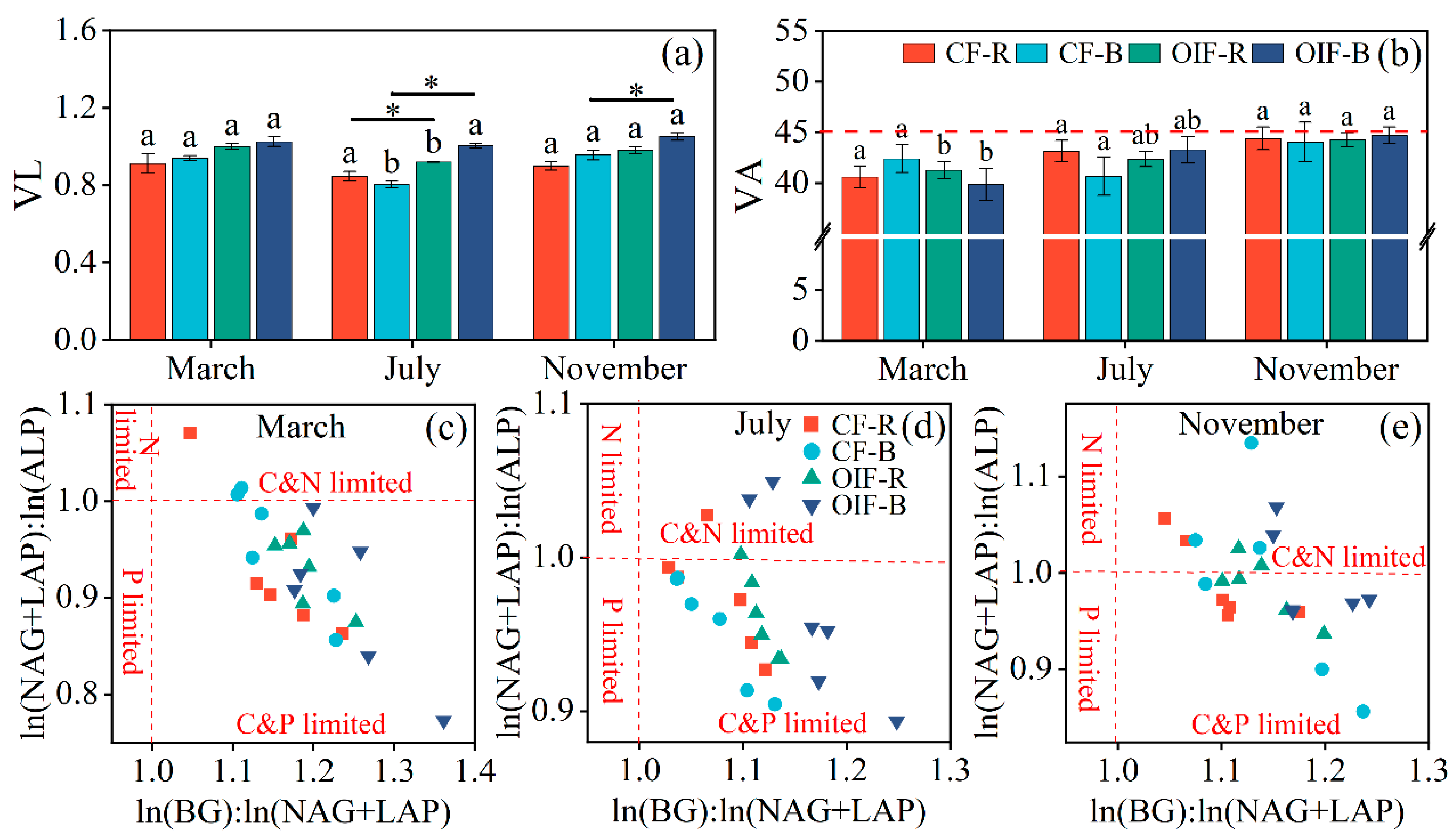
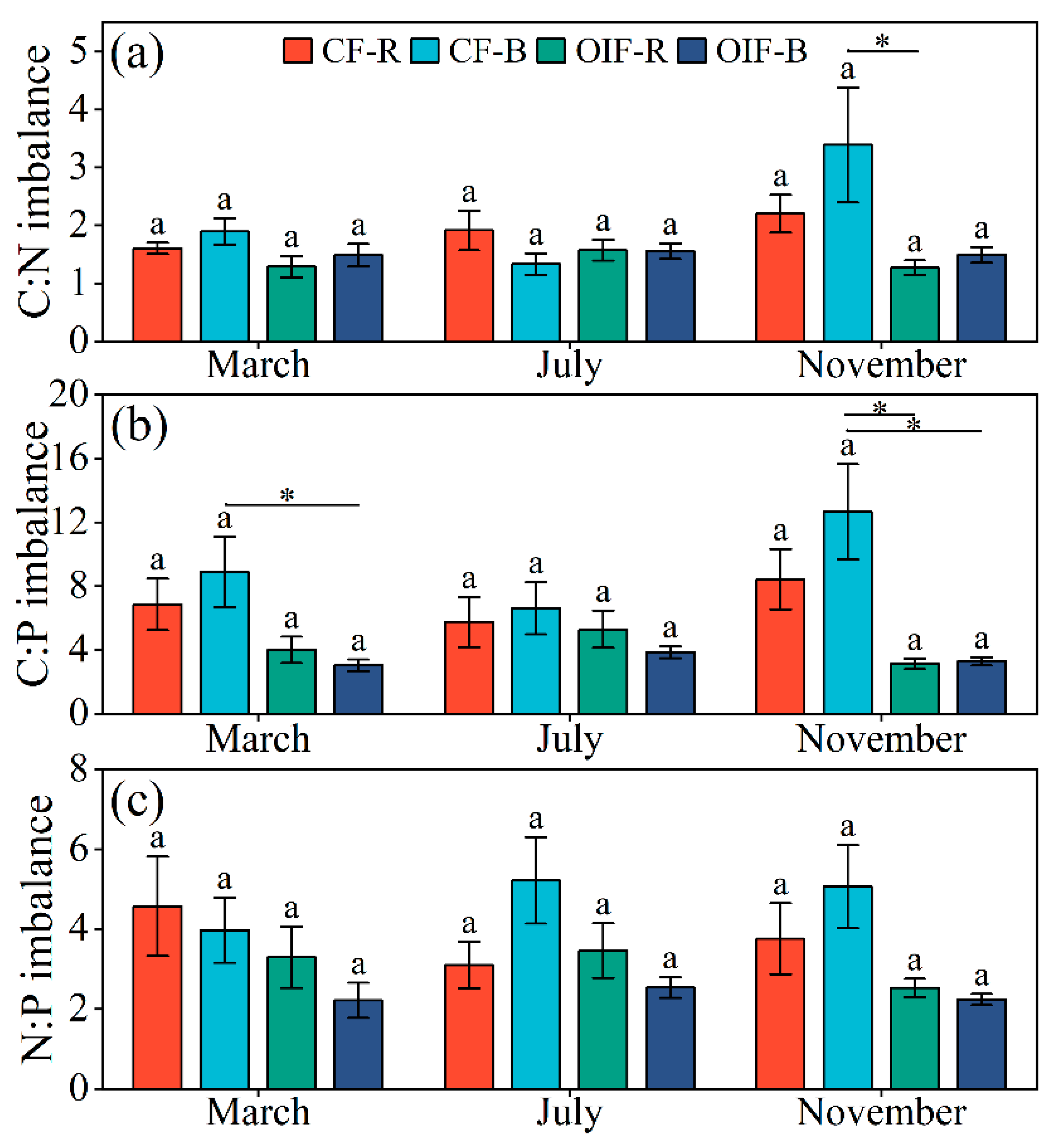
3.3. Seasonal Evolution of Microbial Nutrient Limitation Inferred from Enzyme Vectors and Stoichiometric Imbalance Indices
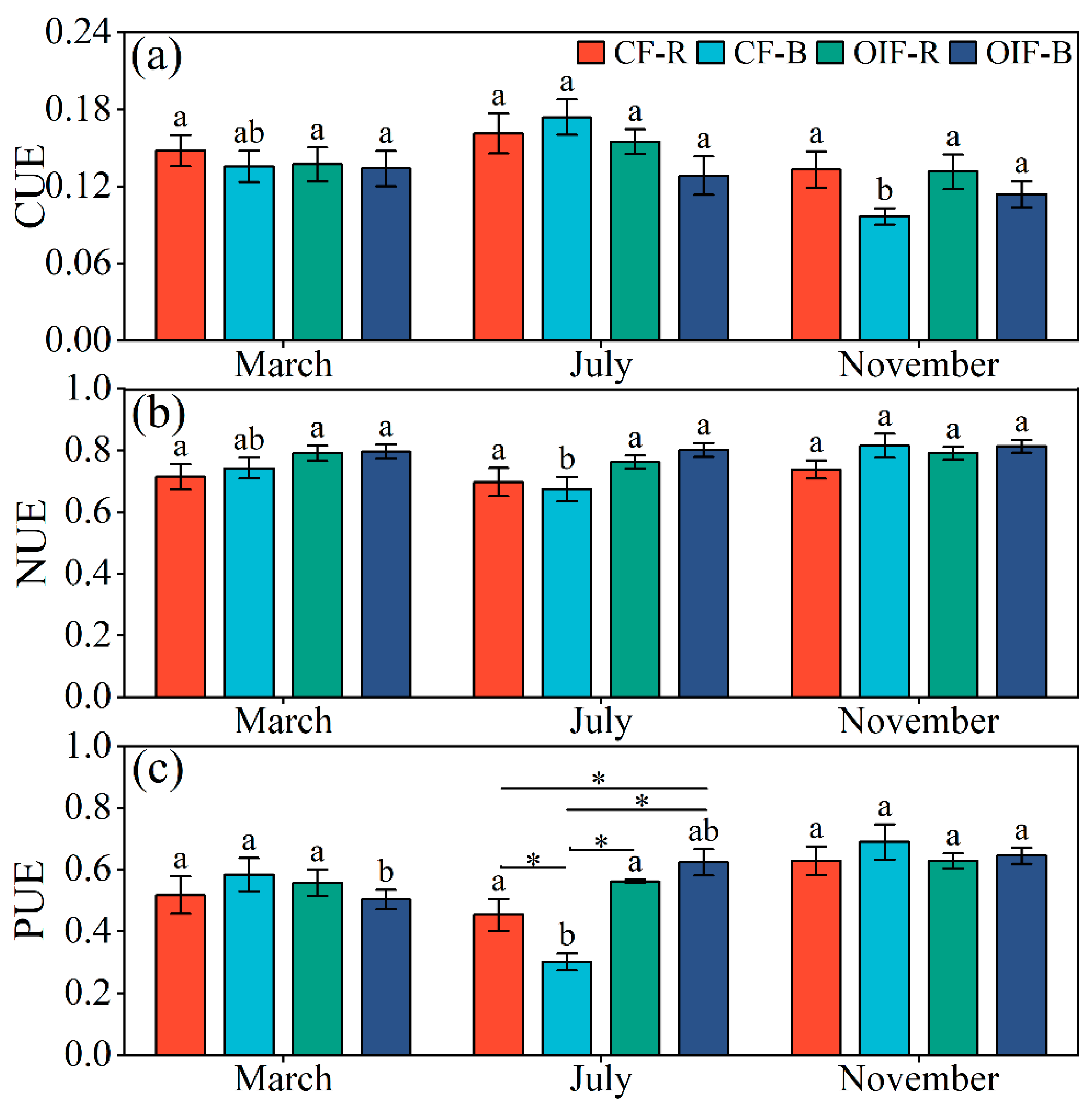
3.4. Seasonal Differentiation of Microbial C, N, and P Use Efficiency and Shifts in Metabolic Strategies
3.5. Responses of Microbial Biomass Stoichiometric Homeostasis to Fertilization Management
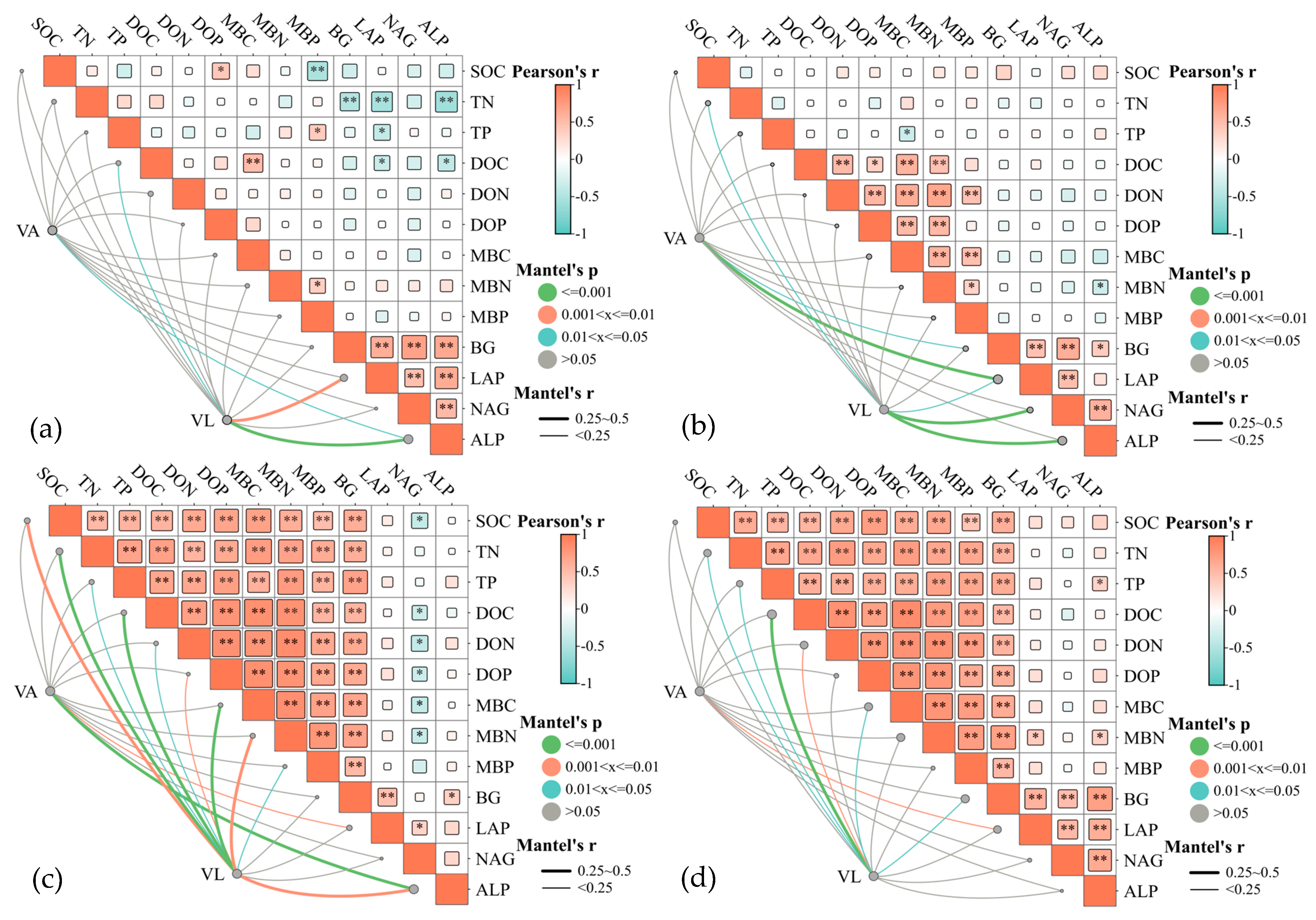
3.6. Association Networks Between Multicomponent Soil Stoichiometry and Microbial Functional Attributes
3.7. Key Pathway Analysis of Drivers Regulating Microbial Element Use Efficiency
4. Discussion
4.1. Seasonal Dynamics of Soil Nutrients and Extracellular Enzyme Activity
4.2. Combined Organic and Inorganic Fertilization and Rhizosphere Effects Synergistically Enhance Microbial Stoichiometric Homeostasis
4.3. Seasonal Discrepancies in Microbial Element Use Efficiency Reflect Strategic Adaptations
4.4. Environmental Stress Drives Seasonal Dynamics of Microbial Nutrient Limitation
4.5. Study Limitations and Future Directions
5. Conclusions
Supplementary Materials
Author Contributions
Funding
Institutional Review Board Statement
Informed Consent Statement
Data Availability Statement
Acknowledgments
Conflicts of Interest
References
- Gaffney, P.P.J.; Tang, Q.; Wang, J.; Zhang, C.; Xu, X.; Xu, X.; Li, Y.; Pap, S.; Ratcliffe, J.L.; Li, Q.; et al. The High-Altitude Peatland Carbon Cycle: A Review of the Impacts of Climate Change, Human Disturbance and Management. Sustainability 2025, 6, 100353. [Google Scholar] [CrossRef]
- Huang, M.; Lu, R.; Wu, Y.; Zhao, T.; Zhao, J.; Ma, L. Spatiotemporal Dynamics and Influencing Factors of Soil Quality in Aeolian Desertified Lands of the Qinghai-Tibet Plateau. Ecol. Indic. 2025, 172, 113264. [Google Scholar] [CrossRef]
- Sun, Y.; Liu, S.; Liu, C.; Sun, J.; Liu, Y.; Wang, F. Interactive Response and Spatial Heterogeneity of Alpine Grassland Biodiversity to Soil, Topography, Climate, and Human Factors on the Qinghai-Tibet Plateau. Land Degrad. Dev. 2023, 34, 4488–4502. [Google Scholar] [CrossRef]
- Xia, M.; Jia, K.; Zhao, W.; Liu, S.; Wei, X.; Wang, B. Spatio-Temporal Changes of Ecological Vulnerability across the Qinghai-Tibetan Plateau. Ecol. Indic. 2021, 123, 107274. [Google Scholar] [CrossRef]
- Dong, J.; Cui, X.; Wang, S.; Wang, F.; Pang, Z.; Xu, N.; Zhao, G.; Wang, S. Changes in Biomass and Quality of Alpine Steppe in Response to N & P Fertilization in the Tibetan Plateau. PLoS ONE 2016, 11, e0156146. [Google Scholar] [CrossRef]
- Wang, D.; Zhou, H.; Zuo, J.; Chen, P.; She, Y.; Yao, B.; Dong, S.; Wu, J.; Li, F.; Njoroge, D.M.; et al. Responses of Soil Microbial Metabolic Activity and Community Structure to Different Degraded and Restored Grassland Gradients of the Tibetan Plateau. Front. Plant Sci. 2022, 13, 770315. [Google Scholar] [CrossRef]
- Meng, Z.; Liu, J.; Cao, L.; Li, B.; Wang, N.; Chen, M.; Zhou, Z. Trade-off between Soil Carbon and Water Following Revegetation across Climatic Gradients on the Loess Plateau. Catena 2025, 255, 109071. [Google Scholar] [CrossRef]
- Otto, G. Changing Soil Microbiomes. Nat. Rev. Microbiol. 2021, 19, 283. [Google Scholar] [CrossRef]
- Sorensen, P.O.; Finzi, A.C.; Giasson, M.-A.; Reinmann, A.B.; Sanders-DeMott, R.; Templer, P.H. Winter Soil Freeze-Thaw Cycles Lead to Reductions in Soil Microbial Biomass and Activity Not Compensated for by Soil Warming. Soil Biol. Biochem. 2018, 116, 39–47. [Google Scholar] [CrossRef]
- Kallenbach, C.M.; Frey, S.D.; Grandy, A.S. Direct Evidence for Microbial-Derived Soil Organic Matter Formation and Its Ecophysiological Controls. Nat. Commun. 2016, 7, 13630, Erratum in Nat. Commun. 2018, 9, 3929. https://doi.org/10.1038/s41467-018-06427-3. [Google Scholar] [CrossRef] [PubMed]
- Tao, F.; Huang, Y.; Hungate, B.A.; Manzoni, S.; Frey, S.D.; Schmidt, M.W.I.; Reichstein, M.; Carvalhais, N.; Ciais, P.; Jiang, L.; et al. Microbial Carbon Use Efficiency Promotes Global Soil Carbon Storage. Nature 2023, 618, 981–985. [Google Scholar] [CrossRef] [PubMed]
- Ren, C.; Zhou, Z.; Delgado-Baquerizo, M.; Bastida, F.; Zhao, F.; Yang, Y.; Zhang, S.; Wang, J.; Zhang, C.; Han, X.; et al. Thermal Sensitivity of Soil Microbial Carbon Use Efficiency across Forest Biomes. Nat. Commun. 2024, 15, 6269. [Google Scholar] [CrossRef]
- Zhou, J.; Luo, Y.; Chen, J. Dilemmas in Linking Microbial Carbon Use Efficiency with Soil Organic Carbon Dynamics. Glob. Change Biol. 2025, 31, e70047. [Google Scholar] [CrossRef]
- Mooshammer, M.; Hofhansl, F.; Frank, A.H.; Wanek, W.; Hämmerle, I.; Leitner, S.; Schnecker, J.; Wild, B.; Watzka, M.; Keiblinger, K.M.; et al. Decoupling of Microbial Carbon, Nitrogen, and Phosphorus Cycling in Response to Extreme Temperature Events. Sci. Adv. 2017, 3, e1602781. [Google Scholar] [CrossRef]
- Sun, L.; Qiao, Y.; Wanek, W.; Moorhead, D.L.; Cui, Y.; Peng, Y.; Song, L.; Hu, B.; Zhang, T.; Li, S. Nitrogen Input Decreases Microbial Nitrogen Use Efficiency in Surface Soils of a Temperate Forest in Northeast China. Geoderma 2025, 453, 117159. [Google Scholar] [CrossRef]
- Yao, B.; Wang, X.; Li, Y.; Lian, J.; Li, Y.; Luo, Y.; Li, Y. Soil Extracellular Enzyme Activity Reflects the Change of Nitrogen to Phosphorus Limitation of Microorganisms during Vegetation Restoration in Semi-Arid Sandy Land of Northern China. Front. Environ. Sci. 2023, 11, 1298027. [Google Scholar] [CrossRef]
- Zeng, Q.; Chen, Z.; Tan, W. Plant Litter Quality Regulates Soil Eco-Enzymatic Stoichiometry and Microbial Nutrient Limitation in a Citrus Orchard. Plant Soil 2021, 466, 179–191. [Google Scholar] [CrossRef]
- Wang, C.; Kuzyakov, Y. Soil Organic Matter Priming: The pH Effects. Glob. Change Biol. 2024, 30, e17349. [Google Scholar] [CrossRef]
- Gao, Y.; Tariq, A.; Zeng, F.; Sardans, J.; Graciano, C.; Li, X.; Wang, W.; Peñuelas, J. Soil Microbial Functional Profiles of P-Cycling Reveal Drought-Induced Constraints on P-Transformation in a Hyper-Arid Desert Ecosystem. Sci. Total Environ. 2024, 925, 171767. [Google Scholar] [CrossRef]
- Diao, H.; Wang, J.; Chen, Y.; Gao, Y.; Liang, W.; Pang, G.; Bian, J.; Wang, J.; Hao, J.; Wang, C.; et al. Interactive Effects of Nitrogen Addition and Drought on Soil Microbial Carbon Use Efficiency in Saline-Alkaline Grasslands of Northern China. Plant Soil 2025, 514, 1561–1576. [Google Scholar] [CrossRef]
- Ji, X.; Liu, M.; Yang, J.; Feng, F. Meta-Analysis of the Impact of Freeze–Thaw Cycles on Soil Microbial Diversity and C and N Dynamics. Soil Biol. Biochem. 2022, 168, 108608. [Google Scholar] [CrossRef]
- Liu, M.; Zhang, Z.; He, P.; Zhang, Y.; Li, L.-J. Changes in Soil Microbial Community and Carbon Use Efficiency in Freeze-Thaw Period Restored after Growth Season under Warming and Straw Return. Appl. Soil Ecol. 2025, 205, 105779. [Google Scholar] [CrossRef]
- Sinsabaugh, R.L.; Manzoni, S.; Moorhead, D.L.; Richter, A. Carbon Use Efficiency of Microbial Communities: Stoichiometry, Methodology and Modelling. Ecol. Lett. 2013, 16, 930–939. [Google Scholar] [CrossRef]
- Domeignoz-Horta, L.A.; Pold, G.; Liu, X.-J.A.; Frey, S.D.; Melillo, J.M.; DeAngelis, K.M. Microbial Diversity Drives Carbon Use Efficiency in a Model Soil. Nat. Commun. 2020, 11, 3684. [Google Scholar] [CrossRef]
- Zhang, Q.; Qin, W.; Feng, J.; Li, X.; Zhang, Z.; He, J.-S.; Schimel, J.P.; Zhu, B. Whole-Soil-Profile Warming Does Not Change Microbial Carbon Use Efficiency in Surface and Deep Soils. Proc. Natl. Acad. Sci. USA 2023, 120, e2302190120. [Google Scholar] [CrossRef]
- Zhang, S.; Zheng, Q.; Noll, L.; Hu, Y.; Wanek, W. Environmental Effects on Soil Microbial Nitrogen Use Efficiency Are Controlled by Allocation of Organic Nitrogen to Microbial Growth and Regulate Gross N Mineralization. Soil Biol. Biochem. 2019, 135, 304–315. [Google Scholar] [CrossRef] [PubMed]
- Li, J.; Sang, C.; Yang, J.; Qu, L.; Xia, Z.; Sun, H.; Jiang, P.; Wang, X.; He, H.; Wang, C. Stoichiometric Imbalance and Microbial Community Regulate Microbial Elements Use Efficiencies under Nitrogen Addition. Soil Biol. Biochem. 2021, 156, 108207. [Google Scholar] [CrossRef]
- Wu, J.; Cheng, X.; Liu, G. Increased Soil Organic Carbon Response to Fertilization Is Associated with Increasing Microbial Carbon Use Efficiency: Data Synthesis. Soil Biol. Biochem. 2022, 171, 108731. [Google Scholar] [CrossRef]
- Bao, S. Agrochemical Analysis of Soil; China Agricultural Press: Beijing, China, 2000. [Google Scholar]
- Wu, J.; Lin, Q.; Huang, Q. Determination Methods of Soil Microbial Biomass and Its Application, 4th ed.; China Meteorological Press: Beijing, China, 2006. [Google Scholar]
- Luo, X.; Zhang, L.; Li, Z.; Zhang, R.; Le Roux, J.J.; Reynolds, J.K.; Yu, H.; Chen, M.; Zheng, Y.; Hou, E.; et al. Adaptation Mechanisms of Soil Microbial Community to Stoichiometric Imbalances Caused by Forest Conversion. Appl. Soil Ecol. 2024, 201, 105529. [Google Scholar] [CrossRef]
- Moorhead, D.L.; Sinsabaugh, R.L.; Hill, B.H.; Weintraub, M.N. Vector Analysis of Ecoenzyme Activities Reveal Constraints on Coupled C, N and P Dynamics. Soil Biol. Biochem. 2016, 93, 1–7. [Google Scholar] [CrossRef]
- Mu, C.; Li, J.; Huang, F.; Zhang, Z.; Qin, J.; Wang, G. Response of Extracellular Enzyme Stoichiometric Properties and Microbial Metabolic Limitations to the Ecosystem Transition Mode Employed in Red Jujube Economic Forests on the Loess Plateau. Microorganisms 2025, 13, 729. [Google Scholar] [CrossRef]
- Deng, Y.; Li, X.; Shi, F.; Zhang, Y. Divergent Controlling Factors of Freeze–Thaw-Induced Changes in Dissolved Organic Carbon and Microbial Biomass Carbon between Topsoil and Subsoil of Cold Alpine Grasslands. Catena 2024, 241, 108063. [Google Scholar] [CrossRef]
- Wu, J.; Song, M.; Ma, W.; Zhang, X.; Shen, Z.; Tarolli, P.; Wurst, S.; Shi, P.; Ratzmann, G.; Feng, Y.; et al. Plant and Soil’s δ15N Are Regulated by Climate, Soil Nutrients, and Species Diversity in Alpine Grasslands on the Northern Tibetan Plateau. Agric. Ecosyst. Environ. 2019, 281, 111–123. [Google Scholar] [CrossRef]
- Gannett, M.; DiTommaso, A.; Sparks, J.P.; Kao-Kniffin, J. Microbial Nitrogen Immobilization Reduces Competitive Advantage of Nitrophilous Plants with Soybean. Plant Soil 2025, 508, 819–838. [Google Scholar] [CrossRef]
- Chuwongpanich, W.; Fujii, K.; Inagaki, Y.; Hayakawa, C.; Chittamart, N. Effects of Sugarcane Substrate Inputs on Microbial Biomass and Nitrogen Availability in Tropical Sandy Soils of Northeast Thailand. Soil Sci. Plant Nutr. 2021, 67, 130–138. [Google Scholar] [CrossRef]
- Schmidt, S.K.; Lipson, D.A.; Ley, R.E.; Fisk, M.C.; West, A.E. Impacts of Chronic Nitrogen Additions Vary Seasonally and by Microbial Functional Group in Tundra Soils. Biogeochemistry 2004, 69, 1–17. [Google Scholar] [CrossRef]
- Schnecker, J.; Baldaszti, L.; Gündler, P.; Pleitner, M.; Sandén, T.; Simon, E.; Spiegel, F.; Spiegel, H.; Urbina Malo, C.; Zechmeister-Boltenstern, S.; et al. Seasonal Dynamics of Soil Microbial Growth, Respiration, Biomass, and Carbon Use Efficiency in Temperate Soils. Geoderma 2023, 440, 116693. [Google Scholar] [CrossRef]
- Hu, Y.; Ganjurjav, H.; Hu, G.; Ji, G.; Han, L.; Sha, Y.; Liang, Y.; Gao, Q. Responses of Bacterial Community Composition and Diversity to Multi-Level Nitrogen Addition at Different Periods of Growing Season Driven by Conditional Rare Taxa in an Alpine Meadow. Biol. Fertil. Soils 2023, 59, 939–952. [Google Scholar] [CrossRef]
- Huo, C.; Zhang, J.; Yang, X.; Li, X.; Su, Y.; Chen, Z. Dry Season Irrigation Promotes Nutrient Cycling by Reorganizing Eucalyptus Rhizosphere Microbiome. Sci. Total Environ. 2024, 954, 176307. [Google Scholar] [CrossRef]
- Chen, H.; Gou, M.; Hu, J.; Lei, L.; Zhu, S.; Hu, R.; Zhao, H.; Xiao, W.; Liu, C. Seasonal Variations in Soil Enzyme Activity and Nutrient Limitations of Differently Aged Pinus Massoniana Plantation. Microorganisms 2024, 12, 2314. [Google Scholar] [CrossRef]
- Li, Y.; Ma, J.; Li, Y.; Shen, X.; Xia, X. Microbial Community and Enzyme Activity Respond Differently to Seasonal and Edaphic Factors in Forest and Grassland Ecosystems. Appl. Soil Ecol. 2024, 194, 105167. [Google Scholar] [CrossRef]
- Zhang, S.; Tang, Y.; Yang, Y.; Zhang, C.; Liu, S.; Niu, S.; Yang, H.; Zhang, X. Responses of Soil Extracellular Enzymes to N and P Additions Vary between Temperate and Subtropical Forests. Eur. J. Soil Sci. 2025, 76, e70178. [Google Scholar] [CrossRef]
- Mooshammer, M.; Wanek, W.; Zechmeister-Boltenstern, S.; Richter, A. Stoichiometric Imbalances between Terrestrial Decomposer Communities and Their Resources: Mechanisms and Implications of Microbial Adaptations to Their Resources. Front. Microbiol. 2014, 5, 22. [Google Scholar] [CrossRef] [PubMed]
- Wang, X.; Sun, T.; Mao, X.; Cheng, Q.; Liu, X.; Zhou, J.; He, Y.; Ma, Q.; Wu, L. Long-Term Fertilizer Application Alters Microbial Resource Limitations in Soil Aggregates via Nutrient and Microbial Resource Allocation. Plant Soil 2024, 508, 971–985. [Google Scholar] [CrossRef]
- Shi, J.; Deng, L.; Wu, J.; Huang, Y.; Dong, Y.; Peñuelas, J.; Liao, Y.; Yang, L.; Huang, X.; Zhang, H.; et al. Global Change Modulates Microbial Carbon Use Efficiency: Mechanisms and Impacts on Soil Organic Carbon Dynamics. Glob. Change Biol. 2025, 31, e70240. [Google Scholar] [CrossRef]
- Su, W.; Ma, Y.; Hua, M.; Chen, H.; Liu, Z.; Wang, S.; Wang, Y. Enhancing Microbial Carbon Use Efficiency via Exogenous Carbon Inputs: Implications for Soil Carbon Sequestration and Phosphorus Availability. Appl. Soil Ecol. 2025, 211, 106160. [Google Scholar] [CrossRef]
- Wang, L.; Zhang, L.; George, T.S.; Feng, G. A Core Microbiome in the Hyphosphere of Arbuscular Mycorrhizal Fungi Has Functional Significance in Organic Phosphorus Mineralization. New Phytol. 2022, 238, 859–873. [Google Scholar] [CrossRef]
- Cui, J.; Zhang, S.; Wang, X.; Xu, X.; Ai, C.; Liang, G.; Zhu, P.; Zhou, W. Enzymatic Stoichiometry Reveals Phosphorus Limitation-Induced Changes in the Soil Bacterial Communities and Element Cycling: Evidence from a Long-Term Field Experiment. Geoderma 2022, 426, 116124. [Google Scholar] [CrossRef]
- Lu, Q.; An, Z.; Zhang, B.; Lu, X.; Mao, X.; Li, J.; Chang, S.X.; Liu, Y.; Fu, X. Optimizing Tradeoff Strategies of Soil Microbial Community between Metabolic Efficiency and Resource Acquisition along a Natural Regeneration Chronosequence. Sci. Total Environ. 2024, 946, 174337. [Google Scholar] [CrossRef]
- Wutzler, T.; Reimers, C.; Ahrens, B.; Schrumpf, M. Optimal Enzyme Allocation Leads to the Constrained Enzyme Hypothesis: The Soil Enzyme Steady Allocation Model (SESAM; v3.1). Geosci. Model Dev. 2024, 17, 2705–2725. [Google Scholar] [CrossRef]
- Luo, C.; Wu, Y.; He, Q.; Wang, J.; Bing, H. Microbial Nutrient Limitation and Carbon Use Efficiency Changes under Different Degrees of Litter Decomposition. Environ. Geochem. Health 2024, 46, 328. [Google Scholar] [CrossRef]
- He, X.; Liu, F.; Ma, T.; Ma, A.; Wang, Y.; Li, Y.; Gao, W.; Yang, Z.; Ke, J.; Xiao, Y.; et al. Temperature and Microbial Metabolic Limitations Govern Microbial Carbon Use Efficiency in the Tibetan Alpine Grassland. Appl. Soil Ecol. 2025, 206, 105880. [Google Scholar] [CrossRef]
- Dragone, N.B.; Hoffert, M.; Strickland, M.S.; Fierer, N. Taxonomic and Genomic Attributes of Oligotrophic Soil Bacteria. ISME Commun. 2024, 4, ycae081. [Google Scholar] [CrossRef]
- Lv, C.; Wang, C.; Cai, A.; Zhou, Z. Global Magnitude of Rhizosphere Effects on Soil Microbial Communities and Carbon Cycling in Natural Terrestrial Ecosystems. Sci. Total Environ. 2023, 856, 158961. [Google Scholar] [CrossRef]
- Liu, Y.; Shahbaz, M.; Fang, Y.; Li, B.; Wei, X.; Zhu, Z.; Lynn, T.M.; Lu, S.; Shibistova, O.; Wu, J.; et al. Stoichiometric Theory Shapes Enzyme Kinetics in Paddy Bulk Soil but Not in Rhizosphere Soil. Land Degrad. Dev. 2022, 33, 246–256. [Google Scholar] [CrossRef]
- Tong, R.; Kuzyakov, Y.; Yu, H.; Cao, Y.; Wu, T. Rhizosphere Response and Resistance to Fertilization. Commun. Earth Environ. 2025, 6, 602. [Google Scholar] [CrossRef]
- Dopheide, A.; Davis, C.; Wakelin, S.A.; Whitehead, D.; Grelet, G.-A. Labile Carbon Inputs Support the Recovery of Bacterial Communities, but Not Fungal Communities, from a Simulated Bovine Urine Event. Biol. Fertil. Soils 2023, 59, 333–349. [Google Scholar] [CrossRef]
- Marschmann, G.L.; Tang, J.; Zhalnina, K.; Karaoz, U.; Cho, H.; Le, B.; Pett-Ridge, J.; Brodie, E.L. Predictions of Rhizosphere Microbiome Dynamics with a Genome-Informed and Trait-Based Energy Budget Model. Nat. Microbiol. 2024, 9, 421–433. [Google Scholar] [CrossRef]
- Fu, Y.; Tang, X.; Sun, T.; Lin, L.; Wu, L.; Zhang, T.; Gong, Y.; Li, Y.; Wu, H.; Xiong, J.; et al. Rare Taxa Mediate Microbial Carbon and Nutrient Limitation in the Rhizosphere and Bulk Soil under Sugarcane–Peanut Intercropping Systems. Front. Microbiol. 2024, 15, 1403338. [Google Scholar] [CrossRef]
- Du, S.; Xie, H.; E, C.; Zhang, G.; Qiao, F.; Geng, G. Effectiveness of Different Sand Control Measures in Improving the Surface Soil in Alpine Sandy Land. Land Degrad. Dev. 2025, 36, 5269–5286. [Google Scholar] [CrossRef]
- Schmitt, M.; Jarosch, K.A.; Hertel, R.; Spielvogel, S.; Dippold, M.A.; Loeppmann, S. Manufacturing Triple-Isotopically Labeled Microbial Necromass to Track C, N and P Cycles in Terrestrial Ecosystems. Appl. Soil Ecol. 2022, 171, 104322. [Google Scholar] [CrossRef]
- Tang, S.; Pan, W.; Yang, Y.; Luo, Z.; Wanek, W.; Kuzyakov, Y.; Marsden, K.A.; Liang, G.; Chadwick, D.R.; Gregory, A.S.; et al. Soil Carbon Sequestration Enhanced by Long-Term Nitrogen and Phosphorus Fertilization. Nat. Geosci. 2025, 18, 1005–1013. [Google Scholar] [CrossRef]
- Zhang, F.; Du, W.; Song, C.; Li, H.; Zhu, J.; Liang, N. Long-Term Multi-Nutrient Enrichment Enhances Aboveground Biomass without Compromising Ecosystem Temporal Stability in a Tibetan Alpine Meadow. Agric. Ecosyst. Environ. 2025, 394, 109917. [Google Scholar] [CrossRef]





| Indicator | Treatment | March | July | November |
|---|---|---|---|---|
| SOC | CF-R | 6.30 ± 0.24 Aa | 5.73 ± 0.47 Aa | 5.98 ± 0.62 Aa |
| (g·kg−1) | CF-B | 5.57 ± 0.23 Aa | 5.23 ± 0.45 Aa | 5.51 ± 0.28 Aa |
| OIF-R | 8.01 ± 0.56 Aa | 8.21 ± 0.51 Aa | 8.50 ± 0.36 Aa | |
| OIF-B | 7.25 ± 0.37 Aa | 7.39 ± 0.68 Aa | 7.62 ± 0.50 Aa | |
| TN | CF-R | 0.767 ± 0.011 Aa | 0.649 ± 0.034 Bb | 0.762 ± 0.020 ABa |
| (g·kg−1) | CF-B | 0.771 ± 0.024 Aa | 0.652 ± 0.042 Ab | 0.732 ± 0.019 Aab |
| OIF-R | 0.903 ± 0.018 Aa | 0.887 ± 0.026 Aa | 0.891 ± 0.021 Aa | |
| OIF-B | 0.888 ± 0.032 Aa | 0.879 ± 0.010 Aa | 0.883 ± 0.022 Aa | |
| TP | CF-R | 0.379 ± 0.032 Aa | 0.344 ± 0.034 Aa | 0.384 ± 0.019 Aa |
| (g·kg−1) | CF-B | 0.364 ± 0.026 Aa | 0.358 ± 0.040 Aa | 0.401 ± 0.026 Aa |
| OIF-R | 0.559 ± 0.052 Aa | 0.549 ± 0.036 Aa | 0.531 ± 0.018 Aa | |
| OIF-B | 0.531 ± 0.015 Aa | 0.554 ± 0.020 Aa | 0.547 ± 0.031 Aa | |
| DOC | CF-R | 121.6 ± 5.74 Aa | 90.56 ± 11.38 Ab | 84.43 ± 5.33 Ab |
| (mg·kg−1) | CF-B | 118.1 ± 4.20 Aa | 78.19 ± 6.30 Bb | 82.84 ± 8.61 Bb |
| OIF-R | 197.6 ± 6.9 ABa | 152.6 ± 12.0 Bb | 201.5 ± 8.7 Aa | |
| OIF-B | 170.1 ± 9.8 Aa | 134.1 ± 9.5 Ab | 161.7 ± 4.5 Aab | |
| DN | CF-R | 24.61 ± 2.78 Aa | 20.93 ± 2.40 Aa | 18.56 ± 0.79 Aa |
| (mg·kg−1) | CF-B | 24.88 ± 1.32 Aa | 26.14 ± 2.36 Aa | 17.91 ± 1.40 Ab |
| OIF-R | 53.81 ± 2.57 Aa | 33.96 ± 2.33 Bb | 58.31 ± 0.74 Aa | |
| OIF-B | 42.29 ± 4.10 Aa | 35.77 ± 1.61 Aa | 44.74 ± 2.53 Aa | |
| DP | CF-R | 2.39 ± 0.43 Aa | 1.93 ± 0.28 Aa | 1.88 ± 0.27 Aa |
| (mg·kg−1) | CF-B | 1.97 ± 0.24 Aa | 1.74 ± 0.24 Aa | 1.47 ± 0.18 Aa |
| OIF-R | 5.27 ± 0.49 ABab | 3.79 ± 0.50 Bb | 6.65 ± 0.36 Aa | |
| OIF-B | 5.10 ± 0.58 Aa | 4.27 ± 0.20 Aa | 5.25 ± 0.37 Aa | |
| MBC | CF-R | 82.49 ± 5.46 Aa | 73.01 ± 3.78 ABa | 51.62 ± 4.09 Bb |
| (mg·kg−1) | CF-B | 69.67 ± 6.57 Aa | 58.80 ± 3.65 Aab | 41.72 ± 7.35 Ab |
| OIF-R | 146.9 ± 9.1 ABa | 115.6 ± 2.6 Bb | 163.4 ± 9.5 Aa | |
| OIF-B | 136.8 ± 4.3 Aa | 89.5 ± 3.0 Bb | 139.1 ± 5.6 Aa | |
| MBN | CF-R | 25.77 ± 1.59 Aa | 29.66 ± 1.41 Aa | 24.50 ± 3.46 Aa |
| (mg·kg−1) | CF-B | 26.18 ± 1.20 Aa | 24.54 ± 1.29 Aa | 23.85 ± 1.00 Aa |
| OIF-R | 49.57 ± 4.22 ABab | 39.54 ± 2.81 Bb | 58.40 ± 2.90 Aa | |
| OIF-B | 47.68 ± 1.84 Ab | 36.68 ± 1.58 Bc | 55.89 ± 1.99 Aa | |
| MBP | CF-R | 8.90 ± 0.50 Aa | 7.73 ± 0.93 Aa | 8.15 ± 1.62 Aa |
| (mg·kg−1) | CF-B | 8.64 ± 1.31 Aa | 7.66 ± 1.28 Aa | 7.76 ± 1.09 Aa |
| OIF-R | 14.06 ± 1.66 Aa | 13.12 ± 0.86 Aa | 16.43 ± 1.23 Aa | |
| OIF-B | 11.75 ± 0.66 Aab | 11.07 ± 1.10 Ab | 14.45 ± 0.56 Aa |
| Indicator | Treatment | March | July | November |
|---|---|---|---|---|
| BG | CF-R | 0.517 ± 0.053 Bb | 0.963 ± 0.058 Aa | 0.705 ± 0.056 ABb |
| (μmol·g−1·h−1) | CF-B | 0.542 ± 0.048 Ab | 0.716 ± 0.022 Aa | 0.633 ± 0.048 Aab |
| OIF-R | 1.082 ± 0.051 Ab | 1.279 ± 0.078 Aa | 1.247 ± 0.051 Aa | |
| OIF-B | 0.922 ± 0.067 Ab | 1.173 ± 0.041 Aa | 1.087 ± 0.067 Aab | |
| LAP | CF-R | 0.165 ± 0.019 Bb | 0.405 ± 0.036 Aa | 0.240 ± 0.023 Bb |
| (μmol·g−1·h−1) | CF-B | 0.146 ± 0.027 Bb | 0.314 ± 0.045 Aa | 0.187 ± 0.027 ABb |
| OIF-R | 0.269 ± 0.019 Ab | 0.406 ± 0.029 Aa | 0.365 ± 0.038 Aab | |
| OIF-B | 0.190 ± 0.025 Ab | 0.299 ± 0.043 Aa | 0.271 ± 0.008 Aab | |
| NAG | CF-R | 0.061 ± 0.007 Bc | 0.187 ± 0.012 Aa | 0.147 ± 0.009 Ab |
| (μmol·g−1·h−1) | CF-B | 0.106 ± 0.025 Aa | 0.155 ± 0.021 Aa | 0.112 ± 0.018 Aa |
| OIF-R | 0.087 ± 0.013 Bb | 0.199 ± 0.027 Aa | 0.161 ± 0.021 ABab | |
| OIF-B | 0.068 ± 0.012 Bb | 0.144 ± 0.017 Aa | 0.094 ± 0.011 ABab | |
| ALP | CF-R | 0.344 ± 0.032 Bb | 0.699 ± 0.039 Aa | 0.414 ± 0.026 Bb |
| (μmol·g−1·h−1) | CF-B | 0.311 ± 0.021 Bb | 0.623 ± 0.014 Aa | 0.335 ± 0.050 Bb |
| OIF-R | 0.561 ± 0.044 Bb | 0.782 ± 0.053 Aa | 0.574 ± 0.025 Bb | |
| OIF-B | 0.475 ± 0.043 Aa | 0.536 ± 0.039 Aa | 0.388 ± 0.039 Aa |
Disclaimer/Publisher’s Note: The statements, opinions and data contained in all publications are solely those of the individual author(s) and contributor(s) and not of MDPI and/or the editor(s). MDPI and/or the editor(s) disclaim responsibility for any injury to people or property resulting from any ideas, methods, instructions or products referred to in the content. |
© 2026 by the authors. Licensee MDPI, Basel, Switzerland. This article is an open access article distributed under the terms and conditions of the Creative Commons Attribution (CC BY) license.
Share and Cite
Yang, K.; Huang, F.; Yang, W.; Lu, X.; Zhu, Z.; Zhu, J.; Wu, Q.; Xu, X. Integrated Organic–Inorganic Fertilization Enhances Microbial Stoichiometric Homeostasis but Triggers Seasonal Metabolic Trade-Offs in an Alpine Sandy Ecosystem. Microorganisms 2026, 14, 1186. https://doi.org/10.3390/microorganisms14061186
Yang K, Huang F, Yang W, Lu X, Zhu Z, Zhu J, Wu Q, Xu X. Integrated Organic–Inorganic Fertilization Enhances Microbial Stoichiometric Homeostasis but Triggers Seasonal Metabolic Trade-Offs in an Alpine Sandy Ecosystem. Microorganisms. 2026; 14(6):1186. https://doi.org/10.3390/microorganisms14061186
Chicago/Turabian StyleYang, Kai, Fuchun Huang, Wensheng Yang, Xupeng Lu, Zhengtao Zhu, Jianqiang Zhu, Qixia Wu, and Xiaohong Xu. 2026. "Integrated Organic–Inorganic Fertilization Enhances Microbial Stoichiometric Homeostasis but Triggers Seasonal Metabolic Trade-Offs in an Alpine Sandy Ecosystem" Microorganisms 14, no. 6: 1186. https://doi.org/10.3390/microorganisms14061186
APA StyleYang, K., Huang, F., Yang, W., Lu, X., Zhu, Z., Zhu, J., Wu, Q., & Xu, X. (2026). Integrated Organic–Inorganic Fertilization Enhances Microbial Stoichiometric Homeostasis but Triggers Seasonal Metabolic Trade-Offs in an Alpine Sandy Ecosystem. Microorganisms, 14(6), 1186. https://doi.org/10.3390/microorganisms14061186