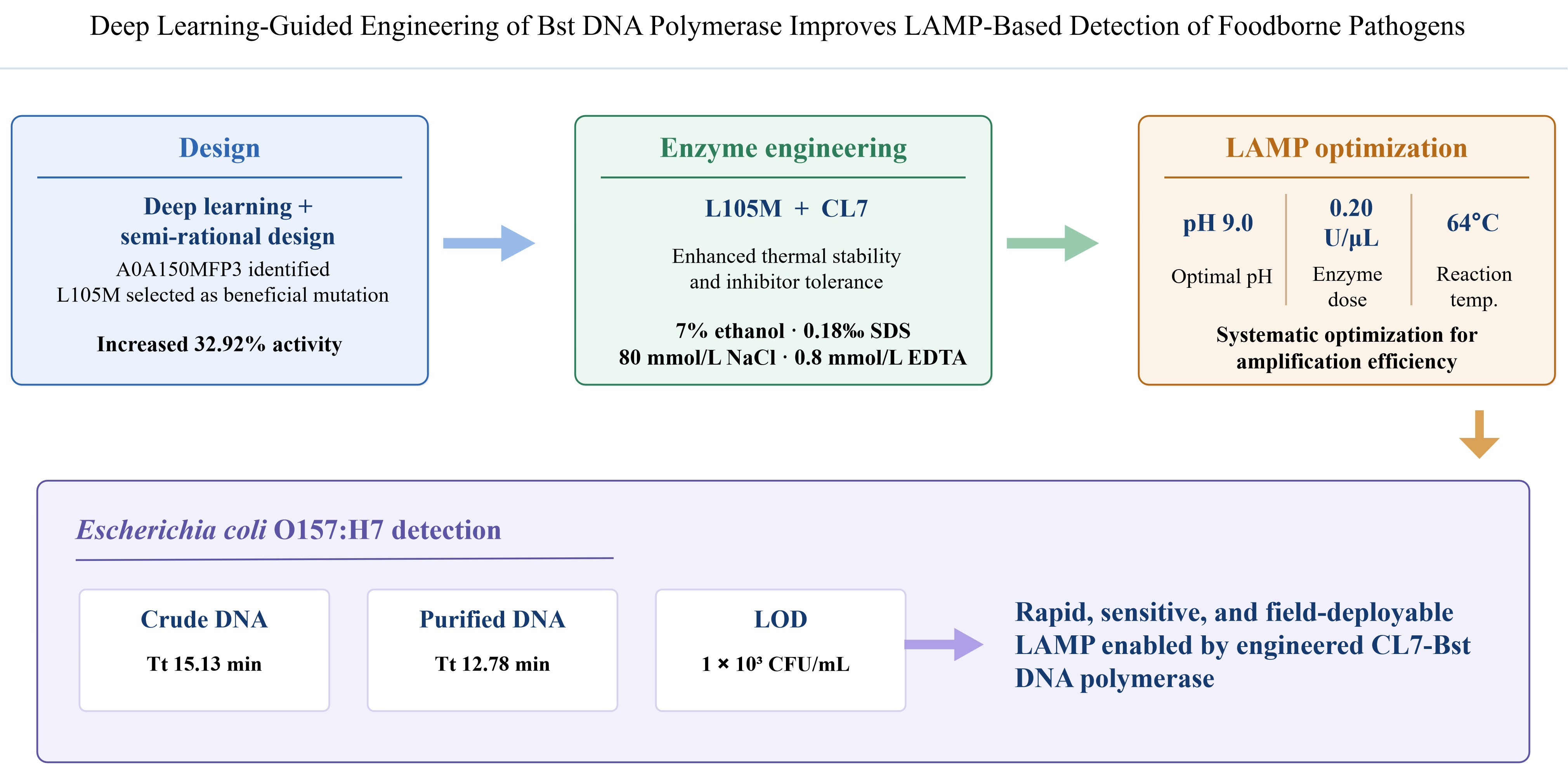
Deep Learning-Guided Engineering of Bst DNA Polymerase Improves LAMP-Based Detection of Foodborne Pathogens

 ,
, Abstract
Share and Cite
Chen, H.; Zhang, J.; Xu, X.; Zhang, H.; Chang, Y.; Shi, L.; Zhao, L. Deep Learning-Guided Engineering of Bst DNA Polymerase Improves LAMP-Based Detection of Foodborne Pathogens. Microorganisms 2026, 14, 954. https://doi.org/10.3390/microorganisms14050954
Chen H, Zhang J, Xu X, Zhang H, Chang Y, Shi L, Zhao L. Deep Learning-Guided Engineering of Bst DNA Polymerase Improves LAMP-Based Detection of Foodborne Pathogens. Microorganisms. 2026; 14(5):954. https://doi.org/10.3390/microorganisms14050954
Chicago/Turabian StyleChen, Haoting, Jingfeng Zhang, Xiaoli Xu, Huang Zhang, Yanlei Chang, Lei Shi, and Lichao Zhao. 2026. "Deep Learning-Guided Engineering of Bst DNA Polymerase Improves LAMP-Based Detection of Foodborne Pathogens" Microorganisms 14, no. 5: 954. https://doi.org/10.3390/microorganisms14050954
APA StyleChen, H., Zhang, J., Xu, X., Zhang, H., Chang, Y., Shi, L., & Zhao, L. (2026). Deep Learning-Guided Engineering of Bst DNA Polymerase Improves LAMP-Based Detection of Foodborne Pathogens. Microorganisms, 14(5), 954. https://doi.org/10.3390/microorganisms14050954