Article

Stagnihabitans lacustris sp. nov., an Anoxygenic Photoheterotrophic Bacterium of the Family Paracoccaceae, Isolated from a Eutrophic Pond in Czechia

1
Department of Life Science, Sharda School of Bio-Science and Technology, Sharda University, Greater Noida 201306, India
2
Microbial Type Culture Collection and Gene Bank (MTCC), CSIR Institute of Microbial Technology (CSIR-IMTECH), Chandigarh 160036, India
3
Laboratory of Anoxygenic Phototrophs, Centre Algatech, Institute of Microbiology CAS, 37901 Třeboň, Czech Republic
*
Authors to whom correspondence should be addressed.
Microorganisms 2026, 14(5), 1157; https://doi.org/10.3390/microorganisms14051157
Submission received: 1 April 2026 / Revised: 7 May 2026 / Accepted: 13 May 2026 / Published: 20 May 2026

Abstract

A novel photoheterotrophic, beige-pigmented, bacteriochlorophyll a-containing strain KR11T was isolated from Kaprový pond in Třeboň, Czechia. KR11T cells were Gram-negative, rod-shaped, and motile. The isolated strain grew under photoheterotrophic conditions between 20 and 40 °C (optimum 22–25 °C), at pH ranges from 6.0 to 9.0 (optimum 7.0). It did not require NaCl for growth but tolerated NaCl concentrations up to 1.5% (w/v). No growth was observed under photoautotrophic conditions. Strain KR11T showed the highest 16S rRNA gene sequence similarity to the type strains of Stagnihabitans tardus CYK-10T (98.84%), Tabrizicola fusiformis SY72T (95.95%), and Rhodobacter sediminis N1T (95.37%). Phylogenetic analyses based on 16S rRNA gene sequences indicated that strain KR11T clusters within the genus Stagnihabitans in the family Paracoccaceae of class Alphaproteobacteria. The whole-genome sequence of strain KR11T comprises 4,085,976 bp with a 65 mol% G+C content. Phylogenomic analysis, including core-genome phylogeny, and the low genomic similarity (<95% ANI and <70% dDDH) to phylogenetically related taxa confirmed the taxonomic separation of strain KR11T at the species level. The distinctive phenotypic traits, chemotaxonomic studies, phylogenetic, and genomic analysis establish strain KR11T as a novel species within the genus Stagnihabitans. Accordingly, we propose the name Stagnihabitans lacustris sp. nov. KR11T (=CCUG 74777T, LMG 31924T), isolated from fresh water.

1. Introduction

The Rhodobacteraceae family, previously defined by Garrity et al., 2005, belongs to the order Rhodobacterales, class Alphaproteobacteria, and includes bacteria with different phenotypic, metabolic, and ecological properties [1]. The Rhodobacteraceae family contains many phototrophic species that harvest light using bacteriochlorophyll (BChl) a and carotenoids of the spheroidene series. In 2021, Liang et al. separated the marine Roseobacter clade into the new family Roseobacteraceae, based on whole-genome phylogenetic analysis from family Rhodobacteraceae [2]. The remaining taxa in Rhodobacteraceae was found to bear an illegitimate name, contravening Rule 51 of the International Code of Nomenclature of Prokaryotes, and was formally replaced by the name Paracoccaceae, with Paracoccus as the type genus [2] and validated by Göker 2022 [3]. Huang et al. subsequently performed a comprehensive genome-based reclassification of genera within the family Paracoccaceae using phylogenomic analysis of 1606 high-quality genomes and AAI metrics, identifying cases of misclassification arising from over-reliance on 16S rRNA gene phylogeny alone [4]. Strain KR11T belongs to the genus Stagnihabitans within the family Paracoccaceae, class Alphaproteobacteria and order Rhodobacterales.
The genus Stagnihabitans (earlier classified in Rhodobacter genus) was proposed by Ma et al. 2022, based on analyses of 16S rRNA, gyrB, and concatenated protein phylogenetic trees together with genome comparisons [5]. To date, only one species has been validated in the genus Stagnihabitans, named as Stagnihabitans tardus (http://www.bacterio.net/). S. tardus CYK-10T was isolated from a freshwater pond in Hinoki Village in Chiayi County, Taiwan. It is a Gram-negative, aerobic, non-motile, and ovoid to rod-shaped with ubiquinone-10 (Q-10) as the main respiratory quinone [6]. The major cellular fatty acid is C18:1 ω7c, and the major hydroxyl fatty acids are C10:03-OH and C18:03-OH. The DNA G+C content is 66%.
In the present study, we report the phenotypic and genomic characteristics of strain KR11T, which was isolated from the eutrophic Kaprový pond in Třeboň, Czechia. Chemotaxonomic and genetic analyses indicate that KR11T belongs to the genus Stagnihabitans. Furthermore, our phylogenomic research confirmed that strain KR11T comprises a new lineage within the genus Stagnihabitans and is clearly differentiated from its nearest relatives, hence validating its classification as a novel species and proposing the name Stagnihabitans lacustris.

2. Materials and Methods

2.1. Sample Collection and Isolation

In this study, a bacterial strain KR11T was isolated from water samples (temperature 15 °C, pH 7.3) collected from a eutrophic Kaprový pond (48°59.47′ N, 14°46.86′ E), Třeboň, Czechia, on 29 October 2018. Water samples were serially diluted to concentrations of 10−3 and 10−4 (v/v). Further, 100 µL of each dilution was spread on R2A agar plates and incubated under microaerophilic conditions (10% O2 + 90% N2) at 28 ± 1 °C under 12 h light:12 h dark cycles. The modified fluorescence imaging system, FluorCam 800 MF (Photon Systems Instruments Ltd., Drásov, Czech Republic), was used to identify the BChl autofluorescence positive colonies on the agar plates. The BChl positive colonies were picked and transferred to fresh media. Purified strain KR11T was regularly maintained on slants of R2A agar and preserved in glycerol (20% w/v) at −80 °C.

2.2. Microscopic and Spectroscopic Examination

Phase contrast microscopy was performed using the Axio Imager. Z2 (Carl Zeiss AG, Jena, Germany) equipped with the Zeiss Plan-NEOFLUAR 100×/1.3 oil Ph3 phase contrast objective (Carl Zeiss AG, Jena, Germany). The in vivo absorption spectra of strain KR11T were recorded using the UV-2600 spectrophotometer (Shimadzu, Kyoto, Japan) equipped with an integrating sphere. To further reduce scattering, the cells were suspended in 50% (w/v) glycerol. For the in vitro absorption spectra, the pigments were extracted with acetone–methanol (7:2), filtered through a 0.2 µm polytetrafluoroethylene 4 mm filter, a single-use filter device (Whatman PLC, Marlborogh, MA, USA).

2.3. Physiological and Biochemical Characterization

Physiological and biochemical characterization was carried out in R2A media aerobically at 25 °C ± 1 °C under 12 h light:12 h dark cycles unless stated otherwise. Anaerobic growth was assessed using R2A agar plates kept in anaerobic jars (Anoxomat), and for microaerophilic growth, plates were kept in an incubator maintaining microaerophilic conditions (10% O2 + 90% N2). To determine the growth at different temperatures, KR11T strain was inoculated on R2A agar medium at 5–50 °C (interval of 5 °C). The range of pH for growth was explored in R2A broth, which was prepared using buffer systems between 4.0 and 12.0 pH (1.0 pH unit interval) [7]. The tolerance to salt was determined by supplementing the R2A agar medium with 10% (w/v) NaCl (in increments of 1% w/v). Gram-staining of the strain KR11T was accomplished by the standard Gram’s reaction [8]. Oxidase activity was determined using the filter paper method as described by Kovács, 1956 [9], whereas catalase activity was tested by observing bubble formation on the addition of 3% (v/v) H2O2 drops. Carbon source utilization was carried out at 25 °C using the minimal media containing K2HPO4 (0.5 g L−1), peptone (0.15 g L−1), 1 mL trace element solution SL-8 supplemented with one of the following carbon sources (5 mM): sucrose, inulin, sodium pyruvate, malate, glucose, glycerol, acetate, melibiose, galactose, fructose, mannose, cellobiose, trehalose, sorbitol, rhamnose, or lactose [10].

2.4. Chemotaxonomic Analyses

For fatty acid and polar lipid analysis, 1 g of cell biomass was obtained from a culture grown on R2A agar. The polar lipids of strain KR11T were extracted and then identified through second-dimensional thin-layer chromatography [11]. The first-dimension separation was done with a mixture of chloroform/methanol/water in the ratio of (60:30:3.8, v/v), and the second-dimension with a mixture of chloroform/methanol/acetic acid/water (40:7.5:6:1.8, v/v). Polar lipids on plates were visualized using 10% ethanolic phosphomolybdic acid for total lipid analysis, alpha-naphthol with ninhydrin agent for amino lipids, and molybdenum blue for phospholipids (PLs). For fatty acids, whole cells of strain KR11T were saponified, methylated, extracted, and identified using the MIDI/Hewlett-Packard Microbial Identification System (Midi, Inc., Newark, DE, USA) using the MIS library TSBA6 database, following the manufacturer’s instructions.
Respiratory quinones were identified in the same acetone/methanol extract as pigments. In total, 50 µL of the extract was injected into the Prominence-i HPLC system (Shimadzu, Kyoto, Japan). The quinones were separated on a heated (40 °C) Kinetex 2.6 µm C18 100 Å 150 × 4.6 mm column (Phenomenex, Torrance, CA, USA) using a binary solvent system, 1′ 100%A, 12′ 100%B, 24′ 100%B, 25′ 100%A, where A: 100% methanol and B: methanol + heptane 10:3 (v/v) with a flow rate of 1 mL min−1. The eluted quinones were detected at 270 nm and identified based on their absorption spectra recorded by a UV-VIS diode-array detector (Shimadzu, Kyoto, Japan) and the retention time determined using the Q-10 standard.

2.5. Genome Sequencing and Annotation

Genomic DNA was isolated from the strain KR11T using ZR bacterial/fungal Miniprep kit (Zymo Research, Irvine, CA, USA) according to the instructions of the manufacturer. The identity of the culture was verified by amplification and sequencing of its 16S rRNA gene. The Illumina whole-genome shotgun sequencing was performed using Illumina HiSeq platform at MedGenome (https://diagnostics.medgenome.com/, accessed on 4 August 2020) with 2 × 150 bp chemistry at 100× sequencing depth. The raw reads were checked for quality using FastQC v0.11.9 [12]. The reads with a Phred score higher than 33 were selected and further processed. The Illumina sequences and adapters from raw reads were removed using Trimmomatic v0.39 [13]. The reads were further assembled on Spades v3.13.0 [14], and the assembled draft genome was visualized on Quality Assessment Tool (QUAST) [15]. The contamination and completeness of the draft genome was checked using CheckM v1.2.3 [16]. An annotation was carried out using NCBI Prokaryotic Genome Annotation Pipeline (PGAP v6.9) [17].

2.6. Phylogeny and Genomic Analyses

The phylogenetic analysis of the 16S rRNA gene was done by comparing the sequence with all validly named species using EZbioCloud [18]. The 16S rRNA gene sequence (GenBank accession number MT586031) of strain KR11T was retrieved from its genome sequence (GenBank accession number JAPDGS000000000). Reference sequences were obtained from NCBI GenBank in February 2026 and aligned using MAFFT [19]. The neighbour-joining (NJ) and maximum likelihood (ML) algorithms were used to construct a phylogenetic tree in MEGA version 12 software [20]. Tree topology was evaluated with bootstrap analysis using 1000 replicates. Deinococcus xianganensis Y35T was used as an outgroup.
The ANI of strain KR11T with other reference strains was calculated using the OrthoANI toolv0.7.0 [21] and a heatmap based on ANI was generated with OrthoFinder v3.1.4 [22]. The dDDH values and differences in G+C content were calculated on the online platform Genome-to-Genome Distance Calculator (GGDC 2.1). The GGDC uses Genome BLAST Distance Phylogeny (GBDP) with advanced statistical models to generate dDDH values and confidence intervals [23]. These values are plotted as a heatmap using TBtools II v2.390 [24].
Orthologous gene cluster analysis was performed using the OrthoFinder [25]. Type Strain Genome Server (TYGS) was used to construct a phylogenomic tree for strain KR11T and its closely related species. We retrieved the draft genome assemblies for closely related species from NCBI (https://www.ncbi.nlm.nih.gov/genbank/, accessed on 5 February 2026) and uploaded the user-submitted genomes on the TYGS (https://tygs.dsmz.de/user_requests/new, accessed on 5 February 2026). The results from TYGS include the phylogenomic tree by comparing the whole-genome assemblies, and a further tree was visualized using Interactive Tree of Life (iTOL) v7 (https://itol.embl.de/, accessed on 7 February 2026) [26].

3. Results and Discussion

3.1. Strain Characteristics and Physiology

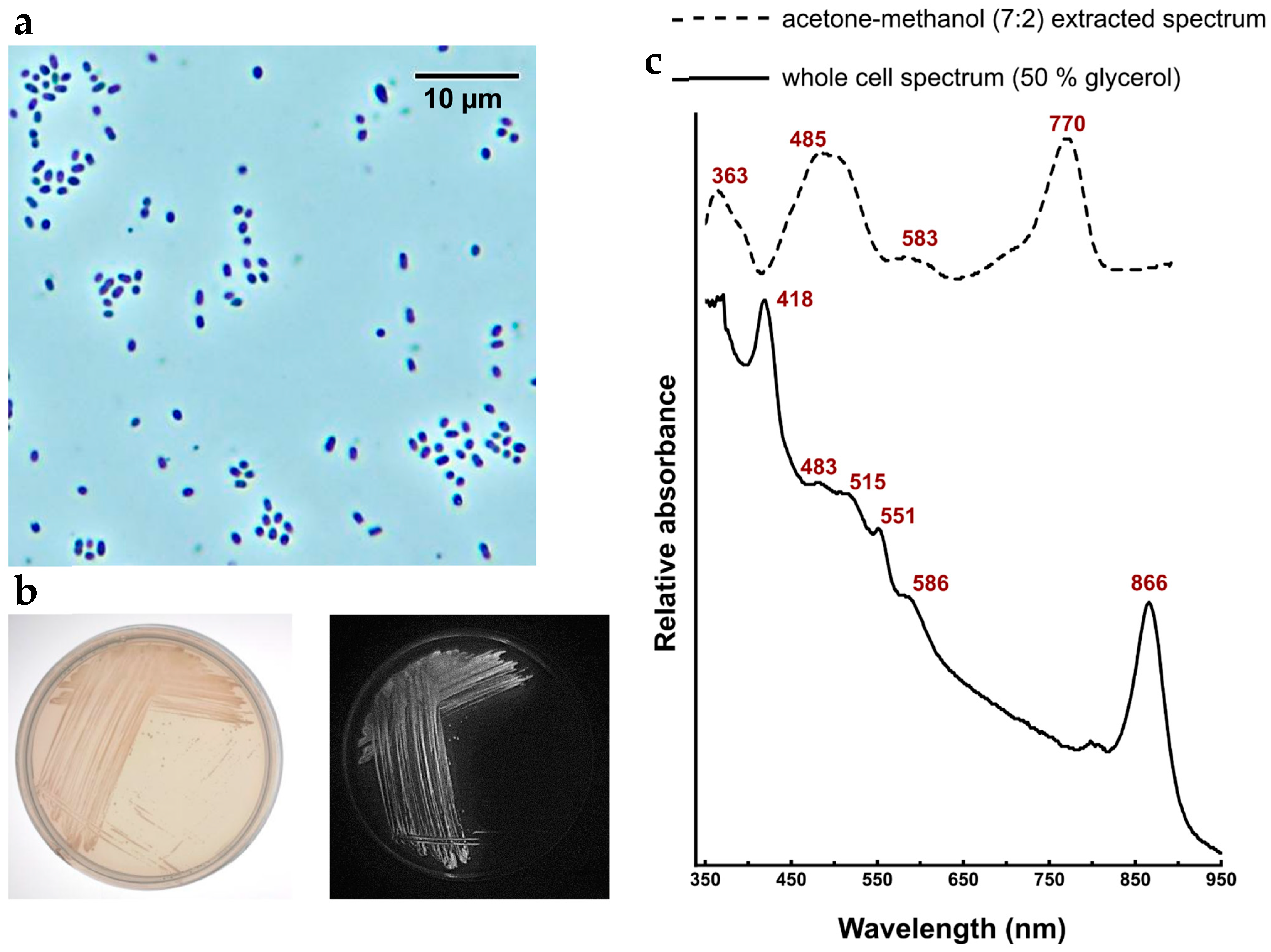
Strain KR11T cells are Gram-negative, motile, 1.0–2.2 μm long and 0.5–0.8 μm wide rods (Figure 1a). KR11T colonies on agar plates are beige in colour and emit BChl a autofluorescence (Figure 1b). Liquid cultures of strain KR11T exhibited photoorganoheterotrophic growth under both aerobic and microaerobic conditions (10% O2/90% N2) with a 12 h light:12 h dark cycle, utilizing organic carbon sources such as sodium pyruvate, malate, glucose, glycerol, and acetate. It also showed chemoorganoheterotrophic growth in the dark, with different organic carbon sources (Table 1). A weak anaerobic photoheterotrophic growth was observed after ten days of incubation, but photoautotrophic growth was not registered. Chemolithotrophy, photolithoautotrophy, and photolithoheterotrophy were not observed with sulfide or thiosulfate as electron donors. The colour of phototrophically grown cell suspensions was beige with a pink tinge due to the presence of pigments. Optimal growth occurs at 22–25 °C (range 20 to 40 °C) and pH 7.0 (pH range 6.0 to 9.0) under aerobic conditions, with a 12 h light:12 h dark light cycle. NaCl was not required for growth, but was tolerated up to 1.5% (w/v, NaCl). The strain KR11T is positive for both oxidase and catalase activities.
Phenotypically, strain KR11T can be distinguished from its closest validly published relative, S. tardus CYK-10T, by a combination of at least eight phenotypic and physiological traits (Table 1). Notably, KR11T is motile and positive for catalase, whereas S. tardus CYK-10T is non-motile and negative for catalase. In terms of carbon source utilization, KR11T is able to utilize sucrose, trehalose, and rhamnose, none of which support growth in S. tardus CYK-10T. These differences in enzymatic activities and carbon utilization profiles collectively provide robust phenotypic evidence for the species-level distinctiveness of strain KR11T.
Strain KR11T can also be clearly differentiated from T. fusiformis SY72T by its phototrophic capacity—evidenced by the presence of BChl a (Figure 1c)—its lower optimum growth temperature, motility, and positive urease activity. Differentiation from R. sediminis N1T is KR11T supported by the presence of BChl a, positive for catalase and urease activities, and the inability to utilize galactose while in R. sediminis—absence of BChl a, negative for catalase and urease activities, and ability to utilize galactose as a carbon source. The optimum growth temperature for KR11T is 22–25 °C, while the optimum growth temperature for R. sediminis is 27–35 °C.

3.2. Pigment and Lipid Composition

The in vivo absorption spectrum of KR11T cells suspended in 50% glycerol shows maxima at 418, 483, 515, 586, and 866 nm (Figure 1c). The absorption band at 418 nm likely originates from the cytochrome c. The weak absorption maxima at 483, 515, and 586 nm document the presence of carotenoids. The 866 nm absorption band originates from BChl a present in the light-harvesting complex I. An absorption peak corresponding to the light-harvesting complex II was not observed. The absorption spectrum of acetone–methanol (7:2) extracted pigments (Figure 1c) gave maxima at 770 nm and 485 nm, indicating the presence of the BChl a and carotenoids of spheroidenone series, respectively.
The main respiratory quinone in KR11T is Q-10. The polar lipids of strain KR11T comprises phosphatidylethanolamine, phosphatidylglycerol, uncharacterized aminophospholipids, and uncharacterized phospholipids (Figure S1). The primary cellular fatty acids in strain KR11T (>10%) were C15:0 anteiso (11.48%) and C18:1 ω7c (13.09%). The fatty acid profile of strain KR11T differs sharply from its closest relatives (Table 2). In S. tardus CYK-10T, T. fusiformis SY72T, and R. sediminis N1T, C18:1 ω7c dominates at over 60% of total fatty acids—typical for Paracoccaceae [4,29]. In KR11T, it drops to 13.09%, co-dominated by C15:0 anteiso (11.48%), a branched-chain fatty acid absent from all three reference strains [30]. Temperature and medium can shift fatty acid proportions, but they do not generate major fatty acids outside a strain’s metabolic pathway [30,31]. The complete absence of C15:0 anteiso from those three relatives reflects a real biochemical difference. The KR11T strain was grown under standardized conditions (R2A, 25 °C, mid-exponential phase) while comparative data for the reference strains were taken from the literature (Table 2). Branched-chain anteiso fatty acids are rare in Alphaproteobacteria and carry taxonomic weight at genus and species levels [31]. They also increase membrane fluidity at lower temperatures [30,31], since KR11T grows optimally at 22–25 °C, lower than T. fusiformis (30–37 °C) or R. sediminis (27–35 °C), and was isolated from a temperate freshwater pond. The fatty acid profile provides chemotaxonomic support for treating KR11T as a novel Stagnihabitans species.

3.3. 16S rRNA Gene and Phylogenomic Analysis

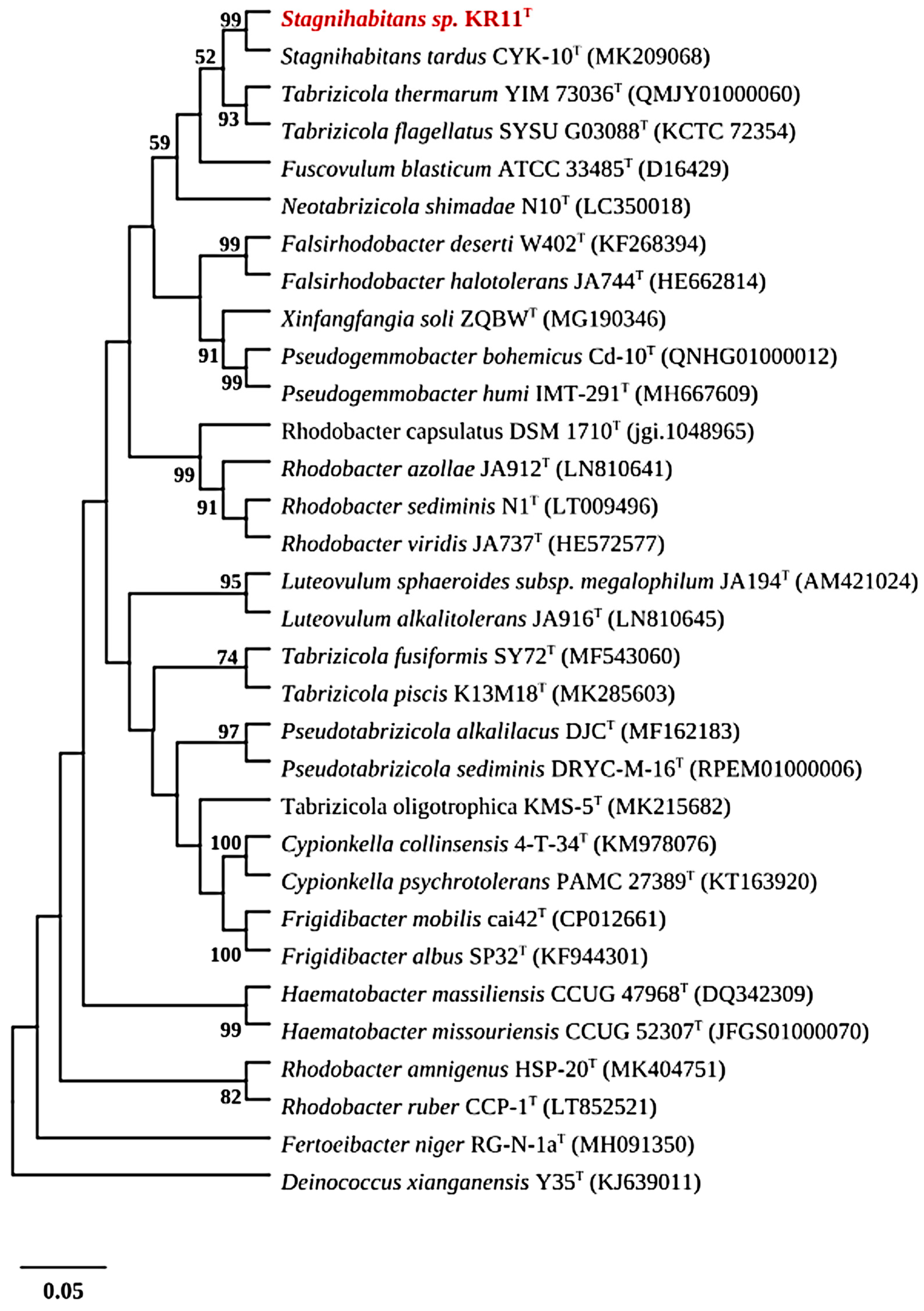
The 16S rRNA gene of strain KR11T (GenBank accession number MT586031) exhibits the highest sequence similarity with the 16S rRNA gene of S. tardus CYK10T (98.84%), followed by Tabrizicola thermarum YIM 73036T (96.60%) and Tabrizicola fusiformis SY72T (95.95%). Phylogenetic analysis based on ML and NJ trees further revealed that the novel strain KR11T formed a monophyletic clade with the genus Stagnihabitans and clustered with S. tardus CYK10T within the family Paracoccaceae (Figure 2 and Figure S2).
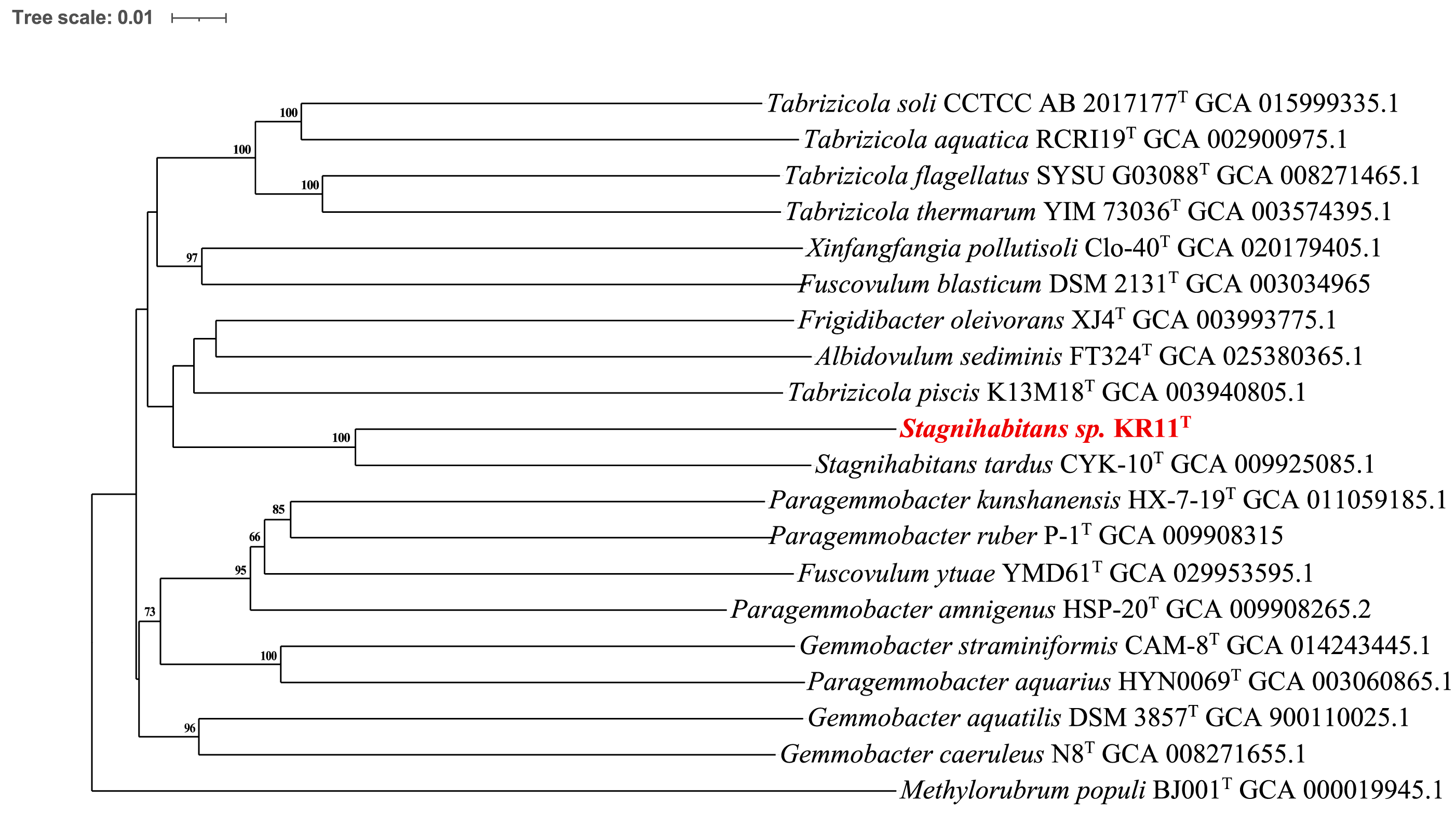
While the 16S rRNA gene sequence similarity between KR11T and S. tardus CYK10T (98.84%) does not follow the traditional thresholds of ~98.65% [32] and ~98.7% [33], such values are no longer considered definitive evidence of novel species. Chun et al. (2018) established minimal genomic standards for prokaryotic taxonomy, providing a framework under which 16S similarity alone is insufficient [33], particularly for genera such as Nocardiopsis [34,35,36] and Streptomyces [37,38], where closely related validly published species are known to share >99% 16S rRNA similarity and were resolved as distinct taxa via genomic metrics such as ANI and dDDH. Therefore, we employed phylogenomic analyses to clarify the status of KR11T. The phylogenomic tree was based on a total of 20 members of the family Paracoccaceae, which was rooted with one outgroup, Methylorubrum populi BJ001T. The resulting phylogenomic tree (Figure 3) and high bootstrap values confirmed the distinct lineage of the strain KR11T within the Stagnihabitans genus and were clearly separated from S. tardus CYK10T, supporting its status as a novel species. The ANI values between KR11T and its reference strains remained below 95% (the established species-delineation cutoff), further visualized in the heatmap provided in Figure S3. Furthermore, KR11T exhibited dDDH values of 25.2% with S. tardus CYK10T, 19.2% with T. flagellata SYSU G03088T, 19.3% with T. thermarum YIM 73036T, and 19.0% with F. blasticum ATCC 33485T. dDDH values were found to be significantly below the 70% threshold [33,39], providing robust evidence that KR11T is a distinct evolutionary lineage (Table S1 and Figure S4). The G+C difference in the draft genome of strain KR11T with the closely related genome of its type strain showed up to 2% difference (Table S2). Along with the unique phenotypic traits, physiological profiles, and chemotaxonomic markers (fatty acids and polar lipids) collectively confirm the classification of KR11T as representative of a novel species.

3.4. Genome Analysis

The draft genome of KR11T consists of 21 contigs, with a total length of 4,085,976 bp. The quality of the draft genome was assessed using CheckM (v1.2.3), which reported 91.76% completeness and 3.8% contamination, meeting the minimum quality thresholds for a high-quality draft genome as defined by the MIMAG standards [40]. It contains one copy of each rRNA operon (5S, 16S, 23S), 50 tRNA genes, and 3790 protein-coding sequences. The G+C content is 65 mol%.
In addition, we calculated the number of shared orthologous gene clusters among strain KR11T and the two reference strains S. tardus CYK-10T and T. fusiformis SY72T. From the total number of orthogroups (3436), 69.2% (2379) were present in all three strains. Strain KR11T shares 2903 and 2482 orthologous genes clusters with S. tardus CYK-10T and T. fusiformis SY72T, respectively. The number of unique orthologous gene clusters (524) shared by strain KR11T and S. tardus CYK-10T was much greater than the number shared by either strain KR11T and T. fusiformis SY72T (103) or S. tardus CYK-10T and T. fusiformis SY72T (252), indicating a close relationship between strain KR11T and S. tardus CYK-10T at the genomic level. Therefore, phylogenetic and genomic analyses confirm that strain KR11T is a distinct species within the genus Stagnihabitans.
The subsystems are annotated and classified based on their features and the number of counts provided (Figure S5). The maximum number of genes is assigned to protein and carbohydrate metabolism. A total of 35 genes have been assigned to virulence, disease, and defence subsystems, out of which 24 have been assigned to resistance to antibiotics and toxic compounds. A total of 15 genes were assigned to the metabolism of aromatic compounds, out of which nine were assigned to the metabolism of central aromatic compounds, and two were assigned to the peripheral pathway.

3.5. Metabolic Pathways

Similar to S. tardus CYK-10T, KR11T contains a standard set of genes coding for enzymes of the tricarboxylic acid cycle (gltA, acnA, icd, sucAB, sucCD, sdhABCD, fumC, mdh) and genes coding for five main protein complexes involved in oxidative phosphorylation (marker genes nuoABCDEFGHIJKLMN, sdhA, petABC, coxABC, atpIBEFHAGDC), as well as all enzymes involved in the gluconeogenesis/glycolysis (marker genes pckA, glpX, eno, tpiA). Compared to the S. tardus CYK-10T, strain KR11T lacks genes (cydABX) coding for cytochrome bd quinol oxidase (EC 7.1.1.7), a terminal oxidase in the respiratory chain. This enzyme is characterized by an extremely high oxygen affinity, playing a key role in adaptation to microaerobic environments [41].
It is notable that the KR11T genome contains one continuous 47.3 kb photosynthesis gene cluster (PGC) involving 46 ORFs (locus tag: NX862_RS15560–NX862_RS15785) encoding genes for BChl biosynthesis, light-harvesting proteins, and the photosynthetic reaction centre subunits (genes pufL and pufM). An interesting feature is the presence of the oxygen-independent Mg-Protoporphyrin monomethylester cyclase (bchE) inside the PGC, while its oxygen-dependent form (acsF; EC 1.14.13.81) is at the periphery of the PGC. This arrangement is not common among phototrophic Alphaproteobacteria [42]. The PGC was found also in photoautotrophic S. tardus CYK-10T (Table 3), but the main difference was in the ability to fix carbon dioxide. Strain KR11T lacks genes for ribulose-1,5-bisphosphate carboxylase/oxygenase (RuBisCO) and other genes required for CO2 fixation. This is consistent with the fact that it cannot grow photoautotrophically. Therefore, strain KR11T is obligately dependent on organic carbon sources and functions as a photoorganoheterotroph, potentially contributing to organic carbon cycling in its freshwater pond habitat rather than primary production. From nitrogen cycle pathways known from freshwater environments, both strains have the enzyme nitrous oxide reductase (nosZ; EC 1.7.2.4). It is a key enzyme in the denitrification pathway [43]. Due to the absence of other enzymes from the pathway, both organisms are rather N2O scavengers than full denitrifiers. Although the availability of phosphorus is usually not a limiting growth factor in freshwater eutrophic ponds, KR11 has a capacity to use non-conventional phosphorus sources using C-P lyase (phnJ; EC 4.7.1.1). Furthermore, we identified genes (phnCDE) coding for a transporter necessary for the transport of methylphosphonate into the cytoplasm, where it can by cleaved to methane and phosphate by the C-P lyase. Interestingly, the reference strain lacks genes for both the enzyme and the transporter. The main processes of the microbial sulfur cycle involve oxidation of reduced inorganic sulfur compounds and assimilatory and dissimilatory sulfate reduction. Both strains lack the sulfur-oxidizing (Sox) complex, which bacteria use for oxidation of thiosulfate, sulfite, or sulfide to sulfate to yield energy for growth [44,45]. Due to the absence of the gene cysC, coding for an adenylylsulfate kinase (EC 2.7.1.25), the assimilatory sulfate reduction pathway is incomplete in both strains. In the same token, the dissimilatory sulfate reduction pathway is also incomplete; only in the first step, the activation of sulfate to adenosine 5′-phosphosulfate is presumably functional in both organisms.
Strain KR11T differs from S. tardus CYK-10T also in several other genes, including those related to cell surface polysaccharide biosynthesis (neuA, neuB, legB), metal resistance (arsC), L-arabinose (araFGH), octopine/nopaline (occPTOM), cobalt (cbiMNQO), and copper (copCD) uptake, and the attEFGH ABC transporter. Strain KR11T contains the complete flagellar gene cluster, which is in line with the observed motility. Strain KR11T also contains CRISPR-associated proteins (cas1, cas3) and a type VI secretion system component (tssM). These genomic differences support that strain KR11T is functionally distinct from S. tardus CYK-10T. Furthermore, KR11T contains a complete, continuous gene cluster (locus tag: NX862_RS04510–NX862_RS04585) encoding gene transfer agents (GTAs), virus-like particles that transfer segments of genomic DNA between prokaryotic cells. The gene organization is similar to the GTA cluster in Rhodobacter capsulatus DSM 1710T [26].

4. Taxonomic Conclusions

The strain KR11T was distinguished from closely related strains, S. tardus CYK-10T, T. fusiformis SY72T, and R.sediminis N1T, by physiological, morphological, and biochemical characteristics such as cell size, cell shape, NaCl tolerance, enzyme activity, range of temperature for growth, acid production, and cellular fatty acid composition (Table 1). Based on combined phenotypic, chemotaxonomic, genomic, and phylogenomic evidence, strain KR11T is proposed as a novel species within the genus Stagnihabitans.

Description of Stagnihabitans lacustris sp. nov.

la.cus’tris. N.L. masc./fem. adj. lacustris, inhabiting a lake, referring to Stagnihabitans lacustris as a novel species predominantly found in lakes.
Cells are Gram-negative, motile, and rod-shaped. Colonies are small and beige-coloured on R2A agar plate after incubation for 24 h under aerobic conditions at 22–25 °C under a 12 h light:12 h dark cycle. A weak anaerobic photoheterotrophic growth was observed after ten days of incubation in contrast; substantial growth was observed in microaerophilic conditions (10% O2 + 90% N2) at 25 °C after three days. Optimum growth occurs at pH 7.0–7.2; NaCl is not required for growth but is tolerant to NaCl concentrations up to 1.5% (w/v). It can grow from 20 °C to 40 °C (optimum 22–25 °C). The in vivo absorption spectra of cells in 50% glycerol exhibited peaks at 418, 483, 515, 586, and 866 nm, documenting the existence of photosynthetic complexes. The absorption spectra of pigments extracted using acetone–methanol (7:2, v/v) displayed a peak at 770 and 487 nm, representing photosynthetic pigments BChl a and carotenoids of the spheroidenone series, respectively (Figure 1c). The main respiratory quinone is ubiquinone-10 (Q-10). The preferred growth mode is photoheterotrophy. Catalase and oxidase are present, but arginine dihydrolase, lysine decarboxylase, and arginine decarboxylase activities are absent. Gelatin, starch, chitin, casein, and Tween 80 are not hydrolysed. Polar lipids contain phosphatidylethanolamine; phosphatidylglycerol; uncharacterized aminophospholipids; and uncharacterized phospholipids (Figure S1). The major fatty acids (>10% of total) are C15:0 anteiso and C18:1 ω7c. It is negative for the reduction in nitrate to nitrite. It utilizes fructose, salicin, sucrose, rhamnose, trehalose, maltose, raffinose, mannose, arabinose, pyruvate, and does not utilize dextrose, adonitol, dulcitol, cellobiose, inulin, galactose, sorbitol, melibiose, and lactose.
The type strain KR11T = CCUG 74777T = LMG 31924T was isolated from the eutrophic Kaprový pond in Třeboň, Czechia (48°59.47′ N, 14°46.86′ E). The DNA G+C content of the type strain is 65 mol%, consisting of 4,085,976 bp. The GenBank accession numbers for the 16S rRNA gene sequence and the draft genome sequence of strain Stagnihabitans lacustris sp. nov. KR11T are MT586031 and JAPDGS000000000.1, respectively.

Supplementary Materials

The following supporting information can be downloaded at: https://www.mdpi.com/article/10.3390/microorganisms14051157/s1, Figure S1: Two-dimensional thin-layer chromatogram of the total polar lipids of strain KR11T. Figure S2: Phylogenetic relationship between strain KR11T and closely related taxa within the family Paracoccaceae. Figure S3: Heatmap generated with orthoANI values calculated using OAT software. Figure S4: The dDDH values were calculated using GGDC and plotted using TBTools. Figure S5: The functional annotation is plotted as the number of counts assigned to the subsystem using RAST. Table S1: Pairwise dDDH values and percent G+C difference in strain KR11T with selected type strain genomes. Table S2: Dataset of selected type strains to compare strain KR11T.

Author Contributions

M.K. and N. conceived the study and wrote the paper with input from A.S., S.K., G.V., M.K.S., K.K. and A.K.P. A.K.P. co-supervised the lab-related work. N. carried out the fieldwork and performed the isolation of the strain. A.S., S.K. and M.K.S. performed the phenotypic and physiological characterization. G.V., K.K., A.S. and N. analyzed the genomes. All authors have read and agreed to the published version of the manuscript.

Funding

This research was partially funded by CSIR Institute of Microbial Technology IMTECH and Sharda University, Greater Noida, India (the Seed fund project number SU/SF/2022/13). M.K.S., M.K., and K.K. were supported by the project Photomachines (CZ.02.01.01/00/22_008/0004624) financed by the OP JAK programme of the Czech Ministry of Education.

Institutional Review Board Statement

Not applicable.

Informed Consent Statement

Not applicable.

Data Availability Statement

The GenBank/EMBL/DDBJ accession numbers for the 16S rRNA gene sequence and the whole-genome sequences of strain KR11T are MT586031 and JAPDGS000000000.1 respectively.

Acknowledgments

Nupur would like to thank the Research Development Cell, Sharda University, Greater Noida, India. PAK acknowledges the Council of Scientific and Industrial Research (CSIR) and the Department of Biotechnology, Government of India. The authors would also like to thank Jason Dean for technical assistance.

Conflicts of Interest

The authors declare no conflicts of interest.

Abbreviations

The following abbreviations are used in this manuscript:
ANIAverage nucleotide identity
BChlBacteriochlorophyll
dDDHdigital DNA-DNA hybridization
GGDCGenome-to-Genome Distance Calculator
GTAGene transfer agents
iTOLInteractive Tree of Life
RASTRapid Annotation using Subsystem technology
R2AReasoner’s 2A medium
TYGSType Strain Genome Server
QUASTQuality Assessment Tool
Q-10ubiquinone-10

References

  1. Garrity, G.M.; Bell, J.A.; Lilburn, T. Rhodobacteraceae Fam. Nov. In Bergey’s Manual of Systematics of Archaea and Bacteria; Wiley: Hoboken, NJ, USA, 2015; pp. 1–2. [Google Scholar]
  2. Liang, K.Y.H.; Orata, F.D.; Boucher, Y.F.; Case, R.J. Roseobacters in a Sea of Poly- and Paraphyly: Whole Genome-Based Taxonomy of the Family Rhodobacteraceae and the Proposal for the Split of the “Roseobacter Clade” Into a Novel Family, Roseobacteraceae Fam. Nov. Front. Microbiol. 2021, 12, 683109. [Google Scholar] [CrossRef]
  3. Göker, M. Filling the Gaps: Missing Taxon Names at the Ranks of Class, Order and Family. Int. J. Syst. Evol. Microbiol. 2022, 72, 005638. [Google Scholar] [CrossRef]
  4. Huang, Z.; Li, M.; Oren, A.; Lai, Q. Genome-Based Analysis of the Family Paracoccaceae and Description of Ostreiculturibacter nitratireducens gen. nov., sp. nov., Isolated from an Oyster Farm on a Tidal Flat. Front. Microbiol. 2024, 15, 1376777. [Google Scholar] [CrossRef]
  5. Ma, T.; Xue, H.; Piao, C.; Liu, C.; Yang, M.; Bian, D.; Li, Y. Reclassification of 11 Members of the Family Rhodobacteraceae at Genus and Species Levels and Proposal of Pseudogemmobacter hezensis sp. Nov. Front. Microbiol. 2022, 13, 849695. [Google Scholar] [CrossRef]
  6. Sheu, C.; Li, Z.H.; Sheu, S.Y.; Yang, C.C.; Chen, W.M. Tabrizicola oligotrophica sp. nov. and Rhodobacter tardus sp. nov., Two New Species of Bacteria Belonging to the Family Rhodobacteraceae. Int. J. Syst. Evol. Microbiol. 2020, 70, 6266–6283. [Google Scholar] [CrossRef] [PubMed]
  7. Akter, S.; Huq, M.A. Fluviicola chungangensis sp. nov., a Bacterium Isolated from Rice Field. Arch. Microbiol. 2019, 202, 293–298. [Google Scholar] [CrossRef] [PubMed]
  8. Gregersen, T. Rapid Method for Distinction of Gram-Negative from Gram-Positive Bacteria. Eur. J. Appl. Microbiol. Biotechnol. 1978, 5, 123–127. [Google Scholar] [CrossRef]
  9. Kovacs, N. Identification of Pseudomonas pyocyanea by the Oxidase Reaction. Nature 1956, 178, 703. [Google Scholar] [CrossRef]
  10. Zeng, Y.; Nupur; Wu, N.; Madsen, A.M.; Chen, X.; Gardiner, A.T.; Koblížek, M. Gemmatimonas groenlandica sp. nov. Is an Aerobic Anoxygenic Phototroph in the Phylum Gemmatimonadetes. Front. Microbiol. 2021, 11, 606612. [Google Scholar] [CrossRef]
  11. Minnikin, D.E.; O’Donnell, A.G.; Goodfellow, M.; Alderson, G.; Athalye, M.; Schaal, A.; Parlett, J.H. An Integrated Procedure for the Extraction of Bacterial Isoprenoid Quinones and Polar Lipids. J. Microbiol. Methods 1984, 2, 233–241. [Google Scholar] [CrossRef]
  12. Andrews, S. FastQC: A Quality Control Tool for High Throughput Sequence Data. 2010. Available online: https://www.bioinformatics.babraham.ac.uk/projects/download.html#fastqc (accessed on 10 September 2020).
  13. Bolger, A.M.; Lohse, M.; Usadel, B. Trimmomatic: A Flexible Trimmer for Illumina Sequence Data. Bioinformatics 2014, 30, 2114–2120. [Google Scholar] [CrossRef]
  14. Bankevich, A.; Nurk, S.; Antipov, D.; Gurevich, A.A.; Dvorkin, M.; Kulikov, A.S.; Lesin, V.M.; Nikolenko, S.I.; Pham, S.; Prjibelski, A.D.; et al. SPAdes: A New Genome Assembly Algorithm and Its Applications to Single-Cell Sequencing. J. Comput. Biol. 2012, 19, 455–477. [Google Scholar] [CrossRef]
  15. Gurevich, A.; Saveliev, V.; Vyahhi, N.; Tesler, G. QUAST: Quality Assessment Tool for Genome Assemblies. Bioinformatics 2013, 29, 1072–1075. [Google Scholar] [CrossRef] [PubMed]
  16. Parks, D.H.; Imelfort, M.; Skennerton, C.T.; Hugenholtz, P.; Tyson, G.W. CheckM: Assessing the Quality of Microbial Genomes Recovered from Isolates, Single Cells, and Metagenomes. Genome Res. 2015, 25, 1043–1055. [Google Scholar] [CrossRef] [PubMed]
  17. Overbeek, R.; Olson, R.; Pusch, G.D.; Olsen, G.J.; Davis, J.J.; Disz, T.; Edwards, R.A.; Gerdes, S.; Parrello, B.; Shukla, M.; et al. The SEED and the Rapid Annotation of Microbial Genomes Using Subsystems Technology (RAST). Nucleic Acids Res. 2014, 42, D206–D214. [Google Scholar] [CrossRef]
  18. Chalita, M.; Kim, Y.O.; Park, S.; Oh, H.S.; Cho, J.H.; Moon, J.; Baek, N.; Moon, C.; Lee, K.; Yang, J.; et al. EzBioCloud: A Genome-Driven Database and Platform for Microbiome Identification and Discovery. Int. J. Syst. Evol. Microbiol. 2024, 74, 006421. [Google Scholar] [CrossRef]
  19. Katoh, K.; Misawa, K.; Kuma, K.I.; Miyata, T. MAFFT: A Novel Method for Rapid Multiple Sequence Alignment Based on Fast Fourier Transform. Nucleic Acids Res. 2002, 30, 3059–3066. [Google Scholar] [CrossRef] [PubMed]
  20. Kumar, S.; Stecher, G.; Li, M.; Knyaz, C.; Tamura, K. MEGA X: Molecular Evolutionary Genetics Analysis across Computing Platforms. Mol. Biol. Evol. 2018, 35, 1547–1549. [Google Scholar] [CrossRef]
  21. Lee, I.; Kim, Y.O.; Park, S.C.; Chun, J. OrthoANI: An Improved Algorithm and Software for Calculating Average Nucleotide Identity. Int. J. Syst. Evol. Microbiol. 2016, 66, 1100–1103. [Google Scholar] [CrossRef]
  22. Emms, D.M.; Kelly, S. OrthoFinder: Phylogenetic Orthology Inference for Comparative Genomics. Genome Biol. 2019, 20, 238. [Google Scholar] [CrossRef]
  23. Meier-Kolthoff, J.P.; Auch, A.F.; Klenk, H.P.; Göker, M. Genome Sequence-Based Species Delimitation with Confidence Intervals and Improved Distance Functions. BMC Bioinform. 2013, 14, 60. [Google Scholar] [CrossRef]
  24. Chen, C.; Chen, H.; Zhang, Y.; Thomas, H.R.; Frank, M.H.; He, Y.; Xia, R. TBtools: An Integrative Toolkit Developed for Interactive Analyses of Big Biological Data. Mol. Plant 2020, 13, 1194–1202. [Google Scholar] [CrossRef] [PubMed]
  25. Letunic, I.; Bork, P. Interactive Tree of Life (ITOL) v6: Recent Updates to the Phylogenetic Tree Display and Annotation Tool. Nucleic Acids Res. 2024, 52, W78–W82. [Google Scholar] [CrossRef]
  26. Lang, A.S.; Beatty, J.T. Genetic Analysis of a Bacterial Genetic Exchange Element: The Gene Transfer Agent of Rhodobacter Capsulatus. Proc. Natl. Acad. Sci. USA 2000, 97, 859–864. [Google Scholar] [CrossRef] [PubMed]
  27. Ko, D.J.; Kim, J.S.; Park, D.S.; Lee, D.H.; Heo, S.Y.; Seo, J.W.; Kim, C.H.; Oh, B.R. Tabrizicola fusiformis sp. nov., Isolated from an Industrial Wastewater Treatment Plant. Int. J. Syst. Evol. Microbiol. 2018, 68, 1800–1805. [Google Scholar] [CrossRef] [PubMed]
  28. Subhash, Y.; Lee, S.S. Rhodobacter sediminis sp. nov., Isolated from Lagoon Sediments. Int. J. Syst. Evol. Microbiol. 2016, 66, 2965–2970. [Google Scholar] [CrossRef][Green Version]
  29. Pujalte, M.J.; Lucena, T.; Ruvira, M.A.; Arahal, D.R.; Macián, M.C. The Family Rhodobacteraceae. In The Prokaryotes: Alphaproteobacteria and Betaproteobacteria; Springer: Berlin/Heidelberg, Germany, 2014; pp. 439–512. [Google Scholar]
  30. Annous, B.A.; Becker, L.A.; Bayles, D.O.; Labeda, D.P.; Wilkinson, B.J. Critical Role of Anteiso-C15:0 Fatty Acid in the Growth of Listeria Monocytogenes at Low Temperatures. Appl. Environ. Microbiol. 1997, 63, 3887–3894. [Google Scholar] [CrossRef]
  31. Kaneda, T. Iso- and Anteiso-Fatty Acids in Bacteria: Biosynthesis, Function, and Taxonomic Significance. Microbiol. Rev. 1991, 55, 288–302. [Google Scholar] [CrossRef] [PubMed]
  32. Kim, M.; Oh, H.S.; Park, S.C.; Chun, J. Towards a Taxonomic Coherence between Average Nucleotide Identity and 16S RRNA Gene Sequence Similarity for Species Demarcation of Prokaryotes. Int. J. Syst. Evol. Microbiol. 2014, 64, 346–351. [Google Scholar] [CrossRef] [PubMed]
  33. Chun, J.; Oren, A.; Ventosa, A.; Christensen, H.; Arahal, D.R.; da Costa, M.S.; Rooney, A.P.; Yi, H.; Xu, X.W.; De Meyer, S.; et al. Proposed Minimal Standards for the Use of Genome Data for the Taxonomy of Prokaryotes. Int. J. Syst. Evol. Microbiol. 2018, 68, 461–466. [Google Scholar] [CrossRef]
  34. Mo, P.; Li, K.; Zhou, J.; Zhou, F.; He, J.; Zou, W.; Gao, J. Nocardiopsis changdeensis sp. nov., an Endophytic Actinomycete Isolated from the Roots of Eucommia ulmoides Oliv. J. Antibiot. 2023, 76, 191–197. [Google Scholar] [CrossRef]
  35. Chantavorakit, T.; Suriyachadkun, C.; Hong, K.; Duangmal, K. Nocardiopsis suaedae sp. nov. and Nocardiopsis endophytica sp. nov., Two Novel Halophilic Actinobacteria Isolated from Halophytes. Int. J. Syst. Evol. Microbiol. 2023, 73, 005948. [Google Scholar] [CrossRef]
  36. Mo, P.; Zhou, J.; Zhou, F.; He, J.; Zou, W.; Gao, J. Nocardiopsis akebiae sp. nov., a Novel Endophytic Actinomycete Isolated from Fruits of Akebia Trifoliata. Arch. Microbiol. 2022, 204, 643. [Google Scholar] [CrossRef]
  37. Komaki, H. Recent Progress of Reclassification of the Genus Streptomyces. Microorganisms 2023, 11, 831. [Google Scholar] [CrossRef]
  38. Hu, S.; Li, K.; Zhang, Y.; Wang, Y.; Fu, L.; Xiao, Y.; Tang, X.; Gao, J. New Insights Into the Threshold Values of Multi-Locus Sequence Analysis, Average Nucleotide Identity and Digital DNA–DNA Hybridization in Delineating Streptomyces Species. Front. Microbiol. 2022, 13, 910277. [Google Scholar] [CrossRef]
  39. Jain, C.; Rodriguez-R, L.M.; Phillippy, A.M.; Konstantinidis, K.T.; Aluru, S. High Throughput ANI Analysis of 90K Prokaryotic Genomes Reveals Clear Species Boundaries. Nat. Commun. 2018, 9, 5114. [Google Scholar] [CrossRef]
  40. Bowers, R.M.; Kyrpides, N.C.; Stepanauskas, R.; Harmon-Smith, M.; Doud, D.; Reddy, T.B.K.; Schulz, F.; Jarett, J.; Rivers, A.R.; Eloe-Fadrosh, E.A.; et al. Minimum Information about a Single Amplified Genome (MISAG) and a Metagenome-Assembled Genome (MIMAG) of Bacteria and Archaea. Nat. Biotechnol. 2017, 35, 725–731, Erratum in Nat. Biotechnol. 2018, 36, 196. Erratum in Nat. Biotechnol. 2018, 36, 660. [Google Scholar] [CrossRef] [PubMed]
  41. Borisov, V.B.; Gennis, R.B.; Hemp, J.; Verkhovsky, M.I. The Cytochrome Bd Respiratory Oxygen Reductases. Biochim. Biophys. Acta Bioenerg. 2011, 1807, 1398–1413. [Google Scholar] [CrossRef] [PubMed]
  42. Boldareva-Nuianzina, E.N.; Bláhová, Z.; Sobotka, R.; Koblížek, M. Distribution and Origin of Oxygen-Dependent and Oxygen-Independent Forms of Mg-Protoporphyrin Monomethylester Cyclase among Phototrophic Proteobacteria. Appl. Environ. Microbiol. 2013, 79, 2596–2604. [Google Scholar] [CrossRef]
  43. Hallin, S.; Philippot, L.; Löffler, F.E.; Sanford, R.A.; Jones, C.M. Genomics and Ecology of Novel N2O-Reducing Microorganisms. Trends Microbiol. 2018, 26, 43–55. [Google Scholar] [CrossRef]
  44. Friedrich, C.G.; Bardischewsky, F.; Rother, D.; Quentmeier, A.; Fischer, J. Prokaryotic Sulfur Oxidation. Curr. Opin. Microbiol. 2005, 8, 253–259. [Google Scholar] [CrossRef] [PubMed]
  45. Meyer, B.; Imhoff, J.F.; Kuever, J. Molecular Analysis of the Distribution and Phylogeny of the SoxB Gene among Sulfur-Oxidizing Bacteria—Evolution of the Sox Sulfur Oxidation Enzyme System. Environ. Microbiol. 2007, 9, 2957–2977. [Google Scholar] [CrossRef] [PubMed]
Figure 1. (a) Phase contrast image showing the rod-shaped cells (scale bar 10 μm). (b) Colonies of strain KR11T showing beige colour (left), producing the BChl a autofluorescence (right) on agar plate. (c) Whole-cell absorption spectrum of strain KR11T in 50% glycerol and absorption spectrum of acetone: methanol (7:2) extracted pigments.
Microorganisms 14 01157 g001
Figure 2. Phylogenetic relationship between strain KR11T and closely related taxa within the family Paracoccaceae. The phylogenetic tree based on 16S rRNA gene sequence showing the relationship between strain KR11T (in red) and closely related species was constructed by using the maximum likelihood (ML) method. Bootstrap values (>50%) based on 1000 resampling are shown. Bar, 0.05 substitutions per nucleotide position. Deinococcus xianganensis Y35T was used as an outgroup.
Microorganisms 14 01157 g002
Figure 3. The phylogenomic tree was inferred using Genomic BLAST Distance Phylogeny (GBDP) implemented in the Type Strain Genome Server (TYGS). Branch lengths are scaled according to the GBDP distance formula d5, and bootstrap support values (>60%) based on 100 replications are shown at nodes. The tree was rooted using Methylorubrum populi BJ001T as an outgroup. Strain KR11T (in red) forms a distinct clade with its closest relatives. The tree was visualized and annotated using the Interactive Tree of Life (iTOL).
Microorganisms 14 01157 g003
Table 1. Differential properties between strain KR11T and its closely related type strains of genus Stagnihabitans. The KR11T data were taken from this study while the data for the rest of the strains were taken from the literature: Stagnihabitans tardus CYK-10T [5,6], Tabrizicola fusiformis SY72T [27], Rhodobacter sediminis N1T [28]. All the reference strains mentioned contain Q-10 as the main respiratory quinone. +, positive; w, weakly positive; −, negative; nd, not determined.
CharacteristicsKR11TStagnihabitans
tardus CYK-10T
Tabrizicola
fusiformis SY72T
Rhodobacter
sediminis N1T
Colony colourBeigeWhiteTranslucent whiteReddish-brown
Cell shapeRod-shapedOvoid to Rod-shapedFusiform-shapedRod-shaped
Cell size (µm)0.5–0.8 × 1.0–2.20.6–0.8 × 1.4–2.20.2–0.5 × 1.3–2.10.5–0.7 × 2.1–4.0
Motility++
Growth without NaCl++++
Optimum temperature for growth (°C)252530–3727–35
Optimum pH for growth7.07.06.0–7.06.5–8.0
DNA G+C content (mol%)656663.770.66
Bacteriochlorophyll a++
Catalase++
Oxidase+++
Urease+
Methyl rednd+
Reduction in nitratend+
Citrate utilizationnd
Indole production
Utilization of     
Sucrose+++
Inulinndndnd
Melibiosendnd
Galactose+w+
Fructose++w+
Mannose+++nd
Cellobiose++
Trehalose++nd
Sorbitolw+
Rhamnose++
Lactosendnd
Table 2. Cellular fatty acid composition of strain KR11T and closely related type strains. TR—traces.
Fatty AcidKR11TStagnihabitans tardus CYK-10TTabrizicola fusiformis SY72TRhodobacter sediminis N1T
Hydroxy:     
C10:0 3-OH0.885.84.33.4
C18:0 3-OH2.414.44.51.4
Saturated:    
C16:02.078.02.24.9
C15:0 anteiso11.48---
C18:01.523.42.96.7
Unsaturated:    
C18:1ω7c13.0964.869.366.7
C18:1ω7c-11 methyl-5.913.91.6
C18:1ω9c----
C18:0 10-methyl0.5-1.2-
C15:0 iso 2-OH/C16:1ω7c1.79-TR-
C19:1ω6c/ω7c/C19:0 cyc ω10c2.48---
Table 3. Comparison of selected gene and metabolic pathways between strain KR11T and Stagnihabitans tardus CYK-10T. +, present; −, absent.
Gene/PathwaysKR11TStagnihabitans tardus CYK-10T
Chlorophyll biosynthesis++
Bacterial light-harvesting proteins++
Photosystem II-type photosynthesis reaction centre++
CMP-N-acetylneuraminate biosynthesis+
Legionaminic acid biosynthesis+
Lipopolysaccharide assembly+
Multidrug resistance efflux pumps++
Protein and nucleoprotein secretion system, type IV+
Protein secretion system, type VI++
AttEFGH ABC transport system+
Copper uptake system CopCD+
Tricarboxylate transport system+
Bacterial chemotaxis++
Global two-component regulator PrrBA in proteobacteria++
Flavohaemoglobin+
Carbon monoxide oxidation+
CO2 fixation: Calvin–Benson cycle+
Homogentisate pathway of aromatic compound degradation
Protocatechuate branch of beta-ketoadipate pathways
Central meta-cleavage pathway of aromatic compound degradation
CRISPR-associated protein Cas1+
CRISPR-associated helicase Cas 3+
Transposable elements (TniB, TniA, RepA, etc.)+
Disclaimer/Publisher’s Note: The statements, opinions and data contained in all publications are solely those of the individual author(s) and contributor(s) and not of MDPI and/or the editor(s). MDPI and/or the editor(s) disclaim responsibility for any injury to people or property resulting from any ideas, methods, instructions or products referred to in the content.