Article

Chemical Control of Ichthyotoxic Algal Blooms in Aquaculture: Assessing Algicide Impacts on Cellular Motility and Bloom Suppression


1
Department of Chemical and Biochemical Engineering, Thompson Engineering Building, Western University, 1151 Richmond Street N., London, ON N6A5B9, Canada
2
Department of Civil and Environmental Engineering, Western University, Spencer Engineering Building, 1151 Richmond Street N., London, ON N6A5B9, Canada
3
Department of Physical & Environmental Sciences, University of Toronto, Toronto, ON M5S 1A1, Canada
4
Department of Mechanical & Materials Engineering, Western University, Spencer Engineering Building, 1151 Richmond Street N., London, ON N6A5B9, Canada
5
Matière et Systèmes Complexes Laboratory, Université Paris Cité, CNRS UMR 7057, 75013 Paris, France
*
Author to whom correspondence should be addressed.
Microorganisms 2026, 14(5), 1086; https://doi.org/10.3390/microorganisms14051086
Submission received: 4 April 2026 / Revised: 4 May 2026 / Accepted: 8 May 2026 / Published: 11 May 2026
(This article belongs to the Section Environmental Microbiology)

Abstract

Aquaculture is the fastest-growing food production sector, supplying more than half of the world’s seafood and projected to expand further to meet rising global protein demands. Among the various pressures confronting this industry, harmful algal blooms (HABs) rank among the most alarming. Ichthyotoxic flagellates are microalgae known for producing toxins or inducing gill damage that leads to widespread fish mortality. Their increasing frequency poses a critical threat to aquaculture, emphasizing the urgent need for effective and environmentally sustainable strategies to regulate and mitigate these harmful episodes. This study investigated the responses of three ichthyotoxic flagellates renowned for impacting aquaculture operations (Prymnesium parvum, Heterosigma akashiwo, and Fibrocapsa japonica) and tested their susceptibility to two routinely applied chemical agents, hydrogen peroxide (H2O2) and copper sulfate (CuSO4). Mortality, viability, and motility were assessed alongside trajectory-based metrics, including mean squared displacement (MSD) and probability density function (PDF). The results revealed species-specific sensitivities: P. parvum was highly susceptible to H2O2, while H. akashiwo and F. japonica were more susceptible to copper toxicity. Ichthyotoxic flagellates exhibited differential sensitivities to chemical treatments, with copper sulfate generally achieving lower EC50 thresholds and greater inhibition of motility than hydrogen peroxide, except in P. parvum. The rapid attenuation of motility at sublethal concentrations highlights swimming behavior as a functional vulnerability, reinforcing the potential for behavior-based mitigation strategies that minimize chemical loading and reduce unintended impacts on cultured fish and surrounding ecosystems.

1. Introduction

Aquaculture, the fastest-growing food production sector globally, now supplies over half of all seafood consumed globally, and output is expected to keep rising to meet the protein demands of a growing population [1,2]. The continued growth of this food sector is threatened by numerous environmental stressors, with harmful algal blooms (HABs) representing some of the most acute and costly challenges [3,4]. HABs are proliferations of phytoplankton species capable of producing toxins or causing other deleterious effects on aquatic ecosystems [5], and in the aquaculture context, they can result in extensive fish and shellfish mortality through physiological stress (e.g., gill damage, hemolytic compounds, and biotoxins) as well as indirect effects such as oxygen depletion following bloom senescence [6,7]. The economic ramifications of HABs in the aquaculture sector are substantial. Global HAB-related losses to aquaculture have been estimated at over USD 8 billion annually, with individual events costing tens to hundreds of millions of dollars in fish mortality and mitigative measures [4,8]. The combined influence of human activities and climate change is amplifying the threat posed by HABs, with evidence of rising frequency, broader geographic distribution, and heightened severity in many aquaculture-intensive regions. These trends necessitate urgent, evidence-based interventions to ensure the resilience of critical aquatic food supplies [3,6,9].
Among harmful algal taxa, ichthyotoxic flagellates represent an understudied yet problematic subset, receiving less research attention than toxin-producing species associated with shellfish poisoning [10,11,12]. Unlike many non-motile HAB taxa, these flagellates possess the ability for directed movement, enabling them to actively seek favorable conditions, aggregate around aquaculture cages, and accumulate on fish gills where their effects are most severe [3]. This behavioral advantage, combined with their diverse modes of action, makes them particularly concerning. Raphidophytes (e.g., Heterosigma, Chattonellam, and Fibrocapsa) [13,14,15,16], Dinophytes (e.g., Karenia) [17], or Prymnesiophyte (e.g., Prymnesium) [18] are all capable of inducing large-scale fish mortality. Their impacts arise through multiple mechanisms, including the production of ichthyotoxins, the generation of reactive oxygen species, and direct physical damage to gill tissues [4].
An array of tactics is used to mitigate the impacts of blooms and reduce losses in aquaculture [4]. Physical approaches include aeration and destratification to raise dissolved oxygen and disrupt surface accumulations, bubble curtains and skimmers to exclude or concentrate biomass, clay flocculation to sink cells from the water column, and targeted filtration at intakes [19,20]. Biological approaches seek to shift community structure or inhibit target taxa using probiotics and algicidal bacteria, selective grazers or filter feeders, and nutrient management that limits bloom-promoting conditions [21]. Chemical controls are often favored in operational settings because they provide rapid, scalable interventions that can be deployed in ponds, raceways, and net-pens with minimal infrastructure. Their appeal lies in immediacy and dose control, although they require careful stewardship to avoid non-target effects and post-treatment rebounds [22].
Among the chemical algaecides available, copper sulfate and hydrogen peroxide are two of the most frequently applied agents due to their accessibility, cost-effectiveness, and broad-spectrum algicidal activity [23]. Copper sulfate functions primarily through the release of bioavailable copper ions, which disrupt photosynthesis, enzyme function, and membrane integrity in phytoplankton cells. However, a critical concern associated with this agent is its potential to persist and accumulate in the environment, thereby increasing risks to other aquatic organisms [20,24]. In contrast, hydrogen peroxide acts by generating reactive oxygen species that cause oxidative damage to cell membranes, pigments, and organelles [25,26]. Hydrogen peroxide has attracted growing interest because of its rapid degradation in aquatic environments, which minimizes long-term environmental residues and reduces impacts on non-target organisms [27,28]. Nevertheless, the efficacy and success of hydrogen peroxide treatments are highly variable in scientific literature, likely influenced by the taxonomic composition of the bloom and environmental conditions such as temperature, salinity, and light availability [23,29,30].
There is a clear global research gap in understanding the differential responses of ichthyotoxic flagellates to treatments and the environmental conditions that regulate these responses and treatment outcomes. The aim of this study was twofold: (1) Determine taxonomic responses; ichthyotoxic flagellates have unique physiologies attributed to their diverse evolutionary lineages, making it necessary to identify which genera are most susceptible to these compounds in order to develop species-specific treatment regimens; and (2) characterize motility and behavioral dynamics under algaecide exposure; quantifying changes in swimming speed provides critical insight into the mechanistic effects of treatment at the cellular level. This helps explain whether impaired motility contributes to mortality and supports better predictions of treatment efficacy. In this study, we focus on three ichthyotoxic flagellates (Prymnesium parvum, Heterosigma akashiwo, and Fibrocapsa japonica) and assess their susceptibility to two commonly used chemical agents. The growth and motility metrics were assessed as indicators of physiological stress responses and determined the impacts on cell fitness and the median effective concentration (EC50).

2. Materials and Methods

2.1. Culturing and Experimental Procedures

Algal strains (Table 1) were obtained from the Algal Resources Collection (ARC), Wilmington, NC, USA. Stock cultures were maintained in 125 mL Erlenmeyer flasks, supplied with a chemically defined medium (Table 1) prepared according to [31]. Cultures were incubated at 20 ± 1 °C under a 12:12 h light–dark photoperiod with an irradiance of 75 ± 5 μmol photons m−2 s−1.
Analytical-grade hydrogen peroxide (30% H2O2; Fisher Chemical, Pittsburgh, PA, USA) and copper sulfate (CuSO4·5H2O; Sigma-Aldrich, St. Louis, MO, USA) were used to prepare stock solutions immediately prior to each experiment. Independent exposure experiments were conducted for H2O2 and CuSO4·5H2O. These stock solutions were added to 30 mL aliquots of mid-exponential phase algal cells (initial cell density: 1 × 10⁴ cells mL−1) to achieve final concentrations of 0, 0.625, 1.25, 2.5, 5, 10, and 20 mg L−1 for both H2O2 and CuSO4·5H2O. Each concentration was tested in triplicate, and algal bioassay conditions for light and temperature were consistent with the culturing procedures described above.

2.2. Cellular Mortality

Cell mortality was evaluated after 24 h via flow cytometric analysis, Cytek® Guava® Muse® Cell Analyzer (Fremont, CA, USA). A sub-sample (100 μL) of each culture was mixed with 400 μL of Muse® Count & Viability Reagent and incubated at room temperature for 5 min, and then analyzed by the Cell Analyzer. Cell populations were identified and gated using a dot-plot, and cell mortality was calculated according to the following formula:
C e l l   M o r t a l i t y   % = D e a d   c e l l s T o t a l   c e l l s × 100
The half-maximal effective concentration (EC50) for each compound was derived from variable-slope sigmoidal concentration–response analysis. Curve fitting and parameter estimation were conducted using OriginPro 2017 (OriginLab, Northampton, MA, USA).

2.3. Cellular Motility

A 20 μL aliquot of each sample was placed on a concave glass slide and covered with a coverslip. Imaging was performed using a Nikon Eclipse Ti2 inverted microscope equipped with a 10× objective lens and an Iris 15 monochrome camera at 16-bit depth and a spatial resolution of 1.7 μm pixel−1. Recordings were acquired for 60 s at 30 frames s−1 with a frame resolution of 1264 × 740 pixels and stored in .mp4 format. To facilitate motion analysis, raw video recordings were processed to generate 15 s clips with enhanced contrast. Processed video recordings were then analyzed using TrackPy (version 0.7), a Python (version 3.10)-based particle tracking toolkit. Frame-by-frame analysis identified individual cell positions, and trajectories were reconstructed by linking positions across consecutive frames.
In addition, cell dynamics were quantified by calculating the mean squared displacement (MSD) and displacement probability density function (PDF). The MSD characterizes how far a cell moves over time, providing information on both the magnitude and temporal features of its motion (Samadi et al., 2023) [32]. The PDF describes the distribution of displacement steps over a defined time interval, offering insight into the variability and typical patterns of cell movement, including the presence of directed or irregular motility (Samadi et al., 2023) [32]. Together, these metrics allowed a detailed comparison of the dynamic behavior across species. Each sample was analyzed in quintuplicate.

2.4. Statistical Analysis

Normality and sphericity were assessed using the Shapiro–Wilk and Mauchly’s tests, respectively. Significant differences among treatment means were evaluated using repeated measures Analysis of Variance (ANOVA), followed by Tukey’s post hoc test, implemented in OriginPro 2017 (OriginLab, USA). Statistical significance was determined at p-value < 0.05.

3. Results and Discussion

The increasing occurrence of phytoflagellate species associated with ichthyotoxic events has intensified the demand for effective mitigation approaches within aquaculture systems. Among available strategies, copper sulfate and hydrogen peroxide remain widely used due to their rapid and cost-efficient action, yet they exert their effects through distinct metal-induced and oxidative mechanisms that differentially impair algal physiology, including cellular integrity and motility [20,24,25,26]. Given the central role of motility in phytoflagellate ecology, influencing resource acquisition, predator avoidance, and bloom development, evaluating motility responses to algicide exposure provides an opportunity to detect sublethal behavioral shifts that may contribute to bloom suppression. Such motility-based indicators can serve as early-warning metrics, offering a practical tool for assessing the subtle, pre-lethal effects of algicides in bloom-management strategies. Understanding how these two algicides influence phytoflagellate behavior is therefore critical for assessing their ecological impact and informing more sustainable management practices.

3.1. Cellular Mortality Assessment

Hydrogen peroxide induced a clear concentration-dependent increase in cell mortality across all three HABs species examined (Figure 1a). P. parvum exhibited the highest sensitivity, with mortality approaching 100% at concentrations of approximately 10 mg L−1. H. akashiwo showed a moderate increase in mortality, while F. japonica displayed a biphasic response, characterized by an initial decline or apparent growth at lower concentrations, followed by a gradual rise in mortality at higher concentrations. Statistical analysis revealed a significant main effect of algal species on mortality responses (p-value < 0.05). Post hoc pairwise comparisons indicated that both H. akashiwo and P. parvum exhibited significantly higher mortality than F. japonica (p-value < 0.05), whereas no significant difference was observed between H. akashiwo and P. parvum. These results indicate that F. japonica is less sensitive to the applied oxidative stress than the other two species, suggesting species-specific physiological or structural mechanisms underlying their sensitivity to oxidative stress.
In contrast, copper sulfate treatment caused more variable responses (Figure 1b). P. parvum and H. akashiwo demonstrated a decline in mortality at low concentrations, reaching negative values suggestive of potential growth stimulation, physiological adaptation, or experimental variability, before stabilizing near zero at higher concentrations. F. japonica responded more predictably, with mortality increasing steadily and plateauing at elevated CuSO4 concentrations, indicating a saturation effect.
These results highlight species-specific sensitivities to chemical treatments. H2O2 was particularly effective against P. parvum, while CuSO4 showed greater efficacy at lower concentrations against F. japonica and H. akashiwo. Notably, concentrations exceeding 10 mg L−1 produced strong effects on P. parvum under both treatments, suggesting a potential threshold for effective control. Consistent with the two-way repeated-measures ANOVA and subsequent post hoc analysis, the mortality rate of P. parvum was significantly higher than both H. akashiwo and F. japonica, with p-values of 0.005 and 0.001, respectively.
The differential responses observed among various species under different treatments reflect not only species-specific biochemical sensitivity but also underlying morphological traits that influence chemical interactions and stress tolerance. P. parvum, a haptophyte with a smooth ellipsoid cell surface and a haptonema, is covered only by thin organic scales that offer minimal structural defense, leaving its plasma membrane directly exposed to oxidative agents [33,34]. This structural vulnerability, combined with its high surface-area-to-volume ratio and motile appendages, likely contributes to its pronounced sensitivity to hydrogen peroxide and copper ions [33,34]. In contrast, H. akashiwo lacks a rigid wall but contains mucocysts beneath the plasma membrane, which may serve as a protective barrier, delaying oxidative damage and potentially chelating copper ions before they reach vital cellular components [35]. F. japonica, though lacking a true wall, is distinguished by fibrous extracellular material and mucocysts that may slow down the diffusion of hydrogen peroxide and intercept copper ions, explaining its delayed and biphasic response to chemical exposure [36].

3.2. Phytoplankton Toxicological Response to H2O2 and CuSO4

The EC50 widely acts as a robust parameter for evaluating the potency of chemical agents in suppressing biological activity, including phytoplankton growth. It serves as a critical threshold for determining the concentration at which a compound causes a 50% reduction in biomass, making it highly relevant for environmental risk assessments and mitigation strategies targeting HABs [23,37].
In this study, the EC50 values were calculated after 24 h of exposure to H2O2 and CuSO4 (Table 2). Among the tested species, F. japonica exhibited the highest tolerance under H2O2 treatment, followed by H. akashiwo, while P. parvum was the most sensitive species. Statistical analysis confirmed significant differences between P. parvum and the other two species (p-value < 0.05). Under CuSO4 treatment, the toxicity profile shifted. P. parvum showed increased tolerance, while H.akashiwo was the most sensitive species (p-value < 0.05).
These findings underscore the importance of incorporating psychological diversity into HAB management strategies. The differential sensitivity of phytoplankton taxa to chemical treatments such as H2O2 and CuSO4 indicates that mitigation approaches need to be tailored to bloom composition [23,37,38,39]. Raphidophyte taxa exhibited convergent response profiles, characterized by lower EC50 values and greater overall treatment sensitivity, whereas P. parvum (Haptophyta) displayed greater susceptibility to hydrogen peroxide. These findings demonstrate that, despite being broadly classified as ichthyotoxic flagellates, taxa from distinct phycological divisions can differ substantially in their physiological responses to chemical stressors. This divergence emphasizes the necessity of resolving bloom composition at finer taxonomic levels and tailoring mitigation strategies to species-specific sensitivities rather than relying on broad functional generalizations.

3.3. Monitoring Algal Motility Following Chemical Treatment

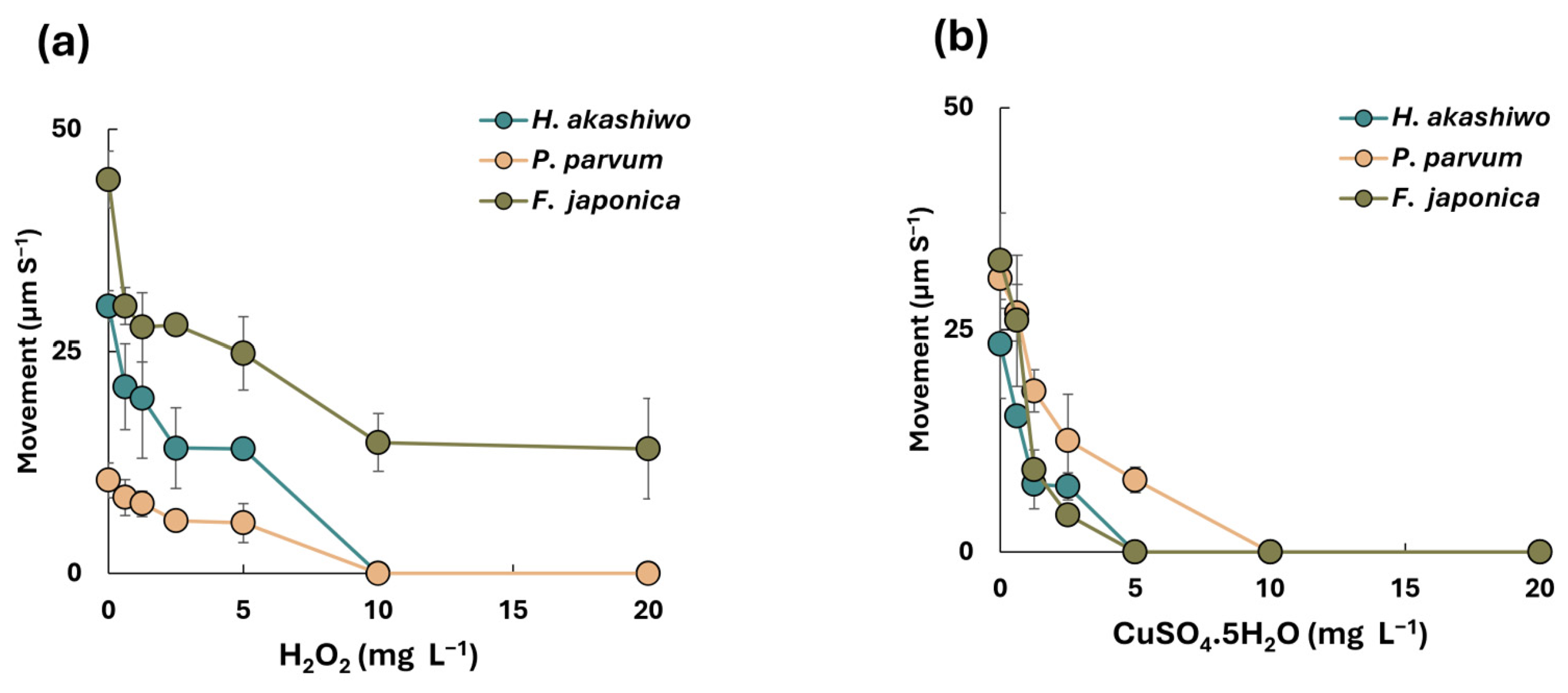
Due to the morphological structure of phytoflagellates, monitoring motility behavior under algaecide exposure is critical for understanding the mechanistic effect of treatment on phytoflagellates and predicting their ecological impacts. After 24 h of treatment, the average velocity of phytoplankton was measured and plotted against algaecide concentrations (Figure 2). It was observed that the motility of all three species showed a clear dose-dependent response to both H2O2 and CuSO4. Increasing concentrations of either algaecide resulted in significant reductions in motility (p-value < 0.01), with complete cessation of movement observed at the highest doses, except for F. japonica treated by H2O2.
Under H2O2 treatment, P. parvum exhibited the highest sensitivity (p-value < 0.01), followed by H. akashiwo and F. japonica. At 10 mg L−1F. japonica retained approximately 50% of its initial motility, whereas P. parvum and H. akashiwo showed complete loss of movement. In contrast, under CuSO4 exposure, the trend shifted: H. akashiwo and F. japonica displayed similar reductions in motility, followed by P. parvum (p-value < 0.01). Both H. akashiwo and F. japonica stopped moving at 5 mg L−1, while P. parvum required 10 mg L−1 for complete immobilization.
The observed dose-dependent decline in motility across all species confirms that oxidative and ionic stressors disrupt key physiological processes required for flagellar function. Motility impairment is an early and sensitive indicator of cellular stress, preceding cell growth inhibition and death under oxidative treatments [40]. Hydrogen peroxide exerts its algacidal effect primarily through oxidative damage to membranes and the flagellar apparatus, generating ROS that impair ion gradients and ATP-dependent motility systems [41,42]. Copper ions, on the other hand, interfere with enzyme activity and cellular homeostasis, leading to rapid immobilization and eventual cell lysis [43,44,45].
Species-specific differences in sensitivity reflect underlying physiological and biochemical traits. Although P. parvum has a smaller size (≤10 µm) and biovolume (368 µm3) compared to H. akashiwo and F. japonica, its surface area-to-volume ratio is higher [46,47,48]. This morphological characteristic increases the relative exposure of P. parvum to oxidizing agents such as hydrogen peroxide, potentially accelerating oxidative stress and cellular damage. On the other hand, the similar response of H. akashiwo and F. japonica to CuSO4 suggests shared tolerance mechanisms, possibly linked to metal-binding proteins and detoxification pathways common in raphidophytes [46,49].
Importantly, motility collapse at higher doses indicates that behavioral endpoints can serve as rapid predictors of treatment efficacy. This supports the integration of real-time motility monitoring into HAB management strategies, enabling adaptive dosing before irreversible ecological impacts occur. Previous work has shown that motility-based thresholds correlate with mortality and can inform operational decisions in aquaculture systems [40,50].

3.4. Cell Motion Dynamics: Mean Squared Displacement (MSD) and Probability Density Function (PDF)

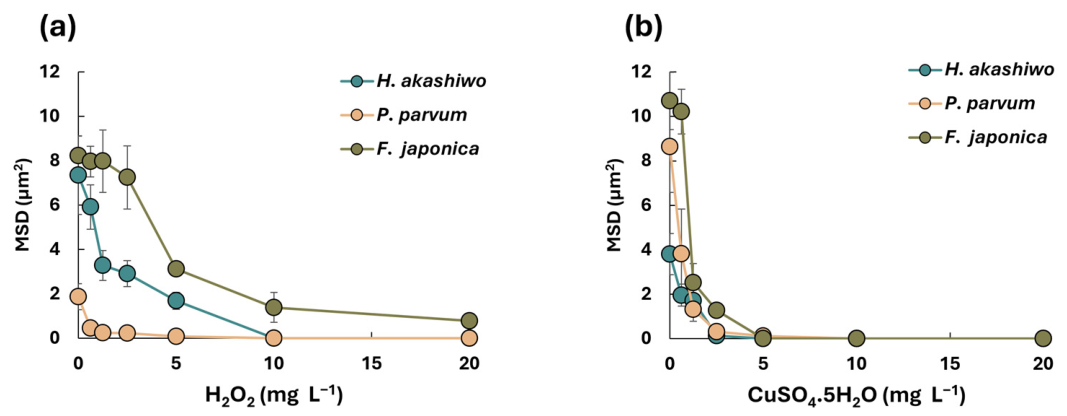
The mean squared displacement (MSD) is a quantitative measure of the average squared distance traveled by a particle over time [32], and is calculated using the following equation:
M S D   t = X i t X i 0 2
where X i t denotes the positions of particle i at time and . denotes ensemble average.
Increasing the concentrations of H2O2 and CuSO4 resulted in a pronounced decline in MSD for all three species after 24 h (Figure 3a,b). In line with previous results, even low concentrations of CuSO4 significantly impaired motility and therefore MSD in all species (p-value < 0.01).
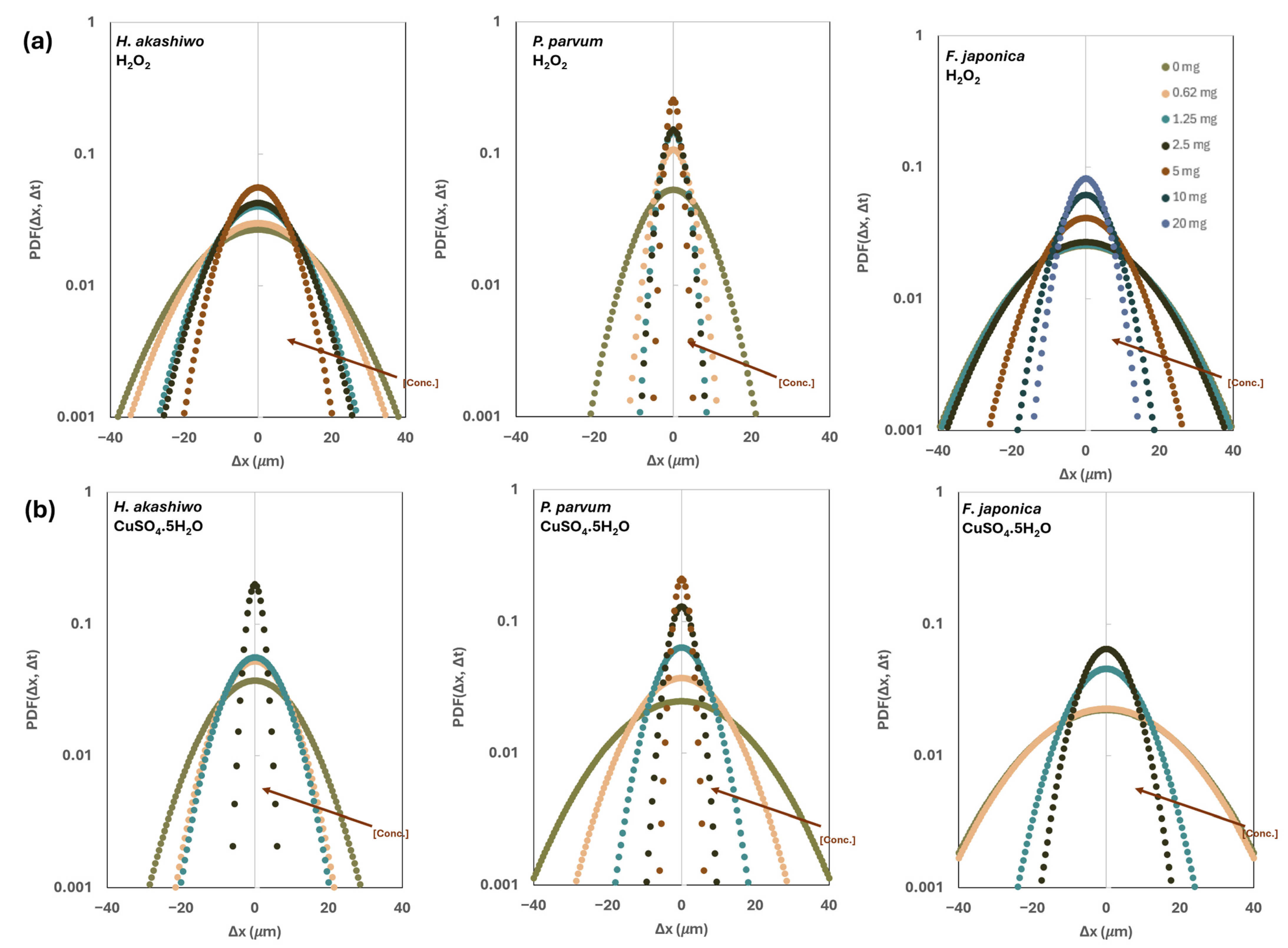
The probability density function (PDF) analysis of the movement also confirmed a clear concentration-dependent effect of both algaecides on the motility behavior of the studied phytoflagellates (Figure 4). Across all treatments, progressive narrowing of PDFs indicated reduced displacement and motility, with the degree of collapse varying by species and chemical stressors.
Under H2O2 exposure, P. parvum exhibited the most pronounced motility reduction, with PDFs sharply contracting even at low concentrations (0.625–2.5 mg L−1), confirming its high susceptibility to oxidative stress. Meanwhile, H. akashiwo and F. japonica maintained broader displacement distributions at lower doses but showed severe narrowing at 10–20 mg L−1, signaling progressive impairment.
Under CuSO4 treatment, H. akashiwo and P. parvum displayed marked motility collapse at intermediate concentrations (5–10 mg L−1), while F. japonica retained relatively broader PDFs across similar doses.
PDF analysis complements MSD by revealing the distributional characteristics of cell movement rather than just average displacement. The observed narrowing of PDFs under stress indicates a shift from active swimming to constrained or erratic motion, consistent with stress-induced impairment of flagellar activity and energy metabolism [51,52].
Overall, these results confirm that both algaecides significantly impair motility in the studied ichthyotoxic flagellates, but the magnitude and rate of inhibition differ between stressors and species. CuSO4 exhibited a more potent and rapid effect, likely due to its ability to disrupt cellular ion homeostasis and enzyme function, leading to immediate physiological stress [24,53,54]. In contrast, H2O2-induced oxidative damage [25,26] appears to accumulate over time, causing a more gradual decline in motility.

4. Conclusions

This study demonstrated distinct, species-specific sensitivities of each ichthyotoxic flagellate to commonly used chemical mitigation agents. Our findings highlight that all species exhibited sensitivity to both algaecides, but with distinct patterns: P. parvum was highly vulnerable to oxidative stress, likely due to its high surface-area-to-volume ratio and limited structural defenses, whereas H. akashiwo and F. japonica showed greater tolerance to H2O2 but increased susceptibility to copper toxicity, reflecting shared detoxification mechanisms among raphidophytes.
The findings of this study suggest that H2O2 may represent a more suitable mitigation option for aquaculture settings, particularly when used at low to moderate concentrations and short exposure durations. Hydrogen peroxide offers a more environmentally responsible alternative to copper sulfate, largely because it degrades rapidly and poses minimal risk of sediment accumulation [55]. In contrast, although copper sulfate is effective, its continued use raises concerns regarding sediment buildup, toxicity to non-target organisms, and increasing regulatory constraints [53].
Importantly, when these treatments are evaluated through the lens of motility-based mechanisms, the ability of flagellated taxa to swim and actively position themselves within the water column becomes a critical determinant of both their vulnerability to intervention and the development of targeted, ecologically responsible control strategies. The findings of this study suggest that algal motility can be disrupted at lower concentrations than those needed to induce significant cell mortality, pointing to an underexplored strategy for mitigating harmful algal blooms.
Rather than relying on high-dose treatments aimed at cell death, disrupting swimming behavior could limit the ability of these taxa to position themselves in harmful zones (e.g., aggregate around cages). By removing their capacity to navigate the water column, we effectively neutralize their ecological advantage and diminish bloom impact without the need for more aggressive interventions. It should also be noted that all experiments in this study were conducted under controlled laboratory conditions. Accordingly, future studies should evaluate these responses under more complex and representative natural environmental conditions to assess their relevance beyond laboratory-scale systems.

Author Contributions

Conceptualization, M.M.A., K.J.E., and H.P.; methodology, M.M.A., T.Y., J.Z., S.Z., and K.J.E.; software, M.M.A., T.Y., J.Z., and S.Z.; validation, M.M.A., T.Y., J.Z., S.Z., K.J.E. and H.P.; formal analysis, M.M.A., T.Y., J.Z., and S.Z.; investigation, T.Y., J.Z., and S.Z.; resources, M.M.A., T.Y., J.Z., S.Z., P.D., and H.P.; data curation, M.M.A., T.Y., J.Z., and S.Z.; writing—original draft preparation, M.M.A.; writing—review and editing, M.M.A., T.Y., J.Z., S.Z., K.J.E., P.D., and H.P.; visualization, M.M.A.; supervision, M.M.A., K.J.E., and H.P.; project administration, M.M.A.; funding acquisition, H.P. All authors have read and agreed to the published version of the manuscript.

Funding

This research was funded by NSERC RGPIN-2019-05156, RGPIN-2017-04078, and CFI (38749), which was funded by HP.

Institutional Review Board Statement

Not applicable

Informed Consent Statement

Not applicable

Data Availability Statement

The original contributions presented in this study are included in the article. Further inquiries can be directed to the corresponding author.

Conflicts of Interest

The authors declare no conflicts of interest.

Abbreviations

The following abbreviations are used in this manuscript:
HABsHarmful algal blooms
H2O2Hydrogen peroxide
CuSO4Copper sulfate
MSDMean squared displacement
PDFProbability density function
EC50Median effective concentration
ANOVAAnalysis of variance

References

  1. Subasinghe, R.; Soto, D.; Jia, J. Global aquaculture and its role in sustainable development. Rev. Aquac. 2009, 1, 2–9. [Google Scholar] [CrossRef]
  2. Naylor, R.L.; Hardy, R.W.; Buschmann, A.H.; Bush, S.R.; Cao, L.; Klinger, D.H.; Little, D.C.; Lubchenco, J.; Shumway, S.E.; Troell, M. A 20-year retrospective review of global aquaculture. Nature 2021, 591, 551–563, Erratum in Nature 2021, 593, E12; Erratum in Nature 2021, 595, E36. [Google Scholar] [CrossRef]
  3. Brown, A.R.; Lilley, M.; Shutler, J.; Lowe, C.; Artioli, Y.; Torres, R.; Berdalet, E.; Tyler, C.R. Assessing risks and mitigating impacts of harmful algal blooms on mariculture and marine fisheries. Rev. Aquac. 2020, 12, 1663–1688. [Google Scholar] [CrossRef]
  4. Mehdizadeh Allaf, M.; Erratt, K.J. Navigating aquaculture losses: Tackling fish-killing phytoflagellates in a changing global landscape. Rev. Aquac. 2024, 16, 2023–2033. [Google Scholar] [CrossRef]
  5. Smayda, T.J. What is a bloom? A commentary. Limnol. Oceanogr. 1997, 42, 1132–1136. [Google Scholar] [CrossRef]
  6. Hallegraeff, G.M. Harmful algal blooms: A global overview. In Manual on Harmful Marine Microalgae; Hallegraeff, G.M., Anderson, D.M., Cembella, A.D., Eds.; UNESCO Publishing: Paris, France, 2004; pp. 25–50. [Google Scholar]
  7. Fernandes-Salvador, J.A.; Davidson, K.; Sourisseau, M.; Revilla, M.; Schmidt, W.; Clarke, D.; Miller, P.I.; Arce, P.; Fernández, R.; Maman, L.; et al. Current status of forecasting toxic harmful algae for the north-east Atlantic shellfish aquaculture industry. Front. Mar. Sci. 2021, 8, 666583. [Google Scholar] [CrossRef]
  8. Díaz, P.A.; Álvarez, G.; Varela, D.; Pérez-Santos, I.; Díaz, M.; Molinet, C.; Seguel, M.; Aguilera-Belmonte, A.; Guzmán, L.; Uribe, E.; et al. Impacts of harmful algal blooms on the aquaculture industry: Chile as a case study. Perspect. Phycol. 2019, 6, 39–50. [Google Scholar] [CrossRef]
  9. Mehdizadeh Allaf, M.; Trick, C.G. Growth response and cell permeability of the fish-killing phytoflagellate Heterosigma akashiwo under projected climate conditions. Toxins 2025, 17, 259. [Google Scholar] [CrossRef] [PubMed]
  10. Mehdizadeh Allaf, M. Heterosigma akashiwo, a fish-killing flagellate. Microbiol. Res. 2023, 14, 132–147. [Google Scholar] [CrossRef]
  11. Whyte, J.N.C.; Haigh, N.; Ginther, N.G.; Keddy, L.J. First record of blooms of Cochlodinium sp. (Gymnodiniales, Dinophyceae) causing mortality to aquacultured salmon on the west coast of Canada. Phycologia 2001, 40, 298–304. [Google Scholar] [CrossRef]
  12. Davidson, K.; Gowen, R.J.; Harrison, P.J.; Fleming, L.E.; Hoagland, P.; Moschonas, G. Anthropogenic nutrients and harmful algae in coastal waters. J. Environ. Manag. 2014, 146, 206–216. [Google Scholar] [CrossRef] [PubMed]
  13. Chang, F.H.; Anderson, C.; Boustead, N.C. First record of a Heterosigma (raphidophyceae) bloom with associated mortality of cage-reared salmon in big glory bay, New zealand. New Zeal. J. Mar. Freshw. Res. 1990, 24, 461–469. [Google Scholar] [CrossRef]
  14. García-Mendoza, E.; Cáceres-Martínez, J.; Rivas, D.; Fimbres-Martinez, M.; Sánchez-Bravo, Y.; Vásquez-Yeomans, R.; Medina-Elizalde, J. Mass Mortality of Cultivated Northern Bluefin Tuna Thunnus thynnus orientalis associated with Chattonella Species in Baja California, Mexico. Front. Mar. Sci. 2018, 5, 454. [Google Scholar] [CrossRef]
  15. Jack Rensel, J.E.; Haigh, N.; Tynan, T.J. Fraser river sockeye salmon marine survival decline and harmful blooms of Heterosigma akashiwo. Harmful Algae 2010, 10, 98–115. [Google Scholar] [CrossRef]
  16. Pezzolesi, L.; Cucchiari, E.; Guerrini, F.; Pasteris, A.; Galletti, P.; Tagliavini, E.; Totti, C.; Pistocchi, R. Toxicity evaluation of Fibrocapsa japonica from the Northern Adriatic Sea through a chemical and toxicological approach. Harmful Algae 2010, 9, 504–514. [Google Scholar] [CrossRef]
  17. Li, X.; Yan, T.; Yu, R.; Zhou, M. A review of Karenia mikimotoi: Bloom events, physiology, toxicity and toxic mechanism. Harmful Algae 2019, 90, 101702. [Google Scholar] [CrossRef]
  18. Sobieraj, J.; Metelski, D. Insights into toxic Prymnesium parvum blooms as a cause of the ecological disaster on the Odra river. Toxins 2023, 15, 403. [Google Scholar] [CrossRef]
  19. Anderson, D.M. Approaches to monitoring, control and management of harmful algal blooms (HABs). Ocean Coast. Manag. 2009, 52, 342–347. [Google Scholar] [CrossRef]
  20. Jančula, D.; MarŠálek, B. Critical review of actually available chemical compounds for prevention and management of cyanobacterial blooms. Chemosphere 2011, 85, 1415–1422. [Google Scholar] [CrossRef]
  21. Balaji-Prasath, B.; Wang, Y.; Su, Y.P.; Hamilton, D.P.; Lin, H.; Zheng, L.; Zhang, Y. Methods to control harmful algal blooms: A review. Environ. Chem. Lett. 2022, 20, 3133–3152. [Google Scholar] [CrossRef]
  22. Gallardo-Rodríguez, J.J.; Astuya-Villalón, A.; Llanos-Rivera, A.; Avello-Fontalba, V.; Ulloa-Jofré, V. A critical review on control methods for harmful algal blooms. Rev. Aquac. 2019, 11, 661–684. [Google Scholar] [CrossRef]
  23. Mehdizadeh Allaf, M.; Erratt, K.J.; Peerhossaini, H. Comparative assessment of algaecide performance on freshwater phytoplankton: Understanding differential sensitivities to frame cyanobacteria management. Water Res. 2023, 234, 119811. [Google Scholar] [CrossRef]
  24. Ebenezer, V.; Lim, W.A.; Ki, J.S. Effects of the algicides CuSO4 and NaOCl on various physiological parameters in the harmful dinoflagellate Cochlodinium polykrikoides. J. Appl. Phycol. 2014, 26, 2357–2365. [Google Scholar] [CrossRef]
  25. Burson, A.; Matthijs, H.C.P.; de Bruijne, W.; Talens, R.; Hoogenboom, R.; Gerssen, A.; Visser, P.M.; Stomp, M.; Steur, K.; van Scheppingen, Y.; et al. Termination of a toxic Alexandrium bloom with hydrogen peroxide. Harmful Algae 2014, 31, 125–135. [Google Scholar] [CrossRef]
  26. Chen, Y.; Zaman, F.; Jia, Y.; Huang, Y.; Li, T.; Bai, F.; Li, L.; Song, L.; Li, J. Harmful cyanobacterial bloom control with hydrogen peroxide: Mechanism, affecting factors, development, and prospects. Curr. Pollut. Rep. 2024, 10, 566–579. [Google Scholar] [CrossRef]
  27. Drábková, M.; Admiraal, W.; Maršálek, B. Combined exposure to hydrogen peroxide and light-selective effects on cyanobacteria, green algae, and diatoms. Environ. Sci. Technol. 2007, 41, 309–314. [Google Scholar] [CrossRef]
  28. Drábková, M.; Matthijs, H.C.P.; Admiraal, W.; Maršálek, B. Selective effects of H2O2 on cyanobacterial photosynthesis. Photosynthetica 2007, 45, 363–369. [Google Scholar] [CrossRef]
  29. Sandrini, G.; Piel, T.; Xu, T.; White, E.; Qin, H.; Slot, P.C.; Huisman, J.; Visser, P.M. Sensitivity to hydrogen peroxide of the bloom-forming cyanobacterium Microcystis PCC 7806 depends on nutrient availability. Harmful Algae 2020, 99, 101916. [Google Scholar] [CrossRef] [PubMed]
  30. Buley, R.P.; Gladfelter, M.F.; Fernandez-Figueroa, E.G.; Wilson, A.E. Complex effects of dissolved organic matter, temperature, and initial bloom density on the efficacy of hydrogen peroxide to control cyanobacteria. Environ. Sci. Pollut. Res. 2023, 30, 43991–44005. [Google Scholar] [CrossRef] [PubMed]
  31. Andersen, R.A.; Berges, J.A.; Harrison, P.J.; Watanabe, M.M. Recipes for freshwater and seawater media. In Algal Culturing Techniques; Andersen, R.A., Ed.; Elsevier Academic Press: Burlington, MA, USA, 2005; pp. 429–538. [Google Scholar]
  32. Samadi, Z.; Mehdizadeh Allaf, M.; Vourc’h, T.; DeGroot, C.T.; Peerhossaini, H. Investigation of Synechocystis sp. CPCC 534 motility during different stages of the growth period in active fluids. Processes 2023, 11, 1492. [Google Scholar] [CrossRef]
  33. Roelke, D.L.; Barkoh, A.; Brooks, B.W.; Grover, J.P.; Hambright, K.D.; Laclaire, J.W.; Moeller, P.D.R.; Patino, R. A chronicle of a killer alga in the west: Ecology, assessment, and management of Prymnesium parvum blooms. Hydrobiologia 2016, 764, 29–50, Erratum in Hydrobiologia 2016, 764, 51. [Google Scholar] [CrossRef]
  34. Wagstaff, B.A.; Hems, E.S.; Rejzek, M.; Pratscher, J.; Brooks, E.; Kuhaudomlarp, S.; O’Neill, E.C.; Donaldson, M.I.; Lane, S.; Currie, J.; et al. Insights into toxic prymnesium parvum blooms: The role of sugars and algal viruses. Biochem. Soc. Trans. 2018, 46, 413–421. [Google Scholar] [CrossRef] [PubMed]
  35. Engesmo, A.; Eikrem, W.; Seoane, S.; Smith, K.; Edvardsen, B.; Hofgaard, A.; Tomas, C.R. New insights into the morphology and phylogeny of Heterosigma akashiwo (Raphidophyceae), with the description of Heterosigma minor sp. nov. Phycologia 2016, 55, 279–294. [Google Scholar] [CrossRef]
  36. de Boer, M.K.; Tyl, M.R.; Fu, M.; Kulk, G.; Liebezeit, G.; Tomas, C.R.; Lenzi, A.; Naar, J.; Vrieling, E.G.; van Rijssel, M. Haemolytic activity within the species Fibrocapsa japonica (Raphidophyceae). Harmful Algae 2009, 8, 699–705. [Google Scholar] [CrossRef]
  37. Wang, H.; Ebenezer, V.; Ki, J.S. Photosynthetic and biochemical responses of the freshwater green algae Closterium ehrenbergii Meneghini (Conjugatophyceae) exposed to the metal coppers and its implication for toxicity testing. J. Microbiol. 2018, 56, 426–434. [Google Scholar] [CrossRef] [PubMed]
  38. Hu, J.; Berthold, D.E.; Wang, Y.; Xiao, X.; Laughinghouse, H.D. Treatment of the red tide dinoflagellate Karenia brevis and brevetoxins using USEPA-registered algaecides. Harmful Algae 2022, 120, 102347. [Google Scholar] [CrossRef]
  39. Lusty, M.W.; Gobler, C.J. The Efficacy of Hydrogen Peroxide in Mitigating Communities across Four Lakes in NY, USA. Toxins 2020, 12, 428. [Google Scholar] [CrossRef]
  40. Park, S.C.; Lee, J.K.; Kim, S.W.; Park, Y. Selective algicidal action of peptides against harmful algal bloom species. PLoS ONE 2011, 6, e26733. [Google Scholar] [CrossRef] [PubMed]
  41. Wagstaff, B.A.; Pratscher, J.; Rivera, P.P.L.; Hems, E.S.; Brooks, E.; Rejzek, M.; Todd, J.D.; Murrell, J.C.; Field, R.A. Assessing the toxicity and mitigating the impact of harmful Prymnesium blooms in eutrophic waters of the Norfolk broads. Environ. Sci. Technol. 2021, 55, 16538–16551. [Google Scholar] [CrossRef]
  42. Kim, C.S.; Lee, S.G.; Lee, C.K.; Kim, H.G.; Jung, J. Reactive oxygen species as causative agents in the ichthyotoxicity of the red tide dinoflagellate Cochlodinium polykrikoides. J. Plankton Res. 1999, 21, 2105–2115. [Google Scholar] [CrossRef]
  43. Liu, G.; Chai, X.; Shao, Y.; Hu, L.; Xie, Q.; Wu, H. Toxicity of copper, lead, and cadmium on the motility of two marine microalgae Isochrysis galbana and Tetraselmis chui. J. Environ. Sci. 2011, 23, 330–335. [Google Scholar] [CrossRef]
  44. Tsai, K.P. Management of target algae by using copper-based algaecides: Effects of algal cell density and sensitivity to copper. Water Air Soil Pollut. 2016, 227, 238. [Google Scholar] [CrossRef]
  45. Qian, H.; Yu, S.; Sun, Z.; Xie, X.; Liu, W.; Fu, Z. Effects of copper sulfate, hydrogen peroxide and N-phenyl-2-naphthylamine on oxidative stress and the expression of genes involved photosynthesis and microcystin disposition in Microcystis aeruginosa. Aquat. Toxicol. 2010, 99, 405–412. [Google Scholar] [CrossRef] [PubMed]
  46. Moreno-Andrés, J.; Romero-Martínez, L.; Seoane, S.; Acevedo-Merino, A.; Moreno-Garrido, I.; Nebot, E. Evaluation of algaecide effectiveness of five different oxidants applied on harmful phytoplankton. J. Hazard. Mater. 2023, 452, 131279. [Google Scholar] [CrossRef] [PubMed]
  47. Olenina, I.; Hajdu, S.; Edler, L.; Andersson, A.; Wasmund, N.; Busch, S.; Göbel, J.; Gromisz, S.; Huseby, S.; Huttunen, M.; et al. Biovolumes and size-classes of phytoplankton in the Baltic Sea. In Proceedings of the HELCOM Baltic Sea Environment Proceedings; No. 106; Helsinki Commission, Baltic Marine Environment Protection Commission: Helsinki, Finland, 2006; pp. 1–144. [Google Scholar]
  48. Aguiar Juárez, D.; Sunesen, I.; Flores-Leñero, A.; Norambuena, L.; Krock, B.; Fuenzalida, G.; Mardones, J.I. Uncovering Fibrocapsa japonica (Raphidophyceae) in South America: First taxonomic and toxicological Insights from Argentinean coastal waters. Toxins 2025, 17, 386. [Google Scholar] [CrossRef]
  49. Markina, Z.V. The cell ultrastructure and autotrophic function of the Raphidophyte alga Heterosigma akashiwo (Y. Hada) Y. Hada ex Y. Hara and M. Chihara, 1987 under copper exposure. Russ. J. Mar. Biol. 2021, 47, 204–209. [Google Scholar] [CrossRef]
  50. Du, X.; Zhou, W.; Zhang, W.; Sun, S.; Han, Y.; Tang, Y.; Shi, W.; Liu, G. Toxicities of three metal oxide nanoparticles to a marine microalga: Impacts on the motility and potential affecting mechanisms. Environ. Pollut. 2021, 290, 118027. [Google Scholar] [CrossRef] [PubMed]
  51. Giugliano, G.; Valentino, M.; Cavalletti, E.; Memmolo, P.; Miccio, L.; Bianco, V.; Sardo, A.; Ferraro, P. Digital holography unveils sub-lethal copper doses using motility patterns of Tetraselmis microalgae bioprobes. Algal Res. 2025, 86, 103928. [Google Scholar] [CrossRef]
  52. Bondoc-Naumovitz, K.G.; Laeverenz-Schlogelhofer, H.; Poon, R.N.; Boggon, A.K.; Bentley, S.A.; Cortese, D.; Wan, K.Y. Methods and measures for investigating microscale motility. In Proceedings of the Integrative and Comparative Biology; Oxford University Press: Oxford, UK, 2023; Volume 63, pp. 1485–1508. [Google Scholar]
  53. Leal, P.R.; Moschini-Carlos, V.; López-Doval, J.C.; Cintra, J.P.; Yamamoto, J.K.; Bitencourt, M.D.; Santos, R.F.; Abreu, G.C.; Pompêo, M.L.M. Impact of copper sulfate application at an urban Brazilian reservoir: A geostatistical and ecotoxicological approach. Sci. Total Environ. 2018, 618, 621–634. [Google Scholar] [CrossRef]
  54. Tsai, K.P.; Uzun, H.; Chen, H.; Karanfil, T.; Chow, A.T. Control wildfire-induced Microcystis aeruginosa blooms by copper sulfate: Trade-offs between reducing algal organic matter and promoting disinfection byproduct formation. Water Res. 2019, 158, 227–236. [Google Scholar] [CrossRef]
  55. Matthijs, H.C.P.; Visser, P.M.; Reeze, B.; Meeuse, J.; Slot, P.C.; Wijn, G.; Talens, R.; Huisman, J. Selective suppression of harmful cyanobacteria in an entire lake with hydrogen peroxide. Water Res. 2012, 46, 1460–1472. [Google Scholar] [CrossRef] [PubMed]
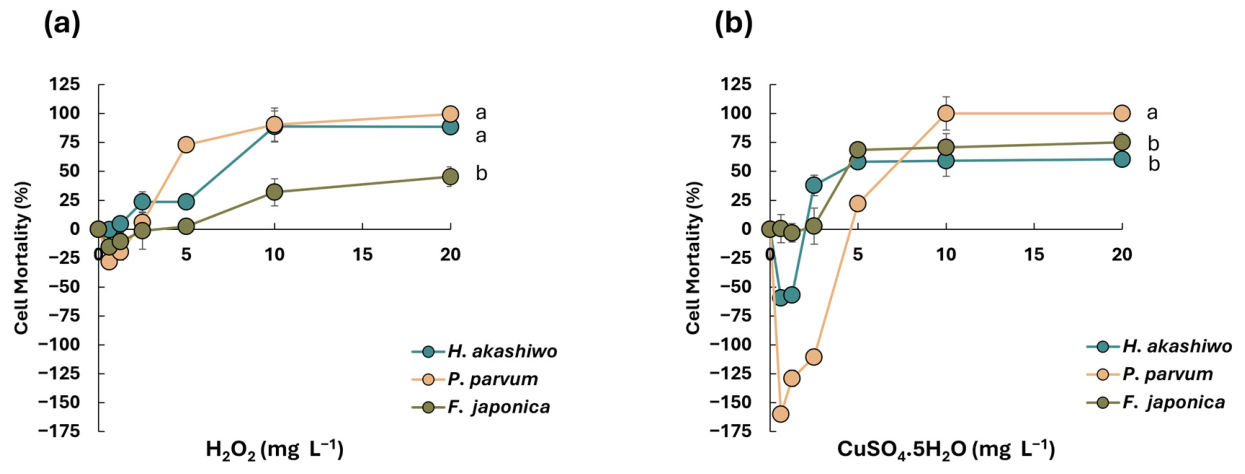
Figure 1. Cell mortality after 24 h of exposure to various concentrations of hydrogen peroxide (a) and copper sulfate (b). The presented data for each species is the average of different datasets ± SD. Different lowercase letters indicate statistically significant differences among species at the highest tested concentration (20 mg L−1). The same lowercase letter denotes no significant difference. Statistical significance was determined at a p-value < 0.05 level.
Microorganisms 14 01086 g001
Figure 2. Cell movement after 24 h of exposure to various concentrations of hydrogen peroxide (a) and copper sulfate (b). The presented data for each species is the average of different datasets ± SD.
Microorganisms 14 01086 g002
Figure 3. Variation in MSD across different species under varying concentrations of H2O2 (a) and CuSO4 (b) after 24 h. The presented data for each species is the average of different datasets ± SD.
Microorganisms 14 01086 g003
Figure 4. Displacement probability density function (PDF) of cell displacement under increasing concentrations of H2O2 (a) and CuSO4 (b). Over 24 h. Narrower curves at higher concentrations suggest reduced motility, while broader curves at lower concentrations indicate more active movement. The arrow indicates the direction of increasing algaecide concentration [Conc.]. The presented data for each species is the average of different datasets ± SD.
Microorganisms 14 01086 g004
Table 1. Experimental algal strains and their proper culturing media.
Algae SpeciesCulture Strain NumberMedia
Prymnesium parvumARC 66f/20
Heterosigma akashiwoARC 446f/2
Fibrocapsa japonicaARC 40f/2
Table 2. The median effective concentration (EC50) values (mg L−1) for different species after 24 h exposure to H2O2 and CuSO4.
Time (h)PhytoplanktonHydrogen Peroxide (EC50)Copper Sulfate (EC50)
24H. akashiwo6.01 ± 1.512.05 ± 0.44
P. parvum3.35 ± 0.174.07 ± 0.4
F. japonica7.86 ± 2.943.55 ± 0.42
Disclaimer/Publisher’s Note: The statements, opinions and data contained in all publications are solely those of the individual author(s) and contributor(s) and not of MDPI and/or the editor(s). MDPI and/or the editor(s) disclaim responsibility for any injury to people or property resulting from any ideas, methods, instructions or products referred to in the content.