Article

Temporal Dynamics of Vaccine Uptake: Perceptual and Social Drivers of Adoption Speed Across Innovation Diffusion Curve

1
Department of Business Administration, Tunghai University, Taichung 407, Taiwan
2
Policy and Organizational Management Program, Duke University, Durham, NC 27708, USA
3
Independent Researcher, Fayetteville, NY 13066, USA
4
School of Medicine, Duke University, Durham, NC 27708, USA
*
Author to whom correspondence should be addressed.
Microorganisms 2026, 14(5), 1049; https://doi.org/10.3390/microorganisms14051049
Submission received: 30 March 2026 / Revised: 28 April 2026 / Accepted: 5 May 2026 / Published: 7 May 2026
(This article belongs to the Special Issue SARS-CoV-2: Infection, Transmission, and Prevention)

Abstract

The effectiveness of infection prevention depends on not only uptake but also the timing of adoption. Vaccination studies typically treat uptake as binary, overlooking when while investigating why individuals get vaccinated. Using the novel mRNA COVID-19 vaccines as a case study, the influences of risk perceptions and social norms on vaccination timing were examined through an Innovation Diffusion framework. An online survey was conducted in November 2021 to assess vaccination behaviors, attitudes, and peer expectations of 1710 U.S. residents (51.64% females, 31.23% minorities, with a relatively balanced distribution across age and income brackets). Participants were classified by vaccination timing and intentions as early adopters, early majority, late majority, or laggards for comparative analyses. One year after vaccine rollout, 64.3% had received at least one dose; 20.1% reported no intention to vaccinate, and this resistance persisted through May 2023 when the pandemic ended. Vaccine confidence and prior behavior (e.g., influenza vaccination) demonstrated strong gradients across adoption timing. Earlier uptake was associated with higher perceived vaccine importance, infection risk, and peer uptake, whereas age and education effects diminished over time. Perceived illness severity and disease knowledge showed inconsistent influences. Later adopters anticipated higher post-vaccination infection risk and greater peer non-vaccination, reinforcing hesitancy. Social norms (but not risk perception) mediated the relationship between confidence and timing; earlier adoption further predicted booster acceptance. These findings highlight the importance of trust, correcting efficacy misperceptions, and leveraging positive peer norms to promote timely vaccination and inform strategies for other infectious diseases.

1. Introduction

The effectiveness of a scientific invention or medical breakthrough, be it an infection preventive procedure or novel treatment, largely depends on whether the intended population is willing and able to accept the new measure and obtain it in time. Despite the availability of numerous safe and effective vaccines, many individuals delay or refuse vaccination—a phenomenon known as vaccine hesitancy that impedes progress toward herd immunity against infectious diseases [1,2,3]. This challenge is especially pronounced and concerning during regional or global outbreaks, as seen during the COVID-19 pandemic, when prompt and mass uptake was essential to curb transmission and support economic recovery [4].
The Centers for Disease Control and Prevention’s (CDC) Immunization Services Division distributed the COVID-19 vaccine to each of the CDC’s 64 jurisdictions (50 states, the District of Columbia, five cities and eight territories). Census data and vaccine availability projections were used to determine jurisdictional vaccine allocations; each jurisdiction developed its own COVID-19 allocation framework using general guidance from the CDC and available data on critical and vulnerable populations. Although the plans were provided to the CDC, state and local health departments determined how many doses to distribute to the enrolled providers in their jurisdiction [5,6].
Even when the new mRNA vaccine was provided free to the public, with costs covered by the U.S. government, only 61.43% of the American population were fully vaccinated by the end of 2021, one year after the launch of the vaccine (compared to 74.91% in France, 69.54% in the United Kingdom (UK), and 79.77% in Japan) [7]. Likewise, for the seasonal flu shot, recommended for people six months and older but not required (except for certain professions like military and healthcare) and fully covered by both public and private insurance in the U.S., the vaccination rates have hovered around 41–63%, varying by state and declining since the pandemic [8,9].
To understand vaccine decision-making, researchers have drawn on behavioral models such as the Health Belief Model (HBM) [10,11,12], Theory of Planned Behavior (TPB) [12,13,14], and Precaution Adoption Process Model (PAPM) [15,16]. The PAPM emphasizes how knowledge, provider reassurance, and social norms influence Human Papillomavirus (HPV) vaccine acceptance [16]. Similarly, the HBM links acceptance to perceived efficacy, risk, and provider recommendation, and identifies barriers such as cost and concerns that vaccinating against a common sexually transmitted infection (STI) like HPV may be seen as implicitly promoting adolescent sexual activity [12,17]. Though these models provide a cognitive, individual-level explanation of behavior, they often investigate vaccination as a dichotomy and fall short of accounting for or predicting the timing or speed of adoption and the ratio of unprotected population across broader social systems at a particular phase. These dynamics could determine the length of an outbreak and the risk of it turning into an epidemic.
The Diffusion of Innovations (DOI) theory, developed by Everett Rogers with origins in sociology and communication [18], addresses this gap by examining how new ideas and technologies are spread within populations. It categorizes individuals into five groups based on adoption timing: innovators, early adopters, early majority, late majority, and laggards [19]. The categorization reflects differences in response to new information, uncertainty, and social influence. DOI also identifies five innovation characteristics that shape adoption: relative advantage, compatibility, complexity, trialability, and observability [19]. The theory has been applied globally in healthcare [20,21], technology (e.g., e-health [22] and patient portals [23]), and public policy [24,25]. For instance, the DOI theory was used to successfully predict healthcare workers’ readiness to adopt E-Health platforms in a Mauritian hospital setting, with early adopters serving as key leaders in driving diffusion across adopter categories [22]. Preventive innovations like vaccines often diffuse slowly, as their benefits are less immediately visible and their value may be difficult to comprehend or assess [26].
In influenza and HPV vaccination studies, DOI has helped demonstrate how factors like alignment with individual beliefs, access, and trusted messengers (e.g., school nurses [27]) motivated uptake over time [27,28,29]. However, peer-to-peer influence, despite its central role in the theory, has largely been overlooked. Many studies have focused on trusted sources like healthcare providers or pastors [30,31], but people also take cues from friends, coworkers, and others in their social circles [32]. Recognizing the potential sway of these personal networks, or “observability” as the DOI describes, can bring deeper insight into the social drivers of vaccination behavior. Further, many studies inquired about intentions or hypothetical responses rather than the action of actual uptake [16,33,34,35,36], which may not fully represent the behavior or capture changes in perceptions and contextual factors at the time of decision.
The COVID-19 vaccine offers a unique and compelling case for applying DOI theory in studying real-time adoption behavior: it was the first mRNA vaccine with FDA approval [37], beneficial to populations worldwide yet unfamiliar to the public. Some obtained the vaccine as soon as it became available, and others stalled for months or longer—or never accepted it [38,39]—despite widespread access, vast promotion, and amidst increasing confirmed cases nationally and worldwide [40]. In September 2020, two regional polls in North Carolina and Iowa, respectively, found 20.6% and 28.0% respondents said they would take the shot as soon as they could, while 51.0% and 45% chose to wait until others have taken it [41,42]. DOI’s core premise that adoption depends on perceived risk, benefit, and trust provides a temporal framework to examine the progression of uptake. A few COVID-19 studies referenced DOI, but not all applied the full model in comparing the timing of adoption or considered the influence of social perception. For instance, a study in Cacao, China, examined COVID-19 vaccination timing among tourism workers, integrating DOI with TPB and finding that vaccine attitude, perceived behavioral control, and prior influenza vaccination history predicted earlier uptake [43]. While this work demonstrates the value of a timing-based, DOI-informed approach in a non-Western context, it was limited to a single high-risk occupational group and did not explore peer-to-peer social influence.
Building on prior research, the objective of this study was to investigate the uptake progression via the DOI framework with a nationally representative sample in assessing not just who obtained vaccination but when and why. This approach aimed to overcome the shortfall of binary classification in most studies contrasting vaccinated vs. unvaccinated individuals, which oversimplifies the complex interplay of social, psychological, and contextual factors [1,16]. Specifically, actual adoption timing (or intention, for those not yet vaccinated) and the factors shaping it are analyzed, including common behavioral drivers like perceived infection risk and past vaccination behavior (e.g., annual flu shot) [39,44,45], as well as how self-perceived knowledge, external conditions, and peer influence affect vaccine decisions across adopter categories. The findings could help inform healthcare providers and policymakers in understanding and applying the differing effects of relevant factors that motivate vaccination adoption, encourage early action, or delay uptake.

2. Methods

2.1. Study Design and Participants

An online survey was conducted in November-December 2021, approximately one year after the launch of the first COVID-19 vaccine, to assess participants’ and their peers’ vaccination status, attitudes and experience relating to the COVID-19 pandemic and vaccine, along with demographic information (age, gender, race, education, and household income). To minimize selection bias, a stratified quota sampling approach was employed with the support of a professional panel company to strengthen the representativeness of the sample. Potential participants were only notified about the opening of the survey and not informed of the subject matter to avoid self-selection bias that may lead to oversampling people who had particularly strong opinions about the pandemic or vaccine. Unique to COVID-19 vaccination, most people remembered the month of their first dose at the time of the survey because of the widespread attention to the initial eligibility prioritization, the need to make and often wait for an appointment, and the required interval to receive the second dose or a booster (or they could check the date on their vaccination card), which reinforced memory.
The selection of indicators was based on theory, the literature review, and study objectives. The questionnaire was reviewed and advised by an expert panel and pilot tested with a small, diverse group resembling the intended sample before fielding. Because COVID-19 vaccines became available through emergency authorization in December 2020 for people aged 16 and older, the target population included U.S. residents aged 16+ (approximately 275 million) [46]. With a goal of achieving a 98% confidence level and 3% margin of error, the sample size was estimated to be at least 1509 [47]. Participants were recruited through a panel company to reach a nationally representative sample. The study protocol was approved by Duke University’s Institutional Review Board. Each participant indicated their consent by clicking the “next” button at the end of the informed consent webpage to start the survey.

2.2. Measures

2.2.1. Vaccination Status and DOI Group Categorization

The primary outcome variable was vaccination timing. Participants reported their COVID-19 vaccine status with six answer options: 1—No, I do not plan to get it; 2—I am not sure whether to get it; 3—I will (or plan to) get it; 4—I received one dose of the Pfizer or Moderna vaccine, but I am not sure if I want to get the second dose; 5—I received one dose and will get the second dose soon; and 6—I am fully vaccinated. Those vaccinated (responded 4–6) then reported the month of their first dose.
Following Rogers’ DOI theory [18], participants were initially grouped into five categories—innovators, early adopters, early majority, late majority, and laggards—based on the month (or absence) of their first COVID-19 vaccine dose. Due to the small number of innovators, as well as the initial vaccine shortage and limited eligibility that might have delayed some eager individuals from obtaining the vaccine, this group was merged with early adopters, resulting in four categories for statistical analysis.
Participants vaccinated between December 2020 and March 2021 were classified as early adopters (23%), April–July 2021 as early majority (30.6%), after July 2021 or those expressing intent or uncertainty about vaccination as late majority (26.4%), and those with no intention to get vaccinated as laggards (20.1%). This distribution aligns with CDC-reported national trends: by December 2021, 68.6% of the U.S. population had received at least one dose, rising to 78.43% by December 2022 [7]. The proportion of laggards in this study (20.1%) closely mirrors the ~20% who remained unvaccinated at the end of the pandemic (May 2023) [7].

2.2.2. Risk Perceptions, Attitudes, and Knowledge

Independent variables were selected based on prior literature on vaccine uptake and hesitancy. Risk-related measures included perceived risk of contracting COVID-19 (called “infection risk” hereafter), perceived risk of becoming seriously ill from COVID-19 (“severity risk”), perceived risk of infection despite vaccination (“post-vaccination infection risk”), and perceived overall seriousness of the situation (“seriousness”).
Attitudinal measures included confidence in the COVID-19 vaccines (“confidence”), belief in the importance of vaccination (“importance”), general support of vaccines (“support”), and past flu shot uptake (“past vaccination”). In addition, self-rated COVID-19 knowledge (“knowledge”) and intention to receive a booster (“booster intention”) were measured, all via Likert scales. Higher scores represented a higher inclination to vaccinate. “Prefer not to say” responses were coded as missing, and “Other” or “Unsure” responses were recoded or treated as missing as appropriate.

2.2.3. Social Influence

To assess social influence, participants were asked about the perceived vaccination status of peers. A distinction was made between frequent contacts (i.e., classmates or coworkers) and friends to investigate whether vaccination decisions were shaped more by proximity or personal connection and trust.

2.3. Data Analysis

Correlation analyses examined associations between vaccination timing and predictors, followed by Kruskal–Wallis tests to assess differences across DOI groups. Significant differences were assessed using post hoc comparisons. Mediation analyses tested whether perceived COVID-19 seriousness and peers’ vaccination status influenced the effects of confidence and infection risk on speed to adoption (or vaccination timing). To extend beyond bivariate relationships and considering the nonlinearity of some of the relationships, a multinomial logistic regression (MNLR) was performed to examine predictor significance and the odds of each adoption group membership, designating laggards as the reference category. All theoretically relevant predictors were entered into the MNLR model to discover the relative influences of the indicators.
Predictors comprised categorical demographic variables (dummy-coded with reference groups: age ≥ 65, White, female) alongside continuous/ordinal covariates. Model assumptions were tested before interpretation, including independence of observations, mutual exclusivity and exhaustiveness of outcome categories, linearity in the logit for continuous predictors, absence of severe outliers or influential points, and multicollinearity evaluated using variance inflation factors (VIFs), with a conservative threshold of VIF < 3 indicating acceptable collinearity [48,49,50,51]. Significance was set at p < 0.05 for all analyses.
Analysis was performed via IBM SPSS Statistics (Version 31) [52] and the PROCESS macro extension (Version 4.3) [53] was used to conduct mediation analyses. Data visualization was conducted in Python (Version 3.14.3) using the Matplotlib library (Version 3.10.8) [54,55], with code developed in Visual Studio Code (Version 1.109).

3. Results

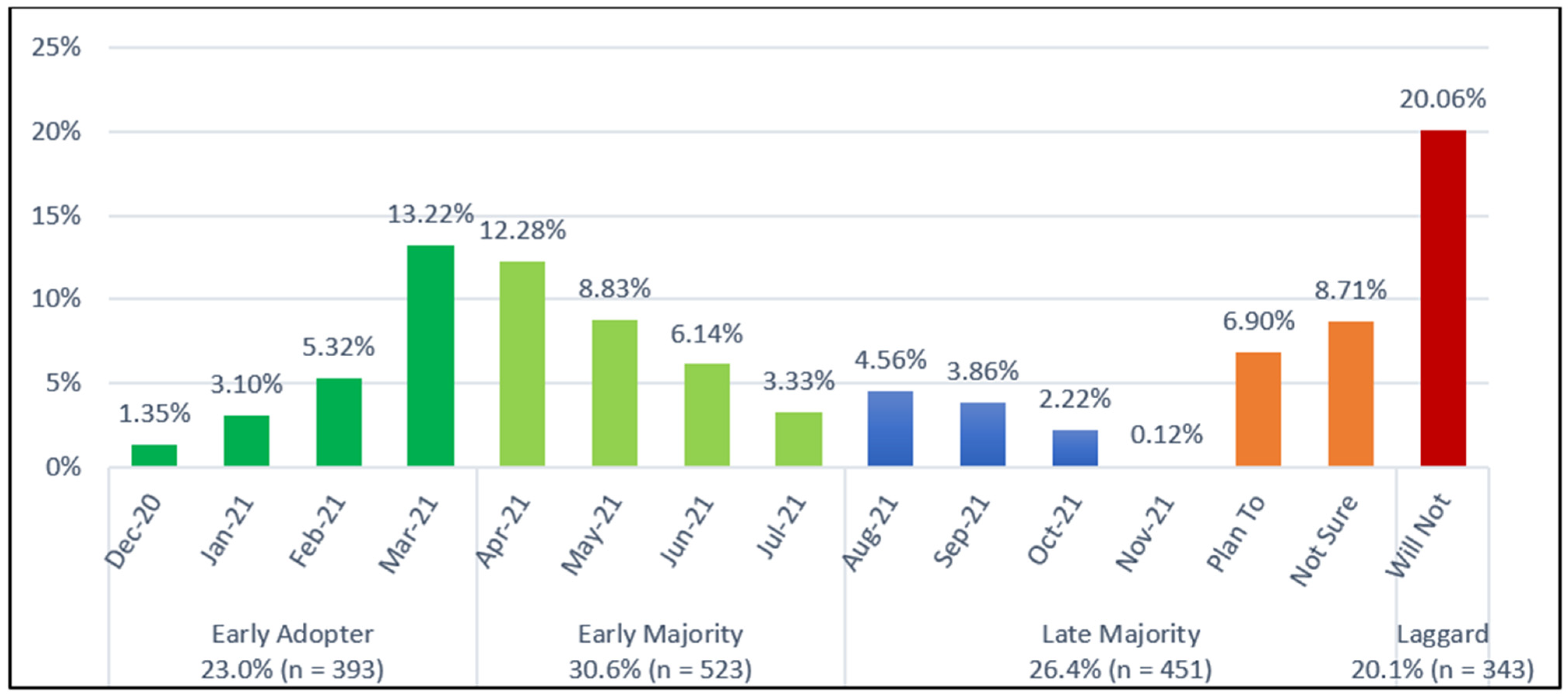
A total of 1710 individuals aged 16 years or older responded to the survey (participant characteristics presented in Table 1). Within one year of the COVID-19 vaccine rollout, 64.3% (n = 1100) had received at least one dose, with 1024 fully vaccinated. Among the 35.7% not yet vaccinated (610, presented in orange and red bars, Figure 1), 56.2% (343, or 20.1% of the sample) reported no intention to get vaccinated (red bar).

3.1. Demographic, Behavioral, and Attitudinal Factors

Vaccine adoption timing was significantly associated with multiple demographic and psychosocial factors (all p < 0.001). Among demographic variables, education exhibited the strongest positive correlation with earlier vaccination (r = 0.264), followed by income (r = 0.251) and age (r = 0.216), indicating that individuals who were older, had obtained more years of formal education, and were in the higher income groups (among the five levels presented in Table 1) tended to vaccinate earlier. Both past and future vaccination behavior were associated with earlier uptake, including the pattern of obtaining flu shots (r = 0.393) and booster intention (r = 0.234). On the other hand, self-reported COVID-19 knowledge showed a weak but statistically significant association (r = 0.093). Non-parametric analysis indicated that prior flu shot pattern differed across all four groups at each phase (H(3) = 310.82, p < 0.001). Knowledge also varied (H(3) = 13.69, p = 0.003) but the pattern was inconsistent; pairwise comparisons showed a significant difference only between early adopters and later adopter groups.
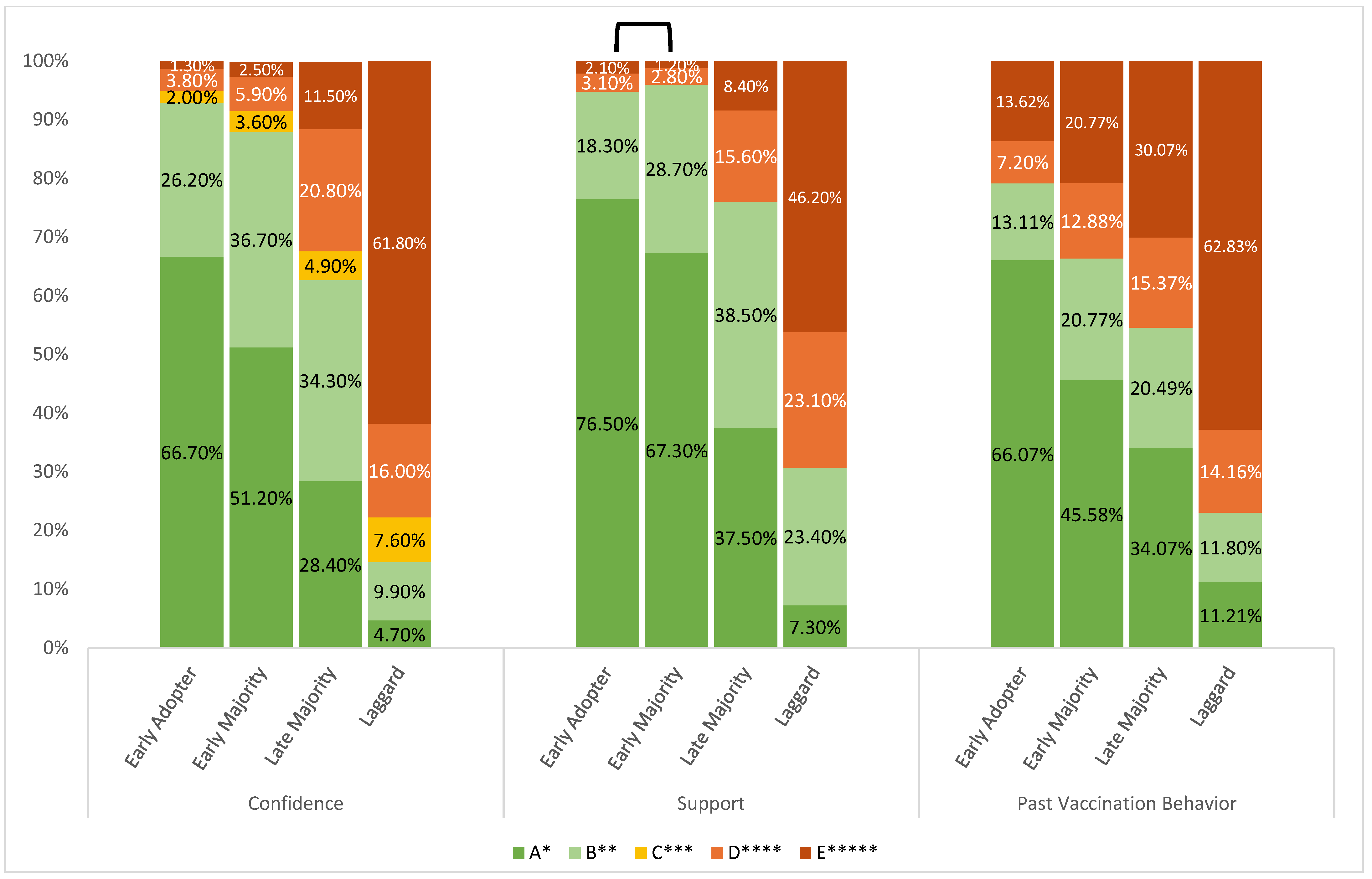
Relating to attitudes, belief in vaccine importance (r = 0.604; H(3) = 708.16, p < 0.001), vaccine confidence (r = 0.599; H(3) = 671.79, p < 0.001), and general support for vaccination (r = 0.562; H(3) = 592.38, p < 0.001) were associated with adoption speed. All showed variations across groups, with consistent pairwise differences except between early adopters and early majority (for importance and support). Later adopters, particularly laggards, reported more skepticism and lower perceived importance. Past vaccination behavior showed a clear gradient across adopter groups, with the proportion reporting “always or almost always” obtaining flu shots decreasing from 66.07% among early adopters to 11.21% among laggards (Figure 2).

3.2. Perceived Infection, Severity, Post-Vaccination, and Situational Risks

Likewise, perceived infection risk (r = 0.415), seriousness of the situation (r = 0.279), and illness severity risk (r = 0.150) were associated with earlier uptake. On the other hand, those who believed that post-vaccination risk was likely tended to delay or refuse the vaccine (r = 0.330).
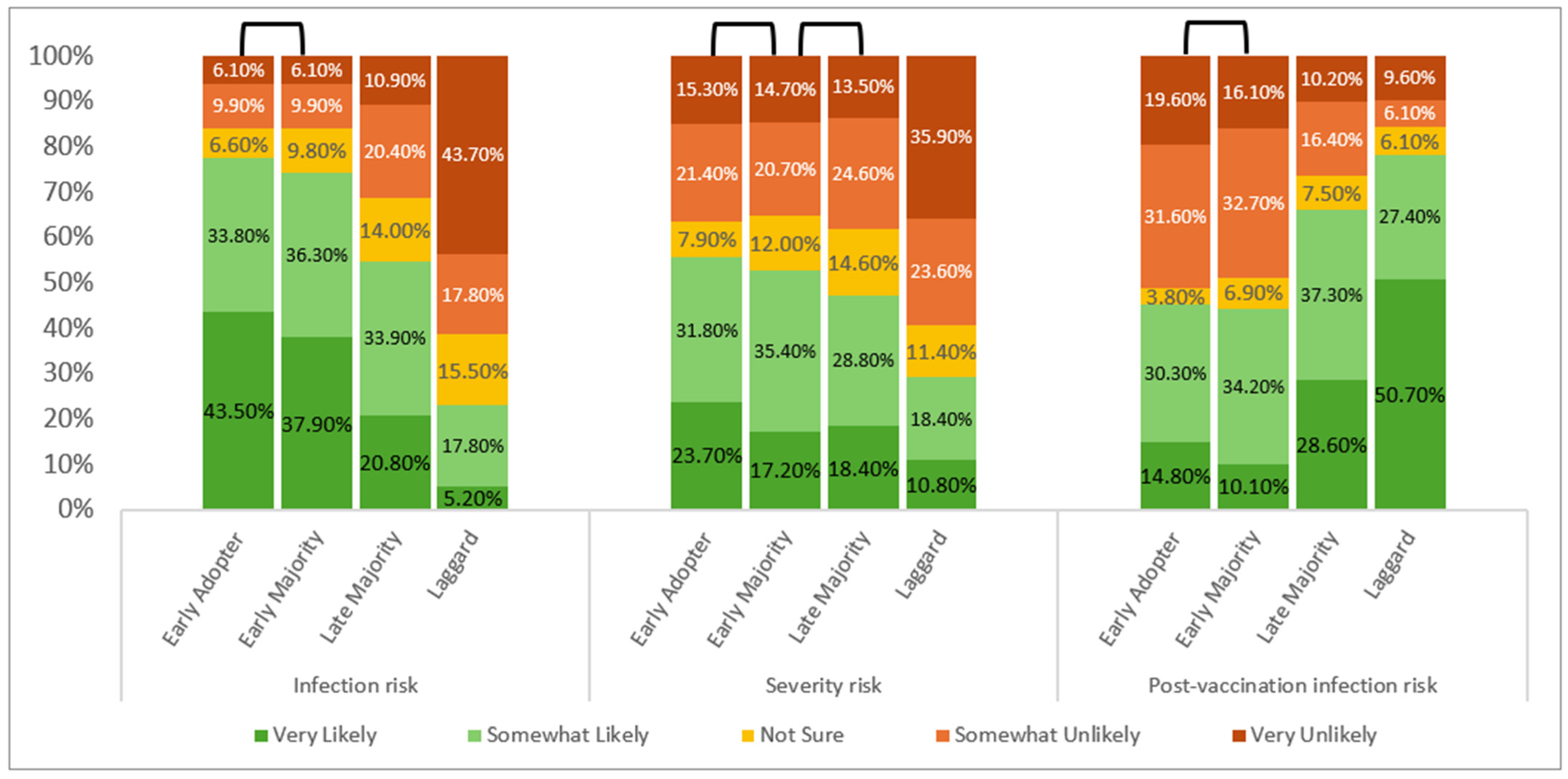
Significant differences were observed across the four adoption groups (all p < 0.001), yet each followed distinct patterns (Figure 3). Infection risk was highest among early adopters and declined across later groups, though pairwise comparisons showed that differences between the first two groups—early adopters and early majority—were insignificant. Severity risk showed little variation among the first three groups—early adopters, early majority, and late majority (p > 0.05); laggards deviated from them (p < 0.001), with 59.5% believing severe illness was somewhat/very unlikely. Post-vaccination infection risk revealed a reverse trend. Early adopters and early majority expressed stronger belief in vaccine protection, whereas over three-quarters of laggards believed infection after vaccination was still somewhat/very likely (Figure 3), citing it as a main reason for rejecting the vaccine.

3.3. Social Influence on Vaccination Speed

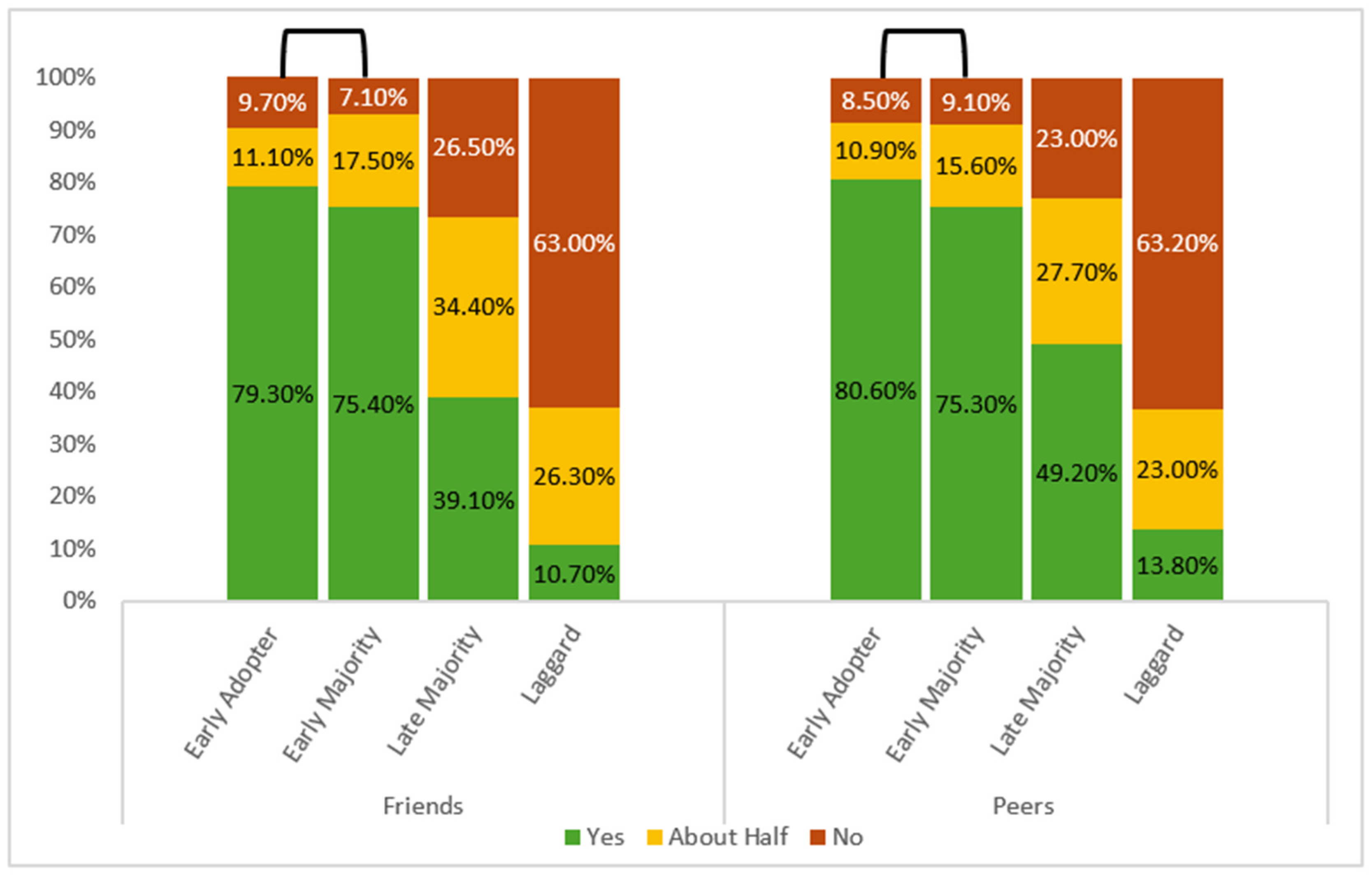
Both social influence factors were significantly associated with adoption speed, with individuals who had more friends (r = 0.542) or peers (r = 0.496) who were already vaccinated also obtaining vaccination earlier. Reported vaccination levels among friends and peers were similar between early adopters and early majority but differed significantly with later groups (friends: H(3) = 452.102; peers: H(3) = 247.565; both p < 0.001). The percentages declined steadily from early adopters to laggards, while non-vaccinated rates increased across later groups (Figure 4). At the same time, a substantial share of participants reported uncertainty regarding their peers’ vaccination status: 17.5% unsure about friends and 42.4% for coworkers or classmates. These responses were excluded from the primary analysis.

3.4. Mediation Analysis and Multinomial Regression

Vaccine confidence (β = 0.58, SE = 0.10, p < 0.001) and perceived infection risk (β = 0.29, SE = 0.09, p = 0.001) were clear indicators of adoption timing. In exploring potential mediating effects, peer vaccination status was found to partially mediate the relationship between confidence and adoption timing (β = 0.04, BootSE = 0.02, 95% CI [0.01, 0.09]) but not with infection risk. Perceived seriousness did not mediate either relationship.
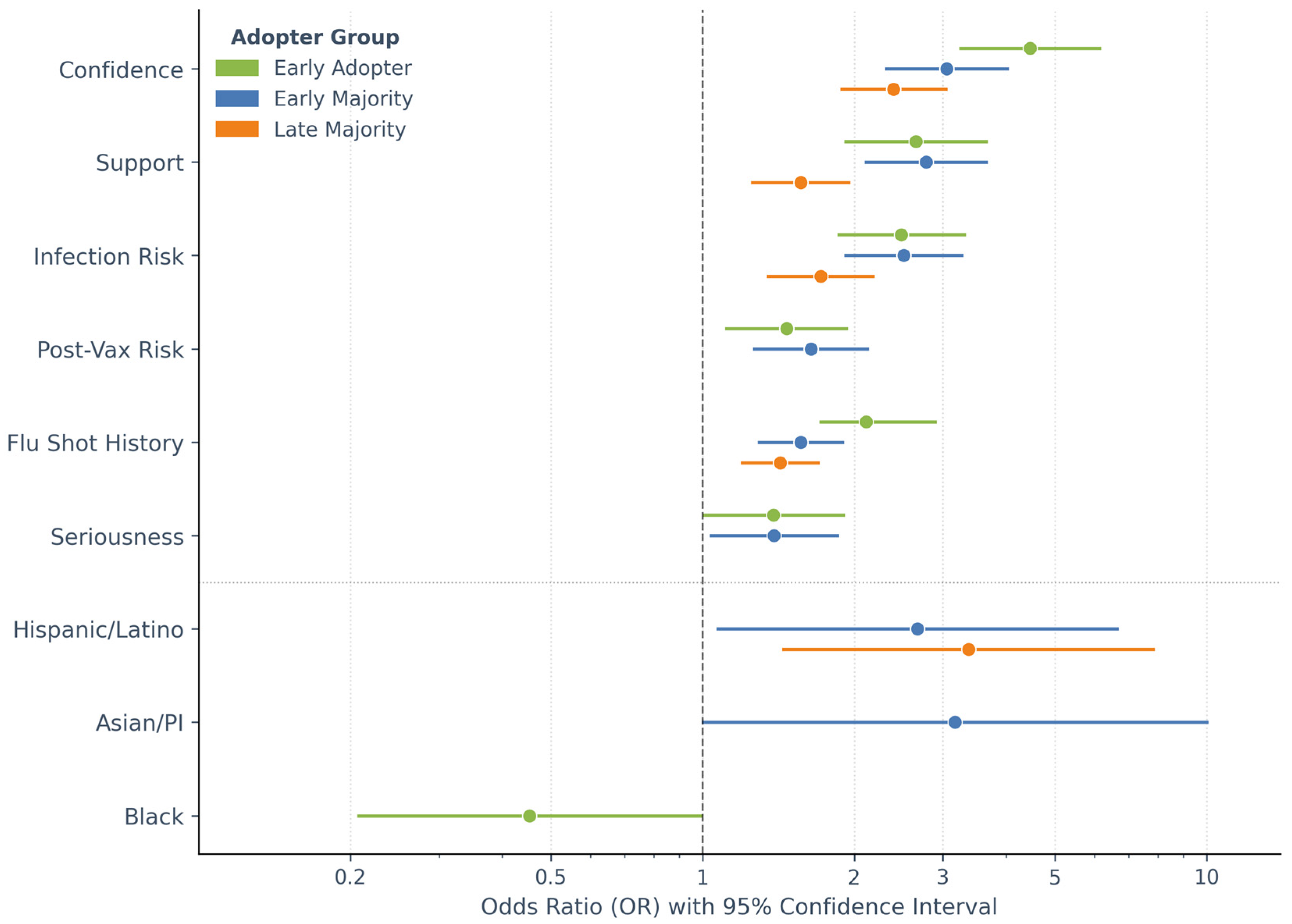
MNLR results are presented in Table 2, and the odds ratios (OR) of significant indicators are plotted in a coefplot (Figure 5), with laggards as the reference category. All model assumptions were assessed and met, as described in Section 2. The model showed acceptable fit and strong explanatory power: Nagelkerke R2 = 0.602 (>0.4 indicates a strong relationship); likelihood-ratio test p < 0.001.
No significant gender differences were observed across groups. Compared with adults aged 65+, younger groups had lower odds of early adoption (all p < 0.05), while no significant age differences emerged for the two middle groups—early and late majorities. Black respondents were less likely to be in the initial group—early adopters (OR = 0.454, p = 0.048)—whereas Asian and Hispanic/Latino respondents had higher odds of being in the early or late majority groups.
Behavioral history and risk perceptions significantly differentiated adopter groups. Prior flu-shot history was associated with increased odds of being in the early adopter (OR = 2.111), early majority (OR = 1.567), and late majority group (OR = 1.425; all p < 0.001) relative to laggards. Higher perceived infection risk was similarly associated with increased odds of membership in all earlier adoption groups (all p < 0.001). Lower perceived post-vaccination infection risk, signaling stronger trust in the vaccine efficacy, was associated with higher odds of being an early adopter (OR = 1.468, p = 0.006) or early majority (OR = 1.640, p < 0.001). However, perceived severity was not significant across adopter groups.
Participants who reported greater pandemic seriousness were more likely to be an early adopter or early majority, but no significant differences were observed between the latter two groups. Those who expressed confidence in and support for the vaccine had very low odds of being laggards. Self-reported knowledge level was not associated with adopter group membership.

4. Discussion

This study examined vaccine behavior and perceptions by not only identifying who or why but also how quickly individuals would obtain vaccination. The temporal factor is critical in predicting and controlling the spread of disease. The pandemic provided a rare opportunity to investigate the progression of adopting a new vaccine at the population level, and the application of the DOI framework offered more nuanced insights into demographic, behavioral, and psychosocial factors. The findings provide additional evidence of the direct effects of confidence, risk perceptions, and social norms on adoption timing, as well as a mediating effect of peer vaccination status in the relationship between confidence and uptake.
Older adults were more likely to get vaccinated early, reflecting both their elevated COVID-19 infection risk and prioritization during the initial vaccine rollout—a strategy similarly adopted across countries globally and recommended by the World Health Organization (WHO) [56,57]. Due to the initial supply shortage [58] during the first few months in the U.S., frontline healthcare professionals and those who worked or lived in long-term care facilities were the first to obtain vaccination, followed by people aged 65 or older and front-line essential workers, stipulated by federal recommendation, with variation by states [59]. Such prioritization rendered higher vaccination rates among older adults worldwide (e.g., Germany and the UK observed 84% and 97% for adults over 65, respectively, compared to 78% in the U.S. [60]). Multinomial analyses confirmed that age exerted its strongest influence over the earliest phase, when limited availability and risk-focused messaging disproportionately favored older adults [61].
Higher education and income levels also predicted earlier acceptance, likely due to enhanced health literacy [39], trust in science [62,63], and better healthcare access [64,65]. Until spring 2021, COVID-19 vaccine demand had exceeded supply. Many individuals in the U.S., even when they became eligible according to their jurisdiction’s allocation plan, waited days or weeks for an appointment; the shortage was particularly severe and persisted in lower-resourced nations [66,67,68]. However, the relationship between education and trust in science is not universal; across 142 countries, the positive association was weaker or nonexistent in highly corrupt countries, suggesting that institutional context moderates the role of education in vaccine-related decision-making [69]. Once vaccines became widely available, these demographic factors were no longer strong determinants of uptake timing. Such diminishing influences were often masked in prior binary studies that did not consider the progression of adoption over time, demonstrating the benefit of applying the DOI framework.
The different dimensions of risk perceptions exhibited varied effects and were further distinguished here. Extending the existing literature [39,70], infection risk, along with several attitudinal factors, was found to be positively associated with speed to vaccination. Research on coping responses indicated that higher perceived threat increased willingness to be vaccinated [71]; a similar association was reported in Australia and Slovenia [72,73]. The observed increase in uptake during August and September 2021 followed the surge in confirmed cases in late summer [7]. Nevertheless, this effect could be attenuated by anticipated severity risk: if the chance of getting very sick was low, then the urgency of avoiding infection seemed trivial. Evidenced by the indifference observed among the first three groups that diverged from laggard, severity risk may persuade the hesitant to get vaccinated but be insufficient to motivate earlier adoption.
Moreover, belief in lower post-vaccination infection risk was positively associated with uptake decision and timing. It aligned with documented hesitancy regarding the COVID-19 vaccine, which primarily stems from safety and efficacy concerns, e.g., the technology was too new, the vaccine was developed too quickly, or the approval process was too rushed [33,39,74,75]. The results revealed that over three-quarters of laggards believed infection after vaccination was still somewhat or very likely. While this belief is not entirely wrong—since no vaccine is 100% effective at preventing infection [76,77]—it suggests that laggards may over-emphasize this limitation, contributing to a misconception that vaccines are ineffective and thus not worth taking.
On the other hand, self-rated COVID-19 knowledge was only weakly associated with vaccination timing and showed no consistent pattern across adopter groups. Even among those who reported being well-informed, vaccine decisions may hinge on trust, values, and perceived risks. Research using Protection Motivation Theory (PMT) found that in Taiwan, perceived knowledge enhanced coping appraisals—individuals’ positive perceptions of the COVID-19 vaccine as an effective prevention strategy—and led to uptake [78]. An American study of adolescents reported that perceived knowledge moderated the relationship between risk perception and vaccination among the low-knowledge group [79]. In the UK, however, knowledge was not predictive—likely due to misinformation and low institutional trust [80]. Consistent with this, MNLR did not identify self-rated knowledge as a significant predictor of earlier adoption, suggesting that information alone was insufficient to accelerate uptake. These findings underscore the need to communicate vaccine benefits more clearly to instill trust: they are intended to reduce hospitalization, morbidity, and mortality, not to completely eliminate infection [78]. Future studies could compare self-reported vs. objectively measured knowledge to help elucidate the discrepancy in the literature.
Attitudinal and behavioral factors, particularly belief in vaccine importance and confidence, consistently predicted earlier uptake, with confidence showing the clearest gradient across adopter groups. This mirrors findings from Australia, where use of trusted information sources such as government health websites and healthcare provider recommendations was among the strongest predictors of vaccine confidence and uptake [81]. Viewed through the DOI framework, these factors not only facilitated vaccination decisions but also could expedite adoption—key to disease prevention and epidemic control. In contrast, while perceived infection risk exerted a direct influence on uptake speed, severity did not independently predict adoption timing once confidence and infection risk were considered. Support for vaccines, including flu shot history, also contributed to earlier adoption, reflecting broader preventive health habits and compliance with public health recommendations among earlier groups. Understanding and applying the differing and interacting impacts of these facilitators are important, especially considering the continuously evolving SARS-CoV-2 virus and resurgence of several infectious diseases. Since the pandemic, the public has become vaccine-fatigued [82,83]. Messages and promotional strategies must be reevaluated to encourage adoption of subsequent boosters and timely vaccination.
While three in ten in the U.S. had not been vaccinated by the end of 2021, either still hesitated or refused (relatively high compared to 18.47% in Canada and 11.59% in China) [7], a notable subset of the population (20.1%) expressed no intention to get vaccinated, despite sufficient supply and continuously rising confirmed cases [84]. This rejection proportion remained stable through May 2023, when the last national cumulative data were reported, coinciding with the WHO’s declaration of the end of the pandemic [85]. Similarly, the unvaccinated ratio was 26.66% in Asia and 35.37% globally at the time and plateaued [7]. This group represents entrenched resistance rather than temporary reluctance, indicating that access and information alone may be insufficient to shift attitudes. Given this, it would not be productive to endeavor to change their minds, as success is unlikely. Instead, public efforts should focus on those who are hesitant but still willing to consider vaccination and motivate them to adopt the vaccine earlier or faster. This points to the need to examine the differences in group drivers to tailor approaches to specific populations.
Social influence has been identified as a strong promoter of behavior, including vaccination [86,87]. Early adopters and early majority were shown to report having a much higher proportion of their network vaccinated (75–80% responded most of their friends or peers had already been vaccinated) than later groups. Similarly, among UK adolescents, vaccination decisions were primarily shaped by parents, healthcare providers, and peers rather than social media, underscoring the cross-national relevance of social influence on vaccine behavior [88]. Conversely, being surrounded by unvaccinated people may shape reluctance or stimulate refusal. The pronounced disparity in peer vaccination between early and later groups suggests the operational function of social norms in the diffusion process. As vaccination became more common within close social networks, uncertainty may have diminished, enabling hesitant adopters to move toward vaccination. A study applying Social Cognitive Theory similarly identified observational learning—waiting to see whether friends and family get vaccinated first—as a significant predictor of vaccine behavior [89].
Mediation analyses further elucidate the dual roles of social influence in vaccination decision-making. People with higher vaccine confidence were more likely to perceive higher vaccination uptake among their peers, and these perceived norms were associated with earlier vaccination. This suggests that confidence acts both at the individual level and through perceived social norms, which in turn facilitate earlier vaccination.
The results also revealed that many people actively discussed COVID-19 vaccination with others, more frequently with friends than with broader peer groups. While perception can influence behavior, it may not be factually accurate. Earlier studies showed that individuals often misjudge peer behaviors, which public health campaigns have leveraged by correcting misperceptions and promoting positive social norms [86]. Others highlighted the role of subjective norms, particularly perceived approval from peers and family, in sustaining vaccine behaviors [90]. Messaging that emphasizes widespread uptake (e.g., “most students your age are vaccinated”) may help normalize vaccination and be particularly effective for younger, hesitant groups to move towards vaccination.

Limitations and Future Research

This study has several limitations. First, data were collected via a self-administered survey, relying on participants’ recall and subjective perceptions, which may introduce bias or inaccuracies. For instance, knowledge was self-reported rather than objectively measured, which may explain part of the inconsistent effect on vaccine acceptance. Second, although actual uptake rather than intention alone was examined, the survey design cannot account for structural factors—such as access, mandates, or logistical barriers—that may have influenced vaccination behavior, especially during the early phase of rollout when there was a shortage. Finally, while the sample was relatively representative of the U.S. population and offered valuable insight into psychological and social drivers of vaccination timing, COVID-19 was a special case with rapid and widespread infection, high global mortality, daily news broadcasting, and a vaccine that employed a novel technology and was initially launched under emergency use authorization (EUA). These additional contextual factors may have intensified both the urgency to get vaccinated and, concurrently, hesitancy compared to other vaccines.
Future studies could examine the different influences between subjective and objective knowledge levels and their potential interaction effect. Similarly, given the strong role of social influence, it would be beneficial to further explore whether perceived norms and actual vaccination rate exert a similar impact on vaccination decision as well as timing.

5. Conclusions

Vaccine hesitancy studies have identified a range of factors influencing uptake decisions, primarily focusing on individual characteristics, including demographics, perceived risk, and attitudes (confidence in vaccine and authority or science, general support of such a preventive intervention). This study further distinguished various dimensions of risk perception, validated the influence of peer behavior, mapped actual vaccine adoption timing instead of hypothetical scenarios, and provided reference comparisons to other countries. In particular, the research examined these factors through the lens of the DOI framework, with the advantage of accounting for the progression of cumulated protection at the population level, expanding on and overcoming the deficiency of the more conventional dichotomized analysis of vaccinated vs. unvaccinated. Contextually, the pattern of uptake was also associated with availability, accessibility (both eligibility and ease of obtainment), and disease activity (levels of confirmed cases and mortality).
By identifying what separated early from late adopters, and what ultimately facilitated the hesitant to vaccinate, this study offers a more nuanced understanding of vaccination behavior and adds a critical temporal perspective that can inform and potentially improve future public health vaccination efforts. Using the DOI framework to focus on hesitant to vaccinate individuals and population groups using proven interventions to improve uptake, such as employing trusted community voices, clear provider communications, community-centered education and outreach, and the use of data to guide targeted outreach and vaccination programs has the potential to help individual providers, health departments, and health systems reverse the rising levels of vaccine hesitancy and declination of vaccination seen in the U.S. and globally [91]. Improving vaccine confidence and trust among those who are hesitant to vaccinate may facilitate more effective approaches to addressing other infectious diseases and mitigating public health threats, especially in our most vulnerable communities.

Author Contributions

Conceptualization, R.T., C.L. and P.T.; methodology, C.L., A.M.R. and P.T.; formal analysis, R.T., C.L. and G.N.S.; resources, C.L. and P.T.; data curation, C.L., W.E.B. and G.N.S.; writing—original draft preparation, R.T., C.L. and G.N.S.; writing—review and editing, all authors; supervision, C.L.; project administration, P.T. All authors have read and agreed to the published version of the manuscript.

Funding

This research received no external funding.

Institutional Review Board Statement

The study was conducted in accordance with the Declaration of Helsinki, and approved by Duke University Institutional Review Board (approval code 2022-0049, 20 August 2021).

Informed Consent Statement

Informed consent was obtained from all subjects involved in the study.

Data Availability Statement

The data presented in this study are available on request from the corresponding author one year from the date of publication upon reasonable request with a methodologically sound research proposal.

Acknowledgments

The authors would like to thank Laura Bayzle and The Link Group for their advice and generous assistance in designing and programming the survey for the study. We also appreciate Duke University Bass Connections’ support for the research.

Conflicts of Interest

The authors declare no conflicts of interest.

References

  1. MacDonald, N.E. Vaccine Hesitancy: Definition, Scope and Determinants. Vaccine 2015, 33, 4161–4164. [Google Scholar] [CrossRef]
  2. Igyártó, B.Z. “Don’t Look Up” Your Science—Herd Immunity or Herd Mentality? Microorganisms 2022, 10, 1463. [Google Scholar] [CrossRef]
  3. Clark, S.A.; Borrow, R. Herd Protection against Meningococcal Disease through Vaccination. Microorganisms 2020, 8, 1675. [Google Scholar] [CrossRef]
  4. U. S. Government Accountability Office. The Role and Risk of Herd Immunity When It Comes to COVID-19|U.S. GAO. Available online: https://www.gao.gov/blog/role-and-risk-herd-immunity-when-it-comes-covid-19 (accessed on 22 July 2025).
  5. Schmidt, H.; Weintraub, R.; Williams, M.A.; Miller, K.; Buttenheim, A.; Sadecki, E.; Wu, H.; Doiphode, A.; Nagpal, N.; Gostin, L.O.; et al. Equitable Allocation of COVID-19 Vaccines in the United States. Nat. Med. 2021, 27, 1298–1307. [Google Scholar] [CrossRef]
  6. Duggar, C.; Santoli, J.M.; Noblit, C.; Moore, L.B.; El Kalach, R.; Bridges, C.B. U.S. COVID-19 Vaccine Distribution Strategies, Systems, Performance, and Lessons Learned, December 2020–May 2023. Vaccine 2024, 42, 125703. [Google Scholar] [CrossRef] [PubMed]
  7. Coronavirus (COVID-19) Vaccinations—Our World in Data. Available online: https://ourworldindata.org/covid-vaccinations (accessed on 15 July 2025).
  8. CDC 2025–2026 Flu Season. Available online: https://www.cdc.gov/flu/season/2025-2026.html (accessed on 25 April 2026).
  9. CDC Flu Vaccination Coverage, United States, 2024–25 Influenza Season. Available online: https://www.cdc.gov/fluvaxview/coverage-by-season/2024-2025.html (accessed on 25 April 2026).
  10. Zampetakis, L.A.; Melas, C. The Health Belief Model Predicts Vaccination Intentions against COVID-19: A Survey Experiment Approach. Appl. Psychol. Health Well Being 2021, 13, 469–484. [Google Scholar] [CrossRef] [PubMed]
  11. Adiyoso, W.; Wilopo, W.; Mondry; Nurbaiti, B.; Suprapto, F.A. The Use of Health Belief Model (HBM) to Explain Factors Underlying People to Take the COVID-19 Vaccine in Indonesia. Vaccine X 2023, 14, 100297. [Google Scholar] [CrossRef] [PubMed]
  12. Batista Ferrer, H.; Audrey, S.; Trotter, C.; Hickman, M. An Appraisal of Theoretical Approaches to Examining Behaviours in Relation to Human Papillomavirus (HPV) Vaccination of Young Women. Prev. Med. 2015, 81, 122–131. [Google Scholar] [CrossRef]
  13. Limbu, Y.B.; Gautam, R.K.; Zhou, W. Predicting Vaccination Intention against COVID-19 Using Theory of Planned Behavior: A Systematic Review and Meta-Analysis. Vaccines 2022, 10, 2026. [Google Scholar] [CrossRef]
  14. Almoayad, F.; Bin-Amer, L.A.; Althubyani, N.T.; Alajmi, S.M.; Alshammari, A.A.; Alsuwayal, R.A. The General Public’s Intent to Receive a COVID-19 Vaccine in Saudi Arabia. Int. J. Health Promot. Educ. 2024, 62, 412–427. [Google Scholar] [CrossRef]
  15. Barnard, M.; George, P.; Perryman, M.L.; Wolff, L.A. Human Papillomavirus (HPV) Vaccine Knowledge, Attitudes, and Uptake in College Students: Implications from the Precaution Adoption Process Model. PLoS ONE 2017, 12, e0182266. [Google Scholar] [CrossRef] [PubMed]
  16. Tatar, O.; Shapiro, G.K.; Perez, S.; Wade, K.; Rosberger, Z. Using the Precaution Adoption Process Model to Clarify Human Papillomavirus Vaccine Hesitancy in Canadian Parents of Girls and Parents of Boys. Hum. Vaccines Immunother. 2019, 15, 1803–1814. [Google Scholar] [CrossRef]
  17. Brewer, N.T.; Fazekas, K.I. Predictors of HPV Vaccine Acceptability: A Theory-Informed, Systematic Review. Prev. Med. 2007, 45, 107–114. [Google Scholar] [CrossRef]
  18. Rogers, E.M. Diffusion of Innovations, 3rd ed.; Free Press: New York, NY, USA, 1983. [Google Scholar]
  19. Rogers, E.M. Diffusion of Innovations, 5th ed.; Free Press: New York, NY, USA, 2003. [Google Scholar]
  20. Gallos, P.; Minou, J.; Routsis, F.; Mantas, J. Investigating the Perceived Innovation of the Big Data Technology in Healthcare. Stud. Health Technol. Inform. 2017, 238, 151–153. [Google Scholar]
  21. Reiner, B.I. Optimizing Technology Development and Adoption in Medical Imaging Using the Principles of Innovation Diffusion, Part I: Theoretical, Historical, and Contemporary Considerations. J. Digit. Imaging 2011, 24, 750–753. [Google Scholar] [CrossRef][Green Version]
  22. Putteeraj, M.; Bhungee, N.; Somanah, J.; Moty, N. Assessing E-Health Adoption Readiness Using Diffusion of Innovation Theory and the Role Mediated by Each Adopter’s Category in a Mauritian Context. Int. Health 2022, 14, 236–249. [Google Scholar] [CrossRef] [PubMed]
  23. Roger’s Diffusion of Innovations Theory and the Adoption of a Patient Portal’s Digital Anamnesis Collection Tool: Study Protocol for the MAiBest Project|Implementation Science Communications|Full Text. Available online: https://implementationsciencecomms.biomedcentral.com/articles/10.1186/s43058-024-00614-8 (accessed on 24 July 2025).
  24. Fundytus, K.; Santamaria-Plaza, C.; McLaren, L. Policy Diffusion Theory, Evidence-Informed Public Health, and Public Health Political Science: A Scoping Review. Can. J. Public Health 2023, 114, 331–345. [Google Scholar] [CrossRef]
  25. Qiu, H.; Chreim, S. A Tension Lens for Understanding Public Innovation Diffusion Processes. Public Manag. Rev. 2021, 24, 1873–1893. [Google Scholar] [CrossRef]
  26. Rogers, E.M. Diffusion of Preventive Innovations. Addict. Behav. 2002, 27, 989–993. [Google Scholar] [CrossRef]
  27. Rosen, B.; Goodson, P. A Recommendation to Use the Diffusion of Innovations Theory to Understand School Nurses’ Role in HPV Vaccine Uptake. Int. Q. Community Health Educ. 2014, 34, 37–49. [Google Scholar] [CrossRef] [PubMed]
  28. Chun, G.J.; Sautter, J.M.; Patterson, B.J.; McGhan, W.F. Diffusion of Pharmacy-Based Influenza Vaccination Over Time in the United States. Am. J. Public Health 2016, 106, 1099–1100. [Google Scholar] [CrossRef]
  29. Britto, M.T.; Schoettker, P.J.; Pandzik, G.M.; Weiland, J.; Mandel, K.E. Improving Influenza Immunisation for High-Risk Children and Adolescents. Qual. Saf. Health Care 2007, 16, 363–368. [Google Scholar] [CrossRef]
  30. Tiwari, B.B.; Woldman, T.; Resma, S.S.; Matta, J.; Padilla, H.; Rajbhandari-Thapa, J. Barriers to COVID-19 Vaccination and Perceptions Around Vaccination Uptake Strategies Among African Americans Living in the US South: Opportunities for Public Health Program Intervention. J. Racial Ethn. Health Disparities 2025. [Google Scholar] [CrossRef]
  31. Crawshaw, A.F.; Farah, Y.; Deal, A.; Rustage, K.; Hayward, S.E.; Carter, J.; Knights, F.; Goldsmith, L.P.; Campos-Matos, I.; Wurie, F.; et al. Defining the Determinants of Vaccine Uptake and Undervaccination in Migrant Populations in Europe to Improve Routine and COVID-19 Vaccine Uptake: A Systematic Review. Lancet Infect. Dis. 2022, 22, e254–e266. [Google Scholar] [CrossRef] [PubMed]
  32. The Power of Peers. Available online: https://newsinhealth.nih.gov/2021/09/power-peers (accessed on 31 July 2025).
  33. Berry, D.M.; Adams, L.M.; Vytla, S.P. Vaccine Hesitancy and Hesitant Adoption among Nursing Students in Texas. Prev. Med. Rep. 2024, 38, 102612. [Google Scholar] [CrossRef]
  34. Kolotylo-Kulkarni, M.; Marakas, G.M.; Xia, W. Understanding Protective Behavior and Vaccination Adoption among US Individuals during the COVID-19 Pandemic: A Four-Wave Longitudinal Study. J. Bus. Res. 2024, 179, 114649. [Google Scholar] [CrossRef]
  35. Young, K.M.; Corrin, T.; Pussegoda, K.; Baumeister, A.; Waddell, L.A. Evidence Brief on Facilitators, Barriers and Hesitancy of COVID-19 Booster Doses in Canada. Can. Commun. Dis. Rep. 2024, 50, 338–344. [Google Scholar] [CrossRef]
  36. Burke, P.F.; Masters, D.; Massey, G. Enablers and Barriers to COVID-19 Vaccine Uptake: An International Study of Perceptions and Intentions. Vaccine 2021, 39, 5116–5128. [Google Scholar] [CrossRef]
  37. The Long History of mRNA Vaccines|Johns Hopkins|Bloomberg School of Public Health. Available online: https://publichealth.jhu.edu/2021/the-long-history-of-mrna-vaccines (accessed on 24 July 2025).
  38. Hamel, L.; Lopes, L.; Kearney, A.; Sparks, G.; Stokes, M.; Brodie, M. KFF COVID-19 Vaccine Monitor: June 2021. KFF 2021. Available online: https://www.kff.org/covid-19/kff-covid-19-vaccine-monitor-june-2021/ (accessed on 24 July 2025).
  39. Lin, C.; Tu, P.; Beitsch, L.M. Confidence and Receptivity for COVID-19 Vaccines: A Rapid Systematic Review. Vaccines 2021, 9, 16. [Google Scholar] [CrossRef] [PubMed]
  40. Baack, B.N.; Abad, N.; Yankey, D.; Kahn, K.E.; Razzaghi, H.; Brookmeyer, K.; Kolis, J.; Wilhelm, E.; Nguyen, K.H.; Singleton, J.A. COVID-19 Vaccination Coverage and Intent Among Adults Aged 18–39 Years — United States, March–May 2021. MMWR Morb. Mortal. Wkly. Rep. 2021, 70, 928–933. [Google Scholar] [CrossRef] [PubMed]
  41. Suffolk University. Suffolk Poll Finds Growing Confidence in COVID-19 Vaccines. 2020. Available online: https://www.suffolk.edu/news-features/news/2020/12/22/21/22/suffolk-poll-finds-growing-confidence-in-covid-19-vaccines (accessed on 18 June 2024).
  42. Leys, T. Iowa Poll: Iowans Are Wearing Masks More Often to Ward off the Coronavirus, Especially If They’re Democrats. Available online: https://www.desmoinesregister.com/story/news/politics/iowa-poll/2020/09/26/iowa-poll-more-wear-masks-ward-off-covid-19-partisan-split-remains/5830977002/ (accessed on 24 April 2026).
  43. He, W.; Wu, J.; Chen, C.H.; Finley, A.; Wang, H.; Huang, H.; Ng, C.; Chui, T.; Zhang, J.; Hon, C. Predicting COVID-19 Vaccination Timing by Integrating the Theory of Planned Behavior and the Diffusion of Innovations: A Cross-Sectional Survey in Macao, China. J. Thorac. Dis. 2025, 17, 2813–2826. [Google Scholar] [CrossRef]
  44. Skyles, T.J.; Stevens, H.P.; Davis, S.C.; Obray, A.M.; Miner, D.S.; East, M.J.; Davis, T.; Hoelzer, H.; Piccolo, S.R.; Jensen, J.L.; et al. Comparison of Predictive Factors of Flu Vaccine Uptake Pre- and Post-COVID-19 Using the NIS-Teen Survey. Vaccines 2024, 12, 1164. [Google Scholar] [CrossRef]
  45. Luisi, M.; Geana, M.V.; Pei, J. Pandemic Antecedents—Exploring Predictivity and Relationships between COVID-19 Vaccine Uptake and Influenza, Shingles, and HPV Vaccination. Vaccine 2024, 42, 2455–2462. [Google Scholar] [CrossRef]
  46. US Census Bureau Population Under Age 18 Declined Last Decade. Available online: https://www.census.gov/library/stories/2021/08/united-states-adult-population-grew-faster-than-nations-total-population-from-2010-to-2020.html (accessed on 21 October 2021).
  47. Althubaiti, A. Sample Size Determination: A Practical Guide for Health Researchers. J. Gen. Fam. Med. 2022, 24, 72–78. [Google Scholar] [CrossRef] [PubMed]
  48. Kim, J.H. Multicollinearity and Misleading Statistical Results. Korean J. Anesthesiol. 2019, 72, 558–569. [Google Scholar] [CrossRef]
  49. James Gaskin. Multicollinearity in SPSS; 2020. Gaskination’s Statistics. Available online: http://youtube.com/Gaskination (accessed on 21 April 2026).
  50. How to Perform a Multinomial Logistic Regression in SPSS Statistics|Laerd Statistics. Available online: https://statistics.laerd.com/spss-tutorials/multinomial-logistic-regression-using-spss-statistics.php (accessed on 26 January 2026).
  51. Daines, R. LibGuides: Statistics Resources: Multinomial Logistic Regression. Available online: https://resources.nu.edu/statsresources/Multinomiallogistic (accessed on 21 April 2026).
  52. IBM. SPSS Statistics Premium 31.0; IBM: Armonk, NY, USA, 2025. [Google Scholar]
  53. Introduction to Mediation, Moderation, and Conditional Process Analysis: Third Edition: A Regression-Based Approach. Available online: https://www.guilford.com/books/Introduction-to-Mediation-Moderation-and-Conditional-Process-Analysis/Andrew-Hayes/9781462549030 (accessed on 16 October 2025).
  54. Hunter, J.D. Matplotlib: A 2D Graphics Environment. Comput. Sci. Eng. 2007, 9, 90–95. [Google Scholar] [CrossRef]
  55. The Python Language Reference. Available online: https://docs.python.org/3/reference/index.html (accessed on 21 April 2026).
  56. Hunter-Mullis, K.; Macy, J.T.; Greene, A.; Simon, K. Perceived COVID-19 Vaccine Attributes Associated with Early Adoption among Adults in Rural Indiana. Health Educ. Res. 2022, 37, 466–475. [Google Scholar] [CrossRef]
  57. Eyal, N.; Gheaus, A.; Gosseries, A.; Magalhaes, M.; Ngosso, T.; Steuwer, B.; Tangcharoensathien, V.; Trifan, I.; Williams, A. Coronavirus Disease 2019 (COVID-19) Vaccine Prioritization in Low- and Middle-Income Countries May Justifiably Depart From High-Income Countries’ Age Priorities. Clin. Infect. Dis. 2022, 75, S93–S97. [Google Scholar] [CrossRef] [PubMed]
  58. Li, L.; Feng, T.; Shen, Q.; Shi, X.; Wei, Z.; Chen, W.; Yang, F.; Zhu, Y.; Zhang, C.; Zhang, S.; et al. Natural Infection of Omicron BA.5.2 in Patients Provides Broad Immune Responses Against SARS-CoV-2. Microorganisms 2025, 13, 746. [Google Scholar] [CrossRef] [PubMed]
  59. Freed, M.; Cubanski, J.; Ochieng, N.; Neuman, T. At This Early Stage of the COVID-19 Vaccine Roll-Out, Most Older Adults Have Not Yet Been Vaccinated As Supply Remains Limited; KFF: San Francisco, CA, USA, 2021. [Google Scholar]
  60. Williams, R.D., II; Shah, A.; Doty, M.M.; Fields, K.; FitzGerald, M. The Impact of COVID-19 on Older Adults: Findings from the 2021 International Health Policy Survey of Older Adults; The Commonwealth Bank: Sydney, Australia, 2021. [Google Scholar] [CrossRef]
  61. Wong, H.-L.; Tworkoski, E.; Ke Zhou, C.; Hu, M.; Thompson, D.; Lufkin, B.; Do, R.; Feinberg, L.; Chillarige, Y.; Dimova, R.; et al. Surveillance of COVID-19 Vaccine Safety among Elderly Persons Aged 65 Years and Older. Vaccine 2023, 41, 532–539. [Google Scholar] [CrossRef]
  62. Alper, S.; Yelbuz, B.E.; Akkurt, S.B.; Yilmaz, O. The Positive Association of Education with the Trust in Science and Scientists Is Weaker in Highly Corrupt Countries. Public Underst. Sci. 2024, 33, 2–19. [Google Scholar] [CrossRef] [PubMed]
  63. Cologna, V.; Mede, N.G.; Berger, S.; Besley, J.; Brick, C.; Joubert, M.; Maibach, E.W.; Mihelj, S.; Oreskes, N.; Schäfer, M.S.; et al. Trust in Scientists and Their Role in Society across 68 Countries. Nat. Hum. Behav. 2025, 9, 713–730. [Google Scholar] [CrossRef]
  64. Larrimore, J. Does a Higher Income Have Positive Health Effects? Using the Earned Income Tax Credit to Explore the Income-Health Gradient. Milbank Q. 2011, 89, 694–727. [Google Scholar] [CrossRef] [PubMed]
  65. Woolf, S.H. How Are Income and Wealth Linked to Health and Longevity? Urban Institute: Washington, DC, USA, 2015. [Google Scholar]
  66. Drew, J.; Miller, Z. US Boosting Vaccine Deliveries amid Complaints of Shortages|AP News. Available online: https://apnews.com/article/biden-boost-coronavirus-vaccine-supply-5cb7cad19bb77313123042e5594e8a27 (accessed on 25 April 2026).
  67. Wilson, C.U.S. COVID-19 Vaccinations Slow Amid Lack of Demand. Available online: https://time.com/6046880/covid-19-vaccine-slowdown/ (accessed on 25 April 2026).
  68. Will Low-Income Countries Be Left Behind When COVID-19 Vaccines Arrive? Available online: https://globalhealth.duke.edu/news/will-low-income-countries-be-left-behind-when-covid-19-vaccines-arrive (accessed on 25 April 2026).
  69. Erduran, S. Trust in Science and Science Education. Sci. Educ. 2022, 31, 1425–1427. [Google Scholar] [CrossRef]
  70. Kolobova, I.; Nyaku, M.K.; Karakusevic, A.; Bridge, D.; Fotheringham, I.; O’Brien, M. Vaccine Uptake and Barriers to Vaccination among At-Risk Adult Populations in the US. Hum. Vaccines Immunother. 2022, 18, 2055422. [Google Scholar] [CrossRef]
  71. Morstead, T.; Zheng, J.; Sin, N.L.; DeLongis, A. Perceived Threat and Coping Responses during the COVID-19 Pandemic: Prospective Associations with Vaccine Hesitancy. Vaccine 2022, 40, 7586–7592. [Google Scholar] [CrossRef]
  72. Dodd, R.H.; Pickles, K.; Cvejic, E.; Cornell, S.; Isautier, J.M.J.; Copp, T.; Nickel, B.; Bonner, C.; Batcup, C.; Muscat, D.M.; et al. Perceived Public Health Threat a Key Factor for Willingness to Get the COVID-19 Vaccine in Australia. Vaccine 2022, 40, 2484–2490. [Google Scholar] [CrossRef]
  73. Kirbiš, A. The Impact of Socioeconomic Status, Perceived Threat and Healthism on Vaccine Hesitancy. Sustainability 2023, 15, 6107. [Google Scholar] [CrossRef]
  74. D’Souza, G.C.; Yingst, J.M.; Krebs, N.M.; Bordner, C.; Allen, S.I.; Calo, W.A.; Hobkirk, A.L.; Foulds, J. Using the Diffusion of Innovations Theory to Understand Factors Associated with COVID-19 Vaccination among Tobacco Users. PLoS ONE 2024, 19, e0309780. [Google Scholar] [CrossRef]
  75. Yasmin, M.; Tfaily, M.A.; Wazzi Mkahal, R.; Obeid, R.; Emery, R.P.; Hassouna, H.; Bhugra, M.; Bonomo, R.A.; Kanafani, Z.A. Determinants of COVID-19 Vaccine Hesitancy: A Cross-Sectional Study in Three Communities in the United States and Lebanon. Microorganisms 2024, 12, 1200. [Google Scholar] [CrossRef] [PubMed]
  76. Vaccine Efficacy, Effectiveness and Protection. Available online: https://www.who.int/news-room/feature-stories/detail/vaccine-efficacy-effectiveness-and-protection (accessed on 21 April 2026).
  77. Vaccines: The Myths and the Facts|AAAAI. Available online: https://www.aaaai.org/tools-for-the-public/conditions-library/allergies/vaccine-myth-fact (accessed on 21 April 2026).
  78. Lin, C.; Bier, B.; Reed, A.M.; Paat, J.J.; Tu, P. Changes in Confidence, Feelings, and Perceived Necessity Concerning COVID-19 Booster. Vaccines 2023, 11, 1244. [Google Scholar] [CrossRef]
  79. Tu, P.; Kotarba, M.; Bier, B.; Clark, R.; Lin, C. Internal and External Motivations and Risk Perception toward COVID-19 Vaccination in Adolescents in the U.S. Vaccines 2022, 10, 697. [Google Scholar] [CrossRef] [PubMed]
  80. Huang, P.-C.; Chen, I.-H.; Barlassina, L.; Turner, J.R.; Carvalho, F.; Martinez-Perez, A.; Gibson-Miller, J.; Kürthy, M.; Lee, K.-H.; Griffiths, M.D.; et al. Expanding Protection Motivation Theory to Explain Vaccine Uptake among United Kingdom and Taiwan Populations. Hum. Vaccines Immunother. 2023, 19, 2211319. [Google Scholar] [CrossRef]
  81. Williams, C.T.; Saini, B.; Zaidi, S.T.R.; Castelino, R.L. Determinants of High Vaccine Confidence and Uptake among the Australian Public: Insights from a Cross-Sectional Study. Front. Public Health 2025, 13, 1513892. [Google Scholar] [CrossRef]
  82. Stamm, T.A.; Partheymüller, J.; Mosor, E.; Ritschl, V.; Kritzinger, S.; Alunno, A.; Eberl, J.-M. Determinants of COVID-19 Vaccine Fatigue. Nat. Med. 2023, 29, 1164–1171. [Google Scholar] [CrossRef] [PubMed]
  83. Kassianos, G.; MacDonald, P.; Aloysius, I.; Pather, S. Responses to Common Misconceptions Relating to COVID-19 Variant-Adapted mRNA Vaccines. Vaccines 2024, 12, 57. [Google Scholar] [CrossRef]
  84. Mathieu, E.; Ritchie, H.; Rodés-Guirao, L.; Appel, C.; Gavrilov, D.; Giattino, C.; Hasell, J.; Macdonald, B.; Dattani, S.; Beltekian, D.; et al. COVID-19 Pandemic; Our World in Data: Oxford, UK, 2020. [Google Scholar]
  85. Share of People Who Received at Least One Dose of COVID-19 Vaccine. Available online: https://ourworldindata.org/grapher/share-people-vaccinated-covid (accessed on 28 March 2023).
  86. Graupensperger, S.; Abdallah, D.A.; Lee, C.M. Social Norms and Vaccine Uptake: College Students’ COVID Vaccination Intentions, Attitudes, and Estimated Peer Norms and Comparisons with Influenza Vaccine. Vaccine 2021, 39, 2060–2067. [Google Scholar] [CrossRef] [PubMed]
  87. Lin, C.; Parker, T.; Pejavara, K.; Smith, D.; Tu, R.; Tu, P. “I Would Never Push a Vaccine on You”: A Qualitative Study of Social Norms and Pressure in Vaccine Behavior in the U.S. Vaccines 2022, 10, 1402. [Google Scholar] [CrossRef]
  88. Drobniewski, F.; Ashmi, M.; Ahmad, R.; He, C.; Bogdanova, M.; Garbacz, A.; Moustafa, A. Factors Influencing Vaccine Hesitancy among United Kingdom Adolescents in a Senior High School Environment and Actions to Address It. Hum. Vaccines Immunother. 2025, 21, 2475599. [Google Scholar] [CrossRef]
  89. AlSaeed, A.A.; Rabbani, U. Explaining COVID-19 Vaccine Rejection Using Social Cognitive Theory in Qassim, Saudi Arabia. Vaccines 2021, 9, 1304. [Google Scholar] [CrossRef]
  90. Yu, H.; Bonett, S.; Oyiborhoro, U.; Aryal, S.; Kornides, M.; Glanz, K.; Villarruel, A.; Bauermeister, J. Factors Associated with the COVID-19 Booster Vaccine Intentions of Young Adults in the United States. Hum. Vaccines Immunother. 2024, 20, 2383016. [Google Scholar] [CrossRef]
  91. Brumbaugh, K.Q.; Gellert, F.; Mokdad, A.H. Understanding Vaccine Hesitancy: Insights and Improvement Strategies Drawn from a Multi-Study Review. Vaccines 2025, 13, 1003. [Google Scholar] [CrossRef]
Figure 1. Timing of first COVID-19 vaccination and corresponding adoption groups in the U.S. (N = 1710). One year after vaccine rollout, 64.3% (1100) received at least one vaccine dose, and 35.7% (610; orange and red bars) were unvaccinated. Among the total sample, 20.1% (343; red bars only) expressed no intention to get vaccinated.
Microorganisms 14 01049 g001
Figure 2. Portions of participants expressed levels of vaccine confidence, support, and past vaccination behavior across adoption groups (n = 1710). Ranges of response options (A to E) for confidence in the COVID-19 vaccine were as follows: very confident to very unconfident; general support of vaccines: strongly agree to strongly disagree; past-vaccination behavior (flu shot uptake): always or almost always to never. All three attitudes varied significantly across adoption groups (Kruskal–Wallis: H(3) = 671.79, 592.38, 310.82, respectively; all p < 0.001). The reversed U-shape on top of the bars indicates the pairs of groups that were insignificant from one another.
Microorganisms 14 01049 g002
Figure 3. Levels of perceived COVID-19 infection risk, severe illness risk, and post-vaccination infection risk across adoption categories (N = 1710). Responses were 5-point Likert scales ranging from very likely to very unlikely. All three perceptions varied significantly across adoption groups (Kruskal–Wallis: H(3) = 353.73, 79.64, 204.04, respectively; all p < 0.001). The reversed U-shape on top of the bars indicates that the pairs of groups were insignificant from one another.
Microorganisms 14 01049 g003
Figure 4. Perceived vaccination status of friends and peers across vaccine adoption groups (N = 1710). Participants indicated whether most friends and classmates/coworkers were vaccinated (Kruskal–Wallis: H(3) = 452.102 and 247.565, respectively; both p < 0.001). The reversed U-shape on top of the bars indicates the pairs of groups that were not significantly different from one another.
Microorganisms 14 01049 g004
Figure 5. Significant predictors of vaccine adoption timing group membership. Odds ratios (ORs) from multinomial logistic regression are shown for statistically significant predictors (p < 0.05) across three adopter groups relative to the laggards group (reference category). Dots represent point estimates; respective accompanying horizontal lines indicate the 95% confidence intervals. The vertical dashed line at OR = 1 denotes no effect. Predictors below the dotted horizontal divider represent race/ethnicity variables; those above represent behavioral and attitudinal covariates.
Microorganisms 14 01049 g005
Table 1. Participant self-reported demographic characteristics by adoption group, based on the timing of obtaining the first dose of COVID-19 vaccine (N = 1710).
TOTAL
% (N)
Early Adopters
% (n)
Early
Majority
% (n)
Late
Majority
% (n)
Laggard
% (n)
100 (1710)22.98 (393)30.58 (523)26.37 (451)20.06 (343)
Age Group
     16–1715.32 (262)6.87 (18)35.11 (92)36.26 (95)21.76 (57)
     18–2215.32 (262)12.21 (32)36.26 (95)32.44 (85)19.08 (50)
     23–294.74 (81)16.05 (13)28.40 (23)27.16 (22)28.40 (23)
     30–3916.84 (288)13.23 (52)13.96 (73)18.85 (85)22.74 (78)
     40–4924.21 (414)28.02 (116)31.88 (132)23.19 (96)16.91 (70)
     50–6415.91 (272)33.82 (92)29.04 (79)20.22 (55)16.91 (46)
     65+7.66 (131)53.44 (70)22.14 (29)9.92 (13)14.50 (19)
Gender
     Male46.55 (796)28.52 (227)31.16 (248)22.49 (179)17.84 (142)
     Female51.64 (883)18.01 (159)29.90 (264)29.78 (263)22.31 (197)
     Other1.81 (31)22.58 (7)35.49 (11)29.03 (9)12.90 (4)
Race
     Native American1.64 (28)10.71 (3)17.86 (5)35.71 (10)35.71 (10)
     Asian/Pacific Islander5.73 (98)17.35 (17)53.06 (52)20.41 (20)9.18 (9)
     Black/African American12.40 (212)9.91 (21)26.89 (57)41.04 (87)22.17 (47)
     Hispanic/Latino8.36 (143)17.48 (25)35.66 (51)36.36 (52)10.49 (15)
     White/Caucasian68.77 (1176)27.38 (322)28.91 (340)22.45 (264)21.26 (250)
     Other3.10 (53)9.44 (5)33.96 (18)33.96 (18)22.64 (12)
Household Income *
     <$25,00021.16 (251)17.13 (43)25.50 (64)27.49 (69)29.88 (75)
     $25,000–$49,99925.72 (305)24.26 (74)29.18 (89)23.93 (73)22.62 (69)
     $50,000–$99,99928.50 (338)31.95 (108)26.63 (90)22.49 (76)18.93 (64)
     $100,000–$199,99917.62 (209)40.19 (84)33.01 (69)17.70 (37)9.09 (19)
     $200,000+3.71 (44)45.45 (20)31.82 (14)15.91 (7)6.82 (3)
     Prefer Not to Answer3.29 (39)35.90 (14)25.64 (10)23.08 (9)15.38 (6)
* For reference, the median annual household income in the U.S. for 2024–2025 was $83,730. The average monthly cost of living is $2924 for a single person and $7101 for a family of four, with variation across states and cities.
Table 2. Predicting COVID-19 vaccine adoption timing groups via multinomial logistic regression (N = 1710).
Adopter Group aParameterBStd.
Error
WalddfSig.Odds Ratio (OR)95% Confidence
Interval for Exp(B)
Lower BoundUpper Bound
Early AdopterIntercept−11.6810.980142.01310.000
Race (Factor Variable)
  Native American−1.4711.0352.01910.1550.2300.0301.747
  Asian/PI0.2670.6370.17610.6751.3060.3754.555
  Black−0.7890.3993.91710.0480.4540.2080.992
  Hispanic/Latino0.5900.5011.38610.2391.8040.6764.815
  White0 b 0
Covariate Variables
  Flu shot history0.7470.10550.52710.0002.1111.7182.594
  Infection risk0.9090.14638.82810.0002.4821.8653.304
  Severity risk−0.2550.1453.10110.0780.7750.5831.029
  Seriousness0.3250.1624.01610.0451.3841.0071.902
  Confidence1.4960.16185.88610.0004.4653.2546.127
  Support0.9750.16335.65710.0002.6511.9253.651
  Knowledge0.0850.1350.40210.5261.0890.8361.419
  Post-vac risk0.3840.1397.60810.0061.4681.1171.928
Early MajorityIntercept−10.3850.913129.48310.000
Race (Factor Variable)
  Native American−0.6950.8310.70010.4030.4990.0982.544
  Asian/PI1.1530.5873.85710.0503.1681.00210.015
  Black0.0130.3320.00110.9701.0130.5291.940
  Hispanic/Latino0.9810.4654.44810.0352.6671.0726.637
  White0 b 0
Covariate Variables
  Flu shot history0.4490.09721.64610.0001.5671.2971.894
  Infection risk0.9200.13546.07010.0002.5081.9233.271
  Severity risk−0.1710.1361.58110.2090.8430.6451.100
  Seriousness0.3270.1474.92110.0271.3871.0391.851
  Confidence1.1170.14063.45310.0003.0542.3214.020
  Support1.0220.14053.13410.0002.7782.1113.656
  Knowledge−0.0500.1240.16210.6870.9510.7461.213
  Post-vac risk0.4940.13114.23210.0001.6401.2682.120
Late MajorityIntercept−6.1970.80060.01210.000
Race (Factor Variable)
  Native American0.1890.6590.08210.7741.2080.3324.395
  Asian/PI0.2550.5870.18910.6641.2900.4094.075
  Black0.4980.2902.93910.0861.6450.9312.905
  Hispanic/Latino1.2150.4307.96310.0053.3691.4497.833
  White0 b 0
Covariate Variables
  Flu shot history0.3540.08915.99810.0001.4251.1981.695
  Infection risk0.5400.12219.51710.0001.7151.3502.179
  Severity risk0.0560.1240.20810.6491.0580.8301.348
  Seriousness0.1830.1282.02510.1551.2000.9331.544
  Confidence0.8730.12151.99910.0002.3931.8883.034
  Support0.4480.11215.89110.0001.5651.2561.951
  Knowledge−0.0020.1090.00010.9850.9980.8061.236
  Post-vac risk0.0910.1200.57910.4471.0960.8661.387
a. The reference category is laggard. b. White participants were designated as the reference group; this parameter is set to zero because it is redundant.
Disclaimer/Publisher’s Note: The statements, opinions and data contained in all publications are solely those of the individual author(s) and contributor(s) and not of MDPI and/or the editor(s). MDPI and/or the editor(s) disclaim responsibility for any injury to people or property resulting from any ideas, methods, instructions or products referred to in the content.