Spatial Distributions of Active Pico- and Nano-Haptophytes (Eukaryota, Hacrobia) in the Tropical and Subtropical Western Pacific Ocean



Abstract
1. Introduction
2. Materials and Methods
2.1. Sample Collection and Measurement on Environmental Parameters
2.2. RNA Extraction, PCR Amplification, and High-Throughput Sequencing
2.3. Data Processing and Statistical Analyses
2.4. Community Assembly Process
2.5. Co-Occurrence Network Analysis
2.6. Phylogenetic Analysis
3. Results
3.1. Taxonomic Composition and Size Distribution of Haptophyte Communities
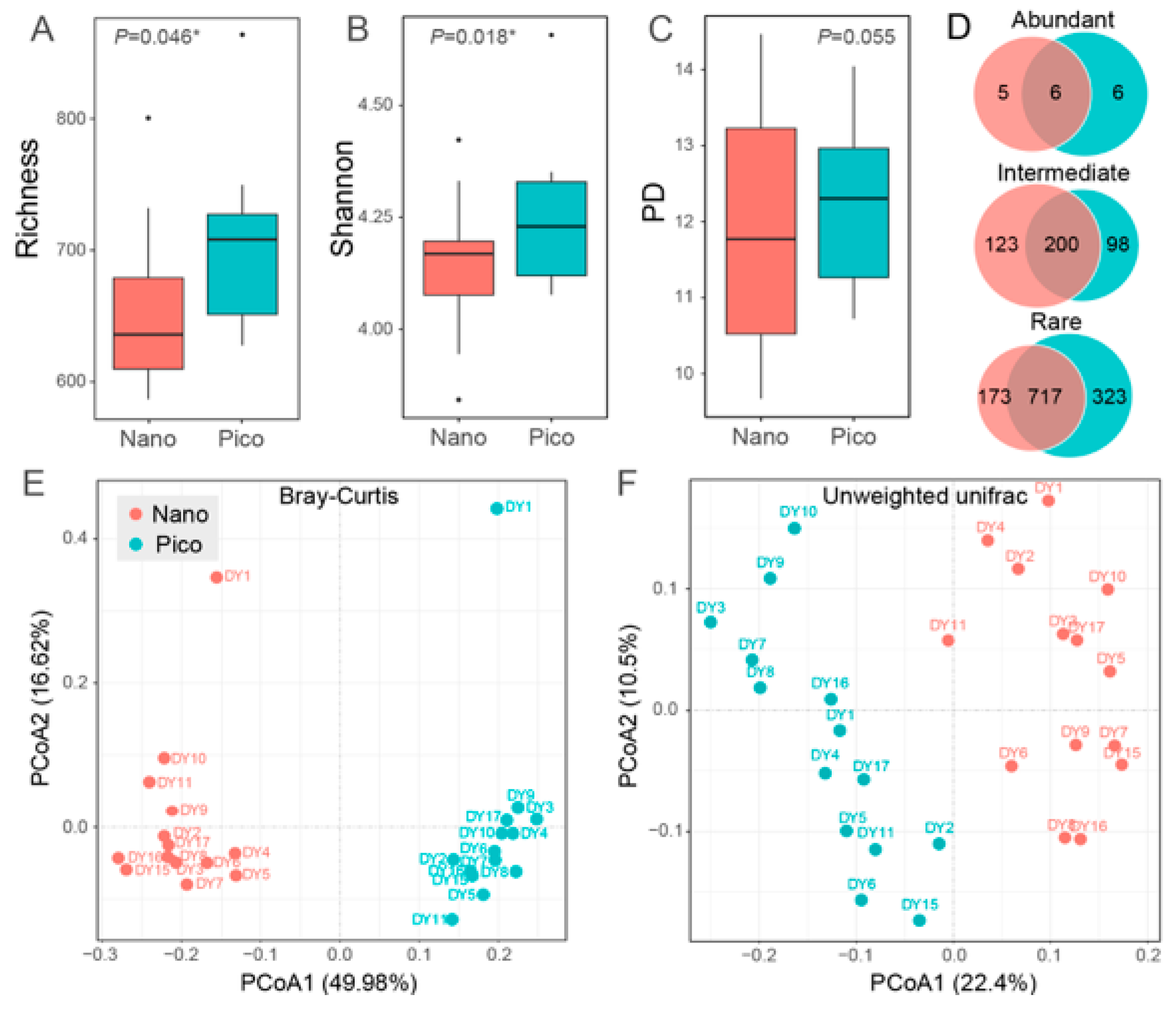
3.2. Diversity Patterns and Community Differentiation Across Size Fractions
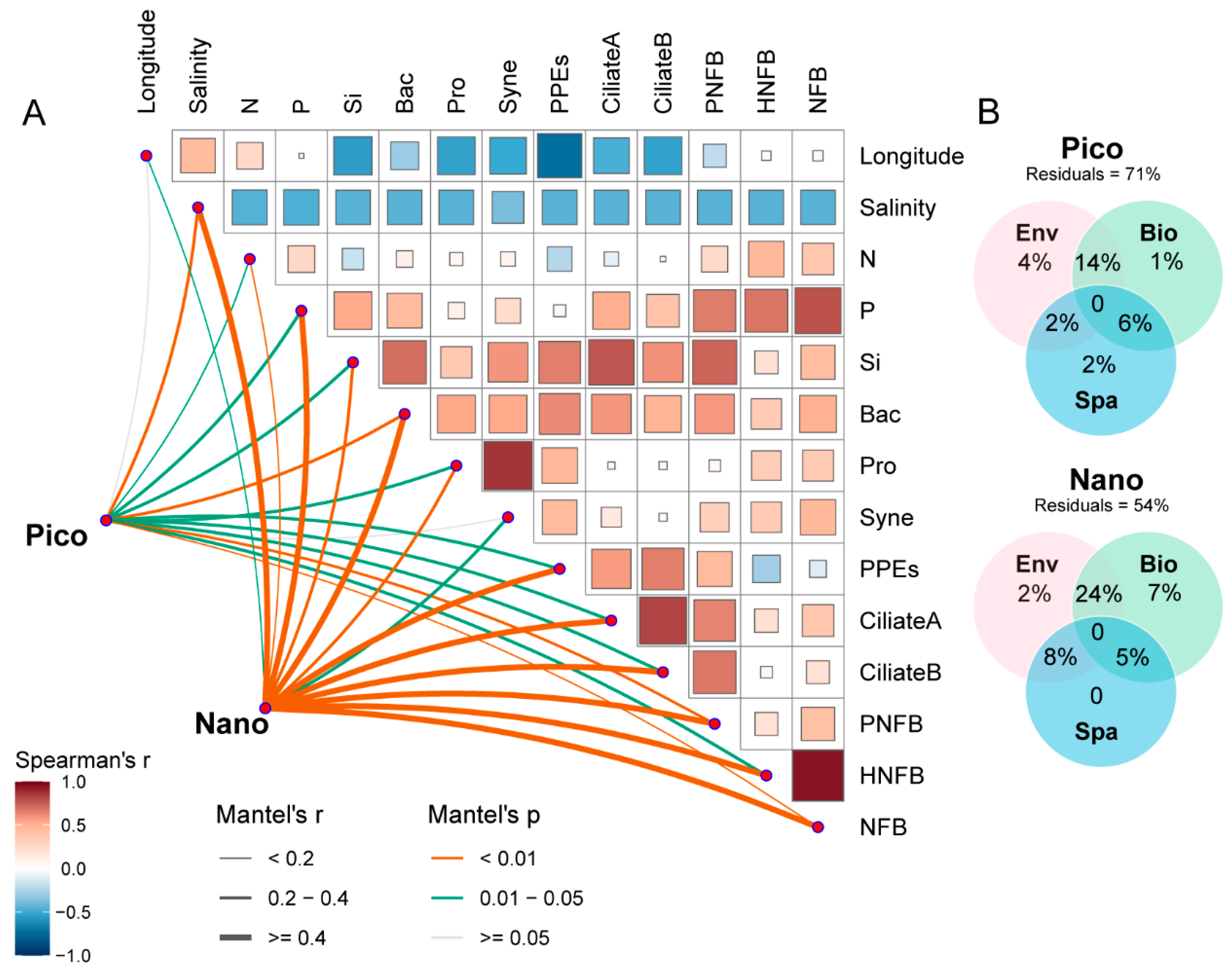
3.3. Environmental Factors Associated with Haptophyte Communities
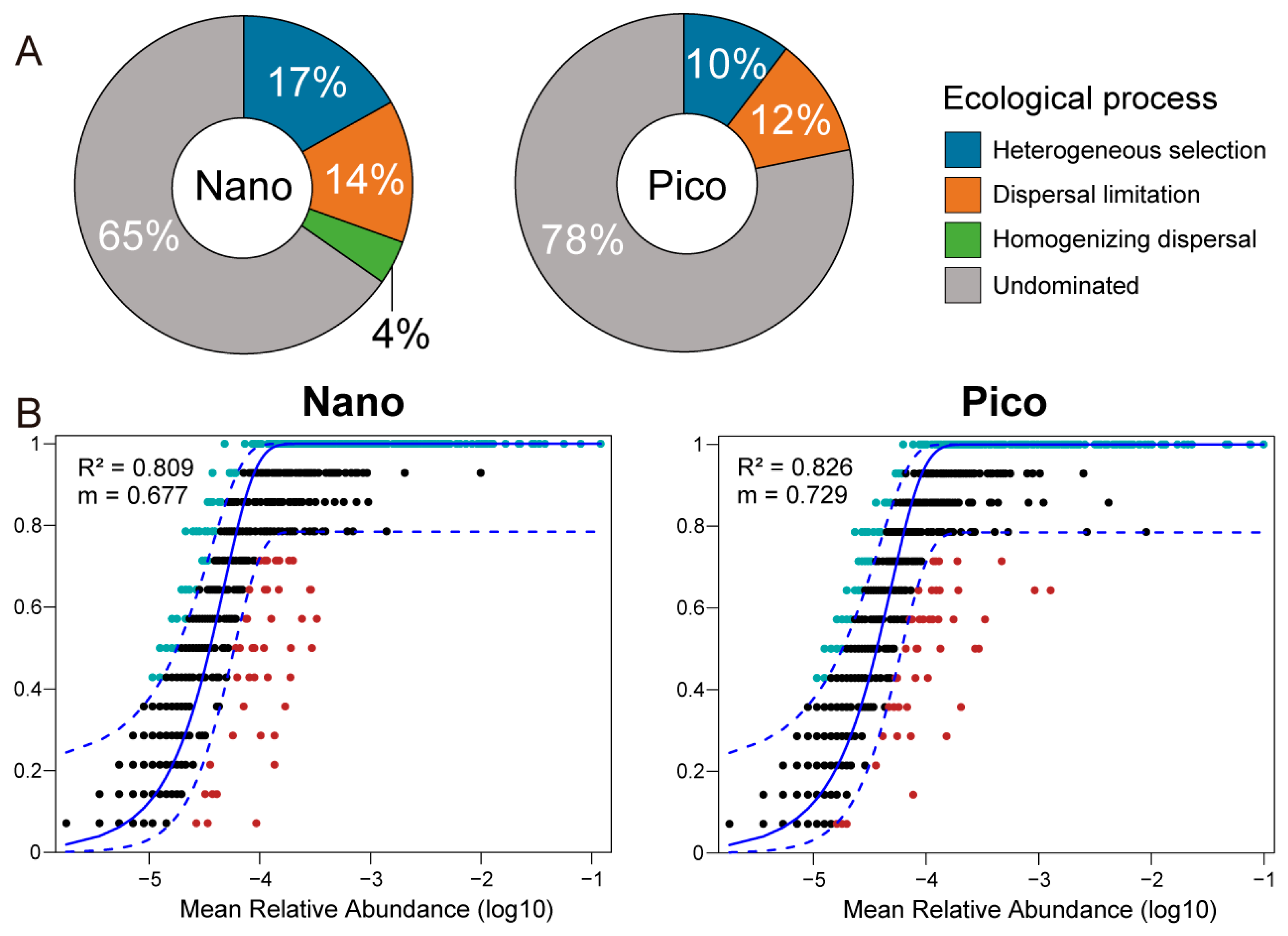
3.4. Community Assembly Processes
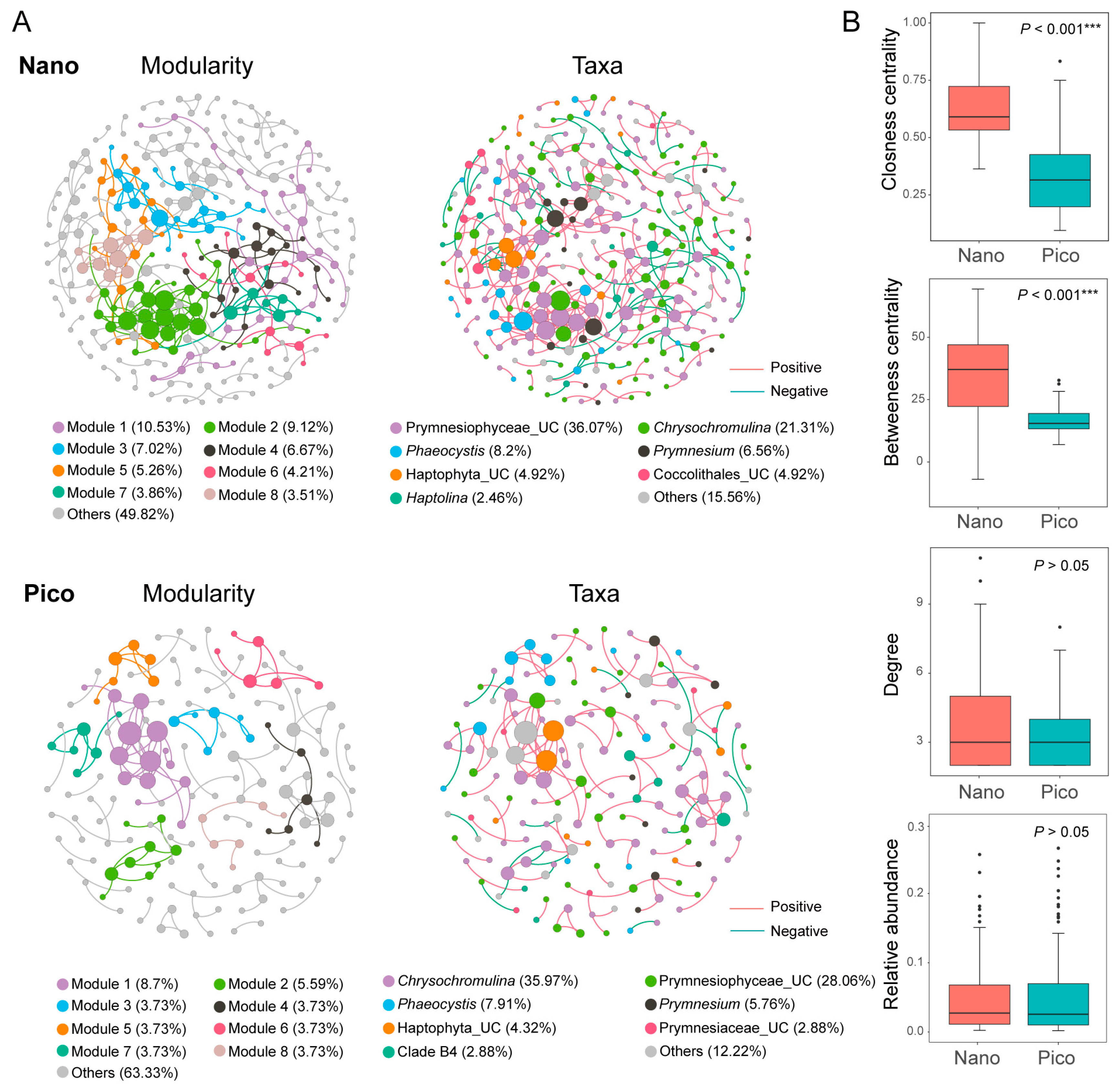
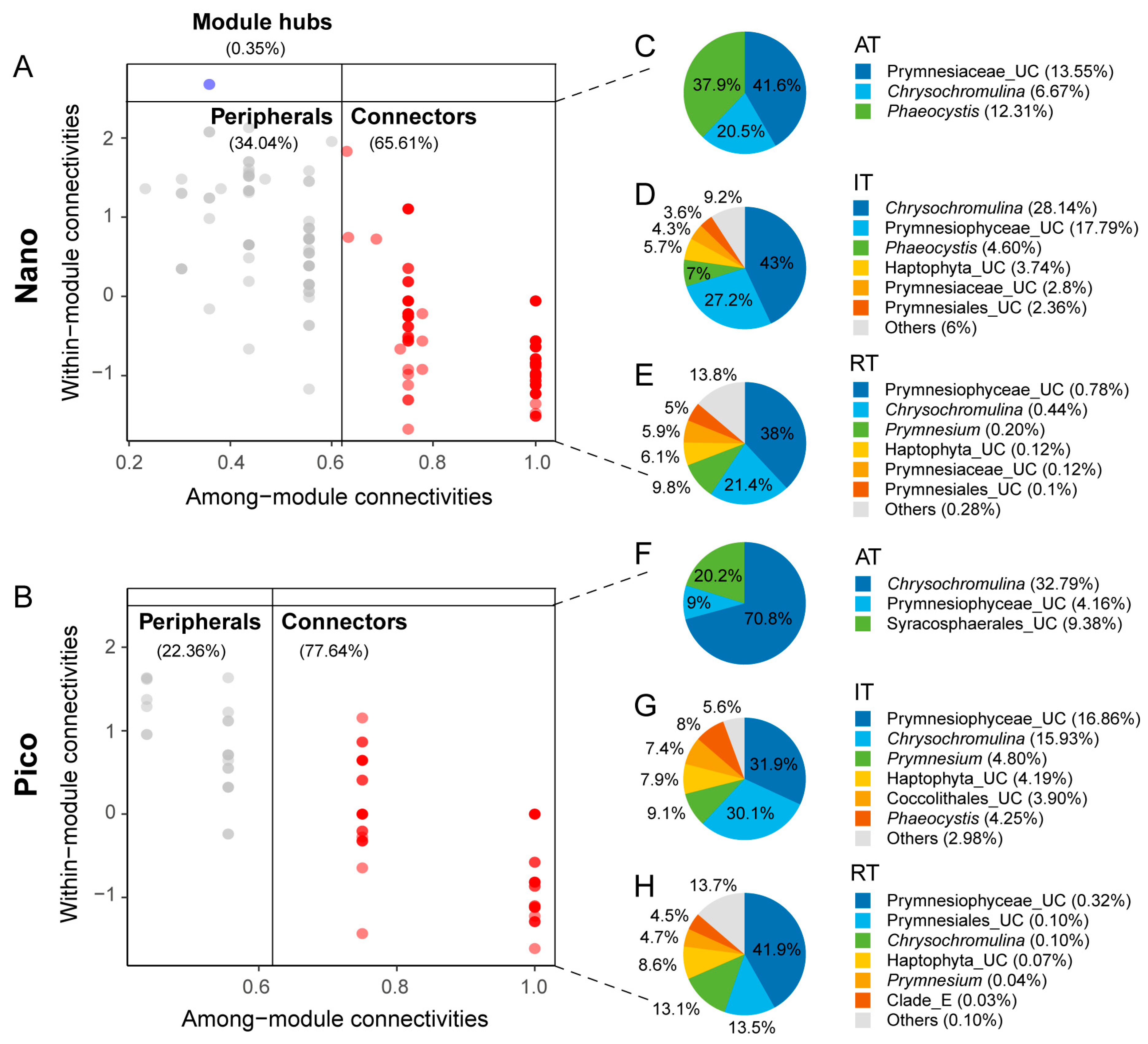
3.5. Co-Occurrence Networks of the Nano- and Pico-Subcommunities
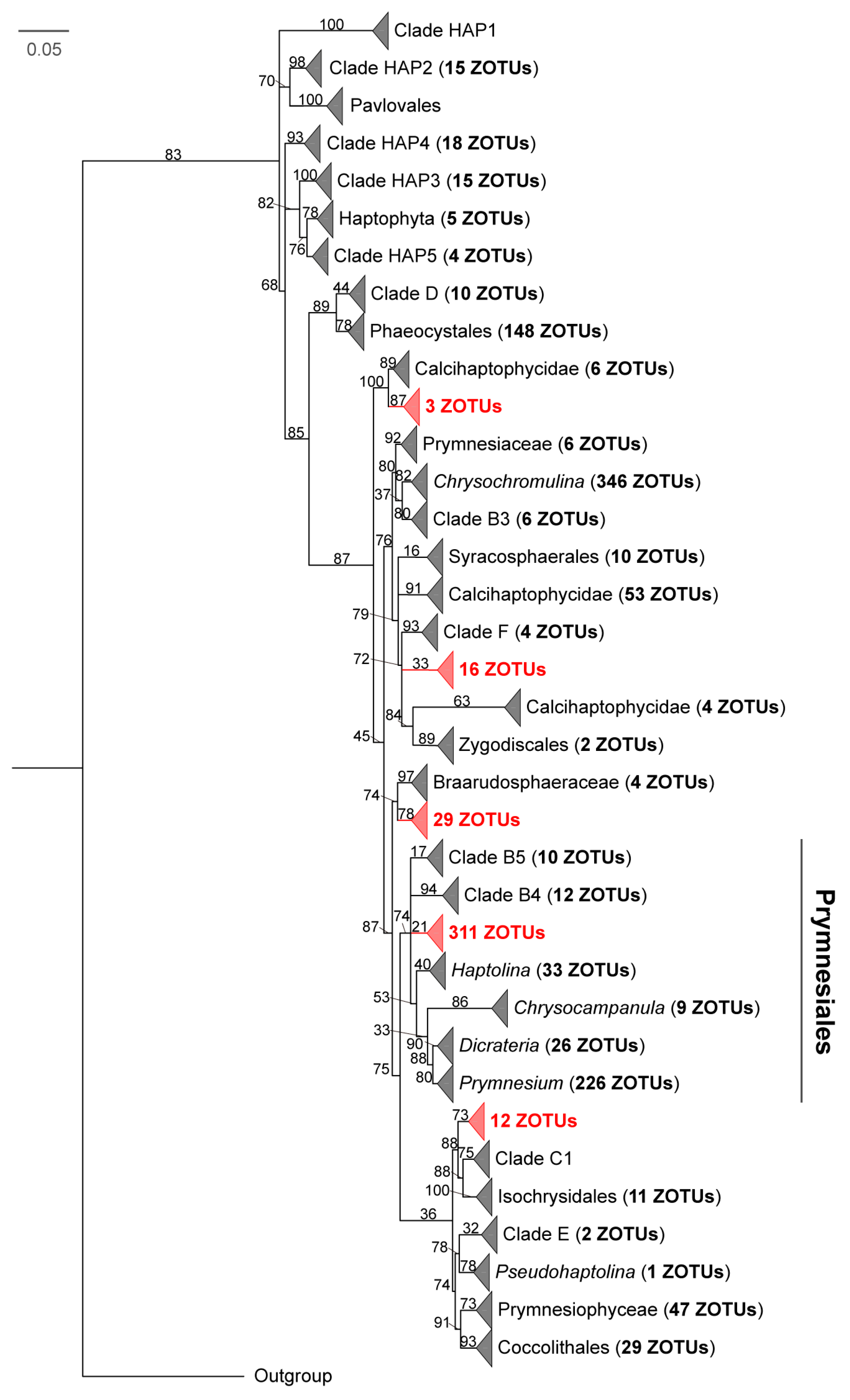
3.6. Phylogenetic Diversity of Haptophyta-Affiliated Sequences
4. Discussion
4.1. Divergences Between Haptophyte Taxa and Size-Fractionated Communities
4.2. Environmental Drivers of Size Fractionated Haptophyte Communities
4.3. Potential New Haptophyte Clades
Supplementary Materials
Author Contributions
Funding
Institutional Review Board Statement
Informed Consent Statement
Data Availability Statement
Acknowledgments
Conflicts of Interest
References
- Keeling, P.J. Diversity and evolutionary history of plastids and their hosts. Am. J. Bot. 2004, 91, 1481–1493. [Google Scholar] [CrossRef]
- Jordan, R.W.; Chamberlain, A.H.L. Biodiversity among haptophyte algae. Biodivers. Conserv. 1997, 6, 131–152. [Google Scholar] [CrossRef]
- Gonzalez-Olalla, J.M.; Medina-Sanchez, J.M.; Norici, A.; Carrillo, P. Regulation of phagotrophy by prey, low nutrients, and low light in the mixotrophic haptophyte Isochrysis galbana. Microb. Ecol. 2021, 82, 981–993. [Google Scholar] [CrossRef]
- Fourquez, M.; Strzepek, R.F.; Ellwood, M.J.; Hassler, C.; Cabanes, D.; Eggins, S.; Pearce, I.; Deppeler, S.; Trull, T.W.; Boyd, P.W.; et al. Phytoplankton responses to bacterially regenerated iron in a southern ocean eddy. Microorganisms 2022, 10, 1655. [Google Scholar] [CrossRef]
- Penot, M.; Dacks, J.B.; Read, B.; Dorrell, R.G. Genomic and meta-genomic insights into the functions, diversity and global distribution of haptophyte algae. Appl. Phycol. 2022, 3, 340–359. [Google Scholar] [CrossRef]
- Jardillier, L.; Zubkov, M.V.; Pearman, J.; Scanlan, D.J. Significant CO2 fixation by small prymnesiophytes in the subtropical and tropical northeast Atlantic Ocean. ISME J. 2010, 4, 1180–1192. [Google Scholar] [CrossRef]
- Jones, H.L.J.; Leadbeater, B.S.C.; Green, J.C. Mixotrophy in marine species of Chrysochromulina (Prymnesiophyceae): Ingestion and digestion of a small green flagellate. J. Mar. Biol. Assoc. UK 1993, 73, 283–296. [Google Scholar] [CrossRef]
- Unrein, F.; Gasol, J.M.; Not, F.; Forn, I.; Massana, R. Mixotrophic haptophytes are key bacterial grazers in oligotrophic coastal waters. ISME J. 2014, 8, 164–176. [Google Scholar] [CrossRef] [PubMed]
- Koppelle, S.; Lopez-Escardo, D.; Brussaard, C.P.D.; Huisman, J.; Philippart, C.J.M.; Massana, R.; Wilken, S. Mixotrophy in the bloom-forming genus Phaeocystis and other haptophytes-CARD-FISH. Harmful Algae 2022, 117, 102292. [Google Scholar] [CrossRef] [PubMed]
- Poulton, A.J.; Adey, T.R.; Balch, W.M.; Holligan, P.M. Relating coccolithophore calcification rates to phytoplankton community dynamics: Regional differences and implications for carbon export. Deep Sea Res. Part II Top. Stud. Oceanogr. 2007, 54, 538–557. [Google Scholar] [CrossRef]
- Liu, H.; Aris-Brosou, S.; Probert, I.; de Vargas, C. A time line of the environmental genetics of the haptophytes. Mol. Biol. Evol. 2010, 27, 161–176. [Google Scholar] [CrossRef]
- Tsuji, Y.; Yoshida, M. Chapter Seven–Biology of haptophytes: Complicated cellular processes driving the global carbon cycle. In Advances in Botanical Research; Hirakawa, Y., Ed.; Academic Press: Cambridge, MA, USA, 2017; Volume 84, pp. 219–261. [Google Scholar]
- Zehr, J.P.; Shilova, I.N.; Farnelid, H.M.; Munoz-Marin, M.D.; Turk-Kubo, K.A. Unusual marine unicellular symbiosis with the nitrogen-fixing cyanobacterium UCYN-A. Nat. Microbiol. 2016, 2, 16214. [Google Scholar] [CrossRef]
- Gerikas Ribeiro, C.; Lopes Dos Santos, A.; Marie, D.; Pereira Brandini, F.; Vaulot, D. Small eukaryotic phytoplankton communities in tropical waters off Brazil are dominated by symbioses between Haptophyta and nitrogen-fixing cyanobacteria. ISME J. 2018, 12, 1360–1374. [Google Scholar] [CrossRef]
- Mills, M.M.; Turk-Kubo, K.A.; van Dijken, G.L.; Henke, B.A.; Harding, K.; Wilson, S.T.; Arrigo, K.R.; Zehr, J.P. Unusual marine cyanobacteria/haptophyte symbiosis relies on N2 fixation even in N-rich environments. ISME J. 2020, 14, 2395–2406. [Google Scholar] [CrossRef]
- Turk-Kubo, K.A.; Mills, M.M.; Arrigo, K.R.; van Dijken, G.; Henke, B.A.; Stewart, B.; Wilson, S.T.; Zehr, J.P. UCYN-A/haptophyte symbioses dominate N2 fixation in the Southern California Current System. ISME Commun. 2021, 1, 42. [Google Scholar] [CrossRef]
- Coale, T.H.; Loconte, V.; Turk-Kubo, K.A.; Vanslembrouck, B.; Mak, W.K.E.; Cheung, S.; Ekman, A.; Chen, J.-H.; Hagino, K.; Takano, Y.; et al. Nitrogen-fixing organelle in a marine alga. Science 2024, 384, 217–222. [Google Scholar] [CrossRef]
- Schoemann, V.; Becquevort, S.; Stefels, J.; Rousseau, V.; Lancelot, C. Phaeocystis blooms in the global ocean and their controlling mechanisms: A review. J. Sea Res. 2005, 53, 43–66. [Google Scholar] [CrossRef]
- Lovejoy, C.; Massana, R.; Pedros-Alio, C. Diversity and distribution of marine microbial eukaryotes in the Arctic Ocean and adjacent seas. Appl. Environ. Microbiol. 2006, 72, 3085–3095. [Google Scholar] [CrossRef] [PubMed]
- Not, F.; Latasa, M.; Scharek, R.; Viprey, M.; Karleskind, P.; Balagué, V.; Ontoria-Oviedo, I.; Cumino, A.; Goetze, E.; Vaulot, D.; et al. Protistan assemblages across the Indian Ocean, with a specific emphasis on the picoeukaryotes. Deep Sea Res. Part I Oceanogr. Res. Pap. 2008, 55, 1456–1473. [Google Scholar] [CrossRef]
- Liu, H.; Probert, I.; Uitz, J.; Claustre, H.; Aris-Brosou, S.; Frada, M.; Not, F.; de Vargas, C. Extreme diversity in noncalcifying haptophytes explains a major pigment paradox in open oceans. Proc. Natl. Acad. Sci. USA 2009, 106, 12803–12808. [Google Scholar] [CrossRef] [PubMed]
- Andersen, R.A.; Bidigare, R.R.; Keller, M.D.; Latasa, M. A comparison of HPLC pigment signatures and electron microscopic observations for oligotrophic waters of the North Atlantic and Pacific Oceans. Deep Sea Res. Part II Top. Stud. Oceanogr. 1996, 43, 517–537. [Google Scholar] [CrossRef]
- Xu, D.; Sun, P.; Zhang, Y.; Li, R.; Huang, B.; Jiao, N.; Warren, A.; Wang, L. Pigmented microbial eukaryotes fuel the deep sea carbon pool in the tropical Western Pacific Ocean. Environ. Microbiol. 2018, 20, 3811–3824. [Google Scholar] [CrossRef]
- Huang, B.; Hu, J.; Xu, H.; Cao, Z.; Wang, D. Phytoplankton community at warm eddies in the northern South China Sea in winter 2003/2004. Deep Sea Res. Part II Top. Stud. Oceanogr. 2010, 57, 1792–1798. [Google Scholar] [CrossRef]
- Wang, J.; Kong, F.; Geng, H.; Zhang, Q.; Yuan, Y.; Yu, R. CHEMTAX analysis of phytoplankton assemblages revealed potential indicators for blooms of haptophyte Phaeocystis globosa. Ecol. Indic. 2021, 131, 108177. [Google Scholar] [CrossRef]
- Lin, Y.C.; Chung, C.C.; Gong, G.C.; Chiang, K.P. Diversity and abundance of haptophytes in the East China Sea. Aquat. Microb. Ecol. 2014, 72, 227–240. [Google Scholar] [CrossRef]
- Zhang, S.; Fu, Z.; Dong, X.; Zheng, X.; Gu, H. Diversity and seasonal occurrence of haptophyta in northern South China Sea through size-fractionated metabarcoding. Mar. Pollut. Bull. 2024, 205, 116609. [Google Scholar] [CrossRef] [PubMed]
- Zhang, H.; Li, R.; Gu, B.; Kong, H.; Xu, J.; Zhang, R.; Li, X.; Jiao, N.; Xu, D. Dynamics of haptophytes (Eukaryota, Hacrobia) revealed via short-term sampling in the South China Sea. J. Ocean Univ. China 2024, 23, 1677–1688. [Google Scholar] [CrossRef]
- Egge, E.S.; Eikrem, W.; Edvardsen, B. Deep-branching novel lineages and high diversity of haptophytes in the Skagerrak (Norway) uncovered by 454 pyrosequencing. J. Eukaryot. Microbiol. 2014, 62, 121–140. [Google Scholar] [CrossRef]
- Egge, E.S.; Johannessen, T.V.; Andersen, T.; Eikrem, W.; Bittner, L.; Larsen, A.; Sandaa, R.A.; Edvardsen, B. Seasonal diversity and dynamics of haptophytes in the Skagerrak, Norway, explored by high-throughput sequencing. Mol. Ecol. 2015, 24, 3026–3042. [Google Scholar] [CrossRef] [PubMed]
- Gran-Stadniczeñko, S.; Šupraha, L.; Egge, E.D.; Edvardsen, B. Haptophyte diversity and vertical distribution explored by 18S and 28S ribosomal RNA gene metabarcoding and scanning electron microscopy. J. Eukaryot. Microbiol. 2017, 64, 514–532. [Google Scholar] [CrossRef] [PubMed]
- Endo, H.; Umezawa, Y.; Takeda, S.; Suzuki, K. Haptophyte communities along the Kuroshio current reveal their geographical sources and ecological traits. Mol. Ecol. 2022, 32, 110–123. [Google Scholar] [CrossRef]
- Sun, P.; Liao, Y.; Wang, Y.; Yang, E.-J.; Jiao, N.; Lee, Y.; Jung, J.; Cho, K.-H.; Moon, J.-K.; Xu, D. Contrasting community composition and co-occurrence relationships of the active pico-sized haptophytes in the surface and subsurface chlorophyll maximum layers of the Arctic Ocean in summer. Microorganisms 2022, 10, 248. [Google Scholar] [CrossRef]
- Xu, D.; Kong, H.; Yang, E.J.; Wang, Y.; Li, X.; Sun, P.; Jiao, N.; Lee, Y.; Jung, J.; Cho, K.H. Spatial dynamics of active microeukaryotes along a latitudinal gradient: Diversity, assembly process, and co-occurrence relationships. Environ. Res. 2022, 212, 113234. [Google Scholar] [CrossRef] [PubMed]
- Pierella Karlusich, J.J.; Pelletier, E.; Zinger, L.; Lombard, F.; Zingone, A.; Colin, S.; Gasol, J.M.; Dorrell, R.G.; Henry, N.; Scalco, E.; et al. A robust approach to estimate relative phytoplankton cell abundances from metagenomes. Mol. Ecol. Resour. 2022, 23, 16–40. [Google Scholar] [CrossRef] [PubMed]
- Sommeria-Klein, G.; Watteaux, R.; Ibarbalz, F.M.; Pierella Karlusich, J.J.; Iudicone, D.; Bowler, C.; Morlon, H. Global drivers of eukaryotic plankton biogeography in the sunlit ocean. Science 2021, 374, 594–599. [Google Scholar] [CrossRef]
- Xu, Z.; Cheung, S.; Endo, H.; Xia, X.; Wu, W.; Chen, B.; Ho, N.H.E.; Suzuki, K.; Li, M.; Liu, H. Disentangling the ecological processes shaping the latitudinal pattern of phytoplankton communities in the Pacific Ocean. mSystems 2022, 7, e0120321. [Google Scholar] [CrossRef]
- Thomsen, H.A.; Buck, K.R.; Chavez, F.P. Haptophytes as components of marine phytoplankton. In The Haptophyte Algae; Green, C., Leadbeater, B.S.C., Eds.; Oxford University Press: Oxford, UK, 1994; pp. 187–208. [Google Scholar]
- Jordan, R.W.; Cros, L.; Young, J.R. A revised classification scheme for living haptophytes. Micropaleontology 2004, 50, 55–79. [Google Scholar] [CrossRef]
- Edvardsen, B.; Egge, E.; Vaulot, D. Diversity and distribution of haptophytes revealed by environmental sequencing and metabarcoding—A review. Perspect. Phycol. 2016, 3, 77–91. [Google Scholar] [CrossRef]
- Ward, B.A.; Dutkiewicz, S.; Jahn, O.; Follows, M.J. A size-structured food-web model for the global ocean. Limnol. Oceanogr. 2012, 57, 1877–1891. [Google Scholar] [CrossRef]
- Huang, H.; Yang, J.; Huang, S.; Gu, B.; Wang, Y.; Wang, L.; Jiao, N.; Xu, D. Spatial distribution of planktonic ciliates in the western Pacific Ocean: Along the transect from Shenzhen (China) to Pohnpei (Micronesia). Mar. Life Sci. Technol. 2021, 3, 103–115. [Google Scholar] [CrossRef] [PubMed]
- Egge, E.; Bittner, L.; Andersen, T.; Audic, S.; De Vargas, C.; Edvardsen, B. 454 pyrosequencing to describe microbial eukaryotic community composition, diversity and relative abundance: A test for marine haptophytes. PLoS ONE 2013, 8, e74371. [Google Scholar] [CrossRef]
- Bolger, A.M.; Lohse, M.; Usadel, B. Trimmomatic: A flexible trimmer for Illumina sequence data. Bioinformatics 2014, 30, 2114–2120. [Google Scholar] [CrossRef]
- Magoč, T.; Salzberg, S.L. FLASH: Fast length adjustment of short reads to improve genome assemblies. Bioinformatics 2011, 27, 2957–2963. [Google Scholar] [CrossRef]
- Li, R.; Hu, C.; Wang, J.; Sun, J.; Wang, Y.; Jiao, N.; Xu, D. Biogeographical distribution and community assembly of active protistan assemblages along an estuary to a basin transect of the northern South China Sea. Microorganisms 2021, 9, 351. [Google Scholar] [CrossRef]
- Schloss, P.D.; Westcott, S.L.; Ryabin, T.; Hall, J.R.; Hartmann, M.; Hollister, E.B.; Lesniewski, R.A.; Oakley, B.B.; Parks, D.H.; Robinson, C.J.; et al. Introducing mothur: Open-source, platform-independent, community-supported software for describing and comparing microbial communities. Appl. Environ. Microbiol. 2009, 75, 7537–7541. [Google Scholar] [CrossRef]
- Edgar, R.C. Search and clustering orders of magnitude faster than BLAST. Bioinformatics 2010, 26, 2460–2461. [Google Scholar] [CrossRef]
- Edgar, R.C. UNOISE2: Improved error-correction for Illumina 16S and ITS amplicon sequencing. bioRxiv 2016, 081257. [Google Scholar] [CrossRef]
- Edgar, R.C. SINTAX: A simple non-Bayesian taxonomy classifier for 16S and ITS sequences. bioRxiv 2016, 074161. [Google Scholar] [CrossRef]
- Guillou, L.; Bachar, D.; Audic, S.; Bass, D.; Berney, C.; Bittner, L.; Boutte, C.; Burgaud, G.; de Vargas, C.; Decelle, J.; et al. The Protist Ribosomal Reference database (PR2): A catalog of unicellular eukaryote Small Sub-Unit rRNA sequences with curated taxonomy. Nucleic Acids Res. 2012, 41, D597–D604. [Google Scholar] [CrossRef]
- Caporaso, J.G.; Kuczynski, J.; Stombaugh, J.; Bittinger, K.; Bushman, F.D.; Costello, E.K.; Fierer, N.; Peña, A.G.; Goodrich, J.K.; Gordon, J.I.; et al. QIIME allows analysis of high-throughput community sequencing data. Nat. Methods 2010, 7, 335–336. [Google Scholar] [CrossRef] [PubMed]
- Logares, R.; Audic, S.; Bass, D.; Bittner, L.; Boutte, C.; Christen, R.; Claverie, J.M.; Decelle, J.; Dolan, J.R.; Dunthorn, M.; et al. Patterns of rare and abundant marine microbial eukaryotes. Curr. Biol. 2014, 24, 813–821. [Google Scholar] [CrossRef]
- Zhang, W.; Pan, Y.; Yang, J.; Chen, H.; Holohan, B.; Vaudrey, J.; Lin, S.; McManus, G.B. The diversity and biogeography of abundant and rare intertidal marine microeukaryotes explained by environment and dispersal limitation. Environ. Microbiol. 2018, 20, 462–476. [Google Scholar] [CrossRef]
- Zhao, F.; Wang, Y.; Zheng, S.; Zhao, R.; Lin, M.; Xu, K. Patterns and drivers of microeukaryotic distribution along the north equatorial current from the central Pacific Ocean to the South China Sea. Mar. Pollut. Bull. 2021, 165, 112091. [Google Scholar] [CrossRef]
- Clarke, K.; Gorley, R.N. PRIMER v6: User Manual/Tutorial; PRIMER-E: Plymouth, UK, 2006; Volume 29, pp. 1060–1065. [Google Scholar]
- Stegen, J.C.; Lin, X.; Konopka, A.E.; Fredrickson, J.K. Stochastic and deterministic assembly processes in subsurface microbial communities. ISME J. 2012, 6, 1653–1664. [Google Scholar] [CrossRef] [PubMed]
- Stegen, J.C.; Lin, X.; Fredrickson, J.K.; Chen, X.; Kennedy, D.W.; Murray, C.J.; Rockhold, M.L.; Konopka, A. Quantifying community assembly processes and identifying features that impose them. ISME J. 2013, 7, 2069–2079. [Google Scholar] [CrossRef] [PubMed]
- Zhou, J.; Ning, D. Stochastic community assembly: Does it matter in microbial ecology. Microbiol. Mol. Biol. Rev. 2017, 81, e00002-17. [Google Scholar] [CrossRef] [PubMed]
- Sloan, W.T.; Lunn, M.; Woodcock, S.; Head, I.M.; Nee, S.; Curtis, T.P. Quantifying the roles of immigration and chance in shaping prokaryote community structure. Environ. Microbiol. 2006, 8, 732–740. [Google Scholar] [CrossRef]
- Bastian, M.; Heymann, S.; Jacomy, M. Gephi: An Open Source Software for Exploring and Manipulating Networks. Proc. Int. AAAI Conf. Weblogs Soc. Media 2009, 3, 361–362. [Google Scholar] [CrossRef]
- Guimera, R.; Amaral, L.A. Cartography of complex networks: Modules and universal roles. J. Stat. Mech. 2005, 2005, P02001. [Google Scholar] [CrossRef]
- Cumbo, F.; Paci, P.; Santoni, D.; Di Paola, L.; Giuliani, A. GIANT: A cytoscape plugin for modular networks. PLoS ONE 2014, 9, e105001. [Google Scholar] [CrossRef]
- Tylianakis, J.M.; Morris, R.J. Ecological networks across environmental gradients. Annu. Rev. Ecol. Evol. Syst. 2017, 48, 25–48. [Google Scholar] [CrossRef]
- Katoh, K.; Standley, D.M. MAFFT multiple sequence alignment software version 7: Improvements in performance and usability. Mol. Biol. Evol. 2013, 30, 772–780. [Google Scholar] [CrossRef]
- Capella-Gutiérrez, S.; Silla-Martínez, J.M.; Gabaldón, T. trimAl: A tool for automated alignment trimming in large-scale phylogenetic analyses. Bioinformatics 2009, 25, 1972–1973. [Google Scholar] [CrossRef] [PubMed]
- Minh, B.Q.; Schmidt, H.A.; Chernomor, O.; Schrempf, D.; Woodhams, M.D.; von Haeseler, A.; Lanfear, R. IQ-TREE 2: New models and efficient methods for phylogenetic inference in the genomic era. Mol. Biol. Evol. 2020, 37, 1530–1534. [Google Scholar] [CrossRef]
- Kalyaanamoorthy, S.; Minh, B.Q.; Wong, T.K.F.; von Haeseler, A.; Jermiin, L.S. ModelFinder: Fast model selection for accurate phylogenetic estimates. Nat. Methods 2017, 14, 587–589. [Google Scholar] [CrossRef]
- Letunic, I.; Bork, P. Interactive Tree Of Life (iTOL) v5: An online tool for phylogenetic tree display and annotation. Nucleic Acids Res. 2021, 49, W293–W296. [Google Scholar] [CrossRef]
- Chan, Y.F.; Chiang, K.P.; Ku, Y.; Gong, G.C. Abiotic and biotic factors affecting the ingestion rates of mixotrophic nanoflagellates (Haptophyta). Microb. Ecol. 2019, 77, 607–615. [Google Scholar] [CrossRef] [PubMed]
- Massana, R.; Gobet, A.; Audic, S.; Bass, D.; Bittner, L.; Boutte, C.; Chambouvet, A.; Christen, R.; Claverie, J.M.; Decelle, J.; et al. Marine protist diversity in European coastal waters and sediments as revealed by high-throughput sequencing. Environ. Microbiol. 2015, 17, 4035–4049. [Google Scholar] [CrossRef]
- Wu, C.; Xue, Y.; Song, Q.; Yin, J.; Zhang, Y.; Shen, P. Strong seasonality and unsuspected diversity of haptophytes explored by metabarcoding analysis in the Chinese seas. Mar. Environ. Res. 2024, 202, 106792. [Google Scholar] [CrossRef]
- McDonald, S.M.; Sarno, D.; Scanlan, D.J.; Zingone, A. Genetic diversity of eukaryotic ultraphytoplankton in the Gulf of Naples during an annual cycle. Aquat. Microb. Ecol. 2007, 50, 75–89. [Google Scholar] [CrossRef]
- Endo, H.; Ogata, H.; Suzuki, K. Contrasting biogeography and diversity patterns between diatoms and haptophytes in the central Pacific Ocean. Sci. Rep. 2018, 8, 10916. [Google Scholar] [CrossRef]
- Baker, J.W.; Grover, J.P.; Brooks, B.W.; Ureña-Boeck, F.; Roelke, D.L.; Errera, R.; Kiesling, R.L. Growth and toxicity of Prymnesium parvum (Haptophyta) as a function of salinity, light, and temperature. J. Phycol. 2007, 43, 219–227. [Google Scholar] [CrossRef]
- Faure, E.; Not, F.; Benoiston, A.-S.; Labadie, K.; Bittner, L.; Ayata, S.-D. Mixotrophic protists display contrasted biogeographies in the global ocean. ISME J. 2019, 13, 1072–1083. [Google Scholar] [CrossRef] [PubMed]
- Li, Q.; Edwards, K.F.; Schvarcz, C.R.; Steward, G.F. Broad phylogenetic and functional diversity among mixotrophic consumers of Prochlorococcus. ISME J. 2022, 16, 1557–1569. [Google Scholar] [CrossRef]
- Boucher, C.; Lacour, T.; Julie, A.; Damien, R.; Juel, H.P.; Francis, M. Mixotrophic lifestyle of the ichthyotoxic haptophyte, Prymnesium parvum, offered different sources of phosphorus. Harmful Algae 2023, 127, 102483. [Google Scholar] [CrossRef]
- Bittner, L.; Gobet, A.; Audic, S.; Romac, S.; Egge, E.S.; Santini, S.; Ogata, H.; Probert, I.; Edvardsen, B.; de Vargas, C. Diversity patterns of uncultured Haptophytes unravelled by pyrosequencing in Naples Bay. Mol. Ecol. 2013, 22, 87–101. [Google Scholar] [CrossRef] [PubMed]
- Jousset, A.; Bienhold, C.; Chatzinotas, A.; Gallien, L.; Gobet, A.; Kurm, V.; Kusel, K.; Rillig, M.C.; Rivett, D.W.; Salles, J.F.; et al. Where less may be more: How the rare biosphere pulls ecosystems strings. ISME J. 2017, 11, 853–862. [Google Scholar] [CrossRef]
- Behrenfeld, M.J.; O’Malley, R.; Boss, E.; Karp-Boss, L.; Mundt, C. Phytoplankton biodiversity and the inverted paradox. ISME Commun. 2021, 1, 52. [Google Scholar] [CrossRef]
- Peres-Neto, P.R.; Legendre, P.; Dray, S.; Borcard, D. Variation partitioning of species data matrices: Estimation and comparison of fractions. Ecology 2006, 87, 2614–2625. [Google Scholar] [CrossRef]
- Suttle, C.A. Marine viruses—Major players in the global ecosystem. Nat. Rev. Microbiol. 2007, 5, 801–812. [Google Scholar] [CrossRef]
- Sandaa, R.-A.; Saltvedt, M.R.; Dahle, H.; Wang, H.; Våge, S.; Blanc-Mathieu, R.; Steen, I.H.; Grimsley, N.; Edvardsen, B.; Ogata, H.; et al. Adaptive evolution of viruses infecting marine microalgae (haptophytes), from acute infections to stable coexistence. Biol. Rev. 2022, 97, 179–194. [Google Scholar] [CrossRef]
- Vincent, F.; Gralka, M.; Schleyer, G.; Schatz, D.; Cabrera-Brufau, M.; Kuhlisch, C.; Sichert, A.; Vidal-Melgosa, S.; Mayers, K.; Barak-Gavish, N.; et al. Viral infection switches the balance between bacterial and eukaryotic recyclers of organic matter during coccolithophore blooms. Nat. Commun. 2023, 14, 510. [Google Scholar] [CrossRef]
- Biggs, T.E.G.; Huisman, J.; Brussaard, C.P.D. Viral lysis modifies seasonal phytoplankton dynamics and carbon flow in the Southern Ocean. ISME J. 2021, 15, 3615–3622. [Google Scholar] [CrossRef]
- Lanzén, A.; Jørgensen, S.L.; Bengtsson, M.M.; Jonassen, I.; Øvreås, L.; Urich, T. Exploring the composition and diversity of microbial communities at the Jan Mayen hydrothermal vent field using RNA and DNA. FEMS Microbiol. Ecol. 2011, 77, 577–589. [Google Scholar] [CrossRef] [PubMed]
- Hu, S.K.; Campbell, V.; Connell, P.; Gellene, A.G.; Liu, Z.; Terrado, R.; Caron, D.A. Protistan diversity and activity inferred from RNA and DNA at a coastal ocean site in the eastern North Pacific. FEMS Microbiol. Ecol. 2016, 92, fiw050. [Google Scholar] [CrossRef] [PubMed]
- Xu, D.; Li, R.; Hu, C.; Sun, P.; Jiao, N.; Warren, A. Microbial eukaryote diversity and activity in the water column of the South China Sea based on DNA and RNA high throughput sequencing. Front. Microbiol. 2017, 8, 1121. [Google Scholar] [CrossRef]
- Kong, H.; Yang, E.J.; Jiao, N.; Lee, Y.; Jung, J.; Cho, K.H.; Moon, J.K.; Kim, J.H.; Xu, D. RNA outperforms DNA-based metabarcoding in assessing the diversity and response of microeukaryotes to environmental variables in the Arctic Ocean. Sci. Total Environ. 2023, 876, 162608. [Google Scholar] [CrossRef]
- Viana, D.S.; Chase, J.M. Spatial scale modulates the inference of metacommunity assembly processes. Ecology 2019, 100, e02576. [Google Scholar] [CrossRef] [PubMed]
- Farjalla, V.F.; Srivastava, D.S.; Marino, N.A.C.; Azevedo, F.D.; Dib, V.; Lopes, P.M.; Rosado, A.S.; Bozelli, R.L.; Esteves, F.A. Ecological determinism increases with organism size. Ecology 2012, 93, 1752–1759. [Google Scholar] [CrossRef]
- Brasil, J.; Santos, J.B.O.; Sousa, W.; Menezes, R.F.; Huszar, V.L.M.; Attayde, J.L. Rainfall leads to habitat homogenization and facilitates plankton dispersal in tropical semiarid lakes. Aquat. Ecol. 2019, 54, 225–241. [Google Scholar] [CrossRef]
- Zhou, J.; Deng, Y.; Luo, F.; He, Z.; Tu, Q.; Zhi, X. Functional molecular ecological networks. mBio 2010, 1, e00169-10. [Google Scholar] [CrossRef] [PubMed]
- Faust, K.; Raes, J. Microbial interactions: From networks to models. Nat. Rev. Microbiol. 2012, 10, 538–550. [Google Scholar] [CrossRef]
- Banerjee, S.; Schlaeppi, K.; van der Heijden, M.G.A. Keystone taxa as drivers of microbiome structure and functioning. Nat. Rev. Microbiol. 2018, 16, 567–576. [Google Scholar] [CrossRef]
- Lu, M.; Wang, X.; Li, H.; Jiao, J.J.; Luo, X.; Luo, M.; Yu, S.; Xiao, K.; Li, X.; Qiu, W.; et al. Microbial community assembly and co-occurrence relationship in sediments of the river-dominated estuary and the adjacent shelf in the wet season. Environ. Pollut. 2022, 308, 119572. [Google Scholar] [CrossRef]
- Berry, D.; Widder, S. Deciphering microbial interactions and detecting keystone species with co-occurrence networks. Front. Microbiol. 2014, 5, 219. [Google Scholar] [CrossRef]
- Sun, P.; Huang, L.; Xu, D.; Huang, B.; Chen, N.; Warren, A. Marked seasonality and high spatial variation in estuarine ciliates are driven by exchanges between the ‘abundant’ and ‘intermediate’ biospheres. Sci. Rep. 2017, 7, 9494. [Google Scholar] [CrossRef]
- De Vargas, C.; Audic, S.; Henry, N.; Decelle, J.; Mahé, F.; Logares, R.; Lara, E.; Berney, C.; Le Bescot, N.; Probert, I.; et al. Eukaryotic plankton diversity in the sunlit ocean. Science 2015, 348, 1261605. [Google Scholar] [CrossRef]
- Piredda, R.; Tomasino, M.P.; D’Erchia, A.M.; Manzari, C.; Pesole, G.; Montresor, M.; Kooistra, W.H.C.F.; Sarno, D.; Zingone, A. Diversity and temporal patterns of planktonic protist assemblages at a Mediterranean Long Term Ecological Research site. FEMS Microbiol. Ecol. 2016, 93, fiw200. [Google Scholar] [CrossRef] [PubMed]
- Tragin, M.; Zingone, A.; Vaulot, D. Comparison of coastal phytoplankton composition estimated from the V4 and V9 regions of the 18S rRNA gene with a focus on photosynthetic groups and especially Chlorophyta. Environ. Microbiol. 2018, 20, 506–520. [Google Scholar] [CrossRef] [PubMed]
- Santoferrara, L.; Burki, F.; Filker, S.; Logares, R.; Dunthorn, M.; McManus, G.B. Perspectives from ten years of protist studies by high-throughput metabarcoding. J. Eukaryot. Microbiol. 2020, 67, 612–622. [Google Scholar] [CrossRef]
- Ridder, L.; Edvardsen, B.; Wolf, M. ITS2 and 18S rRNA gene sequence-structure phylogeny of the Haptophyta (Haptista). PLoS ONE 2026, 21, e0344353. [Google Scholar] [CrossRef] [PubMed]
- Houdan, A.; Billard, C.; Marie, D.; Not, F.; Sáez, A.G.; Young, J.R.; Probert, I. Holococcolithophore-heterococcolithophore (Haptophyta) life cycles: Flow cytometric analysis of relative ploidy levels. Syst. Biodivers. 2004, 1, 453–465. [Google Scholar] [CrossRef]
- Bendif, E.M.; Probert, I.; Schroeder, D.C.; de Vargas, C. On the description of Tisochrysis lutea gen. nov. sp. nov. and Isochrysis nuda sp. nov. in the Isochrysidales, and the transfer of Dicrateria to the Prymnesiales (Haptophyta). J. Appl. Phycol. 2013, 25, 1763–1776. [Google Scholar] [CrossRef]
- Vaulot, D.; Eikrem, W.; Viprey, M.; Moreau, H. The diversity of small eukaryotic phytoplankton (≤ 3 μm) in marine ecosystems. FEMS Microbiol. Rev. 2008, 32, 795–820. [Google Scholar] [CrossRef]
- Logares, R.; Deutschmann, I.M.; Junger, P.C.; Giner, C.R.; Krabberød, A.K.; Schmidt, T.S.B.; Rubinat-Ripoll, L.; Mestre, M.; Salazar, G.; Ruiz-González, C.; et al. Disentangling the mechanisms shaping the surface ocean microbiota. Microbiome 2020, 8, 55. [Google Scholar] [CrossRef]



| Category | Nano | Pico | |
|---|---|---|---|
| Unique ZOTUs | AT | 6 (20.62%) | 5 (17.92%) |
| IT | 98 (9.03%) | 123 (9.91%) | |
| RT | 323 (1.09%) | 173 (0.52%) | |
| Shared ZOTUs | AT | 6 (33.72%) | 6 (32.49%) |
| IT | 200 (33.62%) | 200 (37.32%) | |
| RT | 717 (1.94%) | 717 (1.85%) |
Disclaimer/Publisher’s Note: The statements, opinions and data contained in all publications are solely those of the individual author(s) and contributor(s) and not of MDPI and/or the editor(s). MDPI and/or the editor(s) disclaim responsibility for any injury to people or property resulting from any ideas, methods, instructions or products referred to in the content. |
© 2026 by the authors. Licensee MDPI, Basel, Switzerland. This article is an open access article distributed under the terms and conditions of the Creative Commons Attribution (CC BY) license.
Share and Cite
Li, W.; Liao, Y.; Jiao, N.; Xu, D. Spatial Distributions of Active Pico- and Nano-Haptophytes (Eukaryota, Hacrobia) in the Tropical and Subtropical Western Pacific Ocean. Microorganisms 2026, 14, 941. https://doi.org/10.3390/microorganisms14040941
Li W, Liao Y, Jiao N, Xu D. Spatial Distributions of Active Pico- and Nano-Haptophytes (Eukaryota, Hacrobia) in the Tropical and Subtropical Western Pacific Ocean. Microorganisms. 2026; 14(4):941. https://doi.org/10.3390/microorganisms14040941
Chicago/Turabian StyleLi, Wenlu, Yuyu Liao, Nianzhi Jiao, and Dapeng Xu. 2026. "Spatial Distributions of Active Pico- and Nano-Haptophytes (Eukaryota, Hacrobia) in the Tropical and Subtropical Western Pacific Ocean" Microorganisms 14, no. 4: 941. https://doi.org/10.3390/microorganisms14040941
APA StyleLi, W., Liao, Y., Jiao, N., & Xu, D. (2026). Spatial Distributions of Active Pico- and Nano-Haptophytes (Eukaryota, Hacrobia) in the Tropical and Subtropical Western Pacific Ocean. Microorganisms, 14(4), 941. https://doi.org/10.3390/microorganisms14040941