Article

Serotypes, MIC-Based Antimicrobial Susceptibility, and Genotypic Diversity of Actinobacillus pleuropneumoniae Isolates from Diseased Pigs in Brazil

by
Barbara L. P. Costa
1,
Carlos E. C. Matajira
1,2,
André P. Poor
1,
Matheus S. Monteiro
1,
Luisa Z. Moreno
1,3,
Maurício C. Dutra
1,4 and
Andrea M. Moreno
1,*
1
Department of Preventive Veterinary Medicine and Animal Health, School of Veterinary Medicine and Animal Science, University of São Paulo, Av. Prof. Dr. Orlando Marques de Paiva, 87, Cidade Universitária, Sao Paulo 05508-270, SP, Brazil
2
Laboratory of Microbial Biomolecules, School of Pharmaceutical Sciences, University of São Paulo, São Paulo 05508-900, SP, Brazil
3
Department of Pathology, Reproduction, and One Health (DPRSU), School of Agricultural and Veterinary Studies (FCAV), São Paulo State University (UNESP), Jaboticabal 01049-010, SP, Brazil
4
Consultoria GFD, Campinas 13026-515, SP, Brazil
*
Author to whom correspondence should be addressed.
Microorganisms 2026, 14(4), 828; https://doi.org/10.3390/microorganisms14040828
Submission received: 28 February 2026 / Revised: 1 April 2026 / Accepted: 2 April 2026 / Published: 4 April 2026

Abstract

Actinobacillus pleuropneumoniae is a major swine pathogen that causes pleuropneumonia and leads to substantial economic losses due to mortality, impaired growth, and carcass condemnation. Nineteen serovars have been described, and their geographic distribution has been assessed using multiple typing approaches. High serovar diversity, together with limited cross-protective immunity, increases reliance on antimicrobial therapy for disease control. However, data on the genotypic diversity and antimicrobial susceptibility of A. pleuropneumoniae remain limited worldwide, and information on serovar distribution in Brazil is scarce. Here, we report serotyping, genotyping, and antimicrobial susceptibility profiling of A. pleuropneumoniae isolated from diseased pigs in Brazil. Eighty-five isolates from eight Brazilian states were analyzed; serovars 5 and 10 were the most prevalent (38.8% and 29.4%, respectively). Ceftiofur, spectinomycin, gentamicin, neomycin, tilmicosin, tulathromycin, and florfenicol showed good in vitro activity against the isolates. The highest resistance rates were observed for tylosin (98.8%), clindamycin (90.6%), chlortetracycline (67.1%), and oxytetracycline (67.1%), and multidrug resistance was detected in 55% of strains. SE-AFLP and PFGE revealed high genetic diversity, including among isolates of the same serovar, although a modest tendency to cluster by geographic origin and serovar was observed.

1. Introduction

Actinobacillus pleuropneumoniae is one of the bacteria most frequently isolated from swine respiratory infections and is the etiologic agent of pleuropneumonia [1,2]. The clinical course can be peracute, acute, or chronic, depending on factors such as the initial infectious dose, serotype, and toxin profile, as well as the age and immune status of the host. A. pleuropneumoniae can infect pigs of all ages; however, its epidemiology is closely associated with the production stage. Piglets are partially protected during the first weeks of life by maternal antibodies, but susceptibility increases after weaning as this passive immunity declines. Although the disease may occur in other production groups, including breeding animals [1,3], clinical cases are most frequently observed in growing–finishing pigs, in which the highest incidence of outbreaks has been reported [2]. In peracute and acute forms, high morbidity and mortality may occur [4], which can contribute to increased sow mortality in some Brazilian herds [5]. Infection reduces herd profitability by increasing mortality, worsening feed conversion, and raising treatment costs, and reducing average daily gain by up to 33.6% [4,6,7]. Furthermore, fibrinous pleuritis lesions increase carcass condemnation [8].
Nineteen serotypes have been described based on surface carbohydrates, mainly capsular polysaccharides, and their prevalence varies among countries and over time [1,9]. In addition, cross-protection mediated by antibodies against different serotypes is limited, which can make commercial vaccines ineffective in some settings [1].
Serotype characterization alone may fail to elucidate the genetic diversity and infection dynamics of A. pleuropneumoniae [10]. Fingerprinting techniques provide better discrimination among closely related organisms at the species and strain levels and are valuable tools for differentiating A. pleuropneumoniae strains [11].
Another key issue in controlling A. pleuropneumoniae infection is the growing concern about antimicrobial resistance. Increasing resistance rates over the years have been reported [12], and 33% of isolates have been described as resistant to more than three antimicrobial classes (multidrug resistance [MDR]) [13,14]. High resistance rates have been observed for sulfonamides, tetracyclines, penicillins, and third-generation quinolones [12,13,14,15,16]. Despite the substantial health and economic impact of this pathogen, few studies have evaluated the minimum inhibitory concentrations (MICs) of antimicrobials against A. pleuropneumoniae [14,16], and only a limited number have assessed Brazilian strains [17,18]. Moreover, longitudinal interpretation of resistance trends depends on the availability of robust baseline datasets from earlier periods.
Therefore, the aim of this study was to establish a descriptive historical and epidemiological baseline for A. pleuropneumoniae in Brazil using molecular epidemiology data, focusing on the main serotypes circulating in each region and their associations with antimicrobial resistance profiles.

2. Materials and Methods

2.1. Bacterial Isolation

Eighty-five A. pleuropneumoniae strains were isolated from lung samples, collected at necropsy from naturally infected pigs from herds with a clinical history of pleuropneumonia (2006–2013). The animals originated from eight Brazilian states: Goiás (GO), Minas Gerais (MG), Mato Grosso (MT), Mato Grosso do Sul (MS), Paraná (PR), Rio Grande do Sul (RS), Santa Catarina (SC), and São Paulo (SP). The strains belonged to the culture collection of the Laboratory of Swine Health, Department of Preventive Veterinary Medicine and Animal Health (VPS), School of Veterinary Medicine and Animal Science, University of São Paulo (FMVZ-USP) (São Paulo, Brazil). After isolation, strains were stored at −80 °C in broth containing skim milk (Difco, Sparks, MD, USA) and glycerol until further analysis.

2.2. Culture Conditions

For reactivation, frozen stocks were thawed and inoculated into 4 mL of Brain Heart Infusion (BHI) broth (Difco, Sparks, MD, USA) supplemented with nicotinamide adenine dinucleotide (NAD) (Sigma, St. Louis, MO, USA) and 5% fetal bovine serum (LGC Biotecnologia, Cotia, SP, Brazil). Culture purity was assessed by plating onto Columbia agar (Difco, Sparks, MD, USA) supplemented with 5% sheep blood and cross-streaking with Staphylococcus aureus ATCC 25923 as an NAD source. Tubes and plates were incubated under microaerophilic conditions at 37 °C for 24 h. After confirming purity and colony morphology, 1 mL of the BHI culture was aliquoted for DNA extraction.

2.3. Molecular Identification and Serotyping

Genomic DNA was extracted according to the protocol described by Boom et al. [19]. Species identification of A. pleuropneumoniae was confirmed by polymerase chain reaction (PCR) using the primers and conditions described by Gram and Ahrens [20]. Molecular serotyping was performed using the protocols and primers described by Bossé et al. [21] and Turni et al. [22].
PCRs were carried out in a final volume of 50 µL containing 5 µL of DNA template, 2.5 mM MgCl2, 200 µM of each deoxynucleotide triphosphate (dNTP), 20 pmol of each primer, 1 U of HOT FIREPol® Taq DNA Polymerase (Solis BioDyne, Tartu, Estonia), 1× PCR buffer, and Milli-Q® water to volume. Amplification products were resolved by electrophoresis on 1.5% agarose gels stained with BlueGreen® (LGC Biotecnologia, Cotia, SP, Brazil). Bands were visualized using a Gel Doc XR imaging system (Bio-Rad, Munich, Germany) and compared with a 100 bp DNA ladder (New England BioLabs, Ipswich, MA, USA).

2.4. Antimicrobial Resistance Profiling

Minimum inhibitory concentrations (MICs) were determined by broth microdilution [23] using the BOPO6F Sensititre® panel (TREK Diagnostic Systems/Thermo Fisher Scientific, Waltham, MA, USA). A. pleuropneumoniae ATCC 27090 and Staphylococcus aureus ATCC 23213 were included as quality-control strains. The following antimicrobials were tested: ampicillin (AMP), clindamycin (CLI), chlortetracycline (CTET), danofloxacin (DANO), enrofloxacin (ENRO), florfenicol (FFN), gentamicin (GEN), neomycin (NEO), oxytetracycline (OXY), penicillin (PEN), sulfadimethoxine (SDM), spectinomycin (SPE), trimethoprim/sulfamethoxazole (SXT), tiamulin (TIA), tilmicosin (TIL), tulathromycin (TUL), tylosin (TYLT), and ceftiofur (TIO).
The bacterial inoculum was prepared from a pure culture of A. pleuropneumoniae grown in BHI broth supplemented with NAD and fetal bovine serum and incubated at 37 °C. Culture turbidity was adjusted in sterile 0.9% saline using a spectrophotometer at 600 nm to an approximate concentration of 1 × 10⁸ CFU/mL. Subsequently, 50 µL of the adjusted suspension was diluted in 10 mL of Mueller–Hinton Fastidious broth supplemented with yeast extract (MHF-Y; Difco, Sparks, MD, USA) to obtain a final inoculum of 5 × 10⁵ CFU/mL. Then, 50 µL of this suspension was dispensed into each well of a 96-well BOPO6F Sensititre® microplate (Thermo Fisher Scientific, Waltham, MA, USA). Plates were sealed with an adhesive film and incubated at 37 °C under microaerophilic conditions. MICs were read after 24 h.
MIC endpoints were determined visually as the lowest antimicrobial concentration showing no visible growth (no button formation). Isolates were categorized as susceptible, intermediate, or resistant according to the Clinical and Laboratory Standards Institute (CLSI) guidelines (VET01S, 7th ed.) [23] as described in Table 1.

2.5. Molecular Genotyping

2.5.1. Single-Enzyme Amplified Fragment Length Polymorphism (SE-AFLP)

All strains were genotyped by single-enzyme amplified fragment length polymorphism (SE-AFLP) using HindIII (New England BioLabs, Ipswich, MA, USA), according to the protocol described by McLauchlin et al. [24]. Amplicons were separated on 2% agarose gels for 4 h at 90 V, stained with BlueGreen® (LGC Biotecnologia, Cotia, SP, Brazil), and compared with a 100 bp DNA ladder (New England BioLabs, Ipswich, MA, USA).

2.5.2. Pulsed-Field Gel Electrophoresis (PFGE)

For PFGE, an aliquot of bacterial culture standardized to 1 × 10⁹ CFU/mL was mixed with low-melting-point agarose (SeaKem® Gold; Cambrex Bio Science, Rockland, ME, USA) and dispensed into plug molds. Agarose plugs were subjected to in situ lysis and stored in Tris–EDTA buffer until use.
A portion of each plug was digested with ApaI (New England BioLabs, Ipswich, MA, USA) and loaded onto a 1% SeaKem® Gold agarose gel. Electrophoresis was performed using a CHEF-DR III system (Bio-Rad Laboratories, Hercules, CA, USA) for 24 h at 6 V/cm, with a fixed angle of 120°, initial pulse time of 5 s, and final pulse time of 20 s, in 0.5× TBE buffer maintained at 14 °C. Gels were stained for 40 min with SYBR Safe® (Invitrogen, Carlsbad, CA, USA), and DNA fragments were visualized under UV illumination using a Gel Doc XR® imaging system (Bio-Rad Laboratories, Hercules, CA, USA). Band sizes were estimated using a lambda DNA PFGE marker (New England BioLabs, Ipswich, MA, USA).

2.6. Statistical Analysis

Frequency distributions of serotypes and antimicrobial resistance profiles were analyzed using SPSS v16.0 (SPSS Inc., Chicago, IL, USA). MIC50 and MIC90 values were determined as described by Schwarz et al. [25]. Multidrug resistance (MDR) was defined according to Magiorakos et al. [26] as resistance to at least one antimicrobial agent in three or more antimicrobial classes.
Cluster analyses of SE-AFLP and PFGE profiles were performed using BioNumerics v7.6 (Applied Maths NV, Sint-Martens-Latem, Belgium). Dendrograms were generated using the Dice similarity coefficient and the unweighted pair group method with arithmetic mean (UPGMA). For SE-AFLP, a 90% similarity cutoff was applied to define clusters [26]. For PFGE, pulsotypes were distinguished based on a minimum difference of four bands between strains [27].

3. Results

3.1. Molecular Identification and Serotyping

All 85 strains were confirmed as A. pleuropneumoniae by PCR. Molecular serotyping yielded the following frequencies: serotype 5, 38.8% (33/85); serotype 10, 29.4% (25/85); serotype 7, 5.9% (5/85); serotype 8, 5.9% (5/85); and serotype 6, 3.5% (3/85). Fourteen strains (16.5%) were classified as non-typable.
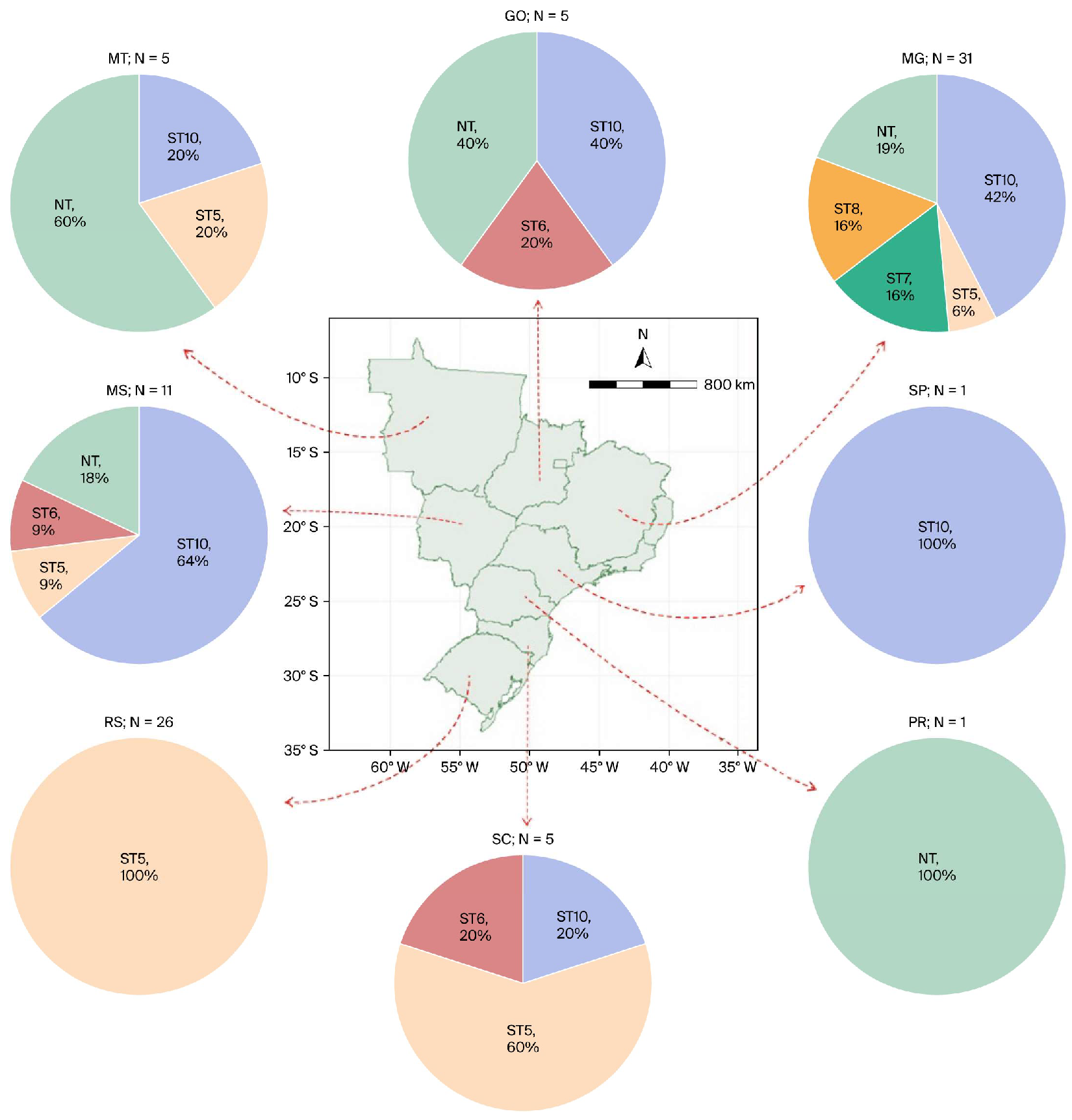
The serotype distribution across Brazilian states is shown in Figure 1. Minas Gerais (n = 31) included strains of serotypes 5, 7, 8, and 10, as well as non-typable strains. Rio Grande do Sul (n = 26) included only serotype 5 strains. Mato Grosso do Sul (n = 11) included serotypes 5, 6, and 10, as well as non-typable strains. Mato Grosso (n = 5) included serotypes 5 and 10 and non-typable strains. Goiás (n = 5) included serotypes 6 and 10 and non-typable strains. Santa Catarina (n = 5) included serotypes 5, 6, and 10.

3.2. Antimicrobial Resistance Profiling

All strains were susceptible to ceftiofur, gentamicin, tulathromycin, spectinomycin, and tilmicosin. Low resistance rates were observed for florfenicol (1/85, 1.2%), neomycin (1/85, 1.2%), trimethoprim/sulfamethoxazole (2/85, 2.3%), tiamulin (5/85, 5.9%), ampicillin (6/85, 7.1%), enrofloxacin (8/85, 9.4%), danofloxacin (12/85, 14.1%), and penicillin (22/85, 25.9%). In contrast, high resistance rates were detected for clindamycin (77/85, 90.6%), chlortetracycline (57/85, 67.1%), oxytetracycline (57/85, 67.1%), sulfadimethoxine (44/85, 51.8%), and tylosin (84/85, 98.8%) (Table 2). Overall, 55.2% (47/85) of the strains were classified as multidrug-resistant. Most MDR strains (44/85, 51.8%) were resistant to three or four antimicrobial classes, whereas only three strains were resistant to five or more classes.

3.3. Molecular Genotyping

3.3.1. Single-Enzyme Amplified Fragment Length Polymorphism (SE-AFLP)

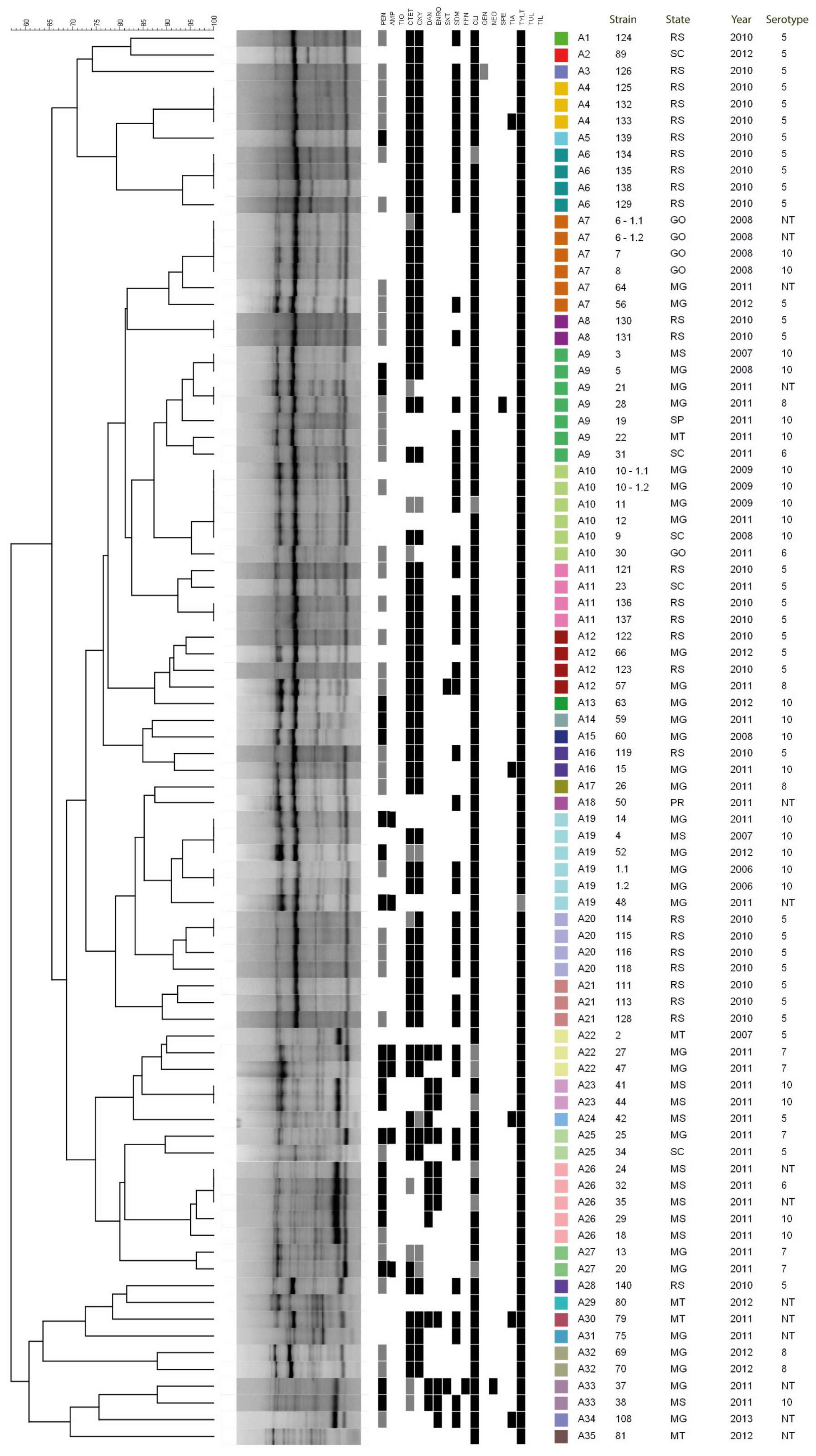
SE-AFLP genotyping identified 35 profiles (A1–A35). Cluster analysis generated the dendrogram shown in Figure 2. Two main groups were distinguished at <65% genetic similarity: a smaller group comprising 10 strains assigned to eight profiles (A28–A35), representing more divergent genotypes, and a larger group comprising the remaining 75 strains, which formed internal clusters from 70% similarity onward. Overall, a modest tendency for strains to cluster by geographic origin and serotype was observed (e.g., profiles A4, A6, A20, A21, and A23). However, several profiles also included strains from different origins and serotypes (e.g., A7, A9, and A26). The discriminatory index (D) for SE-AFLP was 0.97.

3.3.2. Pulsed-Field Gel Electrophoresis (PFGE)

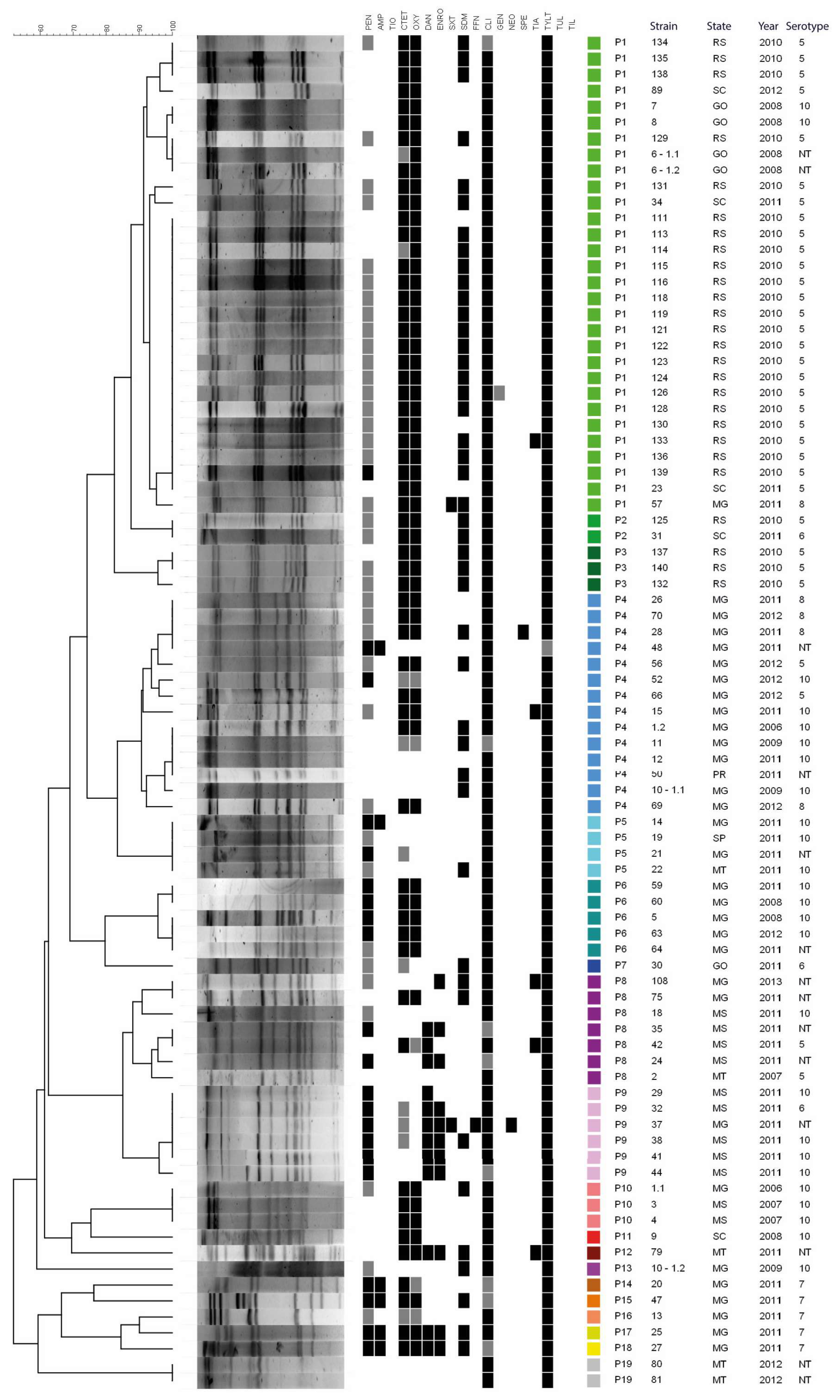
PFGE identified 19 pulsotypes (P1–P19) showing >55% genetic similarity. The dendrogram (Figure 3) revealed two main groups: a smaller group comprising seven strains assigned to six pulsotypes (P14–P19), representing more divergent genotypes and consisting mostly of serotype 7 strains; and a larger group comprising the remaining 78 strains, distributed among 13 pulsotypes. Within the latter, pulsotype P1 was predominant, including 30 strains collected in different years from four states and mainly classified as serotype 5. Although some pulsotypes (e.g., P5 and P10) grouped strains of the same serotype from different geographic origins, no clear association was observed between PFGE profiles and origin, serotype, or antimicrobial resistance patterns. The discriminatory index (D) for PFGE was 0.84.

4. Discussion

This study evaluated the distribution of A. pleuropneumoniae across Brazilian states based on serotype, antimicrobial resistance patterns, and SE-AFLP and PFGE profiles. Serotype 5 was the most prevalent, followed by serotype 10, and a high level of genetic heterogeneity was observed among the strains as assessed by both AFLP and PFGE. Our findings reinforce concerns regarding the emergence of multidrug-resistant (MDR) strains, as 55% of the isolates showed resistance to more than three antimicrobial classes.
In Brazil, only serotypes 1 to 15 have been reported, with no descriptions of serovars 16 to 19 [28,29,30,31,32]. The most prevalent serotypes were previously reported as 5, 3, 6, and 10 [29] and, more recently, as 8, 7, and 5 [32]. These differences may reflect variation by region, year of isolation, and sample type (e.g., necropsy samples, nasal swabs, or slaughterhouse collections). In the present study, serotypes 5 and 10 accounted for more than 65% of the isolates.
Kuchiishi et al. [32] analyzed lung samples obtained from slaughterhouses (57%) and necropsies (43%), with most samples collected in Rio Grande do Sul (RS; 30%), Santa Catarina (SC; 28%), and Minas Gerais (MG; 12%). In our study, only lung samples from necropsies were included, and MG contributed the largest proportion of isolates, followed by RS and Mato Grosso do Sul (MS) (36.5%, 30.6%, and 12.9%, respectively). Serotype 10 was highly prevalent in MG and MS. In contrast, serotype 10 was not detected in RS, consistent with the findings of Kuchiishi et al. [32].
Despite differences among Brazilian studies, the emergence of serotypes 7 and 8 in Brazil is evident. In the present study, these serotypes were detected only in samples from Minas Gerais (MG), whereas another survey reported their occurrence in multiple states [32]. Serotype 5 was the most prevalent in both studies, suggesting a strong potential for persistence and dissemination over time and across different regions.
The global epidemiology of A. pleuropneumoniae shows marked regional differences in serotype distribution and antimicrobial resistance. In Asia, serotype 2 predominates in Japan (71.2%) [33]. In Taiwan, 71.4% of isolates are multidrug resistant, particularly to tetracyclines and aminoglycosides [34]. Similarly, in North Korea, approximately 70% of isolates belong to serotypes 5 and 1 [35]. In Europe, serotype distribution is also heterogeneous. Serotype 2 predominates in Poland (65.5%) [36], whereas in Hungary approximately 55% of isolates belong to serotypes 2 and 13 [30,37]. In contrast, in England and Wales, serotype 8 accounts for more than 70% of isolates across different time periods, while serotype 5 is not considered epidemiologically relevant [38]. Additionally, studies from Italy and Spain have reported the co-circulation of multiple serotypes, including 9/11, 2, 4, and 5 [14,39]. Increasing antimicrobial resistance has also been documented, including high resistance to tetracycline (up to 53%) and the emergence of multidrug-resistant strains, including isolates resistant to ≥7 antimicrobial classes [14,36]. In Africa, long-term data from South Africa indicate a predominance of serotype 7 (22.7%), followed by serotype 5, with temporal fluctuations observed over several decades [40]. In the Americas, heterogeneous patterns have also been reported. In Canada, serotypes 5 and 7 predominated from 2011 to 2014 and remained the most frequently isolated during 2015–2020, with an increasing predominance of serotype 7 [41]. In Argentina, serotype 1 accounts for 66.7% of isolates [42]. Taken together, these findings highlight the marked geographic variability in the epidemiology of A. pleuropneumoniae and underscore the importance of regional baseline studies across different continents.
The genotypic characterization of the studied strains by SE-AFLP revealed a high diversity of profiles (n = 36), which in some cases clustered strains according to serotype or geographic origin, with a discriminatory index of 0.97. To our knowledge, this is the first report describing the application of SE-AFLP to A. pleuropneumoniae strains. Kokotovic and Angen [10] described the use of AFLP in A. pleuropneumoniae using the restriction enzymes EcoRI and BspDI. The use of two restriction enzymes considerably increases the number of bands generated and generally requires automated systems for band detection and analysis. In that study, the authors reported a discriminatory index of 0.96; however, unlike the present study, all tested strains clustered according to serotype.
Analysis of the strains by PFGE separated the isolates into 19 profiles, showing a stronger association between the resulting clusters and both serotype and geographic origin; however, the discriminatory index was lower (0.84). Chevallier et al. [43] evaluated 44 strains of serotypes 1 and 5 and observed perfect clustering by serotype using ApaI, the enzyme also used in the present study. Yoo et al. [13] analyzed 102 A. pleuropneumoniae strains of different serotypes and years of isolation and reported high variability among PFGE profiles, with no significant correlation with serotype or year of isolation. Consistent with these findings, our SE-AFLP and PFGE analyses indicated high genetic variability, even among isolates from the same state and serotype. Moreover, polymorphism analysis of the apxIA gene (sequencing) in A. pleuropneumoniae serovar 5 identified 14 different haplotypes among 60 strains, revealing high genetic variance that may contribute to immune evasion [44].
All tested A. pleuropneumoniae strains were susceptible to ceftiofur, gentamicin, tilmicosin, and tulathromycin. Low resistance rates (<10%) were observed for spectinomycin, neomycin, florfenicol, ampicillin, and tiamulin. However, a study in Romania reported higher resistance to gentamicin [45]. In the present study, we observed emerging resistance to enrofloxacin and danofloxacin. Approximately one quarter of the strains were resistant to penicillin, and more than half were resistant to chlortetracycline, oxytetracycline, clindamycin, and tylosin. Similarly, other studies have reported high resistance to sulfonamides, tetracyclines, penicillin, and third-generation quinolones [12,14,15,16].
In Brazil, antimicrobial susceptibility data for A. pleuropneumoniae are still limited and are predominantly based on disk diffusion assays rather than MIC determination. Previous studies have reported that all evaluated strains carried genes associated with tetracycline resistance [17], and phenotypic testing by disk diffusion showed higher resistance rates to tetracycline and erythromycin, with approximately 12% of strains resistant to enrofloxacin [18]. However, these studies included a relatively small number of isolates (21 and 17, respectively) and relied on different methodological approaches, including PCR detection of resistance genes and phenotypic assays. This scenario highlights the scarcity of MIC-based data and limits direct comparisons, reinforcing the need for standardized susceptibility studies.
In line with this, although standardized therapeutic guidelines for A. pleuropneumoniae are limited in Brazil, available evidence indicates that ceftiofur and florfenicol—considered among the most effective therapeutic options under field conditions—together with macrolides such as tildipirosin, tilmicosin, and tulathromycin, exhibit high in vitro activity against A. pleuropneumoniae isolates, supporting their use in clinical settings [18]. Our results reinforce this scenario, showing complete susceptibility to ceftiofur (0% resistance) and high activity of florfenicol (1.2% resistance), as well as the absence of resistance to tilmicosin and tulathromycin. In contrast, high resistance rates were observed for tetracyclines (67.1%), tylosin (98.8%), and clindamycin (90.6%), indicating their limited usefulness for empirical therapy. From a practical perspective, ceftiofur and florfenicol emerge as the most reliable first-line options, whereas macrolides may be used strategically, further reinforcing the importance of AST-guided therapy [18,23].
This study provides a detailed characterization of the minimum inhibitory concentration (MIC) profile of A. pleuropneumoniae strains isolated in Brazil. A high proportion of multidrug-resistant (MDR) strains was identified (55%), representing one of the highest rates reported to date. In contrast, previous studies have described MDR prevalences of approximately 33% [13,14]. The elevated MDR rate observed in the present study may be associated with the extensive use of antimicrobials in Brazilian swine production systems. According to Dutra et al. [46], the median lifetime exposure of Brazilian pigs to antimicrobials was 73.7%, with a median of seven different drugs used.
Concerns regarding antimicrobial resistance should be emphasized, as it reduces the number of effective therapeutic options available for both humans and animals. The emergence of quinolone-resistant strains is particularly concerning because this class is categorized by the World Health Organization as “highest priority critically important antimicrobials” (WHO, 2019) [47]. Knowledge of prevalent serotypes, resistance patterns, and genotypic profiles is essential to define the epidemiology of A. pleuropneumoniae and may support more targeted prevention and treatment protocols, thereby reducing the use of ineffective drugs in Brazil.

5. Conclusions

This genotypic and phenotypic assessment of A. pleuropneumoniae strains from different Brazilian states revealed substantial pathogen diversity and indicated that PFGE correlated more closely with epidemiological data. Despite the widespread use of antimicrobials in Brazilian pig production for the prevention and control of bacterial diseases, most A. pleuropneumoniae isolates remained susceptible to beta-lactams, tilmicosin, tulathromycin, florfenicol, spectinomycin, enrofloxacin, danofloxacin, and neomycin. Nevertheless, a high proportion of multidrug-resistant strains was observed. Further studies are needed to monitor the dynamics of A. pleuropneumoniae infection, the emergence of new dominant serotypes, and trends in antimicrobial resistance.

Author Contributions

Conceptualization, A.M.M.; Data curation, B.L.P.C. and L.Z.M.; Formal analysis, L.Z.M. and A.M.M.; Funding acquisition, A.M.M.; Investigation, B.L.P.C., C.E.C.M., A.P.P., M.S.M. and M.C.D.; Project administration, L.Z.M. and A.M.M.; Resources, A.M.M.; Supervision, L.Z.M. and A.M.M.; Writing—original draft, B.L.P.C., C.E.C.M., A.P.P. and M.S.M.; Writing—review and editing: L.Z.M. and A.M.M. All authors have read and agreed to the published version of the manuscript.

Funding

This study was funded in part by the Coordination of Improvement of Higher Education Personnel—Brazil (CAPES)—Finance Code 001—and the National Council for Scientific and Technological Development (CNPq)—Process 312684/2022-3.

Institutional Review Board Statement

The study was conducted in accordance with the Declaration of Helsinki and approved by the Animal Ethics Committee (CEUA) of the School of Veterinary Medicine and Animal Science, University of São Paulo (protocol number 3102/2013, the approval date is 14 August 2013).

Informed Consent Statement

Not applicable.

Data Availability Statement

The original contributions presented in this study are included in the article. Further inquiries can be directed to the corresponding author.

Acknowledgments

During the preparation of this manuscript, the authors used Trinka AI (web-based version; accessed in January 2026) and GPT-5.4 Thinking (web-based version; accessed in January 2026) for assist with reference formatting and English-language editing. The authors have reviewed and edited the output and take full responsibility for the content of this publication.

Conflicts of Interest

Author Maurício C. Dutra was employed by the company Consultoria GFD. The remaining authors declare that the research was conducted in the absence of any commercial or financial relationships that could be construed as a potential conflict of interest.

References

  1. Nahar, N.; Turni, C.; Tram, G.; Blackall, P.J.; Atack, J.M. Actinobacillus pleuropneumoniae: The molecular determinants of virulence and pathogenesis. Adv. Microb. Physiol. 2021, 78, 179–216. [Google Scholar] [CrossRef]
  2. Gottschalk, M.; Broes, A. Actinobacillosis. In Diseases of Swine, 11th ed.; Zimmerman, J.J., Karriker, L.A., Ramirez, A., Schwartz, K.J., Stevenson, G.W., Zhang, J., Eds.; Wiley: Hoboken, NJ, USA, 2019; pp. 749–766. [Google Scholar] [CrossRef]
  3. Cruijsen, T.; Van Leengoed, L.A.; Ham-Hoffies, M.; Verheijden, J.H. Convalescent pigs are protected completely against infection with a homologous Actinobacillus pleuropneumoniae strain but incompletely against a heterologous-serotype strain. Infect. Immun. 1995, 63, 2341–2343. [Google Scholar] [CrossRef]
  4. Sassu, E.L.; Bossé, J.T.; Tobias, T.J.; Gottschalk, M.; Langford, P.R.; Hennig-Pauka, I. Update on Actinobacillus pleuropneumoniae—Knowledge, gaps and challenges. Transbound. Emerg. Dis. 2018, 65, 72–90. [Google Scholar] [CrossRef]
  5. Monteiro, M.S.; Matias, D.N.; Poor, A.P.; Dutra, M.C.; Moreno, L.Z.; Parra, B.M.; Silva, A.P.S.; Matajira, C.E.C.; Gomes, V.T.M.; Barbosa, M.R.F.; et al. Causes of Sow Mortality and Risks to Post-Mortem Findings in a Brazilian Intensive Swine Production System. Animals 2022, 12, 1804. [Google Scholar] [CrossRef]
  6. Hoflack, G.; Maes, D.; Mateusen, B.; Verdonck, M.; De Kruif, A. Efficacy of Tilmicosin Phosphate (Pulmotil® Premix) in Feed for the Treatment of a Clinical Outbreak of Actinobacillus pleuropneumoniae Infection in Growing-Finishing Pigs. J. Vet. Med. B 2001, 48, 655–664. [Google Scholar] [CrossRef]
  7. Holmgren, N.; Lundeheim, N.; Wallgren, P. Infections with Mycoplasma hyopneumoniae and Actinobacillus pleuropneumoniae in fattening pigs. Influence of piglet production systems and influence on production parameters. J. Vet. Med. B 1999, 46, 535–544. [Google Scholar] [CrossRef] [PubMed]
  8. Rocha, N.; Mores, M.A.Z.; Dezen, D.; Mores, N.; Coldebella, A.; Rebelatto, R.; Kich, J.D. Economic impact of chronic pleural lesions and consequent disqualification of carcasses for export during inspection in swine slaughterhouses. Pesqui. Vet. Bras. 2022, 42, e07118. [Google Scholar] [CrossRef]
  9. Gottschalk, M. The challenge of detecting herds sub-clinically infected with Actinobacillus pleuropneumoniae. Vet. J. 2015, 206, 30–38. [Google Scholar] [CrossRef]
  10. Kokotovic, B.; Angen, Ø. Genetic Diversity of Actinobacillus pleuropneumoniae Assessed by Amplified Fragment Length Polymorphism Analysis. J. Clin. Microbiol. 2007, 45, 3921–3929. [Google Scholar] [CrossRef] [PubMed]
  11. Kokotovic, B.; Friis, N.F.; Jensen, J.S.; Ahrens, P. Amplified-Fragment Length Polymorphism Fingerprinting of Mycoplasma Species. J. Clin. Microbiol. 1999, 37, 3300–3307. [Google Scholar] [CrossRef]
  12. Vanni, M.; Merenda, M.; Barigazzi, G.; Garbarino, C.; Luppi, A.; Tognetti, R.; Intorre, L. Antimicrobial resistance of Actinobacillus pleuropneumoniae isolated from swine. Vet. Microbiol. 2012, 156, 172–177. [Google Scholar] [CrossRef] [PubMed]
  13. Yoo, A.N.; Cha, S.B.; Shin, M.K.; Won, H.K.; Kim, E.H.; Choi, H.W.; Yoo, H.S. Serotypes and antimicrobial resistance patterns of the recent Korean Actinobacillus pleuropneumoniae isolates. Vet. Rec. 2014, 174, 223. [Google Scholar] [CrossRef]
  14. Guarneri, F.; Romeo, C.; Scali, F.; Zoppi, S.; Formenti, N.; Maisano, A.M.; Catania, S.; Gottschalk, M.; Alborali, G.L. Serotype diversity and antimicrobial susceptibility profiles of Actinobacillus pleuropneumoniae isolated in Italian pig farms from 2015 to 2022. Vet. Res. 2024, 55, 48. [Google Scholar] [CrossRef]
  15. Kucerova, Z.; Hradecka, H.; Nechvatalova, K.; Nedbalcova, K. Antimicrobial susceptibility of Actinobacillus pleuropneumoniae isolates from clinical outbreaks of porcine respiratory diseases. Vet. Microbiol. 2011, 150, 203–206. [Google Scholar] [CrossRef]
  16. Somogyi, Z.; Mag, P.; Simon, R.; Kerek, Á.; Makrai, L.; Biksi, I.; Jerzsele, Á. Susceptibility of Actinobacillus pleuropneumoniae, Pasteurella multocida and Streptococcus suis isolated from pigs in Hungary between 2018 and 2021. Antibiotics 2023, 12, 1298. [Google Scholar] [CrossRef]
  17. Pereira, M.F.; Rossi, C.C.; Seide, L.E.; Martins Filho, S.; Dolinski, C.D.M.; Bazzolli, D.M.S. Antimicrobial resistance, biofilm formation and virulence reveal Actinobacillus pleuropneumoniae strains’ pathogenicity complexity. Res. Vet. Sci. 2018, 118, 498–501. [Google Scholar] [CrossRef]
  18. Serpa, M.; Nascimento, J.A.F.B.D.; Alves, M.F.; Guedes, M.I.M.C.; Reis, A.T.; Heinemann, M.B.; Lage, A.P.; Lobato, Z.I.P.; Dorneles, E.M.S. Antimicrobial resistance in bacteria isolated from pigs with respiratory clinical signs in Brazil. Braz. J. Vet. Res. Anim. Sci. 2020, 57, e160956. [Google Scholar] [CrossRef]
  19. Boom, R.; Sol, C.J.; Salimans, M.M.; Jansen, C.L.; Wertheim-van Dillen, P.M.; Van Der Noordaa, J. Rapid and simple method for purification of nucleic acids. J. Clin. Microbiol. 1990, 28, 495–503. [Google Scholar] [CrossRef]
  20. Gram, T.; Ahrens, P. Improved diagnostic PCR assay for Actinobacillus pleuropneumoniae based on the nucleotide sequence of an outer membrane lipoprotein. J. Clin. Microbiol. 1998, 36, 443–448. [Google Scholar] [CrossRef] [PubMed]
  21. Bossé, J.T.; Li, Y.; Angen, Ø.; Weinert, L.A.; Chaudhuri, R.R.; Holden, M.T.; Williamson, S.M.; Maskell, D.J.; Tucker, A.W.; Wren, B.W.; et al. Multiplex PCR assay for unequivocal differentiation of Actinobacillus pleuropneumoniae serovars 1 to 3, 5 to 8, 10, and 12. J. Clin. Microbiol. 2014, 52, 2380–2385. [Google Scholar] [CrossRef] [PubMed][Green Version]
  22. Turni, C.; Singh, R.; Schembri, M.A.; Blackall, P.J. Evaluation of a multiplex PCR to identify and serotype Actinobacillus pleuropneumoniae serovars 1, 5, 7, 12 and 15. Lett. Appl. Microbiol. 2014, 59, 362–369. [Google Scholar] [CrossRef]
  23. Clinical and Laboratory Standards Institute (CLSI). Performance Standards for Antimicrobial Disk and Dilution Susceptibility Tests for Bacteria Isolated from Animals, 7th ed.; CLSI Supplement VET01S; CLSI: Wayne, PA, USA, 2024; ISBN 978-1-68440-211-3. [Google Scholar]
  24. McLauchlin, J.; Ripabelli, G.; Brett, M.M.; Threlfall, E.J. Amplified fragment length polymorphism (AFLP) analysis of Clostridium perfringens for epidemiological typing. Int. J. Food Microbiol. 2000, 56, 21–28. [Google Scholar] [CrossRef] [PubMed]
  25. Schwarz, S.; Silley, P.; Simjee, S.; Woodford, N.; Van Duijkeren, E.; Johnson, A.P.; Gaastra, W. Editorial: Assessing the antimicrobial susceptibility of bacteria obtained from animals. J. Antimicrob. Chemother. 2010, 65, 601–604. [Google Scholar] [CrossRef] [PubMed]
  26. Magiorakos, A.-P.; Srinivasan, A.; Carey, R.B.; Carmeli, Y.; Falagas, M.E.; Giske, C.G.; Harbarth, S.; Hindler, J.F.; Kahlmeter, G.; Olsson-Liljequist, B.; et al. Multidrug-resistant, extensively drug-resistant and pandrug-resistant bacteria: An international expert proposal for interim standard definitions for acquired resistance. Clin. Microbiol. Infect. 2012, 18, 268–281. [Google Scholar] [CrossRef]
  27. Van Belkum, A.; Tassios, P.T.; Dijkshoorn, L.; Haeggman, S.; Cookson, B.; Fry, N.K.; Fussing, V.; Green, J.; Feil, E.; Gerner-Smidt, P.; et al. Guidelines for the validation and application of typing methods for use in bacterial epidemiology. Clin. Microbiol. Infect. 2007, 13, 1–46. [Google Scholar] [CrossRef] [PubMed]
  28. Piffer, I.A.; Klein, C.S.; Fávero, M.B.B.; Figueiredo, J. Sorotipos de Actinobacillus pleuropneumoniae prevalentes no Brasil. In Proceedings of the Congresso Brasileiro de Veterinários Especialistas em Suínos, 7, Blumenau, Brazil, 14–17 November 1995; p. 77. [Google Scholar]
  29. Kuchiishi, S.S.; Kich, J.D.; Ramenzoni, M.L.F.; Spricigo, D.; Klein, C.S.; Fávero, M.B.B.; Piffer, I.A. Sorotipos de Actinobacillus pleuropneumoniae isolados no Brasil de 1993 a 2006. Acta Sci. Vet. 2018, 35, 79. [Google Scholar] [CrossRef]
  30. Santos, L.F.; Reis, K.C.P.; Santos, J.L.; Scatamburlo, M.A. Diferenciação de sorotipos de Actinobacillus pleuropneumoniae pela combinação de dois PCR multiplex. Cienc. Rural 2013, 43, 890–893. [Google Scholar] [CrossRef]
  31. Rossi, C.C.; Vicente, A.M.; Guimarães, W.V.; Fernandes de Araújo, E.; Vieira de Queiroz, M.; Bazzolli, D.M.S. Face to Face with Actinobacillus pleuropneumoniae: Landscape of the Distribution of Clinical Isolates in Southeastern Brazil. Afr. J. Microbiol. Res. 2013, 7, 2916–2924. [Google Scholar] [CrossRef]
  32. Kuchiishi, S.S.; Ramos Prigol, S.; Bresolin, E.; Fernandes Lenhard, B.; Pissetti, C.; García-Iglesias, M.-J.; Gutiérrez-Martín, C.-B.; Martínez-Martínez, S.; Kreutz, L.C.; Frandoloso, R. Brazilian Clinical Strains of Actinobacillus pleuropneumoniae and Pasteurella multocida: Capsular Diversity, Antimicrobial Susceptibility (In Vitro) and Proof of Concept for Prevention of Natural Colonization by Multi-Doses Protocol of Tildipirosin. Antibiotics 2023, 12, 1658. [Google Scholar] [CrossRef]
  33. Ozawa, M.; Kawano, M.; Abo, H.; Issiki, Y.; Kumakawa, M.; Kawanishi, M.; Kojima, A.; Iwamoto, S. Characterization of Actinobacillus pleuropneumoniae isolated from pigs in Japan using whole genome sequencing. Comp. Immunol. Microbiol. Infect. Dis. 2023, 102, 102062. [Google Scholar] [CrossRef]
  34. Ke, C.H.; Lai, P.Y.; Hsu, F.Y.; Hsueh, P.R.; Chiou, M.T.; Lin, C.N. Antimicrobial susceptibility and resistome of Actinobacillus pleuropneumoniae in Taiwan: A next-generation sequencing analysis. Vet. Q. 2024, 44, 1–13. [Google Scholar] [CrossRef]
  35. Kim, B.; Hur, J.; Lee, J.Y.; Choi, Y.; Lee, J.H. Molecular serotyping and antimicrobial resistance profiles of Actinobacillus pleuropneumoniae isolated from pigs in South Korea. Vet. Q. 2016, 36, 137–144. [Google Scholar] [CrossRef]
  36. Paulina, P.; Dawid, T. Serotyping and antimicrobial resistance of Actinobacillus pleuropneumoniae isolates from fattening pigs in Poland from 2019 to 2024. BMC Vet. Res. 2025, 21, 40. [Google Scholar] [CrossRef] [PubMed]
  37. Kardos, G.; Sárközi, R.; Laczkó, L.; Marton, S.; Makrai, L.; Bányai, K.; Fodor, L. Genetic Diversity of Actinobacillus pleuropneumoniae Serovars in Hungary. Vet. Sci. 2022, 9, 511. [Google Scholar] [CrossRef]
  38. Li, Y.; Bossé, J.T.; Williamson, S.M.; Maskell, D.J.; Tucker, A.W.; Wren, B.W.; Rycroft, A.N.; Langford, P.R. Actinobacillus pleuropneumoniae serovar 8 predominates in England and Wales. Vet. Rec. 2016, 179, 276. [Google Scholar] [CrossRef] [PubMed]
  39. Arnal Bernal, J.L.; Gottschalk, M.; Lacotoure, S.; Sanz Tejero, C.; Chacón Pérez, G.; Martín-Jurado, D.; Fernández Ros, A.B. Serotype diversity of Actinobacillus pleuropneumoniae detected by real-time PCR in clinical and subclinical samples from Spanish pig farms during 2017–2022. Vet. Res. 2024, 55, 165, Erratum in Vet. Res. 2025, 56, 122. [Google Scholar] [CrossRef]
  40. Seakamela, E.M.; Henton, M.M.; Jonker, A.; Kayoka-Kabongo, P.N.; Matle, I. Temporal and serotypic dynamics of Actinobacillus pleuropneumoniae in South African porcine populations: A retrospective study from 1985 to 2023. Pathogens 2024, 13, 599. [Google Scholar] [CrossRef]
  41. Lacouture, S.; Gottschalk, M. Distribution of Actinobacillus pleuropneumoniae (from 2015 to June 2020) and Glaesserella parasuis (from 2017 to June 2020) serotypes isolated from diseased pigs in Quebec. Can. Vet. J. 2020, 61, 1261–1263. [Google Scholar]
  42. Cane, V.I.; Gottschalk, M.; Vincent, A.T.; Cane, F.D.; Sarradell, J.E.; Cane, J.L.; Pereyra, N.B. Serotype distribution of Actinobacillus pleuropneumoniae isolated from diseased pigs in Argentina (2020–2024). Can. J. Vet. Res. 2025, 89, 149–152. [Google Scholar]
  43. Chevallier, B.; Dugourd, D.; Tarasiuk, K.; Harel, J.; Gottschalk, M.; Kobisch, M.; Frey, J. Chromosome sizes and phylogenetic relationships between serotypes of Actinobacillus pleuropneumoniae. FEMS Microbiol. Lett. 1998, 160, 209–216. [Google Scholar] [CrossRef] [PubMed]
  44. Dos Santos, L.F.; Costa Polveiro, R.; Scatamburlo Moreira, T.; Pereira Vidigal, P.M.; Chang, Y.-F.; Scatamburlo Moreira, M.A. Polymorphism analysis of the apxIA gene of Actinobacillus pleuropneumoniae serovar 5 isolated in swine herds from Brazil. PLoS ONE 2018, 13, e0208789. [Google Scholar] [CrossRef] [PubMed]
  45. Siteavu, M.I.; Drugea, R.I.; Pitoiu, E.; Ciobotaru-Pirvu, E. Antimicrobial Resistance of Actinobacillus pleuropneumoniae, Streptococcus suis, and Pasteurella multocida Isolated from Romanian Swine Farms. Microorganisms 2023, 11, 2410. [Google Scholar] [CrossRef]
  46. Dutra, M.C.; Moreno, L.Z.; Dias, R.A.; Moreno, A.M. Antimicrobial use in Brazilian swine herds: Assessment of use and reduction examples. Microorganisms 2021, 9, 881. [Google Scholar] [CrossRef]
  47. World Health Organization (WHO). Critically Important Antimicrobials for Human Medicine; 6th revision; WHO: Geneva, Switzerland, 2019. [Google Scholar]
Figure 1. Distribution of A. pleuropneumoniae serotypes according to the Brazilian state of origin of the isolates. Pie charts show the relative frequency of serotypes within each state, NT, non-typable.
Microorganisms 14 00828 g001
Figure 2. SE-AFLP dendrogram of A. pleuropneumoniae strains, annotated with epidemiological data and antimicrobial resistance profiles. Colored boxes adjacent to each strain identify the SE-AFLP profiles.
Microorganisms 14 00828 g002
Figure 3. Dendrogram generated from PFGE analysis of A. pleuropneumoniae strains digested with the ApaI restriction enzyme, with corresponding epidemiological information and antimicrobial resistance profiles. Colored boxes adjacent to each strain identify the PFGE profiles.
Microorganisms 14 00828 g003
Table 1. Criteria for analyzing MIC results (breakpoints).
Antimicrobial AgentsMIC (µg/mL)
SensitiveIntermediateResistant
Ampicillin≤0.51≥2
Ceftiofur≤24≥8
Penicillin≤0.250.51
Chlortetracycline≤0.51≥2
Oxytetracycline≤0.51≥2
Florfenicol≤2-≥8
Danofloxacin≤0.25--
Enrofloxacin≤0.25-≥1
Gentamicin≤24≥8
Neomycin≤8--
Spectinomycin≤32-≥128
Clindamycin≤0.51–2≥4
Tylosin≤12–4>4
Tiamulin≤16-≥32
Tilmicosin≤16-≥32
Tulathromycin≤64--
Sulfadimethoxine≤256-≥512
Trimethoprim/Sulfamethoxazole≤2/38-≥4/76
MIC: minimum inhibitory concentration; -: no interpretive breakpoint available.
Table 2. Distribution of minimum inhibitory concentrations (MICs), MIC50, MIC90, and resistance rates among 85 A. pleuropneumoniae strains.
AntimicrobialNumber of Strains with MIC (µg/mL)MIC50
(µg/mL)
MIC90
(µg/mL)
Resistant
%
0.120.250.51248163264
Penicillin32436160105--0.5125.9
Ampicillin-754000105-0.250.57.1
Ceftiofur-8500000---0.250.250.0
Chlortetracycline--1810262110---2867.1
Oxytetracycline--235011244--161667.1
Danofloxacin667228-----0.12114.1
Enrofloxacin6764008----0.120.512.9
Florfenicol-20604001---0.50.51.2
Spectinomycin------0579132320.0
Gentamicin--2325910000220.0
Neomycin-----768100481.2
Clindamycin-000828462108890.6
Tylosin--0001175620326498.8
Tilmicosin-----2258500880.0
Tulathromycin---0795019008160.0
Tiamulin--001011685016165.9
Antimicrobial N° of isolates with MIC of (µg/mL)   
Sulfadimethoxine≤256>256MIC50MIC90Resistant
4144>256>25651.7
Trimethoprim/
sulfamethoxazole
≤2/38>2/38MIC50MIC90Resistant
832≤2/38≤2/382.35
MIC: minimum inhibitory concentration; Res: resistance rate; “-“: dilution not included in the antimicrobial panel or value not applicable.
Disclaimer/Publisher’s Note: The statements, opinions and data contained in all publications are solely those of the individual author(s) and contributor(s) and not of MDPI and/or the editor(s). MDPI and/or the editor(s) disclaim responsibility for any injury to people or property resulting from any ideas, methods, instructions or products referred to in the content.