Symbiotic Bacterial Diversity, Functional Profiling and Antibiotic Susceptibility of the Red Imported Fire Ant

 , ,
, ,  and
and
Abstract
1. Introduction
2. Materials and Methods
2.1. Field Collection of Ant Samples
2.2. Identification and Storage of Ant Samples
2.3. Evaluation of Difference in Symbiotic Bacterial Community Structure and Composition
2.4. Isolation and Identification of Bacterial Symbionts from RIFAs
2.5. Assaying Extracellular Protease and Lipase Activities of Isolated Bacterial Strains
2.6. Antibiotic Susceptibility Assessment of Symbiotic Bacteria
2.7. Statistical Analysis
3. Results
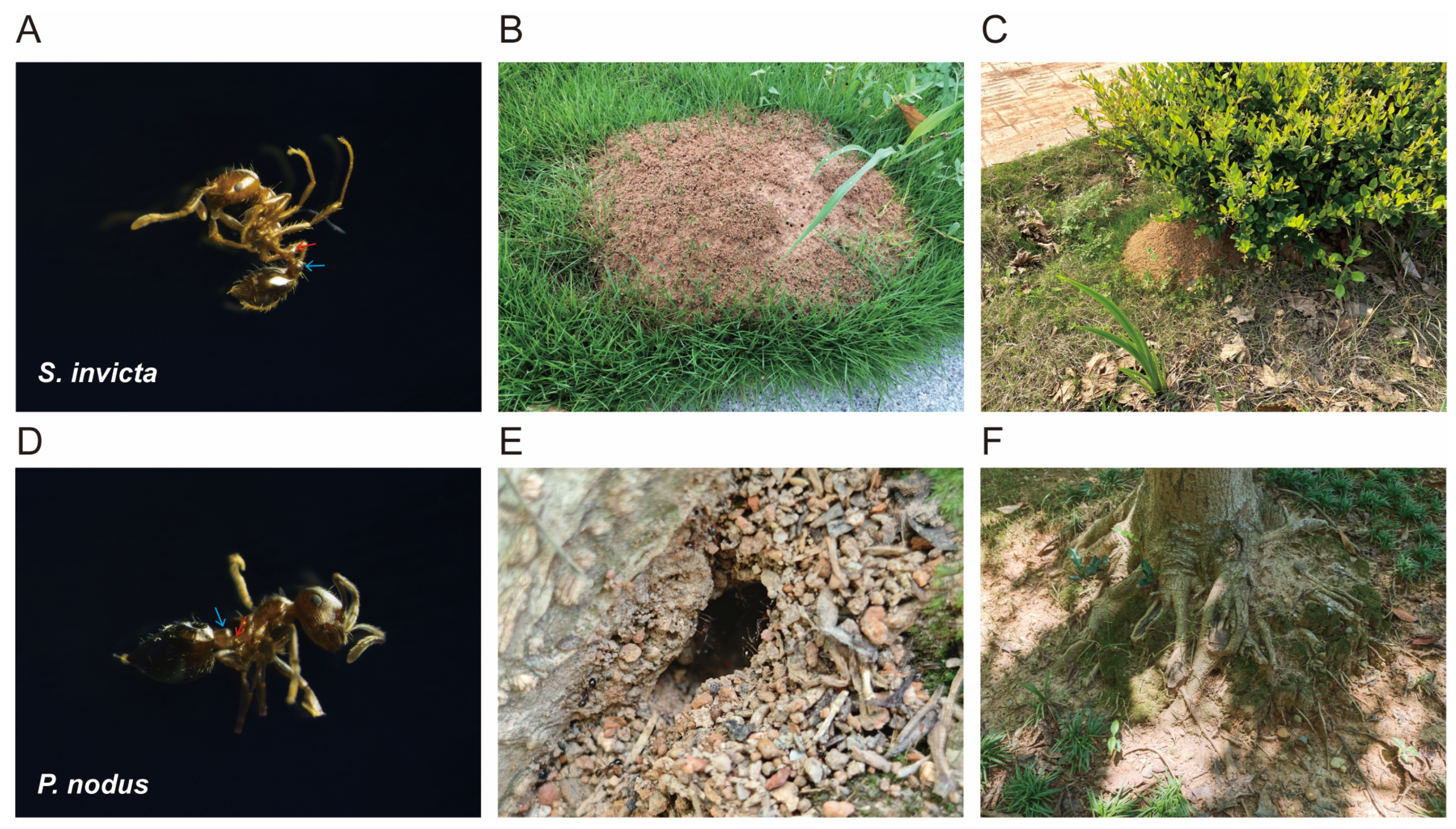
3.1. Morphological and Molecular Identification of Ant Samples
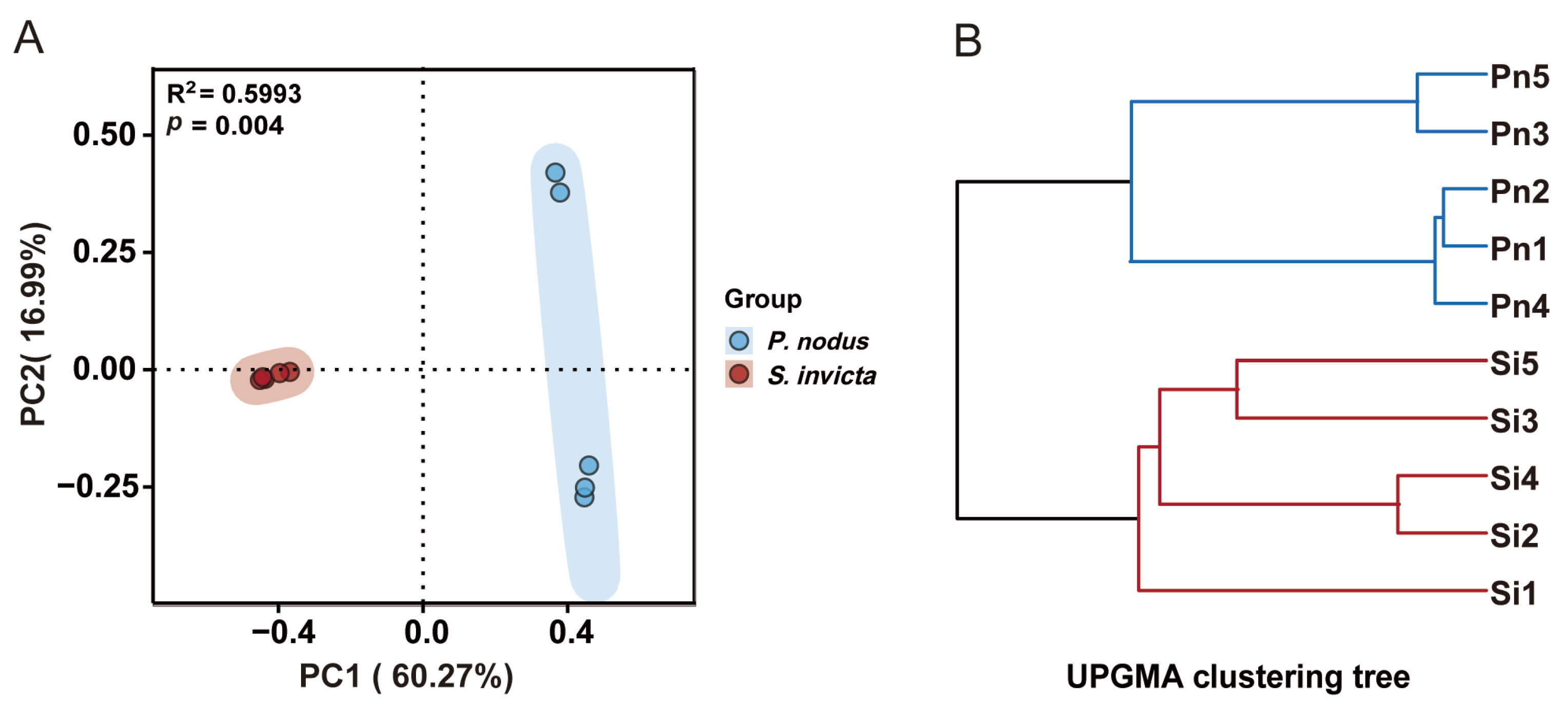
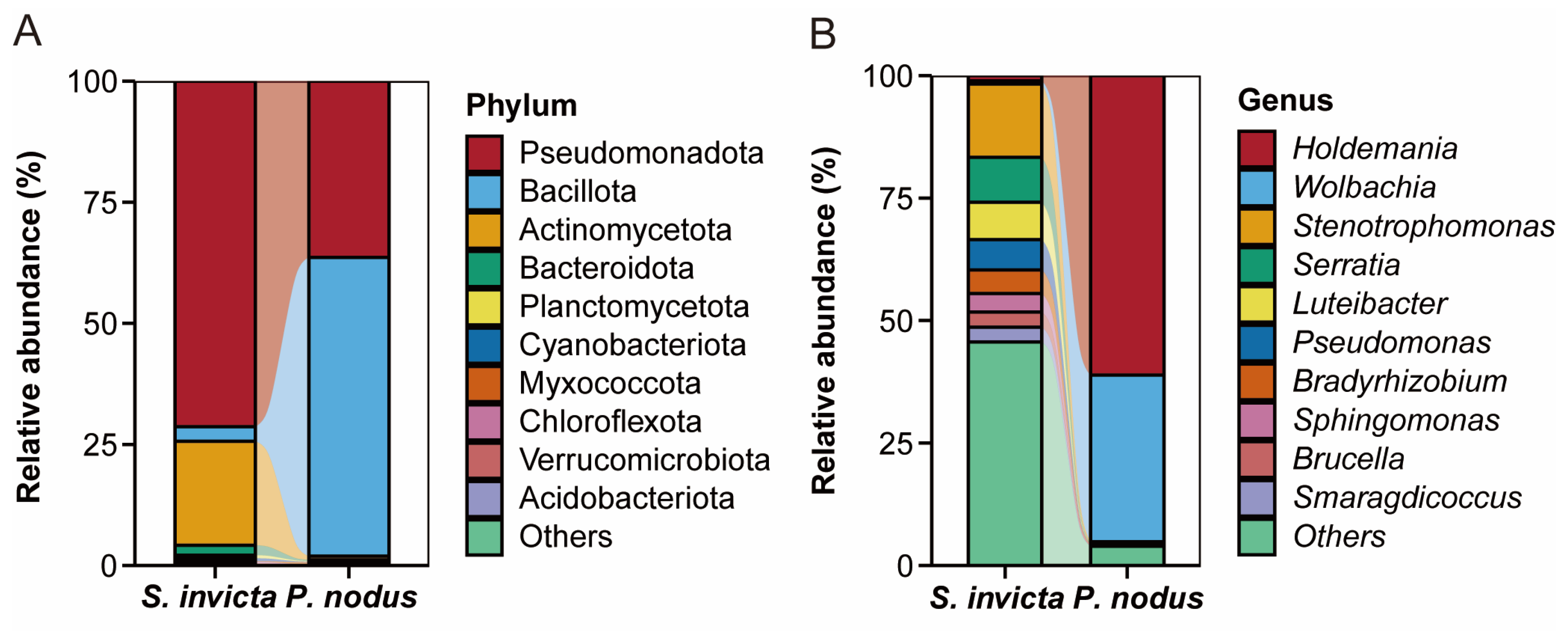
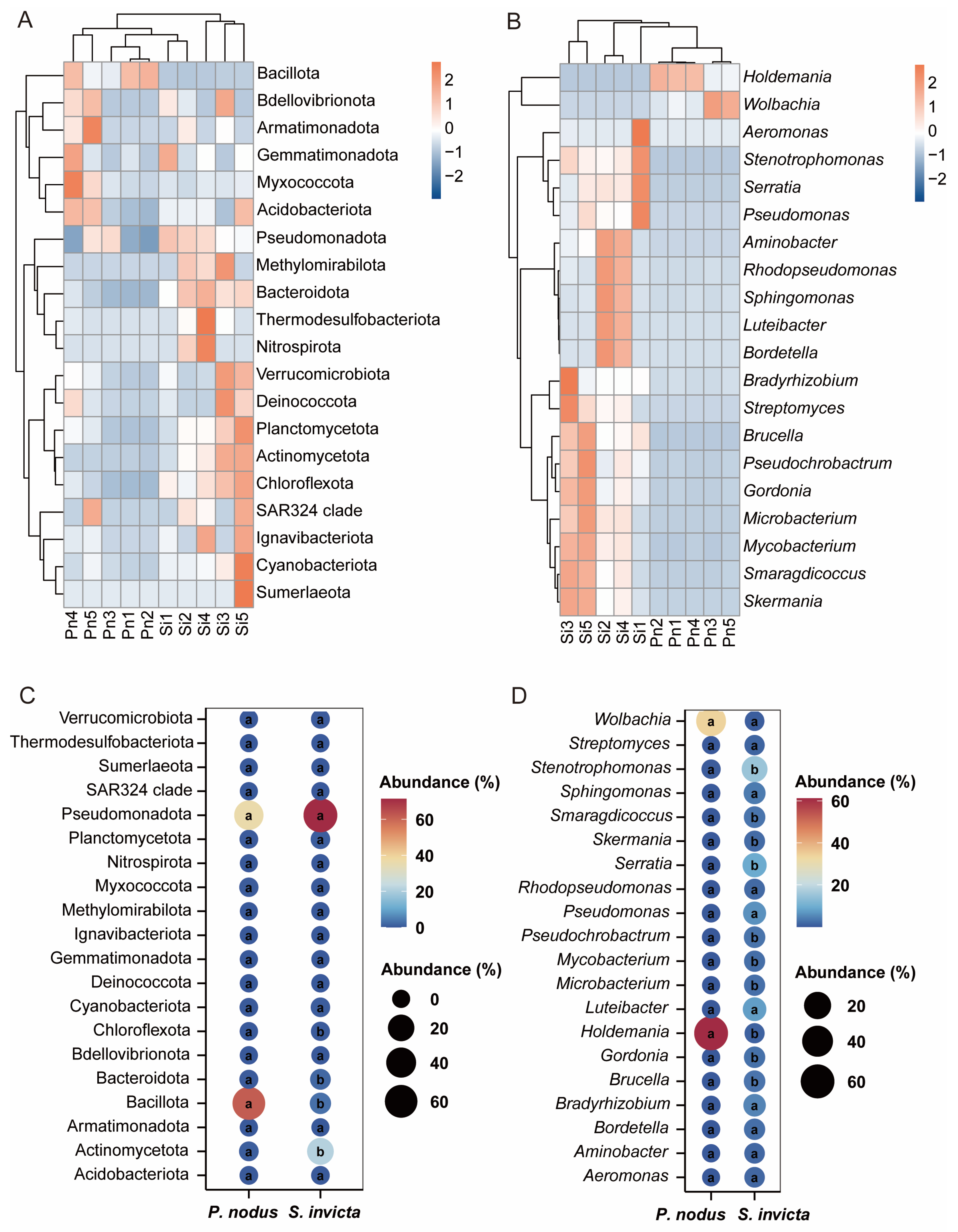
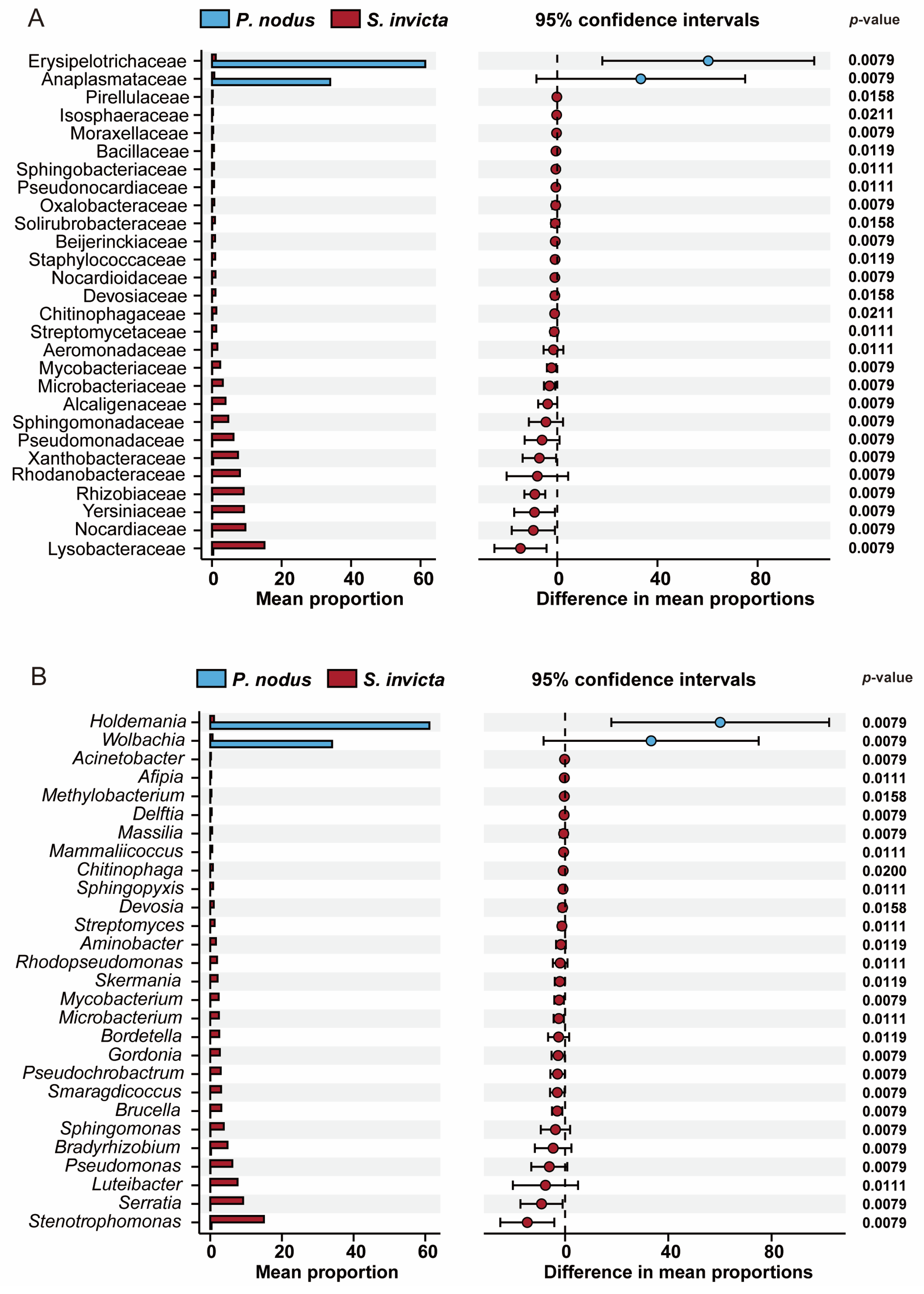
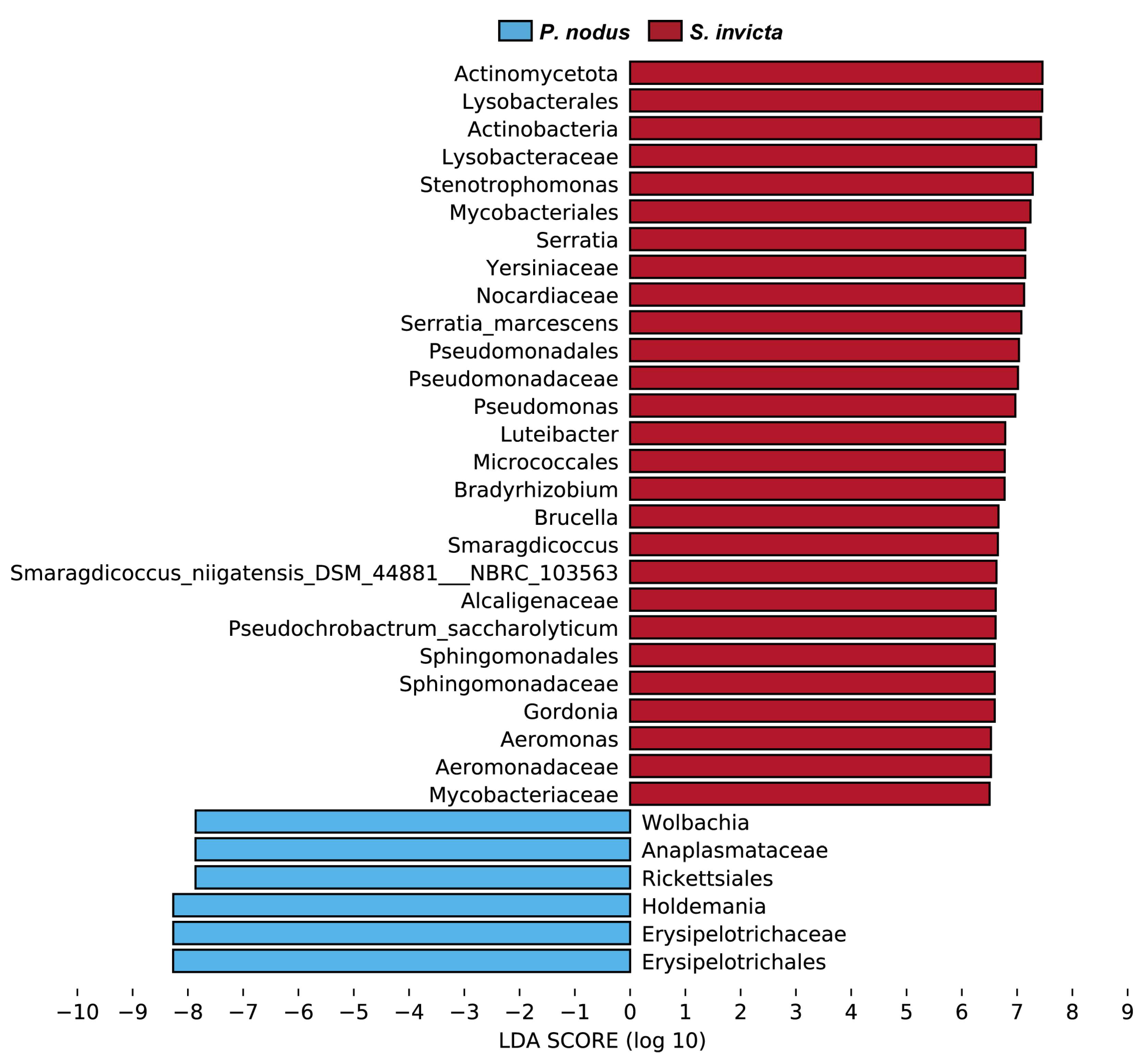
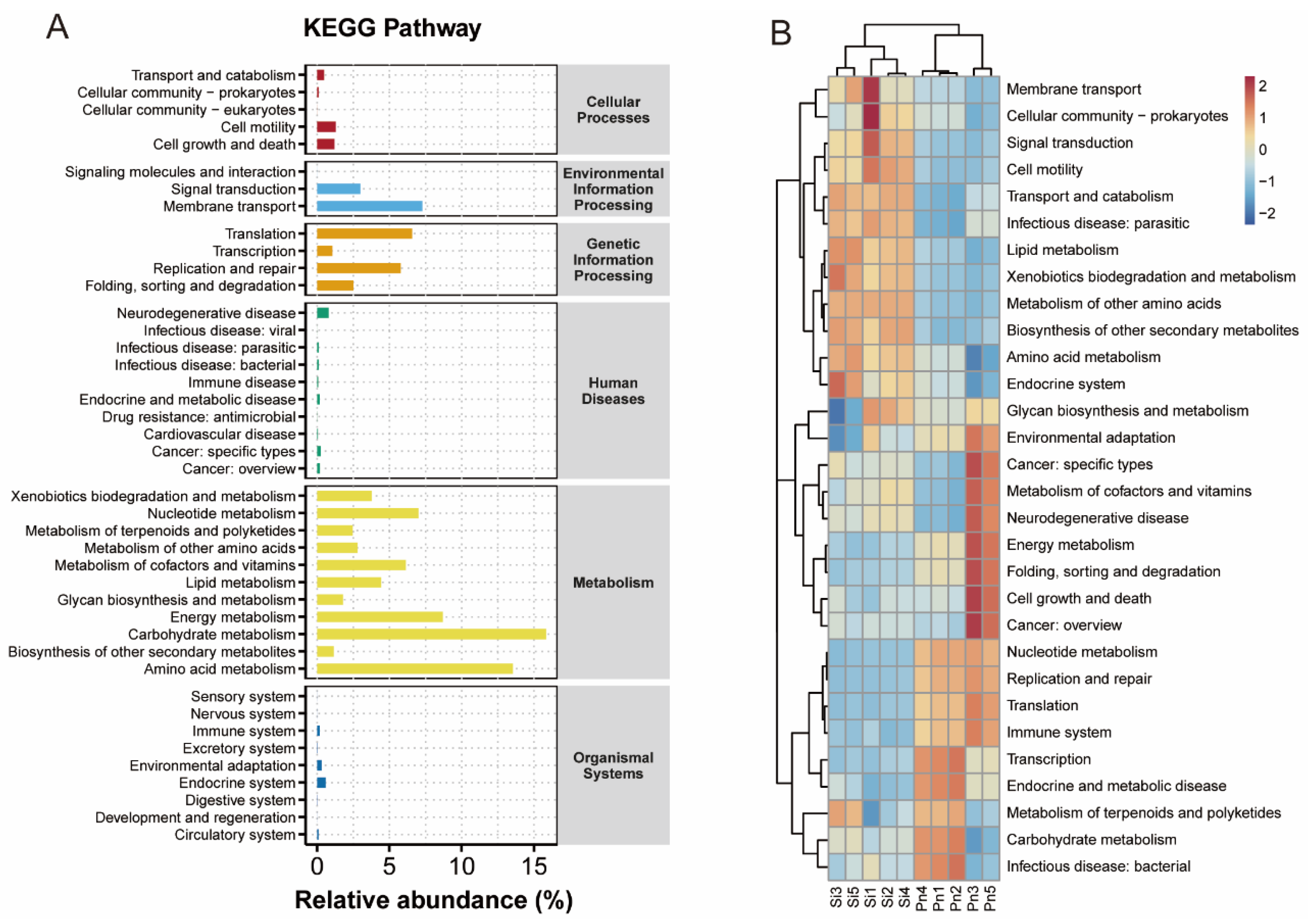
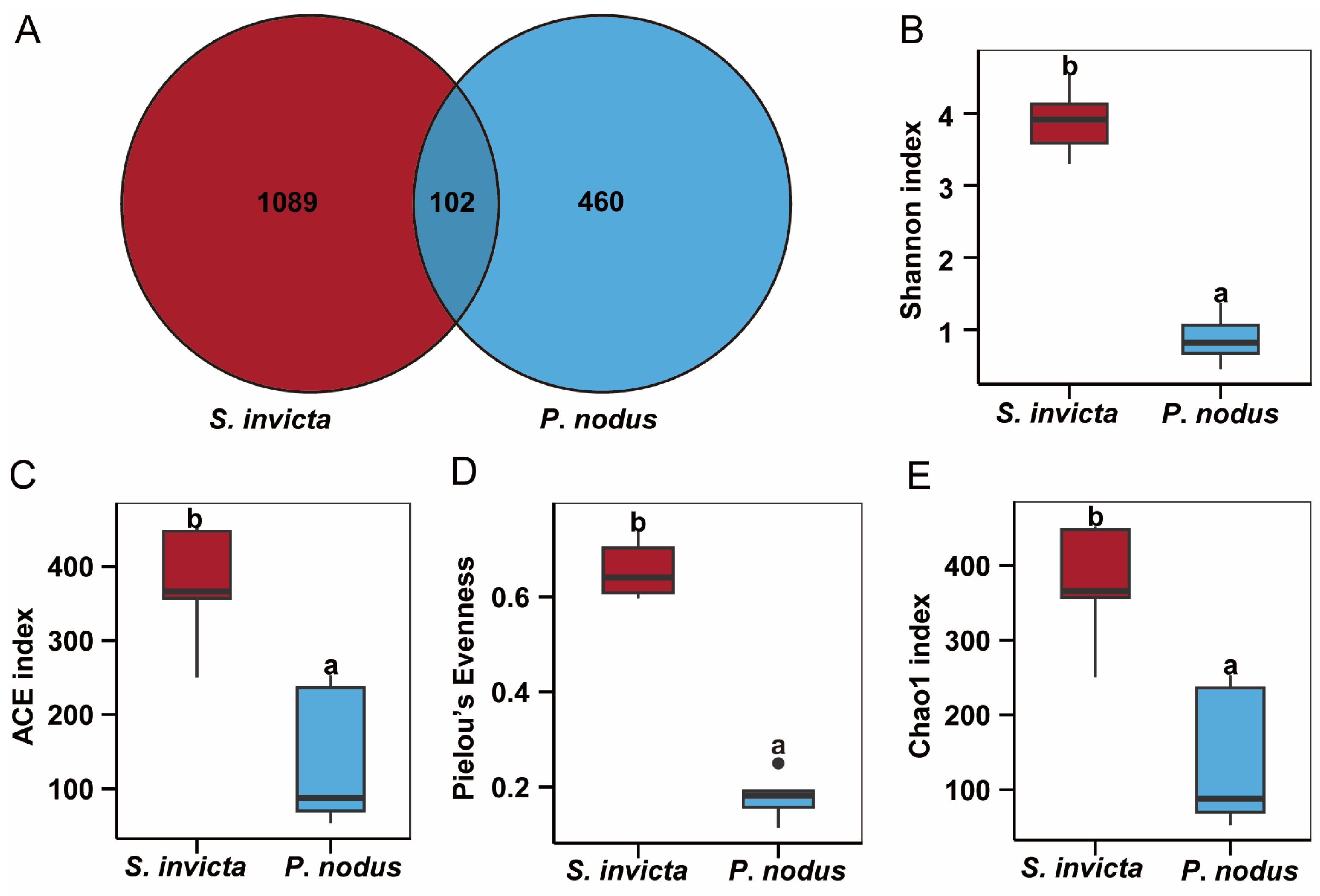
3.2. Differences in Symbiotic Bacterial Community Between S. invicta and Non-Target Ants
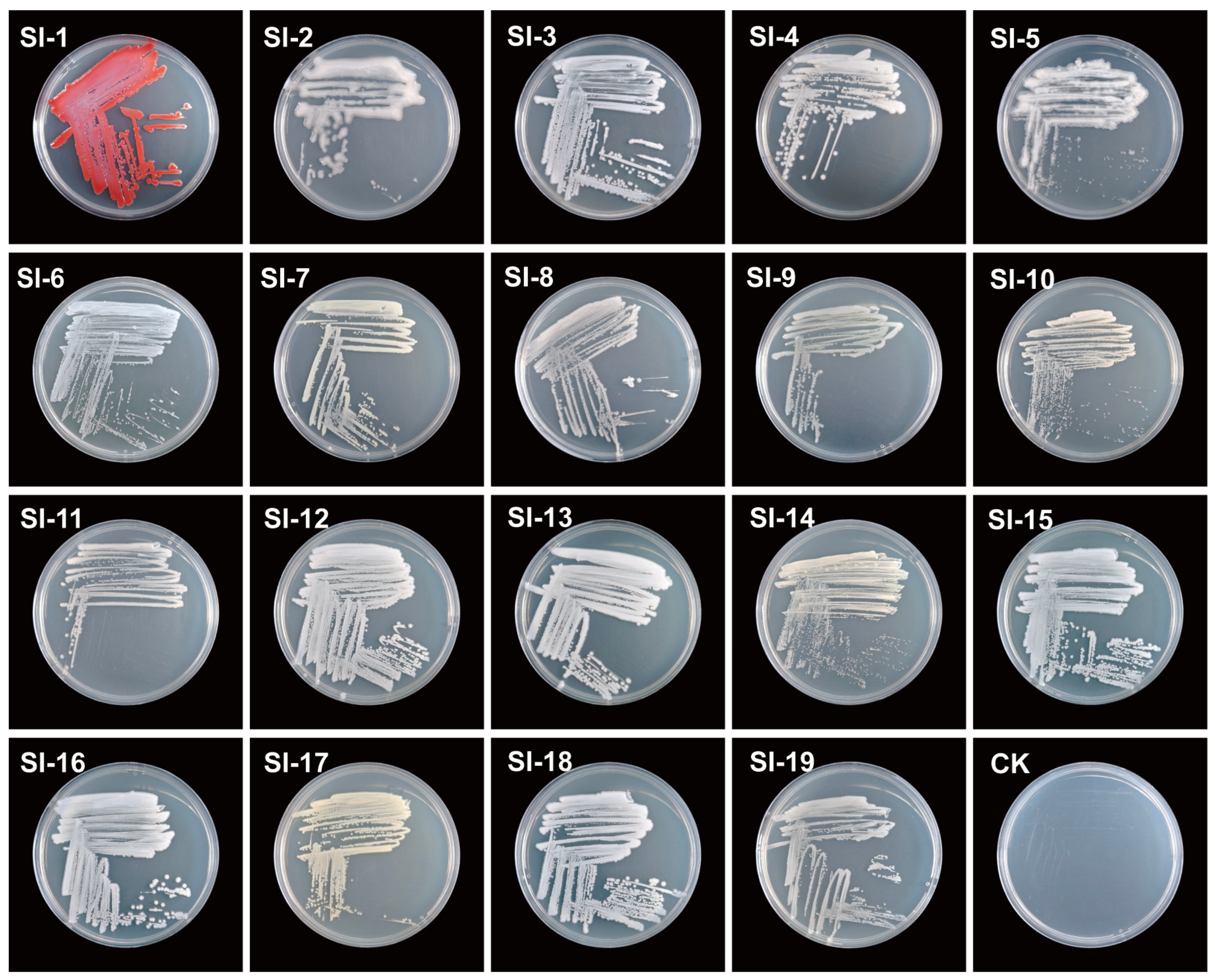
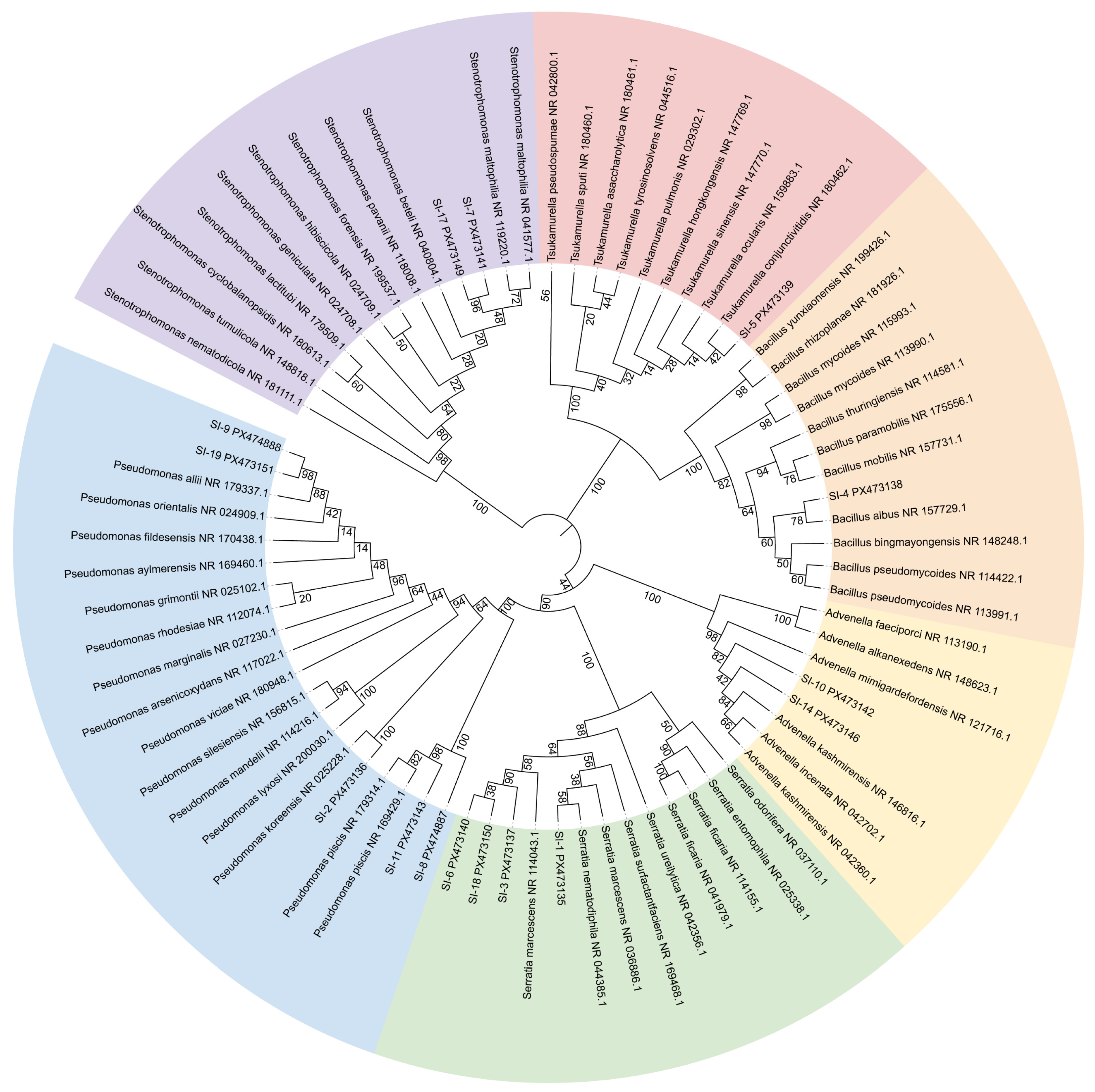
3.3. Identification and Phylogenetics of Bacterial Symbionts in S. invicta
3.4. Detection of Extracellular Protease and Lipase Activities in Symbiotic Bacteria
3.5. Antibiotic Susceptibility Assessment of Symbiotic Bacteria from S. invicta
4. Discussion
4.1. Microbiome as a Key Driver of Ecological Adaptability in the Invasion of RIFAs
4.2. Culturable Symbiotic Bacteria in RIFAs Exhibit Substantial Metabolic Capabilities
4.3. Novel Strategies and Future Perspectives for Sustainable Control of RIFAs
5. Conclusions
Supplementary Materials
Author Contributions
Funding
Institutional Review Board Statement
Informed Consent Statement
Data Availability Statement
Conflicts of Interest
References
- Petralia, R.; Vinson, S.B. Internal Anatomy of the Fourth Instar Larva of the Imported Fire Ant, Solenopsis invicta Buren (Hymenoptera: Formicidae). Int. J. Insect Morphol. Embryol. 1980, 9, 89–106. [Google Scholar] [CrossRef]
- Lofgren, C.S.; Banks, W.A.; Glancey, B.M. Biology and Control of Imported Fire Ants. Annu. Rev. Entomol. 1975, 20, 1–30. [Google Scholar] [CrossRef]
- Banks, W.A.; Lofgren, C.S. Effectiveness of the Insect Growth Regulator Pyriproxyfen against the Red Imported Fire Ant (Hymenoptera: Formicidae). J. Entomol. Sci. 1991, 26, 331–338. [Google Scholar] [CrossRef]
- Li, X.; Yi, S.; Chen, L.; Hafeez, M.; Zhang, Z.; Zhang, J.; Zhou, S.; Dong, W.; Huang, J.; Lu, Y. The Application of Entomopathogenic Nematode Modified Microbial Communities within Nesting Mounds of the Red Imported Fire Ants, Solenopsis invicta. Sci. Total Environ. 2024, 912, 168748. [Google Scholar] [CrossRef] [PubMed]
- Ascunce, M.S.; Yang, C.C.; Oakey, J.; Calcaterra, L.; Wu, W.J.; Shih, C.J.; Goudet, J.; Ross, K.G.; Shoemaker, D. Global Invasion History of the Fire Ant Solenopsis invicta. Science 2011, 331, 1066–1068. [Google Scholar] [CrossRef]
- Wang, L.; Xu, Y.; Zeng, L.; Lu, Y. Impact of the Red Imported Fire Ant Solenopsis invicta Buren on Biodiversity in South China: A Review. J. Integr. Agric. 2019, 18, 788–796. [Google Scholar] [CrossRef]
- Zhang, X.; Hou, Y.M. Invasion History of Solenopsis invicta (Hymenoptera: Formicidae) in Fujian, China Based on Mitochondrial DNA and Its Implications in Development of a Control Strategy. Insect Sci. 2014, 21, 493–498. [Google Scholar] [CrossRef]
- deShazo, R.D.; Kemp, S.F.; deShazo, M.D.; Goddard, J. Fire Ant Attacks on Patients in Nursing Homes: An Increasing Problem. Am. J. Med. 2004, 116, 843–846. [Google Scholar] [CrossRef]
- Rupp, M.R.; deShazo, R.D. Indoor Fire Ant Sting Attacks: A Risk for Frail Elders. Am. J. Med. Sci. 2006, 331, 134–138. [Google Scholar] [CrossRef]
- Rhoades, R.B.; Stafford, C.T.; James, F.K. Survey of Fatal Anaphylactic Reactions to Imported Fire Ant Stings. Report of the Fire Ant Subcommittee of the American Academy of Allergy and Immunology. J. Allergy Clin. Immunol. 1989, 84, 159–162. [Google Scholar] [CrossRef] [PubMed]
- Stafford, C.T. Hypersensitivity to Fire Ant Venom. Ann. Allergy Asthma Immunol. 1996, 77, 87–95; quiz 96–99. [Google Scholar] [CrossRef]
- Caldwell, S.T.; Schuman, S.H.; Simpson, W.M. Fire Ants: A Continuing Community Health Threat in South Carolina. J. S. C. Med. Assoc. (1975) 1999, 95, 231–235. [Google Scholar]
- Kruse, B.; Anderson, J.; Simon, L.V. Fire Ant Bites. In Statpearls; StatPearls Publishing: Treasure Island, FL, USA, 2025. [Google Scholar]
- Solley, G.O.; Vanderwoude, C.; Knight, G.K. Anaphylaxis Due to Red Imported Fire Ant Sting. Med. J. Aust. 2002, 176, 521–523. [Google Scholar] [CrossRef]
- Porter, S.D.; Savignano, D.A. Invasion of Polygyne Fire Ants Decimates Native Ants and Disrupts Arthropod Community. Ecology 1990, 71, 2095–2106. [Google Scholar] [CrossRef]
- Allen, C.R.; Birge, H.E.; Slater, J.; Wiggers, E. The Invasive Ant, Solenopsis invicta, Reduces Herpetofauna Richness and Abundance. Biol. Invasions 2017, 19, 713–722. [Google Scholar] [CrossRef]
- Adams, C.T.; Banks, W.A.; Lofgren, C.S.; Smittle, B.J.; Harlan, D.P. Impact of the Red Imported Fire Ant, Solenopsis invicta (Hymenoptera: Formicidae), on the Growth and Yield of Soybeans1. J. Econ. Entomol. 1983, 76, 1129–1132. [Google Scholar] [CrossRef]
- Morrison, J.E.; Williams, D.F.; Oi, D.H.; Potter, K.N. Damage to Dry Crop Seed by Red Imported Fire Ant (Hymenoptera: Formicidae). J. Econ. Entomol. 1997, 90, 218–222. [Google Scholar] [CrossRef]
- Zhang, S.; Qiao, Z.; Yao, H.; Li, Z.; Yan, Q.; Potapov, A.; Sun, X. Invasion by Red Imported Fire Ants Depletes Soil Microarthropod Communities in Agricultural Systems. Eur. J. Soil. Sci. 2024, 75, e13556. [Google Scholar] [CrossRef]
- Emery, C. Red Ants Invade China. Front. Ecol. Environ. 2005, 3, 72. [Google Scholar] [CrossRef]
- Lafleur, B.; Hooper-Bùi, L.M.; Mumma, E.P.; Geaghan, J.P. Soil Fertility and Plant Growth in Soils from Pine Forests and Plantations: Effect of Invasive Red Imported Fire Ants Solenopsis invicta (Buren). Pedobiologia 2005, 49, 415–423. [Google Scholar] [CrossRef]
- Lange, C.; Boyer, S.; Bezemer, T.M.; Lefort, M.C.; Dhami, M.K.; Biggs, E.; Groenteman, R.; Fowler, S.V.; Paynter, Q.; Mogena, A.M.V.; et al. Impact of Intraspecific Variation in Insect Microbiomes on Host Phenotype and Evolution. ISME J. 2023, 17, 1798–1807. [Google Scholar] [CrossRef]
- Douglas, A.E. Multiorganismal Insects: Diversity and Function of Resident Microorganisms. Annu. Rev. Entomol. 2015, 60, 17–34. [Google Scholar] [CrossRef]
- Ferrarini, M.G.; Dell’Aglio, E.; Vallier, A.; Balmand, S.; Vincent-Monégat, C.; Hughes, S.; Gillet, B.; Parisot, N.; Zaidman-Rémy, A.; Vieira, C.; et al. Efficient Compartmentalization in Insect Bacteriomes Protects Symbiotic Bacteria from Host Immune System. Microbiome 2022, 10, 156. [Google Scholar] [CrossRef]
- Han, S.; Akhtar, M.R.; Xia, X. Functions and Regulations of Insect Gut Bacteria. Pest Manag. Sci. 2024, 80, 4828–4840. [Google Scholar] [CrossRef]
- Kaltenpoth, M.; Flórez, L.V.; Vigneron, A.; Dirksen, P.; Engl, T. Origin and Function of Beneficial Bacterial Symbioses in Insects. Nat. Rev. Microbiol. 2025, 23, 551–567. [Google Scholar] [CrossRef] [PubMed]
- Douglas, A.E. Nutritional Interactions in Insect-Microbial Symbioses: Aphids and Their Symbiotic Bacteria Buchnera. Annu. Rev. Entomol. 1998, 43, 17–37. [Google Scholar] [CrossRef]
- Miyamoto, H.; Asano, F.; Ishizawa, K.; Suda, W.; Miyamoto, H.; Tsuji, N.; Matsuura, M.; Tsuboi, A.; Ishii, C.; Nakaguma, T.; et al. A Potential Network Structure of Symbiotic Bacteria Involved in Carbon and Nitrogen Metabolism of Wood-Utilizing Insect Larvae. Sci. Total Environ. 2022, 836, 155520. [Google Scholar] [CrossRef] [PubMed]
- Gündüz, E.A.; Douglas, A.E. Symbiotic Bacteria Enable Insect to Use a Nutritionally Inadequate Diet. Proc. R. Soc. B Biol. Sci. 2008, 276, 987–991. [Google Scholar] [CrossRef]
- Douglas, A.E. The Microbial Dimension in Insect Nutritional Ecology. Funct. Ecol. 2009, 23, 38–47. [Google Scholar] [CrossRef]
- Shin, S.C.; Kim, S.H.; You, H.; Kim, B.; Kim, A.C.; Lee, K.A.; Yoon, J.H.; Ryu, J.H.; Lee, W.J. Drosophila Microbiome Modulates Host Developmental and Metabolic Homeostasis via Insulin Signaling. Science 2011, 334, 670–674. [Google Scholar] [CrossRef] [PubMed]
- Coon, K.L.; Brown, M.R.; Strand, M.R. Mosquitoes Host Communities of Bacteria That Are Essential for Development but Vary Greatly between Local Habitats. Mol. Ecol. 2016, 25, 5806–5826. [Google Scholar] [CrossRef]
- Scarborough, C.L.; Ferrari, J.; Godfray, H.C.J. Aphid Protected from Pathogen by Endosymbiont. Science 2005, 310, 1781. [Google Scholar] [CrossRef]
- Oliver, K.M.; Russell, J.A.; Moran, N.A.; Hunter, M.S. Facultative Bacterial Symbionts in Aphids Confer Resistance to Parasitic Wasps. Proc. Natl. Acad. Sci. USA 2003, 100, 1803–1807. [Google Scholar] [CrossRef]
- Kellner, R.L.L. What Is the Basis of Pederin Polymorphism in Paederus Riparius Rove Beetles? The Endosymbiotic Hypothesis. Entomol. Exp. Appl. 1999, 93, 41–49. [Google Scholar] [CrossRef]
- Weeks, A.R.; Marec, F.; Breeuwer, J.A.J. A Mite Species That Consists Entirely of Haploid Females. Science 2001, 292, 2479–2482. [Google Scholar] [CrossRef]
- Werren, J.H. Biology of Wolbachia. Annu. Rev. Entomol. 1997, 42, 587–609. [Google Scholar] [CrossRef]
- Weeks, A.R.; Tracy Reynolds, K.; Hoffmann, A.A. Wolbachia Dynamics and Host Effects: What Has (and Has Not) Been Demonstrated? Trends Ecol. Evol. 2002, 17, 257–262. [Google Scholar] [CrossRef]
- McMeniman, C.J.; Lane, R.V.; Cass, B.N.; Fong, A.W.C.; Sidhu, M.; Wang, Y.F.; O’Neill, S.L. Stable Introduction of a Life-Shortening Wolbachia Infection into the Mosquito Aedes aegypti. Science 2009, 323, 141–144. [Google Scholar] [CrossRef]
- Werren, J.H.; Baldo, L.; Clark, M.E. Wolbachia: Master Manipulators of Invertebrate Biology. Nat. Rev. Microbiol. 2008, 6, 741–751. [Google Scholar] [CrossRef] [PubMed]
- Ross, P.A.; Axford, J.K.; Yang, Q.; Staunton, K.M.; Ritchie, S.A.; Richardson, K.M.; Hoffmann, A.A. Heatwaves Cause Fluctuations in wMel Wolbachia Densities and Frequencies in Aedes aegypti. PLoS Neglected Trop. Dis. 2020, 14, e0007958. [Google Scholar] [CrossRef] [PubMed]
- Williams, D.F.; Collins, H.L.; Oi, D.H. The Red Imported Fire Ant (Hymenoptera: Formicidae): An Historical Perspective of Treatment Programs and the Development of Chemical Baits for Control. Am. Entomol. 2001, 47, 146–159. [Google Scholar] [CrossRef]
- Williams, D.F. The Development of Toxic Baits for the Control of the Imported Fire Ant. Fla. Entomol. 1983, 66, 162–172. [Google Scholar] [CrossRef]
- Song, Y.; Chen, M.; Wu, J.; Hong, J.; Ouyang, T.; Liang, Y.; Liang, M.; Lu, Y. Impact on Ant Communities by Chemical Pesticides Applied in Controlling the Red Imported Fire Ant (Solenopsis invicta Buren) in the Field. Insects 2024, 15, 876. [Google Scholar] [CrossRef] [PubMed]
- Yue, K.; Li, Y.; Gao, Z.; Liang, Y.; Lu, Y.; Wang, L. Advancing Biocontrol Strategies for Red Imported Fire Ants with Emerging Technologies. Pest Manag. Sci. 2025, 81, 6041–6061. [Google Scholar] [CrossRef]
- Pan, X.; Pike, A.; Joshi, D.; Bian, G.; McFadden, M.J.; Lu, P.; Liang, X.; Zhang, F.; Raikhel, A.S.; Xi, Z. The Bacterium Wolbachia Exploits Host Innate Immunity to Establish a Symbiotic Relationship with the Dengue Vector Mosquito Aedes aegypti. ISME J. 2017, 12, 277–288. [Google Scholar] [CrossRef]
- Valtierra-de-Luis, D.; Villanueva, M.; Berry, C.; Caballero, P. Potential for Bacillus thuringiensis and Other Bacterial Toxins as Biological Control Agents to Combat Dipteran Pests of Medical and Agronomic Importance. Toxins 2020, 12, 773. [Google Scholar] [CrossRef]
- Lin, Y.H.; Joubert, D.A.; Kaeser, S.; Dowd, C.; Germann, J.; Khalid, A.; Denton, J.A.; Retski, K.; Tavui, A.; Simmons, C.P.; et al. Field deployment of Wolbachia-infected Aedes aegypti using uncrewed aerial vehicle. Sci. Robot. 2024, 9, eadk7913, Erratum in Sci. Robot. 2024, 9, ads4716. https://doi.org/10.1126/scirobotics.ads4716. [Google Scholar] [CrossRef]
- Thia, J.A.; Dorai, A.P.S.; Hoffmann, A.A. Symbiotic Bacteria and Pest Control: Plant Toxins, Chemical Pesticides, and Fungal Entomopathogens. Trends Microbiol. 2025, 33, 976–988. [Google Scholar] [CrossRef] [PubMed]
- Lv, C.; Huang, Y.Z.; Luan, J.B. Insect-microbe symbiosis-based strategies offer a new avenue for the management of insect pests and their transmitted pathogens. Crop Health 2024, 2, 18, Correction in Crop Health 2025, 3, 3. https://doi.org/10.1007/s44297-025-00041-8. [Google Scholar] [CrossRef]
- Folmer, O.; Black, M.; Hoeh, W.; Lutz, R.; Vrijenhoek, R. DNA Primers for Amplification of Mitochondrial Cytochrome c Oxidase Subunit I from Diverse Metazoan Invertebrates. Mol. Mar. Biol. Biotechnol. 1994, 3, 294–299. [Google Scholar]
- Chen, S.; Zhou, Y.; Chen, Y.; Gu, J. Fastp: An Ultra-Fast All-in-One FASTQ Preprocessor. Biotechnology 2018, 34, i884–i890. [Google Scholar] [CrossRef]
- Magoč, T.; Salzberg, S.L. FLASH: Fast Length Adjustment of Short Reads to Improve Genome Assemblies. Bioinformatics 2011, 27, 2957–2963. [Google Scholar] [CrossRef] [PubMed]
- Callahan, B.J.; McMurdie, P.J.; Rosen, M.J.; Han, A.W.; Johnson, A.J.A.; Holmes, S.P. DADA2: High-Resolution Sample Inference from Illumina Amplicon Data. Nat. Methods 2016, 13, 581–583. [Google Scholar] [CrossRef]
- Edgar, R.C. Search and Clustering Orders of Magnitude Faster than BLAST. Bioinformatics 2010, 26, 2460–2461. [Google Scholar] [CrossRef]
- Quast, C.; Pruesse, E.; Yilmaz, P.; Gerken, J.; Schweer, T.; Yarza, P.; Peplies, J.; Glöckner, F.O. The SILVA Ribosomal RNA Gene Database Project: Improved Data Processing and Web-Based Tools. Nucleic Acids Res. 2012, 41, D590–D596. [Google Scholar] [CrossRef]
- Tomah, A.A.; Abd Alamer, I.S.; Li, B.; Zhang, J.-Z. A New Species of Trichoderma and Gliotoxin Role: A New Observation in Enhancing Biocontrol Potential of T. virens against Phytophthora capsici on Chili Pepper. Biol. Control 2020, 145, 104261. [Google Scholar] [CrossRef]
- Stackebrandt, E.; Goebel, B.M. Taxonomic Note: A Place for DNA-DNA Reassociation and 16S rRNA Sequence Analysis in the Present Species Definition in Bacteriology. Int. J. Syst. Evol. Microbiol. 1994, 44, 846–849. [Google Scholar] [CrossRef]
- Tindall, B.J.; Rosselló-Móra, R.; Busse, H.-J.; Ludwig, W.; Kämpfer, P. Notes on the Characterization of Prokaryote Strains for Taxonomic Purposes. Int. J. Syst. Evol. Microbiol. 2010, 60, 249–266. [Google Scholar] [CrossRef]
- Tamura, K.; Stecher, G.; Kumar, S. MEGA11: Molecular Evolutionary Genetics Analysis Version 11. Mol. Biol. Evol. 2021, 38, 3022–3027. [Google Scholar] [CrossRef]
- Kotra, L.P.; Haddad, J.; Mobashery, S. Aminoglycosides: Perspectives on Mechanisms of Action and Resistance and Strategies to Counter Resistance. Antimicrob. Agents Chemother. 2000, 44, 3249–3256. [Google Scholar] [CrossRef]
- Chopra, I.; Roberts, M. Tetracycline Antibiotics: Mode of Action, Applications, Molecular Biology, and Epidemiology of Bacterial Resistance. Microbiol. Mol. Biol. Rev. 2001, 65, 232–260. [Google Scholar] [CrossRef] [PubMed]
- Vázquez-Laslop, N.; Mankin, A.S. How Macrolide Antibiotics Work. Trends Biochem. Sci. 2018, 43, 668–684. [Google Scholar] [CrossRef]
- Trif, E.; Cerbu, C.; Olah, D.; Zăblău, S.D.; Spînu, M.; Potârniche, A.V.; Pall, E.; Brudașcă, F. Old Antibiotics Can Learn New Ways: A Systematic Review of Florfenicol Use in Veterinary Medicine and Future Perspectives Using Nanotechnology. Animals 2023, 13, 1695. [Google Scholar] [CrossRef] [PubMed]
- Lima, L.M.; da Silva, B.N.M.; Barbosa, G.; Barreiro, E.J. β-Lactam Antibiotics: An Overview from a Medicinal Chemistry Perspective. Eur. J. Med. Chem. 2020, 208, 112829. [Google Scholar] [CrossRef]
- Armstrong, T.; Fenn, S.J.; Hardie, K.R. JMM Profile: Carbapenems: A Broad-Spectrum Antibiotic. J. Med. Microbiol. 2021, 70, 001462. [Google Scholar] [CrossRef]
- Rodrigues, C.F.; Silva, F. The Rise, Fall, and Rethink of (Fluoro) Quinolones: A Quick Rundown. Pathogens 2025, 14, 525. [Google Scholar] [CrossRef]
- Adams, R.A.; Leon, G.; Miller, N.M.; Reyes, S.P.; Thantrong, C.H.; Thokkadam, A.M.; Lemma, A.S.; Sivaloganathan, D.M.; Wan, X.; Brynildsen, M.P. Rifamycin Antibiotics and the Mechanisms of Their Failure. J. Antibiot. 2021, 74, 786–798. [Google Scholar] [CrossRef]
- Bauer, A.W.; Kirby, W.M.M.; Sherris, J.C.; Turck, M. Antibiotic Susceptibility Testing by a Standardized Single Disk Method. Am. J. Clin. Pathol. 1966, 45, 493–496. [Google Scholar] [CrossRef]
- M100|Performance Standards for Antimicrobial Susceptibility Testing. Available online: https://clsi.org/shop/standards/m100/ (accessed on 21 March 2026).
- Schloss, P.D.; Westcott, S.L.; Ryabin, T.; Hall, J.R.; Hartmann, M.; Hollister, E.B.; Lesniewski, R.A.; Oakley, B.B.; Parks, D.H.; Robinson, C.J.; et al. Introducing Mothur: Open-Source, Platform-Independent, Community-Supported Software for Describing and Comparing Microbial Communities. Appl. Environ. Microbiol. 2009, 75, 7537–7541. [Google Scholar] [CrossRef]
- Dixon, P. VEGAN, a Package of R Functions for Community Ecology. J. Veg. Sci. 2003, 14, 927–930. [Google Scholar] [CrossRef]
- Ramette, A. Multivariate Analyses in Microbial Ecology: Multivariate Analyses in Microbial Ecology. FEMS Microbiol. Ecol. 2007, 62, 142–160. [Google Scholar] [CrossRef]
- Lü, J.; Guo, W.; Chen, S.; Guo, M.; Qiu, B.; Yang, C.; Lian, T.; Pan, H. Host Plants Influence the Composition of the Gut Bacteria in Henosepilachna vigintioctopunctata. PLoS ONE 2019, 14, e0224213. [Google Scholar] [CrossRef]
- Segata, N.; Izard, J.; Waldron, L.; Gevers, D.; Miropolsky, L.; Garrett, W.S.; Huttenhower, C. Metagenomic Biomarker Discovery and Explanation. Genome Biol. 2011, 12, R60. [Google Scholar] [CrossRef]
- Langille, M.G.I.; Zaneveld, J.; Caporaso, J.G.; McDonald, D.; Knights, D.; Reyes, J.A.; Clemente, J.C.; Burkepile, D.E.; Vega Thurber, R.L.; Knight, R.; et al. Predictive Functional Profiling of Microbial Communities Using 16S rRNA Marker Gene Sequences. Nat. Biotechnol. 2013, 31, 814–821. [Google Scholar] [CrossRef]
- Moeller, A.H.; Sanders, J.G. Roles of the Gut Microbiota in the Adaptive Evolution of Mammalian Species. Philos. Trans. R. Soc. B Biol. Sci. 2020, 375, 20190597. [Google Scholar] [CrossRef]
- Alberdi, A.; Aizpurua, O.; Bohmann, K.; Zepeda-Mendoza, M.L.; Gilbert, M.T.P. Do Vertebrate Gut Metagenomes Confer Rapid Ecological Adaptation? Trends Ecol. Evol. 2016, 31, 689–699. [Google Scholar] [CrossRef]
- McLaren, M.R.; Callahan, B.J. Pathogen Resistance May Be the Principal Evolutionary Advantage Provided by the Microbiome. Philos. Trans. R. Soc. B Biol. Sci. 2020, 375, 20190592. [Google Scholar] [CrossRef] [PubMed]
- Comizzoli, P.; Power, M.L.; Bornbusch, S.L.; Muletz-Wolz, C.R. Interactions between Reproductive Biology and Microbiomes in Wild Animal Species. Anim. Microbiome 2021, 3, 87. [Google Scholar] [CrossRef] [PubMed]
- Pfau, M.J.; Weber, S.; Kennedy, S.; Krehenwinkel, H.; Roderick, G.; Gillespie, R. Invasive Spiders and Their Microbiomes: Patterns of Microbial Variation in Native and Invasive Species in Hawai’i. Ecol. Evol. 2025, 15, e72175. [Google Scholar] [CrossRef] [PubMed]
- Romeo, C.; Brenner, E.; Wauters, L.A.; Alberdi, A. The Role of Microbiomes in Animal Invasions: A Scoping Review. Neobiota 2025, 98, 335–360. [Google Scholar] [CrossRef]
- Kaltenpoth, M. Actinobacteria as Mutualists: General Healthcare for Insects? Trends Microbiol. 2009, 17, 529–535. [Google Scholar] [CrossRef]
- Jakubiec-Krzesniak, K.; Rajnisz-Mateusiak, A.; Guspiel, A.; Ziemska, J.; Solecka, J. Secondary Metabolites of Actinomycetes and Their Antibacterial, Antifungal and Antiviral Properties. Pol. J. Microbiol. 2018, 67, 259–272. [Google Scholar] [CrossRef] [PubMed]
- Huang, H.; Ren, L.; Li, H.; Schmidt, A.; Gershenzon, J.; Lu, Y.; Cheng, D. The Nesting Preference of an Invasive Ant Is Associated with the Cues Produced by Actinobacteria in Soil. PLoS Pathog. 2020, 16, e1008800. [Google Scholar] [CrossRef]
- Travanty, N.; Vargo, E.; Schal, C.; Apperson, C.; Ponnusamy, L. Bacterial Isolates Derived from Nest Soil Affect the Attraction and Digging Behavior of Workers of the Red Imported Fire Ant, Solenopsis invicta Buren. Insects 2022, 13, 444. [Google Scholar] [CrossRef]
- Travanty, N.V.; Vargo, E.L.; Apperson, C.S.; Ponnusamy, L. Colonization by the Red Imported Fire Ant, Solenopsis invicta, Modifies Soil Bacterial Communities. Microb. Ecol. 2021, 84, 240–256. [Google Scholar] [CrossRef]
- Shi, L.; Liu, F.; Peng, L. 1-Impact of Red Imported Fire Ant Nest-Building on Soil Properties and Bacterial Communities in Different Habitats. Animals 2023, 13, 2026. [Google Scholar] [CrossRef]
- Saied, W.I.; Merceron, S.; Schwebel, C.; Monnier, A.L.; Oziel, J.; Garrouste-Orgeas, M.; Marcotte, G.; Ruckly, S.; Souweine, B.; Darmon, M.; et al. Ventilator-Associated Pneumonia Due to Stenotrophomonas maltophilia: Risk Factors and Outcome. J. Infect. 2020, 80, 279–285. [Google Scholar] [CrossRef]
- Brooke, J.S. Advances in the Microbiology of Stenotrophomonas maltophilia. Clin. Microbiol. Rev. 2021, 34, e0003019. [Google Scholar] [CrossRef]
- Ye, S.; Lu, Y.; Li, G.; Li, D.; Wu, Y.; Yao, Y. Stenotrophomonas maltophilia Isolated from the Gut Symbiotic Community of the Plastic-Eating Tenebrio Molitor. Appl. Biochem. Biotechnol. 2024, 196, 7805–7815. [Google Scholar] [CrossRef] [PubMed]
- Wielkopolan, B.; Szabelska-Beręsewicz, A.; Gawor, J.; Obrępalska-Stęplowska, A. Cereal Leaf Beetle-associated Bacteria Enhance the Survival of Their Host upon Insecticide Treatments and Respond Differently to Insecticides with Different Modes of Action. Environ. Microbiol. Rep. 2024, 16, e13247. [Google Scholar] [CrossRef] [PubMed]
- Flyg, C.; Xanthopoulos, K.G. Insect Pathogenic Properties of Serratia marcescens. Passive and Active Resistance to Insect Immunity Studied with Protease-Deficient and Phage-Resistant Mutants. Microbiology 1983, 129, 453–464. [Google Scholar] [CrossRef]
- Lee, J.; Kim, J.U.; Lee, B.L.; Kim, J.K. Alteration of Lipopolysaccharide O Antigen Leads to Avirulence of Gut-Colonizing Serratia marcescens. Front. Microbiol. 2023, 14, 1278917. [Google Scholar] [CrossRef]
- Mansour, A.; Jeong, T.; Lee, D.; Song, J.-H.; Kim, E.; Lee, D.-W.; Mannaa, M.; Seo, Y.-S. Fungal-Bacterial Interactions Leading to Increased Insect Mortality: Trichoderma xixiacum Enhances the Pathogenicity of Serratia marcescens in Protaetia brevitarsis Larvae. J. Invertebr. Pathol. 2025, 211, 108327. [Google Scholar] [CrossRef]
- de Assis Alcoforado Costa, M.; Owen, R.A.; Tammsalu, T.; Buchanan, G.; Palmer, T.; Sargent, F. Controlling and Co-Ordinating Chitinase Secretion in a Serratia marcescens Population. Microbiology 2019, 165, 1233–1244. [Google Scholar] [CrossRef]
- Xia, X.-J.; Wu, W.; Chen, J.-P.; Shan, H.-W. The Gut Bacterium Serratia marcescens Mediates Detoxification of Organophosphate Pesticide in Riptortus pedestris by Microbial Degradation. J. Appl. Entomol. 2023, 147, 406–415. [Google Scholar] [CrossRef]
- Akter, S.; Huq, M.A. Luteibacter pinisoli sp. Nov., a Casein Degrading Bacterium Isolated from Rhizospheric Soil of Pinus koraiensis. Arch. Microbiol. 2018, 200, 1017–1023. [Google Scholar] [CrossRef]
- Friedrich, I.; Kuritsyn, A.; Hertel, R.; Daniel, R. Luteibacter flocculans Sp. Nov., Isolated from a Eutrophic Pond and Isolation and Characterization of Luteibacter Phage vB_LflM-Pluto. Microorganisms 2023, 11, 307. [Google Scholar] [CrossRef] [PubMed]
- Joe, H.I.; Choi, J.W.; Lee, J.Y.; Sung, H.; Jeong, S.W.; Jeong, Y.S.; Lee, J.Y.; Bae, J.W. Description of Luteibacter aegosomatis Sp. Nov., Luteibacter aegosomaticola sp. Nov., and Luteibacter aegosomatissinici sp. Nov. Isolated from the Intestines of Aegosoma sinicum Larvae. J. Microbiol. 2023, 61, 603–613. [Google Scholar] [CrossRef] [PubMed]
- Otsu, Y.; Matsuda, Y.; Mori, H.; Ueki, H.; Nakajima, T.; Fujiwara, K.; Matsumoto, M.; Azuma, N.; Kakutani, K.; Nonomura, T.; et al. Stable Phylloplane Colonization by Entomopathogenic bacterium Pseudomonas fluorescens KPM-018P and Biological Control of Phytophagous Ladybird beetles Epilachna vigintioctopunctata (Coleoptera: Coccinellidae). Biocontrol Sci. Technol. 2004, 14, 427–439. [Google Scholar] [CrossRef]
- Park, S.J.; Kim, S.K.; So, Y.I.; Park, H.Y.; Li, X.H.; Yeom, D.H.; Lee, M.N.; Lee, B.L.; Lee, J.H. Protease IV, a Quorum Sensing-Dependent Protease of Pseudomonas Aeruginosa Modulates Insect Innate Immunity. Mol. Microbiol. 2014, 94, 1298–1314. [Google Scholar] [CrossRef]
- Smee, M.R.; Baltrus, D.A.; Hendry, T.A. Entomopathogenicity to Two Hemipteran Insects Is Common but Variable across Epiphytic Pseudomonas syringae Strains. Front. Plant Sci. 2017, 8, 2149. [Google Scholar] [CrossRef] [PubMed]
- Boush, M.G.; Matsumura, F. Insecticidal Degradation by Pseudomonas melophthora, the Bacterial Symbiote of the Apple Maggot1. J. Econ. Entomol. 1967, 60, 918–920. [Google Scholar] [CrossRef]
- Kellner, R.L.L.; Dettner, K. Allocation of Pederin during Lifetime of Paederus Rove Beetles (Coleoptera: Staphylinidae): Evidence for Polymorphism of Hemolymph Toxin. J. Chem. Ecol. 1995, 21, 1719–1733. [Google Scholar] [CrossRef] [PubMed]
- Weglarz, K.M.; Havill, N.P.; Burke, G.R.; Dohlen, C.D. von Partnering with a Pest: Genomes of Hemlock Woolly Adelgid Symbionts Reveal Atypical Nutritional Provisioning Patterns in Dual-Obligate Bacteria. Genome Biol. Evol. 2018, 10, 1607–1621. [Google Scholar] [CrossRef]
- Holland, B.L.; Matthews, M.L.; Bota, P.; Sweetlove, L.J.; Long, S.P.; diCenzo, G.C. A Genome-Scale Metabolic Reconstruction of Soybean and Bradyrhizobium diazoefficiens Reveals the Cost–Benefit of Nitrogen Fixation. New Phytol. 2023, 240, 744–756. [Google Scholar] [CrossRef]
- Camuel, A.; Gully, D.; Pervent, M.; Teulet, A.; Nouwen, N.; Arrighi, J.-F.; Giraud, E. Genetic and Transcriptomic Analysis of the Bradyrhizobium T3SS-Triggered Nodulation in the Legume aeschynomene Evenia. New Phytol. 2024, 244, 1994–2007. [Google Scholar] [CrossRef]
- VanInsberghe, D.; Maas, K.R.; Cardenas, E.; Strachan, C.R.; Hallam, S.J.; Mohn, W.W. Non-Symbiotic Bradyrhizobium Ecotypes Dominate North American Forest Soils. ISME J. 2015, 9, 2435–2441. [Google Scholar] [CrossRef]
- de Mesquita, C.P.B.; Olm, M.R.; Bissett, A.; Fierer, N. High Strain-Level Diversity of Bradyrhizobium across Australian Soils. ISME J. 2025, 19, wraf222. [Google Scholar] [CrossRef]
- Michalik, K.; Szklarzewicz, T.; Kalandyk-Kołodziejczyk, M.; Michalik, A. Bacterial Associates of Orthezia urticae, Matsucoccus pini, and Steingelia gorodetskia-Scale Insects of Archaeoccoid Families Ortheziidae, Matsucoccidae, and Steingeliidae (Hemiptera, Coccomorpha). Protoplasma 2019, 256, 1205–1215. [Google Scholar] [CrossRef]
- Mejía-Alvarado, F.S.; Ghneim-Herrera, T.; Góngora, C.E.; Benavides, P.; Navarro-Escalante, L. Structure and Dynamics of the Gut Bacterial Community across the Developmental Stages of the Coffee Berry Borer, Hypothenemus hampei. Front. Microbiol. 2021, 12, 639868. [Google Scholar] [CrossRef] [PubMed]
- Hettiarachchi, A.; Cnockaert, M.; Joossens, M.; Laureys, D.; Clippeleer, J.D.; Vereecken, N.J.; Michez, D.; Smagghe, G.; de Graaf, D.C.; Vandamme, P. Convivina Is a Specialised Core Gut Symbiont of the Invasive Hornet Vespa velutina. Insect Mol. Biol. 2023, 32, 510–527. [Google Scholar] [CrossRef]
- Lv, N.; Li, R.; Cheng, S.; Zhang, L.; Liang, P.; Gao, X. The Gut Symbiont Sphingomonas Mediates Imidacloprid Resistance in the Important Agricultural Insect Pest Aphis gossypii Glover. BMC Biol. 2023, 21, 86. [Google Scholar] [CrossRef]
- Byndloss, M.X.; Tsolis, R.M. Brucella spp. Virulence Factors and Immunity. Annu. Rev. Anim. Biosci. 2016, 4, 111–127. [Google Scholar] [CrossRef]
- Memon, F.U.; Zhu, Y.; Cui, Y.; Feng, X.; Ahmad, S.; Zeng, P.; Nabi, F.; Hao, D.; Huang, Z.; Tettamanti, G.; et al. Gut Microbial Communities and Transcriptional Profiles of Black Soldier Fly (Hermitia illucens) Larvae Fed on Fermented Sericulture Waste. Waste Manag. 2025, 194, 158–168. [Google Scholar] [CrossRef]
- Adachi, K.; Katsuta, A.; Matsuda, S.; Peng, X.; Misawa, N.; Shizuri, Y.; Kroppenstedt, R.M.; Yokota, A.; Kasai, H. Smaragdicoccus niigatensis Gen. Nov., sp. Nov., a Novel Member of the Suborder Corynebacterineae. Int. J. Syst. Evol. Microbiol. 2007, 57, 297–301. [Google Scholar] [CrossRef] [PubMed]
- Benitez, M.S.; Osborne, S.L.; Lehman, R.M. Previous Crop and Rotation History Effects on Maize Seedling Health and Associated Rhizosphere Microbiome. Sci. Rep. 2017, 7, 15709. [Google Scholar] [CrossRef] [PubMed]
- Mishra, A.K.; Lagier, J.C.; Pfleiderer, A.; Nguyen, T.T.; Caputo, A.; Raoult, D.; Fournier, P.E. Non-Contiguous Finished Genome Sequence and Description of Holdemania massiliensis Sp. Nov. Environ. Microbiome 2013, 9, 395–409. [Google Scholar] [CrossRef] [PubMed]
- Dai, H.; Hou, T.; Wang, Q.; Hou, Y.; Zhu, Z.; Zhu, Y.; Zhao, Z.; Li, M.; Lin, H.; Wang, S.; et al. Roles of Gut Microbiota in Atrial Fibrillation: Insights from Mendelian Randomization Analysis and Genetic Data from over 430,000 Cohort Study Participants. Cardiovasc. Diabetol. 2023, 22, 306. [Google Scholar] [CrossRef]
- Little, A.S.; Younker, I.T.; Schechter, M.S.; Bernardino, P.N.; Méheust, R.; Stemczynski, J.; Scorza, K.; Mullowney, M.W.; Sharan, D.; Waligurski, E.; et al. Dietary- and host-derived metabolites are used by diverse gut bacteria for anaerobic respiration. Nat. Microbiol. 2024, 9, 55–69, Correction in Nat. Microbiol. 2025, 10, 1550. https://doi.org/10.1038/s41564-025-02031-6. [Google Scholar] [CrossRef]
- Saridaki, A.; Bourtzis, K. Wolbachia: More than Just a Bug in Insects Genitals. Curr. Opin. Microbiol. 2010, 13, 67–72. [Google Scholar] [CrossRef]
- Arai, H.; Wijonarko, A.; Katsuma, S.; Naka, H.; Kageyama, D.; Hornett, E.A.; Hurst, G.D.D. Evolution of Wolbachia Male-Killing Mechanism within a Host Species. Curr. Biol. 2025, 35, 2006–2018.e6. [Google Scholar] [CrossRef]
- Ritchie, S.A.; van den Hurk, A.F.; Smout, M.J.; Staunton, K.M.; Hoffmann, A.A. Mission Accomplished? We Need a Guide to the ‘Post Release’ World of Wolbachia for Aedes-Borne Disease Control. Trends Parasitol. 2018, 34, 217–226. [Google Scholar] [CrossRef]
- Pimentel, A.C.; Cesar, C.S.; Martins, M.; Cogni, R. The Antiviral Effects of the Symbiont Bacteria Wolbachia in Insects. Front. Immunol. 2021, 11, 626329. [Google Scholar] [CrossRef]
- Osorio, J.; Villa-Arias, S.; Camargo, C.; Ramírez-Sánchez, L.F.; Barrientos, L.M.; Bedoya, C.; Rúa-Uribe, G.; Dorus, S.; Alfonso-Parra, C.; Avila, F.W. wMel Wolbachia Alters Female Post-Mating Behaviors and Physiology in the Dengue Vector Mosquito Aedes aegypti. Commun. Biol. 2023, 6, 865. [Google Scholar] [CrossRef]
- Gao, T.; Zhang, Y.; Sun, W.; Li, Q.; Huang, X.; Zhi, D.; Zi, H.; Ji, R.; Long, Y.; Gong, C.; et al. The Symbiont Wolbachia Increases Resistance to Bifenthrin in Ectropis grisescens by Regulating the Host Detoxification Function. Ecotoxicol. Environ. Saf. 2025, 289, 117666. [Google Scholar] [CrossRef] [PubMed]
- Li, H.; Medina, F.; Vinson, S.B.; Coates, C.J. Isolation, Characterization, and Molecular Identification of Bacteria from the Red Imported Fire Ant (Solenopsis invicta) Midgut. J. Invertebr. Pathol. 2005, 89, 203–209. [Google Scholar] [CrossRef]
- Gunawan, S.; Tufts, D.M.; Bextine, B.R. Molecular Identification of Hemolymph-Associated Symbiotic Bacteria in Red Imported Fire Ant Larvae. Curr. Microbiol. 2008, 57, 575–579. [Google Scholar] [CrossRef]
- Lee, A.H.; Husseneder, C.; Hooper-Bùi, L. Culture-Independent Identification of Gut Bacteria in Fourth-Instar Red Imported Fire Ant, Solenopsis invicta Buren, Larvae. J. Invertebr. Pathol. 2008, 98, 20–33. [Google Scholar] [CrossRef] [PubMed][Green Version]
- Yang, F.; Yu, J.; Chen, S.; Ning, D.; Hassan, B.; Xu, Y. Identification and Diversity of Bacterial Communities Associated with the Venom Glands of the Fire Ant, Solenopsis invicta Buren (Hymenoptera: Formicidae). Res. Sq. 2020. [Google Scholar] [CrossRef]
- Ishak, H.D.; Plowes, R.; Sen, R.; Kellner, K.; Meyer, E.; Estrada, D.A.; Dowd, S.E.; Mueller, U.G. Bacterial Diversity in Solenopsis invicta and Solenopsis geminata Ant Colonies Characterized by 16S Amplicon 454 Pyrosequencing. Microb. Ecol. 2011, 61, 821–831. [Google Scholar] [CrossRef]
- Ibrahim, E.; Nasser, R.; Zhang, J.; Ayoade, S.O.; Chen, L.; Yu, H.; Sang, L.; Hafeez, R.; Luo, J.; Lu, J.; et al. Gut Microbiota Communities and Their Multifaceted Roles in Immune Defense and Social Behavior of the Red Imported Fire Ant (Solenopsis invicta). Microbiol. Res. 2026, 306, 128438. [Google Scholar] [CrossRef]
- Jiao, Y.T.; Luo, G.H.; Cheng, D.F. Symbiont bacterial diversity of different zooids of Solenopsis invicta in different geographical populations. J. Environ. Entomol. 2024, 46, 371–376. [Google Scholar] [CrossRef]
- Zhang, X.; Zhang, F.; Lu, X. Diversity and Functional Roles of the Gut Microbiota in Lepidopteran Insects. Microorganisms 2022, 10, 1234. [Google Scholar] [CrossRef]
- Hongoh, Y.; Sasaki, T.; Ishikawa, H. Cloning, Sequence Analysis and Expression in Escherichia coli of the Gene Encoding a Uricase from the Yeast-like Symbiont of the Brown Planthopper, Nilaparvata lugens. Insect Biochem. Mol. Biol. 2000, 30, 173–182. [Google Scholar] [CrossRef] [PubMed]
- Huang, X.F.; Chaparro, J.M.; Reardon, K.F.; Judd, T.M.; Vivanco, J.M. Supplementing Blends of Sugars, Amino Acids, and Secondary Metabolites to the Diet of Termites (Reticulitermes flavipes) Drive Distinct Gut Bacterial Communities. Microb. Ecol. 2016, 72, 497–502. [Google Scholar] [CrossRef]
- Vesala, R.; Ghosh, S.; Murphy, R.; Poulsen, M.; Schmidt, S.; Mwangala, L.; Wooller, M.J.; Rikkinen, J.; Arppe, L. Nutritional Dynamics in Fungus-Growing Termites: Integration of Biological Nitrogen Fixation and Microbial Amino Acids. Funct. Ecol. 2025, 39, 2481–2495. [Google Scholar] [CrossRef]
- Anand, A.A.P.; Vennison, S.J.; Sankar, S.G.; Prabhu, D.I.G.; Vasan, P.T.; Raghuraman, T.; Geoffrey, C.J.; Vendan, S.E. Isolation and Characterization of Bacteria from the Gut of Bombyx mori That Degrade Cellulose, Xylan, Pectin and Starch and Their Impact on Digestion. J. Insect Sci. 2010, 10, 107. [Google Scholar] [CrossRef]
- Gaio, A.D.O.; Gusmão, D.S.; Santos, A.V.; Berbert-Molina, M.A.; Pimenta, P.F.; Lemos, F.J. Contribution of Midgut Bacteria to Blood Digestion and Egg Production in Aedes aegypti (Diptera: Culicidae) (L.). Parasites Vectors 2011, 4, 105. [Google Scholar] [CrossRef]
- Banks, W.A.; Adams, C.T.; Lofgren, C.S. Damage to Young Citrus Trees by the Red Imported Fire Ant (Hymenoptera: Formicidae). J. Econ. Entomol. 1991, 84, 241–246. [Google Scholar] [CrossRef]
- Oi, D.H.; Pereira, R.M.; Stimac, J.L.; Wood, L.A. Field Applications of Beauveria Bassiana for Control of the Red Imported Fire Ant (Hymenoptera: Formicidae). J. Econ. Entomol. 1994, 87, 623–630. [Google Scholar] [CrossRef]
- Teng, J.L.L.; Tang, Y.; Wong, S.S.Y.; Fong, J.Y.H.; Zhao, Z.; Wong, C.-P.; Chen, J.H.K.; Ngan, A.H.Y.; Wu, A.K.L.; Fung, K.S.C.; et al. MALDI-TOF MS for Identification of Tsukamurella Species: Tsukamurella tyrosinosolvens as the Predominant Species Associated with Ocular Infections. Emerg. Microbes Infect. 2018, 7, 80. [Google Scholar] [CrossRef]
- Zhang, H.; Han, L.; Jiang, B.; Long, C. Identification of a Phosphorus-Solubilizing Tsukamurella tyrosinosolvens Strain and Its Effect on the Bacterial Diversity of the Rhizosphere Soil of Peanuts Growth-Promoting. World J. Microbiol. Biotechnol. 2021, 37, 109. [Google Scholar] [CrossRef]
- Clifford, A.; Wong, J.S.J.; Aw-Yeong, B.; Lea, K.; Globan, M.; Smith, B. Tsukamurella tyrosinosolvens Respiratory Infection in Immunocompetent Man. Emerg. Infect. Dis. 2025, 31, 596–599. [Google Scholar] [CrossRef]
- Rojas-Villalta, D.; Núñez-Montero, K.; Chavarría-Pizarro, L. Social Wasp-Associated Tsukamurella Sp. Strains Showed Promising Biosynthetic and Bioactive Potential for Discovery of Novel Compounds. Sci. Rep. 2024, 14, 21118. [Google Scholar] [CrossRef]
- Overmann, J.; Abt, B.; Sikorski, J. Present and Future of Culturing Bacteria. Annu. Rev. Microbiol. 2017, 71, 711–730. [Google Scholar] [CrossRef]
- Tong, Z.; Sadowsky, M.J. A Selective Medium for the Isolation and Quantification of Bradyrhizobium japonicum and Bradyrhizobium elkanii Strains from Soils and Inoculants. Appl. Environ. Microbiol. 1994, 60, 581–586. [Google Scholar] [CrossRef]
- Sarao, S.K.; Boothe, V.; Das, B.K.; Gonzalez-Hernandez, J.L.; Brözel, V.S. Bradyrhizobium and the Soybean Rhizosphere: Species Level Bacterial Population Dynamics in Established Soybean Fields, Rhizosphere and Nodules. Plant Soil 2025, 508, 515–530. [Google Scholar] [CrossRef]
- Johansen, J.E.; Binnerup, S.J.; Kroer, N.; Mølbak, L. Luteibacter rhizovicinus Gen. Nov., Sp. Nov., a Yellow-Pigmented Gammaproteobacterium Isolated from the Rhizosphere of Barley (Hordeum vulgare L.). Int. J. Syst. Evol. Microbiol. 2005, 55, 2285–2291. [Google Scholar] [CrossRef] [PubMed]
- Luo, Y.; Wang, F.; Huang, Y.; Zhou, M.; Gao, J.; Yan, T.; Sheng, H.; An, L. Sphingomonas sp. Cra20 Increases Plant Growth Rate and Alters Rhizosphere Microbial Community Structure of Arabidopsis Thaliana under Drought Stress. Front. Microbiol. 2019, 10, 1221. [Google Scholar] [CrossRef] [PubMed]
- Zobell, C.E.; Meyer, K.F. Metabolism Studies on the Brucella Group: VIII. Nutrient Requirements in Synthetic Mediums. J. Infect. Dis. 1932, 51, 344–360. [Google Scholar] [CrossRef]
- Ramos-Ramírez, L.D.C.; Saldaña-Ahuactzi, Z.; Morales-Lara, L.; Martínez-Laguna, Y.; Castañeda-Roldán, E.I. Isolation and Identification of Two Brucella Species from a Volcanic Lake in Mexico. Curr. Microbiol. 2020, 77, 3565–3572. [Google Scholar] [CrossRef]
- Qiangsheng, F.; Xiaoqin, H.; Tong, L.; Wenyun, G.; Yuejuan, S. Brucella Cultures Characteristics, Clinical Characteristics, and Infection Biomarkers of Human Brucellosis. J. Infect. Public Health 2023, 16, 303–309. [Google Scholar] [CrossRef]
- Teng, J.L.L.; Tang, Y.; Chiu, T.H.; Cheung, C.L.W.; Ngan, A.H.Y.; Ngai, C.; Wong, S.S.Y.; Que, T.-L.; Lau, S.K.P.; Woo, P.C.Y. The groEL Gene Is a Promising Target for Species-Level Identification of Tsukamurella. J. Clin. Microbiol. 2017, 55, 649–653. [Google Scholar] [CrossRef]
- Liu, Y.; Štefanič, P.; Miao, Y.; Xue, Y.; Xun, W.; Zhang, N.; Shen, Q.; Zhang, R.; Xu, Z.; Mandic-Mulec, I. Housekeeping Gene gyrA, a Potential Molecular Marker for Bacillus Ecology Study. AMB Express 2022, 12, 133–145. [Google Scholar] [CrossRef]
- Mulet, M.; Lalucat, J.; García-Valdés, E. DNA Sequence-based Analysis of the Pseudomonas Species. Environ. Microbiol. 2010, 12, 1513–1530. [Google Scholar] [CrossRef]
- Svensson-Stadler, L.A.; Mihaylova, S.A.; Moore, E.R.B. Stenotrophomonas Interspecies Differentiation and Identification by gyrB Sequence Analysis. FEMS Microbiol. Lett. 2012, 327, 15–24. [Google Scholar] [CrossRef]
- Brady, C.; Cleenwerck, I.; Venter, S.; Coutinho, T.; De Vos, P. Taxonomic Evaluation of the Genus Enterobacter Based on Multilocus Sequence Analysis (MLSA): Proposal to Reclassify E. nimipressuralis and E. amnigenus into Lelliottia Gen. Nov. as Lelliottia nimipressuralis Comb. Nov. and Lelliottia amnigena Comb. Nov., Respectively, E. Gergoviae and E. Pyrinus into Pluralibacter Gen. Nov. as Pluralibacter gergoviae Comb. Nov. and Pluralibacter pyrinus Comb. Nov., Respectively, E. Cowanii, E. Radicincitans, E. Oryzae and E. Arachidis into Kosakonia Gen. Nov. as Kosakonia cowanii Comb. Nov., Kosakonia radicincitans Comb. Nov., Kosakonia oryzae Comb. Nov. and Kosakonia arachidis Comb. Nov., Respectively, and E. Turicensis, E. Helveticus and E. Pulveris into Cronobacter as Cronobacter zurichensis Nom. Nov., Cronobacter helveticus Comb. Nov. and Cronobacter pulveris Comb. Nov., Respectively, and Emended Description of the Genera Enterobacter and Cronobacter. Syst. Appl. Microbiol. 2013, 36, 309–319. [Google Scholar] [CrossRef]
- Kämpfer, P.; Glaeser, S.P. Serratia aquatilis Sp. Nov., Isolated from Drinking Water Systems. Int. J. Syst. Evol. Microbiol. 2016, 66, 407–413. [Google Scholar] [CrossRef] [PubMed]
- Sant’ Anna, D.; Sampaio, J.L.M.; Sommaggio, L.R.D.; Mazzeo, D.E.C.; Marin-Morales, M.A.; Marson, F.A.L.; Levy, C.E. The Applicability of Gene Sequencing and MALDI-TOF to Identify Less Common Gram-Negative Rods (Advenella, Castellaniella, Kaistia, Pusillimonas and Sphingobacterium) from Environmental Isolates. Antonie Van Leeuwenhoek 2020, 113, 233–252. [Google Scholar] [CrossRef] [PubMed]
- Schwarz, S.; Kehrenberg, C.; Doublet, B.; Cloeckaert, A. Molecular Basis of Bacterial Resistance to Chloramphenicol and Florfenicol. FEMS Microbiol. Rev. 2004, 28, 519–542. [Google Scholar] [CrossRef] [PubMed]
- Yang, F.; Lin, Z.; Riviere, J.E.; Baynes, R.E. Development and Application of a Population Physiologically Based Pharmacokinetic Model for Florfenicol and Its Metabolite Florfenicol Amine in Cattle. Food Chem. Toxicol. 2019, 126, 285–294. [Google Scholar] [CrossRef]
- Bragard, C.; Baptista, P.; Chatzivassiliou, E.; Serio, F.D.; Gonthier, P.; Miret, J.A.J.; Justesen, A.F.; Magnusson, C.S.; Milonas, P.; Navas-Cortes, J.A.; et al. Pest Categorisation of Solenopsis invicta. EFSA J. 2023, 21, e07998. [Google Scholar] [CrossRef] [PubMed]
- Xing, H.; Hu, Y.; Yang, L.; Lin, J.; Bai, H.; Li, Y.; Tanvir, R.; Li, L.; Bai, M.; Zhang, Z.; et al. Fumigation Activity of Essential Oils of Cinnamomum loureirii toward Red Imported Fire Ant Workers. J. Pest. Sci. 2022, 96, 647–662. [Google Scholar] [CrossRef]
- Tian, Y.; Zhang, Z. Insecticidal Activities of Sophora Flavescens Alt. towards Red Imported Fire Ants (Solenopsis invicta Buren). Toxins 2023, 15, 105. [Google Scholar] [CrossRef]
- Wang, G.; Zhou, H.; Yu, S.; Wang, Z.; Zeng, Y.; Wu, X.; Han, K.; Ding, R.; Liu, H.; Kuang, Y.; et al. Behavioral Preferences of Solenopsis invicta Buren to Essential Oils and Active Compounds from Amiaceae Plants. Ind. Crops Prod. 2024, 214, 118471. [Google Scholar] [CrossRef]
- Wu, S.Y.; Tang, H.; Zhang, C.; Tang, F.; Lin, J.; Wang, Y.; Chen, L.; Hou, Y. Potential of Entomopathogenic Nematode-Infected Insect Cadavers for the Biocontrol of the Red Imported Fire Ant Solenopsis invicta. Pest Manag. Sci. 2023, 79, 4383–4389. [Google Scholar] [CrossRef]
- Shi, D.; Kong, D.; Fan, M.; Liu, X.; Qiu, H.; Nian, X.; Wang, D. Evaluation of Beauveria bassiana Bb04 for the Biological Control of Red Imported Fire Ants. Int. J. Pest Manag. 2025, 1–9. [Google Scholar] [CrossRef]
- Wang, J.; Chen, Y.; Zhang, Y.; Lin, J.; Gao, S.; Tang, B.; Hou, Y. Establishment of RNAi-Mediated Pest Control Method for Red Imported Fire Ant, Solenopsis invicta. J. Agric. Food Chem. 2024, 72, 10936–10943. [Google Scholar] [CrossRef]
- Niu, Y.D.; Wang, M.K.; Yan, Z.C.; Bing, X.L.; Hong, X.Y. Wolbachia-mediated reproductive manipulation in rice planthoppers. Crop Health 2025, 3, 20. [Google Scholar] [CrossRef]



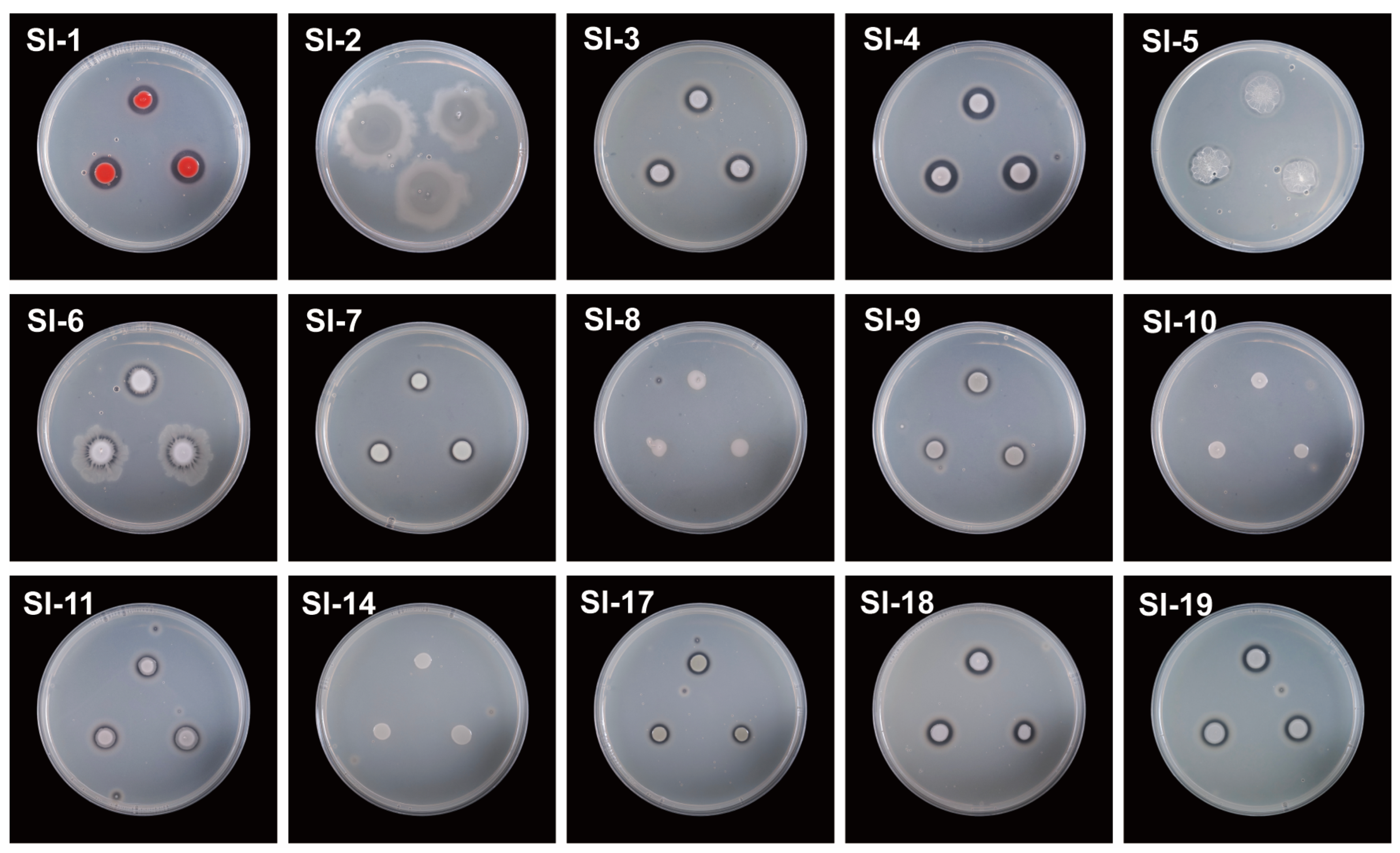
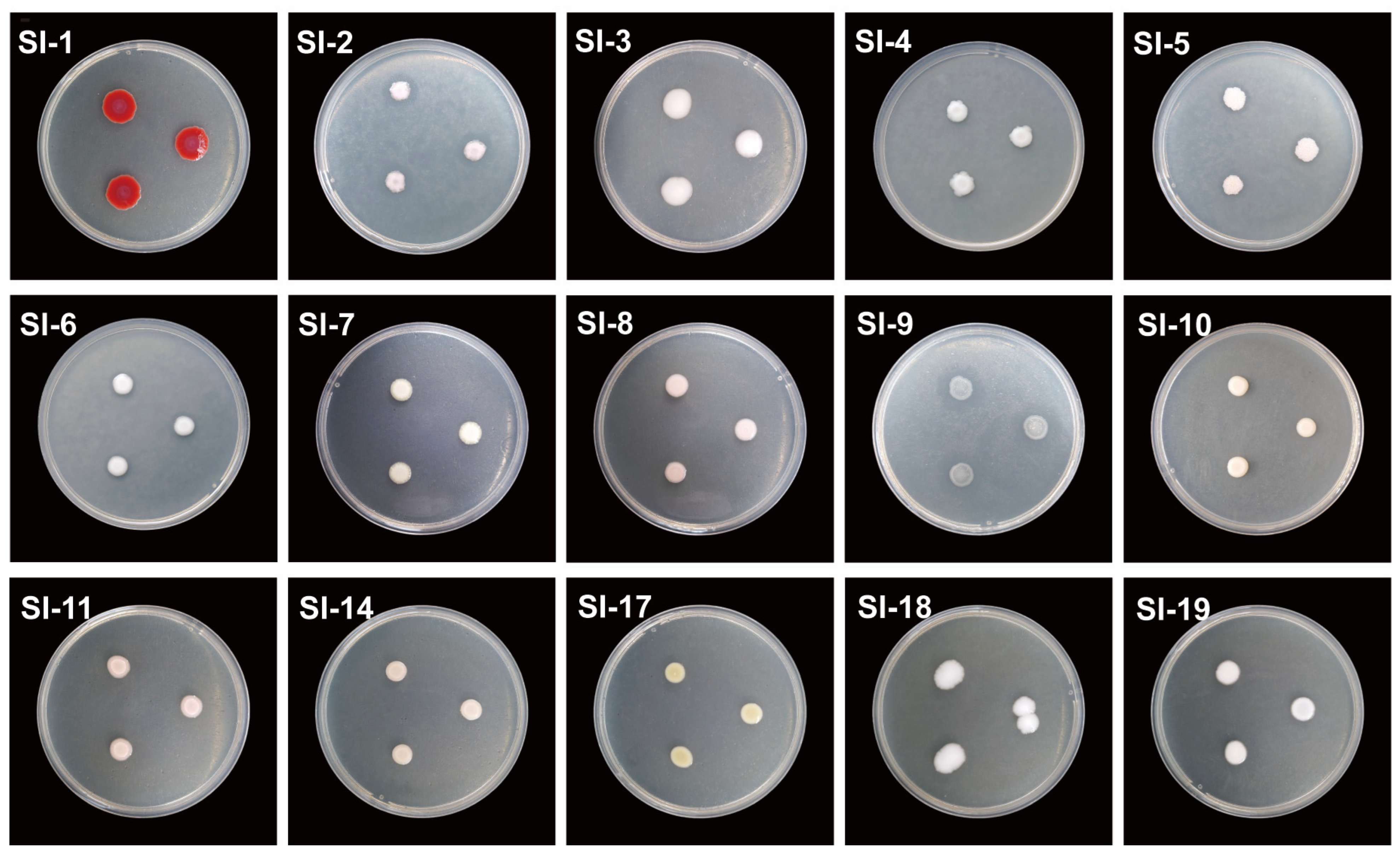
| Bacterial Strains | Colony Characterization | 16S rRNA Sequences | Enzyme Production | ||||||
|---|---|---|---|---|---|---|---|---|---|
| Morphology | Color | Texture | Margin | Blast | Similarity (%) | Accession No. | Protease | Lipase | |
| SI-1 | round | red | smooth, viscid | entire | Serratia marcescens | 99.86 | PX473135 | + | − |
| SI-2 | round | dirty white | smooth, viscid | entire | Pseudomonas koreensis | 99.79 | PX473136 | − | + |
| SI-3 | round | white | smooth, viscid | entire | Serratia marcescens | 99.73 | PX473137 | + | − |
| SI-4 | round | dirty white | smooth, viscid | entire | Bacillus albus | 99.93 | PX473138 | + | − |
| SI-5 | irregular | dirty white | rough, powdery | serrate | Tsukamurella ocularis | 99.93 | PX473139 | + | + |
| SI-6 | round | white | smooth, viscid | entire | Serratia marcescens | 99.73 | PX473140 | + | + |
| SI-7 | round | pale yellow | smooth, viscid | entire | Stenotrophomonas maltophilia | 99.66 | PX473141 | + | − |
| SI-8 | round | dirty white | smooth, viscid | entire | Pseudomonas piscis | 99.93 | PX474887 | − | − |
| SI-9 | round | dirty white | smooth, viscid | entire | Pseudomonas allii | 99.50 | PX474888 | + | + |
| SI-10 | round | pale yellow | smooth, viscid | entire | Advenella kashmirensis | 99.64 | PX473142 | − | − |
| SI-11 | round | dirty white | smooth, viscid | entire | Pseudomonas piscis | 99.93 | PX473143 | + | − |
| SI-14 | round | pale yellow | smooth, viscid | entire | Advenella kashmirensis | 99.57 | PX473146 | − | − |
| SI-17 | round | yellow | smooth, viscid | entire | Stenotrophomonas maltophilia | 99.66 | PX473149 | + | − |
| SI-18 | round | white | smooth, viscid | entire | Serratia marcescens | 99.80 | PX473150 | + | − |
| SI-19 | round | dirty white | smooth, viscid | entire | Pseudomonas allii | 99.79 | PX473151 | + | − |
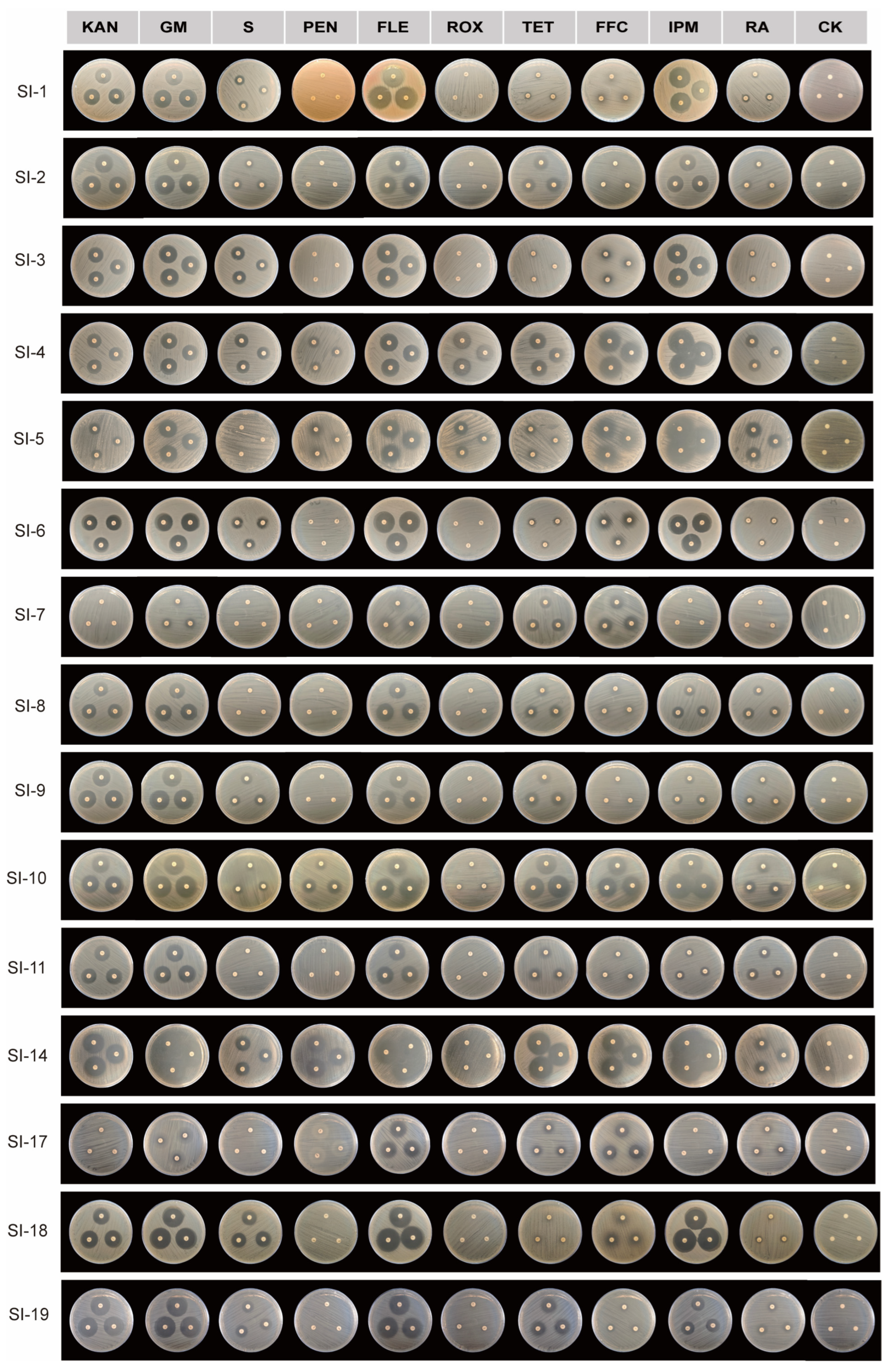
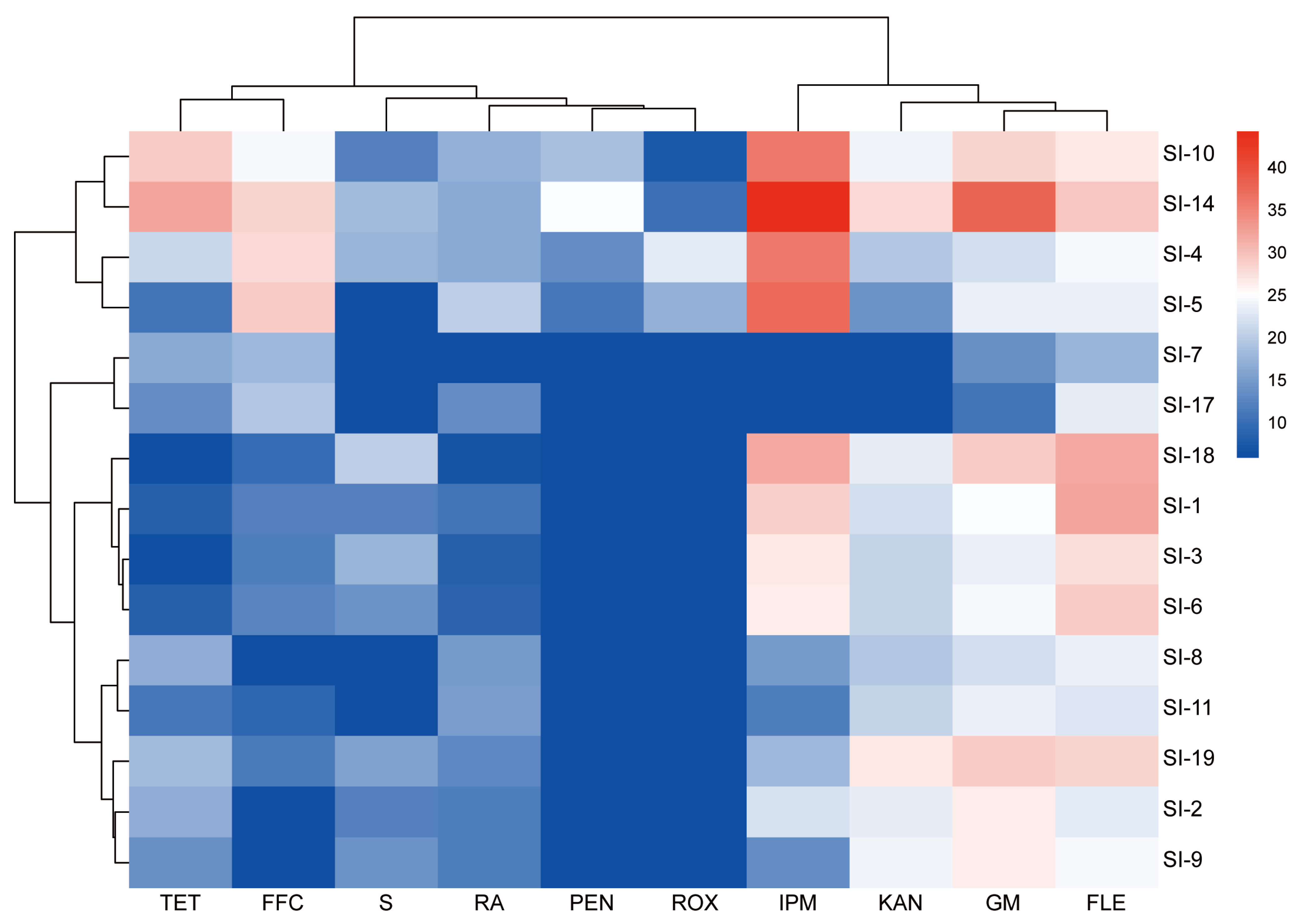
| Strains | KAN (mm) | GM (mm) | S (mm) | PEN (mm) | FLE (mm) | ROX (mm) | TET (mm) | FFC (mm) | IPM (mm) | RA (mm) |
|---|---|---|---|---|---|---|---|---|---|---|
| 30 μg/Piece | 120 μg/Piece | 10 μg/Piece | 10 μg/Piece | 5 μg/Piece | 15 μg/Piece | 30 μg/Piece | 30 μg/Piece | 10 μg/Piece | 5 μg/Piece | |
| SI-1 | 21.92 ± 0.38 c | 24.83 ± 0.29 de | 12.50 ± 0.25 e | 6.00 ± 0.00 d | 32.33 ± 0.29 a | 6.00 ± 0.00 e | 8.33 ± 0.14 h | 12.25 ± 0.43 d | 28.67 ± 0.29 e | 10.67 ± 0.14 e |
| SI-2 | 23.64 ± 0.63 b | 26.68 ± 0.25 c | 12.23 ± 0.85 e | 6.00 ± 0.00 d | 23.02 ± 0.41 ef | 6.00 ± 0.00 e | 16.83 ± 1.02 de | 6.00 ± 0.00 g | 22.28 ± 0.37 g | 11.95 ± 0.61 de |
| SI-3 | 20.72 ± 0.32 c | 23.90 ± 0.23 e | 17.59 ± 1.40 bc | 6.00 ± 0.00 d | 27.55 ± 0.08 cd | 6.00 ± 0.00 e | 6.72 ± 0.25 hi | 11.95 ± 0.51 d | 26.80 ± 0.44 f | 8.68 ± 0.41 f |
| SI-4 | 19.46 ± 0.02 c | 22.04 ± 0.57 f | 17.86 ± 0.39 bc | 13.52 ± 0.49 c | 24.44 ± 0.21 e | 22.98 ± 0.20 a | 21.17 ± 0.20 c | 28.06 ± 0.35 a | 35.99 ± 0.20 c | 16.72 ± 0.43 bc |
| SI-5 | 14.14 ± 0.67 d | 23.88 ± 0.24 e | 6.00 ± 0.00 f | 11.26 ± 0.33 c | 23.91 ± 0.23 ef | 17.49 ± 1.03 b | 10.68 ± 0.69 g | 29.10 ± 0.95 a | 37.83 ± 1.31 b | 20.30 ± 0.59 a |
| SI-6 | 20.71 ± 0.16 c | 24.63 ± 0.45 e | 14.28 ± 1.26 de | 6.00 ± 0.00 d | 29.25 ± 0.52 b | 6.00 ± 0.00 e | 8.45 ± 0.34 h | 12.61 ± 0.47 d | 26.61 ± 0.19 f | 8.91 ± 0.75 f |
| SI-7 | 6.00 ± 0.00 e | 13.80 ± 0.23 g | 6.00 ± 0.00 f | 6.00 ± 0.00 d | 17.59 ± 2.96 g | 6.00 ± 0.00 e | 16.68 ± 0.48 e | 17.99 ± 0.25 c | 6.00 ± 0.00 k | 6.00 ± 0.00 g |
| SI-8 | 19.57 ± 0.48 c | 22.07 ± 0.22 f | 6.00 ± 0.00 f | 6.00 ± 0.00 d | 23.65 ± 0.28 ef | 6.00 ± 0.00 e | 17.06 ± 0.53 de | 6.00 ± 0.00 g | 15.13 ± 0.48 i | 15.12 ± 0.45 c |
| SI-9 | 24.32 ± 0.07 b | 26.55 ± 0.27 cd | 14.30 ± 0.91 de | 6.00 ± 0.00 d | 24.44 ± 0.76 e | 6.00 ± 0.00 e | 13.76 ± 0.80 f | 6.00 ± 0.00 g | 13.66 ± 0.43 i | 11.91 ± 0.39 de |
| SI-10 | 24.24 ± 0.65 b | 28.63 ± 0.01 b | 12.21 ± 0.84 e | 18.67 ± 2.68 b | 26.83 ± 1.30 d | 7.88 ± 0.50 d | 29.03 ± 0.44 b | 24.69 ± 0.56 b | 36.03 ± 0.63 c | 17.23 ± 0.84 b |
| SI-11 | 20.64 ± 0.76 c | 23.96 ± 0.69 e | 6.00 ± 0.00 f | 6.00 ± 0.00 d | 22.52 ± 0.20 f | 6.00 ± 0.00 e | 10.99 ± 0.46 g | 9.13 ± 0.62 f | 11.99 ± 0.09 j | 15.22 ± 0.62 c |
| SI-14 | 28.09 ± 1.42 a | 37.85 ± 1.68 a | 18.28 ± 1.02 ab | 25.01 ± 0.11 a | 29.54 ± 0.30 b | 10.46 ± 1.65 c | 32.28 ± 0.89 a | 28.34 ± 0.13 a | 44.36 ± 0.92 a | 16.56 ± 0.22 bc |
| SI-17 | 6.00 ± 0.00 e | 10.91 ± 0.29 h | 6.00 ± 0.00 f | 6.00 ± 0.00 d | 23.29 ± 0.42 ef | 6.00 ± 0.00 e | 13.65 ± 0.59 f | 19.45 ± 0.07 c | 6.00 ± 0.00 k | 13.34 ± 0.66 d |
| SI-18 | 23.48 ± 0.21 b | 29.10 ± 0.53 b | 20.22 ± 0.81 a | 6.00 ± 0.00 d | 31.80 ± 0.32 a | 6.00 ± 0.00 e | 6.00 ± 0.00 i | 10.19 ± 0.77 ef | 31.83 ± 0.15 d | 7.00 ± 0.39 g |
| SI-19 | 26.96 ± 0.38 a | 29.32 ± 0.13 b | 15.91 ± 0.31 cd | 6.00 ± 0.00 d | 28.51 ± 0.30 bc | 6.00 ± 0.00 e | 18.62 ± 0.72 d | 11.59 ± 0.57 de | 18.02 ± 0.14 h | 12.96 ± 0.40 d |
| Ant Species | Geographical Range | Dominant Microorganisms | Distribution | References |
|---|---|---|---|---|
| Solenopsis invicta | Zhejiang, China | Stenotrophomonas, Serratia, Bradyrhizobium, Pseudomonas, Bradyrhizobium, Sphingomonas, Brucella, Luteibacter, Smaragdicoccus | whole ant (sterilized) | This study |
| Solenopsis invicta | TX, USA | Enterococcus, Enterobacter, Kluyvera, Lactococcus, Pseudomonas, Achromobacter, Bacillus, Serratia, Listeria | midgut | [128] |
| Solenopsis invicta | LA, USA | Klebsiella, Enterobacter, Pseudomonas, Acinetobacter, Serratia, Burkholderia, Pantoea, Providencia, Citrobacter, Morganella, Obesumbacterium, Lactococcus | gut | [130] |
| Solenopsis invicta | Guangzhou, China | Pseudomonas, Exiguobacterium, Acinetobacter, Mesoplasma, Bacillus, Proteus | venom glands | [131] |
| Solenopsis invicta | Guangxi, China | Mesoplasma, Exiguobacterium, Pseudomonas, Acinetobacter, Bacillus, Enterococcus | venom glands | [131] |
| Solenopsis invicta | Guangzhou, China | Enterococcus, Serratia, Lactococcus, Clostridioides, Bacillus, Pseudomonas, Brevibacterium, Enhydrobacter | whole ant (sterilized) | [134] |
| Solenopsis invicta | Foshan, China | Enterococcus, Weissella, Lactococcus, Brevibacterium, Bacillus, | whole ant (sterilized) | [134] |
| Solenopsis invicta | Guangzhou, China | Enterococcus, Lactococcus, Lactobacillus, Pseudomonas, Brevibacterium, Weissella | whole ant (sterilized) | [134] |
| Solenopsis invicta | TX, USA | Bacillus | hemolymph | [129] |
| Solenopsis invicta | TX, USA | Acinetobacter, Aeromicrobium, Conexibacter, Bacillus, Caldilinea, Bradyrhizobium, Marmoricola, Nocardioides, Stenotrophomonas, Mycobacterium, Pseudomonas, Streptomyces | whole ant (sterilized) | [132] |
| Solenopsis geminata | TX, USA | Acinetobacter, Bacillus, Pseudomonas, Propionibacterium, Conexibacter, Marmoricola, Nocardioidaceae, Nocardioides, Sphingomonas, Stenotrophomonas | whole ant (sterilized) | [132] |
| Pheidole nodus | Zhejiang, China | Holdemania, Wolbachia | whole ant (sterilized) | This study |
Disclaimer/Publisher’s Note: The statements, opinions and data contained in all publications are solely those of the individual author(s) and contributor(s) and not of MDPI and/or the editor(s). MDPI and/or the editor(s) disclaim responsibility for any injury to people or property resulting from any ideas, methods, instructions or products referred to in the content. |
© 2026 by the authors. Licensee MDPI, Basel, Switzerland. This article is an open access article distributed under the terms and conditions of the Creative Commons Attribution (CC BY) license.
Share and Cite
Xin, Y.; Chen, L.; Ijaz, M.; Chen, R.; Manzoor, N.; Alrafaie, A.; Wang, X.; Luo, J.; Li, B.; Shou, L. Symbiotic Bacterial Diversity, Functional Profiling and Antibiotic Susceptibility of the Red Imported Fire Ant. Microorganisms 2026, 14, 808. https://doi.org/10.3390/microorganisms14040808
Xin Y, Chen L, Ijaz M, Chen R, Manzoor N, Alrafaie A, Wang X, Luo J, Li B, Shou L. Symbiotic Bacterial Diversity, Functional Profiling and Antibiotic Susceptibility of the Red Imported Fire Ant. Microorganisms. 2026; 14(4):808. https://doi.org/10.3390/microorganisms14040808
Chicago/Turabian StyleXin, Yukang, Lei Chen, Munazza Ijaz, Rui Chen, Natasha Manzoor, Alhassan Alrafaie, Xiao Wang, Jinyan Luo, Bin Li, and Linfei Shou. 2026. "Symbiotic Bacterial Diversity, Functional Profiling and Antibiotic Susceptibility of the Red Imported Fire Ant" Microorganisms 14, no. 4: 808. https://doi.org/10.3390/microorganisms14040808
APA StyleXin, Y., Chen, L., Ijaz, M., Chen, R., Manzoor, N., Alrafaie, A., Wang, X., Luo, J., Li, B., & Shou, L. (2026). Symbiotic Bacterial Diversity, Functional Profiling and Antibiotic Susceptibility of the Red Imported Fire Ant. Microorganisms, 14(4), 808. https://doi.org/10.3390/microorganisms14040808