Article

Molecular Characteristics and Genetic Diversity of Canine Parvovirus in Shanghai, China, from 2016 to 2025

1
Shanghai Animal Disease Control Center, No. 30 Lane 855 Hongjing Road, Shanghai 201103, China
2
Shanghai Jiading District Animal Disease Prevention and Control Center, Shanghai 201800, China
3
Shanghai Baoshan District Animal Disease Prevention and Control Center, Shanghai 201900, China
4
Shanghai Pudong New District Husbandry and Aquaculture Technology Extension Center, Shanghai 201299, China
*
Authors to whom correspondence should be addressed.
These authors contribute equally to the work.
Microorganisms 2026, 14(4), 761; https://doi.org/10.3390/microorganisms14040761
Submission received: 16 March 2026 / Revised: 23 March 2026 / Accepted: 24 March 2026 / Published: 27 March 2026
(This article belongs to the Topic Advances in Infectious and Parasitic Diseases of Animals)

Abstract

Canine parvovirus (CPV) is a major pathogen causing severe gastroenteritis in dogs. Since its emergence, CPV has undergone continuous evolution, leading to the predominance of variants such as CPV-2a, CPV-2b, and CPV-2c. To characterize the genetic features and evolutionary trends of CPV-2 at a regional level, 775 fecal samples were collected from domestic and stray dogs with suspected CPV-2 infection in Shanghai between 2016 and 2025. The overall positivity rate was 23.2% (180/775); incidence was substantially higher in stray dogs (30.2%) than in domestic dogs (15.9%). Thirty-one CPV-2 strains were successfully isolated. Temporal analysis revealed a pronounced genotype shift: isolates from 2016 to 2020 were predominantly New CPV-2a, whereas CPV-2c became the dominant genotype from 2021 through 2025. Sequence analysis identified the polymorphism of VP2 gene and characteristic mutations F267Y, Y324I, N426E, Q370R and A440T in CPV-2c strains. A novel I447M mutation was detected in several isolates. Phylogenetic analysis showed that Shanghai isolates formed distinct clusters; CPV-2c strains were closely related to the Asian lineage. Structural modeling indicated that mutations at residues L87M, T101I, Y267F, A297S, G300A, Y305D, I324Y, Q370R, N426E, A440T, and I447M may alter the tertiary structure of the VP2 protein, potentially affecting antigenicity and receptor recognition. Collectively, these results demonstrate the complete genotype replacement of CPV-2 in Shanghai; CPV-2c is now predominant. Identification of the novel I447M mutation and structural analysis of key amino acid substitutions provide insight into CPV molecular evolution. These findings suggest that vaccines primarily based on older CPV-2 or CPV-2b genotypes offer suboptimal protection, highlighting the need for updated vaccine strategies targeting prevalent CPV-2c variants.

1. Introduction

Canine parvovirus (CPV) is an infectious disease that can cause severe vomiting, diarrhea, hemorrhagic gastroenteritis, and myocarditis [1,2]. Puppies aged 2–6 months are particularly susceptible, with high incidence and mortality rates [3]. CPV belongs to the family Parvoviridae, subfamily Parvovirinae, and genus Protoparvovirus [4]. Its 5.2-kb genome consists of single-stranded linear DNA [5]. The CPV genome encodes two structural proteins (VP1 and VP2) and two nonstructural proteins (NS1 and NS2) [6]. VP2 is the main capsid protein, constituting approximately 90% of the viral capsid [3,7]; it determines viral host range and plays a critical role in activating adaptive immune responses [8].
The evolution and transmission of CPV exhibit complex dynamics. Its single-stranded DNA genome confers a high mutation rate similar to that of RNA viruses [8], and mutations at key amino acid sites drive subtype replacement. CPV-2a, which emerged in 1979, replaced the original CPV-2; this was followed by mutations at residue 426 (N426D and N426E) in the VP2 gene of CPV-2a, producing the CPV-2b and CPV-2c subtypes [3,9]. In recent years, CPV-2a and CPV-2b have diversified into new subtypes associated with the S297A mutation, resulting in pronounced antigenic differences [10]. Since the initial discovery of CPV in China in 1982, circulating strains have undergone continuous evolution from CPV-2a to CPV-2b and subsequently to CPV-2c, which has become the dominant genotype [11,12]. This trend is not unique to China, as the “Asian CPV-2c” variant has been identified in multiple countries [13,14,15]. In addition, CPV-2c has also become the main variant prevalent in Europe, CPV-2c has also frequently appeared in many European countries [16,17,18]. During viral evolution, key VP2 mutations such as N426D/E and S297A not only reshape host range (including infection of cats and other species) but also influence virulence and vaccine efficacy [19,20,21]. Continuous surveillance of genetic variation, development of targeted vaccines, and strengthening of integrated prevention and control measures are essential to limit CPV spread; its evolutionary patterns provide a valuable model for studies of viral adaptive evolution.
Shanghai is a major city in eastern China with over 24 million residents, and the numbers of stray and domestic dogs have greatly increased over the past decade [19]. Recent statistics indicate that the total number of pet dogs and cats in Shanghai has exceeded 2 million, with the number of pet-owning households reaching approximately 1.82 million, ranking among the highest in China [22]. Despite the implementation of routine vaccination that achieve relatively high coverage in some urban domestic dog populations, clinical cases of CPV infection continue to be observed annually in veterinary practices across the city, including in dogs with documented vaccination histories [23,24,25]. Given the widespread occurrence of canine parvovirus disease in both stray and domestic dogs—particularly the CPV-2c variant, which has become the dominant CPV-2 genotype in dogs in Shanghai and globally [26]—concerns have arisen regarding the protective efficacy of attenuated CPV-2 vaccines. Because stray dogs have extensive movement ranges and generally poor vaccination coverage, they are more susceptible to CPV-2 infection and dissemination. Here, we systematically investigated the prevalence of CPV-2 in domestic and stray dog populations in Shanghai over the past decade and analyzed the phylogenetic characteristics of viral mutations, with the aim of elucidating epidemic trends of CPV-2 strains and providing a foundation for molecular epidemiological research in this field.

2. Materials and Methods

2.1. Sample Collection and Viral DNA Extraction

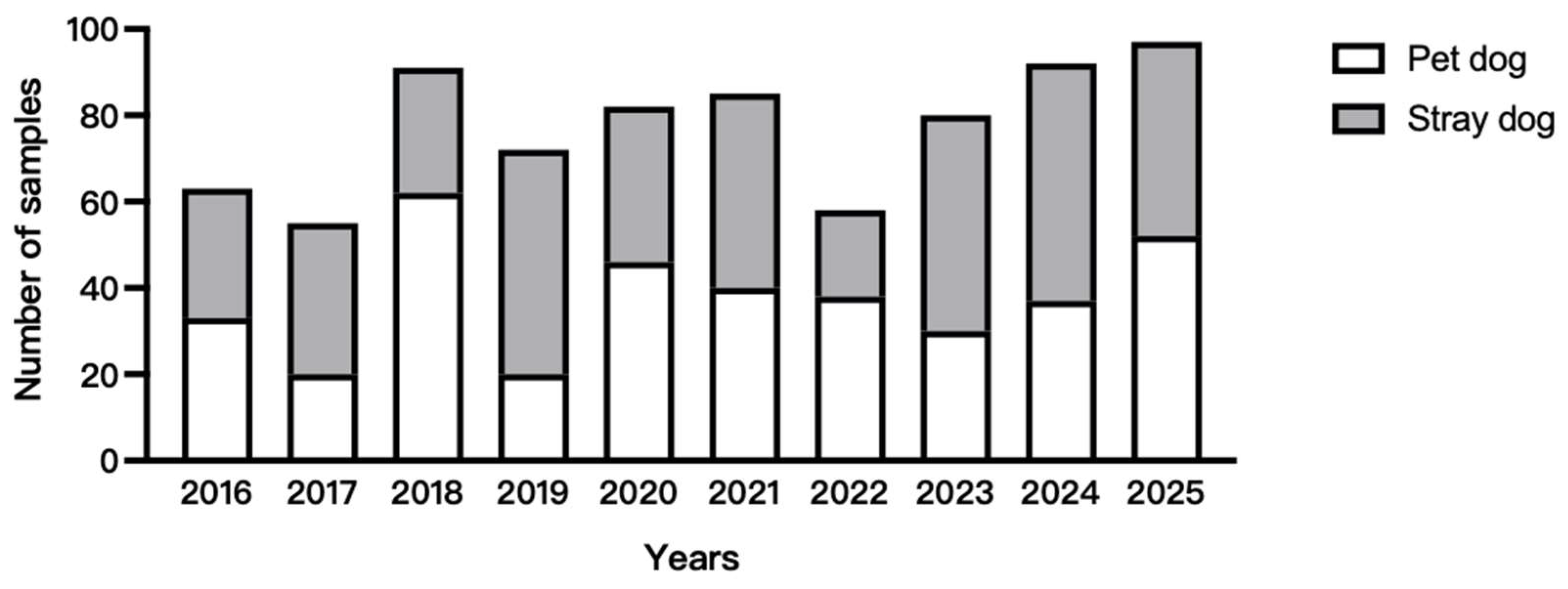
A total of 755 rectal swab samples were collected annually between 2016 and 2025 from dogs exhibiting clinical signs of gastroenteritis. Samples were obtained from two sources: (1) animal hospitals located in seven districts of Shanghai (Minhang, Baoshan, Pudong, Xuhui, Qingpu, Jiading, and Jing’an), covering the major urban and suburban areas of the city; and (2) stray dog shelters in Shanghai, which receive stray dogs from various districts across the city. This sampling strategy was designed to capture the genetic diversity of CPV circulating throughout the entire Shanghai area rather than focusing on a single facility or district. Annual sample numbers are shown in Figure 1, 378 samples were collected from pet dogs and 397 samples were collected from stray dogs. The sampling procedure was as follows: a cotton swab was soaked in sample processing solution, inserted approximately 2–3 cm into the dog’s anus, gently rotated to swab the anal mucosa, and then placed into a tube containing sample processing solution. All samples were stored at −80 °C. The Canine Parvovirus Colloidal Gold Test Strip (Nabai Biotech, Beijing, China; CAT: 010718898) was used to detect and screen positive samples. An appropriate amount of the sample was dispensed for testing using a plastic pipette, and 2–3 drops were slowly added into the sample well of the test strip. The results were observed after the sample had flowed through the window for 5 min, and reading was terminated at 15 min to determine the final result. The screened positive samples were inoculated into F81 cells, which were cultured in an incubator at 37 °C until cytopathic effects (CPE) were observed. The infected cells were then subjected to repeated freeze–thaw cycles to release viral particles. The supernatant was collected and stored at −80 °C for further analysis. Viral DNA was extracted from 50 µL of supernatant containing viral particles using the MagPure Virus RNA/DNA Assay Kit (Magen Biotech, Guangzhou, China; CAT: IVD5412). Extracted DNA was stored at −20 °C until further analysis.

2.2. Amplification and Sequencing of VP2

The CPV-2-specific primer pair VP2-F (5′-CGGGATCCATGAGTGATGGAGCAGTTCAA-3′) and VP2-R (5′-GGAATTCTTAGTATAATTTTCTAGGTGCTAGTT-3′) [27], synthesized by Shanghai Saiheng Biotechnology Co., Ltd. (Shanghai, China), was used to amplify the full-length VP2 gene (1755 bp) by polymerase chain reaction (PCR) to confirm the presence of CPV-2 DNA [28]. To minimize the risk of contamination, standard precautions were strictly followed. All PCR setups were performed in a dedicated clean area physically separated from post-PCR handling, using aerosol-resistant filter tips and sterile aliquoted reagents. Each amplification run included a negative control (distilled water instead of template DNA) to monitor for potential cross-contamination. The amplification reactions were carried out in 50 μL PCR volume containing 25 μL of 2× Phanta Flash Master Mix (Vazyme Biotech, Nanjing, China; CAT: P510-01), 4 μL primers, 2 μL template, and 19 μL distilled water. Under the following cycling conditions: predenaturation at 95 °C for 5 min; 35 cycles of denaturation at 95 °C for 30 s, annealing at 56 °C for 30 s, and extension at 72 °C for 1 min; and a final extension at 72 °C for 7 min. Given the inherent limitations of Sanger sequencing in detecting low-abundance variants (<15–20%), we adopted a cloning-based sequencing strategy to enhance the reliability of genotype assignment. PCR products were cloned into the pMD™19-T Vector (Takara Biotech, Beijing, China; CAT: 6013), and each amplicon was subjected to Sanger dideoxy sequencing (Shanghai Saiheng Biotechnology Co., Ltd., Shanghai, China).

2.3. Sequence Analysis

VP2 sequence amplified from the CPV-2 strain DNA isolated from specimens were aligned with those of 44 reference CPV strains (Table 1) using the ClustalW algorithm implemented in MEGA 7.0 software (https://www.megasoftware.net (accessed on 28 October 2025)). Nucleotide and amino acid identity analyses were subsequently conducted.

2.4. Phylogenetic Analysis

To assess the genetic diversity of CPV isolates from Shanghai, VP2 nucleotide sequences from 31 strains were compared with those from 44 reference strains. Reference sequences representing all major CPV genotypes (CPV-2, CPV-2a, CPV-2b, CPV-2c, New CPV-2a, New CPV-2b, and FPV) were selected from the GenBank database based on previously published phylogenetic studies [19,27,29,30], ensuring the inclusion of well-characterized prototype strains for each genotype. These sequences encompass diverse geographical origins and temporal ranges to provide a comprehensive framework for phylogenetic comparison. Phylogenetic trees based on VP2 amino acid sequences were constructed by the maximum-likelihood method with FLU + I as the best-fit model implemented in MEGA 7.0 software (https://www.megasoftware.net), with 1000 bootstrap replicates [29].

2.5. Tertiary Structure Prediction

The tertiary structure of the VP2 protein was predicted using the SWISS-MODEL server (https://swissmodel.expasy.org (accessed on 22 December 2025)) [31]. The predicted models were visualized in PyMOL 3.1 software (https://pymol.org (accessed on 23 December 2025)) [31]; amino acid substitution sites were mapped onto the VP2 structure to determine their locations and potential effects on protein conformation.

3. Results

3.1. Isolation and Genotyping of CPV-2

In total, 775 rectal swab samples from dogs with suspected CPV-2 infection were collected in Shanghai between 2016 and 2025. CPV positive screening was performed using the Canine Parvovirus Colloidal Gold Test Strip. Among these samples, 180 showed positive test results, yielding an overall positivity rate of 23.2% (180/775). Positivity rates were 15.9% (60/378) in domestic dogs and 30.2% (120/397) in stray dogs. Annual CPV-2 positivity rates for rectal swab samples are summarized in Table 2. After isolation and propagation of positive samples in F81 cells, 31 CPV-2 strains exhibiting typical cytopathic effects were obtained: 20 from stray dogs and 11 from pet dogs. Table 3 provides detailed information on sampling date, location, clinical signs, gross lesions, and CPV-2 immunization status. For the purposes of this study, immunization status was recorded based on owner-reported vaccination history or veterinary medical records at the time of sample collection. Dogs were classified as “Yes” if they had received at least one dose of a CPV-2-containing vaccine within the year prior to the onset of clinical signs. Dogs were classified as “No” if there was no documented history of vaccination or if the owner confirmed that the dog had never been vaccinated.

3.2. Amino Acid Mutation Analysis of VP2

The VP2 genes of the 31 CPV-2 isolates were amplified by PCR and sequenced. To identify amino acid substitutions in VP2, we compared sequences from these isolates with the sequences of 20 reference strains (Table 4). Sixteen isolates (SH2019-1, SH2020-3, SH2021-1, SH2021-2, SH2021-3, SH2022-1, SH2022-3, SH2023-1, SH2023-2, SH2024-1, SH2024-2, SH2024-3, SH2025-1, SH2025-2, SH2025-3, and SH2025-4) were classified as CPV-2c; they exhibited the characteristic amino acid substitutions Q370R, N426E, and A440T. The I447M substitution was detected in isolates SH2021-1, SH2023-3, SH2024-1, and SH2025-2. The SH2023-1 isolate contained key substitutions at positions L87M, T101I, G300A, and Y305D, consistent with the CPV-2 genotype; it also harbored mutations at Y267F, A297S, I324Y, and A440T. The remaining 14 isolates were classified as New CPV-2a and displayed the T440A substitution.
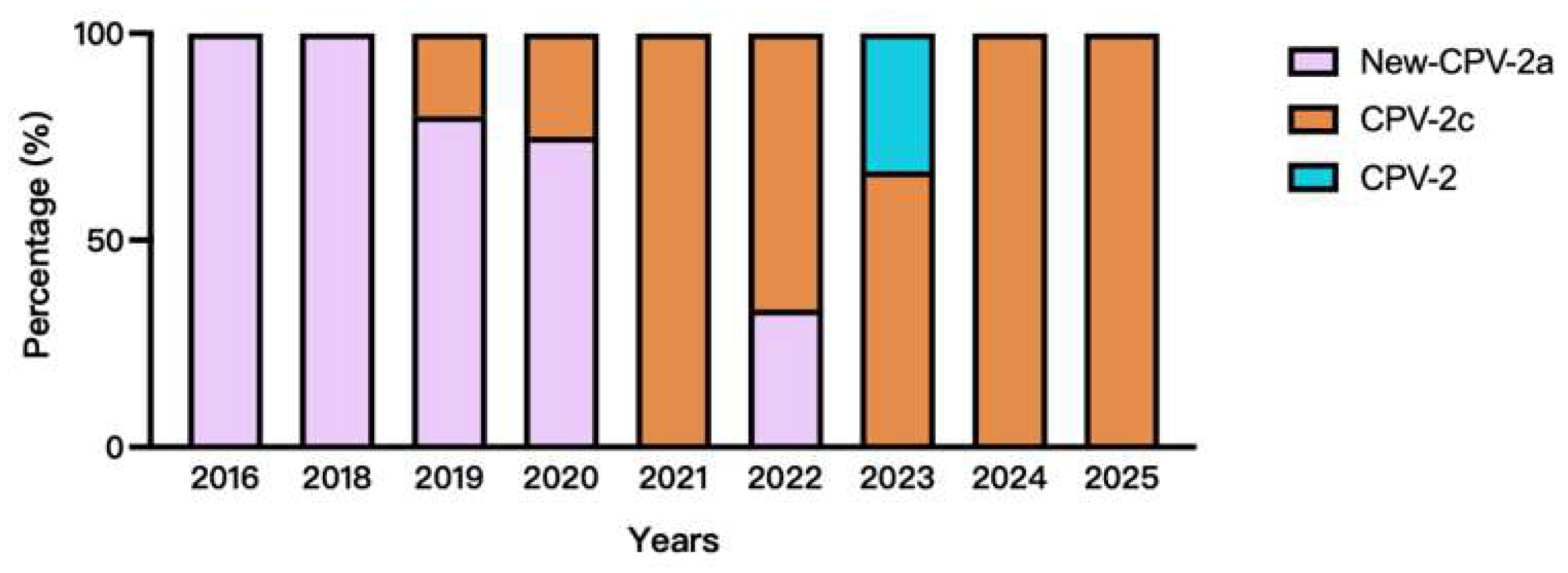
Next, we analyzed genotype changes in CPV-2 strains isolated between 2016 and 2025 (Figure 2). All CPV isolates obtained in 2016 and 2018 were classified as New CPV-2a. CPV-2c strains first appeared in 2019; however, most isolates from 2019 and 2020 remained New CPV-2a. Beginning in 2021, a clear genotype shift was observed, with a pronounced increase in CPV-2c strains over the subsequent 5 years. All isolates obtained in 2021, 2024, and 2025 belonged to the CPV-2c genotype; in 2023, a single CPV-2 isolate with a sequence similar to the vaccine strain was identified.

3.3. Geographic Distribution of CPV Genotypes Across Shanghai Districts

To assess whether this shift represented a citywide phenomenon, we examined the geographic distribution of genotypes across the seven sampled districts (Table 5). In Minhang, CPV-2c appeared as early as 2019–2020 and progressively replaced New CPV-2a, becoming the major genotype by 2024–2025. In Pudong, Xuhui, and Baoshan, New CPV-2a predominated until 2020, after which CPV-2c became dominant in 2021–2023 and exclusively detected in 2024–2025. Qingpu and Jing’an, though lacking early isolates, showed CPV-2c as the major genotype once sampling commenced in 2019–2020 and 2021–2023, respectively. Jiading had only New CPV-2a isolates in early years and no later isolates. Overall, CPV-2c emerged and became predominant in all districts with sufficient longitudinal sampling, and the timing of the shift was consistent across locations. These spatial data, combined with the temporal trend, demonstrate that the major genotype shift from New CPV-2a to CPV-2c occurred broadly across Shanghai rather than being confined to a single facility or district.

3.4. Phylogenetic Analysis of the VP2 Gene

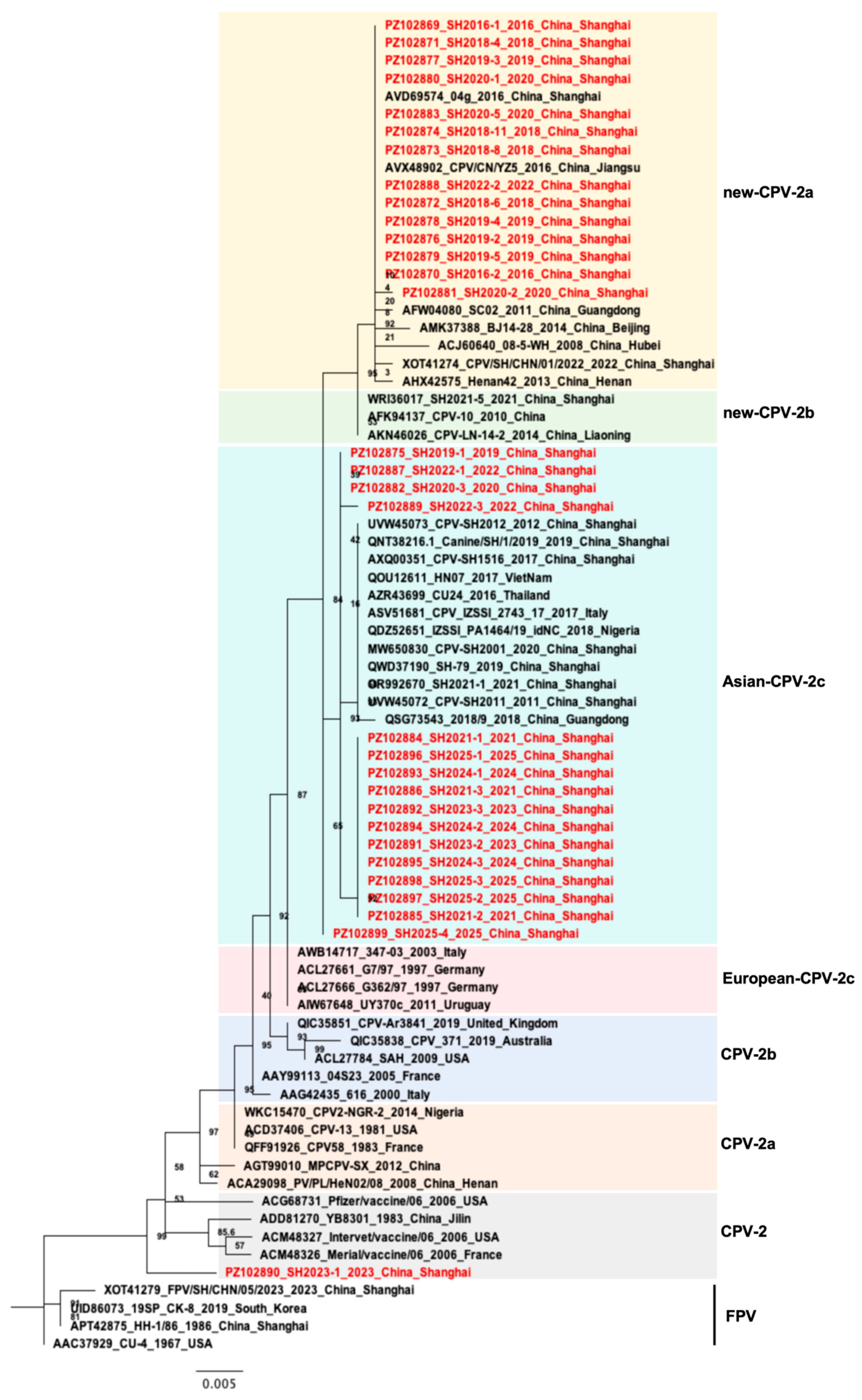
Forty-four CPV reference strains representing different genotypes were retrieved from the GenBank database. Phylogenetic trees were constructed based on VP2 amino acid sequences from the 31 CPV isolates, together with the reference strains. The analysis showed that one isolate (SH2023-1) clustered within the CPV-2 branch. Sixteen isolates from 2019 to 2025 were grouped within the Asian CPV-2c lineage and showed close links to CPV strains of Asian origin (Figure 3). The remaining 14 isolates, collected in 2016, 2018, 2019, 2020, and 2022, clustered within the New CPV-2a branch; they were closely related to strains identified in Shanghai, Guangdong, Beijing, Hubei, Henan, and other regions of China.

3.5. Tertiary Structure Analysis of the VP2 Protein

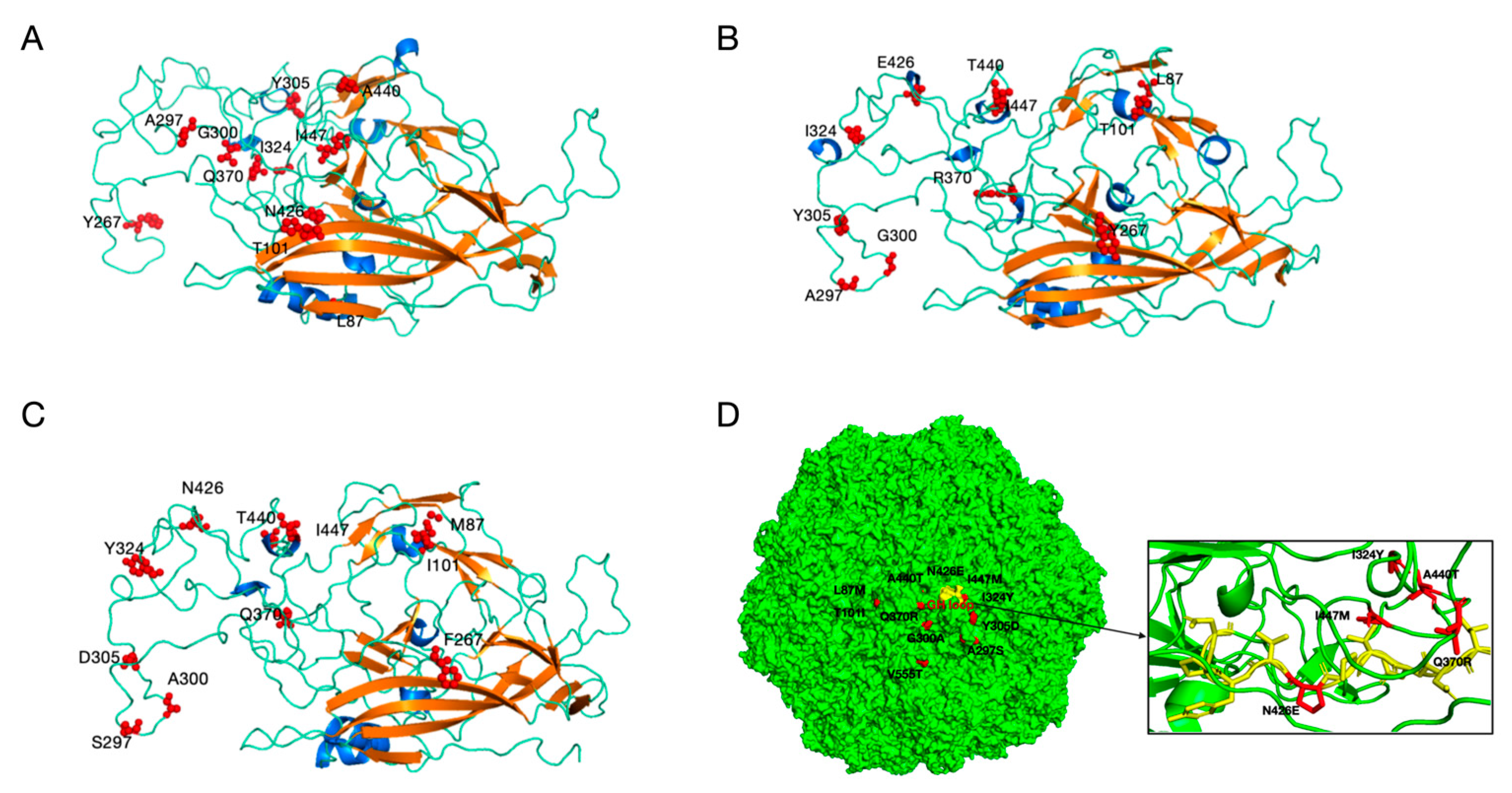
To visualize the spatial distribution of amino acid substitutions identified in this study, homology models of the VP2 protein were constructed for the three CPV genotypes detected in Shanghai (New CPV-2a, CPV-2c, and CPV-2) using the SWISS-MODEL server. Different template structures were employed to ensure optimal homology modeling for each genotype, thereby providing the most accurate structural context for interpreting mutations in these strains. Structural mapping (Figure 4) revealed that the majority of mutated residues identified in Shanghai isolates—including L87M, T101I, Y267F, A297S, G300A, Y305D, I324Y, Q370R, N426E, A440T, and the novel I447M substitution—are located on surface-exposed regions of the viral capsid. These structural mapping suggests that the observed substitutions are not randomly distributed but are concentrated in regions critical for receptor recognition, may affect the tertiary structure of the VP2 protein. Notably, residue 426 (N426E in CPV-2c) is situated in the GH loop of VP2, a structural element known to form part of the receptor-binding interface. The I447M substitution is located in the C-terminal region of VP2; in the folded protein structure, residues 426 and 447 are in close spatial proximity. Other substitutions, such as Y267F and Y324I, are located in the β-barrel core of the protein.

4. Discussion

In recent years, rapid expansion of the pet industry has led to an increase in companion dog populations, highlighting the need to address emerging infectious diseases [12]. Canine parvovirus–associated diarrhea, a severe threat to canids, has attracted considerable attention. CPV-2 was initially detected in China in the early 1980s, and CPV-2a became the predominant genotype by 1986 [19]. Since 2010, CPV-2c has been increasingly detected in eastern, northern, northeastern, and southern regions of China, aligning with its global dissemination and current predominance [32,33]. This pattern underscores the ongoing evolution and strong regional transmissibility of canine parvovirus.
Our data show a substantial difference in infection rates between stray and domestic dogs; the positivity rate was higher in stray dogs (30.2%) than in pet dogs (15.9%). This disparity in infection rates can be partly attributed to the distinct living environments of these two populations in Shanghai. The majority of pet dogs in this metropolitan area are primarily kept indoors, with limited exposure to uncontrolled external environments and potentially infected animals. In contrast, stray dogs inhabit outdoor environments characterized by high population density and lack of sanitary oversight. Furthermore, the urban landscape of Shanghai facilitates frequent indirect and direct contact between stray and pet dog populations. During outdoor activities such as walks in public parks or residential areas, pet dogs may encounter stray dogs or come into contact with environments contaminated by them (e.g., feces, soil). This ecological interface serves as a critical bridge for pathogen spillover, allowing the high viral burden circulating in stray populations to pose a continuous infection risk to household pets. This observation is consistent with the limited vaccination coverage and uncontrolled living conditions of stray dogs, which serve as the main hosts and drivers of CPV-2 transmission and evolution. Although most stray dogs do not experience vaccine induced selection pressure, gene mutations and genotype changes still occur, which may be due to the high population density and continuous transmission chains among stray dogs provide extensive opportunities for viral replication and mutation accumulation, effectively fueling viral evolution. In addition, natural selection acts on viral fitness traits such as transmission efficiency, environmental stability, and receptor binding. CPV-2c may possess intrinsic replication advantages or enhanced environmental persistence that facilitate its spread in high-density stray populations independent of immune evasion. Futhermore, genetic drift may play a role. Thus, while vaccination influences viral evolution in domestic dogs, the stray dog reservoir functions as an independent evolutionary arena where viral diversity emerges and is maintained through sustained transmission. The high genetic diversity within these populations may facilitate the emergence of novel variants. All dogs included in this study presented with clinical signs consistent with canine parvovirus infection, including lethargy, anorexia, vomiting, and hemorrhagic diarrhea of varying severity. The majority of cases exhibited moderate to severe clinical manifestations requiring veterinary intervention. However, due to the retrospective nature of sample collection and the lack of standardized clinical scoring at the time of presentation, we were unable to perform a quantitative correlation between specific clinical signs and the infecting CPV genotype. Nevertheless, no obvious differences in clinical presentation were observed between dogs infected with CPV-2c versus those infected with New CPV-2a, suggesting that the ongoing genotype shift may not be associated with a discernible change in disease phenotype.
The geographic stratification of our isolates further supports the interpretation that the CPV-2c genotype shift is a citywide phenomenon rather than a localized outbreak. CPV-2c strains were detected in samples collected from veterinary hospitals and shelters across all seven surveyed districts, with the transition from New CPV-2a to CPV-2c occurring synchronously in multiple locations between 2019 and 2021. This pattern is inconsistent with a single-facility outbreak and instead reflects broader epidemiological dynamics operating at the metropolitan scale. Although sample sizes from individual districts varied annually, the consistency of the genotypic shift across geographically distinct sampling sites provides empirical evidence for the widespread dissemination of CPV-2c throughout Shanghai. The rapid expansion of Asian-derived CPV-2c in China suggests the presence of evolutionary advantages [34]. Given the role of VP2 as a surface structural protein that regulates host tropism [35,36], hemagglutination properties, and antigenicity through induction of neutralizing antibody responses, we sequenced VP2 genes from rectal swabs of dogs that exhibited gastroenteritis in Shanghai between 2016 and 2025. Most CPV-2c isolates harbored characteristic substitutions (F267Y, Y324I, Q370R, N426E, and A440T), consistent with previously reported strains from Shanghai and Beijing [26,37]. Additionally, a unique I447M substitution was identified in some isolates. The F267Y, Y324I, N426E, and A440T substitutions have been identified as predominant mutations during early stages of CPV evolution [9,38]. Residues 267 and 426 are considered critical determinants of antigenicity and host receptor recognition. The N426E substitution, a defining feature of CPV-2c, is located in the GH loop of VP2 and enhances binding affinity to the canine transferrin receptor, which may explain the increased fitness of this variant. The Q370R substitution was initially identified in CPV-2a strains isolated from giant pandas in Sichuan Province, China, and subsequently became prevalent in CPV-2c strains [39]. The functional significance of the I447M substitution identified in this study remains unclear. A key finding of this study is the temporal shift in genotype predominance. Although New CPV-2a was predominant between 2016 and 2020, a clear transition occurred in 2021, culminating in complete dominance of CPV-2c by 2025, consistent with a report by Liu et al. [26]. Phylogenetic analysis confirmed that the CPV-2c isolates clustered closely with previously reported Asian CPV-2c strains from Shanghai, forming distinct lineages separate from European and American epidemic strains. This rapid replacement suggests that CPV-2c possesses substantial adaptive advantages over earlier variants in the Shanghai ecosystem. The observed major genotypic shift towards CPV-2c predominance, particularly within the unvaccinated stray dog population, rather than immune evasion, is the primary driver of selection. CPV-2c, with its enhanced binding affinity to the canine transferrin receptor (conferred by the N426E substitution), likely possesses a transmission advantage in dense, immunologically naïve populations, allowing it to outcompete older variants like New CPV-2a.
Previous studies have shown that residues 267 and 426, which exhibit high mutation frequencies in CPV-2, play important antigenic roles and influence the tertiary structure of VP2 [40]. The S297A substitution—detected in all strains in the present study—has been reported to induce antigenic changes in CPV-2 variants and may substantially contribute to ongoing host adaptation [41]. Notably, many of the mutated residues identified in our Shanghai isolates (including S297A, G300A, I324Y, Q370R, and N426E) are located within or adjacent to known B-cell epitopes, such as loop 3 (residues 298–302) and the GH loop (residues 420–430), which are critical targets for neutralizing antibodies [42,43,44]. Pan et al. predicted that substitutions at positions M87L, I101T, S297A, and N426E alter the surface topology of the viral capsid, potentially affecting antibody neutralization [27]. A critical finding of our structural analysis is the spatial clustering of mutations around the receptor-binding interface. Residue 426, located in the GH loop, has been conclusively shown by X-ray crystallography and mutagenesis studies to be a key determinant of canine transferrin receptor (TfR) recognition. The N426E substitution characteristic of CPV-2c enhances binding affinity by creating favorable electrostatic interactions with positively charged residues (e.g., arginine and lysine) on TfR, as demonstrated in the structural study by Lee et al. [31]. Our models confirm that this substitution introduces a negatively charged side chain at a position that directly contacts the receptor in the viral-receptor complex. Additionally, residue 447 is located in the C-terminal region of VP2, adjacent to key functional domains, including the receptor-binding region containing residue 426. Its potential synergistic interaction with N426E may enhance viral affinity for the canine transferrin receptor. I447M may exert a synergistic effect on receptor binding by stabilizing the conformation of the GH loop or by contributing to the local electrostatic environment. The substitution of isoleucine (a hydrophobic residue with a branched side chain) to methionine (a longer, sulfur-containing, flexible side chain) could alter loop dynamics or create additional van der Waals contacts with neighboring residues, potentially fine-tuning the receptor-binding interface. Future studies employing site-directed mutagenesis and surface plasmon resonance (SPR) binding assays are needed to quantitatively assess the impact of I447M, both alone and in combination with N426E, on TfR binding affinity. Accordingly, our analyses predicted that substitutions at positions L87M, T101I, Y267F, A297S, G300A, Y305D, I324Y, Q370R, N426E, A440T, and I447M alter the tertiary structure of the VP2 protein. These structural changes may result in altered antigenicity and modified cellular receptor recognition, and further experiments are needed for verification.
Although vaccination is the primary strategy for CPV prevention in China, CPV-2c breakthrough infections persist [3,20,21,45]. Vaccine failure may be associated with maternal antibody interference [46,47,48]. Notably, vaccines currently used in China primarily target ancestral CPV-2 or CPV-2b antigens [38] and may offer limited protection against CPV-2c [3,24,49]. Here, we found that domestic dogs with a history of CPV vaccination were still infected, implying that existing vaccines have insufficient protective effects. Long-term surveillance of viral mutations and regional prevalence is essential to guide the development of CPV-2c-specific vaccines. This study has several limitations that should be acknowledged. First, our sampling was restricted to dogs presenting with clinical signs of gastroenteritis; we did not screen asymptomatic or subclinically infected dogs, which may serve as unrecognized reservoirs for CPV transmission. The prevalence and genetic characteristics of CPV in asymptomatic carriers remain unknown and warrant future investigation. Recent studies in healthy dog populations have demonstrated that parvovirus shedding occurs in apparently healthy animals. Ferrara et al. investigated 170 apparently healthy dogs in Italy and detected CPV-2 in 6.5% (11/117) of fecal samples using real-time PCR, confirming that asymptomatic carriers actively shed the virus [4]. Importantly, their risk factor analysis revealed significantly higher parvovirus detection rates in animals of stray origin, those with altered fecal scores, and those living outdoors. These findings align with our observation of higher infection rates in stray dogs and underscore the importance of asymptomatic carriers in maintaining viral circulation within dog populations. Second, although our phylogenetic analysis clearly demonstrates clustering of Shanghai CPV-2c isolates with Asian strains, the limited number of European and American reference sequences included in this study precludes a comprehensive global phylogeographic analysis. Third, while we identified a novel I447M substitution and predicted its potential structural impact using in silico modeling, these predictions remain speculative in the absence of functional validation. No in vitro or in vivo experiments were conducted to confirm the effects of this mutation—or the other identified substitutions—on viral antigenicity, receptor binding affinity, or virulence. Future studies employing reverse genetics systems to engineer these mutations into infectious clones, followed by in vitro receptor binding assays and animal challenge studies, are essential to establish causality. Despite these limitations, this study provides a decade-long (2016–2025) overview of CPV genotypes in Shanghai, characterizes emerging mutant strains and novel substitutions, and establishes a theoretical basis for improving CPV-2c vaccine strategies and reducing disease burden.

5. Conclusions

In this study, we collected 775 fecal samples from dogs with suspected CPV-2 infection, including both domestic and stray dogs, in Shanghai between 2016 and 2025; we successfully isolated 31 CPV strains. Genotype analysis stratified by sampling location revealed that the shift from New CPV-2a to CPV-2c occurred consistently across multiple districts, with CPV-2c becoming the predominant genotype citywide from 2021 onward. The CPV-2c strains identified in this study harbored the characteristic substitutions F267Y, Y324I, N426E, and A440T, as well as a novel I447M substitution; its functional significance warrants further investigation. These findings suggest that CPV-2c continues to undergo evolutionary change and that vaccines developed against CPV-2 or CPV-2b genotypes may not provide complete protection. Therefore, this decade-long surveillance of CPV strains in Shanghai provides a theoretical basis for the development of improved vaccines.

Author Contributions

Conceptualization, Q.X. and J.L.; methodology, Y.G.; software, F.X.; validation, L.X., C.C. and B.C.; formal analysis, X.Y.; investigation, W.C.; resources, Q.X.; data curation, J.L.; writing—original draft preparation, Q.X.; writing—review and editing, Q.X.; visualization, Y.G.; supervision, F.X.; project administration, H.Z.; funding acquisition, J.W. All authors have read and agreed to the published version of the manuscript.

Funding

This research was funded by the 2023 Shanghai Oriental Talent Leadership Project (LJ2023079).

Institutional Review Board Statement

Not applicable.

Informed Consent Statement

Not applicable.

Data Availability Statement

The original contributions presented in this study are included in the article. Further inquiries can be directed to the corresponding author.

Acknowledgments

The authors would like to thank the animal disease prevention and control centers in various districts of Shanghai for their support in this work.

Conflicts of Interest

The authors declare no conflicts of interest.

References

  1. Appel, M.J.; Cooper, B.J.; Greisen, H.; Scott, F.; Carmichael, L.E. Canine viral enteritis. I. Status report on corona- and parvo-like viral enteritides. Cornell Vet. 1979, 69, 123–133. [Google Scholar]
  2. Battilani, M.; Balboni, A.; Ustulin, M.; Giunti, M.; Scagliarini, A.; Prosperi, S. Genetic complexity and multiple infections with more Parvovirus species in naturally infected cats. Vet. Res. 2011, 42, 43. [Google Scholar] [CrossRef] [PubMed]
  3. Decaro, N.; Buonavoglia, C. Canine parvovirus—A review of epidemiological and diagnostic aspects, with emphasis on type 2c. Vet. Microbiol. 2012, 155, 1–12. [Google Scholar] [CrossRef]
  4. Ferrara, G.; Chianese, M.; Pagnini, U.; Iovane, G.; Montagnaro, S. Detection of old and recently discovered parvoviruses in apparently healthy dogs in Campania region, Italy. Res. Vet. Sci. 2025, 196, 105887. [Google Scholar] [CrossRef] [PubMed]
  5. Reed, A.P.; Jones, E.V.; Miller, T.J. Nucleotide sequence and genome organization of canine parvovirus. J. Virol. 1988, 62, 266–276. [Google Scholar] [CrossRef]
  6. Steinel, A.; Parrish, C.R.; Bloom, M.E.; Truyen, U. Parvovirus Infections in Wild Carnivores. J. Wildl. Dis. 2001, 37, 594–607. [Google Scholar] [CrossRef]
  7. Spitzer, A.L.; Maxwell, I.H.; Parrish, C.R. Tropic determinant for canine parvovirus and feline panleukopenia virus functions through the capsid protein VP2. J. Gen. Virol. 1997, 78, 925–928. [Google Scholar] [CrossRef]
  8. Voorhees, I.E.H.; Lee, H.; Allison, A.B.; Lopez-Astacio, R.; Goodman, L.B.; Oyesola, O.O.; Omobowale, O.; Fagbohun, O.; Dubovi, E.J.; Hafenstein, S.L.; et al. Limited Intrahost Diversity and Background Evolution Accompany 40 Years of Canine Parvovirus Host Adaptation and Spread. J. Virol. 2019, 94, 10-1128. [Google Scholar] [CrossRef]
  9. Cao, Y.; Zhou, P.; Zeng, W.; Zhang, X.; Li, S. The genetic evolution of canine parvovirus—A new perspective. PLoS ONE 2017, 12, e0175035. [Google Scholar] [CrossRef]
  10. Meng, Z.; Geng, Y.; Guo, D.; Li, C.; Wang, E.; Wei, S.; Wang, Z.; Yao, S.; Zhao, X.; Su, M.; et al. Co-Circulation of the Rare CPV-2c with Unique Gln370Arg Substitution, New CPV-2b with Unique Thr440Ala Substitution, and New CPV-2a with High Prevalence and Variation in Heilongjiang Province, Northeast China. PLoS ONE 2015, 10, e0137288. [Google Scholar] [CrossRef]
  11. Zhao, Y.; Lin, Y.; Zeng, X.; Lu, C.; Hou, J. Genotyping and pathobiologic characterization of canine parvovirus circulating in Nanjing, China. Virol. J. 2013, 10, 272. [Google Scholar] [CrossRef] [PubMed]
  12. Qi, S.; Zhao, J.; Guo, D.; Sun, D. A Mini-Review on the Epidemiology of Canine Parvovirus in China. Front. Vet. Sci. 2020, 7, 5. [Google Scholar] [CrossRef]
  13. Carrino, M.; Tassoni, L.; Campalto, M.; Cavicchio, L.; Mion, M.; Corrò, M.; Natale, A.; Beato, M.S. Molecular Investigation of Recent Canine Parvovirus-2 (CPV-2) in Italy Revealed Distinct Clustering. Viruses 2022, 14, 917. [Google Scholar] [CrossRef] [PubMed]
  14. Kang, B.-K.; Song, D.-S.; Lee, C.-S.; Jung, K.-I.; Park, S.-J.; Kim, E.-M.; Park, B.-K. Prevalence and genetic characterization of canine parvoviruses in Korea. Virus Genes 2008, 36, 127–133. [Google Scholar] [CrossRef] [PubMed]
  15. Kapil, S.; Cooper, E.; Lamm, C.; Murray, B.; Rezabek, G.; Johnston, L.; Campbell, G.; Johnson, B. Canine Parvovirus Types 2c and 2b Circulating in North American Dogs in 2006 and 2007. J. Clin. Microbiol. 2007, 45, 4044–4047. [Google Scholar] [CrossRef]
  16. Mira, F.; Purpari, G.; Di Bella, S.; Colaianni, M.L.; Schirò, G.; Chiaramonte, G.; Gucciardi, F.; Pisano, P.; Lastra, A.; Decaro, N.; et al. Spreading of canine parvovirus type 2c mutants of Asian origin in southern Italy. Transbound. Emerg. Dis. 2019, 66, 2297–2304. [Google Scholar] [CrossRef]
  17. Balboni, A.; Niculae, M.; Di Vito, S.; Urbani, L.; Terrusi, A.; Muresan, C.; Battilani, M. The detection of canine parvovirus type 2c of Asian origin in dogs in Romania evidenced its progressive worldwide diffusion. BMC Vet. Res. 2021, 17, 206. [Google Scholar] [CrossRef]
  18. Mira, F.; Purpari, G.; Lorusso, E.; Di Bella, S.; Gucciardi, F.; Desario, C.; Macaluso, G.; Decaro, N.; Guercio, A. Introduction of Asian canine parvovirus in Europe through dog importation. Transbound. Emerg. Dis. 2018, 65, 16–21. [Google Scholar] [CrossRef]
  19. Pu, J.; Zhang, Y.; Zhong, D.; Chen, Q. Detection and genetic characterization of circulating canine parvovirus from stray dogs in Shanghai, China. Virology 2024, 595, 110041. [Google Scholar] [CrossRef]
  20. Yip, H.Y.E.; Peaston, A.; Woolford, L.; Khuu, S.J.; Wallace, G.; Kumar, R.S.; Patel, K.; Ahani Azari, A.; Akbarzadeh, M.; Sharifian, M.; et al. Diagnostic Challenges in Canine Parvovirus 2c in Vaccine Failure Cases. Viruses 2020, 12, 980. [Google Scholar] [CrossRef]
  21. Miranda, C.; Thompson, G. Canine parvovirus in vaccinated dogs: A field study. Vet. Rec. 2016, 178, 397. [Google Scholar] [CrossRef]
  22. Chen, Y.; Li, M.; Sun, B.; Xia, L.; Zhang, Y.; Feng, J.; Chen, M.; Cheng, Z.; Lv, C.; Chen, W.; et al. Companion animals as sources of hazardous critically important antimicrobial-resistant Escherichia coli: Genomic surveillance in Shanghai. J. Hazard. Mater. 2025, 491, 137852. [Google Scholar] [CrossRef]
  23. Decaro, N.; Cirone, F.; Desario, C.; Elia, G.; Lorusso, E.; Colaianni, M.L.; Martella, V.; Buonavoglia, C. Severe parvovirus in a 12-year-old dog that had been repeatedly vaccinated. Vet. Rec. 2009, 164, 593–595. [Google Scholar] [CrossRef] [PubMed]
  24. Mittal, M.; Chakravarti, S.; Mohapatra, J.K.; Chug, P.K.; Dubey, R.; Upmanuyu, V.; Narwal, P.S.; Kumar, A.; Churamani, C.P.; Kanwar, N.S. Molecular typing of canine parvovirus strains circulating from 2008 to 2012 in an organized kennel in India reveals the possibility of vaccination failure. Infect. Genet. Evol. 2014, 23, 1–6. [Google Scholar] [CrossRef]
  25. Decaro, N.; Desario, C.; Elia, G.; Martella, V.; Mari, V.; Lavazza, A.; Nardi, M.; Buonavoglia, C. Evidence for immunisation failure in vaccinated adult dogs infected with canine parvovirus type 2c. New Microbiol. 2008, 31, 125–130. [Google Scholar] [PubMed]
  26. Liu, C.; Gao, J.; Li, H.; Sun, F.; Liang, H.; Liu, H.; Yi, J. Phylogenetic Characteristics of Canine Parvovirus Type 2c Variant Endemic in Shanghai, China. Viruses 2021, 13, 2257. [Google Scholar] [CrossRef]
  27. Pan, S.; Man, Y.; Xu, X.; Ji, J.; Zhang, S.; Huang, H.; Li, Y.; Bi, Y.; Yao, L. Genetic Diversity and Recombination Analysis of Canine Parvoviruses Prevalent in Central and Eastern China, from 2020 to 2023. Microorganisms 2024, 12, 2173. [Google Scholar] [CrossRef] [PubMed]
  28. Pan, S.; Jiao, R.; Xu, X.; Ji, J.; Guo, G.; Yao, L.; Kan, Y.; Xie, Q.; Bi, Y. Molecular characterization and genetic diversity of parvoviruses prevalent in cats in Central and Eastern China from 2018 to 2022. Front. Vet. Sci. 2023, 10, 1218810. [Google Scholar] [CrossRef]
  29. Li, H.; Zhou, H.; Li, L.; Han, X.; Shang, Q.; Zhang, C.; Zhou, M.; Fu, Z.F.; Zhao, J.; Zhao, L. Epidemiological status and genome characteristics of canine parvovirus in China from 2022 to 2024. Arch. Virol. 2025, 170, 124. [Google Scholar] [CrossRef]
  30. Chen, Y.; Wang, J.; Bi, Z.; Tan, Y.; Lv, L.; Zhao, H.; Xia, X.; Zhu, Y.; Wang, Y.; Qian, J. Molecular epidemiology and genetic evolution of canine parvovirus in East China, during 2018–2020. Infect. Genet. Evol. 2021, 90, 104780. [Google Scholar] [CrossRef] [PubMed]
  31. Lee, H.; Callaway, H.M.; Cifuente, J.O.; Bator, C.M.; Parrish, C.R.; Hafenstein, S.L. Transferrin receptor binds virus capsid with dynamic motion. Proc. Natl. Acad. Sci. USA 2019, 116, 20462–20471. [Google Scholar] [CrossRef]
  32. Pérez, R.; Francia, L.; Romero, V.; Maya, L.; López, I.; Hernández, M. First detection of canine parvovirus type 2c in South America. Vet. Microbiol. 2007, 124, 147–152. [Google Scholar] [CrossRef]
  33. Moon, B.Y.; Jang, J.; Kim, S.H.; Kim, Y.H.; Lee, H.k.; So, B.; Park, C.K.; Lee, K.K. Genetic characterization of canine parvovirus type 2c from domestic dogs in Korea. Transbound. Emerg. Dis. 2020, 67, 1645–1653. [Google Scholar] [CrossRef] [PubMed]
  34. Hao, X.; Li, Y.; Xiao, X.; Chen, B.; Zhou, P.; Li, S. The Changes in Canine Parvovirus Variants over the Years. Int. J. Mol. Sci. 2022, 23, 11540. [Google Scholar] [CrossRef]
  35. Fu, P.; He, D.; Cheng, X.; Niu, X.; Wang, C.; Fu, Y.; Li, K.; Zhu, H.; Lu, W.; Wang, J.; et al. Prevalence and Characteristics of Canine Parvovirus Type 2 in Henan Province, China. Microbiol. Spectr. 2022, 10, e0185622. [Google Scholar] [CrossRef] [PubMed]
  36. Truyen, U.; Gruenberg, A.; Chang, S.F.; Obermaier, B.; Veijalainen, P.; Parrish, C.R. Evolution of the feline-subgroup parvoviruses and the control of canine host range in vivo. J. Virol. 1995, 69, 4702–4710. [Google Scholar] [CrossRef]
  37. Wu, J.; Gao, X.-T.; Hou, S.-H.; Guo, X.-Y.; Yang, X.-S.; Yuan, W.-F.; Xin, T.; Zhu, H.-F.; Jia, H. Molecular epidemiological and phylogenetic analyses of canine parvovirus in domestic dogs and cats in Beijing, 2010–2013. J. Vet. Med. Sci. 2015, 77, 1305–1310. [Google Scholar] [CrossRef]
  38. Hao, X.; He, Y.; Wang, C.; Xiao, W.; Liu, R.; Xiao, X.; Zhou, P.; Li, S. The increasing prevalence of CPV-2c in domestic dogs in China. PeerJ 2020, 8, e9869. [Google Scholar] [CrossRef]
  39. Guo, L.; Yang, S.-l.; Chen, S.-j.; Zhang, Z.; Wang, C.; Hou, R.; Ren, Y.; Wen, X.; Cao, S.; Guo, W.; et al. Identification of canine parvovirus with the Q370R point mutation in the VP2 gene from a giant panda (Ailuropoda melanoleuca). Virol. J. 2013, 10, 163. [Google Scholar] [CrossRef] [PubMed]
  40. Hu, W.; Xu, X.; Liu, Q.; Ji, J.; Kan, Y.; Yao, L.; Bi, Y.; Xie, Q. Molecular characterisation and genetic diversity of canine parvovirus type 2 prevalent in Central China. J. Vet. Res. 2020, 64, 347–354. [Google Scholar] [CrossRef]
  41. Truyen, U. Evolution of canine parvovirus—A need for new vaccines? Vet. Microbiol. 2006, 117, 9–13. [Google Scholar] [CrossRef] [PubMed]
  42. Langeveld, J.P.; Casal, J.I.; Vela, C.; Dalsgaard, K.; Smale, S.H.; Puijk, W.C.; Meloen, R.H. B-cell epitopes of canine parvovirus: Distribution on the primary structure and exposure on the viral surface. J. Virol. 1993, 67, 765–772. [Google Scholar] [CrossRef] [PubMed]
  43. de Turiso, J.A.L.; Cortes, E.; Ranz, A.; Garcia, J.; Sanz, A.; Vela, C.; Casal, J.I. Fine mapping of canine parvovirus B cell epitopes. J. Gen. Virol. 1991, 72, 2445–2456. [Google Scholar] [CrossRef]
  44. Rueda, P.; Hurtado, A.; del Barrio, M.; Martinez-Torrecuadrada, J.L.; Kamstrup, S.; Leclerc, C.; Casal, J.I. Minor Displacements in the Insertion Site Provoke Major Differences in the Induction of Antibody Responses by Chimeric Parvovirus-like Particles. Virology 1999, 263, 89–99. [Google Scholar] [CrossRef] [PubMed][Green Version]
  45. Woolford, L.; Crocker, P.; Bobrowski, H.; Baker, T.; Hemmatzadeh, F. Detection of the Canine Parvovirus 2c Subtype in Australian Dogs. Viral Immunol. 2017, 30, 371–376. [Google Scholar] [CrossRef]
  46. Hao, X.; Li, Y.; Chen, H.; Chen, B.; Liu, R.; Wu, Y.; Xiao, X.; Zhou, P.; Li, S. Canine Circovirus Suppresses the Type I Interferon Response and Protein Expression but Promotes CPV-2 Replication. Int. J. Mol. Sci. 2022, 23, 6382. [Google Scholar] [CrossRef]
  47. Schang, L.M.; Kotsias, F.; Bucafusco, D.; Nuñez, D.A.; Lago Borisovsky, L.A.; Rodriguez, M.; Bratanich, A.C. Genomic characterization of canine circovirus associated with fatal disease in dogs in South America. PLoS ONE 2019, 14, e0218735. [Google Scholar] [CrossRef]
  48. Anderson, A.; Hartmann, K.; Leutenegger, C.M.; Proksch, A.L.; Mueller, R.S.; Unterer, S. Role of canine circovirus in dogs with acute haemorrhagic diarrhoea. Vet. Rec. 2017, 180, 542. [Google Scholar] [CrossRef] [PubMed]
  49. Decaro, N.; Buonavoglia, C.; Barrs, V.R. Canine parvovirus vaccination and immunisation failures: Are we far from disease eradication? Vet. Microbiol. 2020, 247, 108760. [Google Scholar] [CrossRef] [PubMed]
Figure 1. Collection of rectal swab samples from dogs with clinical gastroenteritis in Shanghai between 2016 and 2025. Gray represents the number of stray dogs, while white represents the number of pet dogs.
Microorganisms 14 00761 g001
Figure 2. The isolation status of CPV positive strains and the proportion of different genotypes. Pink represents the New CPV-2a genotype, orange represents the CPV-2c genotype, and blue represents the CPV-2 genotype.
Microorganisms 14 00761 g002
Figure 3. Phylogenetic tree analysis. A phylogenetic tree based on 31 VP2 gene sequences of isolates and 44 reference FPV/CPV strains was constructed by the maximum likelihood method using the MEGA 7.0 software, and evolutionary distances were determined based on the FLU + I matrix-based model, with 1000 boot strap replicates. The new CPV isolates identified in this study are marked with red.
Microorganisms 14 00761 g003
Figure 4. Predicted tertiary structures of VP2 protein from three CPV genotypes detected in Shanghai. (A) New CPV-2a (PDB ID code 9E8D). (B) CPV-2c (PDB ID code 7UTU). (C) CPV-2 (PDB ID code 2CAS). Surface-exposed residues that differ between genotypes are highlighted in red. α-helices are shown in dark blue, β-sheets in orange, and random coils in light blue. (D) The structural model of CPV-2, with mutated amino acid sites represented in red and GH loop represented in yellow.
Microorganisms 14 00761 g004
Table 1. Information about CPV reference strains.
GenetypeGenbank No.StrainYearCountry (Province)
CPV-2bQIC35851CPV-Ar38412019United Kingdom
CPV-2bAAG424356162000Italy
CPV-2bAAY9911304S232005France
CPV-2bACL27784SAH2009USA
CPV-2bQIC35838CPV_3712019Australia
Asian-CPV-2cQNT38216.1Canine:SH:1:20192019China, Shanghai
Asian-CPV-2cQOU12611HN072017Viet Nam
Asian-CPV-2cQWD37190SH-792019China, Shanghai
Asian-CPV-2cMW650830CPV-SH20012020China, Shanghai
Asian-CPV-2cUVW45073CPV-SH20122012China, Shanghai
Asian-CPV-2cAZR43699CU242016Thailand
Asian-CPV-2cAXQ00351CPV-SH15162017China, Shanghai.
Asian-CPV-2cQDZ52651IZSSI_PA1464:19_idNC2018Nigeria
Asian-CPV-2cQSG735432018:09:002018China, Guangdong
Asian-CPV-2cASV51681CPV_IZSSI_2743_172017Italy
Asian-CPV-2cUVW45072CPV-SH20112011China, Shanghai
Asian-CPV-2cOR992670SH2021-12021China, Shanghai
FPVUID8607319SP_CK-82019South Korea
FPVXOT41279FPV:SH:CHN:05:20232023China, Shanghai
FPVAAC37929CU-41967USA
FPVAPT42875HH-1:861986China, Shanghai
CPV-2ACM48326Merial:vaccine:062006France
CPV-2ADD81270YB83011983China, Jilin
CPV-2ACM48327Intervet:vaccine:062006USA
CPV-2ACG68731Pfizer:vaccine:062006USA
new-CPV-2aAFW04080SC022011China, Guangdong
new-CPV-2aAVD6957404g2016China, Shanghai
new-CPV-2aAHX42575Henan422013China, Henan
new-CPV-2aXOT41274CPV:SH:CHN:01:20222022China, Shanghai
new-CPV-2aAMK37388BJ14-282014China, Beijing
new-CPV-2aAVX48902CPV:CN:YZ52016China, Jiangsu
new-CPV-2aACJ6064008-5-WH2008China, Hubei
CPV-2aACD37406CPV-131981USA
CPV-2aACA29098PV:PL:HeN02:082008China, Henan
CPV-2aQFF91926CPV581983France
CPV-2aWKC15470CPV2-NGR-22014Nigeria
CPV-2aAGT99010MPCPV-SX2012China
European-CPV-2cAIW67648UY370c2011Uruguay
European-CPV-2cACL27666G362:971997Germany
European-CPV-2cACL27661G7:971997Germany
European-CPV-2cAWB14717347-032003Italy
new-CPV-2bAKN46026CPV-LN-14-22014China, Liaoning
new-CPV-2bAFK94137CPV-102010China
new-CPV-2bWRI36017SH2021-52021China, Shanghai
Table 2. CPV positivity rates in dog fecal samples (No. positive samples/No. samples).
SourceTotal2016201720182019202020212022202320242025
Pet dog15.9%
(60/378)
15.1%
(5/33)
10%
(2/20)
14.5%
(9/62)
15%
(3/20)
10.9%
(5/46)
20%
(8/40)
13.2%
(5/38)
30%
(9/30)
24.3%
(9/37)
9.6%
(5/52)
Stray dog30.2%
(120/397)
16.7%
(5/30)
11.4%
(4/35)
17.2%
(5/29)
32.7%
(17/52)
52.8%
(19/36)
26.7%
(12/45)
45%
(9/20)
50%
(25/50)
27.3%
(15/55)
20%
(9/45)
Table 3. Summary of CPV-2 isolates from dogs in Shanghai, China.
NumberStrainGenbank No.YearGenetypeVaccinateSourceDistrict
1SH2016-1PZ1028692016New CPV-2aNoStray dogMinhang
2SH2016-2PZ102870New CPV-2aNoStray dogXuhui
3SH2018-4PZ1028712018New CPV-2aYesPet dogPudong
4SH2018-6PZ102872New CPV-2aYesPet dogPudong
5SH2018-8PZ102873New CPV-2aYesPet dogJiading
6SH2018-11PZ102874New CPV-2aYesPet dogBaoshan
7SH2019-1PZ1028752019CPV-2cNoStray dogMinhang
8SH2019-2PZ102876New CPV-2aNoStray dogMinhang
9SH2019-3PZ102877New CPV-2aNoStray dogPudong
10SH2019-4PZ102878New CPV-2aNoStray dogXuhui
11SH2019-5PZ102879New CPV-2aNoStray dogXuhui
12SH2020-1PZ1028802020New CPV-2aNoStray dogJiading
13SH2020-2PZ102881New CPV-2aNoStray dogQingpu
14SH2020-3PZ102882CPV-2cNoStray dogMinhang
15SH2020-5PZ102883New CPV-2aNoStray dogBaoshan
16SH2021-1PZ1028842021CPV-2cYesPet dogMinhang
17SH2021-2PZ102885CPV-2cYesPet dogMinhang
18SH2021-3PZ102886CPV-2cNoStray dogJiading
19SH2022-1PZ1028872022CPV-2cNoStray dogJing’an
20SH2022-2PZ102888New CPV-2aNoStray dogMinhang
21SH2022-3PZ102889CPV-2cNoStray dogPudong
22SH2023-1PZ1028902023CPV-2YesPet dogBaoshan
23SH2023-2PZ102891CPV-2cYesPet dogBaoshan
24SH2023-3PZ102892CPV-2cNoStray dogXuhui
25SH2024-1PZ1028932024CPV-2cYesPet dogMinhang
26SH2024-2PZ102894CPV-2cNoStray dogXuhui
27SH2024-3PZ102895CPV-2cNoStray dogJing’an
28SH2025-1PZ1028962025CPV-2cYesPet dogPudong
29SH2025-2PZ102897CPV-2cYesPet dogBaoshan
30SH2025-3PZ102898CPV-2cNoStray dogQingpu
31SH2025-4PZ102899CPV-2cNoStray dogQingpu
Table 4. Amino acid substitutions in the VP2 region of CPV-2 strains identified in this study compared with reference strains.
StrainYearGenetypeOrign587101267297300305324370426440447555
YB83011983CPV-2China, JilinAMIFSDDYQNTIV
QHD2019 ChinaAMIFAADYQNTIV
062006 USAAMIFSADYQNTIV
388/05-32005 ItalyAMIFSADYQNTIV
SH2023-12023 China, ShanghaiAMIFSADYQNTIV
Canine/SH/1/20192019CPV-2cChina, ShanghaiGLTYAGYIRETIV
SH20012020 China, ShanghaiGLTYAGYIRETIV
SH15162017 China, ShanghaiGLTYAGYIRETIV
SH20112011 China, ShanghaiGLTYAGYIRETIV
CU242016 ThailandGLTYAGYIRETIV
SH2019-12019 China, ShanghaiALTYAGYIRETIV
SH2020-32020 China, ShanghaiALTYAGYIRETIV
SH2021-12021 China, ShanghaiALTYAGYIRETMV
SH2021-22021 China, ShanghaiALTYAGYIRETIV
SH2021-32021 China, ShanghaiALTYAGYIRETIV
SH2022-12022 China, ShanghaiALTYAGYIRETIV
SH2022-32022 China, ShanghaiALTYAGYIRETIV
SH2023-22023 China, ShanghaiALTYAGYIRETMV
SH2023-32023 China, ShanghaiALTYAGYIRETIV
SH2024-12024 China, ShanghaiALTYAGYIRETMV
SH2024-22024 China, ShanghaiALTYAGYIRETIV
SH2024-32024 China, ShanghaiALTYAGYIRETIV
SH2025-12025 China, ShanghaiALTYAGYIRETIV
SH2025-22025 China, ShanghaiALTYAGYIRETMV
SH2025-32025 China, ShanghaiALTYAGYIRETIV
SH2025-42025 China, ShanghaiALTYAGYIQETIV
04g2016New CPV-2aChina, ShanghaiALTYAGYIQNAIV
Henan422013 China, HenanALTYAGYIQNAIV
CPV/SH/CHN/01/20222022 China, ShanghaiALTYAGYIQNAIV
08-5-WH2008 China, HubeiALTYAGYIQNAIV
SH2016-12016 China, ShanghaiALTYAGYIQNAIV
SH2016-22016 China, ShanghaiALTYAGYIQNAIV
SH2018-42018 China, ShanghaiALTYAGYIQNAIV
SH2018-62018 China, ShanghaiALTYAGYIQNAIV
SH2018-82018 China, ShanghaiALTYAGYIQNAIV
SH2018-112018 China, ShanghaiALTYAGYIQNAIV
SH2019-22019 China, ShanghaiALTYAGYIQNAIV
SH2019-32019 China, ShanghaiALTYAGYIQNAIV
SH2019-42019 China, ShanghaiALTYAGYIQNAIV
SH2019-52019 China, ShanghaiALTYAGYIQNAIV
SH2020-12020 China, ShanghaiALTYAGYIQNAIV
SH2020-22020 China, ShanghaiALTYAGYIQNAIV
SH2020-52020 China, ShanghaiALTYAGYIQNAIV
SH2022-22022 China, ShanghaiALTYAGYIQNAIV
CPV-LN-14-22014New CPV-2bChina, LiaoningALTYAGYIQDAIV
SH2021-5 2021 China, ShanghaiALTYAGYIQDAIV
PV/PL/HeN02/082008CPV-2aChina, HenanALTFSADYQNTIV
CPV58 1983 FranceALTFSGYYQNTIV
6162000CPV-2bItalyALTFSGYYQDTIV
SAH2009 USAALTFAGYYQDTIV
CPV-Ar38412019 United KingdomALTFAGYYQDTIV
The bold text indicates the isolated strains in this study.
Table 5. Distribution of CPV genotypes by district and year.
District2016–20182019–20202021–20232024–2025Major Genotypes Shift Observed
MinhangNew CPV-2aNew CPV-2a/CPV-2cNew CPV-2a/CPV-2cCPV-2cYes
PudongNew CPV-2aNew CPV-2aCPV-2cCPV-2cYes
XuhuiNew CPV-2aNew CPV-2aCPV-2cCPV-2cYes
BaoshanNew CPV-2aNew CPV-2aCPV-2cCPV-2cYes
Qingpu-New CPV-2aCPV-2cCPV-2cYes
JiadingNew CPV-2aNew CPV-2a--N/A (no isolates)
Jing’an--CPV-2cCPV-2cYes
Disclaimer/Publisher’s Note: The statements, opinions and data contained in all publications are solely those of the individual author(s) and contributor(s) and not of MDPI and/or the editor(s). MDPI and/or the editor(s) disclaim responsibility for any injury to people or property resulting from any ideas, methods, instructions or products referred to in the content.