Review

Microalgae-Driven Circular Agriculture: System Integration, Nutrient Recovery, and AI-Assisted Optimization

1
Gansu Province Microalgae Technology Innovation Center, Hexi University, Zhangye 734000, China
2
Gansu Kaiyuan Biotechnology Development Center Co., Ltd., Hexi University, Zhangye 734000, China
3
College of Agriculture and Ecological Engineering, Hexi University, Zhangye 734000, China
4
College of Life Sciences and Engineering, Hexi University, Zhangye 734000, China
*
Authors to whom correspondence should be addressed.
Microorganisms 2026, 14(4), 753; https://doi.org/10.3390/microorganisms14040753
Submission received: 21 January 2026 / Revised: 14 March 2026 / Accepted: 16 March 2026 / Published: 27 March 2026
(This article belongs to the Section Environmental Microbiology)

Abstract

With rising global pressures on resources and the environment, transitioning out of our traditional linear agricultural models is long overdue. By itself, circular agriculture seeks to close loops for nutrients, but it also has a future that is constrained by the fragmentation of process integration, lack of system integration and optimization, and poor adaptive decision-making under the often very variable circumstances of agricultural systems. Microalgae are a versatile photosynthetic platform with unique value in this context. They can recover key nutrients (nitrogen, phosphorus and carbon) from agricultural wastes simultaneously and also convert these vital nutrients into multipurpose biomass. Here, this review synthesizes the multifunction of microalgae towards sustainable agriculture, with a particular emphasis on nutrient recycling and the use of whole microalgal biomass. Downstream applications are manifold, ranging from agricultural outputs, such as biofertilizers and biostimulants, to different products of high value (HVPs). Realizing this potential requires practical challenges to be addressed in integrated system design, coupling and scaling up. AI-assisted modelling and optimization have already started emerging as important tools for this purpose. Reliable system optimization relies on defining objective functions and balancing resource recovery efficiency and economic output, which in turn enables robust multi-objective decision-making. Concluding this review, we propose a holistic vision from a central integral biorefinery concept. Our framework clearly demonstrates how to fully enhance competitiveness, sustainability and scalability of microalgae-based agricultural systems through co-integrated high-value utilization and nutrient cycling.

Graphical Abstract

1. Introduction

In the global agricultural production system, the long-dominant linear growth model is characterized by high-intensity external inputs and a heavy reliance on chemical fertilizers to sustain crop productivity [1]. While this model has substantially increased food supply capacity, it has simultaneously driven the accumulation of resource inefficiencies and environmental externalities [2]. These challenges are manifested in accelerated losses of soil nitrogen and phosphorus, the accumulation of agricultural wastes, heightened risks of aquatic eutrophication [3], and a sustained increase in greenhouse gas emissions [4]. As pressure on arable land, water resources and key mineral nutrients (in particular, phosphorus) becomes greater [5], the inefficiency of linear agriculture for resource use, environmental and productivity sustainability and medium- to long-term stability is becoming increasingly apparent. Clearly, the sustainable conversion of agriculture is not just a straightforward replacement of input factors; it is a big step of optimization on material flow, energy efficiency and ecological carrying capacity. Therefore, due to intensified resource constraint conditions and the continuous aggravation of agricultural non-point pollution pressures, a transformation toward a production mode that effectively consumes resources and holds low carbon emissions is imminent. Circular agriculture is the main path of such a transformation. It aims to break the constraints of linear production modes by building a circular system for the effective utilization of nutrients and resources. However, at present, circular agriculture technologies emphasize only the optimization of various links and generally do not involve cross-scale linkage of the system and coordinated control of multiple objectives.
The circular economy provides a robust conceptual basis to redesign agricultural systems by highlighting closed material and energy flows, waste valorization and nutrient recycling [6]. In the circular economy framework, circular agriculture represents steps towards decoupling from finite inputs by the resource-oriented transformation of agricultural wastes and recurrence of recovered nutrients into agricultural production processes [3,7]. In principle, such approaches can evolve from linear farming systems to integrated bioprocessing systems, in which waste regeneration, resource recycling and cascade usage occur closely coupled [8,9]. However, in practice, many existing circular agriculture technologies are still fragmented and are technology- and function-based, addressing isolated technologies such as composting [10], anaerobic digestion for biogas production, or wastewater treatment [11]. While each of them can yield some degree of nutrient recovery (up to 80% in the case of anaerobic digestion [12]), they often entail additional energy costs and often lack effective integration across multiple resource flows [13]. Hence, their overall system performance and potential value amplification are limited, which restricts the full synergistic deployment of environmental and economic advantages. As a result, these technologies do not yet benefit from integrated techno-economic objective functions and integrated cross-process coordination, and hence cannot operate as whole-system optimized solutions and scale-up.
Microalgae have attracted increasing interest in agriculture and environmental engineering because they are highly efficient photoautotrophic platforms for waste treatment and resource recovery [14,15]. Microalgal systems can use agricultural wastewater, animal farm wastewater and CO2-rich gas as growth substrates [16] and effectively assimilate inorganic N, P and C [17]. These products can be converted by the photosynthesis of microalgal cells to rich multipurpose biomass from proteins, lipids, polysaccharides and other bioactive substances [18], yielding products that have direct links to agriculture. Importantly, microalgae technologies have the opportunity to seamlessly combine waste recovery, nutrient management and the production of agrochemicals into a single operation platform [19]. Microalgae biomass and by-products can be further used as biofertilizers, biostimulants and soil ameliorants [20], which lead to improved soil quality, enhanced crop yields and raised crop stress resistance [21]. Microalgae deliver fixed carbon and nutrients back to cropland and close this loop as a “waste–microalgae–cropland” cycle [22], making them a hub function of circular agriculture [23,24]. Other than nutrient recovery, microalgae have significant metabolic plasticity, and thus, can be used to produce HVPs on demand, making microalgae a potential biological heart of an integrated biorefinery. Such a dual function—nutrient recovery and value exploitation—sets microalgae apart from common waste treatment technologies, making them more relevant for the circular agricultural transformation.
Despite the above benefits, existing studies on microalgae in circular agriculture concentrate on single application cases or studies of mechanism at the lab scale, but pay less attention to system integration, process coupling and comprehensive performance. Specific comparative evaluation among different microalgae application modes—in terms of nutrient recovery rate, energy demand and agro-synergy—is lacking. Furthermore, insufficient emphasis is given to the biological starting point of system design: the strain selection and genetic potential assessment, which define the nutrient conversion efficiency and product quality, as well as possible degrees of adaptation to the agricultural environment. As the microalgal system scales up and competes with a heterogeneous agricultural infrastructure, the complexity of operating factors markedly increases, which calls for more complex and advanced tools facilitating multivariate control and dynamic decision-making. Building on the above, AI-assisted modelling and multi-objective optimization are emerging not just as complementary tools but also as important building blocks to accomplish integrated “strain–process–system” coordination. Incorporating nutrient recovery rate, energy consumption, HVPs generation and economic income to a unified objective function, AI-driven optimization has the capability to conduct balanced optimization under environmental and resource constraints. Accordingly, this review portrays microalgae as a central integrative platform for circular agricultural systems and presents the systematic engineering role of microalgae.

2. Microalgae-Driven Resource Utilization and Nutrient Recovery from Agricultural Waste

2.1. Agricultural Waste as an Engineering Challenge for Nutrient Recovery

Green agricultural production systems create enormous volumes of nutrient-rich waste, such as livestock and poultry [25], effluent, agricultural runoff and processing process wastewater [26]. Technically, such waste streams for agriculture are different from ‘urban’ point source pollution in that they are spatially distributed, temporally intermittent and closely tied to the seasonality of agricultural activities [27]. All these factors are likely to contribute to very high collection and transport costs, fluctuations in pollutant loads and heterogeneous physicochemical characteristics, which together make centralized treatment and resource recovery a very hard problem [28].
Despite their dilute and variable nature, agricultural wastes contain significant amounts of recoverable nitrogen, phosphorus [29], and organic matter, indicating considerable theoretical potential for nutrient recycling and energy recovery [30]. However, the intrinsic features of “low concentration, large volume, and unstable composition” fundamentally constrain the performance of conventional treatment technologies [31]. Processes such as activated sludge systems and anaerobic digestion are primarily designed for regulatory compliance and pollutant removal, rather than for maximizing nutrient retention or downstream resource utilization. As a result, nutrients are frequently dissipated through gaseous emissions, immobilized in sludge, or unevenly redistributed, hindering the establishment of closed-loop nutrient cycles at the agricultural system level [32].
These limitations are further aggravated in practice by energy-intensive operational needs [33,34], such as continuous aeration and heat control, rendering technology economically unattractive in a decentralized rural setting [35]. As a result, there is emerging awareness that conventional, single-function treatment technologies are incapable of fulfilling the two tasks, large-scale agricultural waste treatment and efficient resource valorization. What is needed is an integrated [36], low energy-based technological concept that can simultaneously control pollutant discharge, recover nutrients and generate biomass even under highly varying operating conditions.

2.2. Process Mechanisms and Performance Advantages of Microalgae-Based Systems

Microalgae-based systems provide an entirely different engineering approach for agricultural waste management by linking wastewater treatment to biomatter production through photosynthetic metabolism [37]. Due to their highly efficient photosynthesis, microalgae can use inorganic carbon in water (CO2 and bicarbonate) and convert it into organic carbon required for growth [38]. At the same time, microalgae can quickly absorb and assimilate dissolved nutrient components, such as nitrate, ammonium and soluble phosphate [39], so that microalgae can effectively treat pollutants and realize nutrient extraction simultaneously [37,40]. This concept redefines agricultural wastes from a waste disposal issue into a biotechnological feedstock for biological synthesis. Nevertheless, interspecific differences among microalgal species or strains are substantial in terms of nutrient uptake efficacy and tolerance level, as well as metabolic pathways [41,42]. Chlorella [43,44,45], Scenedesmus [46,47] and Spirulina [48,49] are some widely investigated genera that show great adaption to enriched waste nutrients, and are thus used for the treatment of eutrophic waters like agricultural or aquaculture waste effluents [50].
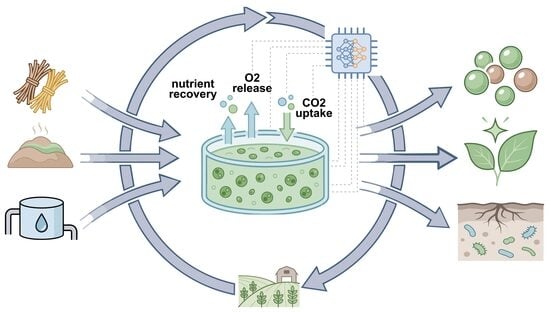
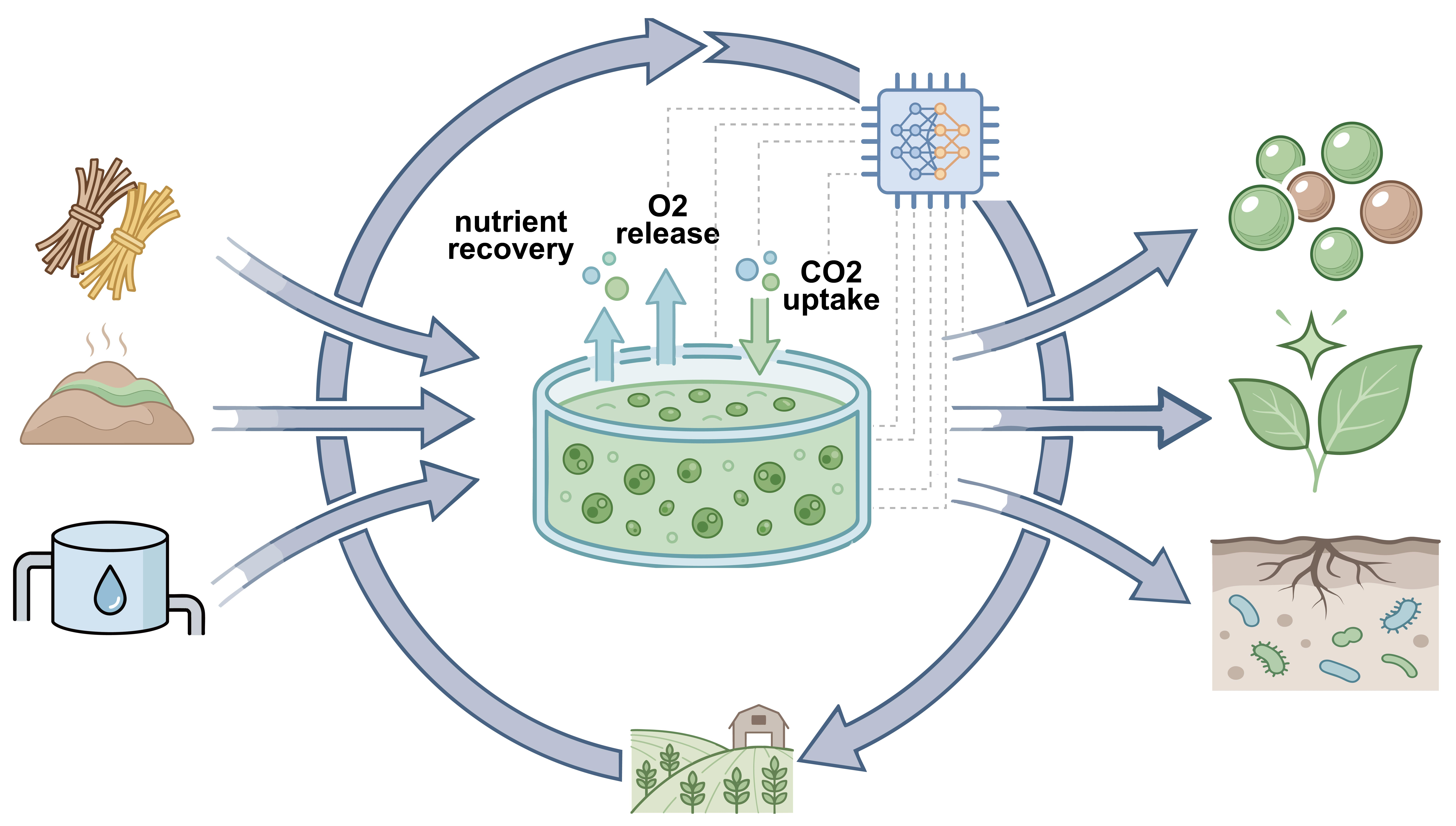
Under optimal operating conditions, microalgae-based treatment systems achieve nutrient removal performance that sometimes outperforms conventional biological treatment systems [51]. Bharti and co-workers, for instance, reported that by optimizing light intensity, photoperiod and hydraulic retention time, total N and total P removal rates of microalgal systems could be as high as 70–95% and 60–90%, respectively [52]. Such removal values greatly exceed those usually realized by activated sludge systems or biofilm systems [53,54]. Importantly, nutrients captured by microalgae are retained in the harvested algae and not lost through volatilization or chemical precipitation; hence, they do not lose their potential to be utilized downstream [18]. From an engineering point of view, high photosynthetic fixation of carbon, efficient utilization of nutrients, and biomass accumulation consolidate the high potentiality of microalgae-based treatment systems as a standalone platform for nutrient recovery and the purification of wastewater (Figure 1).
This figure depicts how microalgal systems link together waste treatment and agriculture industries. The system makes use of wastewater from livestock farming, agricultural runoff and food processing industries. Pollutants are converted into productive biomass, thanks to photosynthesis and nutrient assimilation by microalgae. The end products (biofertilizers, animal feed, and biomass pellets) are incorporated in the agricultural value chain, thus delivering a closed nutrient cycle.

2.3. Microalgae as a System-Level Converter: From Pollutant Removal to Resource Recovery

Microalgal technology engineering importance goes beyond treatment efficiency and suggests a new approach on system design, moving from an end-of-pipe pollutant removal strategy to a resource-perspective approach. In microalgae-based systems, the nutrients commonly considered as wastes are intentionally retained and transformed into value-added biomass so that they can be recycled into agriculture-related supply chains [18,58]. Harvested microalgal biomass containing high N, P, and O atoms is enriched with organic carbon and can be used as bio-fertilizers, bio-stimulators, soil amendments [59], or as an input for downstream biorefinery processes [60,61]. Through such transitions, microalgal systems create a kind of connection between waste treatment and producing some agricultural input goods, so as to achieve a closed nutrient cycle at the system level. Nevertheless, the practical application of microalgae technology itself also depends on specific conditions. Previous studies show that this technology works best when dealing with wastewater with a relatively low or moderate degree of nutrients. At this time, there are usually many lighting conditions, and a complete resource recovery track has been established [62]. Further research proves that the three key parameters that limit the practical application of microalgae are light intensity, CO2 concentration and nutrient conditions [63]. Among these, ensuring that enough light is in the reactor and controlling the appropriate liquid depth are important factors in ensuring the activity of photosynthesis. As soon as light becomes insufficient, it will directly lead to a large drop in the absorption efficiency of nutrition and biomass, and it also makes it difficult for microalgae technology to independently treat high-nutrient wastewater [64]. Therefore, lack of light has become one of the main bottlenecks restricting the operational performance of microalgae systems. In practice, we can improve the efficiency of wastewater treatment by adding a source of artificial light and also reducing the liquid depth of the reactor. These biological and engineering sensitivities indicate that in many practical cases without proper operation conditions, microalgae alone might not be sufficient to meet the treatment objectives, particularly for high organic loading or complex wastewater, in which metabolic flexibility may be lost with photoautotrophic cultivation alone.
Based on this, when the organic load is high or the light intensity is low, the microalgae system usually has to be combined with other complementary treatment methods. For example, anaerobic digestion can be used prior to microalgae cultivation to lower the chemical oxygen demand (COD), or advanced pretreatment can be employed to enhance the wastewater’s quality [65]. Such treatments would stabilize the system’s operation and enhance the recuperation efficiency. A combination of microalgae cultivation and anaerobic digestion of high-level organic waste streams can improve the overall resource balance of the system. That is, organic matter is removed as biogas, and the resulting digestate is nutrient-enriched, available for the use of algae [66]. For this combined mode, the application of microalgae is not to directly take the place of the traditional wastewater treatment but rather to integrate the connection interface between environmental rescue and resource recovery (Figure 1). That is, by converting a waste substance into microalgae for bio-oil (microalgae biomass can be used as fodder), a microalgae-based system offers a feasible way to transform the use of agricultural waste disposal from merely fulfilling regulatory requirements to the comprehensive nutrient recovery of agricultural waste in a circular bioeconomy [67].
Although microalgae have certain potential as a nutrient recovery and a biomass-to-product conversion facility, their practical application cannot simply apply a single indicator such as nutrient recovery efficiency or biomass conversion efficiency. Instead, one has to think about the coordinated development of technology, economy and ecology in aggregate. On top of that, microalgae-related product quality needs to fit the standards and norms of specific industries. They need to be applied for functions such as improving the content of soil organic matter, soil water retention and soil microbial activity to really ensure that the comprehensive benefits of agricultural sustainable development can be achieved. Thus, a comprehensive consideration is needed, that is, it is needed to connect engineering feasibility and ecological functions in order to transform recovered nutrients into applicable products that can really realize circular agriculture well. Thus, here lies the use of biomass valorization as the link between process-level recovery of nutrients and system performance. Different valorization routes—spanning direct use as biofertilizers to the valorization in high-value biostimulant production—have different trade-offs with regard to energy use, costs and agricultural suitability. Hence, a deeper discussion of the applicable microalgal biomass valorization pathways is necessary to evaluate the practical prospects of microalgae-based circular agricultural systems. Following our discussion of the resource recovery pathways above, Section 3 introduces the downstream transformations and agricultural uses of microalgal biomass and stresses the impact product pathway choice has on the performance and scalability of overall system performance.

3. Biomass Valorization Pathways and Agricultural Applications

The effects of microalgae-mediated circular agriculture systems depend not only on the efficiency of upstream nutrient recovery, but more importantly on the downstream biomass valorization pathway and its capacity to decide the agricultural fate of the recovered resources. Unlike with other waste residues, microalgal biomass can act as a versatile carrier, the agronomic value of which is not intrinsic but is strongly driven by the valorization and conversion strategy chosen [67]. Through valorization pathways, microalgal biomass can be valorized in various value-added agricultural products, such as biofertilizers [68], biostimulants [69] and biopesticides [70]. Each valorization pathway puts different pressures on energy consumption and economics, and is differently integrated with current farming and agricultural practices and thus directly affects the sustainability and scalability of the system.
From an engineering and environmental perspective, biomass valorization must be regarded as a core system design element rather than a subsidiary end-of-pipe step. Life cycle assessments consistently identify biomass harvesting and drying as major contributors to energy demand and carbon emissions in microalgal systems, highlighting the need for low-impact processing strategies. The use of gravity sedimentation instead of chemical flocculation can substantially reduce environmental footprints while maintaining acceptable recovery efficiencies. Moreover, successful agricultural application of microalgal products requires addressing practical constraints related to nutrient bioavailability, product stability, and field performance [71]. Direct application of raw biomass may yield inconsistent agronomic outcomes due to slow nutrient mineralization, particularly for phosphorus; such limitations can be mitigated through conversion technologies, such as hydrothermal carbonation, which enhance nutrient availability and improve soil amendment properties [72]. Realizing the full potential of microalgae in closing an agricultural nutrient loop will ultimately require a holistic approach, which co-optimizes the valorization routes on the basis of profitability as well as agronomic performance, such that biomass conversion effectively benefits circular farms.

3.1. Biomass Valorization as a System-Level Design Decision

The effectiveness of microalgae-driven circular agriculture relies heavily on how the harvested biomass is valorized in agriculture [73]. Microalgal biomass is rich in proteins, polysaccharides, lipids, pigments and phytohormone-like substances and it is thus suited for a large number of downstream valorization applications such as biofertilizers, biostimulants, soil amendments and feedstocks for further transformation in biorefineries [74]. From a design perspective, the valorization of biomass is not a downstream step of use but a design aspect and core decision that also governs nutrient recycling efficacy, process energy demand, economic feasibility and environmental performance [75]. Different levels of processing lead to different functionalities: low-processing valorization pathways favour nutrient retention at a high scale, while higher-value valorization pathways favour controllable physiological regulatory effects at higher complexity and product processing [76]. The effectiveness of agriculture functionality can then be considered as the outcome of a valorization approach rather than as an artefact with a single product attribute.

3.2. Low-Processing Pathways: Nutrient Recycling and Soil Conditioning

Direct use of whole or minimally processed microalgal biomass is the lowest processing intensity and the most straight-forward application of circular agricultural principles. Harvested biomass—fresh slurry, dried biomass, or partly stabilized products—can be directly applied to soils as a source of nutrients and as an organic amendment [77]. A clear advantage of this approach is its slow nutrient-releasing dynamics. The nitrogen, phosphorus and potassium in microalgal biomass are mostly in organically bound forms and slow down release to soil thanks to microbial breakdown [78]. This is closely matched to crop nutrient demand and significantly reduces nutrient losses in terms of leaching and runoff with respect to customary mineral fertilizers, improving the nutrient-use efficiency at the field scale [79].
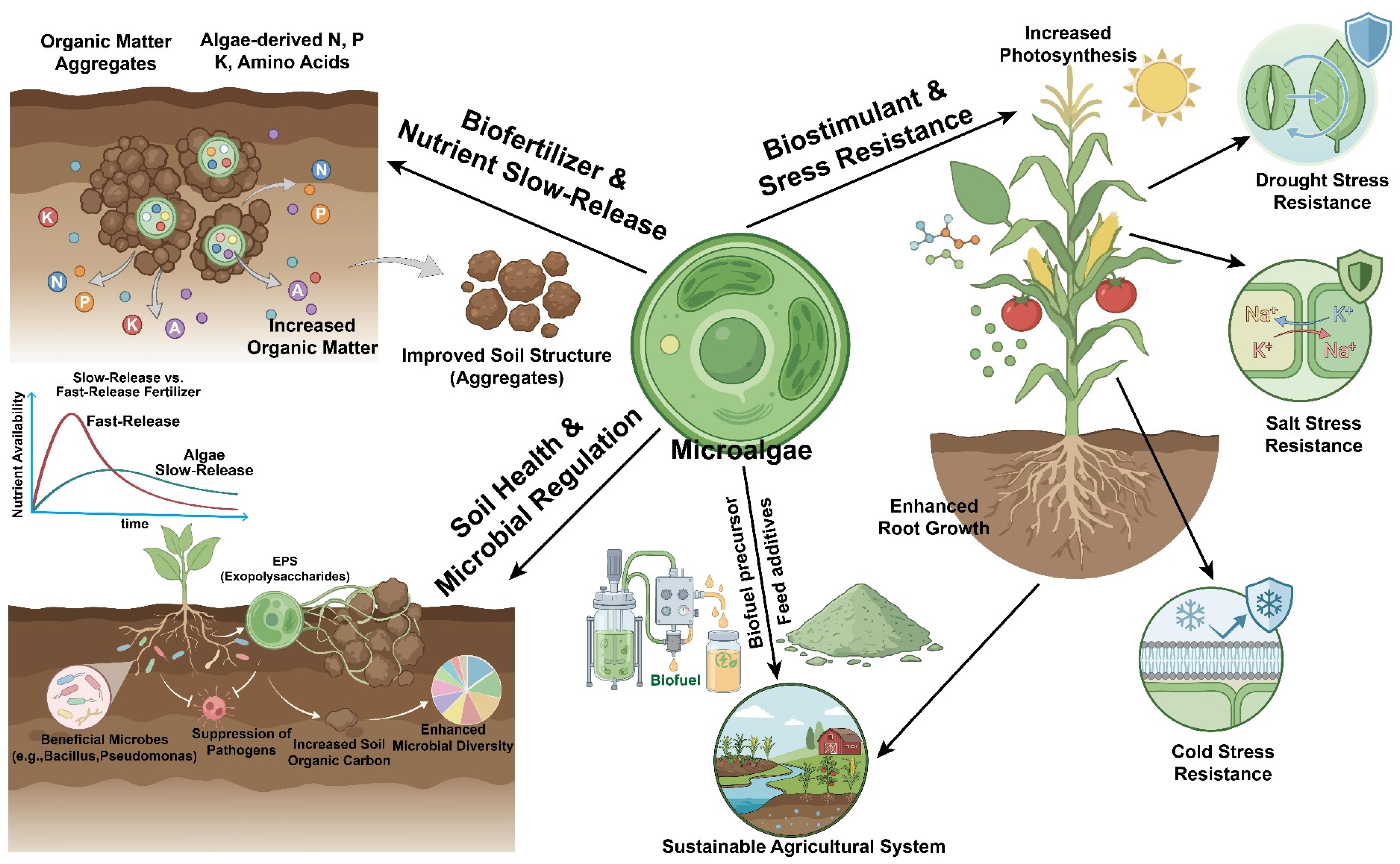
As discussed above, the incorporation of microalgal biomass improves soil physical properties and biological activities. More regular and repeated applications increase soil organic content, encourage soil aggregation, increase water-holding capacity and foster the microbial metabolism of soil—effects that are especially strong in degraded or organic-poor soils [80]. While microalgal biomass is relatively costly per unit volume and also variable in nutrients, it has low energy demand, high scalability and excellent agricultural compatibility, making it ideally suited for localized circular agricultural systems (Figure 2).
Figure 2 demonstrates how microalgae enhance agricultural systems through three major pathways: (1) Biofertilization and controlled nutrient release—By supplying nitrogen, phosphorus, potassium (N, P, K), and amino acids, promoting soil aggregate formation and enabling slow nutrient release (in contrast to quick-release fertilizers). (2) Soil health and microbial regulation—Secretion of extracellular polymeric substances (EPSs) stimulates the growth of beneficial microbes (e.g., Bacillus and Pseudomonas), increases microbial diversity, and suppresses pathogens. (3) Biostimulants and stress tolerance—Enhancement of plant photosynthesis and root development while improving resistance to abiotic stresses such as drought, salinity, and low temperature. (4) Bioenergy and feed applications—Microalgal biomass can be used as a biological precursor for producing clean bioenergy and feed additives. These applications provide renewable energy for agricultural activities and enhance livestock nutrition, thereby strengthening resource recycling and supporting a stable and sustainable agricultural system.

3.3. Moderate-Processing Pathways: Functional Stabilization and Agronomic Reliability

Processing strategies that fall into the range of those being moderately processed, such as drying, pelletizing, fermenting, co-composting, and formulation with other organic or mineral components, for instance, enhance the consistency, safety and agronomic reliability of microalgal products whilst keeping the energy and cost inputs acceptable [85]. This way of treating microalgal biomass transforms the microalgal biomass to a stabilized microalgal biofertilizer or amendment with more desirable properties for storage, handling and field performance [86]. At the level of moderately processed processing, microalgae are not only used as fertilizers. They can also be used efficiently for animal feed. For feed making, dried or slightly fermented microalgae (such as Chlorella and Spirulina) can be good feed additives. Dried microalgae (biofuel and feed are still under research and development) are rich in protein, polyunsaturated fatty acids and bioactive compounds. They are used for poultry, ruminants and aquaculture [87]. For instance, in new “land-free” circular farms, microalgae are cultivated from the livestock’s sewage. People first simply concentrate or dry them. Then, they can be directly used as liquid or pelletized feed for the animals [88]. Microalgae replace plant-based feeds. At the same time, they reduce the pressure on arable land. They make animal products richer. Also, they reduce the methane emissions by ruminant livestock [89]. Compared with direct application, moderately processed products have higher availability of bioactive substances and lower disease risk, while fermentation and co-composting lead to beneficial activity of microbes and accelerate the process of nutrient mineralisation [90], thus improving fertilizer-utilization efficiency and nutrient uptake in crops [91]. Additionally, in the conversion of bioenergy, microalgal biomass can also be turned into biofuels (biogas) by anaerobic digestion [92], which is also an important use. After this step, processing pathways are important intermediate pathways. In an agricultural circularity pathway, microalgae normally have a low carbon-to-nitrogen (C/N) ratio [93]. Thus, they are normally co-digested with carbon source materials (for example, crop straw, poultry manure or food waste) [94]. For example, microalgae can be fermented together with agricultural organic waste. In this pathway, renewable energy in the form of biogas can be produced, and digestate rich in nutrients can also be produced. The digestate can be reused to cultivate microalgae again. It can also be directly fertilized in farmland as liquid fertilizer [95]. In terms of system integration, such pathways balance performance improvement and engineering convenience, and integrate well with existing agricultural input supply chains. Although moderate processing unavoidably requires additional energy use and infrastructure, particularly in the drying and stabilization stages [96], its overall sustainability is greatly influenced by the local level of energy supply, the production scale and by the level of product homogeneity needed; still, in many circumstances in the field of agriculture, moderate-processing strategies represent a practical compromise between minimal energy cost nutrient recycling and product functionality.

3.4. High-Value Pathways: Biostimulants and Targeted Stress Regulation

Microalgae-driven circular agricultural biorefinery systems understand that HVPs are not just side-products but an independent subsystem affecting economic viability, market competitiveness and effectiveness of optimization schemes [97,98]. Biotechnology and systems engineering point out that optimization models are developed with only a focus on recovery efficiency and nutrient rationality, while, ignoring the valorization of HVPs, do not reflect the true technological competitiveness of the system and could result in unreliable AI models and multi-objective optimization for decision support. Thus, it is essential to explicitly include HVPs in overall process design and the expression of objective functions to promote realization of the concept of ‘‘no-waste operation” and industrial development of an integrated biorefinery [99]. HVPs harvested from microalgal biomass mainly include extracellular polysaccharides, free amino acids, carotenoids, antioxidant compounds and phytohormone-like bioactive compounds [100,101]. When applied to crops at low doses, these compounds can act as biostimulants to exert precise regulation of the signalling pathways for plant growth, improving plant resource use and stress adaptation [102,103,104]. When compared with a conventional fertilizer system that focuses on nutrient supply, biostimulants have the characteristics of high efficiency, selectivity and low input–high output to provide greater economic weight to HVPs in the entire system.
The stable production and directional synthesis of HVPs rely on engineering-level fine control of microalgal cultivation conditions [105]. Among them, light is not only a driving force for the growth of microalgal but also a metabolic switch that affects the distribution of carbon flux and induces secondary metabolite accumulation. Light intensity, spectral and photoperiod can be treated as designable, optimizable process variables that enable microalgae to synthesize different products such as proteins, polysaccharides, and antioxidant substances [64,106]. High light stress prompts Haematococcus pluvialis accumulates to accumulate astaxanthin for suppressing photo-oxidative harm [107], while for some kinds of microalgae, a particular light spectrum (for example, blue light) can induce the formation of bioactive polysaccharides [108]. In addition to light regulation, nutrient stresses such as nitrogen and phosphorus limitation and/or adjustments in the C/N ratio can reroute photosynthetic energy and carbon allocation towards the production of lipids, pigments and particular polysaccharides with a high added value [109]. These facts showcase that the formation of HVPs is not a passive phenomenon but a controlled metabolic result, an end product that can be achieved through smart process design. This controllability offers degrees of freedom that are very important to AI-supported dynamic optimization and control. Mindful of these strategic aspects of microalgal HVPs, we have to highlight that, beyond feedstocks, microalgal HVPs have very significant roles in the pharmaceutical and biomedical industries. In this respect, microalgae are increasingly considered irreplaceable natural biofactories [110] for conventional carotenoids but also for products with activity against viruses (for example, polysaccharides of Spirulina), against cancer (for example, astaxanthin) or beneficial for the nervous system [111,112]. These bioactive molecules typically have special structures and higher biological potency that are hard to obtain by traditional chemical synthesis and therefore have substantial commercial value and strategic significance in the development of drugs and functional food industries [113]. The combination of an agriculture-based microalgal cultivation system with a pharmaceutical-quality microalgal extract purification process could build a multi-track value-output biorefinery system, thereby closing value the loop from raw materials to final applications [114,115].
Overall, high-value pathways tightly knit together microalgal cultivation conditions, metabolic regulation and multi-tier application scopes, facilitating circular agriculture with economic and functional ends that go far beyond recovering a single nutrient objective. Explicitly incorporating HVPs into system designs and artificial intelligence (AI)-assisted optimization platforms bring them to be independent economic objectives or sub-objectives of system design, together with nutrient recovery efficiency, energy consumption and operating costs, inside a unified multi-objective function. Taking into account such integration helps to address the trade-off between resource circularity and value creation at the system level under dynamic and steady agricultural conditions, making decision-making fully reliable for scenario upgrades and the marketization of microalgae-based circular agriculture biorefinery systems.

3.5. Beyond Inputs: Soil Health Regulation and Microbiome Engineering

Apart from being nutrient carriers or biostimulants, microalgae are increasingly functioning as soil regulators and driver agents of soil health and microbial ecology [116]. Microalgae photosynthetically fix CO2 and secrete extracellular polysaccharides, proteins and various metabolites for soil organic carbon, directly contributing to the soil organic carbon pool and causing the formation of stable soil aggregates [117], thereby improving soil health, water-holding capacity and the long-term potential for soil carbon sequestration [59] (Figure 2). Meanwhile, microalgae also strongly regulate the soil microbial community structure and activity; their remains and extracellular substances can supply ready-made carbon and energy for promoting the activity of soil microbes, enriching community diversity and facilitating beneficial functional groups [118,119]. Sequestrate synergistic interactions with plant growth-promoting microorganisms improve the efficiency of nutrient mobilization and facilitate the inhibition of soil-borne pathogens via competition and the accumulation of antimicrobial products [120]. In contaminated or deteriorated soils, microalgae also participate in soil remediation by promoting nutrient activation, biological nitrogen fixation [121], immobilization of heavy metals and the improvement of soil under saline–alkali conditions [122]. Thus, by collectively remodelling soil physicochemical properties and microbial communities, microalgae help build up robust “microalgae–microbe–plant” interaction frameworks that can promote high-efficiency agricultural production and meet the goal of decreasing chemicals consumption.

3.6. System-Level Trade-Offs and Pathway Selection

At the system level, microalgal biomass valorization pathways cover a full spectrum with a continuously increasing processing intensity, energy input and function specificity. Low-processing valorization routes focus on the scalability, robustness and maximal protection of nutrients; high-value valorization pathways focus on targeted physiological control and higher value at the expense of higher technical complexity and energy inputs; and intermediate valorization routes can provide intermediate compromises between these two extremes. Crucially, none of the valorization pathways is the overall optimum; the correct choice of valorization is strongly context dependent and will take into account site-specific factors such as waste characteristics, local energy resource, agricultural market needs, infrastructural challenges and overall management goals. As such, biomass valorization needs to be seen as an integral part of system design and not merely as a downstream consideration, as it plays the fundamental role in nutrient cycle efficiency, energy balance and system performance. Thus, this system-level perspective is a critical starting point to form integrated deployment strategies and later to optimize them.

4. System Integration Pathways of Microalgae in Sustainable Agriculture and the Circular Economy

4.1. Microalgae-Driven Agricultural Circular System Models

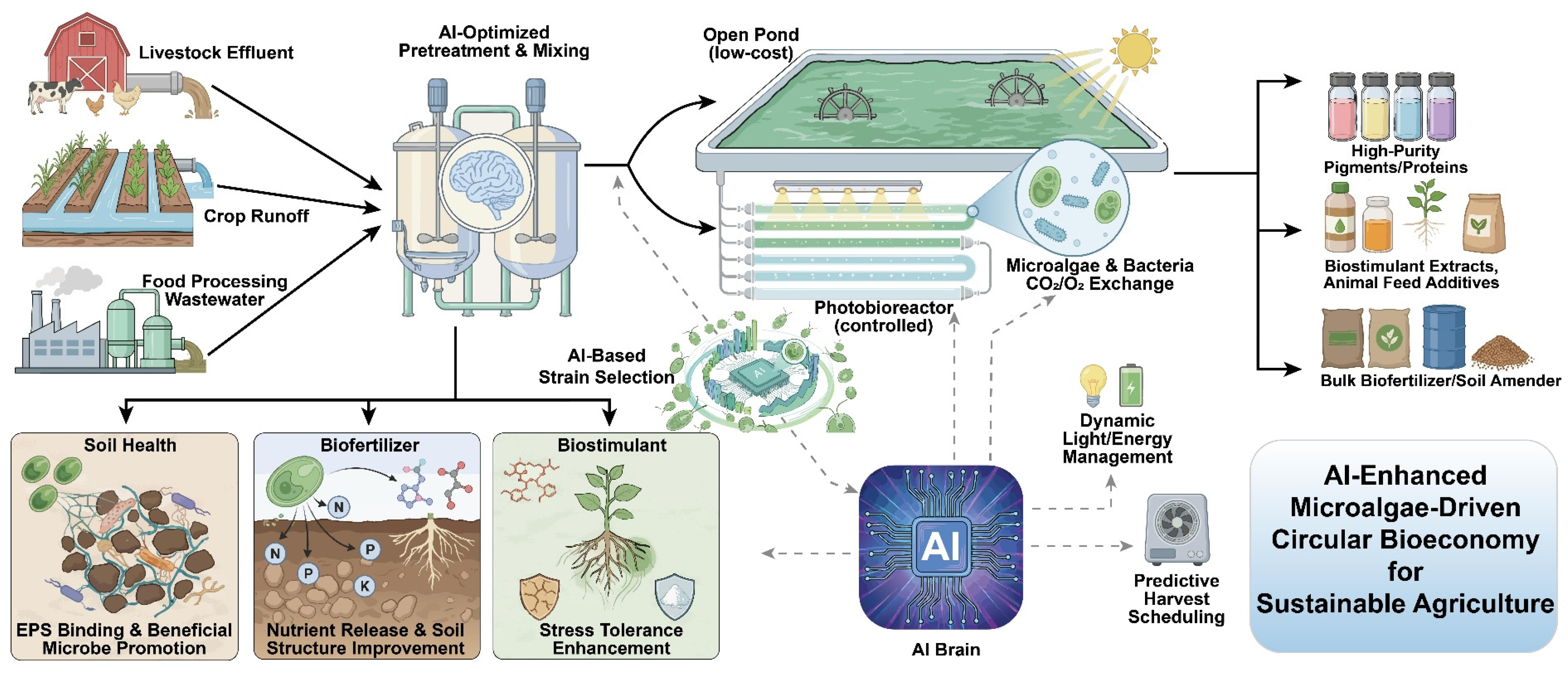
For an engineering system design of microalgae applications for agricultural circular systems, there is no single integrable option or best industrial configuration; instead, reasonable integrations should be determined by multidimensional trade-offs [123]. Precisely speaking, system design needs to simultaneously consider the stability of resource supply, input energy consumption, running costs, the value structure of the output, and the spatial–temporal matching of agricultural production processes. According to this, microalgae systems can be flexibly embedded in different kinds of agricultural circular system modes, and different integration pathways leading towards nutrient loops or value upgrading will emerge (Figure 3).
AI-assisted genomic screening is first used to find good microalgal strains for wastewater treatment and microalgal biomass. The AI system uses organic wastewater from livestock, farmland and the food processing industry as the input, which is then fed to the cultivation system (open ponds or photobioreactors) after AI optimization pretreatment and blending. The ‘AI brain’ (such as light control and harvesting time prediction) realizes real-time management; then, microalgae grow effectively and are converted into high-purity pigments, feed additive and biofertilizer, which can be used to improve the condition of fields, supply bio-nutrients and improve crop tolerance, closing a loop of recycling wastewater for the sustainable development of agriculture.
Within circular agriculture, given their high assimilation and bioconversion efficiencies, microalgae function as an interface for linking waste valorization with green agriculture production [129,130]. Starting from the viewpoint of system integration, microalgae are generally integrated into circular agricultural systems in the following roles: (1) as wastewater treatment and recovery units to remediate nutrient-containing wastewaters; (2) as bioconversion systems that convert carbon, nitrogen and phosphorus resources from waste into valuable biomass; and (3) as the heart of a multiproduct biorefinery system that simultaneously delivers valuable products such as biostimulants and feed additives. Depending on the role of a given system and system boundaries, two main integration schemes are proposed.
Another type is the simple circulation model for “nutrient loop closure”, such as the typical circulation pathway: “livestock and poultry wastewater–microalgal cultivation–algal fertilizer application to fields”. This model focuses more on direct recycling of agricultural nutrients, for which the livestock wastewater is used as the growth medium of microalgae, and then the microalgae is extracted to form the algal slurry through a very simple production process, which is applied directly as liquid fertilizer or liquid soil conditioner [131]. Due to a relatively simple process and high energy efficiency, this model is suitable for moderately sized livestock operations with nearby arable land to assimilate nutrients, thereby realizing in situ and low-cost cycle reuse of core nutrients such as nitrogen and phosphorus.
This results in a “product-oriented” integrated value-addition model, which forms a chain of “diverse agricultural wastewaters ⟶ microalgal growth ⟶ multiple-path product development”. Microalgal technologies provide specific pathways in circular agriculture, ranging from practical circular loops of agricultural nutrients to relatively advanced circular industry integration. At their most simple level, microalgae serve agricultural pollution mitigation. A more technologically integrated model broadens the roles of microalgae: in addition to bioremediation, microalgal biomass is used for marketable products such as high-purity extracts, biofuels and specialty feed ingredients. This scheme improves economic sustainability by offsetting the cost of operation [132]; meanwhile, it increases process technology complexity and the dependence on the market, which is more appropriate for large-scale biorefineries or local treatment facilities. The selection of these two pathways comes ultimately from different environmental objectives, different economic targets and regional characteristics.

4.2. Engineering Scale-Up and Economic Feasibility Challenges

Although microalgae have great application potential and some remarkable environmental advantages at the laboratory and small-experimental scales [133], the application of microalgae at the large-scale level in agricultural circular systems still has plenty of technical and economic issues [134]. Differing from linear technology pathways, the scale-up process of microalgae cultivation technologies cannot be reduced to a simple technique geometry scale-up but should be treated as an ongoing closed feedback and loop process of “scale-up–evaluate feedback–reoptimize” [135]. In an open and dynamic agricultural environment, several technical and economic feasibility problems still exist [136].
Cultivation systems and energy efficiency are the two main bottlenecks of large-scale production. The photoautotrophic growth of microalgae is heavily dependent on light and the adopted illumination strategy directly determines the cost and sustainability of the whole system [108]. Open raceway ponds have a simple structure and low investment costs and a basis for application in scenarios where the land is abundant [137]. However, open raceway ponds have their own inherent limitations: low light utilization efficiency, a high evaporation rate and a high possibility of contamination; thus, they face huge obstacles when operating in high-latitude regions or in winter (depending on natural light would increase the operational energy costs enormously) [138,139]. Contrary to the open photobioreactors mentioned above, closed photobioreactors have the advantages of controllability, high cultivation density and pollution control [136]. Studies have demonstrated that flat-panel, tubular, thin-film photobioreactors can largely improve light utilization efficiency and cell density [140], which makes the cultivation process more controllable and the achieved high cell density lowers the volumetric load and energy consumed in the following harvesting step (30–20% of the production cost in general [141]). Although investment in closed photobioreactors is high in advance, life cycle assessment and techno-economic analysis show that, for a special agricultural case, the yield advantage can be translated to economically favourable performance [142]. For example, when treating meat processing wastewater, a closed photobioreactor achieved a biomass productivity of 483.33 mg·L−1·d−1, which is more than five times higher than that of an open-pond system (95.00 mg·L−1·d−1), and also achieved 100% ammonium nitrogen removal; it also greatly decreased the energy used in the harvesting process and land footprint per unit biomass productivity in the closed photobioreactor [143]. Therefore, when facing land shortage and/or for HVP production, closed photobioreactors might be better than the usual open-pond system [144].
System design and operation have to be extremely flexible for the intermittent and seasonal discharge of agricultural waste [25]. The generation of livestock wastewater or processing by-products can dramatically change with agricultural production cycles [145], and is incompatible with stable and effective growth of microalgae. For microalgae engineering, the traditional “fixed-conditions” concept should be abandoned for a scale-up concept towards a dynamic synergy between processing capacity and the variable load on the system’s input. It requires an engineering system on a modular, “core-variable” basis, complemented by proper buffering and regulating units. The core of this engineering approach is a rigorous and closed-loop approach: reliable scale-up is not a straight, ever-forward process, but a cycle of “scale-up and scale-down” [146]. In particular, problems such as poor mixing, mass transfer limitations or physiological problems met during the pilot plant scale-up should also be treated as a signal that recommends subsequent “scale-down” design investigations in the lab. By going back to the lab to investigate mechanisms and tune up parameters [147,148], and then returning to the next design iteration to give back learned scientific insights, system stability and system efficiency are gradually improved. Such iteration cycles lead to scientific and reliable engineering scale-up. Through this cyclic iteration, the risk of engineering scaling-up failure can be decreased and this is the very important and core method for linking basic research with commercial application and fulfilling the engineering scaling-up process. With respect to economic feasibility, the economic competitiveness of a microalgae system does not rely on one factor only, but has multiple important factors such as energy efficiency, capital investment (CAPEX), operating cost (OPEX), stability of the system and flow of by-products and HVPs [149,150]. Various technological and economic assessments indicate huge differences for the economic performances of different cultivation systems and large engineering scale-up can further contribute to reducing unit production costs [151].
For large-scale systems, the design and operation optimization should be based on the technical and economic objective function, rather than considering solely the biological production rate or nutrient removal efficiency. Based on the construction of a target function from different characters such as energy consumption, investment and product value, different system structures, system operating modes and product paths can be quantified in a unified multi-objective trade-off space. This has set up a clear and transparent decision-making system for next-step AI-based modelling and optimization, enabling data-based trade-offs between resource recovery efficiency and economic performance.

4.3. Techno-Economic Feasibility and Multi-Product Synergy Strategies

In agriculture, microalgal systems designed for a single low-value product, such as normal biofertilizers, tend to be non-viable, as product revenues do not cover the cost of microalgal cultivation, harvesting and processing. Bypassing this bottleneck requires shifting to a multi-product, biorefinery approach in which microalgal biomass is valorized in successive uses and by product value extraction to get the maximum value of the system and spread the cost.
Specifically, the above strategy is for product portfolio diversity. Most of the microalgal biomass can be processed cost-effectively—for example, slurry preparation or simple drying—and then directly used as high-quality organic fertilizer or soil conditioner, achieving its main nutrition recycling role and bringing the basic revenue to a stable level [152]. At the same time, part of the microalgal biomass is processed to extract high-value products, such as certain polysaccharides, proteins or pigments, which can be developed to different biostimulants, feed additives, natural pigments, etc. [153]. Such a “baseline primary product with value-added co-products” development model internalizes the cost of agricultural waste treatment for the environment, but shifts the burden to high-value and marketable products, greatly enhancing the stability to the project’s business operation and overall robustness (Figure 3).
Consequently, future engineering design of microalgae-based agriculture systems has to achieve a fundamental change in paradigm: going from improving the performance of isolated micro-algal components, such as that of the photobioreactor efficiency, towards integrated system designs with a target at net benefits of the whole system. Implementing this from scratch means that feedstocks, pathways, energy networks, products, and environmental aspects are all simultaneously considered. Multi-objective optimization finds the optimal trade-off between technical and economic feasibility. The adoption of a system-integrated, multi-product biorefinery approach is essential to scale microalgal technologies from pilots to full agricultural applications and to achieve efficient integration of such technologies into a circular economy, as proposed recently [113].

4.4. Artificial Intelligence-Assisted Optimization of Microalgae-Based Agricultural Systems

The increasing complexity of microalgae-driven circular agriculture, as reflected in the strong spatiotemporal dependence of feedstock properties, of growing conditions and of system performance, reveals the limits of straightforward empirical optimization [154]. New research indicates that AI- and data-driven methods can help most in combination with mechanistic knowledge and be implemented within a well-defined framework of control structures instead of as so-called point solutions [155,156]. Their effectiveness is ultimately a function of good data and the clear understanding of the biological systems involved in circular agriculture. In this case, AI mostly plays mostly the role of a tool that enhances instead of replaces the existing scientific and engineering knowledge. A full AI-supported approach therefore needs to start with biological mechanisms followed by process control and system-level integration.
Within microalgae-based agricultural cycles, the effective use of AI begins with the identification and design of engineered strains that match specific application goals. Methods of strain screening can be slow, labour-intensive and uncertain [157]. The rapid development of AI has started to tackle this upstream challenge [158]. Machine learning models can incorporate information from multi-omics data, including from genomics [159], transcriptomics and metabolomics, to identify genetic markers associated with efficient nutrient uptake, strong environmental tolerance and the synthesis of high-value compounds [160]. By combining physiological data for algal strains with simulations of different environmental scenarios, AI models can also predict phenotypic performance for different complex wastewater substrates and fluctuating climatic scenarios. These predictions can orientate high-throughput phenotypic screening, increase the efficiency of screening and shorten the development time [161]. This step supplies the biological basis for subsequent process optimization and process integration [162]. In practice, AI has mostly played the role of an accelerator in this stage, and its predictions still need experimental identification, verification, and detailed mechanistic analysis.
Once high-performance engineered strains have been obtained, fine control of cultivation conditions is key to improving the overall performance of the system. Microalgal growth occurs with variation in several parameters simultaneously, such as nutrients, light and temperature. These variables, and how they interact, in complex and nonlinear ways, often make it challenging for simple mechanistic models, based on various assumptions and simplifications, to offer a precise description. AI offers practical ways to resolve this challenge. Some data-driven methods are also available (including ML [163], artificial neural networks [164], support vector regression [165], random forests and long short-term memory networks (LSTMs) [166]) to learn patterns and correlations from historical and real-time data. They are able to describe the system dynamics and predict key parameters such as biomass productivity and nutrient removal efficiency [167]. Based on the predictions, AI models can even aid in dynamic planning and real-time tuning of operating parameters [168]. Therefore, the parameters of hydraulic retention time, nutrient load, light regulation measures and harvest duration, among others, can be adjusted all the time so as to keep high levels of nutrient recoveries and biomass production under variabilities [169]. These RL methods are natural for this problem because they constantly update operation strategies with feedback, which lets cultivation systems move from fixed conditions to adaptive control. These AI models can also be blended with optimization methods, such as Bayesian optimization and genetic algorithms, to enhance operation strategies and to reconcile different objectives (for example, productivity, energy and resource use) [57].
At the system level, microalgae technologies need to be integrated with different types of farms, agricultural land (crop land), and energy infrastructures. Such integration also leads to complex problems of decision-making that involve competing objectives, long-term uncertainty and matching of multiple dynamic flows [170]. AI-assisted decision-support frameworks are helpful in such contexts. Combining AI-based surrogate models with multi-objective optimization algorithms such as genetic algorithms and particle swarm optimization, researchers can compare various integration schemes. Examples include coupling microalgae cultivation with aquaculture treatment waters or using microalgae for greenhouse CO2 consumption. These approaches enable quantitative evaluations of the use of energy, economic return and environmental impact, which can help to identify the appropriate system configurations for the application [128,171]. Agricultural wastes also vary in both their flow and composition [172]. AI-based predictive models can aggregate historical records with climate information to estimate the future load of a particular nutrient. Such predictions can help operational scheduling and adaptive management in advance to ensure the stable performance of nutrient treatment [173]. AI can also link different analytical approaches. Process models, LCA, and techno-economic analysis (TEA) can be brought together on a common data structure, and can also be evaluated at the process, system and sustainability levels. To achieve economically viable microalgae-based circular agriculture, AI-assisted optimization must be based on a well-defined techno-economic objective function (OF). In the same way as with the biorefinery concept, the aim is not only maximizing microalgae biomass production. The economic outcome is driven by producing HVPs, such as drugs and bioactive compounds [174,175]. Therefore, a reliable optimization framework should simultaneously factor in: the genetic potential of targeted strains; dynamic environmental regulation strategies such as light and nutrient stress; and overall techno-economic feasibility. Mathematically speaking, the AI algorithm should maximize total profit Z over the length of cultivation time period T based on a biorefinery framework optimization model [176].
M a x i m i z e   Z = 0 T i P H V P , i · Y H V P , i S , U ( t ) ) + P b u l k · Y b u l k S , U ( t ) ) C U t d t C A P E X
In this objective function, the variables are defined as follows:
S (strain selection) represents the initial boundary condition of the system. Selecting a suitable microalgae strain determines the theoretical upper limit for producing high-value products [177]. Without high-performance strains, improvements in later process stages remain limited.
U(t) (dynamic operating conditions) represents the control variables in the optimization process, mainly including real-time regulation of light strategies and nutrient stress. By adjusting U(t) through AI-supported control, targeted stress conditions can be applied to redirect cellular metabolism toward the accumulation of high-value products such as specific bioactive compounds [178].
Y and P denote product output and market price. YHVP,i represents the dynamic yield of the i-th high-value product and corresponds to its market price PHVP,i. This component is the main contributor to economic performance because the revenue from HVPs is typically much higher than that from bulk biomass products.
C(U(t)) and CAPEX represent operating costs and capital expenditure, including the cost of maintaining facilities such as closed photobioreactors [179].
By using this techno-economic objective function, the dynamic programming algorithm is able to assess the trade-off between the high cost of closed photobioreactors and the returns from high-value products. This function assists in the rapid, efficient, low-waste transition from laboratory to industrial-scale production and ensures that this technical approach remains economically competitive. The bottom line is that AI provides a systematic way to optimize microalgae-driven circular agriculture in a hierarchic structure of “algae species design–process regulation–system integration design”. However, it must be clear that within this paradigm, the core role of artificial intelligence is as an augmentative tool that empowers and improves the science foundations and engineering of the system rather than a system that solves problems autonomously.

4.5. Performance-Based Comparison and System-Level Evaluation

From the system-level perspective, microalgae-based platforms should be evaluated holistically using integrated system-level metrics, such as nutrient recovery efficiency, energy demand, greenhouse gas mitigation and their impact on farming practices. As summarized in Table 1, microalgae-based systems usually have higher nitrogen and phosphorus recovery efficiencies than existing technologies such as composting, anaerobic digestion, constructed wetlands or chemical precipitation; meanwhile, they generate multifunctional biomass suitable for direct recycling into agriculture. The system includes multifunctionality—from biofertilizers and biostimulants to soil amendments—and has a specific advantage for circular agricultural uses, because it couples waste treatment with the recycling of nutrients and product substitution. However, Table 1 also shows that this benefit has a moderate-to-high energy cost (on harvesting, dewatering and downstream processing) that might offset environmental benefits if not managed. By contrast, conventional technologies are lower in energy requirements or higher in robustness of operation, but often present with poorer nutrient exploitation, product capability or potential for deployment and integration. Consequently, the overall success of microalgal systems does not require maximum realization of any single performance index, but, instead, requires trade-offs to be balanced between nutrient harvest, energy input and product use in any given situation. This comparison illustrates the value of integrated system-level design and pathway choice, rather than the isolation of process optimizations, when assessing the role of microalgae in circular agricultural systems.

5. Challenges and Future Perspectives

Even though the multifunctional potentials of microalgae in agricultural circular systems have already been widely verified, the large-scale use of microalgae still faces systematic challenges [187]. Among them, strain selection, as the first step of the microalgae technology path, is the key foundation for guaranteeing the stability of the system, the yield and its economy. However, at present, existing studies are mostly committed to engineering scaling-up and process optimization but pay no attention to the systematic methodology of strain screening [135,188]. For future studies, a goal-oriented strain screening system for particular agricultural scenarios should be generated, taking into account various factors, including growth rate, efficiency of the utilization of light energy, absorption capacities of nutrients and even pollution resistance and stress resistance, as well as the synthetic potential of HVPs [189]. Using high-throughput screening methods, metabolomics analysis and genomic-assisted selection, a functional strain library suited to different types of wastewaters and climate conditions can be constructed, to provide a biological basis to inform subsequent process optimization and large-scale scaling-up.
At the engineering level, scaling up microalgae circular agriculture involves not only expansion of the equipment and infrastructure but also a systems engineering process that synergistically balances the biological limit, process design and economics objectives [190]. Future research should strengthen the coupled design between “strain–process–system”, achieving a dynamic balance between nutrient recovery efficiency and energy consumption control by improving light energy utilization efficiency, optimizing reactor structure, and constructing stable algae–microbe symbiotic systems [191]. At the same time, engineering scale-up should also follow a closed-loop approach of “scale-up–scale-down” bidirectional confirmation to guarantee the transferable and stable factors of parameters in various scales. At the level of system integration, deep integration of microalgae technology into existing agriculture infrastructures represents a path towards increasing its techno-economic feasibility. For example, when embedding microalgae cultivation into livestock and poultry farming systems [192], facility agriculture or agricultural wastewater treatment plants can accomplish on-site nutrient recycling and effective use of spatial utilization [193]. Constructing modular models for recycling according to regional resource endowments can increase the adaptability of the recycling system to fluctuations in raw materials and environmental changes (Table 2).
Another important direction for improving the benefit of the system as a whole is to diversify product utilization pathways. In addition to being biofertilizers and biostimulants, microalgae biomass can also be high-tech transformed into feed additives, functional materials and active substances for pharmaceuticals [199]. Future research efforts need to shift from a single-product development for microalgae to a multi-product cooperative development that brings about nutrient recovery, biomass production, high-value-added compounds that are complementary with each other and compose a multi-product value stream [200]. Meanwhile, this would also enhance the economic sustainability of the system. By taking advantage of digital and smart technologies, new opportunities in microalgae circular agriculture can also be created. The integration of the sensor network, automatic control and AI-based statistics can deliver real-time control and dynamic optimization of the process [201]. Thereafter, AI-based LCA and TEA can also assist scenario assessment for different strains, system designs and product selections. These tools assess the main trade-offs—such as between energy input, carbon mitigation and economic return—to provide a scientific basis for technology deployment strategies.
Overall, the future development of microalgae circular agriculture systems should shift from single-technology optimization to a comprehensive framework that synergistically promotes strain selection, engineering design, system integration, and multi-objective optimization. Only by establishing a close coupling between biological fundamentals, engineering methods, and digital optimization can microalgae technology be transformed from laboratory innovation to large-scale, economically feasible, and environmentally sustainable agricultural applications.

6. Conclusions

Microalgae-driven circular agriculture is an important pathway for the resource utilization of agricultural waste, closed-loop recycling of nutrients from agriculture and a low-carbon transformation of agriculture. Basically, in this review, we summarize the major functions of microalgae in nutrient recovery, microalgae biomass valorization and system integration. It also highlights that large-scale and sustainable development must rely on a multi-level collaborative optimization development process to optimize the strain, process and system. Within this system, strain screening and evaluation of the genetic potential are the biological basis of the technological system: both influence the efficiency of nutrient conversion and the generation of high-value products. Engineering-scale expansion should be checked with a closed-loop approach that integrates scale-up and scale-down. Such a strategy will guarantee the stability and transferability of parameters for different operation scales and boost the coupling between microalgae units and the agriculture structure. At the level of the economic structure, coordinated development of HVPs is important for HVPs to improve economic feasibility and increase the capability of the system to develop an economic risk buffer. It should be included into a unified multi-objective techno-economic function alongside nutrient recovery efficiency and the energy utilization level. Artificial intelligence and digital modelling are key tools for the dynamic optimization of complex systems. However, their practical application requires the construction of an objective function proposed from the scientific perspective and the build-up of complete system components. To summarize, a microalgae-driven circular agriculture is a multi-variable, multi-constraint, and multi-objective system optimization problem. Long-term sustainability requires a coordinated balance of biological performance, engineering parameters and economic structure. Future research should strengthen the coupling between strain design and system-level optimization, build transparent AI-assisted decision-making models and examine techno-economic and ecological performance, to be realized under real agricultural conditions. Such work would facilitate the large-scale employment of microalgae technology and facilitate the transformation and upgrading of the circular agricultural system.

Author Contributions

X.L.: Writing—Original Draft, Visualization, Methodology, Formal Analysis, and Conceptualization. L.W.: Data Curation, Resources, and Writing—Original Draft. C.X.: Writing—Review and Editing and Visualization. H.L.: Data Curation, Writing—Review and Editing, and Visualization. G.L.: Supervision, Resources, Project Administration, and Conceptualization. S.Y.: Project Administration and Supervision. All authors have read and agreed to the published version of the manuscript.

Funding

This work was supported by the Doctoral Scientific Research Start-up Fund of China (Grant No. KYQD2025010, KYQD2020019), as well as the Ganzhou District Science and Technology Plan of China (Grant No. GZ2024JS38).

Institutional Review Board Statement

Not applicable.

Informed Consent Statement

Not applicable.

Data Availability Statement

No new data were created or analyzed in this study.

Conflicts of Interest

Authors Xiaoyan Liu, Lijuan Wang, Chunyu Xing, Haiyan Liu, Guanghong Luo and Shenghui Yang were employed by the Gansu Kaiyuan Biotechnology Development Center Co., Ltd. Authors declare that the research was conducted in the absence of any commercial or financial relationships that could be construed as a potential conflict of interest.

References

  1. Gao, X.; Yang, J.; Liu, W.; Li, X.; Zhang, W.; Wang, A. Effects of Alkaline Biochar on Nitrogen Transformation with Fertilizer in Agricultural Soil. Environ. Res. 2023, 233, 116084. [Google Scholar] [CrossRef]
  2. Guo, Y.; Qiu, T.; Gao, M.; Ru, S.; Gao, H.; Wang, X. Does Increasing the Organic Fertilizer Application Rate Always Boost the Antibiotic Resistance Level in Agricultural Soils? Environ. Pollut. 2023, 322, 121251. [Google Scholar] [CrossRef]
  3. Shan, G.; Li, W.; Bao, S.; Li, Y.; Tan, W. Co-Hydrothermal Carbonization of Agricultural Waste and Sewage Sludge for Product Quality Improvement: Fuel Properties of Hydrochar and Fertilizer Quality of Aqueous Phase. J. Environ. Manag. 2023, 326, 116781. [Google Scholar] [CrossRef] [PubMed]
  4. Ma, R.; Zou, J.; Han, Z.; Yu, K.; Wu, S.; Li, Z.; Liu, S.; Niu, S.; Horwath, W.R.; Zhu-Barker, X. Global Soil-derived Ammonia Emissions from Agricultural Nitrogen Fertilizer Application: A Refinement Based on Regional and Crop-specific Emission Factors. Glob. Change Biol. 2021, 27, 855–867. [Google Scholar] [CrossRef] [PubMed]
  5. Liu, X.; Wang, Q.; Wang, Y.; Shen, S.; Ge, Y.; Pan, K.; Guo, X.; Lei, Y.; Gao, Y. Strategy for Nitrogen Fertilizer Substitution: Co-Composting of Agricultural Waste to Regulate Vegetable Quality and Rhizosphere Microorganisms. Ecotoxicol. Environ. Saf. 2025, 302, 118573. [Google Scholar] [CrossRef]
  6. Sani, M.N.H.; Amin, M.; Siddique, A.B.; Nasif, S.O.; Ghaley, B.B.; Ge, L.; Wang, F.; Yong, J.W.H. Waste-Derived Nanobiochar: A New Avenue towards Sustainable Agriculture, Environment, and Circular Bioeconomy. Sci. Total Environ. 2023, 905, 166881. [Google Scholar] [CrossRef]
  7. Silvius, J.; Hoogstra, A.G.; Candel, J.J.L.; De Olde, E.M.; De Boer, I.J.M.; Termeer, C.J.A.M. Determining the Transformative Potential of Circular Agriculture Initiatives. Ambio 2023, 52, 1968–1980. [Google Scholar] [CrossRef]
  8. Kumar Sarangi, P.; Subudhi, S.; Bhatia, L.; Saha, K.; Mudgil, D.; Prasad Shadangi, K.; Srivastava, R.K.; Pattnaik, B.; Arya, R.K. Utilization of Agricultural Waste Biomass and Recycling toward Circular Bioeconomy. Environ. Sci. Pollut. Res. 2022, 30, 8526–8539. [Google Scholar] [CrossRef]
  9. Sheer, A.; Fahad Sardar, M.; Younas, F.; Zhu, P.; Noreen, S.; Mehmood, T.; Ur Rahman Farooqi, Z.; Fatima, S.; Guo, W. Trends and Social Aspects in the Management and Conversion of Agricultural Residues into Valuable Resources: A Comprehensive Approach to Counter Environmental Degradation, Food Security, and Climate Change. Bioresour. Technol. 2024, 394, 130258. [Google Scholar] [CrossRef]
  10. Liu, X.; Park, H.; Ackermann, Y.S.; Avérous, L.; Ballerstedt, H.; Besenmatter, W.; Blázquez, B.; Bornscheuer, U.T.; Branson, Y.; Casey, W.; et al. Exploring Biotechnology for Plastic Recycling, Degradation and Upcycling for a Sustainable Future. Biotechnol. Adv. 2025, 81, 108544. [Google Scholar] [CrossRef] [PubMed]
  11. Grossmann, L. Sustainable Media Feedstocks for Cellular Agriculture. Biotechnol. Adv. 2024, 73, 108367. [Google Scholar] [CrossRef] [PubMed]
  12. Serrano, A.; Wyn, H.; Dupont, L.; Villa-Gomez, D.K.; Yermán, L. Self-Sustaining Treatment as a Novel Alternative for the Stabilization of Anaerobic Digestate. J. Environ. Manag. 2020, 264, 110544. [Google Scholar] [CrossRef] [PubMed]
  13. Nur, M.M.A.; Mahreni; Murni, S.W.; Setyoningrum, T.M.; Hadi, F.; Widayati, T.W.; Jaya, D.; Sulistyawati, R.R.E.; Puspitaningrum, D.A.; Dewi, R.N.; et al. Innovative Strategies for Utilizing Microalgae as Dual-Purpose Biofertilizers and Phycoremediators in Agroecosystems. Biotechnol. Rep. 2025, 45, e00870. [Google Scholar] [CrossRef]
  14. Nie, J.; Sun, Y.; Zhou, Y.; Kumar, M.; Usman, M.; Li, J.; Shao, J.; Wang, L.; Tsang, D.C.W. Bioremediation of Water Containing Pesticides by Microalgae: Mechanisms, Methods, and Prospects for Future Research. Sci. Total Environ. 2020, 707, 136080. [Google Scholar] [CrossRef] [PubMed]
  15. Çakirsoy, I.; Miyamoto, T.; Ohtake, N. Physiology of Microalgae and Their Application to Sustainable Agriculture: A Mini-Review. Front. Plant Sci. 2022, 13, 1005991. [Google Scholar] [CrossRef]
  16. Wollmann, F.; Dietze, S.; Ackermann, J.; Bley, T.; Walther, T.; Steingroewer, J.; Krujatz, F. Microalgae Wastewater Treatment: Biological and Technological Approaches. Eng. Life Sci. 2019, 19, 860–871. [Google Scholar] [CrossRef]
  17. Zhang, A.; Fang, S.; Ge, M.; Zhang, J.; Xi, H.; Xu, Y.; Gao, Z.; Huang, Z.; Liu, M. Microalgae-Derived Hydrogels/Membranes for Phosphorus Removal and Recovery from Aquaculture Tailwater: Waste Utilization and Phosphorus Recycling. Bioresour. Technol. 2024, 409, 131246. [Google Scholar] [CrossRef]
  18. Santos, F.M.; Pires, J.C.M. Nutrient Recovery from Wastewaters by Microalgae and Its Potential Application as Bio-Char. Bioresour. Technol. 2018, 267, 725–731. [Google Scholar] [CrossRef]
  19. Alavianghavanini, A.; Shayesteh, H.; Bahri, P.A.; Vadiveloo, A.; Moheimani, N.R. Microalgae Cultivation for Treating Agricultural Effluent and Producing Value-Added Products. Sci. Total Environ. 2024, 912, 169369. [Google Scholar] [CrossRef]
  20. Yan, Q.; Zhang, Y.; Xu, Z.; Qu, W.; Li, J.; Li, W.; Zhao, C.; Ling, H. Irrigation of Suaeda salsa with Saline Wastewater and Microalgae: Improving Saline–Alkali Soil and Revealing the Composition and Function of Rhizosphere Bacteria. Microorganisms 2025, 13, 1653. [Google Scholar] [CrossRef]
  21. González-Pérez, B.K.; Rivas-Castillo, A.M.; Valdez-Calderón, A.; Gayosso-Morales, M.A. Microalgae as Biostimulants: A New Approach in Agriculture. World J. Microbiol. Biotechnol. 2022, 38, 4. [Google Scholar] [CrossRef]
  22. Khiewwijit, R.; Chainetr, S.; Thiangchanta, S.; Ngoenkhumkhong, K. Development of Sustainable Poultry Waste Management Using Integrated Microalgae Cultivation: Towards Performance, Resource Recovery and Environmental Impact. Heliyon 2024, 10, e40885. [Google Scholar] [CrossRef]
  23. Chakraborty, B.; Gayen, K.; Bhowmick, T.K. Transition from Synthetic to Alternative Media for Microalgae Cultivation: A Critical Review. Sci. Total Environ. 2023, 897, 165412. [Google Scholar] [CrossRef] [PubMed]
  24. Yu, S.; Chen, Z.; Li, M.; Qiu, S.; Lv, Z.; Ge, S. Principles, Challenges, and Optimization of Indigenous Microalgae-Bacteria Consortium for Sustainable Swine Wastewater Treatment. Bioresour. Technol. 2024, 406, 131055. [Google Scholar] [CrossRef] [PubMed]
  25. Yan, B.; Li, Y.; Qin, Y.; Shi, W.; Yan, J. Spatial-Temporal Distribution of Biogas Production from Agricultural Waste per Capita in Rural China and Its Correlation with Ground Temperature. Sci. Total Environ. 2022, 817, 152987. [Google Scholar] [CrossRef] [PubMed]
  26. Koul, B.; Yakoob, M.; Shah, M.P. Agricultural Waste Management Strategies for Environmental Sustainability. Environ. Res. 2022, 206, 112285. [Google Scholar] [CrossRef]
  27. Liu, H.; Long, J.; Zhang, K.; Li, M.; Zhao, D.; Song, D.; Zhang, W. Agricultural Biomass/Waste-Based Materials Could Be a Potential Adsorption-Type Remediation Contributor to Environmental Pollution Induced by Pesticides-A Critical Review. Sci. Total Environ. 2024, 946, 174180. [Google Scholar] [CrossRef]
  28. Xu, Q.; Zhang, T.; Niu, Y.; Mukherjee, S.; Abou-Elwafa, S.F.; Nguyen, N.S.H.; Al Aboud, N.M.; Wang, Y.; Pu, M.; Zhang, Y.; et al. A Comprehensive Review on Agricultural Waste Utilization through Sustainable Conversion Techniques, with a Focus on the Additives Effect on the Fate of Phosphorus and Toxic Elements during Composting Process. Sci. Total Environ. 2024, 942, 173567. [Google Scholar] [CrossRef]
  29. Zhao, L.; Liu, L.; Liu, X.; Shu, A.; Zou, W.; Wang, Z.; Zhou, Y.; Huang, C.; Zhai, Y.; He, H. Efficient Phosphorus Recovery from Waste Activated Sludge: Pretreatment with Natural Deep Eutectic Solvent and Recovery as Vivianite. Water Res. 2024, 263, 122161. [Google Scholar] [CrossRef]
  30. Singh, R.; Paritosh, K.; Pareek, N.; Vivekanand, V. Integrated System of Anaerobic Digestion and Pyrolysis for Valorization of Agricultural and Food Waste towards Circular Bioeconomy: Review. Bioresour. Technol. 2022, 360, 127596. [Google Scholar] [CrossRef]
  31. Bai, Z.; Liu, L.; Obersteiner, M.; Mosnier, A.; Chen, X.; Yuan, Z.; Ma, L. Agricultural Trade Impacts Global Phosphorus Use and Partial Productivity. Nat. Food 2023, 4, 762–773. [Google Scholar] [CrossRef]
  32. Suparanon, T.; Ouiseng, P.; Phetwarotai, W. Fabrication of Highly Flame Retardancy and Impact Strength Polylactide Foams with Phosphorus-Containing and Agricultural Waste-Derived Multifuctional Additives. Int. J. Biol. Macromol. 2024, 282, 136684. [Google Scholar] [CrossRef]
  33. Nag, R.; Auer, A.; Markey, B.K.; Whyte, P.; Nolan, S.; O’Flaherty, V.; Russell, L.; Bolton, D.; Fenton, O.; Richards, K.; et al. Anaerobic Digestion of Agricultural Manure and Biomass—Critical Indicators of Risk and Knowledge Gaps. Sci. Total Environ. 2019, 690, 460–479. [Google Scholar] [CrossRef] [PubMed]
  34. Boarino, A.; Demichelis, F.; Vindrola, D.; Robotti, E.; Marengo, E.; Martin, M.; Deorsola, F.; Padoan, E.; Celi, L. Bio-Physical Pre-Treatments in Anaerobic Digestion of Organic Fraction of Municipal Solid Waste to Optimize Biogas Production and Digestate Quality for Agricultural Use. Waste Manag. 2024, 189, 114–126. [Google Scholar] [CrossRef]
  35. Li, J.; Hao, X.; Shen, Z.; Wu, Y.; Van Loosdrecht, M.C.M. Low-Temperature Drying of Waste Activated Sludge Enhanced by Agricultural Biomass towards Self-Supporting Incineration. Sci. Total Environ. 2023, 888, 164200. [Google Scholar] [CrossRef]
  36. Pan, S.-Y.; Tsai, C.-Y.; Liu, C.-W.; Wang, S.-W.; Kim, H.; Fan, C. Anaerobic Co-Digestion of Agricultural Wastes toward Circular Bioeconomy. iScience 2021, 24, 102704. [Google Scholar] [CrossRef]
  37. Fallahi, A.; Rezvani, F.; Asgharnejad, H.; Khorshidi Nazloo, E.; Hajinajaf, N.; Higgins, B. Interactions of Microalgae-Bacteria Consortia for Nutrient Removal from Wastewater: A Review. Chemosphere 2021, 272, 129878. [Google Scholar] [CrossRef] [PubMed]
  38. Hu, J.; Wang, D.; Chen, H.; Wang, Q. Advances in Genetic Engineering in Improving Photosynthesis and Microalgal Productivity. Int. J. Mol. Sci. 2023, 24, 1898. [Google Scholar] [CrossRef]
  39. Burlacot, A.; Peltier, G. Energy Crosstalk between Photosynthesis and the Algal CO2-Concentrating Mechanisms. Trends Plant Sci. 2023, 28, 795–807. [Google Scholar] [CrossRef] [PubMed]
  40. Peng, L.; Shu, M.; Fang, L.; Xu, Y. Revealing Roles of Immobilization in Microalgae-Bacteria Symbiosis System for Nutrient Removal from Wastewater. Bioresour. Technol. 2025, 437, 133136. [Google Scholar] [CrossRef]
  41. Wu, L.; Zhu, Q.; Yang, L.; Li, B.; Hu, C.; Lan, S. Nutrient Transferring from Wastewater to Desert through Artificial Cultivation of Desert Cyanobacteria. Bioresour. Technol. 2018, 247, 947–953. [Google Scholar] [CrossRef] [PubMed]
  42. Zhang, J.-T.; Wang, J.-X.; Liu, Y.; Zhang, Y.; Wang, J.-H.; Chi, Z.-Y.; Kong, F.-T. Microalgal-Bacterial Biofilms for Wastewater Treatment: Operations, Performances, Mechanisms, and Uncertainties. Sci. Total Environ. 2024, 907, 167974. [Google Scholar] [CrossRef] [PubMed]
  43. Azam, R.; Kothari, R.; Singh, H.M.; Ahmad, S.; Sari, A.; Tyagi, V.V. Cultivation of Two Chlorella Species in Open Sewage Contaminated Channel Wastewater for Biomass and Biochemical Profiles: Comparative Lab-Scale Approach. J. Biotechnol. 2022, 344, 24–31. [Google Scholar] [CrossRef]
  44. Sousa, H.; Sousa, C.A.; Vale, F.; Santos, L.; Simões, M. Removal of Parabens from Wastewater by Chlorella vulgaris-Bacteria Co-Cultures. Sci. Total Environ. 2023, 884, 163746. [Google Scholar] [CrossRef]
  45. Sarpal, A.S.; Teixeira, C.M.L.L.; Costa, I.C.R. Cultivation of Chlorella vulgaris in Wastewater: Biodiesel Potential and Wastewater Remediation. Environ. Sci. Pollut. Res. 2024, 31, 48795–48810. [Google Scholar] [CrossRef]
  46. Silambarasan, S.; Logeswari, P.; Sivaramakrishnan, R.; Incharoensakdi, A.; Kamaraj, B.; Cornejo, P. Scenedesmus sp. Strain SD07 Cultivation in Municipal Wastewater for Pollutant Removal and Production of Lipid and Exopolysaccharides. Environ. Res. 2023, 218, 115051. [Google Scholar] [CrossRef]
  47. Rajamanickam, R.; Selvasembian, R. Mechanistic Insights into the Potential Application of Scenedesmus Strains towards the Elimination of Antibiotics from Wastewater. Bioresour. Technol. 2024, 410, 131289. [Google Scholar] [CrossRef]
  48. Liang, C.; Zhang, N.; Pang, Y.; Li, S.; Shang, J.; Zhang, Y.; Kuang, Z.; Liu, J.; Fei, H. Cultivation of Spirulina Platensis for Nutrient Removal from Piggery Wastewater. Environ. Sci. Pollut. Res. 2023, 30, 85733–85745. [Google Scholar] [CrossRef]
  49. Selvaraj, D.; Arivazhagan, M. Synergistic Effects of Spirulina platensis Cultivation in Textile Wastewater towards Nutrient Removal and Seed Germination Study. Environ. Pollut. 2024, 357, 124435. [Google Scholar] [CrossRef]
  50. Sun, J.; Yang, L.; Xiao, S.; Chu, H.; Jiang, S.; Yu, Z.; Zhou, X.; Zhang, Y. A Promising Microalgal Wastewater Cyclic Cultivation Technology: Dynamic Simulations, Economic Viability, and Environmental Suitability. Water Res. 2022, 217, 118411. [Google Scholar] [CrossRef] [PubMed]
  51. Han, M.; Zhang, C.; Ho, S.-H. Immobilized Microalgal System: An Achievable Idea for Upgrading Current Microalgal Wastewater Treatment. Environ. Sci. Ecotechnology 2023, 14, 100227. [Google Scholar] [CrossRef]
  52. Bharti, S.; Raj, A.; Saratale, G.D.; Romanholo Ferreira, L.F.; Lucena De Souza, R.; Mulla, S.I.; Bharagava, R.N. A Critical Review on the Symbiotic Effect of Bacteria and Microalgae on Treatment of Sewage with Biofertilizer Production. J. Environ. Manag. 2025, 373, 123704. [Google Scholar] [CrossRef] [PubMed]
  53. Chen, S.-L.; Wang, T.-Y.; Tang, C.-C.; Wang, R.; He, Z.-W.; Li, Z.-H.; Tian, Y.; Wang, X.C. Revealing Mechanisms of Triclosan on the Removal and Distribution of Nitrogen and Phosphorus in Microalgal-Bacterial Symbiosis System. Environ. Pollut. 2023, 337, 122539. [Google Scholar] [CrossRef] [PubMed]
  54. Ma, P.; Li, X.; Wu, B.; Liu, Z.; Li, Z.; Sun, X.; Zhou, L.; Du, M. Evaluating Growth and Nitrogen and Phosphorus Removal of Four Microalgae in Different Nutrient Concentrations. Biology 2025, 14, 1155. [Google Scholar] [CrossRef]
  55. López-Sánchez, A.; Silva-Gálvez, A.L.; Aguilar-Juárez, Ó.; Senés-Guerrero, C.; Orozco-Nunnelly, D.A.; Carrillo-Nieves, D.; Gradilla-Hernández, M.S. Microalgae-Based Livestock Wastewater Treatment (MbWT) as a Circular Bioeconomy Approach: Enhancement of Biomass Productivity, Pollutant Removal and High-Value Compound Production. J. Environ. Manag. 2022, 308, 114612. [Google Scholar] [CrossRef]
  56. Nagarajan, D.; Lee, D.-J.; Chen, C.-Y.; Chang, J.-S. Resource Recovery from Wastewaters Using Microalgae-Based Approaches: A Circular Bioeconomy Perspective. Bioresour. Technol. 2020, 302, 122817. [Google Scholar] [CrossRef] [PubMed]
  57. Ajeng, A.A.; Rosli, N.S.M.; Abdullah, R.; Yaacob, J.S.; Qi, N.C.; Loke, S.P. Resource Recovery from Hydroponic Wastewaters Using Microalgae-Based Biorefineries: A Circular Bioeconomy Perspective. J. Biotechnol. 2022, 360, 11–22. [Google Scholar] [CrossRef]
  58. Benedetti, M.; Vecchi, V.; Barera, S.; Dall’Osto, L. Biomass from Microalgae: The Potential of Domestication towards Sustainable Biofactories. Microb. Cell Fact. 2018, 17, 173. [Google Scholar] [CrossRef]
  59. Yu, S.; Li, J.; Du, D.; Li, H.; Hao, J.; Teng, Z.; Ji, X. Coal Gangue Ecological Matrix Coupled with Microalgae for Soil Improvement and Plant Growth in Reclaimed Mining Areas. Biology 2025, 14, 741. [Google Scholar] [CrossRef]
  60. González, I.; Herrero, N.; Siles, J.Á.; Chica, A.F.; Martín, M.Á.; Izquierdo, C.G.; Gómez, J.M. Wastewater Nutrient Recovery Using Twin-Layer Microalgae Technology for Biofertilizer Production. Water Sci. Technol. 2020, 82, 1044–1061, Erratum in Water Sci. Technol. 2021, 84, 262. https://doi.org/10.2166/wst.2021.212. [Google Scholar] [CrossRef] [PubMed]
  61. Salakkam, A.; Sittijunda, S.; Mamimin, C.; Phanduang, O.; Reungsang, A. Valorization of Microalgal Biomass for Biohydrogen Generation: A Review. Bioresour. Technol. 2021, 322, 124533. [Google Scholar] [CrossRef]
  62. Gopalakrishnan, K.; Wager, Y.Z.; Roostaei, J. Co-Cultivation of Microalgae and Bacteria for Optimal Bioenergy Feedstock Production in Wastewater by Using Response Surface Methodology. Sci. Rep. 2024, 14, 20703. [Google Scholar] [CrossRef]
  63. Aditya, L.; Vu, H.P.; Abu Hasan Johir, M.; Mahlia, T.M.I.; Silitonga, A.S.; Zhang, X.; Liu, Q.; Tra, V.-T.; Ngo, H.H.; Nghiem, L.D. Role of Culture Solution pH in Balancing CO2 Input and Light Intensity for Maximising Microalgae Growth Rate. Chemosphere 2023, 343, 140255. [Google Scholar] [CrossRef] [PubMed]
  64. Li, S.; Xing, D.; Sun, C.; Jin, C.; Zhao, Y.; Gao, M.; Guo, L. Effect of Light Intensity and Photoperiod on High-Value Production and Nutrient Removal Performance with Bacterial-Algal Coupling System. J. Environ. Manag. 2024, 356, 120595. [Google Scholar] [CrossRef] [PubMed]
  65. Cheng, S.; Huai, J.; Zhong, F.; Wu, J.; Yu, S. Enhancing Denitrification in Constructed Wetland with Algae Addition. Environ. Sci. Pollut. Res. 2022, 29, 1949–1960. [Google Scholar] [CrossRef] [PubMed]
  66. Fu, J.; Yan, B.; Gui, S.; Fu, Y.; Xia, S. Anaerobic Co-Digestion of Thermo-Alkaline Pretreated Microalgae and Sewage Sludge: Methane Potential and Microbial Community. J. Environ. Sci. 2023, 127, 133–142. [Google Scholar] [CrossRef]
  67. Kumar, R.; Ghosh, A.K.; Pal, P. Synergy of Biofuel Production with Waste Remediation along with Value-Added Co-Products Recovery through Microalgae Cultivation: A Review of Membrane-Integrated Green Approach. Sci. Total Environ. 2020, 698, 134169. [Google Scholar] [CrossRef]
  68. Cao, T.N.-D.; Mukhtar, H.; Le, L.-T.; Tran, D.P.-H.; Ngo, M.T.T.; Pham, M.-D.-T.; Nguyen, T.-B.; Vo, T.-K.-Q.; Bui, X.-T. Roles of Microalgae-Based Biofertilizer in Sustainability of Green Agriculture and Food-Water-Energy Security Nexus. Sci. Total Environ. 2023, 870, 161927. [Google Scholar] [CrossRef]
  69. Miranda, A.M.; Hernandez-Tenorio, F.; Villalta, F.; Vargas, G.J.; Sáez, A.A. Advances in the Development of Biofertilizers and Biostimulants from Microalgae. Biology 2024, 13, 199. [Google Scholar] [CrossRef]
  70. Casanova, L.M.; Macrae, A.; De Souza, J.E.; Neves Junior, A.; Vermelho, A.B. The Potential of Allelochemicals from Microalgae for Biopesticides. Plants 2023, 12, 1896. [Google Scholar] [CrossRef]
  71. Kang, J.; Yang, Z.; Li, L.; Wang, Y.; Wu, Z.; Ding, G.; Cen, R.; Zhang, C. Application of Microalgae as Functional Biomaterials for Tissue Repair and Regeneration. Acta Biomater. 2026, 209, 102–119. [Google Scholar] [CrossRef]
  72. Bossa, R.; Di Colandrea, M.; Salbitani, G.; Carfagna, S. Phosphorous Utilization in Microalgae: Physiological Aspects and Applied Implications. Plants 2024, 13, 2127. [Google Scholar] [CrossRef]
  73. Mukherjee, C.; Chowdhury, R.; Ray, K. Phosphorus Recycling from an Unexplored Source by Polyphosphate Accumulating Microalgae and Cyanobacteria-A Step to Phosphorus Security in Agriculture. Front. Microbiol. 2015, 6, 1421. [Google Scholar] [CrossRef] [PubMed]
  74. Wang, X.; He, Y.; Zhou, Y.; Zhu, B.; Xu, J.; Pan, K.; Li, Y. An Attempt to Simultaneously Quantify the Polysaccharide, Total Lipid, Protein and Pigment in Single Cyclotella cryptica Cell by Raman Spectroscopy. Biotechnol. Biofuels Bioprod. 2023, 16, 63. [Google Scholar] [CrossRef]
  75. Yuan, S.; Lei, W.; Cen, Y.; Liu, Q.; Liu, J.; Fu, J.; Han, Y. Economic Analysis of Global Microalgae Biomass Energy Potential. Sci. Total Environ. 2023, 899, 165596. [Google Scholar] [CrossRef] [PubMed]
  76. Wang, W.; Liao, P.; Li, G.; Chen, H.; Cen, J.; Lu, S.; Wong, P.K.; An, T. Photocatalytic Inactivation and Destruction of Harmful Microalgae Karenia mikimotoi under Visible-Light Irradiation: Insights into Physiological Response and Toxicity Assessment. Environ. Res. 2021, 198, 111295. [Google Scholar] [CrossRef] [PubMed]
  77. Tang, C.; Dai, D.; Li, S.; Qv, M.; Liu, D.; Li, Z.; Huang, L.-Z.; Zhu, L. Responses of Microalgae under Different Physiological Phases to Struvite as a Buffering Nutrient Source for Biomass and Lipid Production. Bioresour. Technol. 2023, 384, 129352. [Google Scholar] [CrossRef]
  78. Skeffington, A.W.; Scheffel, A. Exploiting Algal Mineralization for Nanotechnology: Bringing Coccoliths to the Fore. Curr. Opin. Biotechnol. 2018, 49, 57–63. [Google Scholar] [CrossRef]
  79. Occhipinti, P.S.; Russo, N.; Foti, P.; Zingale, I.M.; Pino, A.; Romeo, F.V.; Randazzo, C.L.; Caggia, C. Current Challenges of Microalgae Applications: Exploiting the Potential of Non-conventional Microalgae Species. J. Sci. Food Agric. 2024, 104, 3823–3833. [Google Scholar] [CrossRef]
  80. Pan, Z.; Cai, X.; Bo, Y.; Guan, C.; Cai, L.; Haider, F.U.; Li, X.; Yu, H. Response of Soil Organic Carbon and Soil Aggregate Stability to Changes in Land Use Patterns on the Loess Plateau. Sci. Rep. 2024, 14, 31775, Erratum in Sci. Rep. 2025, 15, 16565. https://doi.org/10.1038/s41598-025-00836-3. [Google Scholar] [CrossRef] [PubMed] [PubMed Central]
  81. Sun, Z.; Liu, X.; Ugya, A.Y.; Liu, H.; Sun, L.; Luo, G. Microalgae and Cyanobacteria as a Tool for Agricultural Sustainability: A Review of Biofertilizer and Biostimulant Potential. Front. Plant Sci. 2026, 16, 1733394. [Google Scholar] [CrossRef]
  82. Kabato, W.S.; Hailegnaw, N.; Chaffamo, T.E.; Samuel, A.; De Silva, A.G.S.D.; Molnár, Z. Microalgae-Based Strategies for Soil Health and Crop Productivity: Mechanisms, Challenges, and Pathways to Climate-Resilient Agriculture. Agronomy 2025, 15, 2669. [Google Scholar] [CrossRef]
  83. Chabili, A.; Minaoui, F.; Hakkoum, Z.; Douma, M.; Meddich, A.; Loudiki, M. A Comprehensive Review of Microalgae and Cyanobacteria-Based Biostimulants for Agriculture Uses. Plants 2024, 13, 159. [Google Scholar] [CrossRef]
  84. Garcia-Gonzalez, J.; Sommerfeld, M. Biofertilizer and Biostimulant Properties of the Microalga Acutodesmus dimorphus. J. Appl. Phycol. 2016, 28, 1051–1061. [Google Scholar] [CrossRef] [PubMed]
  85. Najar-Almanzor, C.E.; Velasco-Iglesias, K.D.; Nunez-Ramos, R.; Uribe-Velázquez, T.; Solis-Bañuelos, M.; Fuentes-Carrasco, O.J.; Chairez, I.; García-Cayuela, T.; Carrillo-Nieves, D. Microalgae-Assisted Green Bioremediation of Food-Processing Wastewater: A Sustainable Approach toward a Circular Economy Concept. J. Environ. Manag. 2023, 345, 118774. [Google Scholar] [CrossRef] [PubMed]
  86. Prates, J.A.M. Enhancing Meat Quality and Nutritional Value in Monogastric Livestock Using Sustainable Novel Feed Ingredients. Foods 2025, 14, 146. [Google Scholar] [CrossRef] [PubMed]
  87. Valente, L.M.P.; Cabrita, A.R.J.; Maia, M.R.G.; Valente, I.M.; Engrola, S.; Fonseca, A.J.M.; Ribeiro, D.M.; Lordelo, M.; Martins, C.F.; Falcão E Cunha, L.; et al. Microalgae as Feed Ingredients for Livestock Production and Aquaculture. In Microalgae; Elsevier: Amsterdam, The Netherlands, 2021; pp. 239–312. [Google Scholar]
  88. Vanthoor-Koopmans, M.; Wijffels, R.H.; Barbosa, M.J.; Eppink, M.H.M. Biorefinery of Microalgae for Food and Fuel. Bioresour. Technol. 2013, 135, 142–149. [Google Scholar] [CrossRef]
  89. Wahl, F.; Baumeyer Brahier, A.; Bagnoud-Velásquez, M.; Kurpan, D. Microalgae as Key to a Land-Free Circular On-Farm Feed Production System. Chimia 2025, 79, 324–329. [Google Scholar] [CrossRef]
  90. Costa, M.M.; Spínola, M.P.; Prates, J.A.M. Microalgae as an Alternative Mineral Source in Poultry Nutrition. Vet. Sci. 2024, 11, 44. [Google Scholar] [CrossRef]
  91. Verni, M.; Demarinis, C.; Rizzello, C.G.; Pontonio, E. Bioprocessing to Preserve and Improve Microalgae Nutritional and Functional Potential: Novel Insight and Perspectives. Foods 2023, 12, 983. [Google Scholar] [CrossRef]
  92. De Castro, I.M.P.; De Alencar Neves, T.; Rosa, A.P.; Da Cunha, F.F.; Passos, F. Long-Term Assessment of Anaerobic Co-Digestion of Food Waste and Microalgae: Process Stabilization, Methane Yield and Agronomic Properties of Digestate. Algal Res. 2025, 86, 103947. [Google Scholar] [CrossRef]
  93. Dang, B.-T.; Nguyen, T.-T.; Ngo, H.H.; Pham, M.-D.-T.; Le, L.T.; Nguyen, N.-K.-Q.; Vo, T.-D.-H.; Varjani, S.; You, S.-J.; Lin, K.A.; et al. Influence of C/N Ratios on Treatment Performance and Biomass Production during Co-Culture of Microalgae and Activated Sludge. Sci. Total Environ. 2022, 837, 155832. [Google Scholar] [CrossRef]
  94. Ward, A.J.; Lewis, D.M.; Green, F.B. Anaerobic Digestion of Algae Biomass: A Review. Algal Res. 2014, 5, 204–214. [Google Scholar] [CrossRef]
  95. Stiles, W.A.V.; Styles, D.; Chapman, S.P.; Esteves, S.; Bywater, A.; Melville, L.; Silkina, A.; Lupatsch, I.; Fuentes Grünewald, C.; Lovitt, R.; et al. Using Microalgae in the Circular Economy to Valorise Anaerobic Digestate: Challenges and Opportunities. Bioresour. Technol. 2018, 267, 732–742. [Google Scholar] [CrossRef]
  96. Attar, S.B.-E.; Morillas-España, A.; López, J.L.C.; Pinna-Hernández, M.G.; Acién, G. Rheology of Microalgae Concentrates and Its Influence on the Power Consumption of Enzymatic Hydrolysis Processing. New Biotechnol. 2022, 72, 107–113. [Google Scholar] [CrossRef] [PubMed]
  97. Liang, M.-H.; Wang, L.; Wang, Q.; Zhu, J.; Jiang, J.-G. High-Value Bioproducts from Microalgae: Strategies and Progress. Crit. Rev. Food Sci. Nutr. 2019, 59, 2423–2441. [Google Scholar] [CrossRef] [PubMed]
  98. Yang, M.; Baral, N.R.; Simmons, B.A.; Mortimer, J.C.; Shih, P.M.; Scown, C.D. Accumulation of High-Value Bioproducts in Planta Can Improve the Economics of Advanced Biofuels. Proc. Natl. Acad. Sci. USA 2020, 117, 8639–8648, Erratum in Proc. Natl. Acad. Sci. USA 2020, 117, 27061. https://doi.org/10.1073/pnas.2018562117. [Google Scholar] [CrossRef] [PubMed] [PubMed Central]
  99. Wang, C.; You, Y.; Huang, W.; Zhan, J. The High-Value and Sustainable Utilization of Grape Pomace: A Review. Food Chem. X 2024, 24, 101845. [Google Scholar] [CrossRef]
  100. Arenas Colarte, C.; Balic, I.; Díaz, Ó.; Moreno, A.A.; Amenabar, M.J.; Bruna Larenas, T.; Caro Fuentes, N. High-Value Bioactive Molecules Extracted from Microalgae. Microorganisms 2025, 13, 2018. [Google Scholar] [CrossRef]
  101. Masi, A.; Leonelli, F.; Scognamiglio, V.; Gasperuzzo, G.; Antonacci, A.; Terzidis, M.A. Chlamydomonas reinhardtii: A Factory of Nutraceutical and Food Supplements for Human Health. Molecules 2023, 28, 1185. [Google Scholar] [CrossRef]
  102. Sathasivam, R.; Radhakrishnan, R.; Hashem, A.; Abd_Allah, E.F. Microalgae Metabolites: A Rich Source for Food and Medicine. Saudi J. Biol. Sci. 2019, 26, 709–722. [Google Scholar] [CrossRef] [PubMed]
  103. Aslam, A.; Bahadar, A.; Liaquat, R.; Saleem, M.; Waqas, A.; Zwawi, M. Algae as an Attractive Source for Cosmetics to Counter Environmental Stress. Sci. Total Environ. 2021, 772, 144905. [Google Scholar] [CrossRef]
  104. Popa, D.G.; Tritean, N.; Georgescu, F.; Lupu, C.; Shaposhnikov, S.; Constantinescu-Aruxandei, D.; Oancea, F. SL-6 Mimic Is a Biostimulant for Chlorella sorokiniana and Enhances the Plant Biostimulant Effect of Microalgal Extract. Plants 2025, 14, 1010. [Google Scholar] [CrossRef] [PubMed]
  105. Abu-Ghosh, S.; Dubinsky, Z.; Verdelho, V.; Iluz, D. Unconventional High-Value Products from Microalgae: A Review. Bioresour. Technol. 2021, 329, 124895. [Google Scholar] [CrossRef]
  106. Fields, M.W.; Hise, A.; Lohman, E.J.; Bell, T.; Gardner, R.D.; Corredor, L.; Moll, K.; Peyton, B.M.; Characklis, G.W.; Gerlach, R. Sources and Resources: Importance of Nutrients, Resource Allocation, and Ecology in Microalgal Cultivation for Lipid Accumulation. Appl. Microbiol. Biotechnol. 2014, 98, 4805–4816. [Google Scholar] [CrossRef]
  107. Li, Q.; Zhao, Y.; Ding, W.; Han, B.; Geng, S.; Ning, D.; Ma, T.; Yu, X. Gamma-Aminobutyric Acid Facilitates the Simultaneous Production of Biomass, Astaxanthin and Lipids in Haematococcus pluvialis under Salinity and High-Light Stress Conditions. Bioresour. Technol. 2021, 320, 124418. [Google Scholar] [CrossRef]
  108. Parveen, A.; Bhatnagar, P.; Gautam, P.; Bisht, B.; Nanda, M.; Kumar, S.; Vlaskin, M.S.; Kumar, V. Enhancing the Bio-Prospective of Microalgae by Different Light Systems and Photoperiods. Photochem. Photobiol. Sci. 2023, 22, 2687–2698. [Google Scholar] [CrossRef]
  109. Li, C.; Liu, K.; Wu, X.; Shui, W.; Luo, J.; Cao, J.; Xu, M.; Liu, W. Mechanisms of Enhanced Synergistic Pollution Reduction and Carbon Fixation Induced by Microalgal-Bacterial Interactions within Different Biofilm Structures. J. Environ. Manag. 2026, 398, 128412. [Google Scholar] [CrossRef]
  110. Xia, D.; Qiu, W.; Wang, X.; Liu, J. Recent Advancements and Future Perspectives of Microalgae-Derived Pharmaceuticals. Mar. Drugs 2021, 19, 703. [Google Scholar] [CrossRef]
  111. Aher, A.A.; Thitame, S.N.; Viddyasagar, M.; Wabale, A.S. Bioactive Algae in Wound Healing: Natural Solutions for Modern Medicine. J. Pharm. Bioallied Sci. 2025, 17, S20–S23. [Google Scholar] [CrossRef] [PubMed]
  112. Hwang, J.; Yadav, D.; Lee, P.C.; Jin, J. Immunomodulatory Effects of Polysaccharides from Marine Algae for Treating Cancer, Infectious Disease, and Inflammation. Phytother. Res. 2022, 36, 761–777. [Google Scholar] [CrossRef]
  113. Ibrahim, T.N.B.T.; Feisal, N.A.S.; Kamaludin, N.H.; Cheah, W.Y.; How, V.; Bhatnagar, A.; Ma, Z.; Show, P.L. Biological Active Metabolites from Microalgae for Healthcare and Pharmaceutical Industries: A Comprehensive Review. Bioresour. Technol. 2023, 372, 128661. [Google Scholar] [CrossRef]
  114. Sarkar, P.; Bandyopadhyay, T.K.; Gopikrishna, K.; Nath Tiwari, O.; Bhunia, B.; Muthuraj, M. Algal Carbohydrates: Sources, Biosynthetic Pathway, Production, and Applications. Bioresour. Technol. 2024, 413, 131489. [Google Scholar] [CrossRef]
  115. Cao, K.; Cui, Y.; Sun, F.; Zhang, H.; Fan, J.; Ge, B.; Cao, Y.; Wang, X.; Zhu, X.; Wei, Z.; et al. Metabolic Engineering and Synthetic Biology Strategies for Producing High-Value Natural Pigments in Microalgae. Biotechnol. Adv. 2023, 68, 108236. [Google Scholar] [CrossRef] [PubMed]
  116. Lorentz, J.F.; Calijuri, M.L.; Rad, C.; Cecon, P.R.; Assemany, P.P.; Martinez, J.M.; Kholssi, R. Microalgae Biomass as a Conditioner and Regulator of Soil Quality and Fertility. Environ. Monit. Assess. 2024, 196, 198. [Google Scholar] [CrossRef] [PubMed]
  117. Bérard, A.; Crouzet, O.; Morin, S.; Pesce, S. Improved Assessment of the Impacts of Plant Protection Products on Certain Soil Ecosystem Services Requires Better Consideration of Terrestrial Microalgae and Cyanobacteria. Environ. Sci. Pollut. Res. 2023, 32, 2786–2793. [Google Scholar] [CrossRef] [PubMed]
  118. Albornoz, F.; Godoy, L. Modulation of Root Nitrogen Uptake Mechanisms Mediated by Beneficial Soil Microorganisms. Plants 2025, 14, 2729. [Google Scholar] [CrossRef]
  119. Chen, S.; Jing, X.; Yan, Y.; Huang, S.; Liu, X.; Chen, P.; Zhou, S. Bioelectrochemical Fixation of Nitrogen to Extracellular Ammonium by Pseudomonas stutzeri. Appl. Environ. Microbiol. 2021, 87, e01998-20. [Google Scholar] [CrossRef]
  120. Mao, Q.; Xie, Z.; Pinzon-Nuñez, D.A.; Issaka, S.; Liu, T.; Zhang, L.; Irshad, S. Leptolyngbya sp. XZMQ and Bacillus XZM Co-Inoculation Reduced Sunflower Arsenic Toxicity by Regulating Rhizosphere Microbial Structure and Enzyme Activity. Environ. Pollut. 2024, 341, 123001. [Google Scholar] [CrossRef]
  121. Hao, J.; Feng, Y.; Wang, X.; Yu, Q.; Zhang, F.; Yang, G.; Ren, G.; Han, X.; Wang, X.; Ren, C. Soil Microbial Nitrogen-Cycling Gene Abundances in Response to Crop Diversification: A Meta-Analysis. Sci. Total Environ. 2022, 838, 156621. [Google Scholar] [CrossRef]
  122. Yeheyo, H.A.; Ealias, A.M.; George, G.; Jagannathan, U. Bioremediation Potential of Microalgae for Sustainable Soil Treatment in India: A Comprehensive Review on Heavy Metal and Pesticide Contaminant Removal. J. Environ. Manag. 2024, 363, 121409. [Google Scholar] [CrossRef] [PubMed]
  123. Arbour, A.J.; Bhatt, P.; Simsek, H.; Brown, P.B.; Huang, J.-Y. Life Cycle Assessment on Environmental Feasibility of Microalgae-Based Wastewater Treatment for Shrimp Recirculating Aquaculture Systems. Bioresour. Technol. 2024, 399, 130578. [Google Scholar] [CrossRef]
  124. Yu, B.S.; Pyo, S.; Lee, J.; Han, K. Microalgae: A Multifaceted Catalyst for Sustainable Solutions in Renewable Energy, Food Security, and Environmental Management. Microb. Cell Fact. 2024, 23, 308. [Google Scholar] [CrossRef] [PubMed]
  125. Lu, Q. A State-of-the-Art Review of Microalgae-Based Food Processing Wastewater Treatment: Progress, Problems, and Prospects. Water 2025, 17, 536. [Google Scholar] [CrossRef]
  126. Tummawai, T.; Rohitatisha Srinophakun, T.; Padungthon, S.; Sukpancharoen, S. Application of Artificial Intelligence and Image Processing for the Cultivation of Chlorella sp. Using Tubular Photobioreactors. ACS Omega 2024, 9, 46017–46029. [Google Scholar] [CrossRef]
  127. Syed, T.; Krujatz, F.; Ihadjadene, Y.; Mühlstädt, G.; Hamedi, H.; Mädler, J.; Urbas, L. A Review on Machine Learning Approaches for Microalgae Cultivation Systems. Comput. Biol. Med. 2024, 172, 108248. [Google Scholar] [CrossRef] [PubMed]
  128. Oruganti, R.K.; Biji, A.P.; Lanuyanger, T.; Show, P.L.; Sriariyanun, M.; Upadhyayula, V.K.K.; Gadhamshetty, V.; Bhattacharyya, D. Artificial Intelligence and Machine Learning Tools for High-Performance Microalgal Wastewater Treatment and Algal Biorefinery: A Critical Review. Sci. Total Environ. 2023, 876, 162797. [Google Scholar] [CrossRef]
  129. De Grahl, I.; Reumann, S. Stramenopile Microalgae as “Green Biofactories” for Recombinant Protein Production. World J. Microbiol. Biotechnol. 2021, 37, 163. [Google Scholar] [CrossRef]
  130. Devi, A.; Verma, M.; Saratale, G.D.; Saratale, R.G.; Ferreira, L.F.R.; Mulla, S.I.; Bharagava, R.N. Microalgae: A Green Eco-Friendly Agents for Bioremediation of Tannery Wastewater with Simultaneous Production of Value-Added Products. Chemosphere 2023, 336, 139192. [Google Scholar] [CrossRef]
  131. Wang, Z.; Wang, Z.; Wang, G.; Zhou, Z.; Hao, S.; Wang, L. Microalgae Cultivation Using Unsterilized Cattle Farm Wastewater Filtered through Corn Stover. Bioresour. Technol. 2022, 352, 127081. [Google Scholar] [CrossRef]
  132. Wang, H.; Liu, J.; Phyu, K.; Cao, Y.; Xu, X.; Liang, J.; Chang, C.-C.; Zhang, K.; Zhi, S. Microalgae Create a Highway for Carbon Sequestration in Livestock Wastewater: Carbon Sequestration Capacity, Sequestration Mechanisms, Influencing Factors, and Prospects. Sci. Total Environ. 2024, 956, 177282. [Google Scholar] [CrossRef]
  133. Cavieres, L.; Bazaes, J.; Marticorena, P.; Riveros, K.; Medina, P.; Sepúlveda, C.; Riquelme, C. Pilot-Scale Phycoremediation Using Muriellopsis sp. for Wastewater Reclamation in the Atacama Desert: Microalgae Biomass Production and Pigment Recovery. Water Sci. Technol. 2021, 83, 331–343. [Google Scholar] [CrossRef]
  134. Toda, N.; Inoue-Kashino, N.; Fujita, H.; Yoshida, R.; Nimura-Matsune, K.; Watanabe, S.; Kuroda, A.; Kashino, Y.; Hirota, R. Cell Morphology Engineering Enhances Grazing Resistance of Synechococcus elongatus PCC 7942 for Non-Sterile Large-Scale Cultivation. J. Biosci. Bioeng. 2024, 137, 245–253. [Google Scholar] [CrossRef]
  135. Novoveská, L.; Nielsen, S.L.; Eroldoğan, O.T.; Haznedaroglu, B.Z.; Rinkevich, B.; Fazi, S.; Robbens, J.; Vasquez, M.; Einarsson, H. Overview and Challenges of Large-Scale Cultivation of Photosynthetic Microalgae and Cyanobacteria. Mar. Drugs 2023, 21, 445. [Google Scholar] [CrossRef]
  136. Workie, D.T.; Chowdhary, A.K.; Sekine, M.; Larry, W.; Woldie, A.A.; Kishi, M.; Toda, T. Development of a Low-Cost Real-Time Monitoring System for Biomass Concentration and Environmental Factors in Microalgae Limnospira fusiformis Cultivation. Bioprocess. Biosyst. Eng. 2026, 49, 47–57. [Google Scholar] [CrossRef]
  137. Zhu, C.; Ji, Y.; Du, X.; Kong, F.; Chi, Z.; Zhao, Y. A Smart and Precise Mixing Strategy for Efficient and Cost-Effective Microalgae Production in Open Ponds. Sci. Total Environ. 2022, 852, 158515. [Google Scholar] [CrossRef] [PubMed]
  138. Yang, H.; He, Q.; Hu, C. Feasibility of Biodiesel Production and CO2 Emission Reduction by Monoraphidium dybowskii LB50 under Semi-Continuous Culture with Open Raceway Ponds in the Desert Area. Biotechnol. Biofuels 2018, 11, 82. [Google Scholar] [CrossRef]
  139. Singh, V.; Mishra, V. A Review on the Current Application of Light-Emitting Diodes for Microalgae Cultivation and Its Fiscal Analysis. Crit. Rev. Biotechnol. 2023, 43, 665–679. [Google Scholar] [CrossRef]
  140. Susanna, D.; Dhanapal, R.; Mahalingam, R.; Ramamurthy, V. Increasing Productivity of Spirulina platensis in Photobioreactors Using Artificial Neural Network Modeling. Biotech. Bioeng. 2019, 116, 2960–2970. [Google Scholar] [CrossRef] [PubMed]
  141. Show, K.-Y.; Lee, D.-J.; Chang, J.-S. Algal Biomass Dehydration. Bioresour. Technol. 2013, 135, 720–729. [Google Scholar] [CrossRef] [PubMed]
  142. Soudagar, M.E.M.; Kiong, T.S.; Jathar, L.; Nik Ghazali, N.N.; Ramesh, S.; Awasarmol, U.; Ong, H.C. Perspectives on Cultivation and Harvesting Technologies of Microalgae, towards Environmental Sustainability and Life Cycle Analysis. Chemosphere 2024, 353, 141540. [Google Scholar] [CrossRef]
  143. Magalhães, I.B.; Ferreira, J.; de Siqueira Castro, J.; de Assis, L.R.; Calijuri, M.L. Agro-Industrial Wastewater-Grown Microalgae: A Techno-Environmental Assessment of Open and Closed Systems. Sci. Total Environ. 2022, 834, 155282. [Google Scholar] [CrossRef] [PubMed]
  144. Jerney, J.; Spilling, K. Large Scale Cultivation of Microalgae: Open and Closed Systems. In Biofuels from Algae; Spilling, K., Ed.; Methods in Molecular Biology; Springer New York: New York, NY, USA, 2018; Volume 1980, pp. 1–8. [Google Scholar]
  145. Roman, B.; Brennan, R.A. Coupling Ecological Wastewater Treatment with the Production of Livestock Feed and Irrigation Water Provides Net Benefits to Human Health and the Environment: A Life Cycle Assessment. J. Environ. Manag. 2021, 288, 112361. [Google Scholar] [CrossRef] [PubMed]
  146. Tack, D.S.; Tonner, P.D.; Pressman, A.; Olson, N.D.; Levy, S.F.; Romantseva, E.F.; Alperovich, N.; Vasilyeva, O.; Ross, D. Precision Engineering of Biological Function with Large-Scale Measurements and Machine Learning. PLoS ONE 2023, 18, e0283548. [Google Scholar] [CrossRef] [PubMed]
  147. Marra, L.; Aurino, E.; Raganati, F.; Wukovits, W.; Pollio, A.; Marzocchella, A. Exhausted Culture Media Reuse in Autotrophic Microalgae Production: Optimization and Modelling of Pseudococcomyxa simplex Cultures. Bioresour. Technol. 2026, 443, 133847. [Google Scholar] [CrossRef]
  148. Zhu, C.; Zhai, X.; Xi, Y.; Wang, J.; Kong, F.; Zhao, Y.; Chi, Z. Progress on the Development of Floating Photobioreactor for Microalgae Cultivation and Its Application Potential. World J. Microbiol. Biotechnol. 2019, 35, 190. [Google Scholar] [CrossRef]
  149. Bhatt, A.; Khanchandani, M.; Rana, M.S.; Prajapati, S.K. Techno-Economic Analysis of Microalgae Cultivation for Commercial Sustainability: A State-of-the-Art Review. J. Clean. Prod. 2022, 370, 133456. [Google Scholar] [CrossRef]
  150. Pérez Mesa, A.; Céspedes Grattz, P.A.; Vidal Vargas, J.J.; Ríos, L.A.; Ocampo Echeverri, D. Techno-Economic Assessment of Microalgae-Based Biofertilizer Production from Municipal Wastewater Using Scenedesmus sp. Water 2025, 17, 2941. [Google Scholar] [CrossRef]
  151. Afreen, R.; Tyagi, S.; Singh, G.P.; Singh, M. Challenges and Perspectives of Polyhydroxyalkanoate Production from Microalgae/Cyanobacteria and Bacteria as Microbial Factories: An Assessment of Hybrid Biological System. Front. Bioeng. Biotechnol. 2021, 9, 624885. [Google Scholar] [CrossRef]
  152. Chauhan, D.S.; Mohanty, K. Exploring Microalgal Nutrient-Light Synergy to Enhance CO2 Utilization and Lipid Productivity in Sustainable Long-Term Water Recycling Cultivation. J. Environ. Manag. 2024, 356, 120631. [Google Scholar] [CrossRef]
  153. Hirooka, S.; Itabashi, T.; Ichinose, T.M.; Onuma, R.; Fujiwara, T.; Yamashita, S.; Jong, L.W.; Tomita, R.; Iwane, A.H.; Miyagishima, S. Life Cycle and Functional Genomics of the Unicellular Red Alga Galdieria for Elucidating Algal and Plant Evolution and Industrial Use. Proc. Natl. Acad. Sci. USA 2022, 119, e2210665119. [Google Scholar] [CrossRef]
  154. McGinn, P.J.; Dickinson, K.E.; Bhatti, S.; Frigon, J.-C.; Guiot, S.R.; O’Leary, S.J.B. Integration of Microalgae Cultivation with Industrial Waste Remediation for Biofuel and Bioenergy Production: Opportunities and Limitations. Photosynth. Res. 2011, 109, 231–247, Erratum in Photosynth. Res. 2011, 109, 249. [Google Scholar] [CrossRef] [PubMed]
  155. Zhang, P.; Guo, Z.; Ullah, S.; Melagraki, G.; Afantitis, A.; Lynch, I. Nanotechnology and Artificial Intelligence to Enable Sustainable and Precision Agriculture. Nat. Plants 2021, 7, 864–876. [Google Scholar] [CrossRef] [PubMed]
  156. Nabavi-Pelesaraei, A.; Rafiee, S.; Mohtasebi, S.S.; Hosseinzadeh-Bandbafha, H.; Chau, K. Integration of Artificial Intelligence Methods and Life Cycle Assessment to Predict Energy Output and Environmental Impacts of Paddy Production. Sci. Total Environ. 2018, 631–632, 1279–1294. [Google Scholar] [CrossRef]
  157. Hlavova, M.; Turoczy, Z.; Bisova, K. Improving Microalgae for Biotechnology—From Genetics to Synthetic Biology. Biotechnol. Adv. 2015, 33, 1194–1203. [Google Scholar] [CrossRef]
  158. Mochida, K.; Koda, S.; Inoue, K.; Hirayama, T.; Tanaka, S.; Nishii, R.; Melgani, F. Computer Vision-Based Phenotyping for Improvement of Plant Productivity: A Machine Learning Perspective. GigaScience 2019, 8, giy153. [Google Scholar] [CrossRef] [PubMed]
  159. Abdelfattah, A.; Ali, S.S.; Ramadan, H.; El-Aswar, E.I.; Eltawab, R.; Ho, S.-H.; Elsamahy, T.; Li, S.; El-Sheekh, M.M.; Schagerl, M.; et al. Microalgae-Based Wastewater Treatment: Mechanisms, Challenges, Recent Advances, and Future Prospects. Environ. Sci. Ecotechnology 2023, 13, 100205. [Google Scholar] [CrossRef]
  160. Kselíková, V.; Singh, A.; Bialevich, V.; Čížková, M.; Bišová, K. Improving Microalgae for Biotechnology—From Genetics to Synthetic Biology—Moving Forward but Not There Yet. Biotechnol. Adv. 2022, 58, 107885. [Google Scholar] [CrossRef]
  161. Fu, J.; Zheng, S.; Fan, L.; Zheng, X.; Qian, Q. Breeding 5.0: Artificial Intelligence (AI)-decoded Germplasm for Accelerated Crop Innovation. J. Integr. Plant Biol. 2025, jipb.70008. [Google Scholar] [CrossRef]
  162. Lin, M.; Xu, Y.; Peng, J.; Chen, Y.; Zhu, Y.; Fu, X.; Zhu, Y.; Lin, L. From Passive Prevention to Proactive Intervention: An AI-Assisted Integrated Governance System for Algal Bloom Monitoring and Control. Environ. Res. 2026, 289, 123379. [Google Scholar] [CrossRef]
  163. Imamoglu, E. Artificial Intelligence and/or Machine Learning Algorithms in Microalgae Bioprocesses. Bioengineering 2024, 11, 1143. [Google Scholar] [CrossRef]
  164. Hammouda, N.G.; Kriaa, K.; Alsayah, A.M.; Rajab, H.; Singh, N.S.S.; Hajlaoui, K.; Aich, W.; Jadidi, M. Computational Artificial Intelligence Modeling and Optimization of Nutrient Removal in Microalgae Membrane Bioreactors Using ANN and RSM. Sci. Rep. 2026, 16, 5445. [Google Scholar] [CrossRef]
  165. Li, C.; Guo, D.; Dang, Y.; Sun, D.; Li, P. Application of Artificial Intelligence-Based Methods in Bioelectrochemical Systems: Recent Progress and Future Perspectives. J. Environ. Manag. 2023, 344, 118502. [Google Scholar] [CrossRef]
  166. Lai, Y.-R.; Chiu, W.-C.; Huang, C.-C.; Cheng, B.-C.; Kung, C.-T.; Lin, T.Y.; Chiang, H.C.; Tsai, C.-J.; Kung, C.-F.; Lu, C.-H. Longitudinal Artificial Intelligence-Based Deep Learning Models for Diagnosis and Prediction of the Future Occurrence of Polyneuropathy in Diabetes and Prediabetes. Neurophysiol. Clin. 2024, 54, 102982. [Google Scholar] [CrossRef]
  167. Kanwal, F.; Aslam, A.; Torriero, A.A.J. Microalgae-Based Biodiesel: Integrating AI, CRISPR and Nanotechnology for Sustainable Biofuel Development. Emerg. Top. Life Sci. 2025, 8, 131–143. [Google Scholar] [CrossRef]
  168. Lim, H.R.; Khoo, K.S.; Chia, W.Y.; Chew, K.W.; Ho, S.-H.; Show, P.L. Smart Microalgae Farming with Internet-of-Things for Sustainable Agriculture. Biotechnol. Adv. 2022, 57, 107931. [Google Scholar] [CrossRef] [PubMed]
  169. Musa, M.; Ayoko, G.A.; Ward, A.; Rösch, C.; Brown, R.J.; Rainey, T.J. Factors Affecting Microalgae Production for Biofuels and the Potentials of Chemometric Methods in Assessing and Optimizing Productivity. Cells 2019, 8, 851. [Google Scholar] [CrossRef]
  170. Khiari, Z. Enzymes from Fishery and Aquaculture Waste: Research Trends in the Era of Artificial Intelligence and Circular Bio-Economy. Mar. Drugs 2024, 22, 411. [Google Scholar] [CrossRef] [PubMed]
  171. Sahu, S.; Kaur, A.; Singh, G.; Kumar Arya, S. Harnessing the Potential of Microalgae-Bacteria Interaction for Eco-Friendly Wastewater Treatment: A Review on New Strategies Involving Machine Learning and Artificial Intelligence. J. Environ. Manag. 2023, 346, 119004. [Google Scholar] [CrossRef] [PubMed]
  172. Kumar, A.; Mishra, S.; Singh, N.K.; Yadav, M.; Padhiyar, H.; Christian, J.; Kumar, R. Ensuring Carbon Neutrality via Algae-Based Wastewater Treatment Systems: Progress and Future Perspectives. J. Environ. Manag. 2024, 360, 121182. [Google Scholar] [CrossRef]
  173. Haripriyan, U.; Gopinath, K.P.; Arun, J.; Govarthanan, M. Bioremediation of Organic Pollutants: A Mini Review on Current and Critical Strategies for Wastewater Treatment. Arch. Microbiol. 2022, 204, 286. [Google Scholar] [CrossRef] [PubMed]
  174. Chew, K.W.; Yap, J.Y.; Show, P.L.; Suan, N.H.; Juan, J.C.; Ling, T.C.; Lee, D.-J.; Chang, J.-S. Microalgae Biorefinery: High Value Products Perspectives. Bioresour. Technol. 2017, 229, 53–62. [Google Scholar] [CrossRef] [PubMed]
  175. Olguín, E.J.; Sánchez-Galván, G.; Arias-Olguín, I.I.; Melo, F.J.; González-Portela, R.E.; Cruz, L.; De Philippis, R.; Adessi, A. Microalgae-Based Biorefineries: Challenges and Future Trends to Produce Carbohydrate Enriched Biomass, High-Added Value Products and Bioactive Compounds. Biology 2022, 11, 1146. [Google Scholar] [CrossRef]
  176. Flassig, R.J.; Fachet, M.; Höffner, K.; Barton, P.I.; Sundmacher, K. Dynamic Flux Balance Modeling to Increase the Production of High-Value Compounds in Green Microalgae. Biotechnol. Biofuels 2016, 9, 165. [Google Scholar] [CrossRef]
  177. Schiano Di Visconte, G.; Spicer, A.; Chuck, C.J.; Allen, M.J. The Microalgae Biorefinery: A Perspective on the Current Status and Future Opportunities Using Genetic Modification. Appl. Sci. 2019, 9, 4793. [Google Scholar] [CrossRef]
  178. Wang, D.; Lai, Y.-C.; Karam, A.L.; De Los Reyes, F.L.; Ducoste, J.J. Dynamic Modeling of Microalgae Growth and Lipid Production under Transient Light and Nitrogen Conditions. Environ. Sci. Technol. 2019, 53, 11560–11568. [Google Scholar] [CrossRef] [PubMed]
  179. Geng, Y.; Shaukat, A.; Azhar, W.; Raza, Q.-U.-A.; Tahir, A.; Abideen, M.Z.U.; Zia, M.A.B.; Bashir, M.A.; Rehim, A. Microalgal Biorefineries: A Systematic Review of Technological Trade-Offs and Innovation Pathways. Biotechnol. Biofuels Bioprod. 2025, 18, 93. [Google Scholar] [CrossRef]
  180. Zhang, Z.; Pan, S.; Huang, F.; Li, X.; Shang, J.; Lai, J.; Liao, Y. Nitrogen and Phosphorus Removal by Activated Sludge Process: A Review. Mini-Rev. Org. Chem. 2017, 14, 99–106. [Google Scholar] [CrossRef]
  181. Silva-Gálvez, A.L.; López-Sánchez, A.; Camargo-Valero, M.A.; Prosenc, F.; González-López, M.E.; Gradilla-Hernández, M.S. Strategies for Livestock Wastewater Treatment and Optimised Nutrient Recovery Using Microalgal-Based Technologies. J. Environ. Manag. 2024, 354, 120258. [Google Scholar] [CrossRef] [PubMed]
  182. Pantha, K.; Schultz, N.; Barton, A.; Long, B. Insights into Bioremediation of Pharmaceuticals from Wastewater Streams: A Meta-Analysis of Build Type and Organism Selection. J. Environ. Manag. 2025, 394, 127482. [Google Scholar] [CrossRef]
  183. Hedayati Marzbali, M.; Hakeem, I.G.; Ngo, T.; Balu, R.; Jena, M.K.; Vuppaladadiyam, A.; Sharma, A.; Choudhury, N.R.; Batstone, D.J.; Shah, K. A Critical Review on Emerging Industrial Applications of Chars from Thermal Treatment of Biosolids. J. Environ. Manag. 2024, 369, 122341. [Google Scholar] [CrossRef]
  184. García, J.; Ortiz, A.; Álvarez, E.; Belohlav, V.; García-Galán, M.J.; Díez-Montero, R.; Álvarez, J.A.; Uggetti, E. Nutrient Removal from Agricultural Run-off in Demonstrative Full Scale Tubular Photobioreactors for Microalgae Growth. Ecol. Eng. 2018, 120, 513–521. [Google Scholar] [CrossRef]
  185. Bolan, S.; Wijesekara, H.; Tanveer, M.; Boschi, V.; Padhye, L.P.; Wijesooriya, M.; Wang, L.; Jasemizad, T.; Wang, C.; Zhang, T.; et al. Beryllium Contamination and Its Risk Management in Terrestrial and Aquatic Environmental Settings. Environ. Pollut. 2023, 320, 121077. [Google Scholar] [CrossRef] [PubMed]
  186. Sharma, M.; Bains, A.; Goksen, G.; Dhull, S.B.; Ali, N.; Rashid, S.; Elossaily, G.M.; Chawla, P. A Review of Valorization of Agricultural Waste for the Synthesis of Cellulose Membranes: Separation of Organic, Inorganic, and Microbial Pollutants. Int. J. Biol. Macromol. 2024, 277, 134170. [Google Scholar] [CrossRef] [PubMed]
  187. Adetunji, A.; Erasmus, M. Green Synthesis of Bioplastics from Microalgae: A State-of-the-Art Review. Polymers 2024, 16, 1322. [Google Scholar] [CrossRef] [PubMed]
  188. Marangon, B.B.; Magalhães, I.B.; Pereira, A.S.A.P.; Silva, T.A.; Gama, R.C.N.; Ferreira, J.; Castro, J.S.; Assis, L.R.; Lorentz, J.F.; Calijuri, M.L. Emerging Microalgae-Based Biofuels: Technology, Life-Cycle and Scale-Up. Chemosphere 2023, 326, 138447. [Google Scholar] [CrossRef]
  189. Slocombe, S.P.; Zúñiga-Burgos, T.; Chu, L.; Wood, N.J.; Camargo-Valero, M.A.; Baker, A. Fixing the Broken Phosphorus Cycle: Wastewater Remediation by Microalgal Polyphosphates. Front. Plant Sci. 2020, 11, 982. [Google Scholar] [CrossRef]
  190. Wang, L.; Jia, X.; Xu, L.; Yu, J.; Ren, S.; Yang, Y.; Wang, K.; López-Arredondo, D.; Herrera-Estrella, L.; Lambers, H.; et al. Engineering Microalgae for Water Phosphorus Recovery to Close the Phosphorus Cycle. Plant Biotechnol. J. 2023, 21, 1373–1382. [Google Scholar] [CrossRef]
  191. Zhang, C.; Zhang, Y.; Zhuang, B.; Zhou, X. Strategic Enhancement of Algal Biomass, Nutrient Uptake and Lipid through Statistical Optimization of Nutrient Supplementation in Coupling Scenedesmus Obliquus-like Microalgae Cultivation and Municipal Wastewater Treatment. Bioresour. Technol. 2014, 171, 71–79. [Google Scholar] [CrossRef]
  192. Gouda, M.; Tadda, M.A.; Zhao, Y.; Farmanullah, F.; Chu, B.; Li, X.; He, Y. Microalgae Bioactive Carbohydrates as a Novel Sustainable and Eco-Friendly Source of Prebiotics: Emerging Health Functionality and Recent Technologies for Extraction and Detection. Front. Nutr. 2022, 9, 806692. [Google Scholar] [CrossRef]
  193. Wang, B.; Zhang, L.; Lian, L.; Zhang, X.; Qi, Y. Treatment of Compound Pollution in Simulated Livestock and Poultry Wastewater by Algae-Bacteria Symbiosis System. Chemosphere 2025, 370, 143927. [Google Scholar] [CrossRef] [PubMed]
  194. Cao, Y.; Zhi, S.; Phyu, K.; Wang, H.; Liu, J.; Xu, X.; Zhang, K. Interaction between Microalgae and Phycosphere Bacteria in a Binary Cultivation System-Based Dairy Farm Wastewater Treatment. Bioresour. Technol. 2024, 409, 131248. [Google Scholar] [CrossRef]
  195. Elalami, D.; Oukarroum, A.; Barakat, A. Anaerobic Digestion and Agronomic Applications of Microalgae for Its Sustainable Valorization. RSC Adv. 2021, 11, 26444–26462. [Google Scholar] [CrossRef] [PubMed]
  196. Vazirzadeh, A.; Jafarifard, K.; Ajdari, A.; Chisti, Y. Removal of Nitrate and Phosphate from Simulated Agricultural Runoff Water by Chlorella vulgaris. Sci. Total Environ. 2022, 802, 149988. [Google Scholar] [CrossRef] [PubMed]
  197. Li, P.; Luo, Y.; Tian, J.; Cheng, Y.; Wang, S.; An, X.; Zheng, J.; Yan, H.; Duan, H.; Zhang, J.; et al. Outdoor Tubular Photobioreactor Microalgae-Microorganisms Biofilm Treatment of Municipal Wastewater: Enhanced Heterotrophic Assimilation and Synergistic Aerobic Denitrogenation. Bioresour. Technol. 2024, 408, 131151. [Google Scholar] [CrossRef]
  198. Xie, P.; Wang, Q.-S.; Qu, W.-Y.; Chen, X.; Feng, Y.-J.; Ma, J.; Ren, N.-Q.; Ho, S.-H. Revealing Real Impact of Microalgae on Seasonal Dynamics of Bacterial Community in a Pilot-Scale Microalgal-Bacterial Consortium System. Water Res. 2025, 274, 123145. [Google Scholar] [CrossRef]
  199. Vieira, M.V.; Pastrana, L.M.; Fuciños, P. Microalgae Encapsulation Systems for Food, Pharmaceutical and Cosmetics Applications. Mar. Drugs 2020, 18, 644. [Google Scholar] [CrossRef]
  200. T Lam, G.P.; Vermuë, M.H.; Eppink, M.H.M.; Wijffels, R.H.; Van Den Berg, C. Multi-Product Microalgae Biorefineries: From Concept Towards Reality. Trends Biotechnol. 2018, 36, 216–227. [Google Scholar] [CrossRef]
  201. Zhang, D.; Savage, T.R.; Cho, B.A. Combining Model Structure Identification and Hybrid Modelling for Photo-production Process Predictive Simulation and Optimisation. Biotech. Bioeng. 2020, 117, 3356–3367. [Google Scholar] [CrossRef] [PubMed]
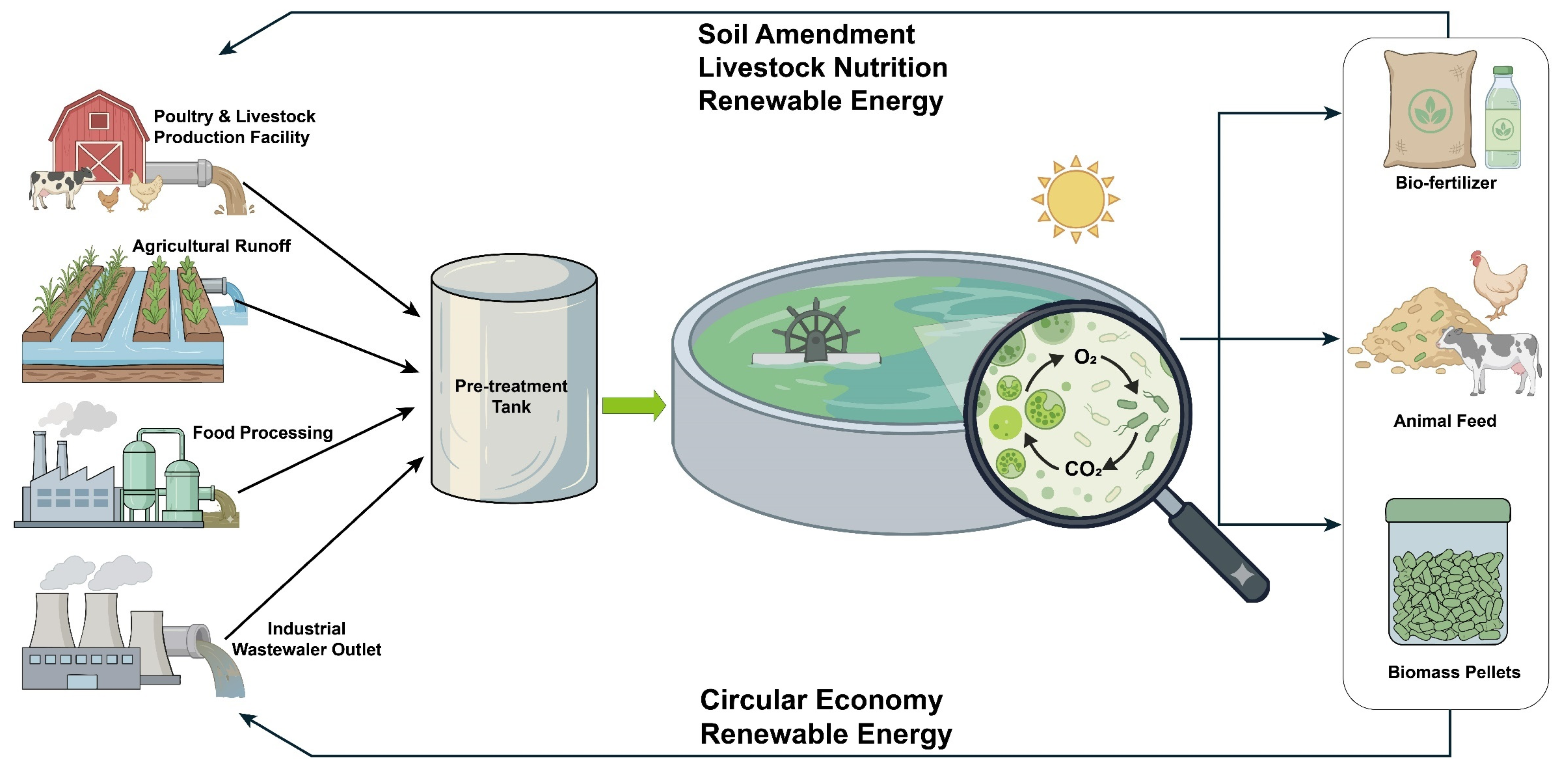
Figure 1. Schematic of a microalgae-based agricultural waste valorization and circular bioeconomy model (created by the authors based on the literature [18,55,56,57]).
Microorganisms 14 00753 g001
Figure 2. Schematic of the multifunctional mechanisms by which microalgae promote sustainable agriculture (created by the authors based on the literature [80,81,82,83,84]).
Microorganisms 14 00753 g002
Figure 3. Schematic of an AI-enabled, microalgae-driven sustainable agricultural circular bioeconomy (created by the authors based on the literature [123,124,125,126,127,128]).
Microorganisms 14 00753 g003
Table 1. Integrated comparison of microalgae-based systems and conventional technologies for nutrient recovery and circular agricultural applications.
TechnologyTarget Waste StreamPrimary FunctionNutrient RecoveryEnergy DemandProduct Form and ValueAgricultural CompatibilityLimitationsSystem Integration PotentialRefs.
Microalgae-based systemsAgricultural/livestock wastewaterNutrient recovery/biomass productionHighLow–moderateMultifunctional biomass (biofertilizers/biostimulants/soil amendments)High (direct land return, slow-release nutrients, bioactive effects)Harvesting cost; light and temperature dependency; wastewater variabilityHigh (couples waste treatment, nutrient cycling, and agricultural inputs)[180]
Activated sludgeAgricultural wastewaterBiological wastewater treatmentModerateHighLow-value sludgeLowHigh energy consumption; sludge disposalLow[181]
Anaerobic digestionLivestock manureOrganic matter stabilization/biogasModerateModerateBiogas/digestateModerate (digestate nutrient imbalance)Digestate management; limited nutrient valorizationModerate[182]
CompostingOrganic agricultural wasteOrganic waste stabilizationLow–moderateLowCompostHigh (widely accepted soil amendment)Long processing time; N volatilizationLow[183]
Constructed wetlandsAgricultural runoffWastewater treatmentModerateLowPlant biomass with limited reuseLow–moderateLarge land requirement; seasonal variabilityLow[184]
Chemical precipitationWastewater (P-rich streams)Targeted phosphorus removalHighLow–moderateMineral precipitatesModerate (requires post-processing)Chemical input dependenceLow[185]
Membrane separationConcentrated wastewaterNutrient concentration/separationHighHighConcentrated nutrient streamsLow (indirect agricultural use)Fouling; high operational costLow[186]
Table 2. Comparison of microalgae integration scenarios in circular agricultural systems.
Integration ScenarioWaste/Resource InputsCore System FunctionNutrient Recovery PerformanceEnergy DemandBiomass Utilization PathwayAgricultural CompatibilityEngineering ChallengesRefs.
Livestock wastewater–microalgae–cropland systemLivestock and poultry wastewaterWastewater treatment/nutrient regenerationHighModerateBiofertilizer/soil amendmentHighVariability of effluent composition; pathogen control[194]
Anaerobic digestion–microalgae coupled systemDigestate and CO2-rich biogasResidual nutrient recovery/carbon captureModerateModerate-highBiomass valorization/energy offsetModerateEnergy trade-offs; system complexity[195]
Agricultural runoff–open-pond microalgae systemDiffuse nutrient runoffNutrient interception and polishingModerateLowLow-processed biomass/recyclingModerateSeasonal instability; land requirement[196]
Photobioreactor-based microalgae treatmentControlled wastewater streamsHigh-efficiency nutrient recoveryHighHighHigh-value biomass/extractsModerateCapital and energy intensity[197]
Integrated microalgae–biorefinery systemMixed agricultural wastesNutrient recovery + multi-product valorizationHighVery highBiostimulants, specialty productsLow to moderateEconomic feasibility; process coupling[198]
Disclaimer/Publisher’s Note: The statements, opinions and data contained in all publications are solely those of the individual author(s) and contributor(s) and not of MDPI and/or the editor(s). MDPI and/or the editor(s) disclaim responsibility for any injury to people or property resulting from any ideas, methods, instructions or products referred to in the content.