Molecular Epidemiology of Toxigenic Clostridioides difficile Isolated from Bulgarian Patients and the Prevalence of Hypervirulent ST1 Clone

 , , , , and
Abstract
1. Introduction
2. Material and Methods
2.1. Study Design, Bacterial Isolates and Toxin Detection
2.2. Cultivation and Susceptibility Testing
2.3. Genetic Analysis
2.4. MLST Typing
2.5. Statistical Analysis
3. Results
3.1. Characteristics of Patients and C. difficile Toxigenic Isolates and Their Susceptibility
3.2. Genetic Analysis: Toxigenic Characteristics and tcdA and tcdC Deletions
3.3. MLST Typing
4. Discussion and Analysis
5. Conclusions
Author Contributions
Funding
Institutional Review Board Statement
Informed Consent Statement
Data Availability Statement
Conflicts of Interest
References
- Lanzoni-Mangutchi, P.; Banerji, O.; Wilson, J.; Barwinska-Sendra, A.; Kirk, J.A.; Vaz, F.; O’beirne, S.; Baslé, A.; El Omari, K.; Wagner, A.; et al. Structure and assembly of the S-layer in C. difficile. Nat. Commun. 2022, 13, 970. [Google Scholar] [CrossRef] [PubMed]
- Hall, I.C.; O’Toole, E. Intestinal flora in newborn infants with description of a new pathogenic anaerobe. Am. J. Dis. Child 1935, 49, 390–402. [Google Scholar] [CrossRef]
- Lawson, P.A.; Citron, D.M.; Tyrrell, K.L.; Finegold, S.M. Reclassification of Clostridium difficile as Clostridioides difficile (Hall and O’Toole 1935) Preevot 1938. Anaerobe 2016, 40, 95–99. [Google Scholar] [CrossRef] [PubMed]
- Czepiel, J.; Dróżdż, M.; Pituch, H.; Kuijper, E.J.; Perucki, W.; Mielimonka, A.; Goldman, S.; Wultańska, D.; Garlicki, A.; Biesiada, G. Clostridium difficile infection: Review. Eur. J. Clin. Microbiol. Infect. Dis 2019, 38, 1211–1221. [Google Scholar] [CrossRef]
- Buddle, J.E.; Fagan, R.P. Pathogenicity and virulence of Clostridioides difficile. Virulence 2023, 14, 2150452. [Google Scholar] [CrossRef]
- Janezic, S.; Rupnik, M. Genomic diversity of Clostridium difficile strains. Res. Microbiol. 2015, 166, 353–360. [Google Scholar] [CrossRef]
- Martínez-Meléndez, A.; Cruz-López, F.; Morfin-Otero, R.; Maldonado-Garza, H.J.; Garza-González, E. An Update on Clostridioides difficile Binary Toxin. Toxins 2022, 14, 305. [Google Scholar] [CrossRef]
- Nelson, W.W.; Scott, T.A.; Boules, M.; Teigland, C.; Parente, A.; Unni, S.; Feuerstadt, P. Health care resource utilization and costs of recurrent Clostridioides difficile infection in the elderly: A real-world claims analysis. J. Manag. Care Spec. Pharm. 2021, 27, 828–838. [Google Scholar] [CrossRef]
- Feuerstadt, P.; Theriault, N.; Tillotson, G. The burden of CDI in the United States: A multifactorial challenge. BMC Infect. Dis. 2023, 23, 132. [Google Scholar] [CrossRef]
- Sholeh, M.; Beig, M.; Kouhsari, E.; Rohani, M.; Katouli, M.; Badmasti, F. Global insights into the genome dynamics of Clostridioides difficile associated with antimicrobial resistance, virulence, and genomic adaptations among clonal lineages. Front. Cell. Infect. Microbiol. 2025, 14, 1493225. [Google Scholar] [CrossRef]
- Rupnik, M.; Viprey, V.; Janezic, S.; Tkalec, V.; Davis, G.; Sente, B.; Devos, N.; Muller, B.H.; Santiago-Allexant, E.; Cleuziat, P.; et al. Distribution of Clostridioides difficile ribotypes and sequence types across humans, animals and food in 13 European countries. Emerg. Microbes Infect. 2024, 13, 2427804. [Google Scholar] [CrossRef]
- Blau, K.; Berger, F.K.; Mellmann, A.; Gallert, C. Clostridioides difficile from Fecally Contaminated Environmental Sources: Resistance and Genetic Relatedness from a Molecular Epidemiological Perspective. Microorganisms 2023, 11, 2497. [Google Scholar] [CrossRef]
- Stabler, R.A.; Dawson, L.F.; Valiente, E.; Cairns, M.D.; Martin, M.J.; Donahue, E.H.; Riley, T.V.; Songer, J.G.; Kuijper, E.J.; Dingle, K.E.; et al. Macro and micro diversity of Clostridium difficile isolates from diverse sources and geographical locations. PLoS ONE 2012, 7, e31559. [Google Scholar] [CrossRef]
- Uzal, F.A.; Navarro, M.A.; Asin, J.; Henderson, E. Clostridioides difficile infection in animals: A literature review. Anaerobe 2026, 97, 103028. [Google Scholar] [CrossRef]
- Centers for Disease Control and Prevention. Antibiotic Resistance Threats in the United States, 2019; U.S. Department of Health and Human Services, CDC: Atlanta, GA, USA, 2019. Available online: https://www.cdc.gov/antimicrobial-resistance/media/pdfs/2019-ar-threats-report-508.pdf?CDC_AAref_Val=https://www.cdc.gov/drugresistance/pdf/threats-report/2019-ar-threats-report-508.pdf (accessed on 5 January 2026).
- Johnson, S.; Lavergne, V.; Skinner, A.M.; Gonzales-Luna, A.J.; Garey, K.W.; Kelly, C.P.; Wilcox, M.H. Clinical Practice Guideline by the Infectious Diseases Society of America (IDSA) and Society for Healthcare Epidemiology of America (SHEA): 2021 Focused Update Guidelines on Management of Clostridioides difficile Infection in Adults. Clin. Infect. Dis. 2021, 73, e1029–e1044. [Google Scholar] [CrossRef]
- Karime, C.; Odah, T.; Hashash, J.G.; Pardi, D.S.; Khanna, S.; Farraye, F.A. Bezlotoxumab for prevention of Clostridioides difficile recurrence in patients with inflammatory bowel disease: A retrospective multicenter experience. Ann. Gastroenterol. 2026, 39, 114–122. [Google Scholar] [PubMed]
- Knetsch, C.W.; Lawley, T.D.; Hensgens, M.P.; Corver, J.; Wilcox, M.W.; Kuijper, E.J. Current application and future perspectives of molecular typing methods to study Clostridium difficile infections. Eurosurveillance 2013, 18, 20381. [Google Scholar] [CrossRef] [PubMed]
- Griffiths, D.; Fawley, W.; Kachrimanidou, M.; Bowden, R.; Crook, D.W.; Fung, R.; Golubchik, T.; Harding, R.M.; Jeffery, K.J.; Jolley, K.A.; et al. Multilocus sequence typing of Clostridium difficile. J. Clin. Microbiol. 2010, 48, 770–778. [Google Scholar] [CrossRef]
- Boyanova, L.; Dimitrov, G.; Niyazi, D.; Marteva-Proevska, Y.; Hadzhyiski, P.; Gergova, R.; Markovska, R. Toxigenic Clostridioides difficile and their antibiotic susceptibility in Bulgarian patients during and post-COVID-19 pandemic. C. R. Acad. Bulg. Sci. 2025, 78, 1703–1709. [Google Scholar] [CrossRef]
- EUCAST. The European Committee on Antimicrobial Susceptibility Testing. Breakpoint Tables for Interpretation of MICs and Zone Diameters. Version 14.0. 2024. Available online: http://www.eucast.org (accessed on 5 August 2025).
- Paltansing, S.; van den Berg, R.J.; Guseinova, R.A.; Visser, C.E.; Van Der Vorm, E.R.; Kuijper, E.J. Characteristics and incidence of Clostridium difficile-associated disease in The Netherlands, 2005. Clin. Microbiol. Infect. 2007, 13, 1058–1064. [Google Scholar] [CrossRef]
- Kato, N.; Ou, C.Y.; Kato, H.; Bartley, S.L.; Brown, V.K.; Dowell, V.R.; Ueno, K. Identification of toxigenic Clostridium difficile by the polymerase chain reaction. J. Clin. Microbiol. 1991, 29, 33–37. [Google Scholar] [CrossRef]
- Kato, H.; Kato, N.; Watanabe, K.; Iwai, N.; Nakamura, H.; Yamamoto, T.; Suzuki, K.; Kim, S.-M.; Chong, Y.; Wasito, E.B. Identification of toxin A-negative, toxin B-positive Clostridium difficile by PCR. J. Clin. Microbiol. 1998, 36, 2178–2182. [Google Scholar] [CrossRef] [PubMed]
- Persson, S.; Torpdahl, M.; Olsen, K.E. New multiplex PCR method for the detection of Clostridium difficile toxin A (tcdA) and toxin B (tcdB) and the binary toxin (cdtA/cdtB) genes applied to a Danish strain collection. Clin. Microbiol. Infect. 2008, 14, 1057–1064, Erratum in Clin. Microbiol. Infect. 2009, 15, 296.. [Google Scholar] [CrossRef] [PubMed]
- European Centre for Disease Prevention and Control. Clostridioides (Clostridium) difficile infections. In Annual Epidemiological Report for 2016–2017; ECDC: Stockholm, Sweden, 2022. [Google Scholar]
- Persson, S.; Nielsen, H.L.; Coia, J.E.; Engberg, J.; Olesen, B.S.; Engsbro, A.L.; Petersen, A.M.; Holt, H.M.; Lemming, L.; Marmolin, E.S.; et al. Sentinel surveillance and epidemiology of Clostridioides difficile in Denmark, 2016 to 2019. Eurosurveillance 2022, 27, 2200244. [Google Scholar] [CrossRef]
- Dingle, K.E.; Griffiths, D.; Didelot, X.; Evans, J.; Vaughan, A.; Kachrimanidou, M.; Stoesser, N.; Jolley, K.A.; Golubchik, T.; Harding, R.M.; et al. Clinical Clostridium difficile: Clonality and pathogenicity locus diversity. PLoS ONE 2011, 6, e19993. [Google Scholar] [CrossRef]
- Smits, W.K.; Lyras, D.; Lacy, D.B.; Wilcox, M.H.; Kuijper, E.J. Clostridium difficile infection. Nat. Rev. Dis. Primers 2016, 2, 16020. [Google Scholar] [CrossRef]
- Kuijper, E.J.; Coignard, B.; Tüll, P. ESCMID Study Group for Clostridium difficile; EU Member States; European Centre for Disease Prevention and Control. Emergence of Clostridium difficile-associated disease in North America and Europe. Clin. Microbiol. Infect. 2006, 12, 2–18. [Google Scholar] [CrossRef] [PubMed]
- Mengoli, M.; Barone, M.; Fabbrini, M.; D’Amico, F.; Brigidi, P.; Turroni, S. Make It Less difficile: Understanding genetic evolution and global spread of Clostridioides difficile. Genes 2022, 13, 2200. [Google Scholar] [CrossRef]
- Shirinda, H.; Smith, A.M.; Prinsloo, B.; Kock, M.M.; Moodley, M.; Said, M.; Ehlers, M.M. Clostridioides difficile hypervirulent strain ST1 isolated from clinical stool specimens obtained from three Provinces in South Africa. Anaerobe 2025, 91, 102926. [Google Scholar] [CrossRef] [PubMed]
- Davies, K.A.; Ashwin, H.; Longshaw, C.M.; Burns, D.A.; Davis, G.L.; Wilcox, M.H. Diversity of Clostridium difficile PCR ribotypes in Europe: Results from the European, multicentre, prospective, biannual, point-prevalence study of Clostridium difficile infection in hospitalised patients with diarrhoea (EUCLID), 2012 and 2013. Eurosurveillance 2016, 21, 30294. [Google Scholar] [CrossRef]
- Eyre, D.W.; Davies, K.A.; Davis, G.; Fawley, W.N.; Dingle, K.E.; De Maio, N.; Karas, A.; Crook, D.W.; Peto, T.E.A.; Walker, A.S.; et al. EUCLID Study Group. Two distinct patterns of Clostridium difficile diversity across europe indicating contrasting routes of spread. Clin. Infect. Dis. 2018, 67, 1035–1044. [Google Scholar] [CrossRef] [PubMed]
- Freeman, J.; Vernon, J.; Pilling, S.; Morris, K.; Nicolson, S.; Shearman, S.; Clark, E.; Palacios-Fabrega, J.A.; Wilcox, M. Five-year Pan-European, longitudinal surveillance of Clostridium difficile ribotype prevalence and antimicrobial resistance: The extended ClosER study. Eur. J. Clin. Microbiol. Infect. Dis. 2020, 39, 169–177. [Google Scholar] [CrossRef]
- Aptekorz, M.; Sacha, K.; Gofron, Z.; Kabała, M.; Harmanus, C.; Kuijper, E.; Martirosian, G. Antibiotic resistance profile of RT 027/176 versus other Clostridioides difficile isolates in Silesia, Southern Poland. Pathogens 2022, 11, 949. [Google Scholar] [CrossRef]
- Plankaova, A.; Brajerova, M.; Capek, V.; Balikova Novotna, G.; Kinross, P.; Skalova, J.; Soltesova, A.; Drevinek, P.; Krutova, M. Clostridioides difficile infections were predominantly driven by fluoroquinolone-resistant Clostridioides difficile ribotypes 176 and 001 in Slovakia in 2018–2019. Int. J. Antimicrob. Agents 2023, 62, 106824, Erratum in Int. J. Antimicrob. Agents 2025, 65, 107408. https://doi.org/10.1016/j.ijantimicag.2024.107408.. [Google Scholar] [CrossRef]
- Kracík, M.; Dolinová, I.; Žemličková, H. Ribotyping of Clostridioides difficile in the Liberec Regional Hospital: A tertiary health care facility. Folia Microbiol. 2023, 68, 315–320. [Google Scholar] [CrossRef]
- Kachrimanidou, M.; Baktash, A.; Metallidis, S.; Tsachouridou, O.; Netsika, F.; Dimoglou, D.; Kassomenaki, A.; Mouza, E.; Haritonidou, M.; Kuijper, E. An outbreak of Clostridioides difficile infections due to a 027-like PCR ribotype 181 in a rehabilitation centre: Epidemiological and microbiological characteristics. Anaerobe 2020, 65, 102252. [Google Scholar] [CrossRef]
- Baur, D.; Gladstone, B.P.; Burkert, F.; Carrara, E.; Foschi, F.; Döbele, S.; Tacconelli, E. Effect of antibiotic stewardship on the incidence of infection and colonisation with antibiotic-resistant bacteria and Clostridium difficile infection: A systematic review and meta-analysis. Lancet Infect. Dis. 2017, 17, 990–1001. [Google Scholar] [CrossRef]
- Abdrabou, A.M.M.; Ul Habib Bajwa, Z.; Halfmann, A.; Mellmann, A.; Nimmesgern, A.; Margardt, L.; Bischoff, M.; von Müller, L.; Gärtner, B.; Berger, F.K. Molecular epidemiology and antimicrobial resistance of Clostridioides difficile in Germany, 2014–2019. Int. J. Med. Microbiol. 2021, 311, 151507. [Google Scholar] [CrossRef]
- Abdrabou, A.M.M.; Bischoff, M.; Mellmann, A.; von Müller, L.; Margardt, L.; Gärtner, B.C.; Berger, F.K. German C. difficile surveillance group. Implementation of a Clostridioides difficile sentinel surveillance system in Germany: First insights for 2019–2021. Anaerobe 2022, 77, 102548. [Google Scholar] [CrossRef] [PubMed]
- European Centre for Disease Prevention and Control. Antimicrobial Consumption in the EU/EEA (ESAC-Net)—Annual Epidemiological Report 2023; ECDC: Stockholm, Sweden, 2024. [Google Scholar]
- European Centre for Disease Prevention and Control. Antimicrobial Consumption in the EU/EEA (ESAC-Net)—Annual Epidemiological Report 2022; ECDC: Stockholm, Sweden, 2023. [Google Scholar]
- Dobreva, E.G.; Ivanov, I.N.; Vathcheva-Dobrevska, R.S.; Ivanova, K.I.; Asseva, G.D.; Petrov, P.K.; Kantardjiev, T.V. Advances in molecular surveillance of Clostridium difficile in Bulgaria. J. Med. Microbiol. 2013, 62, 1428–1434. [Google Scholar] [CrossRef] [PubMed]
- Dobreva, E.; Donchev, D.; Stoikov, I.; Teneva, D.; Hristova, R.; Murdjeva, M.; Vatcheva-Dobrevska, R.; Ivanov, I.N. Whole genome sequencing characterization of Clostridioides difficile from Bulgaria during the COVID-19 pandemic. Diagn. Microbiol. Infect. Dis. 2025, 111, 116703. [Google Scholar] [CrossRef] [PubMed]
- Velev, V.; Pavlova, M.; Alexandrova, E.; Popov, M.; Lutakov, I.; Tcherveniakova, T.; Angelova, A.; Hristozova, E.; Kalchev, Y.; Ivanov, I. Study on patients with Clostridioides difficile infection during the COVID-19 pandemic in Bulgaria. Biotechnol. Biotechnol. Equip. 2023, 37, 188–193. [Google Scholar] [CrossRef]
- Stojanovic, P.; Harmanus, C.; Kuijper, E.J. Community-onset Clostridioides difficile infection in south Serbia. Anaerobe 2023, 79, 102669. [Google Scholar] [CrossRef]
- Tickler, I.A.; Obradovich, A.E.; Goering, R.V.; Fang, F.C.; Tenover, F.C.H.; Consortium. Changes in molecular epidemiology and antimicrobial resistance profiles of Clostridioides (Clostridium) difficile strains in the United States between 2011 and 2017. Anaerobe 2019, 60, 102050. [Google Scholar] [CrossRef] [PubMed]
- Imwattana, K.; Knight, D.R.; Kullin, B.; Collins, D.A.; Putsathit, P.; Kiratisin, P.; Riley, T.V. Clostridium difficile ribotype 017—Characterization, evolution and epidemiology of the dominant strain in Asia. Emerg. Microbes Infect. 2019, 8, 796–807. [Google Scholar] [CrossRef]
- Boyanova, L.; Dimitrov, G.; Gergova, R.; Hadzhiyski, P.; Markovska, R. Clostridioides difficile resistance to antibiotics, including post-COVID-19 data. Expert Rev. Clin. Pharmacol. 2023, 16, 925–938. [Google Scholar] [CrossRef]
- Schwartz, O.; Azrad, M.; Peretz, A. In vitro susceptibility of clinical Clostridioides difficile isolates in Israel to metronidazole, vancomycin, fidaxomicin, ridinilazole and ibezapolstat. BMC Gastroenterol. 2025, 25, 209. [Google Scholar] [CrossRef]
- Knight, D.R.; Riley, T.V. Genomic Delineation of Zoonotic Origins of Clostridium difficile. Front. Public Health 2019, 7, 164. [Google Scholar] [CrossRef]
- Knetsch, C.W.; Connor, T.R.; Mutreja, A.; van Dorp, S.M.; Sanders, I.M.; Browne, H.P.; Harris, D.; Lipman, L.; Keessen, E.C.; Corver, J.; et al. Whole genome sequencing reveals potential spread of Clostridium difficile between humans and farm animals in the Netherlands, 2002 to 2011. Eurosurveillance 2014, 19, 20954. [Google Scholar] [CrossRef]
- Xu, X.; Luo, Y.; Chen, H.; Song, X.; Bian, Q.; Wang, X.; Liang, Q.; Zhao, J.; Li, C.; Song, G.; et al. Genomic evolution and virulence association of Clostridioides difficile sequence type 37 (ribotype 017) in China. Emerg. Microbes Infect. 2021, 10, 1331–1345. [Google Scholar] [CrossRef]
- Saad, G.; Azrad, M.; Aias, M.; Leshem, T.; Hamo, Z.; Rahmoun, L.A.; Peretz, A. The effect of different C. difficile MLST strains on viability and activity of macrophages. Heliyon 2023, 9, e13846. [Google Scholar] [CrossRef] [PubMed]
- Luo, Y.; Chen, Y.; Lin, S.; Hu, H.; Song, X.; Bian, Q.; Fang, W.; Lv, H.; Wang, Q.; Jiang, J.; et al. Genomic epidemiology of Clostridioides difficile sequence type 35 reveals intraspecies and interspecies clonal transmission. Emerg. Microbes Infect. 2024, 13, 2408322. [Google Scholar] [CrossRef] [PubMed]
- Aoki, K.; Takeda, S.; Miki, T.; Ishii, Y.; Tateda, K. Antimicrobial susceptibility and molecular characterisation using whole-genome sequencing of Clostridioides difficile collected in 82 hospitals in Japan between 2014 and 2016. Antimicrob. Agents Chemother. 2019, 63, e01259-19. [Google Scholar] [CrossRef] [PubMed]


| Age, n (%) | ≤16 years * | 29 (29%) |
| 17–64 years | 35 (35%) | |
| ≥65 years | 36 (36%) | |
| Gender, n (%) | Males | 48 (48%) |
| Females | 52 (52%) | |
| Comorbidity **, n | Ulcerative colitis | 9 |
| Hematologic diseases | 7 | |
| Cardio-cerebrovascular diseases | 4 | |
| Solid tumors | 4 | |
| Dementia, depression | 3 | |
| Post-COVID-19 enterocolitis | 12 | |
| Gastrointestinal non-CDI diseases | 3 | |
| Chronic kidney insufficiency, nephritis, kidney transplantation | 7 | |
| Other—pyoderma, cystic fibrosis, chronic obstructive lung disease | 3 |
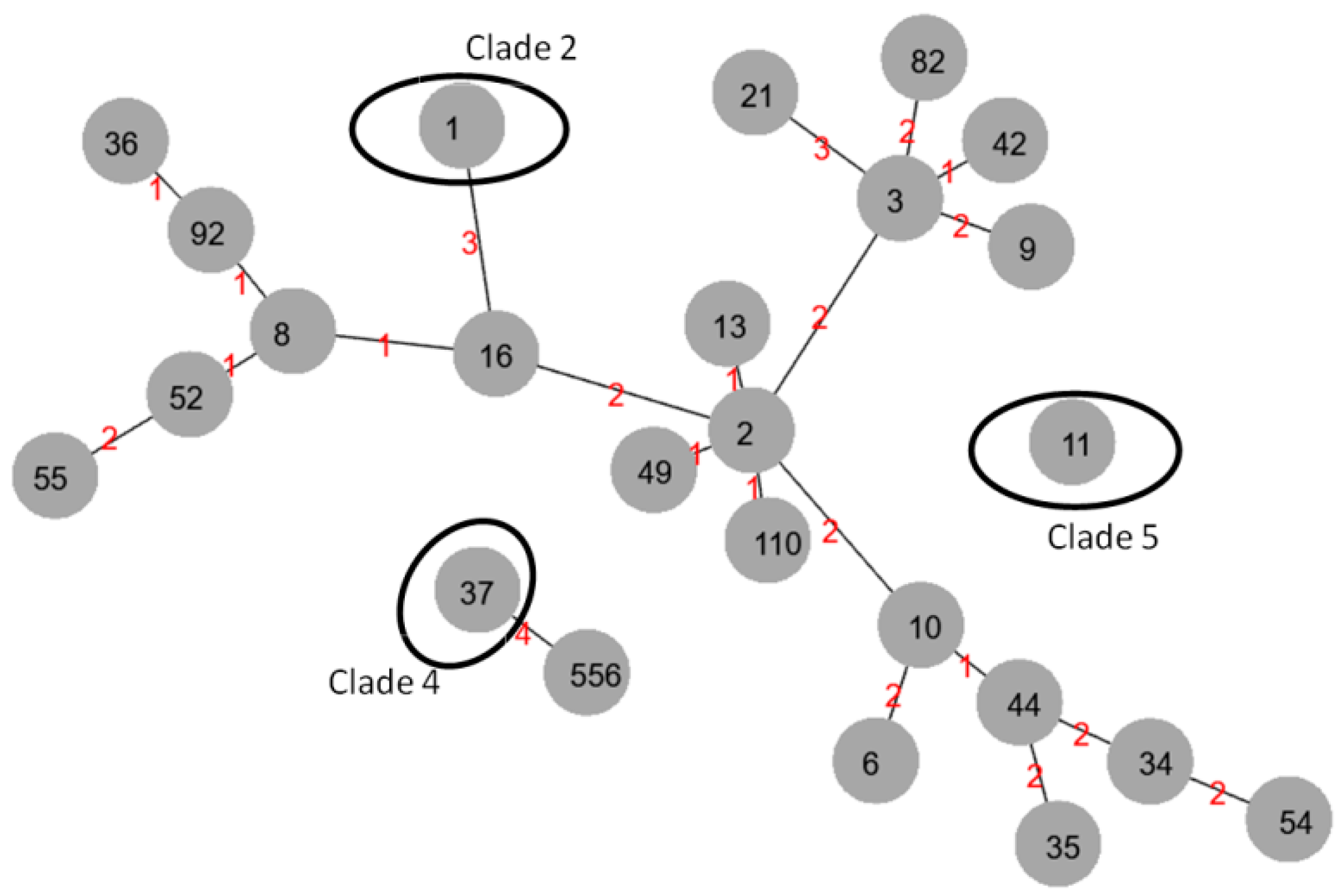
| ST Types, Clade 1 | n | Children n | Adults n | 2014–2019 n | 2020–2023 n | Place of Isolation (n) 2 | Toxin Genotype | tcdC Deletion |
|---|---|---|---|---|---|---|---|---|
| ST1,cl 2 | 34 | 1 | 33 | 2 | 32 | Sofia (11),Varna (20), amb (3) | tcdA + tcdB + cdtA/B+ | 18-bp |
| ST2,cl 1 | 6 | 3 | 3 | 3 | 3 | Sofia (4),Varna (2) | tcdA + tcdB + cdtA/B− | No |
| ST3,cl 1 | 14 | 1 | 13 | 3 | 11 | Sofia (11),Varna (2), amb (1) | tcdA + tcdB + cdtA/B− | No |
| ST6,cl 1 | 3 | 1 | 2 | 1 | 2 | Sofia (3) | tcdA + tcdB + cdtA/B− | No |
| ST8,cl 1 | 2 | 2 | 1 | 1 | Sofia (2) | tcdA + tcdB + cdtA/B− | No | |
| ST9,cl 1 | 1 | 1 | 1 | Varna (1) | tcdA + tcdB + cdtA/B− | No | ||
| ST10,cl 1 | 3 | 2 | 1 | 3 | Sofia (3) | tcdA + tcdB + cdtA/B− | No | |
| ST11,cl 5 | 1 | 1 | 1 | Sofia (1) | tcdA + tcdB + cdtA/B+ | 39-bp | ||
| ST13,cl 1 | 1 | 1 | 1 | Varna (1) | tcdA + tcdB + cdtA/B− | No | ||
| ST16,cl 1 | 2 | 2 | 1 | 1 | Sofia (2) | tcdA + tcdB + cdtA/B− | No | |
| ST21,cl 1 | 1 | 1 | 1 | Sofia (1) | tcdA + tcdB + cdtA/B− | No | ||
| ST34,cl 1 | 1 | 1 | 1 | Varna (1) | tcdA + tcdB + cdtA/B− | No | ||
| ST35,cl 1 | 3 | 3 | 2 | 1 | Sofia (2),Varna (1) | tcdA + tcdB + cdtA/B− | No | |
| ST36,cl 1 | 1 | 1 | 1 | Sofia(1) | tcdA + tcdB + cdtA/B− | No | ||
| ST37,cl 4 | 1 | 1 | 1 | amb (1) | tcdA − tcdB + cdtA/B− 3 | No | ||
| ST42,cl 1 | 5 | 2 | 3 | 1 | 4 | Sofia (2),Varna (3) | tcdA + tcdB + cdtA/B− | No |
| ST44,cl 1 | 2 | 1 | 1 | 2 | Sofia (2) | tcdA + tcdB + cdtA/B− | No | |
| ST49,cl 1 | 4 | 2 | 2 | 2 | 2 | Sofia (3), amb (1) | tcdA + tcdB + cdtA/B− | No |
| ST52,cl 1 | 1 | 1 | 1 | Varna (1) | tcdA + tcdB + cdtA/B− | No | ||
| ST54,cl 1 | 3 | 2 | 1 | 3 | Sofia (1),Varna (2) | tcdA + tcdB + cdtA/B− | No | |
| ST55,cl 1 | 1 | 1 | 1 | Sofia (1) | tcdA + tcdB + cdtA/B− | No | ||
| ST82,cl1 | 1 | 1 | 1 | Sofia (1) | tcdA + tcdB + cdtA/B− | No | ||
| ST92,cl 1 | 5 | 3 | 2 | 4 | 1 | Sofia (3), amb (2) | tcdA + tcdB + cdtA/B− | No |
| ST110,cl 1 | 2 | 2 | 1 | 1 | Sofia (1),Varna (1) | tcdA + tcdB + cdtA/B− | No | |
| ST556,cl 1 | 2 | 1 | 1 | 1 | 1 | Sofia (1),Varna (1) | tcdA + tcdB + cdtA/B− | No |
| Total | 100 | 29 | 71 | 28 | 72 | Sofia (56), Varna (36), amb (8) |
Disclaimer/Publisher’s Note: The statements, opinions and data contained in all publications are solely those of the individual author(s) and contributor(s) and not of MDPI and/or the editor(s). MDPI and/or the editor(s) disclaim responsibility for any injury to people or property resulting from any ideas, methods, instructions or products referred to in the content. |
© 2026 by the authors. Licensee MDPI, Basel, Switzerland. This article is an open access article distributed under the terms and conditions of the Creative Commons Attribution (CC BY) license.
Share and Cite
Markovska, R.; Dimitrov, G.; Niyazi, D.; Stoeva, T.; Mihova, K.; Boyanova, L. Molecular Epidemiology of Toxigenic Clostridioides difficile Isolated from Bulgarian Patients and the Prevalence of Hypervirulent ST1 Clone. Microorganisms 2026, 14, 532. https://doi.org/10.3390/microorganisms14030532
Markovska R, Dimitrov G, Niyazi D, Stoeva T, Mihova K, Boyanova L. Molecular Epidemiology of Toxigenic Clostridioides difficile Isolated from Bulgarian Patients and the Prevalence of Hypervirulent ST1 Clone. Microorganisms. 2026; 14(3):532. https://doi.org/10.3390/microorganisms14030532
Chicago/Turabian StyleMarkovska, Rumyana, Georgi Dimitrov, Denis Niyazi, Temenuga Stoeva, Kalina Mihova, and Lyudmila Boyanova. 2026. "Molecular Epidemiology of Toxigenic Clostridioides difficile Isolated from Bulgarian Patients and the Prevalence of Hypervirulent ST1 Clone" Microorganisms 14, no. 3: 532. https://doi.org/10.3390/microorganisms14030532
APA StyleMarkovska, R., Dimitrov, G., Niyazi, D., Stoeva, T., Mihova, K., & Boyanova, L. (2026). Molecular Epidemiology of Toxigenic Clostridioides difficile Isolated from Bulgarian Patients and the Prevalence of Hypervirulent ST1 Clone. Microorganisms, 14(3), 532. https://doi.org/10.3390/microorganisms14030532