Non-Thermal and Mild Thermal Technologies for Table Egg Shell Surface Decontamination: Microbial Efficacy, Egg Quality, and Industrial Considerations

 , , and
Abstract
1. Introduction
2. Microorganisms of Interest in Eggs
3. Surface Decontamination of Eggs: Current Challenges and Emerging Solutions
3.1. Plasma Activated Water
3.2. Moderate Electric Field (MEF)
3.3. Ozone
3.4. Cold Plasma (CP)
3.5. Hot Air
3.6. UV-C Irradiation
3.7. Hydroxyl Radical in Gas Phase
3.8. Pulsed Light (PL) and Pulsed Ultraviolet Light (PUV)
3.9. Infrared Irradiation (IR)
3.10. Radiofrequency (RF)
4. Perspectives for the Use of Emerging Technologies in the Egg Chain and Main Challenges
5. Conclusions
Author Contributions
Funding
Institutional Review Board Statement
Informed Consent Statement
Data Availability Statement
Conflicts of Interest
References
- Food and Agriculture Organization of the United Nations. Agricultural Production Statistics 2010–2024; FAO: Rome, Italy, 2025.
- Réhault-Godbert, S.; Guyot, N.; Nys, Y. The Golden Egg: Nutritional Value, Bioactivities, and Emerging Benefits for Human Health. Nutrients 2019, 11, 684. [Google Scholar] [CrossRef] [PubMed]
- Alexander, D.D.; Miller, P.E.; Vargas, A.J.; Weed, D.L.; Cohen, S.S. Meta-Analysis of Egg Consumption and Risk of Coronary Heart Disease and Stroke. J. Am. Coll. Nutr. 2016, 35, 704–716. [Google Scholar] [CrossRef] [PubMed]
- Al-Bahry, S.; Mahmoud, I.; Al-Rawahi, S.; Paulson, J. Egg Contamination as an Indicator of Environmental Health. In Eggs: Nutrition, Consumption and Health; Nova Science Publishers: Hauppauge, NY, USA, 2011; ISBN 978-1-61942-013-7. [Google Scholar]
- Bellairs, R.; Osmond, M. The Hen’s Egg and Its Formation. In Atlas of Chick Development; Academic Press: Cambridge, MA, USA, 2014; pp. 1–6. ISBN 9780123849519. [Google Scholar]
- Abdoli, B.; Khoshtaghaza, M.-H.; Ghomi, H.; Karimi Torshizi, M.A.; Mehdizadeh, S.; Pishkar, G.; Dunn, I. Cold Atmospheric Pressure Air Plasma Jet Disinfection of Table Eggs: Inactivation of Salmonella Enterica, Cuticle Integrity and Egg Quality. Int. J. Food Microbiol. 2024, 410, 110474. [Google Scholar] [CrossRef]
- Figueiredo, E.; Corrêa, G.; Albino, L.; Donzele, R.F.; Donzele, J.; Pinto, R.; Silva, M.; Corrêa, A.; Tavares, J. Fisiologia da formação do ovo: Um referencial teórico. In Inovações na Nutrição Animal: Desafios da Produção de Qualidade; Editora Científica Digital: São Paulo, Brazil, 2021; pp. 109–126. ISBN 9786589826255. [Google Scholar]
- Tuță, F.; Dumitru, M.; Tatiana, P.; Habeanu, M.; Bunduc, V. Potential Implications of Natural Antioxidants from Plant to Improve Nutritional Quality, Oxidative Stability and Lipid Degradation of Egg Yolk: A Review. Arch. Zootech. 2023, 26, 28–55. [Google Scholar] [CrossRef]
- Rondoni, A.; Asioli, D.; Millan, E. Consumer Behaviour, Perceptions, and Preferences towards Eggs: A Review of the Literature and Discussion of Industry Implications. Trends Food Sci. Technol. 2020, 106, 391–401. [Google Scholar] [CrossRef]
- Mahmoud, B.Y.; Semida, D.A.; Elnesr, S.S.; Elwan, H.; El-Full, E.A. Approaches of Egg Decontamination for Sustainable Food Safety. Sustainability 2022, 15, 464. [Google Scholar] [CrossRef]
- Bermudez-Aguirre, D.; Niemira, B.A. A Review on Egg Pasteurization and Disinfection: Traditional and Novel Processing Technologies. Compr. Rev. Food Sci. Food Saf. 2023, 22, 756–784. [Google Scholar] [CrossRef]
- Ministério da Agricultura, Pecuária e Abastecimento. Portaria SDA nº 612, de 6 de julho de 2022. Aprova os Requisitos de Instalações, Equipamentos e os Procedimentos para o Funcionamento de Granjas Avícolas e de Unidades de Beneficiamento de Ovos e Derivados. Diário Oficial da União. 2022. Available online: https://www.cidasc.sc.gov.br/inspecao/files/2022/08/PORTARIA-SDA-N%C2%BA-612-DE-6-DE-JULHO-DE-2022.pdf (accessed on 27 January 2026).
- CAC/RCP 15-1976; Code of Hygienic Practice for Eggs and Egg Products. Codex Alimentarius Commission: Rotterdam, The Netherlands, 1976.
- de Freitas Meireles, I.M.; Dias-Martins, A.M.; Junior, W.J.F.L.; Minafra, C.; da Silva, M.A.P.; Cappato, L.P. Modeling the Inactivation Kinetics of Salmonella Typhimurium and Pseudomonas aeruginosa on Eggshell Surfaces Using Gaseous Ozone. Food Microbiol. 2025, 132, 104845. [Google Scholar] [CrossRef]
- Mine, Y.; Guyonnet, V.; Hatta, H.; Nau, F.; Qiu, N. Handbook of Egg Science and Technology; CRC Press: Boca Raton, FL, USA, 2023; ISBN 1000899616. [Google Scholar]
- De Reu, K.; Grijspeerdt, K.; Heyndrickx, M.; Uyttendaele, M.; Debevere, J.; Herman, L. Bacterial Shell Contamination in the Egg Collection Chains of Different Housing Systems for Laying Hens. Br. Poult. Sci. 2006, 47, 163–172. [Google Scholar] [CrossRef]
- Gantois, I.; Ducatelle, R.; Pasmans, F.; Haesebrouck, F.; Gast, R.; Humphrey, T.J.; Van Immerseel, F. Mechanisms of Egg Contamination by Salmonella Enteritidis. FEMS Microbiol. Rev. 2009, 33, 718–738. [Google Scholar] [CrossRef]
- EFSA Panel on Biological Hazards (BIOHAZ). Scientific Opinion on the Public Health Risks of Table Eggs Due to Deterioration and Development of Pathogens. EFSA J. 2014, 12, 3782. [Google Scholar] [CrossRef]
- Humphrey, T.J. Contamination of Egg Shell and Contents with Salmonella enteritidis: A Review. Int. J. Food Microbiol. 1994, 21, 31–40. [Google Scholar] [CrossRef] [PubMed]
- Pesavento, G.; Calonico, C.; Runfola, M.; Nostro, A. Lo Free-Range and Organic Farming: Eggshell Contamination by Mesophilic Bacteria and Unusual Pathogens. J. Appl. Poult. Res. 2017, 26, 509–517. [Google Scholar] [CrossRef]
- Li, L.; Zhou, Y.; Chousalkar, K.; McWhorter, A. Phenotypic and Genotypic Investigation into the Survival of Salmonella Typhimurium and Salmonella Hessarek in Eggs at Different Storage Temperatures. Food Res. Int. 2025, 222, 117795. [Google Scholar] [CrossRef] [PubMed]
- Jung, H.-R.; Lee, Y.J. Prevalence and Characterization of Non-Typhoidal Salmonella in Egg from Grading and Packing Plants in Korea. Food Microbiol. 2024, 120, 104464. [Google Scholar] [CrossRef]
- Gong, H.; Ma, Y.; Wang, M.; Gu, Y.; Deng, R.; Deng, B.; Feng, D.; Han, Y.; Mi, R.; Huang, Y. Microbiota Profiles of Hen Eggs from the Different Seasons and Different Sectors of Shanghai, China. Microorganisms 2023, 11, 2519. [Google Scholar] [CrossRef]
- Chousalkar, K.K.; Flynn, P.; Sutherland, M.; Roberts, J.R.; Cheetham, B.F. Recovery of Salmonella and Escherichia Coli from Commercial Egg Shells and Effect of Translucency on Bacterial Penetration in Eggs. Int. J. Food Microbiol. 2010, 142, 207–213. [Google Scholar] [CrossRef]
- Galiş, A.M.; Marcq, C.; Marlier, D.; Portetelle, D.; Van, I.; Beckers, Y.; Théwis, A. Control of Salmonella Contamination of Shell Eggs—Preharvest and Postharvest Methods: A Review. Compr. Rev. Food Sci. Food Saf. 2013, 12, 155–182. [Google Scholar] [CrossRef]
- Yaya-González, A.; Laika, J.; Peralta-Ruiz, Y. Emerging Nonthermal Technologies for Food Safety: Trends, Limitations, and Future Research. Curr. Opin. Chem. Eng. 2025, 49, 101178. [Google Scholar] [CrossRef]
- López, M.; Calvo, T.; Prieto, M.; Múgica-Vidal, R.; Muro-Fraguas, I.; Alba-Elías, F.; Alvarez-Ordóñez, A. A Review on Non-Thermal Atmospheric Plasma for Food Preservation: Mode of Action, Determinants of Effectiveness, and Applications. Front. Microbiol. 2019, 10, 622. [Google Scholar] [CrossRef]
- Liao, X.; Liu, D.; Xiang, Q.; Ahn, J.; Chen, S.; Ye, X.; Ding, T. Inactivation Mechanisms of Non-Thermal Plasma on Microbes: A Review. Food Control 2017, 75, 83–91. [Google Scholar] [CrossRef]
- Sastry, S. Ohmic Heating and Moderate Electric Field Processing. Food Sci. Technol. Int. 2008, 14, 419–422. [Google Scholar] [CrossRef]
- Sastry, S.K. Advances in Ohmic Heating and Moderate Electric Field (MEF) Processing. In Novel Food Processing Technologies; CRC Press: Boca Raton, FL, USA, 2004; pp. 513–522. [Google Scholar]
- Pandiselvam, R.; Sunoj, S.; Manikantan, M.R.; Kothakota, A.; Hebbar, K.B. Application and Kinetics of Ozone in Food Preservation. Ozone Sci. Eng. 2017, 39, 115–126. [Google Scholar] [CrossRef]
- Kim, J.G.; Yousef, A.E.; Dave, S. Application of Ozone for Enhancing the Microbiological Safety and Quality of Foods: A Review. J. Food Prot. 1999, 62, 1071–1087. [Google Scholar] [CrossRef]
- Skowron, K.; Wiktorczyk-Kapischke, N.; Grudelwska-Buda, K.; Zacharski, M.; Paluszak, Z.; Gospodarek-Komkowska, E. Antimicrobial Effect of Radiant Catalytic Ionization. Lett. Appl. Microbiol. 2022, 74, 482–497. [Google Scholar] [CrossRef]
- Skowron, K.; Wałecka-Zacharska, E.; Grudlewska, K.; Kwiecińska-Piróg, J.; Wiktorczyk, N.; Kowalska, M.; Paluszak, Z.; Kosek-Paszkowska, K.; Brożek, K.; Korkus, J. Effect of Selected Environmental Factors on the Microbicidal Effectiveness of Radiant Catalytic Ionization. Front. Microbiol. 2020, 10, 3057. [Google Scholar] [CrossRef]
- Pankaj, S.K.; Wan, Z.; Keener, K.M. Effects of Cold Plasma on Food Quality: A Review. Foods 2018, 7, 4. [Google Scholar] [CrossRef]
- Mahendran, R.; Abirami, C.V.K.; Alagusundaram, K. Cold Plasma Technology: An Emerging Non-Thermal Processing of Foods—A Review. In Engineering Interventions in Agricultural Processing; Apple Academic Press: Point Pleasant, NJ, USA, 2017; pp. 33–55. [Google Scholar]
- Pasquali, F.; Fabbri, A.; Cevoli, C.; Manfreda, G.; Franchini, A. Hot Air Treatment for Surface Decontamination of Table Eggs. Food Control 2010, 21, 431–435. [Google Scholar] [CrossRef]
- Altemimi, A.; Aziz, S.N.; Al-HiIphy, A.R.S.; Lakhssassi, N.; Watson, D.G.; Ibrahim, S.A. Critical Review of Radio-Frequency (RF) Heating Applications in Food Processing. Food Qual. Saf. 2019, 3, 81–91. [Google Scholar] [CrossRef]
- Bermudez-Aguirre, D.; Sites, J.; Carter, J.; Niemira, B.A. Radio Frequency plus Heat for In-Shell Egg Pasteurization. Innov. Food Sci. Emerg. Technol. 2024, 98, 103834. [Google Scholar] [CrossRef]
- Ramos, G.L.P.A.; Esper, L.M.R.; Gonzalez, A.G.M. A Review on the Application of UV-C Treatment on Food and Food Surfaces: Association with Food Microbiology, Predictive Microbiology and Quantitative Microbial Risk Assessment. Int. J. Food Sci. Technol. 2024, 59, 1187–1196. [Google Scholar] [CrossRef]
- Monteiro, M.L.G.; Rosario, D.K.A.; de Carvalho, A.P.A.; Conte-Junior, C.A. Application of UV-C Light to Improve Safety and Overall Quality of Fish: A Systematic Review and Meta-Analysis. Trends Food Sci. Technol. 2021, 116, 279–289. [Google Scholar] [CrossRef]
- Gomez-Lopez, V.M.; Ragaert, P.; Debevere, J.; Devlieghere, F. Pulsed Light for Food Decontamination: A Review. Trends Food Sci. Technol. 2007, 18, 464–473. [Google Scholar] [CrossRef]
- Lasagabaster, A.; Arboleya, J.C.; de Marañón, I.M. Pulsed Light Technology for Surface Decontamination of Eggs: Impact on Salmonella Inactivation and Egg Quality. Innov. Food Sci. Emerg. Technol. 2011, 12, 124–128. [Google Scholar] [CrossRef]
- Armagan, H.S.; Demirci, A. Current Status of Pulsed Uv Light Technology for Food, Water, and Food Processing Surface Decontamination. Food Eng. Rev. 2025, 17, 966–993. [Google Scholar] [CrossRef]
- Alkaya, G.B.; Erdogdu, F.; Halkman, A.K.; Ekiz, H.I. Surface Decontamination of Whole-Shell Eggs Using Far-Infrared Radiation. Food Bioprod. Process. 2016, 98, 275–282. [Google Scholar] [CrossRef]
- Fakayode, O.A.; Ojoawo, O.O.; Zhou, M.; Wahia, H.; Ogunlade, C.A. Revolutionizing Food Processing with Infrared Heating: New Approaches to Quality and Efficiency. Food Phys. 2025, 2, 100046. [Google Scholar] [CrossRef]
- Nasiru, M.M.; Boateng, E.F.; Umair, M.; Alnadari, F.; Bassey, A.P.; Qian, J.; Yan, W.; Li, C.; Zhang, J. Decontamination of Egg-Associated Pathogens by Plasma-Activated Water and Hydrogen Peroxide. J. Food Saf. 2024, 44, e13136. [Google Scholar] [CrossRef]
- Rahman, M.; Hasan, M.S.; Islam, R.; Rana, R.; Sayem, A.S.M.; Sad, M.A.A.; Matin, A.; Raposo, A.; Zandonadi, R.P.; Han, H. Plasma-Activated Water for Food Safety and Quality: A Review of Recent Developments. Int. J. Environ. Res. Public Health 2022, 19, 6630. [Google Scholar]
- Wang, Q.; Kathariou, S.; Salvi, D. Plasma-Activated Water for Inactivation of Salmonella Typhimurium Avirulent Surrogate: Applications in Produce and Shell Egg and Understanding the Modes of Action. LWT 2023, 187, 115331. [Google Scholar] [CrossRef]
- Lin, C.-M.; Chu, Y.-C.; Hsiao, C.-P.; Wu, J.S.; Hsieh, C.-W.; Hou, C.-Y. The Optimization of Plasma-Activated Water Treatments to Inactivate Salmonella Enteritidis (ATCC 13076) on Shell Eggs. Foods 2019, 8, 520. [Google Scholar] [CrossRef] [PubMed]
- Narasimhan, S.L.; Salvi, D.; Schaffner, D.W.; Karwe, M.V.; Tan, J. Efficacy of Cold Plasma-Activated Water as an Environmentally Friendly Sanitizer in Egg Washing. Poult. Sci. 2023, 102, 102893. [Google Scholar] [CrossRef] [PubMed]
- Shah, U.; Wang, Q.; Kathariou, S.; Salvi, D. Optimization of Plasma-Activated Water and Validation of a Potential Surrogate for Salmonella for Future Egg Washing Processes. J. Food Prot. 2023, 86, 100029. [Google Scholar] [CrossRef] [PubMed]
- Kasler, D.R.; Pyatkovskyy, T.; Yousef, A.E.; Sastry, S.K. Effect of Moderate Electric Field Pretreatment in Combination with Ozonation on Inactivation of Escherichia Coli K12 in Intact Shell Eggs. LWT 2020, 127, 109338. [Google Scholar] [CrossRef]
- Joeres, E.; Schölzel, H.; Drusch, S.; Töpfl, S.; Heinz, V.; Terjung, N. Ohmic vs. Conventional Heating: Influence of Moderate Electric Fields on Properties of Egg White Protein Gels. Food Hydrocoll. 2022, 127, 107519. [Google Scholar] [CrossRef]
- Oyama, S.T. Chemical and Catalytic Properties of Ozone. Catal. Rev. 2000, 42, 279–322. [Google Scholar] [CrossRef]
- Braun, P.G.; Fernandez, N.; Fuhrmann, H. Investigations on the Effect of Ozone as a Disinfectant of Egg Surfaces. Ozone Sci. Eng. 2011, 33, 374–378. [Google Scholar] [CrossRef]
- Choi, G.-H.; Lee, K.-H. Effect of Ozone Treatment for Sanitation of Egg. Korean J. Food Sci. Anim. Resour. 2012, 32, 198–203. [Google Scholar] [CrossRef]
- Lin, C.-M.; Chen, S.-Y.; Lin, Y.-T.; Hsiao, C.-P.; Liu, C.-T.; Hazeena, S.H.; Wu, J.-S.; Hou, C.-Y. Inactivating Salmonella Enteritidis on Shell Eggs by Using Ozone Microbubble Water. Int. J. Food Microbiol. 2023, 398, 110213. [Google Scholar] [CrossRef]
- Sun, Y.; Wang, Q.; Jin, H.; Li, Z.; Sheng, L. Impact of Ozone-Induced Oxidation on the Textural, Moisture, Micro-Rheology and Structural Properties of Egg Yolk Gels. Food Chem. 2021, 361, 130075. [Google Scholar] [CrossRef]
- Birania, S.; Attkan, A.K.; Kumar, S.; Kumar, N.; Singh, V.K. Cold Plasma in Food Processing and Preservation: A Review. J. Food Process Eng. 2022, 45, e14110. [Google Scholar] [CrossRef]
- Movasaghi, M.; Heydari, M.M.; Schwean-Lardner, K.; Kirychuk, S.; Thompson, B.; Zhang, L. Investigating Cold Plasma Jet Effectiveness for Eggshell Surface Decontamination. Food Control 2025, 168, 110928. [Google Scholar] [CrossRef]
- Lin, C.-M.; Herianto, S.; Chen, H.-L.; Chiu, Y.-C.; Hou, C.-Y. The Application of a Novel Non-Thermal Plasma Device with Double Rotary Plasma Jets for Inactivation of Salmonella Enteritidis on Shell Eggs and Its Effects on Sensory Properties. Int. J. Food Microbiol. 2021, 355, 109332. [Google Scholar] [CrossRef] [PubMed]
- Kowalski, W. Ultraviolet Germicidal Irradiation Handbook; Springer: Berlin/Heidelberg, Germany, 2009; pp. 17–50. ISBN 978-3-642-01998-2. [Google Scholar]
- Vidakovic Knezevic, S.; Slobodan, K.; Vranesevic, J.; Pajić, M.; Ružić, Z.; Spiridonovic, S.; Đukić Stojčić, M. Reduction of Eggshell Microbial Load of Table Eggs by Ultra-Violet Treatment. Meat Technol. 2023, 64, 397–400. [Google Scholar] [CrossRef]
- Zai, B.; Comacho-Martinez, V.; Hasani, M.; Warriner, L.J.; Koutchma, T.; Keener, K.; Marcone, M.; Warriner, K. Inactivation of Salmonella Enteritidis on Hatchery and Table Eggs Using a Gas-Phase Hydroxyl-Radical Process. J. Food Prot. 2023, 86, 100189. [Google Scholar] [CrossRef]
- Wang, B.; Wei, W.; Aputexiakere, J.; Li, Y.; Ma, H. Surface Decontamination of Whole Eggs Using Pulsed Light Technology and Shelf Life Study of Combined Pulsed Light and Vaseline Coating during Room Temperature Storage. Food Control 2022, 137, 108411. [Google Scholar] [CrossRef]
- Yang, Y.; Geveke, D.J. Shell Egg Pasteurization Using Radio Frequency in Combination with Hot Air or Hot Water. Food Microbiol. 2020, 85, 103281. [Google Scholar] [CrossRef]
- Piyasena, P.; Mohareb, E.; McKellar, R.C. Inactivation of Microbes Using Ultrasound: A Review. Int. J. Food Microbiol. 2003, 87, 207–216. [Google Scholar] [CrossRef]
- Mattioli, S.; Ortenzi, R.; Scuota, S.; Cartoni Mancinelli, A.; Dal Bosco, A.; Cotozzolo, E.; Castellini, C. Impact of Ozone and UV Irradiation Sanitation Treatments on the Survival of Salmonella and the Physical–Chemical Characteristics of Hen Eggs. J. Appl. Poult. Res. 2020, 29, 409–419. [Google Scholar] [CrossRef]
- Cassar, J.R.; Bright, L.M.; Patterson, P.H.; Mills, E.W.; Demirci, A. The Efficacy of Pulsed Ultraviolet Light Processing for Table and Hatching Eggs. Poult. Sci. 2021, 100, 100923. [Google Scholar] [CrossRef]
- Grinshpun, S.A.; Adhikari, A.; Honda, T.; Kim, K.Y.; Toivola, M.; Ramchander Rao, K.S.; Reponen, T. Control of Aerosol Contaminants in Indoor Air: Combining the Particle Concentration Reduction with Microbial Inactivation. Environ. Sci. Technol. 2007, 41, 606–612. [Google Scholar] [CrossRef]



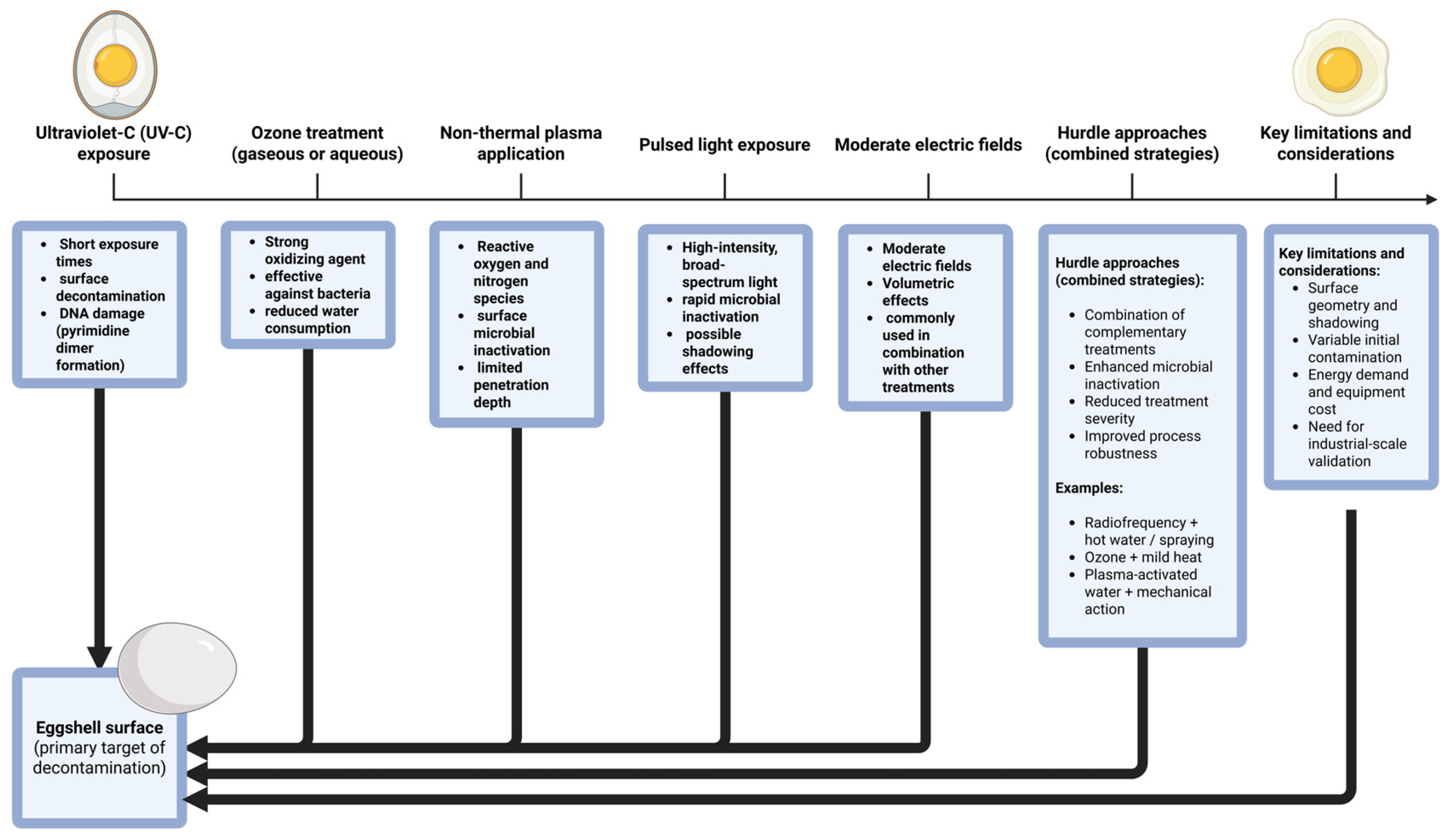
| Decontamination Methods | Mechanism of Action on the Microorganism | Changes in Food | References |
|---|---|---|---|
| Non-thermal plasma (NTP). | Reactive oxygen species (ROS) and reactive nitrogen species (RNS) induce lipid peroxidation, damage proteins, and alter DNA, compromising cellular integrity and ultimately leading to cell death. These species have a more pronounced effect on Gram-negative bacteria, as their outer membrane is rich in lipopolysaccharides, which makes them more susceptible to oxidative damage. | NTP (Non-Thermal Plasma): May induce lipid peroxidation and protein denaturation in food, altering its sensory and nutritional properties. | [27,28] |
| Moderate Electric Field (MEF). | Moderate Electric Field (MEF) modifies cell permeability by creating pores in the membrane, facilitating the entry of antimicrobials. When combined with shear forces, it further amplifies membrane damage, thereby enhancing microbial inactivation. | MEF (Moderate Electric Field): Can affect the texture, pH, and structure of food proteins due to low-intensity pulses. | [29,30] |
| Ozone. | Ozone oxidizes membrane lipids, proteins, and nucleic acids, leading to cell membrane dysfunction and the inactivation of essential enzymes, thereby compromising cellular metabolism. | Ozone: Can lead to lipid peroxidation and protein oxidation, impacting the texture, flavor, color, and stability of bioactive compounds in food. It may also alter the pH and sensory attributes of food. | [31,32] |
| Radiant Catalytic Ionization (RCI). | Oxidizing agents induce lipid peroxidation, disrupting the cell membrane and increasing its permeability. Additionally, they damage proteins and nucleic acids, leading to enzyme inactivation and causing lethal mutations in DNA and RNA. | RCI (Radiant Catalytic Ionization): Generates reactive oxygen species (ROS) that oxidize lipids, proteins, and nucleic acids, thereby altering the texture, stability, and functional and sensory properties of food. | [33,34] |
| Cold Plasma. | The generation of reactive oxygen species (OH, O3, H2O2) and nitrogen species (NO, NO2, NO3) induces lipid peroxidation, compromising the cell membrane and increasing its permeability. Damage to bacterial DNA and RNA hinders replication and repair processes. Additionally, the reduction in pH (from 7.4 to 3.4) further enhances the antimicrobial effects. | Cold Plasma: Produces reactive oxygen species (ROS) and nitrogen species (RNS) that interact with lipids and proteins, causing lipid peroxidation, which may affect the texture and flavor of food. | [35,36] |
| Hot air. | Heat denatures membrane proteins and lipids, leading to rupture and increased permeability, which results in the loss of cellular integrity and intracellular leakage. It also denatures essential proteins and can induce breaks in DNA and RNA, thereby preventing replication and transcription. | Hot Air: Can reduce moisture, which affects softness and freshness, and may cause minor variations in pH and the color of the eggshell and albumen. | [37] |
| Radio frequency. | Radiofrequency (RF) energy disrupts cell membrane function, increasing permeability and causing leakage of essential intracellular components. This leads to protein denaturation and membrane destruction, ultimately inducing cell death. In addition to its thermal effects, RF energy can also damage DNA, inhibiting replication and interfering with metabolic reactions. | RF (Radiofrequency): Can denature proteins found in food, such as those in egg whites and yolks. It may also induce small variations in the pH of the food. | [38,39] |
| UV C irradiation. | UV-C radiation (200–280 nm) induces damage to microbial DNA by forming thymine dimers, which hinder replication and result in cell death. It also affects proteins and cell membranes, compromising structural integrity. UV-C is an effective method that does not generate chemical residues, making it a sustainable alternative for decontaminating foods such as eggs. | UV-C Radiation: Can cause slight changes in pH and color, promoting oxidation, but these effects are minimal when the radiation is controlled, thus preserving sensory quality and ensuring food safety. | [40,41] |
| Pulsed Light (PL). | UV-C radiation from pulsed light induces thymine dimer formation in DNA, disrupting replication and leading to cell death. It also physically damages cell membranes, increasing permeability and compromising cellular integrity. Although non-thermal, pulsed light can generate localized heat, which aids in the inactivation of more resistant structures, such as spores. | Pulsed Light (PL): Can alter the texture and color of food, particularly eggs and fruits, and cause lipid oxidation in fat-rich foods. | [42,43] |
| Pulsed Ultraviolet Light (PUV). | Pulsed ultraviolet light (PUV) operates by damaging DNA through the formation of thymine dimers (UV 100–400 nm) and causing cell membrane collapse via microvibrations and heating (UV 400–1100 nm). Additionally, it increases permeability and destabilizes intracellular proteins due to localized heating. | UVP (Pulsed Ultraviolet Light): Like UV-C, UVP can cause lipid oxidation, particularly in lipid-rich foods, which may affect the stability and flavor of the product. In some foods, UVP may cause small changes in pH and occasionally alter the structure of proteins. | [44] |
| Infrared Radiation (FIR). | Far-infrared radiation (FIR) inactivates microorganisms by elevating their internal temperature, leading to the denaturation of essential proteins, alteration of cell membrane permeability, and DNA damage. While effective against heat-sensitive microorganisms, FIR requires more intense conditions to effectively kill spores. | Far-Infrared Radiation (FIR): Preserves nutritional properties better, with less impact on vitamins and nutrients, and is a more sustainable technology, as it does not require large volumes of water. | [45,46] |
| Plasma Activated Water (PAW). | Plasma Activated Water (PAW) inactivates microorganisms by damaging the cell membrane through lipid peroxidation, oxidizing proteins and nucleic acids, and disrupting redox metabolism, leading to oxidative stress. Its low pH and high oxidation-reduction potential further intensify these effects, enhancing its antimicrobial action. | Plasma Activated Water (PAW): Can cause lipid peroxidation, affecting food stability and flavor, with slight alterations in pH, especially in foods that absorb acidic compounds. PAW maintains better preservation of nutritional properties compared to heat treatments, as it does not apply direct heat, thereby retaining vitamins and nutrients. | [47,48] |
| Decontamination Method | Target Microorganism | Observed Reductions | Impact on Egg Quality | Reference |
|---|---|---|---|---|
| Non-Thermal Plasma (NTP) on an industrial scale | Salmonella Enteritidis | Reduction of up to 3.57 log CFU/egg after two passes through NTP. | Non-Thermal Plasma (NTP) treatment did not significantly alter the sensory quality of the eggs and preserved freshness characteristics for up to 15 days. | [62] |
| Moderate Electric Field (MEF) in combination with Ozonation | Escherichia coli K12 (used as a substitute for Salmonella). | Inactivation of 0.94 log CFU/g compared to conventional heating. | The temperature was controlled to maintain the integrity of egg proteins. | [53] |
| Gaseous Ozone | Salmonella Typhimurium and Pseudomonas aeruginosa | A 4D reduction was achieved in 52.5 and 51.8 min at 75 ppm, and in 49.0 and 44.8 min at 110 ppm, for Salmonella Typhimurium and Pseudomonas aeruginosa, respectively | No significant quality differences were observed between ozonated and control eggs during storage. | [14] |
| Radiant Catalytic Ionization (RCI) and Ozonation | Three strains of Salmonella enterica (S. Enteritidis, S. typhimurium, and S. virchow). | Reduction of up to 3.54 log CFU/egg with RCI and up to 2.73 log CFU/egg with ozonation. | There were no details provided regarding sensory or physical quality. | [34] |
| Hot Air Treatment | Salmonella Enteritidis | Reduction of up to 1.9 log CFU/egg. | The treatment did not affect the pH, color, or shell resistance. | [37] |
| Ozonation and UV-C Irradiation | Mixture of three strains of Salmonella enterica. | Reduction of 2 log CFU/egg with UV-C; ozone was less effective. | UV-C treatment better preserved antioxidants and cholesterol levels in the yolk. | [69] |
| Ozone Microbubbles (OMB) | Salmonella Enteritidis | Maximum reduction of up to 5.19 log CFU/egg in 10 L of water. | No significant changes in sensory quality were observed after 15 days. | [58] |
| Hydroxyl Radical Process in Gas Phase | Salmonella Enteritidis | Reduction of more than 5 log CFU/egg. | The cuticle and integrity of the eggs were preserved. | [65] |
| Cold Plasma | Salmonella Enteritidis e Escherichia coli. | Up to 1.94 log reduction for E. coli and 1.11 log for Salmonella. | There were no significant changes in the chemical composition or physical quality of the eggs. | [61] |
| Radiofrequency combined with hot water (RF/HW) | Salmonella Typhimurium | >5 log reduction from initial 2.5 log CFU/mL; partial reduction from 6.5 log CFU/mL (to 0.7 log CFU/mL). | Physical quality was similar to untreated eggs, with a more cloudy albumen. | [67] |
| UV-C irradiation | Total aerobes, Enterobacteriaceae, Escherichia coli, yeasts and molds. | Up to 0.85 log CFU/egg reduction. | No specific information was provided. | [64] |
| Pulsed Light (PL) | Escherichia coli ATCC 8739 | Up to 3.77 log CFU/egg reduction. | There was no significant impact on egg temperature, and internal properties remained stable for 4 weeks. | [66] |
| Far Infrared Radiation (FIR) | Escherichia coli ATCC 25922 | 3.37 log CFU/egg reduction. | No adverse effects were observed on internal quality. | [45] |
| Plasma Activated Water (PAW) | Salmonella Enteritidis ATCC 13076 | 5 log CFU/egg reduction in 60 s. | The treatment did not compromise sensory integrity or internal quality. | [50] |
| Pulsed Ultraviolet Light (PUV) | Escherichia coli K12-NSR e Enterococcus faecium. | Up to 4.54 log CFU/cm2 reduction for E. coli. | The temperature increase was insignificant, with no negative impact on internal quality. | [70] |
Disclaimer/Publisher’s Note: The statements, opinions and data contained in all publications are solely those of the individual author(s) and contributor(s) and not of MDPI and/or the editor(s). MDPI and/or the editor(s) disclaim responsibility for any injury to people or property resulting from any ideas, methods, instructions or products referred to in the content. |
© 2026 by the authors. Licensee MDPI, Basel, Switzerland. This article is an open access article distributed under the terms and conditions of the Creative Commons Attribution (CC BY) license.
Share and Cite
Martina de Freitas Meireles, I.; José Fernandes Lemos Junior, W.; Mattos Dias-Martins, A.; Silva, M.A.P.d.; Cipolat-Gotet, C.; Cappato, L.P. Non-Thermal and Mild Thermal Technologies for Table Egg Shell Surface Decontamination: Microbial Efficacy, Egg Quality, and Industrial Considerations. Microorganisms 2026, 14, 442. https://doi.org/10.3390/microorganisms14020442
Martina de Freitas Meireles I, José Fernandes Lemos Junior W, Mattos Dias-Martins A, Silva MAPd, Cipolat-Gotet C, Cappato LP. Non-Thermal and Mild Thermal Technologies for Table Egg Shell Surface Decontamination: Microbial Efficacy, Egg Quality, and Industrial Considerations. Microorganisms. 2026; 14(2):442. https://doi.org/10.3390/microorganisms14020442
Chicago/Turabian StyleMartina de Freitas Meireles, Izadora, Wilson José Fernandes Lemos Junior, Amanda Mattos Dias-Martins, Marco Antônio Pereira da Silva, Claudio Cipolat-Gotet, and Leandro Pereira Cappato. 2026. "Non-Thermal and Mild Thermal Technologies for Table Egg Shell Surface Decontamination: Microbial Efficacy, Egg Quality, and Industrial Considerations" Microorganisms 14, no. 2: 442. https://doi.org/10.3390/microorganisms14020442
APA StyleMartina de Freitas Meireles, I., José Fernandes Lemos Junior, W., Mattos Dias-Martins, A., Silva, M. A. P. d., Cipolat-Gotet, C., & Cappato, L. P. (2026). Non-Thermal and Mild Thermal Technologies for Table Egg Shell Surface Decontamination: Microbial Efficacy, Egg Quality, and Industrial Considerations. Microorganisms, 14(2), 442. https://doi.org/10.3390/microorganisms14020442